Monthly Archives: September 2025
One Battle After Another (2025)
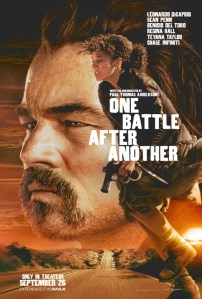
Over his thirty-year career, writer/ director Paul Thomas Anderson (PTA) has developed a mystique and reputation like few other auteurs working in cinema. He’s a visionary filmmaker whose first few movies count among my favorites of all time (Boogie Nights, Magnolia) and whose latter output can leave me shrugging and sighing (Licorice Pizza, Inherent Vice, The Master). My decade-plus-long observational bon mot has been that Anderson decided to make amends for his plot-heavy early movies with more airy, far less plotted vibes-movies. One Battle After Another is something far different from Anderson. He’s making his own version of a $150-million studio action movie, with big ideas and Leonardo DiCaprio as lead (DiCaprio has long regretted passing on Dirk Diggler, still Mark Wahlberg’s acting high-point, so thanks Leo). PTA is using the big-budget storytelling of action cinema to tell something new and personal and politically relevant behind all the gunfire and daring car chases. It’s been dubbed the movie of the moment and perhaps the one to beat for the 2025 Academy Awards. Now that I’ve finally watched all 150 minutes of Anderson’s opus, I’m not as high on it as others but do acknowledge it is a thrilling, engrossing, and occasionally frustrating work from a visionary artist.
Bob (DiCaprio) used to run with a leftist military group known as the French 75. He fell in love with Perfidia (Teyana Taylor), one of the leaders of the group, and together they had a baby, little Willa. Perfidia runs off, unable to settle down, leaving Bob to raise their daughter under a different identity. Sixteen years later, that old life comes back to Bob. It so happens Colonel Steven J. Lockjaw (Sean Penn) had an ongoing sexual tryst with Perfidia during one of their stings. There’s a chance that Willa (Chase Infiniti), now a teenager wanting to live a normal life, is actually his biological daughter. He needs to capture her under any circumstance and possibly dispose of her in order to be admitted to an exclusive white supremacist cabal within the U.S. government. Bob is forced back to action to find and protect Willa but he’s not exactly in the best shape. He’s been a burnout for so long. Can he now be a hero?
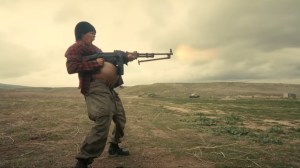
While the movie was filmed throughout 2024, and supposedly has been in the works for over twenty years by Anderson, One Battle After Another feels extremely timely and relatable in these troubled political days of ours (even the title expresses what it’s like to get up and try and process the daily barrage of horrifying news in this Trump Administration 2.0 Era). Anderson’s screenplay, loosely adapted from Thomas Pynchon’s 1990 novel Vineland, proposes a right-wing U.S. government swept up in fascist impulses that is highly militarized and declares war on immigration, rounding up primarily Hispanic men, women, and children and locking them away in camps. It’s also a law enforcement unit that pose as protestors to create a rationale for enacting physical violence and intimidation against peaceful protestors. At the core is a secret society of white supremacists running the show. Short of a concurrent documentary, it will be harder to find a movie more politically topical to the status of life in 2025, especially for the many shaking their heads and wondering how exactly we got here. Pynchon’s original novel was about the transformation of 1960s America to the 1980s, and it feels highly relevant to our 2025 times where there yet again seems to be great upheaval and conflict over those in power operating said power against the governed. It’s impossible to watch One Battle After Another and not think about the headlines. It’s not exactly the escapism many might be seeking. There’s never been a leftist paramilitary group as organized and as successful as the French 75 (they have their own affiliated convent – nuns with guns). The movie isn’t leftist wish-fulfillment to take down the current administration. It’s more a father-daughter battle to reunite in the face of state terror. It certainly has its fiery political commentary, but it’s more a family striving to stay together.
I did quite enjoy that the movie undercuts Bob as our hero, using him more as an entry point into other characters in this story, others who have a much larger impact and prove more capable. The character of Bob serves as a gateway for the other characters to really take over and shine, and it’s smart to use the familiar archetype of the old gunslinger being called back into action past his prime to atone for the sins of the past. We’ve seen this kind of character before, but Bob is kind of hapless and far out of his depth, and it makes the movie so much more entertaining. The rest of the movie exists in a more familiar action-thriller setting, albeit with some fun house mirror edges for pointed satire, but Bob is this bumbling, stumbling dope from a stoner comedy whose been copy-pasted into a different genre. He provided explosives for the French 75 but that doesn’t mean he’s got a wealth of clandestine knowledge and cunning at his disposal, especially since he’s normally inebriated. Now sixteen years later, the archetype would typically have to pull out their old skills that have calcified over a long hibernation, but Bob doesn’t have those skills. When he has an opportunity to take the big heroic shot, he misses. When he has the opportunity to make a daring escape, he falls off the side of a building. When he has to remember the coded exchanges of old, he can’t remember all of the parts. The climax doesn’t really even involve him as he’s playing catch-up for most of the extended conclusion. He’s more like the Big Lebowski waking up in, say, No Country for Old Men and desperately seeking shelter.
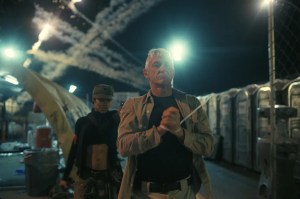
However, Anderson’s empathy for his characters of all stripes shines through, and while Bob is presented as diminished or bumbling, he’s not a complete moron without any redeeming qualities. His most resounding positive quality is his complete dedication and love for his daughter. We’ve seen this kind of story before, the overbearing parental figure trying to drill their child to be prepared for when danger inevitably arises, and the child growing resentful and distant to the parent because of that demanding and limiting home life. Then trouble strikes and the child has to rely upon those seasoned skills they practiced while that paranoid and obsessive adult was ultimately proven right for their unorthodox parenting. Bob’s love for Willa is what has shaped his life for these past sixteen years. He’s the parent who stayed, the one who settled from his old life to take on the responsibility of raising a child as a new life. He’s the one who changed her diapers, the one who shows up for parent-teacher conferences even if it’s to lecture the teachers about the curriculum while lighting up a joint. His love for his daughter is the thing that drives him forward and keeps him going. You feel that love between them, and in the climax of the movie, it becomes something poignant about the connection between these two over such extreme circumstances. There’s an ongoing question over the paternity of Willa but this never for a second changes Bob’s view of his daughter or his willingness to do anything to save her. If he was a Liam Neeson-styled master spy with a particular set of skills, the journey wouldn’t feel as rewarding. With Bob being punched down by the universe again and again but still going, it makes us root for him more.
Penn is completely enthralling as Lockjaw. His danger is never downplayed, and he’s frequently shown as a man who will use his considerable means of power to get what he wants, but Anderson also finds interesting ways to lampoon him and complicate him. I loved that the secret white supremacist society Lockjaw is so eager to join is called the Christmas Adventurers Club. It’s so stupidly anodyne that it sounds like a rejected title for a Boxcar Children novel. The members even pledge, “Merry Christmas. Hail Saint Nick.” It’s so stupid but so are many of the associative slogans of these right-wing groups (I learned the Proud Boys are named after a cut song from Disney’s animated Aladdin, “Proud of Your Boy,” and no I am not kidding). These men are indeed dangerous but they’re also not insurmountable, and I think that’s an important distinction. They’re small, angry, racist men trying to forcibly reshape the world but they are a minority of a minority clinging to power to reject progressive reforms. Lockjaw’s big problem is that he has a tremendous attraction to African-American women, the type of people he should see as inferior. The movie’s momentum is kicked into gear all because Lockjaw wants to be accepted in this special club. Penn is incredible in how he brings to life the snarling contradictions of this man, someone so aggressively challenging but who is also given to gnawing insecurities. Even the way Penn holds his body and walks is an indication of who this man is, with stick firmly planted in rear. He’s scary but he is also stupid, a fine encapsulation of our present political quandary. I’d expect him to be the current front-runner for Best Supporting Actor at the Oscars but it is still plenty early for predictions.

I do wish those engaging supporting characters had more to do besides Lockjaw. Even at 150 minutes, there isn’t much development for Willa to really grow as a character. She’s the target for the chase, and she’s the one trying to understand what is happening as it happens. It would make sense for her to have been the protagonist as she has the most to learn. For far too much of the movie she’s just a passive passenger, being shipped from one location to another. I wish we had more moments to really grapple with her perspective and her shifting opinion about her father and his past. I do enjoy that she’s the real star of the climax but at that point I wished we had seen far more of her resilience and determination and making use of what her father had been teaching her, not simply trading coded conversations. If she is the future, the possibility of turning this world around as someone declares by film’s end, then maybe let’s spend a little more time with her being active and reflective and taking more ownership of her survival. It’s as much her movie as it is Bob’s but he gets far more generous screen time over those 150 minutes.
The same can be said for Willa’s mother, Perfidia. I never found her that interesting as a character. She’s a true-born revolutionary from a family of revolutionaries, but some part of her is drawn back to Lockjaw, whether it’s simply the transactional exchange of sex for protection and assurances, or maybe something more, perhaps the power play of dominance over the very kind of bad men in power she wanted to control. She runs away from a domestic life with baby Willa because she knows she’s ill-suited for it. From there, she gets captured and turns on her former comrades to enter Witness Protection, which she runs away from. I kept waiting for her to resurface in a meaningful way in the story since we’re shown that she escapes into Mexico (Lockjaw lies that he killed her rather than admit she ran off). However, Anderson only utilizes the character as a catalyst, a means of entangling the two men into a paternal showdown. It’s disappointing that Perfidia is reduced to such a nothing of a character when there was much to explore.
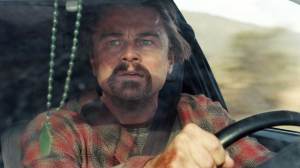
And now comes the part of the review where we talk about Anderson’s bold leap into action filmmaking. He’s not the first prestige indie darling to make a grand genre jump into action-thriller bravado. One thinks of Sam Mendes tackling Skyfall with aplomb, Paul Greengrass with the Bourne series, Patty Jenkins going from Monster to Wonder Woman, Lee Issac Chung going from Minari to Twisters, and of course the big man himself, Christopher Nolan. It can be done with the right filmmaker understanding the key tenets of action, in particular how to connect the various set pieces and conflicts with the characters and their emotional state and chain of needs and priorities. I was impressed with Anderson’s sense of scope and his ability to wring tension. There aren’t really many strict action scenes. Much ink has been spilled on the climactic chase that utilizes a series of rolling hills as the focal point of this battle, and it’s immersive and exciting and different. I’d also be lying if I said I wasn’t a little disappointed by it. This is because this sequence, up until the very very end, is all about one car tailing another. It’s taut and extremely well photographed, but ultimately it amounts to two cars following one another until one clever conclusion. It’s not really a sequence that changes and finds organic complications. It has the makings of a great action sequence but stalls. I thought back to 2014’s Snowpiercer and the sniper shooting match at two different points in the train, where each participant was waiting for the train to curve just so to better facilitate their shot. That was geography as advantage. Overall, Anderson is definitely making his version of an action movie but I don’t feel like he’s fully committed to the planning and development of those sequences. It feels more like ironic subversion when the genuine article would have been more appealing and impactful and just novel.
While One Battle After Another doesn’t rise to the capital-M masterpiece that so many of my critical brethren are falling over themselves to proclaim, it is a good movie with bold artistic swings. It thrums with energy and empathy. It’s probably PTA’s most accessible movie since There Will Be Blood or arguably Boogie Nights. I enjoyed the different characters and the brimming conflict and how much of the movie is grounded on the character relationships and their perspectives. There is a clear command of craft here like every PTA movie. He’s definitely passionate about bringing this world to life, which is eerily relevant to our own politically tumultuous times, but he still finds room for satirical mockery that doesn’t diminish the tension of the villains. It’s a universe I wanted more explanation and exploration, and the most interesting character by far is Benicio del Toro as a humble town sensei who is at the forefront of an immigrant underground railroad. I was never bored and often quite entertained but I stepped away wanting more, and maybe that’s greedy of me or an entitlement of the viewer. One Battle After Another flashes such terrific intrigue and personality that I wanted more refinement and development to better accentuate its mighty potential.
Nate’s Grade: B
Share this:

The Naked Gun (2025)
 Relaunching a seminal spoof series in today’s environment is going to be a risk. I’ve discussed how comedy seems to have been relegated to TV and streaming in a post-COVID theatrical era, but there is still an immense appeal of watching something funny with a jovial audience. The Naked Gun series was a spoof on police procedurals with the indefatigable Leslie Neeson as the dumbest straight man to the absurdity of the Zucker-Abrahams-Zucker boys. This time it’s Liam Neeson as the lead but he’s thankfully keeping to the same spirit, playing the entire movie straight rather than being in on the joke, and it makes his performance that much more seriously funny. A scene where he and Danny Huston unexpectedly declare their irony-free love of The Black Eyes Peas made me laugh hard because of the sheer conviction of their performances. The intrinsic nature of spoofs is that they are uneven. It’s hit-or-miss but because the pacing is multiple jokes every minute, if one of the gags doesn’t make you smile, you only have to wait a short while for the next. I’d say my laugh percentage was about 20-33% of the jokes, which I think is a pretty solid batting average for yuks. Naturally, your mileage will vary. Neeson is terrific and so is Pamela Anderson as his co-star. She has a delightful impromptu scatting performance that is silly beyond words, which is a good overall description of the movie. I wish there were more visual gags and running gags (I enjoyed how frequently people discarded coffee cups for more coffee cups) to compensate for the heavy verbal whimsy, double entendres, and slapstick. There are some deranged sequences that go in directions I could not predict, like a holiday montage that gets freaky for several reasons. I wish the movie had more sustained sequences like this but I’m grateful we got as many as we did. It’s also a little weird that the villain’s plan is exactly the same as 2015’s Kingsman but nobody mentions this. Regardless, the new Naked Gun is refreshingly stupid and a good silly time at the movies.
Nate’s Grade: B
Share this:

Honey Don’t (2025)
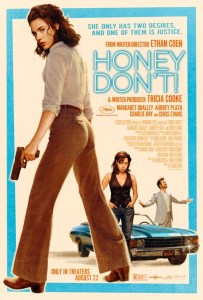 It’s the second collaboration between Ethan Coen and his wife Tricia Cooke and reportedly the second in their “B-movie lesbian trilogy” (the planned third film is tentatively titled Go Beavers). It’s better than 2024’s Drive-Away Dolls, a randy cartoon that was so overpowering and underwhelming. This time the filmmakers play around in the film noir genre with Margaret Qualley as a wily private eye, Honey O’Donahue. The whodunnit plot is a series of disconnected threads and plotlines that don’t connect together in interesting or surprising ways. It begins with an immediate mystery: a woman, dressed right out of Faster, Pussycat! Kill! Kill!, walking down an embankment to inspect an overturned auto and the body inside. Boom. I’m intrigued right away. Sadly, this might be the high point. A third of Honey Don’t involves Chris Evans playing a debauched minister selling drugs on the side and exploiting his congregation. His storyline seems to run in parallel with Honey’s investigation without really crossing in meaningful ways. It even resolves without her intervention. It’s also incredibly dull and repetitive, with Evans’ reverend being interrupted during sex multiple times for comedy, I guess. Honey Don’t exists as a winky flip on the noir genre, this time with lesbians! It doesn’t so much feel like a compelling story with colorful characters as it does a writing exercise. Qualley fares better as the straight-laced yet flirty private eye than she did as the horny caricature in Drive-Away Dolls. She’s got a self-possessed charisma and determination that works. If only the rest of the movie didn’t repeatedly let her down. It’s not offensively bad, or even as aggressively cringey as their previous collaboration, but Honey Don’t is another middling, daffy, disposable genre riff by Ethan Coen that makes me long for an eventual reunion with his brother.
Nate’s Grade: C
Share this:

Mission: Impossible – The Final Reckoning (2025)

It’s not just the increasing age of producer and star Tom Cruise, the Mission: Impossible movies have become victims of their own outlandish success, and this might have led to their ultimate end. This franchise has become known for its amazing stunts and placing Cruise in the thick of them. After every gasp-inducing, eyeball-popping stunt, the inevitable question arises, “What could top that?” And so writer/director Christopher McQuarrie, who has steered the franchise for a decade straight, has placed himself in a filmmaking arms race of action set pieces, and these budgets keep getting bigger and bigger, to compensate for the increasing scope and scale. As a result, these movies need to make an even higher amount of money to break even to cover their expanding expenses, and it doesn’t look like the M:I franchise has reached that next level of success (six of the previous seven movies have grossed between $175 million and $220 million domestically). As a result, Final Reckoning is the winding down of the franchise, or at least this incarnation, and it has enough to satisfy long-time fans, yours truly included, but it’s also a reminder of how things have gotten away from the series in the name of chasing spectacle.
Agent Ethan Hunt (Cruise) is tasked once again by the Impossible Mission Force (IMF) to save the world. In a continuation from the 2023 movie, Dead Reckoning, an evil A.I. known as The Entity is taking over the world’s complex computer networks and taking over control of nuclear missiles. It’s only a matter of time before the last four nations fall victim as well, so Ethan and his team (Simon Pegg, Ving Rhames, and now Hayley Atwell as Grace) must work together to get the only code that can kill The Entity.

Final Reckoning is the Scream 6 of the Mission: Impossible franchise. For those who never saw the sixth entry in an irony-drenched, self-reverential slasher series, it was intended to be the final entry in the franchise, and in doing so that made it try to tie back as many elements and moments as possible to the previous five movies. It was meant to feel not just final but full-circle for the fans. Naturally, the problem for Scream 6 is that it wasn’t going to be the final movie, and so a sequel is scheduled in 2026, and all that finality and franchise-reflection seems a bit like misguided internal stargazing. Coincidentally, the Mission: Impossible franchise also began the same year as the first Scream, 1996, and so this movie is intended to (possibly) close the door on the 30-year franchise and on (possibly) Ethan Hunt’s career as the best damn agent the IMF has ever had and yet whom they always doubt his motives in every movie.
M:I 8 takes far, far too much time trying to set up its stakes, which were already set up in M:I 7, which at the time was titled Dead Reckoning Part One before the “Part One” was scrubbed. Seriously, the first 45 minutes or so is awash in M:I clips from the previous seven movies and sloppy attempts to connect everything back together. Now the evil A.I. threatening the world has been revealed to be born from… the “Rabbit’s foot,” the undetermined MacGuffin from the third Mission: Impossible in 2006. Is that better? Does anyone really care about that? How about one of the cops being the son of a previous character? Does that change your opinion of Chasing Cop #2? How about the one guy in the first movie who found Ethan’s knife after he broke into the CIA in that movie’s most memorable sequence? Did you ever wonder what happened to him? Did you ever care about his well-being? I strongly doubt it. These Easter eggs to the older movies would be less egregious if this supposed final movie didn’t squander its first 45 minutes going over its own history as a means of trying to convince the audience This Stuff Really Matters. It’s even more egregious when the running time is 165 minutes long. All of this backward-looking ret-coning and clip show montages feel like an attempt to add weight to a franchise that never needed it. Let the stunts and set pieces stand for themselves. I don’t need all this nostalgic congratulatory back-patting.
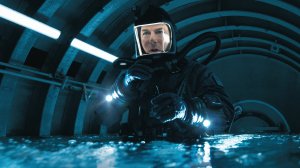
And there is a truly outstanding action set piece that anchors this movie, so much so that it actually comprises a full hour of the film. Set up in the preceding movie’s prologue, we know the only way to kill the evil A.I. is by securing a code located in a Russian submarine at the bottom of the Bering Sea. Just planning to find the location is the first hurdle that Ethan and the team have to surmount. Then there’s getting onto a clandestine U.S. submarine and launching out its tubes to swim to the bottom of the ocean, securing passage inside the fallen sub, and working one’s way through the different chambers, filled with frozen dead bodies, while the sub rolls around, tumbling further and further along the ocean floor. Each smaller sequence has a clearly defined series of mini-goals and organic complications, the kind of exciting escalations that make these set pieces so much better. It’s not enough for the pros to come up with a comprehensive plan, there needs to be unexpected complications that force them to improvise. A foolproof plan that goes perfectly is anathema to action cinema. This sequence has it all, which is why I have no qualms about its length because McQuarrie has justified every link in this set-piece chain. It’s also fantastic visually and really taut, especially as Ethan is tumbling through the innards of the sub with torpedoes falling over and pinning him underneath. This is a prime example of the maximalist virtuoso blockbuster filmmaking excellence that people have come to expect from the franchise.
The problem is that there’s an entire hour after this sequence and, once again, an M:I movie has peaked early. I think only Fallout and Dead Reckoning have their best moments during their actual climaxes. It hurts that Gabriel (Esai Morales) is the weakest villain the franchise may have ever had. I don’t care that the prior film tried to ret-con younger Gabriel into killing Ethan’s love and thus motivating him for vengeance and entering into the IMF. That personal connection and tragedy is a transparent attempt to make this character more important and menacing, and frankly, I am still astounded that this guy… THIS GUY… killed Rebecca Ferguson’s Ilsa. I can confirm, sadly, she is still dead, a reality that astounds me in the realm of a spy thriller where people assume identities. It’s she that Ethan should be fantasizing about in what could be his final moments, not Grace, and I will stand by that (no disrespect to Atwell, who is a genuinely fun and flirty addition to the team as an expert thief).

Regardless, back to Gabriel, who is just an empty suit of a villain, partly because the real villain is the scary A.I. conquering the world’s nuclear arsenals. It’s hard to really vilify a computer code for a movie, so enter this human handler, but he was uninspiring, so they added the secret back-story connection. It doesn’t work. I don’t really care about this guy being defeated, nor do I find him particularly threatening, miraculously killing Ilsa notwithstanding. The ultimate fight atop warring biplanes is visually impressive with its aerial photography, but the conclusion feels anticlimactic and the thrill of the set piece feels even slightly redundant when we remember Cruise has already hung from the side of a plane in M:I 5 and dangled from a helicopter in M:I 6. There’s yet another ominous timer ticking down, yet another deadly device with wires needing to be cut, and yet another side character possibly bleeding out to death. It feels rather par for the series, perhaps a thematic distillation of all those clips. There’s also some extra Fail Safe-style political hand-wringing at the highest levels of the U.S. government whether to give Ethan the benefit of the doubt or resort to some unorthodox methods for added stakes. It just adds up to a final hour of some strong moments in passing and too much of the same for a franchise that chartered new heights.
Placing it through the M:I pecking order, Final Reckoning is probably the weakest of the McQuarrie Era and arguably lesser than Mission: Impossible III, but it is leagues better than the first two Mission: Impossible entries. Realistically, this isn’t the end of the Mission: Impossible franchise, which has grossed close to five billion dollars over the span of its eight movies, but it is the end of Cruise as our star. The franchise was already previously engineered to hand off to Jeremy Renner in 2011’s Ghost Protocol, but then the movie proved too popular to persuasively function as writing off Ethan Hunt (unlike the other franchise also trying to hand off to Renner at the time, 2012’s Bourne Legacy, which proved so unpopular that Matt Damon came out of Bourne retirement). Cruise is now 63 years old and probably aware that these kind of death-defying stunts might be behind him even at his pace. Though I think the three separate shirtless scenes with Cruise are intended to dissuade you about the limits of his age (hey, I hope I look as good as Cruise’s abs when I’m 63). Final Reckoning is another chance to bid goodbye to its seminal action hero, which may be why there’s so much looking back and connecting unnecessary dots. This franchise is a celebration of the highs of big–budget action storytelling with the most game superstar with a death wish Hollywood could provide, so it’s bittersweet to see it reach some form of an end. McQuarrie, the David Yates of the franchise, has been an excellent shepherd with a kinship with Cruise for grand popcorn entertainment. It’s not the best entry but even a lesser M:I movie still rises above just about most studio action cinema. It’s definitely underdeveloped, too long, and structurally questionable with its pacing and climax, but at its best, it still reminds you why this franchise rose above the rest.
Nate’s Grade: B
Share this:

Highest 2 Lowest (2025)
 Spike Lee’s remake of Akira Kurosawa’s High and Low, both of them based upon the novel King’s Ransom, is a movie in desperate need of a stronger identity. Every “Spike Lee joint” is definitely an experience that few can imitate, and his personal predilections and stylish direction often elevates the movie into something more engaging and intriguing. We follow Denzel Washington as David King, or “King David,” a middle-aged record company president who is at a career and personal crossroads. He’s trying to negotiate back enough capital to buy back controlling interest in his company, to ward off being bought by a soulless conglomerate that has no interest in protecting the decades of Black musicians given platforms. His teenage son is also kidnapped, except it’s revealed that the kidnappers nabbed the wrong kid; they grabbed the son of his chauffeur (Jeffrey Wright) instead. The movie is at its most entertaining when it dwells in this moral quandary of whether David feels as compelled to pay the ransom when it’s someone else’s child, especially when he needs that money to regain his company. I wish the entire movie had been spent over this agonizing personal guilt crucible. This is the hook of the movie. I found it hard to care once the money went out. But then David agrees to meet the ransom, deliver it personally, and it becomes a generic police thriller from there, including an Act Three where David tracks down the culprit. It’s just far less interesting than the personal stakes of what occurred earlier. There’s also an ongoing digression of analyzing what it means to be a successful Black musician, enough so that the movie literally ends on an uninterrupted musical audition meant to symbolize David feeling like the music matters to him again after so long, that this ordeal has refocused his attention to What Actually Matters. It just doesn’t feel like it meshes with the trail of conscience nor the police thriller. Highest 2 Lowest ends up being stretched into too many directions, chasing after a relevancy that seems just outside its grasp. Lee and Washington have certainly done better together.
Nate’s Grade: C+
Share this:

Friendship (2025)
 If you’re a fan of Tim Robinson’s brand of weird, cringe-inducing comedy that can accelerate in intensity or abrasiveness at a moment’s notice, then Friendship may indeed be the comedy of the year for you. I’ve never watched Robinson’s popular Netflix sketch comedy series, so consider me a novice to the man’s style of locked-in irony and chagrin. To say I “enjoyed” Friendship would be inaccurate. It exists on a comedy plane where I can mentally step back, assess the particulars, and often the sheer commitment to the bit, and think, “This is schematically funny.” Do I actually laugh out loud? Rarely. It’s a comedy that might be easier to admire for its jaunts into sudden weirdness and discomfort then it is to say you love the movie. Robinson plays a boring middle-aged man starting a new adult friendship with his new neighbor, played by Paul Rudd. It’s a comedy of errors as Rudd wises up to how weird and potentially unstable his newest friend can be, and he decides to end their brief friendship. Imagine taking a broad studio bromance like I Love You, Man, also starring Rudd, and mixing it through the perspective of Big Fan, the obsessive loner drama. There are a few amusing sidesteps, like when Robinson’s wife (Kate Mara) literally gets lost in the town’s system of sewers, or when he tries licking a psychedelic toad only to hallucinate a trip to Subway and feeling cheated from a better trip. The actors are all on the same wavelength, committed to selling the jokes by pretending no such jokes exist in this universe. I laughed occasionally but mostly shrugged my shoulders, hoping it would hit a new gear that never came.
Nate’s Grade: C+


 nathanzoebl
You must be logged in to post a comment.