Monthly Archives: August 2025
Opus (2025)
 Ever want to watch a second-rate version of The Menu and be left wondering why you didn’t just watch The Menu? That was my main takeaway watching the indie horror/comedy (?) Opus, a darkly satirical look at the music industry and specifically cults of personality. John Malkovich plays Alfred Moretti, an exalted and reclusive musical genius who has earned numerous awards and built a devoted fandom. He’s invited six special guests to a listening party for his new album, the first since his mysterious retirement. It just so happens that party is at his compound and the guests are tended to by a cult of devotees. From there, people start to go missing and weirdness ensues. I was waiting throughout the entirety of Opus for something, anything to really grab me. These are good actors. It’s a premise that has potential. Alas, the movie is uneven and under developed and I found my interest draining the longer it went. The music satire isn’t specific or sharp enough to draw blood or genuine laughs. The weirdness of life on the compound is pretty bland, with the exception of a museum devoted to Moretti’s childhood home that is explored during the climax. The characters are too stock and boring, not really even succeeding as industry send-ups. The music itself is also pretty lackluster, but the movie doesn’t have the courage to argue that the cult has formed around a hack. In the world of Opus, Moretti is an inarguable musical genius. We needed the main character, played by Ayo Edebiri (The Bear), to be an agnostic, someone who doesn’t get the appeal of this musical maven and can destruct his pomposity. Alas, the obvious horror dread of the followers being a murder cult is never given more thought. It’s fine that Opus has familiar horror/cult elements (The Menu, Midsommar, Blink Twice, etc.) but it doesn’t do anything different or interesting with them. It’s obvious and dull without any specific personality to distinguish itself, and if maybe that was the argument against the cult leader, I might see a larger creative design. Instead, it all feels so listless. When the weird cult movie can’t even work up many weird details about its weird cult, then you’re watching a movie that is confused about themes and genre.
Nate’s Grade: C-
Share this:

Death of a Unicorn (2025)
 Unfortunately, this never became the glorious B-movie its premise promises, a monster movie with ghastly gore that also satirizes the rich business elites. Death of a Unicorn has enough appealing elements, from the father/daughter relationship between Paul Rudd and Jenna Ortega, to some ridiculous gore and kills, to impressive creature prosthetics to bring the unicorn to life (and death). The setup has Rudd and Ortega run over a unicorn in a secluded nature reserve on their way to meet dad’s boss. They discover the unicorn blood can be miraculously healing, which is a fortuitous discovery considering Rudd’s boss runs a pharmaceutical company. You can see where this goes, especially when you learn that there are more unicorns out there and they are not happy. It becomes a wily creature feature from there, with unicorns picking off the characters one-by-one as they try and escape. The satirical broadsides are a bit too broad, thus only really glancing in their pointed attacks that the people in charge of medical care are themselves venal and selfish. Got it. Much of the humor is related directly to the absurdity of watching a unicorn as a blood-thirsty monster. If you replaced the unicorn with, say, a yeti, would the situation still be amusing? Maybe, but I seriously doubt it. Death of a Unicorn could have been a little scarier, funnier, even freakier, and maybe carried through on the courage of its convictions.
Nate’s Grade: C+
Share this:

Weapons (2025)

Zack Cregger began his career as one of the co-creators and co-stars of the sketch comedy troupe, The Whitest Kids U Know. This led to a poorly received sex comedy, 2009’s Miss March, which Cregger co-directed and starred as the lead. Then in 2022, Cregger made a name for himself in a very different genre, writing and directing Barbarian, a movie whose identity kept shifting with twists and world-building buried underneath its simple Air B&B gone awry setup. From there, Cregger joined the ranks of Jordan Peele, John Krasinski, and other horror-thriller upstarts best known for comedy. It became a question over what Cregger would do next, which sparked a bidding war for Weapons. It’s easy to see why with such a terrific premise: one day a classroom of kids all run out into the night at the same time, all except for one child, and nobody knows why. Weapons confirms Cregger’s genre transformation and the excitement that deservingly follows each new release. Each new Cregger horror movie is a game of shifting expectations and puzzles, though the game itself might be the only point.

The premise is immediately grabbing and Cregger’s clever structural gambits add to that intrigue. Right away in the opening narration from an unseen child, we’re given the state of events in this small town, already reckoning with an unknowable tragedy. The screenplay takes a page from Christopher Nolan or Quentin Tarantino, following different lead characters to learn about their personal perspectives. It continually allows the movie to re-frame itself, allowing us to pick up details or further context with each new person giving us a fuller sense of the big picture. Rather than resetting every twenty minutes or so, the movie offers an implicit promise of delivering something new at those junctures, usually leaving that previous lead character in some kind of dire cliffhanger. With each new portion, we can gain some further insight, but it also allows the story to ground its focus and try on different tones. With Justine (Julia Garner), we see a woman who is trying to figure out how to regain her life she feels has been unfairly stripped away, and many of her coping mechanisms are self-destructive old habits. With Archer (Josh Brolin), we see a father consumed by his sudden loss and the reflection it forces him into, while also obsessing over what possible investigative details he can put together to possibly provide a framework of an answer. Then with other characters, which I won’t spoil, we gain other perspectives less directly involved that approach a dark comedy of errors. At one point, you may even wonder when the movie is going to remember those missing kids again. I appreciated that Cregger resolves his mystery with enough time to really examine its implications. This isn’t just a last-minute twist or Scream-like unveiling of the villain coming to light. I also appreciated that it ends in such an enthusiastic climax that left me cackling and cheering. It’s a mystery with a relatively satisfying answer but a climax that is also cathartic and exhale-inducing after all the dread and build-up.

The technical elements are just as polished as its knotty screenplay. The movie is genuinely unnerving at many points. Even the image of kids Narutu-running off into the night is inherently creepy. There are a few cheap jump scares but most of the movie is built around a quiet sense of desperation and dread. Cregger prefers holding onto shots to build tension, like a door opening and waiting for something, anything to pop out of the darkness. There are moments that made me wince and moments that made me gasp, like suddenly being compelled to stab one’s face with a fork dozens of times. However, a significant drawback for me was the lighting levels of the cinematography. To be clear, the photography was eerie and very evocative. My problem is that this was a movie whose light levels were so low it made it excruciatingly hard to simply identify what was happening onscreen. I’m sure my theater’s dim projection was part of this, but this is also a trend with modern movie-making, the murky lighting, like everyone is trying to recreate those Barry Lyndon’s candle-lit tableaus. Sometimes I just want to see what’s happening in my movie.
Weapons is certainly a thought-provoking premise, but with some distance from the movie, I’m starting to wonder what more there may be under the surface. Now not every movie has to be designed for maximum layers and themes and metaphors; movies can have their own points of appeal before getting to subtext. I do think most viewers will find Weapons engaging and intriguing, and the slippery structure helps make the movie feel new every twenty minutes while also testing out different tones that might have been too obtrusive with different characters and their specific perspectives. However, once you straighten out that timeline and see things clearly, it begs the question what exactly Cregger is actually saying. The sudden and disturbing horror of a classroom of children all disappearing has to have obvious connections to school shootings and mass killings, right? The trauma image is too potent and specifically tied to schools to be accidental or casual. Taking that, what is the movie saying about our culture where one day, any day, a class full of young children can just go missing? Despite a literal floating assault rifle appearing in a dream, there doesn’t appear to be much on the movie’s mind about gun violence or even weapons in general. I’m reminded of my favorite movie of 2020, the criminally under-seen Spontaneous, which explored a world where one high school class of students lived under the threat that at any time they could explode. There was no explanation for this strange phenomenon, though scientists certainly tried, and the focus was instead on the unfair dread hanging over their day-to-day existence, that at any moment their life could be forfeited. The parallel was obvious and richly explored about the pressure and anxieties of a life where this very disturbing reality is considered your accepted new normal. That was a movie with ideas and messages linking them to its school-setting of metaphorical trauma. I can’t say the same with Weapons.

I’ve read some people analyze each one of the characters as one of the stages of alcoholism, and I’ve read other people argue that the movie is an exploration of a town come undone through unexplainable trauma, but I seriously doubt that last one. Don’t you think the mystery of the missing class would draw national and international media attention? Hangers-ons thinking they cracked the case? Intruders harassing the bigger names? People trying to exploit a tragedy for money or a sense of self-importance? Conspiracy theorists linking this mystery to their other data points for a larger conspiracy? It doesn’t feel like the impact of this unique mystery has escaped the county lines. Certainly there are characters searching for answers and treating this poor schoolteacher as a scapegoat for their collective fears and anger, but by turning the screenplay into a relay race where one character hands off to the next for time in the spotlight, it doesn’t expand our sense of the town and the broader effects of this bizarre tragedy. Instead, it pens in the characters we do have, which all seem to interact with those very same characters, making the bigger world feel actually smaller. Narrowing the lens of perspectives makes it more difficult to articulate commentary about community breakdown in the face of uncertainty. The creative choices square with the central mystery and the nesting-doll structure, playing a game with the audience to discover the source of this incident, but once you discover that source, and once we reach our ending, you too may appreciate Cregger’s narrative sleight-of-hand but eventually wonder, “Is that all there is?” Maybe so.
Weapons is an effective and engaging follow-up for Cregger and confirms that whatever stories he feels compelled to tell in horror are worthy of watching, preferably with as little prior information as possible. You definitely feel you’re in the confidant hands of a natural storyteller who enjoys throwing out surprises and shock value. I have some grumbles about ultimately what might all be behind that intriguing mystery and the lack of foundational commentary that would permit multiple viewings of close analysis. Then again not every movie is meant to be a repeat viewing. Some movies are one-and-dones but still enjoyable, and that might best sum up Weapons. It’s sharp and cleverly designed but maybe lacking a finer point.
Nate’s Grade: B
Share this:

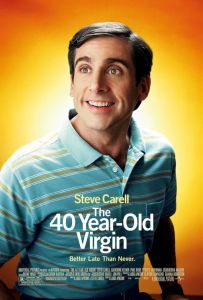
The 40-Year-Old Virgin (2005) [Review Re-View]
 Originally released August 19, 2005:
Yes it’s an uproarious sex farce, that’s a given from the ads, but this movie is also surprisingly sweet and genuinely moving. A lot of credit goes to star/co-writer Steve Carell and co-writer/director Judd Apatow, creator of some of the best, most honestly funny TV series unjustly cancelled. Apatow is a master at mining human comedy for pathos, where you get a great sense of character and really feel for those onscreen, and yet nothing feels cheap or unwarranted, all the while deriving comedy from the situations. We need more men like Apatow in the film industry. Carell can do it all whether it’s deflecting his insecurity, which we feel so bad when he comes up with outrageous things he’s overheard to make himself seem like one of the guys. The supporting cast is top-notch. They’re basically the stock roles in a sex comedy and yet they bring so much more to the table, with a true-to-life boys-will-be-boys camaraderie that you can identify with. The character relationships in The 40-Year-Old Virgin really elevate the story and the jokes and make the film something really special. It’s not merely a barrage of gross-out humor; it’s a nice story with some very tender moments. This is a movie that goes well beyond its gimmick premise, never feeling like a skit blown up into a feature film. It mixes in psychology, heartbreak, awkwardness, but also insights into loneliness and human connection. The best character-based comedy in years.
Nate’s Grade: A
——————————————————
WRITER REFLECTIONS 20 YEARS LATER
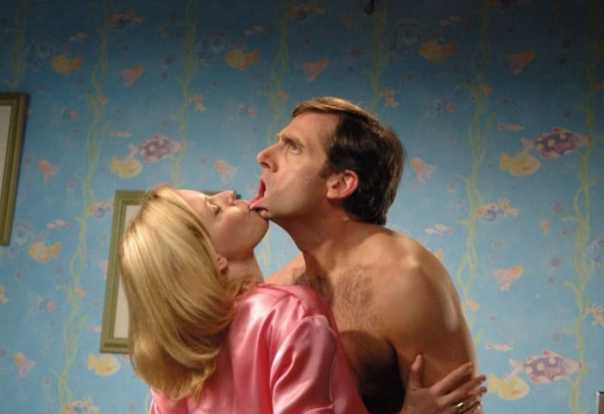
It’s always an interesting prospect to revisit beloved comedies decades after their impact. Comedy is, by its nature, a form of entertainment with the shortest shelf life. What one generation and time considers funny may prove antiquated or offensive the next or, just simply, not funny. I challenge readers to watch the old vaudeville routines and really try to laugh, not just snicker or titter but laugh, the kind of laughter where you have to hold your sides and worry about losing bladder control. Shakespeare wrote many comedies but I would argue most would view them today as clever rather than gut-busting. That’s just the nature of funny, which is in constant flux. One day you’re a popular comedian building your brand on copious “I hate my wife” jokes, and the next you’re a has-been who has transparent issues hating women. I experienced this before when I revisited the movies of Kevin Smith, a filmmaker who made a significant formative impact on my burgeoning sense of comedy and indie cinema. I found that the same movies that proved so funny and outrageous in my teenage and young adult years now, in the light of distance and decades, felt painfully dated and grasping, gassed and flailing. Comedy is a cultural time capsule.
The 40-Year-Old Virgin was a delightful surprise when it was originally released twenty years ago, but it wasn’t only a popular sex comedy, it began a new era of dominant comedy, the Judd Apatow Era. The prolific producer had been responsible for critically acclaimed TV series that always got cancelled too soon, like Freaks and Geeks (created by Paul Feig), Undeclared, and The Ben Stiller Show. He was a well-regarded writer with a sharp eye for talent, but it wasn’t until 2004’s Anchorman that Apatow had a hit under his name, a comedy that crossed over from a small cult audience into the zeitgeist. After The 40-Year-Old Virgin’s reign, the Apatow style of comedy became hip and desirable. It was a winning mixture of broad body humor and character-driven pathos, usually following lonely men suffering from arrested development and finding kinship, agency, and a fuller sense of who they are by the end. There were regular set pieces like traditional comedies but these were more focused on character moments and vibes, which lead to roaming running times and loose-goosey, improv-heavy jam sessions. It was the combination of salty and sweet that proved a winning combination, starring less conventional leading men like Steve Carell, Seth Rogen, Jason Segel, and Jonah Hill, many of whom also wrote or co-wrote their own movies. The Apatow factory created a comedy coaching tree of influential big screen storytellers.
 It was the apex of studio comedy and then… it wasn’t. This isn’t so much a tale of the world growing fickle to the Apatow formula, though with time any formula can start to wear out its novelty. Apatow went on a cold streak for me, first with 2009’s misanthropic and misshapen Funny People and then again with 2012’s This is 40, a sequel to Knocked Up that was obnoxiously wallowing in its sense of woe-is-me rich privilege (it definitely wasn’t my life turning 40). After that, he became something of a shepherd for exciting new comic voices, creating starring vehicles for Amy Schumer (2015’s Trainwreck) and Pete Davidson (2020’s The King of Staten Island) and Lena Dunham (HBO’s Girls). Then he made 2022’s The Bubble, a limp COVID-era satire of studio filmmaking that was painfully unfunny. It felt like Apatow had run out of things to say and even things to laugh about. It was pretty depressing for this comedy giant.
However, the downturn in Apatow’s influence also coincided with the downturn in studio comedies. These mid-budget vehicles used to dominate the box-office and then by the end of the 2010s, they seemed to vanish, seemingly folded into larger-budgeted superhero movies and/or ceded to streaming venues. This became even more entrenched in the theatrical environment during and “after” COVID. Even the occasional A-list starring vehicle, like 2023’s No Hard Feelings with a brassy Jennifer Lawrence performance and the selling point of a full-frontal nude fight scene, could only muster so much attention. Take for instance a Will Ferrell and Reese Witherspoon comedy released just this year directed by Nicholas Stoller (Neighbors). Can anyone even remember the title? I had to look it up myself and I watched it. Have moviegoers grown to expect comedies being lesser or have people lost their sense of humor in the Trump Era where every day can feel like a burdensome weight on your very soul.
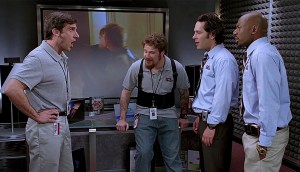
I genuinely enjoyed most of the Apatow-related comedies of the 2000s, and The 40-Year-Old Virgin holds up because its central appeal is on the engaging characters, their winning camaraderie, and the relatable vulnerability and awkwardness of sex and dating. While some of the jokes and attitudes have changed in twenty years, there is a timeless quality to the inherent vulnerability of feeling like you cannot connect with others and the steps taken to rectify that, risking shame. Dating is still a minefield for awkward yet relatable observational comedy just as it was and just as it always will be. Apatow and co-writer Carell anchored their movie on a repressed man’s awakening, taking the formula of a sexual awakening we usually see in teen/young adult movies and applying it to an older man. It redefines a sub-genre but also provides a little sadness and sweetness, as we can’t help but hope that Andy (Carell) will luck in on pleasurable experiences denied him. He’s not a creep, and the explanation for how a man could hold onto his virginity for 40 years (the CDC stats say 0.3% of women and 1.2% of men aged 40 to 44 are indeed virgins) is painfully plausible. After a few embarrassing experiences, he just waited with the expectation it would happen eventually, and the longer it took, the more shame built, and the less certain he was to pursue a romantic relationship. He knows once his secret is out that people won’t just look at him differently, they’ll look at him as if he’s a freak and think less of him. That’s why it’s genuinely sweet how involved his co-workers get to help Andy get over this hump, so to speak. While each co-worker has a different perspective of advice, they open up about their own troubles with women and self-confidence. It’s not like this is a searing relationship drama, but the fundamentals that make it worth investing are there, and that begins and ends with the characters and their conflicts and their camaraderie.
 Each of Andy’s co-workers is giving him bad advice because each one of them wants him to be someone else. Cal (Rogen) advises Andy to be inscrutable and standoffish, turning everything into a question while revealing nothing personal. It’s reminiscent of those smug 2000s pick-up artists that trained a generation of young men into thinking the way to a woman’s heart was to insult her. He does have a hilariously specific note (“Be like David Caruso in Jade”) that still made me laugh hard. Jay (Romany Malco) advises Andy about it being a numbers game, to embrace a bravado to ensnare women, and to pick them up where they are most impressionable. David (Paul Rudd) is still hung up on his ex and is lovelorn, so his advice is often coated in reflexive bitterness. He’s the friend who advises Andy to explore more about his own desires, leading to a very funny sequence where Andy sets up his home environment for his attempt at masturbation, turning around family pictures to spare their eyes. It’s actually through the character of Marla (Kat Dennings, Thor), the teen daughter of his girlfriend, that Andy finds a level of self-acceptance for being a novice to human sexuality. I think it’s telling that the best advice he receives on the subject is from a teenage girl rather than his horndog pals who consider themselves female experts.
The movie pivots into a more focused romantic comedy by its second half once Andy finally works up the nerve to ask out Trish, played by Catherine Keener (Get Out, Being John Malkovich). This is a natural transition because now Andy has a person to practice all the advice and prove himself. They have a chummy and self-deprecating chemistry together, so the challenge becomes how long he can hide what amounts to his secret shame. Things are going so well he throws out obstacles to delay their physical copulation because he’s afraid that’s when she’ll realize he isn’t worth it. You’re rooting for Andy to get over his hangups and recognize he’s actually a nice guy and that Trish would be really happy to have sex with him, especially after waiting over twenty-plus dates. This is one of Keener’s warmest performances in her storied career. This was Carell’s star-making role. He had been a notable scene-stealer before in Bruce Almighty and Anchorman, but now he was a leading man, further solidifying that same year with the role that would define him, as Michael Scott on the American version of The Office. The both of them are a winning pair and you want their shared adorkable energy to work out for the best.
Much of the comedy still works very well, like the famous chest-waxing scene where Carell really had his chest hair ripped out, but there are some elements that would have been scuttled had The 40-Year-Old Virgin been released today. It’s hard to conceive of a modern studio comedy that would allow two straight guys insulting each other with the many ways they are irrefutably gay. The 2000s was a time rife with gay panic jokes. What has aged the worst is the advice to prey upon “drunk bitches” because they have fewer defenses. Given the term, “prey upon,” you’ll no doubt surmise that this advice is predatory. This dubious thinking is something that would set up a guy as one of the bad men in Promising Young Woman, and it would have proven fitting had one of those women gotten one over on the guys. Frustratingly, Jay has a brief moment of recompense and self-reflection when his long-suffering girlfriend has had enough of his cheating ways, but then she goes right back to him and reveals she’s pregnant. We’re missing a scene that would help solidify how this event changes Jay, but instead he’s basically rewarded for his bad behavior with a baby and a woman forgiving him once again.
 You’ve probably heard about the loneliness epidemic of modern men, a media-friendly term exploring how many of today’s available men are having difficulty making connections with women and some of them using this rejection and/or fear of rejection as the excuse to radicalize themselves. There’s been so much written on the subject, but I think most of it really just comes down to empathy. When you care about other people, and allow yourself to think about their needs and desires, it communicates an openness to others and that their time and emotional investment is worth it. It’s hard to fathom a swath of young men, the ones who identify as reactionary incels, deigning to view empathy as a strength rather than character defect. Empathy communicates two important self-realizations: 1) other people matter, and 2) being vulnerable and possibly being hurt is worth the risk. You can’t have one without the other. When young men reach that epiphany and acceptance, they will discover women are, amazingly, much more open to seeing them as a romantic partner worth their time, affection, and their bodies. Nobody owes anyone their bodies or emotional bandwidth. Sharing your life with others should be valued, not entitled.
This is also a perfect spot to talk about one of the minor co-stars, Shelley Malil as co-worker Haziz, who was charged with stabbing his girlfriend 25 times in 2008. He was released from prison in 2018 after serving eight years of a twelve-years-to-life prison sentence, which doesn’t sound very close to “life” for me, but on the flip side, “12 years to all years” seems like too expansive of a window of time to serve.
Twenty years later, The 40-Year–Old Virgin still funny and sweet and entertaining because it nails the tenets of what makes movies worth coming back to again and again, our connection to the characters and their relatable plights. Even two decades later, we can still see elements of ourselves in these characters, though maybe fewer. This was the announcement of the Judd Apatow Era of big screen yuks, and frankly I’d be happy to return to it if we got more movies like this and Knocked Up, a comedy I liked even more upon release. My original review was correct for all the accolades The 40-Year-Old Virgin deserved and still deserves, and so it remains a comedy classic with more on its dirty mind than many adult dramas.
Re-View Grade: A
Share this:

The Fantastic Four: First Steps (2025)

Apparently there must have been an ancient curse that brings forth a new attempt at a Fantastic Four franchise every ten years, even further if you want to include the 1994 Roger Corman movie that was purposely made and never released just to hold onto the film rights (I’ve seen it, and once you forgive the chintzy special effects and shoestring budget, it’s actually a pretty reverent adaptation). The 2000s Fantastic Four films were too unserious, then the 2015 Fantastic Four gritty reboot (forever saddled with the painful title Fant4stic) was too serious and scattershot. Couldn’t there be a healthy middle? There has been an excellent Fantastic Four film already except it was called The Incredibles. That 2004 Pixar movie followed a family of superheroes that mostly aligned with the powers of the foursome that originally made their debut for Marvel comics in 1961. It makes sense then for Marvel to borrow liberally from the style and approach of The Incredibles because, after all, it worked. There’s even a minor villain that is essentially a mole man living below the surface. Set on an alternate Earth, this new F4 relaunch eschews the thirty-something previous films of the Marvel Cinematic Universe (MCU). You don’t need any prior understanding to follow the action, which is kept to under 105 minutes. The 1960s retro futurist visual aesthetic is a constant delight and adds enjoyment in every moment and every scene. The story is a modern parable: a planet-eating Goliath known as Galactus will consume all of Earth unless Reed Richards (Pedro Pascal) and Sue Storm (Vanessa Kirby), a.k.a. Mr. and Ms. Fantastic, give over their unborn son. The added context is that they have struggled with fertility issues, and now that at last they have a healthy baby on the cusp of being theirs, a cosmic giant wants to call dibs. It makes the struggle and stakes much more personal. It makes the foursome genuinely feel like a family trying to resolve this unthinkable ultimatum. I cared, and I even got teary-eyed at parts relating to the baby and his well-being, reflecting on my own parenting journey.

From a dramatic standpoint, this movie has it. From an action standpoint, it leaves a little to be desired. It incorporates the different powers well enough, but there are really only two large action set pieces with some wonky sci-fi mumbo jumbo. There’s a whimsical throwback that makes the movie feel like an extension of a Saturday morning cartoon show except for the whole give-me-your-baby-or-everybody-dies moral quandary. While I also appreciated its running time being lean, you can feel the absence of connective tissue. Take for instance The Thing (The Bear‘s Ebon Moss-Bachrach) having a possible romance with a teacher played by Natasha Lyonne (Poker Face). The first scene he introduces himself… and then he appears much later at her synagogue seeking her out specifically during mankind’s possible final hours. We’re missing out on the material that would make this personal connection make sense. The same with the world turning on the F4 once they learn they’ve put everyone in danger. It’s resolved pretty quickly by Sue giving one heartfelt speech. The movie already feels like it has plenty of downtime but I wanted a little more room to breathe. I was mostly underwhelmed by Pascal, who seems to be dialing down his natural charm, though his character has some inherently dark obsessions that intrigued me. He recognizes there is something wrong with him and the way his mind operates, and yet he hopes that his child will be a better version of himself, a relatable parental wish. There are glimmers of him being a more in-depth character but it’s only glimmers. The family downtime scenes were my favorite, and the camaraderie between all four actors is, well, fantastic (plus an adorable robot). Kirby (Napoleon) is the standout and the heart of the movie as a figure trying to square the impossible and desperate to hold onto the baby she’s dreamed of for so long.
The Fantastic Four: First Steps is an early step in a better direction. It’s certainly better than the prior attempts to launch Marvel’s first family of heroes, though this might not be saying much. It does more right than wrong, so perhaps the fourth time might actually be the charm.
Nate’s Grade: B-
Share this:

War of the Worlds (2025)

It’s almost refreshing when you discover a movie that is so bad it becomes a feat of amazement. Pitching a War of the Worlds remake primarily starring Ice Cube staring at his work computer sounds akin to pitching a Pride and Prejudice remake starring Jojo Siwa and it’s entirely about her gardening. You could do something like that but why would you? It’s almost like some setup for a joke. This movie was originally made in 2020 and has sat on the shelf for five years, enough so to make one wonder why anyone felt like now was the time to release it, especially in this final condition. I’m dumbfounded simply thinking about this movie. It’s so misguided in about every creative decision, from its stylistic approach to its thematic emphasis and especially making what may be the most boring alien invasion movie into an afterthought about government surveillance laws. Sheesh.
Author H. G. Wells published War of the Worlds in 1898, and it’s since been turned into many popular radio serials, movies, and TV series, including the 2005 Tom Cruise-Steven Spielberg hit. Whenever a filmmaker or production company shakes the dust off a story that we already have many versions of, the question arises what this new version will bring to the table. How will this one stand out? How will it connect in a way that the other movies had not? In short, why do we need another version? Naturally, Hollywood doesn’t think about the creative necessity of movies, only their profitability. The core difference with the new 2025 movie is that it’s a “screenlife” movie where everything we see is meant to approximate a computer screen. It’s a variation on the found footage genre. This technique was used to great effect in 2018’s Searching where John Cho tried to uncover his missing daughter’s digital footprint. That was an inventive updating of the detective thriller. Here, I cannot imagine a more boring way to illustrate an alien invasion. We’re watching one man behind a computer screen react to the news and cycle through camera feeds for exposition, having Face Time conversations with loved ones and Zoom meetings with government officials, and he apparently seems to be the only guy capable of doing his job during this war of the worlds. It reminds me of 2010’s Skyline, a smaller alien invasion movie that tried to mask its limited budget by following a group of characters trapped in an apartment that would worriedly look out the windows. It’s a bad approach, making the events feel too limited and like we’re missing out on more interesting events. Suffice to say, when the world is going to war and aliens are destroying cities, you don’t want the focus of our movie to be Ice Cube staring at you and furiously typing key commands.

Another significant blunder was making this less an alien invasion movie and more about government overreach when it comes to data mining. There will be spoilers in this paragraph, dear reader, but honestly I would actively advise you to read them anyway to just better appreciate how ridiculous this all is. The powerful aliens aren’t here for our natural resources, for turning people into food, or even a hostile takeover of the planet as their new home world. Oh, it’s far worse than that. What these dirty dirty aliens are really hungry for is… our personal data. Yes, you read that correctly. The aliens literally consume electronic data. What dull lives these creatures lead. This is less an alien invasion and more a stark literalization of data mining. These aliens are advanced enough to travel through space but need to be in such close physical proximity to harvest our data? They can’t just hack the Pentagon wifi? It turns the aliens into big dumb technological mosquitoes who just need to be directed elsewhere. I’m astounded that War of the Worlds presents an alien invasion and says that nosy government is the real problem. The movie tries to argue that these advanced aliens wouldn’t even be here if Big Government wasn’t wantonly collecting our data for their nebulous spying purposes. It’s an attack on the post-9/11 surveillance state born of the Patriot Act, but it’s also 15-20 years too late for this to be politically relevant.
The movie also picks the wrong character to serve as its moral awakening. It’s nonsensical that Ice Cube could be a trusted DHS official and be unaware of these systems and their reach. He seems to be the guy that the FBI is waiting on for door-breaching warrants that he tidily uploads as PDF files. He’s the guy NASA wants to clue in on their latest reports. He’s the guy the Secretary of Defense calls directly. He’s not the head of Homeland Security; he’s just a guy in the office, and seemingly the only guy in the building (was it a holiday weekend?). Ice Cube plays a man with some extreme boundary issues. He’s literally using government surveillance to spy on his pregnant daughter, hacking into her fridge, and I think even installing cameras into her apartment. He’s using government resources to criticize his daughter’s grocery choices. He’s overstepping his bounds and taking full advantage of that same government surveillance state that he decries at the end of the movie. At three different points someone will say incredulously about the government spying on people’s “Amazon carts,” and it’s just remarkable that something like that would politically galvanize this man when he’s already spying on his kids with that same surveillance apparatus. He’s knowingly breaking into their messages and social media and personal data. This can’t be a “what have we become?” epiphany when he’s always been there.
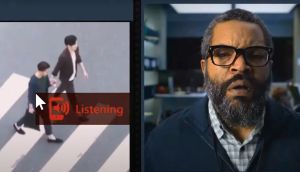
I like Ice Cube as an actor. He showed surprising depth in Boyz n the Hood, was hilariously applied in the 21 Jump Street movies as a stern sourpuss authority figure. There’s a natural intimidation factor, which was recently played for clever laughs with his appearance on The Studio. This is a performer that can be a great addition when aligned with his strengths. However, range is not a word one would readily use when describing the acting capabilities of Mr. Cube. Hinging this entire movie on Ice Cube’s emotional journey is too much of an ask. Having this man listlessly read gobs of exposition is not good for anyone. He doesn’t have that kind of arresting voice that could hypnotize us, like a Morgan Freeman or Jeremy Irons. It’s even worse when you feel the lackluster effort on his part. Strangely, despite his children being in direct danger, and the whole alien invasion backdrop, the moment that draws the most dramatic response from Ice Cube is when the aliens delete his deceased wife’s Facebook account (I would have accepted you consuming the planet, but when you delete Facebook pictures, now you’ve gone too far). The movie was filmed in the early days of the COVID pandemic and feels it, restricting everyone to their own little screens with nary the physical interaction. When you’re watching Ice Cube race through empty rooms of Homeland Security to insert a thumb-drive in the nick of time to save the world (along with shouting to the unconvincing alien special effects, “Movie bitch, get out the way”) it all just reminds you how painfully myopic and agonizingly restrictive this alien invasion approach ultimately proves to be.
Special mention needs to be made for the over-the-top Amazon product placement in this movie. The company is referenced several times, even used as a motivator for a homeless man (what computer?), but it’s much worse when one of the characters is a proud Amazon delivery driver and he’s going to use their cutting-edge drone delivery tech to make sure Ice Cube gets that all-important thumb-drive in record time. Amazon helps in saving the world thanks to their logistics in package delivery. Thank you corporate overlords, and please enjoy this movie on your life-saving Amazon Prime account, dutiful citizen.
War of the Worlds 2025 is a fascinating and maddening case study in bad adaptation choices. It feels more like an anti-government surveillance state thriller that got awkwardly grafted onto an alien invasion. The way the movie just abandons its larger scale drama for lessons in modern-day privacy laws is creatively criminal. This is an astonishingly bad movie that gets just about everything wrong at every turn. I’m almost tempted to recommend people watch it just to try and reconcile it for themselves. There have been dozens of adaptations of this classic science-fiction tale, and I feel confident in declaring this one the absolute worst even if I haven’t seen every one of them. There can’t be a worse one than this.
Nate’s Grade: F


 nathanzoebl
You must be logged in to post a comment.