Monthly Archives: July 2025
Together (2025)
 With co-dependency as its anchor metaphor, Together is a body horror movie asking the question how intimate you’d ever want to be with your beloved? It’s a relationship drama about two people that should probably break up and move on but are clinging to some sense that they need to stay. Real-life married couple Dave Franco (The Disaster Artist) and Alison Brie (Horse Girl) play pretend couple Tim and Millie who relocate to the small-town countryside and come across a mysterious sinkhole belonging to an abandoned New Agey church, as one does. After Tim, in his desperation, drinks the water out of a pit that looks like it was designed by H.R. Giger, his body and mind are hijacked with the compulsion to be as close as possible with his long-time girlfriend. Now the two of them are fighting strange impulses, like swallowing one another’s hair, or trying to physically meld their bodies together. Can they learn more about their predicament and the history of this symbiosis before they are forced together forever?
 Considering its premise, there is plenty of potential here for grandly gross body horror. There are certainly some squirm-worthy and disgusting moments of vivid imagery that could induce nightmares. I’m not even talking about the direct body horror moments. Seeing a man swallowing a majority of your ponytail in his sleep might make you gag like it did me. Things get more wild after an hour and stay that way to the end, as the couple has to thwart their bodies from literally fusing together. The sticky skin-to-skin, or eyeball-to-eyeball sequences are dreadfully unnerving, but the imagery of them literally being dragged by invisible forces across the ground to one another like literal magnets is less horrifying and more absurdly ridiculous. That’s the rub. There’s some terrific body horror grotesquery here, and writer/director Michael Shanks has a sneaky way with dread, building things to a monumental point and then cutting away. However, some of the other aspects of this curse come across as far goofier, like the aforementioned being dragged across the floor. For some it might come across as terrifying, the whole supernatural exaggeration of being out of control of your own body, but it reminded me of Tenet where it looked like characters were just rolling around on the ground in a supremely silly way when it was supposed to be “backwards time.” There are also some middling jump scares relating to Tim’s trauma with his parents that, I guess, is the explanation for why he has intimacy problems. Still, if you’re coming to Together for the outlandishly gross potential of its premise, there may be enough to sate your curiosity for macabre oddities.
Together is more a movie about a couple who should retire. There’s far more about the struggles and pains of this relationship than weird body horror. She wants to get married, he doesn’t. She wanted to move for a new job, and he did not. She wants to have regular sex, he hasn’t wanted to for months for unspecified reasons (unresolved childhood traumas?). The relationship is very one-sided and unlike 2019’s Midsommar, which was about a poor woman realizing it was time to kick her no-good boyfriend to the curb, or burn him alive via cult intervention, this movie is more about Millie wearing down Tim’s defenses. He’s connecting with her again but it’s through this metaphysical compulsion that he can’t fully explain. He’s expressing real physical interest but he’s still finding ways to reject her, which just drives her crazier. One minute they’re trying to resolve their intimacy issues, and the next they’re working together to slice their arms apart. There are some memorable discomforts, like having to physically dislodge after some vigorous yet impulsive bathroom stall sex. That sequence made me uncomfortable for several reasons. The film’s shock value and tone flirts with darker humor without committing. The final shot of the movie is also a bit silly, and while it achieves the articulation of the movie’s main theme, the concluding imagery is more like, “Oh, well, okay then.” It might even produce a few guffaws. It’s not quite the lasting image I think the filmmakers wanted to go out on. It made me think of Kevin Smith’s man-becomes-walrus horror film, Tusk, where it ends and you go, “Oh… well, they did it, all right.” Some things are better in theory than finally visualized where they come across as anticlimactic.
 That’s the other thing with Together, it’s practically bludgeoning you with its obvious theme, having every other line relate back to codependency. Multiple times you will hear, “It would be better to separate now. It will just be harder the longer we wait.” Can you get how this will be applied in multiple contexts? These are characters that feel stuck. Get it? Franco and Brie have an easy-going chemistry and an innate ability to find the darker humor amidst all the body horror splicing. I might argue their chemistry is too good considering they’re supposed to be a couple that shouldn’t really stay together and have passed their relationship expiration date. I don’t think you should want them to stay together considering this relationship is killing the both of them, now very literally. I was surprised there wasn’t more combustion to how this complicates their interactions and mobility. If this is a relationship that has had its rocky points and toxicity, you would think something this unnatural and against their autonomy would produce some friction (no pun intended). I suppose you could examine the entire movie as an analysis of how easily people will subsume themselves in order to stay in something even they would admit isn’t healthy. I’m not going to pretend The Substance was subtle either, but that movie was more fable and mixing in its over-the-top elements with verve, rather than fitting them into a relationship dirge.
Right before its nationwide theatrical release, Together was accused of plagiarism by another filmmaker who approached Franco and Brie with a similar concept in 2020. Shanks has defended his film by saying he registered his first draft back in 2019, and the producers of Together, including Franco and Brie, have dismissed the claim. I haven’t read the competing script, nor do I pretend to be an insider on this matter, but it’s easy for me to see how this concept could have been independently generated by dozens of screenwriters and aspiring body horror gurus. It’s taking its theme and making it quite literal, forcing the challenged couple who shouldn’t be together to literally, physically, irrevocably be together. It’s all pretty straightforward, which makes Together a workable but limited body horror experiment. I liked it, as much as one can like a movie where characters have to forcibly unstuck their genitals, but I found myself wanting a little more from Together. The added Tim back-story spooks feel out of place, the ongoing mystery of what happened to a previous backpacking couple is over represented, and the theme is so obvious at every turn that the metaphor is in danger of being stripped bare. Its concept is undeniable, and the body horror imagery can be aces, but the development and execution could have been a little more, well, together.
Nate’s Grade: B-
Share this:

Batman Begins (2005) [Review Re-View]
 Originally released June 15, 2005:
I have been a Batman fan since I was old enough to wear footy pajamas. I watched the campy Adam West TV show all the time, getting sucked into the lead balloon adventures. Tim Burton’s 1989 Batman was the first PG-13 film I ever saw, and I watched it so many times on video that I have practically worn out my copy. Batman Returns was my then most eagerly anticipated movie of my life, and even though it went overboard with the dark vision, I still loved it. Then things got dicey when Warner Brothers decided Batman needed to lighten up. I was only a teenager at the time, but I distinctly remember thinking, “You’re telling the Dark Knight to lighten up?” Director Joel Schumacher’s high-gloss, highly stupid turn with Batman Forever pushed the franchise in a different direction, and then effectively killed it with 1997’s abomination, Batman and Robin. I mean these films were more worried about one-liners and nipples on the Bat suits. Nipples on the Bat suits, people! Is Batman really going, “Man, you know, I’d really like to fight crime today but, whoooo, my nipples are so chaffed. I’m gonna sit this one out”?
For years Batman languished in development hell. Warner Bothers licked their wounds and tried restarting their franchise again and again, only to put it back down. Then around 2003 things got exciting. Writer/director Christopher Nolan was announced to direct. Nolan would also have creative control. Surely, Warner Brothers was looking at what happened when Columbia hired Sam Raimi (most known for low-budget splatterhouse horror) for Spider-Man and got out of his way. After Memento (My #1 movie of 2001) and Insomnia (My #5 movie of 2002), Nolan tackles the Dark Night and creates a Batman film that’s so brilliant that I’ve seen it three times and am itching to go again.
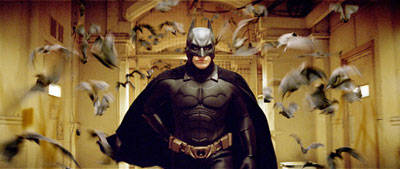 The film opens with a youthful Bruce Wayne (Christian Bale) in a Tibetan prison. He’s living amongst the criminal element searching for something within himself. Henri Ducard (Liam Neeson) offers Bruce the chance to be taught under the guidance of the mysterious Ra’s Al Ghul (Ken Watanabe), the leader of the equally mysterious warrior clan, The League of Shadows. Under Ducard’s direction, Bruce confronts his feelings of guilt and anger over his parents’ murder and his subsequent flee from his hometown, Gotham City. He masters his training and learns how to confront fear and turn it to his advantage. However, Bruce learns that the League of Shadows has its judicial eyes set on a crime ridden Gotham, with intentions to destroy the city for the betterment of the world. Bruce rebels and escapes the Tibetan camp and returns to Gotham with his own plans of saving his city.
With the help of his trusted butler Alfred (Michael Caine), Bruce sets out to regain his footing with his family’s company, Wayne Enterprises. The company is now under the lead of an ethically shady man (Rutger Hauer) with the intentions of turning the company public. Bruce befriends Lucius Fox (Morgan Freeman), the company’s gadget guru banished to the lower levels of the basement for raising his voice. Bruce gradually refines his crime fighting efforts and becomes the hero he’s been planning on since arriving home.
Gotham is in bad shape too. Rachel Dawes (Katie Holmes), a childhood friend to Bruce, is a prosecutor who can’t get anywhere when crime lords like Falcone (Tom Wilkinson) are controlling behind the scenes. Most of the police have been bought off, but Detective Gordon (Gary Oldman) is the possibly the city’s last honest cop, and he sees that Batman is a figure trying to help. Dr. Crane (Cillian Murphy) is a clinical psychologist in cahoots with Falcone. Together they’re bringing in drug shipments for a nefarious plot by The Scarecrow, a villain that uses a hallucinogen to paralyze his victims with vivid accounts of their own worst fears. Bruce is the only one who can unravel the pieces of this plot and save the people of Gotham City.
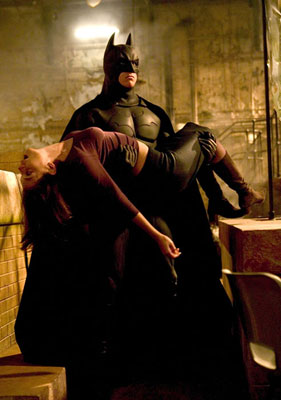 Nolan has done nothing short of resurrecting a franchise. Previous films never treated Batman as an extraordinary character; he was normal in an extraordinary world. Batman Begins places the character in a relatively normal environment. This is a brooding, intelligent approach that all but erases the atrocities of previous Batman incarnations. Nolan presents Bruce Wayne’s story in his typical nonlinear fashion, but really gets to the meat and bone of the character, opening up the hero to new insights and emotions, like his suffocating guilt over his parents murder.
Nolan and co-writer David S. Goyer (the Blade trilogy) really strip away the decadence of the character and present him as a troubled being riddled with guilt and anger. Batman Begins is a character piece first and an action movie second. The film is unique amongst comic book flicks for the amount of detail and attention it pays to characterization, even among the whole sprawling cast. Nolan has assembled an incredible cast and his direction is swimming in confidence. He’s a man that definitely knows what he’s doing, and boy oh boy, is he doing it right. Batman Begins is like a franchise colonic.
This is truly one of the finest casts ever assembled. Bale makes an excellent gloomy hero and really transforms into something almost monstrous when he’s taking out the bad guys. He’s got great presence but also a succinct intensity to nail the quieter moments where Bruce Wayne battles his inner demons. Caine (The Cider House Rules, The Quiet American) is incomparable and a joy to watch, and his scenes with the young Bruce actually had me close to tears. This is by far the first time a comic book movie even had me feeling something so raw and anything close to emotional. Neeson excels in another tough but fair mentor role, which he seems to be playing quite a lot of lately (Kingdom of Heaven, Star Wars Episode One). Freeman steals every scene he’s in as the affable trouble causer at Wayne Enterprises, and he also gets many of the film’s best lines. Oldman (The Fifth Element, Harry Potter and the Prisoner of Azkaban) disappears into his role as Gotham’s last good cop. If ever there was a chameleon (and their name wasn’t Benicio del Toro), it is Oldman. Holmes works to the best of her abilities, which means she’s “okay.”
The cast of villains are uniformly excellent, with Wilkinson’s (In the Bedroom) sardonic Chicagah accented mob boss, to Murphy’s (28 Days Later…) chilling scientific approach to villainy, to Watanabe’s (The Last Samurai) cold silent stares. Even Rutger Hauer (a man experiencing a career renaissance of his own) gives a great performance. Seriously, for a comic book movie this is one of the better acted films of the year. And that’s saying a lot.
Batman Begins is such a serious film that it almost seems a disservice to call it a “comic book movie.” There are no floating sound effects cards and no nipples on the Bat suits. Nolan really goes about answering the tricky question, “What kind of man would become a crime-fightin’ super hero?” Batman Begins answers all kinds of questions about the minutia of the Dark Knight in fascinating ways, yet the film remains grounded in reality. The Schumacher Batmans (and God save us from them) were one large, glitzy, empty-headed Las Vegas entertainment show. No explanation was given to characters or their abilities. Likewise, the Gothic and opulent Burton Batmans had their regrettable leaps of logic as well. It’s hard not to laugh at the end of Batman Returns when Oswald Cobblepot (a.k.a. The Penguin) gets a funeral march from actors in emperor penguin suits. March of the Penguins it ain’t. Nolan’s Batman is the dead-serious affair comic book lovers have been holding their breath for.
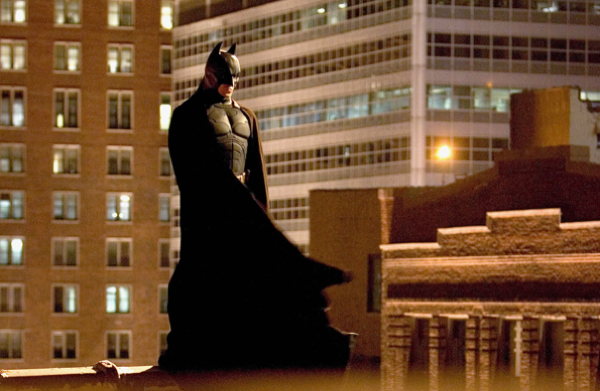 The action is secondary to the story, but Batman Begins still has some great action sequences. Most memorable is a chase sequence between Gotham police and the Batmobile which goes from rooftop to rooftop at one point. Nolan even punctuates the sequence with some fun humor from the police (“It’s a black … tank.”). The climactic action sequence between good guy and bad guy is dutifully thrilling and grandiose in scope. Nolan even squeezes in some horror elements into the film. Batman’s first emergence is played like a horror film, with the caped crusader always around another turn. The Scarecrow’s hallucinogen produces some creepy images, like a face covered in maggots or a demonic bat person.
There are only a handful of flaws that make Batman Begins short of being the best comic book movie ever. The action is too overly edited to see what’s happening. Whenever Batman gets into a fight all you can see are quick cuts of limbs flailing. My cousin Jennifer got so frustrated with the oblique action sequences that she just waited until they were over to see who won (“Oh, Batman won again. There you go.”). Nolan’s editing is usually one of his strong suits; much of Memento’s success was built around its airtight edits. He needs to pull the camera back and let the audience see what’s going on when Batman gets physical.
Another issue is how much plot Batman Begins has to establish. This is the first Batman film to focus solely on Batman and not some colorful villain. Batman doesn’t even show up well into an hour into the movie. As a result, Batman Begins perfects the tortured psychology of Bruce Wayne but leaves little time for villains. The film plays a shell game with its multiple villains, which is fun for awhile. The Scarecrow is really an intriguing character and played to gruesome effect by the brilliant Cillian Murphy. It’s a shame Batman Begins doesn’t have much time to develop and then play with such an intriguing bad guy.
Batman Begins is a reboot for the film franchise. Nolan digs deep at the tortured psyche of Bruce Wayne and come up with a treasure trove of fascinating, exciting, and genuinely engrossing characters. Nolan’s film has a handful of flaws, most notably its oblique editing and limited handling of villains, but Batman Begins excels in storytelling and crafts a superbly intelligent, satisfying, riveting comic book movie. The best bit of praise I can give Batman Begins is that I want everyone responsible to return immediately and start making a host of sequels. This is a franchise reborn and I cannot wait for more of it.
Nate’s Grade: A
——————————————————
WRITER REFLECTIONS 20 YEARS LATER
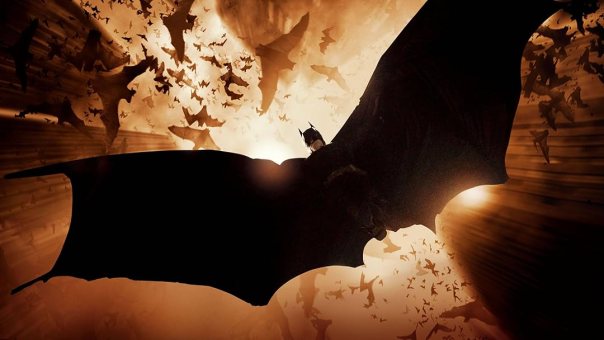
Batman Begins could have also been subtitled, Christopher Nolan Begins. The eponymous writer/director, who has defined the twenty-first century in the realm of artful blockbusters perhaps more than anyone, had made three movies prior to this big moment. He began with 1998’s Following, but it was 2001’s Memento that got everyone’s attention. His immediate follow-up, 2002’s Insomnia, is a very good movie, and actually a better version than the Nordic original, but it was really proof for Warner Brothers that this clever indie guy could handle a larger studio project. In the early 2000s, Warner Brothers was desperate to relaunch Batman after the demise of the franchise with 1997’s ultra campy Batman & Robin, and many filmmakers were courted to relaunch the Dark Knight. It was literally a month after rejecting Joss Whedon’s reboot pitch that in January 2003, the studio announced Nolan was attached and writing the screenplay with David S. Goyer, who was hot off the Blade movies and seemed to have cracked the code for making more mature comic book movie adaptations. What followed was a dramatic reworking of Batman, grounding him and his world in realism and opening Bruce Wayne up for a closer psychological examination, giving the man behind the mask an opportunity to be the actual focus for once. The results reinvigorated the dormant franchise, provided a path for superhero reboots in a post-9/11 landscape, and launched Nolan on his ascendant trajectory to being the biggest blockbuster voice of the modern era.
 Batman was a popular character in DC comics (note: DC stands for “Detective Comics,” so saying, “DC comics” is like saying, “Detective Comics comics,” much like the way the “Sahara” means “desert”) from his inception in in 1939, but he was always well behind Superman, the golden boy. The campy Adam West TV series was popular, and actually saved the comic from being discontinued, but it wasn’t until 1989 that Batman became the most popular superhero. The darkness and edge of Batman was more appealing for the modern masses, and paired with Tim Burton, it proved the new levels of studio blockbusters after the steep decline from the Christopher Reeve Superman movies. Ever since, we’ve had over ten live-action headlining Batman movies and only four Superman live-action movies, now five thanks to James Gunn’s recent high-flying addition. Much as the Burton 1989 Batman brought the character to an even bigger height of modern stardom, it was Nolan who likewise took the character and made it an even bigger spectacle that also steered the zeitgeist of what superhero movies could be.
While 2008’s The Dark Knight is widely regarded as Nolan’s best movie in his trilogy, I actually consider Batman Begins his best. That is no insult to The Dark Knight, a wildly entertaining movie that is something truly special every second Heath Ledger is onscreen with his magnetic portrayal of the Joker, a modern-day anarchist seeking validation from the costumed crusader who “changed all the rules.” It’s a good movie with some wonky plotting you don’t think of as long as Ledger is lighting it up, but that first movie was a proof of concept that Batman can carry his own movie. It humanizes the character and strips him down before gradually putting him back together, explaining how this character assembles the tools of his trade and the allies that help support his mission. It’s a satisfying series of trial and error that proves entertaining as we watch the myth of Batman take shape. This first movie is about the formation of Batman, whereas the second is about the escalating consequences of introducing a well-armed vigilante into the bloodstream of organized crime. The first film is the most complete movie, and while it has some flights of fancy like a secret ninja conspiracy, it still works on a relatively grounded level. For the first time in perhaps the character’s film history, you will find yourself caring about the character. That is an accomplishment, and you can feel it when Bruce Wayne (Christian Bale) merely standing amidst a swarm of bats is played as a turning point of self-actualization. And it works. This is Nolan’s best Batman.
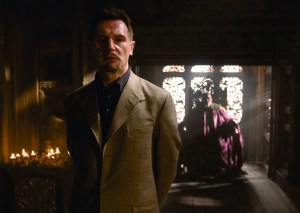 We don’t even get our first glimpse of Batman as we know him until halfway through the movie. That’s a lot of waiting for a movie with “Batman” as the first word of its title. Even twenty years later, I find the build-up satisfying, watching Bruce Wayne put together the pieces that we associate with Batman, from his cowl to his cape to his suit to the Batmobile, which is practically an all-terrain tank. Finding interesting ways to generate these familiar parts, iconography, and allies makes an invigorating drama that is better than the more action-heavy second half of the movie. It’s still fun and enjoyable how Nolan is able to bring together so many elements with payoffs. This is Nolan’s first blockbuster and he proves that he has an innate feel for popcorn entertainment, knowing how to structure and pace the action and intrigue and laying in those setups and payoffs along with winning character beats and themes. He shows how he can make the moments matter to form an even greater whole. That’s the lasting impact of Batman Begins, where every moment helps to build the mystique of the superhero but also the psychology of Wayne and what motivates a man to dress up and punch dudes for a living.
It also helps that this movie is perfectly cast from top to bottom. Bale was as sturdy a center as you could get. He only went on to be nominated for four Oscars, winning once for 2010’s The Fighter (and should have won in 2018 as Dick Cheney in Vice). He’s long been known for transforming himself completely with his roles. Between 2004’s The Machinist and Batman Begins, there’s a 100-pound difference in Bale’s physique. His performances can get too easily overlooked because of the gimmicky body transformations, but Bale has been one of our most consistent and interesting actors for these last twenty years. Getting Michael Caine (Oscar winner), Morgan Freeman (Oscar winner), Gary Oldman (future Oscar winner), Cillian Murphy (future Oscar winner), Tom Wilkinson (future Oscar nominee), Neeson, Wantanabe, and even Rutger Hauer to be in your movie is obviously a setup for greatness. Nolan and company even get the smallest roles right, like hiring Rade Serbedzija (Snatch, Eyes Wide Shut) just as a homeless man Bruce gives his coat to. He’s only in two scenes for maybe thirty seconds but you got this actor for that part. The odd one out is Katie Holmes as Bruce’s childhood friend who becomes a crusading prosecutor. It’s not a knock on Holmes but simply her character’s role in the story. There’s also the knowledge that this role was recast with Maggie Gyllenhaal in the 2008 sequel, so one wonders what Gyllenhaal would have been like here. I like Holmes as an actress but Maggie Gyllenhaal is a definite upgrade.
 Allow me to question the mission of the League of Shadows and good ole Ra’s al Ghul (Ken Wantanabe, but really Liam Neeson). They are a secret order of ninjas trained to fight injustice through extreme measures. They’ve been in existence for hundreds of years, maybe thousands, and claim to have contributed to the destruction of such empires as Rome and Constantinople when they became breeding grounds of injustice. Their next target is Gotham and they become our returning antagonists for the climax, Batman having to take down his mentor. This philosophy purports to link criminality with borders, alleging that criminals are only encouraged by the corrupt institutions of the city. If Rome can no longer support a thriving criminal network, the assumption is that crime goes away. You take away the platform and, voila, injustice and criminality are gone. That’s quite an oversimplification. You could make the argument that destroying a corrupt city makes it harder for criminals to find footing, but does it eliminate crime or just force it to migrate elsewhere? This also assumes that only cities are cesspools for criminality and corruption; look into the Sackler-lead network of pill mills dotting rural America. I guess drug and sex trafficking only exist in urban America, right? The League of Shadows have a bad idea forming a bad philosophy that is being applied badly, and I just wanted to point this out.
The legacy of the Nolan Batman trilogy carries on twenty years later. They are considered some of the biggest blockbusters of the twenty-first century, but it’s also the beginning of the meteoric ascent of Nolan. 2006’s The Prestige, likely his most underrated film, is the last of the Before Movies. Ever since, every Nolan movie has been an event, even ones that step back into more personal and cerebral spaces, like 2023’s runaway Oscar juggernaut, the billion-dollar three-hour biopic, Oppenheimer. He’s become one of a very select few filmmakers whose very name is a selling point to the general public regardless of whatever the project might be (joining Spielberg, Tarantino, James Cameron, and maybe Jordan Peele at this point). I agree with my 2005 criticisms that Nolan is not an expert handler of action. He’s tremendous at atmosphere, with judicious editing and eye-popping visuals, but action construction is not his forte, even after several more action movies to his name. I was much more entertained by the horror sequences from the Scarecrow fear toxin than I was by the straight action. I do wish the villains had more time, especially the Scarecrow, but it’s a result of having so much more plot to do, and centering around Bruce Wayne and his personal journey to superhero-dom means everything serves this streamlined goal.
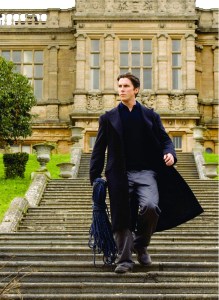 I saw Batman Begins three times in the theater back in 2005. As a longtime Batman fan, a kid whose first VHS tape was the 89 Batman, who obsessed over every detail for the Batman Returns release, who religiously watched the excellent 90s animated series, I felt a sense of elation that this was a movie that got it. Nolan and his team got Batman and did him justice that had been denied for years. We now likely live in a universe where we’ll never be more than four years away from another live-action Batman movie or appearance. I enjoy the Matt Reeves’ Batman era we’re currently living through, another gritty take favoring realism and depth of character to comic book pulp heroics. The Nolan movies walked so that the Reeves films could fly. If you’re a fan of Batman in the real world, then these last twenty years have been resplendent (Ben Affleck was the highlight of Batman vs. Superman – no joke). It’s interesting to see that convergent point in 2005, where Nolan re-imagined the character for today, and also where Christopher Nolan became the signature blockbuster filmmaker we now freely associate him to be. Batman Begins is a comic book movie that feels so well-suited for the times as well as all time. It’s still smashing.
Re-Review Grade: A
Share this:

Jurassic World: Rebirth (2025)
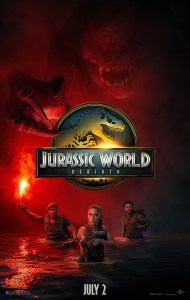
“Rebirth” might be a bit optimistic in that title. The issue with the still-quite-popular Jurassic Park/World franchise is an ongoing lesson in diminished returns. Back in 1993, Steven Spielberg and special effects breakthroughs enchanted audiences on the peril of man’s hubris and the core love and undying appeal of dinosaurs getting to be wrecking machines. Thanks to the marvels of modern big-budget blockbusters, we can bring realistic dinosaurs back to life for perilous adventures in survival, but much like the famous line, the producers eager to crank out a new Jurassic movie every so many years only focused on whether they could and not whether they should. The movies are still significant moneymakers; the worst film in the franchise, 2022’s Dominion, still made over a billion dollars at the global box-office. Just imagine how much that could have raked in if it was actually, you know, good. Jurassic World touched upon the nature of diminished returns through satire, that audiences that were once wowed by the very presence of real dinosaurs have grown bored and need more to capture their flagging interest. Since then we’ve had a movie about dinosaurs eating the rich in a haunted house-style horror-thriller and a nostalgic-heavy conclusion that was more about giant locusts and far less about dinosaurs cohabitating with mankind. The interesting storyline (man co-existing with dino) has been there for multiple movies, and yet the producers keep neglecting that glorious potential. Now here comes Jurassic World: Rebirth, another attempt to keep this franchise chugging along with more mediocre sequels that have fleeting moments of popcorn thrills. Ultimately, it’s a bit more of the same, and like the characters in this world, I too am growing restless.

There are two groups of characters that we follow. The first is a clandestine science team funded by a large pharmaceutical company looking to create the next big drug as a result of studying dinosaur blood and tissue. This is the familiar movie world of quippy security experts and ex-CIA agents and panicky scientists thrust into danger in the field. The other group is a family going on a sailing trip through… dinosaur-infested waters for some reason. The first group is on a mission. The second group is just trying to survive, and possibly for the teen daughter’s boyfriend to grow on her skeptical father.
Rather than reinvention, Rebirth is once again more of the same old same old. There can still be intrigue and spectacle from simply interacting with living dinosaurs brought to life by the best special effects money can buy, so the Jurassic movies will never be without some level of primal appeal. There are some fun moments and sequences throughout Rebirth, but it’s hard to stitch together the whole movie from these minor pieces. I think the premise could have worked. The team on the mission has to track down and retrieve blood from the three biggest dinosaurs by habitat: one by land, one by sea, and one by air. There’s some flimflam excuse that these creatures have the biggest hearts and therefore the live blood they extract blah blah, but it doesn’t really matter. The premise of having to track three of the biggest dinos in different terrains makes for an episodic but varied structure that is easy to follow and engage with. All along the way, we know what the total number needs to be and the progression provides mini-climaxes. It’s just that the retrieval of all of these is completed before Act Three. That’s right, it’s all done before the movie is supposed to get really climactic and intense. The land dino isn’t even a challenge, more just an attempt to recreate the majesty of when we first saw those plodding apatosaurs in 1993. This feels like a mistake, and each of the dino retrievals should be getting moderately harder to succeed. There should be escalation so that each one feels more like an accomplishment with the team getting better not worse.

So what could be Act Three? Well you see, dear reader, this is yet another new island. I can already hear you asking how many islands there are, and the answer is however many the studio needs. This island could have been nicknamed Monster Island because it was the dinosaur experimentation labs. Here’s where the InGen scientists threw darts at a board and said, “What if you mixed a [anything] with a raptor?” That seemed to be their go-to for these sequels. We’re introduced into mutant T-Rex in the opening, presented like a monster lurking in the shadows, and then we come back to our giant lab-designed monstrosity. Except this is the silliest looking dinosaur mutant. I laughed out loud when I saw its full form. It made me think of the xenomorph and human hybrids from Alien Resurrection. Its head is so bulbous like he’s part mushroom, but there’s no contours or anything menacing like spikes or something evolutionary useful. It’s just a big goofy head. This is the kind of dinosaur that would be made fun of by the other dinosaurs who snicker when his considerable back is turned. It has larger forearms but walks with them like a hunched gorilla. A T-Rex was already frightening because of its size, as evidenced during one of the movie’s better sequences where a normal T-Rex chases after the beleaguered family in a raft. This just made the T-Rex’s head comically oversized, like somebody glued a shower cap on this guy. This guy has a bigger head but it doesn’t mean bigger brain. It makes for a rather perfunctory and silly ending fighting against a disappointing dino Frankenstein. We shouldn’t have held our expectations too high considering this mutant’s lab breakout all stems from a lone Snickers candy wrapper getting loose.
The characters are also pretty disposable and strictly archetypal. Scarlett Johansson (Fly Me to the Moon) is the lead as our quippiest ex-CIA agent, more or less playing a version of her Marvel persona. She has a slight arc about joining the mission for the money and being convinced by the idealistic head scientist (Jonathan Bailey) to release the medical information to the entire planet. I don’t think this is as hopeful as the characters think because it seems like you’re also making it so plenty more mad scientists have access to dino DNA to make their own at-home Jurassic Parks. The other lead character is played by Mahershala Ali (Leave the World Behind) as the boat captain who provides the movie with the most disposable of characters so that the dinosaurs have something to feed upon. It doesn’t seem like a coincidence that the one lost family is gifted a dinosaur baby that they trot around like an adorable puppy. That thing’s going to get extremely big and I don’t know if anybody is going to be able to pick up after it. I wouldn’t say any of these characters are memorable or even that likeable, mostly stars coasting on charm autopilot.
I didn’t know where else to put this but I loathed every time the Jurassic Park musical themes would start to trinkle into a scene, especially since so many of them are perplexing. Why would you insert that familiar theme over this scene? It’s intrusive, tone deaf, and just a bizarre creative choice.

It’s hard to really see the added value of returning veteran screenwriter David Koepp (Black Bag) and new director Gareth Edwards (Godzilla, The Creator). This whole enterprise feels a bit like a runaway train rushing to meet its release date deadline. The development needed for a relaunch seems to go by the wayside so that we can squeeze in more set pieces, and I suppose two sets of characters equal always having a new and fraught action sequence we can jump to. It’s just that everything feels so rote and familiar, so much of the same kinds of thrills and chills we’ve gotten from the previous six movies. The most exciting development across these new movies since 2018 has been the reality of humans having to adapt to an Earth with dinosaurs in our ecosystems, and yet this again is hand-waved away in exposition that limits the dinosaurs to a much smaller band of the Earth. Turns out they only really live around the Equator now. Okay, if that’s the case, then tell me a story from that setting. It can still be done. Jurassic Park: Rebirth doesn’t feel like the start of something new or exciting or even promising. It feels like more of the same, sliced and cut up with different actors getting their turn to make frightened faces. It’s not as bad in design or execution as Dominion but Rebirth is no more than more of the same.
Nate’s Grade: C
Share this:

Ballerina (2025)
 It’s a John Wick spinoff that tests whether or not the franchise can extend itself without John Wick. Then the producers got a little nervous and re-shot the movie extensively, adding extra John Wick (Keanu Reeves) scenes and even a clunky title to remind all those forgetful viewers: From the World of John Wick: Ballerina (not to be confused with, From the World of Jurassic World). Taking place between Wicks 3 and 4, Ballerina follows another formidable assassin kill lots of people until finally toppling a boss at the top and fulfilling their personal vengeance. The aforementioned dancer is Eve (Ana de Armas) who is the daughter of assassins and whose father was killed by assassins so she trains to be an assassin and thus kill the assassins that assassinated her father for wanting to step away from being an assassin. The plot is less important than the action combat, and while Ballerina doesn’t rise to the rhapsodic levels of action nirvana from its franchise forebears, it does have consistently entertaining action choreography and development. It’s a good movie with a few moments of greatness, like a kitchen battle that makes clever use of everything in range and a climactic flamethrower vs. water hose battle for the ages. I enjoy that Eve is still vulnerable. She’s deadly but she still makes mistakes, can slip and fall and make the wrong moves in fights, providing the sequences better stakes and intrigue over how she exactly will overcome her latest obstacles. de Armas (Blonde) takes up where she left off in 2021’s No Time to Die and proves herself an adept physical performer of action. It’s a decent mid-tie action movie that throws more world-building nonsense at the wall that you can tune out. There are other Wick cameos from Ian McShane, Angelica Huston, and the late Lance Reddick who died in 2023. Ballerina can scratch that John Wick itch (now with extra John Wick) for fans but I don’t know if it deserves a second dance.
Nate’s Grade: B-
Share this:

Superman (2025)
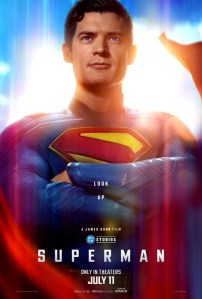 Has the world ever needed Superman more? I don’t know about you, but I could really use a symbol of good right now who represents the best of us, fighting for justice and protecting the innocent against the diabolical in power that seek to profit and prey upon the vulnerable. Vulture film critic Allison Wilmore has a fantastic headline for her review: “Superman [the movie] isn’t trying to be political. We just have real-life super villains now.” James Gunn, the quirky filmmaker who made us fall in love with a raccoon and a tree in the Guardians of the Galaxy trilogy, ascended to be head of DC movies in 2022, and he eyed reigniting Superman as the top priority, selecting himself as writer and director. It’s a lot of pressure to rebuild the DC movie brand by yourself, as there are only two other movies with scheduled release dates currently. This movie could make or break the fledgling DC Universe (DCU) rebuild soon after the smoking demise of the DC Extended Universe (2013-2023), informally dubbed the Snyderverse. Fortunately, Gunn’s take on the boy in blue is a reminder why this character has lasted so long and why the world still needs a symbol of hope.
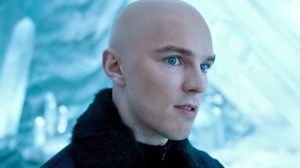
Superman (David Corenswet) a.k.a. Clark Kent, has been a defender of Metropolis for three years now. He’s romantically involved with ace reporter Lois Lane (Rachel Bosnahan), who knows his secret identity but still chides Clark on somehow getting all those “exclusive interviews” with Superman. He’s also been a thorn in billionaire industrialist Lex Luthor’s (Nicholas Hoult) side and become an obsession of his. The world is still debating Superman’s unexpected intervention, thwarting a powerful military from invading its neighbor’s sovereign border (very reminiscent of Russian aggression). The U.S. government needs actionable proof that Superman is a threat, and Lex is determined to eliminate the alien for good.
 Amazingly, this movie feels like the second in a series rather than a reboot kickoff. From the opening text, Gunn drops us into this world already in progress. We’re skipping over the origin story, the character introductions, and all the table-setting that comprises many first films in franchises. It’s usually that second film that really takes advantage of the setup and patience of the first movie, expanding the world and deepening the character relationships and conflicts. Gunn has mercifully skipped over all that and gotten us right to the good stuff. The opening minutes of the movie drop us into a super-powered battle with the declaration that this is the first time our Superman has lost, and that beginning follows the most powerful alien on Earth having to patch up his injuries. I think that’s a very intriguing first impression, but I’ll detail more of that in a later paragraph. The world that Gunn establishes already feels well underway but the story is still accessible and the supporting characters have meaning within this world. This is a world that has been used to super heroes, a.k.a. metahumans, for some time, so when Superman finally dons his red underwear it’s not a complete shocker. This is not necessarily a reality where one super-charged character has reconfigured mankind’s entire sense of identity. The world is accustomed and adapted to extraordinary figures and monsters. This is where the Justice Gang comes in (Green Lantern, Hawkgirl, and Mr. Terrific). They’re the corporate supes, the ones called in to sign autographs, smile for pictures, and save the day for good P.R. Perhaps that’s too flippant, but the trio of established heroes doesn’t feel the same call to activism like Superman. It’s hard to fully articulate, so bear with me dear reader, but Gunn’s Superman already feels fully established, with the figure known, his relationship with Lois already in play, and Lex having already put nefarious time, research, and lots of money into combating this super obstacle with his own lethal experiments. With Gunn, there’s no time to waste. It’s already fully formed from his imagination, and the parts have their reasoning and meaning, making the whole much more satisfying.
Another way to differentiate this Superman is less from his strength than his vulnerabilities. This is a character long regarded as overly powerful, too indestructible and therefore lacking realtability. Well with Gunn’s version, here is a Superman that gets beat up. A lot. Ben Affleck’s Batman pointedly asked Henry Cavill’s Supes, “Do you bleed?” Gunn has answered in the affirmative. Much like Matt Reeves’ 2022 Batman, we get a work-in-progress superhero that is still feeling out how to best be a superhero. It’s a version that takes lots of lumps and Gunn finds interesting ways to test Superman’s limits, both emotionally and physically. The introduction of nanites into orifices certainly provides nods to Gunn’s body horror roots. While this is a Superman that gets knocked around quite a bit, his biggest vulnerability is his doubt. He’s simply trying to do good and save lives regardless of the political ramifications, but the world and its people, and especially their fears and paranoia of an Other, are more complicated. Superman explains he intervened in an international border war for the simple reason of saving lives. When Lois pushes him in a practice on-the-record interview, during one of the better scenes, about his decision-making, thinking through the consequences, consulting with world leaders and the like, he gets flustered and says there wasn’t time. All he wanted to do was save lives that would have been lost, so why is the rest of the world having a hard time with that? Over the course of those two hours and change, we watch this Superman battle through his self-doubts in a very real and compelling way that I don’t feel like any other Superman movie has better demonstrated. This is a world already rife with heroes, but is it better with a Superman? Is his existence a net positive?
 Gunn truly understands the character in a way that Zack Snyder never did. With Man of Steel and the subsequent film appearances, we were given a Superman that didn’t really want to be Superman. He was an overburdened superior being tasked with serving as mankind’s savior, and came across as annoyed. That version of Pa Kent famously told his super son that it might have been best if Clark had just let a bus full of kids die to keep his secret. Thanks for the life lesson, dad, and oh, by the way, your sacrifice was ultimately meaningless when your entire worldview was proven wrong by the end of Man of Steel. Regardless, here is a Superman that is unabashedly sincere and even a little corny. That’s who this character is, a do-gooder wanting to inspire others and wanting to save all life, even the villains, even the wildlife (my theater took special note when Superman saved a squirrel from being crushed). Snyder’s Superman was part of an entire Metropolis 9/11 of horrible collateral damage disaster porn. Gunn’s Superman works hard to make sure the giant kaiju monster, when teetering over, doesn’t fall on any building to protect the people inside. This is also a Superman that feels compelled to be a hero, to do better with his super gifts, and to keep trying even when he fails, that there can be dignity in losing a fight but continuing on because you know that fight is worth it. The depiction of Superman/Clark makes him feel much more a character worth closer examination. He’s not a detached god feeling above these petty mortals always needing saving. The real super power is his empathy and desire to help others, and that may sound corny, but Superman is too, and that’s completely fine in a world that would be better if we had more Supermans and fewer wannabe super villains.
The big question for me was whether Gunn could adapt his cheeky, irony-rich goofball sensibilities from the Guardians movies and make a Superman movie that was earnest and restrained. He has, and let this be a lesson that Gunn does not disappoint when it comes to superhero projects. There are still unmistakable elements of Gunn’s humor and style, like the ironic distance from action serving as an extended joke while characters discuss an unrelated topic, the bouncy and specific needle-drops that cue extended fight or action sequences, and of course the quippy sense of humor. I don’t agree with some of the early reviews I’ve come across that accuse Gunn of undercutting his drama with too many jokes. That is exactly why I was afraid that Gunn would be too insecure with straight drama and earnestness that he would have to rely upon an awkwardly squeezed-in ironic joke to, in his mind, balance the tone. There are jokes, some of them wild and unexpected, but this is most certainly not a movie in the same tonal space as anything Gunn has done before either as a director or a screenwriter. I did not feel that the comedy ever undercut the stakes or the sincerity of the scenes and the movie as a whole. Gunn has shown he can re-calibrate his style and comedic voice while at the same time still making things his own without copious slow-motion. The action is refreshingly staged to be immersive, with few cuts and wide camera swings in order to present everything on the screen in an easily oriented field of vision.
 Corenswet (Pearl, Twisters) has some big tights to fill, as I would argue while there have been iffy-to-bad Superman movies there hasn’t been a bad Superman. Obviously the one that all others are defined by is Christopher Reeve who was the greatest special effect the original movie had (I know the flying sequences were groundbreaking for their time, but they play out so cheesy and dated, complete with sudden Margot Kidder poetic resuscitation). Watching him switch from suave hero to clumsy Earthling in a split-second was the best. Corenswet certainly looks the part, clean-cut All-American looks, even though he’s British. He really channels the character’s big heart with his struggle to be accepted, by the public, by the media, by Lois, by even his enemies. He’s got the presence to fill out that suit but the emphasis is not on the contours of his abs but on the unfailing dedication and goodness of a character trying to do right. He won me over early, and it doesn’t hurt hat he has terrific chemistry with Brosnahan, who has been readying herself for this part for years with The Fabulous Mrs. Maisel. She’s great too. Hoult (Nosferatu) channels his smarm perfectly as a very punchable Lex who might make you think about a certain DOGE-master and his team of flunkies wreaking havoc on the rest of the country through unchecked hubris. I loved his pettiness and thinly-veiled vanity, like during an approaching apocalyptic cataclysm and he says to screw the people of Metropolis. “They chose him, let them suffer.” It sounds a lot like, “Your state voted against me, so you won’t get immediate emergency assistance.” You will cheer hard for Lex’s defeat, even more so when his plan involves literal extra-judicial forever confinement.
However, the real brreak-out star of the movie will most certainly be Krypto, the adorably jumpy super dog. Every time this pooch makes an appearance it is welcomed and he’s utilized as more than just easy comic relief. I expect a sharp uptick in the number of good boys named “Krypto” afterwards.
 James Gunn has alleviated all of my fears about him tackling the Man of Steel, and he’s created a Superman that soars above the superhero field. It’s so vibrant and funny and accessible to anyone regardless of their prior feelings or understanding of Superman. It’s also a clear-cut example of what a Superman movie can and should be, sincere and bright and, yes, a little bit corny too. We need this character, and we especially need film artists that know how to craft engaging stories with this character who’s existed for almost 90 years. There’s an inherent lasting power to Superman, and it’s his sheer goodness as an outsider, a feared alien, who has all the powers in the world but just wants to help others. Many have long viewed Superman as boring, a Boy Scout in a world that has grown too morally murky to maintain such a morally unwavering figure of truth, justice, and the American way (what does that last part even mean any more in the bleak environment of 2025?). Gunn has shown us how necessary the character can be, a balm to our troubled times, and the reality that do-gooder figures can be inspirational and aspirational no matter the circumstances. He’s made a Superman movie with an intriguing, lived-in world, one that I now believe can easily support a fuller universe of stories and side characters. He’s also made what I consider the best Superman movie to exist yet (apologies to the nostalgia of the fans of the Richard Donner/Christopher Reeve originals). I have some minor quibbles, like how Lois fades into the background for the second half, but they are only quibbles. This movie was exactly what I needed. I’m sure there are millions of others yearning for the same. Superman is proof that the DC film universe might actually have the perfect person in charge of charting their cross-franchise courses. Kneel before Gunn.
Nate’s Grade: A-
Share this:

The Old Guard 2 (2025)
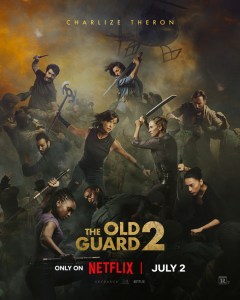
I wasn’t a big fan of the 2020 immortal action movie The Old Guard, but apparently it became one of Netflix’s most viewed movies, so here we are five years later with a sequel about the ancient conspiracy of warring immortals co-starring Chiwetel Ejiofor (not to be confused with Infinite, which is about an ancient conspiracy of warring immortals who are reincarnated into new bodies co-starring Chiwetel Ejiofor). I found the action and the general world-building to be underwhelming, but Old Guard 2 makes The Old Guard look like Michael Bay in comparison. There are two key developments in this sequel. Uma Thurman plays the first immortal and she wants to destroy the world or whatever. The second is that anyone injured by our newest immortal, Nile (Kiki Layne), loses their immortality. The rules of this universe get awfully hazy. I’m taking this directly from the film’s Wikipedia summary: “Additionally, anyone who has lost their immortality can regain their power by another wounded immortal who can transfer their power to the host they choose.” Still following? So we have one person who can make immortals mortal, but any mortal immortal can also choose to have their absent immortality bequeathed to a mortal immortal of their choice, reasserting their immortality. Okay. The confusing rules would be mitigated if we found any of the characters compelling. The sequel does bring back Andy’s (Charlize Theron) ex-beloved Quynh (Veronica Ngô) who was locked into an iron maiden coffin and dumped overseas. The established rules had immortals reawaken from death, so this poor woman would keep waking back up again only to drown instantly and repeat the horrifying process again. Let’s do the math here. On average it takes about two minutes to drown (FYI, I typed into Google “how long does it take to drown,” and now my computer is worried about my mental health). Let’s cut that in half from the extra water pressure filling her lungs. So let’s say she dies every minute. That means she dies 1440 times a day. Over the course of 500 years she has died 262,800,000 times. Rescuing this woman should be a recognition not just of her relentless suffering but the fact that her mind should be shot. Having to endure that horror would break anyone, and Andy coming to terms with her inability to heal someone who cannot die but is also unable to continue life any longer woukd be interesting. That’s my preferred sequel. Instead with The Old Guard 2 we get a bunch of lackluster fights and convoluted lore, and it doesn’t even offer a conclusion, more an implied hand-off to a third movie where the characters may indeed be able to finish what they’ve started. It’s time to let these mortal immortals just die in peace.
Nate’s Grade: C-
Share this:

KPop Demon Hunters (2025)
 I’ve watched KPop Demon Hunters four times in the last week on Netflix, so I may be a bit partial to it. Sony Animation’s newest genre-bending stunner is an action musical with surprising heart to ground the supernatural multi-dimensional battles between the forces of good and evil. Our main characters are the three young women who form the Korean pop group Huntrix; they play sold-out arenas by day and slay demons by night, working toward sealing a barrier that will protect mankind from soul-sucking demons. They meet their match when the demons form their own boy band, the Saja Boys. Handsome, charming, and media savvy, the Saja Boys begin pushing Huntrix out of the top spot and stealing their fans and their souls. It’s a cute premise buoyed by spry and colorful animation with terrifically designed and pleasing action sequences. It also helps that every song is an absolute banger, with some exceptional melodies and anthemic choruses. It may prove impossible to resist the songs, making those dastardly yet dreamy demons all the more likeable. What works just as well is the character work put into establishing the friendship between Huntrix, whose lead singer, Rumi, is keeping a secret that she is herself part demon. She finds herself drawn to Jinu, the leader of the Saja Boys, who seems more complicated than simply being a remorseless creature. He has plenty of real remorse and feeling, as Rumi has plenty of self-repression and shame, and they find the other more complex and mysteriously appealing as they feel out a possible romance. There’s a lesson here about self-acceptance and being open with the ones you love, and it’s effectively developed to the point that, during the grand climax, with the crowd chanting in unison with our ladies, affirming that solidarity, you too might get a little misty of the eye. That’s the amazing part of a movie literally titled KPop Demon Hunters: it can have you bopping your head one minute and drying your eyes the next. The animation can get exaggerated into cartoon comic absurdity (eyes literally pouring popcorn another person gobbles down), but it’s the sincerity and messages about acceptance and tolerance that rise highest. Plus there’s that music. It’s all such a vibrant blast, and it’s got the infectious jams of the summer all in a tight yet playful and poignant 90 minutes.
Nate’s Grade: B+


 nathanzoebl
You must be logged in to post a comment.