Daily Archives: March 14, 2025
The Electric State (2025)

The fire hose that has been the Netflix cash flow may be reigning in, but that didn’t stop the streaming giant from making another attempt at a huge blockbuster to rival those Hollywood designs for the big screen. The Electric State is a $320-million sci-fi adventure spectacle from the Russo brothers, Anthony and Joe, the team that gave us the highs of the Marvel Cinematic Universe (MCU) later Avengers movies, and the lows of, well, everything after their MCU movies. Netflix is actively trying to compete with the theatrical experience brought to you at home, so they take these big expensive swings on large-scale, quippy, action vehicles like Red Notice and 6 Underground every so often to mixed results. Netflix has become the go-to place for a kind of movie that has altogether vanished in the studio sphere, the mid-tier movie for adults. We need those stories. What Netflix hasn’t done as effectively is compete with the big studios for comparable expensive action spectacle. The Electric State is further proof.
In an alternate America, robots were created and given menial tasks by mankind. Naturally, they grew tired of this and attempted a revolution for their equal rights. Mankind was on the brink when an unlikely savior emerged. Tech CEO Ethan Skate (Stanley Tucci) created an army of humanoid drones controlled via VR helmets. This disposable army of avatars was able to beat back the robots and forced their leader, literally an animatronic Mr. Peanut (voiced by Woody Harrelson), to sign a “peace treaty.” The results exiled the robots into a walled off wasteland in the American southwest, and humanity went on its merry way, now with VR-controlled avatars that allowed every American the luxury of staying on their duff. Michelle (Millie Bobby Brown, contractually obligated to be in every Netflix original not starring Joey King) is an orphan WITH AN ATTITUDE. One day she’s greeted by a pint-sized robot looking like the Cosmo cartoon character her younger brother was obsessed with. The little robot says he is her brother and Michelle realizes that maybe she has some family left after all. She and the Cosmo bot are on the run from scavengers and bounty hunters trying to stop their fateful face-to-face reunion.

The Electric State is lacking such vital creative sparks to feel anything more than the ramshackle sum of its derivative sci-fi parts. It began as a melancholy mixed media book from the same Swedish author behind Tales From the Loop and it’s become a giant lumbering mess of mediocre and familiar elements. It kind of feels like the newer Ready Player One-era Steven Spielberg trying to emulate early E.T.-era Spielberg, but then that would give us an artist on the level of Spielberg, and that’s not what we have here. It’s standard adventure fare with a brother and sister crossing the country to save the day and thwart a big evil corporation along with scrappy, rakish rogues joining them along the way for fun and life lessons. Chris Pratt’s character is so transparently a Han Solo clone but he’s an empty vest with eye-rolling quips. This is an alternate history story with a literal robot uprising but it devotes so little interest in its own world building and history. The movie essentially castigates all the robots to a forbidden zone that naturally will be visited by our plucky heroes. The majority of the movie is watching these robotic avatars (reminded me of the Geth from Mass Effect) for people who can’t be bothered to leave their VR helmets. If this new world has devolved human interaction into a series of screens (commentary!) then maybe let’s explore that with meaning. If robots are going to be an exploited labor class (commentary!) then maybe let’s explore that too. If this is a future world where robots have been exiled and feared as an Other (commentary!) then let’s explore that too. There’s one moment where Evil Steve Jobs enjoys a VR recreation of his deceased mother, except he admits that this version is the version he wishes he had, and the real figure was far less doting and far more abusive. That’s an interesting concept, that VR offers users the ability to live in a reality of their own desires. But this isn’t a movie that wants to take time to explore interesting and relevant themes, because that would get in the way of action set pieces and goofy robot action. Seriously, there’s one fight where a U.S. postal service robot is literally hurling undelivered mail at a killer robot avatar and succeeds. Because this isn’t a deep movie, we have essentially good robots and bad robots, and if you’re shocked that the robots may have been misunderstood, well congratulations on seeing your first movie. I assure you, they mostly get better from here if you give them a chance.
The inclusion of robots is so underutilized, tapped for ready sidekicks and villains, that you could have replaced them with aliens or clones or any other disposable science fiction element. In this parallel world, Walt Disney created the robots for Disney World, so wouldn’t it be worthy of exploring that history and the sense of Victor Frankenstein-style paternal obligation? Wouldn’t the robots retreat to their ancestral home of Disney World? Or perhaps they view this as the birth of their enslavement? What about different generations of robots, especially older models being replaced with newer ones, thus creating class warfare within an exploited secondary class? What about looking at robots having to subsist off junk to continue with their meager existences? What about robots still living in forbidden zones that are hunted by the government and its armada of robot drones? There are so many possible ideas and stories and characters that are open through the inclusion of robots, but the movie doesn’t have the interest or drive to make them matter. As a result, it’s mostly a swift-moving travelogue with some ugly-looking or cranky guests riding shotgun. Occasionally The Electric State will remember, oh yeah, robots can do stuff people cannot, like having one of them hack into a server or having a smaller robot inside like a high-tech Russian nesting doll.
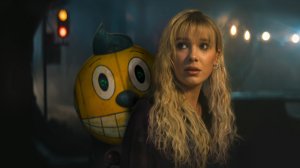
I think it was a combination of the uninvolved storytelling as well as the character design that left my emotional attachment to be null and void. I hated the Cosmo character design. He’s this big spherical head with little skinny limbs, but the head might as well be an un-moving mask. A giant toothy smile is drawn on the front and it’s so inexpressive. Also, the fact that the kid has to exclusively rely upon only using sound bytes from this canceled cartoon series makes for a quickly annoying little brother. I didn’t care about this kid, human or robot, and I didn’t care if Michelle ever reunited with her brother. Then the fact that the movie’s climax involves such a serious and emotional choice seems absurd considering what has been underdeveloped up until this abrupt shift in intended emotional stakes. It’s such an out-of-left field escalation that I almost laughed out loud at what the movie was asking me to feel, as well as what it was asking its protagonist to decide. Likewise, the betterment of robot-kind is given such little recognition, culminating in a showdown between the avatar of good robots and evil robots essentially going to revise a treaty that we don’t know much about. For a movie about how easy it can be to distance ourselves via technology, it sure fails to reasonably make the viewer care about robot equality.
Then there’s the fact that this whole enterprise cost an astounding $320 million for Netflix to platform it as its next hit movie to doze off to while in the middle of doing laundry. The Russo brothers have retreated back to Marvel to handle the next two Avengers movies, and it seems like at a time where both parties have missed and could use one another. Outside of Marvel, the Russos have delivered one super expensive action movie (The Grey Man), a super expensive spy action series (The Citadel), and one lackluster biopic that used every Scorsese stylistic trick they’ve been saving up (Cherry). With The Electric State, we have the brothers’ more familiar mixture of large-scale action and special effects in a mass appeal studio blockbuster space. However, every movie outside of Marvel has made me question their capabilities of handling these big movies. I know the Russos can be fantastic with comedy, as some of their TV episodes are the best of recent memory, and their stewardship of the big MCU movies in the wake of Joss Whedon’s departure was undeniably successful. So why isn’t The Electric State successful? It comes down to the screenplay which is so disinterested in its own ideas, world, and characters, held together by the familiarity of other adventure blockbuster staples like loose chewing gum. It’s a movie replete with famous faces and big effects but feels so devoid of life and creativity, a blockbuster automaton intended to hold the attention but rarely engage one’s imagination and emotions.
Nate’s Grade: C


 nathanzoebl
You must be logged in to post a comment.