Monthly Archives: March 2025
The Monkey (2025)
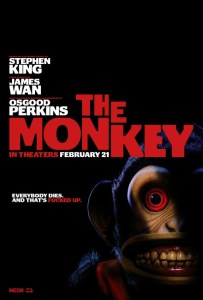 It was only minutes when I thought to myself, “I think I love this movie.” To be fair, this movie might only jibe for a very select few with a penchant for gory, outlandish horror and a demented sense of humor, but it just so happens that specific population includes yours truly. The Monkey is a dark comedy about the cruel indifference of fate disguised as a supernatural thriller adaptation of a Stephen King short story. It’s about two twin brothers (both played by Theo James as an adult) coming to terms with a family curse, a toy monkey that, when wound up, will beat its drum until the final blow correlates with the sudden, often shocking death of a random person. It’s essentially a death device and the brothers are haunted by it since losing both of their parents to it as teenagers, both grasping for meaning from their tragedy. One of them blames himself and the other blames his brother, and this has warped them into adulthood and how they view themselves, their responsibility as a parent, and their hostility to one another. The movie becomes a cagey reunion between the two brothers while also vying for power over a dangerous totem that loves elaborate Final Destination-style calamities. These deaths are over-the-top, often with bodies exploding in bloody heaps, and I found myself cackling along in response to the ridiculous violence. This is quite a change of pace for writer/director Osgood Perkins who just last year helmed the Satanic serial killer thriller Longlegs. Whereas that movie was a bit too lost in its slow-build atmosphere and a jumbled story burdened with underdeveloped plot elements, The Monkey is refreshingly straightforward and always entertaining in its contained madness. There are some bold and dark choices made and I appreciated every one of them. This is really a movie about trying to make sense of death and grief but it’s through the visage of spilled viscera and gallows humor. I didn’t think I’d walk away saying this, but I can’t wait to show my wife the movie about the killer windup monkey.
Nate’s Grade: A-
Share this:

Soul to Squeeze (2025)
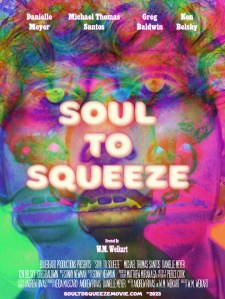
It’s been some time since I’ve reviewed an Ohio-made indie (having a baby and adjusting to a new job will do that). My goal has always been to discover the rare diamonds in the rough and to provide professional film criticism to these smaller-scale movies trying to make some noise. I’ve been doing this for a few years now and I’ll admit I haven’t found that many diamonds, so to speak. My wife has long since stopped watching these movies with me and declared me a masochist for continuing this quest. What can I say, I’m still hopeful to discover what Ohio filmmakers can do when given a platform. One such filmmaker, who has since relocated from Ohio to the City of Angels, is W.M. Weikart. I reviewed his 2019 short film Pure O and we have several mutual friends. He asked me to review his next project, a feature-length movie shot with some Ohio-bred talent in front of and behind the camera, so I’m considering Soul to Squeeze as Ohio-indie-adjacent. It’s a trippy, beguiling experience, and it’s one that will prove befuddling to some but is an experience that gets better with every additional minute.
The story itself is relatively simple. Jacob (Michael Thomas Santos, CSI: Vegas) is a young coed who agrees to be the subject of a mysterious experiment. He lives in a house for days and experiences a series of bizarre auditory and visual hallucinations, picking at his mind, memories, and hidden trauma that he’s been trying to ignore for years. Or are they actually hallucinations after all? Can his mind survive?

These experimental/psychological triptych kinds of movies hinge on a few points of potential viewer engagement. First, the most obvious is simply being interesting and memorable in its weirdness. If you’re going for a crazy sensory experience, it helps if there’s actually something crazy worth watching. This was one of my biggest issues with the 2023 horror indie Skinamarink, a strange nightmare that mostly felt like the same ten boring images jumbled around for 80 very tedious minutes of dashed hopes. There’s only so much formless imagery I can watch without some larger connection, and if your movie is going to live or die based upon your outlandish nightmare imagery, then you better rise to the challenge. Skinamarink did not. Thankfully Soul to Squeeze has a larger agenda that reveals itself over the course of its 80-minute running time. We have a character trying to hide from some trauma he’d rather ignore, so we know this experience will force him to confront those feelings and, hopefully, find some way to process his intense emotions and come out the other side a better person. Or it will drive him completely mad. Either storytelling path offers intrinsic entertainment value. There’s purpose under the imagery so it’s not all abstract nonsense waiting for someone else to project meaning onto the disconnected pieces.
Now, it takes a little long to get going to begin to reveal that trauma and that connectivity. For the first forty minutes, weird things are going down without much in the way of a larger set of rules, which could have benefited the engagement, such as disturbing or confounding visions happening between certain hours of the day, allowing our protagonist time to anxiously dread their arrival. Or there could be an escalation in the intensity of the visions and their duration. There could also be the question over whether the visions are real or not, especially if they’re occurring after he’s forced to eat the provided food in the house. Perhaps he even tries to abstain from eating to then discover they still come like dreadful clockwork. Unraveling past residents of this experiment could also foretell what possible fates, both helpful and harmful, could await. Our protagonist could also try and escape as the visions get more personal and find he cannot escape. The character could be a little more active. Jacob seems very compliant for a wounded character undergoing psychological experimentation, which begs the question why he would continue with this treatment after it begins picking away at the secret he doesn’t want to face. There are other directions that the main character could have gone through while we waited for the larger thematic clarity to come into focus with the visions after 40-minutes of atmospheric noodling.

When you’re going for a more experimental narrative with heavy visual metaphors, it can be tricky to find a balance between arty and pretentious, or, to put it in other words, between David Lynch and student films. This balance is tipped toward the latter early, especially when I think a blue flower comes to life and is… a French woman… spouting platitudes before turning back into a flower. It’s stuff like that which can seem a little daft but without the intention of weird humor. In contrast, there’s a strange but amusing scene where our character comes across a sitting mermaid on display in a museum. She literally eats a pearl necklace from Jacob’s hands and then smiles mischievously as it reappears around her neck, now her own possession. There is a larger metaphorical connection here that’s revealed later, with the necklace having a connection to Jacob’s traumatic past and even the concept of the mermaid too. There’s a phone conversation that we get both sides of that ends up starting as one of the earliest points of confusion and agitation for Jacob and then, by its return, serves as an unexpected vehicle for our protagonist’s emotional growth and reflection. It’s a clever and rather satisfying creative boomerang.
Soul to Squeeze impressively masks its low-budget nature through creative choices and elevated technical craft. Weikart has a natural eye for visual composition and lighting especially, so there’s nary a moment where the movie isn’t at least appealing to the eyes. Having a director who can frame an engaging shot is a godsend when you’re primarily going to be stuck in a single location for 80 minutes. A smart and talented visual artist can really hide the limitations of a low budget well. This is also by far one of the best sounding low-budget indies I’ve heard. The sound mixing is impeccably professional and the score by Sonny Newman (Burn the Witch) is very pleasant and evocative and soothing when it wants to be. Sound design is one of the biggest areas that holds back so many micro-budget film productions, and it’s so refreshing to have a movie not only where sound has been given great attention but also incorporated into the presentation and experiences in meaningful and artistic ways. The visuals can be rather eye-catching, like when Jacob’s TV transforms into a multi-screen monster where eyeballs and a giant mouth take up residence on the various screens, and aided by a slick sound design, it all allows the sensory experience to be even more compelling and accessible. As the film progresses, the bigger picture comes into focus, which means more exposition is thrown at the viewer. Weikart and his team cleverly find ways to present the information through a series of sufficient images and sounds that imply plenty with minimal (some of the sound and picture arrangements can take on a certain true crime dramatic recreation feel). I don’t have a final budget number but it looks better than many indies I’ve seen with considerably higher budgets.

There is one very significant technical choice that I wish had been more essentially incorporated into the story of Soul to Squeeze. As its promotional materials declare, this is the “the first film ever to have a continuously changing aspect ratio throughout the entire film. It begins in a 4:3 aspect ratio and expands out to a 2.35:1 by the end.” For the layman, that means throughout the film the aspect ratio is changing from the old boxy TV standard to a wider and wider widescreen. Now, you could make an argument that this is meant to represent the progression of Jacob’s thinking, that his world is literally expanding, but if that’s the case it feels a little too metaphorical to land as an essential tool for this story to be told at its best. It’s kind of neat but ultimately feels more like a gimmick. Perhaps the nights could have been labeled sequentially, and with each additional night the aspect ratio alters, expanding the horizons. You could even make it a Wizard of Oz motif, with Jacob opening a door and coming out the other end with a different aspect ratio to communicate the transition to a new plane of thinking and reality. Without calling more attention to its changes, and without connecting it more deliberately with the onscreen action, it becomes only a slightly noticeable visual choice over time that may go ignored by most.
By design, Soul to Squeeze is meant to be mystifying and experimental, which will try some people’s patience if they don’t find the ensuing imagery and weirdness to be entertaining. I wish there was more of what I appreciated in the second half to be present in the first half, and I’ll freely admit that I might have missed some of those clues and connective tissue just due to the strange and abstract nature of the movie. I was never bored and often amused at the various ideas that animate the movie (a game show host narrating breakfast is quite surreal and hilarious). The movie looks good, sounds good, and moves along at a fitting pace. The biggest gripe I have with these kinds of movies is whether it will ever add up to anything or is every moment just another in a chain of interchangeable weirdness? With Soul to Squeeze, there is a connection to much of the imagery and hallucinations, so there is a larger design that coalesces. I think there are some specifics that would have potentially aided the overall experience, but adding specificity could deter the immersion and grasping for understanding desired from these kinds of movies. Soul to Squeeze might not be that quintessential diamond in the rough I’m in search of with these Ohio (and Ohio-adjacent) indies, but it’s still a professionally made, creatively engaging, and fairly entertaining curio that can surprise at a moment’s notice.
Nate’s Grade: B
Share this:

Flow (2024)
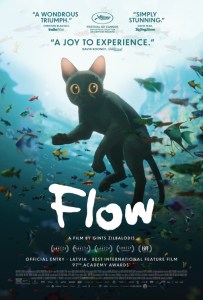 The international animation sensation from Latvia surprised the world by besting big movies from big studios to win the Academy Award for the Best Animated Movie of 2024. Flow is a wordless fable about a group of animals trying to survive in a flood-ravaged world bereft of humans. The presumptive main character is a small black cat who befriends an alliance of a Labrador, a lemur, a large bird, and even a capybara. They float around on a sailboat and take turns relying upon one another. The animation style is dream-like and painterly from Blender, a free open-source 3D software tool. There’s a sweetness to the movie that doesn’t dip into maudlin territory; it’s like Homeward Bound minus celebrity voices. However, the movie is also a bit airy and lackadaisical in its pacing. There are many sequences of the cat just observing the view underwater, and there are segments that get very abstract and metaphorical that can be confusing. The movie also ends in a very, “Oh, that’s it?” kind of fashion. Without broader characterization, we’re watching animals essentially be animals. While this doesn’t mean they are undeserving of empathy, I kept wondering if maybe we were headed for a Life of Pi-style allegory. It’s quite often a beautiful movie to watch, and I celebrate this little underdog animated movie getting the kind of platform and acclaim that larger animation houses take for granted, but it left me a bit cold. It’s an easy movie to appreciate with its mature themes and surreal imagery, but I wanted more to engage with.
Nate’s Grade: B-
Share this:

The Electric State (2025)

The fire hose that has been the Netflix cash flow may be reigning in, but that didn’t stop the streaming giant from making another attempt at a huge blockbuster to rival those Hollywood designs for the big screen. The Electric State is a $320-million sci-fi adventure spectacle from the Russo brothers, Anthony and Joe, the team that gave us the highs of the Marvel Cinematic Universe (MCU) later Avengers movies, and the lows of, well, everything after their MCU movies. Netflix is actively trying to compete with the theatrical experience brought to you at home, so they take these big expensive swings on large-scale, quippy, action vehicles like Red Notice and 6 Underground every so often to mixed results. Netflix has become the go-to place for a kind of movie that has altogether vanished in the studio sphere, the mid-tier movie for adults. We need those stories. What Netflix hasn’t done as effectively is compete with the big studios for comparable expensive action spectacle. The Electric State is further proof.
In an alternate America, robots were created and given menial tasks by mankind. Naturally, they grew tired of this and attempted a revolution for their equal rights. Mankind was on the brink when an unlikely savior emerged. Tech CEO Ethan Skate (Stanley Tucci) created an army of humanoid drones controlled via VR helmets. This disposable army of avatars was able to beat back the robots and forced their leader, literally an animatronic Mr. Peanut (voiced by Woody Harrelson), to sign a “peace treaty.” The results exiled the robots into a walled off wasteland in the American southwest, and humanity went on its merry way, now with VR-controlled avatars that allowed every American the luxury of staying on their duff. Michelle (Millie Bobby Brown, contractually obligated to be in every Netflix original not starring Joey King) is an orphan WITH AN ATTITUDE. One day she’s greeted by a pint-sized robot looking like the Cosmo cartoon character her younger brother was obsessed with. The little robot says he is her brother and Michelle realizes that maybe she has some family left after all. She and the Cosmo bot are on the run from scavengers and bounty hunters trying to stop their fateful face-to-face reunion.
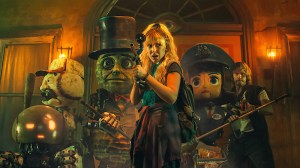
The Electric State is lacking such vital creative sparks to feel anything more than the ramshackle sum of its derivative sci-fi parts. It began as a melancholy mixed media book from the same Swedish author behind Tales From the Loop and it’s become a giant lumbering mess of mediocre and familiar elements. It kind of feels like the newer Ready Player One-era Steven Spielberg trying to emulate early E.T.-era Spielberg, but then that would give us an artist on the level of Spielberg, and that’s not what we have here. It’s standard adventure fare with a brother and sister crossing the country to save the day and thwart a big evil corporation along with scrappy, rakish rogues joining them along the way for fun and life lessons. Chris Pratt’s character is so transparently a Han Solo clone but he’s an empty vest with eye-rolling quips. This is an alternate history story with a literal robot uprising but it devotes so little interest in its own world building and history. The movie essentially castigates all the robots to a forbidden zone that naturally will be visited by our plucky heroes. The majority of the movie is watching these robotic avatars (reminded me of the Geth from Mass Effect) for people who can’t be bothered to leave their VR helmets. If this new world has devolved human interaction into a series of screens (commentary!) then maybe let’s explore that with meaning. If robots are going to be an exploited labor class (commentary!) then maybe let’s explore that too. If this is a future world where robots have been exiled and feared as an Other (commentary!) then let’s explore that too. There’s one moment where Evil Steve Jobs enjoys a VR recreation of his deceased mother, except he admits that this version is the version he wishes he had, and the real figure was far less doting and far more abusive. That’s an interesting concept, that VR offers users the ability to live in a reality of their own desires. But this isn’t a movie that wants to take time to explore interesting and relevant themes, because that would get in the way of action set pieces and goofy robot action. Seriously, there’s one fight where a U.S. postal service robot is literally hurling undelivered mail at a killer robot avatar and succeeds. Because this isn’t a deep movie, we have essentially good robots and bad robots, and if you’re shocked that the robots may have been misunderstood, well congratulations on seeing your first movie. I assure you, they mostly get better from here if you give them a chance.
The inclusion of robots is so underutilized, tapped for ready sidekicks and villains, that you could have replaced them with aliens or clones or any other disposable science fiction element. In this parallel world, Walt Disney created the robots for Disney World, so wouldn’t it be worthy of exploring that history and the sense of Victor Frankenstein-style paternal obligation? Wouldn’t the robots retreat to their ancestral home of Disney World? Or perhaps they view this as the birth of their enslavement? What about different generations of robots, especially older models being replaced with newer ones, thus creating class warfare within an exploited secondary class? What about looking at robots having to subsist off junk to continue with their meager existences? What about robots still living in forbidden zones that are hunted by the government and its armada of robot drones? There are so many possible ideas and stories and characters that are open through the inclusion of robots, but the movie doesn’t have the interest or drive to make them matter. As a result, it’s mostly a swift-moving travelogue with some ugly-looking or cranky guests riding shotgun. Occasionally The Electric State will remember, oh yeah, robots can do stuff people cannot, like having one of them hack into a server or having a smaller robot inside like a high-tech Russian nesting doll.
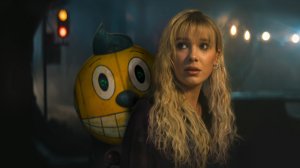
I think it was a combination of the uninvolved storytelling as well as the character design that left my emotional attachment to be null and void. I hated the Cosmo character design. He’s this big spherical head with little skinny limbs, but the head might as well be an un-moving mask. A giant toothy smile is drawn on the front and it’s so inexpressive. Also, the fact that the kid has to exclusively rely upon only using sound bytes from this canceled cartoon series makes for a quickly annoying little brother. I didn’t care about this kid, human or robot, and I didn’t care if Michelle ever reunited with her brother. Then the fact that the movie’s climax involves such a serious and emotional choice seems absurd considering what has been underdeveloped up until this abrupt shift in intended emotional stakes. It’s such an out-of-left field escalation that I almost laughed out loud at what the movie was asking me to feel, as well as what it was asking its protagonist to decide. Likewise, the betterment of robot-kind is given such little recognition, culminating in a showdown between the avatar of good robots and evil robots essentially going to revise a treaty that we don’t know much about. For a movie about how easy it can be to distance ourselves via technology, it sure fails to reasonably make the viewer care about robot equality.
Then there’s the fact that this whole enterprise cost an astounding $320 million for Netflix to platform it as its next hit movie to doze off to while in the middle of doing laundry. The Russo brothers have retreated back to Marvel to handle the next two Avengers movies, and it seems like at a time where both parties have missed and could use one another. Outside of Marvel, the Russos have delivered one super expensive action movie (The Grey Man), a super expensive spy action series (The Citadel), and one lackluster biopic that used every Scorsese stylistic trick they’ve been saving up (Cherry). With The Electric State, we have the brothers’ more familiar mixture of large-scale action and special effects in a mass appeal studio blockbuster space. However, every movie outside of Marvel has made me question their capabilities of handling these big movies. I know the Russos can be fantastic with comedy, as some of their TV episodes are the best of recent memory, and their stewardship of the big MCU movies in the wake of Joss Whedon’s departure was undeniably successful. So why isn’t The Electric State successful? It comes down to the screenplay which is so disinterested in its own ideas, world, and characters, held together by the familiarity of other adventure blockbuster staples like loose chewing gum. It’s a movie replete with famous faces and big effects but feels so devoid of life and creativity, a blockbuster automaton intended to hold the attention but rarely engage one’s imagination and emotions.
Nate’s Grade: C
Share this:

Mickey 17 (2025)
 Bong Joon Ho is one of those filmmakers that has earned the right to make any movie he wants. Hollywood might not feel the same, but the filmmaker behind Snowpiercer, The Host, and the triumphant Oscar-winning Parasite, the first time an international movie won Best Picture, is an amazingly versatile storyteller who seamlessly blends different genres and tones into unique and mesmerizing film experiences. If he’s interested in telling a story, then that guarantees I’m interested in watching it. This is especially true if he steps into the realm of science fiction. After the worldwide success of Parasite, Bong Joon Ho was given $100 million dollars and final cut from a big studio to make whatever he wanted, and he chose an adaptation of Edward Ashton’s novel, Mickey 7, telling the story of the world’s most/least fortunate expendable in a fledgling space colony. I read the book last year and it was quite good, so my anticipation was even higher for the feature film Mickey 17, especially after Warner Brothers delayed the movie an entire year. Now, after the long wait, we can all finally enjoy Bong Joon Ho with peak artistic freedom, a position that will likely not be repeated. It’s a grand movie with big ideas, vision, satire, and also enough underutilized ideas and distracting characters and performances to quibble over “what if’s.”
In the distant future, Earth is overrun in population and low on natural resources, so the next space race is to find habitable colony worlds. Mickey (Robert Pattinson) gets in over his head to shady loan sharks and looks for any possible way off of the planet. The only position he can sign up for is that of an expendable, a person who can be cloned from a biological printing machine. These expendables are put in dangerous jobs and different science tests because, well, if they die, you can start over. It’s a terrible job, one that involves dying repeatedly, and Mickey agrees to be the human crash test dummy. He’s on a multiyear colony ship traveling across space to find a habitable world. The planet they land on is bitterly cold, impossible to farm, and crawling with its own crawly wildlife. Mickey 17 is left for dead after falling down a chasm but he survives, trudges back home, only to discover another Mickey in his bed. They’ve assumed Mickey 17 died and already printed out his replacement. There’s a rule about there not being multiples and, if discovered, both expendables would be killed. They have to hide their secret and work together while still vying for dominance over one another and staying out of the crosshairs of buffoonish yet powerful political leaders Kenneth Marshall (Mark Ruffalo) and his wife, Yifa (Toni Collette).
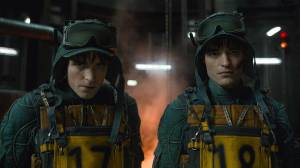 Mickey 17 is a smart, weird, and consistently fun and thoughtful movie. It doesn’t waste any time getting started, literally with Mickey 17 on the cusp of dying with his looming interaction with the aliens. Bong Joon Ho adapted the screenplay and has a nimble way of dealing with the conflicts and setting. I appreciated that he doesn’t prolong different storylines beyond their point of interest. He’s always got another development or joke or set piece to provide. There’s a fun sense of discovery with the movie as well as satisfaction to watch how he slides all the pieces into place. I appreciated how he imbues character notes so easily with supporting characters, giving this universe a larger personality that resonates. I love the setting and the reality it presents of a long-voyage space colony fighting for resources and struggling to keep the lights on. The sets and photography are gorgeous to behold but also filled with details to help make the world feel lived-in. I loved that even in the far-flung future, technology can still work in fits and starts, like watching Mickey slide out of the printer conveyor belt only to lurch backwards before going forward again, like the printers of the 1980s. I love the alien creature design that resembles an armadillo crossed with the subterranean worms from Tremors. I loved how they were able to defend their queen/mamma in Act Three. I love the goofy comic flourishes too, like the fact that there’s a guy just walking around in like a pigeon mascot costume that is never really explained. This is also the same movie where characters constantly ask Mickey what it’s like to die and you realize that every version of Mickey doesn’t know because he’s never experienced it personally, only born from the aftermath. The way this movie is capable of marrying big ideas with silly visual jokes and slapstick and explosions is impressive and a reminder that certain artists will prosper on big stages when given ultimate freedom. Come for the star power and slapstick, stay for the existential dread.
Pattinson presents another wildly weird performance that reminds me how exciting he is as an actor. He’s got these movie star good looks but he really wants to play all the weirdos he can with the most eclectic filmmakers, and I love it. His Mickey 17 and Mickey 18 may be constructed from the same DNA but they come across as vastly different iterations of our hero. This provides a more assertive version of Mickey to try and shape up our more passive Mickey into standing up for himself, taking chances, and taking charge when the situation calls for it. He’s like a mentor. Mickey 18 isn’t featured that often in the story, and truthfully he wasn’t featured that often in the book as well. It’s mostly the story of the hapless and whiny-voiced Mickey 17 and his journey of self. It’s a familiar yet enticing formula to watch a character gain agency and go from pushover to defender of the vulnerable. Pattinson finds little sparks to grab onto with the character, little pieces of weirdness that really help crystalize our understanding of Mickey. Of course the human lab rat would have the fight bred out of him through resignation, and it’s still gratifying to see him stay who he is while also rising to the challenge of the moment. In interviews, Pattinson has said that he modeled his two Mickey performances after the cartoon characters Ren and Stimpy. This actor is perfect for the wacky, tone-blending worlds of Bong Joon Ho. He’s game for everything.
 It’s not hard to see the entire enterprise as a crafty critique of capitalism, not exactly a new point in the Bong Joon Ho movie universe. Mickey’s value to his mission is the literal exploitation of his body. He’s callously tested upon for vaccines and weapons and whatever the scientists may cook up. Because they know they can download another Mickey, it changes how they view the current iteration: he’s not a person, he’s only whatever they want him to be at whatever moment. His value is what he can offer to them as a test subject, as a pile of flesh to be experimented upon. Therefore, the casual cruelty in the name of science and “progress” is yet another example of how we can easily dehumanize our fellow man in a system that profits from their labor and exploitation. Bong Joon Ho also provides a more compassionate view of the downtrodden Other, in particular the indigenous alien species on the colony world (to be fair, as is pointed out by another character, the humans are the actual aliens in this scenario). The creatures are viewed as unworthy of co-existence, in the way of man’s intergalactic manifest destiny, and so they must be wiped out for greater conquest. It’s not a huge surprise that the aliens might not be the stupid and scary creatures that they’ve been projected to be, and this is revealed very early when a collective herd saves the wounded Mickey 17. He views this as an insult, that he’s not even seen as worth eating, but the reading should be obvious to everyone in the audience. Thus we spend the rest of the movie for the other characters to realize the reality of these strange creatures. I did appreciate that the end of the movie coincides with a battle for primacy versus cooperation and compassion, which centers some of the major themes and ties the movie’s character arcs and significant messages together. Plus there’s also explosions.
And yet, there are ideas that could have been explored for even more depth and contemplation. There’s a very intriguing question concerning the different personalities of Mickey 17 and Mickey 18, which begs the follow-up question whether or not they are indeed one hundred percent replicas. Their personalities are such wild swings away from one another, with one being much more the laconic pushover and the other being the aggressive and assertive ideal Mickey. The next Mickey is built upon the recorded memories of the previous memories, so in theory there wouldn’t be many significant differences. However, the big personality differences are not explored or even questioned. This is a missed opportunity that could have gotten to something deeper philosophically and with the revelations of its world-building tech. Perhaps the cloning device doesn’t actually work as advertised and each new Mickey is a close proximity but there are minute yet distinct differences, meaning each new Mickey is his own person deserving of identity. This could then also further connect with the religious objection to cloning that one body should only have one soul. This could lead to Mickey 17, and even 18, debating whether or not they have souls of their own and their conception of life and sacrifice, being more than just the living equivalent of a punching bag. It could also bring into a spiritual element about possibly having a celestial reward after their extra-solar toils, at least the hopeful belief. There were real thematic qualities to explore and provide meaningful texture to the whole movie, and yet they’re disappointingly ignored.
 The Trump buffoonery avatar stuff is a little harder to take in early 2025 with the fallout of a second Trump presidency still having its far-reaching, chaotic, despotic consequences. The character and his wife are invented entirely for the movie by Bong Joon Ho, and clearly he had some things he wanted to say about the former and now-current president (there are even followers wearing those signature red caps). I just don’t know if there’s anything of real substance to this portrayal. He’s a cartoonish idiot villain overcome with vanity, ego, overconfidence, and craven manipulation, but there’s not much that is gained from his multiple appearances. Ruffalo is doing fine work jutting out his jaw and making sure to show those upper teeth as often as possible. It’s just that the character is an exaggerated all-purpose blowhard villain, and it makes for a character you desperately want to see brought lower, to be exposed as a fraud, to get their cosmic comeuppance. The problem is that the appearances are all hammering away at the exact same point that I began to tune Marshall out. In our current political landscape, with the intended target taking up every iota of oxygen in the public sphere, it just becomes another reflection point of the exhaustion felt from the Trump administration. One character verbally lambastes the political bully as a world-class idiot and says, “That’s why you lost the elections.” Plural. It’s then I recalled Mickey 17 was delayed a year, and this would have played differently for me in early 2024 than 2025.
There’s also a very late sequence I would like to analyze why it doesn’t quite work as conceived, but this will enter into some spoilers, so skip to the next question if you’d like to remain pure, dear reader. During the epilogue or coda, Mickey is seemingly remembering something from his past until it’s revealed to be a nightmare and thus having little consequence beyond insight into Mickey’s subconscious anxiety. In this nightmare, Mickey stumbles upon Yifa in the midst of her printing out a new version of her husband through the cloning machine. We’d been previously told that after her husband’s death that Yifa had been locked away and supposedly slit her own wrists. This raises the question whether the Yifa that we see at the machine is her or a clone, and that tantalizing possibility unlocks a new world of story for the movie that seems completely natural and essential. It’s the kind of twist hiding in plain sight that could have worked, that there were two Yifas at the same time there had been two Mickeys or long predating. This is because once you start thinking of this possibility it’s too obvious that it would happen. Of course the rich and famous blowhards who regard themselves as more important than others would see the expendable process as a means of living forever, or at least having a back-up plan. Of course the Marshalls would be hypocrites about their moral righteousness against cloning being an affront to God and creation. Of course these people would use whatever means they could to extend their power and their lives. Just like that, the very end of the movie has an extra layer to it that also provides more purpose for Yifa as a character. Then, just like that, it’s revealed as a nightmare, and all that intriguing possibility is wiped out, and I was left wondering why even produce this moment after the duplicating machine has been destroyed?
 Mickey 17 is an engaging, funny, enraging, and silly example of what science fiction can do. It can explore existential and essential questions about what it means to be human while also employing cartoonish slapstick, as well as cartoonish political satire. Not everything comes together smoothly; it’s a true jumble of tones and ideas, a Bong Joon Ho staple, but he’s typically so skilled at hiding the transitions and seams so you don’t even notice the genre movement until it’s already happened. There are intriguing directions and ideas I wish the movie had explored more, and the climax is a little conveniently tidy but suitably fitting as an invention for a showdown. As a reader of the novel, I can say that it’s an entertaining and fitting adaptation but also one that works on its own while I can still encourage people to read the novel. Mickey 17 is ambitious and messy and also very human, finding grace inside the darkness and absurdity. It’s not perfect but it is worth celebrating, just like each of the put-upon Mickeys.
Nate’s Grade: B+
Share this:

A Complete Unknown (2024)

I’m not really a Bob Dylan fan. While I can appreciate several of his songs, it’s his voice that has always put me off. An entire movie about the mystique of Dylan and his rise through the 1960s folk scene was never going to be too appealing for me. So keep all of that in mind as I tell you that A Complete Unknown is a thoroughly fine movie with the not-so grand insight that this famous troubadour might just be a talented prick. The end. Director/co-writer James Mangold returns to the musical biopic sub-genre almost twenty years after his Walk the Line (a non-Joaquin Phoenix Johnny Cash has a cameo in this movie too, securing the Boomer Music Cinematic Universe). It all feels very stately and staid and reverent and, especially during its climax, hopelessly quaint. The conclusion is over whether or not Dylan will play music at the Newport Folk Festival that the fuddy-duddy programmers demand. Will he go electric? Will he play traditional folk? Will you care? I suppose it’s about people trying to control and define this idiosyncratic artist who wants to be himself, whatever that may be, whatever feathers may be ruffled by the traditionalist gatekeepers of the folk music scene. This celebration of artistic integrity and creative revolution would mean a little more if I got a better understanding of Dylan as a person. Blessed with audience foreknowledge, we already know he’s going to be successful and that his creative impulses will be rewarded. Timothee Chalamet does a fine Dylan impression and recreates the famous songs with an impeccable nasally impersonation. For my money, I’d rather this have been a Pete Seger (Edward Norton) movie about his passing of the torch from one generation of folk artists to another and recognizing that the culture and peace movement were moving beyond him. Regardless, if you’re a Bob Dylan fan, there’s plenty to like, especially many extended jam sessions. If you’re looking for more than a handsomely recreated Best Of album, you might need to read a book instead.
Nate’s Grade: C+


 nathanzoebl
You must be logged in to post a comment.