Blog Archives
War Dogs (2016)
 As I watched War Dogs, the darkly comic true-life story of war graft, gunrunning, and bro-tastic bravado, I kept wishing to copy and paste other characters into what was an interesting plot. A pair of neophytes was awarded military arms contracts from the Pentagon during the Iraq War, and their schemes to skirt U.S. laws to import guns across borders, illegal and faulty munitions, and uneasily work as a go-between with a client (Bradley Cooper) on the U.S. terrorism watch list are filled with perplexing yet juicy details. The biggest problem is that the two main characters, played by Miles Teller and Jonah Hill, are so powerfully archetypal to the point of unrelenting blandness. We have the naïve everyman pulled into a life of big bucks, big risk, and big power only to have it all come crashing down. Hill’s character is the loud, uncouth part we’ve come to expect from the Oscar-nominated actor, and I defy anyone to tell me anything about Teller’s character other than occupation and his relationship to other people. These parts are so thinly drawn that I didn’t care about them once they finally got into deep trouble. I believe that director/co-writer Todd Phillips, he of The Hangover series, has the right qualifications to make a flinty neo-noir thriller, but War Dogs is more his half-hearted version of a glib Scorsese movie, or a David O. Russell version of a Scorsese movie. The voice over narration is dull and doesn’t help illuminate Teller’s character at all, and the other stylistic flourishes, from pointless inter-titles to a non-linear plot, add up to very little. Half of the movie’s scant jokes are the ongoing sound of Hill’s off-putting wheeze of a laugh. I’m not kidding, after an hour the movie still treats his laugh like it’s a potent punchline. There is entertainment value to be gleaned from War Dogs chiefly from its larger-then-life story and the intriguing, shadowy world of war profiteers. It’s a movie that made me wish I had read the magazine article it’s based upon instead, which would have also been shorter.
Nate’s Grade: C
Share this:

Free State of Jones (2016)
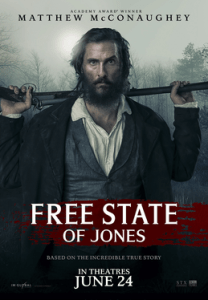 Well meaning and somberly recreated, Free State of Jones is a historical drama that wants to illuminate the story of Newton Knight (Matthew McConaughey) who deserted from the Confederate army and seceded from the very people who seceded from the United States. Knight and the people of Jones county Mississippi declared themselves independent and awaited the consequences. At first the Confederate army is annoyed, but as armed skirmishes increase and Knight’s team swells with poor farmers and runaway slaves, garnering Robin Hood-esque folk hero status, you’re expecting an escalating level of force that will doom Newton. We’ve seen this kind of historical drama before where men (usually men) of courage and politics ahead of their time are stamped out by the forces of oppression and we then celebrate their noble sacrifice. I kept waiting for Jones to go this route, and then (slight historical spoilers) the Civil War ends and instead the last half hour is an episodic history tour that includes the rise of the KKK, registering freed black men for voting, and early voter suppression acts. There is also a storyline strewn throughout that takes place in a 1940s Mississippi courtroom. At first you’re left scratching your head about the flash forwards, and then the connections come to bear. We’re watching Knight’s (great?) grandson and his legal troubles because the courts don’t know whether he’s the byproduct of Newton’s first wife (Kerri Russell), who left him, or his common law second wife (Gugu Mbatha-Raw), a former slave. It’s a storyline that just doesn’t really gel with the movie as a whole and really only serves to remind you that 100 years later Mississippi was still a pretty terrible place to live. Free State of Jones’ failure is that it doesn’t make this slice of history emotionally engaging. We don’t get a strong sense of whom Newton is as a person except for his 99% rabble rousing. His relationship with Mbatha-Raw’s character is the most engaging part of the film given its inherent conflict, and I’ll credit writer/director Gary Ross (Seabiscuit) with how restrained he is about dealing with her sexual abuse from slavery. The relationship is treated very tenderly and Mbatha-Raw aces her scenes. Also warning to dog lovers: there are several sequences of violence against man’s best friend that will be hard to watch. Free State of Jones works better as a history lesson rather than as a fully formed movie.
Nate’s Grade: C+
Share this:

13 Hours: The Secret Soldiers of Benghazi (2016)
 Michael Bay is the kind of filmmaker that naturally attracts negative attention and derision, so when he fast-tracked a movie about the Benghazi embassy attacks, and in a presidential election year too, there were plenty that cried foul. Bay’s not exactly known as the subtlest filmmaker, and many feared a Benghazi movie under his guidance would only reaffirm the worst. 13 Hours: the Secret Soldiers of Benghazi (a subtitle that never appears in the movie, by the way) is a surprisingly serious and generally apolitical action movie that reaffirms the strengths and weaknesses of Bay as a filmmaker.
On September 11, 2012, an armed mob stormed an American outpost in Benghazi, an attack that left four Americans dead. After Libya had toppled its decades-long autocrat, a power vacuum emerged and militants filled its place. An unclassified CIA annex in Benghazi was established to track the possible sale of munitions from the old regime. The CIA chief, Bob (David Constabile), has been forced to hire a security team of former Army Rangers and Navy Seals to protect his agents. Jack Silva (John Krasinski) is a family man reuniting with his old pal Tyrone “Rone” Woods (James Badge Dale), the head of the hired security team. The other guys (Pablo Schreiber, David Denman, Dominic Fumusa, Max Martini) welcome Jack, explaining the rising tensions in Benghazi and how they’re generally frustrated by the CIA know-it-all attitudes. They’re wary of the State department outpost for Ambassador Chris Stevens (Matt Letscher), wary of the security detail watching him, and wary of the Libyan local forces providing assistance. Flash forward to the night of the attack and Rone and his team are stymied in their early attempts to rescue the ambassador. Afterwards, the focal point of the fight shifts to that very CIA annex and one hellish night of intense combat.
 This is Bay’s return to the realm of more “serious filmmaking,” a world he hasn’t considered since 2001’s lackluster Pearl Harbor, and while the standard Bay elements of boom are present and accounted for, the drama doesn’t stack up to the action. First, the good news is that the action in 13 Hours is often thrilling, beautifully staged and photographed by Dion Beebe (Collateral), and unlike Bay’s Transformers films, easy enough to follow along. It’s a chaotic incident where plans and communication are broken down, but Bay is able to keep the geography and the immediate and secondary goals of each action sequence clear. While the storming of the embassy isn’t quite as nerve-racking as Argo, it’s still plenty thrilling and communicates the fog of war and dawning horror of those trapped on the inside. The centerpiece is the attack on the CIA annex, which both sides anticipate and prepare for. It establishes the geography of the field of combat, the different access points, and the most likely ambushes. From there, it’s our outnumbered professionals versus a horde of armed Libyans, a standoff reminiscent in classic Hollywood action cinema. Over the course of those titular 13 hours, our security force faces wave after wave of attacks, each once becoming more sophisticated and bringing heavier firepower. Bay’s camera captures the explosions and gunfire in his usual balletic decadence. Say what you will about the man and his jingoistic tendencies, but he’s an ace visual stylist who bathes a sheen of popcorn entertainment to visceral struggle. When the action is heated, that’s when 13 Hours packs its most powerful punch.
Unfortunately, there are lulls in between the fighting, and it’s during these moments that we realize how poorly written our characters are. With the battle looming ahead, the mitigated character development emphasizes easy clichés we’ve come to expect, like the family man who needs to realize his family should come first, etc. These six guys are little more than stock characters on the screen, differentiated more by appearance and the occasional reading material than any significant personality differences. The dialogue is also rather clunky, falling too often upon tough guy speak to make up the difference. The way I was able to separate them in my head was through the actors’ previous roles (“There’s Pornstash, there’s Roy from The Office, there’s the guy from The Pacific who was the bad guy in Iron Man 3, and boy did Jim from The Office get buff”). Krasinski (Aloha) is the audience’s entry point into this world and given the most attention, so he’s ostensibly our main protagonist. He’s a strong presence to anchor the film despite the character’s shortcomings. I enjoyed watching Krasinski in such a different sort or role and started thinking about he and his wife, Emily Blunt, must have traded workout regiment advice. “Jim from The Office” with a six-pack is a surprising sight.
There’s a strange defining conflict for the first hour of the movie, namely Bay and Hogan narrowing personal clashes down to a slobs vs. snobs mentality of war. Bay has a history of fetishizing machismo and military hardware, so it should be no surprise that his movie lionizes the beefy, strapping military men serving as security. They’re placed against the eggheads of the CIA, who take every moment to remind our burly, bearded security guys that they were educated at Ivy League schools and know so much more about the Middle East. They often sound haughty when they’re scolding the security force for interfering even when it’s clear they’re saving their lives. The perspective aligns with the idea that the military-experienced, no-nonsense men of action are being ignored and looked down upon by the CIA ninnies who look at them as unnecessary babysitters. Naturally, with the hindsight of history, we know the concerns of Rone and his guys will be vindicated and the CIA snobs will be grateful they had these blue-collar American heroes. The entire role of Bob is to condescend and ignore our guys and their warnings. Bob even says early in his introduction that he’s on the brink of retirement and they won’t ruin it for him. Until the attack on September 11, we’re stuck with this reductive class warfare clash.
Another interesting aspect is that the movie makes use of its audience’s relative ignorance when it comes to the specific people involved in the Benghazi firefight. I doubt that many people know the names of the four victims excluding Ambassador Stevens. Because of that uncertainty we don’t know which of our six security characters will live, and the screenplay seems to know this, which is why it takes time to present each of the six with some sort of looming tragic back-story. We have multiple characters sending loving messages to their young children, learning they’re wife is pregnant, and making all sorts of “final” decisions, the kind that set up these characters in most movies for an early demise (if you write your girl during war or talk about your post-retirement plans, you’re guaranteed to die). I was slightly amused that the movie established each character to have a moment where it potentially sets up this tragic outcome.
 One of my big questions walking into Bay’s Benghazi movie was exactly whose version of events was the story going to follow. After eight congressional investigations, and a prominent Republican slipping by admitting one of the guiding purposes is to tarnish Hilary Clinton as a presidential candidate, I was worried that the movie was going to be a hacky, manipulative promotion of propaganda. There’s a reason that eight congressional investigations, including one that has lasted longer than Watergate, don’t seem to satisfy those calling for blood: they keep coming to the same inconvenient conclusions, namely that there was no stand down order, no conspiracy, no cover-up. There’s been a flurry of rightwing fury brewed over stoking unfounded rumors of conspiracy with Benghazi; it’s a fundraising industry unto itself for politicians. Therefore, I was initially worried that the movie was going to reinforce a version of events that eight (and counting?) congressional committees have refuted. I was relieved then that Bay’s movie keeps its focus pretty much squared on the heroism of the security team. In a way it reminded me of Black Hawk Down as it strived to recreate a series of harrowing life-and-death events with its focus more on the brotherhood and bravery of the ones in harm’s way rather than the broader political context. There is the infamous “stand down” order; however, it’s played almost incidentally, as Bob is trying to process all the chaos unfolding and the best recourse. As presented, it doesn’t sound like “stand down and let them die,” and more, “wait and let me think for a minute.” The fight to get air support from Italy doesn’t mention the fact that those Italian fighter jets sitting on the runway were not combat ready and were for flight training. There’s only one other passing dialogue exchange that touches the political, when the guys recount that the news is telling them it was a protest, which they scoff at and then let it go. That’s it. I imagine the audience that would be most excited for a Benghazi movie will be deflated. For everyone else, the sidestepping of politics lets the movie stand on its own better.
An article from Vox.com raises the issue of whether any movie about Benghazi can possibly be apolitical. It appears like the topic of Benghazi has been so cravenly politicized that any rendition of the events of that fateful day will reinforce or contradict some narrative, be it the security contractors, the CIA, the politicians on both sides of the aisle. And the absence of what others declare with certainty will only make those same people cry “cover-up.” It’s a shame that this topic is so radioactive that an objective approach celebrating the courage of those involved, mourning the loss of life, and asking for better from those in power seems impossible given the current divisive political environment. Did it have to come to this? Bay’s Benghazi is easily his most restrained movie in his bombastic career, paying reverence to the people who paid the ultimate sacrifice. The action is well staged and often visually striking, but Bay wants this movie to be more than a series of escalating action sequences. You feel he wants this to be his version of a Zero Dark Thirty-style thriller. Except it’s not. You watch the movie and sense there’s a more intelligent, nuanced, and ambiguous movie here that can make cogent points about foreign policy and the state of the Middle East. This is an action movie where the good guys shoot the relatively faceless bad guys. 13 Hours is an acceptable action movie but that’s all it ever asserts to be. Is that enough after all?
Nate’s Grade: B-
Share this:

The Hateful Eight (2015)
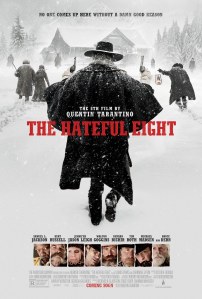 The Hateful Eight almost didn’t happen thanks to our modern-day views on copyright and privacy. Writer/director Quentin Tarantino sent the first draft of his newest script to three trusted actors, and within days it had spread to the outer reaches of the Internet. Tarantino was so incensed that he swore to shelve Hateful Eight and never film it. After a staged reading in L.A. with many of the eventual actors for the film, he changed his mind, to the relief of his sizable fanbase and actors everywhere. The Hateful Eight is a drawing room mystery with plenty of Tarantino’s signature propulsive language and bloody violence, but it’s also the director’s least substantial film to date.
In post-Civil War Wyoming, famous bounty hunter John “The Hangman” Ruth (Kurt Russell) is taking the outlaw Daisy Domergue (Jennifer Jason Leigh) to hang for her crimes. Along the way, he meets up with Major Marquis Warren (Samuel L. Jackson), a bounty hunter who served in the North and carries a letter written to him from none other than Abraham Lincoln. They’re both heading to Red Rock to extract their bounty earnings. Due to an oncoming blizzard, they’re forced to make a stay at Minnie’s haberdashery, except Minnie isn’t anywhere to be found. There’s Bob the Mexican (Demian Bichir) who says Minnie left him in charge, a foppish hangman Oswaldo Moblay (Tim Roth), a quiet cattle driver Joe Gage (Michael Madsen), a Confederate general, Sandy Smithers (Bruce Dern), and Chris Mannix (Walton Goggins), the son of a Confederate rebel who claims to be the newly designated sheriff of Red Rock. Over the course of one long night, everyone’s true identity will be learned, because someone is not who they seem to be and is secretly waiting to free Daisy and kill the rest.
 Even as lesser Tarantino, The Hateful Eight is still an entertaining and talky stage play put to film. The setup is strong and invites the audience to play along, to scrutinize the assorted characters and determine who is telling the truth. There are plenty of twists and turns and some violent surprises to keep things interesting. The conversations of the characters are such a pleasure to listen to; I want to luxuriate in Tarantino’s language. His wordsmith abilities are unparalleled in Hollywood. There’s a reason every star is dying to snag a part in a Tarantino movie, especially now that they’ve caught Oscar fire as of late. That’s somewhat crazy to think about. Cinema’s ultimate indie voice with his encyclopedic knowledge of the medium, high and low art, has become an institution within the system and his violent period films are now looked at as year-end prestige pictures. Tarantino’s M.O. has been to take B-movies and to transform them into A-movie level talent and intelligence. Never has a Tarantino flick felt more B-movie than The Hateful Eight. It was inspired from episodes of TV and it’s easy to see that genesis in its execution. It’s a self-contained mystery that comes to a head. It’s a limited story that’s likely taken as far as it could possible go, pushing three hours. I’m a tad befuddled why this was the movie Tarantino insisted on filming in “glorious Panavision 70 millimeter.” It’s almost entirely set in that one-room interior location. The extra depth that 70 millimeter affords would appear to be wasted, unless you enjoy looking at general store items on shelves in the background. Still, The Hateful Eight is a movie that doesn’t feel like three hours and harbors enough intrigue and payoffs to hook.
I tried to diagnose why this felt like lesser Tarantino, and it’s because over the course of almost three hours we don’t have much at stake because the people inhabiting the movie aren’t really characters but tough-talking facades. Tarantino is often cited for his uniquely florid dialogue, and nobody writes dialogue like Tarantino and his naturally stylized cadences, but another of the man’s skills is how great he can write a coterie of colorful characters that pop from the big screen. You might not be able to remember many lines from Hans Landa or Vincent Vega or Django, but you remember the vivid characters. Tarantino is preternaturally skilled at building characters that feel fully realized with their own viewpoints and flaws and prior experiences. He can make characters stand out but he also has the great ability to make the larger-than-life characters feel real, which is truly genius screenwriting for characters so flamboyant. The older romance in Jackie Brown is perfectly captured and felt. It’s downright mature. This is the first time I would say Tarantino has disappointed when it comes to his characters.
There are broadly drawn folk aplenty onscreen and they still talk in that wonderfully florid language of Tarantino’s that actors must savor like a fine steak, something they can sink themselves in for and enjoy every morsel. However, the characters onscreen have never felt this empty before. They are what they are and the only real change that occurs is that many will be dead before the end credits. They don’t have arcs per se but end points. It’s all about unmasking and identifying the rogues in a room full of rogues. Beyond Warren and Mannix, we’re left with precious little for characterization beyond bravado and nihilism. The effect of how empty they are would be felt less if we weren’t stranded with them for near three hours. Trapped in a room with a group of suspicious characters can only go so far, and ultimately it’s a parlor game that cannot sustain longer staying power. I doubt I’ll ever watch this with the frequency of other Tarantino flicks.
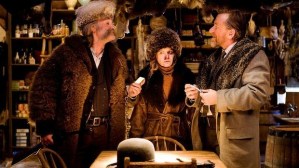 “You keep talkin’. You’re gonna talk yourself to death,” says one of those hateful numbers to another member. I’d pay to listen to Tarantino rewrite the phone book, that’s how excellent the man is with his dialogue. The man likes to hear his words and I like listening to them too. The problem is that The Hateful Eight has no reason for its gargantuan running time. As stated above, the characters we’re getting are nowhere near as complex or interesting as previous Tarantino escapades, so the talking can grow weary. Tarantino has patented a new formula from 2009’s Inglorious Basterds that involves characters playing a game of I-know-you-know-I-know while they suss out the truth, all the while the tension finely simmers until it blows. It’s a long fuse of suspense that can pay off rich rewards, like the near-perfect tavern scene in Basterds. The dinner table scene with Candie and the skull of his favorite house slave is another good example. Once our titular eight have gathered at Minnie’s, the entire movie is this sort of scene. It may be broken up into chapters and flashbacks but it feels like one long scene.
There’s also far less at stake than there was with Basterds or Django Unchained, even Reservoir Dogs, and that’s because the protagonists had goals and we had built up far more allegiance and time with them. When they were in danger, it mattered. The danger doesn’t feel as immediate because so little else is happening. There are plenty of comparisons to Dogs, which also utilized a hidden identity and a confined location. I think the difference was that, besides it being Tarantino’s first foray as a director, the tension was felt more because the danger was immediate from the start and we cared about character relationships. I cared about Mr. Orange and Mr. White and their bond. I can’t say I cared about any of the characters in Hateful Eight. I found them interesting at points, sure, but they were all a bunch of rotten bastards with little variation short of a burgeoning understanding between Mannix and Warren. The wait at Minnie’s feels like the Basterds tavern scene on steroids, pushed to the breaking point, and yet absent the urgency.
The acting is yet another tasty dish served up by Tarantino, and it feels like the actors are having the time of their lives playing their lively scoundrels. Jackson (Kingsmen: the Secret Service) settles in nicely and always seems to elevate his game when he’s reciting Tarantino’s words. He’s icy cool in scenes where the other characters are trying to do whatever they can to fire him up. He’s less bombastic than we’ve come to expect from Jackson. For bombast, there’s Russell (Furious 7) who cranks his performance to the broad heights of his bellicose lawman. Goggins gives a sly and extra caffeinated performance that answered the question of what it would sound like if you dropped his character from TV’s Justified into a Tarantino movie. Roth (Selma) feels like he’s doing his best manic Christoph Waltz impression. Dern (Nebraska) is a racist codger with a soft spot for his kin. Madsen (Kill Bill vol. 2) seems somewhat wasted as a taciturn “cow puncher.” Bichir (The Heat) gets some laughs as a seemingly aloof caretaker. It’s Leigh (Anomalisa) who steals the show, especially in the film’s second half. Daisy is a character that relishes being bad, and Leigh takes every opportunity to enjoy the fun. Her character plays a bit of possum during the first half but it’s the second half where she lets loose and becomes unhinged, and her exasperated and grotesque responses are often played for great sputtering comic effect. It’s a boys movie but it’s the lone woman who will prove most memorable. Tarantino’s last two movies have won acting awards and Leigh just might make it three-in-a-row.
 There are also some uncomfortable elements that can deter your viewing enjoyment, which isn’t exactly a foreign charge against Tarantino’s career. At this point you can probably repeat the oft-cited accusations: flagrant use of the N-word and exploitative violence. At least the historical background provides a context for the other characters unleashing the N-word, and I’d argue it tells us something about the characters as well. The characters that use the N-word when referring to Warren are the ones with allegiances to the Confederacy and those viewpoints don’t vanish even after you lost a war. They’re dismissive and intolerant and view Warren as sub-human. It also doesn’t approach Django Unchained-levels of excess, so I let it slide (I know my perspective as a white male makes my opinion on this effectively meaningless). It was the violence that got to me, specifically the violence directed at Daisy. Tarantino’s penchant for violence goes all the way back to his ear-slicing debut, so it’s nothing unexpected. He often tells stories about violent men and women fighting their way in a world governed by violence. I accept that these characters are bad to their core. That doesn’t excuse behavior. Violence on screen can be tempered with authorial commentary, but it’s the association that bothered me with Hateful Eight. For the entire movie, Daisy is put through the physical wringer. Our very first image of her is with a black eye. She’s a nasty woman and Ruth often expresses his distaste of her by punching her in the face, which is played as dark comedy. This happens repeatedly. We’re meant to recoil from much of the bloody violence on screen but repeatedly we’re meant to laugh at the violent suffering of Daisy. Tarantino has often used over-the-top violence as dark humor, and I’ve laughed along with it. This was one instance though where I stopped laughing and starting shifting uncomfortably in my seat.
Even lesser Tarantino can still be plenty entertaining and superior to most of what Hollywood usually cranks out as product. The Hateful Eight can be exciting, funny, surprising, and plenty of things, but what it can’t be is more than a lark. Tarantino has taken stories that would seem like larks, particularly the Kill Bill series, and infused them with pathos and meditation and soul to go along with all that snazzy genre stuff. It’s disappointing that Hateful Eight isn’t more than what’s on screen, but what’s on screen is still worth watching, though I don’t know whether it’s worth watching a second time.
Nate’s Grade: B
Share this:

Little Boy (2015)
 I was expecting to bury Little Boy in an avalanche of negativity once I found out a late plot point that made my jaw drop. This inspirational Christian independent film is set during World War II and features a pint-sized moppet, Pepper (Jakob Salvati), whose only real friend is his father (Michael Rapaport), who is now serving in the fight in the Pacific. He’s told that through the power of belief he can accomplish great things, and well, he really wants his dad to come home. So through the power of belief he causes… the dropping of the atomic bomb (WWII aficionados will recognize the nickname of the bomb). I was waiting for the moment and amping my sense of dread and moral outrage. A funny thing happened on the way to a nuclear bomb detonation, and that is that Little Boy is a fairly agreeable and effective family film that conveys a message with a welcomed degree of ambiguity and complexity and tolerance. This is a Christian-themed film about the power of belief but at no point does it make explicit whether it’s coincidence or the power of Pepper channeling God. Part of Pepper’s list of good deeds given to him by a priest (Tom Wilkinson) is to befriend a Japanese neighbor who returned home from an internment camp. The movie shows how casual these small-town folk indulge in racism and bullying. The Japanese man is also an atheist and I was legitimately astonished that the movie never makes a judgment about this. He’s treated as a complex man with his own system of thinking, and he’s not viewed as lesser or wayward because of his lack of belief in a higher power. Little Boy is no God’s Not Dead. The melodrama is well paced, the acting is solid if a bit heavy on long bouts of weeping, and the movie undercuts what normally would be the inspirational apexes with harsher reality. The bomb is dropped, and Pepper is initially celebrating until he discovers the total horror of Hiroshima. His “wish” may have even backfired with his father getting further punishment in a POW camp. While I still find the development tacky, I have to reluctantly credit the filmmakers for refusing to pander in a style that removes the complexity and ambiguity of real life. It’s still a movie and it still has a rather predictable albeit emotionally earned ending, but Little Boy might just be one of the biggest surprises of this year for me at the movies.
Nate’s Grade: C+
Share this:

Unbroken (2014)
 Angelina Jolie is one of the biggest stars on the planet but as a director she’s still a mystery. Jolie was so enamored with Lauren Hillenbrand’s best-selling novel Unbroken that she felt like she was the only person who could translate this story to the big screen. Somehow that passion got lost in translation.
Louis Zamperini (Jack O’Connell) is a man who ran for his country in the Olympics. He fought on a bomber plane over the Pacific. He was shot down and survived in a raft for over 40 days at sea. He was taken to a Japanese P.O.W. camp and endured harsh and cruel treatment, and he still persevered and returned home a hero.
It’s hard not to feel a general calculation about the entire film. I’m not trying to say that Jolie or her crew had any sort of nefarious ulterior motives, but the entire product seems like it was made in an Oscar Bait factory. This is the kind of movie that the Academy typically salivates for, and it’s based on a true story, and it’s set during World War II! There’s a reason that, sight unseen, Unbroken was often at the top of the prediction lists for Oscar pundits. It is those same Oscar-friendly elements, though, that act as a detriment to the story, because the thematic elements stand in for the story and sense of commentary. The movie is so caught up with Louis’ dilemma that it forgets that it needs to make you care about him as a person rather than a martyr. The biggest hindrance for Unbroken is just how little it develops its protagonist. The only emotion he seems to exhibit in the two-plus hours is suffering. The guy ends up being a human punching bag with the movie clobbering the audience with the same message again and again as well, the will to survive. Unlike other war stories or concentration camp survival tales, Louis doesn’t survive through any great networking of allies, skill, scheming, or prescient decision-making. We do not see him adapt and outsmart his adversaries. He merely outlasts them as he wastes away. Like what I wrote in my review of last year’s Best Picture winner 12 Years a Slave, I need more characterization than suffering. It’s a frustrating experience because you know there has to be more to this character.
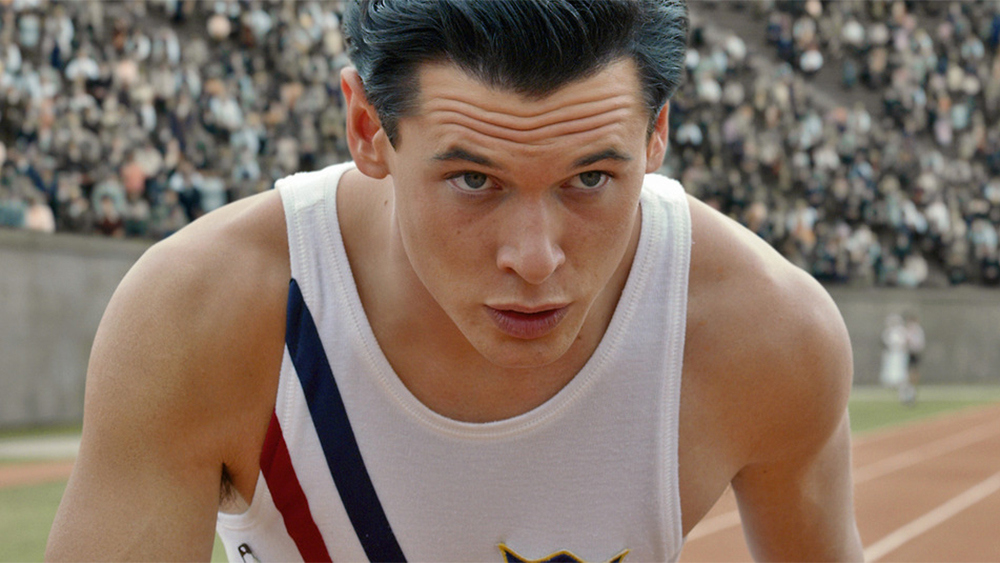 The danger with any film that purports to tell a true story of a hero is making sure the audience doesn’t lose sense of the person beneath the hero. We glorify their positive qualities and what we admire but when placed upon a pedestal, our heroes can start to become otherworldly, separate from the rest of us mortals. A biography that idealizes its subject is called a hagiography, and that is where Unbroken falls. Louis Zamperini is lost in this story, instead replaced with Louis the Survivor or, occasionally, Louis the Runner. Amidst the swelling music, the pretty cinematography, and the supporting characters channeling the audience with their encouraging mutterings of, “Come on,” and the like, Louis is painted more saint than man, which is a shame. Considering all of the peril he survived, it would make sense for him to struggle with his own doubts and fears. The most we get a sense of him and his internal struggle is when he prays aloud to God during a thunderstorm at sea and Louis promises to serve Him somehow if he survives. The movie forgets about this moment until the end credits text. If Louis Zamperini is going to be the focal point for a true story of heroism, then the movie needs to do better to make him human rather than resorting to having him only bleed.
The entire first act flashbacks could likely have been jettisoned. Watching Louis as a young man learn to run and then eventually compete in Berlin’s Olympics (way to take all of his luster away, Jesse Owens), we expect these moments to have relevance again, pointing toward some kind of grit or training regiment or lesson learned that will become useful or comforting solace during his internment. It all boils down to one skill, endurance, and that’s all we keep coming back to. We don’t need to see the Olympics or his younger life to establish as back-story in the P.O.W. camp, just as we didn’t get back-story for the prisoner who was revealed in the moment to be a concert musician. The flashbacks do little to flesh out Louis as a character. He was a troubled son of immigrants and found popularity and purpose with running, which he did to the Olympics, and then… the war. Too bad running doesn’t really come into play during his torment in Japan. I understand that we’re working with a true story but what has been added by including 20-30 minutes of flashbacks, particularly when they fail to illuminate our main character? Skipping right to the war, with perhaps a smattering of brief memories during physically and mentally fraught times, would have been preferable and more useful.
The other aspect that makes Unbroken frustrating is the potential it does flash in sparse moments. For the majority of its running time, the film is a perfectly decent war drama with an extra glossy sheen to it provided by expert cinematographer Roger Deakens (Skyfall). When adrift at sea, there’s an inherently interesting survival story there. Louis and his comrades are still in an active war zone. In one scene, a plane approaches and the guys realize late it’s no rescue but a Japanese fighter plane. They leap into the ocean as the plane fires bullets after them. This scene is made all the worse by the fact that sharks are swimming below. There’s an extra kick of dread worrying what will happen next if anyone gets wounded or killed by that gunfire. It’s a great sequence, but then it’s over and the film goes back to autopilot glorifying the resolute nature of Louis. Likewise the opening with Louis crawling along and having to manually close the bomber plane’s doors during a dogfight is great. Unbroken does get a lift when it introduces its main antagonist, Watanabe (played by rock star Takamasa Ishihara), nicknamed “The Bird.” The film now has a sense of direction and a renewed sense of danger with “The Bird” eager to break down his Olympic prize runner. The story feels more personal and interesting and it feels like this fresh antagonism will allow us to develop Louis more as a character. Sadly, he remains the same film martyr.
 This is Jolie’s second film as a director and she’s revealing some pretty old-fashioned tastes and instincts. Actors are judged at a somewhat harsher standard when they turn to directing, but the audience must simply ask if this person elevated the performances of their actors and whether they found an incisive and insightful way of telling a story. The jury’s still out on Jolie as a directing talent. The direction is more than adequate and quite fine, especially aided by having a team of gifted technicians. If you had taken Jolie’s name off the film I wouldn’t be any more or less effusive. Perhaps a more experienced director would have insisted on fixing the screenplay’s development, but then again, perhaps that director wasn’t going to get the gig of a major Oscar bait film for a studio.
I’ve spent the majority of this review criticizing Unbroken and may have given the impression that it’s a bad movie. It isn’t. It is a perfectly fine film by all accounts and a movie that will likely find a welcoming audience this holiday season. It’s got emotions and survival and danger and all set to a rousing score. It looks the part of an Oscar contender and that will be enough for many ticket-buyers. Unbroken is a perfectly good-looking tale of survival that unravels upon reflection. The necessary work of building up strong, complex, interesting characters takes a backseat to setting up a series of punishing obstacles for our protagonist. It’s like the filmmakers wanted to make an inspirational tale but didn’t want to complicate that with ambiguity and nuance and doubts. Louis is canonized in the movie’s flattering glow, and his suffering is shrugged off as “character-building.” Cogent or potent commentary on war, man’s capability for evil and good, or the nature of forgiveness, are absent, which means the film can only go as far as the immediate impact of its plot beats. Supposedly the whole movie was about forgiveness but I got no sense of that until the end credits. Unbroken is a by-the-book rendition on how to make a movie that looks good and about Important Things. It just lacks the deft storytelling, characterization, and subtext to make it important on its own.
Nate’s Grade: B-
Share this:

The Hunger Games: Mockingjay Part 1 (2014)
 Taking place immediately after Katniss (Jennifer Lawrence) was rescued from the events of Catching Fire, we find ourselves locked away underground with the residents of District 13. Long believed annihilated by the Capital, and its tyrannical leader President Snow (Donald Sutherland), the people rebuilt their society as one large series of underground bunkers, preparing for a day of revolt. The leader of District 13, Coin (Julianne Moore, under a thick grey wig), is wary of Katniss as the symbol of the revolution. She would rather fight the Captiol without her, but the people love her, and it is the common people that Coin and her team must struggle to unite and inspire. Katniss is not exactly in the inspirational mood. Her family was saved from District 12 before it was bombed but the Capital holds Peeta (Josh Hutcherson) as a high-profile captive, ready to denounce the latest aggressive acts of the rebels as foolish and dangerous. Katniss desperately wants to rescue Peeta but before she can she has to accept her fate and become the Mockingjay, the figure to rally the districts in war.
 The very title The Hunger Games: Mockingjay Part 1 both tells you everything and nothing. Firstly, there are no Hunger Games anymore. This is a full-on war film, and we’re finally getting to all the good stuff, the revolutions stirring all throughout Panem we heard about and caught glimpses of before the plot required a redo of the games, repeating the structure of the first film. It felt overly redundant, especially when the stuff outside of the games was far more interesting. That structure has been cast aside and Mockingjay is a completely different film than the ones before it, focusing much more on character and the politics of propaganda. In many ways, this is a quieter film that allows the characters to deal with the trauma of their experience in the deadly arena. Even though war is fermenting and people are being bombed into oblivion, there is considerably less urgency, especially less contrived urgency. This allows the characters and the plot to breathe, the calm before the storm. Much has changed and a measured amount of time to process this is a good move. This is no longer the Hunger Games. This is war. The subterranean District 13 is the major setting of our film, which gives Katniss time to reflect on how damaged she is and her guilt over what exactly the Capitol is doing to their promotional lapdog, Peeta. The movie opens with her muttering to herself, hiding from others due to a disturbing nightmare. The psychological well being of our heroine is a ripe topic. While the world is on fire, much is once again expected of Katniss, and we get to watch her transform, awkwardly, into the revolutionary figure others require of her. The political and media critiques add another level of entertainment, as each side spins and contorts to position themselves for the news cycle. This expose of media manipulation makes Mockingjay feel in part like a post-apocalyptic Wag the Dog. Credit co-screenwriter Danny Strong, he of HBO’s Recount and Game Change fame. This welcomed change of pace and structure allows the film to finally feel like the story we want to watch. And while I’m tip-toeing around spoilers, I’ll just say that the split occurs exactly where you think, book readers.
And secondly, the “Part 1” of the title is also what defines this 125-minute prelude to the concluding movie, a fact that becomes inescapable as it seems all the good stuff is being reserved for later. While the reflective plotting allows more space to breathe, it also becomes abundantly clear that this wasn’t exactly a story that needed to be told in two parts. From a financial standpoint, I can’t argue with the decision from Lionsgate. This is their once-in-a-lifetime franchise and elongating the final film in YA franchises has become de rigueur and a box-office no-brainer. Still, the overwhelming feeling is that this is all setup and the best stuff is just ahead, a tease that the franchise also toyed with during Catching Fire, as we were stuck in the games instead of the revolution. Mockingjay Part 1 is mostly buildup; it’s entertaining and more politically adroit than expected, but in the end it’s still a story stretched out. The intriguing supporting characters from Catching Fire are still mostly put on hold. The inclusion of Gale (Liam Hemsworth) still feels relatively pointless in the scheme of things, except for prolonging the love triangle, the weakest element of the story by far, and one that even author Suzanne Collins seems half-hearted about. When the world is falling apart, who cares which boy Katniss decides to kiss? Old favorites like Haymitch (Woody Harrelson) and Effie (Elizabeth Banks) get brief appearances but little else. There is a stark decrease in action with this movie, only two real sequences of suspense, and one of them proves to be false. Strangely enough, there’s a high-stakes nighttime raid that plays out unironically like a dystopian Zero Dark Thirty finale. I await others to make a similar comparison. It’s no surprise that Mockingjay becomes more suspenseful, engaging, and meaningful just as it’s ending, leaving less on a cliffhanger and more on a latent promise. Instead, this particular movie features a lot of speeches and hushed discussions in dank quarters (the photography is rather dimly lit and hard to decipher at times). It’s not exactly rollicking.
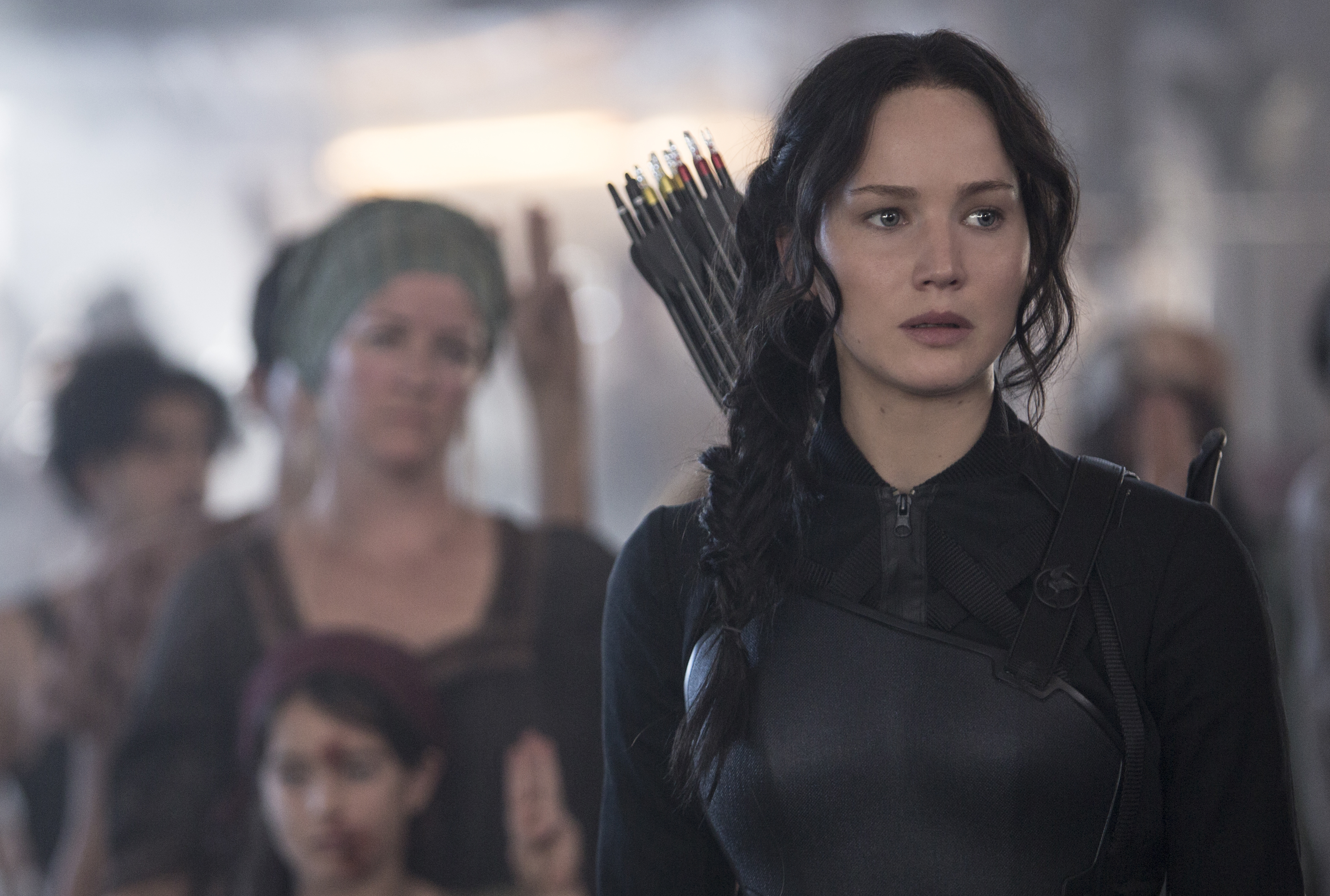 Being a war film, atrocities are commonplace and examined openly, especially when Katniss visits the ruins of her home in District 12. Not once but twice does the camera slowly zoom out to allow the graveyard of charred skeletons to gets its thematic due. There’s only so far a mandated PG-13 rating can take you when it comes to illustrating the horrors of war, but I give Mockingjay credit for neither glossing over the loss of innocent life or glorify the leaders of this revolution, namely District 13. President Coin is shown to be a calculating and pragmatic leader who is concerned more about the big picture. She’s thankful for Katniss but just as ready to move onward and forget her. By the end of the movie, you don’t exactly have warm feelings for the people of District 13, who laid in wait, sowing seeds of rebellion with the other districts, all the while relying on their bunker for ultimate safety. The other districts are more vulnerable and more likely to feel the Capital’s wrath. Just ask the smoldering citizens of District 12.
Director Francis Lawrence (I Am Legend, Constantine) is the Hunger Games’ version of David Yates, the director who steered the concluding four Harry Potter films. Chris Columbus put that world together, but a better, more visually adept director saw Potter through to its end. Likewise, Lawrence has taken the world that the original Games director Gary Ross cultivated and given it the mood and visual heft needed for the franchise to feel properly and triumphantly cinematic. If it weren’t for this man’s visual talents, the many conversations in the dark would be even harder to watch. Lawrence has been a helpful addition to the franchise, especially as the world was starting to get more fleshed out. While I bemoan the overly gloomy cinematography (which was also an issue with Catching Fire), Lawrence has brought a necessary sense of gravitas to the series. The emotional pain and psychological torment registers, and his handling of his actors will often be overlooked thanks to the natural talent of his lead actress, but Lawrence has found a way to strike the right tone to make us care.
Speaking of the woman in question, Jennifer Lawrence (American Hustle) is already an Oscar-winning Hollywood star in her mid twenties, and she elevates these films even more. Her character is a reluctant figurehead, never having asked for such prominence, nor having asked to trigger a revolution with countless casualties. Without as much physical activity and arrow slinging, Lawrence gets greater opportunities to emote and show the fractured, conflicted feelings of the woman in the middle of the revolt. She’s not a natural when it comes to being on-camera, she cannot fake sincerity (even though she played up the whole “star-crossed lovers” angle in the first film as a means of survival, but whatever), and it’s somewhat funny watching skilled actors pretend to be bad actors. The emotions are on a hair trigger here, as rage boils over to fear and shock. Lawrence anchors the series with another surefooted, strong performance.
The real standout is Sutherland (The Italian Job). This is as much President Snow’s movie as it is Katniss Everdeen’s. Rather than plotting from the shadows, Snow gets to become the worthy villain the franchise has been waiting for. Sutherland relishes his retorts with Katniss and preying upon her. His broadcasting of an ever-increasingly frail Peeta is more meant as a crushing psychological blow, a reminder that his prized hostage will be punished for Katniss’s and the rebellion’s mounting successes. When they’re finally face-to-face once more, it’s the film’s most invigorating moment.
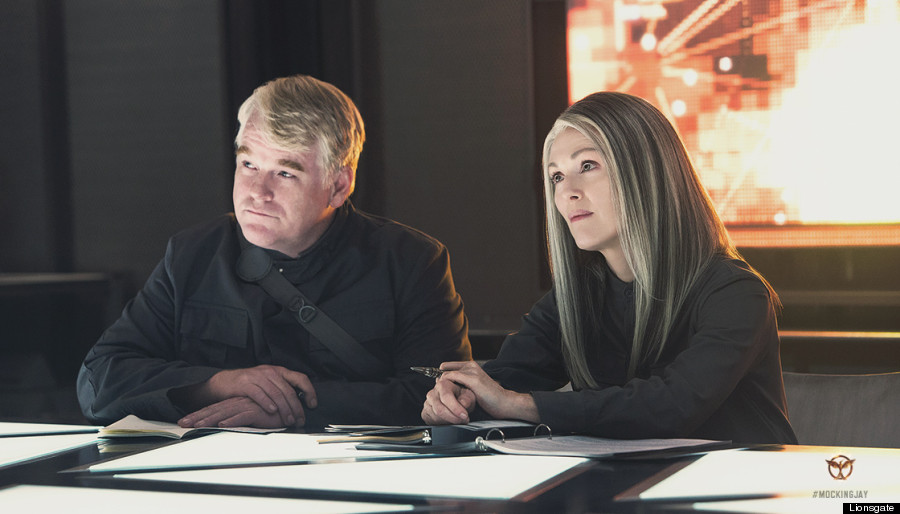 It’s also hard to watch the movie and not feel grief over the loss of actor Phillip Seymour Hoffman. Mockingjay Part 2 will officially be the actor’s last onscreen appearance. He’s good, though the part isn’t exactly challenging, but the real pang is the realization that we’ll never get another Hoffman performance. Once the final minute of Plutrarch Heavensbee is gone onscreen, so is the cinematic ghost of a ridiculously talented man who was taken from the world far too soon. In a nice gesture, Mockingjay Part 1 is dedicated to his memory.
Once more into the breach, dear friends, as Mockingjay Part 1 lays the way for the promise of an exciting and action-packed finale. The extra pause, the last breath before the melee, is both a blessing and a curse. It allows the film to break away from the plotting of the previous two entries and it provides a refreshingly reflective opportunity peppered with intelligent conversations about the political process and propaganda. It also stretches out a story that proves it did not have enough plot points to justify the expansion. No matter, the cash registers will ring loudly as the world’s hunger for the Hunger Games knows no limit. Lawrence and a team of great supporting actors help provide reasons to keep watching, as well as the increasingly dire circumstances of the war against the districts. This intermediary film serves as a bridge to the exciting conclusion, the assault on the Capitol. Let’s just hope that audiences don’t feel too stingy about paying to watch a two-hour trailer for another movie.
Nate’s Grade: B-
Share this:

Fury (2014)
 Why haven’t there been more tank movies? We have a slew of war films in all shapes and sizes and yet there are hardly any movies from the unique point of view of the battle-tested tank crew. Perhaps it’s the claustrophobic shooting conditions and limited breathing room, but then both of those are usually assets to the submarine sub-genre, and we got plenty of movies set primarily in less-than-spacious submarine quarters. Maybe it’s the sheer cost, since a submarine can be replicated with a model and a tank requires its own onset crew just to get exterior shots. Then there’s the issue of just watching close-ups of people looking through telescopes, squinting, and pulling triggers. I don’t really have a working hypothesis to explain the paucity of tank movies from Hollywood but now there’s at least one mainstream effort on the big board.
Fury follows the brave men of the titular tank that’s traveled from Northern Africa to France and now Germany in the dwindling days of World War II. Norman (Logan Lerman) is the new guy, replacing a fallen comrade on Don “Wardaddy” Collier’s (Brad Pitt) crew. The average life expectancy on a tank was only a handful of missions, but under Collier’s leadership his squad has defied the odds. Now the presence of a rookie puts all their lives in danger especially so close to the end of the war.
Writer/director David Ayer (End of Watch, Sabotage) delivers a meat-and-potatoes kind of war film, a movie that knows what it’s doing and how to satisfy its audience but rarely steps outside of this mission to resonate further. There’s a requisite pathos and air of contemplation to the proceedings, especially with the conflict of Norman’s innate goodness getting in the way of killing soldiers, armed and unarmed, in the line of duty. What does it take to be a soldier? Can you still recover as a man or does one have to shut off those elements of concern, the quibbles over moral actions that would otherwise haunt. In one sense, it’s a little contrived that the new recruit has to be so green to the battlefield that everything needs to be taught to him including the us vs. them mentality of war. On the other hand, it provides an ongoing source of conflict that leads to some striking moments, like when Collier literally forces Norman’s hand to get him his first kill. Much like Saving Private Ryan once it settles down, the movie progresses as a series of vignettes that showcase a variety of consequences and realities of the war. Naturally some are more engaging than others, but for the majority Fury holds your attention nicely. Ayer’s direction of action is astute and a tank-on-tank battle is wondrously taut thanks to the stubborn and fascinating tactics of tank warfare. I just don’t know how all these guys can make out whose order is for whom with all the other noise going on.
 It’s during the concluding act where the movie abandons most of its sense of realism to completely double down on exaggerated action movie heroics, and it’s unnecessary. Beforehand, we’ve been treated to this crew and their town-by-town escapades, watching them come together but also watching them deal with the vagaries and lasting traumas of war. And then it suddenly shifts gears and becomes a last stand movie where our small crew in one immobile tank has to take on, literally, 300 Nazi soldiers. Ayer makes a specific point of clarifying them as Nazi S.S. men and not your casual German soldier. Pitt and company all decide to stay and fight valiantly rather than hide, and so we’re treated to their preparations for what is sure to be an Alamo in a tank. It then just becomes a rote action movie where they fire into the smoke, more Germans keep coming, and we just patiently watch them run through their last remaining desperate options for defense. Ayer doesn’t falter with his depiction of the action or the logical nature of his plot beats, though I don’t know why they didn’t keep more of the gun ammo in the tank. There’s a repetition and expectation of casualties with this section, perhaps intended to magnify their sacrifice and heroism but it feels too forced. The movie was working perfectly fine prior to this new shift in tone. Now we have Germans that are plainly idiotic, with poor marksmanship, and who can’t just wait out the tank. They have rocket-propelled weapons and the tank only shoots in one direction. The ending action assault still works as an entertaining barrage of blood and violence, but if you were liking Fury for what it was then be prepared to be a little disappointed.
What really hooked me with the film was an extended sequence that doesn’t even involve the tank at all. Stopping to regroup with their company in a small, bombed-out German town, Collier and Norman enter the home of two women, Irma and Emma. Initially the scene plays out like they’re scouting for any hiding soldiers, so there’s an initial carryover of tension. Then the gentlemen stay and the scene transforms organically into something more interesting. The scene is allowed to linger, and we see a different side of Pitt’s tank captain. The women set up a dinner and there’s a moment of reserved calm. Norman and the youngest German woman get some privacy, much to the knowing approval of the other two older adults in the room. Then just as their little scene has reached serving time, the other members of the tank storm the room, drunk and confused. They came seeking to deflower Norman with an ugly prostitute they each had a turn with. Their eyes settle on the young, much prettier women, the food about to be served, and you can feel the resentment starting to build, the old conflicts and tensions sneaking back into the scene, particularly a sneering Jon Bernthal (Wolf of Wall Street), who relishes being hostile. You don’t know where this is going to go. Are they going to make a fuss? Will they mistreat the German civilians, maybe even assault them, and if so how will Collier and Norman respond? What will they say about the appearance of preference with these civilians than with their tank company? How far will this go? I am not kidding when I say that for a movie with plenty of war violence, this was the tensest scene in all of Fury. It plays out so naturally, leisurely, but every moment pushing forward and building in tension. It’s a shame then how Ayer decides to conclude this entire episode, glibly turning these women from characters into a cheap plot device. Until then, though, it’s a 12-minute oasis from the genre machinery of war movies.
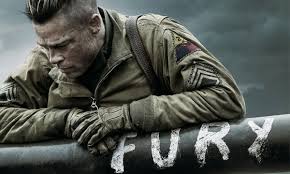 The other aspect where Fury falters is when it comes to fleshing out the characters in that dangerous tin can. With war movies the characterization can often get lost in the shuffle of violence and messages, so there’s something of a sliding scale; if you can get one good sequence, perhaps one solid insight into a character that opens them up as more than “Hispanic Gunner” or “Vaguely Southern Religious Marksman” then you call yourself fortunate. The characters don’t stray far from their archetypical orbits: the rookie, the hotheaded one, the Bible-quoting philosopher, the commander who hides his fear and… the Hispanic Gunner (sorry Michael Pena). The assembled actors do fine work with what they’re given, but so much of the part is reactionary to off-screen, out-of-the-tank action. Pitt (World War Z) has a stolid clam that commands leadership but boy does his character lack a personality. He’s just settled into that authority figure role. Shia LaBeouf (Nymphomaniac) gives a performance with enough edge, the emotions just peaking through during key moments, to leave you wanting more, both from the character and the actor. Lerman (Perks of Being a Wallflower) is suitably wide-eyed and out of his element early, finding his requisite spine and becoming a “man” over the course of the film. It works as a point of view entry into this world though his character can come across as naive and then later also unjustly criticized. After two hours with this crew, you won’t be fighting back too many emotions as they make their last stand and their numbers dwindle.
Fury is a fairly gritty, bloody, and sturdily entertaining World War II action thriller that is unwaveringly serious for a solid two acts until an all-out assault into over-the-top action movie land for its final, admittedly enjoyable, conclusion. It decides to just skimp out on the characterization so as to spend more time pumping up the virtues of tone and action. The film never bored me, and during stretches it was riveting with suspense and a gritty realism, all before retreating back to archetypes and Hollywood standoffs. For long stretches it’s a series of vignettes but there are moments that rise above, which cut through the carnage and stay with you. Ayer’s direction of action is rather impressive and this is easily the finest work behind the camera for the famous screenwriter. In many ways, Fury is a no-nonsense throwback to World War II war movies, with a similar no-nonsense pack of characters. An older audience will definitely find the movie appealing. It does more than enough well to recommend but just don’t expect the next Saving Private Ryan in terms of lasting impact. Still, give me more tank movies, Hollywood.
Nate’s Grade: B
Share this:

The Grand Budapest Hotel (2014)
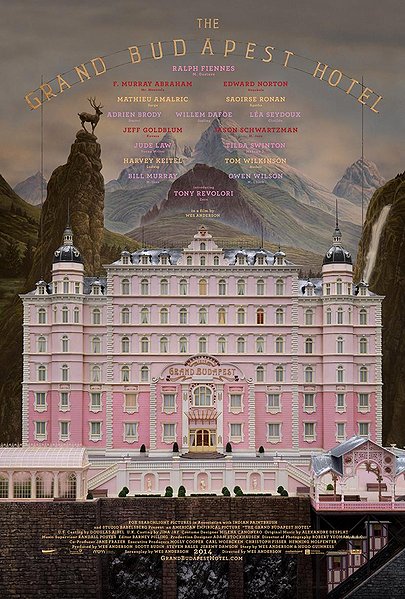 Wes Anderson is a filmmaker whose very name is a brand itself. There are a small number of filmmakers who have an audience that will pay to see their next film regardless of whatever the hell it may be about. Steven Spielberg is the world’s most successful director but just having his name attached to a movie, is that enough to make you seek it out and assume quality? If so, I imagine there were more than a few disappointed with War Horse and Kingdom of the Crystal Skull. But Wes Anderson has gotten to that height of audience loyalty after only seven movies, mostly because there are expectations of what an Anderson film will deliver. And deliver is what the quirky, fast-paced, darkly comic, and overall delightful Grand Budapest Hotel does.
In the far-off country of Zubrowka, there lays the famous hotel known the world over, the Grand Budapest. The head of the hotel, the concierge, is Gustave (Ralph Fiennes), a highly mannered Renaissance man who caters to the every whim of his cliental. Zero (Tony Revolori), an orphaned refugee, is Mr. Gustave’s apprentice, a lobby boy in training learning from the master in the ways of hospitality. Gustave likes to leave people satisfied, including the wealthy dowagers that come from far just for him (Gustave: “She was dynamite in the sack,” Zero: “She was… 84,” Gustave: “I’ve had older.”). One of these very old, very rich ladies is found murdered and in her rewritten will, the old bitty had left a priceless portrait to Gustave. Her scheming family, lead by a combustible Adrien Brody, plots to regain the painting, which Gustave and Zero have absconded with.
 For Wes Anderson fans, they’ll be in heaven. I recently climbed back aboard the bandwagon after the charming and accessible Moonrise Kingdom, and Grand Budapest is an excellent use of the man’s many idiosyncratic skills. The dollhouse meticulous art design is present, as well as the supercharged sense of cock-eyed whimsy, but it’s a rush for Anderson to pair a story that fits snuggly with his sensibilities. The movie is a series of elaborate chases, all coordinated with the flair of a great caper, and the result is a movie over pouring with entertainment. Just when you think you have the film nailed down, Anderson introduces another conflict, another element, another spinning plate to his narrative trickery, and the whimsy and the stakes get taken up another notch. The point of contention I have with the Anderson films I dislike (Life Aquatic, Darjeeling Limited) is the superficial nature of the films. As I said in my review for Darjeeling, Anderson was coming across like a man “more interested in showing off his highly elaborate production design than crafting interesting things for his characters to do inside those complex sets.” With this film, he hones his central character relationships down to Gustave and Zero, and he can’t stop giving them things to do. Thankfully, those things have merit, they impact the story rather than serving as curlicue diversions. We get an art heist, a prison break, a ski chase, a murderous Willem Dafoe leaving behind a trail of bodies, not to mention several other perilous escapes. This is a film packed with fast-paced plot, with interesting actions for his actors, maybe even too packed, opening with three relatively unnecessary frame stories, jumping from modern-day, to the 1980s, back to the 1960s, and finally settling into the 1930s in our fictional Eastern European country.
The other issue with Anderson’s past films, when they have underachieved, is that the flights of whimsy come into conflict with the reality of the characters. That is not to say you cannot have a mix of pathos and the fantastical, but it needs to be a healthy combination, one where the reality of the creation goes undisturbed. With Grand Budapest, Anderson has concocted his best character since Rushmore’s Max Fisher. Gustave is another overachieving, highly literate, forward-driving charmer that casually collects admirers into his orbit, but he’s also a man putting on a performance for others. As the head of the Grand Budapest, he must keep the illusion of refinement, the erudite and all-knowing face of the luxurious respite for the many moneyed guests. He has to conceal all the sweat and labor to fulfill this image, and so he is a character with two faces. His officiously courtly manner of speaking can be quite comical, but it’s also an insightful indication that he is a man of the Old World, a nostalgic European realm of class and civilization on the way out with looming war and brutality. And as played by the effortlessly charming Fiennes (Skyfall), Gustave is a scoundrel that the audience roots for, sympathizes with, scolds, but secretly desire his approval, much like Zero. It is a magnificent performance that stands as one of the best in any Anderson film.
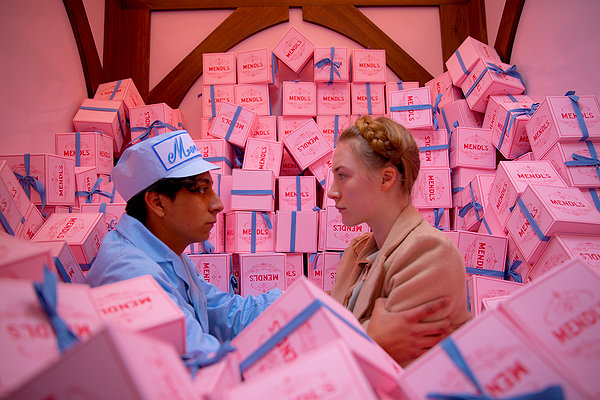 The fun of a Wes Anderson movie is the zany surprises played with deadpan sincerity, and there is plenty in Grand Budapest to produce smiles and laughter. It’s hard to describe exactly which jokes land the best in a Wes Anderson film because they form a patchwork that elevates the entire movie, building an odd world where oddballs can fit right in. It was under a minute before I laughed, and I smiled through just about every remaining minute of the film. I enjoyed a joke involving a dead cat that just kept being carried from scene to scene. I enjoyed a sexually graphic painting that just happened to be lying around. I enjoyed the fact that Zero draws on a mustache every morning to better fit in with the men of his day. But mostly I just enjoyed the characters interacting with one another, especially Gustave and Zero, which forms into the emotional core of the film. It begins as a zany chase film and matures as it continues, tugging at your feelings with the father/son relationship (there’s also a subtly sweet romance for Zero and a pastry girl played by Saoirse Ronan). One of the big surprises is the splash of dark violence that grounds the whimsy, reminding you of the reality of death as war and fascism creep on the periphery. In fact, the movie is rather matter-of-fact about human capacity for cruelty, so much so that significant characters will be bumped off (mostly off screen) in a style that might seem disarming and unsatisfying. It’s the mixture of the melancholy and the whimsy that transforms Grand Budapest into a macabre fairy tale of grand proportions.
The only warning I have is that many of the star-studded cast members have very brief time on screen. It’s certainly Fiennes and Revolori’s show, but familiar names like Bill Murray, Tilda Swinton, Tom Wilkinson, Jeff Goldblum, Lea Seydoux, Jude Law, Harvey Keitel, Jason Schwartzman, Owen Wilson, F. Murray Abraham, and Bob Balaban are in the film for perhaps two scenes apiece, no more than three minutes of screen time apiece. Norton, Brody, and Dafoe have the most screen time of the supporting cast. Though how does Revolori age into the very non-ethnic Abraham? It reminded me of Street Fighter: The Legend of Chun-Li (here me out) where, as she ages, Chun-Li becomes less and less Chinese in her facial appearance. Anyway, the brevity of cast screen time is not detrimental to the enjoyment of the film, considering all the plot elements being juggled, but I would have liked even more with the dispirit array of fun characters.
The Grand Budapest Hotel is Wes Anderson at his best, pared down into a quirky crime caper anchored by a hilariously verbose scoundrel and his protégé. Naturally, the technical merits of the film are outstanding, from the intricate art direction and set dressing, to the period appropriate costumes, to the camerawork by longtime cinematographer Robert Yeoman. The movie is a visually lavish and handcrafted biosphere, a living dollhouse whose central setting ends up becoming a character itself. The trademark fanciful artifice is alive and well but this time populated with interesting characters, a sense of agency, and an accessible emotional core. The faults in Anderson’s lesser films have been fine-tuned and fixed here, and the high-speed plotting and crazy characters that continually collide left me amused and excited. If you’re looking for a pair of films to introduce neophytes into the magical world of Wes Anderson, you may want to consider Grand Budapest with Moonrise Kingdom (Royal Tenenbaums if they need bigger names). In the end, I think Anderson more than identifies with his main character, Gustave, a man enchanted in a world of his own creation, a world better than the real one. Who needs the real world when you’ve got The Grand Budapest Hotel?
Nate’s Grade: A
Share this:

The Monuments Men (2014)
 An all-star cast, a true-life tale that incorporates a treasure hunt, a race against time, Nazis, and fish-out-of-water tropes as non-soldiers are placed in harm’s way, plus the skills of George Clooney behind the camera; in short, how could this go wrong? With that plot makeup and this cast it would take more effort to tell a boring big screen adventure of the real-life Monuments Men (and women). And yet, the movie found a way. It’s by no means a bad film and its heart is in the right place, but allow me to explain why The Monuments Men sadly fails to live up to its mission.
It’s 1944 and Adolf Hitler doesn’t just have his sights on constructing a permanent empire, he wants all the world’s art treasures as well. The Nazis have been plundering famous works of art, and while the war is coming to a close with the Allied invasion, the fate of these priceless works of art may be in jeopardy. Frank Stokes (Clooney) is tasked with putting together a team to save Europe’s art from the Nazis. He puts together an unconventional group of soldiers (Matt Damon, John Goodman, Bill Murray, Bob Balaban, Jean Dujardin, Hugh Bonneville) and search for the hidden loot.
 The film looks like it’s going to be a high-concept heist film when it reality it’s a series of vignettes that do not add up to a solid whole. Early on, the Monuments Men team is scattered to the wind, divided into pairs, and so we have four or five competing storylines that don’t develop as desired. To be fair, there are some very good scenes, well executed and written by Clooney and Grant Heslov (The Men Who Stare at Goats) where the conflict is turned up, but the film cannot escape the fact that it feels more like a series of scenes than a cohesive story. Not all of the stories are equal in their interest as well. The Cate Blanchett (Blue Jasmine) and Damon storyline in France amounts to little else than her stalling for as long as the plot necessitates, then handing over the Very Important Info, then she’s swept aside. The comical asides, notably with Murray and Balaban, feel like scene fillers when there could be stronger material. Once they’re reunited as a group, you wonder why we even needed the time apart. Perhaps it’s an attempt to showcase a wider sampling of stories and perspectives on a complicated war, which is fine, but the characters don’t get the same complicated examination. Despite physical descriptors, these guys are fairly one-note and stay that way, which is a real shame especially when we start losing Monuments Men. The attention is split amongst a bunch of characters lacking proper development. If I felt like we knew these guys on any substantive level, I would feel more at their untimely passing.
Another issue that exacerbates the directionless feeling pervading the film is that it lacks a clear and concise goal. I understand they’re saving and rescuing art, but that’s kept vague until the very end of the film when it becomes more concrete. Until then, the guys are just traveling from place to place, retrieving this piece or that, having comic misadventures, and the movie just feels like it needs a stronger guiding force to corral all these stories, a concise goal that each scene builds onto and where the urgency increases. Late in the film, I got a glimpse of exactly what kind of movie Monuments Men could have been. Once the war is over, the Germans are replaced as antagonists by the Russians (two-for-two with classic American movie villains) and it becomes a race against time to get to the art before the Russians confiscate it. There was always a ticking clock in the film, as Hitler was assembling his art and his command would destroy them in spite of returning them. However, in the very end of the film, the urgency is cranked up, made real, and for once the film emerges with a sense of suspense. I think it would have been a more engaging film experience if the scope of the film were narrowed simply to the material covered in the climax, namely beating the Russians to the art reserves. It practically has a Raiders of the Lost Ark feel with two parties trying to outrace the other to the next precious treasure. How cool would that movie have been?
 Another problem is the film’s seesaw tone never really gels together in a satisfying manner. The film awkwardly switches gears from drama to comedy to action without smooth transitions. Clooney wants his film to be a comical buddy comedy but also a poignant remembrance of the lives lost so that we can enjoy our great treasures. Clashing tones take away from the effectiveness, making us feel that Clooney didn’t feel confidant with either direction to make a movie. Alexander Desplat’s overbearing musical score instructs the audience what they should be feeling at any given moment. It vacillates without similar transitions informing you with little transparency that you should feel whimsical, now sad, and now heroic, now go back to whimsical. The entire film, from a story standpoint to a technical standpoint, cried out for a greater sense of unity.
Then there’s the question of whether art is worth people giving up their lives, and this is a valid question that deserves consideration. I was never in doubt what Clooney and company would say to this ethical query, but it’s as if Clooney has little faith in his own audience. He gives three separate speeches about the significance of art and culture and why it is worth dying for. I expected one hefty speech, but three? It’s like Clooney is afraid his audience will waver when blood starts to be shed, and so we need to be reminded by the professor why art is significant to mankind’s value. The point has been made; it doesn’t need to be belabored. The film even ends on recycling this debate, with Clooney putting one final stamp of judgment before the credits roll.
One gets the sense while watching The Monuments Men that it would make a better documentary than a fictional feature film, at least this incarnation of a fictional film. Hearing from the men who lived it will be far more interesting than watching the comic squabbles of Clooney’s crew through Europe. I was instantly reminded of an engrossing documentary from a few years ago called The Rape of Europa, which looked at the subject of saving the arts from Hitler, not specifically the Monuments Men. That documentary was filled with so many different fascinating stories, I remember thinking that any one of them could have made a stellar movie. Monuments Men is further proof that a sharper, more contained focus would be best rather than trying to tell as many war stories involved on the topic. Clooney has proven himself an excellent director and despite his film’s faults it’s still an entertaining film in spurts. I just think we all expected better given the pedigree of talent involved and the can’t-miss quality of the history.
Nate’s Grade: B-


 nathanzoebl
You must be logged in to post a comment.