Blog Archives
Bloodrayne: The Third Reich (2011)
 It took five years and three movies, but notorious film director Uwe Boll has finally gotten to the original time period of the Bloodrayne video game. The popular game concerns a lithe, redheaded half-vampiric lass killing nefarious Nazis in World War II. You would have thought that would make for a decent starting point. But Boll instead took his time, possibly always envisioning a trilogy to do the character and his storytelling ambition proper service. Or it was just a way to make more money. So after stops in 18th-century Romania and the Wild West, Rayne comes home, so to speak in Bloodrayne: The Third Reich. What if somebody was adapting the Grand Theft Auto franchise into a film and took Boll’s dawdling approach? The first film would probably start with horses and buggies.
Rayne (Natassia Malthe), our favorite dhampir, is back at slaying them dead. She teams up with Nathaniel (Brendan Fletcher) and his band of resistance fighters on the Eastern front. They rescue one train filled with prisoners and get into a shootout with Commandant Ekhart Brand (Michael Paré). But Rayne makes the unfortunate mistake of biting the Commandant before impaling the guy. She has unknowingly turned the Nazi officer into a vampire like her, one that can walk in daylight. You would think after 200 years of existence she would have a handle on this. The Commandant is educated in the ways of the vampire by a mad scientist, Dr. Mangler (Clint Howard), who enjoys torturing human and vampire alike for science. At one point the doc says, while slicing up a living body,” Vampires no longer have any bonds to the moral laws of man.” That seems like a pot/kettle situation to me. The Commandant assembles his own undead army of vampire soldiers. Rayne feels responsible for this ugly mess and vows to kill the Commandant again and to a satisfying degree of dead this time.
 For a while, Bloodrayne III looks like it might be the best in the trilogy, admittedly a dubious honor. Despite all my misgivings, Bloodrayne III almost works on its own lowered-expectation exploitation genre level. Almost. The campy combination of Nazis and vampires is a wild premise, though hardly original, and should reap some ripe and schlocky exploitation entertainment. The locations in Croatia are terrific and add just enough authenticity for a story about a vampire lady killing Nazis. In fact one sequence plays like Boll’s take on Tarantino’s Inglourious Basterds, involving a tavern showdown where people play a tense game of secret identities. There are moments that work, little bursts of promise, but they get reaped all too quickly. Boll’s action choreography is sadly limited in scope and editing. He sticks too close to his characters, never allowing for complicated tussles or expanding the scope of the action. There are a few serviceable explosions, some minor gore effects, but Boll does nobody any favor when the action is too brief and brittle. Everything feels pared down so most of the fights involve minimal players and the sequences themselves mostly give way to redundant posturing.
The failings of Bloodrayne III are roughly the same failings that dogged Bloodrayne II: Boll does not embrace his film’s inherent cheesiness. I wrote about 2007’s Bloodrayne: Deliverance: “Boll seems uneasy about embracing its supernaturally campy potential. Bloodrayne II has little blood, zero gore, no nudity, no sex, and a pitifully scant amount of action. In other words, it’s missing all of the exploitation elements that make a movie like Bloodrayne II worth watching.” While Boll has seen fit to correct the absence of certain genre elements, notably blood and boobs, he still cannot seize the pulpy premise into Grand Guignol. Nazi vampires, an immortal Hitler, a 200-year-old ass-kicking woman with signature arm-blades AND Clint Howard as a mad Nazi scientist and this is the best you can do? That’s unacceptable. The supernatural potential is wasted here. Rayne’s vampire side is barely utilized. She bites people, she jumps high once, but there’s nothing really vampiric about her beside one scene where she complains about having to drink pig’s blood. She might as well be anything else if you’re not going to take advantage of what makes a vampire a vampire. At one point, the Commandant turns his best tracker into a vampire for the purposes of finding Rayne (her secret hideout turns out to be a not very discreet large castle). That idea had great promise, all things considered, but like most of the other fights, it’s one-and-done. Rayne takes out the guy and we move along. Rayne is betrayed by one of the brothel girls who has her eyes set on running the business (“You’re a cocksucking entrepreneur,” someone declares, though I wouldn’t put that exact terminology on a resume). She gets turned into a vampire too. All right, she could work as a character that could get close to Rayne. But then she too is dispatched with mercurial swiftness. Why the hurry? Bloodrayne III runs a total 72 minutes before end credits. The film could have used a lot more fleshing out, and it could have benefited from being less serious with something so flatly ridiculous.
It wouldn’t be a Boll movie without the whiplash-inducing shifts in tone. One second we’re dwelling on the campy idea of Herr Hitler becoming a powerful vampire (there’s even a goofy dream sequence where Rayne is terrorized by Adolf with fangs) and the next minute the film descends into soft-core porn territory. Rayne visits a brothel to get an oiled massage, because apparently being a centuries-old undead slayer of evil can really cause some killer knots that only hookers are properly trained to knead away. Anyway, Rayne saves one of the brothel girls from an abusive Nazi john, and the women of the brothel wish to show their gratitude via some sex “on the house.” We’re then treated to a solid four minutes of heavy breathing and gauzy soft-focus shots of hands, nipples, and crevices. To Boll’s credit, it’s on par with most soft-core porn productions. When Rayne is beating the Nazi john she becomes a feminist mouthpiece: “I can’t punish you for the legions of women who have been brutalized by men, but I’ll give it my best shot.” If Sucker Punch proved anything, it’s hard to stand on a feminist soapbox when your characters are pure male fantasy figures. The onscreen lesbian tryst would fit the context of the film better if Boll kept a continuity of tawdry sensuality. I don’t recall any other lesbian leanings in previous entries but I suppose spontaneous lesbians/opportune bisexuality just goes with direct-to-DVD territory. The only other element of sexuality occurs late in Bloodrayne III, like ten minutes to credits. Rayne and Nathaniel decide it’s time to get it on. Oh, did I mention that they come to this decision while in the back of a German transport truck on the way to Berlin. Nonetheless, an awkward and deeply unerotic sex scene follows before their rescue. They appear to be making the most of their time, though curiously both participants leave their fingerless gloves on while they copulate. I call it “hobo lovemaking.
Boll doesn’t seem to understand what a truly juicy concept vampire Nazis are so we are treated to a lot of talking. But it’s not talking that really establishes character, setting, or plot; it’s mostly a jumble of self-aggrandizing, hyperbolic asides as heroes and villains are constantly reconfirming the stakes. Vampire Nazis. Trust us, we get it. But alas, the Commandant keeps gripping his fists and speaking about being “power incarnate” and how everyone shall bow to his power and how he’s “the prodigal son of the Third Reich,” which I don’t think is the proper analogy to apply. Dr. Mangler (too on-the-nose or an attempt to reference Dr. Mengele? You be the judge) will not let any situation to bray about the obvious go to waste, sometimes with peculiar anachronisms. Over the course of the film, this talkative evil scientist will reference Shakespeare, say “the world is your oyster,” and even, “The times they are a changin’, gyspy.” He even slams the father of penicillin, saying, “Alexander Fleming had his fungi. I have [Rayne].” But the worst offenders have to be Rayne and Nathaniel. At one point they bellow, “He’s not just a vampire! He’s a vampire with an entire German army behind him!” You know, in case you couldn’t grasp the subtleties of the narrative. Rayne is given to long passages of voice over where we get to listen to her wax poetic about man’s inhumanity to man, the cycle of violence, and other hilarious grasps at being mistaken as having, you know, depth or thoughts. This is the same character who ends the film saying, “Guten tach, mother fuckers!” Yeah, this one’s a regular Rodin.
 The film is populated entirely with Boll’s stock players, so you know the acting returns will be fairly diminished. Malthe (Elektra) returns for her second go-round as the titular half-vampire half-human heroine. For what reason, I could not say. Perhaps the former Maxim model had a large gas bill one winter. Malthe hasn’t advanced much as an actress in the layover between sequels. Malthe looks deathly pale in the film with alabaster skin. Apparently in the 60 years since the events of Bloodrayne II, she decided to keep the cleavage-accentuated fighting outfits but lose her skin tone and her heretofore signature red hair. But fear not video game aficionados because this Rayne has streaks of bright red amongst her otherwise jet black tresses. I suppose she found the one Hot Topic open on the Eastern front. Malthel looks the part, no matter what improbable form-fitting outfit she chooses to slay evil in, until she opens her mouth and destroys the illusion. To be fair, the Rayne character is mostly defined by costuming and weaponry. Don’t believe me? Read the user reviews by fanboys and see what they quibble over most.
It wouldn’t be a Boll film without his lucky charm, Paré (11 Boll film appearances!). The plainspoken actor was actually a fine fit in Bloodrayne II as a cowpoke. He’s not so well a good fit as an evil Nazi officer. Paré is never truly threatening in any capacity as a Nazi or a vampire. That’s pretty sad. He’s given tough guy things to say, and he bites people, but he never comes across as menacing. He’s letting the uniform do the acting for him. Likewise, Howard (first Boll appearance since 2003’s House of the Dead) gets lost in the broad generalization of his character. Howard always seems like he’s on the verge of breaking into third person. He seems lost in a daze too often. Howard comes across as more Igor than mad scientist. He’s definitely not going to be one the scientists other countries offer asylum for at war’s end.
Bloodrayne: The Third Reich could have been a ridiculously yet enjoyably campy B-movie that knew how to play to its strengths – vampire Nazis, attractive woman killing vampire Nazis. You would think that salaciously junky concept would write itself. The problem is that Boll seems to have made a movie that seemed like it would write itself. It’s not enough to just have a handful of genre elements (vampires, Hitler, lesbians!), you have to present those elements in an appealing manner. The premise is workable but the plot, characters, action, and tone are not given necessary attention. I never thought I would say this, but there’s just not enough holding together a movie about vampire Nazis. The dialogue is mostly characters talking in circles, rehashing what should be obvious, explaining why the bad guys should be threats when they fail to be credible onscreen. The film might be the best of the ongoing trilogy, but what exactly is that saying? Barely covering 75 minutes, with negligible action and an overall rushed pace, Bloodrayne III is a sterling example of disposable entertainment that hasn’t even been given the necessary components to be “entertainment.” Instead it’s just eminently disposable. The saddest part is knowing it’s only so long before this character gets resurrected for a fourth movie. Perhaps by then Boll will have figured out what to do with his vampire-killing lead. Fourth time’s the charm, right?
Nate’s Grade: C-
Share this:

Attack on Darfur (2010)
 The idea of a filmmaker of Uwe Boll’s caliber tackling a subject like contemporary genocide seems like an artistic stretch. The man is mostly known for the poorly made, poorly received video game adaptations. It would be like the Wayans brothers making a stirring expose on supply side economics. The topic just seems far beyond their purview. I mean, maybe if somebody created some Darfur video game I might start thinking of Boll circling the project. Apparently, the despised German filmmaker had something Important to Say About Society. Attack on Darfur (or Darfur in some listings) is a well-intentioned cry for justice for a conflict often ignored by Western media. It’s a disturbing and grueling experience; however, the shortcomings of the script hinder the impact of the film and its crusading message. It ends up being a message movie subsumed by its message.
The Darfur region in southern Sudan has been the site of great atrocities. Thousands of people have been injured, raped, killed, and displaced. It is an ongoing civil war pitting Arabs against black Africans. The Sudanese government has been accused of working with death squads and militias, particularly the Janjaweed group. The Sudan government and the rebel groups formed a ceasefire after intense international pressure. But those in the Darfur region still report violent raids. The United Nations has dispatched a group of journalists to investigate a village for evidence that the ceasefire has been breached. Along the way are reporters (Billy Zane, Kristanna Loken, David O’Hara), a photographer (Edward Furlong), a cameraman (Matt Frewer), and others. Shortly after departing the village they can see the Janjaweed approaching in the distance. If they continue to leave then the village will most certainly be slaughtered. If they stay, perhaps they can avoid a bloodbath due to the presence of Western media. Some will go back to help fight for the condemned village and lay their lives on the line.
 Attack on Darfur is Boll’s attempt to be a serious filmmaker. He’s targeted a serious issue and he’s going to give it serious attention. And he does, mostly. The first half of the movie is almost entirely expository, attempting to educate an audience ignorant to the depths of the genocide. The film even ends on a post-script lecturing us that because action has not taken place that the world has learned nothing. It’s easy to see Boll had some very good intentions with his film, and it follows an Edward Zwick path of preaching. Except while Zwick buries his lessons in easily digestible action. Boll doesn’t bury his message. His message is all you will get for 90 minutes. The opening focuses on many establishing shots of village life, and it’s truly amazing that the film doesn’t condescend or pander. Attack on Darfur feels authentic without having to ratchet up the differences with Western culture. Well, it tips into that territory when Loken hands out deflated balloons to the village kids as a treat. The problem is that all those horror stories end up blurring together, which is a horrible statement. This is because during this 40-minute chunk of exposition, Boll doesn’t fully educate about the conflict. All we know is that one group is getting treated really really badly. We don’t know about the people’s history, about the intricacies of the conflict, or the particulars of who belongs to what.
When the massacre is unleashed Boll doesn’t hold anything back. We witness mass murder, rape, baby smashing, baby impaling, baby slicing, child burning, and, oh, more rape. It’s a harrowing montage of death and destruction and dehumanization. It’s hard to watch, and that’s exactly the point. Boll overwhelms with the emotional appeals, trying to raise people’s collective sense of outrage. People are lined up and executed. Kids are locked into a hut and then the hut is burned to the ground. Nobody escapes this hellish nightmare. At last, Boll is utilizing commentary with his displays of exploitative violence. However, because of the lengths of degradation, it’s hard to even the scales from a storytelling standpoint. The leader of the Janjaweed militia (Sammy Sheik, Charlie Wilson’s War) is a way to put a manageable face to a problem too difficult to fix. It introduces a villain that can be vanquished so there’s some small sense of satisfaction by the time the movie draws to a close. We yearn for somebody to right these egregious wrongs, and that’s who our white journalist characters are supposed to be. I don’t exactly know what their plan is considering three head back to save the village and two of them have minimal to no experience with firearms. Three guys with guns vs. much more than three guys with guns? It’s even more confusing when our journalists-turned-gunmen stick with their handguns. They fail to grab the automatic weapons from the bad guys they kill, and naturally they run out of ammo when they need it most. While the third act produces some minor level of satisfaction as the bad guys are picked off here and there, we all know where this is headed; there will be no happy ending because that would disrupt the Message.
 In the end, despite all the good intentions and horrific displays of violence, I’m left wondering why this story needed to be told? I’m not talking about the backdrop of the Darfur genocide, which clearly needs more attention. But what about this story did Boll and co-writer Chris Roland deem worthy of being their vehicle to garner attention to a worthy cause? The structure follows a very Edward Zwick approach; we’re introduced to the moral atrocity and then expected to stand up and make a difference. The first 40 minutes of Attack on Darfur is nothing but characters holding a microphone. That is the only purpose for the majority of our above-the-title recognizable faces. They are mic holders, and perhaps that’s a metaphor for the film as a whole but I doubt Boll has thought that deeply. We’re treated to extensive montages of village life and the testimonials from actual survivors of genocide (a nice touch by Boll). But what purpose do all of these characters serve if only THREE go back to fight against the Janjaweed? Billy Zane (Titanic, Bloodrayne), Edward Furlong (T2, Stoic), Matt Frewer (Dawn of the Dead, Rampage), and Kristanna Loken (Terminator 3, In the Name of the King)? They all stay in the car.
Completely ignore the poster/DVD cover art. Judging from that artwork, you would think very differently about where the story will head. With Zane front and center, sporting sunglasses and an automatic weapon, you’d naturally think Zane is going to lead a team to defend the victimized. And the bottom half of the artwork contains men in combat armor and attack helicopters looming overhead. But then would you ever guess that those same steely looks and explosions add up to… the advertised thespians sitting in a car looking glum? Their role is to serve as the shocked white faces of anguished reaction so we can truly know how bad things are, because otherwise how would we even know?
 Boll is definitely trending upwards in his directing abilities. It’s not leaps and bounds but progress is unquestionably being made from the days of House of the Dead. He seems to be aping the visual aesthetic of a different artist with every film. Due to the true-life nature of the genocide it’s no surprise that Boll makes use of the Paul Greengrass docu-drama approach: quick edits, swishy camerawork, and extreme close-ups angling to keep the actors faces inside the frame. This visual aesthetic works effectively during the chaos of the massacre, but it proves to be a distraction beforehand. There’s no reason that the edits have to be so choppy and the camerawork so self-consciously handheld when characters are just standing around talking. It also somehow manages to minimize the visual urgency of the ensuing massacre. The concluding shootouts are efficiently entertaining without packing any thrills. Boll’s command with actors has improved, though this might owe up to the fact that his last couple of his movies have been devoted entirely to improvised dialogue. Reportedly the actors created exhaustive research to study the habits of journalists and create elaborate back-stories for their characters. That’s nice. It’s also a gigantic waste of time considering the actors have little to do.
Attack on Darfur is a hard film to watch and a difficult one to justify beyond raising awareness. What’s the point of the movie’s story? Why introduce characters to only have them turn away when danger mounts? I understand Boll wants to communicate the frustration of the inaction to the Darfur genocide. He wants us to get angry when our U.N. peacekeepers keep to the line that they can do no more than observe. Boll wants to compel us to make sure what happens in Darfur will never happen again. Never forget. But this intent to shock and horrify overwhelms his narrative. The message becomes the movie and the characters just get pushed to the edges to make room for more atrocities. Boll would have served his message and his movie better by building a better story.
Nate’s Grade: C+
Share this:

The Final Storm (2009)

Famously detested film director Uwe Boll finally tackles a subject that many film fans, and video game aficionados, felt he could possibly be the harbinger for – the apocalypse. Yes, in our apocalypse-drenched times with the bottoms falling out of economic markets and civil unrest, it was only a matter of time before Boll decided to put his unique German stamp on the end of the world. Usually we associate a feeling of dread with the apocalypse, akin to the feeling of dread whenever somebody turns on a Boll movie. Except Boll’s apocalyptic entry, The Final Storm, is a direct-to-DVD oddity that actually works for a while but ultimately fails like other Boll movies. But here’s the funny thing – it’s not Boll’s fault.
Tom (Steve Bacic) and Gillian Grady (Lauren Holly) ditched their big city lives to raise live on a farm out in the country. The TV is filled with apocalyptic flair: riots, fires, strange weather, radiation leaks, power outages, etc. Over the night, a ferocious storm knocks out the family’s power. Their dog runs off into the night and a mysterious stranger collapses on their doorstep. Silas (Luke Perry) says his family used to live on the Grady farm, but he can’t remember much else. Tom is convinced (somehow) that Silas is no good, whereas Tom’s wife is happy to accept a guest that will agree to do housework. When the Grady clan, plus Silas, enters into town they find it deserted. People seemed to have vanished overnight, except for the violent gang roaming the town. Silas, a man of faith, is pretty confidant that God’s Rapture is upon mankind, but Tom goes back into town once more to seek answers about the world and about Silas’ family past.
 For a while there, The Final Storm actually presents a pair of intriguing mysteries that keep the mind occupied: 1) Who is Silas, and 2) What has happened to the outside world? The world has pretty much disappeared; neighbors are gone, the police station has half-drunk cups of coffee and half-eaten donuts. Tom keeps trying to find a rational explanation for what is happening, arguing that the empty town was evacuated as a precaution. But a precaution against what exactly? Something major is underway or has already taken place. Ever since the heavy storm, there have been no birds singing or circkets chirping, no real noises of any kind. Silas is pretty confidant that it’s the end of the world and says that all they have to do is “stack up the chairs and turn out the lights.” Boll places us in the family’s camp; we only know as much as the beleaguered family trying to make sense out of the unexplainable. Canadian screenwriter Tim McGregor (Bitten) is telling a worldly event from a small perspective, trying to personalize the apocalypse. There are no big special effects sequences a la 2012 where the earth swallows cities whole. There is only uncertainty and an overall dread that something is coming but must be waited for. It’s an unsettling thought and played out with enough Twilight Zone –level ambiguity to keep the audience guessing and sticking around for answers.
A general complaint is that nobody seems to react about, you know, the End of Days. Animals and people disappeared over night. Certain townspeople are left behind. Why? Why were others taken and others not? How exactly does that one get explained (in the Left Behind movies, they comically tried to explain the Rapture as “radiation”)? The only one who shows any sign of concern is Gillian, probably because she’s slotted into the thriller female role and thus needs to express concern and eventually need saving. Tom is too preoccupied with his paranoia over Silas, and Silas is supposed to be mysterious so he reacts like he always knew the apocalypse was right around the corner. Even Graham (Cole Heppell), the Grady’s son, seems to be more concerned with his missing dog than the end of all existence. If only everybody was this blasé about the End of Days.
But then there’s that other mystery. Silas shows up at the Grady family home the night of the intense thunderstorm. He says he can’t recall how he got there, per se, and his body is covered in Biblical tattoos. Silas also appears to have some sort of insight into what’s happening in the world. He even tells Graham that his dog, which ran away during the storm, is dead. He’s so certain and preoccupied with making a nice grave marker for the dog that I almost started guessing that Silas was the dead dog incarnate. Seriously, the movie really tries hard to present the illusion that Silas has some sort of ephemeral connection to what is happening, some sort of understanding that goes beyond knowledge of Scripture.
And then the last 20 minutes of the movie reveal that Silas is … (spoiler alert) just some dude who killed his dad and escaped from prison. The Grady home is Silas’ old family home. So the guy who Tom kept saying was dangerous, who showed no real signs of being unbalanced or anything other than courtly and helpful, is revealed to be your standard killer on the loose. This is where The Final Storm utterly falls apart. These characters should be reacting with more alarm about the end of the world. Perhaps McGregor was trying to illustrate how extreme situations affect us, and how jealousy and paranoia can take hold as a means of comfort and survival. But I don’t buy that. First off, it rewards Tom for his unchecked paranoia that had no basis in reality. Silas fixes the roof, helps fend off attackers in town, and chops wood, but it all just makes Tom angry. The last 20 minutes is Silas fully embracing his villainy, the stuff that didn’t show any previous signs of existing. Silas is one big red herring and the movie shifts gears so quickly and absurdly to fit in “super able killer terrorizes family clan” mode. Silas gets frisky with Gillian, asking her to bring in hot water for his bath while he’s in the tub (it’s like an Amish Body Heat). Then he goes full crazy and tries to hang Tom in a tree. Eventually, Silas is set on fire and stabbed with a pitchfork. Then the family stares into the sky and watches as stars get blotted out and the universe collapses. Where is the connection to the apocalypse? The two storylines don’t seem to mix when there is no greater connection. It feels like an ordinary “dangerous drifter” story weirdly set against the backdrop of the apocalypse. Why connect these stories if there is no relevancy, McGregor? It seems like an awfully big waste of time.
Luke Perry (TV’s first Beverly Hills 90210) and Lauren Holly (Dumb and Dumber) don’t seem too shocking to star in a Boll movie when you remind yourself that this isn’t 1996 and neither star has exactly been in high demand since their zeniths. That’s the Boll casting way: catch a falling star. Perry is actually pretty good. He has this serene nature to him that regrettably makes him seem knowledgeable, until you realize that his secret he’s hiding is mundane. He has a slight creepiness brought out through his serenity, but then he gives in fully to malice when his character indulges the dark side. Holly’s character is mostly the worried mother figure, the concerned type who widens her eyes and dribbles her lips to denote said worry. There’s little else to her character, though McGregor tries to come up with some weak back-story. Holly goes in and out of a Southern accent but is generally decent at being wary. What is perhaps the most perplexing is that Holly agrees to get naked for a Uwe Boll movie. Anyway, it’s a point of excitement for any NCIS fans out there that can still feel something below the waist.
 As for Boll, this is one movie that I can honestly say is not his fault. His direction doesn’t exactly elevate the material but at the same time he doesn’t get in the way of the mysteries. I was genuinely interested in discovering what has happened. I figured a religious explanation was going to be the climax, especially after we witness a blood-red moon. But it’s not Boll’s fault that the movie collapses at the end when it feels the need to endanger the family by cribbing from slasher movie rules. Boll’s direction is fairly invisible, though a few shots seem to go on much longer than necessary. The entire production feels like a TV-movie just with a few more naughty words. I feel like Boll is getting a better command of how to direct actors because Holly, Perry, and Bacic (TV’s Big Love), who actually is the best actor of the bunch, all give decent if underwhelming performances. But it wouldn’t be a Boll movie without some form of imitation. I think McGregor and Boll were trying to create their own version of Cormac McCarthy’s widely revered, The Road. There’s an unidentifiable apocalypse, a father and son, roaming bands of desperate gangs, and the general unease of futility creeping up. Too bad that Boll’s movie
The Final Storm isn’t necessarily a good movie by most standards but by Boll’s standards it rises to the top of the junk heap. The supernatural apocalyptic mystery is clearly the most interesting aspect, far more interesting than Silas becoming your standard movie maniac terrorizing a family. Has he no consideration? It’s the end of the world, man. Leave land squabbles for the day after the apocalypse. This unrelated side story pretty much derails the movie during the last act, jettisoning the apocalypse for lousy thriller fare. Boll’s direction lets the story play out to its potential and we feel the pull of the mystery, the longing for discovery and answers, and then the answers end up being far less than satisfying. The Final Storm is probably a little too slow for its own good, which furthers my hypothesis that McGregor had half a story about a crazy drifter and thought, “Well, I can’t finish this. I’ll throw together some end of the world stuff and call it a day.” Boll seems to be advancing as a director; the last few movies have become more capable. This is the first of his thirteen movies (and counting) that I’ve reviewed that I can say, without a hint of seething irony, that this movie sucks and it’s not Boll’s fault. Of course, you’re still left with a movie that sucks.
Nate’s Grade: C
Share this:

Rampage (2009)
 When I heard that Uwe Boll was writing and directing a movie called Rampage, my thoughts immediately went to the 1980s arcade game of the same name. In the game you played as one of various classic movie monsters, like King Kong or Godzilla, and the mission was to obliterate a city building by building and avoid the military forces trying to take you down (edit: later turned into a 2018 movie starring The Rock). At first I thought there was no way that Boll could raise a budget big enough for a giant monster movie, then I paid closer attention to Boll’s Rampage and discovered it only had one cost-effective monster — man. Boll’s film revolves around a single man massacring a small town. Most surprising of all, Rampage is actually earning Boll a full slate of positive reviews. Critics have mostly taken a shine to this violent shoot-em-up, going so far as to all it Boll’s best film to date. I suppose Boll’s recent upgrade in ability he showcased with Stoic and The Final Storm raised my expectations that the prospect of a “good Uwe Boll movie” is actually a concept not just in the theoretical realms any longer. It could happen. I can honestly say that Rampage is not it.
Bill Williamson (Brendan Fletcher) is just a regular dude living at home with his parents and bouncing from dead-end job to dead-end job. That’s all about to change. Bill seems to have taken a cue from his friend Evan (Shaun Sipos), who has advocated radical measures be taken to make the world a better place. Bill has been building a bundle of arms and body armor for one mission — to kill as many people as possible in a day.
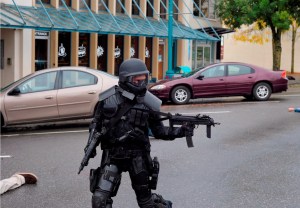 I think the movie’s main weakness is that it’s too insular. We can never free ourselves from Bill Williamson’s head (really, Boll? William Williamson? Are you even trying?). I understand that Boll tries to drop us into the psychosis of a seemingly ordinary 23-year-old burnout that snaps. To that end, Boll effectively fills the background with an mélange of chatter; short news radio bursts are strung together noting the ails of the global ails of the world. It feels like an actual peak into the anxiety-riddled skull of the main character. But this guy just isn’t that interesting. We’re never given any real insight into his thought process because Boll holds back whatever Bill really thinks until the very end, which means for the majority of the movie we’re just watching a nut in body armor. A far majority of the movie is tagging along on Bill’s killing spree, watching person after person gunned down. Is this entertainment and for whom?
Boll assembles a better thesis about what makes people grab guns and lash out than he did in 2003’s school shooter rumpus, Heart of America, which also starred Fletcher as a chief bully. But that doesn’t mean that the pieces fit together any better. Bill’s rationale is that the world is overpopulated and could use a good pruning. So everybody goes. This is a pretty weak justification, especially when you consider that he’s slaughtering the denizens of a SMALL TOWN who has plenty of room for growth. Will purposely goes out of his way to gun down the servers who irritated him the day before, thus he seeks vengeance not ideological purity. Boll at least switches spree motivations late into something a tad more consumerist, but by then it’s too late. We need outside perspectives for this story to become more than a horror highlight reel of death. This movie could have worked from a Falling Down-esque narrative divided between the man on the rampage and the man in hot pursuit. That dynamic would provide for more thrills as well as a natural good guy and bad guy designation. But Boll doesn’t want any such designation. He wants us to be uncomfortable from beginning to end, to empathize with Bill early on and become horrified about what this says about all of us. A radio broadcaster says, without a hint of irony: “I don’t know how this could happen here or anywhere?” You’re uncomfortable but not because of what Bill is doing. You never empathize with the guy because he’s a loser and pretty hotheaded. It’s because the movie is bereft of commentary that makes it uncomfortable because then the violence becomes celebratory.
Rampage is set in a small town for some sort of ham-handed message about the unpredictability of violence, but could something of this magnitude truly go down in today’s technologically saturated world (for extra sledgehammer irony, the town is called Tenderville)? I will even give some leeway that a small town has a limited number of police officers and Bill blows up the police station as his first goal, but then where are all the neighboring cops? When we live in a world where everybody owns a cell phone, and every cell phone owner is an amateur journalist, it’s somewhat preposterous that news of this magnitude would remain so isolated for so long. As soon as a crazy guy walked down the center of town and murdering everybody, you better believe that CNN would have some cell phone video up in a manner of minutes. Surely the barrage of 911 calls would have informed emergency technicians that the police station was bombed and the killer is still on the loose. Where are the neighboring communities’ police officers? Where are the helicopters? In the age of information, nobody seems able to communicate anything. And why do people have trouble locking and barricading their doors? As Bill goes window-shopping for victims all the store doors remain unlocked, allowing him easy access to blow away customers. If Rampage was set in a violence-torn area that had become eerily accustomed to the sound of gunfire then perhaps people’s initial indifference to gunfire could be explained. But remember, this is a small town for maximum intentional dramatic impact. They should be extremely responsive to the sound of continual gunfire. And these people should be packing too.
 The scheme of Bill’s coalesces in the last ten minutes of the movie, attempting to offer clarity and advance the material. Beware gentle reader, spoilers will follow, but you’ve already come this far. In the end, Bill has planned his killing spree with the intent of framing his only friend, Evan. Bill has made sure all his mail-order purchases were delivered to Evan’s home, Evan is the one with the long YouTube rants about overpopulation and people standing up to make change, and Evan’s father is a former radical from the 1960s who justified violence in the name of good causes. Of course we only learn that last bit in the film’s closing seconds because why would something like that be relevant to know beforehand, right? Bill meets his buddy in the woods for their scheduled paintball date, tazes the bastard, then stuffs a gun in Evan’s hand and has him pull the trigger to fulfill his role as patsy. The cops will think Evan has killed himself after being pursued into the woods. This is why Bill had to come back and brutally gun down an entire salon of women because he took his mask off and exposed his real face. Bill then disappears with the money.
As you expect, there are more holes to this plot than Swiss cheese. First off, there’s a noticeable height difference between Evan and Bill (Fletcher is only 5’4″ tall). Take into account different boot sizes, massive amounts of security camera footage, the registration for the cars that Bill turned into suicide bombs, the fact that the stolen bank money would now be marked, an autopsy report that would discover the stun gun wound and the awkward position for the self-inflicted gunshot wound, and the eye witnesses that must have seen Bill roaming around his neighborhood head-to-toe in his armor, never mind the fact that a massacre of this size practically guarantees the FBI’s involvement, and you’ve got so many areas for this master plan to unravel. That’s probably why Rampage ends with a post-script informing us Bill took off and has yet to be caught because somehow he’s a criminal genius.
This is Fletcher’s (Freddy vs. Jason, HBO’s The Pacific) movie and he pretty much hides behind his character’s literal and figurative mask. It’s not too hard to glower and walk with purpose, which is what Bill does for most of the movie. He doesn’t come across as overtly threatening, which is probably the point, but nor does Fletcher ever show insight into Bill’s dark recesses. He just seems like an irritable child with guns who wants to settle some scores from a bruised ego. Fletcher has acting ability but his assimilation into the Boll Players should worry anybody who wants to see that ability again (four Boll films and counting). Curiously, Katherine Isabelle, the star of the clever teen-girl-werewolf Canadian horror series Ginger Snaps, has a near cameo appearance as one of the salon workers who gets murdered. Having an actress like her play such a small character with brief screen time seems bizarre. Maybe Fletcher, as the film’s co-producer, called in a favor from his Freddy vs. Jason co-star.
 Boll’s direction pretty much gets swallowed whole by the void of his main character. Every decision seems made to suit some kind of allegorical message that never seems to materialize. The camerawork is self-consciously shaky; there’s no reason a simple family conversation over the breakfast table should look like a 9.8 earthquake is going on simultaneously. The film also has the annoying habit of jumping forwards and backwards in time for split-second edits. I couldn’t tell if these flash edits were mere foreshadowing peaks at what was to come, trying to sate a bloodthirsty audience getting antsy, or if they were small fantasies playing out inside Bill’s head, showing his violent tendencies and delicate hold on reality. Well, they were just previews for the main attraction, which makes their use hard to fathom. If Boll wanted an audience to be shocked by what was to come, why give them previews? The film would have worked better without the non-linear quirks. Boll makes sure his camera is never far away from Bill, and during stretches the camera is pinned on Bill’s face as he huffs and puffs and kills people off screen. It’s Boll’s one somewhat interesting moment of artistic restraint. Boll is improving as an action director in certain regards. Rampage has some nice stunt work and some pretty well executed explosions.
Don’t believe the steady stream of good press for Rampage. I never thought I’d have an opportunity to write these words … but Rampage does not live up to the hype. It is not Boll’s first successful movie; I’d argue that his Vietnam movie Tunnel Rats came much closer to being a good and entertaining movie. Rampage is a rather empty vehicle to watch innocents get massacred. It lacks subtext and commentary, so the violence becomes gratuitous and meaningless, which is much more uncomfortable than anything Boll intends with his narrative. Obviously, Boll has modeled his story after recent incidents like the Virginia Tech gunman in 2007. Sadly, there is no shortage of crazed gunman stories in the news to pick from. If Boll attempted to squeeze some subtext into the various proceedings, satirizing the sensationalistic media turning people into fragile, potentially-lethal time bombs, or perhaps even the allure of fame through whatever costs, even the most infamous, then maybe watching countless people get shot would at least offer some meaning. I wasn’t expecting a Funny Games dissection level of violence and voyeurism and the participation of the viewer, but I expected more than watching a dude in a suit of armor kill fleeing civilians for an hour. If that’s your idea of entertainment than perhaps you should go play a video game that rewards such behavior. Don’t worry; it’s only a matter of time before Boll transforms that into a movie next.
Nate’s Grade: C-
Share this:

Stoic (2009)
 Until recently, it would have been unthinkable to associate Uwe Boll with the idea of social activist. This is the same man who has caused people so much pain and with his movies, ranging from bad to ridiculously bad to “You cannot unsee what you have seen” bad. The German director who has caused so many film and video game fans suffering seemed an unlikely candidate to seriously explore the suffering of others. And yet Boll’s heart grew three sizes and he directed a slate of movies with a social conscience. His movie about the genocide in Darfur is still circling around, awaiting a release date, but let me stop to remind you that Uwe Freaking Boll directed a movie about a topical humanitarian crisis. This is akin to… Eli Roth directing an Edith Wharton adaptation (“From the director of Cabin Fever comes … Ethan Frome!”). It just doesn’t seem like an organic pairing. Boll is used to blood and boobs (both of the mammary kind and of the idiot variety), not social relevancy. You don’t expect an exploitation filmmaker to shine a light on exploitation. While we await his Darfur movie, in the meantime is Stoic, a quick and cheap movie about three prison inmates (Edward Furlong, Sam Levinson, Steffen Mennekes) brutalizing their cellmate, Mitch (Shaun Sipos) when a bet goes wrong. It’s based on a true story from a German juvenile detention center, or so we’re told.
So what kind of movie is Stoic, actually? Well, for starters it’s an uncomfortable one. The movie aims to show the capability of human cruelty and how easy it is to become compliant within a group, to go along with the flow despite some murky moral hazards. The three cellmates end up kick starting a cycle of violence, each trying to top the last so as not to appear weak or to damage ego. Can this cycle of cruelty be stopped? The dehumanization leads to some rather brutal and disgusting acts of violence and degradation including forcing Mitch to eat his own vomit, dumping urine on the guy’s face, raping him, and sodomizing him with a broom handle (“Just curiosity, I guess,” explains one of his attackers). Despite all this, there are actual moments of restraint on Boll’s part, particularly during the rape sequence. The audio drops out, the edits become jump cuts stuttering ahead through time, and I thought perhaps Boll was maturing. Needless to say this thought was torpedoed a tad when Boll later showcased the inmates rubbing the bloody broom handle over Mitch’s unconscious mouth. Stoic is essentially a torture movie; it’s 80 minutes of literal torture with some extra psychological justification tagged along for safe measure.
 Where Stoic comes into issue is whether or not it possesses any merits to justify watching 80-some minutes or torture. The movie doesn’t offer much in the way of psychological insights or rich characters. Watching people become increasingly hurtful is not the same as exploring the habits that make such escalating acts of barbarity occur. Boll and the actors pound us with the message that we’re in prison and prison has its own operating system and everybody jockeys for position; Peter (Levinson) repeatedly tells us that he feels sorry but felt he had to participate or else they’d turn on him. It’s all about having somebody weaker to take the fall. I’ll give Boll credit that the amplification of events seems plausible given the circumstances, to the point that the three guys have come to the conclusion that there will be serious consequences for their actions unless they convince Mitch to go along with a fake suicide. The movie maintains believability even as things get more and more out of hand, which is commendable. But what isn’t commendable is that there seems little reason for Stoic to exist. Narratively the movie is simple: three guys pick on another guy. The characters are all slight variations of one another based upon the level to process guilt and deception. During the interviews, we’re given fleeting glimpses at denial and coping mechanisms, mainly lying (“I would’ve remembered something like that.”) to self-rationalization (“I kept saying to myself, ‘As long as it’s not me.’”). There aren’t many insights to be gleaned from the brief interviews, which serve as commentary.
Boll decided to make Stoic his Mike Leigh film, meaning that he had the basic outline of a story and told his actors to run with it while he filmed them. There was no script and all the dialogue was completely improvised. This does allow Stoic to maintain a naturalistic feel, however, it also means that the actors are beholden to tough guy clichés. The dialogue, particularly during the interrogation scenes, keeps falling back to a “you don’t know what’s it’s like, man!” mantra. Here are some examples of bland dialogue that the actors came up with:
“What choice did I have?”
“You’re either with them or against them.”
“What don’t you understand? If I didn’t seem like I was apart of it, they’d kill me.”
“I had no choice. They forced me.”
“I want to lie because I don’t want to be that person.”
“I felt like there was no way out.”
And because you knew it had to happen:
“I’m just as bad as the two of them because I didn’t do anything to stop it.”
 You’ll note that most of these dialogue examples belong to the Peter, the chattiest and most remorseful interviewee. Improvisation has its virtues but it can also lead to actors falling back on stuff they’ve seen in countless other genre examples, which means that the banal, cliché dialogue all gets stirred together one more time.
In defense of Stoic, it may prove to be Boll’s finest directorial effort yet. The handheld camera, sharp edits, and close angles copy the Paul Greengrass (The Bourne Ultimatum, United 93) style of visuals, and yet the docu-drama copy works. The visual aesthetic improves the quality of the film and allows Boll many opportunities for interesting compositions and smart stylistic decisions with the economical space of the set. The interviews are shot as one static camera shot to contrast with the shaky, reactionary movement from within the cell. It may not be an original style, but then again Boll seems to adopt (some might say rip-off) a new style with every film. For Stoic, Boll’s direction makes you feel in the middle of these awful incidents, and the pain feels even more real.
But is there any reason to really watch Stoic? The acting is mostly good, and maybe fans of Edward Furlong would like to see what he’s been up to since 1998’s Pecker and American History X. Perhaps the declaration of “Boll’s best directorial effort” will appeal to maybe six or seven curious, and questionably masochistic, film fans. Due to Boll’s German background, I can’t help but wonder if his country’s history influenced him to try a narrative experiment hat explores how easy it is to go along with something awful, how difficult it is to make a moral stand against the grain, and how easily circumstances can find momentum and get out of control. I wonder if Stoic is Boll’s personal act of penance, of trying to understand a nation’s actions (and inaction) and working through a lingering shroud of shame. Then again, I may be reading way more into this movie than was ever intended. It could have just been a lark for a quick buck/deutschmark. Stoic is a mildly interesting little filmic experiment from Boll. Due to its narrative simplicity and limited characterization, it can’t offer much more than another voyeuristic slideshow of human degradation.
Nate’s Grade: C
Share this:

Tunnel Rats (2009)
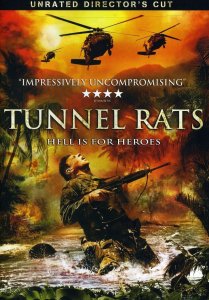 Uwe Boll does a Vietnam War film? It certainly sounds like a recipe for profound disaster. In 1968, as the intrusive prefix to the title tells us, the U.S. military had a unit of soldiers with the special mission to discover and infiltrate the miles-long underground tunnels by the Viet Cong. These “tunnel rats” were tasked with clearing out these deadly and cavernous mazes, where the Viet Cong ate, slept, and even walled up their dead within. Sergeant Vic Hollowborn (Michael Pare, who else?) heads the unit and has to shape up the new recruits into formidable fighters. Hollowborn lectures his young men on the dangers of “Charlie” and even orders them to execute an enemy prisoner. “Charlie’s gonna kill you just for being here,” he warns. “He doesn’t care if you’re a nice guy.” This nugget of wisdom is proven true over the 90-minutes of the film. The Tunnel Rats unit finds a new tunnel and this discovery eventually leads to the camp being decimated over the course of one hellish night in Vietnam.
When the action goes underground is when the movie gets, remarkably, pretty good. The labyrinthine tunnels dug out by the Viet Cong is an incredibly interesting subject that no Vietnam film has yet to cover with any substantial attention. Did you know that the Viet Cong could smell the smoke or aftershave of a man in those tunnels? They can even tell the brand of cigarette supposedly. Boll’s movie fails to take full advantage of its intriguing wartime setting. I wanted to know more about the particulars of the duties entrusted to the Tunnel Rats, a real unit of the armed forces with a high mortality rate. I wanted to know about the incredible construction of these tunnels and the dangers they posed to the U.S. armed forces. I wanted to know about the day-to-day lives of men who specialize in the tunnels, and I really wanted to learn about the unique minutia of hand-to-hand combat within such confined space. Fighting for your life in such limited space, now that’s interesting stuff.
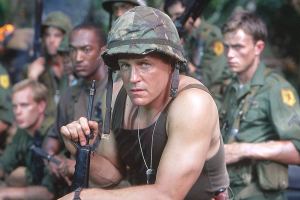 While Boll’s war movie fails to explore the tunnel setting in detail, Tunnel Rats has its fair share of quality suspense, mostly thanks to the claustrophobic quarters. It’s hard to make such limited space exciting for so long, but Boll manages to crank up the tension by pressing in on his actors. Watching the soldiers crawl on their hands and knees, possibly for miles, never knowing what trap might be in wait, well it makes for some intense feeling of dread. There are two standout scenes involved in the tunnels. The first involves a soldier that discovers a tautly wound tripwire leading to a grenade. Boll carefully follows the soldier steadily try to diffuse the booby trap and it almost reaches a nerve-wracking sense of unease. The second standout scene involves a solider that killed a Viet Cong member in the tunnel. The U.S. soldier has to use a simple knife to pulverize the corpse of the Viet Cong member just so he has enough room to pass by inside the tunnel. The scene is shot in tight close-ups as we watch the sickening repetitive motions of the soldier doing his best and bloodiest work just to move on by. It’s harrowing and empathetic. The above ground stuff has all the requisite chaotic explosions and soldiers being gunned down, but it’s the action underground that is surprisingly steady and consistently well designed.
The cinematography by Boll regular Mathias Neumann is a great strength. It takes a page out of Janusz Kaminski’s playbook, Spielberg’s long-time cinematographer, by layering in streams of milky light. The colors are muted and the camerawork is mostly handheld. Sure the visual aesthetic is a tad derivative (it made me wonder if Boll rented Tigerland before filming) but it’s a fairly good copy. The South African location shoot makes for a pleasing facsimile of Vietnam. Neumann also finds new and interesting ways to film the tunnels so that the setting doesn’t lose any of its unsettling power. Watching soldiers crawl along the inky blackness with but a flimsy flashlight provides for some spooky imagery that doesn’t even have to resort to cheap scare tactics. However, there are far too many spinning low-angle shots that do little more than stare at the tree canopies above. It’s like the cameraman is in the constant process of nearly passing out.
 The war as hell metaphor is familiar and potent, but Tunnel Rats lacks a deeper message. The film wallows in war clichés, particularly in its opening 20 minutes. The bland stock soldiers are interchangeable. They wax philosophically about the nature of God and war, talk about their hopes and dreams back home, and recount stories about laying under the stars and enjoying mom’s home cookin’. They bond, they share pictures of their respective sweethearts, and then they naturally meet a grisly end. One newbie even asks, in all seriousness, “You ever get scared out there?” The dialogue is pretty lousy and rife with clichés. The movie isn’t too subtle with some of its metaphors either, like when a Viet Cong woman literally tries washing the blood off her hands after executing a U.S. soldier. While the film is clearly told from the perspective of American soldiers, and the Viet Cong are antagonists, Boll takes time to show fairness to the enemy. One female warrior (Jane Le) fights to protect her young children. Another Viet Cong soldier fights to avenge the honor of a woman who was raped by American troops. The only message that appears to emerge from the movie occurs in the final minutes, when Boll seems to cram in a heavy-handed attempt at moralizing, a “we’re in this together, folks” kind of message that involves nearly four minutes of uninterrupted digging. But then Boll subverts that message and kills it, ending the film with the same sense of hopelessness. Tunnel Rats doesn’t bother to explore human insights and the nature of war and feels decidedly minor, following one all-out skirmish on one day of the Vietnam War. I wish Boll realized the potential his narrative had, which is not something you’ll likely often see me write. Tunnel Rats seems to be too content to be an effective horror movie dressed up as a war flick.
What is it about war movies that seem to excuse exploitation? It seems that a filmmaker can showcase tremendous gore and horrific bloody violence when they can cloak the material under the illusion of being true to life. Somehow filmmakers believe that wallowing in blood and guts is honoring the valor of those who served. This can be true, like the opening onslaught of Saving Private Ryan. But this can also be rubbish. War films can be just as exploitative as any other genre of film. Tunnel Rats has just as gruesome violence as Boll’s other horror movies, but because it has a war setting does not automatically give the violence and gore more integrity or meaning.
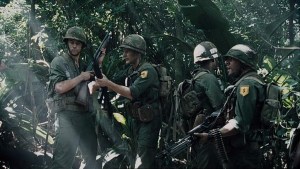 Tunnel Rats is a resounding achievement for the talents of Uwe Boll. It cannot even be passive-aggressively complimented as being “competent.” No, this is actually a halfway good movie that has some unsettling moments amid the suspense and chaos. The underground tunnel sequences manage to find an eerie intensity and are the best part about the movie. Thankfully Boll seems to realize this, which is why a majority of the movie alternates between various soldiers finding their way amongst the underground maze. The acting is actually some of the strongest yet in a Boll movie. Tunnel Rats would have greatly benefited from more attention being spent on the details of the life of a tunnel rat (it seems like a suicide mission). The movie never really feels fully realistic but at the same time it eschews being campy. It’s not as nearly as serious and artistically daring as the pinnacle Vietnam War flicks, but then again the movie is also better than plenty of other recent war films that have the tendency to either be jingoistic or fetishize the brutality of war.
In a twist of fate, Boll is actually developing a first-person shooter video game based upon his Tunnel Rats movie. The man who takes video game properties and makes crummy movies out of them has now made a decent-to-somewhat-good movie and developed a video game from it. Now it’s only a matter of time before Boll adapts the game into another crummy movie.
Nate’s Grade: B-
Share this:

Fary Cry (2008)
 Say what you will about Uwe Boll as a writer and director; Lord knows I’ve written nearly a Master’s thesis on the notorious schlock filmmaker. However, this man would be an asset to have as a producer, at least initially. The German tax loophole was closed and yet the man still finds a way to make like three to four movies a year. He can pull together resources and organization as well as anybody in the business. So what if the final product happens to be substandard? This man knows how to produce. He’s just not as skilled at other positions. Far Cry, Boll’s latest video game adaptation, is a clunky action movie that treats genre clichés as virtues. It is not a bad movie but it’s not a good bad movie either. It’s just Boll’s version of disposable action.
Valerie (Emmanuelle Vaugier) is a Vancouver newspaper reporter who has got a great lead on a story. Turns out Dr. Krieger (Udo Kier), your classic mad scientist, is running experiments on a nearby island and he has an armored guard. Our spunky heroine is determined to investigate. Her uncle Max (Ralf Moeller) is actually working for the mad doctor and having misgivings, which is why he tries to send Valerie classified info on the experiments. Dr. Krieger is bankrolled by the (Canadian?) government to develop genetically modified super soldiers. They have a layer of armor under their skin and the only foolproof way to kill these super soldiers is to shoot them in the eye or mouth. My best guess why is because they both lead to the brain, but then why stop there? Why not shooting into ear and nose cavities? Anyway, the super soldiers won’t take orders so the mad doctor and his mercenaries capture Max and turn him into the newest test subject. Valerie has chartered a boat to meet up with her uncle. The boat captain, Jack (Til Schweiger, who sounds like his voice was dubbed by an actor that could not widen his mouth to enunciate), just happens to be an old Special Forces buddy of Max’s. This comes in handy when both Jack and Valerie are attacked once they reach the island. The duo must run for their lives and inflict much ass-kicking justice.
 Far Cry is a mediocre cliché-ridden action vehicle. You’ve got so many formula elements widely circulated in numerous other action flicks, and I’m not even talking about the standards like that the good guys are marksmen, the bad guys are terrible shots, and anyone can move unfazed if they get shot in the shoulder. We also have the fact that all evil hideouts, when not hewn into volcanic rock, must be located in giant warehouses with too many catwalks and chains and extraneous machinery that do little else but spit sparks when called upon. Jack also pulls the timeless tactic of stripping an enemy solider, putting on his uniform, and then infiltrating the enemy camp under a flawless disguise – a change in clothes. Let’s not also forget the tried-and-true method of throwing a rock in a different direction to cause a distraction. I think at this point only dogs fall for that. By the thirty-minute point, we’ve already seen two separate shots of Jack swimming underwater while an explosion rages above the surface. Though the word has likely lost all meaning to Boll, I would describe that as excessive.
Another major cliché of action movies is the forced coupling between Jack and Valerie. It doesn’t take long before their bickering leads to smooching. Shortly after just escaping mercenaries and a helicopter explosion in a lake, Jack and Valerie find a shack nearby and tend to their wounds. She changes out of wet clothes and makes sure that he doesn’t catch a peek (he does) and he dresses a flesh wound on his rippled abdomen. Eventually she crawls under the blankets on a bed to warm herself for the night. He does too, to stay warm of course. “I have to take off my wet pants, you know,” he reasons (oldest trick in the book). But after they’re in bed together they have to still talk about how cold they each are still, and then Jack suggests, “shared body heat,” you know, just to stay dry. After what seems like forever, these two just give up this charade and start kissing and have them some sex. Naturally, the introduction of an attractive female character in an action movie is designed so that she can snuggle and then be put in danger. Valerie does little else to the story. I want to know why either of these two is acting so casual moments after they escaped fiery death. They know that they’re still being hunted, and the shack is within walking distance from the crash site, which is being investigated by the mercenaries. For that matter, why do the bad guys call off each attack to search and confirm for kills? Are they that concerned with paperwork?
 Far Cry feels like every generic moment rises from the shadow of other generic action movies. The final conflict between Jack and Max the Super Solider boils down to an appeal to the man inside the monster, trying to tap the humanity buried beneath the killing machine. You’ve seen this in countless other movies. Dr. Krieger has a dominatrix-esque second-in-command that has some personality to her; it must be hard to be a female henchwoman, having to be even more evil than the henchmen to prove her self. The initial plot setup even reminds me of Ed Wood’s Bride of the Monster — girl reporter investigates mad scientist. The whole island-based setting, with the aquatic inclined stunts, led by a Central European action star, buddied up with a yammering idiot as a comic sidekick … it oddly reminds me of the entirely forgettable 1998 Jean Claude Van-Damme movie, Knock-Off, with also had the misfortune of co-starring Rob Schneider. A knock-off of Knock-Off? Well it is time for the tenth anniversary after all.
Boll stubbornly tries to make his mundane action movie into a comedy. The comic elements never fully gel with the rest of the film, and yet Boll keeps transforming the movie into this screwy action comedy. There’s the bickering between Jack and Valerie, which is expected territory for the genre, but then the movie fills its time with excessive wisecracks, strange digressions, and so much comic relief that it fails to be relief (or comic). Chris Coppola chews as much scenery as possible as Emilio, the irritating, hapless sidekick to Jack. He’s introduced at almost the hour mark and seems to be trying to make up for lost time in annoyance. He’ll offer to help Jack fight but then recoil and scamper off. This is the kind of movie that has the overweight Coppola lovingly caress a sandwich and coo, “I’ve been thinking about you all day.” Get it? He’s fat. Fat people love food.
But by far the funniest and weirdest aspect abut Far Cry is how unbelievably prepared Jack is for any situation. He hands Valerie a handcuff key from his pocket, which he always carried with him because, presumably, Jack lands in handcuffs often or cannot be trusted to remember his “safe word.” But then late in the movie, Jack is handcuffed and he literally regurgitates ANOTHER handcuff key. This means that Jack keeps a key in his pocket and swallows a spare. Does he eat these daily? What else is hidden among his body? The man could be a human Swiss army knife.
 No one ever seems to question what the chances are that a German former Special Forces agent will work at a Canadian lab, within reach of his Canadian niece ace reporter, who will charter a boat from another German former Special Forces agent who also happens to be within reach of this lab. I guess when you’ve got invincible super soldiers you don’t sweat the details.
Despite all its flaws and general laziness, Far Cry is a semi-decent action movie, especially one with a low budget. Boll manages to construct some passing action sequences with respectable camerawork, and the end battles between our heroes and the Super Soldiers is actually well-edited, with sharp cuts that help ratchet up the energy level, and has plenty of good stunt work. A chase through the nondescript warehouse between Jack and a super soldier actually makes use of some spiffy Parkour choreography, a welcomed addition. The forced comedy can actually succeed at times during the action, like when Valerie is hurling grenades with the pins still attached or when she accidentally lassos a helicopter with a harpoon gun (Dr Krieger scolds her, “You know, you owe me a helicopter.”).
In the pantheon of Boll movies, Far Cry lands more toward the top. It’s a middling action movie that tries too hard to constantly inject misguided humor into every freaking minute. The movie suffers from the same boneheaded flaws that plague the action movie genre, but by the end of its admittedly brief running time, Boll has pulled off a minor success. Far Cry is not a good movie and has too many derivative and unimaginative elements, but Boll seems to have cranked this one out. While Far Cry is not a particularly good action movie, it is relatively indecipherable from the thousands of other cheap mediocre action movies that pollute the direct-to-DVD market. He’s made an easily digestible product that isn’t even bad enough or weird enough to be memorable. To him that’s victory, but to me, an avid Boll expert, that’s just plain boring.
Nate’s Grade: C
Share this:

Seed (2008)
 Uwe Boll had some things he wanted to say with his low-rent horror flick, Seed. Like much of Boll’s output it’s based upon a video game. However, Boll opens the flick with a warning that footage of animal abuse and disturbing images will be incorporated into the movie. Seed gets the ball rolling with a two-minute montage of animals being cruelly beaten and mutilated before the title ever finds its place on screen. Boll’s opening text says that he decided to use this disturbing snuff footage because he “wanted to make a statement about humanity.” Yeah, sure Boll. Isn’t it a bit trite and easy to castigate the human condition for evil when you just roll out visceral real-life footage of cruelty? By highlighting the real stuff Boll is calling into question the significance of his whole stupid slasher movie. It opens with real-life cruelty and then plays out 90 minutes of fake cruelty, so what’s the point? I don’t think Seed has any interest in the subtext that can elevate horror movies. I think Boll just wanted to make his own torture-heavy horror film and found some animal abuse footage on the cheap (PETA probably gave it to him free of charge). The opening smacks of exploitation and opportunism and has zero thematic connection to the flaccid and empty-headed horror movie that follows. If I sound angry that’s because I don’t need to see animals having their skulls crushed in to get it.
Seed (William Sanderson) is a killer of astounding proficiency (for further details: see below). Matt Bishop (Boll BFF, Michael Paré) is the detective that’s been tracking Seed all these years. You can tell he’s a haunted cop because he has a drinking problem and hears the cries of dead babies. Eventually, Bishop tracks down Seed’s hideout and he arrests the murderous fiend. Seed is sentenced to die by the electric chair. The problem is that the prison doesn’t have a pristine electric chair, and the law says that if a man survives three jolts of juice then he’s free to go (for further details: see below). The warden (Ralf Moeller) decides to take command. He and a group of prison employees bury Seed alive and tell the world he died on the faulty electric chair. Of course Seed comes back and rekindles that old killing feeling.

 If Sanctimony was Boll’s attempt to manufacture the clever Saw-esque serial killer, a higher scale of serial killers, then Seed is at the opposite end of the serial killer equation. This is a dull slasher movie and Seed is about as dull as killers can be. His main attributes are that he’s a huge guy with a sack on his head, which is kind of similar to about 1000 different slasher movies. He looks particularly close to Leatherface from The Texas Chainsaw Massacre. I guess the slasher recipe is add one obscure mask plus one set of overalls plus dirt = killer. The guy has zero personality and is merely a silent killing machine that, in typical slasher fashion, always roams around at a deliberately slow pace. Sanderson (star of SEVEN Boll films) is unrecognizable as Seed and this is mostly because he wears a sack on his head and says maybe one thing for the entire 90-minute running time. I don’t recall Sanderson being as bulky either. Boll’s attempt at a horror movie wallows in exploitation and prolonged torture. As always, he’s late to the party.
Seed is credited as bring solely written by Boll, and the man screws it all up within minutes. When it comes to horror movies there will always need to be a somewhat healthy suspension of disbelief but only up to a point. Every movie no matter the genre or internal logic will have a breaking point. Seed cruises through that breaking point alarmingly early. Through the use of newspaper clippings, Boll introduces us to the backstory of Mr. Seed (he uses newspaper clippings for 90 percent of all exposition, meaning someone at the police department has a big thing for scrapbooking). We are told that from 1973-1979, Seed killed an astounding, and numerologically convenient, 666 people in those six years. Just take a second and think that figure over. One person in a ratty cloth mask and overalls killed 666 people. Ted Bundy and John Wayne Gacey weren’t even anywhere near that figure and they are highly prolific serial killers. Boll wanted to make his serial killer scary but he totally overcompensates and destroys any credibility the film could possibly attain. Why 666? There’s no way it’s a coincidence considering the pull of that number in our pop culture. Was that a target quota for Seed? Did he make a chart to know when he was falling behind?
The sheer magnitude of that number obliterates the facade of “reality” Boll wants to create in his movie. These cops have to be the worst investigative unit in history. Seriously, could they not tabulate any clues or patterns or habits of Seed after 665 murders? I think the FBI would have stepped in hundreds of unsolved murders ago. And yet Boll then shows again how staggeringly inept these local cops are. They find out Seed’s home, which is of course a dilapidated shack in the middle of nowhere. This naturally begs the question that Seed would have to venture out long distances to find so many victims, and yet no witnesses of any sort? But Boll ignores this and steamrolls ahead. What showcases the utter stupidity of these boys in blue is that they ride out in the middle of the night, into the middle of the woods, and decide to raid Seed’s house with only six officers. I’m sorry, but if any man killed 666 people with his own hands then you don’t plan on taking him down with a small unit of cops who have already proven to be inept. You bring in tanks.
 The premise itself is deeply flawed and begging for mockery. Seed proposes that there is a law on the books that somehow mandates prisoners must be set free if you can’t kill them after three jolts from the electric chair. We’re talking 45 second long jolts of 15,000 volts of electricity frying your brain. Your heart will eventually explode with all that electricity. So how does this law truly work? Surely no one would actually abide by it or fear that the government would punish them for breaking this law? Seed never specifies where it takes place, though the vibe I get is more southern, and they love to kill people in the South, especially Texas. Did the electric company propose this three-strikes-and-you’re-alive policy as an incentive to inmates? Do low-income prisons have a higher turnaround rate? Does this law cover firing squads and hangings as well? A judge and jury have found Seed guilty and sentenced him to be executed. That judicial ruling is not absolved because an inmate could withstand a high degree of voltage. The premise turns an execution into a contest.
Most slasher movies involve a near superhuman antagonist, and Seed follows suit. He can attack and kill four prison guards who try to gang rape him in his cell (what part of 666 kills says, “please expose your penis near me”?). He can step on a prison guard’s forearm and crush it so that it looks like a swaying doll part. He can bust out of a coffin and dig himself out of a grave. Now I did some quick math and a 6 feet by 6 feet by 3 feet grave is 108 total cubic feet. The lightest dirt will weigh is 42 pounds per cubic foot. That means that Seed had 4536 pounds of force weighing down on him in that grave. Yet he was able to free himself and go on his rampage. If Seed is this indestructible force then it’s ridiculous that Pare could kick him a few times and the man went down during the police capture. Which is the worse screenwriting sin? Having Seed wiggle out of 4500 pounds of force or the fact that the prison guards did a lousy job of BURYING ALIVE a man who killed 666 people! Why would you ever bury this maniac alive?! That seems hardly definitive. Common sense begs cutting off the man’s head just to be certain.
When it comes to horror movies, building an atmosphere is essential but there’s a notable difference between building dread and simply killing time. Boll does not know this difference. Seed doesn’t even get placed on the electric chair until 46 minutes in. The first 33 minutes of the movie is pointless because it retells Seed’s capture via a flashback while he sits on death row. Watching Seed finally get captured isn’t really important to the story, and a good half of that misspent time is simply gross and grainy home videos. Seed sends videotapes to the police to taunt them. The tapes are shot in a dungeon-like location and involve living creatures rotting thanks to the miracles of time-lapse photography. Naturally this raises two quibbles: 1) No one had personal video recording devices in the mid 1970s, let alone a maniac living in the middle of nowhere, and 2) watching dogs and babies die of dehydration and then decompose to ash means that these video projects took many weeks to accomplish. That’s a lot of time. Boll spends five plus minutes of screen time just showing these grainy snuff videos with the police recoiling. Perhaps the extent of their investigation was watching these gross videos and making faces. How many videos do the police have from Seed? It seems like Seed’s version of the fruit of the month club.
 But getting back to misspent time, Boll thinks just holding onto a shot and not cutting makes it scary or tense. It doesn’t. I don’t need nearly two minutes uninterrupted of watching guards fiddle with Seed’s chains as they try and latch him into the electric chair. I don’t need almost a minute of one shot panning around a boat departing the prison isle. I don’t need nearly two uninterrupted minutes of watching the prison doctor’s bedtime rituals before he eventually gets murdered. I especially don’t need over five uninterrupted minutes of watching Seed hit a woman in the head with a mallet. I’m not being facetious when I tell you that he literally hits her 40 times until her head is purified into a bloody stump of a neck. Seed literally paints the walls with this old woman’s blood (how did this genius not get caught?). The soundtrack soars to laughable heights and the scene just goes on and on, figuratively bludgeoning the audience as well. Boll believes that just holding onto a moment of depravity makes it sinister. It doesn’t when there’s no audience connection whatsoever to the tired material. Boll does craft one nicely tense sequence where Pare and the cops capture Seed. There’s a moment when one officer is tiptoeing through the basement of Seed’s home and the only source of light is the flicker of the police siren. It’s visually appealing and works to create tension as well. But this moment is short-lived. I’ll never know how a burly guy can see through a cloth mask in the dark and sneak around in a dilapidated home filled with crap covered in tetanus.
It may be hard to notice for some, but Uwe Boll is actually improving as a filmmaker, at least from a technical standard. Seed looks like an actual movie. Seed is grisly and nihilistic and futile. The killer is a bore and the story is poorly structured, taking far too long to get Seed in the ground and wrecking havoc. Boll’s screenwriting shortcomings are fully evident as he strings together genre clichés and ridiculous plot points that obliterate credibility. He grasps at making statements about the human capacity for cruelty. Well I didn’t need a Uwe Boll movie to educate me on man’s inhumanity to man, especially one this shoddy and empty. This movie isn’t even entertaining; it’s a chore to sit through. This is the first Boll movie that I sat just waiting for it to be over. There is no reason to watch this thing. During the extended scenes of video watching by the police, one of the cops watches a baby decompose and replies, “Sick bastard.” I think Boll was projecting here. And I didn’t need footage of animals being slaughtered to reach that conclusion either.
Nate’s Grade: D-
Share this:

Postal (2008)
 I feel very strange at this moment. I may need to consult a physician. I’m undergoing an altogether new and confusing sensation. You see, I’m hesitant, almost embarrassed to admit this, but I finally found a Uwe Boll movie that I, well, don’t hate. In fact, I was laughing with Postal and not derisively at it. I would never have guessed that a social satire co-written and directed by Boll, which begins with hijackers flying a plane into a large skyscraper, is actually intentionally funny. That’s not to say that the outrageous, violent, and messy film is verifiably good, but for the first time I feel like Boll is genuinely progressing as a filmmaker and may prove that he can craft a competently entertaining movie in the future. And if you know anything about Boll, that statement is akin to going from crawling to flying an F-14 fighter jet blindfolded while constructing a birdhouse out of Popsicle sticks.
The slapdash plot takes place in the small town of Paradise, Arizona. Postal Dude (Zack Ward, TV’s Titus, Bloodrayne II) is a guy who gets pushed around by life. His fat wife is cheating on him constantly, he’s bullied by rednecks that live in the neighborhood trailer park, and he can’t find a job to escape. He’s looking for any way out. His uncle Dave (Dave Foley) has started a doomsday religious cult of disenfranchised hippies. The IRS is currently targeting him and needs a quick money fix. Uncle Dave and Postal Dude scheme to steal the lone shipment of “Krotchy” dolls, a doll that resembles male testicles that is highly in demand (the Chinese shipment capsized and the crew all died, but luckily the dolls were saved). Also looking to snatch the dolls is a terrorist cell that includes Osama bin Laden (played by Jewish actor Larry Thomas, best known as the Soup Nazi on Seinfeld). The plot isn’t important per se, but you will find yourself openly questioning why respected actors like J.K. Simmons and Seymour Cassel are doing in this mess.
 I think Boll has finally found a genre best suited for his cinematic interests. Setting Postal in the wacky comedy world has a freeing effect for Boll: he doesn’t have to adhere to any form of logic. His other movies usually suffered through continual lapses in thought and deed. With Postal, Boll can be as silly as he wants and not have to worry about disrupting his narrative. It should be no surprise then that Postal contains the best acting ever seen in a Boll movie. The good German has always had a seemingly inability to control his actors or provide any helpful direction, but finally he has found a genre that will work with actors giving unrestrained performances that are figuratively all over the thespian map. Shockingly, Ward and Foley both give quite good straight-laced comedic performances (nothing can prepare you for Foley’s generous dose of full-frontal nudity).
Boll stuffs a lot of extreme elements into his movie, including Islamic terrorists, Osama bin Laden frolicking hand-in-hand with President Bush, inbred rednecks with garish teeth, sex scenes with the morbidly obese, crass racial stereotypes, sexual abuse gags, the media’s opportunism in response to tragedy, an ending that takes a page from Dr. Strangelove, a mentally handicapped martyr, and much more. The movie’s aim is to offend and it has many targets. Boll is no insightful political satirist but even he finds humor in the absurd. The movie is blunt and belittles everyone. Postal skewers religious fundamentalism/apocalyptic yearnings on all sides. There is one sequence where Ward is pinned down by rednecks, Islamic terrorists, and crazy cult followers. He tries appealing to their hearts and establishing common ground. “Well,” one of the terrorists says, “We all hate the Jews,” and then everyone nods solemnly. That’s funny. It’s not deep or biting but it is funny in setup and delivery. I give credit where it’s due. Postal takes some seriously demented detours that take advantage of the wacky, anything-goes atmosphere.
The movie’s jokes hit high and low but some of them definitely stick. The concept of our main character caught in a shootout at the welfare office is given a wicked twist when he crawls along the incapacitated victims looking to trade up a better waiting number. There are comedic riffs hat actually work. Postal isn’t clever or scathing, and is hardly subtle or nuanced, but I could honestly see Postal developing a small cult following, one removed from the cult following already built around bashing Boll.
 Here is a list of moments that made me actually laugh: using a man in a vegetative state bound in wheelchair as a stepping stone to help climb a chain-link fence, Foley and Ward arguing decimal placements, watching Mini-Me actor Verne Troyer pushing a suitcase bigger than himself across a long shot, the fact that Osama bin Laden casually walks around in broad daylight to underscore the nagging fact that the man is still at large, the concept of using a cat as a silencer for a gun (fear not animal lovers, the cat lives), a “God shelter” in case of rapture, Osama attending a workshop on leadership styles and having his credit card declined, a character’s dying attempt to discover if he’s gay or merely bisexual, and the insane religious prophecy involving Troyer and 1000 horny monkeys. That last one is almost inspired in its sheer lunacy. The best part for many will be when Uwe Boll appears onscreen as himself. He admits he finances his crummy movies via Nazi gold and then, no kidding, the actual creator of the Postal video game appears and shoots Boll in the groin. For many, this is a vicarious moment to be savored.
Postal could have worked even better had Boll had a more consistent tone. Simply put, being offensive and shocking and wallowing in bad taste does not guarantee being funny. Watching a truck run over a baby carriage isn’t funny because it’s shocking. Without greater context or setup, it’s the equivalent of a tired and morose “dead baby” joke: tasteless but lacking any humor. And yet here are more missed comedic opportunities that Boll fails to capitalize upon. The missed comedic opportunities mount (Islamic terrorists eventually descend upon a redneck trailer park and … nothing?). Some jokes teeter but then hit a wrong note and become uncomfortable. Watching a black police officer (Chris Spencer, Bloodrayne II) brutally murder an Asian driver is not funny. Seeing a montage of children being massacred by stray gunfire is not funny and has no hope of being funny. When the movie utilizes realistic violence, it must walk a very delicate tone to spring laughs from darker territory. Realistic violence by itself is not funny because brutality is hard to milk for laughs.
Boll will drift and lose his comedy momentum. The highly publicized opening sequence is actually kind of funny. Two terrorists have hijacked a plane but then have second thoughts after they realize there are discrepancies about the number of post-martyrdom virgins. They begin to then analyze the gaps in theology and decide to turn the plane around and head to the Bahamas instead. With this segment Boll has taken a politically sensitive subject and given it a twist. Where the segment goes wrong is not when the passengers storm the cockpit and cause the plane to crash, this serves as irony. Where the segment goes wrong is when it cuts to a window washer atop a skyscraper and we watch the plane come closer and crash into a fiery blaze. The view doesn’t serve as any comedic punchline and places the viewer in an uncomfortable position of not only reliving 9/11 but also reliving it from a hapless victim’s perspective. It’s one example of a misstep that ruins the joke. By the film’s end it has turned into an incoherent bloodbath.
 Not to kill Uwe Boll with praise, but Postal is also his best looking movie to date. The shot compositions are framed well, there is actual camerawork that gives off a slight Coen brothers’ vibe, and the cinematography by Boll staple Mathias Nuemann is crisp and clean. This is a good-looking movie that works within its limited budget and locations.
Postal wasn’t given much of a chance out of the gate. It has been sitting on a shelf for over a year, it was dumped into a small number of theaters opening the same weekend opposite the slightly higher profile Indiana Jones sequel. Boll arranged a free screening of the film and a majority walked out after the opening segment involving the hijackers. Postal is a bizarre and distasteful movie that relies too heavily on shock tactics and the idea that offensive equates humor. There are holes, inconsistencies, shallow satire, and many missed comedic opportunities, and yet, in spite of everything, I laughed at several points. This is Boll’s most intentionally entertaining movie to date. While it may sound like heresy, I would rather watch Postal again than the much more commercial and critically lauded Pineapple Express.
It feels like Boll is actually progressing as a filmmaker, however, I make this statement under the caveat that the confines of the wacky comedy genre forgive lapses in content. But I may not be alone. Boll submitted his flick to the Hoboken International Film Festival and actually won. Boll was named Best Director and the film was awarded Best of the Festival, which is a category based upon audience votes. Perhaps it’s just my lowered expectations with any Boll production, but Postal almost works; not quite but almost. And that’s a tremendous leap forward for a man whose movies have made me retire synonyms for “stupid.”
Nate’s Grade: C
Share this:

In the Name of the King: A Dungeon Siege Tale (2008)
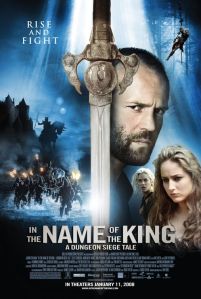 I have no idea how it happened but someone gave infamously reviled director Uwe Boll a bunch of money to adapt a fantasy video game called Dungeon Siege into a star-laden movie. In the Name of the King: A Dungeon Siege Tale seemed to be Boll’s stab at achieving mainstream credibility. He assembled his best cast yet with plenty of recognizable stars. At one point, I remember reading that Boll wanted to divide this film into two, Kill Bill-style, or release a 180-minute version. Until this movie, no Boll film had ever gone over barely an hour and a half. After seeing a slimmed down version that runs a little over two hours, I honestly have no idea what more Boll could have. In the Name of the King struggles to fill two hours worth with crap.
In a far off land, there lives a farmer named, coincidentally enough, Farmer (Jason Statham). His world is turned upside down when his family is killed by a band of creatures known as the Krug. He and his friend (Ron Perlman) must track down Farmer’s captured wife (Claire Forlani) and inflict some peasant vengeance of their own.
Evil wizard Gallian (Ray Liotta) was the cause of the attack. He has built up a whole army of Krug to challenge the King (Burt Reynolds) for the throne. Gallian also has two unwitting allies. The King’s nephew, the Duke (Matthew Lilard), wants to rule and is willing to plot with the evil wizard to achieve this goal. Muriella (Leelee Sobieski) is secretly sleeping with Gallian; he says he is teaching her how to use her blooming magical powers (remove your mind from the gutter) but he is really stealing her powers.
Farmer reluctantly becomes a leader to protect the kingdom. Gallian is stupefied that this simple farmer is somehow beyond the control of his magic. That’s because Farmer should probably change his name to Prince because he is the long-lost son of the King and some stable girl. Merick (John Rhys-Davies) serves as the King’s most trusted advisor but he is also the father of Muriella. He scolds her for being so foolish and being used by Gallian. She suits up like Joan of Arc and wants to fight, but her father won’t allow it.
Eventually this all leads to a large-scale battle between the forces of good and evil where Gallian uses his magic powers to create a cyclone of books to stop Farmer. There you have it.
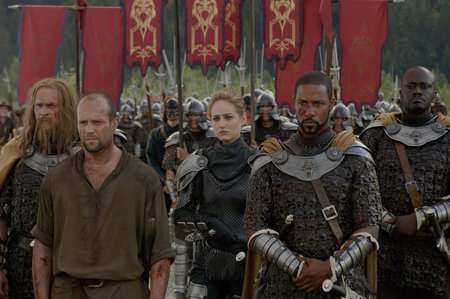 If I were Peter Jackson, I might consider a copyright infringement suit, because In the Name of the King is a sloppy Lord of the Rings rip-off through and through. The long-lost heir to the throne must accept his magisterial destiny … just like in Lord of the Rings. There is a 10-minute fight sequence that happens in a swath of woods … just like in Fellowship of the Ring. The villain relies on an army of stupid supernatural hordes … just like Lord of the Rings. There is a wizard-on-wizard duel … just like Lord of the Rings. A noble woman wishes to fight but her father does not approve, so she sneaks off in armor and does fight … just like in Return of the King. There is a shadowy “other” world that goes beyond our dimension … just like in Lord of the Rings. The eventual trek of our heroes leads to a volcano, but not just that, it’s also the villain’s lair … just like in Lord of the Rings. Bastian (William Sanderson, in his sixth Boll movie) serves no purpose other than to resemble Legolas. John Rhys-Davies you should know better; you freaking starred IN the Lord of the Rings trilogy.
So what does a $60 million budget get Boll? Lots and lots of crane shots. Boll relies on extended aerial photography and zooming, CGI landscapes that serve to remind you how much better Lord of the Rings was and that Vancouver is no New Zealand. There are some segments that lack a firm geographic bearing because Boll wants to jump from expansive crane shot to expansive crane shot. I get that he wants to showcase the depth of the battles, which do feature a fair amount of background action, but the repetition of any camera technique will always grow old if it doesn’t feel congruent to the onscreen drama. I’m happy that Boll wants to open up the scope, but when he relies on a multitude of high-angle crane shots in motion the effect becomes wearisome. The audience can never settle into the action because Boll is too forceful with wanting to demonstrate what he bought with his budget. The cinematography is a notable step up for Boll and longtime director of photography Mathias Neumann. Then again, if I had a $60 million budget I’m sure my movie would look good too, or at least better.
In the Name of the King is the biggest budget Boll has ever had, but it seems like proper costumes must have still been out of his price range. The marauding horde of Orcs, oh I’m sorry, the Krug look like cheesy low-rent Power Rangers villains in goofy rubber outfits. The camera never lets you get a good glimpse of these creatures because even Boll knows how crummy they look. You get another idea of how bad the creatures look when Farmer utilizes the familiar dress-in-other-guy’s-uniform-to-pretend-to-blend-in ploy that was perfected by the aging action stars of the 1980s. So Farmer knocks out a Krug creature, throws on its spongy armor, and is able to walk around the Krug camp.
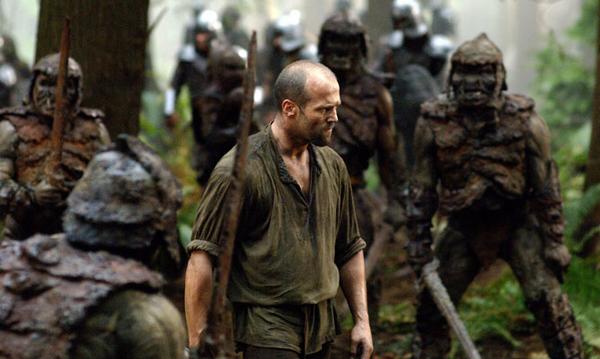 The special effects also seem to run the gamut. The green screen work is painfully ineffective and very transparent, like when Farmer is swinging down a rope across a gorge. When Boll tries to show large fields of soldiers it also exposes how fake the CGI work looks. The many battalions of soldiers look like a dated computer video game. The special effects for Alone in the Dark were better and that film had, reportedly, half the budget of this movie. Realizing all this, it’s no wonder that Boll tries to use as many real sets as he can.
And yet despite all of this, In the Name of the King is high-class camp. Boll achieves a workable level of derisive enjoyment that manages to keep the movie entertaining even while its spins into stupidity. The fight scenes are actually decent and Boll manages to compose a few shots here and there that look quite good, like when the camera scans over a field of dead bodies. During the action centerpiece, the 10-minute battle in the woods between man and Krug, Boll’s camera manages to frame some solid, if unspectacular, action with some good angles. It’s also cut to be mostly coherent. The fight choreography is credited to Siu-tung Ching who also did the choreography for Hero and House of the Flying Daggers. He must have procrastinated until the night before his choreography was due. It will pass but there’s little creativity there; however, Boll must have been flabbergasted. I think the true test for derisive viewer enjoyment will be when the ninjas come out of nowhere at the King’s disposal. All of a sudden in the middle of a medieval style fantasy fight there are flipping black-clad ninjas. I loved it for its sheer anachronistic absurdity. To me, it felt like Boll was trying to cram in everything that he thought was theoretically cool into one massive fight sequence. He just didn’t have the money to also include pirates and robots and hobos and vampires and bears and Batman.
Fantasy is just not Boll’s preferred territory and it mostly shows. He really wants to make his own entry in the style of Lord of the Rings, but you can tell his mind is elsewhere. The plot is a mess but that isn’t indicative of Boll’s lack of interest with the film, it’s just indicative of a typical Boll movie. In the Name of the King feels like Boll is following a checklist of what is expected in a modern fantasy epic, except that Boll cannot provide the epic part. Here’s my proof: the vine-swinging tree nymphs led by Elora (Kristanna Loken). If Boll was really invested in this movie he would have paid more attention to these alluring vixens. These anti-war ladies have sworn off men (take that for what you will) and live their lives like Cirque du Soliel jungle performers. This stuff is right up Boll’s exploitation rich alley, and yet he and the film treat these women of the woods like afterthoughts. They show up and save the day when the film requires an inexplicable savior. I don’t know how helpful tree-dwelling women would be in a fight either unless it was fought in a well-forested area. Boll not capitalizing on these women warriors proves to me that his heart isn’t in this movie.
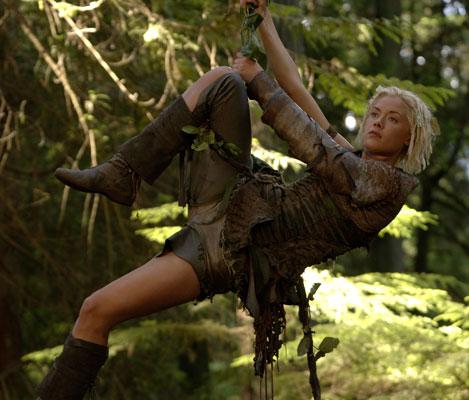 Screenwriter Doug Taylor was clearly cobbling a story together by his fading memory of the Lord of the Rings trilogy, and yet this being a Boll movie, there are still plenty of head-scratching decisions that defy logic even for a would-be fantasy film. For instance, why does Farmer fight with a boomerang? How effective can a weapon be when it gets thrown and then needs to be picked up? The boomerangs that I know can hit people, sure, but usually hitting someone stops its path of movement. Then again, these could be magic boomerangs. How did Gallian raise such a massive monster army to rival that of the King’s without anyone noticing? I’m sure the excuse for that is also magic-related. The Duke takes out two legions of soldiers for his own purposes, and when one man asks where the commanding officers are the Duke, in front of everyone, stabs him. It seems like a lousy way to lead but I’m sure Joseph Stalin would approve. A telekinetic sword fight sounds cool on paper until you realize it is just actors standing passively while CGI swords clang around them. During the climactic battle it’s dark and raining (hey, like in Lord of the Rings) for the King’s army vs. the Krug, but then as Farmer and Elora race to the Volcano Lair it is light out. How many time zones does this kingdom have? Also during this climactic battle, the King’s army has the high ground thanks to a hill and the Krug race up the raised land. The archers atop the hill fire their flaming arrows at an angle pointing up, which would sail over the heads of all their targets. I suppose the King’s archery education program has been suffering some severe budget cutbacks.
The dialogue is pretty corny amidst all the sword-and-sorcery antics and induces its fair share of giggles. When Muriella asks Gallian if he always appears out of nowhere he responds, “No. I appear suddenly. Out of somewhere.” Thanks for clearing that semantic argument up. He also has a very icky conversation with his bedfellow Muriella dripping with double entendres: “I knew you would come,” “I told you I would,” “I felt it before you came,” “You told me I could come and go as I please.” I think my favorite moment is when the King is on his deathbed and addressing Farmer. He advises the man of agricultural means to try using seaweed to enrich his soil. “How do you know this?” asks Farmer. “Because I am king,” he replies.
The actors all feel like they are in separate movies on a collision course with one another. Boll has never had a firm command with actors. The big name actors feel their way around a scene with little guidance from Boll, which means they routinely experiment and play their roles like they were an exercise instead of a final performance. A fine example is a single line spoken at a family table; it’s just perfectly off enough to prick your ears to Boll’s tone-deaf direction. I think Boll either doesn’t care that much about performances or is easily cowed into submission by actors. Staham is recycling his glaring machismo that he’s turned into an action movie franchise, but he seems to me like a modern-day Steven Segal who dispatches foes in a monotone whisper. Luckily for Boll, Statham is adept at picking up fight choreography and so the movie benefits by watching the actor clearly in the middle of the fracas performing his own sword fights.
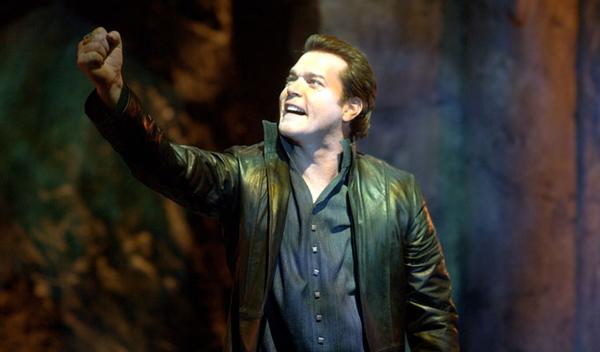 Most of the actors also seem to be falling back on past performances as inspiration for what to do under Boll’s laissez faire direction. Perlman plays his standard gruff tough with a deadpan delivery. Sobieski hasn’t acted in a movie for some time. She comes across as her usual inexpressively empty self, which is her thing, along with being a physical clone of Helen Hunt. Loken shows she can swing from a vine but not master a vague British accent. Forlani gets to cower and weep. Burt Reynolds is playing Burt Reynolds, and Rhys-Davies falls back on his trademark gravitas. Only Lillard seems to find enjoyment out of Boll’s vacuum of direction. His accent mirrors his wildly over the top style of acting that sometimes feels like a fish flopping around for air. His physical mannerisms are uncontrolled and he sneers through much of his lines, but I’ll give it to Lilard, he is much more fun to watch than any of the other slumming stars.
Special attention must be made to Liotta, who is on a different plane of terrible. It’s bad enough that he’s chewing the scenery in his typical manic, bug-eyed crazy yell-speak he refers to as acting, but the movie has to open on the discomfiting image of Liotta trying to suck Leelee Sobieski’s face inside out via kissing. Liotta’s character Gallian feels and looks out of place; he resembles a skuzzy Las Vegas magician with a pompadour and a long leather jacket and a button-down shirt. Where did this man come from? His performance is astonishing in how deeply the awful goes, and when he tells Farmer’s wife, “I feel him inside you,” try your best not to shudder.
After seeing eight of his films and writing 17,000 words on the man (including 2,600 for this review), I feel like I have a special connection to Uwe Boll. I just don’t sense that Boll’s heart was truly in this venture. In the Name of the King seems to be the last time I think we’ll see Boll flirt with mainstream Hollywood genre filmmaking. I think his time luring known actors has come to a merciful end. His next slew of films seem destined to all direct-to-DVD and feature no name casts that are mostly the same actors he has worked with before. In the Name of the King will stand as a ridiculous Lord of the Rings rip-off that has some workable action alongside its many laughably awful moments. It’s a lousy fantasy movie with too many extraneous characters and too familiar a plot outline. Even for a $60 million film, Boll finds new ways to prove that no matter what sized budget the man has he will always try to grasp something beyond his reach.
Nate’s Grade: D+


 nathanzoebl
You must be logged in to post a comment.