Blog Archives
The Battle of Shaker Heights (2003)
 Ben Affleck and Matt Damon, being the egalitarian champions we all know celebrities to be, started a contest called Project Greenlight that allowed aspiring screenwriters to enter for a chance to have the winning script made into a movie by Miramax and the process documented for a behind the scenes reality show to run on HBO. Project Greenlight‘s first winner was the hapless Pete Jones. His winning screenplay gave birth to Stolen Summer, a maudlin coming-of-age story about a Catholic boy trying to get his ailing Jewish friend into heaven. You can feel the grating precociousness already. While Stolen Summer was an artistic yawn the HBO series was a hit as we the viewers saw every stupid mistake, naïve decision, and screaming matches during the production. Pete Jones’ pain was our gain.
Unlike the first contest, this one had a separate entry for directors and the tag-team of Efram Potelle and Kyle Rankin were picked to direct the winning screenplay The Battle of Shaker Heights, by Columbus, Ohio (represent) grad student Erica Beeny. Project Greenlight on HBO showcased the tension created by these butting heads. Beeny seemed ready to meltdown at a moments notice, probably because she let her good nature be taken advantage of by the egotistical, passive-aggressive, non-communicative, hilariously self-absorbed directors. This raises the question; did Affleck and Damon pick the best people or the people most likely to create the best television?
 Once again, the winning screenplay involved a coming-of-age story, this time revolving around the life of Kelly (Shia LeBeouf), a glib teenage war re-enactor. Kelly befriends Bart (Elden Henson) during a battle reenactment. Bart is from a wealthy Wasp-y household where his college is already predetermined. Kelly, on the other hand, must sullenly deal with his father (William Sadler), a former junkie who wasted away his college fund, and his flighty mother (Kathleen Quinlan). Bart and Kelly scheme to teach a schoolyard bully a lesson, and in the process Kelly starts falling for Bart’s attractive older sister Tabby (Amy Smart).
The character of Kelly doesn”t seem to have any deep reflections of life or anything of substance, just wicked one-liners. The fact that Kelly comes off as a sympathetic hero goes fully to the charming LeBeouf, who displays a laid back sense of humor and allure that is reminiscent of a young John Cusack. LeBeouf gives a star-making performance that keeps the audience engaged, even if the story is turning them off.
One of several problems Shaker Heights suffers from is that the finished product is a one-man show. Kelly is such a dominating character, a whirlwind of misplaced rage that everyone that gets in his path suffers. His relationship with Tabby seems like nothing more than unrequited puppy love that doesn’t need so much screen time being spent on a tired will they or wont they diversion. Kelly’s parents come off like theyre invisible. If you blink you may miss their entire time on screen. The father is more an absent force to drive Kellys angst, while his mother doesn’t seem to have any purpose or influence whatsoever.
 Shaker Heights feels like a film made by committee because as Project Greenlight astutely documented it was made by a committee. Miramax executives decided they could sell the film better as a pure comedy so they removed most of the winning screenplays drama. So now, with this new incarnation of Shaker Heights, the comedy never really emerges from more than a handful of superficially cute lines, and whenever a bit of drama does emerge it seems alien and disorienting. The heavy-handed direction by Potelle and Rankin paints in broad strokes, so the dramatic efforts come off as forced and overblown when they sneak up on an audience.
This incarnation of the movie may be entertaining to some, but with these cuts and directorial choices Shaker Heights seems horribly ordinary. Kelly is a disaffected teen with smart-ass comments; he lusts after the older girl who, of course, is with a supposed loser; his parents just don’t know what to do with him. The story is dulled down and all the edges seem polished off, and what an audience is left with is scenes, characters, and a story we’re already well familiar with. Does Project Greenlight seem to have a desire to select coming-of-age stories and then water them down to the point of distilling any original voice? The only interesting diversion in Shaker Heights is the war reenactment section, which is tragically too short.
The Battle of Shaker Heights is another theatrical dud from the Project Greenlight crew. Fans of teen melodrama might get some moderate enjoyment from it, but realistically, the only people who are going to pay any sort of money to see Shaker Heights are the people who avidly followed the Project Greenlight TV series. And in the end, one cant shake the feeling that The Battle of Shaker Heights ultimately feels like a disappointing season finale to Project Greenlight.
Nate’s Grade: C+
Share this:

S.W.A.T. (2003)
 Hey, I got an idea, let’s spend 2/3 of our movie building characters no one cares about, and then we’ll let something action-y happen in the last act? What could possibly go wrong? I got an even better idea, let’s bring along Michelle Rodriguez as a, get this, tough girl cop. Oh yeah, and we need some Samuel L. Jackson too. And let’s have the bad guy be French, since no one likes them right now anyway. Brilliant.
Nate’s Grade: C
Share this:

Mulholland Drive (2001)
 Mulholland Dr. has had a long and winding path to get to the state it is presented today. In the beginning it was 120 minutes of a pilot for ABC, though it was skimmed to 90 for the insertion of commercials. But ABC just didn’t seem to get it and declined to pick up David Lynch’s bizarre pilot. Contacted by the French producers of Lynch’s last film, The Straight Story, it was then financed to be a feature film. Lynch went about regathering his cast and filming an additional twenty minutes of material to be added to the 120-minute pilot. And now Mulholland Dr. has gone on to win the Best Director award at Cannes and Best Picture by the New York Film Critics Association.
Laura Harring plays a woman who survives a car crash one night. It appears just before a speeding car full of reckless teens collided into her limo she was intended to be bumped off. She stumbles across the dark streets of Hollywood and finds shelter in an empty apartment where she rests. Betty Elms (Naomi Watts) is a young girl that just got off the bus to sunny California with aspirations of being a big time movie star. She enters her aunt’s apartment to find a nude woman (Harring) in the shower. She tells Betty her name is Rita after glancing at a hanging poster of Rita Hayworth. Rita is suffering from amnesia and has no idea who she is, or for that fact, why her purse is full of thousands of dollars. Betty eagerly wants to help Rita discover who she is and they set off trying to unravel this mystery.
 Across town, young hotshot director Adam Kesher (Justin Theroux) is getting ready to go into production for his new film. He angers his mob producers by refusing to cast their chosen girl for his movie. After some harassment, threats, and a visit by an eyebrow-less cowboy assassin (God bless you David Lynch), he relents.
In the meanwhile, people are tracking the streets looking for Rita. Betty and Rita do some detective work and begin amassing clues to her true identify. As they plunge further into their investigation the two also plunge into the roles of lovers. Rita discovers a mysterious blue box and key in her possession. After a night out with Betty she decides to open it, and just when she does and the audience thinks it has a hold on the film, the camera zooms into the abyss of the box and our whole world is turned upside down.
David Lynch has made a meditation on dreams, for that is at the heart of Mulholland Dr. His direction is swift and careful and his writing is just as precise. The noir archetypes are doing battle with noir expectations. The lesbian love scenes could have been handled to look like late night Cinemax fluff, but instead Lynch’s finesse pays off in creating some truly erotic moments. Despite the population of espresso despising mobsters, wheelchair bound dwarfs, and role-reversal lesbians, the audience knows that it is in hands that they can trust. It’s Lynch back to his glorious incomprehensible roots.
Watts is the true breakthrough of Lynch’s casting and she will surely be seen in more films. Watts has to play many facets of possibly the same character, from starry-eyed perky Nancy Drew to a forceful and embittered lesbian lover.
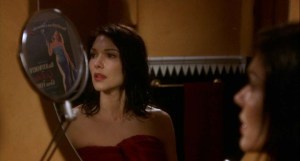 One scene stands out as a perfect example of the talent Watts possesses. Betty has just been shuffled off to an audition for a film and rehearsing with Rita all morning. She’s introduced to her leathery co-star and the directors await her to play out the audition scene of two kids and their forbidden love. As soon as the scene begins Betty vanishes and is totally inhabited by the spirit of her character. She speaks her lines in a breathy, yet whisper-like, voice running over with sensuality but also elements of power. In this moment the characters know, as the audience does, that Betty and Naomi Watts are born movie stars.
It’s not too difficult for a viewer to figure out what portions of the film are from the pilot and what were shot afterwards. I truly doubt if ABC’s standards and practices allows for lesbian sex. The pilot parts seem to have more sheen to them and simpler camera moves, nothing too fancy. The additional footage seems completely opposite and to great effect. Mulholland Dr. has many plot threads that go nowhere or are never touched upon again, most likely parts that were going to be reincorporated with the series.
The truly weirdest part of Mulholland Drive is that the film seems to be working best when it actually is still the pilot. The story is intriguing and one that earns its suspense, mystery, and humor that oozes from this noir heavy dreamscape. The additional twenty minutes of story could be successfully argued one of two ways. It could be said it’s there just to confound an audience and self-indulgent to the good story it abandons. It could also be argued that the ending is meticulously thought out and accentuates the 120 minutes before it with more thought and understanding.
Mulholland Dr. is a tale that would have made an intriguing ongoing television series complete with ripe characters and drama. However, as a movie it still exceeds in entertainment but seems more promising in a different venue.
Nate’s Grade: B
Reviewed 20 years later as part of the “Reviews Re-View: 2001” article.
Share this:

The Grinch (2000)
 Ron Howard brings to the screen a lively but languid and ultimately empty revision of Dr. Seuss’ magical tale of a green haired grouch with an ill temper for yule tidings. There’s plenty of noise and effects but none of the magic can be sustained.
The most difficult problem with making a feature film out of Seuss’ How The Grinch Stole Christmas is that it’s 20 minutes of source material. This then requires a lot of padding, and boy does Howard pad like none other. With the aid of the screenwriters of Who Framed Roger Rabbit? (who I’ve now lost all respect for) they go into a psychoanalysis of why the Grinch acts how he does. As it seems with every serial killer movie the Grinch was tormented as a child for being a little green, hairy brussel sprout. What child wouldn’t make fun of a kid that was green? This distaste for the holidays turns the Grinch into a hermit who enjoys his days making prank phone calls down to the city of Who-ville and wallowing in despair. Cindy Lou-Who sees a nice but misunderstood person underneath all that fur and thus embarks on a quest to show the citizens of Who-ville that the Grinch isn’t so bad. Mixed results ensue.
Howard’s direction is very child-like but empty after an initial glow. One wonders what Tim Burton could have concocted with the same material. The art direction looks like a candy-coated Oz instead of the whimsical imagination of Dr. Seuss. The central message of The Grinch is that Christmas doesn’t come from a box or a store but the message is entirely hypocritical when you have a bazillion product deals for the film. The whole “lost view of Christmas” is a very lame moral anyway.
Jim Carrey, on the other hand, puts this movie on his green back and nearly saves it himself. But the immense weight overtakes him in the end. Carrey gives a flat-out slapstick comedic performance like none other. If you had any doubt in Carrey’s ability to contort himself for laughter all doubts will be quelled. While Carrey is marvelous as the central villain/hero (?) the majority of time is spent with the dog-nosed Whos. These people are lifeless and uninteresting. It’s a breath of relief every time we return back to Carrey. The Who’s are populated with a Martha Stewart like former crush of the Grinch’s (Christine Baranski), the mother who strives to be like Martha May-Who and has no other characterization (Molly Shannon), and the dowdy mayor of Who-ville (Jeffrey Tambor). No one can survive unclean.
Without Carrey this family film would be without merit. The writing throws a few bones toward the adult audience but relies too much on Carrey being goofy – which he is good at. Anthony Hopkins as a grandfatherly narrator works only in making you miss Boris Karloff even more. In short, watch the Chuck Jones special instead. This Christmas gift is a lump of coal disguised as candy.
Nate’s Grade: C
Share this:

Charlie’s Angels (2000)
 These angels aren’t exactly what your father was enjoying when your mother was away fulfilling errands. These angels aren’t delegated as mere sex objects running around providing the jiggle entertainment that is (or was) supplied by today’s Baywatch. The 90s is a different decade after our minority movements and today’s woman is just as apt to do a flying kung-fu face plant into a baddie as any man. The angels of the film are action heroes for an armada of small girls needing some female empowerment when their only other choices consist of a barely clothed Britney or a barely covered Christina. These angels aren’t just the sex objects that the classic assortment of angelic 70s stars were; these angels are also tough-as-nails, resourceful, and not afraid to tussle or tango. Now that this exposition is out I can concentrate on the scattershot film Charlie’s Angels.
The film has been rumored to have at a minimum of 17 writers who tried shaping a story for Cameron Diaz, Drew Barrymore, and Lucy Lui. The story is pretty much shelved toward the back so the forefront is our trio of ladies kicking ass then shaking it with zig-zaggy and wild camera movements from debut filmmaker and video director McG.
Charlie’s Angels is whiz-bang dumb fun. The overall feel of the film is something more difficult to get a grasp on. At times it shows itself as tongue-in-cheek and satirical but then at other times it seems overly serious or overly dumb. The characters are non-existent and basically only discernible by hair color. The characters are very wooden and I actually found more enjoyment watching the villains and seeing more of them; call it the Austin Powers dilemma. Diaz makes the only notable attempt as her goofy and light-hearted angel connects with the audience best. Lui plays a techno-babe dominatrix but is easy to see that she was the last angel chosen and doesn’t exactly gel with the others as much as she could have.
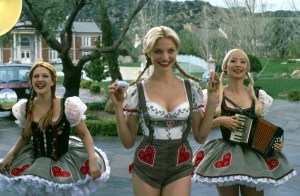 Charlie’s Angels is best when the action is pumping. The scenes are cut together in a jam-packing sequential way adding distinct flavor and style. McG is a true surprise in the effectiveness he can orchestrate his action motifs even if the Matrix effects and moves make absolutely no sense in the real world.
Crispin Glover shows himself as a silent assassin nicknamed “the thin creepy man.” Glover is so suave and slick in his role of the non-verbal Oddjob henchman role that he exhilarated me with every presence he made on screen. Goodness, he was too cool in this film and everyone gets brownie points for allowing him. He has such energy and charisma that I wanted the film to veer off into him and desert our angels. Seeing our ageless McFly perform action scenes and choreographed fights is something I will be pleased with until my grave. seeing Crispin in the excellent Nurse Betty and now huge exposure in this is a true joy. And man… he smokes a cigarette way too cool every time he’s in this film. Some people can smoke cool some of the time but Crispin does it all of the time. His mere presence almost cancels out the annoyance of Barrymore.
The line is drawn with Charlie’s Angels in that it’s sex-kitten jiggle and an acrobatic arrangement of (light) feminism and humor. These gals know they’re sex objects and they’ll use it to their advantage delighting in every second of it. Therefore, you could argue successfully that Angels is exploitation hiding as meaningful but hell… why think about this stuff? The movie rolls along at a fast pace where you don’t keep track of these issues. It’s just an easy sit down.
The gigantic success of Charlie’s Angels makes sequels and a possible franchise all but certain. I’d be happy for McG to hop back in his directorial chair but have a unique idea for Angels 2: Bigger, Longer, and Uncut… it involves Glover kicking a lot of ass really cool like.
Nate’s Grade: B-
Reviewed 20 years later as part of the “Reviews Re-View: 2000” article.
Share this:

Mission: Impossible II (2000)
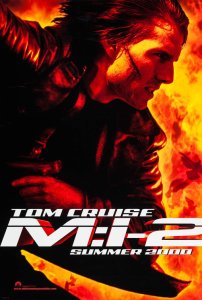 John Woo’s loud and flashy sequel to DePalma’s overwrought Mission: Impossible comes with both guns blazing — and doves flying. Since EVERYONE from the show, minus Tom Cruise, was killed in the first movie, the series starts off with a fresh cast complete with weak villain. Dougray Scott plays the rouge MI agent who steals a virus and its subsequent antidote to only release the super virus onto the world and make a super steady pharmaceutical profit from the the antidote. One wonders what the MI agency does except create rogue operatives for movie plotlines. Oval-faced, glass-eyed beauty Thandie Newton, who was last seen croaking and spitting river water in Beloved, plays Cruise’s new love interest. Her role isn’t really fleshed out but she provides the sparkle and charm, not to mention plenty of spice, that is necessary. The real problem MI:2 has is the action. Now Woo is a marvelous choreographer of action, his visions are poetry — but they all seem so cliche now that most of the action came across as hollow and just empty noise. There are moments of excitement but they are few and far between a hackneyed lumbering plot. Still, in a summer wishing for fireworks you can’t fault MI:2 for delivering.
Nate’s Grade: B-
Share this:

The Mod Squad (1999)
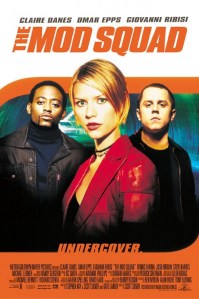 There are some movies out there that you simply can’t stop yourself from scratching your head and wondering how it ever got made in the first place. Some movies so horrible that you ponder what any big suited executives were thinking. Well folks, The Mod Squad is one of those movies.
It’s the cinematic updating of the Vietnam era show epitomizing the rebellion against authority and suppression by the Boomers like only Aaron Spelling can. I’m convinced that if you pay adequate attention to the plot you will actually lower your intelligence but don’t hold me to it. It’s only a theory, I still need the tests to come back. This basically is nothing more than a watered down 90-minute jeans ad. “Oooh, look at those jeans Claire Danes shoots up in! I wonder if they have them in a size 30 waist?”
This is one of those movies I seriously can’t find anything remotely good to mention. Though I’m trying to get it all out of my head as quickly as humanly possible. I feel sickened by this poison MGM has thrown out to the masses. I remember the last time Generation X & Y tried looking back nostalgically and enviously on the Boomer’s playground. It was called Woodstock ’99. Anyone care to remember what happened there?
Nate’s Grade: F
Share this:

Wild Wild West (1999)
 This movie should have been re-titled “Wild Wild Mess.” After much speculation, the truth finally comes out about the overly hyped Will Smith vehicle: It is the loser of the summer season.
Rehashed from a 1960s series that no one under 30 will remember unless they stay up late watching Nick at Nite, it is full of special effects, headlining stars, and a talented director. So what went so terribly wrong?! The main problem is the story, or more accurately, the absence of one. This movie meanders through the entire plot, characters are thrown in, but there is NO story whatsoever.
Will Smith is a real disappointment. Even though he is such a charismatic actor and has a natural likability, he couldn’t save this disaster in the West. There is so little chemistry between Smith and Kline that it probably would’ve been better if ILM just created a Western Jar Jar for Smith to banter with. The jokes are so lame and unfunny that I slapped myself in the face more often than I laughed.
The beautifully delicious Salma Hayek plays peek-a-boo with the audience as she disappears and then reappears periodically throughout the movie. She has no real purpose except for some T&A and a forced romantic love interest. After playing every possible Shakespearean character, Kenneth Branagh now focuses on being an evil Lt. Dan of the South. His villain is more kooky than dangerous and provides more unintentional laughs than thrills.
This is an incredible lumbering mess that shows what can go wrong when children are not supervised while playing with daddy’s toys. May John Peters’ mechanical spider rot in hell! I want two hours of my life back!
Nate’s Grade: D
Share this:

South Park: Bigger, Longer, and Uncut (1999)
I ‘ll start off and say I had fallen out of favor with the show at the time and really wasn’t interested in seeing the movie. But after being dragged along by a group of friends against my will I’m very glad I did.
I don’t fall into hysterics by hearing eight-year-old cartoons use the F-word profusely like many in my theater, but luckily for me there was plenty of wit to go around. The movie is riotously funny and I often found myself at times having to grip the armrest so I wouldn’t tumble out of my seat.
The movie could have been easily re-titled South Park: The Musical with the batch of 14 original songs they have that parody the Disney formula tunes and classic Broadway renditions. The songs are dead-on perfect at parodying their designed targets. The music is so brilliant and catchy that it deserves to be nominated for an Oscar for Best Original Comedy or Musical score if there is any justice in the film community. Never thought you’d see the words South Park and Oscar in the same sentence did you? Well neither did I.
The movie even plays witness to issues circling our country today like knee-jerk reaction to assess blame, responsible parenting, and blaming Hollywood media. This is a true piece of comic brilliance as they satirize anything and everything and so damn well. There are those that might take offense to some of the racial jokes but take it with a grain of salt because pretty much every person of race, creed, culture, and what not will be a source of humor. After all, that’s what Brian Boitono would do.
Nate’s Grade: A


 nathanzoebl
You must be logged in to post a comment.