Blog Archives
The Iron Claw (2023)
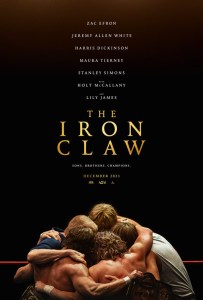 The true story of a wrestling family that was beset by so much tragedy it might as well be a lost Shakespearean drama. The Iron Claw follows the Von Erich brothers, lead by oldest brother Kevin (Zac Efron). They’re all competing for their father’s approval, the same man who gives them updated son rankings at the breakfast table. Kevin and his three brothers (Jeremy Allen White, Harris Dickinson, Stanley Simons) are living out their old man’s dream of being a professional wrestler of significant renown, and the appeal of the brothers is as a fighting family of wrestlers rather than as single entities. In essence, they don’t seem to matter unless as a collective. This leads to plenty of misguided attempts to curry favor with their toxic parent and a pile-up of tragedies that would be absurd if it wasn’t actually true. The issue for me was that I didn’t see the other brothers as fully dimensional characters, and side stories like Kevin’s romantic escapades felt lacking as illumination. It felt for much of its running time like a good movie but one going about its business with a little too much expediency. I was interested but felt like the brothers were more reflections on Kevin than their own separate characters. However, the film’s last twenty minutes are by far the best part and finally find a way to elevate the drama as well as better personalize it through Kevin’s grief and survivor’s guilt. “It’s okay dad, we’ll be your brothers,” spoken with the innocent yearning of a child, pretty much broke me and caused me to sob. If you’re a fan of 1980s professional wrestling, or meaty dramas about the suffering of strong men from strong men, I’m here to assure you that it’s okay to cry here. The Iron Claw is a fine drama that comes together by its end for an off-the-ropes wallop, and the lingering sadness is one that will be hard to shake for hours.
Nate’s Grade: B
Share this:

Monster (2003) [Review Re-View]
 Originally released December 24, 2003:
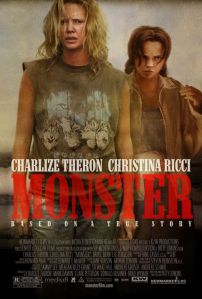
Monster follows the life of Aileen Wuornos (Charlize Theron, now nominated for a Best Actress Oscar), Americas only known female serial killer. In the late 1980s, Wueros was a roadside prostitute flexing her muscles with Florida motorists. She describes hookin’ as the only things shes ever been good at. One day Wuornos has the full intention of taking her own life, but she meets 18-year-old Selby (Christina Ricci) at a lesbian bar and finds a companion. Driven by a growing hatred of men from sexual abuse, Wuorno’s starts killing her johns to try and establish a comfortable life for her and Selby.
Let’s not mince words; Theron gives one of the best performances I have ever seen in my life. Yes, that’s right. One of. The. Best. Performances. Ever. This is no exaggeration. I’m not just throwing out niceties. Theron is completely unrecognizable under a mass of facial prosthetics, 30 extra pounds, fake teeth and a total lack of eyebrows. But this is more than a hollow ploy to attract serious attention to the acting of a pretty face. Theron does more than simple imitation; she fully inhabits the skin of Aileen Wuornos. The closest comparison I can think of is Val Kilmer playing Jim Morrison in The Doors.
Theron is commanding, brave, distressing, ferocious, terrifying, brutal, stirring, mesmerizing and always captivating. It may be a cliché, but you really cannot take your eyes off of her. Her performance is that amazing. To say that Theron in Monster is an acting revelation is perhaps the understatement of the year.
With previous acting roles in Reindeer Games and The Cider House Rules, Theron is usually delegated to pretty girlfriend roles (who occasionally shows her breasts). Who in the world thought she had this kind of acting capability? I certainly did not. If Nicole Kidman can win an Oscar for putting on a fake nose and a so-so performance, surely Theron should win an Oscar for her absolute transformation of character and giving the performance of a lifetime.
With this being said, and most likely over said, Monster is by no means a perfect film. Minus the terrific central performance, Monster is more of an everyday profile of a grotesque personality. The film weakly tries to portray Wuornos more as a victim, but by the end of the film, and six murdered men later, sympathy is eradicated as Wuornos transforms into the titular monster. Some supporting characters, like Ricci’s narrow-minded Christian up bringers, are flat characters bordering on parody. The supporting characters are generally underwritten, especially the male roles that serve as mere cameos in a film dominated by sapphic love.
Monster is proof positive that human beings will never be phased out by advancing machinery when it comes to acting. Monster boasts one of the greatest acting achievements in recent cinematic history, but it also coasts on sharp cinematography and a moody and ambient score by BT (Go). Monster is a haunting film that you won’t want to blink for fear of taking your eyes off of Theron. She gives an unforgettable tour de force performance that will become legendary.
Nate’s Grade: B
——————————————————
WRITER REFLECTIONS 20 YEARS LATER

Monster was a revelation for Charlize Theron, an actress who until then had mostly been known for parts that asked that she be good looking and little else. Twenty years later, Theron is one of the best actresses working in Hollywood and it almost never happened without her breakthrough performance where she brought to startling life the horror of Aileen Wuornos’s tragic life and tragic desperation. When this movie came out originally in 2003, I doubt anyone but Theron’s closest friends suspected she was capable of a performance this raw and spellbinding, but that’s also a condemnation on all of us. How many other actresses out there could maybe rival the best of the best if they just had the right opportunity? How many actresses are stuck playing the same limited roles because that’s all they’re ever asked to do? How many actresses are wrongly assumed to be of limited talent simply because of their comely appearance? That isn’t to say there’s some hidden universal equation that the uglier you are the better at acting you have to be (though it sure has worked out for [insert your example of a conventionally unattractive actor here]), but this movie is a clear indication that too many actors are never given enough opportunities to shine.
Back in early 2004, I credited Theron’s performance as one of the best I’ve ever witnessed in my then-twenty-one years of moviegoing (although that number should be smaller considering I wasn’t keenly watching Scorsese as a baby). She is very good, but I’d like to claw back some of my rapturous words of praise now that we’ve seen twenty years of Theron acting excellence. Looking over her career, I might actually cite 2011’s Young Adult as her finest performance, and that one didn’t even nab an Oscar nomination (she’s since been nominated twice since, for 2005’s North Country and 2019’s Bombshell). The draw of the movie is the head-turning performance from Theron and she just disappears completely inside the skin of her subject. It’s hard to remember at times that this is Theron, thanks to the richness of her startling performance but also the accomplished makeup effects, which were not nominated. At every point, you feel the fire burning behind the stricken complexion of Theron, a fire that will eventually consume her and everything she loves. While highly compelling, this is not a performance of subtlety and restraint. This is a big performance, and the movie is often prone to making loud pronouncements about its subjects and pertinent themes. It’s loud, brash, and maybe for some it will seem a little too loud, a little too unsubtle, but it’s a movie that refuses to be ignored for good reason.
 In my original review I raised some reservations with the rest of the movie, and I’m here to recant one of them. I wrote back in 2004, “The film weakly tries to portray Wuornos more as a victim, but by the end of the film, and six murdered men later, sympathy is eradicated as Wuornos transforms into the titular monster.” I’m positive that many will still cling to this same idea but oh boy have I come around in twenty years. By the time the movie is over, you wonder why more women haven’t just snapped and gone on killing sprees. Wuornos is indeed a victim. She’s responsible for terrible deeds but that doesn’t change the fact that she started as a victim and continued as one until put to death by the state of Florida in 2002. She was a sexual assault survivor, groomed into prostitution, and then trapped by a society that saw her as little other than trash, something to be pitied but ultimately forgotten. She comes of age as an adult thinking her only value is the fleeting moments of pleasure she can provide for men, and in the narration, we hear her dreams that one of these men who repeatedly tell her how pretty she is would take her away to another life, like a princess. Alas. It’s impossible to separate her past as a victim of predatory men from her actions when she turns on predatory men. Being forced into prostitution out of desperation is one of the definitions for sex slavery and trafficking. The movie does try to make her last few johns more ambiguous over whether or not they are “good people” and thus “deserving” of their fates, like a scale is being introduced and we’re doing the calculation whether Wuornos will strike (#NotAllMen, eh felas?). There’s a clear dark path where the murders get considerably worse. She begins by defending herself against a rapist, but by the end, it’s just a kind family man who picked her up without even the intention of having sex. We’re meant to see her transform into the titular monster, but I kept wondering about Aileen Wuornos as the societal stand-in, accounting for thousands of other women who lived and died under similar tragic circumstances.
I also found myself growing increasingly contemptuous of the love interest character played by Christina Ricci (Yellowjackets). When we’re introduced to Selby, she’s a wide-eyed naif testing her boundaries of comfort but clearly tapping into repressed homosexual feelings. Their relationship is meant to serve as the emotional rock for Wuornos, the reason that she’s acting more rash is because she’s trying to earn enough money for the two of them to run away together and build a new life. She is her motivation, but Selby is absolutely the worst. You can excuse some of her hemming and hawing about striking out on her own and leaving her controlling parents, as she’s fighting against repression as well as trepidation for starting out independently, but this lady becomes fully aware of the dangers and dehumanization that Aileen goes through to earn her meager amounts of money, and Selby encourages her to do so. Not just encourages her, Selby pressures her to do so, to get back out there and “provide” for her, knowing fully well what that means, knowing fully well how these men have treated Wournos, repeatedly abusing her. What are you doing to help things out, huh Selby? She’s embarrassed hanging around Wuornos around some other lesbian friends she just met, so she’s already looking to upgrade and move past her lover. By the end, as she’s trying to coax a confession of guilt from her girlfriend to save her own skin, Selby becomes just another user, taking what they want from Wuornos and discarding her when they’ve had their fill.
 This was the directorial debut for Patty Jenkins, who also served as the sole credited screenwriter, and while the indie darling-to-franchise blockbuster pipeline has been alive and well in Hollywood, it was quite a surprising leap that her next movie after Monster was none other than 2017’s Wonder Woman. To go from this small character-driven true crime indie to leading the big screen solo outing for comics’ most famous female hero is quite a bizarre but impressive jump. Her only other feature credit is the much less heralded 2020 Wonder Woman sequel. She was attached to direct a Star Wars movie about fighter pilots but that seems to have gone into turnaround or just canceled. So is the way with Star Wars movies after 2019’s Rise of Skywalker. Just ask the Game of Thrones creators, Josh Trank, and Taika Watiti how that goes.
Monster is a phenomenal performance with a pretty okay movie wrapped around it in support. Twenty years later, Theron is still a monster you can’t take your eyes away from. It changed her career destiny and I think acts as an exemplar for two reasons: leaving the viewer with the question how many other wonderfully talented performers will never get the chance to showcase their true talents because of faulty assumptions, and how many other women are out there living in quiet degradation like Aileen Wuornos.
Re-Veiw Grade: B
Share this:

She Said (2022)
 The fall of Harvey Weinstein was a long, long time coming, and the journalistic procedural drama She Said demonstrates just how hard it is to hold bad men accountable. This is a very similar movie to 2015’s Best Picture-winning Spotlight, following hard-nosed professionals as they go through beat-after-beat of assembling their case, following the leads, and convincing those who have been wronged to come forward and share their personal stories. The star is the details, the main crusading New York Times journalists (Carey Mulligan, Zoe Kazan) being defined by their tenacity and determination. As should be obvious, it’s galling how many people protected this awful man, including the police, because of how influential he was as a movie producer. Peeling back the layers of protection revolves around working on the niggling moral concerns of many who looked the other way, out of financial incentive or fear or disregard for rocking the “way things were.” When the expose picks up actual momentum, you can feel the same excitement of holding the powerful to account, even already knowing the end results that would land Weinstein in jail for the remainder of his life. It’s a simple yet effective approach. She Said is little more than a dramatized in-depth news article on its relevant subject, but the ensemble of actors give it a fire that simply scanning the written word can miss. The direction is very matter-of-fact, the writing is thoughtful though a bit heavy with data dumps, and outside of the victims narrating their experiences, or relatives discovering the extent of those experiences that have been kept hidden from them, there isn’t much sustainable tension. Much has been made of Samantha Morton’s one-scene wonder but I think Jennifer Ehle (Braveheart) does even more with her scenes as a victim choosing to speak during a health scare that reassess her thinking. I wish the movie had extrapolated about the entire film industry protecting abusers, but it keeps its focus squarely narrowed on taking down Weinstein. She Said is a worthy movie with a worthy subject and heavy in the details but maybe light on its own drama.
Nate’s Grade: B
Share this:

Cherry (2021)
 Between 2014 and 2019, the Russo brothers directed four Marvel movies with a combined worldwide box-office of over six billion dollars, so for their first foray from the world of super heroes and magic space gems, the brothers had carte blanche to pick whatever project they desired and Cherry was it. Watching all 140 minutes of this true-life tale, you get the feeling it’s less a story about loss and redemption and more an overly extended excuse for Joe and Anthony Russo to use every stylistic trick they’ve ever wanted to employ to make their own inferior Goodfellas (or Casino). Free of MCU oversight, these guys are practically going full Tony Scott or Darren Aronofsky with the multitude of their visuals tricks and gimmicks. We’re talking different aspect ratios, color washes and spotlights, heightened fade outs, fourth wall breaks and freeze frames, chapter titles complete with prologue and epilogue, in-your-face subtitles, tracking shots, and even oblique angles such as a point of view from inside Tom Holland’s inspected rectum. Cherry is aggressively flashy to compensate for how little substance there is with its story and humdrum characters. It’s based on a true story about Nico Walker (Holland), an Iraq War veteran coming back to Ohio, getting hooked on drugs, and resorting to robbing banks The trauma of his war experiences leads him to seek help and the system fails him and pushes opioids on him, turning him into another addict among too many who is desperate to do anything for cash. On paper, that sounds like it would be interesting, and the shocking part is that for all these identifiable dramatic elements and stylistic flourishes, Cherry is kind of dull. Everything feels like it’s kept at a surface-only level. Walker is just not that interesting even though interesting things happen to him. You would think it’s about PTSD, the opioid crisis, economic anxiety, and while these elements are present they are not really explored with any sustained nuance or theme. The level of social commentary stops at Fight Club-level snarky sight gags, like the names of the banks being “The Bank” and “Shitty Bank.” There’s too much bloat with the plot and running time. By far the most interesting section of the movie was his descent into addiction and the criminal excursion, but Walker doesn’t even exit the war until over an hour in. We did not need all the fluff before the war to properly set up this limited character. The real drama of the movie is post-war, and there’s an hour of setup that could have been cleaved away. You leave this stuff in as “texture” if you’re building something rich in atmosphere and character but I can only tell you what has happened to Walker externally. He’s perfectly unremarkable. The movie is too shallow for its own possible ambitions, and it ultimately feels like cribbed notes and homages to other movies the Russos enjoyed, like Goodfellas or Requiem for a Dream or Boogie Nights. It only reminds you of other, better movies, and one I was reminded of was Roger Avary’s Rules of Attraction. I appreciated the flash and style of that 2002 movie because it was about empty characters living empty lives striving for something they were incapable of, so the excessive and prioritized visual artifice worked. With Cherry, the visual trickery is distraction from the underwritten characters who the movie very much wants us to see favorably through their struggles. I enjoy Holland (Spider-Man: Far From Home) as an actor immensely but he is miscast here. He’s too boyish and charming and genial to ably perform dark and gritty antiheroes. You sense he’s eager to try these “darker roles” to prove himself but he doesn’t need to. Ciaria Bravo (Wayne) plays the girlfriend/infatuation object/junkie partner and she looks so young that see feels like an unsupervised child onscreen. Maybe that works with her as a symbol of innocence. Cherry is a movie that left me indifferent and shrugging throughout all its excesses and meandering. It feels like a movie the Russos needed to get out of their system, one of creative indulgence charging into familiar territory when more restraint, nuance, and contemplation would have sufficed, and maybe their next movie will be more mature and fulfilling and worthy of 140 minutes.
Nate’s Grade: C


 nathanzoebl
You must be logged in to post a comment.