Blog Archives
War Dogs (2016)
 As I watched War Dogs, the darkly comic true-life story of war graft, gunrunning, and bro-tastic bravado, I kept wishing to copy and paste other characters into what was an interesting plot. A pair of neophytes was awarded military arms contracts from the Pentagon during the Iraq War, and their schemes to skirt U.S. laws to import guns across borders, illegal and faulty munitions, and uneasily work as a go-between with a client (Bradley Cooper) on the U.S. terrorism watch list are filled with perplexing yet juicy details. The biggest problem is that the two main characters, played by Miles Teller and Jonah Hill, are so powerfully archetypal to the point of unrelenting blandness. We have the naïve everyman pulled into a life of big bucks, big risk, and big power only to have it all come crashing down. Hill’s character is the loud, uncouth part we’ve come to expect from the Oscar-nominated actor, and I defy anyone to tell me anything about Teller’s character other than occupation and his relationship to other people. These parts are so thinly drawn that I didn’t care about them once they finally got into deep trouble. I believe that director/co-writer Todd Phillips, he of The Hangover series, has the right qualifications to make a flinty neo-noir thriller, but War Dogs is more his half-hearted version of a glib Scorsese movie, or a David O. Russell version of a Scorsese movie. The voice over narration is dull and doesn’t help illuminate Teller’s character at all, and the other stylistic flourishes, from pointless inter-titles to a non-linear plot, add up to very little. Half of the movie’s scant jokes are the ongoing sound of Hill’s off-putting wheeze of a laugh. I’m not kidding, after an hour the movie still treats his laugh like it’s a potent punchline. There is entertainment value to be gleaned from War Dogs chiefly from its larger-then-life story and the intriguing, shadowy world of war profiteers. It’s a movie that made me wish I had read the magazine article it’s based upon instead, which would have also been shorter.
Nate’s Grade: C
Share this:

The Infiltrator (2016)
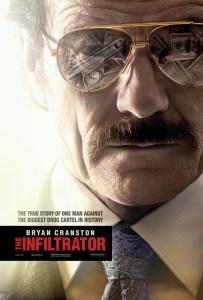 In the mid 1980s, Pablo Escobar and his cartel were responsible for billions of dollars worth of narcotics filtering into the United States. It’s the kind of work that can fill up Robert Mazur’s (Bryan Cranston) career. He works as a Florida Customs agent but his specialty is going undercover for his assignments. He’s called out of retirement with the promise of striking high in the ranks of Escobar’s ring of lieutenants. Mazur’s partner, Emir (John Leguizamo), uses an unreliable informant to start the new identity, and so Mazur poses as a money laundering expert who offers his sundry services to the Colombian cartel. After blurting out that he has a fiancé in lieu of accepting a prostitute’s services as a very 80s way of saying “thank you,” the agency must now provide him with a fake wife, played by rookie agent Kathy Ertz (Diane Kruger). The two have to rely upon one another in a world of criminals and murderers who would have no gutting them.
My main feeling once The Infiltrator had come to its natural conclusion was that everything about this movie should have been better. It’s a terrific premise as we follow the undercover travails of a man trying to stay one step ahead and keep his dual lives separated, invariably having them bleed into one another especially as danger escalates and his cover may be blown. Then you add an untrained partner and the conflict magnifies from there. Then you have Mazur work his way up the food chain to the major lieutenants of Pablo Escobar. This movie should be exploding with dramatic irony, weighty decisions, and magnificent suspense, but it’s really not. So why not?
 One reason is that the movie whiffs with its modest ambitions, namely in its shallow character study of Mazur and the lingering effects of pretending to be a very bad man. Going undercover has to be one of the most stressful jobs in law enforcement, and living two different lives has to have a noticeable psychological impact, eating away at our protagonist and affecting his relationships and sense of self. That doesn’t happen with The Infiltrator as the few glimpses we get of Mazur’s home life are mostly harmless check-ins. A red light is installed in his home to mean a secret special phone line. You would assume that some family situation has to draw out conflict from this scenario, maybe Mazur’s little girl answering the phone before he can reach it. Nothing of consequence happens with daddy’s special red light phone. The family, absent anything important to do but wait at home, becomes a drag on the narrative and doesn’t even fulfill what you would assume would be its primary service: contrast. In the world of The Infiltrator, sex, money, and drugs are rampant, but our protagonist is unaffected. He remains the same character from the beginning of the story to the end. We don’t really learn more about him other than he is skilled at going undercover. We don’t see any particular toll on him psychologically. We don’t feel the threat of what he’s going through because the movie doesn’t pretend it matters enough.
Going undercover with the Medellin Cartel should provide endless suspense scenarios. This movie should be rife with conflict, and yet it consistently finds deflating, coincidental outs to save its characters. As a good screenwriting rue of thumb, it’s acceptable to use coincidence to put your character into greater danger. It’s not a smart idea to use coincidence to save your character from danger. Example: in Donnie Brasco, a man approaches Johnny Depp’s character and clearly refers to him by his agency name, implying working together with the FBI. That’s a good use of coincidence. With The Infiltrator, Mazur’s secret recording in his briefcase is discovered by a mid-level cartel operative, for once it feels like Mazur is vulnerable. Then the movie quickly dispatches with this guy for a rash explanation and so he takes his secret to his grave. There’s another moment where Emir’s informant is about to squeal to some very bad people, with Emir in the room sweating bullets, and he too is wiped out before sharing his privileged information. The movie is filled with these frustrating solutions just when it seems like tensions is developed. The entire appeal of the undercover mob movie is the twists and turns to hide the real identity and make it out alive. I’m genuinely dumbfounded how much of this movie just skates by with little regard to drawing out effective tension.
I think I can crystallize just how poorly The Infiltrator handles its many threads of conflict with one great example. Kathy and Robert Mazur are fake getting married according o their cover stories, so what else does a fake bride-to-be do but seek out her fake husband’s tuxedo that he wore decades prior upon his real wedding to his real wife? Why does Robert need to wear the exact same tuxedo? Can his office not afford to rent a new one that likely more accurately represents his fitting size? Even if this cost-cutting measure was plausible, why must Kathy be the one to pick it up, and from Mrs. Mazur? It’s contrived and forced conflict to shove these two characters together, so that Mrs. Mazur can ask pointedly, “Are you sleeping with him?” Rather than say nothing, or dismiss the assertion, Kathy provides what has to be the most irritating and obfuscating answer: “I think you know the answer to that.” Does she? The film seems to think there is a simmering sexual tension between Kathy and Robert Mazur, but it never materializes. I guess we’re just supposed to assume a sexual tension. This scene is a pristine example of characters operating at a sub-level of intelligence because the movie wants to force contrived drama when there is already plenty of organic drama being ignored.
The last third of the movie is built around the relationship that Mazur and Kathy form with Robert Alcaino (Benjamin Bratt). With an actor of Bratt’s stature, you’d be lead to assume his character will have a significant amount of screen time; however, The Infiltrator also boasts blink-and-you’ll-miss-them performances from Amy Ryan and Jason Isaacs, so maybe not. Bratt’s character is a family man and we’re treated to several scenes with him and his wife. It’s meant to engender sympathy so that when the end comes around we can feel some conflicted emotions. Except this is another area where the screenplay cannot live up to its aims. At no point did I feel sympathy for this mobster. He’s a “family man” and we even see him with his daughter… in one scene who asks to sleep over at a friend’s. Robert preaches about the importance of trust and family in that typical way that all thinly veiled mobsters do in movies, and he even cooks, which is another personality trait I’m sure we’ve never seen in a film about mobsters. The entire last act is predicated on our undercover duo feeling guilt over setting up Robert and his family in an eventual sting, and this guilt feels entirely manufactured.
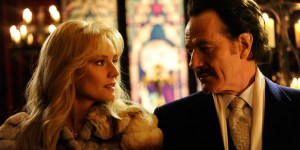 Cranston (Trumbo) is the real draw here and it’s easy enough to see how alluring the undercover gig is for an actor of immense talents. In the opening scene we get a sense of Mazur on the job, digging deep into a seedy drug dealer lounging in a bowling alley and making passes at the waitresses. It’s a meaty introduction that whets your appetites for the different personalities that Cranston will have to draw from on his next assignment. Cranston is routinely entertaining to watch but I couldn’t help but feel underwhelmed at what the film was asking him to do and what I fully know he’s capable of delivering. It’s like hiring a world famous chef and asking him to fix your plumbing. The other actors don’t distinguish themselves in their fleeting scenes except for Kruger (Inglorious Basterds) and Joseph Gilgun (TV’s Preacher) as a convict that Mazur likes to have pose as his driver/muscle. In the case of both actors, you wish that more had been made with their dynamic to the mission.
The Infiltrator is based on a true story and I assume that what I see on screen closely echoes Mazur’s real exploits and predicaments, but somewhere along the way the filmmakers lost track on what made this story tick. The psychological aspects are barely touched upon, the family conflicts are given careless lip service, the suspense sequences are clipped, under developed, and often solved by convenient coincidence, and the characters are too shallow to grow out from their stock roles. I know these are real human beings for the most part but they don’t feel anything more than genre archetypes. The Infiltrator does enough at a serviceable level of entertainment that it might pass some viewers’ lower threshold to fill an empty two-hour window. With all of its ready-made suspense possibilities and internal and external conflicts, this real-life story should be far more compelling than the one we’re given, which settles too often. It’s a genre movie masquerading as a character study except it’s blown its cover.
Nate’s Grade: C
Share this:

13 Hours: The Secret Soldiers of Benghazi (2016)
 Michael Bay is the kind of filmmaker that naturally attracts negative attention and derision, so when he fast-tracked a movie about the Benghazi embassy attacks, and in a presidential election year too, there were plenty that cried foul. Bay’s not exactly known as the subtlest filmmaker, and many feared a Benghazi movie under his guidance would only reaffirm the worst. 13 Hours: the Secret Soldiers of Benghazi (a subtitle that never appears in the movie, by the way) is a surprisingly serious and generally apolitical action movie that reaffirms the strengths and weaknesses of Bay as a filmmaker.
On September 11, 2012, an armed mob stormed an American outpost in Benghazi, an attack that left four Americans dead. After Libya had toppled its decades-long autocrat, a power vacuum emerged and militants filled its place. An unclassified CIA annex in Benghazi was established to track the possible sale of munitions from the old regime. The CIA chief, Bob (David Constabile), has been forced to hire a security team of former Army Rangers and Navy Seals to protect his agents. Jack Silva (John Krasinski) is a family man reuniting with his old pal Tyrone “Rone” Woods (James Badge Dale), the head of the hired security team. The other guys (Pablo Schreiber, David Denman, Dominic Fumusa, Max Martini) welcome Jack, explaining the rising tensions in Benghazi and how they’re generally frustrated by the CIA know-it-all attitudes. They’re wary of the State department outpost for Ambassador Chris Stevens (Matt Letscher), wary of the security detail watching him, and wary of the Libyan local forces providing assistance. Flash forward to the night of the attack and Rone and his team are stymied in their early attempts to rescue the ambassador. Afterwards, the focal point of the fight shifts to that very CIA annex and one hellish night of intense combat.
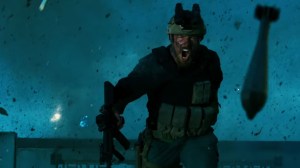
 This is Bay’s return to the realm of more “serious filmmaking,” a world he hasn’t considered since 2001’s lackluster Pearl Harbor, and while the standard Bay elements of boom are present and accounted for, the drama doesn’t stack up to the action. First, the good news is that the action in 13 Hours is often thrilling, beautifully staged and photographed by Dion Beebe (Collateral), and unlike Bay’s Transformers films, easy enough to follow along. It’s a chaotic incident where plans and communication are broken down, but Bay is able to keep the geography and the immediate and secondary goals of each action sequence clear. While the storming of the embassy isn’t quite as nerve-racking as Argo, it’s still plenty thrilling and communicates the fog of war and dawning horror of those trapped on the inside. The centerpiece is the attack on the CIA annex, which both sides anticipate and prepare for. It establishes the geography of the field of combat, the different access points, and the most likely ambushes. From there, it’s our outnumbered professionals versus a horde of armed Libyans, a standoff reminiscent in classic Hollywood action cinema. Over the course of those titular 13 hours, our security force faces wave after wave of attacks, each once becoming more sophisticated and bringing heavier firepower. Bay’s camera captures the explosions and gunfire in his usual balletic decadence. Say what you will about the man and his jingoistic tendencies, but he’s an ace visual stylist who bathes a sheen of popcorn entertainment to visceral struggle. When the action is heated, that’s when 13 Hours packs its most powerful punch.
Unfortunately, there are lulls in between the fighting, and it’s during these moments that we realize how poorly written our characters are. With the battle looming ahead, the mitigated character development emphasizes easy clichés we’ve come to expect, like the family man who needs to realize his family should come first, etc. These six guys are little more than stock characters on the screen, differentiated more by appearance and the occasional reading material than any significant personality differences. The dialogue is also rather clunky, falling too often upon tough guy speak to make up the difference. The way I was able to separate them in my head was through the actors’ previous roles (“There’s Pornstash, there’s Roy from The Office, there’s the guy from The Pacific who was the bad guy in Iron Man 3, and boy did Jim from The Office get buff”). Krasinski (Aloha) is the audience’s entry point into this world and given the most attention, so he’s ostensibly our main protagonist. He’s a strong presence to anchor the film despite the character’s shortcomings. I enjoyed watching Krasinski in such a different sort or role and started thinking about he and his wife, Emily Blunt, must have traded workout regiment advice. “Jim from The Office” with a six-pack is a surprising sight.
There’s a strange defining conflict for the first hour of the movie, namely Bay and Hogan narrowing personal clashes down to a slobs vs. snobs mentality of war. Bay has a history of fetishizing machismo and military hardware, so it should be no surprise that his movie lionizes the beefy, strapping military men serving as security. They’re placed against the eggheads of the CIA, who take every moment to remind our burly, bearded security guys that they were educated at Ivy League schools and know so much more about the Middle East. They often sound haughty when they’re scolding the security force for interfering even when it’s clear they’re saving their lives. The perspective aligns with the idea that the military-experienced, no-nonsense men of action are being ignored and looked down upon by the CIA ninnies who look at them as unnecessary babysitters. Naturally, with the hindsight of history, we know the concerns of Rone and his guys will be vindicated and the CIA snobs will be grateful they had these blue-collar American heroes. The entire role of Bob is to condescend and ignore our guys and their warnings. Bob even says early in his introduction that he’s on the brink of retirement and they won’t ruin it for him. Until the attack on September 11, we’re stuck with this reductive class warfare clash.
Another interesting aspect is that the movie makes use of its audience’s relative ignorance when it comes to the specific people involved in the Benghazi firefight. I doubt that many people know the names of the four victims excluding Ambassador Stevens. Because of that uncertainty we don’t know which of our six security characters will live, and the screenplay seems to know this, which is why it takes time to present each of the six with some sort of looming tragic back-story. We have multiple characters sending loving messages to their young children, learning they’re wife is pregnant, and making all sorts of “final” decisions, the kind that set up these characters in most movies for an early demise (if you write your girl during war or talk about your post-retirement plans, you’re guaranteed to die). I was slightly amused that the movie established each character to have a moment where it potentially sets up this tragic outcome.
 One of my big questions walking into Bay’s Benghazi movie was exactly whose version of events was the story going to follow. After eight congressional investigations, and a prominent Republican slipping by admitting one of the guiding purposes is to tarnish Hilary Clinton as a presidential candidate, I was worried that the movie was going to be a hacky, manipulative promotion of propaganda. There’s a reason that eight congressional investigations, including one that has lasted longer than Watergate, don’t seem to satisfy those calling for blood: they keep coming to the same inconvenient conclusions, namely that there was no stand down order, no conspiracy, no cover-up. There’s been a flurry of rightwing fury brewed over stoking unfounded rumors of conspiracy with Benghazi; it’s a fundraising industry unto itself for politicians. Therefore, I was initially worried that the movie was going to reinforce a version of events that eight (and counting?) congressional committees have refuted. I was relieved then that Bay’s movie keeps its focus pretty much squared on the heroism of the security team. In a way it reminded me of Black Hawk Down as it strived to recreate a series of harrowing life-and-death events with its focus more on the brotherhood and bravery of the ones in harm’s way rather than the broader political context. There is the infamous “stand down” order; however, it’s played almost incidentally, as Bob is trying to process all the chaos unfolding and the best recourse. As presented, it doesn’t sound like “stand down and let them die,” and more, “wait and let me think for a minute.” The fight to get air support from Italy doesn’t mention the fact that those Italian fighter jets sitting on the runway were not combat ready and were for flight training. There’s only one other passing dialogue exchange that touches the political, when the guys recount that the news is telling them it was a protest, which they scoff at and then let it go. That’s it. I imagine the audience that would be most excited for a Benghazi movie will be deflated. For everyone else, the sidestepping of politics lets the movie stand on its own better.
An article from Vox.com raises the issue of whether any movie about Benghazi can possibly be apolitical. It appears like the topic of Benghazi has been so cravenly politicized that any rendition of the events of that fateful day will reinforce or contradict some narrative, be it the security contractors, the CIA, the politicians on both sides of the aisle. And the absence of what others declare with certainty will only make those same people cry “cover-up.” It’s a shame that this topic is so radioactive that an objective approach celebrating the courage of those involved, mourning the loss of life, and asking for better from those in power seems impossible given the current divisive political environment. Did it have to come to this? Bay’s Benghazi is easily his most restrained movie in his bombastic career, paying reverence to the people who paid the ultimate sacrifice. The action is well staged and often visually striking, but Bay wants this movie to be more than a series of escalating action sequences. You feel he wants this to be his version of a Zero Dark Thirty-style thriller. Except it’s not. You watch the movie and sense there’s a more intelligent, nuanced, and ambiguous movie here that can make cogent points about foreign policy and the state of the Middle East. This is an action movie where the good guys shoot the relatively faceless bad guys. 13 Hours is an acceptable action movie but that’s all it ever asserts to be. Is that enough after all?
Nate’s Grade: B-
Share this:

The Big Short (2015)
 Adam McKay is not exactly the kind of name you associate with a prestige picture that’s building serious Oscar heat. McKay is best known as the director and co-writer of Will Ferrell’s best movies, from Anchorman and its sequel to Talladega Nights and the underrated 2010 buddy cop movie, The Other Guys. If you stuck through the closing credits for Guys, you were treated to an animated education lesson on the size of Wall Street’s greed and accountability in regards to the 2008 financial crisis. It was impassioned, angry, and an interesting note to end an otherwise goofy comedy. The Big Short is based upon Michael Lewis’ (Moneyball) best-selling book and it’s a disaster movie where the biggest disaster is the world economy. The movie McKay co-adapted and directed is bristling with intelligence, indignation, and a clear purpose. He wants to make you very angry, and by the end if you’re not, you haven’t been paying enough attention.
In the wake of the financial collapse in 2008, the fallout was so tremendous that many people felt nobody could have seen this coming. There were a few and they made out like bandits while trying to warn others about the impending doom. In the early 2000s, Michael Burry (Christian Bale) is a hedgefund manager who sees warning signs that the housing market is a bubble ready to burst. He sees the toxicity of the majority sub-prime mortgages wrapped together and sold as a seemingly safe security, a CDO (collateralized debt obligation). His bosses think he’s mad and they’re furious when they discover Burry has gone from bank to bank making big bets against the housing market. The banks are eager to take what they believe to be easy money from a sucker. How could the housing market burst? Other Wall Street investors take notice of Burry, notably Jared Vennett (Ryan Gosling) who pitches the plan to “short” the housing market. Nobody takes him seriously except Mark Baum (Steve Carell) and his small team who works for Goldman Sachs. Baum is curious how something so large could go unnoticed, so he and his team fly to Florida and Vegas to investigate the realities of the market and what they find does not match the rosy cheerleading from Wall Street. A pair of wannabe traders (Finn Witrock, John Magaro) stumbles across Burry’s analysis and try to make their own bets, except they need a bigger name to make the trades. They reach out to an ex-Wall Street trader (Brad Pitt) who agrees to shepherd them on this quixotic quest. Are these men righteous defenders of fraud or just people trying to get their own cut of the pie?
 The brilliance of The Big Short lies in its accessibility and the virulent passion that McKay has for the subject matter. The movie is structured like a heist and an underdog story, suckering in the audience to root for the upstarts trying to fleece the big banks and profit off their greed and stupidity. For the first 90 minutes or so, the film comes across like a caper and we follow our group of misfits as they fight against the conventional wisdom that the housing market could never topple. These guys see the signs and the risks that others could not or would not see, especially since the flow of money was rich and the good times could be shared, which lead to collusion from the very same agencies designed to regulate and enforce the financial laws. For those 90 minutes the movie flies by on its sense of whimsy and are-we-getting-away-with-this good fortune, putting our band of misfits in position to win big on the losses of the ignorant and fraudulent. And then, in one swift move, it all comes down and you’re reminded, rather indignantly by Pitt’s character, that what they are benefiting from is the meltdown of the U.S. housing market and by extension the American economy. What once felt like a celebratory caper now starts to feel queasy, and it’s in the last act that The Big Short reminds you just how awful the events of the 2008 financial crisis were and how these guys did nothing more than benefit from mass misery. These are not heroes, though Mark Baum is given plenty of moral grandstanding moments that present him as the closest thing we have in the picture. These were a bunch of guys who got rich betting on a lot of other people’s bad bets, bets that almost destroyed the world’s economic systems. The concluding half hour feels like a sudden stop after a sugar rush, where you’re left to question your decision-making but also come to terms with the reality of what seemed like a fun time. McKay lures his audience in with the guise of a heist/underdog story, appealing and accessible avenues of cinema, and then serves the cold hard medicine in the concluding moments.
McKay is admirably trying to educate and advocate while he entertains, but he truly wants the audience to understand why they should be sharpening their pitchforks. At several points, characters will break the fourth wall and talk directly into the camera, admitting that certain events didn’t happen exactly as we saw, or occasionally they’ll remind us that what we watched was exactly how it happened. It’s a measure that isn’t overplayed and helps juice the spirits of the movie, becoming something of a confidant in the schemes with the onscreen participants. When things gets a little hard to understand with the mountain of Wall Street lingo, McKay will cut to celebrity cameos to help explain the more arcane instruments of the financial system. Margot Robbie luxuriates in a bubble bath and explains sub-prime mortgages, Anthony Bourdain explains CDOs, and Selena Gomez, in a rather cogent analogy, explains synthetic CDOs as an endless chain of side bets being made off one hand of blackjack. The movie goes pretty fast and a viewer might experience information overload but McKay knows when to slow things down and provide a well-timed assist so that his learned audience will see the true extent of the corruption and greed rampant in how Wall Street handled its business.
 Of the three storylines, I found Mark Baum and his team easily the most interesting and I think McKay and co-screenwriter Charles Randolph (The Interpreter) agreed, which is why he’s the biggest part of the movie. Burry gets things started but he recedes into the background after the first act, and that’s where Baum and his financial team step into the spotlight to further explore how unstable the housing market just might be. I think this is Carell’s best dramatic performance to date (I wasn’t wowed by Foxcatcher). He’s playing perhaps one of the angriest people seen on screen but that’s because he has a moral center and the bad business practices, let alone the sociopathic greed of his “peers,” constantly enrage him. He’s something like a flabbergasted crusading journalist who keeps shaking his head in stupefying revulsion at just how deep this whole thing goes. Having Baum as our entry into the moral morass of Wall Street allows the audience to feel a sense of ethical superiority, and then like Pitt’s character, it can all go away with one perfectly articulated retort. There’s a moment where Baum is lambasting a mortgage ratings officer (Melissa Leo, her only scene too) after she admits that if they don’t rate bad mortgages as good, the banks will just go to their competitor, and then she accuses Baum of being a hypocrite. His reason for the office visit is not his outrage at the fraud but the fact that this fraud is holding up his winnings. He’s not the crusader he may wish to be. Bale (American Hustle) and Gosling (Only God Forgives) are perfectly cast and provide strong supporting work in small doses spread throughout. Pitt is in 12 Years a Slave producer mode where he knows he needs to appear in the movie to better sell it to audiences, and so he’s here and rather unremarkable. There is a bevy of familiar faces (Marisa Tomei, Rafe Spall, Max Greenfield, Karen Gillan) appearing in small moments as if everybody in Hollywood wanted to get in on McKay’s party.
There is one annoying misstep in the movie and it occurs about halfway and it’s made to stretch out the stakes in a haphazard manner. The Big Short is a disaster movie where the audience knows exactly when the disaster is coming, and yet there’s a section in the middle where the characters are all left in doubt whether their big bets will pay off because of the ratings fraud. Burry is threatened with losing his job. It’s silly because we know the economy is going to crash in 2008, but the movie throws out a weak obstacle that, hey, maybe it won’t crash. It reminds me of the Hinderberg movie from the 1970s. There were several moments where it looked like that zeppelin full of hydrogen was going to go up in flames… except students of history know that moment is fated in New Jersey, so all the close calls were foolish fake-outs for a major event that was well anticipated. We all know the economy is going down so there’s no need for the manufactured doubts.
McKay and company want to wake up a fairly apathetic general public about the crimes and negligence of the Wall Street robber barons that risked the world’s economy and then managed to skip out on the tab. The tones can juggle wildly, and I’d credit McKay’s background in comedy for his ability to maintain a reliable and firm comic footing for the film without losing the significance of his message. It’s hard to nail down a genre for the movie; it’s a dark comedy, a drama, a true crime picture, and a wake-up call. You have moments that feel like a heist flick and moments that feel like a sickening journalistic expose. It’s got highs, lows, laughs, groans, and plenty of human emotions, though the most prominent would be disgust and disbelief. The Big Short is advocacy populism as pop-entertainment, and it succeeds ably. It’s an economics lesson for the public. At the end of the movie, the closing text informs us about “bespoke tranches,” which are investment opportunities that banks are flocking to ($5 billion in 2013 to $20 billion in 2014). It’s just another name for CDOs. Unless an informed public demands action from the system, it seems that Wall Street is doomed to repeat its same high-risk mistakes and that same vulnerable public is doomed to clean up the mess.
Nate’s Grade: A-
Share this:

The Revenant (2015)
 Which do you value more, verisimilitude or narrative? If you’re looking for an intense, immersive filmgoing experience that’s just as harrowing as it is beautiful, then perhaps The Revenant is your movie. If you are looking for characters and a story to engage with, then maybe it won’t be. Leonardo DiCaprio plays the real-life frontiersman Hugh Glass who was mauled by a bear and left for dead by his companions. He miraculously survives and tracks down those who betrayed him for some frontier justice Under the unyielding vision of director Alejandro Gonzalez Innarito (Birdman), the movie opens up its scary world with an exhilarating sense of detail. Inarritu favors lots of natural light and long, gorgeous tracking shots, which creates a spellbinding sense of realism. The attacks and escapes and moment-to-moment survival communicate the remarkable dangers of this natural world. The cinematography by Emmanuel Lubezki is flawless, using light and camera placement to stunning effect. However, The Revenant (meaning a person who has come back from the dead) is a series of beautifully rendered moments delicately stretched over a ponderous running time of 157 minutes. There’s just not enough plot events to fill that running time, so to compensate Inarritu gives way to some Terrence Malick (Tree of Life) impulses that try for philosophical poetry but miss. DiCaprio is getting plenty of plaudits for his demanding role, and he’s quite good and visceral (and no, he does not get raped by a bear). I was more impressed with Tom Hardy, who plays the target of Glass’ fury. Hardy imbues depth into his antagonist, and while you won’t exactly be rooting for him to get away you can see the guy as more pragmatist than mustache-twirling rogue. He even has an interesting back-story surviving being scalped that informs his decision-making. Much of the film is watching Glass endure physical hardship after physical hardship, which may grow wearying for many audience members, especially those most squeamish. When it’s firing, The Revenant is a magnificent and stunningly realized survival thriller with sprinkles of engaging human drama. The problem is that there isn’t enough to go around for its running time.
Nate’s Grade: B
Share this:

Concussion (2015)
 Concussion wants to be a hard-hitting drama exposing the dangers of repetitive head trauma in football and the lengths of the cover-ups and collusion within the NFL, except that movie already exists and is the Frontline documentary League of Denial that was too controversial to air on ESPN. Concussion, in comparison, is an adequate but hopelessly underwhelming film on the Nigerian-born Dr. Omalu (Will Smith) who discovered chronic traumatic encephalopathy (CTE) in the brains of deceased NFL players. The resistance and denials are soft-pedaled, though the movie treats them with heightened dramatic stakes that are unearned. There’s one threatening anonymous phone call but for the most part it feels like Dr. Omalu is just being ignored, and “being ignored” is a hard thing to turn into outstanding dramatic stakes at the movies. The movie doesn’t let the NFL completely off the hook but its critiques have been softened by studio interference (as revealed through the Sony email hack). As a straightforward drama, Concussion is easy to watch and Smith gives an authentic performance that doesn’t have to go to histrionic lengths to communicate his internal struggle. There’s a nice subplot with Omalu courting his eventual wife played by Gugu Mbatha-Raw. Albert Brooks and Alec Baldwin are strong supporting players. David Morse gets a show-stopping part to show off his acting skills. By the end, it all feels just a little too nice, a little too polished, and a little too easy, both in how it presents a complicated medical discovery and its implications but also the NFL’s response. For an awards-season drama that’s meant to shock and inform, being “easy” is the wrong call.
Nate’s Grade: B-
Note: “League of Denial” is currently available on Netflix streaming and I encourage people to check it out.
Share this:

In the Heart of the Sea (2015)
 In 1822, the men aboard the Essex, a whaling ship sailing from Nantucket, Massachusetts, encountered a beast unlike any they have ever seen. Captain Pollard (Benjamin Walker) and his first mate, Owen Chase (Chris Hemworth), were at odds throughout the voyage, that is until they encountered a 100-foot long white whale. The creature destroyed the Essex, forcing the crew to drift at sea and hope to find land, but the whale follows them as well. Tom Nickerson (Tom Holland as a young man, Brendan Gleeson as the older version) recounts this traumatic survival tale to author Herman Melville (Ben Whishaw), who is desperate to write this true story.
There’s an old-school throwback vibe to In the Heart of the Sea with its high seas adventure, but there’s just not enough attention to adventure, character, or even plot for this movie to really set sail properly. The first act feels so sluggishly long. It’s trying to set up life on a whaling vessel in the early 19th century but I didn’t feel like we got a coherent sense of life aboard the seas or how the various components worked. I didn’t know that whalers row out from the main ship, so there’s that. The opening act sets up the dull conflict between Chase and Pollard, which can be summarized as blunt upstart vs. unchecked privilege. The conflict doesn’t evolve from this dichotomy. Both men are boring in their unyielding simplicity. Hemsworth (Avengers: Age of Ultron) made a stronger impression in Rush, but a humorless movie role is not in his best interests as an actor. When the action does arrive, it can be genuinely thrilling. Director Ron Howard does a slick job of conveying the danger and destruction of the whale attack. Sadly, it’s over too soon and then the remainder of the movie is 45 minutes of a survival drama adrift in the ocean reminiscent of last year’s Unbroken. This period of isolation forces the characters to make some hard choices, yet we don’t feel the impact of those choices because the narrative, too, feels adrift. Implausibly, the giant whale has followed them for thousands of miles. Are whales really this vindictive? The documentary Blackfish makes me wonder but it still feels unbelievable. What was the whale waiting for? For the men’s spirits to be completely broken before it might attack again? We’re told this whale is a “demon” but who exactly are the bad guys in this story?
 I believe another stopping point for this story is that the culture has moved beyond the acceptance of whaling as an honorable profession, to the point that I, and I assume others, was on Team Whale after witnessing a bloody hunt. It’s pretty gross, especially when they’re harvesting the whale body for the precious oil. Perhaps modern audiences, so far removed from hunting as an essential component of life have become more squeamish, or perhaps modern audiences just recognize something as barbaric when they see it. As a result, it’s hard to root for these guys. When the giant whale attacked it felt like retribution. My sympathies were more for the large mammal than the bipeds on ship. At the end of the film (some spoilers), the white-haired moneyed men of Big Whale Oil are worried what the truth will do to their industry. They want the surviving crewmen of the Essex to deny the existence of this gargantuan whale. This makes little sense to me other than awkwardly forcing a Big Business cover-up for relevancy. First off, whaling seems like a pretty unsafe working environment to begin with, especially considering voyages could last up to three years. Would the reality of one big bad whale destroy an industry? I doubt it since there is such money to be had. If anything it might rejuvenate the timber industry to reinforce the ships to make them more durable against larger whale attacks.
At first I thought a framing device was entirely superfluous; why do we need to watch Melville elicit this tale rather than simply just watching the tale itself? It seemed like a distraction, but as the movie progressed I understood that this framing device was its own sub-story and had its own complexity, namely the older Tom coming clean to the decisions that still haunt his soul. It’s an unburdening for both gentlemen, as Melville admits his deep fear that he is a mediocre writer (he’s no Nathaniel Hawthorne) and that he will be unable to tell this story as well as it truly deserves.
As these two men are allowing themselves to become more vulnerable and sharing their demons and doubts and worst fears, I started to realize that this framing device was weirdly more compelling than all the whale action. That’s because older Tom and Melville are the best drawn characters in the movie, which seems like a screenwriting mistake of sizable proportions. Obviously the nautical survival stuff should be the most compelling, and yet I as more taken with two men sitting by an oil lamp discussing their lives. Older Tom is infinitely more interesting than younger Tom; part of this is because young Tom hasn’t experienced the full effect of the events that shape older Tom, but most of this is from the very clear fact that young Tom is kind of a mute witness in this movie. He rarely speaks and is just kind of there, taking up space. There’s one personal harrowing moment when he’s thrust inside a hollowed out whale carcass to extract more blubber, but that’s the only personal perspective offered through young Tom. A question concerning the framing device: how is older Tom retelling events he had no participation or witness to? Another issue is that the characters on board the Essex are bereft of anything that would allow us to feel for them beyond simple human survival. Chase and Pollard are given one note to play and their eventual understanding and cooperation is fine but it feels like fleeting details in a story, lost to memory or disinterest.
 From a purely technical aspect, this is one of the better Howard films. The cinematography by Anthony Dod Mantle (Slumdog Millionaire) is rich and often breath taking, with plenty of stunning aerial and underwater images. The whale attack sequence is harrowing and thrilling. Howard finds ways to imply the harsher aspects of this life without going overboard, maintaining that PG-13 rating. While the look of the film has an enhanced color palate thanks to the extra boost of CGI filters, I still appreciated the vibrancy of the on screen images. As I said with the similarly boosted Mad Max: Fury Road, I’d rather have vibrant and bright colors than a drab and washed-out color palate. Even as the movie drifts and the characters fail to grab you, at least the visuals are pretty. While sitting through the second half, I started to rethink my own prejudices concerning Howard as a filmmaker, a man who lacks a distinctive style but has a definite feel for how to tell a story. I’m not going to excuse him for The Grinch and other misfires, or his tendency to settle for maudlin in place of subtlety, but the man is a born filmmaker.
In the Heart of the Sea is an old school movie that feels too sluggish, too underdeveloped, and too free of characters for the audience to invest in. When the framing device scores the biggest emotional pull, you better start rethinking your rip-roaring high-seas adventure. Master and Commander this is not. As the inspiration for Moby Dick, I wish I had just watched a remake of Melville’s actual novel (now with extra chapters about rope!). If you ever wanted a movie that ends on a blurb by Nathaniel Hawthorne as a payoff for Melville’s artistic neurosis, then your wait is over. In the Heart of the Sea feels like a whale of a tale that is hard to believe, which ends up inspiring a far greater story, which made me yearn for just watching that superior tale. Sometimes the “truth” behind famous stories is less interesting.
Nate’s Grade: C+
Share this:

Steve Jobs (2015)
 Dizzying with its dialogue, Steve Jobs tells the story of its titular man through three Apple product launches, 1985’s Macintosh computer, 1988’s Apple rival and failure, Next, and 1998’s iMac, the beginning of the re-emergence of Apple into ubiquity. It’s really an Aaron Sorkin movie above all else, which means we get absurdly intelligent characters walking and talking at rapid-fire with brilliant one-liners and snappy dialogue that bristles with musicality to it, the kind that your ears perk up for. It’s a feast for the ears; however, Steve Jobs is really an emotionally cold stage play on film. Danny Boyle (Slumdog Millionaire) is the director but the staginess of the conceit is too much for the visually nimble filmmaker to overcome. There are a few small visual flourishes as inserts but the star is Sorkin’s verbose screenplay. We get a glimpse into the prickly, egotistical, bullying, visionary, and curious man that was Steve Jobs. His continual denial of being the father to his daughter is a source of great contrarian insight. The structure of the script lends itself to repetition and artificiality. All these characters keep turning up and having these important conversations at these moments? After a while it feels like the characters are talking in circles and waiting for catharsis, and the concluding ten minutes is a detour into unearned sentiment. The movie and its major themes just do not come together with the clarity or force that the filmmakers believe. Michael Fassbender is superb as Jobs and there isn’t a bad performance in the bunch. It’s an engaging movie in the moment but I don’t feel like I know Jobs any better than before. In attempting to tell the life of one influential man, Sorkin has made the movie about himself, but The Social Network this is not.
Nate’s Grade: B
Share this:

Spotlight (2015)
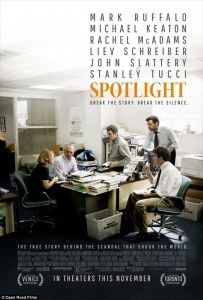 Spotlight is the true-story behind the 2002 expose into the Catholic Church’s cover-up of decades of sexual abuse and it is unflinching in its focus and animated by its outrage, which is the best and worst part of this awards-caliber movie. Writer/director Tom McCarthy (The Station Agent, Win Win) is a splendid curator of unlikely movie families, and with Spotlight he follows the titular investigative team (Michael Keaton, Rachel McAdams, Mark Ruffalo, Brian d’Arcy James) at the Boston Globe as they go about their jobs. That’s really about it. Over the course of two tightly packed hours, we watch as the Spotlight team chases down leads, goes through archives, interview subjects and know when to push harder and when to fall back, and day-by-day build their case to expose the massive corruption within the Church. It’s invigorating material and worthy of the careful and sincere reverence that McCarthy and co-writer Josh Singer have afforded, though the flurry of names can be difficult to keep track of. However, that’s about the extent of the movie. We don’t really get to know any of the journalists on much of a personal level or as a character; they are defined by their tenacity and competence. We don’t get much time for reflection or contemplation on the subject, especially its psychological impact on a majority Catholic city/staff, and the culpability of those within systems of power that chose to ignore rather than accept the monstrous truth. I don’t need more “movie moments” or emotionally manipulative flashbacks, per se. With its nose to the grindstone, Spotlight is an affecting and absorbing news article given life but it feels less like a fully formed movie of its own. It’s confidently directed, written, acted, and executed to perfection, and I feel like a cad even grumbling, but the ceiling for this movie could have been set higher had the filmmakers widened its focus.
Nate’s Grade: B+
Share this:

Black Mass (2015)
 For decades, James “Whitey” Bulger (Johnny Depp) was the most feared man in Boston. After being released from Alcatraz, he returned home to his Massachusetts roots and consolidated power with an iorn grip. He and his cronies ruled Boston’s criminal underworld and were given protection from none other than the FBI. Thanks to agent John Connolly (Joel Edgerton), a childhood pal of Bulger’s, his crimes were given an implicit blessing (as long as he didn’t go too far) as he served as an FBI informant. In reality he was just ratting out his competition and abusing his power. This charade lasted for decades until Bulger went on the run, not being caught until 2011.
Black Mass really suffers from its two core characters, Bulger and Connolly, who are just not that interesting, which is a great surprise for a true-story about corruption and murder. Crime drama have an allure to them and this is accentuated by their colorful and usually larger-than-life figures that we watch commit all those terrible yet cinematic acts of vicious violence. Being the inspiration for Jack Nicholson’s crime lord in The Departed, you’d assume that the real-life Bulger would have a menace and personality that fills up the big screen, leaving you asking for more. Shockingly, he doesn’t. He’s a mean guy and he has his moments of severe intimidation, but he’s also practically a 1990s action movie villain with a sneer and one-dimensional sense of posturing. He doesn’t come across as a character but more as a boogeyman. We see him help some old ladies in the neighborhood, but you never get a sense he has any care or loyalty for his old stomping grounds, especially as he pumps drugs into the impoverished community. We don’t get any sense about how his mind works or what motivates Bulger beyond unchecked greed. We don’t get a sense of any discernable personality. We don’t have any scene that feels tailored toward the character (even though I assume many are based on true events); instead, Bulger feels unmoored and generally unimportant to Black Mass because he could be replaced by any standard movie tough guy. How in the world has a movie about notorious criminal Whitey Bulger found a way to make him this boring?
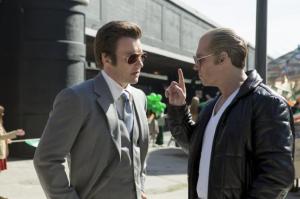 Then there are the underdeveloped supporting characters of Connolly and Bulger’s brother, Billy (Benedict Cumberbatch). The guy responsible for Bulger’s misdeeds getting the green light should be a far more important person in this story but he’s mostly portrayed as a stooge. He wants to look out for Bulger but despite one “you’ve changed” speech from his beleaguered wife, you don’t truly get any sense that Connolly has changed. You don’t get a sense of his moral dilemma or even his desperation as new leadership in the FBI starts to see through his poor obfuscations. He’s a stooge from the beginning and we feel nothing when his self-serving alliance comes to an unceremonious end. There is even less when it comes to Billy, a character that seems to pretend his brother is a different person. Billy works as a state senator. His political position must have supplied more inherent drama than what they movie affords. Black Mass is doomed when its three central characters are this dull.
Another problem is that the movie makes Bulger too protected for too long to the point it becomes comical. The script follows a routine where an associate of Bulger’s knows too much or is going to confess to the police, and within usually the next scene that character is easily dispatched, sometimes in broad daylight and with scores of witnesses. There are several recognizable actors who must have filmed for a weekend. I understand Connolly was protecting his meal ticket here with the Bureau, but Bulger is so brazen that we as an audience need more justification for how Connolly could cover for so long. It feels like Bulger has free reign and that extends into the screenplay as well. Without a stronger sense of opposition, or at least watching Bulger rise through the mob ranks, we’re left with a collection of scenes of the status quo being repeatedly reconfirmed.
I’ve figured out the way to revise Black Mass and make it far more entertaining. As stated above, Bulger is just too much a one-note boogeyman to deserve the screen time he’s given, and his onscreen dominance hampers what should be the movie’s true focus, Agent Connolly. Here is where the movie’s focal point should be because this is the transformation of a person. Bulger is the same from start to finish, only shifting in degrees of power, but it’s Connolly who goes on the moral descent. His is the more interesting journey, as he tries to use his childhood connections to get ahead in the FBI, but he consistently has to make compromise after compromise, and after awhile he’s gone too deep. Now he has to worry about being caught or being too expendable to Bulger. This character arc, given its proper due, would make for a terrific thriller that’s also churning with an intense moral ambiguity of a man trying to justify the choices he has made to stay ahead. It’s a more tragic hero sort of focus but one that has far more potential to illuminate the inner anxiety and psychological torment of the human heart rather than constantly going back to Buger to watch him whack another person. It’s far more interesting to watch a man sink into the mire he has knowingly constructed, and that’s why the narrative needed to shift its focus to Connolly to really succeed.
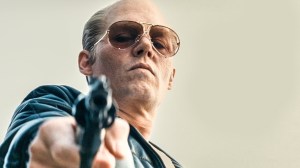 Depp (Pirates of the Caribbean) takes a few steps back from his more eccentric oddballs to portray the unnerving ferocity of Bulger, and he’s quite good at playing a human being again, though Bulger strains the definition of human. He underplays several scenes and his eyes burrow into you with such animosity that it might make you shudder. He’s a thoroughly convincing cold-blooded killer, though I wonder if part of my praise is grading Depp on a curve since Bulger is so unlike his recent parts. Regardless, Depp is the most enjoyable aspect of Black Mass and a reconfirmation that he can be a peerless actor when he sinks his teeth into a role rather than a series of tics. He also handles the Boston accent far better than his peers. Cumberbatch (The Imitation Game) and Edgerton (The Gift) are more than capable actors but oh boy do both flounder with their speaking voices. They are greatly miscast as two native Massachusetts sons.
If you’re a fan of crime thrillers steeped in true-life details of heinous men (it’s typically men) committing heinous acts, even you will likely be underwhelmed or marginally disappointed by Black Mass. There just isn’t enough going on here besides a series of bad events that don’t feel like they properly escalate, complicate, or alter our characters until the film’s very end when the plot requires it. The screenplay has propped up Bulger by his rep, told Depp to crank up his considerable glower, and called it a day. It’s a Boston mob story that needed more intensive attention to its characters to survive. Black Mass is a crime story that dissolves into its stock period details and genre trappings, becoming a good-looking but ultimately meaningless window into a hidden world.
Nate’s Grade: C+


 nathanzoebl
You must be logged in to post a comment.