Blog Archives
Stronger (2017)
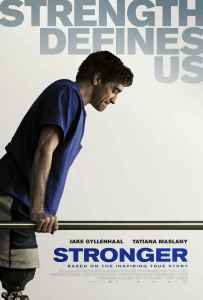 An inspiring true-life story that still manages to stay grounded on its own terms, Stronger is an emotionally affecting movie buoyed by two sensational performances. Jake Gyllenhaal plays Jeff Bauman, an ordinary guy who is present at the 2013 Boston Marathon bombing and loses his legs in the attack. He was there to support his on-again off-again girlfriend, Erin (Tatiana Maslany). Needless to say, his whole world changes and he has to adjust to a new life, a new identity, and the hardships placed upon others within his family sphere, especially Erin. This is a very solid meat and potatoes kind of drama. It’s not flashy or inventive but it has serious human drama and it treats it as such. I was on the verge of tears for a solid thirty minutes. Gyllenhaal delivers yet another Oscar-worthy performance, burrowing into an average screw-up thrust into the national limelight. Everyone tells him he’s a hero, but he doesn’t feel it. Everyone wants a piece of him and his doting mother (Miranda Richardson) often blurs the line between pride in her son and exploitation. The colorful, coarse, dysfunctional family dynamic will remind many of 2010’s The Fighter. I greatly appreciated that even after the terrorist attack Jake is not canonized. He’s no saint just because something terrible happened to him. Director David Gordon Green (Pineapple Express) takes great care to keep the movie grounded even as it hits the standard inspirational notes, finding moments of grace in unexpected places and people. The backbone of Stronger is the thoroughly moving relationship between Jake and Erin. They have exchanges of both ferocious anger and deep tenderness. A post-amputation sex scene between them is so intimately filmed by Green that you almost feel like you’re intruding. Maslany (Orphan Black) can break your heart or make it melt just with an expression. The non-verbal acting in this movie is truly exceptional. Stronger is a strongly developed drama with characters that earn every one of your hard-fought tears.
Nate’s Grade: B+
Share this:

Battle of the Sexes (2017)
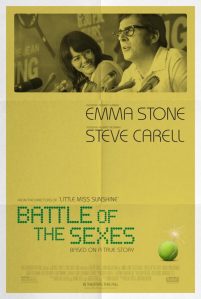 In 1973, tennis player Billie Jean King (Emma Stone) was the number one player in the world, but to many she was still only just a woman playing a man’s game. Bobby Riggs (Steve Carell) was a retired tennis player trying his hand at being a family man. He’s restless and eager to prove something. He’s a natural hustler and so he sees female tennis players fighting for equal pay as his opportunity at a comeback. Riggs wants to prove a point about the inferiority of female athletes. He will play and beat any female tennis pro. He embraces the term of being a male chauvinist and becomes a lightning rod. Men around the world cluck about their biological superiority in athleticism. Billie Jean King feel the full pressure to prove him wrong and make a stand for the women’s movement.
I was pleasantly surprised at the degree of depth given to the characters in Battle of the Sexes, turning what could have been a light-hearted and sprightly throwback to a sports novelty into something a bit deeper and more meaningful, a thoughtful character piece on this climactic conversion of sports, celebrity, and feminism that still resonates.
Billie Jean King is the number one women’s tennis player in the world at age 29. She’s also deeply in the closet and Battle of the Sexes gives considerable attention to this internal conflict of self. The film successfully makes you feel her yearning and unrestrained attraction to hair stylist Marilyn Barnett (Andrea Riseborough). The directors film their first interaction in extreme close-up, which forces them together tighter and allows us to see every little tremor of nerves play across Stone’s face. Her affair with Marilyn coasts on that combination of guilt and compulsion, the push and pull of what she desires and what she can have. Sponsors would not take kindly to an openly gay tennis star. Billie Jean King is struggling with her concept of who she is versus the expectations of others and society. By stepping up to Riggs’ challenge, she is fighting for her own sense of agency. She feels the intense pressure to perform with the credibility of women’s sports placed upon her shoulders. She’s fighting for equal pay and fair treatment, but what happens to that mission if she fails against a 55-year-old oaf? Billie Jean King comes across as a compelling specimen, feisty and independent but also hampered by what those around her would think over her feelings for another woman.
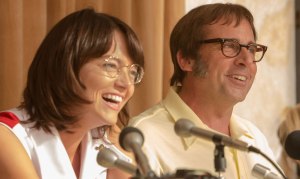 Stone delivers a far more layered and emotionally engaging performance here than in her Oscar-winning turn in La La Land. Hers is a character trying to become comfortable in her own skin. Riggs is the showboat while Billie Jean King is not comfortable in the spotlight. Stone displays the grit and tenacity as well as the vulnerability and complexity of her character’s self doubts and internal struggles. Her scenes with Marilyn have a vitality to them that is absent throughout the rest of the movie, allowing the audience to understand how that burgeoning romance unlocks something within her, something that she might not even fully comprehend. When she does win the big match, Stone seeks solitude and just cries her eyes out, finally able to let her guard down, acknowledge the toll of the moment, the relief of not letting down the women’s movement, and the sheer elation of rising to the occasion. It’s a moment where Billie Jean King feels her most free, where she’s sobbing by herself. Once that’s done she has to collect herself and get back in front of the cameras, adopting her shield once again to face the outside world.
And then there was Bobby Riggs, 55 years old at the time and languishing on the seniors’ tennis circuit and desperately missing the spotlight. The movie finds notes to make him more of a character rather than simply a misogynistic antagonist, and whether that shaded portrayal is deserved is another question. Riggs is fully convinced of his physical capabilities and that he can beat the stars of the women’s tour. These are women fighting for equality and equal pay but Bobby, and he’s certainly not alone, believe that the sexes are inherently unequal when it comes to physical competition. For him, it’s a way to prove his skills and send a message as well, but more so, as presented in the film, it seems like it’s the spotlight that he misses most. He’s enviously licking his lips at the tournament prize purses on the tennis circuit now, even the women’s prizes. He can make more money than he’s ever earned in his pro career. He can still contend, he can still prove something, and the money and stage has never been bigger. He’s getting far more attention at 55 than he ever received during his pro tennis career where he won four Grand Slam titles (he was the number one player for three years). Carell (The Big Short) is well suited to play broad characters that get even bigger with attention. He’s soaking up every moment as if he’s finally getting what he feels is long overdue, and every hammy PR stunt only magnifies the intensity of that attention. He’s a huckster who gleefully adopts the moniker of a misogynist. At 55, Bobby Riggs has found himself in the biggest spotlight with waves of adoring fans and he doesn’t want to give it up.
 You know who else comes across really well in this movie is Billie Jean’s husband, Larry King (not to be confused with the TV host of the same name). It’s not a film that props up the husband as the focal point of someone else’s story; there are more important aspects than how Billie Jean’s lesbianism affects him. However, he is still an important person in Billie Jean’s life and he is processing a form of loss. His relationship with her cannot stay the same, but Larry recognizes what she needs and chooses to be supportive rather than vindictive. He cares enough to put her needs ahead of his own, and that only increased my empathy for him. A marriage pulled in multiple directions is ripe for examination, and it’s rare to maintain sympathy for all of the participants and this movie does.
By the time that seismic tennis battle comes about, the directors Jonathan Dayton and Valerie Faris (Little Miss Sunshine, Ruby Sparks) smartly refrain from lots of edits and angles, instead preferring a standard TV shot to better immerse the audience. The camera angle allows for the entire tennis court to be displayed, and we’ll watch sets play out in long takes with the two athletes running up and down the court. This allows us better understand and appreciate the strategy of both players, and it also probably makes the special effects budget happy as they don’t have to do much to cover the presence of the stand-ins playing the game instead of our movie stars. Even though I knew how the match would end, I was glued to the screen because of everything the match represented. By forgoing the quick cuts and multiple angles that can jazz up the excitement of a tennis presentation, the film is able to carefully illustrate Billie Jean King’s strategy and skill. She intended to run Bobby Riggs up and down the court and exhaust him. Letting the tennis game play out in a wider presentation also better serves the sense of payoff. This is the moment we’ve all been waiting for, as were the 50 million Americans that tuned in. When she does win, I couldn’t get enough of the montage of chagrined male faces twisting in pained grimaces as this lady proved to be the superior player. You could give me a whole movie of pained reaction shots from misogynists and I would be ecstatic.
 It’s also hard to ignore the parallels Battle of the Sexes makes with our current climate. 44 years later, women are still fighting tooth and nail for equality and credibility without qualifiers. Serena Williams is not just the greatest female tennis player of all time; she’s also the greatest tennis player, period. Women’s sports are often seen as lesser in comparison to the men, and abhorrent pay discrepancies are still a reality. Look at the U.S. women’s soccer team, which won the World Cup in 2015, only earning a small fraction of the U.S. men’s team, who finished fifteenth out of a group of sixteen. The casual sexism and lowered expectations extend beyond the realm of sports, as the 2016 presidential election serves as a powerful reminder of the obstacles professional women face in modern society. It’s easy to view Battle of the Sexes through the lens of the 2016 election: a very capable woman who just wanted to do her job is lambasted by an inferior opponent coasting on puffed-up bravado, masculinity, sensationalism, and the sense that the established order of white males is losing something divinely theirs. I’ll admit that channeling this analogue does provide the ending with even more uplift.
Battle of the Sexes is an engrossing story with big personalities, big conflicts, and big stakes, and it feels just as socially resonant forty years later. The messaging can be a bit heavy-handed at time, as Bill Pullman’s character seems to be a composite of all male chauvinism personified, but it’s still easy to get swept along with its sunny cinematography, 1970s period soundtrack, and feel-good story that remembers to always be entertaining. The characters have more depth than I was expecting, and the actors bring extra layers and shades to their roles, making Bobby Riggs a better rounded character than he might have been in real life. Battle of the Sexes is a timely crowd pleaser that doesn’t lose sight of its characters in the guise of its message. By the end of the film, I was cheering, moved, and nicely satisfied, and what more could you ask for?
Nate’s Grade: B+
Share this:

Detroit (2017)
 Something akin to an art house exploitation film, Kathryn Bigelow’s Detroit is a pressure cooker about the horror of institutional racism, but it’s also a limited drama that lacks any sense of catharsis for an audience. Set among a hellish series of days in 1967, the film follows the events at the Algiers Motel, where Detroit police officers killed three innocent black men in their pursuit of what they believed to be a sniper. An all-white jury then acquitted the officers. Will Poulter (We’re the Millers) plays the lead racist cop and instigator, the man who tries using every effort to get a confession. His bad decisions lead to further bad decisions and miscommunication and then cold-blooded murder. It takes a solid 45 minutes to establish the various supporting characters, the fragile tinderbox that is Detroit during a series of riots, and getting everyone to the fateful motel. Afterwards, it’s like a real-time thriller that’s extremely harrowing to watch. It’s very intense and very well made by Bigelow and her go-to screenwriter Mark Boal (Zero Dark Thirty). Like Get Out, it turns the day-to-day black American experience into a grueling horror film. I was squirming in my seat and felt nauseated throughout much of the movie. I wanted to scream at the screen and tell people to stop or run away. However, it’s a movie with a lower ceiling, whose chief goal is to provoke primal outrage, which it easily achieves, but it feels like there’s little else on the artistic agenda. The characterization can be fairly one-note, especially with the racist cops who stew over white women hanging around virile black males. It’s victims and victimizers and we get precious little else. Your blood will boil, as it should, but will you remember the characters and their lives, their personalities, or mostly the cruel injustices they endured? It’s an intense, arty, exploitation film, and I can perfectly understand if certain audience members have no desire to ever watch this movie. It’s not so much escapism as a scorching reminder about how far race relations have come and have yet to go in this country. Detroit is a movie with plenty of merits but I think it’s the least of the three major Bigelow-Boal collaborations.
Nate’s Grade: B
Share this:

Their Finest (2017)
 Their Finest (not to be confused with Their Finest Hours, even though this is based on a book called Their Finest Hour and a Half) is a disarmingly sweet and poignant true story that resonates with empowerment and the power of creativity. Set at the start of WWII, the British film industry is trying to make ends meet as well as provide morale boosts to the public. Catrin Cole (Gemma Arterton, her best performance yet) goes in for a copywriting job and walks out a hired screenwriter, pegged to write the “women’s parts.” Thanks to the depleted workforce, Catrin has an opportunity she never would have otherwise and she blossoms under the crucible of creative collaboration. This was one aspect of the movie that I was very taken with, as a writer and screenwriter myself, the natural progression of creativity, solving a problem, finding a solution, and the elation that follows. The complications keep coming, first from the British film office who need the movie to be inspirational, then from the divergences from the true story of a pair of French girls who stole their uncle’s boat to rescue soldiers at Dunkirk, then from working with American producers who insist on an American hero who can’t act, and then from natural calamities of scheduling, casting, and oh yeah, the bombing and blitzes that could obliterate everyone. The movie is alive with conflict and feeling and the sweet story of a woman finding her sense of empowerment in the arts. The movie-within-the-movie is filmed to period appropriate techniques, and Bill Nighy is effortlessly amusing as an aging actor still fighting for some scrap of respect in an industry ready to forget him. The insights into the different stages of film production were fun and illuminating. I appreciated that the war isn’t just something in the background but a constant. It upsets the order, takes lives, and is a striking reminder why these people are doing what they’re doing. The film also rhapsodizes the power of the arts, and in particular cinema, in a way that feels reverent without being overly sentimental or self-congratulatory. A great collection of characters is assembled as a ramshackle sort of family with a mission, and the movie drives right into one payoff after another, lifting your spirits and warming your heart. There is a sudden plot turn that will likely disappoint many in the audience eager for a simple happy ending, but I almost view it as industry satire on the difference between American and European cinema tastes. Their Finest is a small gem with sympathetic characters trying their finest and achieving something great. It’s a rich story that deserves its moment in the spotlight and I’d advise seeking it out if possible.
Nate’s Grade: B+
Share this:

The Zookeeper’s Wife (2017)
 Antonina Zabinski (Jessica Chastain) and her husband Jan (Johan Heldenbergh) are the keepers of the Warsaw Zoo. Their lives are thrown into turmoil when Germany invades and occupies Poland. Their animals are slaughtered or moved to the Berlin Zoo, under the care of Nazi party member and amateur geneticist Lutz Heck (Daniel Bruhl). Feeling impotent to the horrors around them, Antonina and Jan risk everything to hide Jews in their zoo and eventually smuggle them out to safe houses.
The Zookeeper’s Wife is one of those slice-of-life stories about good people risking much to save lives during the Holocaust that come from obscurity to remind you that there are still fresh, invigorating stories from a topic that can feel tapped out after 70 years. However, it’s also an indication that you need the right handling to do it justice. The Holocaust is by nature such a horrific subject matter that it’s hard to do it justice with a PG-13 or below rating, but it can be done with the right amount of artistic restraint as long as the overall story doesn’t feel hobbled with limitations. Reluctantly, The Zookeeper’s Wife feels a bit too sanitized for the story it’s telling. When it comes to cruelty and human atrocity, you don’t need to shove the audience’s face in the mess to fully comprehend its distaste, but overly avoiding the reality can also be a detriment. The Zookeeper’s Wife, as a PG-13 movie, does not feel like the ideal way to tell this real-life story. It feels too restrained and some of those artistic compromises make for a movie that feels lacking and distracting at points. Fair warning: there are plenty of animal deaths in this movie, though they are all dealt with off-screen with implied violence. The edits to work around this can be jarring and would take me out of the picture. This is only one example of an element that, in order to maintain its dignified PG-13 rating, unfortunately undercuts the realism and power of its story.
 For a Holocaust story set in Poland, the stakes feel abnormally low. The zoo is a sanctuary compared to the Jewish ghettos. The danger of hiding over 300 Jewish people over the course of the entire war feels absent, which is strange considering it should be felt in just about every moment. There are a handful of scenes where we worry whether they will be caught but they’re defused so quickly and easily. After Antonina is caught talking to a very Jewish-looking “doctor” in her bedroom by the housekeeper, they just fire the housekeeper who leaves quietly and never comes back again. It’s a moment of tension that can be felt and it all goes away in a rush. This scene also stands out because the narrow escapes and close calls are surprisingly few and far between. Even when Antonina’s son commits stupid mistake after stupid mistake, including impulsively insulting a Nazi officer to his back, there’s little fear of some sort of retribution. The movie can also lack subtlety, like watching Heck say three times he’s a man of his word and will be trustworthy. We all know he’s going to fall short. There’s also a moment where Jan is literally loading children, who each raise their arms in anticipation, onto a train car. It’s like getting punched in the stomach with every child. Much of the time spent on the zoo is with the quiet moments trying to make the Jewish survivors feel like human beings again (the animals-in-cages metaphor is there). The details of the smuggling and hiding are interesting but cannot carry a movie without more.
The biggest reason to see this movie is the promise of another leading Chastain (Miss Sloane) performance. Ever since rocketing to prominence in 2011, Chastain has proven to be one of the most reliably excellent actors in the industry regardless of the quality of the film. She’s been dubbed a Streep in the making and Zookeeper’s Wife allows her to level up to her “Sophie’s Choice acting challenge stage” and try on that famous Slavic accent that turns all “ing” endings into “ink.” Chastain is terrific as a person trying to navigate their way through the unimaginable, calling upon reserves of courage when needed, and she’s at her best during the moments with Herr Heck. She has to play the dishonorable part of the possible lover, and Heck definitely has his heart set on Antonina. The scenes with the two of them draw out the most tension and afford Chastain a variety of emotions to play as she cycles through her masks. In some ways I wish the more of the movie was focused on this personal conflict and developed it even further.
There was a small practically incidental moment that got me thinking. As stated above, the film has a PG-13 rating and one of the reasons is for brief nudity from Chastain. Now the actress has gone nude before in other movies so that’s not much of a shocker, but it’s the context and execution that got me thinking. Antonina and Jan are lying together in bed after sex and Chastain does the usually Hollywood habit of the bed sheet being at her shoulders while it resides at the man’s waist (those typical L-shaped bed sheets). No big deal. Then, during their discussion over what to do, Antonina rolls over and exposes her breast for a second before she covers herself up again. The reason this stood out to me, beyond the prurient, is because it felt like a mistake. It seems obvious that Chastain was not intended to be seen naked in this intimate post-coital conversation but it was used in the final cut anyway, which made me wonder. Was the take so good, or so much better than the others, that director Niki Caro (Whale Rider, McFarland, USA) and Chastain said “the hell with it” and kept the briefly exposed breast? Did they enjoy the happily accidental casual nature to the nudity, creating a stronger sense of realism between the married couple? Or in the end was it just another selling point to help put butts in seats? I’m thinking best take is the answer. You decide.
 I am convinced one of the main reasons that Chastain wanted to do this movie, and I can’t really blame her, is because she would get to hold a bunch of adorable animals. Given the subject matter, I was prepared for a menagerie of cute little creatures, but I started noticing just how many of them Chastain is seen holding. She holds a rabbit for a monologue. She holds a lion cub. She holds a baby pig. She holds a monkey. She even kind of holds a rubbery baby elephant doll (talk about Save the Cat moment, this movie takes it even more literally). There may very well be animals I simply have forgotten she held. I would not be surprised if in her contract there was a rider that insisted that Ms. Chastain hold at least one small, adorable animal every third day of filming on set.
Stately and sincere, The Zookeeper’s Wife is an inherently interesting true story that should have more than enough elements to bring to life a compelling film experience. It’s an acceptable movie that’s well made but I can’t help but feel that there’s a better version of this story out there. It feels a tad too safe, a tad too sanitized, a tad too absent a sense of stakes, like it’s on awards-caliber autopilot. Chastain is good but her Polish accent becomes a near metaphor for the larger film: it’s polished and proper but you can’t help but feel like something is lacking and going through the motions of what is expected. This is a worthy story and I’m sure there are great moments of drama, but The Zookeeper’s Wife feels a bit too clipped and misshapen to do its story real justice.
Nate’s Grade: B-
Share this:

Hidden Figures (2016)
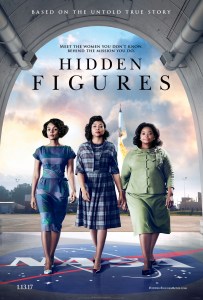 After the end of 2012’s Red Tails, I said to myself that those men of history deserved a better movie. By the end of Hidden Figures I was thinking the same thing for the unheralded African-American women of NASA in the 1960s Space Race. It’s an inherently engrossing story that the public knows precious little about, and the biggest problem with director/co-writer Theodore Melfi’s (St. Vincent) film is that is rarely breaks free from its formula for feel-good mass appeal. Rather than allowing us to absorb the complexities of the three women featured (Taraji P. Henson, Octavia Spencer, Janelle Monae) the movie wants us to just know about their struggles over injustice and inequality. That’s a fine starting point but rarely do these women become fully fleshed out. They’re kept as symbols, put-upon figures, and less as people. That allows them to have their Big Acting Moments where they uncork a snappy retort to institutional prejudice that is the kind of stuff meant for Oscar clip packages. Henson is given the most significant part but even her math genius feels like a crude Hollywood extrapolation of a stereotypical movie nerd. Monae was the one who left me most impressed with her feisty attitude and swagger. It’s all a pleasing and moderately entertaining package but the presentation and artistically stilted character development hinder the movie’s message. I would have preferred a documentary on the same subject, something that would allow further depth as well as the direct testimony of those women involved. I believe Henson’s character is still alive and in her 90s, so there’s no time to waste. Hidden Figures is a safe yet still appealing biopic that hits some of the right notes but lacks greater ambition. Not all films have to try and redefine their genre, but when you’re giving the titular hidden figures of history their much-deserved spotlight, maybe a little more effort is deserving and necessitated.
Nate’s Grade: B
Share this:

Loving (2016)
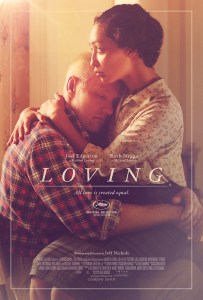 Richard (Joel Edgerton) and Mildred Loving (Ruth Negga) are a young couple deeply in love in the late 1950s. The only problem: he is white and she is black. The laws in their native Virginia forbid marriages to different races. The Lovings traveled to Washington D.C. to be married and then had to live as fugitives before ultimately getting caught and exiled under threat of jail time. Eventually an ambitious ACLU lawyer (Nick Kroll, broadening his range) challenges the legality of the miscegenation law, which will lead to the landmark 1967 Supreme Court ruling striking down laws barring interracial marriage.
The ordinariness of the Lovings betrays the kind of movie moments we expect from great historical turning points, namely moral grandstanding and stentorian speechifying. We’re so used to accentuated versions of history because, deep down, that’s what our storytelling impulses crave because the real thing is often less streamlined and usually more boring. We want Daniel Day-Lewis as President Lincoln admonishing his fellows with the power of his oratory. We don’t necessarily want to watch President Lincoln rewrite his speeches for grammatical mistakes. With all that being said, I appreciated the approach that writer/director Jeff Nichols took with Loving because the very point at the heart of the movie is just how powerfully ordinary Mildred and Richard Loving are. Their love is meant to be ordinary, their relationship relatable. They’re meant to be just like you or I. This thematically taps into the message of the movie about the fundamental human rights of American citizens to love who they love regardless of what others may think. There is nothing dangerous or subversive about their marriage. There is nothing radical. The rationale for why the state would care so much about a marriage can be flabbergasting, including one judge’s written opinion that God created separate races and placed them at separate points on the globe thereby never intending for them to mix. This was considered acceptable legal justification for discrimination in the 1960s and it’s absurd. The other argument against interracial marriage is that biracial children are a harm to larger society… somehow. It’s easy to look back to the past and shake our heads with a fury of moral indignation and say “How could they do that?” but some of these exact same legal arguments have been used in the twenty-first century to justify denying gay citizens the same equality. In that sense, Loving shows us how far we’ve come but also how far we have to go to make sure that human beings are simply considered human.
 If that wasn’t enough the movie also makes a powerfully compelling case about how the state’s miscegenation laws were an offense to human decency. The Lovings are given the legal ultimatum to separate or be exiled from the state, their families, and the home they were making for their family. They have been banished for loving the “wrong” person. Mildred and Richard try living out of the state in a D.C. suburb but it’s not the same; Mildred misses the quiet and relative safety of the country as well as the warmth of her immediate family. They decide to sneak back into Virginia and lay low, and you get a genuine sense of the day-to-day anxiety of having to constantly look over your shoulder and fly under the radar lest someone throw you in prison for loving another race. The degradation and dehumanizing effect of the miscegenation laws is on full display with how Mildred and Richard must act like criminals afraid of their country of laws. They may be used to the glares and hateful comments from intolerant onlookers but it’s another thing when the power of the state is employed to enforce that same hate. The wear and tear of their love perplexes some of the Loving friends and family. Mildred’s brother and sister each take turns blaming Richard for knowingly bringing this heap of trouble upon their beloved sister and for taking her from them. Her brother confesses he doesn’t know why he doesn’t just divorce her and stay together, satisfying the definition of the law. It’s a pertinent question that asks what is the value of marriage? He could readily be with Mildred and save themselves the persecution, but why should they have to settle for something less with their love? Why should they have to be second-class citizens?
This is very much a duet of a movie and Negga and Edgerton deliver admirable, understated work that cuts deeply. I was most impressed with Edgerton (The Gift) who has the more private and insular character. He’s not seeking the spotlight and doesn’t want to be a civil rights crusader. Richard Loving isn’t exactly a man prone to those speeches we crave and he’s certainly not a man to blurt out his feelings. Edgerton has to play within a tiny frame of emotional reference and he makes it work. When he does start to break down, his stoic defenses melting under the pressure and soul-killing compromises, the moments carry even greater emotional weight. Negga is the more emotive of the two but even much of her performance lies in her large, expressive eyes, taking in the collective injustices and triumphs. Using approximately the same Southern accent from her plucky performance on AMC’s Preacher, she radiates warmth and goodness and a sense of indomitable perseverance. It’s a performance that speaks in small gestures and small moments. Much of the film is Negga and Edgerton working together and each lifts the other up, providing the right space needed. There’s a physical intimacy that says much as each member of the relationship seeks out the other’s touch, grip, presence for comfort. It’s a delicate and understated duet of performances that bring the Lovings to faithful life.
 Nichols (Mud, Take Shelter) is the kind of filmmaker that astonishes me with every new movie. He reinvents himself with every picture and he takes genres and redefines them, shaping them to his needs, while never losing sight of tone and characters and narrative payoffs. He’s already delivered one of the best movies of the year with Midnight Special and now he impresses yet again, this time turning toward awards-friendly Important Stories of History. Nichols’ sense of place is implacable. He’s also superb at developing characters and giving them the time to properly breathe. He keeps the spirit of the story linked to his subjects, Richard and Mildred Loving, and makes sure we understand their plight and the larger issue at hand. This isn’t a film that’s going to hit you over the head with its message; in fact you could make a claim that perhaps the movie is too insular. As presented, the Lovings are relatable but we’re only given a fraction of insight into who they are as people and what makes them tick. There’s much subtext here to unpack. It does feel like we’re fighting through the defenses of Mildred and Richard to better know them. This specific approach allows the movie to keep in spirit with the ordinariness of the Lovings and their unknowing place in the history of civil rights, but it also caps the potential emotional impact. We’re invested in them as people but not as completely as characters. It’s a minor criticism perhaps but it’s really the only one I have for Nichols’ movie.
Given our recent turbulent political environment, Loving is an even more significant film. Jeff Nichols has crafted a poignant and affecting movie that passes over easy histrionics for a better representation of history and its characters. These people didn’t want to change the world; they just wanted to live out their lives. Mildred and Richard Loving are regular people living regular lives and that’s the ultimate message of the movie and their love. Having won their Supreme Court battle, the couple returns home to their original plot of land Richard bought in Virginia with the purpose of building his wife a house. Somber text appears in the sky to inform us that Richard would die in a car accident a mere six years later. It left me with a pall thinking about what a short span of time this man had to cherish the woman he loved without recriminations before it all came to a tragic end. It doesn’t seem fair, and I hope that’s a message other audiences take with them. When demagogues try and use religion in place of civil law to justify state-sponsored discrimination, saying the love others share is inferior and somehow a danger to their own lives, that’s when people need to remember the Lovings. This life is too short to harangue others about whom they choose to give their love to. Here is a beautiful, gentle, and restrained film that reminds us that the power of love is in its superhuman perseverance.
Nate’s Grade: B+
Share this:

Deepwater Horizon (2016)
 Peter Berg is becoming the go-to director for inspirational true-life thrillers following the heroic exploits of everyday Americans thrust into danger. It began with Lone Survivor, it will continue this year with the Boston bombing drama Patriot’s Day, and in between there is Deepwater Horizon about the oil rig drillers and the culminating explosion that lead to the worst environmental disaster in U.S. history. It’s a sober and reverent movie, with Berg and his screenwriters taking great care to educate the audience on the science of drilling, the technology, the geography of the floating rig, and just exactly why things went as badly as they did that fateful night. The windup lasts about half the movie but that’s because when the explosion hits there isn’t much plot left (the movie is barely 100 minutes). Deepwater Horizon becomes a full-tilt disaster movie by that point with Mark Wahlberg stalking hallways and looking for injured survivors. The tension prior to the blown pipeline can get genuinely powerful, and the action that follows is suitably rousing as the rig resembles a snapshot of hell. Flames and heat consume the rig and escape seems nigh impossible. The sound design is sensational. The characters are mostly stock roles, with Wahlberg as our blue-collar everyman, Kurt Russell as the irritable boss fighting for his workers, and John Malkovich as the villainous penny-pinching BP representative. Malkovich’s campy performance almost needs to be seen to be believed. It’s like he’s visiting from another planet, the garbled Cajun representative. The lack of politics and curiously narrow focus (nothing about Halliburton, nothing about BP consequences, no environmental effects) does hamper any greater impact the film could have had. It’s a respectful slice-of-life drama that humanizes some of the lives lost that day but only by keeping to formula and stock action character development. It’s like a Towering Inferno-style Hollywood disaster movie, except one that treats its subject with stiff-lipped seriousness. In this new docu-action sub-genre, Berg and Wahlberg are kings.
Nate’s Grade: B
Share this:

Snowden (2016)
 There’s quite a difference when director Oliver Stone actually gives a damn with a movie, and you can tell with Snowden that he is passionate about making a compelling and accessible movie for American audiences to understand why they should be angry. He wants to lead the righteous civil liberties mob against the right perpetrators while providing an appreciative moral context to the actions of Edward Snowden, America’s most famous fugitive. That sense of purpose and drive animates Stone in a way that his recent films have not, and even though it’s far less gonzo and experimental as Stone’s quintessential catalogue, the storytelling skill is still consistently engaging and the resulting 134 minutes inform as well as entertain.
Edward Snowden (Joseph Gordon-Levitt) wanted to serve his country and his expertise in computers landed him in various jobs working for U.S. agencies. He discovered the abuse of surveillance over everyday citizens rubber-stamped by a FISA court meant to provide oversight. Callous private contractors would surf through thousands of collected data points, and if pressed, could justify through terrorism connections, as it seems anyone in the world is perhaps three connections away from a person of interest (consider is the really unfortunate version of the Kevin Bacon game). Snowden risks everything to reach out to a team of journalists (Zachary Quinto, Melissa Leo, Tom Wilkinson) to tell his story and make sure the larger public will know these abuses of power.
 The best compliment I can give Stone as a screenwriter and director of Snowden is that he took a thoroughly challenging scenario with few cut-and-dry answers and made an accessible movie experience that effectively conveys moral outrage and dismay. It feels like Stone the educator is leading you by the hand, taking time out to explain some of the more delicate intricacies of the murky stuff that goes on behind closed doors. I won’t exactly declare it to be an intelligent examination on the moral implications of the material, but it’s certainly a movie that lands its goal of clarity. It produces a sense of clarity for the subject and a sense of clarity for why Snowden made the decisions he did. Gordon-Levitt delivers a steadily engrossing performance, even if it takes several minutes to adjust to his distracting speaking voice. Maybe my ears are just broken but it doesn’t sound like Snowden. Fortunately, my ears did adjust accordingly. Gordon-Levitt and Stone effectively kept my attention throughout the film. I was surprised how much I found myself enjoying long stretches of this movie, even if my own stance on Snowden is less clearly defined. He talks a good talk but the reality is messy.
Given Stone’s conspiratorial history, the plot definitely comes with a distinctive point of view over whether Snowden is a hero or a traitor. I don’t think inherent bias in a movie or the angle taken in storytelling is inherently misguided and that all stories should be as objective as possible. Sometimes the circumstances don’t permit objectivity. Stone’s film is clearly biased but it doesn’t fall into a hagiographical hero worship of its titular figure. This is a complicated subject and deserves a proper analysis to place the real-life people in the meaningful morally ambiguous context. Snowden ultimately makes the decision to become the world’s most famous whistle-blower for what he felt were systematic abuses of government surveillance, but before that climactic decision he comes across less than a spotless martyr. His character arc is a fairly recognizable awakening of alarm and horror at the great abuses of power in the name of security. He does start off as a lifelong Republican with family members who have served in the military and different governmental bodies. He’s devastated to be medically discharged from the Army and hungry to serve his country. He’s a patriot who becomes disillusioned with the system, but he’s also rather self-involved and excuses ego with civic duty. I didn’t know how gifted Snowden was in his field, and the movie has some amusement with the wunderkind training sequences where Snowden delivers shock and awe to his stunned superiors. However, the second act becomes more than a bit protracted because Snowden keeps quitting but eventually going back to government surveillance, whether CIA or private subcontracting. This is because of the pay, sure, but it’s mainly because nobody can do what he can do. He feels important. He feels needed. He convinces himself he’s making a difference in the War on Terror, but eventually the reality of the widening peripheral of the war zone is too much to ignore for him.
This is further epitomized through the romantic subplot with Lindsay Mills (Shailene Woodley), a liberal firebrand, photographer, and exotic exercise instructor. Woodley (The Fault in Our Stars) does her best infusing a warm personality into what is too often the underappreciated yet overly agreeable girlfriend role. It’s a storyline meant to further humanize Snowden as well as personalize the encroaching invasions of privacy and subsequent paranoia. After he discovers that the government can activate laptops and watch oblivious citizens through webcams, Snowden can’t help but stare down his open laptop during an almost laughably forced sex scene. My reaction as Lindsay climbed aboard Snowden was exactly this: “Oh, I guess this is happening now.” She would have a greater impact if the movie did more with her character, as she is the long-suffering girlfriend who keeps accommodating his life choices. They move three times across the country for his jobs and Snowden is always unable to fully explain why he feels the pull to these tech occupations, which further frustrates a woman who just wants trust and stability. There is one interesting conversation that Lindsay offers, typifying the blasé response to spying with a “well I have nothing to hide, so who cares” rationale. Snowden is quick to admonish this line of thinking, an opinion that many still share. The other regrettable reality is that the romance is inevitably going to be the least interesting facet of this story. By going behind the curtain of American secret surveillance, we’re indulging in our collective curiosity at how exactly all these moving parts operate. To then go home and watch a couple squabble is a consistent letdown of drama.
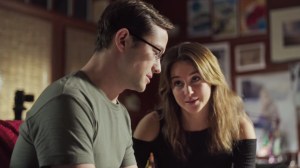 There are a few other artistic miscues that weigh down Snowden, mostly Stone’s penchant for heavy-handed symbolism. The same instincts that allow Stone to carefully thread a knotty story are the same impulses that tell him that subtlety is for cowards. There doesn’t need to be a frame story here. I understand that select media outlets trying to break this story naturally allows for a question-and-answer framing system of flashbacks. However, very little is added besides a skeletal structure. The media members act as reactionary acolytes. It was all captured much more credibly in the Oscar-winning documentary, Citizenfour. There’s no earthly reason for Nicolas Cage to be in this movie except for drawing financing. He plays an old CIA code-breaker and admirer of outdated technology, but really he’s there to serve as an institutional nod to Snowden. At the conclusion, when Snowden’s identity and message becomes public, there’s a scene where Cage’s character literally toasts his pupil’s actions. I would say it’s a bit much but the character is a bit much for an actor that hasn’t generally been known for restraint. When Snowden is leaving the CIA offices in Hawaii for the last time, he steps out into the light (get it? get it?) and the scene is practically rendered in slow motion as the enveloping white light fills the screen and bathes Snowden (get it? get it?). He smiles bigger than we’ve ever seen. Lastly, Stone can’t just help himself during the very end and has Gordon-Levitt replaced with the actual Edward Snowden to deliver the closure of an interview. I don’t think we needed a reminder that Snowden is an actual living person.
Snowden the man, and Snowden the movie, wanted to shake up an ignorant and apathetic American public about the dangers of unchecked power in a surveillance state, but was the mission a qualified success? Years later and Snowden living in exile in Russia, the charitable answer would be inconclusive, though the pessimist in goes further. It very well seems that the majority of the American public simply doesn’t care (out of sight out of mind). The trial over whether Snowden is a patriot or a traitor seems a little moot perhaps when the larger public shrugs at the revelations of security overreach. Does a movie about a Great Man have as much resonant cultural cache if that defining act of greatness produces a shrug? I’m by no means saying we should apply a polling system to accurately measure a person’s value and accomplishments to the larger cultural and political landscape. Snowden wanted to wake the public up but we hit the snooze button. In the meantime, the movie about his exploits is fairly entertaining, so at least he has that.
Nate’s Grade: B
Share this:

Sully (2016)
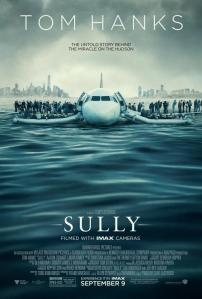 I think I had the same initial thought that most did when they saw the news that there was going to be a movie about the Miracle on the Hudson airline pilot: where exactly is the feature-length story? The flight itself lasted only about 200 seconds before landing on the river, and the sequence is thrillingly recreated and held off until halfway through the movie. The hero in the cockpit, Sully (Tom Hanks), is consumed with ensuring each and every last passenger is accounted for. When he gets the news that all survived, he can finally allow himself to breathe, to take in the full magnitude of the events, and it feels like a cleansing moment of deep emotional catharsis for him and the audience. But what’s the movie here? Apparently the NTSB and the airline insurance companies are disputing whether Sully could have safely landed the plane back at an airport instead. It’s exactly the kind of flimsy, manufactured conflict that sets itself up for moral grandstanding and a courtroom confrontation where our heroes will be vindicated, and we get all that. Sully’s unexpected spotlight wears on him as he feels like an ordinary citizen not worthy of the term “hero.” No other plane has successfully landed in water without a loss of life, so I’m sorry pal, but you’re a hero, even if you think you were just doing your job. Hanks is suitably low-key and humble and strong and emotionally resonant, though he was better on just about every front with Captain Phillips. The direction from Clint Eastwood is respectful without going into hagiography. The overall message is one of uplift, widening the focus from Sully to other heroes in New York City that day that came together to help others. It’s a moving message without having to resort to melodrama. At a mere 96 minutes, Sully gets you in and out and provides a solidly entertaining glimpse at the people who rose to the challenge when needed most. It’s a well-made movie that goes as far as it can without trying your patience.
Nate’s Grade: B+


 nathanzoebl
You must be logged in to post a comment.