Blog Archives
Spider-Man: Homecoming (2017)
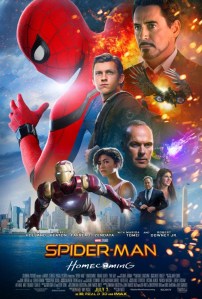 15 years. 6 movies. 3 different lead actors. 2 reboots. I wouldn’t be surprised if a majority of the American public likely knows more about Spider-Man than their relatives. In 2002, the first Spider-Man movie kicked off the new century by affirming to studios that superhero movies are a sound financial investment. Director Sam Raimi and Tobey Maguire kicked off the glut of superhero cinema, paving the path for the massive Marvel Cinematic Universe (MCU) and its own unparalleled run of financial and critical success. Then the overreach killed off Raimi’s Spider franchise in 2007 and overreach again killed off Sony’s Spider reboot in 2014. Sony wisely sought out an assist from the gurus of Marvel, striking a deal and having the web-slinger return to the MCU. Fans rejoiced. Spider-Man: Homecoming announces itself as a brash, exhilarating, hilarious, and amazingly assured film that immediately lines up with the upper tier of the MCU. Marvel should use this as Exhibit A, submit it to Fox, and say, “Here’s how we can do your franchises better.”
Peter Parker (Tom Holland) is your ordinary 15-year-old from Queens, New York who was given amazing powers after being bit by a radioactive (or genetically modified) spider. It’s been weeks since he was called into action by Tony Stark (Robert Downey Jr.) to thwart Captain America (Chris Evans). Now Peter is back home and waiting for his literal call to adventure, for Stark to officially call him up to join the Avengers. Peter anxiously waits for school to end so he can don his Spider-Man suit, modified by Stark Industries, and fight local crime and injustice. This mostly amounts to stopping bicycle thieves, helping old ladies with directions, and other inglorious tasks. Peter’s Aunt May (Marisa Tomei) would prefer he focus on his studies rather than the time he’s been spent on the “Stark internship” (his fib to cover said crime-fighting). New weapons begin appearing on the streets, built from the discarded alien technology from The Battle for New York. Spider-Man investigates the source, Adrian Toomes (Michael Keaton), a pilot who adopts the moniker of The Vulture while in the sky with his winged jet pack. The formidable weapons pose a real pressing danger to society, and Peter pushes further, at his own peril, to confront the Vulture and stop the flow of high-tech weapons.
 For many fans of the webhead, this will feel like the first time they’re watching the Spider-Man of the comics on screen. This is the first film incarnation where Peter remains in high school for the entire duration of the movie, and it’s also thankfully the only telling that eschews an origin story. He just is Spider-Man, however, the arc of the movie is him settling into that identity. It’s in many ways a coming-of-age story for the superhero set, as Peter has to come to terms with his earnest desire to help others and his own maturation, both as Spider-Man and as a high school sophomore. He’s learning just as much to be Peter as he is Spider-Man. Just because he has these powers doesn’t mean he’s ready for the rigors of the world. Homecoming is very much a high school movie. There are familiar John Hughes influences throughout, and the film smartly subverts certain high school tropes (driving lessons, prom dad from hell). It presents our hero struggling with asking the cute upperclassman (Laura Harrier) to the dance just as much as the demands of being a fledgling local superhero. His interior life is much more available and relatable but he’s still a teen navigating the world. Also, by having Peter be the youngest film incarnation yet, it allows for the satisfying indulgence of superhero wish-fulfillment. Whereas the X-Men powers are naturally linked to the progression of puberty, those are usually portrayed as a curse, something that ostracizes, confuses, and produces great anxiety and fear. With Spider-Man, being a superhero is the coolest thing in the world. He’s not consumed with angst like Andrew Garfield’s broody Peter Parker and his weirdly special DNA (what was the deal with his parents and that conspiracy? Oh well). Watching this exuberant Peter Parker embrace his new abilities with glee is a great way to keep the movie light and bouncy.
This is also, bar none, the funniest film yet in the MCU (yes, even dethroning Guardians of the Galaxy). With the lighter tone, the movie finds consistent opportunities to inject comedy, from the irony of Peter trying to lead a normal life, to the awkwardness of Peter’s attempts at crime-fighting, to his over eager demeanor, to misunderstandings and hasty excuse-making to conceal his double life, to the sterling supporting cast of characters that contribute different flavors of jokes when called upon. If anything there is so many talented supporting players I wanted even more time with them (Donald Glover, Hannibal Buress, Martin Starr). This cast is a comedic embarrassment of riches.
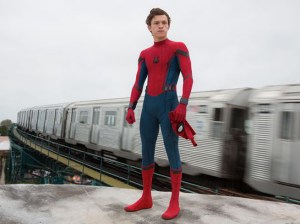 I was laughing pretty much from beginning to end with Homecoming. Just thinking back on the school’s morning announcements (complete with anchor Betty Brant) makes me giggle. Peter’s best friend Ned (Jacob Batalon) is the movie’s chief source of comic relief, and in less careful hands he would become rapidly annoying. Instead, he’s a reliable presence and given a character arc with a payoff of his own, his desire to be Peter’s “guy in the chair.” It’s genuinely impressive screenwriting when even the comic relief sidekicks have arcs. Zendaya does an impressive job of selling every one of her jokes, which traffic in a very specific smart-aleck, apathetic tone. She’s graduated from the Disney Channel to the bigger leagues. There’s a hysterical series of inspirational education videos featuring Captain America, and if you stay past the end credits there’s a great payoff for that. There’s even some sly meta jokes calling back to Raimi’s Spider-Man. Every joke at least lands and most of them hit hard, benefiting from strong development and timing.
Nevertheless, just because it happens to be one of the funniest movies of the year, Spider-Man: Homecoming still finds plenty of space to be dramatic and thrilling. The comedy doe not tonally detract from the other elements. This is not an insubstantial movie just because it knows how to have some fun (take notes, Zack Snyder and DC). This is not a flippant movie because of tone or the heavy joke quotient. There are sincerely sweet moments born out of the characterization, like when Aunt May takes it upon herself to teach Peter how to dance (this would not be possible with a geriatric Aunt May). Director Jon Watts (Cop Car) has a steady command with his high-flying visuals and maintains the tight walk of tone that allows all the elements to work together as a blissful whole.
There are superb action sequences that advance the story forward and allow for the characters to grow. It’s exactly what good action is supposed to do, besides, you know, quicken the pulse. The humor can also arise naturally from these set pieces. Take for instance Peter suiting up while attending a suburban house party. He spots some alarming energy discharges on the other side of the suburb, but without any tall buildings for him to latch onto, he has to hoof it the whole way on foot. It’s a smart comedic aside and it helps to remind us that this Spider-Man isn’t an instant pro after getting his powers. It all comes together best in a D.C. rescue at the Washington Monument. It bridges the personal with the action. The bifurcated ferry set piece serves as the Act Two break and it’s a killer segment that pushes Peter to his limits to solve a dilemma that seems incapable of being fixed. There may not be any action scene to rival Raimi’s finest but the character-centric action and the organic development of the complications lays a foundation for a consistently entertaining film littered with joyful payoffs.
 The biggest fear I’ve read from Spidey fans was that the involvement of Robert Downey Jr. would tip the scales, turning a Spider-Man movie into a defaco Iron Man sequel. Considering America loves Iron Man, I don’t see how his inclusion is a problem. Civil War was still very much a Captain America film even though Iron Man was the co-lead. Tony Stark represents a distant mentor for Peter and also the gatekeeper. Peter is anxious to become an Avenger and looking for Stark’s approval, which brings an enjoyably unorthodox paternal side from Downey. If there is a complaint I can foresee, it will be that Spider-Man is too similar to Iron Man thanks to the special suit. Spider-Man’s suit has its own Jarvis-style A.I. program (adeptly voiced by Jennifer Connelly, wife to Paul Bettany, former voice of Jarvis) and extra special gadgets including a spider drone and unusual web shooting options. It provides a new sense of discovery for the character since we’re already starting with him powered. The second act is Peter getting accustomed to the boost his suit gives him, becoming reliant upon them, and then having it stripped away as a natural Act Two break so that the conclusion has even more stakes without the security of the suit. It makes Peter much more vulnerable. The Iron Man parts are more a background motivational force and this is still very much a Spider-Man film.
Holland (The Lost City of Z) is already my favorite Spider-Man. Period. He made such an immediate and strong impression in Civil War that I was greatly looking forward to his first big starring venture, and Holland does not disappoint. This is the first Spider-Man that doesn’t feel crushed by the heavy burden of being a superhero. He’s a kid eager to grow up and join the world of other caped crusaders, but he’s modeled his crime fighting from what he’s seen on TV. He doesn’t really know what he’s doing. He’s still an awkward kid, and Holland brings great authenticity to the smaller character moments and the bigger heroic strides (while maintaining a convincing American accent). This is a more relatable, vulnerable, and interesting Peter Parker. Even though he thinks he should be beyond the mundane life of high school, he doesn’t ever act pompous or look down on other characters, which is endearing. At times Holland feels like he’s going to explode with energy, as if life is too much to process in the intermediary. He’s a teenager and the world feels so big and open. It’s an instantly engaging and likeable portrayal that wonderfully capitalizes on the introduction from Civil War. This is a Spider-Man, and his spider world, that I want multiple sequels to further explore and challenge.
 Keaton’s Vulture already ranks as one of the best villains in the MCU (a low bar, I admit), and that’s because the movie humanizes him and gives him significant moments. He’s just a regular working-class man trying to provide for his family. In fact the first five minutes of the movie focus exclusively on Toomes and explains his sticky situation. He feels cast aside by those in the upper echelons of power. His eventual “you and I are the same” speech to Spider-Man has credible points. You can see, from his perspective, how he’s an underdog sticking it to the rich elites. Shockingly, there’s only one death in the entire movie and even that is an accident. Toomes is not your standard comic book villain, and there’s a brilliant third act twist that makes him even more centrally involved in the narrative. That opens a delicious sequence of dramatic irony. Keaton has a quiet menace to him that’s very unsettling. It’s all in the lower register. His character doesn’t blow up. He just narrows his brow and intensifies that scary stare. I’m glad the filmmakers realized that more Keaton was an asset to the film.
Let’s also take some time to celebrate the sixth Spider-Man movie for having a diverse population of characters that would actually represent Queens. Peter’s best friend is of Filipino descent, the girl he crushes on is biracial, the loner girl is biracial, and even the high school bully, Flash Thompson, is Hispanic, played by Tony Revolori from The Grand Budapest Hotel. This might be Marvel’s most diverse cast yet, though “yet” being the operative word considering that Black Panther is arriving in early 2018.
This movie is a total blast. Spider-Man: Homecoming actually manages to give new life to a character that has already appeared in five other movies. That’s an amazing feat. Another amazing feat is that six different screenwriters, including the director, are credited with this movie, yet it feels fully coherent in its vision and presentation. This is Peter Parker, the teenager struggling with self-doubt, hormones, and an eagerness to grow up, and the movie feels much more human-scaled, forgoing giant CGI smash-em-ups for something more grounded, personally involving, and ultimately successful. Just because Homecoming is fast-paced and funny doesn’t mean it lacks substance. I was elated during long portions of this movie, impressed by the steady stream of setups and payoffs, the incorporation of the many characters and comedic voices, and the varied action set pieces that were focused on character progression. If you are tired of superhero stories, I’d still heartily recommend this movie. Dear reader, I feel like I’m failing you and turning into a frothing fanboy because I can only think, at worst, of negligible quibbles against the film. Everything in this movie works. Everything. It’s everything I was hoping for and then some.
Nate’s Grade: A
Share this:

Captain America: Civil War (2016)
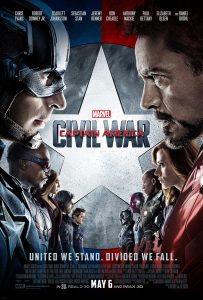 Think you were disappointed by last summer’s Avengers: Age of Ultron? The pressure-packed experience broke writer/director Joss Whedon who swore off being the creative shepherd of the Marvel cinematic Universe (MCU). Enter the Russo brothers, a pair who were widely known for their work in eclectic TV comedies like Community and Arrested Development before blowing away all modest expectations with 2014’s Captain America: Winter Soldier. I can say that the Russos are more than capable for the challenge. My simplistic blurb for Captain America: Civil War is thus: everything Batman vs. Superman did wrong this movie does right.
After the cataclysmic events of multiple movie climaxes, the world governments are wary of the power wielded by the Avengers. Secretary Ross (William Hurt, the lone returning element from 2008’s Incredible Hulk) is pushing the superheroes to sign the Sokovia Accords, which would put them under the control of a U.N. joint panel. This panel would decide when and where to deploy the Avengers. Captain America, a.k.a. Steve Rogers (Chris Evans), is worried about a group of people taking away their choice. Iron Man, a.k.a. Tony Stark (Robert Downey Jr.), believes that they need to accept limitations and that agreeing to these terms staves off something worse later. This division becomes even more pronounced when Rogers’ old friend the Winter Soldier, a.k.a. Bucky Barnes (Sebastian Stan), reappears as the chief suspect in a U.N. bombing. Black Panther, a.k.a. T’Challa (Chadwick Boseman), swears vengeance against Barnes for the bombing. As the assembly of heroes squares off over the fate of the Winter Soldier, Baron Zemo (Daniel Bruhl) is tracking down classified Hydra documents to uncover pertinent information that will topple an empire.
 While I don’t want to turn every new film review as an opportunity to beat a dead horse, I cannot help but draw immediate and stark comparisons between Civil War and the earlier titanic superhero slugfest, Batman vs. Superman: Dawn of Justice. Let’s take this case point by point so there is no reasonable doubt left for the jury of ticket-buyers.
“Batman vs. Superman doesn’t set up its conflicts with enough time to develop them and it lacks real emotional stakes.”
With BvS (I’m saving my fingertips some drudgery), we hadn’t known these characters for more than one movie at best, and in the case of Bruce Wayne less than one. When they fought there wasn’t any real stakes despite the apoplectic marketing because we hadn’t built relationships with these characters. In the case of Henry Cavill’s Superman, many were turned off entirely by the guy (not necessarily by Cavill’s physique, though). Did anyone really care who won? The filmmakers relied on the audience to supply their pop-culture good will for the characters instead of proper characterization and development. In the case of Civil War, we’re dealing with the cumulative effect of having twelve movies to build up storylines and character relationships. We’re invested in these characters and their friendships, so when they fight it actually does matter. You feel for both sides and multiple characters and the movie does a good job of providing each side a credible motivation. It’s a political thorny issue but it’s kept very streamlined, focusing more on the characters. If the MCU has had one nagging problem throughout its history it has been a dearth of good villains. There’s Loki and… Loki. One solution is to just pit the heroes against each other and this produces as many fist-bumps as winces. My audience was gasping at reveals and twists and turns. They weren’t doing that with BvS. And wouldn’t you know Civil War actually has a climax that’s more than just an increasing series of punches and kicks (though plenty of those are featured); the climax is an emotionally grounded confrontation that cuts to the core of the group. The events of this movie matter and while obviously it can’t follow its divisions to an irrevocable end, I appreciated that not everything is resolved. These storylines and the conflicts between characters will carry onward when we pick up the pieces in 2018.
“Batman vs. Superman is too burdened with setting up an array of other film franchises that it loses badly needed focus and momentum.”
 To be fair, this charge can also be laid at the feet of Age of Ultron, which buckled under the heavy weight of setting up multiple other future movies rather than telling a completely satisfying movie in its own right. Once the franchises gave birth to mega-franchises, the wheels-within-wheels of moneymaking, now the studios require a lot of heavy lifting from our entertainment. They’re investments in futures and if done improperly can easily crumble under the failed execution like the Amazing Spider-Man series (R.I.P. 2012-2014). Miraculously, Civil War finds ways to involve every member of a large ensemble cast into the story in ways that matter. The movie finds small character moments that make them feel better rounded, like Vision (Paul Bettany) and Scarlet Witch (Elizabeth Olsen), and it introduces featured supporting players with great care. Black Panther is a terrific addition and brings a quieter intensity that contrasts nicely with the more colorful characters. Hawkeye (Jeremy Renner) introduces himself and Black Panther curtly says, “I don’t care” and goes back to fighting. Boseman (ageless I tell you!) is smooth and magnetic. Then there’s everyone’s favorite neighborhood Spider-Man (Tom Holland), or whom I’m already referring to my pals as “best Spider-Man.” It’s another incarnation of Peter Parker but the first that feels like an actual teenager, a bundle of adolescent energy and excitement. He’s the voice of the fans and during the big battle he can’t help but gush that he gets to be involved alongside the big names. Spidey’s a fanboy too. He also has a few choice meta one-liners that had me cackling. Holland (The Impossible) makes an immediate impact and, unlike BvS, finds new ways to make us care. I’m genuinely excited for solo Black Panther and Spider-Man adventures with these characters. Even the more traditional villain of Civil War, Baron Zemo, is handled in a way that provides an emotional motivation for his character that is sincere rather than mustache-twirling villainy. In a lot of ways this feels like a third Avengers film just with the size and scope alone. The dozen characters are juggled skillfully but the emphasis is always on Rogers and Stark and their significant personal conflicts.
“Batman vs. Superman’s action sequences are repetitive, joyless, and dank.”
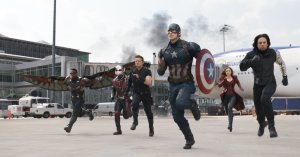
I challenge some enterprising soul to even try and decipher what is happening during the climactic three-on-one monster battle in BvS. I was sitting in the theater and just gave up. I wasn’t having any fun and I couldn’t even literally tell what was happening onscreen with all the confusing CGI obfuscation. The action droned on and on with little variation and was at pains to include certain members and storylines (Lois, maybe don’t get so hasty with that kryptonite spear). It was all just one big overwrought mess that made you question whether anybody on that film production actually liked these superheroes. With Civil War, the action sequences are smartly conceived and choreographed, making excellent use of geography and adding organic complications. The standout is the 20-minute superhero-on-superhero brawl at the Leipzig airport. It is nothing short of nerd nirvana. The characters use their powers together in exciting ways and it further helps them feel like an actual team taking proper advantage of their resources. It’s the culmination of a child’s imagination at play, the living embodiment of smashing action figures against one another and flying around the room. I was thrilled that the Russo brothers found ways to incorporate all the heroes into the action. The specific powers are taken advantage of in fun and surprising ways. The action changes as the stakes keep getting more complicated as more heroes enter the fray. It’s a set piece that will become legendary within film geek circles and it provides payoff after glorious payoff.
“Batman vs. Superman is devoid of all fun and takes itself far too seriously. You feel beaten down, exhausted, and punished by film’s end.”
 The Marvel movies have earned a reputation for their brisk and breezy nature, which has unfairly been labeled as “weightless” and “silly.” I challenge someone to watch Civil War and tell me just how weightless and silly it is. The Russo brothers and the screenwriters take these characters seriously and their care shows. While there can be plenty of rapid-fire quips and one-liners, the movie’s sense of humor does not detract from the emotional weight of its dramatic shifts. There are political and thematic overtones, mostly the costs of vengeance and culpability, that provide extra depth to the onscreen derring-do. However, Civil War understands that an audience wants to be entertained as well with their heavy-handed messianic imagery. There are payoffs galore in this movie. Some are several movies deep from set up. It all comes together to make a thrilling and highly enjoyable movie experience that plays to its audience in the best way possible. It’s an expert summer blockbuster that packs its own punch. There’s a reason I have already seen Civil War three times already. There is so much to enjoy and it’s so tightly packed and structured that you can jump right in and go for the ride. This is the movie fans were hoping for. This is the movie that washes out the bad taste of the dreadful BvS. If one of my lasting disappointments with BvS was how it made me lose hope for future DC movies, Civil War has cemented my anticipation. The future creative direction of the MCU is in good hands with the Russo brothers. This is the movie that reminds you just how damn good superhero movies can be when they’re at the top of their game. I’d place Civil War right up there at the top of the MCU, though at this time I’m still holding Guardians of the Galaxy as the apex. They’re still achieving this high level of quality after a dozen movies, people. I would not have thought that Captain America would become the gold standard of the MCU but there it is. I felt beaten down by the merciless end of BvS. I felt the elation of an adrenaline-rush from Civil War.
I’ll conclude this unorthodox film review with my in-summary blurb: everything Batman vs. Superman did wrong Captain America: Civil War does right. Do yourself a favor and start the healing process from BvS and enjoy Marvel’s latest cinematic gift to its fans.
Nate’s Grade: A
Share this:

In the Heart of the Sea (2015)
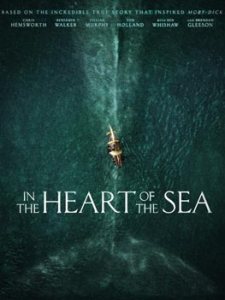 In 1822, the men aboard the Essex, a whaling ship sailing from Nantucket, Massachusetts, encountered a beast unlike any they have ever seen. Captain Pollard (Benjamin Walker) and his first mate, Owen Chase (Chris Hemworth), were at odds throughout the voyage, that is until they encountered a 100-foot long white whale. The creature destroyed the Essex, forcing the crew to drift at sea and hope to find land, but the whale follows them as well. Tom Nickerson (Tom Holland as a young man, Brendan Gleeson as the older version) recounts this traumatic survival tale to author Herman Melville (Ben Whishaw), who is desperate to write this true story.
There’s an old-school throwback vibe to In the Heart of the Sea with its high seas adventure, but there’s just not enough attention to adventure, character, or even plot for this movie to really set sail properly. The first act feels so sluggishly long. It’s trying to set up life on a whaling vessel in the early 19th century but I didn’t feel like we got a coherent sense of life aboard the seas or how the various components worked. I didn’t know that whalers row out from the main ship, so there’s that. The opening act sets up the dull conflict between Chase and Pollard, which can be summarized as blunt upstart vs. unchecked privilege. The conflict doesn’t evolve from this dichotomy. Both men are boring in their unyielding simplicity. Hemsworth (Avengers: Age of Ultron) made a stronger impression in Rush, but a humorless movie role is not in his best interests as an actor. When the action does arrive, it can be genuinely thrilling. Director Ron Howard does a slick job of conveying the danger and destruction of the whale attack. Sadly, it’s over too soon and then the remainder of the movie is 45 minutes of a survival drama adrift in the ocean reminiscent of last year’s Unbroken. This period of isolation forces the characters to make some hard choices, yet we don’t feel the impact of those choices because the narrative, too, feels adrift. Implausibly, the giant whale has followed them for thousands of miles. Are whales really this vindictive? The documentary Blackfish makes me wonder but it still feels unbelievable. What was the whale waiting for? For the men’s spirits to be completely broken before it might attack again? We’re told this whale is a “demon” but who exactly are the bad guys in this story?
 I believe another stopping point for this story is that the culture has moved beyond the acceptance of whaling as an honorable profession, to the point that I, and I assume others, was on Team Whale after witnessing a bloody hunt. It’s pretty gross, especially when they’re harvesting the whale body for the precious oil. Perhaps modern audiences, so far removed from hunting as an essential component of life have become more squeamish, or perhaps modern audiences just recognize something as barbaric when they see it. As a result, it’s hard to root for these guys. When the giant whale attacked it felt like retribution. My sympathies were more for the large mammal than the bipeds on ship. At the end of the film (some spoilers), the white-haired moneyed men of Big Whale Oil are worried what the truth will do to their industry. They want the surviving crewmen of the Essex to deny the existence of this gargantuan whale. This makes little sense to me other than awkwardly forcing a Big Business cover-up for relevancy. First off, whaling seems like a pretty unsafe working environment to begin with, especially considering voyages could last up to three years. Would the reality of one big bad whale destroy an industry? I doubt it since there is such money to be had. If anything it might rejuvenate the timber industry to reinforce the ships to make them more durable against larger whale attacks.
At first I thought a framing device was entirely superfluous; why do we need to watch Melville elicit this tale rather than simply just watching the tale itself? It seemed like a distraction, but as the movie progressed I understood that this framing device was its own sub-story and had its own complexity, namely the older Tom coming clean to the decisions that still haunt his soul. It’s an unburdening for both gentlemen, as Melville admits his deep fear that he is a mediocre writer (he’s no Nathaniel Hawthorne) and that he will be unable to tell this story as well as it truly deserves.
As these two men are allowing themselves to become more vulnerable and sharing their demons and doubts and worst fears, I started to realize that this framing device was weirdly more compelling than all the whale action. That’s because older Tom and Melville are the best drawn characters in the movie, which seems like a screenwriting mistake of sizable proportions. Obviously the nautical survival stuff should be the most compelling, and yet I as more taken with two men sitting by an oil lamp discussing their lives. Older Tom is infinitely more interesting than younger Tom; part of this is because young Tom hasn’t experienced the full effect of the events that shape older Tom, but most of this is from the very clear fact that young Tom is kind of a mute witness in this movie. He rarely speaks and is just kind of there, taking up space. There’s one personal harrowing moment when he’s thrust inside a hollowed out whale carcass to extract more blubber, but that’s the only personal perspective offered through young Tom. A question concerning the framing device: how is older Tom retelling events he had no participation or witness to? Another issue is that the characters on board the Essex are bereft of anything that would allow us to feel for them beyond simple human survival. Chase and Pollard are given one note to play and their eventual understanding and cooperation is fine but it feels like fleeting details in a story, lost to memory or disinterest.
 From a purely technical aspect, this is one of the better Howard films. The cinematography by Anthony Dod Mantle (Slumdog Millionaire) is rich and often breath taking, with plenty of stunning aerial and underwater images. The whale attack sequence is harrowing and thrilling. Howard finds ways to imply the harsher aspects of this life without going overboard, maintaining that PG-13 rating. While the look of the film has an enhanced color palate thanks to the extra boost of CGI filters, I still appreciated the vibrancy of the on screen images. As I said with the similarly boosted Mad Max: Fury Road, I’d rather have vibrant and bright colors than a drab and washed-out color palate. Even as the movie drifts and the characters fail to grab you, at least the visuals are pretty. While sitting through the second half, I started to rethink my own prejudices concerning Howard as a filmmaker, a man who lacks a distinctive style but has a definite feel for how to tell a story. I’m not going to excuse him for The Grinch and other misfires, or his tendency to settle for maudlin in place of subtlety, but the man is a born filmmaker.
In the Heart of the Sea is an old school movie that feels too sluggish, too underdeveloped, and too free of characters for the audience to invest in. When the framing device scores the biggest emotional pull, you better start rethinking your rip-roaring high-seas adventure. Master and Commander this is not. As the inspiration for Moby Dick, I wish I had just watched a remake of Melville’s actual novel (now with extra chapters about rope!). If you ever wanted a movie that ends on a blurb by Nathaniel Hawthorne as a payoff for Melville’s artistic neurosis, then your wait is over. In the Heart of the Sea feels like a whale of a tale that is hard to believe, which ends up inspiring a far greater story, which made me yearn for just watching that superior tale. Sometimes the “truth” behind famous stories is less interesting.
Nate’s Grade: C+
Share this:

The Impossible (2012)
 On December 26, 2004, an underwater earthquake triggered one of the deadliest tsunamis on record, devastating coastal cities along the Indian Ocean. Over 230,000 people are believed to have perished from the waves and resulting damage. The Impossible tells the harrowing and ultimately inspiring true-story of one family and their vacation from hell. We follow Marie (Naomi Watts) and Henry (Ewan McGregor) as well as their three sons, from oldest to youngest, Lucas (Tom Holland), Thomas (Samuel Joslin), and Simon (Oaklee Pendergast). They’re vacationing in Thailand for the holidays and then the tsunami hits, separating Marie and Lucas from the group. They are swept away by the punishing waves and Marie is badly hurt. Henry is desperately searching for his loved ones, Lucas is desperate to get his mother proper medical attention, and there are thousands just as desperate and just as in need.
It’s nigh impossible to watch this movie and be unmoved. It’s not very subtle when it comes to its themes and messages, but man is it ever effective. The family struggle could have easily descended into melodrama with a sappy, maudlin reunion, punctuated with swelling music to hit you over the head. It’s a fairly simple story with little to its plot. The family gets separated and then they desperately search for one another and, surprise, they reunite. It is after all based on a true story and they all lived, so there’s that. It’s the startling level of realism, the exceptional performances, and the poignant moments of human kindness and grace that suckered me in big time. I was an emotional wreck throughout this movie but in the best way possible. I cried at points, sure, but my tears and my emotions always felt genuinely earned. There’s no doubt that this is one manipulative movie. It knows what strings to pull, what buttons to push, and it does so with finesse. Last year I decried Extremely Loud & Incredibly Close for being overly manipulative and overdosing on false sentiment. However, with this movie, my investment was never in jeopardy. I was completely absorbed by the story and felt great empathy for the array of characters as they persevere. The horror of that 2004 tsunami is told in one small story, personalized, and giving an entry point for an audience to engage without feeling overwhelmed by the magnitude of destruction and death.
 Let me go into further detail about that wall of destruction, given astonishing, terrifying realism. The recreation of the tsunami ranks up there as one of the most frightening sequences I’ve ever seen in film. It’s a solid ten minutes of chaos, and you will feel the frenzy of that chaos. You’re put in the middle, floating along with mother and son as they helplessly try and cling to one another. The scope of the disaster will leave you gasping. I know they must have used sets and water tanks but I’m left stupefied how it all came together to look so seamless. It sounds macabre to compliment the marvelous recreation of mayhem, but director Juan Antonio Bayona (The Orphanage) and his team have turned disaster into world-class drama. It’s not just the powerful waves as well, there’s the field of debris just under the surface to contend with. When the first wave hits Maria, we experience her complete disorientation. The sights and sounds are blurs, the water oppressive, and the debris sudden, jolting, unforgiving. It’s the closest any person would ever truly want to get in the middle of a tsunami.
The majority of the film is about the family coming back together, and while their reunion is indeed a tearjerker, I found the film littered with many small moments that just soared emotionally. When a disaster of this magnitude hits, I’m always struck by the wealth of human kindness and cooperation that emerges in response. There’s something deeply moving about helping your fellow man in need, even if you cannot understand his or her language. Maria is aided by the Thai locals who do not treat her differently because she’s a white woman. She is just another person in need.
Whenever disaster strikes, we think of the people who plunge into the middle as heroes, but simple acts can be just as comforting and thoughtful. There are small moments of kindness, like lending a stranger your cell phone to call home, that speak volumes. In that one instance, Henry is so distraught, the weight of everything hitting him as he tries to put it into words, and his call is abrupt and somewhat incomprehensible thanks to his rising emotions. Henry is urged to call back, not to leave it at that, to leave his relatives dangling with such precious little and the alarm in his voice. So he’s given the phone again, and in a more measured demeanor, Henry is able to talk about the situation and promise to find his wife. It’s such an everyday gesture made invaluable to Henry. There’s a woman talking to Thomas about the stars in the sky, how we don’t know which are dead but they continue to live on, and the subtext is a bit obvious but it’s still heartfelt. Then there’s Lucas’ mission of organizing the triage center, scouring the grounds looking for missing family members. He takes it upon himself to make a difference rather than sitting idle. It’s that human connection in the face of adversity that proves most uplifting.
 Watts (J. Edgar) gives a performance of tremendous strength and fragility. The tenacity and resilience she has to keep pushing through is remarkable. She’s so strong but vulnerable at the same time, showing you the fine line she walks to stay above the fray for her child. She endures great physical trauma, a gnarly gash in her leg peeling off like tree bark. Then there’s the emotional burden of trying to be a mother to a child desperately in need of a sturdy parent. Watts could have readily played to the heights of the emotions, resorting to hysterics, but the quiet strength of her character makes her underplay the burdens she endures. She can’t simply just break down. You don’t get a true sense of the toll she has suffered until her life-and-death struggles at the very end.
The supporting team around Watts also deserves accolades. McGregor (Salmon Fishing in the Yemen) has several heartbreaking and heartwarming scenes, striving for hope. Lucas has to rise to maturity when his mother is wounded, protecting her, supporting her. Acting novice Holland rises to that challenge with great courage, though there are moments that still remind you he’s only a boy, like when he bashfully turns his back upon seeing his mother’s exposed breast. That awkward, indecisive moment where a young boy doesn’t know how to handle the sight, seeing his mother so exposed and vulnerable, is quite effective. The other actors who round out the family (Joslin and Pendergast) are quite superb as well. The family feels like a cohesive, loving unit, and every performance feels believable.
The Impossible is based upon the true experiences of a Spanish family, and yet the onscreen family we follow is white, so what gives? It’s not surprising for Hollywood to whitewash a story to appeal to a wider audience. Should we have any more sympathy for this family’s plight because they are white? Would we feel less if they were Spanish? I think the perils and victories would be the same regardless of language or ethnicity.
Watching the unflinching and stunning events in The Impossible, you will likely shed some tears, be they from horror, sadness, or happiness at the family’s reunion. While the ending is never in doubt, the movie has plenty of other potent and poignant small moments to keep your emotions safely stirred. It’s a visceral experience that will shock and exhilarate. There were moments where I felt like I had to cover my eyes. But The Impossible is not disaster porn, ogling over the suffering and endurance of the misfortunate. It’s as much about the response to tragedy as it is the wallop of that cruel tragedy in 2004. The perseverance, the open-hearted help of one’s fellow man, the strength of human connection, the long ripples of kindness, it all comes together to form one compelling, often moving, and quite memorable film experience. Add some formidable performances, top-notch direction, and tremendous technical achievement, and The Impossible is a rousing drama that speaks to the best of us even in the worst conditions (think of it as the antithesis of Ayn Rand’s philosophy). It may be manipulative, it may be somewhat straightforward, and it likely climaxes too soon, but when the results are this powerful and emotionally engaging, then I’m happy to have my buttons pushed.
Nate’s Grade: A-


 nathanzoebl
You must be logged in to post a comment.