Blog Archives
Havoc (2025)/ Novocaine (2025)

Action cinema has long been one of the most satisfying experiences for the always-insatiable moviegoer, being presented with the thrum of kinetic editing, expert choreography, and visceral photography to produce a sensory thrill. Watching a well-developed action sequence is akin to watching a stupendously choreographed dance, where the movement and struggle are part of the storytelling momentum. Two recent action movies show what can be achieved, one through intensity of the familiar and the other through elevating its concept. Both are fairly enjoyable escapes and reminders that, with the right hook or sense of passion, action cinema can be some of the most gleefully transporting sensory experiences.
One of the best genre filmmakers is Gareth Evans, a man who blew the industry away with his intense Indonesian martial arts epics, The Raid and its even better sequel. After watching those movies, and taking time to catch your breath, you have to wonder why Evans isn’t directing every Hollywood action movie, or at least been tapped to try his hand at juicing some studio franchise with his visionary feel for action. It’s still a mystery to me that Evans has only helmed two movies since 2014. Both of them happen to be from Netflix, and while I don’t pretend to understand the creative machinations behind this streaming giant, if I were them I would give Evans a $20-million budget every three years and tell him to do whatever he wants as long as it involves people getting hurt. At first glance, Havoc looks fairly conventional, a crime drama about corrupt cops and hoodlums fighting over who can get to a target first. You have to keep reminding yourself that Havoc is not The Raid and not aspiring to be, so the fact that it cannot rise to that extreme level of action excellence does not mean it is a failure. It’s not in that upper echelon of action cinema, like your John Wicks, but Havoc is most definitely a step above many of Netflix’s junky action-thrillers with A-listers that inevitably disappoint in their flailing execution.
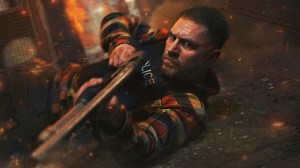
Tom Hardy plays Walker, a veteran cop who works as an enforcer when the money’s right. He’s tired of being a tool to the rich and powerful and looking to get out and be a better family man. You know, the stuff of formulaic action boilerplate. He gets involved in a job gone wrong that leads to a gang war spreading and plenty of hired guns looking to find the son of the mayor (Forest Whitaker). That’s about it as far as the plot. It’s about different groups racing to get what they want first at whatever bloody cost.
Whereas The Raid was a martial arts action extravaganza with professionals at the top of their game getting the platform and material to showcase their amazing skills, Havoc is not that kind of movie; in fact there’s very few moments where the action consists of fisticuffs. This is an action movie built on car chases and mainly gunfights. It’s a cops and robbers kind of action movie, which puts less emphasis on hand-to-hand and more on room clearing. While the accumulated thrills might not be as gratifying as watching professional athletes launch exciting routines, there is still plenty to enjoy when watching finely developed gunfight sequences. The boring approach is simply to convey a shot-reverse shot dynamic: Character A fires a gun, then cuts to Character B being shot or dodging, repeat. Good directors will think about how to better stage a sequence so that each one has its own purpose, its own set of mini-goals, a set of organic complications that keep the conflict roiling, and ways to connect to character. Action sequences should not just be excuses to blow something up. With Havoc, it takes quite a bit to get going, but there are two standout action sequences that make it worthwhile and will satisfy most action aficionados.
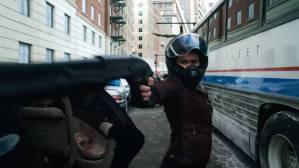
The first sequence is a fight in a club that kicks off the movie’s shift to constant scrambling action. It’s about 50 minutes into the movie and all the respective characters have been slotted into their conflicting positions. We know who the good guys are, the bad guys, the goals in opposition, and what the stakes are, and from there the movie just takes off in a sprint until its final blast. The club involves different levels and different factions fighting and mixing, providing a series of changing complications that makes the sequence feel more lively and engaging. There are several inventive moves to avoid gunfire or reach guns, and the cinematography keeps the action centered and easy to comprehend. The best action sequences are planned like moving puzzles, and the more work that is put into the preparation, the more enjoyable the action can become. This club shootout scene finds numerous ways to keep the stakes upended and to place the characters in new forms of danger they have to quickly adapt to survive.
The second sequence is a climactic confrontation at a cabin in the middle of a snowy forest. It’s a prolonged siege sequence where the bad guys are attempting to break through into this secure location and take out our heroes. From this claustrophobic setting, Evans presents the antagonistic intrusions as unrelenting and coming from all four walls and even below as well. The characters have to constantly be moving and reacting to an assembly of threats while their protective walls begin to literally crumble. It is a literal onslaught. I’m shocked the cabin is still standing by the end. It’s an immensely engaging sequence that communicates the frenzy and anxiety of being under constant attack. The gunplay can be brutal and there are satisfying kills and battles between side characters throughout this sequence to avoid the sequence from feeling too repetitive. It feels in many ways like the whole movie has been leading up to this sequence, not just in a traditional linear-plotting fashion but also the viewer has been waiting for the director to fully go off with a celebration of action mayhem. This is Evans unleashing his best, and he’s adapted his creativity to the setting and the action sub-genre, so there’s different moments meant to present immediate gunfire problems and fast-paced responses. In this world, people aren’t all gifted as expert fighters, and thus even our heroes can falter under the harried circumstances.

Short of these sequences, the rest of Havoc has difficulty breaking free from the gravitational pull of its own genre cliches. Evans wrote the screenplay by himself and I’m surprised how flimsy so much of the story and characters come across. With 2011’s Raid, there wasn’t much of a story once the action stopped, but with 2014’s Raid 2, Evans was able to compose an undercover cop story that was just as compelling even when people weren’t getting kicked in the face. He can write colorful side characters that feel like they stepped out of a Tarantino-favorite grindhouse movie. He can write tense sequences that don’t have to rely upon action. He can do so much more than what Havoc provides, so it’s hard not to feel like this wasn’t exactly a passion project. It feels more like a serviceable vehicle to achieve the kind of action that Evans was looking to achieve. Now, if you’ve underwritten a genre movie because your real interest is staging the action, then you would expect there to be more action, correct? Strangely, Evans spends most of those first fifty minutes setting up his story, the same story that is awash in genre stock roles and cliches without much intrigue beyond a one-sentence description. Simply put, if you’re going to stick us with underdeveloped characters, don’t keep us waiting for the action. There’s so many characters in this movie that I think Evans gets overwhelmed trying to set them all up and involve them in the larger story. If they’re only going to be stock roles, why do we need 30 when 10 can do? I think Evans keeps his cast so big so he can unceremoniously bump off so many of them, which can be surprising, but I would have preferred doing more with the space their absence might have provided the narrative. There’s also an odd stylistic choice where any exterior shots are much more stylized, looking more like video game cut-scenes or something out of the realm of Sin City. It’s at odds with the rest of the film’s stripped-down look.
Havoc is a gritty and bloody action movie that can overwhelm at moments and underwhelm at others. The genre grist is pretty familiar, from our troubled antihero lead trying to atone for his past sins, to the dumb kids in the middle of a gang war they don’t understand, to the good-natured partner who has to grow up, so to speak, by getting their hands dirty. You’ve seen variations of these stories before, but the real draw is once Evans works up enough space to really unleash his invigorating action best. It’s a movie I wish was better but it’s functional enough for Evans to do his extraordinary thing. I just want more of his specialty.
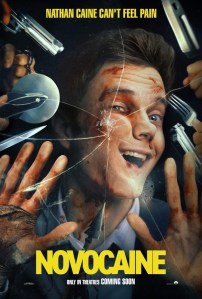
In comparison, Novocaine isn’t going to be defined by stylish choreography or exceptional style. It’s a high-concept action comedy driven by flipping the genre script. Instead of our hero inflicting great pain on his foes, this movie is about a hero enduring amazing amounts of pain. It’s an underdog story where a novice is thrust into an unfamiliar situation and has to utilize his unique disorder, a blessing and a curse, in order to rescue the girl and save the day. It’s a great premise that lends itself to plenty of fun scenarios to fully capitalize on its bizarre potential, and that’s where Novocaine hits a sweet spot of entertainment.
Nate (Jack Quaid) is a shy assistant manager at a small bank in San Diego. He suffers from a unique medical condition where he doesn’t feel the burdens of physical pain. You might think this a luxury but it’s actually a great worry for Nate. Without his body’s alarm system he can stumble into grave danger without even knowing it, so he’s been living an overly cautious life as a result. That all changes when he meets Sherry (Amber Midthunder), a new coworker who takes an interest in him. They go out on a date and really hit it off. Things are looking up for Nate until bank robbers storm his work, kill his boss, and take Sherry hostage. Nate hijacks a cop car and goes chasing after the bandits to rescue Sherry. He’ll undergo lots of trials of pain to win back the girl who makes him feel things.

How do you make a person invulnerable to pain an exciting character? It’s the lingering Superman question, except nobody is going to confuse the character of Nate with Krypton’s orphaned son; if a character cannot feel pain how can we worry over their well-being? Now there’s a reason writers have been able to tell Superman stories for decades, even if the movies often struggle with representing the figure, and that’s because it just forces you to have to think harder. It can be done. With Novocaine, Nate is a hapless naif thrown into an action movie and trying his best to fit in. He lacks physical prowess, weapons training, and tactical planning. However, the only thing he has going for him is his inability to feel physical pain, and the filmmakers routinely find funny and entertaining methods to test how far one could go with this pain threshold. While his body isn’t registering pain he is still taking all the punishment. Nate is nowhere near indestructible, and a running gag becomes how utterly mangled and deformed his hand becomes from event after event (I thought it was just going to be a stump by the end). He takes quite a beating but because of the whole “mind over matter” matter, he’s surprisingly able to persevere where others could not. This allows Nate to become an unexpected hero where the rest of us would pass out from shock. The appeal of the movie isn’t so much the action itself but the ongoing response to all of said action.
The set pieces are what makes this movie so much fun, pushing Naate into action hero mode when he’s clearly awkward and not ready for the promotion. I loved his dry responses to every new injury, from mild annoyance to feigned surprise. There’s a scene where one of the villains is torturing Nate and he has to go along with the charade in order to appease his tormentor and get valuable information out of him. It’s a reverse interrogation where the target is actually trying to manipulate the guy with the pliers. I loved how quickly he could bounce back from whatever trauma, from catching a knife blade first and quickly yanking it out of his hand, to casually writing an address on his hand with a tattoo gun. There is a crafty ingenuity to how the filmmakers can make the best use of this superpower. There are some impressive kills that also made me wince in response, like reaching for a gun at the bottom of a deep fryer, or literally stabbing a person in the face with an exposed arm bone. Novocaine has a delightfully demented sense of humor that keeps everything grounded with mordant laughs even when it’s dishing out the punishment.

Even more surprising, there’s a buoyant love story that genuinely feels sweet that could have benefited from a little more development and attention. Sherry is the one who activates our protagonist and pushes him outside of his comfort zone. He lacks confidence in himself and has been living an overly cautious existence from fear of not being able to respond to his body’s emergencies. The man has been eating his food as liquefied goop out of a fear of choking. She introduces him to the simple joys of eating one’s food before it’s been vigorously blended, like the wonders of pie. Their first date was genuinely charming and I liked the chemistry between both actors. Midthunder has been a favorite of mine since Prey and I want to see her in more varied roles. When the bank robbery commences, I actually had an emotional response to these two being in danger and watching the other being put in danger. Once she becomes a hostage, Sherry is placed as the damsel to be saved, which is disappointing because I liked her contributions to the story and especially what she brought out of Nate. There is a revelation with her later that reorients our understanding of her but I don’t think it was fully necessary. Their budding romance is quite enjoyable and so I wish the story could also continue to develop this connection over its wild series of mishaps.
Novocaine is a great example of a movie that maximizes its unique premise to stand out. It’s structured like a traditional action-thriller but it never takes itself seriously, pushing forward a stumbling protagonist whose real gift is that he’s the human equivalent of a punching bag. This dynamic is ingeniously developed and showcased, and just when I was worrying the premise might get old or become repetitive, the filmmakers find new ways to twist their story into even better twisted results. I wish the female supporting role was more tied into the action and fun, and the villains are a bland blend of overly confident paramilitary goons. Still, the fun comes from Quaid and his light-footed screwball performance anchoring the bloody hi-jinks and demented humor. Novocaine is a fresh reworking of action movie tropes with a twist that allows the audience to heartily laugh at our hero’s pain and pratfalls. It’s the kind of humor and energy that reminds me of the Crank filmmakers. If you’re looking for a winning dark comedy bouncing against the formulas of action movies of old, settle in for some Novocaine and enjoy the pain.
Nate’s Grades:
Havoc: B-
Novocaine: B+
Share this:

The Bikeriders (2024)
 For a four-year period, writer/director Jeff Nichols is a filmmaker who appeared on my Best of the Year list three years, including making my top movie of 2011, Take Shelter. He’s a filmmaker I highly prize, so an eight-year gap from Nichols is an extended leave that makes me personally sad, though his latest movie, The Bikeriders, was delayed by a year after Disney decided to sell it rather than release it for the 2023 awards season. It’s a pretty straightforward drama about a Chicago motorcycle club in the 1960s. It’s all about a group of men that really don’t know how to express their feelings, so it comes out as drinking and fighting and general rebellion against outside authority. These social outsiders find kinship under the leadership of Johnny (Tom Hardy), an unstable man with his own code of honor and retribution. Our narrator is Kathy (Jodie Comer), a plucky woman who falls for a reckless biker, Benny (Austin Butler). There are plenty of interesting moments and sequences, like the rejection of wannabe new members too eager for approval for institutional violence. The changes the club undergoes through the mid 1970s are interesting, especially as the rules of the club begin to fray with the influx of new members and drug addictions, and the challenges to leadership we know will eventually end in tragedy and a betrayal of what the club was intended to be. Regardless, it feels like the movie has all the authentic texture and period details right but is missing a stronger sense of story. It’s more a collage of moments that doesn’t add up to a much better understanding of the three main characters. It’s more like a mood mosaic than engrossing drama, so if you have a general interest in retro motorcycle culture or the time periods, then maybe it will cover the absences in character. I found The Bikeriders to be a good-looking coffee-table book of a movie, more recreation than investment.
Nate’s Grade: B-
Share this:

Venom: Let There Be Carnage (2021)
 Whatever feelings you may have had for 2018’s Venom, I imagine they will only be magnified with the sequel, Let There Be Carnage, where it appears that the filmmakers took the goofy, campy elements from the original and magnified them exponentially. This is a silly, dumb movie that seems almost too aware of its existence as a silly, dumb movie; it reminded me of what a Roger Corman movie might feel like as a modern-day superhero blockbuster. This movie is ridiculous, and that will either be its major selling point of its point of condemnation. I was not a fan of the 2018 predecessor but I found myself enjoying the goofier aspects of Tom Hardy’s performance as journalist Eddie Brock after he shares his body with an alien symbiotic goo. This time we have a second alien symbiotic goo, which is actually what the villain of the first movie was, but this time it’s red and extra trendril-y! The appeal for any viewer is going to be the bonkers buddy film at its core, Eddie Brock and his living id personified as the Venom alien that keeps asking to be allowed to eat people. The movie is almost sitcom-level in it’s portrayal of the two butting heads and going their separate ways to prove they don’t need the other only to learn they were really meant to be. There are some comedic moments that just keep doubling down on silly jokes at the expense of everything else, like the “Not you, Father, you, father” bit that actually made me laugh out loud. Under the guise of actor-turned-director Andy Serkis (Mowgli), the movie is simply a broad cartoon that manages to walk a line between good-bad and laughably bad. It doesn’t always keep that balance but it’s sure entertaining to watch its goofball energy and it’s only a merciful 90 minutes long (almost one half of Eternals). I can’t really tell if everyone attached to the movie is trying hard or really just goofing off on the company’s dime. Regardless, if you were not a fan of Venom before, this movie won’t convince you there’s a compelling character or universe here. Michelle Williams (Manchester by the Sea) is pitifully wasted as Eddie’s ex-girlfriend. The accents are terrible all around. The new villain is a scenery-chewing serial killing dullard and then transforms into a goop monster. The love story with Woody Harrelson (Zombieland) and Naomie Harris (Moonlight) made me think if someone combined Natural Born Killers with X-Men but short-changed us on both counts. What works in this movie is what worked for me in the previous film, but now all elements feel more in alignment with the goofy energy of star-producer-and-credited-“story by”-writer Hardy. I don’t know if this franchise will ever qualify as traditionally good no matter how successful it proves to be. Maybe what the people really want is a screwball comedy with Hardy mugging alongside a wise-cracking, homicidal alien goo suit. Bon appetite, fans of expensive trash.
Nate’s Grade: C
Share this:

Capone (2020)
 In 2012, after the found footage superhero movie Chronicle became a surprise smash, director Josh Trank was at the top of Hollywood’s hot new director list. Within three years, he was a pariah. The production behind 2015’s Fantastic Four was so troubled and fraught with reshoots, creative clashes, and secret edits that Trank was labeled as a malcontent who couldn’t be trusted with the big tentpoles. He was unceremoniously dumped by Star Wars and seemed to become the latest casualty of an industry that eats its own promising wunderkinds. I’d highly advise people read a very illuminating in-depth article from Polygon on Trank’s troubles and triumphs, including his insights on where Fantastic Four went awry. Trank spent years honing his next script, an Al Capone biopic of his late years, and waiting for star Tom Hardy to be available. Some critics have called Trank’s comeback movie a self-indulgent, surreal, campy mess, and indeed while I was watching I had visions of Mommie Dearest. However, that wasn’t a bad thing, at least for me. I cannot call Capone an unqualified success but I appreciated the bizarre lengths Trank goes to make a biopic that mocks and tears away the mystique of its macho idol.
Capone (Hardy), or “Fonze” as he’s referred to primarily, has been released from his prison sentence for tax evasion and living the rest of his days on his Florida estate. He’s suffering dementia from the effects of neurosyphilis, a condition he contracted as a teenager. His wife, Mae (Linda Cardellini), tries her best to keep him from harming himself or others. The F.B.I. is still listening, still watching, and newspaper reporters are still hiding along the bushes. Capone struggles to keep his mind from being completely lost but will lose, dying at age 47.
 First off, I think Trank’s initial creative approach is a genius way to explore a biographical film, running through the major points of a subject’s life in a hallucinatory, non-linear fashion that mixes fantasy and reality. From that standpoint alone, Capone is never boring because it can quite literally go anywhere as Capone retreats further and further into his fraying mind. That’s such a visually stimulating way of telling a story while also presenting a chaotic impression of a character’s perception, locking us into an empathetic experience with an unreliable guidepost. I think that alone makes Capone worthwhile, as does Hardy’s go-for-broke performance (more on that later). It’s a weird fever dream of a movie, constantly shifting between past and present, fantasy and reality, and I think this perspective adds much to the film’s appeal and ambition. One second the man is sitting down with FBI agents and the next he’s wandering a ballroom to go onstage with Louis Armstrong for a New Year’s Eve duet. It gets pretty crazy and that’s good.
I was wondering if Trank would glorify his title subject. I only had to wait for the first twenty minutes where Al Capone literally craps himself twice for my answer. This is not Capone at the height of his fearsome power where he ruled the Chicago ganglands; this is a decrepit, doddering middle-aged man, equally helpless and reckless, unable or unwilling to even control his bowels. He is rotten from the inside out, a vile human being whose own filth is leaking out to smother him. Gangster cinema has often glamorized the mafia and criminals as unorthodox folk heroes, like in 1967’s Bonnie and Clyde and the more recent Public Enemies in 2009. So, with all of that said, I enjoyed that Trank took a legendary figure of the criminal underworld and totally undercut his machismo power. He strips away the romantic notions of the man’s life. This isn’t the man on the pulpy radio dramas, this is a guy who craps the bed. Martin Scorsese’s The Irishman got plenty of acclaim for spending its final half-hour showing where a lifetime of crime leads its elderly protagonist, a sad, lonely life without any lasting personal benefit. Trank takes that much-heralded final half-hour and turns it into an entire 100-minute movie. I wish more movies would do this to deserving subjects.
 The biggest draw of the film is Hardy (Venom, The Revenant) who never met a film role he couldn’t grumble, mumble, growl, or unleash a funny voice for. To say he is committed does not to do the man justice. He is not only chewing scenery; he is rapidly inhaling it. He is playing to the cheap seats with this role, bloodshot eyes bulging out of his head with thousand-yard stares of confusion and paranoia. He’s barely intelligible at times, and that’s before he has a stroke that further impairs his ability to communicate. He can also be hard to recognize under layers of pock-faced makeup. The acting-with-a-capital-A style is so enthralling but perhaps not for the exact intended reasons. It’s fascinating to watch a highly respected, Academy Award-nominated actor just indulge every over-the-top impulse and tic, where each small decision feels like generating the question, “Really, you went with that choice?” The batty performance brought to mind Faye Dunaway’s breathtaking performance in 1981’s so-bad-it’s-good Mommie Dearest as Joan Crawford (she thought she was going to in awards for that performance!). It’s a level of camp with no earthly reservation, and it’s rare to see from such a famous actor, and I was spellbound. If you enjoyed Mommie Dearest for its unintentional camp hilarity, then Capone might be just for you.
While at turns confounding and fascinating, Capone falls short when it comes to examining the inner life of its title character. I assumed with the conceit of losing touch with reality that Capone would be experiencing some reckoning over his past misdeeds, and this happens to a very mild, opaque degree. There are some supporting characters that turn out to be, surprise, ghosts that Capone had killed in his past. But they stop there, failing to provide an opportunity for Capone to feel remorse and they don’t even push him on being guilty. You would think a man with a sizeable list of dead people he’s responsible for would be haunted by more ghosts from the past, forcing him to reconcile his idea of himself with his tortured deeds. Capone is also seeing images of a young boy that is meant to represent his poor youthful upbringing, but he doesn’t interact with this past representation other than look uncomfortable in his presence. The movie desperately needed more introspection with this man examining his sins and legacy and validations. A bad man coming to terms with the end and what it means has great dramatic potential. A bad man who bumbles around his luxurious home, sees some ghosts, and continues bumbling has less so. That’s where Trank’s screenplay really falters because it doesn’t push harder. Capone is too caught up in upending the image of Al Capone rather than digging deeper into the man himself and his inherent end-of-life drama.
 The supporting characters also do little to offer alternative sides to better know Capone. His long-suffering wife is nicely played by Cardellini (Green Book), brought to tears watching her strong man waste away, calling her an angel one minute and forgetting her face the next, but we don’t learn more about the central figure through her. He started poor. Got power. Now he’s incompetent (and incontinent). That’s it. There’s room for more here than a man physically and mentally falling apart. What about the other people in his life? What about plans for succession from those who spent their lives in his service? There’s even a storyline of a lovechild trying to get in contact with him and the movie miraculously does nothing with this abandoned son to add further dimension and insight.
I would be lying if I said I wasn’t laughing throughout Capone, though I think Trank is intending some degree of mockery with his biopic that plumbs the depths of the strange and grotesque. There’s a guy who gets stabbed in the neck maybe 50 literal times. There’s Capone shooting alligators, convinced they’re conspiring to munch on his testicles. There’s Capone applauding and singing along to The Wizard of Oz and arguing for the sake of the Cowardly Lion. There’s an ongoing subplot about different supporting characters trying to somehow sift the location of Capone’s hidden millions from his broken mind like a treasure hunt. There’s an entire sequence where Capone, with carrot-as-cigar in mouth, marches around firing a golden Tommy gun while his saggy adult diaper droops around his waistline. In short, there’s more than enough material here to enjoy on a strictly ridiculous, pulpy, heightened to the point of breaking campy variety. Hardy is fully unrestrained, for better and worse, but he’s always watchable, as I would say of the film itself. Even if it feels ultimately superficial and underdeveloped, Trank’s Capone is a mess of bad taste about a bad man going through some bad times and it just might be the good kind of bad.
Nate’s Grade: C+
Share this:

Venom (2018)
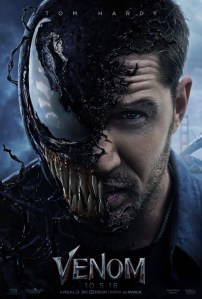 Sony does not have a sterling track record of late when it comes to their superheroes. After the dismal response to 2014’s Amazing Spider-Man 2, Sony reached out to the creative team at the Marvel Cinematic Universe (MCU) to better guide their flagship property. A solution was worked out wherein the MCU would essentially make a Spider-Man movie and borrow the character for their own films and Sony would reap the profits, and it worked wonderfully with 2017’s Spider-Man: Homecoming. Now Sony seems to be falling into a similar trap, getting ahead of themselves with an itch to build a larger superhero universe of properties. Venom is a fan favorite Spider-Man villain, so to give the guy his own movie even without Spider-Man is already a risk. The ensuing Venom solo film is a big gooey mess of a movie that needed to decide whether it was going to be scary, funny, goofy, serious, PG-13 or R-rated, or good or bad.
Eddie Brock (Tom Hardy) is an investigative reporter who has relocated from New York to San Francisco. He’s got a cushy job, a loving fiancé (Michelle Williams), and he loses it all thanks to his ego and drive to uncover the secret experiments of a wealthy Elon Musk-esque business magnate, Carlton Drake (Riz Ahmed). Then Eddie discovers the secret of Drake’s lab, an alien symbiotic substance that crashed on Earth. It bonds with Eddie and appears in his head as a guttural voice egging him into bad behavior and the hopeful munching of heads and bodily organs. Eddie must learn to work with his new partner to thwart Drake and another alien symbiote with plans for world domination.
 Venom struggles to separate itself from the plethora of superhero films out there and forge an identity of its own, unfortunately without Spider-Man and the larger Marvel world. It’s even in the tagline: “The world has enough superheroes.” If this is the anti-superhero movie it can’t pull that far apart. The set-up was there for something potentially different. Venom could have been the villain instead of merely an anti-hero, with Eddie Brock wrestling with his inner demons in a way that evoked the classic tortured duality of Jekyll and Hyde. I think that approach certainly would have brought out more from director Ruben Fleischer (Zombieland, Gangster Squad). Instead the filmmakers assert that their goo-laden superhero is a bit edgier, a bit looser with the ethics of justifiable homicide when it comes to snacks, and to make it certain they employ a clear-cut villain who has even less compunctions so as to make Venom look better in comparison. This is a pretty lazy anti-hero archetype that follows the superhero formula to the core. If the Venom symbiosis was presenting problems in Eddie’s life, or presented a lethal force that tempted him to the dark side that needed to be tamed or at least withheld, that would be one thing, but it’s the same-old tool for empowerment. Thanks to the Venom alien, Eddie is able to stand up to bad guys he shrunk from before. Thanks to the Venom alien, Eddie is able to be a better reporter and reactive citizen. Hooray. For a movie that advertised there were too many superheroes, they just flatly rolled out another.
The major problem with Venom is that nobody seems to be on the same page as to what kind of movie they are making. Firstly, Tom Hardy seems to think he’s making his own version of Jim Carrey’s The Mask, hamming it up to great comic effect, stuttering and sloshing his way from scene to scene. This movie would be vastly less interesting if it was not for Hardy and his committed performance of borderline Nicolas Cage-style nuttiness. The film became that much more entertaining once Venom and Eddie were bonded and Hardy had to reconcile the back-and-forth in his head and in public. There are moments that I’m almost convinced the movie is asking its audience to laugh at it and Hardy rather than with it, like when he takes a dip into a lobster tank to cool off. It made me think of All of Me but with an alien parasite. The buddy comedy aspect and interaction was a highlight. The movie is better when it either embraces its goofy elements or at least pretends not to be as serious. The serious version of this movie seems to infect most of the supporting players, notably Williams and Ahmed. Poor Michelle Williams (Manchester by the Sea) is another underrated love interest, and in the one scene where she does have agency and power, she immediately gives it back over to Eddie. Ahmed (Rogue One) just looks lost, going from overblown monologue to confusing monologue, making it hard to grasp what his motivations are from scene to scene. Is it space exploration, conquering, or saving the Earth? There’s a part at the end confrontation where Ahmed and Hardy are literally fighting one-on-one and it’s hilariously mismatched. There’s no way a tiny guy like Ahmed would be able to contend with Hardy in a fistfight. That’s the more unbelievable moment yet.
 The story has many shortcomings and logical constraints that exist for sloppy stalling purposes. Take for instance the opening scene where a U.S. space shuttle crashes back to Earth and lands in Malaysia (have the people of Malaysia suffered enough downed aircraft?). One of the four alien symbiotes escapes and latches onto an EMT worker, taking control of her body. We then flash forward six months and Drake’s company is testing the symbiotes and having poor results, losing all but one that bonds with Eddie Brock. Why even have four of these things? Why have two to eventually die off-screen when one would do? But really why have any of this setup? The Bad Guy Symbiote is effectively stranded in Malaysia for six months until it figures out that little white girls are the ticket to slipping past airport security guards (and I guess stupid secret lab guards as well). Why not have the breakaway symbiote be the Venom one? Why even have the means of their arrival crash in Malaysia if they’re all just winding up in San Francisco anyway? The only logical answer is the filmmakers wanted the Big Bad sidelined long enough to set up more plot, but it’s so sloppy. The same can be said about how Eddie eventually ends up face-to-face with his special symbiote. Jenny Slate’s (Gifted) scientist character is to sneak Eddie into the lab, without her supervision of where to specifically go, and for him to… take pictures of the suffering test patients? Why does she need an intermediary to take pictures? Why can’t she do this and then submit them to Eddie? If she fears that the tests are as dangerous, why does she let Eddie stumble around? When the bad guys initially give chase they use flying drones as their killer weapons. I figured they would use these aerial machines to fire at Eddie as he speeds away on his motorcycle, but no, instead they use them as kamikaze bombs. How is that effective? Why do the good people of San Francisco seem to shrug at a series of bombs going off around their city? This is pretty much the definition of modern terrorism. How about when the Venom symbiote goo is separated from Eddie and he’s taken away, and the symbiote has to escape from a hospital and it has a choice of small dog or human being as its escape vehicle… and it chooses the small yappy dog. The movie is littered with these kinds of head-scratchers and leaves the overwhelming impression that much of this story and ensuing production was thrown together in the most haphazard fashion.
The action and special effects are also pretty messy and lackluster. The Venom alien goop just looks like Hardy is constantly dripping black paint. The effects do not look drastically improved from when we first caught glimpse of a big screen Venom in 2007’s Spider-Man 3 (though no candy corn fangs). There’s a lengthy attack sequence between Venom and an entire squad of SWAT officers that takes place in the haze of a teargas cloud. It’s meant to evoke a sense of horror as Venom pops up randomly, except it just makes everything too chaotic to maintain interest. Too many sequences take place at night to obfuscate the special effects work. The final act is the worst part as Venom faces down another symbiotic goo-monster, and it ends up being a clash between a black-skinned goo monster and a grey-skinned goo monster outdoors at night with quick camera edits. Good luck trying to comprehend what is happening on the screen. It’s such a bleh villain as well, just a bigger slightly more evil version of Venom, and its world-dominating plan involve bringing the other symbiotes to Earth, which will take, by my calculations, at least a few decades, at best, of space travel time. It’s one last noisy, dumb moment in a movie filled with loud and dumb moments to pass the time.
 I still can’t find a straight answer whether Venom was initially filmed as a PG-13 film or as an R-rated movie and re-edited into a safer, more commercial PG-13 form. In its current incarnation, I don’t think an R-rating would have added much more to it, but that’s because the film doesn’t feel like it was conceived as an R-rated property. That’s a shame considering it features an alien creature that eats people’s heads. There is one scene where Venom eats a mugger’s head and the next scene he reverts back to Eddie Brock, and we see Eddie leave the shop in clear sight. The dead body of his headless victim is curiously missing even though it should be in full view. What happened? Also, what happens to the shop owner who is now witness to this traumatic event? Are the police or insurance agents going to believe her tale about an alien monster biting the head off a man whose body was left in her business? Is anyone going to want to shop there again once word spreads that a guy had his head removed? The Venom movie we get doesn’t earn this scene and it doesn’t get to wave away the scrutiny it invites.
Venom is a mediocre superhero movie that doesn’t know what it wants to be. It says it doesn’t want to be a superhero film, but it falls under the same plot trappings. It seems like it’s a silly comedy, but then it asks you to take it seriously. It seems like a serious action thriller, but then it has a goo-covered anti-hero say, without a hint of irony, that it’s “time to save the world.” Then there’s the painfully on-the-nose post-credits scene meant to bait the audience into interest in future sequels (stop doing this, Hollywood). This is a sloppy movie on all levels. The saving grace is Hardy’s dedicated, ridiculous, tic-heavy performance, which at least smoothed over the rough patches at various points for my enjoyment. Otherwise, the best part of the Venom movie is a three-minute clip for the animated Spider-Man movie Sony is scheduled to release in December. Those delightful three minutes are better than anything else Venom has to offer in its slapdash, goo-filled tonal mishmash. Check out the underrated genre gem Upgrade instead, the superior Venom.
Nate’s Grade: C-
Share this:

Dunkirk (2017)
 Christopher Nolan is one of the rare filmmakers in the world that can do anything he wants. He’s reached a level of critical and commercial success that he has earned the leeway to tell the stories he wants with a blank check. Apparently he’s been eager to tell the big screen story of Dunkirk, the mass evacuation of 400,000 Allied troops on a French beach in World War II, and it would be the first film of his career to not have a crime or science fiction slant. If this is what he has to turn into in order for mainstream Oscar attention then please go back to making your sci-fi puzzle boxes, Mr. Nolan, and let someone else make the underwhelming WWII epics. Don’t believe the effusive praise from critics saying this is Nolan’s masterpiece or the finest of his career. Dunkirk is Nolan’s least engaging film and maybe even the least ambitious of his otherwise storied Hollywood career.
Dunkirk is less of a cohesive movie and more a series of moments, never eclipsing the next or coalescing into a larger, more meaningful, more satisfying whole. We keep cutting from primarily three perspectives (air, sea, land) but it fails to feel more than a check-in before moving onto the next vantage point. It’s a shame because the opening ten minutes launch you immediately into this world of danger and Nolan sets up the different perspectives with effective visual clarity. I thought it was a great moment having the soldiers collect the fluttering propaganda fliers meant to remind them about how the enemy surround them. The initial burst of violence is visceral and unnerving. The burial of a soldier in the sand is a somber moment. Things were getting good, and then I kept waiting for the movie to escalate, to hit a new gear, and it never came. Instead it repeated the same plotting that just forced the bland characters from one curtailed escape to another. Screenwriting is about setups and payoffs, and that is strangely absent throughout Dunkirk. Bad things just kind of happen, and then they happen again, and then you tune out. That’s even before Nolan throws in needless non-linear elements that I was ignorant about. Dunkirk is Nolan’s first film under two hours since 2002’s Insomnia, and yet it could still stand to lose even more. After a while, your mind drifts when all you’re watching is poorly written characters, many of whom you can’t identify, jump from one crummy situation to another without a stronger storytelling drive. If you want a more personally involving retelling of the heroes of Dunkirk, just watch the film-within-a-film of the underrated 2017 gem, Their Finest.
 The miracle of the Dunkirk evacuation is really lost in this film. Without a more involving story, it’s hard to get a sense about the personal sacrifices and risks of the evacuation. The scope feels mishandled. We’re told that 400,000 men were rescued but I did not get any sense of that scale. We’re stuck to a small corner of a beach, or a small section of the sky and sea, for the far majority of the film, which again traps the film at a lower register. We don’t adequately sense the monumental scale of what is at stake. The embodiment of the threat is condensed down to a single German fighter plane that Tom Hardy has to chase for half the movie. It’s like this guy is the freaking Red Baron. Another aspect that exacerbates this issue is Nolan’s haphazard command of screen geography. When the camera is inside the various ships, your sense of space is uncertain. When things go bad, it just all feels like a mess, with no clear indication of where the characters are, their proximity to others, or even the interior design of the ships. Without a coherent sense of geography, the action and suspense is going to be inherently limited. Nolan locks into a claustrophobic sensation at the expense of audience clarity, and without better-developed action and interesting characters, it’s a decision of diminishing returns.
The characters are so indistinct that most of them in the end credits didn’t even merit names (Irate Soldier, Shivering Soldier, and Furious Soldier are among the lot). This is one of the biggest mistakes of Nolan’s movie. By not providing characters that an audience can engage with he’s handicapped how much an audience can care. We don’t learn about any of the main characters we follow, with the slight exception of Mark Rylance’s even-keeled seafaring father. I challenge audience members to even remember a who’s who of the young men because I don’t think I’d be able to identify them in a lineup. I was still trying to recall which of them may have died. I haven’t had this much trouble keeping people straight in a war film since Terrence Malick’s The Thin Red Line. With Dunkirk, there are faces we follow really more than characters. The most recognizable is Tom Hardy and that’s because he’s Tom Hardy and not because of anything related to his character. Kenneth Branagh’s character just seems to be here to stare off into the distance with awe and say something about “seeing home.” It’s as if Nolan had no interest in telling a war story from a human perspective, which is a vastly strange approach considering the large-scale human cost.
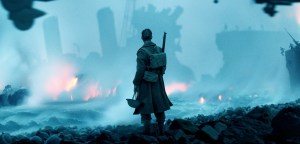 Nolan is a smart filmmaker. He has to know these characters are thinly sketched ciphers at best, so the question becomes why is Nolan choosing to make Dunkirk this way. If I had to hazard a guess I think Nolan was trying to accomplish a visceral, immersive war experience to echo the hopelessness and confusion of those men in jeopardy. They’re meant to be faceless everymen. This would explain why it feels more like a series of moments, of jumping from one failed escape to another and one fraught encounter to another. Nolan does a fine job of introducing conflict (in a wartime setting this also shouldn’t be too hard) but without more distinction he runs the serious risk of everything feeling like more of the same. At the end, thousands of soldiers are ferried back to England and congratulated. One of them is incredulous, not feeling like retreating is worth the fuss. “We just survived,” he says. “Well that’s good enough,” the other says. It’s like Nolan intended to place the audience into a crucible where just getting out was enough to satisfy demands. I don’t think it is.
From a technical standpoint, Dunkirk is often breathtaking, no more so than in its mesmerizing sound design. Nolan uses brilliant sound tacticians to heighten your senses and build a sense of dread. An oncoming fighter plane tearing through the sky can raise the hair on the back of your neck. The sound does the heavy lifting when it comes to creating tension. The score by Hans Zimmer is very effective in that regard as well. Its central musical element sounds literally like a ticking clock, which instantly heightens any scene. Granted adding a ticking clock sound against anything would make it more fraught (you’ll never fill out boring paperwork the same way again). Visually, the aerial photography is gorgeous with the IMAX cameras able to take in such startling depths. Cinematographer Hoyte Van Hoytema (Interstellar) has some beautiful visual compositions, especially as different boats capsize and the water rushes in at odd angles. This is a film that has commendable technical achievements. It’s Nolan who lets down his team.
War movies often run the risk of being overly reliant upon broad themes of heroism, nationalism, patriotism, sacrifice, and such, which can be in replacement of a strong narrative and well developed, interesting characters. War is a film genre like any other, and there are inherent genre shortcuts that can be abused. However, it’s like any other genre in that, regardless of the setting or situation, you are expected to tell an interesting story with characters the audience cares about. Nolan sacrifices all for the immersion in his war experience machine, providing listless, interchangeable characters and a story that amounts to a collection of harrowing moments but not a movie. My pal Joe Marino chided the movie as akin to visiting a planetarium, sitting back, and taking in the wonderful visual spectacle but walking away unmoved. It’s like Nolan has created the Dunkirk Experience: The Ride instead of an actual worthwhile story.
Nate’s Grade: C+
Share this:

The Revenant (2015)
 Which do you value more, verisimilitude or narrative? If you’re looking for an intense, immersive filmgoing experience that’s just as harrowing as it is beautiful, then perhaps The Revenant is your movie. If you are looking for characters and a story to engage with, then maybe it won’t be. Leonardo DiCaprio plays the real-life frontiersman Hugh Glass who was mauled by a bear and left for dead by his companions. He miraculously survives and tracks down those who betrayed him for some frontier justice Under the unyielding vision of director Alejandro Gonzalez Innarito (Birdman), the movie opens up its scary world with an exhilarating sense of detail. Inarritu favors lots of natural light and long, gorgeous tracking shots, which creates a spellbinding sense of realism. The attacks and escapes and moment-to-moment survival communicate the remarkable dangers of this natural world. The cinematography by Emmanuel Lubezki is flawless, using light and camera placement to stunning effect. However, The Revenant (meaning a person who has come back from the dead) is a series of beautifully rendered moments delicately stretched over a ponderous running time of 157 minutes. There’s just not enough plot events to fill that running time, so to compensate Inarritu gives way to some Terrence Malick (Tree of Life) impulses that try for philosophical poetry but miss. DiCaprio is getting plenty of plaudits for his demanding role, and he’s quite good and visceral (and no, he does not get raped by a bear). I was more impressed with Tom Hardy, who plays the target of Glass’ fury. Hardy imbues depth into his antagonist, and while you won’t exactly be rooting for him to get away you can see the guy as more pragmatist than mustache-twirling rogue. He even has an interesting back-story surviving being scalped that informs his decision-making. Much of the film is watching Glass endure physical hardship after physical hardship, which may grow wearying for many audience members, especially those most squeamish. When it’s firing, The Revenant is a magnificent and stunningly realized survival thriller with sprinkles of engaging human drama. The problem is that there isn’t enough to go around for its running time.
Nate’s Grade: B
Share this:

Mad Max: Fury Road (2015)
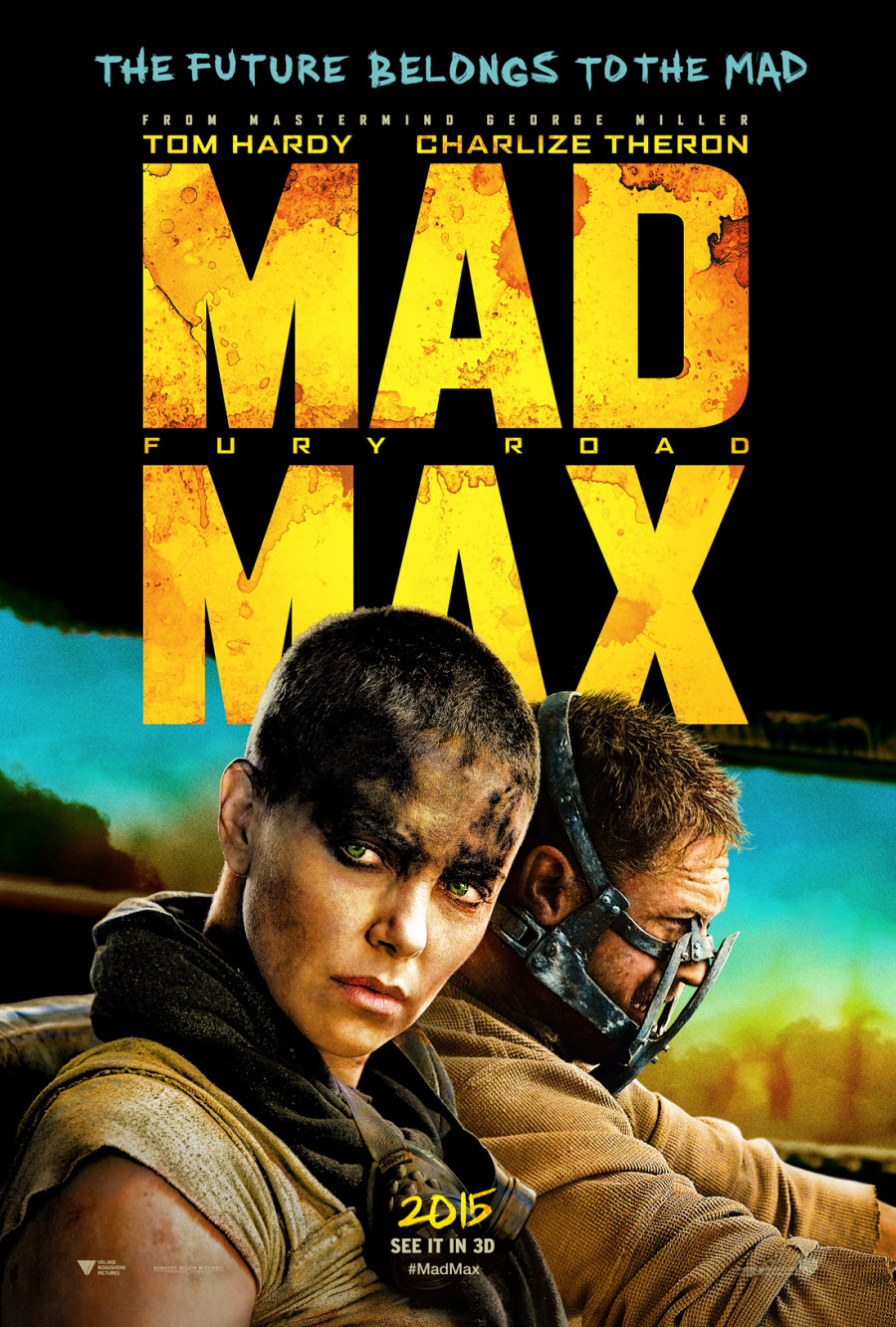 Allow me to begin with a confession. I had to see Mad Max: Fury Road again. I knew minutes into the film that my appetite would not be quenched and I needed to see it again, which I did less than 12 hours later. A week later I saw it a third time in the theater. The reason I did this is obvious in one regard – it’s a highly enjoyable, pulse-pounding, amazing spectacle of first-class stuntwork and mad genius so rarely accomplished on such a large, splendid scale of destruction. The other reason, from a writing standpoint, is that I needed to see the movie again or else my review of Fury Road was going to consist of nothing but an unending stream of positive adjectives vomited upon the page in excitement. And for you, dear reader, I wanted to do better. Also, I wanted to see Mad Max: Fury Road again and I honestly wouldn’t mind in the slightest seeing it again.
In the post-apocalyptic future, Immortan Joe (Hugh Keays-Byrne) is an aging warlord with his own fiefdom. He controls the water supply and has an army of gearhead warriors to enforce his rule. His trusted driver, Imperator Furiosa (Charlize Theron), is leading a caravan for supplies when she goes rogue, driving off into the desert. Furiosa has taken Immortan Joe’s “property,” namely his five wives. Enraged, Immortan Joe gathers a posse of death vehicles and riders and heads off to reclaim his “property.” Max (Tom Hardy) is a drifter thrust into the middle of this conflict when he’s strapped to a car and driven out into the desert, part of the Immortan Joe rapid response forces.
 There are few things more exhilarating in the realm of motion pictures than a well-executed, well-developed action sequence, and Mad Max: Fury Road is a blistering, awe-inspiring masterpiece of brilliant carnage. What director George Miller has achieved onscreen is visionary. The level of execution is so rarely seen at such a large scale, and with so many moving parts, that I was delighted and curious how something this extraordinary could escape the risk-averse studio system. I’m trying my best to restrain myself from sheer hyperbole, but this is an instant classic in the world of action cinema and a definite top five all-time action film (for those keeping track, I would say last year’s Raid sequel would also qualify for that status). The movie provided me a font of joy that did not let up until the end credits ushered me out of the theater. The action sequences are epic in their scale, with dozens of different vehicles in hot pursuit, and yet Miller brilliantly orients his audience to every moment of his symphony of demolition. There are so many different parts to the action but the audience knows everything that happens. The sheer sense of momentum and pacing is overwhelming and giddy. The action sequences develop organically, with new consequences throwing our characters into different and dire directions. There’s also a startling amount of variety with the action sequences. Fury Road has been described as a two-hour chase film, and that’s accurate to a degree, but there are breaks in between the sequences, small moments to catch your breath and learn more about our characters and their hostile world. Each sequence is different enough that the action doesn’t ever feel redundant, even when the third act literally requires the characters to backtrack. The adrenaline just doesn’t turn off from the get-go, and Miller keeps throwing out new tricks, new stunts, and new cars to astound and amaze. Simply put, Fury Road shames other American film releases.
The stuntwork is another facet that just raises the bar when it comes to action movies. Miller emphasized practical effects whenever possible, and the emphasis pay off with a heightened sense of realism onscreen. It’s real cars being smashed to real bits, real stuntmen being tossed around. In an age of CGI over saturation, it’s all too easy to become numb to big screen spectacle because of how hollow it all comes across visually. Just this past month with the Avengers sequel, I knew that all the fight scenes were mostly CGI or actors against green screens, and it eases off the enjoyment of the moment. Don’t even get me started on the deluge of CGI carnage in the last Hobbit film. Real physical objects and physical interaction offer so much more believability in an age of increasing disbelief with special effects. With Miller’s focus on practical effects first and foremost, it brings that sense of crazy excitement back and it ensures that Fury Road will hold up better over time.
 I also appreciated just how much thought Miller and his team put into crafting their world. Every detail feels like it adds to the overall richness of Miller’s vision. The designs of the cars, the use of scrap, the fact that a pulley system is operated with children running up giant wheels, it all contributes to making the world better realized and more alive. The level of thought put into weird and deadly concepts in this movie is fantastic. Once the main characters pass through a bog of land, we see people dressed in cloaks traversing the land on stilts, and it’s little passing details such as this that make the movie feel more complete. I enjoyed that one of Max’s heroic attributes is that he’s specified for his blood type, being O the universal donor. The fact that Miller finds a satisfying way to bring this attribute back as a payoff is also appreciated. I also enjoyed how Miller expands upon the family of Immortan Joe, with his bevy of freakish sons and brothers and peculiarities. I enjoyed the fact that Miller isn’t afraid to embrace the weird of his dystopia, symbolized best by a blind guitar player attached to a roaming wall of speakers who can shoot flames out of his instrument. Every time the movie cut back to this guitar playing pace setter, I smiled, and I smiled a lot during this movie.
Some have grumbled that Max is a supporting player in a movie that bears his name, but I would argue he is a co-lead and the real star is rightfully Imperator Furiosa. Max is not replaced with Furiosa, rather they have an inter-dependant relationship where they’re both vulnerable and they both come to trust the other but without a romantic mingling. These are both wounded, shaken, mistrusting, and volatile people, and to watch their shared sense of teamwork and the gradual opening and reliance upon one another, it is itself an affecting and emotionally satisfying relationship. But back to Furiosa, it’s really her story because she is the one with the personal connection to the mission. Max has always kind of been a wandering warrior who finds himself in other people’s battles. Consider him a post-apocalyptic Man with No Name. Furiosa is the leader who has planned and implemented the escape from Immortan Joe, and it’s she that deserves our attention. I enjoyed the fact that Miller doesn’t even have to explain her past. We know she’s suffered trauma, physical and likely sexual, and he assumes the audience does not need Furiosa’s past abuse spelled out specifically for them, or seen in grisly flashback. She’s a strong woman who is far from helpless with one arm. This is a story about women liberating themselves from sexual slavery under a corrupt patriarchy (more on the thematic relevance below). Theron is our leader and the ferocity in her eyes is all you need to believe that this woman will do whatever it takes for freedom.
The other aspect that’s very clear is that Fury Road is a decidedly feminist film but it never stoops to preaching or even directly calling attention to its efforts. It’s a ruined world where men with unchecked power have exploited the vulnerable, where women are treated as “property” and valued for breeding purposes. Our heroes are by and large women who have rejected their roles in this society or are fleeing their impositions. And with Furiosa as lead, it paints a more than convincing picture of women being just as capable and badass in the post-apocalypse (I want to go as Furiosa for Halloween). It’s a movie that portrays women struggling against an unjust system that devalues them but Fury Road doesn’t wallow in their suffering. It doesn’t have to in order to get its points across. It also treats the wives in a manner that lacks being sexualized. Immortan Joe has treated them as property but Miller treats them as human beings, even going as far as to give them distinguished personalities. They play a role in the action rather than damsels in need of saving. I’m not saying they approach three-dimensional characters but they’re certainly not just eye candy. There’s a sequence where they wash each other with a hose, and you could see the myriad ways this moment would go tawdry for some cheap titillation, but the film steers clear of that and moves on to the bigger picture. What the Men’s Rights Activists (sadly this is actually a thing) seem to have lost in their caterwauling is that feminism is not a zero-sum game; one person gaining stature and opportunity does not mean it’s taken away from another. Just because Furiosa is strong it doesn’t make Max weak. Furiosa being a compelling lead character does not diminish Max. It makes him an even better character because he recognizes her value and his own limitations, like a scene where he voluntarily hands over a rifle because he knows she’s the better marksman. No one has to explicitly point and say, “Girls can do it too.”
 There’s also a fascinating commentary on the danger of religious fundamentalism with the war boys. These powder-white young men are Immortan Joe’s armed forces and they are promised a swift appearance at the gates of their paradise if they die in battle (“Witness me!” is their exclamation before sacrifice). They spray paint their faces chrome (“Eternal, shiny and chrome”) and then go in for the kamikaze kill. Again, the theme is ripe and obvious but without requiring characters to comment. Nux (Nicholas Hoult, wonderfully deranged and then sincere) actually has the closest thing to a character arc, going from hopeful martyr to independent thinker. He begins as a clumsy yet determined antagonist and becomes a resourceful and unexpected ally.
This is practically a flawless film on a technical level. The cinematography by John Seale (Cold Mountain) is bright with lush colors that pop on the big screen. We’ve been treated to far too many color degraded films, so it’s nice to view a movie that wants to use all the colors at its disposal. The musical score by Junkie XL (300: Rise of an Empire) is stirring and pulse-pounding with its heavy percussion, but there’s a languid melody that returns again and again that is emotionally resonant. It’s surprising how the score will punctuate the bombast and wailing guitars with a lovely string arrangement, like when we rush into the sandstorm and a car is blown into the sky. The editing is outstanding by Margaret Sixel (Happy Feet) and she keeps the audience informed with every new twist and turn, and with so many moving parts and changing dynamics, that is a miracle itself. The production design by Colin Gibson beautifully expands and informs this strange world. There isn’t a department in Fury Road that wasn’t at the top of their game.
If I had to quibble, I could accept the argument that Mad Max: Fury Road lacks the substance to be considerably more than an exhilarating action ride. The dialogue can be a bit on-the-nose, Hardy mumbles through a majority of his miniscule lines, and the characters aren’t as fleshed out as they could be and the plot is rather bare bones. However, I view its narrative economy as a virtue, as there isn’t a moment or scene wasted in telling this breakneck tour de force of post-apocalyptic demolition. Rarely does an artist get to work at this level in the studio system let alone succeed with a final product that still manages to be strange, mordant, uncompromising, and completely riveting. This is a near-perfect action movie and a thrilling high-wire act of practical filmmaking bravado. Mad Max: Fury Road is the standard I am going to judge all summer movies by for the rest of the year, and I imagine many will be found wanting. I could continue to heap praise on the movie but the most persuasive stance I can make is that if you fail to see Fury Road on the big screen, you will always regret this decision. I am a disciple of Fury Road and witness my brethren and me. This movie was made for the biggest screen, the loudest sound system, and an endless bucket of popcorn.
Nate’s Grade: A
Share this:

Child 44 (2015)
 Unfairly cast out like some unwanted vermin, Child 44 is a police procedural based on a best-selling novel that the studio simply wanted to get rid of quietly. It was “dumped” into theaters and, as expected, began its disappearing act. That’s a shame, because it’s actually a rather involving mystery and an especially fascinating perspective into a little known world of being a cop on the other side of the Iron Curtain. Tom Hardy plays Leo, a member of the Soviet state police who is tracking a serial murderer preying upon orphaned children across the countryside in 1953. His wife (Noomi Rapace) is terrified of him and secretly a rebel informer. The two of them get banished to a Soviet outpost when Leo refuses to turn her in; he also refuses to accept the state’s conclusion over the dead children. In a weirdly perplexing turn, the Soviet Union believed murder was a Western byproduct. “There is no murder in paradise,” we are told several times, and since the U.S.S.R. is a communist worker’s “paradise,” whatever reality that doesn’t jibe with the party line is swept away. The murder mystery itself is fairly well developed and suspenseful, but it’s really the glimpse into this bleak and paranoid world that I found so intriguing. Child 44 is a slowly paced film thick with the details of establishing the dour existence of Soviet Union life. You truly get a sense of how wearying and beaten down these people’s lives were, how trapped they felt, how justifiable their paranoia was. The husband and wife relationship grows as they’re forced to reevaluate their sense of one another, and it genuinely becomes a meaty dramatic addition. Child 44 is a slow movie but the pacing serves the deliberate and oppressive tone of the film. It’s a film with some problems and missteps (certain antagonists make little sense in their motivations), including some incoherent action/fight scenes (fighting in the mud? Way to visually obscure everybody, guys). However, this is a better movie than the studio, and a majority of critics, would have you believe. It’s engrossing and taut and ambiguous and consistently interesting, with another standout performance by Hardy. Like many of the characters, this movie deserved a better fate.
Nate’s Grade: B
Share this:

Locke (2014)
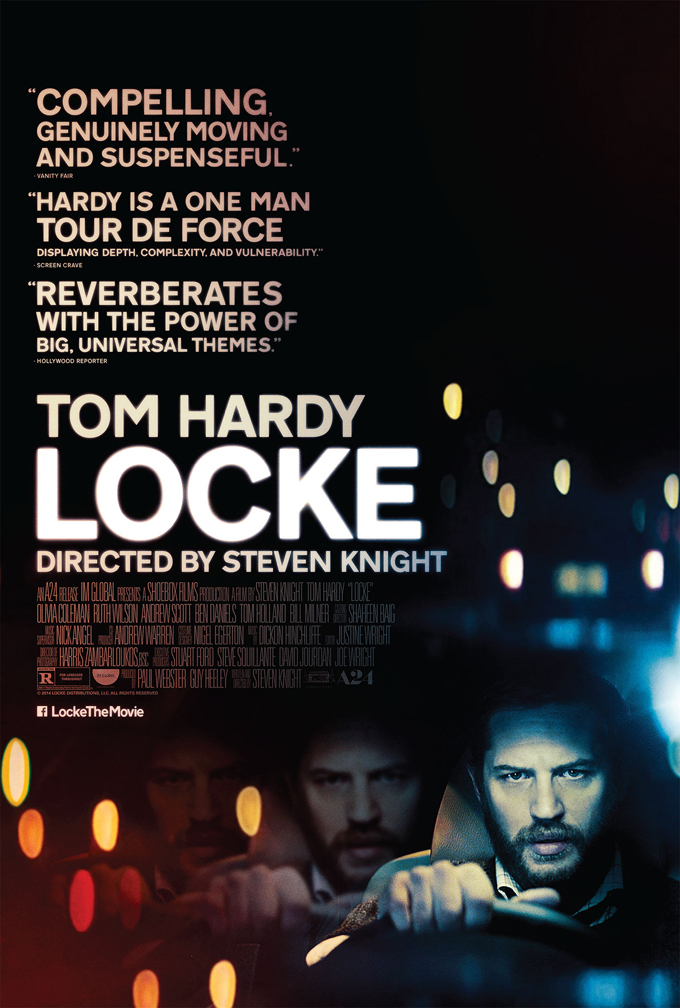 Essentially a one-man show, write/director Steven Knight’s film spends every one of its minutes inside a car with its titular star played by Tom Hardy. Over the course of one real-time late-night drive to London, our driver confronts a series of moral crossroads both personal and professional. It takes a while to get going but once the main conflicts are established, it’s a pleasure watching Hardy try and orchestrate all of them into complacency in the comfort of his car. I kept imagining how someone would translate this into an intimate stage show. The tension builds nicely as Locke has to come to terms with accepting he cannot fix his mistakes. The biggest drawback is that the film abruptly ends without much in the way of a payoff. The whole time Locke is on a mission, berating his invisible absentee father he envisions in his backseat, determined not to make the same mistakes, but then the movie just limps to a finish. It could have used another 10-15 minutes of resolution to feel more complete. Hardy is strong and keeps your attention, often offering glimpses of the complex emotions he’s trying to hide. An intriguing film experiment in minimalism, there are worse ways to spend 85 minutes than inside a car with Tom Hardy. However, there are also better ways.
Nate’s Grade: B


 nathanzoebl
You must be logged in to post a comment.