Blog Archives
Vertical Limit (2000)
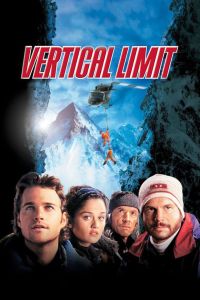 New heights are explored in the mountain climbing expedition that is Vertical Limit. A group of climbers must perform a rescue mission on the second highest mountain in the world or risk losing the lives of their friends and loved ones. With a set-up like this you would assume it would have a lot of great action. Well, yes and no.
Limit stars Bill Paxton (talented but has poor film choices) as the usual corporate villain, Chris O’Donnell (untalented with poor choices) as the tortured rock climbing hero, and Robin Tunney as the overly ambitious climbing sister to O’Donnell. This isn’t all the subplots though — oh no! We get a pair of wise cracking pot head brothers, a religious Pakistani serviceman, a military base, and a grizzled loner that everyone thinks is crazy until we finally realize he’s the best mountain man of them all. By the time it takes to establish all of these subplots, plus others I’ve failed to mention, we haven’t even gotten to the damn mountain yet. Rule #1 of a mountain climbing movie: Get on the bloody mountain within an hour of the movie starting!
The plot is overly cornball and excessively redundant. By the time you actually see the loner’s long lost wife frozen in a wall of ice and looking like a figurine from the Mattel Barbie catalog you will know the ends this film will go.
The experts of rock climbing are all young and seemingly frat house rejects. Why in every film must the experts in any field of scientific research be frat house party animals? How about some realism there and make them all middle aged balding white males. Well… I guess that would be less of a draw.
 Director Martin Campbell (GoldenEye) has a great knack for establishing tight thrills and strong suspense. Campbell is clearly the strong point of this picture. When the action is running it’s plumb with excitement and great visceral visuals of the scenery. The only problem is that the action scenes are separated by long stretches of characters coughing or wheezing and terribly cheesy dialogue. If the story is technically built around the action sequences why do we have to devote so much time to it then? It’s a waste of Campbell, a true action talent.
Limit is rigid with expendable cut-outs designed to be its people. The characters are shoe-string and so is the plot but the action, when allowed to actually happen, is first rate. However, I do exclude a series of scenes where Tunney and Paxton are trapped in an ice cave that resembles more of your grocer’s freezer than a Himalayan peek. The 12 year-old behind me kicking my seat figured it all out good enough. I think that says enough.
Nate’s Grade: C-
Share this:

Proof of Life (2000)
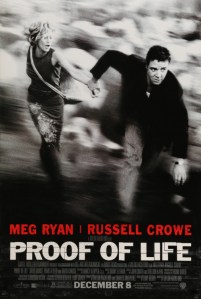 Proof of Life is more an interesting idea than an intelligent or well done thriller. The whole concept of the politics involved in K&R (kidnap and rescue) are duly fascinating. But Proof decides to build a different film around this premise and detours into mediocrity. The film ends with the standard take-down in the jungle I’ve seen many times over except I have the pleasure of seeing David Caruso do it this time.
David Morse is an environmentalist hired by an oil conglomerate to build a dam in a small fictional Ecuador looking country. He gets kidnapped by some radical revolutionaries and is held for ransom. Russel Crowe steps in as the hired K&R expert from Morse’s insurance agency.
The supposed romance on set between Crowe and Ryan is beyond my guess. On screen they have little chemistry and any romance bubbling rates a DOA on Dr. Love’s scale. Meg Ryan betrays herself as an actress and wanders the film minus a bra and constantly sniffling.
During play is a long going friction between Morse, who starts to look like he was auditioning for Cast Away, and some revolutionary hot-headed youth. It’s almost laughable the more it goes on. The will-they-or-won’t-they romance gets snuffed every time we cut back to Ryan’s husband enduring hardships. The editing and the concept ruin whatever sexual tension is supposed to build. The flick also has an unsettling theme that if you aren’t an English speaking white person you can’t be trusted.
The film starts off well with Crowe tangled in Russia but shifts into the mundane rather fast. Proof of Life is proof that what transpires off camera doesn’t always connect on camera.
Nate’s Grade: C+
Share this:

Unbreakable (2000)
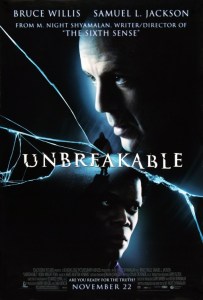 “I should have known it from the children…” Ladies and gentlemen, you have now witnessed the most atrocious ending of this year. Unbreakable has a simple yet moderately sophisticated premise in the examination of what makes a super hero. The psychology going into it would be fascinating, like do you feel a civic duty to help others? This could have made ‘Unbreakable’ a good escapist flick with some imaginative thoughts, but instead it all gets destroyed by a lame lam-shackled ending that will suck the life out of everything good and decent.
There are numerous shots in the film that go on and on and are single coverage. This likely wouldn’t pose as much a problem if it weren’t so persistent and annoying. The opening scene where the camera dances back and forth between two seats to see Bruce Willis fumbly trying to hit on another woman is aggravating to the least in its set-up. Willis himself is a security officer for a college and basically suffering from a faltering marriage and overall loser status. That is, until he is the lone survivor in a horrific train accident. Samuel “Mr. Glass” L. Jackson seeks him out to reveal to Willis that he believes he has been chosen to do good, and comic books are true, and whatever else. How can you trust a man with Gumby hair?
Unbreakable is not a movie without merits, in fact it almost could have been a good film or at least a better one. There are moments of tension, and a scene with Willis stretching out his arms in a bus station a la Christ is particularly well directed. Then there is…. the ending.
M. Night Shyamalan had true break-out success with the monumental Sixth Sense but he is now a victim of his own success because everyone and their invalid grandmothers will be looking and waiting for a twist ending. And the payoff is NOWHERE near as rewarding as Sixth Sense. In fact, it might make you mad. Mad that it ruins the rest of the film that had its few moments. Mad enough … to become a super villain all your own.
Nate’s Grade: C
Share this:

Book of Shadows: Blair Witch 2 (2000)
 Let’s openly admit it from the start … there’s no way the people behind this could win. The Blair Witch Project was a phenomenon in indie cinema that likely will never be seen again. The movie certainly didn’t need a sequel, and probably couldn’t be easily hatched with its cracker-jack ending anyway. We, as a nation, are not only expecting any Blair Witch sequels to fail; hell, we’re demanding it. This is the state my mind I waded in as I started to see Book of Shadows: Blair Witch 2.
Burkitsville Maryland has become quite a hotspot for tourism because of the success of The Blair Witch Project. Local residents sell items such as rocks and stick figures to jabbering tourists, some of whom have come overseas. This is where our tour guide Jeff (Jeff Donovon) enters. He leads our band of characters into a tour of the Maryland woods. Each of his campers has their own reason for going. There’s the engaged couple with Guy (Stephen Baker turner) as the skeptic and realist, and Girl (Tristine Skyler) as the supernatural believer. Then there’s Wicca gal (Erica Leerhson) who’s out to disprove the bad reputation of the Blair Witch. Finally, there’s pseudo-psychic Goth girl (Kim Director) who really has no purpose except to wear pancake makeup and whine about how she’s unfairly treated by society for dressing in black.
 This motley crew of slacker backpackers spends a night in the woods and turns it into something that you would see advertised during a commercial for Howard Stern. The alcohol mixes with the drugs and the next morning no one can remember a thing. Their surveillance equipment is destroyed and Guy’s lengthy paper is littering the ground like snow (it must have been over a 1000 pages for the amount that continuously falls). Accusations fly, and after a brief stay in a hospital occupied with ghostly images of dead children, the group decides to take refuge in Jeff’s secluded residence. It just so happens that it’s an empty warehouse in the middle of nowhere. Perfect setting for scary things to jumps out at people, and they do. The remainder of the movie is spooky shenanigans happening in this big bad haunted house until the mandatory muddled ending.
Book of Shadows (some studio exec must have tacked it on because it sounded “cool” since it has nothing to do with anything) takes off promisingly enough. The first ten minutes show the effect the first film had on the community and the fans with a mock-documentary fashion. Then it’s over quickly and we get a glossy film, a 20 million dollar budget and Marilyn Manson scraping his larynx or killing an owl on the soundtrack. Can you say “corporate fast buck”? I know I did. The sequel to the soggy backpack adventure of indie fame bears little resemblance to its predecessor. The only common line between the two is an assortment of unknown actors starring, which isn’t necessarily a good practice for every movie
None of the characters in Book of Shadows are truly interesting at all. Surprisingly enough though, they have an intelligent conversation about the blame of media and how it can affect others’ will. This, as should be guessed, is the high point of the film. It makes little difference that the most intelligent conversation in the film occurs when everyone is wasted and high by camp light.
The first movie was by no stretch a lesson in horror but it was innovative and relied on a practice of creating horror in your mind, which I can at least admire. Blair Witch 2 has no scares in it whatsoever. It has gore, blood, and things that are thought of as scary: bats, darkness, mean dogs, dead children, insane asylum kooks etc. Problem is none of these things work. They’re all textbook but they never work in execution.
 Blair Witch 2 was directed by documentary filmmaker Joe Berlinger. He co-created the truly excellent and gripping Paradise Lost films over the hysteria and blame that convicted Gothic teens in Arkansas of murder. It’s easy to see some similar themes in Blair Witch 2, which include a Goth crying out against the way she’s seen and treated and a Wicca crying out against the way she’s seen and treated. They’re carryovers from his earlier works. But Berlinger’s first step up to fictional direction is really a step down. He’s so good at storytelling and underscoring tension and drama in his documentaries, so what went wrong? I think it was probably studio interference (look at the title), but Berlinger may just not be up to snuff for fictional film. Which is fine because he’s one of the best documentary filmmakers alive next to Errol Morris, Michael Moore, and Barbara Koppel. Berlinger will bounce back but he may not want to make a fictional film again.
The way the story is told is in different layers cut together from different times. It’s interesting enough and sets up some mild foreshadowing but by the end, when it makes it clear who will survive and who won’t, it becomes annoying. The ending crawls along and presents two possible scenarios (spoilers): one; it invalidates everything before and shows the nature of humans with hysteria and their own capabilities for evil (better ending), and two; some supernatural force interfered and did bad stuff (boo!). Reluctantly I think most people will go with ending number two. The understanding of the ending is too fundamental toward the enjoyment of this film. This further muddles the whole film and the reason for even watching it.
The flick initially took me by surprise but then left me muddled in confusion that has yet to cease. Book of Shadows: Blair Witch 2 is a conundrum of a film. It’s really not very entertaining or innovative. In fact, it’s really not that great at all. It will be interesting to see how people receive this film with years of distance. I think it could be kindle an interesting film class discussion on the pressures of following up a phenomenon. Studio execs certainly had their say and certainly wanted Blair Witch bucks, but the public is older and wiser, and repackaging the same old tricks will not work the same. Owls, dead children, and shadows of friggin’ stick figures will not scare an audience without a story. Of course, after Book of Shadows: Blair Witch 2 bombed so succinctly, the ones left horrified were the studio executives. The public had the last laugh.
Nate’s Grade: C-
Share this:

Nurse Betty (2000)
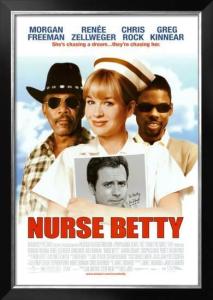 Can a fairy tale have a dark undertone below all the bubbly whimsy? Hell, the Grimm tales were barbaric before they became homogenized, sanitized, and finally Disneytized. Nurse Betty presents a modern day fairy tale with the strike of reality always below it — the strike of darkness and disappointment. Fairy tales are an escape from this, but what if one creates her own fairy tale and chooses to believe in it over the drab reality she presides in?
Neil LaBute, the director of the incessantly dark In the Company of Men and Your Friends and Neighbors, collects together a whimsical modern day fable with a top-notch cast. Yes, to those fans of earlier LaBute offeriengs his name doesn’t seem synonymous with whimsical comedy – but in this flick LaBute cuts his teeth in the mainstream and earns his stripes if ever.
Baby-voiced and rosy-cheeked Renee Zellweger plays our heroine in diner worker and soap opera fanatic Betty. Betty finds solace from her life featuring a sleazy spouse, played with marvelous flair by Aaron Eckhart, in her favorite soap opera. When her louche of a hubby isn’t wiping his hands on the kitchen curtains or banging his secretary he tries proposing drug deals for shady characters. A recent drug peddling snafu sets him up to an ominous encounter with hitmen team Morgan Freeman and Chris Rock. Through a jarring scene of violence Betty’s husband is left brutally murdered and the only witness is Betty herself. The event causes Betty to slip into a fractured psychological state where she believes the world of her soap opera is alive and real with herself a vital character. She hops in one of her dead hubby’s used cars and drives off toward California to meet the doctor/soap star of her dreams in Greg Kinnear.
 Morgan Freeman and Chris Rock mistake Betty for a criminal mastermind and believe her to have taken the drugs and run. They embark on their own mad dash to capture her and finish the job they were paid to complete. Along the way Betty encounters many people that are at first confused but ultimately charmed by this delusional dame. Through a series of events she meets up with the eternally smarmy Kinnear and begins to learn what happens when a fantasy is corrupted by the disappointment of reality. Allison Janey has a small part as a network executive that shines strong, and Crispin “McFly” Glovin is just nice to see in a film again. He doesn’t seem to age though. Maybe he has that Dick Clark disease.
The flow of Betty is well paced and a smart mix between drama, whimsy, and dark humor. Overlooking some sudden bursts of violence bookend the film it comes across as a sweet yet intelligent satire and fable. Betty is looking for her Prince Charming but will later learn that she doesn’t need one, that she is the fairy tale happy ending inside her.
The acting of Nurse Betty is never in danger of flat-lining. Zelwegger is a lovable and good-natured heroine. Freeman is a strong and deceptively hilarious actor along side a caustic yet down-to-earth Rock. And I make an outgoing question if there is an actor alive out there that can do smarm better than Kinnear — I think not.
Nurse Betty is a wonderful surprise. Check into your local theater, take one showing, and call me in the morning. You’ll be glad you did.
Nate’s Grade: A-
Reviewed 20 years later as part of the “Reviews Re-View: 2000” article.
Share this:

Way of the Gun (2000)
 Way of the Gun is screenwriter Christopher McQuarrie’s follow-up to the twisty smash who-dunnit The Usual Suspects. This time he takes the reigns of directing himself and establishes that he is a born man behind the camera and in the chair.
Gun unfolds its tale through the center of two antisocial hoodlums “Parker” (Ryan Phillippe) and “Longbaugh” (Benicio Del Toro), two men brought to the point of selling plasma and sperm to pay the bills. One afternoon they overhear a conversation in the doctor’s office about a wealthy couple paying a woman (Juliet Lewis) to act as the surrogate mother for their child. It seems the real mother just doesn’t want to be burdened with a child hanging on her for nine months. The two men use this information to plot what should be their big break and their big score. After a scheduled doctor’s visit they get into a heated shoot out with the bodyguards (Nicky Katt and Taye Diggs) protecting her for their wealthy employer. Parker and Longbaugh kidnap their impregnated prize and hold her to squeeze a fat ransom.
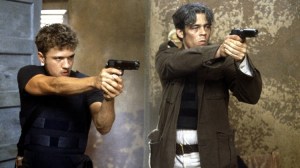 The story-telling Way of the Gun plays is a mix of older mature films where they would have room to breathe as well as Quentin Tarantino flicks. This is a story of characters and their devious multiple back stabbings, crosses, secret affiliations, and ultimate intentions. ‘Gun’ moves methodically with an armada of gaunt twists and turns keeping the audience alive and awake.
James Caan comes in mid-way to play a conniving intermediary in the exchange. His character is the wisest of the bunch and knows more then he’s always telling. It’s also quite a perplexing site to see Caan’s nipples through his shirt in an interrogation scene. Up to this point I never thought about James Caan having nipples.
The action in the flick is pulse-pounding. The shootouts are probably the best on film in a long while. You see and hear every effect a bullet has. The final climax which involves a drawn out gun battle in an empty Mexican brothel is a scene of sheer excitement and relentless entertainment that it may well be my favorite 10-15 minutes of film all year.
There can be a word to describe Way of the Gun and that word could be “ugly.” This is not a film for everyone. The violence and its after-effects can be gruesome at times, as I heard just as much groans and shrieks in my theater than anything else. There’s scenes of picking shards of glass from one’s own arm, performing stitches on one’s eyebrow, and even an impromptu hand done C-section. This will not be something to take grandma to.
Way of the Gun pacing is also a problem. There are moments of drag as we wait and wait. The languid pacing works for the story and the characters but the double-edge sword creates dry spells of interest. The score uses tympani to full extent, sometimes beyond that which it reasonably should.
McQuarrie has sold me with his re-spinning of tired cliches and familiar elements into gold. Way of the Gun is a flick I’ll see with my friends time and again.
Nate’s Grade: A-
Share this:

The Watcher (2000)
 The Watcher doesn’t do much, if realistically anything important, but it does prove that Keanu Reeves is more cardboard than cut-out. Reeves plays a serial killer with no distinct edge or angle, in fact he’d be more of a stalking man child if he just didn’t kill his victims in the end. Anyway, the plot is a rehash of other serial killer vehicles; James Spader has a limited time to rescue a victim, he’s haunted by the ones he’s failed, Keanu is a killer with too much free time to overly plan elaborate set-ups etc.
Keanu may be the goofiest serial killer in all of western civilization. Every twitch, dumbfounded stare of aloofness, or one-toned droning moronic voice only add to the feelings of Keanu as a lost student and not as someone dangerous. Maybe this was the desired effect but I doubt it.
A more interesting prospect arouses when you consider what the movie could’ve been had the male leads switched characters. As it stands, The Watcher is a lifeless and tired strain of an experience. One, I might add, that allows Keanu to light entire rooms with dainty candles with his added spare time.
Nate’s Grade: C-
Share this:

The Cell (2000)
 Welcome to the not too distant future where the miracle of science (i.e. red bodysuits and washcloths over people’s faces) allow you to transport your mind into that of another individual. So what happens when a serial killer snags a catch only to be dropped into a coma with no way of discovering where his victim is before time runs out? Well we send Jennifer Lopez into his head — duh! The Latina songstress transports herself to learn the secrets of Mr. Madman before his next victim becomes just a number on a sheet. Sound contrived, like the movie was in production before they had a workable script? You’re not alone. One-named director Tarsem is from the land of music videos but for the life of me I can’t think of one he’s done.
Perhaps the excruciatingly long Nine Inch Nails promo would be less frustrating if the outpourings of creepy imagery meant something. Despite the desire to explain the inside cerebrum of a crazy, 90% of the imagery is there for the simple sake that it looks cool. Lopez plays Alice to a lumbering wonderland of dark images and a mind-numbingly clattering musical score. Would someone please explain to me why a CGI vine grew on screen for five minutes then went away?
Lopez speaks in whispers, Vaughn speaks like he’s on Ritalin, and the movie speaks that if you had abuse as a kid it’s okay to trap women in self-filling aquarium cubes and bleach them into albino Barbies. Won’t see that in your typical after school special.
The Cell may present some things you’ve never seen before, like a jack-in-the-box theme to twirling intestines, but too often it presents things you have seen much too often in film — boredom.
Nate’s Grade: D
Reviewed 20 years later as part of the “Reviews Re-View: 2000” article.
Share this:

Boiler Room (2000)
 Boiler Room is like a Wall Street for the dot-com kids, hell they even have a scene where they openly quote and recite Glengary Glen Ross. Giovanni Ribisi plays the son of a judge and the head of a gambling front he runs in his home that decides to cut his teeth in the world of stocks and options. Boiler Room begins as an insightful and well-paced inside look toward the cut-throat world that crunches the numbers and keeps the leg of our economy afloat. I find it fascinating that a good base of our economy is based upon round table rumor and the opinions of a select few. But the brash and stirring scenes of the politics of a sell are then given up when the FBI is introduced and Gio tries to take the company out from its dirty inside. The movie then falls to the wayside of entertainment. Boiler Room is a surprisingly engaging film that decides to go down the wrong path.
Nate’s Grade: B
Share this:

What Lies Beneath (2000)
 I cannot write any review of What Lies Beneath without it also turning into an essay on old people. And so fellow reader I give you… “Nate’s Essay on the Movie Watching Habits of the Elderly or: What Lies Beneath the Review.” [Editor’s note: his review was written originally by a testy and somewhat snide 18-year-old me, so please excuse the ageism attack on elderly movie habits, not that there isn’t still truth to this.]
The tale is one of a happily married couple who are just going through the empty-nest syndrome when their only daughter leaves home for college. Michelle Pfeiffer is a strung out house wife trying to fill up her days and enjoy time with her Harrison Ford-like husband. But all is not well in the house. Michelle starts experiencing visions of ghosts in bath water (bathtubs play a huge role in this flick, bigger than red in Sixth Sense likely) as well as coincidental things that you know aren’t at all coincidental. How many times does the door have to open for you by itself before you put two and two together? Anyway Michelle comes undone and tries telling her husband of her spirit stalkings but he believes she’s crazy. In the end we all know it’s the dead spirit of Ford’s mistress mainly because of the trailer and commercials giving us every twist a la Double Jeopardy. I will say this, the last twenty minutes are ludicrous and laughably bad.
Beneath could be argued as an homage to Hitchcock, but that would be slandering Hitchcock. Hitch could hold an audience, show them new things, and play a crowd like a piano. All What Lies Beneath did was put me to sleep.

What Lies Beneath is supposed to be an “adult” scary picture but does no more but define its intentions with the overused but reliable and disappointing jump scare. A jump scare never truly scares but only startles – usually brought on by a loud BANG! in the orchestral score. But no one admires jump scares. No child grows up wishing he can make the ultimate jump scare movie because it’s basically a cheap reaction or reflex. Build an entire concept of “scariness” on this principle and it’s even cheaper. Old people fall for every one of them too and then sit back loudly talking to their friends about how they were had.
Old people are far more talkative through movies then children, teenagers, and people who frequent seizures combined! This isn’t one single occurrence as well, the same thing happened when I saw The Patriot and subsequently Space Cowboys. Old people talk constantly throughout a movie carrying on conversations loudly as if they weren’t watching a film but rather a child playing in the distance. It’s even more difficult to pay attention to a dull film when you keep hearing everyone’s stories around you, though one man’s story of holiday cooking had me at “hello.”
In short stay away from What Lies Beneath or any movie that skews to a demographic that watches reruns of Murder She Wrote. Old people may enjoy their movies… just don’t see any with them if you have the choice.
Nate’s Grade: C-


You must be logged in to post a comment.