Blog Archives
The Shallows (2016)
 Let me take a moment to dispel an expectation amplified by the movie’s first trailer: The Shallows is not the Blake Lively Butt movie you may have imagined. It would not be uncommon for this kind of setup to indulge in the forays of exploitation cinema, but aside from a few shots of Lively on her surfboard, The Shallows is surprisingly free of anything that would constitute leering T&A. Lively even wears her swimming vest to stay warm for the far majority of the movie. I cite this because I want to congratulate the movie on its accomplishments but also assure those wary from the trailer that The Shallows is much more than a tawdry genre movie with a bikini-clad blonde in sexy peril.
After losing her mother to cancer, Nancy (Lively) drops out of school and runs off to Mexico to retreat from her cruel reality. She finds a hidden beach few others know about but was a special place to her dearly departed mother. Nancy takes her surfboard out and happily soaks up the beautiful scenery. Her respite from reality is broken when a shark bites her in her thigh. Panicked, she finds refuge on a small rock sticking out of the water, though vulnerable to high tides. Nancy has to use all her strength and wits to observe the shark and her surroundings and make an escape before her injury gets too bad.
 The Shallows is an excellently paced and plotted survival thriller that keeps its audience involved from the start. I greatly enjoy survival thrillers that think step-by-step with the characters in their on screen predicaments, and every move made in The Shallows follows a logical progression that is intellectually satisfying. It helps that Nancy is a med school dropout and thinks through how best to keep herself alive with the tools that she has. She uses a pair of earrings as sutures. She uses her swimming vest as a tourniquet. She uses her watch to time the seconds it takes for the shark to swim in a perimeter. She is a smart and able heroine who assesses the situation in a manner that makes her a strong protagonist we root for until the very end. It’s also a smart device to have her calmly narrate her desperate medical improvisations as if she were treating a patient, a role-playing exercise meant to make her more objective and to ease her fear. It also provides a credible reason for Nancy to talk out loud. There’s also a seagull that Nancy bonds with, an injured bird marooned on the same small strip of rock. The bird deserves second billing as it has more screen time than any other human short of Lively. It’s not exactly a Wilson-kind of relationship necessity but if you’re like me you’ll feel enough bouts of dread and distress whenever that dumb bird is placed in dangerous scenarios.
Screenwriter Anthony Jawswinski (Kristy) makes every part of his story in play, and he even provides acceptable answers when plot holes do seem to appear. Take for instance my biggest initial question: why is this shark so obsessed with Nancy when it has a massive whale carcass to feast upon? I have a similar complain in all sorts of movies where the predator gives up the larger meal for the possibility of the smaller meal (the new King Kong and Star Trek both come to mind). Why give up a guaranteed food source? I could successfully ignore this plot hole for the most part since it’s essential to the conflict of human vs. shark, and then the script produces an answer. She’s in its feeding ground; this isn’t about food, this is about territory. That’s fair. I felt a similar quibble when this one seagull never flew away from Nancy’s rock. It makes sense to give her a companion to at least allow some one-way dialogue. Then it’s revealed the bird as a separated shoulder and is flightless, stranded too like its new friend. This presents a mini-goal for Nancy to accomplish and provides an accomplishment to carry her over. The only plot hole that stuck was Nancy explaining she’d just hail an Uber to get home from this secret beach in Mexico. I don’t think hey have many drivers in the area, lady. I was impressed with Jawswinski’s ability to develop his conflicts and utilize his surroundings. Every item introduced in this small location will be used at some point. Making use of previously introduced materials produces a string of payoffs, ensuring more fun.
 The technical elements are stunning, adding extra impact to the well-crafted suspense. Director Jaume Collett-Sera (Non-Stop, Run All Night) really draws out the tension, letting an audience simmer in discomfort. I know a movie has me when I start nervously tapping my leg, anticipating something bad at any moment. I was tapping often with The Shallows. The initial first strike is chaotic and frightening, leaving Nancy the morbid option of climbing atop a rotting whale body for momentary safety. Then there’s timing the shark’s laps to determine how much time she has retrieving floating items from her rock. We’re given the setup and Collett-Sera nicely goes from there. Even the requisite “chatting with the family” scene meant to impart enough exposition for our character’s starting point is given some flash thanks to onscreen graphics. The cinematography is absolutely gorgeous, especially the prolonged underwater sequences. If it wasn’t for the perturbed killer shark this could work as a vacation ad for this Mexican beach (it was really filmed in Australia). The editing, the music, the special effects, it all blends seamlessly together to construct a thrilling and stylish summer movie.
I’ll admit that there was a long dry spell for Lively after her mesmerizing turn in 2010’s The Town, enough so that I wondered if she was just coasting for good. Then with last year’s underrated Age of Adaline she reminded me there’s a capable actress here. It’s a one-woman show and Lively does a terrific job of anchoring her character while playing to all the shrieks and startles of the genre requirements. Her depleted mental and physical state is effectively communicated and her surge of purpose in Act Three is infectious. Her tearful “final message” in case she didn’t make it had me almost dabbing my eyes. It’s heartfelt and sorrowful without being too corny. There is an actual character here and a performance that treats her seriously and not merely as a tasty afterthought. There are far worse people in Hollywood to be stuck on a rock with than Bake Lively.
In a summer of disappointments, I’ll gladly take the simple pleasures of a contained thriller that’s as well developed, exciting, and as satisfying as The Shallows. It’s smart, often suspenseful, and boasting great technical accolades to make this harrowing survival drama all the more immersive and enjoyable. There is an escalation of tension and director Collett-Sera keeps the audience oriented throughout the terror so we know exactly what the stakes are of every life and death decision. It taps into a primal fear of humans versus Mother Nature in a way that feels smothering. Lively anchors the film and provides a thinking heroine who can also get the job done when the action calls upon her. The ending confrontation gets a little extreme and curiously vindictive for an animal, but by that point I was enjoying the movie far too much to argue. The Shallows isn’t too deep but it’s the kind of slickly produced and developed B-movie that I’ll happily indulge.
Nate’s Grade: B+
Share this:

The Purge: Election Year (2016)
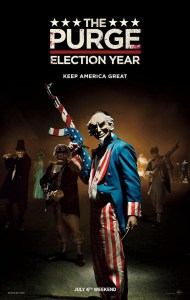 What once seemed like a premise fit for ridicule has become a franchise I actively look forward to now and swallow whole any incredulity. The Purge: Election Year is something of a lateral move from its predecessor, Anarchy, as it’s not an improvement but it’s still a fun and thrilling entry that provides just enough satisfying gonzo political commentary to temper its action. Finally with the second movie I got the Purge movie I wanted, experiencing the event itself outdoors, and Election Year continues this trend. We follow a small group of minority characters trying to survive the night, escaping from one location to another as they encounter a menagerie of weird, murderous citizens trying to make America great again. A presidential candidate (Elizabeth Mitchell) wants to do away with the barbarous Purge practice, and so this makes her a top target during that 12-hour free-for-all. Her head of security, and lone source of protection after an ambush, is played by Frank Grillio, returning from Anarchy and reminding you early and often just what a great action hero he can be. I enjoyed the ongoing shaping and texture of writer/director James DeMonaco’s kill crazy world, whether it was “murder tourists” coming over to America to experience consequences-free killing, the idea of a religious ceremony deifying purging, and even stuff I know is pure trailer candy, like an all-girl gang dressed in creepy masks, princess dresses, and chainsaws. There is some seriously unsettling imagery and moments, though the presence of a white supremacist hit squad dilutes some of the film’s tension simply by being a constant antagonist chasing down our heroes. There aren’t as many new set pieces to further illuminate the depravity of this world as there was with Anarchy. Still, there’s more than enough nasty bite in this franchise. How is this franchise not been turned into an open world survival video game yet? I wonder why everybody just automatically wants to murder during the Purge. I would just probably cheat on my taxes (don’t audit me IRS for this statement!).
Nate’s Grade: B
Share this:

The Conjuring 2 (2016)
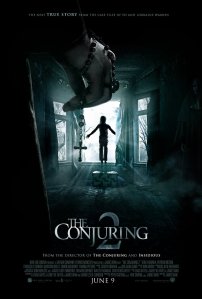 Horror is one genre where sequels rarely if ever satisfy. Usually the repetition is mind numbing and what was once scary has been eradicated. The true signs of great horror is the dread of what’s coming next, and to this end James Wan has shown tremendous skill at playing an audience and their fears. The Conjuring 2 isn’t quite the thrilling success that its predecessor was but it still upholds the best parts of what made the first movie frightening. We follow the Warrens once more, the husband and wife paranormal investigators, and this time to England where a malevolent spirit is haunting a family. One of the few miscues is delaying the meeting of the Warrens with the beleaguered family to almost an hour, pushing the running time to a needlessly overblown 133 minutes. The movie seems to be stretching out the ghost set pieces. Fortunately, Wan knows exactly how to build tension and let it simmer. The demon nun imagery is effectively unsettling, and there’s a brilliant sequence where Mrs. Warren (Vera Farmiga) has to slowly pull a light cord, all while the portrait of the demon nun hangs visibly in the dark. It’s a small scene that explains in full the clever construction of the whole. It sets up the parameters, develops them, and then lets the audience dread what it knows is coming. These are not cheap scares or lame jump scares but genuinely earned terror within a carefully constructed atmosphere. It might not be as good as the first one but The Conjuring 2 is still plenty good, which by default makes it possibly one of the greatest horror sequels of all time. Let’s hope the demon nun spinoff goes better than Anabelle.
Nate’s Grade: B+
Share this:

Now You See Me 2 (2016)
 The first Now You See Me was a pleasant surprise that took a simple concept (magician heist) and injected enough sly fun, style, and humor and made a memorable action thriller. As success demands, a sequel was commanded, but I had hopes considering the blueprint of its success could be repeated because those core elements were strong. We all love heist movies, we all love to be fooled, we all love to watch a smart people befuddle those in power, and the reveals made it even more enjoyable. I wasn’t expecting Now You See Me 2 to drop much of what made the first film appealing and shamble through its set pieces with a disinterested sense of sequel duty. The magic is gone.
The Four Horsemen magic act (Jessie Eisenberg, Woody Harrelson, Dave Franco, Lizzy Caplan) has made quite a few enemies. They’re a group that attacks the fraud, exploitation, and greed of those rich and powerful who feel untouchable. This merry band of Robin Hoods is transported against their will to Macau, China by Walter Mabry (Daniel Radcliffe). Walter lost a lot of money from the Horsemen’s antics in the first film and demands they steal a super microchip that will allow him to erase his identity and stay private permanently. Meanwhile, the Horsemen’s handler, Agent Dylan Rhodes (Mark Ruffalo), is blackmailed by famous and currently incarcerated Thaddeus Bradley (Morgan Freeman). Bradley has a score to settle with the Horsemen and uses Rhodes to escape from prison. All forces are headed to Macau and much more will be learned of the Horsemen’s behind-the-scene organization, The Eye.
 It feels like the filmmakers aren’t even trying to keep one foot in reality this time. It’s not like the first Now You See Me was a deeply grounded movie but it took pains to at least offer varying explanations for how these illusions were accomplished. Some of the answers were clever and some were preposterous, but at least they tried to show you their work, which made the Horsemen even cleverer, in my book. Understanding the preparation for the illusions and the execution of them adds to their impressive aura. The characters in the sequel don’t even attempt to explain the far majority of their tricks, and it’s simply not as fun. The opening job is a fun refresher because we see the different characters working together but also because we can see how they’re getting away with their shenanigans. As the movie continues, those magic acts get bigger and bigger and more ludicrous and harder to explain and then the movie just stops trying to explain. At this point magic might as well be real and the Horsemen are wizards. There’s suspension of belief and then there’s simply obliterating all connections to reality. When Eisenberg can control the direction of rain itself without any explanation, it cheapens the thrill. Because if there isn’t some level of limitations, requiring the tricks to be based in reality, then the on screen efforts lose their appeal because it doesn’t matter. It’s like haphazardly just writing, “The Horsemen do some magic junk and get away.” It’s just not as satisfying when it feels like the trick is ultimately on the audience.
Another complaint I have is that the scattered script seems littered with missed opportunities. One of the bigger misses that comes to mind is Harrelson’s twin brother, an obvious Matthew McConaughey impression from his True Detective costar. The character isn’t nearly as funny as Harrelson or the producers believe. He isn’t particularly memorable or necessary to the plot at all, but that’s not even his biggest offense. In a movie about magicians playing sleight-of-hand trickery, how in the world do we not have a switcheroo with the twins? That would justify his existence for the plot. I was shocked this never happened because it seemed so obvious. Why is he a twin? What does being a brother to Harrelson have to do with anything related to the plot? The script also gets overcrowded with antagonists, introducing Radcliffe and then bringing back Michael Caine and Morgan Freeman. The characters don’t so much compete with one another as they operate in separate spheres until a “twist” reveals more about their connections. Their agendas are too opaque. Radcliffe wants them to steal a super microchip so he can fully be “off the grid.” A man of his means shouldn’t have a problem with this. It’s not like he’s hiding out from the law for some kind of corporate espionage. It’s a convoluted reason to bring the Horsemen to his hiding spot in Macau. It’s just one in a long line of ideas that never feel fully developed. Even the magic set pieces don’t feel as fun. Seriously, one of the climactic magic set pieces is a human game of three-card Monty.
 Director John M. Chu (G.I. Joe: Retaliation, Jem and the Holograms) has worked with action before and certainly knows his way around choreography, but he feels too hesitant this time. The action scenes are rare and the chase sequences are muted. Outside of the tricks, there isn’t a standout action scene in the whole movie. In the first film we had a pretty fun magic fight that was wild and surprising and loaded with small payoffs. In this movie we have a motorcycle chase that plays out as expected. We have a foot chase that plays out as expected. You have professional illusionists at your disposal; action set pieces should not play out as expected. The most fun sequence is fairly straightforward but easily the best developed, and that’s the Mission: Impossible-esque heist of the microchip that is outfitted onto a playing card. It’s also clearly the most visually inventive sequence as the Horsemen play a game of keep away and the camera literally at times tumbles into their clothes. I think what makes this easily the best sequence in the movie is because it’s moderately grounded, the stakes are explained, and the audience is in on the trick, enjoying all the flimflam obfuscation. It also means when there are complications to the plan the sequence generates suspense. When you don’t know what’s going on and don’t know when things are going wrong, or how they could go wrong, it’s hard to generate genuine suspense. Being involved in the action is much more fun.
The actors all seem on autopilot, falling back to the broader descriptions for their characters. Eisenberg is a smug and cocky. Harrelson is smooth and shrewd. Franco is awkward and insecure. Isla Fisher is replaced by the capable Lizzy Caplan (TV’s Masters of Sex) as the requisite Female Horsemen. She makes a good impression but part of it is that Capaln seems to be the only member allowed to be comedic. It feels like there are three straight guys to her comedy cut-up. She’s good but without variation it also starts to lose its appeal when only one character seems to be trying. Ruffalo (Spotlight) seems too often unrelated the Horsemen story as he discovers more info about his father. He’s the only character that actually has something of a storyline, though his playing of both sides and attempts to hide his role to the FBI is just another ludicrous element. I miss Melanie Laurent too.
Now You See Me 2 (how could this not be called Now You Don’t?) is a lackluster sequel that seems to have forgotten what made the first film the enjoyable caper that it was.
Nate’s Grade: C+
Share this:

Money Monster (2016)
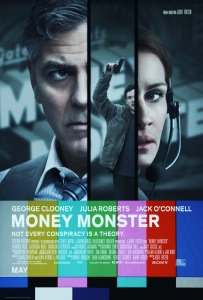 Jodie Foster hasn’t acted in a movie since 2013’s Elysium, and if you saw that movie you might have some sense why she’s taking time away. As a director, she has few film credits to her name, which makes each new Foster directing effort raise the question, “Why this one?” I would assume her last effort, 2011’s The Beaver, was her desire to work again with her Maverick co-star Mel Gibson and perhaps give him a career boost. Money Monster is a would-be hostage thriller with a socially conscience message about the greed and recklessness of Wall Street; however, the Bernie Sanders faithful, let alone anyone mildly educated on the excesses of Wall Street, will find this movie surely lacking, as will anyone looking for a competent and engaging thriller.
Lee Gates (George Clooney) is the host of Money Monster, a financial entertainment show where he provides stock tips to his loyal viewers. One day and angry man, Kyle Budwell (Jack O’Connell), wanders onto the set brandishing a gun. He demands Lee strap on a bomb vest. Kyle lost his life savings on a bad stock tip and he demands justice. Lee agrees to hear the guy out and get to the bottom of why this stock dramatically fell of a cliff, which leads him to suspect internal manipulation from the CEO (Dominic West). Lee’s director Patty (Julia Roberts) stays put through the duress and remains the voice in his ear, coaching him to safety and running research to discover the truth.
 While I was watching Money Monster I had to remind myself that this wannabe message movie existed in our reality, because the brunt of its ire against Wall Street criminal shenanigans is targeted specifically against one bad trader instead of the system. It’s like this movie exists before the 2008 financial meltdown, before the Oscar-winning movies Inside Job and The Big Short, but it doesn’t. It’s borderline insulting that the screenplay myopically focuses all of its attention on one bad actor and lets the rest of the Wall Street elite escape blameless for criminal misdeeds. The bulk of the movie after Kyle begins his hostage standoff is tracking down this bad trader and digging through archives to pin the blame for a stock fall on this guy, all the while keeping him away from the news so he doesn’t get suspicious. It’s a ludicrous turn of events that manages to take a big picture story with relevancy and find the smallest, most insignificant way to tell its tiny story. The condemnation should be for the system and not one guy, and not one character breaks from this preposterous thinking. It feels like they exist in a different time and place. If you didn’t know anything about Wall Street before this movie you would still be left clueless. Is there supposed to be a happy ending when they bring this guy to justice? The movie sets up an ending that doesn’t exactly feel like anyone learned a lesson or even that the villain was properly punished (oh no, he suffers the scorn of Internet memes!). The final line is so glib and self-satisfied that I groaned. By the end of Money Monster I was wondering what any character had learned from the experience except, maybe, to have better locks on the studio doors.
The other debilitating problem is that Money Monster is a movie that cannot find a character for you to care about. The setup should be so obvious and elicit audience sympathy and a natural underdog to root for against a corrupt system. Instead Kyle is a moron. First off he invests all of his money into one single stock based upon one tip from Lee’s TV show. That’s a pretty big risk. Next he takes hostages and makes demands, and yet none of those demands are for the return of his money but rather a simple apology. There’s also the fact that he’s more a ranting and raving angry lunatic than somebody who has targeted ire against the body of Wall Street, making for a pretty uninteresting hostage scenario. You also have to factor in that there will be no good outcome for Kyle, and so he’ll be leaving his girlfriend and unborn child left to fend for themselves after he blew away all their money on a bad gamble. This is not a sympathetic character nor is he rendered in a fashion to make him that interesting. He’s an angry and impulsive man whose actions are almost always about himself and his sense of being wronged. The other two primary characters, Lee and Patty, are completely absent personalities beyond staying cool under pressure. If you put a gun to my head I would not be able to tell you anything about either of those characters as people. Lee doesn’t seem to go through any sort of introspection over his own culpability with his TV show, and Patty is so laser focused on the problem at hand that we know nothing about her other than her capability. Spending 90 minutes with this trio of lackluster characters is a waste of 90 minutes.
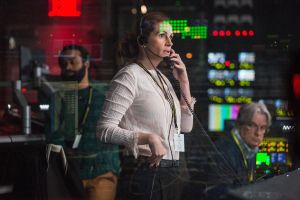 Despite the brisk pacing, I was bored mercilessly with Money Monster. I just didn’t care and Foster and company gave me no reason to care. The pacing made it hard to develop these characters; they felt like chess pieces being randomly assembled across a board, moved when the plot required it, and inert without these manipulations. When the movie goes outside is another example of nothing feelings believable. The will-he-be-shot suspense sequences are hackneyed and dumb. There are a couple of moments of solid comic relief at the expense of character egos, with Emily Meade (That Awkward Moment) serving as the highlight of an otherwise monstrously mediocre movie. Here is a list of other actors that are wasted in do-nothing parts: Caitriona Balfe (TV’s Outlander), Giancarlo Esposito (TV’s Breaking Bad), Christopher Denham (Argo), Lenny Venito (TV’s The Sopranos), and Chris Bauer (TV’s True Blood).
Money Monster is a disappointment in just about every stripe, from its perfunctory performances from it’s a-level movie stars, to the development of its characters, from its suspense sequences, and especially from its frustrating and laughably short-sighted vilification of Wall Street misdeeds on one culprit. It’s like this movie was pulled from a time capsule from the 1990s. Foster’s direction is perfectly acceptable though indistinct from any other journeyman. I cannot say what attracted her to this project as a director except for the opportunity to work with Clooney and Roberts. Otherwise, Money Monster is a thriller that keeps butting heads against reality, reminding the audience at every turn of its airless artificiality and stark superficiality.
Nate’s Grade: C
Share this:

Midnight Special (2016)
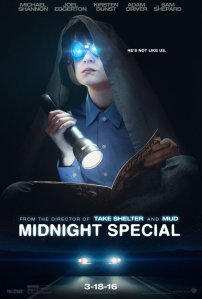 Jeff Nichols should already be a household name after Mud and Take Shelter, and with his new movie Midnight Special, the man has done nothing to break his incredible record of success with making deeply personal, ruminative, thrilling, and brilliant films. Midnight Special is a better and more earnest love letter to the cinema of Spielberg than Super 8 was. A young boy exhibits strange and supernatural powers. The religious compound he came from looks at him as a prophet. The government thinks he might be a weapon. Two different groups are on the hunt for this boy, and that’s where Nichols drops us right into the middle of, respecting the intelligence of his audience to catch up and figure things as they develop. In some ways it reminds me of Mad Max: Fury Road, an expert chase film that establishes its characters naturally as it barrels onward. The acting is wonderful all around and Nichols does a great job of finding small character moments that speak volumes, giving everyone time in the spotlight. The various twists and turns can be surprising, heartwarming, funny, but they stay true to the direction of the story he’s telling and grounded in the simple, unyielding anxiety and love of parents for their child. Michael Shannon (Nichols go-to collaborator) is directly affecting as a humble but determined father risking everything for the well-being of his son. The concluding act left me awed and felt something akin to what I think Brad Bird may have been going for with Tomorrowland. This is a thoughtful science fiction movie that allows its characters space to emote, its plot room to breathe, and yet still thrills and awes on a fraction of a Hollywood budget. It shouldn’t be long before some studio finally taps Nichols to jump to the big leagues of a franchise film, but if he wanted to keep making these small, character-driven indies on his own terms, I’d die happy.
Nate’s Grade: A
Share this:

10 Cloverfield Lane (2016)
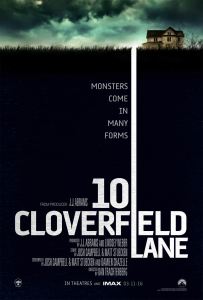 The mysterious sequel to the 2008 found footage monster movie sprung from nowhere, surreptitiously filmed without the general public having any idea of its connection to Cloverfield until mere weeks before its release. It’s the equivalent of a modern-day publicity magic act, something that J.J. Abrams is known for with his crusade against spoilers. The biggest surprise about 10 Cloverfield Lane is that the best parts of a slick and suspenseful movie are the parts that have nothing to do with Cloverfield. The majority of the film’s first two acts take place entirely in a bunker with one possibly disturbed individual played by a terrifically unsettled John Goodman. The unease and dread build nicely and the reveals are paced out in a clever manner to make us second-guess and second-guess our second-guesses. There’s a great moment during an awkward game of charades where Goodman’s character can’t conceive of calling a woman by the term “woman,” instead relying upon patronizing terms like “girl” or “princess.” There’s a darkness and a fury under the surface that should remind of Goodman’s expert turn in Barton Fink. This is a finely suspenseful and mysterious chamber piece until we leave the bunker and the movie officially connects into the Cloverfield universe. It’s a little sloppy and makes for a tonally inconsistent finale. It’s not enough to ruin the movie by any means but it certainly lessens the smartly constructed suspense and paranoia. Mary Elizabeth Winstead (Scott Pilgrim vs. the World) makes for an effective survival thriller heroine, and her line reading of “Oh come on” is a divine highlight. As a Cloverfield movie, this opens up the space for a wider variety of humans vs. monsters stories, but as a movie, it plays at peak performance when it follows its own lead.
Nate’s Grade: B
Share this:

Triple 9 (2016)
 Sometimes the most upsetting movies are the ones that have a glimmer of promise and then never take advantage of that promise, instead falling upon staid genre clichés and predictable plotting that makes you wonder how a good idea was smashed into a boring and formulaic product. Triple 9 falls into this category of film disappointment. It has a great premise: a group of corrupt cops (Chiwetel Ejiofer, Anthony Mackie) are in debt to an Israeli mob matriarch (Kate Winslet) and owe her one last score, and their solution to ensure they can get away with their crime is to arrange for a new cop on the beat (Casey Affleck) to be killed, thus providing a major distraction. The problem here is that none of these characters are at all interesting. They all have conflicts and the movie does a fine job of providing each one with some kind of pressure and general motivation, but outside of the forces against them, you can summarize them in a scant few words apiece (drug addict, war vet, single dad, etc.). The plot events also just seem to coast around until a pile-up of climaxes, all of which lack satisfying closure as the body count mounts. It’s hard to care, and the only character that seems worth following is Affleck’s newcomer sniffing out the dangers that are closing in on him. Woody Harrelson feels like he’s making a special guest appearance from a separate movie from Oren Moverman as a drug-addled and angry detective. Too often the characters feel out of orbit from one another, the storylines rarely coalescing. It feels like everyone was given the same acting note of being dour and harried. Winslet’s hammy turn as an Israeli mob boss allows her to reuse her accent from Steve Jobs. Director John Hillcoat (Lawless) provides a certain charge with how he stages the robbery sequences but it’s not enough. Triple 9 is a movie that wastes a great cast, a fine premise, and a talented director. It’s not terrible by most accounts but it’s resoundingly mediocre, and sometimes that can be even worse than bad.
Nate’s Grade: C
Share this:

London Has Fallen (2016)
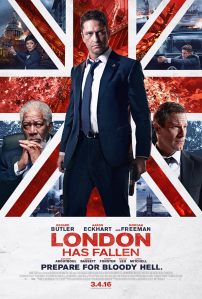 Years after the events from Olympus Has Fallen, Secret Service agent Mike Banner (Gerard Butler) is escorting President Asher (Aaron Eckhart) to London to attend a funeral. It’s there where chaos strikes and Muslim terrorists, disguised as British agents and local police, unleash a series of attacks and explosions throughout the city. Mike is able to rescue the president but the two are essentially in enemy territory looking for an escape, and the terrorists have seized London and plan on executing President Asher live on the Internet for his drone strikes in the Middle East.
The first mission for an action movie is to entertain with its action sequences, and it is here where London Has Fallen falls. The budget has been reported as high as $100 million dollars, and if this is true it may be the biggest waste of $100 million dollars I’ve ever seen on film. The movie just looks cheap. The locations (Bulgaria often doubling for London) look too vague and interchangeable with empty streets. Also, for a city that has over ten million inhabitants, why are these streets so empty? There were people milling about outdoors after 9/11, and the president wasn’t rumored to be somewhere on the streets in that scenario. Another sign of the movie’s cheapness: I’m certain that the shots of the emergency vehicles in London were stock footage. Now this wouldn’t be the first film to pad its establishment scenes with purchasable B-roll footage, but the offense is simply how poorly the movie is at hiding this fact. The footage is clearly from a lower video/film quality and not referenced as a media perspective, so the quality of the movie will suddenly drop for a brief few seconds to watch a cadre of ambulances race off. But back to these lackluster action sequences. There are very few variations on the standard run-and-shoot variety with little regards to geography. The initial escape from the first attack has some sizzle but it devolves into a series of chases and stands being made in small locations. The final assault on the bad guy’s compound unfolds as a tracking shot to kick things off and it’s here that you get a full sense of the movie’s limited ambitions. The action isn’t accelerated or given a visceral kick from the long take; it’s just guys shooting off screen, walking, shooting, with the occasional explosion. There’s no added benefit from the tracking shot, and yet somebody must have thought it would be so cool to do so and patted themself on the back.
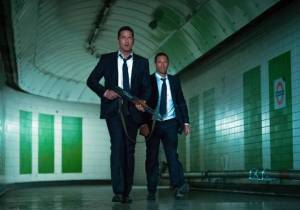 Another issue is that Butler’s character is nearly indestructible and without any vulnerability. Olympus Has Fallen didn’t wow me but it hewed closed to the Die Hard plot points and that’s a great formula to model your action movie after. In that scenario, Mike Banning was outnumbered and had to rely upon his stealth to be most effective. In the sequel, Mike has to protect the president but it’s really just the story of two buds running from place to place, having the occasional chat, and then Mike easily murdering any slew of bad guys, then repeat until the climax. It doesn’t make use of locations enough to cast out the sinking feeling of redundancy. Repetitive action sequences rely upon the concept of “more is better” when what we really demand is “more but different.” The best action movies are the ones where each sequence can stand on its own, push the story forward, makes smart use of its geography, and develops organically. There just aren’t enough of these in London Has Fallen. Our lead character is boring because he is never seen in a vulnerable position. He is told how outnumbered he is and his quippy reply is a trailer-ready line: “You should have brought more men.” This guy doesn’t sweat and only growls and stabs (lots of stabbing in this) and the R-rated violence does little to give this man anything resembling a personality. Mike is a dullard, and his personal arc of whether or not he’ll turn in his resignation from the Secret Service is one of the least believable moments of indecision you’ll ever witness. Gee, I wonder if Stabby McLoves to Stab is going to step away from his stab-heavy vocation.
With the action failing, it becomes even more apparent, and shockingly so, just how unpleasantly xenophobic and grotesque the movie’s overall political message becomes, so much so that you’d have to imagine a contingent of Trump supporters watching with baited breath and cheering mindlessly. It’s not uncommon for the bad guys in Hollywood action films to be darker-hued foreigners, so that wasn’t exactly something shocking, and the movie opens with a stab at creating a legitimate and politically pertinent grievance, a drone strike with unexpected collateral damage that obliterates a wedding party. The bad guys here have a cause that at least goes beyond blind ideology, though perhaps vengeance is actually a lesser motivation than something larger akin to ideology. They aren’t really fleshed out beyond this simple concept of vengeance or given anything larger to play with because they’re simply just villainous cardboard cutouts. And yet, most of this is expected with the territory of a typical action thriller. It’s when London Has Fallen decides to go the extra ugly mile when the movie starts becoming something far more unseemly and uncomfortable. I’m not expecting the most culturally nuanced portrayal of geo-politics, but this movie is practically a campaign ad for anti-Muslim nationalism. Our hero brutally stabs a nondescript bad guy and definitely enjoys inflicting pain. He kills another guy while screaming, “Go back to Fuckheadistan” (note to the geographically challenged: not a real standing nation as of this writing). Then it’s not enough that our hero is beating our secondary villain, he also has to deliver a speech about America’s standing and just what these pesky terrorists will never understand: “100 years later, we’ll still be here, and you’ll be dead.” What highlights these moments is that there aren’t any other political aspects in this movie, even a scant dismissive comment on something like gun control, so it feels like London Has Fallen has purposely chosen to highlight this anger and distrust of foreigners with its hero. It comes across like giving voice and credence to your crackpot uncle who, naturally, is voting for Trump to sweep them illegals and dusky-faced folk from the borders of ‘Merica.
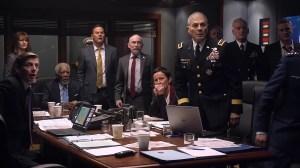 There’s an ongoing subplot in London Has Fallen that answers the question of how many Oscar nominees can you cram into a room and waste their talents. The answer, it would appear, is four, folks. Interspersed between Mike and the president on the run is Vice President Morgan Freeman (yes he has a character name but it’s really VP Morgan Freeman) deliberating in the White House with the assembled cabinet. There’s Melissa Leo (The Fighter) returning as the Secretary of Defense, Robert Forster (Jackie Brown) as a general, and Jackie Earl Haley (Little Children) as DC… something. Every time the movie has to cut back to this room full of wasted talent you’re reminded just how sad this movie is becoming. These characters don’t even have any larger bearing on the plot or any agency into the ongoing conflicts. Instead they are presented as exposition devices and reaction shots. These are some terrific thespians, including two Oscar winners, and here they are barking exposition or delivering forlorn reaction shots. We have four Oscar nominees and they’re stuck in a room, looking horrified into the camera lens, and slowly uttering lines like, “My God.” I do not begrudge actors taking paycheck roles (everybody’s got bills to pay) but this entire scenario is just an insulting waste of time.
Nobody is going to argue that Olympus Has Fallen was one of the greater works of cinema but it was a mildly enjoyable action thriller that was diverting enough to remind its rowdy audience of the Cannon genre films of the 80s. It was bloody, brutal, and fitfully entertaining (my preference was the other 2013-Die–Hard-in-a-White-House flick, White House Down). It was good enough, mostly because it hugged Die Hard closely and repeated the same plot mechanics to success. Now on its own, the sequel has to manufacture its own plotline and it doesn’t fare as well. Director Antoine Fuqua didn’t want to return for the sequel after reading the script, and this is a guy who made King Arthur and Shooter. Shooter, people! His replacement is an Iranian-born filmmaker, which just adds another level of questions for the finished product, and make no mistake, London Has Fallen is just that – product. It’s not really meant to be savored or enjoyed so much as it is processed and consumed and forgotten. The action doesn’t work well and is poorly orchestrated, often repetitive, the characters are boring, the villains are one-note, the capable actors are wasted, the overt political messages that continuously emerge are ugly and pointedly xenophobic, and the end even turns a drone strike, the same tool we saw wipe out an innocent wedding gathering to open the movie, into a crowd-pleasing climactic moment of payback. London Has Fallen is a misguided nationalistic action movie and then some.
Nate’s Grade: C-
Share this:

Kingsman: The Secret Service (2015)
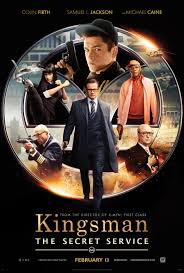 Director Matthew Vaughn’s Kingsman: The Secret Service is my favorite James Bond movie. It’s everything you’d want in a spy thriller while charting its own edgy direction. It’s a combination of Bond and My Fair Lady, and I never knew how brilliant that combination could be until Vaughn got his hands on the graphic novel source material. Newcomer Taron Egerton lays on plenty of star-making charm as a spy-in-training under the guidance of a dapper gentleman brawler Colin Firth. The spy hijinks are fun and stylish but what Vaughn does just about better than any other big-budget filmmaker is pack his movie with payoffs small and large so that the end result is a dizzying rush of audience satisfaction. The action sequences are exhilarating, in particular a frenzied church massacre made to appear as a single take. I never would have thought of the tweedy Firth as an action hero, but he sure plays the part well. There’s also an awesome villainous henchwoman who has blades for legs, and the film makes fine use of this unique killing apparatus. Kingsman explodes with attitude, wit, dark surprises, and knowing nods to its genre forbearers. Vaughn is a filmmaker that has become a trusted brand. He has an innate ability to fully utilize the studio money at his disposal to create daringly entertaining movies that walk to their own stylish beat. This is a cocksure adrenaline shot of entertainment that left me begging for more.
Nate’s Grade: A


You must be logged in to post a comment.