Blog Archives
The Amateur (2025)
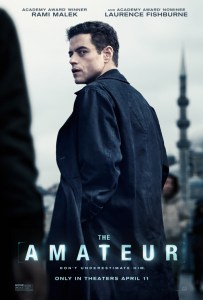 I was genuinely surprised how much I enjoyed The Amateur, which on the surface seemed like a disposable revenge thriller. I never even realized it was a remake of a 1981 movie, co-starring Christopher Plummer. If you look closer, the screenplay has so many nifty little conflicts and points of interest to further draw you in. Rami Malek plays a CIA analyst whose wife dies in a terrorist attack who takes it upon himself to seek vengeance the old fashioned way: with his bare hands. He wants to become a field agent and get retribution, and he’s willing to blackmail his superiors in order to get the approval. From there we have the bosses trying to uncover the leverage against them, there’s a handler trying to train our protagonist but also keep him contained or supervised, and then there’s our would-be amateur who struggles with more physical hand-to-hand fighting and gunplay but can think on his feet and is a whiz with technology, especially improvised explosives. He’s taking out his hit list and going up the chain while his co-workers are trying to sabotage him. There’s so many fun cross-purposes of conflict that keeps the movie entertaining even when it follows a more formulaic “oh what price this vengeance” path. I appreciated that the main character has flaws and vulnerabilities. He’s not great at certain vital aspects to being a field agent, but his determination and adaptability overcome those shortcomings. It makes for a fairly entertaining underdog story with many possible antagonists targeting around our lead. A lot of the supporting characters are pretty rote and the general plot is fairly predictable but it’s the ongoing conflicts and challenges, plus the brain vs. brawn underdog perspective that allow The Amateur to be enjoyable popcorn thrills.
Nate’s Grade: B
Share this:

Play Dirty (2025)
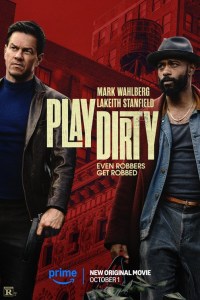 Shane Black is one of the best known writers in Hollywood across three-plus decades. His brand of witty, self-referential genre writing became its own appealing sub-genre of action cinema from the 1980s into the 90s. He resurrected Robert Downey Jr.’s career with Black’s directorial debut, the rollicking and immensely entertaining Kiss Kiss Bang Bang. Downey returned the favor by getting Black the gig writing and directing Iron Man 3. It’s been eight years since Black’s last directing effort, 2018’s messy and ultimately disappointing Predator reboot (Black actually had a small acting role in the original film). Shane Black movies are never ever boring even when they’re not completely working. Play Dirty is based on the Parker book series, a character portrayed by six other actors including Mel Gibson, Jason Statham, and Jim Brown. There are 26 of these Parker books, but after watching Play Dirty, by far Black’s worst movie, I don’t even understand what the appeal would be. This character just plain sucks.
Parker (Mark Wahlberg) is a slick professional criminal trying to score big and get his revenge. In the opening sequence, one of his heist crew, Zen (Rosa Salazar), betrays the group, steals the money, and kills everybody except Parker. He tracks her down and she’s in the middle of an even bigger scheme, one involving billions of dollars from uncovering literal sunken treasure on the ocean floor. He doesn’t like her or trust her but he sure could use his cut of a billion dollars. He taps old colleagues from other old jobs, the colleagues who haven’t been killed, and they must all work together to get their next big score.
 I was blown away by how powerfully unlikable the main character comes across. I don’t need characters to all be beholden to my opinion of likeability, but deficits in this matter are typically offset by writing the character with some degree of personality, menace, or intrigue, something that makes you want to keep watching them onscreen even if you don’t agree with everything they’re doing. However, this Parker guy, as portrayed by Wahlberg, is a big dumb guy who doesn’t recognize he’s a big dumb guy. As a result, he’s beholden to impulsive decisions that come across as cruel to the point of being sociopathic. Again, we’re used to criminal characters being flippant or prone to violence in other stories, but the introductory presentation of this character simply befuddles me and rubbed me the wrong way throughout.
Take for instance the literal opening minutes of Play Dirty. It’s in the middle of a heist but the story doesn’t start us off with the perspective of our thieves collecting their loot. It starts instead with a security guard stumbling onto their heist. He’s with his wife and child in the car and decides, rather than intervening, he’s going to use this opportunity to steal himself some of their ill-gotten loot. Right there, we’re starting with a character making a consequential choice, and our perspectives are not aligned with the robbers but with the robber of the robbers. I wanted him to get away, and frankly, following his story could have proven compelling as well, as someone who gets in over their head and tracked down by professional criminals who want what was taken. Parker gives chase through a race track and eventually shoots this man dead in front of his wife and child. Lest you think Parker is an irredeemable, unfeeling cretin, he takes stock of this woman’s grief and trauma and offers her ten thousand dollars of their loot, to bribe her silence and make amends for the murder of her spouse (that’s not even a good life insurance payout). I don’t know why Black wanted us to begin empathizing from the perspective of some guy who was only intended to be unceremoniously killed, in front of his wife and child. This move made me immediately dislike Parker, and then his little gift for the wife’s trauma felt completely insulting.
 This incident isn’t the only example of Parker being a shoot-first-ask-questions-never brute of limited intelligence. When he reunites with Zen, she’s talking with some guy who planned her new big scheme. Parker doesn’t know anything about this guy other than his physical proximity to Zen. He shoots him dead. For what reason? I don’t know what he was trying to accomplish except an expression of his impatience and hatred for life. I wonder if an elderly nun had been standing next to Zen at this moment and would Parker have committed the same rash act of violence. What about if it was his own mother? To make matters even worse, Parker accompanies Zen to break the news to the dead man’s boyfriend, and it’s in this moment of shock and grief that Parker harasses this bereaved man that Parker berates for crying. He seems to take amusement in how bluntly he informs the other man that his love is never coming back, though leaving out the key part where he carelessly murdered the man. He also shoots Mark Cuban in the leg while he dines in a restaurant for no reason other than being near the guy that he wanted. Again, much of this could be workable if the character of Parker was… anything. He’s not funny, he’s not charming, he’s not really clever or good with plans; he’s just a big dumb guy prone to violence, scowling, and deep sighs. Wahlberg looks bored throughout the whole movie and it makes the character even harder to entertain. If this guy doesn’t want to be here, can we select someone else to be our requisite protagonist?
We might have a leaden dud of a lead, but what about the rest of our enterprising team of thieves and conmen? Do we have any winners here to compensate? Sadly, the team is just as listless. Take Grofield (Lakieth Stanfield) who fraternizes as a theater owner, one who is constantly losing money. That setup has some interest, a criminal who possibly longs to be more of a professional actor, perhaps that eagerness even pushes him into suggesting different covers and roles he could play in their heists. Perhaps he might even see himself above the others since he feels like he is trying to promote the arts. There’s all kinds of ways this introduction could better shape his personality, interests, and contrasts with the other crew. For the rest of the movie, Grofield is just another guy on screen, just another guy driving a car or shooting a gun. There is one brief moment that takes advantage of his interest in acting as he poses as a drunk on a rooftop threatening to jump. After a security guard arrives on the scene, he and Parker subdue the guard, coat him in the same outfit Grofield was wearing, and then toss him off the roof to his death (ho ho). There’s a husband and wife team of crooks (Keegan-Michael Key, Claire Lovering) and that could be interesting, especially if they’re mixing professional and romantic squabbles, or maybe working together is the thing that keeps their spark going, the showcase for their real teamwork. They have one scene with some passing bickering but otherwise they too are just more indiscriminate people onscreen, another person to hold a gun or drive a car. Even the bad guys are boring. Who should I actually care about? I was rooting for that grieving mother and the one guy’s sad boyfriend to team up and punish Parker’s crew.
 Part of the fun of heist crews and con artists are the colorful personalities, the peculiarities, the intra-group conflicts and dynamics, but this movie gives us so little. It’s almost as if the characters are merely meant to trick the brain of a viewer barely paying attention, providing an assurance, “These are the guys,” without forcing thinking over differentiation. It’s like the film equivalent of not wanting to arouse like your elderly grandfather with conflicting evidence contrary to his memories. It’s like accepting defeat.
So the characters are lousy, are there any outstanding or fun caper or action scenes? Black is known for his snappy style and pulpy sensibilities across genres. He hasn’t made a boring movie yet, so I had hoped that even if Play Dirty ultimately proved lackluster, at least it would provide some flash and fun. Nope. Many of the action scenes are Parker and company just throwing caution to the wind and shooting a bunch of guys. There’s one sequence in the middle that involves actually planning and steps to draw our interest, it’s a ridiculously over-the-top plan that shows once again the crew’s disregard for collateral damage. Their valuable cargo is being shipped through the city on an elevated train, so the team decides to derail the train in the middle of the city. Not in a deserted area unpopulated by civilians, in the middle of town. As expected, the train careens off the tracks and through the city, likely causing the deaths of dozens of innocents we’ll never know because their existence is unworthy of the movie’s attention, much like the suffering of that widow and child in the opening sequence. The sequence is the equivalent of killing a mosquito with a flamethrower, and while overkill can certainly be cinematic and pleasingly entertaining, just ask Michael Bay or James Wan, it needs to exist in a world where that overkill is normalized. Otherwise, it just stands out as excessive and causes us to poke holes at the baseline reality.
Play Dirty is astoundingly dull and witless, lacking any of the spark and personality flair I expect from a Shane Black vehicle. Mark Wahlberg’s somnambulist performance is the best symbol for this entire enterprise, a crime thriller going through the motions but with its mind elsewhere. I know I certainly felt my mind going elsewhere while watching. Not just dull and tedious, Play Dirty is also just an uncomfortable experience because we’re stuck watching a group of unrepentantly amoral characters endanger and kill innocent lives in the pursuit of ill-gotten gains, but these characters aren’t intriguing, complex, memorable, or even cool, so the whole movies feels like you’re watching a pack of dude bros just randomly terrorize anecdotal characters out of sheer detached boredom and nihilism. It’s not fun, it’s actually quite the opposite of fun, and I wish Black had put more of himself into this enterprise (hey, the Christmas setting is present). Who wants to play with characters this boring and repulsive for two hours?
Nate’s Grade: C-
Share this:

Highest 2 Lowest (2025)
 Spike Lee’s remake of Akira Kurosawa’s High and Low, both of them based upon the novel King’s Ransom, is a movie in desperate need of a stronger identity. Every “Spike Lee joint” is definitely an experience that few can imitate, and his personal predilections and stylish direction often elevates the movie into something more engaging and intriguing. We follow Denzel Washington as David King, or “King David,” a middle-aged record company president who is at a career and personal crossroads. He’s trying to negotiate back enough capital to buy back controlling interest in his company, to ward off being bought by a soulless conglomerate that has no interest in protecting the decades of Black musicians given platforms. His teenage son is also kidnapped, except it’s revealed that the kidnappers nabbed the wrong kid; they grabbed the son of his chauffeur (Jeffrey Wright) instead. The movie is at its most entertaining when it dwells in this moral quandary of whether David feels as compelled to pay the ransom when it’s someone else’s child, especially when he needs that money to regain his company. I wish the entire movie had been spent over this agonizing personal guilt crucible. This is the hook of the movie. I found it hard to care once the money went out. But then David agrees to meet the ransom, deliver it personally, and it becomes a generic police thriller from there, including an Act Three where David tracks down the culprit. It’s just far less interesting than the personal stakes of what occurred earlier. There’s also an ongoing digression of analyzing what it means to be a successful Black musician, enough so that the movie literally ends on an uninterrupted musical audition meant to symbolize David feeling like the music matters to him again after so long, that this ordeal has refocused his attention to What Actually Matters. It just doesn’t feel like it meshes with the trail of conscience nor the police thriller. Highest 2 Lowest ends up being stretched into too many directions, chasing after a relevancy that seems just outside its grasp. Lee and Washington have certainly done better together.
Nate’s Grade: C+
Share this:

Weapons (2025)

Zack Cregger began his career as one of the co-creators and co-stars of the sketch comedy troupe, The Whitest Kids U Know. This led to a poorly received sex comedy, 2009’s Miss March, which Cregger co-directed and starred as the lead. Then in 2022, Cregger made a name for himself in a very different genre, writing and directing Barbarian, a movie whose identity kept shifting with twists and world-building buried underneath its simple Air B&B gone awry setup. From there, Cregger joined the ranks of Jordan Peele, John Krasinski, and other horror-thriller upstarts best known for comedy. It became a question over what Cregger would do next, which sparked a bidding war for Weapons. It’s easy to see why with such a terrific premise: one day a classroom of kids all run out into the night at the same time, all except for one child, and nobody knows why. Weapons confirms Cregger’s genre transformation and the excitement that deservingly follows each new release. Each new Cregger horror movie is a game of shifting expectations and puzzles, though the game itself might be the only point.

The premise is immediately grabbing and Cregger’s clever structural gambits add to that intrigue. Right away in the opening narration from an unseen child, we’re given the state of events in this small town, already reckoning with an unknowable tragedy. The screenplay takes a page from Christopher Nolan or Quentin Tarantino, following different lead characters to learn about their personal perspectives. It continually allows the movie to re-frame itself, allowing us to pick up details or further context with each new person giving us a fuller sense of the big picture. Rather than resetting every twenty minutes or so, the movie offers an implicit promise of delivering something new at those junctures, usually leaving that previous lead character in some kind of dire cliffhanger. With each new portion, we can gain some further insight, but it also allows the story to ground its focus and try on different tones. With Justine (Julia Garner), we see a woman who is trying to figure out how to regain her life she feels has been unfairly stripped away, and many of her coping mechanisms are self-destructive old habits. With Archer (Josh Brolin), we see a father consumed by his sudden loss and the reflection it forces him into, while also obsessing over what possible investigative details he can put together to possibly provide a framework of an answer. Then with other characters, which I won’t spoil, we gain other perspectives less directly involved that approach a dark comedy of errors. At one point, you may even wonder when the movie is going to remember those missing kids again. I appreciated that Cregger resolves his mystery with enough time to really examine its implications. This isn’t just a last-minute twist or Scream-like unveiling of the villain coming to light. I also appreciated that it ends in such an enthusiastic climax that left me cackling and cheering. It’s a mystery with a relatively satisfying answer but a climax that is also cathartic and exhale-inducing after all the dread and build-up.

The technical elements are just as polished as its knotty screenplay. The movie is genuinely unnerving at many points. Even the image of kids Narutu-running off into the night is inherently creepy. There are a few cheap jump scares but most of the movie is built around a quiet sense of desperation and dread. Cregger prefers holding onto shots to build tension, like a door opening and waiting for something, anything to pop out of the darkness. There are moments that made me wince and moments that made me gasp, like suddenly being compelled to stab one’s face with a fork dozens of times. However, a significant drawback for me was the lighting levels of the cinematography. To be clear, the photography was eerie and very evocative. My problem is that this was a movie whose light levels were so low it made it excruciatingly hard to simply identify what was happening onscreen. I’m sure my theater’s dim projection was part of this, but this is also a trend with modern movie-making, the murky lighting, like everyone is trying to recreate those Barry Lyndon’s candle-lit tableaus. Sometimes I just want to see what’s happening in my movie.
Weapons is certainly a thought-provoking premise, but with some distance from the movie, I’m starting to wonder what more there may be under the surface. Now not every movie has to be designed for maximum layers and themes and metaphors; movies can have their own points of appeal before getting to subtext. I do think most viewers will find Weapons engaging and intriguing, and the slippery structure helps make the movie feel new every twenty minutes while also testing out different tones that might have been too obtrusive with different characters and their specific perspectives. However, once you straighten out that timeline and see things clearly, it begs the question what exactly Cregger is actually saying. The sudden and disturbing horror of a classroom of children all disappearing has to have obvious connections to school shootings and mass killings, right? The trauma image is too potent and specifically tied to schools to be accidental or casual. Taking that, what is the movie saying about our culture where one day, any day, a class full of young children can just go missing? Despite a literal floating assault rifle appearing in a dream, there doesn’t appear to be much on the movie’s mind about gun violence or even weapons in general. I’m reminded of my favorite movie of 2020, the criminally under-seen Spontaneous, which explored a world where one high school class of students lived under the threat that at any time they could explode. There was no explanation for this strange phenomenon, though scientists certainly tried, and the focus was instead on the unfair dread hanging over their day-to-day existence, that at any moment their life could be forfeited. The parallel was obvious and richly explored about the pressure and anxieties of a life where this very disturbing reality is considered your accepted new normal. That was a movie with ideas and messages linking them to its school-setting of metaphorical trauma. I can’t say the same with Weapons.

I’ve read some people analyze each one of the characters as one of the stages of alcoholism, and I’ve read other people argue that the movie is an exploration of a town come undone through unexplainable trauma, but I seriously doubt that last one. Don’t you think the mystery of the missing class would draw national and international media attention? Hangers-ons thinking they cracked the case? Intruders harassing the bigger names? People trying to exploit a tragedy for money or a sense of self-importance? Conspiracy theorists linking this mystery to their other data points for a larger conspiracy? It doesn’t feel like the impact of this unique mystery has escaped the county lines. Certainly there are characters searching for answers and treating this poor schoolteacher as a scapegoat for their collective fears and anger, but by turning the screenplay into a relay race where one character hands off to the next for time in the spotlight, it doesn’t expand our sense of the town and the broader effects of this bizarre tragedy. Instead, it pens in the characters we do have, which all seem to interact with those very same characters, making the bigger world feel actually smaller. Narrowing the lens of perspectives makes it more difficult to articulate commentary about community breakdown in the face of uncertainty. The creative choices square with the central mystery and the nesting-doll structure, playing a game with the audience to discover the source of this incident, but once you discover that source, and once we reach our ending, you too may appreciate Cregger’s narrative sleight-of-hand but eventually wonder, “Is that all there is?” Maybe so.
Weapons is an effective and engaging follow-up for Cregger and confirms that whatever stories he feels compelled to tell in horror are worthy of watching, preferably with as little prior information as possible. You definitely feel you’re in the confidant hands of a natural storyteller who enjoys throwing out surprises and shock value. I have some grumbles about ultimately what might all be behind that intriguing mystery and the lack of foundational commentary that would permit multiple viewings of close analysis. Then again not every movie is meant to be a repeat viewing. Some movies are one-and-dones but still enjoyable, and that might best sum up Weapons. It’s sharp and cleverly designed but maybe lacking a finer point.
Nate’s Grade: B
Share this:

Jurassic World: Rebirth (2025)

“Rebirth” might be a bit optimistic in that title. The issue with the still-quite-popular Jurassic Park/World franchise is an ongoing lesson in diminished returns. Back in 1993, Steven Spielberg and special effects breakthroughs enchanted audiences on the peril of man’s hubris and the core love and undying appeal of dinosaurs getting to be wrecking machines. Thanks to the marvels of modern big-budget blockbusters, we can bring realistic dinosaurs back to life for perilous adventures in survival, but much like the famous line, the producers eager to crank out a new Jurassic movie every so many years only focused on whether they could and not whether they should. The movies are still significant moneymakers; the worst film in the franchise, 2022’s Dominion, still made over a billion dollars at the global box-office. Just imagine how much that could have raked in if it was actually, you know, good. Jurassic World touched upon the nature of diminished returns through satire, that audiences that were once wowed by the very presence of real dinosaurs have grown bored and need more to capture their flagging interest. Since then we’ve had a movie about dinosaurs eating the rich in a haunted house-style horror-thriller and a nostalgic-heavy conclusion that was more about giant locusts and far less about dinosaurs cohabitating with mankind. The interesting storyline (man co-existing with dino) has been there for multiple movies, and yet the producers keep neglecting that glorious potential. Now here comes Jurassic World: Rebirth, another attempt to keep this franchise chugging along with more mediocre sequels that have fleeting moments of popcorn thrills. Ultimately, it’s a bit more of the same, and like the characters in this world, I too am growing restless.

There are two groups of characters that we follow. The first is a clandestine science team funded by a large pharmaceutical company looking to create the next big drug as a result of studying dinosaur blood and tissue. This is the familiar movie world of quippy security experts and ex-CIA agents and panicky scientists thrust into danger in the field. The other group is a family going on a sailing trip through… dinosaur-infested waters for some reason. The first group is on a mission. The second group is just trying to survive, and possibly for the teen daughter’s boyfriend to grow on her skeptical father.
Rather than reinvention, Rebirth is once again more of the same old same old. There can still be intrigue and spectacle from simply interacting with living dinosaurs brought to life by the best special effects money can buy, so the Jurassic movies will never be without some level of primal appeal. There are some fun moments and sequences throughout Rebirth, but it’s hard to stitch together the whole movie from these minor pieces. I think the premise could have worked. The team on the mission has to track down and retrieve blood from the three biggest dinosaurs by habitat: one by land, one by sea, and one by air. There’s some flimflam excuse that these creatures have the biggest hearts and therefore the live blood they extract blah blah, but it doesn’t really matter. The premise of having to track three of the biggest dinos in different terrains makes for an episodic but varied structure that is easy to follow and engage with. All along the way, we know what the total number needs to be and the progression provides mini-climaxes. It’s just that the retrieval of all of these is completed before Act Three. That’s right, it’s all done before the movie is supposed to get really climactic and intense. The land dino isn’t even a challenge, more just an attempt to recreate the majesty of when we first saw those plodding apatosaurs in 1993. This feels like a mistake, and each of the dino retrievals should be getting moderately harder to succeed. There should be escalation so that each one feels more like an accomplishment with the team getting better not worse.

So what could be Act Three? Well you see, dear reader, this is yet another new island. I can already hear you asking how many islands there are, and the answer is however many the studio needs. This island could have been nicknamed Monster Island because it was the dinosaur experimentation labs. Here’s where the InGen scientists threw darts at a board and said, “What if you mixed a [anything] with a raptor?” That seemed to be their go-to for these sequels. We’re introduced into mutant T-Rex in the opening, presented like a monster lurking in the shadows, and then we come back to our giant lab-designed monstrosity. Except this is the silliest looking dinosaur mutant. I laughed out loud when I saw its full form. It made me think of the xenomorph and human hybrids from Alien Resurrection. Its head is so bulbous like he’s part mushroom, but there’s no contours or anything menacing like spikes or something evolutionary useful. It’s just a big goofy head. This is the kind of dinosaur that would be made fun of by the other dinosaurs who snicker when his considerable back is turned. It has larger forearms but walks with them like a hunched gorilla. A T-Rex was already frightening because of its size, as evidenced during one of the movie’s better sequences where a normal T-Rex chases after the beleaguered family in a raft. This just made the T-Rex’s head comically oversized, like somebody glued a shower cap on this guy. This guy has a bigger head but it doesn’t mean bigger brain. It makes for a rather perfunctory and silly ending fighting against a disappointing dino Frankenstein. We shouldn’t have held our expectations too high considering this mutant’s lab breakout all stems from a lone Snickers candy wrapper getting loose.
The characters are also pretty disposable and strictly archetypal. Scarlett Johansson (Fly Me to the Moon) is the lead as our quippiest ex-CIA agent, more or less playing a version of her Marvel persona. She has a slight arc about joining the mission for the money and being convinced by the idealistic head scientist (Jonathan Bailey) to release the medical information to the entire planet. I don’t think this is as hopeful as the characters think because it seems like you’re also making it so plenty more mad scientists have access to dino DNA to make their own at-home Jurassic Parks. The other lead character is played by Mahershala Ali (Leave the World Behind) as the boat captain who provides the movie with the most disposable of characters so that the dinosaurs have something to feed upon. It doesn’t seem like a coincidence that the one lost family is gifted a dinosaur baby that they trot around like an adorable puppy. That thing’s going to get extremely big and I don’t know if anybody is going to be able to pick up after it. I wouldn’t say any of these characters are memorable or even that likeable, mostly stars coasting on charm autopilot.
I didn’t know where else to put this but I loathed every time the Jurassic Park musical themes would start to trinkle into a scene, especially since so many of them are perplexing. Why would you insert that familiar theme over this scene? It’s intrusive, tone deaf, and just a bizarre creative choice.

It’s hard to really see the added value of returning veteran screenwriter David Koepp (Black Bag) and new director Gareth Edwards (Godzilla, The Creator). This whole enterprise feels a bit like a runaway train rushing to meet its release date deadline. The development needed for a relaunch seems to go by the wayside so that we can squeeze in more set pieces, and I suppose two sets of characters equal always having a new and fraught action sequence we can jump to. It’s just that everything feels so rote and familiar, so much of the same kinds of thrills and chills we’ve gotten from the previous six movies. The most exciting development across these new movies since 2018 has been the reality of humans having to adapt to an Earth with dinosaurs in our ecosystems, and yet this again is hand-waved away in exposition that limits the dinosaurs to a much smaller band of the Earth. Turns out they only really live around the Equator now. Okay, if that’s the case, then tell me a story from that setting. It can still be done. Jurassic Park: Rebirth doesn’t feel like the start of something new or exciting or even promising. It feels like more of the same, sliced and cut up with different actors getting their turn to make frightened faces. It’s not as bad in design or execution as Dominion but Rebirth is no more than more of the same.
Nate’s Grade: C
Share this:

Ballerina (2025)
 It’s a John Wick spinoff that tests whether or not the franchise can extend itself without John Wick. Then the producers got a little nervous and re-shot the movie extensively, adding extra John Wick (Keanu Reeves) scenes and even a clunky title to remind all those forgetful viewers: From the World of John Wick: Ballerina (not to be confused with, From the World of Jurassic World). Taking place between Wicks 3 and 4, Ballerina follows another formidable assassin kill lots of people until finally toppling a boss at the top and fulfilling their personal vengeance. The aforementioned dancer is Eve (Ana de Armas) who is the daughter of assassins and whose father was killed by assassins so she trains to be an assassin and thus kill the assassins that assassinated her father for wanting to step away from being an assassin. The plot is less important than the action combat, and while Ballerina doesn’t rise to the rhapsodic levels of action nirvana from its franchise forebears, it does have consistently entertaining action choreography and development. It’s a good movie with a few moments of greatness, like a kitchen battle that makes clever use of everything in range and a climactic flamethrower vs. water hose battle for the ages. I enjoy that Eve is still vulnerable. She’s deadly but she still makes mistakes, can slip and fall and make the wrong moves in fights, providing the sequences better stakes and intrigue over how she exactly will overcome her latest obstacles. de Armas (Blonde) takes up where she left off in 2021’s No Time to Die and proves herself an adept physical performer of action. It’s a decent mid-tie action movie that throws more world-building nonsense at the wall that you can tune out. There are other Wick cameos from Ian McShane, Angelica Huston, and the late Lance Reddick who died in 2023. Ballerina can scratch that John Wick itch (now with extra John Wick) for fans but I don’t know if it deserves a second dance.
Nate’s Grade: B-
Share this:

Drop (2025)
 It’s a bad sign when you forget seeing a movie mere weeks later, and thus is my state with the contained thriller Drop, a movie that never seems to take full advantage of its modern drawing room mystery-thriller premise. Director Christopher Landon (Freaky, Happy Death Day) finds all manner of visual artifice to make the best of this story of one woman’s worst fears re-entering the dating scene. Violet (Meghann Fahy) attends a first date in one of those high-rise skyscraper restaurants, and during the date she’s harassed digitally by an unseen stalker who is sending hostile text messages and increasingly intense demands. Who in the restaurant could be the culprit, and why? Also, can she salvage this first date with this cute guy becoming more alarmed as the night progresses? The fun of the scenario rests in how our protagonist can keep ahead of the suspicion of her date while also trying to stay ahead of the suspicions of her antagonist as she deduces who in the restaurant might be her creep. It’s entertaining enough but the problem lies in the escalation of demands from the antagonist, including murder, and the movie doesn’t have the interest or stomach to go wilder or more extreme. As a result, Drop feels like an under-developed nosy neighbor movie, trying to suss out details with an informal investigation that never really takes off. Landon does his best to jazz up the proceedings with very intrusive visual designs of the ominous texts and messages, filling the screen with literal threats. It reminded me of 2014’s Non-Stop where Liam Neeson was on an airplane and being harassed by an unknown caller who plots to take down the plane. That premise had elevated stakes because of its location and urgency. This movie is about a woman on a date. You can see there’s a bit of a difference in their execution and aims. I can’t work up too many negative criticisms about Drop because it sets out to achieve what it promised, it’s just by the time we get into the third act action heroics away from that central setting, you may be checking your phone too, having already checked out.
Nate’s Grade: C
Share this:

Layer Cake (2005) [Review Re-View]
 Originally released June 10, 2005:
Layer Cake may be the least intimidating name ever for a crime movie. It conjures images of bridal showers, cooking shows, and birthday parties. It does not necessarily bring to mind thoughts of gangsters, assassins, drug trafficking, and the seamy underbelly of London’s criminal underground. Unless you’re watching some really awesome cooking show I don’t know about. The “layer cake” in question refers to the hierarchy of criminals. This isn’t unfamiliar territory for Matthew Vaughn, who produced Guy Ritchie’s Lock, Stock, and Two Smoking Barrels and Snatch. This time it’s Vaughn sitting in the director’s chair and the results are exceptionally entertaining. Layer Cake is a cinematic treat.
Daniel Craig (Road to Perdition) plays our untitled lead, referred to in the end credits as “XXXX.” He’s a cocaine dealer but not a gangster by any means. He wants to make his money, not step on any important toes, and then walk away on top and without any gaping holes in his body. Craig is summoned by his boss Jimmy (Kenneth Cranham) and given two missions, whether he wants to accept them or not. The first is to relocate the missing daughter of a very powerful friend of Jimmy’s. The second, and far more dangerous job, is to secure a package of millions of stolen ecstasy pills and make a profit. Complicating matters is the angry Serbian mob that the pills were stolen from. They’ve dispatched a deadly assassin known as Dragan to track down their stolen drugs and kill anyone involved. Craig is left to juggle the investigation, find a buyer, stay ahead of Serbian hitmen, get some time in with a hot new girl, and all the while keeping his higher-ups content enough not to kill him themselves.
 Layer Cake should be the film that makes Craig the star he so rightfully deserves to be. This man is a modern day Steve McQueen with those piercing blue eyes, cheekbones that could cut glass, and the casual swagger of coolness. Craig grabs the audience from his opening narration as he explains the ins and outs of his business. We may never see Craig sweat but he still expresses a remarkable slow burn of fear so effectively through those baby blues. He’s in over his head and the audience feels his frustrations. In an interesting character twist, when Craig does resort to killing, he’s actually tormented and haunted by his actions.
As with most British gangster flicks, there are a batch of colorful characters that leave their mark. Dragan (Dragan Micanovic) is a wonderfully enigmatic ghost of an assassin always one step ahead of Craig and the audience. Morty (George Harris) and Gene (Colm Meaney) add heart and bluster as Craig’s trusted right hand men. But the actor who steals the whole film with a malevolent glee is Michael Gambon (Harry Potter and the Prisoner of Azkaban). He plays Eddie Temple, the man behind the men behind the scenes. Gambon delivers the harshest of speeches with a velvety pragmatic calm. We don’t know what runs deeper with Eddie, his tan or his scheming.
Sienna Miller plays the thankless love interest to Craig. She’s pretty, sure, but there isn’t much acting ability on display in Layer Cake beside some smoldering glances. We never really know what Craig sees in her besides being another cute blonde to choose over. Miller isn’t alone in the “underwritten character department.” Layer Cake is crammed with secondary characters that pop in and out when it’s necessary. It’s not too annoying but it does mess around with an audience?s ability to follow along coherently.
Layer Cake is not one of the slick, whack-a-mole ventures Ritchie has given us (pre-Madonna). No sir, this is a brooding, serious and nearly terrifying look at the old adage “crime doesn’t pay.” Very few crime centered films express the day-to-day anxiety of just being a criminal. Jimmy reminds Craig that he’ll never be able to walk away because he’s too good an earner for his higher-ups. In Layer Cake, you can get killed for being too greedy, being too careless, being too good at your job, and even just being in the wrong place. Eddie sums it up best whilst describing Faust: “Man sells his soul to the devil. It all ends in tears. These things always do.”
 Vaughn has a polished visual sensibility that doesn’t overwhelm the viewer. He keeps the camera fluid and steady with a minimal amount of cuts. A nifty opening scene involves an imaginary drug store (stocked with pot, cocaine, and the like) melting into a real drug store (one hour photo, impulse items at the register). When the tension does mount Vaughn knows just how to turn the screws. A late sequence involving a chase between the SWAT team and our batch of criminals had me on the edge of my seat. For a first time director, Vaughn also has great patience. He doesn’t rush his storyline and he doesn’t suffocate his movie with visual flourishes. He also has a great deal of faith in his audience’s intelligence. This isn’t as lively as Snatch or Lock, Stock, but that’s because Vaughn’s film is also much more serious and dangerous.
This is an intricate and gripping film but it might be a little too complex for its own good. Twists and double-crosses are expected in this genre, but writer J.J. Connolly has so many characters running around and so many hidden agendas that it’s nearly impossible to keep track. Some of the subplots and back stories add very little like the inexplicable “Crazy Larry” flashbacks. I left the theater still confused about plot points but refreshingly satisfied nonetheless.
Layer Cake is the most thoroughly exhilarating time I’ve had at a theater this year. This pulpy daylight-noir caper is full of memorable hoods, plenty of twists and turns, and a star making performance by the steely-eyed wonder that is Daniel Craig (rumored to be the next 007, though in my heart I’ll always root for Clive Owen). Fans of Ritchie’s frenetic gangster flicks should be entertained. Anyone looking for a clever and exciting potboiler that treats violence and crime seriously should start lining up immediately. If you’re suffering from the cinematic wasteland that 2005 has shaped up to be so far, then have yourself a generous helping of Layer Cake and thank the Brits.
Nate’s Grade: A
——————————————————
WRITER REFLECTIONS 20 YEARS LATER

Back in 2005, Layer Cake was really a proof of concept movie for many items. It was proof that someone could take a Guy Ritchie-style crime pot boiler with colorful Cockney criminals and plenty of twists and unexpected violence and play it straight and serious. It was proof of Matthew Vaughn as a director, who had previously served as a producer of those early Ritchie films. It was proof of Sienna Miller as the next It Girl, a proclamation that carried her for years despite mixed results with the movies. Most of all, it was proof of its lead, Daniel Craig, as being so suave he should be considered the next possible 007. James Bond producer Barbara Broccoli has gone on the record saying this movie is what officially put Craig on their radar and got him the gig that has defined his career trajectory. Twenty years later, Layer Cake is still a potent and smooth little thriller that glides right by on its intelligence, sex appeal, and Craig’s charisma
I find myself agreeing with so many of my original points from 2005 so I don’t want this re-examination to be merely a “ditto” without some additional critical analysis. Even though it’s based on a book by J.J. Connolly, who adapted his own novel, the movie feels very much in the company of those early Guy Ritchie movies that Vaughn began producing. Ritchie burst onto the international scene with 1998’s Lock, Stock, and Two Smoking Barrels, a brash and stylish crime comedy with outlandish characters, violence that alternated between visceral and slapstick, and twisty plots that often left your head spinning. It was like a mixture of Tarantino and a more lewd Looney Tunes cartoon. While the early Ritchie films, including my favorite, 2001’s Snatch, have their share of characters with grounded stakes, the reality is exaggerated, with the appeal being these grandiose personalities butting against one another. No one would confuse one of these Ritchie movies with a realistic portrayal of London criminals. They’re fun. What Layer Cake does so well is take a Ritchie-esque premise with plenty of low-life screw-ups and hardasses and plays it straight. It takes this middle-level drug distributor and makes his life less a comedy of errors and more a never-ending anxiety attack about how he can become undone from any angle. The movie sure doesn’t make a life of crime look appealing.
 Craig’s character, named XXXX, is a smart guy just trying to keep his head down and do his job. The problem for him is that he’s too good at earning money for bad men who like money. In this life, you can get killed for any number of reasons, some of them logical and pragmatic, and others rash and illogical: not being a good enough criminal, being too good of a criminal, thinking he’s too good of a criminal, someone else wanting to make a name for themself and establish cred by going after you, dumb luck, etc. XXXX has his rules and standards to live by to ensure he limits his risk, but when your profession is literally dealing with money and unscrupulous types, there is no absolute zero in that risk. He may be smart and measured but he’s also working with plenty of stupid people who don’t know they’re stupid, and then you mix in vice and avarice with that, and it can be a combustible cocktail of dangerous idiots intruding on whatever peace and distance XXXX has cultivated for himself. In the movie, XXXX is burdened with competing tasks. He’s been offered a stash of stolen ecstasy pills, and his slimy boss wants them sold no matter what, but the assassin hired to retrieve them definitely wants them back too. Either way, our lead character is endangering himself by making someone unhappy. He’s dropped into the sticky morass of power plays and competing interests that will challenge his intended neutrality.
I think the ending for Layer Cake is brilliant and very fitting. For almost two hours, we’ve followed XXXX through hell and back and it looks like he’s found a way out, siding with the right hoodlums and eliminating different risky angles needing to be resolved. He’s kept to his stated retirement of not going out on top and instead going out while comfortable and capable. He’ll leave the business to his associates because he’s tired of looking over his shoulder. And as he walks out with his pretty lady (Sienna Miller) around his arm, that’s when he abruptly gets shot by Sidney (Ben Whishaw – yes, the future James Bond is killed by his future Q). This isn’t some tough or some hotshot; he’s a lanky nephew to another gangster, and he hasn’t exactly shown anything close to a killer instinct. In his brief appearances beforehand, he’s seemed out of place, like a latchkey kid who wandered into a criminal enterprise and everyone has been humoring him for good measure. The only thing he has is… was… the blonde girlfriend (Miller) who’s clearly not interested in him. After playing it so cool and calculated, he’s taken out by this twerpy nobody because he had the audacity to try and steal “his girl.” Even if you are the smartest guy in the room and you’ve made all the right moves, all it takes is one twitchy trigger finger and one grumbling grievance to take you from living to dead. Our hero is denied his happy ending driving off into the sunset with his modest sums of money and his newly acquired pretty woman. Try as he might, XXXX, gunned down mid-sentence as he reveals his real name, becomes just another unfortunate corpse.
 Vaughn’s skilled direction immediately made him an attractive target for bigger studio fare. He was originally attached to direct 2006’s X-Men: The Last Stand but left weeks before filming for stated “family reasons.” In 2023, Vaughn revealed that he left because of the tight production timeline, going from pre-production to a complete movie in under a year, but it was really the shady behavior of Fox execs that pushed him out the door. Apparently one exec put together a fake script to lure Halle Berry back, including scenes of her character Storm saving vulnerable children in Africa to appease Berry, scenes that were never intended to ever be filmed. It was a ploy to trick her into signing onto the film. After two more geek-friendly adaptations, 2007’s Stardust and 2010’s Kick-Ass, Vaughn was courted yet again back to the X-Men franchise. Once again there was a tight one-year turnaround deadline but Vaughn stayed on board and delivered what I consider to be the best X-Men movie, 2011’s First Class. It revitalized the declining franchise, enough so to lure Bryan Singer back. Singer had departed in 2005 to make his Superman movie, opening the door for Vaughn’s first foray with the world of mutants. Now that Vaughn had reinvigorated the franchise with a new cast of younger actors, Singer was ready to take it back to helm 2014’s Days of Future Past. Vaughn was rumored as one of the potential names to make the first new Star Wars movie in ten years. Instead, he made his own action franchise with 2015’s Kingsman. Granted it was based upon the comic by Mark Millar, the same author behind Kick-Ass and Wanted, but it was Vaughn’s signature all over this new spy franchise. Vaughn had constructed a new Bond for a new age. At this point, I was dubbing Vaughn the best working director to use studio money. Each movie was different but made with style and panache with great structure and payoffs. And then…
I think he got so enraptured with the world of Kingsman that he’s now trapped himself creatively. In the ensuing years, he’s made one Kingsman sequel and one prequel, both of them varying degrees of underwhelming, and another action spy-thriller that might as well be called Kingsman-lite, 2024’s Argyle. For an artist that was dabbling with so many genres beforehand and finding sure footing and a way to make his stamp within each, he now feels stuck, finding diminished returns with each iteration of yet another swanky spy action movie with snark. I’m not even an Argyle hater, a movie that appeared on numerous Worst of the Year roundups but one I consider perfectly fine as a TNT Sunday-afternoon kind of chill entertainment. I loved Kingsman when it was originally released in 2015, but looking back, it appears like this was Vaughn building his own prison brick by brick. Maybe he was too preoccupied with turning it into a franchise with many tendrils stretching all over. I truly wish Vaughn would hop genres once again and leave the realm of spy action to others at this point. Maybe he needs a return to something straight akin to Layer Cake without its tongue already so firmly implanted in-cheek.
 But this movie will forever be known as the movie that secured Craig as the next James Bond. He had been working in movies for a while with some high-profile supporting roles like 1998’s Elizabeth and 2001’s Tomb Raider and 2002’s Road to Perdition, but this was a platform that showcased the suave presence of this actor like nothing before. He was so magnetic and a perfect choice for this character, and just listening to him try and talk his way out of jams with so many loose canons was as impressive and entertaining as any high-stakes chase or shootout. These sort of star-making roles are rare and even more rare when they do indeed prove to be star-making. It becomes an artifact to analyze what qualities people with money and influence were won over by. It’s interesting that Craig’s character is so anti-guns and wanting nothing to do with the more unsavory and violent aspects of his profession. When he does hold a gun for the first time, one he compliments as being “really pretty,” he holds it out and strikes a pose, dashing through a hallway like he was James Bond, and it’s just especially funny with hindsight.
The movie is also filled with familiar faces that would become even more familiar over the years, including Tom Hardy, Sally Hawkins, Whishaw, Burn Gorman, and some Vaughn regulars, alums from Snatch and Lock, Stock, Jason Flemyng and Dexter Fletcher. Flemyng became Vaughn’s lucky charm, appearing in his first four movies in some capacity, much like Greg Grumberg does for J.J. Abrams. There you go, an SAT-style relationship sentence I never thought I’d write: Jason Flemyng is to Matthew Vaughn as Greg Grumberg is to J.J. Abrams. My original review in 2005 highlighted Michael Gambon as the biggest honcho, the top tier of this criminal layer cake. I wrote: “He plays Eddie Temple, the man behind the men behind the scenes. Gambon delivers the harshest of speeches with a velvety pragmatic calm. We don’t know what runs deeper with Eddie, his tan or his scheming.” He’s so good at being so malevolent without ever having to raise his voice or anything outwardly hostile.
 This movie has a personal factor for me because I was so highly anticipating it that, during a trip through the British Isles with my father in May 2005, I bought it on VHS overseas. I naively thought that while DVDs had different regions to thwart piracy, that VHS tapes would be rather universal considering it’s just tape being read. I got home, popped it into my American machine, and the thing wouldn’t work. This was one of the biggest souvenirs I got for myself during that trip, which my father wanted to embark as something memorable we could share together, and now that he’s recently passed, I do think back on those experiences and part of me wishes my 23-year-old self would have been more actively appreciative. So now with Layer Cake, part of me will always think about that VHS tape, and that trip, and my father, and it will make me miss him more, but I am glad we got to share that experience.
Ever since I’ve been doing this re-review project, now going on five years, it’s a relief to see my twenty-year-younger self having written a smart and articulate review, especially when I mostly agree with it even so many years later. Again, I find myself nodding along to just about everything I had written with my past critique, from singing the praises of Craig and the general examination of day-to-day anxiety, to shaking my head at the underdeveloped Sienna Miller character served as little more than a trophy for our hero to take with him into retirement. It still is a movie overstuffed with characters and storylines and antics that probably could have been trimmed around the edges, but that same burdensome feeling connects with the emotional state of our lead, the anxious feeling of having too much to do and not enough time to achieve it, so in a way, it’s excusable. I don’t know if I think the movie is quite at the same level, calling it “thoroughly exhilarating” seems a bit much, but Layer Cake is still a movie that proves fresh even twenty years later, and one worth a second helping.
Re-View Grade: A-
Share this:

A Working Man (2025)
 You can see the reasoning behind a movie like A Working Man. It’s based on a series of popular novels by Chuck Dixon, and it looks like a spiritual sequel to 2024’s The Beekeeper, with the same director and star and roughly the same formula of bad man comes out of retirement to enact extreme vengeance on bad people. While The Beekeeper was entertaining mostly for its incredulity and becoming a self-parody of these kinds of loner action vehicles, A Working Man just feels like any other mediocre genre entry that populates the realm of lower-budget direct-to-streaming action. Jason Statham stars once again as a man of the people, a construction foreman, who also happens to be an ex-Royal Marine. The daughter of a friend is abducted for sex trafficking, or taken if you will, and Statham has to use his particular set of skills to crush some skulls and save the girl. I’m struggling to remember much of this movie because there’s nothing that truly stands out. It goes about its business with a pre-programmed utility, delivering Statham to a new bad guy every ten minutes or so as he works his way up the scuzzy ladder of bad men in bad suits. I guess that might be something memorable, one of the bad guys has an exquisitely bad suit, enough that others even question and comment. There aren’t any memorable villains or exchanges or even action sequences. It’s all so rote and mechanical and so easily forgettable. There’s nothing here worth spending almost two hours for, and there’s certainly little here to get anyone excited for a possible franchise of Statham being a faux working man striking back for the little guy.
Nate’s Grade: C
Share this:

The Accountant 2 (2025)
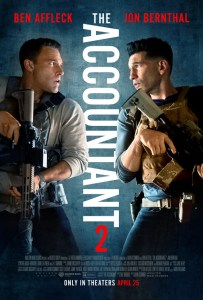 I’m going to start this review by doing what everyone loves to read, the author patting themself on the back. Back in 2016, I found The Accountant to be an enjoyable thriller with a compelling main character that answered the question, “What if Jason Bourne was actually interesting as a character?” I concluded my original review with this observation: “It’s rare that a movie leaves me wanting more, and it’s even more rare when a movie leaves me wanting to watch a weekly variation of Christian Wolff living as whiz kid accountant by day and enforcer of justice by night.” Over the years, The Accountant became one of the most popular streaming movies, a real word-of-mouth sensation that gave it life long after its theatrical release. It was enough that another studio, Amazon MGM, wanted to buy the rights to pay Ben Affleck to produce a sequel that hit theaters and now is available on streaming, thus ready to be the next great movie that dads fall asleep to. It took longer than expected but The Accountant 2 does fulfill my request, showcasing what a regular series could be, for better and worse.
Christian (Affleck) is like Batman if Batman had Autism and did his own taxes. He has a multi-million-dollar foundation that looks for wrongs to right, and this time he’s called back into the action by the sudden death of Ray King (J.K.Simmons), the retired agency head who was tracking the elusive accountant for years. Ray was obsessed with a family lost to human trafficking and hoped to find the missing child. Christian takes up the case and invites his once-again estranged brother Braxton (Jon Bernthal) to help.
 The positives from the original Accountant still shine through, namely the entertainment value of Christian as an outsider character trying to fit into the larger world. He’s an unexpected and often funny person but also a man with his own code of justice, and it’s a treat to watch him bomb through a marathon of speed dating one moment and punch guys in the throat the next moment. Affleck is still enjoyably dry as the lead, and the movie is at its best in the moments where Christian and Braxton are butting heads. It takes a longer than it should to reintroduce Braxton and bring him back into Christian’s orbit, but once the brothers are together, the movie coasts on a chummy buddy comedy dynamic that can reliably work no matter the setting. That’s one of the features that led me to apply the movie into a TV adaptation; the characters are what make ordinary encounters that much more entertaining, and TV is the premiere realm for characters. We tune in on a weekly basis because we want to discover what the characters we love will do next. While The Accountant 2 is certainly a few steps behind its predecessor, the core dynamic that made it enjoyable for so many should still prove appealing to those same legions of fans.
The movie also demonstrates some creaky choices and execution that manages to make it feel less like a full and vital sequel and more like an iffy showcase for turning the franchise into that weekly TV series. The central mystery feels lifted from any generic crime procedural about discovering a human trafficking network. The particulars aren’t that interesting or complicated or even that surprising given the general public’s understanding of human trafficking nowadays. I was waiting for this storyline to give us a little insight into the people most affected, the vulnerable families being exploited as they risk everything to search for a better life or more stable employment. I was waiting for something extra that felt like this storyline would be anything more than a ripped-from-the-headlines rescue mission, and it just doesn’t materialize. Much like 2023’s Sound of Freedom, the complex issue of human trafficking gets boiled down to whether or not our characters can save one unfortunate child. Hilariously, during the climax, the movie keeps cross-cutting between the brothers riding to liberate the kids from their imprisonment and an excavator digging a hole intended to be the kids’ mass grave. One inclusion is enough for us to understand the stakes, but the movie keeps cutting back repeatedly, as if anxiously asking, “Oh no, will the bad guys get the grave completely finished in time for the kids to be dumped inside?”
Already it feels like we’re sanding things down in order to fit a formula. Another indication is the relationship between the brothers. Apparently the brothers have not seen nor spoken with one another since the events from the first movie eight years ago. This is odd considering much of that movie’s story was divided with the Braxton character in parallel and finally recognizing his long-lost brother. After all their years apart it feels more likely that they would have stayed in touch or better. By not going that route, the sequel gets redundant reuniting the brothers again, but this time they’ll actually stick it out because they’ve gone line dancing together and killed even more dudes, the two most brotherly-bonding activities possible. It feels like setting up the team for more fun adventures.
 Although redundancy is part of what holds back the movie. Take for instance back-to-back introduction scenes for Braxton. Our first scene is him trying to psych himself up, and we may think it’s for a date or to talk to a woman he likes, but it’s actually to ask whether or not he can adopt his selected puppy even earlier. Funny, sure, and gets to his loneliness. The next scene he’s trying to have a conversation with a woman who is clearly not as interested and this perturbs him, and upon him leaving we see the trail of bodies he has left behind in the aftermath of some job. Both of these scenes are accomplishing the same thing: Braxton has difficulty connecting with others and is lonely. Why did we need the first scene when the second conveys the same information plus his formidable nature? Braxton even brings up his desire to get a dog later and Christian considers his brother more a “cat person” because he lacks the stable job and responsibility to care for a canine. This moment could have been the first time the film introduced Braxton’s desire for a pet. We don’t gain much from knowing this already. This may seem slight but it’s indicative of a movie that is filling time (hence the mass grave cutaways). For a movie over two hours, there is a surprising amount of fat that could’ve been reduced for narrative redundancy and pacing.
The most obvious sequel idea for a special-skilled accountant would be to meet his match, and The Accountant 2 does and doesn’t do this (some spoilers to follow in this paragraph). Much of the movie is about locating two people, the child stuck in human trafficking and a mysterious woman (Danielle Pineda) who the bad guys are after. She is linked to the missing child but she’s also a highly-skilled killer who is seeking vengeance of her own. It turns out this woman, who I won’t identify, had a traumatic experience and has now become a savant action superhero. This revelation is meant to explain how an ordinary woman could become this badass killing machine, but it awkwardly feels like a ret-con to try and apply Christian’s condition to anyone under unique circumstances (you too could transform, kids). Except the first Accountant made it abundantly clear that Christian was as skilled and methodical as he is because of being on the Autism spectrum, allowing him a unique dedication and attention to detail. Obviously, Autism is not some shortcut to super powers. If it were, RFK Jr. would actually try and read something relevant about medicine. But it was established that the same skills that Christian uses to be such an exacting accountant are the ones he taps into to become a crushing crusader. As someone who has worked with many on the Autism spectrum, I didn’t see this portrayal as insulting or insensitive, especially since much of the movie is about humanizing people with differences and showing how their capabilities can rise above the preconceived perception of others. It wasn’t saying Christian was like all people with Autism, but this is, again, only my nuer typical perspective. I don’t know if in the ensuing eight years that returning screenwriter Bill Dubuque (Ozark) decided that it was less problematic to have the secret formula be the brain’s response to trauma rather than being on the spectrum. It opens up the movie to other highly-powered super spy assassins, but it also takes away something from the premise.
 The actual bad guys are a rather uninspired gathering of goons and shadowy business types. At no point will you feel like our characters are genuinely under threat, and at no point will you remember anything about these villains except for their rote application in the plot. The main trafficker is an evil Boston crime boss (Robert Morgan) that could have been ported over from any other generic crime thriller. His one quirk is that he whistles “Pop Goes the Weasel,” even when he’s murdering migrants in the desert. So there’s that. His main muscle is just… some guy. Literally there is no even cursory attempt to provide any point of characterization for this guy, and he’s supposed to be one of our biggest threats? They could have given this guy, bare minimum, like an eye-patch or an affinity for pop songs, anything. As a result, we have two sets of antagonists, one of which is revealed as an avenging antihero while the others are so disposable to be laughable. At least the first Accountant film gave us a real opponent who, granted, ended up being the younger brother to our main character, but there was a real question what could happen when their paths crossed. Would they use their skills to eliminate the other?
The Accountant 2 might not add up to the same degree of entertainment and thrills that its first outing offered, and there are several missteps and redundancies that take away the edge and uniqueness of that original, but as long as Christian is still determined to help others, I’ll always find this possible franchise worth watching. Now look out for that eventual Amazon TV series to be scheduled right after Reacher.
Nate’s Grade: C+


 nathanzoebl
You must be logged in to post a comment.