 Beloved by many and condemned by others, Philip Pullman’s fantasy series, His Dark Materials, is widely popular. New Line Cinema placed an expensive wager in adapting the first book of the series, The Golden Compass, with the express desire of having their own Narnia-style franchise. Chris Weitz (American Pie, About a Boy) was hired to adapt and direct the enterprise. The final tally had the budget somewhere around $180 million, add in an extra $60 million for marketing, and New Line was pretty much banking their studio’s fortunes on this would-be fantasy blockbuster. Trouble is, there is not built in audience for a Golden Compass movie. The books are more popular overseas and less than ten years old, so there hasn’t been enough time to build a sense of lore or greater anticipation, like with Narnia. As of this writing, it looks like The Golden Compass is going to tap out at about $70 million domestic haul, and while I have no doubt that figure will be much higher overseas, I do not think it is a coincidence that soon after The Golden Compass fizzled New Line buried the hatchet with Peter Jackson and started the process on engineering two Hobbit movies. You see, that’s guaranteed money in the bank unlike The Golden Compass.
On a parallel Earth, people walk around with their souls in the form of animals known as daemons. These creatures serve as conscience, servant, and protector. Until a child reaches adulthood the daemon will often change form until it settles on one creature, be it a cat or a hawk or a toad. Lord Asriel (Daniel Craig) has discovered an inter-dimensional hole around the Arctic Circle, and a magical substance known as Dust is seeping through. The all-powerful Magisterium feels that they know best for others and that people need to be told what to do, and they most certainly do not appreciate Lord Asriel’s scientific discovery. They have decided to silence him permanently as he travels to the Arctic.
 Meanwhile, Lord Asriel’s niece Lyra (Dakota Blue Richards) is investigating poor orphans that seem to be vanishing around her school. The Magisterium has taken an interest in Lyra and “asked” that she accompany Mrs. Coulter (Nicole Kidman), an icy woman with a wicked monkey as a daemon. She has great hopes for Lyra, but soon the child realizes she is a prisoner in the care of Mrs.. Coulter and that the Magisterium is responsible for abducting children and conducting experiments to remove their daemons from them forever.
She escapes and heads to the North, and finds help amongst nomadic people known as Gyptians, an air cowboy (Sam Elliott), a group of flying witches led by Serafina (Eva Green, as lovely as ever), and a scarred and grumpy polar bear named Lorek (voiced by Ian McKellen) who has been exiled from the Ice Bear kingdom after losing in one-on-one combat with the cruel current king, Ragnar (voiced by Ian McShane). Lyra leads this motley crew to the Arctic where the Magisterium is keeping the absconded children for experiments.
Most noticeably absent is a sense of wonder. The Golden Compass kind of plods along, and when new magical creatures are introduced they’re done so with such matter-of-fact complacency. If they can’t pretend to be impressed then why should I? There’s a difference between playing the fantastic straight and just shrugging it off. The structure of the screenplay doesn’t help things much. Many subplots feel rushed or grafted on to a lumbering plot that collects minor characters like static cling; it isn’t until the climax that the whole slew of people combines forces. As a result, some subplots are far more interesting than others, like the world of armored polar bears. This imaginative diversion, like much of Golden Compass, reveals itself as simply a side step in a plot littered with nothing but side steps. Just as soon as the storyline has started it’s pretty much over and the movie has moved on to new ground.
The movie fluctuates between the silly and the confusing. The hardest part of any fantasy film is establishing the rules and laws of this new realm, and The Golden Compass seems a tad overburdened in trying to explain its world. Weitz’s adaptation is heavy in lugubrious exposition without the benefit of drawn-out explanation. Often some character will explain something briefly and then the audience is left to orient themselves with this new morsel of information. Cosmic dust, alternate dimensions, Magesteriums, daemons, Gyptians, polar bears, witches, prophecies, it’s a bit much to decipher for an adult let alone a child (I’m convinced that the sluggish pace and confusing jumble of a story will totally bore kids). The golden compass itself is a very awkward creation and really has little purpose or connection to the events of the film. First off, in order to pose a question a person must align three hands to varying pictures to best describe what they will ask (how many pictures do you need to ask where you left your keys?).
The book’s anti-ideology stance has been severely watered down and replaced with half-hearted euphemisms. Gone are any overt references to the church or Christianity, instead the movie couches its ire in vague authoritarian terms, a giant entity that wants to separate children from their daemons (souls) to purify them from Dust (sin). I do find it amusing that the villainess is a tall, thin blonde woman named Mrs. Coulter, though this seems more coincidence than indignation. There is a brief scene in the film where a bunch of frowning, older white men (one of them Christopher Lee) sit around a table clucking their tongues and talking up their evil scheme; that’s about as provocative as the movie gets. But by sanitizing the book’s provocative nature, Weitz has produced a movie adaptation that feels too silly to be taken at face value and too bland to be taken as anything but.
 From an effects-driven perspective, The Golden Compass is admirable even if few of the CGI works manage to truly dazzle. The special effects are sturdy for a tale with such demands as talking animals and winter icescapes. The bear battle is the film’s highlight but a climax involving a sprawling brawl, which visually indicates a person’s death by a daemon vanishing into a cloud of gold smoke, is fun to watch. Sadly, an ongoing sense of fun or enjoyment is missing from most of The Golden Compass. It feels more dutiful when it should be wondrous and timid when it should be exciting.
The Golden Compass is a less spirited fantasy adventure that skimps on what makes the genre special. It has no sense of awe and wonder, and even worse the movie is structured in a rush with little time for clarification and growing characters. The film is crammed with cheerless exposition and the bulk of the plot is built around a lame rescue attempt. Weitz has sanitized the intellectual and religious provocations of the book to appeal to greater mass audiences, but by doing so he’s robbed the audience of substantial subtext. The Golden Compass even ends on kind of an unresolved, Fellowship of the Ring, “Oh, it’s over” kind of way, finishing before even reaching the climax of the first book it’s based upon. I have read that the studio shot these scenes, and you can even see them in the original trailer and access them via the video game tie-in. They wanted to save them for the start of a second movie. It may be painfully obvious to most, but allow me to say it: there is not going to be a second movie. The Golden Compass is a slightly entertaining but mostly charmless fantasy film. Someone figure out the right three pictures to ask, “How could we have made this movie better?”
Nate’s Grade: C+







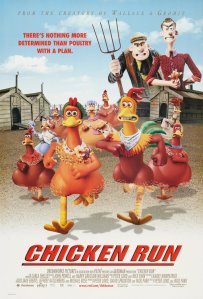 I strongly urge everyone out there if ever given the opportunity to see this movie. Do not confuse Chicken Run as a “kids only” affair while you yourself sneak into something “better.” This movie is easily the best movie of this lackluster summer of commercial perpetual bile, and possibly one of the better if not best films of the year. It’s no secret I have an affinity for animation and the claymation choices of directors Nick Park and Peter Lord, of Wallace and Gromit fame, give the characters real emotion. I can just look at one of the chickens in the eye and feel emotion that I couldn’t get seeing many Hollywood films. The cinematography and animation is lush, vibrant, and breathtakingly beautiful. The story is fresh, wonderfully hilarious, and even touching. The voice artists are terrific, with Miranda Richardson pulling out as my favorite for her delightfully vile Mrs. Tweedy. Treat yourself to one of the very few decent movies this summer and see the incredible fun of Chicken Run, and if you still feel conflicted it has Mel Gibson in it. And if you still feel bad you can say you got lost on your way to the rest room.



 nathanzoebl
You must be logged in to post a comment.