Blog Archives
Doubt (2008)
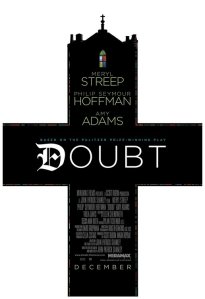 You know you’re in for some intellectual and moral ambiguity when the opening sermon covers the nature of doubt. Doubt follows a New York head nun (Meryl Streep) in 1964 that suspects one of the new parish priests (Philip Seymour Hoffman) of having an inappropriate relationship with a young male student. The acting by the four principal actors is phenomenal. This is a showcase of stellar acting. Streep is ferocious and unwavering, a one-woman wrecking ball, and yet she still manages to make an antagonistic character empathetic: she’s doing what she feels is right to protect her students. Are unethical deeds acceptable in a righteous pursuit? Does she truly believe her convictions, or is Streep striking back against an entrenched hierarchy that diminishes her value? There is a clear resentment between some of the nuns and the array of priests with all the power and all the say. Naturally, in a he-said she-said molestation case, the audience is more likely to side with the funny, caring, progressive priest than the scary nun who detests ballpoint pens and Frosty the Snowman. In the end, the accusations aren’t cleared up and the film lets the audience debate the results. Director/writer John Patrick Shanley adapts from his acclaimed stage play and does a mostly fine job bringing it alive on screen, though he has a penchant for relying on really simplistic visual metaphors. The supporting cast rises up to Streep’s level, notably Viola Davis as the mother of the boy accused of being mishandled. Note to future students of acting: study Davis’ 10 minutes of screen time to see how a truly talented thespian displays a range of conflicted emotions, none of them feeling inauthentic or cheap. Doubt isn’t just one of the best-acted films of the year but also one of the best, period, and I have little doubt to that.
Nate’s Grade: A
Share this:

Changeling (2008)
 This is one crackerjack of a story. The true-life tale of a mother, Christine Collins (Angelina Jolie), who loses her son, only to have the LAPD give her a different boy is easily gripping. The pace is a bit elegiac but the movie never gets boring, partly because Christine is beset by a multitude of adversity by the corrupt members of the 1920s LAPD who want the case to go away. Changeling can seem to fall prey to outrage cinema, and the audience is clearly going to demand some justice after watching Christine undergo a torture chamber of abuse. And justice is what we get. The last 45 minutes of this movie is protracted courtroom sequences where the antagonists get stomped upon with righteous fury. It just keeps going on and on, as if to compensate for the massive grievances Christine endures. Writer J. Michael Stracynzski (Babylon 5) makes the drama stick close to the facts of the case, which is admirable but it also makes Changeling anchored to reality when there is nothing, repeat nothing, subtle in this movie. It’s hardcore melodrama all the way through, but I didn’t mind one bit. Jolie’s frantic performance suits the melodramatic material. She leaves it all on the floor, as they say in sports. Clint Eastwood doesn’t seem to be too enraptured by the material, routinely slipping into his understated direction that seems at odds with such a juicy story. Changeling feels like a tremendously fascinating story that isn’t necessarily presented in the best fashion. Still, this is fine stuff.
Nate’s Grade: B+
Share this:

Hancock (2008)
 Hancock is perhaps the first movie that looks at the consequences of being a super-powered do-gooder. I’m not talking the self-doubt or placing your loved ones in danger. I’m talking about money. A super hero can rack up super amounts of damage to a city, and the titular character often causes millions of dollars in destruction as he sloppily combats crime. In some ways, the super hero is more costly than the criminals. As you can imagine, the public at large isn’t too taken with Hancock (the film misses the opportunity to have neighbors worry their property values will plummet if Hancock moves into town). It’s too bad that Hancock, the film, doesn’t stay as original.
John Hancock (Will Smith) is a disgruntled man. He likes to drink, sleep, and keep to himself. Unfortunately, people keep bugging him for help. This may have something to do with the fact that Hancock is a man with the abilities of a super hero. He can fly, has incredible strength, and appears to be physically impervious, but that doesn’t stop criminals from emptying their guns at him. One gang learns firsthand the anger of Hancock when they destroy his whisky bottle. The city doesn’t know what to do with the world’s lone super being because he causes so much destruction. Ray (Jason Bateman) is a PR man fighting a losing battle to convince major corporations to donate supplies to needy countries for free. Hancock saves his life one afternoon and Ray decides to use his skills to give the irritable super hero an image makeover. He’s going to use Hancock to help change the world for the better. The plan to reform Hancock involves sending him to prison and waiting until the city begs for his assistance with rising crime. Ray’s wife, Mary (Charlize Theron), is wary of her husband’s super hero project. She just wants to live a quiet life with regular meatball madness dinners with her family.
 I think I’m already starting to get sick of super heroes and there’s still more to come this summer. There are several good ideas rolling around inside Hancock, but at a scant 92 minutes there’s little time to develop them. The movie takes off in a mildly satisfying manner but then botches the landing.
Smith’s considerable charms at put at odds with a character that resembles an ornery bastard. It’s a bit of a wink to the audience because no Hollywood studio would let the most popular international movie star release a super expensive summer movie where he begins and ends as a total jackass. The film seems to be tailor-made to Smith’s strengths, which still include his ability to naturally command attention and likeability. The idea of a lone super hero who drinks heavily, destroys personal property, and whom the public vocally dislikes is a sound idea and allows Smith and the filmmakers to explore certain realities not seen in other super hero flicks. The public griping over the methods Hancock chooses to save the day seems rather believable, especially when those methods usually involve heavy-duty collateral damage consequences. I like the idea that every time Hancock lands from flying he takes chunks of concrete or tar with him. There are several interesting ideas that come from the conflict between society and a super hero who would rather sleep off a hangover. I think the idea of paring a disgruntled super hero with an idealistic PR man is a great concept, benefited by Bateman’s sterling comic abilities fine-tuned from Arrested Development (where he also romanced Theron). I really enjoyed the interaction between Hancock and Ray. For a decent 60 minutes, Hancock is a passable super hero excursion lifted by Smith and Bateman’s chemistry.
Hancock starts with some promise but then goes in a completely different direction for its third act (let me just say this: there’s a reason they’ve been hiding Theron from any advertisement). The film also overplays its hand early. When Hancock and Mary first meet they hang on to each other, then she looks at him suspiciously and continues to, then she says some very leading dialogue that is a bit on-the-nose. All an audience needs is one award, penetrating look to understand that something is up. Hancock ends up feeling pulled in too many directions. It begins as a sly satire on super heroes and is mostly confined to jaunty comedy, but then the movie gets dramatic and grim and a bit hard to follow. The film begins as a jokey riff and then gets gritty, finding room to fit in mythology, religious questions, age-old racism about interracial dating, and a terribly clunky villain (Eddie Marsan) who breaks out of jail so that he can seek improbable vengeance against an immortal. Hancock’s origin is muddled and as preposterous as most other super heroes. The third act shift seems to drain all the fun out of the movie and it gets too serious, too confusing, and too convoluted (what’s the distance rule here between super people?). Hancock ultimately has too many chefs in the kitchen and becomes a mess.
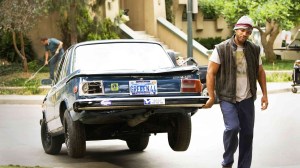 I’m sad to say but director Peter Berg really whiffs with this movie. His visual style is a hindrance to the film. I recently re-watched his first action film, 2003’s The Rundown, and Berg was able to craft stylish, highly playful action sequences without shaking the camera all over the place. A tripod served the film’s best interest and Berg tailored his visual style to the material. I expressed worry with his previous film, 2007’s The Kingdom, that Berg has become locked in to his handheld docu-drama style that bobs and weaves around his actors and employs numerous quick cuts and odd angles. His erratic style can improve and assist narratives but it can also hamper the storytelling. Nothing is really gained by Berg filming his tender moments at obtuse angles, extreme asymmetrical close-ups, and a hovering camera. It feels like a style completely unsuited for the material. I would have liked to fully watch the action sequences and enjoy the clever tweaks on the genre. Berg is an imaginative and underrated director, but his jittery docu-drama style he has embraced can also make his films seem cobbled together and overly rushed and, potentially, half-assed.
Hancock is much like the title character. It means well and wants to help but an audience can’t help but grumble about its methods. The concept of a super hero that is rejected by the people he saves is a subject ripe with subtext that could explore meaningful and insightful glimpses about guilt, the weight of expectation, the desire for human affection and acceptance, the frustration to be understood, the questions of personal responsibility and loyalty, and rejecting or heeding the call to do better. Hancock does not delve into any of these potent psychological areas. That’s fine, as long as the film delivers top-notch popcorn thrills and makes me forget about its wasted potential. Sadly, Hancock fails to deliver. The special effects are generally sub-par, the story misfires, and the whole film begins with promise but ends up turning into a mundane mess. Berg’s aesthetic doesn’t square with the material. Smith is still as charming as ever and will always be a genial presence onscreen, but Hancock turns into a movie that feels like a super hero hangover itself.
Nate’s Grade: C+
Share this:

Wanted (2008)
 Wanted isn’t so much a movie as a fetish vehicle for teen males, with sexy cars, sexy guns, and sexy tatted-up Angelina Jolie, daring the predominantly male audience to decide which is sexiest (I am not a car aficionado nor a gun person, so I’ll say that Jolie easily outpaced her competition).
Wesley (James McAvoy) is a pathetic office drone that sweats out his days never raising his voice. His best friend is constantly screwing Wesley’s bitchy girlfriend, his boss constantly harangues him into panic attacks, and, saddest of all, a Google search results in nothing for Wesley Gibson’s name. He tells us he has done nothing with his life. This all changes when a mysterious woman named Fox (Jolie) tells Wesley that the father he never knew has just died. Not only that, Wesley’s father was one of the world’s greatest assassins and he might just be a chip off the old block. Wesley is recruited into The Fraternity, a thousand year-old organization whose membership includes the best-trained killers. Sloan (Morgan Freeman) is the leader who assigns the targets. He gets his orders, literally, from the Loom of Fate, a weaving loom that writes binary letters via stitches. The Loom of Fate decides whom the planet would be better off without. Fox and her cohorts train Wesley to accept his destiny and avenge his father’s murder.
 The movie fails to establish any form of internal logic or continuity, so anything preposterous suddenly becomes accessible. That means people can jump from one skyscraper to another, you can outrun a moving train, cars will do the damndest things, and that you can curve a bullet simply by rotating your hand and shutting off that little part of your brain that says, “This is defying all laws of physics.” For some reason, people are able to shoot bullets down in mid-air as a defensive maneuver but they rarely take aim at the person, surely a bigger and slower target. It’s like The Matrix outside of the Matrix with no reason for being Matrix-y. The idea is that these super assassins have super hearts that beat like 400 times faster, which pumps more blood and allows their senses to heighten. This somehow allows them to slow down time, zoom in on subjects, and react extra fast. It doesn’t make any sense but then again this is a movie where the killers are taking orders from the Loom of Fate. While I’m on the topic, really, a loom that stitches targets in binary code? Isn’t there an easier way for fate to decree who should be bumped off than someone scrutinizing the stitch work of a rug? What happens when it lists a name with more than one owner? How many “John Smiths” must be killed to secure that the correct Mr. Smith has been erased? My father thought the Loom of Fate was the most bizarre and interesting aspect of the movie.
Despite the freewheeling action, there is something decidedly depraved about fully embracing Wanted. The premise of awesome killers demands awesome carnage, and Wanted dishes out violence as an act to be savored and glorified. Wesley’s self-actualization is linked with getting better at making others suffer, and in the end the film advances a questionable message to follow suit. The movie exists in a hyper-realistic video game universe devoid of consequences. I can see future news reports of idiot teenagers playing their own deadly game of curving bullets (they may have to establish a Wanted category for the Darwin Awards). But yet the most disconcerting feature of Wanted is its dismissive nature toward human life. I’m not even talking about the assassin premise, though trained killer flicks usually work better when the pros have some sort of personal code. Wanted is a fetishistic worship of human bodies being taken apart in loving, gory detail under the auspices of being “cool.” Innocent life barely merits a half-hearted shrug. When Wesley and Fox bring their fight on board a train the eventually force the vehicle off a cliff, and the movie makes no mention of all those innocent people plummeting to their doom. That would get in the way of the film being “cool.”
With all that said, Wanted can feel like a high-octane rush to the senses. This film is soaked in adrenaline. The stunt work is astounding and the action is ramped-up to ridiculous levels. I say ridiculous because the film never establishes any form of internal logic or continuity, but I also say ridiculous because the action can be tremendously exciting and embellished with stylistic flourishes. Wanted is a slick and imaginative action movie, and the fact that it often dances with satisfaction makes me sick for enjoying it so. Summer is the perfect opportunity for empty calorie movies with style to spare, and Wanted is a five-course meal of glossy, disposable artifice. Director Timur Bekmambetov previously directed the Russian vampire films Night Watch and Day Watch, but Wanted is a giant leap forward in budget and sheer scope. Life inside this man’s head must be crazy. He takes the outlandish and makes it seem common.
 The story is rather derivative and smashes the plots of Fight Club and The Matrix together, proving that not only were screenwriters Michael Brandt and Derek Haas alive in 1999 but they were also furiously taking notes. The whole notion has been done to death, a loser who secretly harbors superior talent and ability waiting to be realized. It still proves to be a popular and mostly pleasing storyline because it taps into a universal desire to be special. Brandt and Haas aren’t so much constructing a story as they are constructing a series of eye-popping moments. There is very little substance beneath all the fireworks (stand up for yourself and slay your antagonists?). Normally I’d take issue with a film’s trashy vapidity; however, when that film happens to be so good at being so good looking.
McAvoy is rather believable when he plays the dweeb eking out a miserable existence. He knows how to play meek and anxiety-riddled while maintaining a vulnerability that stops his character from coming across as a figure of annoying inaction. He sure gets beaten up a lot and I’m not quite sure why this is supposed to make him more inclined to join The Fraternity, but then again it hasn’t stopped thousands of college males from wanting to join their own fraternities. McAvoy is less believable when he suddenly transforms into a super soldier, like a pint-sized Rambo. Jolie relies on her exceptional sex appeal in lieu of acting, which is fine with me. It’s good to see her in a role where she can fully make use of her physical talents. Freeman is essentially in the Samuel L. Jackson role and even gets a chance to drop an MF-bomb.
Wanted is a crazy cool and mostly crazy action thriller that is more than a little sick in the head. Its video game universe covets beautiful bloodshed and exquisite carnage. It’s rather depraved and morally questionable not in approach but in execution (no pun intended, well maybe). Wanted is a gory, profane, darkly humorous action movie that secretes adrenaline with every frame. The imagination on display is impressive but you may wish that it had been used for better purposes.
Nate’s Grade: B
Share this:

Sex and the City (2008)
 A lady told me that the Sex and the City movie is like “the Super Bowl for women,” and I couldn’t agree more, especially with the way box office receipts are already shaping up. The smash TV show seemed to become its own brand, launching designer duds and trinkets into the mainstream for single women. I willingly saw the Sex and the City movie on opening night, and I must say it’s an interesting experience to watch the film with a packed house of estrogen. The woman next to me was on a roller coaster ride of gasps and tears, at once passing out tissue to others that she had planned ahead to bring. I was never much of a fan of the show. I found the humor to be pretty lazy and the characters to be somewhat annoying after so many episodes; truth be told, I think I can only watch three before having to walk away. I open this review detailing my biases but with that said, four years after the TV show’s finale, the Sex and the City movie feels like a deflated after party.
Carrie Bradshaw (Sarah Jessica Parker) is planning her life with her beau, Mr. Big (Chris Noth). They find a swanky Fifth Avenue apartment and he buys it for her, then she feels jitters about what might happen if they break up and she’s homeless. Naturally, this causes them to get engaged. Of course something goes wrong before the “I do’s” and Carrie must pick up the pieces of her life.
She has her three friends to reach out to. Career girl Miranda (Cynthia Nixon) is living with her husband Steve (David Eigenberg) and their son. She and Steve have had quite a dry spell when it comes to sex, and one day he strays and cheats on her. She feels violated and she immediately moves out. She won’t listen to Steve’s apologies. Charlotte (Kristin Davis) is happy with her husband and adopted Asian daughter. That’s really about it for her. Samantha (Kim Cattrall) is living out in L.A. managing her boyfriend, the hot actor Smith (Jason Lewis). She feels isolated and misses New York City. She also feels somewhat like a cat without her claws, as her sexy neighbor presents quite the temptation.
 Writer/director Michael Patrick King seems to have condensed an entire season into a movie. It feels like eight episodes packed together but with little central momentum to provide some form of cohesion. There’s no larger scope, not meat to this story, but King feels like he has a checklist of female “events”. So we get weddings, canceled weddings, fashion shoots, pregnancies, and lots and lots of shopping. Sex and the City ends up transforming into hard-core consumerist, female wish fulfillment pornography. The film is heavy with subplots and many of them feel like retreads that the TV show would have already covered and recovered after six seasons. The movie feels overly melodramatic and it isn’t much fun. Carrie spends most of the film moping and heartbroken; she spends a Mexican vacation intended to be her honeymoon in bed. Samantha has to spoon-feed her in order to get her to finally eat something. For some this will come across as moving and heartwarming, but for me it came across as pathetic. King’s idea of comedy doesn’t help. The jokes are pun-heavy and corny, and most sound like they should be followed by someone saying, “Badum dum dum, yeah.” When a film has to resort to a dog humping things over and over you know it has issues.
The movie medium is not the ideal place for these ladies. In half hour doses they come across better, but when blown up to a gargantuan 145-minute length, they become self-absorbed and vapid stereotypes. I didn’t like any of the characters. Perhaps you will. The characters come across as whiny, insecure, and pretty myopic. Miranda holds onto her self-righteous vigor about refusing to forgive her insanely ingratiating husband’s one-time affair yet she holds onto the guilt that her spur-of-the-moment comment doomed Carrie’s wedding. She doesn’t tell her friend about what she said, encouraged by Charlotte to button up out of kindness. In turn, Carrie doesn’t tell Miranda what a mistake it was to make a clean break from Steve after he cheated once. Carrie does this out of kindness to their friendship. They are prolonging each other’s misery. And later Samantha returns with an extra 15 pounds in tow thanks to her constant eating to douse her impulses to cheat. The gals react with such shocked expressions it becomes uncomfortably mean.
 Jennifer Hudson shows up after the hour mark to become Carrie’s new assistant, and she serves as a saintly reminder of how optimistic and buoyant love can be. The character is a total waste and seems tacked on to a story desperately searching for fertile narrative ground. Apparently with oodles of free time Carrie needs someone to check her e-mail for her. I don’t understand why any one of the girls couldn’t have filled this role; it would draw the characters closer together and make the movie shorter. In fact, Charlotte is given shamefully little to do in the film. Her biggest concern is how perfect her life is. Her 4-year-old child (she’s overly meek and barely speaks a word, they might want to have that looked into) is nothing but a prop. She appears in scenes of the girls talking, or shopping, or talking about shopping, but rarely if ever do we see Charlotte dealing with motherhood. Her character’s biggest moment onscreen is crapping her pants. Yes, you read that right.
The rampant consumerism is depressing, especially at such a bloated running time. I’m not going to charge the film with setting back feminism or anything but why do the main characters have to be so shallow, brand-conscious, and live to splurge? The emphasis on buy, buy, buy to make yourself feel good is a rather sad and empty message. I get that the TV show and the movie are supposed to tap into a woman’s fantasy, and the film really panders to Carrie’s princess indulgences and demands. So of course we’re going to get several montages of fashion and shopping and gads of product placement overkill. Seriously, the Sex and the City folk must be pocketing some major dough from all the fawning recommendations they make over brand names (History fact: Louis Vuitton died in 1892). But here’s the thing — the clothes don’t even look good! The difference between designer fashion and complete clownish garbs is practically nonexistent. The outfits these women wear are horrendously garish and bizarrely impractical even for high-end New York career women (high heels on NYC streets?). I’m stunned by the idea that the fashion that these characters wear is deemed glamorous.
 The movie didn’t have to be this clunky. The men are all relegated to the sidelines for giant portions of the film, only to show up and act penitent or selfish. The film’s conclusion, where Carrie and Mr. Big reconcile, looks like it might take its own advice and “write its own rules” but then it ends blandly predictable. Sex and the City could have explored the interesting dynamic of four women well into their 40s and how they navigate the waters of relationships and carnal cravings. Samantha herself turns 50 during the course of the movie and, let’s face it, she has probably gone through or is about to experience menopause. Samantha was always the most promiscuous character, so wouldn’t that be an interesting conflict and feel a bit more realistic? Then again, realism isn’t exactly what Sex and the City is about. If it were there would be no way that Carrie’s terrible, platitude-riddled writing would spawn three best-selling books.
Fans of the Sex and the City TV show will likely enjoy the big screen version of their favorite gal pals. After six seasons, I suppose a 2 hour 25-minute movie won’t feel long enough for the diehards with their cosmos at hand. I am admittedly not a fan of the show, and the movie comes across as long, draggy, aggressively shallow and a tad disingenuous. The actors mug hard, which looks bad when it’s blown up to fit a movie screen. The jokes are pretty stale and the plot spirals into too many subplots. I don’t really want to spend another 145 minutes with these women, especially if this is how they’re aging and maturing. Don’t say I didn’t warn you.
Nate’s Grade: C
Share this:

Persepolis (2007)
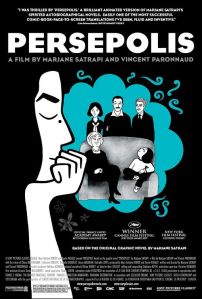 Marjane Satrapi has, by all accounts, a very unique life. Growing up under the repression of the Islamic Revolution, she settled in France and created a series of acclaimed best-selling graphic novels called Persepolis, based upon her life growing up in and out of Iran. The movie was France’s official entry for the 2007 Foreign Language Oscar, bypassing the equally lauded and inventive Diving Bell and the Butterfly. And yet Persepolis did not even make the short list of nine nominees, which eventually gets parred down to five (neither did 4 Months, 3 Weeks, and 2 Days, which WON the Best Film from the European Film Awards, over other movies that managed to make the Academy’s five nominees). I consider this a glaring omission. How could anyone not be entranced by Satrapi and co-director Vincent Paronnaud’s masterwork?
In Tehran, the capital of Iran, young Marjane and her family watch as rebellious forces overthrow the Shah in 1979. The Shah was the ruler of Iran and could readily be described as a dictator. He was friendly to Western countries and wanted Iran to follow their lead. Large forces unified and deposed the Shah, setting the stage for Iran to have its own system of rule that the people would decide upon. Marjane’s father swings her around in his arms and excitedly proclaims that democracy has come to his country at last. Landslide numbers “vote” for radical Islamic leaders to take control of the government, and Iran becomes a militant theocracy. Privileges and reforms are revoked, and women will have to wear long burquas and veils to be righteous. Marjane is too outspoken and her parents, fearing for her safety, send her to Europe to be educated. While she is absent Iraq attacks Iran and the countries are engulfed in a decade-long border war.
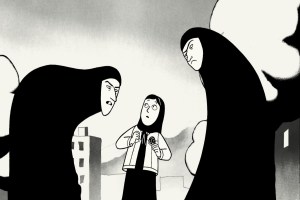 Persepolis is a gem of a movie, at once a personal coming-of-age account that manages to be fascinating and honest and also a universal tale of struggle for cultural identity. The evocative black and white animation is a joy to watch. The crisp drawing style manages to express so much with the seemingly simple, clean images. At times the visuals take on a lovely German expressionistic feel, and the world feels like it is made out of folded layers of paper. I would fall in love with a movement, a facial expression, that fact that smiles look like boomerangs, something small yet immeasurably enjoyable that struck a deep chord inside me. The arresting black and white visuals do not distract from the story in any way, in fact they help to mirror the repressive nature of what befalls Iran. A silhouetted group of protesters is shot at and one of them falls to the ground. Great inky blackness seeps out of the fallen body and merges with the rest of the screen, adding emotional heft that color could never capture.
Told for long stretches from the perspective of a child, Persepolis manages to find unique perceptions. The child point of view allows the film to unfold naturally with innocence and inquisitiveness, qualities that would soon be hard to recapture once the promise of revolution turned sour. Young Marjane feels jealous and competitive that her cousin can brag that her father spent more time as a political prisoner. It’s an odd stance for an adult and yet it feels entirely within reason for children. Marjane deals with issues she cannot fully understand as a child but she tries her best. The eyes of children also let the filmmakers mingle with the fantastic. Marjane speaks to God at points, and after a horrible tragedy God is trying to apologize and explain but little Marjane will not hear any of it. She orders God to leave her and so He departs. A little girl turning her back on God will hit you is the kind of devastating stuff that can put a permanent lump in your throat.
I was dumbfounded at the emotional depths the film plumbs in a scant 95 minutes. This is an incredibly powerful tale, richly told with poignant insights and grace. There were several times I was overcome with emotion and had to dab my eyes. Satrapi achieves great emotional resonance with minute details, making the film exciting in how engaging it continues to be from beginning to end. Marjane’s relationship with her family anchors the movie and you can feel the power of their love and bonds. Imprisoned uncles who spouted communist dogma are released only to be seen as a danger once again. Marjane’s mother is worried when Marjane keeps showing a fiery outspoken spirit. One day she shakes a teenage Marjane, screaming at her the horrid possibilities that can happen to women under this regime. She cites one teenage girl who was executed, but they don’t believe in killing virgins, so the guards took care of that bothersome roadblock. Marjane’s mother is wild-eyed with fear and what might await her little girl, and her gnawing concern is resoundingly powerful. Marjane’s grandmother serves as her emotional compass throughout her life. Grandma stresses that Marjane should be proud of her cultural identity and stay true to herself. When Marjane gets older she hears her grandmother’s voice to set her straight in times of doubt.
 But while the movie can be heartwarming, it does not fall victim to sticky sentimentality. Satrapi deals with some harsh truths about life in Iran and also her time in Europe as a blossoming woman without a country. She doesn’t sugarcoat reality and Marjane’s parents make it a point to be up front with their daughter about what is happening; an uncle tells little Marjane, before he is executed, that knowledge must live on and she, the youth, must be the one to keep it alive. The Iran-Iraq war ends in a stalemate with millions in casualties. Persepolis details life behind the veil and the shift the country took to radical Islamic rule but the film isn’t all doom and gloom. There’s a natural curiosity about a story of a girl who becomes a woman in a repressive society. Marjane’s spiky rebellious spirit makes for genuinely human comedy. She shops for Iron Maiden tapes on the Iranian black market, wears a jacket that states, “Punk is not ded,” and screams with joy at ripping her veil off during a car ride and letting the wind gust through her hair. There is a bounty of humor to be found in unexpected places. Marjane is running to catch a bus and is stopped by two policemen who complain that when she runs her butt moves “in an obscene way.” She simmers and finally yells, “Then stop staring at my ass!”
If Persepolis has any shortcomings it’s that the narrative peaks a bit too early. Seeing a child come of age during the Islamic Revolution is generally more interesting than watching a teenager navigate unfaithful boyfriends in Europe. Persepolis never stops being entertaining or relevant, it just so happens that the greater emotional rewards are tied to life and family in Iran.
Persepolis is a marvelously moving and unique coming-of-age tale set against a unique time. Marjane Satrapi’s graphic novels have fluidly been translated into a film that resonates with great emotional turmoil and inspiration. The alluring black and white visuals and clean animation style dazzle the eyes, while the enthralling personal story reaches deep inside and touches the heart. The film is brilliant, beautiful, harrowing, deeply human, fascinating, and ultimately inspiring. It’s rare to find a movie that can hit so many emotions with finesse, animated or live action. Persepolis is a bold vision and a revealing and lovely film that I cannot wait to revisit often. This is more than just a cartoon, folks. This is art.
Nate’s Grade: A
Share this:

Elizabeth: The Golden Age (2007)
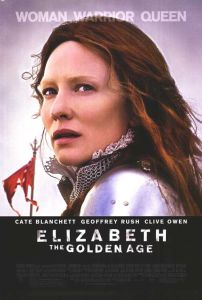 This unanticipated sequel to the 1998 film that put Cate Blanchett on the map is pretty much the same setup from the original go-round. Once again, Elizabeth is trying to assert her authority, once again Catholics are plotting an assassination to place Elizabeth’s good Catholic sister on the throne, once again Elizabeth pines for a man she cannot have, this time in the dashing form of Sir Walter Raleigh (Clive Owen). Everything is cranked into overkill, which means there are plenty of speeches and plenty of bellowing. The romantic triangle between Elizabeth, Raleigh, and Elizabeth’s most beloved assistant to the Queen (Abbie Cornish) is a waste of time and does not dignify any of the three. The camerawork ranges from awe-inspiring to maddening, with the director relying on bird-eye-view long shots and always throwing some object in the foreground to obscure the action. It gets old quickly. Blanchett gets to suit up with armor and ride a horse around, but this Elizabeth redux leaves much to be desired. If they ever kick around an Elizabeth 3 in, oh, 10 or so years, hopefully they can move on to a new story structure while I watch the aging queen through a lattice 300 feet high.
Nate’s Grade: B-
Share this:

The Brave One (2007)
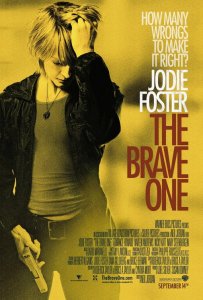 The Brave One, when distilled to its purest essence, is Jodie’s Foster’s Death Wish, but there isn’t anything necessarily wrong about exploring this scuzzy territory again with a fresh set of eyes. The film chronicles a New York City radio host (Foster) who is the victim of a brutal attack that leaves her boyfriend dead and her in a coma for three weeks. Shattered and hardened, she buys a gun for her own protection and finds herself in situations that require one. The Brave One features a lot of audience-approved ass kicking and an absurd amount of dangerous scenarios that Foster seems to casually find on a nightly basis. But what separates The Brave One from the usual grisly pap of the genre is that it refuses to pander to audience bloodlust. Director Neil Jordan (The Crying Game) complicates a simple case of vengeance by making an audience contemplate the true ramifications of violence and whether they are ultimately worth the price. Foster gives a ragged and emotionally raw performance. She discovers how easy killing comes to her and Foster struggles to keep her crumbling sense of humanity, with her last tie to the working world is her friendship with a deeply compassionate cop (Terrence Howard, terrific yet again). The most affecting moments are between Foster and Terrence as they construct a rather moving companionship where each feels out the other and Foster actively tries to avoid getting caught. The end of The Brave One certainly could have followed through with its morally ambiguous deliberations and open-ended questions, but while its climax does pull some punches it doesn’t wrap everything up with a bow either. This is high-end work for a guilty pleasure genre most noted for having its morals face down in the gutter. Now what the hell does the title refer to?
Nate’s Grade: B
Share this:

Marie Antoinette (2006)
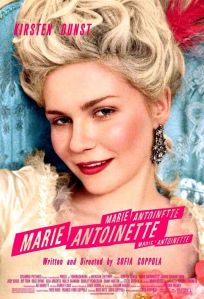 From its opening 80s New Wave soundtrack, you know Sophia Coppola’s Marie Antoinette is a period piece like none other. The famous daughter of Francis Ford Coppola has long been planning a movie around the famous queen that lost her head during the French Revolution. She premiered it at the Cannes film festival where it was booed by the homeland critics. This cast a shadow of doubt over Coppola’s dreamy pop confection of a biopic. Maybe the French don’t like having one of their most iconic historical individuals turned into a bouncing, troubled teenager. Too bad because this is the most interesting and, later, the most frustrating accomplishment Coppola achieves.
Marie (Kirsten Dunst) is a young Austrian girl married away by her family with the hopes of strengthening an alliance between France and Austria. She’s intended to wed Louie August (Jason Schwatzman, Coppola’s cousin), a rather goofy young man more comfortable with hunting than women. Their marriage is arranged by Louis XV (Rip Torn) with the intent on keeping the family line with a male heir. Trouble is, Marie’s husband is more interested in locks than her in a nightie. She’s warned in letters by her family at home, and by a caring ambassador (Steve Coogan), that her only leverage is a child. Without a child her marriage could be annulled. Life at the Versailles palace is a vortex of gossip and attention, and the idea that the queen cannot interest the king is most stressing.
 Marie Antoinette is a feast for the eyes, and that’s saying nothing about Dunst. The costumes are gorgeous, the multitudes of food look delectable, and the sets are the real deal, filmed at the actual Versailles palace for that extra oomph. I’d let them eat cake too if I got the stuff she had. Expect Marie Antoinette to at least get several Oscar nominations for its lavish technical merits; it very well might win too. There’s a really neat sequence that informs the audience through a series of family portraits about a death in the family.
Anyone looking for a strict biography on the famous queen will be left scratching their head. Coppola has thrown historical accuracy to the wind and produced a movie less about plot and character and more about an impression. She really nails the insular palace life, from its ridiculous and rigid traditions to the importance placed on blind formality. There’s a very amusing scene where Marie has to be dressed by handlers, and her clothes must keep getting swapped to the current highest-ranking person in the room. Coppola also smoothly handles this extravagant, opulent world from the point of view of her young teenage girl, betrothed by the age of 14. The world of royals and Versailles was one of constant gossip where everyone’s eyes were glued to the new girl. In many ways, Coppola’s world mirrors high school existence, just with far better clothes. When Marie is ignored yet again by her clammy husband, she goes on a wild shopping spree with fabulous shoes and fabrics in bright, sticky colors. She stays up late with a close circle of friends to watch the sun rise over the palace. Coppola firmly reminds us that Marie Antoinette was still a teenage girl and perhaps was still fighting to be one. The movie is good at stripping away the context of history and showing us the awkward lives of two kids selected to be leaders of their country. Better yet, the film is good at exploring what it?s like for teenagers to have the world at their fingertips and have no clue what to do with it. Besides shoe shopping, that is. The film is an excellent mosaic that reiterates the breezy sensation of being young and trapped in the world that never seemed big enough.
But, alas, the trouble with establishing an impression is that we get the idea pretty quickly, and yet the movie keeps going on and on without anything else to interest us. You can watch Marie lay in the field, host a tea party in her garden, marvel at sumptuous food, try on different clothes, play with her puppies, and, hell, the woman even sings an opera in one moment. I don’t know if Coppola intended to establish the tedium of life in Versailles but the audience will definitely start to feel suffocated by it. At least she never steers into a Terrence Mallick danger zone (the man would have sat in a forest with a camera in his lap and called the results a “movie”). That’s the issue with the movie. Like her 2003 Oscar-winner Lost in Translation, Coppola is more interested in mood and silence than character and plot. This approach worked splendidly in the sparely beautiful and moving Translation, but it cannot fully save this film. After a while it just all gets too repetitious and feels slight, like Lizzie McGuire’s Fabulous Versailles Vacation.
The figure of Marie Antoinette is too big to just be dressed up and put in a room. Coppola doesn’t seem to care about the politics or historical anxieties of the time. That’s a shame since France was going through one of the most amazing turnarounds in all of history. There’s no social commentary and the last quarter of the film seems to go off track. When the peasant mob does appear at the very end it feels like a misplaced subplot instead of a world-changing event. Likewise, the affair Marie Antoinette embarks on feels all too shrift and meaningless, like a high school crush of the week (might she doodle his name on her diamond-encrusted notebook?). Marie Antoinette is an interesting, ambitious period drama trying to be a youthful fantasy turned nightmare. It just doesn’t have enough going on to justify a prolonged experience.
Dunst is an actress I’ve been really hot and cold with. Sometimes she dazzles me but more often she bores me. As the title monarch, Dunst totally comes across like a vibrant teen girl still feeling out the world. She seems impetuous, sensual, and naive, all hallmarks of a growing girl that just so happens to be the queen of France. She does a lot of communication with her face. Sometimes she comes across like a silly, vapid little girl playing dress-up, but then that seems within the scope of Coppola’s aim.
 Schwartzman’s portrayal makes the king look like an aloof adolescent, but he make me laugh very easily at his pained awkwardness. Judy Davis is a hoot as the palace’s liaison of policy and manners, tsk-tsk-ing whenever etiquette is broken. The rest of the cast mostly have moments but it’s surprising to me that I’d see Marianne Faithfull, Rip Torn, Molly Shannon (!), and Asia Argento in a period piece movie. Like I said, Marie Antoinette is a costume drama like none other.
Much was made about the anachronistic soundtrack of 1980s tunes set amongst the pomp and circumstance of 18th century France. I like it because it works in engineering the breezy, bubbly youthful impression Coppola wants. It shouldn’t be that big of a deal because the music is not incorporated into the story unlike 2001’s tandem Moulin Rouge and A Knight’s Tale. It provides some of the more fun moments in the movie, though at times the lyrics become all too transparent; “I Want Candy” during a spending spree, “Fools Rush In” when Marie goes to her affair, The Strokes screaming “I want to be forgotten,” as Marie runs off.
Coppola’s luscious period piece feels more like a dreamscape in a daze. Her focus relies less on linear storytelling and character than on creating an impression of youthful decadence and emptiness. Marie Antoinette manages to simultaneously be fluffy and vague. After a while it all just gets repetitious and a bit dull watching scene after scene of Marie being indulged and bored. Perhaps some of that boredom will translate over to the audience. Coppola reminds us that Marie Antoinette was still a teenage girl beneath her powdered wig and bustle, but after two hours you might wish Coppola had more on her agenda.
Nate’s Grade: C+


 nathanzoebl
You must be logged in to post a comment.