Blog Archives
This is 40 (2012)
 In the five years since 2007’s comedy smash, Knocked Up, writer/director Judd Apatow has ascended to heights in Hollywood that few ever achieve. And while his disappointing 2009 film Funny People may have been an example of the man flying too close to the sun (let’s mix metaphors, why not?), he’s had a stable career guiding mostly hit comedies to big numbers, particularly last year’s Bridesmaids. For Apatow’s next directing effort, he picks up a handful of supporting characters from Knocked Up and gives them their own spotlight. This is 40 is Apatow’s “sort-of sequel.” It may seem familiar in tone and style to his previous efforts, but there’s one big difference between this film and Apatow’s previous works. This movie never feels like it goes anywhere. Even Funny People went somewhere even if I disliked it.
Five years after the events of Knocked Up, Peter (Paul Rudd) and Debbie (Leslie Mann) are struggling to keep their household afloat and sane. Their daughters, Sadie and Charlotte, (played by Apatow’s real daughters, Maude and Iris), are constantly fighting, Debbie’s worried one of her employees is stealing from her business, and Pete’s trying to save his record company without alerting his family to his panic. Pete has put all his efforts into promoting a new album from 1970s rocker Graham Parker, but really he’s fighting a losing battle against mainstream taste. Pete has also been secretly loaning out money to his no-good father (Albert Brooks), while Debbie has been trying to reconnect with her distant biological father (John Lithgow). Weirdly enough, both fathers have started secondary families and have broods of young children. As Debbie and Pete both approach the big 4-0, both of them make resolutions to better themselves, renew their family bonding, and reignite the spark in their romance. Of course, after two kids and several years of marriage tallied, it’s easier said than done.
 The Apatow films have always had their own loping rhythm to them, an easygoing quality that isn’t as directed by plot as character. So when I say that This is 40 feels rather aimless, I want readers to recognize that this goes beyond the normal loosely plotted Apatow affairs. Usually his movies have defined events to direct the overall trajectory of the plot; a baby on the way, losing one’s virginity, etc. I’m hard pressed to say what exactly is the direction of This is 40. It’s about the ups and downs of a married couple, but there isn’t necessarily any definable conflict. They’re sort of in a malaise and internalizing their unhappiness, but the movie is the sum total of many small conflicts that never seem to congeal. As a result, the movie feels like it’s often coasting, going beat-for-beat until something new takes it on a mild diversion. It’s a movie of diversions without a unifying path. Sure the couple becomes, presumably, stronger by the end of the film, but I can’t say what’s taken place to explain this progression. The movie plays out like a series of loosely connected scenes. I enjoyed myself, and found the movie often amusing, but I kept wondering what it was amounting to. It was never enough of a niggling concern to stop from being entertaining, but when it was done, I thought to myself that I just watched Apatow’s friends hang out for two hours and call it a movie.
There’s also the issue of indicating this is a sequel to Knocked Up or at least exists within the same universe. There’s very little continuity between the two films other than Pete and Debbie’s family. Jason Segel (The Muppets) and Charlyne Yi (Paper Heart) make reappearances playing characters with the same names, but they don’t seem like the same characters (though the gyno doc is the same – hooray). My major sticking point is the complete absence of the stars of Knocked Up, Ben (Seth Rogen) and Alison (Katherine Heigl). Now I wasn’t expecting a drawn out cameo from these two, especially after Heigl publicly badmouthed Apatow and the movie that made her a star. I did expect some passing reference, even something as small as, “Ben and Alison are looking at schools for their daughter.” I just wanted something to feel satisfied. Where this becomes a problem is that I’m fairly certain that Ben and Alison would be attending several of these major social events for their family members. They make a big deal about Pete’s 40th birthday party, so why wouldn’t Ben and Alison be there? And with her litany of marital woes, wouldn’t Debbie seek out, you know, her sister to talk with, the same sister she hung out with all the time in Knocked Up? Apatow might as well have just given everyone a new name if this was as sequel-y as This is 40 was daring to go.
Part of my lukewarm reception to the film is likely my lack of empathy with the problems of the main characters. Good storytelling should allow anyone to be able to empathize with characters dissimilar to themselves. I found many of the problems in This is 40 to be the stuff of rich fantasy. Pete is worried his record company, that he started, might not make it. He’s also been secretly giving his mooch of a father $80,000 (!) over the years. Maybe these people could stand to cut back and live within their means. Their house is huge, downright opulent, and it seems like Pete has wasted plenty of money on needless expenditures, which his own employees eventually point out at work. Did they need a big 40th birthday bash? Do their kids need every expensive gadget? When they take a vacation, does it need to be in a lavish hotel along the beach? I found too many of these complaints to be whiny and indulgent. That’s not to say that there aren’t serious relationship problems that are given thoughtful attention. This is 40 is arguably Apatow’s most mature and reflective film yet, though that might be faint praise to some. I would rather the movie spent more time focusing on the relatable concerns of a relationship crumbling rather than the stress of possibly having to move from a super-rich house to a merely somewhat rich house.
And yet the movie is routinely funny and charming, thanks to the Apatow standards of cast camaraderie, character, and the mixture of raunch with sweetness. I like these characters and so I enjoy spending time with them, and even if I feel like we’re not going anywhere fast, I don’t mind that much. I’ll gladly spend two plus hours with these funny people and their mid-life crises comic follies, at least once. The characters are well drawn and played by capable comic players that can do their Apatow jazz deal, finding peculiar riffs to work and squeeze out mirth. I thought a discussion over the appeal of being a widower and the fantasy of a spouse’s untimely demise to be quite funny as well as a topic generally unspoken (“This is the mother of your children we’re talking about. You want her to go peacefully.”). Rudd (Wanderlust) and Mann (The Change-Up) are terrific together and entirely convincing as a longstanding couple, people who know the ins and outs of one another. It’s fascinating just to watch the nuts and bolts of a relationship that is still a battle; it also helps when you like both participants and find that they each have valid points. Though I cannot fathom how hiding impending financial doom is a smart move.
 Apatow does a fine job of making sure the dramatic parts do not overweigh the film, usually settling things with a nicely punctuated joke or pop-culture critique (oddly enough, TV’s LOST becomes a major reoccurring gag, though you expect a bit more of a comedic payoff when they get to the controversial finale). I’m not sure that many people are going to know who Graham Parker is, but here he is folks. There are a lot of Apatow players peopled throughout, like Chris O’Dowd (Bridesmaids), Lena Dunham (TV’s Girls), and Melissa McCarthy (Bridesmaids), making fine work with minimal screen time. You’ll recognize other familiar faces as well. Occasionally the jokes feel like they go on too long, catching the downward slope of an overstayed improv riff, but I was laughing throughout and enjoyed the unpredictable nature scene to scene. You’ll likely predict the outcomes for certain storylines and conflicts, since Apatow is a sucker for the squishy ending, but you’ll feel like it got there on its own relative terms. It’s not exactly a happy ending but it’s a less unhappy ending.
There are plenty of supporting actors that shine in this movie, though I feel that I need to single out the great Albert Brooks (Drive). He plays such a passive-aggressive, manipulative, mooch of a father, but he does it in a way that almost wins you over, how straightforward he is with his bad behavior. When Pete tells him he cannot loan any more money, Brooks blithely, almost cheerily, theorizes that murdering some of his recent kids can solve this problem. He marches out, gets a hose, and asks the kids to volunteer who wants to be murdered. It’s scenes like this that manage to be funny but also cutting to a dramatic truth that the film hovers around, occasionally hitting the bullseye. Megan Fox (Transformers) is also enjoyable as a, what else, vivacious employee men are falling all over themselves for. And even Apatow’s own kids give rather strong performances, now playing actual characters rather than scene-stealers. Maude, the oldest, has a lot of dramatic scenes as the teenager daughter coming to grips with hormones and her crazy parents. The Apatow clan might just get some outside work after people see dad’s movie.
While I doubt Apatow has made any sort of definitive statement on what it means to approach four decades worth of life (and poop jokes), This is 40 is a perceptive and enjoyable movie even if it feels like a collection of scenes. Good thing I like these characters and enjoy spending time with them, otherwise I might find this whole film to be a bit aimless and self-indulgent. Seriously, how many scenes are there going to be of people singing along to music? This is 40 has enough going for it, be it comedy or some insightful dramatic moments, though it keeps an audience a bit removed due to the unrelatable nature of their posh problems. If there’s a This is 50 in the works, next time get me some more Rogen time. I’d rather watch him deal with raising a teenage girl in the age of social media. You don’t have to know anything about Knocked Up to follow along with This is 40, but then again, if you haven’t seen Knocked Up, just go watch that movie instead. Trust me.
Nate’s Grade: B
Share this:

The Sessions (2012)
 When The Session (formerly The Surrogate) debuted at the Sundance film festival, it seemed like Oscar catnip. You’ve got Oscar-pedigree cast, the limitations of disability (iron lung), and writer/director Ben Lewin (Paperback Romance) certainly knows a thing or two on the subject. He’s a polio survivor himself. But the story of a man in an iron lung’s sexual reawakening, as my mother would say, is a harder sell to the public. The movie has enough bizarre intrigue to garner a curiosity factor in many, and the sweeping acting and light-hearted tone will win over many a follower. I just wished that Lewin had focused more on his central character than what’s below the waist.
Mark O’Brian (John Hawkes) is a 37-year-old virgin looking to fix that oversight. The problem is that he’s suffered from polio all his life and can only be outside of his iron lung for upwards of a few hours. He’s not paralyzed, mind you; it’s just that his muscles don’t work too well. To move forward, Mark is set up with a sex surrogate, a sort of alternative therapy that is intended to help the disabled learn how to take control of their bodies for healthy physical relationships. Cheryl (Helen Hunt) has a set of rules as she goes about her business. There will only be six sessions to limit any emotional attachment. Mark is certainly a challenge, a man who doesn’t have muscle control below his neck (he confides that he hasn’t seen his penis in over 30 years). Together they work on getting Mark experienced and aware of his own body and abilities.
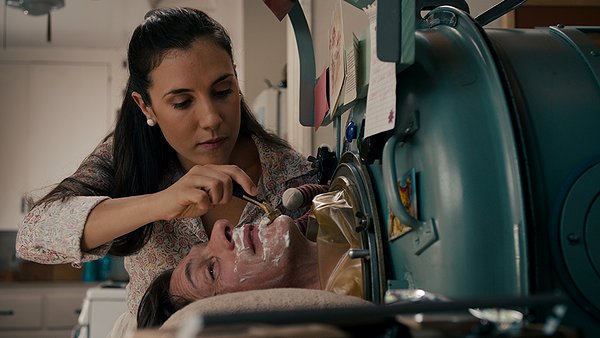 The Sessions is essentially a two-actor showcase (William H. Macy as a helpful priest is really just an ear to listen/audience surrogate), an ongoing dialogue and set of interactions between Mark and Cheryl. The script could have worked as a play though film certainly does open up the viewing possibilities when you’re dealing with an immobilized character. From that stand point, The Sessions is often a fascinating and funny portrait of a world that few of us will ever comprehend. We seem to have this concept that immobility is a death sentence; In Million Dollar Baby, Hilary Swank preferred death over disability. There’s the standard uplifting personal tales of success, the triumph of the human spirit, that sort of thing when we talk about disability in the movies. The Sessions is different. It’s all about sex, and it’s refreshingly frank about the realities of sexuality for those with disability. The human body is an amazingly adaptable creation, so no matter the setback, there is still plenty hope of having a relatively healthy sex life. Beyond a section in Murderball, I cannot think of another movie to explore the reality of sex for those with disabilities. It’s like a wondrous combination of two topics that makes people feel uncomfortable. So, in short, this is not going to be a movie for everyone.
That’s too bad because The Sessions is an engrossing story of a man trying to experience a world of human sexuality denied to him due to cruel circumstance. Mark is a relatively nice guy, a poet, though he can be a little quick with the emotional attachment and declarations of love. Can you blame the guy? I believe some will argue that limiting the focus to Mark’s sexuality, and his desire to shape himself into a better lover, is a misuse of the narrative potential. Some will chide that the film could be the indie version of any number of horny male sex comedies. To some degree, I can agree with this assessment, mostly because I wanted to follow more of Mark’s life and the movie is only 90 minutes long. But I also think the strict focus on human sexuality is also a boon for a movie like this. The fact that you could place a movie about a man in an iron lung and, say, American Pie in the same conversation is a testament that we are losing some of the stigma of disability. This guy wants to get laid. Period. And we can be grown up about this.
Hawkes (Winter’s Bone) is excellent in a role that requires him to do all his acting from above the neck. He’s convincing in every detail, down to his pained, willowy voice and his handling of a pointer for his mouth is first rate. Beyond the physical tics, Mark exists as a complex character that Hawkes is able to fully open up. He’s caustically funny, overcome with self-doubt, sweetly naïve, yet he’s also just like every other man on the planet. Hawkes doesn’t overplay the physical restrictions so it doesn’t end up being a performance dominated in showy actor traits. It’s a sweet and affecting performance that moves in small waves but makes a noted impact. Expect the man to get his second Oscar nomination this winter, as respected actor + disability is a combination they cannot refuse. Also, Hawkes is completely deserving of praise.
Hunt (Soul Surfer) has been grabbing a lot of headlines for the amount of skin she exposes, but her performance deserves more attention than a secondhand reference to her nudity. To be fair, it is copious nudity of Helen Hunt. I think she recites more lines while in different states of undress than clothed. It’s so much nudity that when you close your eyes, you may still be able to see it (not complaining here…). She does a lot of fine acting while naked. It’s hard exactly to get a bead on her character. She seems displeased with her insensitive husband, though he has to have some level of understanding to be okay with her profession. It feels like she’s looking to Mark as… something more, something else, but then it feels like her rationality returns and she returns back to the parameters of her job title. It’s a strong performance and the movie is at its best when Hunt and Hawkes are together. I just can’t help but feel if the ending wasn’t so blunted (more on that below) than maybe her performance would hit an even higher register.
 The actors are so good and the movie is so tender, I almost forgive it for lacking a proper third act (some major end spoilers to follow). Naturally the number one concern you’d imagine for a sex surrogate would be the danger of building emotional attachment. This is why Cheryl limits her sessions to six max. That doesn’t stop attachments from forming. Mark and Cheryl are dreading the conclusion of the sessions, having grown close emotionally as well as physically. So to spare them lingering pain, Cheryl suggests they stop early. Mark reluctantly agrees. There, ladies and gents, is your second act break. But then rather than get a third act, the movie simply gives you a slightly extended resolution instead. Mark meets a nice volunteer at the hospital and flirts with her, crowing with pride to inform he is no virgin. But then… we cut right into Mark’s voice over telling us that he spent the last five years of his life with this new woman. We get an introduction and then immediately jump to the end of the relationship. I understand that without Cheryl’s kindness and education, Mark’s long and healthy romantic relationship would not have happened. I understand that he’s able to succeed because they broke down barriers of confidence together. This doesn’t stop the ending from feeling missing, absent the payoffs we yearn for in drama. It’s a curious and muffled close to a movie that was so interesting and audacious.
The Sessions is more than just an Oscar-bait disability movie. It’s really an arty version of a sex comedy with some extraordinary participants played by skilled actors. It has a frankness that’s refreshing and it’s never less than interesting, exploring the minutia of Mark’s life and the difficulties he overcomes. It’s not exactly a triumph of adversity, per se. It’s not exactly a chamber piece devoted to characters even though two dominate the conversation. The Sessions is a hard movie to pin down. It’s perfectly enjoyable and funny, touching, disarming, and well acted, but I can’t help but feel like Lewin should have aimed higher. To focus solely on Mark’s budding sexuality seems rather limiting for the character, and the disappearance of a final act proves bewildering, blunting the dramatic climax, thwarting further involvement. I’ve seen the film twice now and my opinion of it improved slightly the second go-round, but I’m still left scratching my head over that ending. I get it, I just don’t get why Lewin felt like racing to the end rather than exploring the conflicts and personal struggles of his characters. I suppose there’s some testament to sticking to the facts but that doesn’t matter when it comes to telling me a good story. I’m of a mixed mind here because The Sessions has plenty to recommend but I also feel that the film’s finale and light-hearted, limited sense of purpose hamstring the emotional impact of the whole enterprise. Disabled people can lead healthy sex lives. I get it. Now show me more signs of that life.
Nate’s Grade: B
Share this:

For a Good Time, Call (2012)
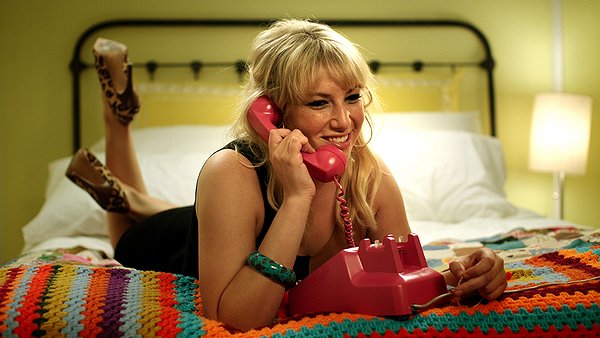
 Given the success of the female-centric mega hit Bridesmaids, it was only a matter of time before we got a slew of girls-behaving-naughty R-rated sex comedies. Enter the phone sex comedy For a Good Time, Call, which has the distinction of being co-written by Seth Rogen’s real-life wife, Lauren Miller, who also stars in the film. It advertises a good time and mostly delivers, though you might not think as much about the movie in the cold light of day.
Lauren (Miller) has just been dumped by her self-involved boyfriend and fired from her job. She’s looking for a new place to live when a mutual friend sets her up with a huge New York City apartment. The catch: her roommate is Katie (Ari Graynor), an acquaintance from college she has despised ever since a very horrifying party foul of seismic proportions. Katie’s going to lose her posh home unless she gets a roommate, so the women reach a mutual understanding. Then one day, listening to Katie’s hyperactive sexual noises, Lauren discovers how her roommate really pays the bills. She’s been running a phone sex line and getting guys off for $3.99 a minute. Lauren decides to get involved in the business end, and before long the ladies have become a professional outlet and roll in their riches. Invigorated, Lauren starts experimenting herself, letting her freak flag fly, and before long she’s also getting in on the calls.
 Graynor is no stranger to stealing a movie, as she did perfectly in the sweetly unassuming 2008 teen romance, Nick and Norah’s Infinite Playlist. This girl has had the markings of a star for years and finally she’s found the vehicle to showcase her comedic vivaciousness. To say Graynor makes this movie is an understatement to her talents. Graynor is this movie’s pulse, its lifeblood, its font of energy, its wickedness, its exuberance, its very soul. This woman is amazing. She can take a simple line and with an effortless dose of comedic verve, it can become a gut-buster. I could watch twelve movies in a row with Graynor playing at this level of exciting excellence. The part is pretty familiar, the dirty girl who has problem with a filter, but Graynor makes the most of every opportunity. I loved her adorable theatricality, like a foxy, younger, brassy Bette Midler (God, did I ever think I’d string those words together?). I loved her enthusiastic hip shake, wearing large body stockings, while singing, “I’m ready to beat date rape!” Naturally, Katie gets all the best lines but her interplay with Lauren also works well. When the movie focuses on Lauren, and by extension the unremarkable performance by Miller, you start to feel things slag. Lauren is passive becoming active, but really even by the end she can still be cited as boring. Katie is active, hungry, brash, charming, and wonderfully portrayed by Graynor, and when she dominates, you’ll ask for more.
Except for the lively theatrics from Graynor, the movie can often feel hung up on generic sitcom plot devices and character generalities. The premise itself is perfectly fine, but the movie seems to exist in some randy fantasy world. We still have a main character in the world of publishing that will obviously be offered the Big Job at an inopportune personal time (as movies have shown, every human being on the planet either works in publishing, advertising, or theater). And then there’s the Bad Boyfriend, who breaks up with our heroine in the opening moments of the movie because they are “boring” together. Any guesses whether he shows up late as well, begging her back? I’d probably be more forgiving of these contrived plot turns if the movie did more to present Lauren and Katie as real characters. As written, they are pigeonholed into opposites (prude/wild woman) and rarely do we learn more about them. Lauren loosens up, Katie gains some self-respect, and they girls becomes BFFs. That development I found rather unconvincing, probably because there was little development. All of a sudden Lauren has an interest in joining the business, and one montage later, the girls have buried the hatchet. It feels like everything changed overnight. The attempts to ladle in some forced sweetness feels, in some regards, more crass than the sex jokes. I’ll credit the movie for keeping me amused while watching, but upon further reflection, the girls and their relationship feels rather slapdash and rote.
The comedy itself gets too easily complacent with all those naughty words bandied about. Oh sure there’s plenty of effective jokes about sexually frank conversations, and the inherently awkward nature of phone sex mechanics, but For A Good Time, Call seems too easily satisfied. I wish that Miller and co-writer Katie Anne Naylor had pushed their comedic setups further, had taken a few more left turns rather than settling for the familiar sex gag. Here’s an example: Lauren’s prissy parents make an unexpected visit and the girls have to hide their business particulars. That’s a fine starting point, but where else does it go? The comic tension is too easily resolved instead of escalated. Then, surprise, the parents make a SECOND unexpected visit. This time the sex decorations are prominently displayed. We’re waiting for some good comedic tension, some squirming, but again, it’s over before the good stuff can even get going (am I right, ladies?). The Justin Long (Going the Distance) flamboyantly gay friend is never as funny as the movie thinks he is. There’s a scene where Lauren is interrupted while masturbating, but we only realize after the fact when the joke is already over. Why introduce such a scenario if you were just going to settle for a weak “smelly finger” joke? Perhaps I would find the material funnier if I was a woman, relating more to the female dynamic on screen, but do you see how condescending that line of thinking gets? I unabashedly adored Bridesmaids (my #3 film of that year). I don’t think anyone needs to grade a comedy on a curve for any reason, especially if they think they’re trying to be polite.
 I’m not going to make more or less of its sexual politics than what is presented. I think there is genuine merit when women take ownership of their sexuality. Why should women feel judged for wanting equality when bedroom activities and impulses are concerned? Whatever helps people build a healthy self-image should be championed, as long as it’s between consenting adults. Watching Katie and Lauren personally grow based upon their unique entrepreneurship is welcomed. However, I can’t help but shake my feelings that there is something lurking, some deeper sub current that is not worth celebrating because the movie seems to play into male fantasy. Even though I adored Graynor, I think it would have served the film better if the more sexually-liberated character, the pro when it comes to working the phones, was actually a less attractive woman, perhaps a mousy gal you’d never expect such lurid behavior from. I think that would offer more comedic potential as well. I think this would also puncture some of the airbrushed fantasy of the film’s cheescake world of a phone sex line.
I have my complaints but I was laughing fairly regularly and enjoyed the experience, so if you’re just looking for a good time at the movies you can consider For A Good Time, Call. Watching Graynor sink her teeth into her role and go full gusto is a rowdy pleasure, and it’s easy to see that this woman is a star. The smutty jokes are fun and offer plenty of ribald laughs, but I always felt like the movie was too complacent, too settled, and curiously clumsy when it came to comic payoffs. The film is pretty flatly directed by Jamie Travis. The characters are pretty thin, and the plot feels ripped from a flimsy TV sitcom, but I laughed aplenty and found the movie difficult to dislike. It’s not the most nuanced sex comedy, or the most ribald, but For a Good Time, Call delivers enough big jokes and Graynor is too sensational to miss.
Nate’s Grade: B
Share this:

American Reunion (2012)
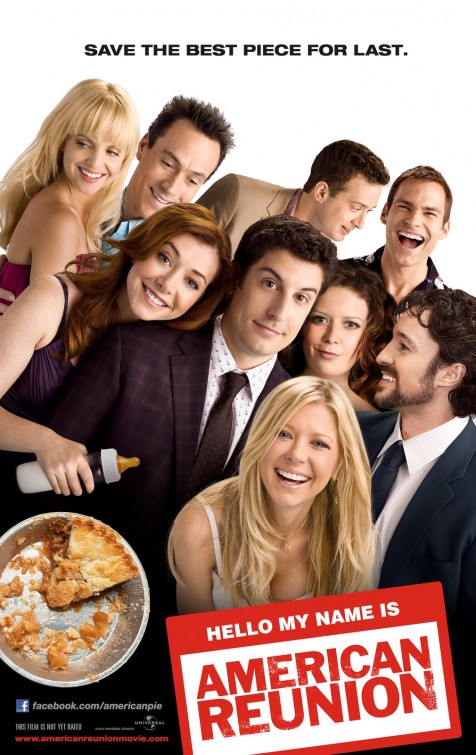 What loser doesn’t attend their 13th high school reunion? Who even organizes such an untimely event? The generally unnecessary American Reunion is being dished out to the public for a number of reasons. The studio would like to revive their once lucrative sex-comedy-meets-baked-goods franchise, and most of these actors could desperately use the work. Remember when the likes of Chris Klein, Mena Suvari, and Tara Reid were above-the-title names? What I recall, now that the gang is together again, is that I found most of these characters to be dullards. They’re in their 30s, have careers and families, and stupidly comfortable lives, yet they’re up to the same old hijinks, which just seem a bit more desperate and embarrassing this time around. Seann William Scott, the franchise’s true wild card, is still amusing as ever, but I couldn’t swallow the forced nostalgia for characters that are unappealing. Jason Biggs and Alyson Hannigan still make a nice pair, but rehashing the old gang mitigates their screen time. Comedy-wise, the movie has a few memorable gross-out moments but nothing really hilarious. I laughed from time to time but mostly I was bored, and Klein, especially in his new post-Street Fighter ironic version of himself, is rarely boring. It’s a pleasant enough experience and I suppose fans of the original films will get a kick out of seeing who ended up where and, in particular, what he hell happened to Reid’s leathery face. Otherwise, American Reunion is a gathering that nobody called for and fails to justify all the effort. Then again, my favorite of the American Pie films is the second one, so take my words with caution.
Nate’s Grade: C
Share this:

Hope Springs (2012)
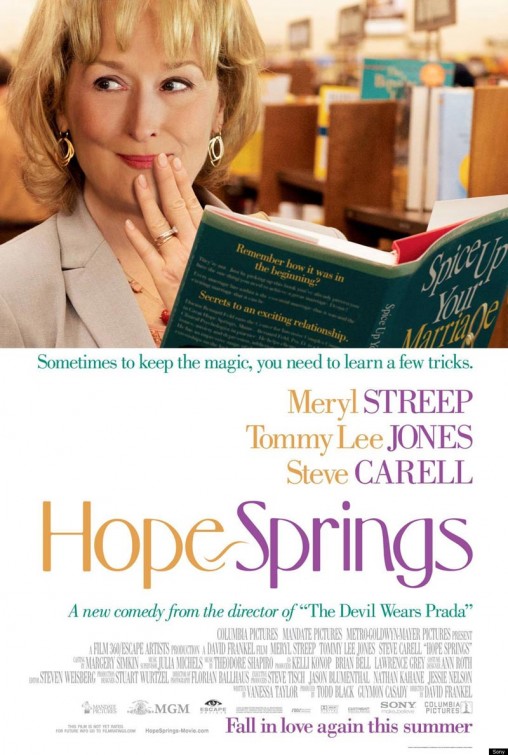 I may be 30 years removed from the target demographic, but I found the sexagenarian romance Hope Springs to be charming, insightful, and quite well developed. The idea of Meryl Streep getting her groove back and an older couple essentially learning how to be intimate again, physically and emotionally, sounds like a hard sell (no pun intended). The central couple has settled into the complacency of a long marriage, and little divisions have turned into routines. How can you bridge the divide? I was routinely surprised at how mature and thoughtful the movie was when it came to examining relationships. In between all these personal revelations of unhappiness is a curiously playful sex comedy, and you’ll see Streep engaging in certain acts you never thought becoming of the three-time Oscar-winner (no pun intended). Streep and her reserved husband, played by Tommy Lee Jones, are terrific, and their counseling scenes are the stuff of great drama, as two people who don’t really know how to communicate reveal their true feelings and problems. I’m making the movie sound like a chore but it’s really engaging and the stuffiness of Jones makes for some enjoyable comedy. This is a small movie, dealing with a weighty but recognizable subject that’s not often handled with this care and attention. Hope Springs is practically a Hollywood version of a Bergman film, and with these results, that’s not a bad thing. I foresee Hope Springs leading to a lot of patrons going home and having sex with their spouses. It’s like an AARP aphrodisiac. Good thing for menopause, or else Hope Springs would be responsible for a baby boom all its own.
Nate’s Grade: B+
Share this:

Hysteria (2012)
 The birth of the vibrator doesn’t seem like a tale that demands telling until you realize that the most prolific sex toy of all time started during one of the most sexually repressive cultures, Victorian England. In 1880, the plague of the era was a malady known as “hysteria.” Half the women in London seemed to suffer from this condition where, as the doctors of the times believed, a woman’s uterus had become unaligned and needed to be properly readjusted; the readjustment produced a “paroxysm” of relief. To treat hysteria, these trained professionals would oil their hands, insert them inside a woman’s vaginal canal, and apply alternating pressure. They were getting these women off. Hysteria presents a charming document about the invention of the vibrator, a miracle of modern science. However, I wish the movie had taken a more mature approach to the material.
The alignment process was an arduous one, and Dr. Robert Dalrymple (Jonathan Pryce) needs a new set of hands. Enter Mortimer Granville (Hugh Dancy), a crusading young doctor who butts heads with the medical establishment over things like washing hands and germs. Under Dr. Dalrymple’s tutelage, the practice is never busier, relieving upper class women of hysteria. It’s going so well that Dr. Dalrymple would like to eventually pass the practice on to his young protégé, as well as his proper young daughter, Emily (Felicity Jones). Then there’s the doctor’s other daughter, Charlotte (Maggie Gyllenhaal), who clashes with authority, is outspoken about women’s suffrage, is critical of the limited role women play in society, and devotes her time to a lower-class shelter to provide refuge and education to those in need. She represents a brand-new kind of woman in time, and Mortimer cannot get a handle on her. Mort is suffering some pretty serious hand cramps from his line of work when he gets a splendid idea from his childhood friend and amateur inventor, Edmund St. John-Smythe (Rupert Everett). It seems with a quick fix, the electric feather duster may have other more scandalous uses.
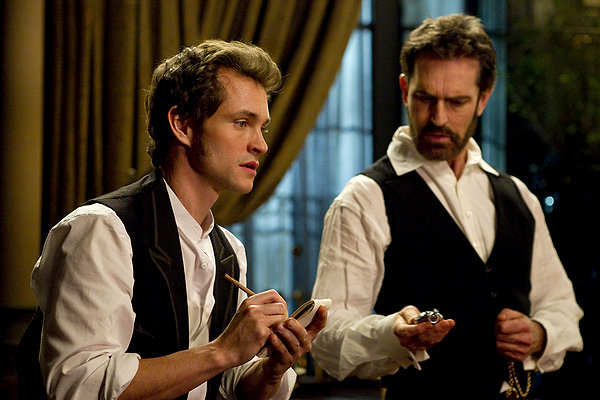 Hysteria is short of being hysterical but it’s certainly charming and provides an interesting history lesson with a light touch. The very nature of women’s hysteria is a fascinating moment in history where men were bending over backwards to find medical assessments for what is, in essence, horniness. The fact that these women’s doctors were getting carpal tunnel from all the manually stimulation of their clients has got to be one of the strangest workplace hazards. In certain regards, the invention of the vibrator has saved lives, or at least the hands of medial practitioners. It’s probably also made a whole lot of women a whole lot happier. Feminine sexuality was just an obtuse concept to the well-educated men in charge. One character says, with absolute certainty, that women cannot achieve sexual pleasure unless through insertion. As another fun historical note of male ignorance when it comes to female anatomy, when Deep Throat was being banned in the U.S., the federal judge who deemed it obscene cited, in his writing, that one of the many dangers of the provocative flesh film was that it mistakenly exposed women to the idea of an orgasm without insertion. This is almost 100 years later and yet men in high places of power are still carrying on complete ignorance of something they very literally know very little about. In that regard, Hysteria is jolly fun as we watch women get their jollies. There’s always something fun about watching uptight characters cut loose, especially when they find pleasure that has been denied them.
Having a talented cast is also a benefit when you’re working in comedy. Dancy (Adam) plays our straight man with fine properness. He has a few moments where he gets to delightfully squirm thanks to bold women and bold topics. He’s got some solid chemistry with Gyllenhaal (Crazy Heart), who is the feisty spitfire we expect in this sort of movie. Gyllenhaal is charming without being obnoxious, and her English accent is impeccable. Pryce (G.I. Joe: Rise of Cobra) and Jones (Like Crazy) are funny in their understated, stuffy British formal way, while Everett (Stardust) provides a great comedic jolt as the self-possessed, blithe technophile, ready at a moment’s notice for a good wisecrack. Sheridan Smith (How to Stop Being a Loser) also deserves special mention as a maid who was formerly employed as a prostitute. Her randiness is a nice counterpoint to all that Victorian repression and she pushes the movie further into sex farce.
While amusing, I wish the filmmakers would have taken a, dare I say it, more mature approach to a very interesting subject of history. The structure and very aim of the movie is that of a typical romantic comedy, which is a shame given the atypical subject matter. It’s pretty much a romantic comedy transplanted to merry old England. Much of the humor of the movie is divided into two camps: 1) watching the uptight Victorian-era Brits cut loose with decorum, or, 2) self-aware humor about the ignorance of the age. The first is always fun since we’re watching people sneak their true feelings through the wall of social repression. Director Tanya Wexler makes sue of a lot of sight gags and heartily enjoys cutaway reaction shots of ladies going orgasmic. It’s enjoyable but the fact that Wexler has to keep going back to the reaction shots for jokes, it loses its effect. Then there’s the self-aware humor built entirely upon dramatic irony, where the writers tweak the knowledge of a bygone era with all of our clever foresight: “Oh those stupid Victorians, not believing in things like germs and female orgasms.” After a while, the self-aware humor becomes tiresome. We get it; these silly Brits did not understand female health and proceeded to rule in their ignorance. I wish the movie left behind the easy jokes for some stronger social commentary. To this very day, we have men legislating women’s bodies and their reproductive rights (see: Oklahoma saying life begins weeks before conception, or Virginia demands medically-unnecessary vaginal probes for no other purpose than to shame women, and so so much more…). Ignorance knows no end, and one imagines the rom-com that makes fun of our current social mores and understanding.
 It’s during the last act where Hysteria really starts to come apart at the seams. Beforehand, it’s been a fairly light comedy with some punctuations of commentary from Charlotte and her idealistic desire for equality. But then, and spoilers will follow, the movie suddenly transforms into a courtroom drama with Charlotte on trial. Her very mental health is on trial and if she’s found to be a hopeless case of incurable hysteria, then she’ll be shipped to a sanitarium and have her uterus forcibly removed. Wow. That is some heavy stuff for a movie that spent an hour making sex jokes. The courtroom setting leads to some pretty transparent speechifying; any subtlety goes out the window and we listen to messages about women’s suffrage, equality, and empathy. This conclusion feels like it was ripped from another movie. It’s tonally jarring. Then, after our lead takes his moral stand and confesses to his belief that there is no such thing as hysteria, that women are just stuck in sexually unfulfilling relationships in a sexually repressed age, everyone goes home to think about life. Then, thirty days later when Charlotte gets out of prison, she’s met by Mortimer where he, I kid you not, proposes to her on the spot. For a movie about breaking misconceptions about women, tying things up with a marriage proposal seems almost hypocritical. It also marks a pretty big leap in the burgeoning romantic relationship between Charlotte and Mort. It seems rushed and a strange way to end a movie about female empowerment. The rom-com elements have won out over any higher messages.
Hysteria starts strong but goes limp. Hysteria runs out of juice. Hysteria is a pleasant experience but doesn’t deliver a proper climax. Hysteria is not the feel-good movie of the year. The very nature of the movie lends itself to all sorts of innuenduous critical blurbs. It’s a rom-com transplanted to Victorian England and I wish that it tried a little harder with the material rather than settling for easy jokes relying upon the ignorance of the age. The cast is superb and the movie is certainly fun, but it falls apart in the end when the messages overtake the narrative. So what is the best Hysteria blurb? I’ve had better.
Nate’s Grade: B-
Share this:

Friends with Benefits (2011)
 Sometimes chemistry can make up for a lot, and the dynamic, natural, and playfully flirty chemistry between stars Justin Timberlake and Mila Kunis makes up for a lot of their movies shortcomings (if you know what I mean). Friends with Benefits is another tale about a guy and a girl, both friends, who embark on a challenge to have casual sex and not form emotional/romantic attachments. No matter how many romantic comedy clichés it points out for ridicule, it doesn’t excuse the fact that the movie becomes one big, mushy, clichéd rom-com itself, albeit with saltier language (if you know what I mean). The randy humor will occasionally feel like it’s trying too hard, afraid to let an obvious joke lie dormant for too long. That’s where the sheer star power and amiable chemistry of the leads comes in handy. Kunis and Timberlake are both rather easy on the eyes, but they have a sharp sense of comic timing and a natural interplay. Hooray, a movie about friends where they feel like actual friends. Under the direction of Will Gluck (Easy A), the film has a jaunty pace except for an extended layover in Los Angeles that seems to sap the comic mojo and chart the film’s obvious rom-com reconciliatory ending. Friends with Benefits is sexy, funny, and an easy way to waste a couple hours (if you know what I mean).
Nate’s Grade: B-
Share this:

Going the Distance (2010)
 At turns randy and sweet, this romantic comedy is surprisingly honest about the trials of long-distance relationships. Justin Long and Drew Barrymore fall for one another before their respective careers place them on opposite coasts. They explore all the real frustrations of having your beloved only reachable via phone for months on end. Going the Distance presents two likeable leads with an affable chemistry, and the real kicker is that they genuinely love each other. Nobody is a man-child or a shrew. The real villain is the distance. While the film doesn’t know if it wants to be a Judd Apatow-style raunchy comedy or a saccharine romantic comedy, there is a strong rooting interest in our couple. The supporting characters aren’t too wacky, the situations feel more authentic than contrived, and our couple makes seriously difficult decisions in the end that are downright adult. Going the Distance is a true surprise of a film. It’s got enough laugh-out-loud lines and situations to recommend as a comedy and enough emotional involvement to recommend as a relationship drama. It’s a little unnecessarily vulgar at times, like a fascinated kid who has just discovered the power of dirty words. While it may not go the full distance, this cheeky rom-com will nicely get you to a pleasant place.
Nate’s Grade: B-
Share this:

Fired Up! (2009)
 Written by four different writers under the combined porn-like pseudonym “Freedom Jones,” this movie about football guys going to cheer camp to score with the limber ladies is… watchable. It’s a silly male fantasy with 30-year-olds posing as high schoolers, the characters are all genre archetypes, and it ends up becoming an unbelievable romantic comedy, but it also feels like a throwback to the juvenile sex comedy buddy movies from the 1980s. The dialogue has a lot more zip and humor than I ever expected. Everything turns into a quip, in a substandard but less hyper literate Diablo Cody style. The main actors have fun spitting out the dialogue, and Fired Up! Is funnier than it has any right to be. At the same time, there are plenty of easy gags around homo-eroticism and a PG-13 atmosphere feels too tame for this kind of material. I don?t hate myself for liking this movie because it’s a step up from its cheer competition, but at the same time I’m not dumb enough to classify Fired Up! as anything more than a quizzically entertaining passer of time.
Nate’s Grade: B-
Share this:

Baby on Board (2009)
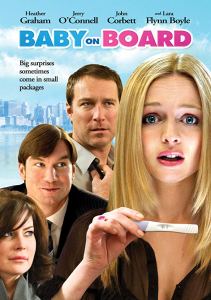 This is such a loathsome comedy that you feel the actors compelling you to put them out of their collective misery. It?s Heather Graham’s second pregnancy comedy in two years, except in 2008’s Miss Conception she wanted to get pregnant. Has Graham become the new face of the ticking biological clock? Graham is a perfume exec who gets in the family way. And how do we reveal this big news? By extended farts and projectile vomit. Stay classy. Instead of approaching an impending baby seriously, the film uses the pregnancy as an inane romantic comedy wedge. Graham’s hubby (Jerry O’Connell) doesn’t think it?s his because he “double bags it.” She thinks he’s a cheater. Their misunderstandings are predicated on the idea that nobody ever stops to say anything that might clear the air. This stuff is beyond sitcom level contrivance. Then the film becomes a battle of the sexes debacle as neither side wants to give in and leave the home, so we?re treated to a montage that zooms through EIGHT MONTHS of pregnancy. This is a comedy with no real feel for pacing, tone, setup, or context. The actors crank it up like they’re bouncing around in a farce, when this is really just a witlessly vulgar Knocked Up knock-off. The director (by the guy who made a movie trying to go on a date with Drew Barrymore) doesn’t so much deliver the jokes as pronounce them dead. This is a vacuum of funny with awful jokes, awful acting, awful attempts at being bawdy, and an even worse sentimental transformation at the end. This is without a doubt one of the most disastrous, abominable comedies of late and should have been terminated at the early script stage. Watch the trailer and spare yourself the agony. Even the trailer can’t help but indulge in a fart joke. The trailer, for god’s sake.
Nate?s Grade: D-


 nathanzoebl
You must be logged in to post a comment.