Blog Archives
Live Free or Die Hard (2007)
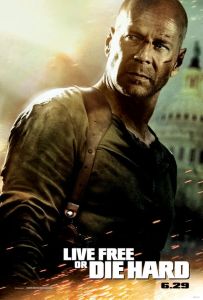 A lot has changed in the world and for Bruce Willis since last we saw John McClane in 1995’s Die Hard with a Vengeance a.k.a. Die Hard 3: Die Harder-er. Is a post 9/11 anxiety-ridden world, does someone like McClane feel quaint, like the remnant of a bygone era? Live Free or Die Hard, a.k.a. Die Hard 4, is Willis getting back to butt-kicking, wise-cracking basics. The film is a surprising and fun summer entry that could have been much much worse, and for that I am grateful.
McClane (Willis) is a pretty run down man thanks to the rigors of his job the heavy price being labeled a “hero.” He’s divorced, estranged from his teenage daughter (Mary Elizabeth Winstead), and retired from the force. He gets called to transport a hacker named Matt (Justin Long) from New Jersey to D.C. and into federal custody. Before he can leave Matt’s apartment, assassins start shooting at McClane and the hacker and the two go on the run for their lives. A former national security leader, Thomas Gabriel (Timothy Olyphant) has planned what is known as a Fire Sale, where the United States’ infrastructure is brought to a standstill by eliminating all power services, communications, and causing the nation to be consumed by chaos. Matt was one of the many that were contracted to unknowingly write code that would assist in Gabirels’ techno takedown. Now Gabriel is cleaning up his tracks and that involves removing an increasingly irritatable John McClane.
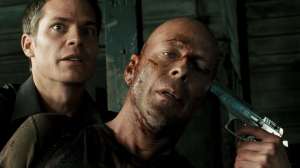 The film is nothing short of Bruce Willis trying to reclaim the action movie genre the way he sees it should be. Die Hard 4 is all about how computers and our complete reliance on modern technology put us all at risk if someone ever pulls the plug. Willis and the film are an efficient, and enjoyably retrograde Hollywood action flick that scoffs at kung fu, self-indulgent effects, and the gravity-defying acrobatics that have dominated action cinema since the rise of The Matrix. McClane shrugs and cannot understand this “kung fu shit” and mistrusts computers. Die Hard 4 puts most of its attention on good old-fashioned practical stunt work, not that the film’s sequences are practical, like when McClane is driving an 18-wheeler around a crumbling highway while being fired upon by a fighter jet. Live Free or Die Hard is crammed with gunfights, fistfights, and motor vehicles launched into the sky. People bounce around like pin balls. It pushes the boundaries of PG-13 action; the profanity of the previous films isn’t exactly missed, but it’s regrettable that cinema’s best catch phrase to ever use the term “yippee-ki-yay” has to be partially muffled by a sound effect to keep its more family-friendly rating.
Willis helps keep things grounded with an enjoyable acting style best be described as bemused crankiness. Throughout the long trip foes and intense obstacles beset McClane, and yet he remains the same grumpy Gus that can’t believe his own damn luck. Whenever he defeats a well armed opponent, or does something “so crazy it just might work,” and it does, he laughs to himself like he cannot believe his luck. He informs the bad guys that he is coming, and he will kill them, and they ask him how and even he doesn’t know and he doesn’t care. He’s a one-man wrecking crew, as he always has been, but there’s an added level of fun watching someone with an AARP card (who isn’t Clint Eastwood) kicking ass and taking cyber geek names.
 Director Len Wiseman cut his teeth on the terrible Underworld movies (I’m sorry, but if you got a movie about vampires vs. werewolves, you don’t give them leather and guns and call it a night), but he now has won me over with his work on Die Hard 4. His careening, deep-focus visuals are like a mix of Michael Bay with an extra dose of the fetish-loving Wachoswki brothers. There are a handful of visual scrapes that really pop onscreen like some very close encounters with high-speed cars.
But let’s not get too wrapped up in the fun of Live Free or Die Hard. It’s still an out-and-out action movie complete with plot holes, logic gaps, stock characters (the movie loses steam every time we have to cut back to the FBI agents), and some one-liner groaners. The villains are pretty standard, though very tech heavy in their approach. The movie never explains why a good portion of the henchmen are French. McClane’s daughter will obviously get crafty and bullish when under pressure, proving herself a chip off the old block. The banter between Willis and Long is overdone in an attempt to add more frantic feeling to a tale about the end of all reliance on technology.
Live Free or Die Hard is an efficient and satisfying retro, macho action movie. The action is frenetic and focused on hard-nosed stunt work that brings so much more excitement to the film. The movie works, and that in and of itself is something of a miracle. McClane rattles off a monologue about what it means to be a hero, and in the end he says it’s just about you being the guy willing to do his job no matter what. Well, as far as I’m concerned, the John McClane job is about providing solid action-packed crowd pleasers. I don’t care how old the man gets, because under the right direction he delivers.
Nate’s Grade: B
Share this:

Pirates of the Caribbean: At World’s End (2007)
 Shiver me timbers Jerry Bruckheimer. The Pirates of the Caribbean movies are taking no prisoners when it comes to money and fans. Ten months after 2006’s Dead Man’s Chest comes the concluding chapter to the Pirates saga. At World’s End is longer, bigger, and more expensive, but it is also the first Pirates movie that felt like a ride I wanted to get off.
The British navy, at the command of Lord Beckett (Tom Hollander), is eliminating all piracy once and for all. He now controls the heart of Davey Jones (Bill Nighy) and so controls Jones and the crew of the Flying Dutchman, the most fearsome ship run by cursed barnacle-encrusted crewmen. As the very busy hangmen will attest, it’s not a friendly time to be a pirate. The Black Pearl has set out to Singapore to find support from Soa Feng (Chow Yun-Fat), one of the nine pirate lords. The Pearl is now commanded by Barbosa (Geoffrey Rush) who was brought back from the dead thanks to the witchy Tia Dalma (Naomie Harris). They travel to the ends of the earth to Davy Jones’ locker to rescue Jack Sparrow (Johnny Depp), who was last seen in the belly of a beast. Elisabeth (Keira Knightley) and Will (Orlando Bloom) are both aboard and still bickering about their stalled romance. Once Sparrow returns to the land of the living, the group meets with the other pirate lords from all across the globe in an effort to pull together and stand against Beckett.
 As it turns out, the fear that Pirates of the Caribbean: Dead Man’s Chest was a 150-minute trailer for this movie was unfounded. That’s because the third movie in the Pirates of the Caribbean series completely ignores or messes up the many intriguing setups from the second film. Character motivations from Dead Man’s Chest are mostly unresolved and revert to stock generalizations. Jack Sparrow feels like he’s been grafted onto an unrelated storyline. Most disappointingly is what happens to Davy Jones, the greatest addition to the Pirates landscape. This awesomely-realized villain was scary and fascinating and looked fantastic thanks to Oscar-winning special effects. At World’s End takes such an intriguing villain and turns him into an impotent tool to Beckett. He’s been transformed into a houseboy who might as well fill people’s teacups. Yes Davy Jones thankfully figures into the climax but why in the world’s end must an audience wait that long? Davy Jones reminds me a lot of the ghostly twins from 2003’s The Matrix Reloaded who were completely dropped from the second Matrix film to the third.
But not only does At World’s End fumble the hand-off from the previous sequel, the movie itself establishes many setups with poor or unsatisfying payoffs. So much is made about the pirate lords from all over the world, and we see a colorful collection of international pirating groups that is fitfully amusing, but the whole section has no point at all. Chow Yun-Fat’s character is a non-starter; in fact none of the new characters introduced in At World’s End play any importance on the overall plot. The film is building to a final all-out battle between the united pirate lords and the British navy. We witness the awesome sight of the sea filled with vast armadas of ships, and as an audience we are getting hungry for some epic nautical action. Then At World’s End pretends that none of the other ships matter and sets its entire battle as one ship versus one ship inside a whirlpool. While this is admittedly exciting it isn’t anywhere near as exciting as an entire war amongst hundreds of ships. The filmmakers have all the money in the world and they couldn’t give us a little something bigger in scope? The pirate lords could have just as easily been cut from the movie if they were just going to stand on the sidelines and wave a flag.
The pirate lords make a big deal about their apprehension with releasing the sea goddess Calysto from her earthly prison. The pirates trapped her into the body of a human in order for them to gain control of the seas. They reckon she’ll be one very bitter sea goddess and take out some apocalyptic wrath out on the pirates. So the pirates release her, cowering in fear at her powerful reprisals and,,, nothing. Calysto vanishes, causes some mildly inclement weather, and is never seen again. Talk about a lot of pointless hot air.
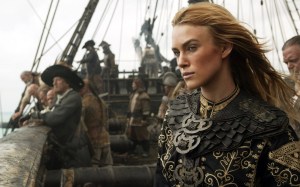 I think perhaps the clearest example of how the movie screws up is with the monstrous Kraken. This slimy beast got a ton of attention in Dead Man’s Chest and was a ferocious terror on the high seas. Now, I would expect that such a creature that played an integral role in Dead Man’s Chest would be back for the next sequel. Ignoring its prominence in the plot, the thing just looked amazing onscreen. But with At World’s End the giant monster is killed off screen and in between the movies. I felt insulted when I saw the mighty carcass washed ashore like a pathetic beached whale. What is satisfying about that? Why would Beckett make Davy Jones kill such a powerful weapon he could use for his own unseemly gain? It makes no sense. The Kraken isn’t the only character done a disservice by a plot stuffed to the gills. Some are killed in terribly pointless incidents and it just becomes irritating.
At World’s End is missing the high-flying fun of the first two Pirates movies, and this venture just feels draggy, tiresome, and far too dreary. You know you’re headed for some morose subject matter when a movie hangs an eight-year-old before the opening credits. This latest film is crushed to death by the weight of excess plot and confusion. There’s a damn near 20-minute section of the movie that’s nothing but characters double-crossing, triple-crossing, quadruple-crossing each other; it literally requires a character to spell out what has just taken place and set the record straight. I don’t think At World’s End ever recovers from this absurdly confusing miscue.
The film seems more interested in talking over an audience than delivering something genuinely thrilling and stirring. There’s a curious lack of action and nothing new matches the imaginative action set pieces of the previous films, like the duel atop the roving water wheel. Excluding a large melee between the Black Pearl and the Flying Dutchman as the climax, the action pops in and out in shortly timed bursts. For a movie within a hair or running three hours, there needed to be more action. Instead of derring-do, At World’s End spends interminable periods of people talking, usually in personal quarters, and explaining the increasingly laborious plot to each other. All of the Pirates movies are filled with false endings and heaping helpings of extra plot, but this is the first time I really felt the real drag of its running time. Director Gore Verbinski still knows how to keep things looking good but he can’t save the film from its anchor of a maddening and convoluted plot.
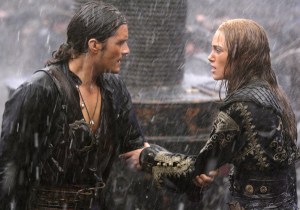 The movie is not without its due pleasures. Depp is always going to enchant with his now iconic character, but the true star of the film is Rush, who makes welcomed return. The special effects are still tops. The sequence rescuing Jack from the world of the dead provides many trippy moments that possess their own strange beauty, like when we watch the Black Pearl sail against the black, star-spotted sky. It’s fun seeing Keith Richards appear in cameo as Jack’s father and the stated inspiration for Depp’s performance. A small man and a large gun makes for one very funny sight gag. A Mexican standoff that actually involves an armed monkey is a comic high point. It’s just that all the fun or memorable moments seem to be the ones that matter the least. At World’s End still manages to do enough right to work, especially its Singapore opening. As far as a movie that upholds the quality of its franchise name, that’s a whole other matter.
Pirates of the Caribbean: At World’s End is a somewhat entertaining but heavily flawed final film to a trilogy. It’s the darkest and trippiest of the three movies, but it also makes the least amount of sense and has the least amount of action. That doesn’t seem like a good exchange in my book. There are not enough important events to justify the bloat. At World’s End has a hardcore case of butterfingers when it comes to handling plot and character setups from earlier films, and as a result almost nothing and no one ends in a satisfying fashion. The effects are still eye-popping and Depp will always be a comic treasure, but this lackluster movie feels like tripping at the end of a marathon. I had so much hope for At World’s End after how gratifying I found the other two movies but I cannot quell my disappointment. This is not a fitting conclusion. This feels more Matrix Revolutions than Return of the King. Of course it’ll make tremendous amounts of booty at the box-office, but will demand for a fourth be as rabid after this muddled and murky capper?
Nate’s Grade: B-
Share this:

Spider-Man 3 (2007)
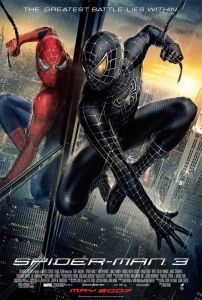 Who the hell are you Spider-Man 3 and what have you done with the franchise I loved? After the massive commercial success of first two Spider-Man chapters, my expectations had been raised fairly high. The more time that passes the more I reflect on how disappointing Spider-Man 3 sadly is. Part of my dashed hopes are because the 2004 Spider-Man sequel was a wonderful follow-up to a pretty swell introduction, and I placed that movie in my Top Ten list for the year and consider it one of the best comic book movies of all time. There’s some great popcorn entertainment to be had with Spider-Man 3, but man is this film just beside itself in wasted potential, a lack of focus, and some really poor choices.
Things are going pretty well for Peter Parker (Tobey Maguire). He plans on asking Mary Jane (Kirsten Dunst) to marry him and New York City is planning a parade out of appreciation for Spider-Man. But the good times can’t last long. Harry Osborn (James Franco) has accepted his fate and become a second generation Green Goblin villain, out to avenge his father’s death at the hands of Spider-Man. But Peter also has to be on the lookout for his job at the newspaper. Eddie Brock (Topher Grace) is an unscrupulous photographer out to replace Parker and nab a picture of Spider-Man caught in a bad light. An alien substance has also hitched a ride to Earth via meteorite and sought out Peter Parker. The black goo attaches itself to Peter and forms a black Spidey suit, one that gives him intoxicating power and a slimy menace. The new Peter cavalierly flirts with bouncy lab partner Gwen Stacy (Bryce Dallas Howard), hurts his friends, and loses his do-gooder ways.
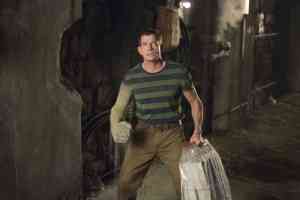
Meanwhile Flint Marko (Thomas Haden Church) has escaped from prison. It seems the police got it wrong and now inform Peter that Marko confessed to being the one who killed Peter’s uncle. While on the run Marko happens to tumble into an open pit that is a science experiment and becomes fused at a molecular level with sand. He uses this new power to rob banks in order to save his sick daughter at home. Peter, with the power of the alien suit, hunts the Sandman to get his own slice of sticky vengeance.
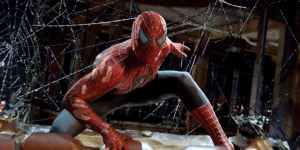 The film has way too much on its plate. There are too many characters, too many undeveloped storylines, too many coincidences, too many contrivances (Amnesia? Really? Really?), and too many aborted moments of drama. Spider-Man 3 is an undisciplined mess. The film practically stumbles from one scene to the next and lacks the coherency and intelligence of the earlier entries in the series. The third film tries to do too much and please too many interests, and as a result it may end up pleasing few fans. I had some trepidation when I learned that there was going to be upwards of three villains for this movie, but I swore that it could work since Batman Begins confidently worked around a trio of big bads. Three villains do not work in Spider-Man 3. Let me dissect this rogue’s gallery and where they fall short.
1) The Sandman is kind of a lame idea from the start. His power seems to limit his available locations, and I’m surprised that he wouldn’t stick to beach areas as a means of playing to his sandy strengths. Regardless, the character plays no part in almost anything that happens, and the Sandman is given one note to play. He’s got a sick daughter and he robs to try and pay for her medicine. That’s great on paper but it never really seems to give the character any sense of urgency or frustration. If he got special sand powers why not sneak into banks through cracks in walls instead of forming as a giant sand monster? Church attempts to imbue the character with a sad soul but he just comes across as being wooden. If he was really on the hunt for money to save his daughter then why does he just slouch around all the time? Wouldn’t it be easier to rob a city not patrolled by a web slinging super hero? How can he say he’s a misunderstood victim of luck just minutes after he tried killing Peter? He seems like a dull lunkhead. The Sandman is given a tiny wisp of character detail (sick kid!) and that’s it. He doesn’t get any other characterization and is kept on the run and pops up whenever the film needs him. He becomes a token character until the very end where Church is given 2 minutes to pour his heart out to Peter. Two minutes of character at the start, two minutes at the end, and a gaping center. The Sandman isn’t so much a character as the ideal of some issue that the filmmakers want to have Peter work through.
And what is that issue? Why vengeance and forgiveness. You see, Spider-Man 3 foolishly rewrites its own history and now it was the Sandman hat killed Peter’s Uncle Ben. This revision does not work at all and actually legitimately damages Spider-Man. Just like Bruce Wayne is tackling crime to alleviate his guilt, so too is Spider-Man, who can never shake the fact that he could have prevented his uncle’s death had he done the right thing moments before. By introducing a new killer it means that Peter has no responsibility for his uncle’s death. This completely strips away the character’s guilt and rationale for what compels him to swing from building to building to fight crime.
 2) Eddie Brock/Venom is wasted as well. Director Sam Raimi has said before he’s not a fan of Venom and doesn’t get the character, and I feel that his contempt carried over into the film. Venom and the black alien goo are given about the same abysmal care as other half-baked plot points. Eddie Brock has about three total scenes before he gets to transform into Venom thanks to the alien substance, and none of these scenes fully flesh out who the character is or justify his relationship with Peter Parker. When we do see Venom in the finale its all too rushed and hokey. The effects make him look less like alien and more like a wax figurine (I suppose there could be intelligent wax life amongst the stars). For whatever dumb reason the alien suit has to retreat so we can see Grace’s face while he taunts and mocks with bad vampire teeth that are meant to inspire what exactly? The character is rushed and underdeveloped and should have been saved for the next sequel instead of being given lip service in this one. Venom is supposed to be the evil doppelganger to Spider-Man, not some smart-alleck with frosted hair that gets about 15 minutes of screen time. I like Grace, I really like him a lot and envision him as his generation’s Tom Hanks, but he does not work in this movie. He could, but I get the sneaking suspicion that Raimi sabotaged the Venom role on purpose or at least subconsciously. The villain goes out with a whimper and it feels like a giant, foolish wasted opportunity that becomes more maddening the more I discuss it. The presence of Venom feels like a shallow attempt to placate a younger generation of comic fans and to sell more action figures.
The alien goo suit is supposed to tempt Peter and bring out his wicked wild side. So what does he do? He acts like he’s auditioning for the lead in The Mask. This embarrassing sequence is painfully goofy and will make you cringe and shield your eyes. Peter flirts with girls and dances at a jazz club, and this is supposed to be the dark side of Spider-Man? What the hell? I acknowledge that Peter has always been an unpopular dork and would be a dork even if he ventured to the dark side, but how does this square with the more serious and edgier tone the film is grasping for? Evil Peter seems more like a broody emo kid, with shocks of black hair in his eyes and traces of eyeliner. The dark side of Spider-Man, much like the rest of the film, is given little time or thought. Peter’s trials with the symbiotic suit last about a reel or two and then it’s abruptly finished.
 3) Harry should have been the main focus of this sequel and it?s a shame the filmmakers had to cram so much crap into a story already heavy with plot leftovers. Harry has the most obvious arc through the three movies and deserves better than to be knocked out of commission by amnesia. The conflict between Peter and Harry is where the film finds its emotional core and it would have been wise to expand this section and eliminate one of the other underutilized villains (my vote: both Venom and Sandman). Harry’s vow to avenge his father is far more interesting than what the other two villains have as motivation, and plus Harry requires no extra time-consuming setup to slow the pacing down. I’m glad the final battle encouraged Harry to come out and play; the film finally gives Franco the screen time he deserves, but it should have been more. The worst plot device in the film involves Harry’s all-knowing butler who has some vital information he most certainly should have shared years ago. So much time is spent on storylines that go absolutely nowhere, and the musical chairs of villains, that the film resorts to having a freakin’ butler tap someone on the shoulder and say, “Excuse me sir,” just to tie things up in the most awkwardly shrift way possible. And even if what the man says is true, how does his perspective add any clarity to the situation? Think about it. I have.
The romance between Peter and Mary Jane feels awfully trite and meandering. Spider-Man 3 lacks the tight focus of the second film. It throws contrivances to place a wedge in their relationship, like the fact that Mary Jane is fired from her Broadway gig but doesn’t tell Peter, or the fact that they never seem to answer the phone on time when the other person is apologetic. Gwen Stacy is less a character than simply a dimwitted blond tool to make Mary Jane jealous and sulk. The ups and downs in this relationship feel pretty forced and some moments defy all human understanding. At one point Mary Jane is forced by Harry to break up with Peter to spare both their lives. So she breaks the news in a park, and Peter is devastated, but why in the world does she never say anything again? Why would she not clear things up after time had passed to explain her actions? Spider-Man 2 ended with Peter finally getting the girl but also on a hint of doubt, and it was marvelous. Spider-Man 3 just sort of ends with everyone presumably in the same place they started.
Spider-Man 2 really succeeded on how focused it was and how it related its action with character. Spider-Man 3 has to resort to cheap and lazy devices to cover its storytelling pitfalls. Don’t even get me started on the fact that the film has to resort to a newscaster narrating our final battle where he actually asks, “Is this the end of Spider-Man?” This might be the end of the quality associated with Spider-Man.
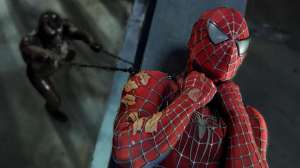 After having spent a whole slew of words detailing in length where the film goes wrong, allow me to illustrate some of what the film does right. Whenever it sticks to action, that’s when Spider-Man 3 works, and Raimi has cooked up some wonderful whiplash-inducing action sequences. The first battle between Peter and Harry is intense and sets the film on the right path, but the action as a whole isn’t as closely tied to Peter’s domestic life and emotional troubles as it was in the other films. A high-rise rescue from a crumbling office building will stir some 9/11 memories but it is awesome to behold. The effects have improved and the swinging shots through New York look the best they ever have. The greatest moment in the film is perhaps the birth of the Sandman as he rises grain by grain from a pile of sand and attempts to reform himself. Aided by some lovely music, the moment takes on a beautiful and unexpected poignancy. This is where Raimi and the CGI wizards hit it out of the park. Nothing rivals the train sequence in Spider-Man 2, though.
It might be dangerous to say, but I feel jilted from this film and either new blood needs to be brought in or the filmmakers need more time and control to make a Spider-Man sequel worthy of its name. This is the gold standard for super hero movies and its been tarnished and sullied. Spider-Man 3 has moments to dazzle and excite but it also feels battle fatigued from carrying the dead weight of extraneous characters and half-baked storylines. There are too many balls in the air for Raimi to juggle. This Spidey chapter squeezes too many ideas in too short a space. After obliterating box-office records, Sony has stated that they plan on three more Spider-Man sequels. If this film is the tipping point, then I’m afraid of what will be swinging down the pipe in years to come.
Nate’s Grade: C+
Share this:

Big Momma’s House 2 (2006)
 Men in drag is one of the truest tenets of comedy. Billy Wilder proved it, Dustin Hoffman proved it, even Robin Williams proved it. Eddie Murphy found career resurgence when he put on a fat suit for 1996’s The Nutty Professor. I think Martin Lawrence thought, why not combine them both? Thus was the unholy birth of 2000’s Big Momma’s House, where Lawrence goes undercover for the FBI as a morbidly obese older woman. If that doesn’t spell comedy then what will. Forgotten amidst the fat jokes and flatulence is the fact that Oscar-nominated Paul Giamatti was Lawrence’s beleaguered co-star.
Now, I myself had never seen the first trip to Big Momma’s House but in order to give a rounder opinion of the year 2006 in film, I felt it was my duty to see its sequel. For fun I felt a traditional review would do a disservice to the fine craftsmanship and invigorating cinema I was about to witness, so I decided to create a rundown of my viewing thoughts by the minute. Here, ladies and gents, is Big Momma’s House 2. Beware plot spoilers below.
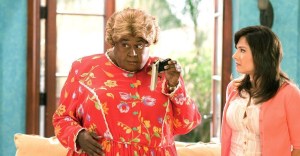 03: Martin Lawrence is dressed as an eagle and teaching kids about safety during a school assembly. Somehow his adolescent stepson is embarrassed by this.
04: Apparently Mrs. Big Momma (Gabriel Union) has a bun in the oven. Or an egg in the nest. She has the most unrealistic looking pregnancy ever. It’s almost like a cone.
10: Lawrence climbs back into the fat suit to go undercover as a nanny to stop computer hackers from dismantling the secrets of national security and selling them to terrorists. That’s right, it’s Big Momma vs. terrorism.
11: Also, apparently the rich do not do background checks on those in charge of watching their children. Has Dateline taught us nothing?
18: Here are the kids: dumb kid, cheerleader wannabe, and Hot Topic rocker chick (the daughter in 40 Year-Old Virgin that wanted to have sex).
22: Wife discovers Lawrence’s secret supply of XXXXXXXXL panties. Does she not know of Big Momma?
26: Nope. No she doesn’t, as she mentions her concern to a gal pal. “A woman this big wearing a thong? That can’t be comfortable.” Cue cut to Big Momma lamenting her thong. Why is Lawrence even wearing a thong? What are the benefits of dressing as a large woman and also wearing a thong?
32: Even the FBI, who put Big Momma into the field years ago, doesn’t even know Big Momma is not real. No wonder we have intelligence failures. Send Big Momma to fix Iraq. That’s a sequel I’d be interested in.
34: What school plays “Baby Got Back” for a gym dance class? Big Momma shows the uncoordinated cheerleader wannabe how to dance. The gym leaders ask for Big Momma to lead them to glory. Maybe he/she can also sink the winning last-second shot for the high school basketball championship too.
40: 19-year-old Chad is lurking in the bushes for the 15-year-old Hot Topic girl. Nothing spells romantic like “lurking” and “interested in dating a 15-year-old.” Again, did Dateline teach us nothing?
 45: Lawrence has to spy on the baddies and attempt to outrun his pregnant wife. Who do you think will win in a footrace?
46: The FBI finally realizes Big Momma is neither. The FBI earns a lollipop.
48: Lawrence decides to actually do housework for his nanny job but he decides to do it outside of his Big Momma costume, you know, in case the family walks in and wonders what a strange man is doing cleaning dishes and cooking dinner.
49: Big Momma pours the doggie a bowl full of tequila to lift its spirits. Dog depression is no laughing matter.
52: Big Momma teaches young girls how to dance like video stars.
56: Big Momma is at a spa with naked women and massages. Her advice to women for long-lasting marriage: put out often. That’s Big Momma for you, teaching our youth to dance salaciously, liquoring up animals, and turning back on the clock on feminism.
60: Big Momma runs on the beach in a 10 parody that no one seeing the movie will ever get. I guess it’s supposed to be funny because she’s fat? I think that’s the punchline for most of the movie.
63: Again, the limitations of an agent undercover in a fat suit (and thong) are revealed when Big Momma tries to chase down a suspect.
73: The dumb kid’s first words are, “Big Momma.” Then, “stakeout” and “investigate” and “hackneyed plot.” I made that last one up but it would have been something.
79: Big Momma enters a club to rescue Hot Topic girl at her plea. Oh, but Chad did not send a message it’s… THE BAD GUYS! And they’re taking her and Big Momma hostage.
80: My first laugh. Hot Topic girl and Big Momma tied in the back of a speeding van and rolling on top of each other with the sharp turns. Big Momma crushes the girl. Hot Topic Girl: “This is not how I imagined my death.” I’ll say.
83: Big Momma on a jet ski battles terrorists. Doesn’t being a large woman also make you a bigger target for bullets? Regardless, she kicks ass and we’re treated to a half-hearted payoff for thong wearing.
 86: Big Momma gets shot just as the FBI arrives to shoot the bad guy. Excellent timing. Big Momma saves the day and is unmasked.
89: Have no fear, Big Momma stands in for the girls’ cheerleading dance. They apparently have a matching uniform in Big Momma size. There’s nothing Big Momma can’t do except star in a decent movie.
93: Lawrence brings home his new baby. He also threatens, in voice over, “You never know when Big Momma might be back.” Great, now I have to check under my bed every night.
I’m somewhat surprised that the movie isn’t as bad as I had feared. It’s mostly bland, with cookie-cutter characters, contrived situations, mishandled life lessons, and a dearth of comedy. Martin Lawrence must have been in bad shape to bring the fat suit out of the closet for one more go-round. The film is a dumb comedy that relies heavily on slapstick and Lawrence’s patter but neither ever feels inspired. This is a big bland mess, but it’s somewhat depressing in how cut-and-paste it all is and still designed to boost Lawrence’s career. If it wasn’t obvious before, it should be now — it’s time for Big Momma to pack her bags for good.
Nate?s Grade: D+
Share this:

Rocky Balboa (2006)
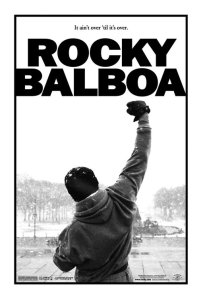 The idea of another Rocky movie, already 16 years since the last installment, sounded as good an idea as a punch to the face. Sylvester Stallone is an actor bottoming out after tons of high profile shit-for-hire jobs, and it looked like the industry was ready to yawn and put him to bed for a long winter?s nap. The idea of a Rocky 6 seemed like a thinly veiled vanity project for Stallone, going back to his bread and butter to try and resurrect some kind of acting pulse. Well, I reasoned, it couldn’t be any worse than Rocky V. I figured we were entering Godfather III territory and that is a scary place. But then I saw Rocky Balboa and realized what Stallone had in mind, and that is a proper sendoff to wipe the acid taste of Rocky V from the collective mouth of the populace. The great big lug can hang up his gloves and rest easy with a job well done.
Rocky (Stallone) has settled into a comfortable retirement. He owns a restaurant named after his deceased wife Adrian, and he regales diners with boxing tales and poses for pictures. His son (Milo Ventimiglia) is trying to make it as a businessman and distance himself from dad. Rocky rediscovers “Little Marie” (Geraldine Hughes), the same girl in 1976 he advised against smoking. She’s got a kid, a lousy job, and a weary perspective. Rocky reconnects with her and gets her to work in his own restaurant. She’s hesitant but he assures her that good ole Rock isn’t expecting anything in return for his kindness.
 Then one day ESPN runs a computer simulation pitting fighters of different eras. Rocky in his prime is paired against the current heavyweight champ Mason “The Line” Dixon (real-life boxer Antonio Tarver). Computer simulation Rocky KO’s computer simulation Dixon and the debate starts. The knock on Dixon is that he has no heart and the current level of boxing competition is beyond barrel scraping. Could an aging fighter from the past last 10 rounds with the current untested champ? Boxing promoters visit Rocky’s restaurant to convince him to an exhibition bout. Rocky mulls over the decision, not wanting “to get mangled and embarrassed.” Ultimately, he feels that he still has something to prove and decides to step back into the ring one more time.
The story is much like past Rocky installments. He spends a lot of time mulling over whether to fight or not, then trains, then we get the fight, though usually it’s some rematch of a Rocky setback. Rocky Balboa doesn’t stray far from the well-worn formula. The character has actually benefited with time and become an underdog once more, one with all sorts of new issues like calcified joints and arthritis. I would have loved a longer training sequence to show how a, presumably, 60-year-old man gets back into shape and how he plans to utilize his strengths (“hurtin’ bombs”). I agree with my friend George Bailey, somewhere along the line Stallone perfected the montage, and Rocky Balboa has an excellent training montage set to the same bom-bom horn theme that will still get your blood pumping.
The film presents some interesting characters but doesn’t spend much time with them. Rocky’s son has to deal with the long shadow his father casts and the idea that, no matter what he accomplishes, he?ll still be seen more as scion than individual. There’s a lot of meat there but Rocky Jr. only gets to huff at dad and then joins the team. Once everyone officially joins the Rocky team they essentially blend into the background of various faces shouting things like, “Come on!” and “Go Rocky!” The biggest supporting player is Hughes who gives a stirring speech for Rocky to confirm that this old man still matters. She has a great sadness to her and the character is played with non-threatening sexuality. Rocky isn’t about to jump anyone’s bones just yet, even years after Adrian’s passing.
 The only reasoning I have for why a so-so plot works as well as it does is because of our warm attachment to Rocky. Arguably the greatest movie figure in the last 30 years, Rocky could do it all, even get a Soviet crowd in Moscow to cheer for the American during the Cold War (don’t neglect to give Rocky his due for the breakup of the Soviet Union). Rocky Balboa, the character, is an old shoe that fits Stallone exceedingly well. Stallone has always been a mumble-heavy droopy dog of an actor, best described like Rocky’s new pet as a “cute ugly.” In short, the man never seemed to fit whatever character he played, and you don’t need to see Stop or My Mom Will Shoot for proof. But Rocky is his masterpiece, and after five sequels and 30 years, America loves its prized prizefighter. When you see the good soul trying to do right you forget all of Stallone’s many cinematic transgressions and you simply fall in love with the character all over again. Old feelings are reawakened and Stallone works his big-hearted, optimistic palooka charm. I watched Rocky Balboa and got swept up. Finally, the great American character can step away with the proper and fitting sendoff he deserves. In some ways, Rocky Balboa feels like a eulogy, as we reflect back on old times and how much these people have meant to us through the years, and the desire to see a lasting legacy intact.
It’s that sense of history that gives this new Rocky movie its heart. It is quite invigorating to see characters in new stations in life when we’ve seen glimpses of these characters for decades. It’s like a high school reunion that can include turtles. Stallone, who also wrote and directed this new movie, really has a strong shopworn affection for his blue-collar characters and a love of Philadelphia. It’s easy to feel the same warm and fuzzy feelings.
Rocky Balboa is a welcomed and surprisingly emotional end for one of American film’s greatest characters. Stallone puts the gloves back on and, like Rocky, still has “stuff in the basement” he needs to get done before he can rest. This is probably the best Rocky movie since the original and time has only made the characters more resonant and endearing. In 1976, Rocky defined the underdog and became well woven into our culture. Who would have guessed that 30 years and countless parodies later Rocky would still pack a punch? Stallone has earned his sendoff. Now about the idea for a Rambo 4.
Nate’s Grade: B
Share this:

Saw III (2006)
 Horror works in cycles and seems to ebb and flow every three years or so. The popular horror cycle right now is all about torture and realism. I guess people have had it with masked men with large pointy things. Pasty Asian children don’t seem as gloomy as they once did; in fact, in today’s world-on-the-go, who wouldn’t want an extra hand in the shower? In a world bombarded with carnage leading the six o’clock news, I guess American audiences desire something more universal than ghosts and boogeymen. The Saw franchise has exploded and seems destined to place a new entry every Halloween until the public looks to a new en vogue horror cycle. After seeing the loss of luster that is Saw III, I am already looking.
Jigsaw (Tobin Bell) is back with a fresh new batch of his twisted games. Unfortunately, he’s bedridden and dying. His serial killer apprentice, Amanda (Shawnee Smith), has to do the grunt work. She kidnaps a depressed doctor, Lynn (Bahar Soomekh), and orders her to keep Jigsaw alive as long as she can. Around Lynn’s neck is a crude explosive device that will detonate if Jigsaw’s heart flatlines. He has to stay alive just long enough to witness one final game. Jeff (Angus Macfadyen) is trapped in a typical Jigsaw-engineered series of traps. He has to pass through three tests of resolve and forgiveness, each involving someone related to his young son’s unexpected death.
 The Saw franchise seems to be losing momentum with each additional thrown-together sequel. I found the first film to be mostly entertaining and very inventive, but this was because of a smart narrative device: we wake up in the same dingy bathroom as our figures and must learn with them about what is happening. It plied some neat tricks and twists and was an altogether enjoyable horror movie that didn’t mind mucking around. But with all invention, if it sells then it becomes repeated in mass-market form, dulling the edges and losing the bite it once had. What once startled and amused is now the expectation. Just like the collapse of the Final Destination franchise, these movies started big but then bottomed out when their audiences had the rules memorized. At that point the only thing left is curiosity in what fiendishly outlandish ways people will get horribly killed. The Saw films still have more smarts to them than your typical man-chases-teens-with-axe slasher flick, but the franchise definitely seems, like Jigsaw, to be dying a slow death.
Saw III spends far too much of its time and energy trying to be a compendium to the franchise, filling in the blanks and the resolutions for Saw and Saw II. The film bends over backwards trying to tie up loose ends that didn’t really need tying up (Finally, now I know what happened to that foot that was cut off!). I don’t need to know how the incidents of the previous movies were set up, or who kidnapped who; the minute details are pointless in a horror film, especially one with such flights of frightful fancy. This movie spends too much time feeding the audience needless back-story. The film’s two major storylines are uneven in interest. There’s a real lack of danger and development for Lynn playing nursemaid to Jigsaw. We know the only time he may die is late in the movie, so her storyline becomes prime thumb-twirling time. We see some nifty medical procedures but I?d rather get back to Jeff’s descent into the funhouse of doom.
Saw III seems too concerned with how it fits within the framework of a trilogy when it should be worrying how it works as a movie. Saw III, for stretches, feels like it was cobbled together from the dull deleted scenes of previous films. And true to form, this Saw sequel ends with a familiar rush of twists, deaths, and a very nihilistic close. Let’s just say the inevitable Halloween 2007-bound Saw IV is going to have to go back to the ridiculous plot device drawing board. I truly wonder how many little tape recorders Jigsaw has stashed around and for what occasion (“Note to self: clean gutters.”).
 Some of the ingenuity is downright admirable; Jigsaw sure puts a lot of thought and care into his skin-crawling craft. Some notably gruesome torture tests include a naked woman being frozen to death by routine sprays of water, a man having his limbs twisted all the way around, and a man drowning in the slimy goo of ground up pig carcasses. Now that takes discipline just to plan, let alone fully stage. I’d like to see Michael Myers or Freddy Kruger try something like that. Part of the macabre fun of the Saw franchise was playing along, wondering what you would do in the situation and how far you?d go to save your own life. But in Saw III the deck is stacked for about half of the twisted games. There’s no way to win. A character goes through great lengths to free herself from a death trap but, alas, there is no escape and she gets her rib cage ripped out for the bloody hell of it. This … lack of sportsmanship, let?s say, does play a crucial part to the Saw III storyline, but it still knocks the film’s fun level down when you’re just waiting for the moment the person becomes a corpse instead of waiting to see what they do next.
It seems like the Saw movies become less engaging the gorier they get, and Saw III may be the goriest yet. These films have never been afraid to get messy, and Saw III has some squirmy moments, particularly a very protracted scene that involves the peeling, drilling, and scraping of the human skull. Horror fans should be happy with the results but there’s nothing that will make the squeamish cover their eyes (a bone snapping through a leg comes closest). Worst yet, despite the yucky credentials I’ve mentioned above, there really isn’t anything too memorable about the death traps this go-round, though the pureed pig entrails is certainly praise-worthy.
After three movies in three years, it feels time for a breather. The Saw movies are losing their sheen as their audiences become hungrier for blood and harder to fool. 2004’s Saw was clever and different, but like the demise of the Final Destination franchise, the sequels are victims of expectation. When the unexpected becomes the expected, then you may need to rework your scare formula. For whatever reason, Saw III feels compelled to be a refresher on the other films, devoting serious chunks of wasted time to clarifying loose ends that never mattered. I’d rather get to more sticky, icky death traps than examine the father-daughter-mentor relationship between Jigsaw and Amanda. Yawn. Saw III feels uneven, distracted, less fun, and a middling close to a franchise that began with wicked promise. This kind of movie just isn’t cutting it like before.
Nate’s Grade: C
Share this:

Pirates of the Caribbean: Dead Man’s Chest (2006)
 America loves its pirates, plain and simple. We as a nation are infatuated with the characters and the high-seas adventure of 2003’s Pirates of the Caribbean: Curse of the Black Pearl. We?re starving for more, and when the first in a two-part sequel was released it only became one of the biggest movies of all time. Pirates of the Caribbean: Dead Man’s Chest has shattered box-office records, rolling up $100 million in two days and a record $135 million weekend gross, easily surpassing former champ Spider-Man‘s supposedly invincible $118 weekend tally. America loves its pirates more than Spiderman, Star Wars, and who knows, maybe even Jesus. After all, Dead Man’s Chest did just kick out The Passion of the Christ from the top ten all-time grossers. Mel Gibson sure has a lot of grief at this moment.
Jack Sparrow (Johnny Depp) is a wanted man on the high seas. The East India Company, whose emissary now controls the Caribbean town of Port Royal, is after Jack and his special compass. But Captain Jack has bigger fish to fry. Davey Jones (Bill Nighy), ruler of the seas, wants what was promised to him: Jack’s soul. Jack made a bargain with the sea creature and now his time is running out. He must assemble a crew and track down the whereabouts of a buried chest. Inside this chest is the still-beating heart of Davey Jones, and he who controls the heart controls Jones, and thus the seas. That is why the East India Company is so interested in Jack. They’ve made an arrangement with groomis interuptis Will Turner (Orlando Bloom), who had his wedding hijacked and his bride (Keira Knightley) locked away. If he can retrieve Jack’s compass, then he and Elizabeth will be pardoned for aiding and abetting a known pirate. Will and Elizabeth each set off to find Jack Sparrow and to gain their freedom.
 The filmmakers have taken notes in the school of sequels from The Empire Strikes Back. Like the second Star Wars chapter, we’re left with the heroes separated and licking their wounds, evil appears to have the upper hand, and the lives of some beloved characters are left in doubt. Just as long as there’s no Ewoks, Disney has guaranteed my place in line on opening day 2007 for Pirates 3.
It?s hard to fully judge this Pirates sequel because it’s part one of a two-part story. I’m holding out my final say, especially if this movie just turns out to be an expensive 150-minute teaser trailer for Pirates of the Caribbean 3. I can?t fully judge many story and character arcs because we don?t know where movie #3 will carry them. Maybe it’ll end up being like the middling Matrix sequels, where subplots and characters were dropped as if the Wachowski brothers had screenwriting butterfingers (it’s a film critic’s unwritten duty to deride the Matrix sequels at any chance). At least this movie ends with a jolt that I did not see coming.
Most surprisingly, Dead Man’s Chest suffers little from the creative deadlock of sequels. Dead Man’s Chest is more a sci-fi monster fantasy than a swashbuckler. The supernatural edge has swallowed the series whole. Take for example Jack’s broken compass. What once was an oddity befitting its owner is now seen as another element of magic. Some of the interest seems lost if things are simply explained away as being magical. The story, unlike the Matrix sequels (See: above), expands and enriches its universe. Some leftovers from the first film made me cringe. I thought we were headed for a bad track, where the movie uses the audience’s memory as a cheap storytelling device. Familiar characters might pop up every which way, smiling, and saying, “Hey ho, remember me?” Miraculously, the leftovers are integrated so well with the new tale that they really do matter and don’t come across as cheap shortcuts. Norrington (Jack Davenport) and the two comic relief cursed pirates are all smartly woven back into the troupe, and each impacts the story in a non-obtrusive manner. Even the undead monkey is used well.
I made it a point to keep my expectations in check for Pirates of the Caribbean: Dead Man’s Chest. It would be naive to think that you could catch lightning in a bottle again. Yes, now with audience expectation we lose the originality and unpredictability that made the first Pirates adventure so joyously delicious. And yet I found myself getting riled up just the same and being whisked away by spirited entertainment. My expectations may have been tempered for Dead Man’s Chest but I still greatly enjoyed the ride. It seems that my opinion sharply differs from my overly negative critical colleagues; my own sister said Pirates 2 was one of the worst movies she’s ever seen. That seems a bit rash. She hasn’t even seen any Uwe Boll movies.
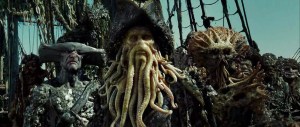 There are moments that seem to stretch the credibility of the story. It’s been said before that it’s not the impossible that bugs you but the improbable, and this holds true for Dead Man’s Chest. I’m able to believe Davey Jones and his creepy crawly crew, but I’m not able to believe that Elizabeth Swan could single-handedly best them all at once in sword fighting. The movie becomes dangerously close to eye-rolls in parts, but generally steers clear of moments that rip you out of the story. Of course a Pirates film would be nothing without Johnny Depp. He’s the main reason the first film was so memorably embraceable and entertaining. It?s not every day someone gets nominated for a Best Actor Oscar playing an addled, swishy comic pirate. He’s truly the star and has been one of our finest actors long before he had any box-office clout. He’s created a character so beloved that he’s crossed over into the cultural lexicon. How many Jack Sparrow outfits do you see come Halloween? I had a friend directing a high school performance of A Midsummer Night’s Dream and every young actor wanted to audition as Captain Jack interpreting Shakespeare. Come to think of it, Jack Sparrow would certainly liven up some of the bard’s dusty works.
Depp is still hilarious and likeable even when he’s being a scoundrel. We simply love this character; I love this character. The unpredictable nature of Jack feels squeezed dry by the demands for familiarity with sequels, but Depp finds new ways to enthrall in Dead Man’s Chest. Some people are going to be uncomfortable with Jack being more dastardly, willing to trade others’ lives to save his own hide. I think desperation is an interesting place to put this character. Besides he has his big hero moments as well.
New dimensions are added to the other characters. Knightley gets to be shrewd and try her hand at pragmatic treachery. It eats her up inside at the end and Knightley, a nice comedic actress, allows us to see the rough seas of guilt within her. Bloom will always be Bloom, meaning he’ll be handsome, British, and seemingly too little for grownup movie stuff. Will is given a whole new set of daddy issues when he actually gets to spend time with dear departed dad (Stellan Skarsgard). Best of the rest (“the rest” being everyone other than Depp) is an unrecognizable Nighy, who saunters his deck with the fiery air of a preacher. Nighy manages to make Davey Jones even more interesting. Naomie Harris (28 Days Later) makes her presence felt as a witchy woman responsible for Jack’s compass.
The action sequences are gigantic and well constructed. They expand with organic complications and a lively, graceful sense of humor. An already fun sword fight atop a watermill wheel gets even more pleasing when the giant wheel breaks free and the fight continues. Three characters climb inside and out, all vying for a key that keeps changing hands thanks to gravity. A human-sized fruit-kabob tied to Jack has a wonderful payoff for something that seemed completely random. The special effects are gorgeous. You can practically taste the slime and sea salt from the creatures. Davey Jones is a fantastic design and I’m dying to know how they did his tentacle beard. Whether it be motion capture, CGI, or puppetry (was someone billed in the credits for “operating” Bill Nighy? Does that sound like a fluffer?), it’s all dazzling to behold. The Kraken is ferocious and so well designed that it’s destined to give an entire nation?s children nightmares for weeks. Coupled with the equally super expensive Superman Returns, it seems that nowadays if you want special effects that will retain their wow-factor, it helps to have a $200 million dollar budget. Director Gore Verbinsky has a terrific eye for shot compositions; I am convinced that if you give this man good material then he will give you popcorn gold. If you give him bad material, well, then you get shiny but pointless stuff like The Weather Man.
 I know this movie, at its center, is empty. It’s grand throwaway entertainment, a true popcorn romp, but yes, when you get down to it the film has little to it. It’s an explosion for the eyes and has some great characters and action choreography, but Dead Man’s Chest is nothing more than very pricey, very tasty cotton candy.
Pirates of the Caribbean: Dead Man’s Chest feels less like a rehash and more like the start of an exciting new voyage. It’s darker, bigger in scale, scarier, louder, brasher, but still barrels of fun. Time will tell whether the back-to-back sequels will support enough intrigue to cover two very long, very expensive action movies. But Dead Man’s Chest has the key Pirates ingredients returning: clever screenwriting duo Terry Rossio and Ted Elliott, and, naturally, the irreplaceable Johnny Depp. An early eye gouging might set the icky tone, but this is one sequel that compares favorably to its source. We’re left in a very Empire Strikes Back position, but not after running out of breath keeping up with the many treasures of Dead Man’s Chest. Nothing will recapture the magic of the 2003 original but this is one summer sequel that delivers without letdown. Then again, after Pirates 3, it could all be for naught. See you in 2007!
Nate?s Grade: B+*
*Final grade pending the outcome of Pirates of the Caribbean 3.
UPDATE: Having just seen the third film, I’m somewhat conflicted. Many items from Dead Man’s Chest have little payoff in the third film, At World’s End. So while I wouldn’t grade Dead Man’s Chest any higher after seeing where it concludes, I still find it to be too fun to rate any lower. Its final grade stands.
Share this:

Superman Returns (2006)
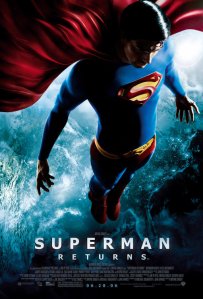 It’s been a total of 19 years since we saw Superman grace the silver screen in the mega-bomb Superman IV: The Quest for Peace. The big question is… did we miss him at all? I know a lot of people that say they just can?t get into Superman as a character. He’s always been a do-gooder, someone with infinite power but too great a sense of nobility to abuse it. Does the Man of Steel still hold relevancy in today’s more erratic, cynical, fearful world? Is it possible to make an indestructible alien relatable or empathetic? Director Bryan Singer is interested in finding out, and he brought nearly his whole X-Men 2 team with him. Instead of retooling the franchise Singer has adopted the idea of starting shortly after the events of 1980’s Superman II. (Yes, I know Richard Lester is credited with directing Superman II but it’s still contentious that Richard Donner, who helmed the first super outing, directed a majority of the sequel. From here on out, Donner will cited as the director of Superman and Superman II).
Superman (Brandon Routh) has been absent for five years trying to look for pieces of his home world, Krypton. Lex Luthor (Kevin Spacey) and his moll (a cheerfully batty Parker Posey) have got some big plans up their villainous sleeves. Using crystals from Superman’s home world, they plan on building a new continent of land to prosper with. He also has a nice supply of kryptonite to make his own fortress with. When Clark Kent does arrive back in town, coincidentally along the same time Superman rescues Lois Lane (Kate Bosworth) in a plane crash, he’s shaken by the changes that have taken place in his absence. Lois is engaged to Richard (James Marsden), nephew of The Daily Planet‘s editor in chief, Perry White (Frank Langella). She’s also won a Pulitzer Prize for her article, “Why the World Doesn’t Need Superman” (a kiss-off letter to a lover if ever there was one). To top it all off she also has a five-year-old son, which would put him within the realm of having a super dad (Lois and Supes took a roll in the hay at the Fortress of Solitude in Superman II). The Man of Steel has a lot on his plate, obviously.
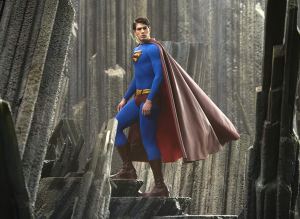 This is rumored to be the most expensive movie of all time, with budget predictions going as high as $260 million. If that?s true than Singer let’s you see every dollar onscreen. As a movie going experience, Superman Returns has little to no equals. The special effects are astounding and the imagery is simultaneously iconic and awe-inspiring. We now exist in a world where we can see a man in a red cape zoom through the sky and have it become believable. Singer, after two X-Men flicks, has a terrific eye for glistening visuals and boy does he know how to conduct Hollywood bombast with equal parts genuine character. His loss was considerably noticeable with X-Men 3, which wilts in direct comparison as unfair as it may be (it’s like the difference between a Van Gogh and a third grader’s imitation of a Van Gogh). The difference is that you can feel the respect the filmmakers had for superman; not so much with X-Men 3. But alas my countrymen, I come here to praise Superman not to bury X-Men 3. The sheer breathtaking visual artistry of Superman Returns demands to be seen on as big a screen as possible. Singer has crafted a wonderful tableau for the eyes and ears, filled with religious symbolism, opening the wonderful possibility of the movies just a little wider.
Singer’s film is a show-stopping pop spectacle, which is good, because the story itself, upon fresh perspective and distance, is good, but not great. The story doesn?t pursue character as strongly as last year?s fellow franchise reboot, Batman Begins, nor does it interlace themes as well. The characters in general are pained but left with little other expressions. Lex Luthor’s evil scheme is grand in cataclysmic scope but at the end of the day it’s still a real estate scam. It’s like if Donald Trump was human or less evil (he’s definitely got the same hair stylist as Luthor). How exactly is Luthor planning on keeping control of a new continent of land? I would think the world would have some way of establishing order. Once again a villain’s scheme is ruined by the less dastardly, more squeamish baddie in the entourage. In fact, the villains are on their own for a long while, embarking on their own tangential movie to play alongside the return of superman. The first hour is slower paced and the final climax could have used an additional boost, but these are quibbles. Superman Returns could have done a lot more with their characters, especially considering their take-off point is two films hence, but this movie is more about reassembling the pieces. To that end, Singer’s satisfying retread is forgivable for its shrift characterization.
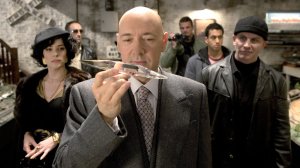 Do not let any misgivings about character and story betray how awesomely entertaining Superman Returns is when it turns on the magic. Even at a bladder-unfriendly 2 hours and 40 minutes in length, the film has little drag and a great sense of confidence of a crowd pleaser that knows how to play to an audience while respecting their intelligence. The movie is self-indulgent (how many slow-mo shots do we need of Superman in the air?) but it never falls short on thrills. Between plane crashes, bank robberies, sudden explosions, and spontaneous, cavernous land masses, you’ll likely be glued to your seat waiting for the outcome, which even with a nigh indestructible being isn’t always a given.
The action is grand in scale but Superman Returns also has the unmistakable stripes of a chick flick. Lois is jilted, moves on to a good man, and suddenly the man of her dreams, the one she thought was gone for good, reenters her life. The film’s sharpest plot point is the complication of its love triangle with Richard and a child in tow. The romantic yearning and interplay give the film its biggest emotional involvement. Even though the filmmakers are deliberately vague, the answer of who’s the father should be rather easy to deduce. Still, the audience has an increasing desire to know the paternal truth.
Singer’s louder, brighter Superman is a loving tribute to the Richard Donner Superman films, you know, before Richard Pryor, evil twins, and the rather rash, though very effective, decision of hurling the world’s supply of nuclear weapons into the sun (the less said about The Quest for Peace the better). It even exists in the same universe so we don’t have to go the origin tale route, though we do get flashbacks to Clark’s past. Marlon Brando’s original performance as Jor-El, father of Superman, is reused and John Williams’ theme gets a new polish. Even the opening title graphics, so horribly dated like a “cutting-edge” Atari game, are the same from the Donner era. There’s such reverence for nostalgia and a fondness for what makes Supes Superman, and that’s why it gets closer than even the Donner flicks, which are good but have weathered with age and can come across as too silly or cheesy.
Even Routh looks uncannily like Chistopher Reeve. Routh is an interesting choice; he’s chiseled, handsome, and questionably appealing. He comes across more like a being finding his place, like a kid fresh out of college, than a being of incalculable power protecting our blue planet. At any rate, Reeve played the comedy better, being both suave hero and clumsy earthling. I wish Superman Returns would go further exploring the perils and expectations of being Superman, a life devoted to servitude and always being an outsider. There’s a small scene where he orbits the Earth listening to 1000 overlapping voices crying for help before zeroing in on one. Otherwise, the movie doesn’t pay much notice to the burdens of Superman, which may unfortunately keep many at a distance.
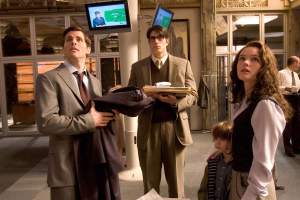 Bosworth is just too young for her role; she resembles Lois Lane’s baby sister, not the feisty Margot Kidder incarnation that left such an impression. This Lois Lane doesn’t so much bicker as she does harrumph. It’s like they took the role, dolled her up, muted her, and then told her to play Lois Lane as if she had stayed up all night binging on Sex and the City reruns. Bosworth is at the mercy of her character, a figure pressed into danger more than she is into emotion. There are some nice moments, like a midnight stroll through the atmosphere with her knight in blue tights. I just wish there were more.
But at least there’s two-time Oscar winner Spacey, who’s terrific as the infamous Lex Luthor. He’s got a funny quirkiness and a perfectly deadpan sarcasm. The opening that reveals how Luther earns back a sizeable fortune is hilarious and perfect to a T. Everyone else seems a bit dour but Spacey is having a ball; he’s even employed Kumar as part of his muscle (you’re a long way from White Castle, Kumar). However, Spacey’s spirited take is a lot more menacing than Gene Hackman’s version, which always came across as an oily used car salesman, more huckster than arch villain/evil genius. Spacey has a really strong disdain for the Man of Steel and his eyes sparkle at the opportunity to get vicious. I’m all for a darker, angrier, down-and-dirty villain to better torment Superman. Not to be out done, used car salesmen have their moments of intimidation.
The story may be good, not great, but Superman Returns is a first-rate cinematic spectacle. Singer and his X-Men 2 team have crafted a nostalgic, reverent movie that smartly addresses whether today’s world has outgrown a big blue Boy Scout. The action sequences and special effects are astounding, and, for the first time in a Superman movie, they are wholly believable. This helps when the main guy wears his underwear on the outside and shoots lasers from his bullet-proof eyeballs. The film stalls when it comes to characterization and the interplay of strong unified themes, but much is forgivable because Singer has worked his ass off getting a storied franchise back on its feet with dignity.
After three super hero films in a row, each with an escalating budget and running time, I’d say the man needs a break, perhaps a tiny independent movie to rejuvenate the batteries. But after watching Superman Returns, what I really want is for Singer to get right back to work as fast as possible. We’ve got this world back in order. Now it’s time for Superman to truly take flight.
Nate’s Grade: B+
Share this:

X-Men: The Last Stand (2006)
 The story behind the making of X-Men: The Last Stand is more interesting than most. Bryan Singer had directed the first two X-Men films and had done a fine job establishing many loveable characters and the universe that housed them. Warner Brothers has been trying to get their Superman franchise flying for so long, going all the way back to 1996 when Kevin Smith wrote the script, Tim Burton was to direct, and Nicolas Cage was going to be the man in tights. Since then directors and drafts of screenplays have come and gone, including Brett Ratner, best known for directing both Rush Hour movies and a slate of mostly mediocre movies. Then Warner Brothers poached most of the X-Men 2 team to make Superman Returns, hiring Bryan Singer as director, plus X2‘s screenwriters, cinematographer, editor/composer, and maybe even the cat that licked Wolverine’s claws. Fox was left without a captain for X-Men 3. They daringly picked Matthew Vaughn (Layer Cake) but then he dropped out for family reasons. Then Fox went with their second choice … Brett Ratner. Both directors had essentially switched projects. Hollywood’s funny like that.
It’s been a few months since the events in X-Men 2. Scott “Cyclops” Summers (James Marsden) is still mourning the loss of his love, Jean Grey (Famke Jannsen), who sacrificed herself to save the rest of the X-Men. He’s tormented by her voice, whispering all around him and pleading with him to return to Alkali Lake, the site of her death. Miraculously, Jean returns from the dead but she’s much different. Her persona has broken and the Phoenix has taken over, a destructive killing force unparalleled on earth.
Magneto (Ian McKellen) has great use for such a force. There’s been news of a new drug that suppresses the gene that causes people to be born as mutants. This discovery has been dubbed a cure. The question persists, is should being different be curable and what would that even mean? Magneto sees the writing on the wall, knowing that any cure would only be voluntary for so long. He collects new mutant fighters along with his stalwarts the shape-shifting Mystique (Rebecca Romijn) and fire starter Pyro (Aaron Stanford), a former student at Xavier’s School for the Gifted.
 Over at Professor X’s (Patrick Stewart) school, the mutant students are each questioning life with a cure. Rogue (Anna Paquin) is considering it so she can finally touch her boyfriend, Bobby “Ice Man” Drake (Shawn Ashmore) without killing him. Plus, so he’ll stop spending so much time with Kitty “Shadowcat” Pryde (Ellen Page), a girl who can walk through matter. Storm (Halle Berry) and Wolverine (Hugh Jackman) are left to run the team after some disastrous setbacks. Henry “Beast” McCoy (Kelsey Grammer) is a man covered in blue fur and appointed as head of Mutant Relations for the president. He senses the growing danger and anxiety the administration has with mutants and joins the X-Men to do what he feels is right.
It feels like that in a rush to production that character development, subtlety, and subtext were chucked out the window to make time for more boom-boom action. The first two X-Men flicks juggled the characters and introductions but still managed to squeeze in one great moment for the characters we cared about. The plot moved at a mature pace, insightful and touching on elements of psychology, politics, and personal struggles to fit into a society that fears you. There was some sophisticated, relevant stuff bandied about this franchise in between the kick-ass action. But with X-Men 3, you basically have Halle Berry doing less with more. She’s got more screen time, in part to her demands, and now she can use that extra time onscreen to show us how perfectly bland her character is as the film’s most laughable moral ideologue. The idea of a cure for the mutant gene is vastly interesting with all kinds of great avenues for character introspection and socio-political debate. But X-Men 3 renders all of its debate to be merely superficial, another in a series of plot points to get the action moving quicker.
The X-Men franchise was already overpopulated with lots of characters vying for screen time, so I don’t understand the decision to add even more characters to the ensemble and cut down the running time to a brisk 100 minutes. As a result, certain characters sit out for long stretches of the film, are inactive during key moments, some are mostly forgotten, or some meet unjustifiably hasty ends. If I was still an ardent comic book fan, and a follower of the X-Men, I might view the third film as heresy. Why even bother bringing the character of Angel into the movie if he’s just going to be on for two minutes, including a forehead-smacking deus ex machine moment? The Dark Phoenix storyline is the most pivotal storyline in the comic’s history, so why even bother dragging it into X-Men 3 if it’s just going to be Zombie Jean Grey? It feels like Ratner is off screen with a pole poking Janssen whenever the story needs her to wake up and stir up some stuff.
 I hope comic fans enjoy the brief glimpses of some of their favorites, because X-Men 3 does a good job of throwing characters into a meat grinder. I had to check online to just to find out who they were, and even then my realization was followed by, “Her? Him? What?” And what the hell is up with Porcupine Face? That has got to be the worst mutant ability of all time. What’s he going to do to his enemies? “Hey, will you come a little closer. I have a secret to tell you. Closer … closer … closer still … that’s right, now please lean against my face.”
The movie trades character for action, so is the action even good? Ratner is a workmanlike director devoid of any personal style, which further brands X-Men 3 as ordinary. The action sequences aren’t anything extraordinary, there just happens to be more of them. The climax pits mutant against mutant in short-lived bursts. A battle between Ice Man and Pyro should be awesome, but Ratner stages the showdown like he was choreographing his neighbor’s kids. This battle lasts a whopping 45 seconds. The climactic end battle, the “war to end all wars,” is rather sloppy. Ratner keeps cutting back and forth between his pairing of Good mutant vs. Evil mutant (why do the two black girls seem forced to fight each other?), but his showdowns are all too quick to quicken the pulse. Wolverine’s brawls in the woods never rise up to the adrenaline-soaked fights in X-Men 2. The special effects and make-up are just as good; they’re just not being put to as good a use. If Ratner is going to dump character for action he has to make his action exceptional. The movie feels on autopilot.
Ratner is not fully to blame for the shortcomings of X-Men 3. Screenwriters Simon Kinberg and Zack Penn (Elektra) have crafted an overly rushed story that is more tailored for getting the job done than telling a good story. They present some big ideas and interesting elements, like a love triangle between Rogue-Ice Man-Shadowcat, but then most of the promise is either skipped over or dropped. They’re trying to juggle too many balls at once, and it just makes me miss Singer and the X2 screenwriters and how effective they were in defining character even in the smallest of moments. Some of the X-Men 3 dialogue is awfully stilted, like “You of all people know how fast the weather can change” and “Sometimes when you cage the beast, the beast gets angry.” There’s also a silly subplot about Storm teaching Wolverine what it means to be responsible. Try and count how many times you roll your eyes with that one. How many times are they going to have the president look blankly at a TV screen and gasp, “My god”? There’s some clever use of mutant powers during battles (mostly involving Shadowcat) but there’s just as many routine moments as well.
 The acting is all over the map. Jackman owns his role as Wolverine. McKellen and Stewart bring a needed dose of grandeur to the proceedings. The X-kids are enjoyable, and Ellen Page (knocking ’em dead in Hard Candy) makes a very nice addition to the fold. I’ve likely enjoyed Paquin the most in this series, next to Jackman of course, so it’s so frustrating that she just plays Jealous Girlfriend at Window. I think it’s criminal how little she’s examined in the movie, especially since the supposed cure has the most questions and ramifications for her. Grammer is essentially Frasier in blue fur, but that’s essentially what Beast is so it works. He has a very nice moment when he sees what life would be like minus his mutant likeness. It’s really hard to judge most of the performances because of how short they appear in the movie.
X-Men: The Last Stand is far from boring but it’s more serviceable than special, and lacks the maturity and imagination that its previous films held. This was a franchise full of limitless potential, so to see it drop to something ordinary is sad, especially if this is the rumored end of the franchise (a record opening gross over Memorial weekend says otherwise). This franchise feels dumbed down; yes it’s still entertaining on a mass market level but it doesn’t have the creativity and precision that Singer’s movies had. X-Men 3 is fast-paced and not without its great geek moments, but it’s also the least emotionally involving of the films. When the deaths and departures come you’ll probably shrug your shoulders because of how the film presents them. X-Men 3 is fine, but I expect better from this franchise.
Nate’s Grade: C+
Share this:

Mission: Impossible III (2006)
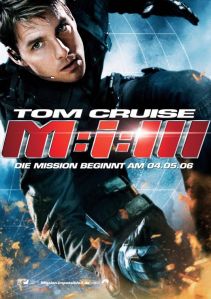 Few celebrities have had the intense flame-out Tom Cruise has experienced in a little over a year’s time. First there was the PDA-heavy relationship with Katie Holmes, never a wet tongue-kiss away from a camera. Then there was the couch aerobics on Oprah Winfrey’s set, bleating his over-the-top declarations of love like Roger Rabbit. This was followed by a series of testy interviews about his war of words on psychiatry and prescription drugs. Entertainment Weekly just ran a cover story asking, “Is Tom Cruise worth his paycheck?” He’s gone from Hollywood’s most bankable actor to a national punch line. To bring new life to Cruise’s spy series, he tapped TV mastermind J.J. Abrams to make his feature debut after Cruise churned through two seasons of spy series Alias DVDs. Abrams is a gifted franchise starter, first with Alias and then with Lost, and with Mission: Impossible III he does the best he can to erase the memory of Tom Cruise, daredevil of furniture.
Ethan Hunt (Cruise) is out of field work at the Impossible Mission Force, training recruits for the big time. He’s settled into a comfortable home life with Julia (Michelle Monaghan), a woman he’s blissfully engaged to be wed. Ethan’s happy home is disrupted when IMF needs his services. It seems one of his trainees (Keri Russell, Felicity goes badass) has been captured by an arms middleman Owen Davian (Phillip Seymour Hoffman), a man that will get any deadly force to the right bidder. Hunt reluctantly goes back into the field, assembling a team that includes Luther (Ving Rhames), Zhen (Maggie Q, quite fetching), and pilot Declan (Jonathan Rhys Meyers). Their mission goes badly and Hunt is reprimanded for his cavalier actions. He’s determined to snag Owen and get justice. This leads to an incredibly stuffed game of cat-and-mouse, each jockeying for leverage. There’s some super powerful device called the “rabbit’s foot” that everyone wants but it’s not really important. What is important is that Owen is eager to strike back at Ethan’s most vulnerable point — harming Julia.
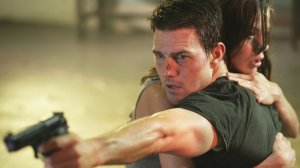 This movie is quite possibly one of the greatest TV adaptations of all time. No, not the Mission: Impossible series but Alias. Just like J.J. Abrams’ TV brainchild, this slick, propulsive caper puts a smart spin on familiar ground. We’ve got the flash-forward narrative trickery, the super gadgets, the undercover teamwork, the world-trotting sprawling vistas, and anchoring the whole thing with an emotional counterpoint, trying to lead a double, “normal” life and keeping your loved ones equally safe and in the dark. There’s a great scene in the middle of a mission where Ethan and Luther casually discuss the impossibilities of living a normal life given what they do. Luther warns that those close to you will only end up getting hurt, and by this point thanks to a startling, right-to-the-point opener with a gun to sweet Julia’s head, we know he’s right. That’s what makes the third go-round different: Abrams has injected some emotion into the darn thing. Ethan is pressed back into service and then becomes something of a knight in shining Kevlar, trying to save his beloved in the crossfire of international espionage. There are a handful of scenes between Cruise and Monaghan and they sell the emotional drama in tender quiet looks. As a result, the audience and Ethan are rooted to their seats beyond just the assembly line of pyrotechnics. Just like Alias (at least up until Season 3 when it jumped the shark with the long-lost sister). It’s like if True Lies was played straight and Tom Arnold was mercifully forgotten.
Ah, but what pyrotechnics they are. Things get heated with a trip to the Vatican and they literally do not let up, all the while raising the stakes by pulling Ethan’s home life closer to the danger of his job. You’ll be left breathless absorbing all the exhilarating action sequences, which to my best estimate are more than the first two flicks combined. The stunts are superbly death-defying. What makes action sequences so enjoyable, pay attention you Hollywood rubes, is when the stage is set and then we watch organic complications. Abrams has a tremendous feel for action and playfully extends virtuoso sequences of awesome carnage. An attack on a bridge is simply outstanding and gave me an overload of geeky joy. We’re given the tight, controlled setting, and then Abrams introduces the outside conflict and keeps developing it masterfully step by step. There’s air attacks, there’s running back and forth amongst the wreckage, there’s searching for guns while escaping attack, and then there’s flying leaps over gaping concrete holes. I was jumping in my seat with boyish glee. The slow-mo gun toss between Cruise and Russell? Awesome. The swing-shot jump off a gigantic skyscraper in Shanghai? Awesome. The use of Simon Pegg (Shaun of the Dead) as gadget guru? Awesome. Mission: Impossible III is, if nothing else, an incredible adrenaline rush orchestrated by a man with a finger directly on the pulse of his audience. By summer popcorn standards, Mission: Impossible III is everything you could hope for. Sure it’s highly implausible but it’s just so damn fun.
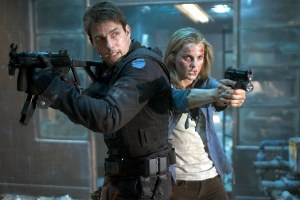 Abrams has created quite a breakthrough for himself. Long regarded as a TV visionary for his tangled, engrossing pop-pulp like Alias and Lost, Abrams shows what he can do with a bazillion dollars and one of the world’s most recognized stars. Abrams intelligent, deft handling of his material, elevating tired genre devices with flash and reverence, reminds me of a young Steven Spielberg. This is a man that respects his material and respects his audience, but still knows how to bring home an entertaining movie. I’ve followed Abrams’ career since getting hooked on Alias in 2001, and I’m confident he will become the best friend a movie geek could ever have (Star Trek fans should be clicking their heels about Abrams’ rumored involvement). Even though Mission: Impossible III is Abrams’ film debut (and on record the most expensive ever for a first time film director) he already shows more command, more wit, and more hipness than most of Hollywood’s graying old guard.
Finally, this is the first Mission: Impossible film to utilize the team aspect of the TV show. Granted, Cruise still does most of the running, jumping, climbing trees, but thankfully this movie is more than the Tom Cruise Kicks Everyone in the Face Show a.k.a Mission: Impossible II. The supporting cast all have their one great moment and part of the fun is their interaction, seeing the pieces fit into place. Just like last summer’s Batman Begins I would like to see another movie immediately with everyone involved. Make it happen. This is the Mission: Impossible world I want to explore in greater detail.
Mission: Impossible III is not bulletproof. The movie seriously needed more time for its villain. Hoffman does a great job of bringing his bad man to grumpy life. He goes about business with a detached nonchalance, like a plumber fixing his 10,000th clog. It may sound silly but it works because Hoffman gives his character a lizardy, unscrupulous sense of ethics. He really will put a bullet between the eyes of anyone, possibly while reheating some food in his microwave. That’s the greatness of Hoffman’s villain, how ordinary he sees his line of work and what it calls him to do. Now, with such a terrific villain it would behoove Mission: Impossible III to give him plenty of screen time. Sadly, Hoffman has about three real scenes, and his end is anticlimactic and so is the film as a whole. And what does IMF have to do to curb moles? There’s been one in all three Mission: Impossible movies. Maybe they should offer better vacation plans.
Tom Cruise may have done a lot to wear out his welcome with the public but he knows to surround himself with good people. The decision to let J.J. Abrams helm Mission: Impossible III has finally given this franchise vision and sustained excitement. This movie is far more emotionally based than any other in the series and there’s a genuine emotional reason for all the fireworks this time. The team aspect is finally addressed and Hoffman makes a truly lecherous, scary villain. But the bread and butter of this flick are its breathless action sequences, brilliantly choreographed by Abrams, a name destined for even greater things. Abrams knows how to spin genre clichés into clever, loose, twisty, funny, thrilling, emotionally centered gold. I don’t care if Cruise abused a couch and the public’s good will; Mission: Impossible III is an extravagant popcorn movie and a great way to start the summer. If only they were all like this.
Nate’s Grade: B+


 nathanzoebl
You must be logged in to post a comment.