Blog Archives
The Jacket (2005)
 In The Jacket, Adrien Brody plays a mentally disturbed soldier sentenced to spend his days in a treatment facility. He gets strapped into a straight jacket and locked inside a morgue drawer as part of his “therapy.” Inside these closed quarters, for whatever unexplained reason, Brody has the ability to travel through time. This got me thinking about some other weird/lame ways people travel through time in films. In 2004’s The Butterfly Effect a bearded Ashton Kutcher is able to jump through time by reading his childhood journals. Sure this is weird, and may give false hope to a nation of gloomy journal-scribbling teenagers, but when it comes to incompetent time travel techniques, 1980’s Somewhere in Time is number one with a bullet. Christopher Reeve’s character desperately wants to travel back to 1912. So he removed all modern furniture, clothing, and anything post-1912. Then he lies down on his hotel bed and keeps repeating to himself that he’s living in 1912. Somehow this works and Reeve gets to embark on romance, 1912-style y’all.
Jack Starks (Brody) is a helpful and well-meaning guy that just can’t catch a break. As a soldier in the 1991 Gulf War, an Iraqi kid he was trying to befriend shoots him in the head. When he returns home he starts a long trek through the Northeast. Starks helps out a mother and daughter whose car has stalled. He befriends the non-gun wielding little girl, Jackie, but her drunken mom nearly accosts Starks and they drive away. Then he gets a ride with a drifter (Brad Renfro). They get pulled over by a cop. The drifter kills the cop; Starks gets knocked out and framed for the murder. He’s sentenced to spend the rest of his days in a clinic for the mentally disturbed. And you thought you were having a bad day.
 The operator of the clinic (Kris Kristofferson) has some unconventional methods of therapy, like locking Starks in a straight jacket and sliding him into a morgue drawer. Inside this confined space Starks can zip through time to 2007. In the future he goes home with an angsty young woman (Keira Knightley) who, surprise, ends up being an adult Jackie, the girl he helped at the side of the road. They’re both confused and freaked out, but what spooks Starks even more is the knowledge that he dies on New Year’s Day, 1993. Starks must now get into that jacket so he can visit 2007 some more, fall in love with Jackie, and piece together clues to prevent his soon-to-be death.
Brody seems to be having as much bad luck post-Oscar as Halle Berry and Nicole Kidman. He’s in some funk playing glum character after glum character. Brody and his gaunt figure do have a natural haunted quality and he does excel at emoting grief and horror (hence the 2002 Best Actor Oscar for The Pianist). Brody gives the film more intensity than it deserves.
Knightley is a decent actress but has little to work with. Her role is wrapped in a slab of Gothic traits posing as characterization. When she talks it sounds like she has a cold. I don’t know if this is because of her attempted American accent, the glum character, or maybe she just had a cold from all that outdoor shooting in the snow.
Director John Maybury has the irritating habit of filming scenes entirely in jagged close-ups. Two people will be talking and then -WAM!- huge close-up of an eyeball. Then -POW!- giant mouth filling up the screen. Then -WAM! (again)- more of the same. This editing decision is a distraction but it also lacks purpose. It doesn’t effectively communicate character emotion or scene tension; it just annoys the crap out of you.
 The Jacket is fairly interesting for a good while. The premise is almost ingenious: a man must travel to the future to collect information to prevent his mysterious death in the past. The Jacket adds further intrigue with the question of whether Starks really is traveling through time. Maybe he truly is disturbed and this is all in his head. Sadly, but as expected, The Jacket disproves this tantalizing possibility after an hour of tease.
When the film does transition into its final half, the possibility it showcased seems to go slack. The answers seem either overly tidy or simply anticlimactic, like the truth behind Starks’ death. The Jacket opens strong and strings us along with some intriguing prospects but the end results merely peter out the film’s potential until The Jacket seems completely drained of blood.
Their relationship also has some unexpected creepy moments. Starks, in 1992, visits the little girl he will eventually have sex with in 2007. Yes she’s an adult when they take their tussle in the sheets, but having him later visit her when she’s a child is just plain cre-eeeee-py.
For a while, The Jacket aims to be an intelligent mind-bender but the film squanders its potential. The answers don’t seem nearly as thought-out as the film’s initially intriguing questions. Brody gives the movie more brooding intensity than it deserves. The Jacket is irritatingly directed, alternating between pale shots of white wilderness, extreme close-ups, and overkill on style. The Jacket seems like a nice fit for a while but becomes too frayed to be memorable.
Nate’s Grade: C+
Share this:

Elektra (2005)
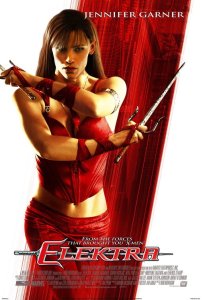 January is typically a cinematic wasteland. It’s the place where films go to die. So imagine my surprise when I heard that Elektra, a comic book movie built around a nimble sai-spinning assassin, was going to be released in January 2005. I remember at one time there were plans for a summer release, which means Elektra had fallen from the very top to the very bottom of expectation. After viewing Elektra for myself I can perfectly understand why anyone would want to dump this clunker.
Elektra (Jennifer Garner) is a feared assassin-for-hire (she even has an agent for her hits). She’s been brought back to life by a powerful sensei, but has ignored a possible higher calling to make her money killing folks. Apparently she is the mythical warrior that will keep the balance between good and evil, or something or other. Her next hit ends up being a nice guy (Goran Visnjic) and his teenage daughter. Elektra doesn’t have the heart to kill them, so she joins them and all three run away from the really bad guys, an ancient group known as The Hand.
Elektra doesn’t really bare comparison to other comic book films because Elektra feels more like a video game. In true video game fashion, I’ll numerically list the likenesses:
1) There is no such thing as characterization, just definition by super power. One assassin is super strong, another can suck the life out of creatures, and a third has the amazing ability to have his tattoos come to poorly rendered life (lucky this guy doesn’t have butterflies and fairies). With a powerful lack of imagination, these assassins are called Stone, Pestilence, and Tattoo (not the Russian girls who make out with each other. That’s Tatu.).
 2) The only sense of a story is pitting Elektra against one bad guy after another. There aren’t character arcs and subplots so much as there are end stage boss battles. It gets really repetitious.
3) The film seems like it’s bending over backwards to get character special moves into the story. With 1995’s Mortal Kombat, the writers, and I use that term in the loosest possible sense, had to work a story that included popular video game moves. Working so hard to include something so trivial and arbitrary really ties the storyteller’s hands. Elektra feels like the film would rather try and include some character’s special move rather than formulate a cogent storyline.
4) Once our assassins are vanquished they burst into clouds of yellow dust. I am not kidding. When they die they explode into clouds of mustard-hued gas. Just like in a video game, once you kill the bad guy they disappear with no necessary cleanup. It’s really thoughtful of them.
5) A second player can jump in at any time! In Elektra, different characters magically appear whenever it’s convenient and I?m not even talking about the super assassins.
6) Just like in a video game, you get an extra life! I don?t know why the producers of Elektra didn’t just make a prequel. With a sequel they have to work around their heroine’s untimely death in 2003’s Daredevil, and so we are introduced to the idea that a warrior of great mind can bring people back from the dead. So if Elektra dies (again) she can just be brought back to life. This whole idea practically eliminates any sense of danger and consequence.
So little of Elektra makes any kind of sense. Characters make rash choices and surprise appearances. The villains are a bland, cliched crop from some back order of ancient kung-fu brotherhoods. The plot is mysteriously oblique and has the frustrating habit of using cheats to get around logical roadblocks. About halfway through Elektra I gave up shrugging my shoulders and rolling my eyes. There is no definition on character limits, so anything can happen, and when it does it’s usually very stupid.
 Even worse is how dreadfully dull Elektra can be. The last two acts are compromised of nothing but a long, boring chase scene. The action sequences are brief and unoriginal, which include the thousandth inclusion of a hedge maze. There’s one moment where Elektra is battling in a room that has sheets flying all around for no good reason. It’s visually reminiscent of a Where’s Waldo? page. Take that for what you will.
The film is brisk, clocking in at just 90 minutes, but you don’t care about the characters because 20 minutes is spent establishing them, and the remaining 70 is spent watching them run.
The only redeeming quality of Elektra is its star. Garner is suited for the running, jumping movies, but she also has great acting chops behind her square jaw and impeccable physique. She casually generates intensity but also has a light, humorous touch. It doesn’t hurt that she looks fabulous in a red bustier. Her character is given OCD but then this plot is dropped entirely. Without the appeal of Garner, Elektra would simply be Catwoman.
Elektra is a flat comic adaptation that plays more like a video game, and just like in real life, watching a video game is no fun at all. Things happen, characters appear, people explode into clouds of yellow dust, and it’s all a bunch of uninteresting, half-baked nonsense. Elektra is frustrating, labored, ridiculous, and empty of thought and enjoyment. Why should I pay to watch Garner kick ass when I can watch Alias on TV and see Garner kick ass for free? And the plots of Alias are brazenly complex, fun, and high-spirited. I care about the people and events on Alias. With Elektra, the only thing I cared about was when the film was going to be over.
Nate’s Grade: D
Share this:

The Forgotten (2004)
 Fair warning: This screed contains huge spoilers about the movie as I rip it apart. The press release for The Forgotten says, “What if you were told that every moment you experienced and every memory you held dear never happened?” And now, upon having seen The Forgotten, I say, “Oh, if only.”
Telly (Julianne Moore) is still grieving the loss of her nine-year-old son who died in a plane crash 14 months ago. She’s seeing a psychiatrist (Gary Sinise) and slowly coming to terms with her loss. One day she discovers all remnants of her son missing. His clothes, baseball glove, even his appearance in pictures has vanished. She accuses her husband (Anthony Edwards) of stealing them, but then is shocked when her hubby and doc both tell her that Telly never had a son. She’s been delusional for years since a miscarriage and has created an imaginary son. Telly refuses to accept the possibility that she’s nuts, and finds initial resistance and then acceptance from another parent (Dominic West) who also remembers a daughter that died in the same plane crash. Together they set off to learn the truth, all the while being hunted down by the NSA for some mysterious reason.
 The Forgotten shares a very dubious honor. Only twice in my life have I been strongly tempted to walk out on a movie, and that was while watching Lost in Space and The Thin Red Line. Six years later, The Forgotten became the third. It got so bad during the second half that I was fashioning my moveable armrest into a crude headboard for me to sleep upon. I was that bored. I can explain the reasons for my boredom very easily: terrible plot structure.
The Forgotten opens with Telly grieving over the loss of her son, and Moore is so good at grief that she can hook an audience as soon as her face crinkles into sadness. Around the 20-minute mark, Telly is told that she never had a son and has been delusional the whole time. Now, stop right there. That’s a great premise. If the makers of The Forgotten had stretched this part of the movie to about 90 minutes, put some thought and skill toward it, then we could have had something fascinating and heartfelt. Instead, you’re given the easily expected and the very boring.
At the 20-minute mark, Telly is told she has no child and she’s crazy. At around the 30-minute mark, none of this matters. The movie doesn’t even allow an opportunity for Telly to even doubt for a sheer second about her wild hunch that everyone in her life, including The New York Times, being apart of some global conspiracy to hide the fact she had a child. And of course, because she?s our heroine and this is Hollywood, her incredibly outlandish theories will be proven right. I understand that, but to reveal her theory’s accuracy only TEN MINUTES later is ridiculous. The Forgotten wastes no time proving Telly’s wild ranting as being correct. It’s as if The Forgotten feels that its audience is cultivated from the dumbest common denominator.
At the 40-minute mark the “A-word” is used, and before the 60-minutes mark, the audience knows everything. The last hour of the film is so obvious; no, it’s beyond obvious. It’s super obvious. It can’t even be obvious because The Forgotten has told you EVERYTHING. You’re not waiting around for predictability to play its way out, because you’ve been told everything. All that’s left is to sit and watch dull chase scenes (a book editor outrun NSA trained agents? Please).
There will be some heavy spoilers in my discussion of the film’s plot. I’m posting fair warning now, but doubt they’ll be too surprising given the ads on TV for The Forgotten (who else would you think was responsible?).
I have no idea what the makers of The Forgotten were thinking. They blow all their secrets in the first half and then mill around for another hour. It’d be like if The Sixth Sense revealed Haley Joel Osment sees ghosts and Bruce Willis is dead in the first hour, and then for another hour they sit uncomfortably and ask about the weather. Anyone think that movie would have worked the same? This is why I was so bored. I could have fallen asleep and accurately predicted everything that would happen in the second hour. There didn’t even need to be a second half to this film. It was all irritatingly explained to us in the first hour. Once the mystery’s gone, the only thing the audience has to keep its faltering attention are the questions of whether Telly can win back her son, and who will be vacuumed out of the universe next. That’s not much to justify another tension-free, revelation-free hour of awful movie.
The ending is also steeped in lunacy. So apparently all-powerful aliens love to play experiments on us and basically control our whole lives. Peachy. Telly is apart of an experiment, and the creepy, slim alien tells her that she’s the anomaly. All the other test subjects have forgotten, but not her, and the little green men want to know why. What’s even more peculiar is that this specimen of a supposedly advanced race is mad at Telly for gunking up the project, and he’s (its?) going to beat her until she forgets and the project is finished. But the alien just said she was the lone anomaly. By definition the project worked if everyone else succeeded. I’m no advanced race and I figured that out. Guess I’m smarter than the screenwriter of The Forgotten.
Once again, humans miraculously triumph over supposedly all-powerful alien species. I realize an audience wants to see our heroes succeed at the end and conquer evil, but is it even plausible when this evil can alter everyone’s existence at a moment’s notice? In the end, Telly gets her son back and her life is fulfilled. The makers of The Forgotten expect you to take this for a happy, victorious ending. Don’t. Sure, Telly has her kid back, but what’s to stop these all-powerful aliens from doing it again. For that matter, since she was the anomaly, wouldn’t they continue to perform experiments on her to see what makes her tick?
 What makes The Forgotten even more irksome is that it’s a blatant rip-off of Alex Proyas’ visionary 1998 sci-fi noir, Dark City. The plot of Dark City is about all-powerful aliens that experiment with human beings. They plant different memories into their heads, allow their human test subjects to live multiple identities, to see what makes us work. A reluctant doctor helps the aliens but is really rooting for the one test subject that seems beyond their power. The aliens are baffled about this anomaly. This is practically the entire plot for The Forgotten; trade Shell Beach for Quest Air, lose all the style, thrills, imagination, and pacing of Dark City, and what you’re left with is The Forgotten.
It’s not enough that The Forgotten is possibly the most ineptly plotted movie ever, or that the trailer and commercials gave away too much (I knew the ending before stepping into the theater), the ails of The Forgotten are exacerbated by the fact that it’s a shallow, homely, incompetent rip-off of Dark City.
I do not fault Moore. She is one of the finest working actresses today and will elevate anything she is in to some degree. She’s stranded by the material. The only performance I even took any note of was the surprise appearance of Lee Tergesen. He’s shown equally impressive comedic chops (USA’s Weird Science) as dramatic chops (He was the closest thing to a hero on HBO’s Oz). It’s always fun to see personally beloved character actors, even if it is in an abomination like The Forgotten.
Director Joseph Ruben (Money Train, The Good Son) finds astonishing ways to make The Forgotten even worse. He overplays his hand early, like having many overhead shots cued with weird, aerial noises. There’s also an ominous and extremely mobile cloud formation that spells out the antagonists. The second half is filled with pointless chase scenes, and Ruben can’t manage to make any part of them exciting. He does have one interesting jump moment while Telly is riding in a car, but I already saw it this year in the superior Bourne Supremacy.
The Forgotten may end up being the worst film of 2004, and with a year dotted by the likes of Hellboy, Van Helsing, Catwoman, and National Lampoon’s Gold Diggers, that may be all I need to say. I suppose someone out there may find something redeemable about The Forgotten (if they haven’t already seen Dark City), but the film’s tepid pacing, mind-numbingly foolish plot structure, and mounting illogical doom the poor audience to two hours of head-smacking boredom. This is a first-class Hollywood train wreck. It doesn’t work as a drama about grief, it doesn’t work as a psychological thriller, and it really doesn’t work as a half-baked X-Files episode. The Forgotten is a really great title, because in a few weeks it’ll be exactly that.
Nate’s Grade: F
Share this:

Sky Captain and the World of Tomorrow (2004)
 Sky Captain and the World of Tomorrow started as a six-minute home movie by Kerry Conran. He used computer software and blue screens to recreate New York City and depict a zeppelin docking at the top of the Empire State building. The six-minute short, which Conran spent several years completing, caught the attention of producer John Avnet (Fried Green Tomatoes). He commissioned Conran to flesh out a feature film, where computers would fill in everything except the actors (he even used the original short in the feature film). The dazzling, imaginative results are Sky Captain and the World of Tomorrow.
Polly (Gwyneth Paltrow) is a reporter in 1930s New York. She?s investigating the mysterious disappearance of World War scientists when the city is invaded by a fleet of robots. The city calls out for the aid of Sky Captain, a.k.a. Joe (Jude Law), a dashing flying ace that happens to also be Polly?s ex. Joe and Polly form an uneasy alliance. He wants to stop Totenkopf (archived footage of Laurence Olivier) from sending robots around the globe and rescue his kidnapped mechanic, Dex (Giovanni Ribisi). She wants to get the story of a lifetime, a madman spanning the world to abduct scientists, parts, and the required elements to start a doomsday device. Along the way, Captain Franky Cook (Angelina Jolie) lends her help with her flying amphibious brigade. Together they might stop Totenkopf on his island of mystery.
 Sky Captain is a visual marvel. It isn’t necessary a landmark, as actors have performed long hours behind green screen before (just look at the Star Wars prequels). Sky Captain is the first film where everything, excluding props the actors handle, is digitally brought to life inside those wonderful computers. The results are breath-taking, like when Polly enters Radio City Music Hall or during an underwater dogfight with Franky’s amphibious squadron. Sky Captain is brimming with visual excitement. The film is such an idiosyncratic vision that there’s no way it could have been made within the studio system.
Sky Captain has definite problems. For one, the characters are little more than stock characters going through the motions. The story also takes a backseat to the visuals. The dialogue is wooden and full of clunkers like, “You won’t need high heels where we’re going.” Generally the dialogue consists of one actor yelling the name of another character (examples include: “Dex!” “Joe!” “Polly!” and “Totenkopf!”). My father remarked that watching Sky Captain was akin to watching What Dreams May Come, because you’re captivated by the painterly visuals enough to stop paying attention to the less-than-there story and characters. The characters running onscreen also appears awkward, like they’re running on treadmills we can’t see, reminiscent of early 1990s video games.
Let’s talk then about those characters then. Paltrow’s character is generally unlikable. She’ll scheme her way toward whatever gains she wishes, but not in a chirpy Lois Lane style, more like a tabloid reporter. She whines, she yells, she complains, she berates, and she doesn’t so much banter as she does argue. Sky Captain is more enigmatic as a character. He seems forever vexed. Jolie’s Captain Franky Cook gives her another opportunity for her to use her faux-British accent. Jolie’s character is the strong-willed, sexy, helpful heroine that should be the center of the film, not Paltrow’s pesky reporter.
It’s also a bit undignified to assemble Laurence Olivier as the villain. It’s very unnecessary, but at least he wasn’t dancing with a vacuum cleaner.
 Now, having acknowledged the flaws of Sky Captain, I must now say this: I do not care at all. This is the first time I’ve totally sidestepped a film’s flaws because of overall enjoyment. I have never felt as giddy as I did while watching Sky Captain and the World of Tomorrow. When the giant robots first showed up I was hopping in my seat. When I saw the mixture of 1930s sci-fi, adventure serials, and Max Fleischer cartoons, I was transported to being a little kid again. No movie has done this so effectively for me since perhaps the first Back to the Future. I loved that we saw map lines when we traveled from country to country. I love the fact that the radio signal hailing Sky Captain is reminiscent of the RKO Pictures opening.This is a whirling, lovelorn homage that will make generations of classic movie geeks will smile from ear to ear. I don’t pretend to brush over the flaws, with which story and characters might be number one, but Sky Captain left me on such a cotton-candy high that my eyes were glazing over.
One could actually make a legitimate argument that the stock characters, stiff dialogue, and anemic story are in themselves a clever homage to the sci-fi serials of old, where the good guys were brave, the women plucky, and the bad guys always bent on world domination. I won?t make this argument, but it could lend credence more toward the general flaws of Sky Captain and the World of Tomorrow.
Sky Captain is an exciting ode to influences of old. It’s periodically breath-taking in its visuals and periodically head scratching with its story, but the film might awaken childhood glee within the viewer. I won’t pretend the film isn’t flawed, and I know the primary audience that will love Sky Captain are Boomers with a love and appreciation for classic cinema. Sky Captain and the World of Tomorrow will be a blast for a select audience, but outside of that group the film’s flaws may be too overwhelming.
Nate’s Grade: B+
Share this:

I, Robot (2004)
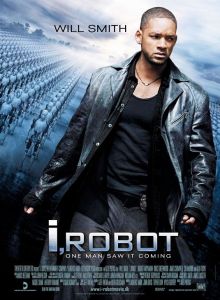 No doubt about it, Will Smith is the best hope our planet has in the face of adversity. He’s taken down aliens three times, foiled one conspiracy, stopped the South from rising again, and the man still finds the time to help Matt Damon with his golf swing. I fear we almost may be taking Smith’s world-saving exploits for granted. Smith’s newest chance to save the world arrives in I, Robot. Can Big Willie save the world yet again, or has he punched his time card one too many times?
In 2035, man has a new class of immigrants to do all the menial tasks no one wants to do – robots that look like crash test dummies. U.S. Robotics (USR) wants to push their new fall line of robots and make sure every happy home has a happy robot. Del Spooner (Will Smith) is a detective wary of our robotic friends. His colleagues laugh at his paranoia, remarking that no robot has ever committed a crime. This is thanks to the three laws hard-wired into every robot: 1) A robot cannot harm a human being, 2) A robot must obey a human beings order as long as it does not conflict with Law #1, and 3) A robot can do whatever to survive as long as this does not conflict with the other laws.
 This sounds great, except the robot creator (James Cromwell, always there if you need an old guy role) has apparently plummeted to his death from his USR office and the circumstances involving his demise are dubious at best. Spooner works alongside a robot technician/shrink (Bridget Moynahan) to find out more about what exactly is going on within USR and its suspicious CEO (the always shady Bruce Greenwood). Spooner discovers that a robot, who wishes to go by the name of Sonny, may have sent his creator to his death and may also be the first step toward uncovering the truth behind a grim conspiracy.
Smith has never really been a great actor but he is likable and charming enough, so that gets him through the day. The problem is that when hes saving the world in summer blockbusters he has a tendency to go into Will Smith Mode, which plays out like hes on auto-pilot. His stares, awkward mannerisms and aw shucks humor seem to be the same in every film. This isn’t to say that Smith cannot be a capable actor, but it seems that when a movies budget goes over a certain amount he resorts to playing Will Smith: World Saver and not so much a character of real value.
The other actors are more so playing vague archetypes than they are anything else. Greenwood is the sneaky, oily executive; Moynahan is the cold scientist learning how to be human once more; the invaluable Chi McBride is the no-nonsense police chief who rolls his eyes at Spooner’s crazy theories; and Shia LeBeof actually shows up for all of three minutes playing some kind of juvenile delinquent that is wholly unnecessary to the film.
The movie’s greatest accomplishment is the character of Sonny, modeled after a physical performance by actor Alan Tudyk. Sonny’s calm line readings, bursts of emotion, and questions on humanity make him a character the audience connects with, especially with the detached nature of Smith and Moynahan’s acting. Bet you never would have guessed this is from the same guy who played Steve the Pirate in Dodgeball.
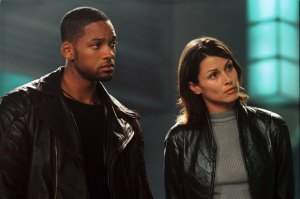 I, Robot isn’t exactly going to establish new ground in the world of science fiction. Its mostly a detective story with some twinges of sci-fi philosophy. As a detective story it adheres to the laws of detective movies, like how NO ONE ever believes the hero on his hypothetical assumptions and paranoia, which will of course always be right, and how the hero can only solve the case after he is thrown off it and gives up his badge. For two thirds of I, Robot we get an amiable, if average, detective story set in the future. Then we get a slightly incoherent final act where robots go all-out crazy.
Director Alex Proyas takes a step back from the grim, noir-ish worlds he worked with so effectively in The Crow and Dark City, and presents a cleaner and more sterilized world. His technical elements, like cinematography and musical score, are still well above par for the summer blockbuster. Proyas is a gifted visual tactician that knows how to wow an audience.
The sleek production design, fancy special effects, and strong visionary directing help lift an average story. Some of the story elements may not all work -like Spooner’s flimsy reason he hates all robots, and Moynahan’s character being very cold because she works around robots (get it? get it?)- but the professionalism of the people behind the scenes help make a rather exciting and occasionally thoughtful movie. Sonny’s questions about life and death as hes near termination are a nice addition to add something more to a summer blockbuster than explosions and car chases. Of course I, Robot also has some exciting car chases and action sequences. Certainly other, better sci-fi movies have dealt with these issues much deeper, and I, Robot seems to only skim the surface of intellectual debate, but at least it’s something (though this sounds really defeatist).
Bearing little resemblance to Asimovs collection of short stories, I, Robot is more a stream-lined sci-fi action flick, but its still a satisfying and stylishly entertaining diversion. Sci-fi fans may grumble at the notion of transforming a complex novel into a watered down action film, but I, Robot is a crowd pleaser that delivers the thrills when it needs to. If Will Smith keeps up this world saving pace he may get a little haggard and start turning into Danny Glover’s Lethal Weapon character: I’m getting too old for this aliens/robots/other aliens/more aliens/giant mechanical spiders shit. Well, at least Smith’s good at it.
Nate’s Grade: B
Share this:

The Day After Tomorrow (2004)
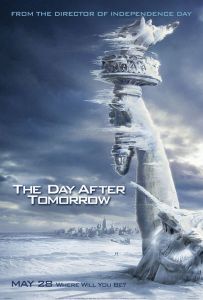 I must confess a giant moment of geekery: for a month or so I waited patiently until the Wednesday before the new disaster opus The Day After Tomorrow opened so I could finally say, The Day After Tomorrow opens … the day after tomorrow. Im surprised the marketing department didn’t beat me to that punch.
Jack Hall (Dennis Quaid) is an environmental scientist concerned about global warming trends and the chaos they could cause. He tries to alert government officials to these dangers but is met with a cold shoulder. Jacks son, Sam (Jake Gyllenhaal), is traveling to New York for a school quiz tournament on the slightly less grave mission of earning the affections of one of his classmates. Somewhere between the establishment of these two stories, all hell breaks loose. Jack and another researcher (Ian Holm) share data and discover that the world is headed toward a gigantic climate shift, a new Ice Age. While the world is crumbling, Jack is determined to reunite with his son, trapped in New York.
The special effects of The Day After Tomorrow are indeed awe-inspiring, but once they finish the viewer is left with a story that is, shall we say, overcast. Unlike director Roland Emmerichs other disaster films with aliens or giant lizards, a cataclysmic climate shift is not a beatable foe, so the story is left without resolution. It’s kind of hard to vilify the weather.
 What do you do once the world starts another Ice Age? Not much besides keeping your butt from freezing off. So this means that the crux of the after scenes revolve around Jack trying to reunite with his son. Jack tells his son to hole up where he is and, cue heroic music, he will come find him. Sure. Does anyone stop and question, Why? I know why Jack treks, on foot no less, from Philadelphia to New York, but it isn’t even necessary. His son and their friends are fine where they are and the only severe threat they face is when the giant frosty eye of the storm looms overhead. Quaid’s character has no opportunity to assist them during even that scene. Im sure someone thought it would be a touching display of a fathers love for his son, but its really just winds up looking foolish. He tells his son not to move, then disobeys his own advice to venture out. Nothing of significance happens because of Jack’s journey. He might as well have stayed home and read a book.
The acting of any disaster flick is really confined to yelling and … panting, I suppose (which could also accurately describe the acting prowess of the late night programming of Showtime). Quaid is a sturdy hero but seems to look ten years older than normal. Gyllenhaal is one of my favorite young actors (I adore Donnie Darko) and, to his credit, he does a suitable job of running around and yelling.
Perhaps the funniest thing in The Day After Tomorrow is a Vice President who refuses to listen to environmental concerns that looks a heck of a lot like our current VP, Dick Cheney. The timeliness also extends to a somewhat witless president who, when faced with a crucial decision, turns to his VP and asks, What do you think?
The necessary scenes of planetary and civilization destruction are first-rate in the film. Emmerich is our premiere master of laying waste to the world, particularly New York City. Emmerich keeps our view of the carnage mostly restrained to long shots where we can witness the full magnitude of devastation he is trying to put forth.
 The weather effects are top notch, especially a series of tornadoes that devastates downtown Los Angeles. There are some beautiful visual moments, like seeing thousands of birds migrating from impending doom, or a final image from above of the iced Statue of Liberty. Tomorrow also has a clever moment late in the film when the frost storm hovers over New York and forces characters to outrun advancing … frost. Its not as stupid as it sounds. And, as per usual in disaster flicks, Mother Nature always knows where to strike – landmarks. How else does one explain the precision of taking out the Hollywood sign?
For a good hour, The Day After Tomorrow is great escapist entertainment. The scenes of destruction are riveting, and the moments leading up to them have great suspenseful pacing. The film’s climax is its half-way point, which is never a good sign. After all the floods, rain, snow, twisters, and everything Mother Nature has in her arsenal, we are left with characters scrambling around running from … wolves. Going from tidal waves to wolves is not exactly an increase in suspense.
There is a hilariously awful moment in the film involving Sam’s wife, played by Sela Ward. Sela is a nurse at a hospital watching over a child with cancer. She refuses to leave him alone and waits for an ambulance to arrive, because, for some reason, the cancer kid can only be transported by ambulance. It’s just distasteful and dumb that this storyline even exists: brave woman determined to stay by the side of cancer child.
The Day After Tomorrow is an exciting diversion that doesn’t know what to do with itself after all the big money shots are spent. Its like a balloon once the air is all out. Perhaps the creators should have consulted any prior warning about stranding an audience in a story that no one cares much about. It’s worth seeing, but it’s also worth leaving after Mother Nature unloads her goods.
Nate’s Grade: C+
Share this:

Van Helsing (2004)
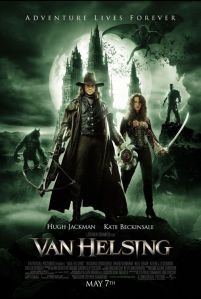 Crossover movies have a distasteful history in the world of cinema. Some movie exec gets the notion, “Hey, why can’t two great tastes taste great together?” But what we’re left with is usually uninspired (The Flintstones Meet the Jetsons notwithstanding). Crossovers for horror movies are the worst of the lot. For every Freddy vs. Jason there’s a dud, like 1966’s Jesse James meets Frankenstein’s Daughter. That year went down in the annals of cinematic history, however, as it also gave us Billy the Kid versus Dracula, marking two entries in the expanding genre of cowboys battling famous monsters (as far as I know, this genre still stands at two movies). So what can one expect from Van Helsing, a big-budget creature feature that includes Dracula, Frankenstein and the Wolfman?
Van Helsing (Hugh Jackman and a really big hat) is a secret soldier for a covert order of the Vatican. This covert order dispatches monsters and creepy-crawlies the world over. He’s been ordered to assist Anna Valerious (Kate Beckinsale), the last in a Romanian family line that has sought to kill the infamous Dracula (Richard Roxburgh). It seems that their family line is dwindling. And Anna’s brother being turned into a werewolf doesn’t help the situation. If her family line dies before Dracula then they cannot enter heaven. Van Helsing comes to town to help out the locals who are terrorized by Dracula’s flying brides. Van Helsing effectively kills one of the vamp ladies and is celebrated as a hero by the village. As he gets closer to Anna he also learns more about his own mysterious past and his connection to a certain figure with big teeth.
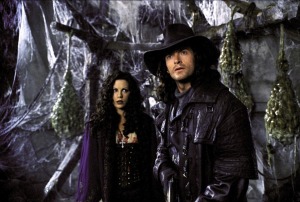 The Big D has a dastardly plan. He wants to find Frankenstein’s monster (Shuler Hensley) to channel enough power through him to awaken zillions of goo-sacks harboring the vamp’s undead brood. Of course, Frankenstein’s monster isn’t too keen on this. Together, he and Van Helsing, with the help of Anna as well as a comic relief monk, battle to stop Dracula from unleashing his children of the night.
Van Helsing is stupid, stupid, stupid. Director Stephen Sommers exists in his own indulgent world where bigger is better and some CGI spackle will fix any plot holes. He makes check-your-brain-at-the-door popcorn movies, but a “popcorn movie” is no excuse to forgive a rambling, incoherent, loud, stupid mess. I liked the first Mummy flick and even found some good with the second, but Van Helsing is Sommers at his rock-bottom worst, gorging on a trough of special effects and vomiting the results onto the big screen. Sommers’ idea of character development is knocking people through walls like they were in a Looney Tunes cartoon.
Van Helsing raises some interesting questions, like why do Dracula’s brides morph into flying demons that are conveniently genitalia-free? Why does a werewolf rolling over the top of a carriage somehow cause it to catch on fire? Why does Dracula keep his magic lycanthropy cure in the open? It doesn’t matter. Van Helsing is so straight-laced about its absurdities that questioning them will just get tiresome.
Not that you would expect much, but the acting in Van Helsing is bad. Beckinsale’s accent couldn’t be less convincing if her role were played by Charo. The trio of Dracula’s brides are played by swimsuit models and let me just say their performance is on par with what you would expect from swimsuit models. Roxburgh is quite possibly the worst vampire in the modern history of vampires, and that includes Blacula, Count Chocula and Tom Cruise. He couldn’t look any less sinister if he was in a diaper and bonnet. What’s up with those strands of hair that dangle in his face? Why do the Van Helsing creators want their Prince of Evil and son of Satan to look like he was the keyboardist for some 80s pop synth band?
 This overly long film feels like a seven-year-old’s book report that he hasn’t read: it’s like a child is making this up as they go. “And then … a werewolf pops up … and then Dracula’s flying brides … and then they all need Frankenstein’s monster ….” Seriously, were the penning this script on the fly? It’s a $150 million improv film. The reels of the film could be switched around and no one would be able to tell the difference. Van Helsing is one long, exasperated action sequence that drags its heels instead of wowing. It beats the audience into submission with its stupidity and redundancy.
The entertainment level of Van Helsing is exceedingly weak. It runs an eternity, which wouldn’t be a problem if one were intrigued by the story, the characters, or the action sequences. The action could have been suitable but Sommers has gotten less reliant on the physical and more superfluous with his CGI. Watching a CGI monstrosity smash into a CGI monstrosity before a CGI background where no semblance of reality is present grows tiresome after 130 minutes. The effects are passable, but they overload the viewer and numb whatever slight interest may have existed for the classic monsters.
What should have been a clever homage turns instead into a hollow marketing ploy that’s so frenetic and tireless with its manic pacing and bad special effects. Even the many attempts at humor are flat. It has to be some kind of apocalyptic sign that Hellboy and now Van Helsing have been unleashed unto the innocents of this world. Some will find Van Helsing decent popcorn entertainment, but most will grow weary of its sloppy design and wafer-thin substance. For me, this is one to avoid, period. There isn’t an ounce of fun to be had while sitting through the painful pair of hours that is Van Helsing. This is one monster mash that’s a real monster mess.
Nate’s Grade: D
Share this:

Spider-Man 2 (2004)
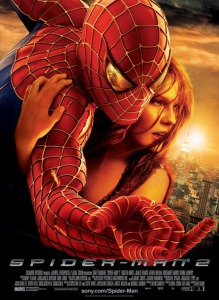 No other movie had higher expectations than Spider-Man 2 and no other movie met and trounced those expectations than director Sam Raimi’s high-flying webslinging sequel. Spider-Man 2 was that rare sequel that excelled in near every way. The action sequences were lively and highly exciting, but what made Spider-Man 2 so thrilling was its success in building strong emotional characters. After all, how many superhero films are written by the writer of Ordinary People? (One wonders what he would have done with Catwoman) Alfred Molina, as Doc Ock, made for a great formidable foe and brought surprising humanity to the dastardly part. Spider-Man 2 was a momentous crowd-pleaser that also dazzled the hardest critics. It reaffirmed exactly what a summer popcorn film can make us feel.
Nate’s Grade: A
Share this:

Hellboy (2004)
 Guillermo del Toro loves things that go bump in the night. The Mexican born writer/director has shown prowess at slimy, spooky creatures with Cronos and 1997’s Mimic. He helmed the 2002 sequel to Blade, which had super vampires whose mouths would open up into four sections with rows of chattering teeth. The man sure loves his movie monsters. del Toro also loved Mike Mignola’s cult comic book Hellboy enough to turn down directing Harry Potter 3 and Blade 3 to ensure he could bring Hellboy to the big screen. Was it worth the sacrifice?
Let me just explain to you the villains of this movie as an example of how ridiculously stupid Hellboy is. The villains are Nazis. Yes, the tried and true villains everyone can hate Nazis. But these ain’t yo daddy’s Nazis; they’re immortal and led by zombie Rasputin (yes, the Rasputin). They all wish to puncture a hole into another dimension. What’s in this alternate dimension? Why nothing except for a giant floating spaceship that houses, I kid you not, the Seven Gods of Chaos, which all happen to be gigantic space squids. Why would anyone create a universe that has nothing but the imprisoned gods of evil? That seems awfully precarious. How exactly are giant squids going to take over the industrialized, nuclear-age world? Shoot ink at everyone? Sorry, space ink?
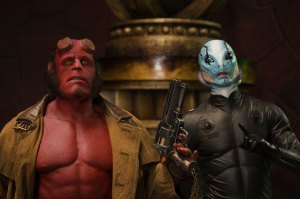 Let me not forget a Nazi assassin and his handy dandy arm-length blades. This assassin is also 100 years old and his body is filled entirely with sand. He winds himself up like a big clock. But if his body is filled completely with sand how can the clock gears work inside? You see what the normal audience member has to deal with? Plus these are just the villains, there’s a whole plot left to toil over as well.
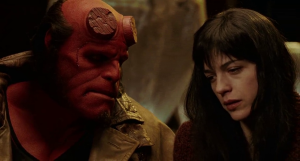
The story revolves around a hulking, red demon named Hellboy (veteran character actor Ron Perlman). Hellboy escaped the space squid dimension in the 1940s when the Nazis unsuccessfully tried to open a dimensional hole large enough for your everyday on-the-go space squid. Now, Hellboy is an elite soldier for the governments Bureau of Paranormal Research. He fights the creepy crawlies. He has to deal with a wide-eyed rookie, the watch of his father (John Hurt) and an attempt to rekindle a romance with a mentally troubled fire starter (Selma Blair). Oh yeah, and all the Nazi/Rasputin/space squid stuff mentioned before.
Perlman is really the only redeeming thing about this movie. The makeup is impressive, and he gives an enjoyably droll performance as a man who fights monsters with the same ho-hum-ness as a plumber reacts to clogged sinks. The rest of the acting runs the gambit of either being too serious (Im looking at you Blair) or just too over-the-top silly (Im looking at you, league of villains).
Hellboy is strung together with bizarre inanities, flat one-liners, heavy Catholic imagery, conflicting logic and contradictions, ridiculous villains, painful comic relief, half-baked romance and frustratingly ever-changing plot devices.
Watching Hellboy is like playing tag with a kid that keeps making up new rules as he goes (“You cant tag me; I have an invisibility shield!”), and after awhile you lose any interest. Late in the film, the Nazis will all of a sudden decide not to be immortal, and at a very inopportune time. Why? How? I don’t know. Hellboy also gets sudden new powers for some reason. Like he can bring people back to life by whispering otherworldly threats in their ears. For some reason nobody’s clothes burn when theyre set on fire.
 Not only does Hellboy frustrate by changing the rules of its world arbitrarily, it will also frustrate out of sheer uninhibited stupidity. How come characters cant hear or see a pendulum the size of the Chrysler building? How come during a vision of the apocalypse we see a newspaper that actually had the time and staff, during the Apocalypse, to print an issue that reads, “APPOCALYPSE”? Why doesn’t Blair use her pyro superpowers immediately to vanquish all the H.P. Lovecraft creatures instead of letting Hellboy foolishly wrestle with them all? The gaping holes in Hellboy are large enough to squeeze a gigantic space squid through.
All this frustration and insanity might have been moot if the action sequences were somewhat thrilling. Sadly, they are not. Del Toro’s action sequences seldom matter. There’s such little consequence of what’s going on that the action becomes stiff and lifeless. The first time we see Hellboy chase a creature through city streets it’s a fun experience, but soon the novelty wears off. The overuse of CGI wears down the audience, and after the third or forth time we watch Hellboy battle the same monster, the audience is ready to go to sleep. There’s little entertainment in the film’s action sequences, but just as much frustration and stupidity.
I have never watched a film that induced more eye rolls, shoulder shrugs, raised eyebrows, pained and confused glances and mutters of, What the hell (boy)? By the time the resurrected torso of a Russian skeleton appears to make cheesy puns and wisecracks, you should have left the theater, demanded full compensation, and maybe, if you’re into it, destroyed whatever Hellboy display was within burning distance. Comic book aficionados may enjoy the fruits of Hellboy but general audiences will simply shrug. I’m amazed that the majority of film critics seem to think positively about this movie. Maybe I’m the last sane person in an insane world but Hellboy is one of the worst films of the year and one of the craziest films you could ever hope to see in a lifetime.
Nate’s Grade: D+
Share this:

Eternal Sunshine of the Spotless Mind (2004)
 No other movie this year captured the possibility of film like Michel Gondry and Charlie Kaufman’s enigmatic collaboration. Eternal Sunshine was a mind-bending philosophical excursion that also ended up being one of the most nakedly realistic romances of all time. Joel (Jim Carrey restrained) embarks on having his memories erased involving the painful breakup of Clemintine (Kate Winslet, wonderful), an impulsive woman whose vibrant hair changes as much as her moods. As Joel revisits his memories, they fade and die. He starts to fall in love with her all over again and tries to have the process stop. This labyrinth of a movie gets so many details right, from the weird physics of dreams to the small, tender moments of love and relationships. I see something new and marvelous every time I watch Eternal Sunshine, and the fact that it’s caught on with audiences (it was nominated for Favorite Movie by the People’s friggin’ Choice Awards) reaffirms its insights into memory and love. I never would have thought we’d get the perfect romance for the new millennium from Kaufman. This is a beautiful, dizzingly complex, elegant romance caked in visual grandeur, and it will be just as special in 5 years as it will be in 50, that is if monkeys don’t evolve and take over by then (it will happen).
Nate’s Grade: A


 nathanzoebl
You must be logged in to post a comment.