Blog Archives
Sucker Punch (2011)

Director Zack Snyder (300, Watchmen) has been drubbed in many circles for being an empty visual stylist, someone in the Michael Bay camp that worships at the altar of style. Snyder is a nearly unparalleled visual stylist. If only he would use his considerable talents for the purposes of good. I’m not a Snyder basher by trade, and have enjoyed all three of his previous films to some extent, but it’s obvious that Snyder spends much of his time scribbling down imagery he thinks will be cool, and then figuring out how to connect it all at the last minute. So Sucker Punch gives us a bevy of highly stylized, anime-influenced imagery complete with a posse of full-lipped ladies with heavy fake eyelashes operating heavy weaponry in fetish-style clothing. If you were expecting much else, then you’re the one who’s been suckered.
Baby Doll (Emily Browning) is a 20-year-old sent to live the rest of her days locked away inside a dilapidated mental ward thanks to her wicked stepfather. He even makes arrangements with a dastardly orderly (Oscar Isaac) to lobotomize Baby Doll to shut her up for good. Then step dad can swindle the family estate for all its worth. While in this asylum, Baby Doll imagines she’s inside a different world to survive. Her fantasies offer her a world to escape to. Inside, she plots with a group of other patients, including Rocket (Jena Malone), her feisty take-charge sister, Sweet Pea (Abbie Cornish), Blondie (Vanessa Hudgens), and Amber (Jamie Chung). Together, along with the sage advice from a mysterious mentor (Scott Glenn) in her visions, they will collect four items to secure their escape. But time is of the essence. The lobotomy doctor, known as the “High Roller” in the fantasy (played in a major surprise by Mad Men‘s Jon Hamm), is scheduled to come do his needle through the brain trick in a matter of days. It’s up to Baby Doll to utilize the therapeutic techniques of Dr. Gorski (Carla Gugino) and retreat into her mind to find the key to save herself.

You can tell Snyder was trying to crowbar in a meek message about female empowerment, but I ask you: is it female empowerment when the women have to be reduced to pretty play things that still operate in the realm of male fantasy? Just because women fight back does not mean that you are presenting a feminist message. Baby Doll’s mode of power is erotic dancing? And her main outfit looks like a grown replica of Sailor Moon’s, which should be a dream come true for just about every male fan of the animated series. You think having characters in short skirts and names like “Baby Doll,” “Sweet Pea,” and Sucker Punch is no more about female empowerment than some ridiculous women’s prison movie where they all fall into long lesbian-tinged shower sequences. That’s female empowerment, right? It’s got women loving women, so what could be more empowering to women?
After Sndyer’s kitchen sink approach to storytelling, the one thing that Sucker Punch lacks, in abundance, is sense. There is no real connective tissue to anything happening onscreen. Snyder employs two different framing devices before slipping into the metaphorical delusions of a third. I felt like I was tumbling through the Inception dream levels without a roadmap or a competent guide. Considering that the first framing device, Baby Doll being locked away in a mental ward, is only featured onscreen for ten minutes, Snyder could have exercised the bit completely. The second framing device, that Baby Doll has imagined her institutionalized imprisonment into a vaguely 1920s-esque burlesque theater/brothel seems just as unnecessary, but whatever. But it’s the third metaphorical level that gave me a headache (more on that later). The premise alone, girls use fantastic imagination to escape from a cruel prison, is good enough to tell a compelling tale. But there desperately needs to be a connection to those images, a relationship between the fantasy and the movie’s reality. In Sucker Punch, there is no substantial relationship to anything. It is a barrage of images meant to arouse and entertain but little more. The different metaphorical levels are only metaphors for, well, hot girls kicking ass, which isn’t so much a metaphor as it is a literal translation. And when the girls are at play in those fantasy sequences, the movie drops all pretenses of any purpose. It’s not just reality defying, which is what movies were meant for, but it defies its own narrative. If I can just cram whatever cool junk I want then what purpose do I even need to set up characters or develop a plot. When the ladies are off on their fantasy tours, they’re invincible and no law of physics, or man, applies to them. It zaps all danger from the screen, and with that, all tension. They all become superheroes who just run around doing super heroic things. And I might have cared if I felt there was any real purpose for what I was watching other than Snyder wanting to scratch a few cinematic itches.

The girls’ quest to attain their needed items for escape is laid out in the most shockingly lazy manner. Snyder uses the power of dance, yes dance; you see, when Baby Doll starts movin’ them hips of hers, she plunges into a fantasy world of her own doing. And then we witness all sorts of crazy things, and she returns back from the fantasy and the mission is complete. The girls have stolen whatever item they were after. I was expecting the fantasy binges to have some direct correlation with the makeup of their world, so that, say, if they have to cross a massive bridge to gain their item, in the brothel they have to cross some massive barrier. It’s the height of indolence for Snyder to simply type “character dances” and then we get an indulgent fantasy sequence and the job is done. We don’t see the steps the girls had to do to win their freedom, the relationships between fantasy and reality, or any clever plotting along the way. There’s no cleverness at all to be had. The fantasy is not just an escape for the characters; it’s an escape from having to do any thinking when it came to storytelling. Imagine what would happen to other works of cinema if they followed this same approach. Why watch the back-and-forth arguments of a courtroom thriller when we could just have “prosecutor dances” and cut to the case being over? Or why bother watching the complicated struggles of a relationship drama when we can have “guy dances” and just cut right to the shot of the camera spinning around the couple kissing? It’s like a fast forward button that eliminates all plot development. Isn’t that much more satisfying? What, you mean it isn’t because it’s a self-indulgent diversion that has no connection to the main storyline and fails to add anything?
I think ultimately Snyder just really wanted to make the most expensive music video of all time. The dialogue is clipped and kept to a minimum, mostly of the expository “you need to do this now” variety. There are long stretches of full-length musical interludes by Tyler Bates (300) and Marius De Vries (Moulin Rouge). The duo orchestrates some uninspiring fuzzy alt covers of alt songs, so familiar tunes like Bjork’s “Army of Me” and the Pixies’ “Where is My Mind?” get a polish they didn’t need (how many times is that Pixies song going to be covered?). Worst of all is a bizarre mash up of Queen’s “I Want It All” and “We Will Rock You” with a rap track. And of course no film that aimed to ape the tropes of Alice in Wonderland would be complete without some version of Jefferson Airplane’s “White Rabbit,” this time covered by talented Icelandic singer Emiliana Torrini. The entire musical oeuvre is a bunch of distorted, loud, blaring guitars meant to amplify the visual noise.

Sucker Punch is not so hot in the acting department. Browning doesn’t particularly act well in the movie, but then again nobody does, especially Gugino’s awful accent. But this isn’t a film about acting so much as it’s looking the part. And Browning is a geek fantasy come to life, samurai swords, pigtails and all. She makes for a great moving poster.
Expect nothing more from Sucker Punch than top-of-the-line eye candy. Expect nothing to make sense. Expect nothing to really matter. In fact, go in expecting nothing but a two-hour ogling session, because that’s the aim of the film. Look at all those shiny things and pretty ladies, gentlemen. This is the perfect film for a 13-year-old kid fed on anime, comic books, and horror films and who don’t give a lick about things like plot, character, or substance. It’s like somebody combined One Flew Over the Cuckoo’s Nest with every single damn videogame cut scene in the history of time. I was waiting for the next dance/trance sequence where Baby Doll was going to start jumping on turtles and collecting coins. It’s a series of vignettes that have no connection whatsoever. Sucker Punch is really a live-action Heavy Metal, except with even less plot. This isn’t a fairy tale. This is a meth-fueled explosion of a Hot Topic store, captured in Snyder’s signature slow motion. Everyone is entitled to their own fantasies but not everyone gets a $100 million dollar check to throw them all together on screen.
Nate’s Grade: C+
Share this:

Megamind (2010)
Y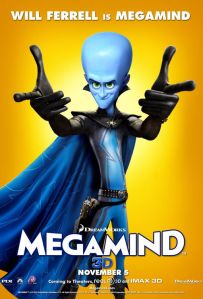 ou’ve seen this movie before, and pretty recently too given in the influx of superhero tales in the last decade. Megamind recycles heavily from numerous other super forbears, and yet this animated tale about a tired hero (voiced by Brad Pitt) and his inept nemesis (Will Ferrell). While it’s never as funny as its premise and cast should make it, the movie does pack a lot of fun and even a little bit of heart. The action sequences are inventive enough and the movie has a tone that drifts from sincere to self-conscious satire, while never settling down but doing enough right not to inflame your sense of irritation. The concepts of identity, good and evil, the duality of man, striking a life for your own… they’re all here. It’s a sloppy message that feels copied out of a plot playbook. Ferrell is funny but a bit more restrained than I like him. I think he works best when he cranks up his absurdist tendencies with a jolt of enthusiasm. Megamind doesn’t come close to approaching the magic, thrills, and emotions of How to Train Your Dragon, but it’s still many ways better than stuff like Monsters vs. Aliens and Shark Tale. It’s overly familiar story given a super spit shine.
Nate’s Grade: B
Share this:

Source Code (2011)
 Captain Colter Stevens (Jake Gyllenhaal) awakes on a train. His mind has been transplanted into the body of Sean Fentress, a doomed train passenger. Fentress, along with 200 others, were killed in an explosion on a commuter train heading in to Chicago. But this has all happened in the past. Colter has been quantum leaped into a top secret government program known as the source code. It uses people’s brain waves to simulate a recorded reality. The last thing Colter can remember is a firefight in Afghanistan, and now he’s aboard a train looking for a mad bomber. Whatever info he can retrieve will help the officials (Vera Farmiga, Jeffrey Wright) prevent a second terrorist bombing scheduled that day. Colter only has eight minutes to interact with the train passengers and deduce who the bomber is. After eight minutes, the train explodes and the reality resets itself again. Things get even more complicated when he falls for Fentress’ fetching female friend Christina (Michelle Mongahan). Can he save her? Can he save anyone? Can he get out of the source code?
Source Code manages to be a twisty, trippy little film that doesn’t so much knock you out but definitely packs a bit of a punch. Its simplicity is its very best asset. There’s a bomb on a train (ignore the questionable movie sci-fi physics). Colter has exactly eight minutes to learn what he can before he and everybody else blows up. Then the fun starts anew. The movie is less a time-travel flick than an alternate reality sort of experiment. Personally, I love movies that present a timeline and then slowly thumb away at the edges, stretching the narrative space, showing the audience the various intricacies of this tiny world. Whether it’s Pulp Fiction, Groundhog Day, or the propulsive fun of Run Lola Run, I enjoy a story that expands outward into a greater foundational complexity. I enjoy the clockwork of a story that shows me how the different pieces work together. I enjoy that through the variations I can experience a richer world, seeing what happens to a passenger as they leave the train, seeing how a character’s actions can impact another, seeing how altering that character’s action alters other forces in the story. That kind of narrative trickery, perfected in Groundhog Day, makes the story feel like a living creature because you witness the interconnected relationships of everything and everyone. It also makes it pretty fun to watch.
 Director Duncan Jones makes slick use of tight spaces like he showcased in 2009’s celestial sci-fi thriller, Moon. The quick pacing and collective rhythm of the movie helps contribute to its entertainment factor. Source Code is playful enough in design and execution. It remains consistently clever with its plotting, but what’s really surprising is that Jones is able to find a personal human story inside all the thriller trappings. Colter is trying to make sense of his situation, but he’s also trying to reconcile the idea of life, death, fate, and getting to speak with his parents who assume he was killed in Afghanistan (he’s been with the source code project for over two months). There’s a human face to all this, and while the love story feels tacked on and underdeveloped, Colter’s emotional turmoil and existential struggles to reassert his identity and find some peace from his life ring true. Gyllenhaal (Prince of Persia) is an ever capable lead who takes a near Hitchcockian leading man role and plays it straight to fine effect.
At the same time, Source Code tries to have it all with an ending that I don’t truly believe it pulls off. Spoilers will lurk, so skip the next two paragraphs those who wish to remain pure and chaste. The film does a fairly nimble job of setting up an appropriate, if mostly downbeat, ending. Colter doesn’t want to be a brain in a box; he doesn’t want the government using him as their newest tool for the rest of his unnatural days. He was pulled from the brink of death and he now just wants to die in peace. In the recorded reality of the source code, he’s allowed the chance that most of us will never have – he can find closure. Whereas he would have died on a desert battlefield, now Colter has an opportunity to speak to his father one last time, to say goodbye. The entire denouement of Source Code seems to be establishing a memorial for the people who were lost on that train, because once the source code is erased so too will they be. They’re electronic recreations but in the end it reminds you that they were real people, and now they get something of a proper sendoff, a fairly touching memorial to the people who will just be seen as numbers in a news report.
 And then… just as Colter makes peace with passing over, he passes over into another reality. The train doesn’t blow up. The people are able to get off. He gets to walk hand-in-hand with his new sweetheart. Jones doesn’t make it clear what really happens, which can lead to some mounting confusion. Did they really alter the past? Did they create a parallel dimension? In one dimension is everyone on the train dead whereas in another everyone lives, short of Sean Fentress? And how crappy is that? Yes, Gyllenhaal is a charming and terrific looking guy, but does no one shed a tear for the fact that he stole another man’s body? Sean Fentress may not have had the courage to ask out his pretty friend, but that doesn’t mean he deserved to have his identity hijacked and his existence more or less erased from time and space. It’s a weird blemish that the filmmakers don’t truly want to address, and why would they? The ending lacks commentary of any sort strictly because the movie wants to have it all. It wants the sad, mournful ending, it wants the happy “Everything’s gonna be okay” ending. It almost let’s you choose. But Source Code doesn’t come across so much as a film that begs to be opened for different interpretations so much as a film that didn’t want to upset anyone by picking an ending.
Source Code is nicely paced, nicely plotted, and it produces just as many intriguing questions as it does substantial thrills. Jones finds interesting ways to make the same material different. The various characters, converging storylines, and science-fiction mumbo jumbo are all nicely woven into a satisfying bite-sized sci-fi thriller. It fumbles with the landing, in my view; it seems like a pandering appeal to please every faction of the audience, or at least to confuse them with the illusion that they have gotten what they wanted. This is an intellectual sci-fi potboiler in disguise as a thriller. Roll with it, play along, don’t think too hard about the moral implications of its murky ending, and enjoy the ride.
Nate’s Grade: B+
Share this:

Battle: Los Angeles (2011)
 It’s just your typical sunny, Southern California day. Blue skies, good vibes, and aliens wiping out the indigenous species (read: us) for our bountiful resources. Staff Sergeant Michael Nantz (Aaron Eckhart), literally a morning away from retirement, is pulled back into combat to be apart of a Marine platoon that must hold up in the city and fight back against our otherworldly intruders.
Well there is a battle, and it is set in Los Angeles, but that’s about all you’re going to get from this movie. If you were looking for something approximating character, you’re looking in the wrong place. The characters are purely defined by one-note superficial differences, like this guy’s a doctor from Nigeria, this guy has a pregnant wife, this guy has… glasses, etc. The characters were so powerfully indistinct that there were three separate times that a person appeared onscreen and I said aloud, “Hey, I thought that guy died.” Battle: Los Angeles is a military movie, a grunts-eye-view to an alien invasion. And we keep that limiting POV for the entire movie. Battle: Los Angeles has more in common with Black Hawk Down than it does with Independence Day. Replace the depiction of angry, faceless Africans with aliens and there you go. We move from house to house, rubble-filled street after another, shooting wildly, barking commands, and trying to make sense of the urban battles. I’m doing the film too much of a favor because that makes it sound thrilling, which it is not. While there is plenty of action kept at a fairly frenetic pace, that action consistently stays at the same level of intensity. Nothing truly builds or develops to add extra levels of tension. The action is consistent, shooting through one neighborhood after the next, and when the action is plentiful but fails to develop, then the entire movie feels stagnant. Sure it develops from a “We have to go here now” assembly of plot dominoes, but advancing from one location to another with fewer characters each time is not the same as a plot.
 These have got to be some of the dumbest aliens in the universe. These are the aliens that the other aliens pick on. Some scientist/exposition device pontificates that the aliens are after our water, which is a better reason than invading a planet to harvest our tasty brains (Skyline, I’m looking in your direction). The talking head says it’s a rarity to find a planet with liquid water and thus Earth is so attractive to outsiders. Okay, so you’re going to tell me that aliens lack the ability to take ice melt it? There’s an awful lot of ice in the universe that could be more easily obtained. That seems like a better solution than an interstellar road trip for a drink. The creature design is decidedly lacking as well. The aliens look like a cross between squids and a hardware store shelf; they have metallic weapons forged to their skin. At one point Nantz and his crew is dissecting an alien POW to look for vulnerable spots (this might violate some sort of treaty somewhere) and find a lone sack underneath about five layers of armor and exoskeleton. Then they relay the news about this “delicate” spot to all the troops and miraculously all of the aliens start to now go down easily by being shot at a great distance and having the bullets penetrate layers to hit one spot a half a foot in diameter on a moving target. Makes perfect sense now that they know. That info didn’t seem any more helpful than just blindly shooting at the area below the head, which was the previous method for killing. These alien spaceships look like someone attached rockets to the shantytowns from District 9. These ships look like something assembled over at a junkyard and I thought to myself, “You traveled through space in this heap?” It’s like an invasion from an impoverished alien race that also happens to be ignorant and uneducated, which might explain the whole coveting water thing. Battle: Los Angeles might secretly be a metaphor for class warfare. Or not. Probably not.
The movie transforms into a two-hour commercial for the Marines. Battle: Los Angeles espouses the selfless bravery and honor of our servicemen, which is commendable, but it should have been done in the ame of recognizable human characters. It does the honor of good men no justice when they are turned into statues. These aren’t people, they’re recruitment figures spouting poster slogans through gritted teeth. The valor turns just this side of jingoism, and that does a disservice to the sacrifice of the men and women of the armed services. It’s hard to watch Battle: Los Angeles and not come away with the impression that the Marines are superhuman badasses and let’s fight some aliens! What compounds this messy association is that the Marines have long featured TV ads where their square-jawed recruits battle fantastical monsters (I recall one of them being made of lava).
 Director Jonathan Liebesman (Texas Chainsaw Massacre: The Beginning, most famous for Jordana Brewster’s gravity-defying low-rise pants) is no great lensman. He gives shrift attention to the significance of geography in action composition, but he makes up in quantity what he lacks in quality. There is plenty of loud noises and the like, so you’ll be kept awake, that is until you heard the stilted dialogue and wish you could fall asleep. The film packs enough stuff into an overlong 110 minutes but it’s not terribly interesting stuff, which is saying something for an alien invasion movie.
Disappointingly, the movie makes no usage of its titular location. Los Angeles may be the battlefield in name, but this movie could have been set anywhere. It does not take advantage of any of the geographic features that are unique to Los Angeles, or even California. Why bother establishing a specific location in the title and premise when the execution means you could have set the story anywhere (Battle: Cleveland?). It’s a crumbling city; it could be Libya for all that matters. Some of this is likely due to the fact that the movie was almost entirely filmed in Louisiana, which seems like a rather unnatural double for Los Angeles pre and post-alien invasions.
Battle: Los Angeles is a studio film that gets its job in an efficiently empty-headed manner. The space invaders are dumb, the action is too limited and erratically framed, and the story exists only in a theoretical state. Eckhart grunts in his raspy Two-Face voice from The Dark Knight for the entire film. I suppose if you have low expectations and just want to fill up on special effects, Battle: Los Angeles should sate your desire for straight-forward shoot-em-up entertainment. It’s not brainless but it’s close to it. Near as I can tell, Battle: Los Angeles is devoid of political or topical commentary on contemporary conflict because that would just get in the way of its straight-laced heroics. Sorry District 9, what were you thinking?
Nate’s Grade: C
Share this:

The Adjustment Bureau (2011)
 Gentlemen, if you were looking for an original excuse about not calling a girl back, try this one on for size: I couldn’t call because a team of men who control human destiny told me that if I did they would erase my memory and keep you from the fame that you are destined to achieve. She’ll probably at least give you points for originality before throwing a drink in your face (but it was all part of The Plan, or was it?).
David Norris (Matt Damon) has just lost a New York congressional election thanks to his frat boy ways of old resurfacing. As he composes his concession speech inside the men’s restroom, he meets Elise (Emily Blunt), a ballet dancer hiding out. They have one of those crazy only-in-a-movie conversations that manages to feel authentic. Then they kiss. She inspires him to ditch his prepared remarks and speak from the heart to the national TV audience, which eats it up. David spends the rest of his days trying to meet the enchanting Elise again. Then he runs into a big stumbling block. He’s late to a meeting and catches a group of mysterious men in suits and fedoras fiddling around with people frozen like statues. They are the adjusters, the ones who ensure that the participants of mankind follow The Plan. These are the people responsible for the illusion of choice in our lives. If we deviate too far from The Plan, causing ripple effects that too need to be accounted for and adjusted, they step in. Richardson (John Slattery) is the spokesmen for the group and decides to just level with David. He is not supposed to be with Elise. He has a different future ahead of him, so sayeth The Plan. They will throw obstacles between the two of them. David seeks out Elise and fights against the whole universe for the two of them to make a future together.
 Horrible title aside, The Adjustment Bureau is a sometimes corny but often deeply satisfying movie. It may distract with some efficient and just-smart-enough sci-fi leanings and magic tricks, but it’s really a unabashed romance at its core. Not just that, it’s a good romance, once that flutter the heart and causes the ends of your mouth to do that thing, you know – smile. It helps when you have movie tars as gorgeous as Blunt and Damon, and are such good actors that they can fill their roles with dangerous amounts of charm, but let’s credit writer/director George Nolfi (The Bourne Ultimatum, Ocean’s Twelve). He takes a fairly routine concept (powerful forces control our lives and choices) and turns it into a finely tuned character-driven romance. Immediately from their first meeting in a men’s room, Blunt and Damon have that electric dynamic that you can genuinely believe in. Their chemistry will knock you over. You feel the spark between these two, which is essential because the two characters spend years apart at times, forever hoping to reunite. In that brief encounter, you fall in love as well and realize that this character, and this actress, is worth waiting for. I think people are going to be surprised that The Adjustment Bureau is a big gooey, stars-in-the-eyes love story, and it’s actually good. It’s a really enchanting love story, tackling the question of whether whom we love is a result of choice or destiny. This central concept is what every sci-fi element and thriller sequence is spun from. Here’s a funny thought: it’s all in service to the story.
It’s rare to see a studio movie that mixes so many different elements together to such effective, satisfying results. The film doesn’t get overly dark despite the cosmically long-reach and determination of the adjusters. There’s never any real threat of danger, only a broken heart or dashed dreams. The film has many light moments throughout, creating a rather bouncy tone that suits the romance angle nicely. The adjusters aren’t very menacing, more so comically perturbed. John Slattery, all silvery Mad Men appeal, is a perfect foil as the face of the adjusters. He feels like an exasperated parent baffled by the thought-processes of his youthful charge. It helps that these cosmic accounting agents have a finite level of power. If they had unlimited power then the film would fail to have any hope for David and Elise. But we learn that there are only so many adjusters that there are limitations to their powers, and that they can be outsmarted with enough gumption. Mingling with that light touch is enough whimsical science fiction to engage your brain. The concept of the adjusters and their supernatural abilities is nicely teased, setup, and then developed, making sure never to rock the audience with too much weirdness at one time. It’s a gradual process of discovery and it leads to a somewhat goofy, but infectiously amusing, climax that involves multiple doorway portals and magic hats. Yes, I said magic hats, which means there is an honest to God good reason why that stupid fedora hat, seen so prominently in advertising that it feels like the third-billed star, is featured. Admittedly, a concept like a magic hat that allows you to teleport through doorways would seem silly, but Nolfi makes it all work. The hardest aspect to believe (in a film with, I repeat, magic hats) is that Blunt could be a ballet dancer, let alone a future star of the medium. I’m by no means saying that the British beauty has anything to worry about in appearance, but she does not have a ballet dancer’s dangerously minuscule physique. Natalie Portman in Black Swan looked like a real-deal ballerina of fragile frame. Blunt doesn’t have the movement or the physique.
 In his directorial debut, Nolfi does enough good things, and does them with a smooth sense of style, to impress. The visual trick of going in one door and opening to another world walks a dangerous line of over saturation, but it’s playfully utilized enough to forgive. Nolfi is not perfect with his plotting, falling to misstep that can push back momentum. Characters will be chatting, and then they’ll walk away and we’ll get a title card that says something like, “Three years later,” and it sort of makes it feel like we have to start all over again. The fact that this happens more than once means that Nolfi might have wanted to plot his story around a series of events that occurred more often than Senate election terms. If we have to begin with David losing one campaign at the start and then zoom ahead at several points through another campaign, then perhaps the timeline could have been condensed a bit in retrospect. The film manages to be religious and faith affirming without pushing an agenda or overstating its romantic cause. The ones behind the plan are only referenced in oblique business terms, never confirming a certain high power but definitely nodding in that general direction.
Damon and Blunt are a terrific team. This is easily Blunt’s finest role as an actress since breaking out in 2006’s Devil Wears Prada. The actress has taken many a role that makes use of her large crystalline eyes and her sometimes go-to acting response of simpering. But in this film, she finally finds that perfect role that makes use of Blunt’s modest, goofy charm. She’s never been a leading actress in a traditional set; there’s always been a delightful goofy appeal that set her apart. When Blunt offers her playful smiles and asserts those glassy eyes of hers, you too will be smitten. Her character is a charming woman thanks to Nolfi’s writing, but having an actress of Blunt’s ability fill her out is a blessing. Damon is at a point in his career where he just grinds out good-to-great performances that manage to be convincing in unassuming, dignified ways. Damon has never been an actor given to the superfluous. His character feels like a sincere sport, which is amazing considering he’s supposed to be playing a politician. He’s the kind of guy you’d actually stand in the rain to vote for, and you understand why Elise would keep a place tucked away deep in her heart for the dashing Damon.
While the movie hinges on the coupling of Damon and Blunt, the rest of the supporting cast does fine work matching tone and making the most of their roles. Actors like Anthony Mackie (The Hurt Locker), Terrence Stamp (Valkyrie), and Michael Kelly (Changling) can make any movie better.
 The Adjustment Bureau, on paper, should not work. A sci-fi fantasy that’s unapologetically grounded in romance. A tone that nestles firmly in a safe, bubble-wrapped whimsy. And those magic hats, need we forget them? On paper this should be one overly silly, dumb, tonally disjointed, cornball movie worth venomous mocking. And yet it works; it does better than “works,” it succeeds. Blunt and Damon are terrifically charming together and imbue the movie with a sense of cheerful optimism in the face of uncertainty (and perhaps heaven itself). You desperately want these two crazy kids to get back together; they’re good, decent, charming people, winning personalities apart and even better together. What might have fallen apart in other hands becomes this endearing, fizzy piece of studio entertainment that fulfills and exceeds most expectations. I was really taken by this movie, won over by its effusive charm offensive, and left buoyant with happiness by the time the tidy, perhaps too tidy ending, came rolling. The Adjustment Bureau is hooey but it’s my kind of hooey.
Nate’s Grade: A-
Share this:

I Am Number Four (2011)
 Despite being based upon a young adult book series, I Am Number Four is an unfortunate title. What do you call the sequel? I Am Number Four 2? I Remain Number Four? Let’s not even mention the obvious pan that is begging to be covered by that title (“I Am Number Four? More like I Am Number Two!”).
Number Four, a.k.a. “John” (Alex Pettyfer), is your normal teenage alien hiding on Planet Earth and trying to live a regular life while eluding intergalactic mercenaries. Numero Quatro has relocated to the town of Paradise, Ohio with Henri (Timothy Olyphant), his alien guardian who poses as dear old dad. The two are trying to keep a low profile because Number Four is one of the last nine super-powered aliens from a dead planet. The aliens develop different special abilities as they mature and Number Four has begun to notice that his hands glow in the dark. Number Four catches the attention of Sarah (Dianna Agron), a pretty gal whose ex-boyfriend happens to be the super jealous quarterback. Number Four also befriends the school’s nerd (Callan McAuliffe) who thinks his father was taken by aliens. He’s not exactly keeping the desire low profile. Numbers 1-3 have been killed by a pack of alien mercenaries who intend to dominate Earth, and now Number Four is next.
While neither special nor afflicting, I Am Number Four is a pretty mundane, mediocre, special effects driven goof aimed primarily at young teen males. The plot lacks any trace of nuance and seems fantastical in what should even be ordinary. The Ohio town is one of those small towns that exist in the minds of west coast studio executives, where everyone gathers round for a carnival and the roads are mostly of the dirt variety. Sarah’s family is one of those ideal, chatty families that exist primarily in the minds of nostalgia. They don’t just sit around and chew their food; they are actively involved in dinner cutesy dinnertime games and cutesy embarrassing interactivity. But the movie never lets you think about these inauthentic tidbits for long before more explosions or colorful special effects rattle you. The plot follows an almost mechanical process, supplying some PG-13 skin (ladies in low rise jeans! Cleavage!) or some rudimentary chase scenes at a fairly brisk pace. The story borrows liberally from many sources, including a dash of super powered loner Spiderman stuff, angsty teen romance from Twilight, and a sprinkle of whatever is playing on TV right now as you sit reading this.
 The action is never really takes off beyond the general concept of Things Exploding and People Running. Director D.J. Caruso (Eagle Eye, Disturbia) can string together a series of pleasing visuals but they never amount to much. The film lacks real suspense and any risible sense of excitement. The action sequences are disposable but at least Caruso makes sure that the audience can follow along. I thought with all the sci-fi elements that the film would make more interesting choices, but alas I Am Number Four relies all too easily along commonplace action tropes like it’s an accomplishment. Number Six (Teresa Palmer) gets to walk away from an explosion in slow-motion (while she wears sunglasses). Nobody in town seems to ever pick up on the mounting collateral damage of this interstellar spat. Caruso and the screenwriters are too content to just be happy playing with the special effects toolbox, emulating the favorite moments of the sci-fi action genre. And one of those tropes is that ANIMALS CAN NEVER DIE. Number 4 has a shape-shifting guardian pet that decides to take the form of a dog. Then when things get rough, this dog mutates into a hulking CGI creature, which still looks like a dog. And when he gets wounded fighting another CGI monster, it’s not enough that we get the pained dog cry but the filmmakers decide that he also has to transform back into a regular Earth dog at this point to hammer home the image of pooch in trouble. Shameless to the very end. And then, during our resolution this space dog has to come hobbling out.
Fortunately for the audience, the actors are all rather beautiful. Pettyfer (Alex Rider) isn’t much when it comes to this thing called acting, but he’s got abs you could scrub laundry with and really that’s half the part of playing a hunk from outer space. I give the guy more credit just for having to be saddled with the lame superpower of glowy hands. It’s a long wait for those glowy hands to become instruments that launch glowy fireballs. For most of their screen time, Pettyfer’s power just looks like he’s clenching two very powerfully charged indigo-glowing cell phones. Olyphant (Deadwood, Hitman) is too young for me to be covering as the dad to a 17-year-old kid. I still remember Olyphant in 1999’s Go. Maybe that’s just my hang-up. The ladies are all gorgeous are all in the flawless skin and teeth variety, you know, the ones that populate every small town. No one truly makes much of an impression but they’re easy on the eyes. It’s like an Abercrombie and Fitch catalogue come to life with extra explosions (and more clothes).
 The only actor that stands out is Kevin Durand and he’s under pounds of makeup as the chief villain. Durand first came to serious attention as a season-long villain on TV’s Lost as Martin Keamy. He has a real distinct menace that doesn’t come across as self-satisfying or ironic. He’s got a real presence and it seems like casting directors have caught on to this former Canadian standup comedian. From there Durand has become something of a go-to guy when it comes to large intimidating men and men with some kind of mild speech impediment; his characters in X-Men Origins: Wolverine, Legion, and even Robin Hood all sounded like they had their mouths stuffed with cotton. Durand always has a good time with his bad guy roles, whether they are flinty or over-the-top. I enjoy watching this man onscreen even if he’s under some fairly lackluster creature makeup that makes him look like a tattooed shark man.
The point that caught my attention, and was scantily mentioned but once without nary a rejoinder from any character, was the fact that the big bad evil aliens are killing the alien teens in order. No reason is ever attempted. There are nine super alien teens but for some reason these interstellar killers are uncontrollably anal-retentive (“We may be vicious monsters, but we respect the value of numerology”). It makes little strategic sense to stick to the doctrine of taking out your enemy one at a time and in a predetermined order that everyone knows about. It also means that presumably Number 9 will be the hardest to vanquish since they will have the longest time to master their super power. Later on, Number 4 gets an added boost from a sexy, slinky Aussie who happens to be Number 6. My first thought: “What the hell happened to Number 5?” Then I figured that Number 5 has to be locked away somewhere in a protective safe house at an unknown location. Because that affords Number 6 to do whatever the hell she wants; the evil aliens would just have to stop and say, “Look Number 6, we’d really, truly love to vaporize you right now, but first we gotta go find and kill Number 5 first. See ya later.” If that’s the case then Number’s 7-9 need to get off the bench and team up. Number 4 can’t keep this up forever, guys.
I Am Number Four is tailor-made for a young male audience that doesn’t have the urge to see something harder or edgier. It’s got superfluous jet-ski stunts, girls with flat tummies, explosions, cool space weaponry, CGI monsters, villains in long black trench coats, failed attempts at romance, a dog, and even a reference to famous Cleveland Browns quarterback Bernie Kosar. It’s not an incoherent cacophony of light and sound like you’d find in a Michael Bay film; director D.J. Caruso is like Bay lite with more self-discipline. I Am Number Four is fairly derivative stuff but nothing worth getting upset about. After you see derivatives of derivatives, you start forgiving the final product for lacking any discernible flavor. All of the elements come together in rather harmless fashion making a rather empty but harmless sci-fi action flick.
Nate’s Grade: C
Share this:

Predators (2010)
 For a solid 45 minutes, Predators is a fairly good genre movie. No, it’s a very good genre movie. We snap awake in freefall with a ripped Adrien Brody. A group of deadly warriors from all cultures find themselves stranded in some strange jungle. For that 45-minutes of goodness, the assembled killers (and Topher Grace as a doctor?) try and piece together their circumstances while exploring the foreign terrain. It’s a setup straight out of the Twilight Zone catalogue. And then, at minute 46, they find out they’re on a game preserve planet for the notorious alien bounty hunters, the Predators. The characters get picked off one-by-one and the patient buildup unwinds in a familiar and depressing bloodbath. Predators will work as a quick fix of junk food, but it teased a promising alternative that never came to fruition. The action is bloody but listless. The plot twists are seen from miles away (Topher Grace as a doctor?) and after all that badass macho posturing, the end credits blast the song… “Long Tall Sally” by Little Richard? It’s the most bizarre element in a movie with killer space monsters in dreadlocks.
Nate’s Grade: C+
Share this:

Tron: Legacy (2010)
 In 1982, TRON was a movie ahead of its time. It took place in a world inside the world of computers, which couldn’t have been that advanced back then. But “ahead of its time” and good are not the same things. Arguable one of the most influential science-fiction films in terms of design and CGI, the original TRON was a financial dud for its film studio. All this makes it so curious why Disney would spend upwards of $200 million dollars on a fancy, shiny, big-budget sequel to a movie people didn’t really give a damn about before. TRON: Legacy looks to capitalize on a generation of geek nostalgia. At least it doesn’t fare as poorly as the Star Wars prequels.
Sam Flynn (Garrett Hedlund) is 27 years old and the lead shareholder of Encom ever since his father, Kevin Flynn (Jeff Bridges), mysteriously disappeared in 1989. Kevin had found a way inside the world of computers, which he called The Grid. He studied it and based his company’s arcade games on what he found. Then after saying he was going to break the world of gaming wide open, he vanished. Then in 2010, Alan Bradley (Bruce Boxleitner, a sight for sore eyes) visits Sam with a message. He got a page from a number that’s been disconnected for over 20 years. Sam ventures into his father’s old arcade/workstation and gets zapped inside the world of computers. Now he’s amidst all those racing light motorcycles and flying disc battles. The slinky program Qorra (Oliva Wilde) rescues Sam from the gladiatorial battles. Inside this realm, the Grid is run by Clu (CGI Bridges), a digital doppelganger of Kevin Flynn. Sam is reunited with his dear old dad and together they try to escape this digital prison and stop Clu.
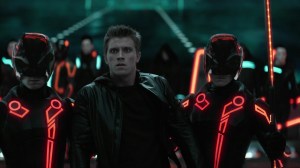 Never have I felt more like an old man than after watching TRON: Legacy. All the special effects dazzled, but after a while it felt relatively empty and insubstantial. But what did all those gleamy flashes of light and snazzy 3-D effects do, ultimately? Distract from the void of a story. I consider myself a fairly intelligent individual, able to follow complicated narratives and appreciate complex storytelling. And yet, when the lights came back up in my theater, I said, “There is a lot that I never understood.” The setup is relatively painless, but where the movie grinds to a deadly halt is for an exposition-heavy 20 minutes in the middle after our second big action sequence. When father and son are reunited they get to talking, and talking, and talking some more about God knows what. I think my brain shut off from all the stilted dialogue. Every character seems to stop and unload a pile of exposition. Even though the characters seem to explain so often, you always feel like you’re still missing something important. You still feel left out. But after this dreadful slog, suddenly there’s Michael Sheen (Frost/Nixon) to save me from my stupor exactly like he did at the end of the turgid Twilight film, New Moon. He brought me back to life, but after his campy, cane-guitar rockin’ sequence of battle, I was trying to get caught up on the parameters of plot and setting. But then the film just flew from one set piece to another and I was forever lost. I couldn’t tell you why anything happened in the last hour of the movie. It just seemed like one thing was following another without any sense of logic or foresight. I got the idea of the need to escape this virtual world and that there was a special doorway to make this happen, but after that it all became an unintelligible chain of ones and zeroes.
The incoherent screenplay by Lost scribes Adam Horowitz and Edward Kitsis is a bleak vehicle for special effects. TRON: Legacy will certainly melt your eyes but it leaves the brain cold and overlooked. The rules of the TRON universe are never adequately explained. When Qorra suddenly drives a vehicle off the Grid and says, “We can do this, they can’t,” you’re forced to just shrug and go with it. Why is Clu trying to kill Sam and his dad when he’s pretty much had the run of things for 20 years? What exactly is his plan for world domination? He thinks his electro-tanks will be able to take out the military powers of the real world? Do these programs have free will or does their engineering trap them? Why would they gather at a stadium to cheer the death of other programs in violent sport? All of these walking/talking computer programs got me thinking about The Matrix and how much more creative and effective and overall better that movie was with storytelling. There are some token nods to character, mainly Sam’s reunion with his long lost pop, but this is a movie designed to mesmerize with flashing lights rather than story and character. I would find this somewhat acceptable if I wasn’t bored so much, let alone paid an extra four bucks for the luxury of being bored in three dimensions.
 But if special effects are what you want, TRON: Legacy delivers big time. The sleek production design is married seamlessly with the flashy, techno-oriented effects inside the computer world. Watching the floating spaceships and zooming racecars is a luscious, exhilarating rush to experience. The visual style obviously has to hew close to the first film in 1982, which seems to handcuff the imagination of the crew. We’ve made gigantic leaps in the world of movie special effects but we’re stuck with characters in glow-in-the-dark jumpsuits and cityscapes that look at like half-finished neon outlines. I haven’t seen a 3-D movie since two-time reigning king of the world James Cameron’s Avatar, but I would readily advise people to see TRON: Legacy in 3-D if available. It gives the film that extra whiz-bang quality. This is not just a cheap grab at extra cash where the studio throws a 3-D rush on a film late in the game. The 3-D, which kicks in when Sam travels inside the computer world (like the change into color from the Wizard of Oz), feels more immersive without resorting to hurling countless objects at the audience. The greatest 3-D effect, bar none, is Olivia Wilde (TV’s House, Year One). Director Joseph Kosinski has a steady background in computer effects, and it shows. His handle on actors is another matter entirely.
But the biggest misstep with the special effects occurs with the 1980-version of Bridges. Whenever we get a glimpse of this Bridges of old, whether it’s from Clu or a brief and distracting scene in the film’s 1989 opening, it’s another opportunity for the movie to remind you of its lack of authenticty. The de-aging technique still needs some serious tinkering. What it does is make an actor look like a plastic doll, with dead Polar Express zombie eyes. It’s creepy and off-putting and every time you see the de-aging effect it rips you out of the movie. Watching young Bridges take on older, current Bridges would have been more interesting if we had an entire digital rogues gallery of Bridges characters. Imagine the Dude and his drunken, self-destructive country singer from Crazy Heart involved in digital games of combat.
 There are some nice action sequences that begin to touch imaginative possibilities of this unique world. The flying disc duels are interesting enough for the time being. The first few disc battles make fine use of the unique features of the boomerang-esque weapon. The motorcycle battle where the ribbons of light/exhaust create a wall is still a great idea for battle of wits at high-octane speeds. It just never fully materializes. The edits don’t occur in that hyperkinetic Michael Bay fashion that discombobulates the senses; however, I never really grasped the geography of the action realms. In order for the viewer to appreciate the action and the moves and counter-moves, we need to understand the arena and boundaries of the setting. With the cycle chase, it just seems like they’re all appearing at random. An action sequence is less satisfying if it doesn’t seem like it’s building and making use of the particular surroundings. The moody score by electornica duo Daft Punk gives the film a thematic lift, though having them score with a full orchestra feels like hiring Yo Yo Ma and forcing him to play a trombone.
TRON: Legacy feels at times like a super-sized Light Bright meant to dazzle and distract from the gaping void at heart. The story merely exists to get the characters from one place to another. The leaden exposition pretty much destroys the film’s momentum. It becomes plodding and tiresome. It would be like if Luke Skywalker sat and listened to 20 years of history rather than actually, you know, doing something. It’s been 28 years since the first TRON and the world has gotten far more computer savvy, and the jargon from the first flick would be readily understood. TRON: Legacy doesn’t feel like you’re in a computer, just whatever weird alternative universe. It seems like the real legacy of TRON ends up being hollow special effects.
Nate’s Grade: C
Share this:

Splice (2010)

Splice is a slice of freaky-deaky sci-fi horror done with enough style and weirdness to keep your eyes glued to the screen. Director Vincenzo Natali (Cube) takes a few notes from David Cronenberg in staging his creature feature. A scientific couple (Adrien Brody, Sarah Polley) are about to have their gene-splicing lab shut down, so they make a radical decision to start an experimental personal project. Utilizing human genes, they combine other DNA to create a new species. The moral ambiguity and scientific danger is thoughtfully addressed, with the couple quickly finding how easy it is to make moral compromises. Soon they become attached to the creature they name “Dren” and view her as a daughter. Things get even crazier when Dren starts exhibiting some Oedipal desires (I believe the reverse is more fitting, an Elektra complex). Slick cinematography and seamless practical and digital effects help ensure that Splice is never dull. The movie seems two steps away from achieving true greatness. In the end, after all the intrigue and surprising amount of emotional subtlety given the premise, Splice devolves into a by-the-numbers slasher film. The final act is all about character poking around in the dark for the big scary monster. It’s not nearly as intellectually stimulating. In this regard, Splice reminds me of 2007’s Sunshine, another sci-fi film that started strong, had some style and brains, and then blew it by devolving into a clichéd horror movie where characters outrun a super-powerful slasher villain. As a fan of intelligent sci-fi, it’s frustrating to get teased with greatness and have to settle with pretty good, but I’ll gladly take the gonzo pleasures of Splice over any rote action thriller.
Nate’s Grade: B
Share this:

Jonah Hex (2010)
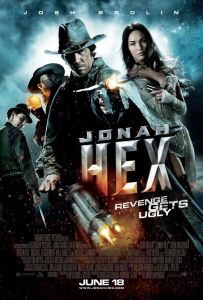 Clocking in at barely 73 fraught minutes, Jonah Hex is a bizarre Western sci-fi hybrid that never really stops to fully explain the rules of this universe. Josh Brolin, who does what he can with the disfigured badass, plays the Hex of title. Hex has a facial deformity along his mouth, which means it’s hard to understand whatever the man is saying as he slurs and mumbles the majority of his tough guy talk. It’s not smart to have your main character unintelligible. Watching Jonah Hex gives you the impression that nobody, cast and crew, knew what was happening. One minute Hex rides a horse with a, I kid you not, double gattling gun, and the next he’s fighting against a crazy John Malkovich who wants to build Eli Whitney’s doomsday machine. Did I also mention that Hex can bring people back to life for short periods of time via his magic touch? The look of the film is overly aggressive, with a rock guitar jackhammer score and plenty of souped-up special effects shots that try and ignite some flailing sense of excitement. It’s hard to get excited about a movie that feels so soulless. Jonah Hex feels like some studio shill thought they could buy a comic property and fill it with sure-fire elements that would please a teenage male base. Megan Fox (Transformers) in a bodice can only distract from the gaping void of a cohesive screenplay for so long. Then you stop and remember how much this movie sucks.
Nate’s Grade: D


 nathanzoebl
You must be logged in to post a comment.