Blog Archives
God Bless America (2012)
 Bobcat Goldthwait’s (World’s Greatest Dad) pitch-black social satire is something akin to Idiocracy meets Falling Down. Frank is a terminally-ill man (Joel Murray), fired from his job, and he’s had enough with the coarsening of American culture. He teams up with Roxy (Tara Lynne Barr), a precocious teenager, and embarks on a killing spree intended to take out the people responsible for making us so mean. Nothing is subtle about Goldthwait’s satire, and while the victims are easy targets (reality TV, media fear-mongering, hateful religious extremists), the results are wickedly funny and entertaining on a vicarious level. Murray is given a few standout speeches about the poisoning of intelligence, the celebration of self-absorption and ignorance, and while it may be preaching to the choir, God Bless America has enough moments that make you want to stand up and salute. There is a sequence in a movie theater where Frank and Roxy kill a group of noisy, inconsiderate teenagers, and I think this part should be shown before every movie, in every theater, for the rest of time.
What stops the film from being an irresponsible 90 minutes of pure cranky wish-fulfillment is that Goldthwait does not condone his killer’s point of view. The movie finds ways to undercut the glamorization of what they do, whether it’s robbing Frank of a movie-style “cool kill,” having Roxy list off every annoyance she think is worthy of being killed over (including people who misuse the word “literally” and Diablo Cody) and having Frank reign her in, or the fact that Frank admits to finding some common ground with a blowhard pundit’s political views. This is definitely a movie for a select audience, but for people with a perverse sense of humor and a sense of rising frustration and dread over the popular culture, God Bless America is the movie equivalent of a cultural enema. It’s the darkest movie about manners you’ll likely see in a lifetime.
Nate’s Grade: A-
Share this:

The Men Who Stare at Goats (2009)
 This movie was a big letdown given the cast, the strange true origins of this fantastic tale, and even with the title. This odd little film feels tonally off. The material feels mishandled, mixing broad humor and with military satire and the dark realities of the war in Iraq. The premise is solid — a Pentagon program training psychic soldiers, men convinced they could run through walls or terminate goats through the power of thought. Why then does the movie feel so misguided and rudderless and, ultimately, boring? Never has such an outlandish concept, based on true events, felt so devoid of edge. The satire picks safe targets and the comedy remains farcically broad. I think the film’s downfall can ultimately be traced to the decision to turn this material into a fictional narrative. I would have preferred an actual documentary detailing the men, women, and goats involved in the real Pentagon program. If truth can be stranger than fiction, why dress it up and then dull it through fiction?
Nate’s Grade: C
Share this:

Bad Lieutenant: Port of Call New Orleans (2009)
 This is a crazy movie. It is not weird, it is not bizarre; it is not silly. Werner Herzog’s whacked-out movie is a remake of a 1992 movie that wasn’t that good to begin with. This certifiably crazy movie mostly involves Nicolas Cage as a corrupt cop playing all sides and snorting everything that isn’t bolted down in the Big Easy up his nose. For a stretch during the middle, he starts to sound like Jimmy Stewart with lockjaw. The central murder investigation plot is pretty much an afterthought in an environment like this. You want the crazy, and with Cage and Herzog, it is in no short supply. There’s Cage threatening an elderly woman at gunpoint, crawling reptile POV shots, a man’s “soul” break-dancing after the man lies dead, and neon iguanas that may exist only in Cage’s drugged-out mind. The film has been described as a trippy parody of standard cops-and-robbers fare, or as a seriously demented anti-drug message, but I think the best description is just “crazy-ass movie.” It has moments that make you do nothing but shake your head and laugh, like when Cage is about to hit rock bottom and EVERY case/storyline gets solved in a matter of seconds to his bemused disbelief. The comedy is straight-faced but it is definitely there. Cage harnesses his eccentricities and delivers an insanely entertaining performance that reconfirms that there is indeed an actor underneath his Hollywood veneer. He is compulsively enjoyable and the movie is compulsively watchable, every crazy freaking second of it. Iguanas!
Nate’s Grade: B
Share this:

In the Loop (2009)
 This is one of those movies that are so sharp, so bristling with intelligence, that you practically need to have a remote control glued to your mitt so that you can rewind and catch all the jokes. I turned the subtitles on myself just to make sure I could get everything. This British comedy is a wicked satire of the miscommunication and blunders that lead the U.S. and Britain into declaring war on a Middle Eastern country. There are some topical jabs but so much of the humor comes from the fractious character interaction; there is a real joy to watching these larger-than-life personalities clash over the course of two nations. It’s fascinating and biting and plays out like a more profane version of The West Wing. The cast is fantastic from top to bottom, with special notice going to My Girl‘s Anna Chlumsky all grown up and perfect with comic timing, and Peter Capaldi as the fearsome, fire-breathing British Director of Communications who can split an epithet like nobody’s business. You might expect his head to burst with how apoplectic he can get. This may be the most quotable comedy in years; every line of this screenplay is gold. There are Hollywood comedies that would kill for just one or two of the choice lines here, but In the Loop is chock full of the funny. It’s a machine gun spray of comedy. Something this scathing and this brilliant doesn’t come along every day.
Nate’s Grade: A
Share this:

District 9 (2009)
 I can’t believe I forgot to review this some how. The sleeper hit of the summer, District 9 is an intelligent, and rather obvious, apartheid metaphor, and a grandly executed action thriller with a strong moral compass. Aliens crammed into ghettos and being mistreated and abused? Sounds like Alien Nation to those with longer memories, however, writer/director Neill Blomkamp forges a docu-drama that manages to be bristling with ethical questions and kick-ass action. It’s very easy to get wrapped up in all the excitement, so much so that I was trying to will the characters onscreen to take certain precautions. Blomkamp manages to take shots at some easy targets, like shady corporations and mercenaries, but that doesn’t make the movie any less affecting. The movie belongs to actor Sharlto Copley, who begins the film as a dithering bureaucrat and ends as a truly unlikely action hero, and you buy every single step of this man’s satisfying emotional arc. While the Academy is picky when it comes to genre films, Copley deserves Oscar consideration; I haven’t seen a more compelling performance by an actor all year. The special effects are astounding, and they were accomplished on a scant budget of 30 million, which is probably what Transformers 2 spent on one explosion. District 9 makes you feel that movies can still surprise you, as long as we have visionary, intelligent life working outside the studio system.
Nate’s Grade: A
Share this:

Wolrd’s Greatest Dad (2009)
 The name Bobcat Goldthwait doesn’t exactly make you think accomplished filmmaker. Goldthwait is best known for his screechy, nervous voice utilized in animated features and the hallowed Police Academy series. But he’s also a writer and a director. His first effort was 1991’s Shakes the Clown, starring Bill Murray as an inept bank-robbing clown. Then he wrote and directed a 2006 movie called Sleeping Dogs Lie that centered on the romantic foibles of a woman who, on a whim, once gave her dog oral pleasure. I can’t see Hollywood touching that one with a ten-foot pole. These sort of unconventional, risky artistic concepts might prepare you for Goldthwait’s newest black comedy, the ironically titled World’s Greatest Dad.
Lance Clayton (Robin Williams) is an underappreciated man. His teenage son, Kyle (Daryl Sabara), hates him. He cannot find anyone interested in published his many manuscripts. His colleagues think little of him, students don’t attend his poetry class, and his quasi-girlfriend, Claire (Alexie Gilmore) is showing more interest in Mike (Henry Simmons), the new hunky, successful English teacher that got a story published in the New Yorker on his first try. Then everything changes. Lance comes home to find his son dead of auto-erotic asphyxiation. He rearranges the body and writes a suicide note, attempting to spare his son from being mocked in death. But then the school hacks into the police system and prints Kyle’s suicide note. The entire school is awash in grief and discovers what an insightful, troubled young man Kyle was. They all want to know everything they can about Kyle, and suddenly Lance has found an outlet for his writing.
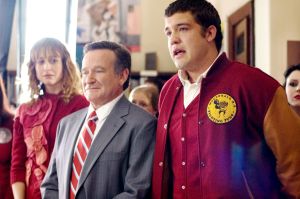 The movie satirizes grief culture with sharp acuity. Kyle’s classmates all react with horror and look back with extreme rose-colored glasses. Suddenly their fallen peer has transformed from the kid nobody liked into the wounded soul that touched all their lives. Bullies reexamine their behavior, girls that never would have given him the time of day now immortalize Kyle, and the faculty that wanted to expel him now wishes to rename the library in his lasting memory. This warm, fuzzy gauze of grief is Goldthwait’s target. He is satirizing how people turn tragedy into hypocritical attitude shifts. He ridicules the easy revision of history under the guise of collective sympathy. Not every youth is necessarily taken before their time. Not everyone was going to grow up to contribute selflessly to society, making the world a better place to live. Not every youth is deserving of canonization. Some people are just jerks from beginning to end, and Goldthwait proposes we do a disservice when we whitewash reality in the name of kindness and good taste. The only person who can see through this wave of hypocrisy is Kyle’s only friend, Andrew (Evan Martin), who doesn’t remember his crabby buddy being deep, articulate, or remotely smart.
Goldthwait’s screenplay is seriously dark and twisted but it’s also routinely hilarious, notably utilizing a deranged sense of irony. Lance uses his own son’s death as the vessel to become a respected writer. He uses his own dead son as his literary pen name. For once in his life, Lance now has an insatiable and adoring audience for his writings, and to top it all off they won’t dare be critical. Lance is manufacturing his son’s legacy and gaining unbeknownst critical praise. That’s fairly dark and fairly amusing stuff. It’s also funny that Kyle’s death has a greater positive effect on the community than Kyle being alive. The school rallies together and students use the death to justify personal growth. The fake journal of Kyle’s touches and enlightens, which further pumps up Lance’s ballooning ego and sense of purpose. At one point, a talk show host raises the question of whether it’s better to be a good person or thought of as a good person, and this gets to the heart of Lance’s dilemma. His actions are morally questionable. What started as an effort to protect his son’s dignity has morphed into personal gain. Is the world a better place because of this false rendering of Kyle? Is the lie better than the ugly truth? Is the lie justifiable? I honestly never expected to be confronted with tricky ethical questions while watching a movie made by Bobcat Goldthwait.
This is the best work Robin Williams has done in years, which I understand might not be saying much considering his recent slate of brain-dead family comedies. He hasn’t shown this much restraint, and talent, since his 2002 World Tour of Evil that included One Hour Photo and the masterful Insomnia. Williams drops every pretense of his well-known manic funnyman shtick and plays an actually subdued character. Lance is beaten down by the disappointments of his job and fatherhood. Williams effectively coveys the exhaustion of a man who repeatedly fails to connect with his brat of a boy. He doesn’t know what to do; the kid is practically a sullen stranger in his own house. Williams endures such slights and misfortunes with deadpan humor and sarcasm and the audience actually vaguely sympathizes with him through much, if not all, of the second half. Williams is mostly reactive and can come across like a calculated straight man to Goldthwait’s cracked-out script. You feel for the guy when he can capitalize on his son’s death and you practically want him to get away with it all.
Sabara has grown up considerably since being the chubby little tyke in the Spy Kids movies. It’s amazing how much you will detest his character. This kid is perverted, repugnant, obstinate, and just plain idiotic. He hates music (“All music? You hate all music?”), he hates movies, and he dislikes pretty much everything other than extreme pornographic fetishes. Kyle is a nightmarish child with no redeeming value. He had to be in order for the satire to work.
 World’s Greatest Dad is a misanthropic hoot of a movie but that doesn’t mean it is without flaws. Goldthwait has yet to prove any particular style or vision behind the camera. His direction isn’t a distraction by any means but it mostly just presents the story in an unobtrusive fashion. He also has the annoying habit of using music selections as a storytelling crutch. He?s prone to using several songs that describe the onscreen drama to a literal level. For a script as biting and clever, it’s disappointing that Goldthwait feels the need to use songs to spell out his implicit drama. This being satire, by nature the characters are mostly going to be thin. The classmates are little more than a cross sectional representation of high school stereotypes, ready to slide in for a joke. Other side characters are weak due to being underwritten or dropped. Claire is a shallow love interest flitting from suitor to suitor, offering little more than a conquest. Mike works as a foil to Lance but then is completely forgotten about in the second half. There’s one interesting scene where Mike, Lance, and the principal are all golfing and the roles are reversed, Lance is the confidant and respected colleague and Mike is jockeying for approval. But that’s pretty much the last you’ll ever see his character in a meaningful way other than taking up space in the background.
In the end, World’s Greatest Dad is not a comedy that will leave your sides aching or seams in need of stitching. It’s dark and disturbing but unlike the earlier Observe and Report, this movie actually provides an entry point for empathy. It’s provocative and twisted but it never pushes the audience out of the story. The intriguing setup is explored with careful consideration. The characters manufacture a false love for a kid that was all but ignored, and everyone is worthy of scorn to some degree. Even Lance is worthy of derision considering he’s exploiting sympathy to find the success that has eluded him his entire life. But Williams’ performance and Goldthwait’s sharp screenplay keep the film grounded amidst its satirical targets. Most surprising of all, there’s a a sweetness that emerges from this film’s black core. Lance regains a sense of humanity and purpose, and so do we due to his journey. Golthwait has come up with an unusual, morbid, and cynical comedy that manages to be somewhat life affirming by its final reel. I can’t believe I?m saying this, but I believe Bobcat Goldthwait is establishing himself as a strong comedic voice in the world of film. I eagerly await the next movie by the guy who did all the funny voices in Police Academy.
Nate’s Grade: A-
Share this:

The Invention of Lying (2009)
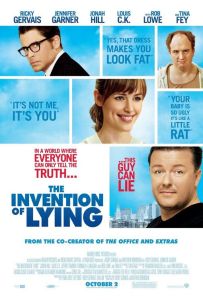 Imagine a world where people could only tell the truth. Sounds scarier than anything in horror movies today.
Mark (Gervais) is trying to romance Anna (Jennifer Garner) but even the waiter tells him she’s out of his league. She tells him upfront that she finds him unattractive and he will never have any hope of having sex with her. She’s more interested in Mark’s snide but handsome co-worker, Brad (Rob Lowe), who she feels is a better genetic match. Mark is about to be fired from his job, writing historical screenplays about the 13th century, and his secretary (Tina Fey) delights in telling him that she loathed every minute they spent together. This is a world without a filter. Until one day Mark goes to take out money from the bank, and something inside his brain switches. His balance is $300 but he asks for $800, and the bank teller apologizes for the computer error and gets Mark his full $800. He explains to his barfly friend Greg (Louis C.K.) that he said something that wasn’t. Nobody understands. “I’m a black Eskimo,” Mark says. Everybody takes him at his word. Mark is the only human on earth who has the ability to tell a lie, which he uses to his great advantage whether it be gambling, getting out of a traffic ticket, or unearthing a “lost” historical chapter about ninjas and aliens that makes for a stirring “non-fiction” film. Mark can’t even explain what he’s done, since the world lacks even a word for “lie.”
Gervais and co-writer Matthew Robinson concoct some interesting and inspired ideas of what a world bereft of lying would be like. Naturally, advertising would be completely different if people had to tell the truth, the whole truth, and nothing but the truth; imagine prescription drug ads that only said, “This is a placebo. Your penis won’t ever grow bigger.” The slogan for Coca-Cola is, “It’s very famous,” and the slogan featured for its rival, Pepsi, is, “When you can’t have Coke.” No one has any concept of fiction, of people pretending to play parts, so movies only consist of an older man sitting comfortably and reading a historical account with some minor dramatic inflection. Movies have become book reports. The sign in front of a retirement center says, “A Sad Place for Hopeless Old People,” and a motel sign reads, “A Cheap Place to Have Intercourse with a Near Stranger.” However, I’m puzzled by how forcefully open every person is. Just because you can only speak the truth doesn’t mean you have to be talking constantly. I understand Gervais’ point about the need for lies to protect people’s feelings, but just because you think someone looks fat doesn’t mean you have to blurt it out. When Mark greets Anna at the door for their date she reveals, “You’re early. I was just masturbating.” It’s funny, sure, but did she feel compelled to link the two statements? It seems in this world, everyone is incapable of keeping their mouths shut.
 The premise of the movie is terrific, and I’m honestly shocked no one has thought of it before. But the premise wears a little thin after the first 30 minutes of people speaking with no filter. You begin to expect outrageous comments that will be hurtful and blunt, and because you expect them it takes away the shock value and lessens the humor. But then The Invention of Lying takes a sharp right turn at about minute forty and becomes a radical and subversive and much funnier movie. Mark is comforting his dying mother (Fionnula Flanagan) who is afraid of leaving existence. She’s afraid of a cold nothingness. So Mark explains to her that there is an afterlife, a world beyond our own, where everybody gets to be around their loved ones in a mansion, and there’s no pain. She closes her eyes and dies in peace with this new knowledge. The doctors and nurses are amazed and beg to know more. Mark has created the idea of religion and God! He’s mobbed by people and camera crews demanding him to explain what he knows. Mark then works up the courage to establish a system of 10 rules to follow, which he tapes onto old pizza boxes. He then addresses his flock and has to explain the complicated minutia of religion, with hilarious questioning from the acolytes. Mark explains that there is a “man in the sky” who watches everything we do and is responsible for everything that happens. “Does that mean the Man in the Sky gave my sister cancer?” someone asks. Mark tries to explain the nature of a loving, all-powerful deity who willingly allows bad things to still happen. “Screw the Man in the Sky,” someone yells, “He’s going to kill us all. We need to fight back!” You try explaining the nature of the unknown to people.
It’s at this point that the movie transforms into a biting satire on belief and belief. I was cackling but I noticed that my theater seemed to get awfully quiet the longer the religious satire went on. I almost spat out my drink when I saw a spinning newspaper headline that said, “Man in the Sky Continues to Give Children AIDS.” It’s offensive but completely within the bounds of religious questioning. Gervais and Robinson aren’t ridiculing religious belief; in fact they seem to prove that it has a definite place of significance within society and can be beneficial psychologically. The satire isn’t savage and still manages to play with the amiable, fable-like nature of the story. Gervais isn’t laying out an argument that believing in an unforeseen deity is stupid. The movie isn’t condescending or hectoring, like Bill Maher’s anti-religion documentary Religulous, but it does take some slyly subversive swipes at the nature of faith and its reliance upon the unproven.
 The Invention of Lying suffers from trying to be a romantic comedy. Too much of its conflict is spent on whether the chubby guy can get the pretty girl. The movie gets a tad sentimental for dealing in bitter-truths, and Gervais and Robinson steer the film to the ultimate romantic comedy setting: objecting at a wedding. I wouldn’t have minded the rom-com asides if they didn’t feel like they kept striking the same chord. Mark wants to be in a relationship with Anna. She points out that he’s fat, has a snub nose, and not a good genetic match. He persists. She points out that he?s fat, has a snub nose, and not a good genetic match. This goes on and on until the inevitable break at the end. Mark, and especially Gervais, is an appealing guy, self-effacing and witty, even downright cute at turns, but when Anna keeps repeating the same looks-first mantra, it makes her seem increasingly shallow and him seem like a glutton for punishment. Garner is a fabulous comedic actress and packs a lot more emotion into her character than I would have expected given the conceit.
Ricky Gervais is catching fire as of late, and it seems that America is finally waking up to the charms and brilliance of this squat comedian. He created The Office, the standard for squirm-based comedy, and appeared in the underrated supernatural comedy Ghost Town last fall. Gervais shows the necessity of lies in our world, from sparing hurt feelings to making mass-market entertainment. The world needs dishonesty. When The Invention of Lying is on-target, it is a hilarious, almost brilliant, comedy, with its best gags saved for taking on “the Man in the Sky.” It’s too bad then that the entire movie doesn’t live up to these flashes of comedic brilliance. Still, the movie is sweet enough and ends on a satisfying level, even if The Invention of Lying begins as one movie and ends as another. Gervais is an appealing lead, though he doesn’t prove much in the way of a director, and he has some real dramatic acting chops too, nicely put to use during his mother’s deathbed scene. I hope more Americans wake up to this man’s charms. Gervais continues to show audiences the sharp wit that has made him one of the world’s foremost funnymen.
Nate’s Grade: B+
Share this:

War Inc. (2008)
 What is the point of this movie? I think I get it, at least get what they were going for. The military industrial complex is bad and can mislead countries into needless conflict just for corporate profits at the expense of human life. Sure, got that, then what the hell is with the storyline of a Eurasian popstar (Hilary Duff) who has daddy issues? War Inc. is a farce but it doesn’t have much of string to connect it all. It’s all so scattershot, from lampooning politicians and corporations to squeezing in contrived romance and peculiar and almost nonsensical flashbacks with a fast-talking Ben Kingsley who sounds like he’s doing an impression of Foghorn Leghorn. This movie feels like a collection of discarded scenes that someone pasted together. The movie’s cynicism is almost repellent, and this is coming from a self-described cynic. It isn’t the cynicism that bothers me but it’s the lack of any bigger point. The satiric targets are all cheap and easy, which would be acceptable if the movie did more with the material. War Inc. is remarkably tone deaf when it comes to satire. The Duff sequences are superfluous and are begging to be scandalous, which then undercuts the movie’s potshots about exploiting teenagers for sex. The movie just utterly collapses from the inside out by the end. The most memorable and headline-grabbing moment of War Inc. is when Duff drops a scorpion down her shorts. Does that sound like an enviable creative highpoint?
Nate’s Grade: C-
Share this:

Tropic Thunder (2008)
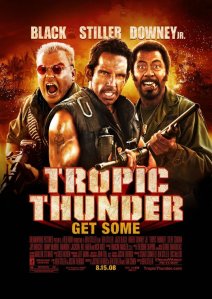 Ben Stiller has been kicking around the idea for Tropic Thunder for nearly 20 years. It took a lot of time to get the script in fighting shape, but the time was well worth it. Tropic Thunder is tasteless and occasionally appalling but it is also wickedly, deliriously funny.
Set inside modern-day Vietnam, Hollywood is filming another epic war movie but this one’s in trouble. It’s over budget, behind schedule, and the first-time director (Steve Coogan) can’t control his actors. Tugg Speedman (Stiller) is a fading action star looking for another hit. Jeff Portnoy (Jack Black) is a crass comedian who’s after some real acting credibility. He’s also addicted to heroin and worries that people will only ever see him as a funny man who farts. Kirk Lazarus (Robert Downey Jr.) is a five-time Oscar-winning actor who, thanks to makeup and a lot of hubris, is playing the film’s African-American sergeant. Alpa Chino (Brandon T. Jackson) is a rapper breaking into acting and is steamed that the Hollywood producers gave the sizeable black role to a white guy.
The director is at his wit’s end and being bullied by producers back in America. He is advised by “Four Leaf” Tayback (Nick Nolte), the Vietnam vet whose story the film is based upon. Tayback says to get real emotion and real fear that the actors should be stranded in the jungle without their precious handlers and demands. So the director takes Speedman, Portnoy, Lazarus, Alpa, and newcomer Kevin Sandusky (Jay Baruchel) in a helicopter and out into the wild. Trouble is, the actors have been left in the middle of an actual drug war, except they think it’s all apart of the script.
 Tropic Thunder is all things to all comedies. It could be tagged as being a bit incoherent but that’s because the movie has so much going on. It’s a sharp satire of Hollywood moviemaking and the raging egos of actors, it’s a send-up of Vietnam war movies and their bloody clichés, it’s a fairly worthwhile action film, and it’s a stupendously politically incorrect comedy with plenty of crude humor mixed side-by-side with genuine wit. It’s a comedy that has the potential to leave you aching from slapstick humor one second and biting satire the next. This feels like a complete comedy and not merely a series of sketches. Every character has an arc, some great moments, and each actor brings something different and something wonderful to the fray. This is clearly Stiller’s greatest achievement as a director.
The focus of Tropic Thunder is all over the place, and no one is safe from Stiller and his co-writers Etan Cohen and actor Justin Theroux. This is a brutal insider satire that plays it broad and loud. There are great jokes that ridicule the pomposity of the entire movie industry and the pitfalls of celebrity as a whole. I loved the jabs at celebrities going overseas and adopting children like they’re souvenirs. The movie has caught flak from disability groups that are mad about the movie’s liberal use of the term “retard.” I don’t want to say these people are missing the point of satire, or the fact that an R-rated comedy should offend on some level, but the joke is clearly on Hollywood and how movies exploit those with mental handicaps under the guise of telling their harrowing and inspiring stories. Movies have long been chronicling the adventurous lives of those with disabilities, which also has the side effect of making these people seem less like, well, just people. In the film, Speedman stared in a movie called “Simple Jack” about a mentally challenged boy who thinks he can talk with animals. Then the character has to pop up later in the film, complete with hysterical dialogue that blows apart just how exploitative these movies are (“I’ll see you in my head movies, but this is one head movie that makes my eyes rain”). It’s performed in just the right tone to make you laugh at the industry and the individual and not because of any disability.
The way the film establishes character back-story is genius. Tropic Thunder introduces all four major characters through fake commercials and trailers, like Grindhouse. The trailers are hilarious and a great way to kick off the movie. Stiller stars in a sinking action franchise where the world keeps being overtaken by fire (“Now, the one man who saved the world five straight times — will have to do it again”). The action franchise’s idea is to just reverse the scenario and, as sequels do, make everything bigger. Black’s trailer revolves around an obese family of super flatulent idiots all played by Black. The sequence is constant farting but it’s so over-the-top and pumped with contempt for lame-brained Hollywood comedies. The best trailer is the one that gives us Downey Jr.’s character, the esteemed Kirk Lazarus. Set in an Augustine monastery around the Middle Ages, Downey plays a monk who finds that he must conceal his inflamed passions for another man of the cloth (a figure I won’t spoil). Think of it as a 12th century Brokeback Mountain, and Stiller and company know exactly where to hammer Hollywood: the go-go eye stares, the hesitant naughtiness, and the ridiculous marketing angles – the title is inexplicably Satan’s Alley. The opening collection of fake trailers serves as perfect comedy bon mots for the feast that is to follow. They whet your appetite and may be the greatest opening 10 minutes of any comedy in memory.
 Downey Jr. gives an unforgettable performance comprised of sheer brilliant comedic bliss. I loved every second he was onscreen and I fully expect the man to get an Oscar nomination for his work here. Now, the role of a Method actor playing a black actor naturally presents a tightrope that needs to be walked just the right manner to maintain a satiric tone that doesn’t turn ugly. Let me state clearly that blackface is never funny. It is repugnant and Hollywood has a rather depressing history with the unsavory practice (Gene Kelly and even Bing Crosby sadly did it). Tropic Thunder is not a Stepin Fetchit-style minstrel show where Downey makes eye-rolling racist stereotypes. The joke is not that Downey is playing a black man, the joke is that he is such an arrogant and egotistical actor that he thinks he can play anyone. Besides, Jackson chides him throughout the film for his unorthodox portrayal, which tells you where the filmmakers stand. Downey elevates every scene he steps into and gives a performance, like the film, that is densely layered with comedy. He never breaks character even when the cameras aren’t filming and even when he’s alone. He’s two steps removed; channeling a performance as a heralded Australian actor playing his idea of a 1970s black male. When Alpa derogatorily drops the N-word, Lazarus slaps him and then begins a speech with, “For over 400 years they have been using that word to keep us down,” and ends it reciting the lyrics to the theme song from The Jefferson’s. In that span of time, Downey takes you along on every stop in the dense, hilarious mind of Lazarus.
While the rest of the actors don’t ascend to Downey’s heights (years ago this would have doubled as a drug reference), the ensemble of Tropic Thunder works together smoothly and they help make the film so much more enjoyable. Black is great when he’s trying to be seen as a “serious” actor when they are filming. I love his rushed and hushed line deliveries. But he’s even funnier after going through the wringer of heroin withdrawal. A sight gag involving Black digging through his speedo had me in stitches. Stiller is playing his usual dimwitted blowhard but propels the plot forward. He knows exactly how to oversell for laughs, like when he’s being riddled with bullets in dramatic slow-mo or when he’s playing Simple Jack. Baruchel is a nice counter foil to the uncheck bravado and craziness of the other actors. Jackson has fun voicing his mounting vexation with Lazarus. Coogan and Nolte provide good small moments, and Danny McBride steals his scenes as a pyrotechnic special effects expert that wants to “make Mother Nature piss her pants.”
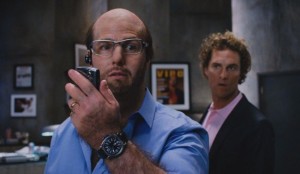 By now you’ve likely heard all about Tom Cruise’s small role in the movie as an irate, bald, fat, extremely hairy studio executive. It’s nice and amusing but I could have done with something different. Downey is unrecognizable in both physical appearance and through his speech; he fully inhabits a character that fully inhabits characters. Cruise, on the other hand, is instantly recognizable even with glasses, a paunch, and a shiny dome. It’s Tom Cruise playing a profane asshole but the joke wears thin. Cruise either needed to do something different or just be seen less, including his hip hop dance moves. And yet, Tropic Thunder has a running joke about Hollywood taking its beautiful A-listers and thinking that, through the power of makeup and superficial physicality, they can play any role. We’ve had a streak of Best Actress Oscar winners that have won accolades by stripping away their beauty and packing on the pounds (check out Charlize Theron in Monster). It seems like even the pretty girls are getting the ugly girl roles now; what’s a homely actress to do nowadays? So, in a way, Tropic Thunder is making fun of this line of thinking, that fat suits and some makeup are the great equalizer, but then it has Tom Cruise more or less falling into the same trap. He puts on a fat suit, a bald cap, but it’s still him and you hear Tom Cruise in every utterance. Maybe it would have been funnier if Cruise were playing a parody of himself since he is a studio executive at United Artists.
Tropic Thunder is a wildly funny movie that takes no prisoners when it comes to its sprawling satire. Stiller and company cut down the self-absorbed lifestyle and mentality inside the film industry and insecure actors. The film really shares the spotlight and each actor provides something different and welcome, and there isn’t a weak link in the bunch. Downey Jr. gives a brilliant comedic performance that will be long remembered. The movie is rude, crude, stupid, smart, and all over the place thanks to such a broad comic canvass. It took many years for Stiller to finally get Tropic Thunder off the ground but the wait was worth it. This is a rare comedy that eels loose, hits hard, and may warrant multiple viewings just to catch all the jokes-within-jokes. This is a movie with plenty on its mind, perhaps too much, but I wish more comedies were as well executed and skillful in their gags about gas passing.
Nate’s Grade: A
Share this:

WALL-E (2008)
 At this point, is there anything Pixar can’t do? They’ve explored the secret life of toys, what’s under the sea, the pains of rearing a family of super heroes, and of course a rat that dreams of becoming a chef. Seriously, anyone that can make that last one not only work but one of the most sparkling, imaginative, enchanting, and poignant films of the year deserves every accolade in the book. Pixar’s newest film, WALL-E, is certainly its most ambitious and potentially its most rewarding yet.
The year is 2700 and the planet Earth has long been left behind by mankind. Humans have exhausted their resources and left behind a planet that looks like one never-ending landfill. Skyscrapers are being built out of garbage cubes. The Waste Allocation Load Lifter – Earth class (WALL-E) robots have been left to toil away and clean up mankind’s mess. There is but one WALL-E robot left and it leads a solitary life of routine. It gets up, it compacts trash into cubes, and it assembles those cubes into eventual giant structures. Then one day a probe lands called EVE. This floating capsule-like robot is easily frustrated and quick on the trigger and WALL-E falls completely in love with his unexpected new companion. The two become close and then EVE is taken away unexpectedly. WALL-E hitches a ride on the ship that collects his beloved and journeys through space to save her.
 I was having reservations citing certain words of praise but this film deserves every ounce of praise; WALL-E is a masterpiece. This is a beautiful story told in a beautiful way in a beautiful looking movie. I imagine kids will be tickled by the funny robots but I really believe that this film will play much better for adults, and when was the last time a mainstream, American family film did that? Most “family” films are an excuse to do something lowbrow and cynical to make a quick buck, like the atrociously cringe-worthy trailer I saw for Beverly Hills Chihuahua (seriously, a civilization of singing/rapping Taco Bell dogs?). Pixar, and God bless them, are proving with each new release that family films need not be brain-killing hours. That reliable Pixar quality touch is never more present than with WALL-E. If you told me that a film that takes place on a trash-filled Earth, with minimal dialogue, and a romance between two robots would be the most thrilling, moving, and wonderful film of 2008, I would have scoffed.
Writer/director Andrew Stanton (Finding Nemo) relies on a universal visual storytelling language to tell the bulk of his tale. WALL-E plays like a gloriously enjoyable silent movie where body language and physicality advance the storyline and provide surprising depth; ignoring brief TV clips of Fred Willard and Hello Dolly, the movie doesn’t have actual dialogue until the 45-minute mark. And it is fantastic. The character of WALL-E is immediately empathetic and the audience will see slivers of themselves inside this independent robot that finds another reason for being. It’s a simple love story told in simple strokes, but it just so happens that Stanton has provided great emotional heft to those strokes. The film has such a huge and vibrant heart. More is said in indecipherable robot bleeps than in much of the tripe Hollywood calls dialogue. Watching WALL-E court EVE, a bit unsuccessfully at first, begins as cute, moves into being adorable, and ends up being greatly touching and flirting with the profound. How many other movies, let alone romances, end with the long-desired climax of two characters merely holding hands? This movie is a delight from beginning to end and a classic example of the power of expert storytelling.
When the film transitions into space is when the potent environmental message, and subversive satire, emerge. Beforehand we have witnessed the awe-inspiring landscape of Earth littered with garbage and empty shopping centers. Humans left the Earth to wait for the robots to do all the work and make the planet hospitable for life once again. For the last 700 years humans have been living in a heavy-duty luxury spaceship. Humans have grown to be fat, lazy, and completely self-involved; people only communicate with others through video screens, even when the other person is inches away. The movie also manages to satirize consumer culture, and in the future one corporate behemoth essentially dictates life’s choices; I found it highly amusing that the former president of the future (a live-action Willard) is also the CEO of the super corporate conglomerate. Business and government have merged completely. The social commentary isn’t as merciless as Mike Judge’s Idiocracy, nor is the environmental message subtle in the slightest, but the satire is sharp enough and blunt that some viewers might be offended, and I think that is genius.
Being a Pixar film, naturally WALL-E is resplendent to look at. The animation is superb and the imagination on display seems limitless. This is one of those films I’m certain I could watch again and again and find something new every time. I don’t really need to say much more about the visuals because they are breathtaking to behold (Roger Deakins, by the far the greatest living cinematographer, was even consulted to help with the look of the film. How awesome is that?).
 And yet even though WALL-E is primarily a love story the film also manages to be greatly exciting and equally funny. Stanton’s screenplay nimbly assembles characters and reintroduces them at key points to push his story onward. I loved that WALL-E is introduced to all sorts of unique robots on the mankind’s space ship and that he even stumbles into, more or less, a group of malfunctioning robots that come to his aid (think the Island of Misfit toys). Stanton manages to reconnect his storytelling threads so that every moment in this movie matters. The last third of the film is a back and forth cat-and-mouse struggle that manages to pump up suspense in smart ways. Stanton lays out his scenario for action and then builds organic complications. I am deeply satisfied when a filmmaker has a firm command of action that they can setup a situation, establish the rules, and then naturally construct obstacles and surprises that feel natural and germane to the story. Pixar has always been able to craft exciting action scenes that felt fully realized and WALL-E is no different.
If there is but one minor quibble I have with this near-perfect film, it is the missed opportunity to explore the mortality of robots. While WALL-E is going through his day-to-day duties he passes by older versions of other WALL-E models. The movie could have pushed just a little harder with the concept that this tiny robot is going to live to collect trash and then die like all the rest, becoming another piece of forgotten garbage. I think if Stanton had only explored this idea a little more it would have made his robo-love story even richer considering that both robots are going against their programming because they have found something that completely changed their world — love. The idea of mortality was explored to excellent effect in 1999’s Toy Story 2, so perhaps the Pixar folk didn’t want to fall into a philosophical repeat.
WALL-E is a wonderful love story, a heartfelt and immensely charming character piece, and a thrilling sci-fi tale that soars to broad heights of imagination. It’s timeless while still being rather timely thanks to its environmental message. Moments after the movie was over I wanted to see it again. I think I’ll feel the same way after the second viewing and the third. This is a phenomenal movie that will stand the test of time as one of the greats.
Nate’s Grade: A


 nathanzoebl
You must be logged in to post a comment.