Blog Archives
The Hitman’s Bodyguard (2017)
 The Hitman’s Bodyguard feels like a 90s Tarantino knockoff remake of Midnight Run, and I don’t mean that in any pejorative sense. This is a movie that knows exactly what it aims to be and strikingly new and original isn’t one of those qualities. When you deliver a late summer movie that has this much depraved entertainment and energy, I don’t mind.
Michael Bryce (Ryan Reynolds) is a disgraced bodyguard-for-hire who lost a high-profile client to an out-of-nowhere sniper. Stuck shielding coked-out white-collar traders, he still knows more than a thing or two about keeping a client safe. His former flame, Interpol agent Amelia Roussel (Elodie Yung), is tasked with getting notorious contract assassin Darius Kincaid (Samuel L. Jackson) to the International Criminal Court at The Hague. Kincaid is the only living witness who can testify against Vladislav Dukhovich (Gary Oldman), a former Belarus military dictator. Coincidentally, all of the witnesses and evidence against him seem to always disappear. Roussel’s team is ambushed and she reluctantly seeks out Bryce for assistance. He has 24 hours to keep Kincaid alive and transport him to The Hague, but Kincaid has some ideas of his own, like arguing, escaping, and visiting his wife (Salma Hayek). It’s a battle of wills and a healthy deployment of the versatile F-word.
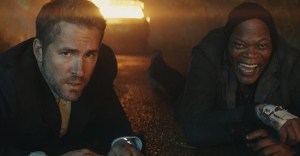 When it comes to genre filmmaking, especially in action or horror, the level of entertainment is much more related to the singer and not the song. Sure a well developed script with interesting characters, organic complications, and memorable set-pieces connected with payoffs are still desired, but often it’s execution that separates the brashly fun bombast from the dreck that dots late night cable. The selling point of this movie is its central pairing of Jackson (Kong: Skull Island) and Reynolds (Deadpool). Hell, both of them aren’t straining too hard from their familiar big screen personalities, Jackson the gleefully stubborn badass and Reynolds as the incredulous smart-alleck with the quick wit. Some critics will chafe and say that the actors are stuck in stale riffs and acting on autopilot. I look at this as a certain virtue of the film. They hired Jackson and Reynolds and let them do exactly what we demand that Jackson and Reynolds do. They were hired for a specific reason. Their crackling repartee keeps the movie alive even as the first half feels too sludgy getting everything going. The comedy can be a tad forced (riding on a bus with chirpy nuns! Gatorade bottle of pee?) and exaggerated at times (really, a fart joke, sound designers?) but this isn’t a film for subtlety, and Jackson and Reynolds, who can outdo just about every working actor for sarcasm and volume, are at their best when they’re big and broad. The rapport elevates even moments that would otherwise be redundant.
I thought the action scenes were going to take a backseat to the Jackson/Reynolds buddy road trip, popping up here and there to move things along and kill off an antagonist or two. To my great surprise, the action in The Hitman’s Bodyguard is uniformly great. Director Patrick Hughes (The Expendables 3) makes each action scene its own story and he thankfully varies the scenarios so they nicely stand out. There’s a terrific motorcycle chase through Amsterdam’s canals and streets, smashing things to bits in the most exciting ways. The action is often divided into two parallel points following Jackson and Reynolds, which allows the film to pair the right sequence for the right character. There’s a late foot chase that’s filmed in refreshing long takes (newest Hollywood action trend?) that stops into the back kitchen of a restaurant and then a hardware store. Each location is well utilized to provide a unique opportunity for the fight choreography and use of props. The movie does a very successful job of approaching action by thinking how to use geography, character, and purpose to plot. Hughes also has a solid inclination when to punch for humor with visual gags, including a few gems involving a minivan. When the comedy wasn’t completely working, I knew I could rely upon the dependable thrills.
The movie also has one of the dumbest attempts at injecting urgency into a story. The plot hinges upon Darius Kincaid arriving at The Hague at an exact time to testify against Oldman’s dictator. In a moment that made me blurt out laughing, an expositional device/news lady informs us that if nobody comes forward to testify then The Hague has to drop all charges, Oldman’s dictator goes free and apparently becomes the president of Belarus immediately again, and probably the end of democracy. First, this false sense of urgency requires witnesses to arrive at a court. That’s not how testimony works. You can give a sworn statement anywhere. You can appear in court via teleconference. The location is not the problem here. And then his testimony is aided by (slight spoilers) photographic evidence of the dictator’s genocide… except it’s all digital pictures. This entire movie hinged on the mad rush to get Jackson to The Hague when he could have just made an email attachment with the incriminating pictures at any wifi spot. There’s also the factor that if it was one second after five or so the court would not accept any testimony. I don’t think courts work that way, especially when it’s a decision over dictators and due process. And yet a wall clock is treated like the ticking clock on a bomb detonator. It’s so dumb I question whether the filmmakers were self-aware and making a satirical riff.
 While being an enjoyably profane experience, The Hitman’s Bodyguard doesn’t know when enough is quite enough. It has problems walking away and routinely falls upon overkill in several elements. There’s almost way too much plot here. Every character has a back-story that nabs a lengthy flashback with an ironically chosen pop song. There are obvious betrayals that the film thankfully doesn’t belabor in revealing the culprits, but did we need them anyway? Hayek seems to have said yes just to be a vulgar badass that would attract Jackson. It’s fun but her shtick gets old quickly. She’s all unchecked exaggeration. Hayek’s character is just here to provide a counterpoint for Kincaid to wax poetic about romance and relationships, to nudge Bryce to “man up” and realize what he’s let slip away. The romantic elements are presented on the same wavelength as the comedy, meant to be a shoulder-shrug of cocksure cool. When they try and get earnest on their own terms it doesn’t quite work out tonally. The movie also runs rampant with false endings, going from one escape to another just as it should be winding down. It’s like the filmmakers were having so much fun they didn’t know when to walk away from their story.
I think every ticket-buyer knows what they’re getting when they walk into The Hitman’s Bodyguard. It’s two actors doing what they do best, in an action vehicle that cribs from Midnight Run, and with a sense of style and attitude that resembles a bluntly ironic return to 90s R-rated action excess. Fortunately, the execution of these genre tropes and elements lead to one of the more profanely entertaining popcorn flicks this summer season. It’s a movie that doesn’t take itself too seriously, coasts on above average action and the charged comic chemistry of its two loud-mouth leads. It’s a movie that doesn’t require much thought and rewards you for the effort. The Hitman’s Bodyguard is everything you want it to be, and if that’s good enough for you, then you’ll find satisfaction here.
Nate’s Grade: B
Share this:

Kong: Skull Island (2017)
 Some of Hollywood’s most famous characters are its monsters, and no I’m not referring to studio executives. Kong was one of cinema’s first international stars, a stop-motion marvel in 1933 that had a hankering for blonde women. His legend has endured many different incarnations and once again the gigantic gorilla is given his close-up, in Kong: Skull Island, the second phase in a would-be MonsterVerse after 2014’s Godzilla. This time the monster comes through. Skull Island is a pleasing two hours spent with just enough style, thrills, and comedy to enjoyably pass the time best accompanied by a big bag of popcorn.
In 1973, a geological surveying team has discovered a heretofore-unknown island ominously shaped like a skull. Everyone is heading there for different reasons. Bill Randa (John Goodman) wants to prove the existence of monsters, and that he’s right. Preston Packard (Samuel L. Jackson) wants one last mission before returning home from the Vietnam War and its anticlimactic ending. James Conrad (Tom Hiddleston) is one of the world’s best big game trackers and wants a new challenge. Mason Weaver (Brie Larson) is an award-winning war photographer who wants a new scoop. Their plans are put on hold when a 100-foot tall ape, Kong, violently knocks their helicopters out of the sky. The survivors scramble to regroup and escape the hostile locals on Skull Island along with the aid of Hank Marow (John C. Reilly), a WWII fighter pilot who crashed on the island thirty years ago and might have a few screws loose from the experiences.
 Kong: Skull Island is a monster mash-up that knows how to entertain in grand smash-em-up style. It is not a remake of the original King Kong story, and being free of that “twas beauty killed the beast” narrative opens the movie to be its own thing, a high-concept action vehicle and clear Vietnam War parallel. It’s like someone watched Peter Jackson’s agreeable if bloated 2005 King Kong and said, “Hey, what if we shaved off the first hour and spent the whole time on Skull Island, the undisputed best part of the movie?” It’s the equivalent of an-all marshmallow box of Lucky Charms (Simpsons reference!). The unique environment boasts a retinue of fun surprises and a variety of action set pieces that keeps the movie from falling into a valley of repetition. It’s not just giant apes and dinosaurs, there’s also giant bulls, insects, and in one creepily terrifying moment a giant spider that uses its stalks of long legs to try and impale its prey down below. It’s a long lost world that allows for a constant sense of discovery that doesn’t get old. When the characters stumble upon a graveyard I wanted to soak up every detail of the spectacular collection of bones. I was grateful that Vogt-Roberts made fine use of his locations, real and computer enhanced, to build a sense of space and atmosphere.
One of the best aspects is that the producers have apparently learned from 2014’s Godzilla and elected not to play an elaborate game of hide and seek. My biggest complaint is that I wanted more Godzilla in my Godzilla movie. I was not content to settle for a shadowy impression or a glimpse of a tail here and a foot there. It was an artistic decision that toyed with audience anticipation but it also felt like we were being lead on. Too much teasing and not enough of the good stuff. This is not a problem with Kong: Skull Island; the title beast makes his presence known in spectacular fashion around the half-hour mark, and there’s no tiresome visual obfuscation to blunt the impact. You see Kong smash and it’s glorious carnage. He’s established as ornery protector, a sheriff of Skull Island keeping order with the fragile ecosystem. It makes the world of monsters seem much larger and more balanced. I wish there was more for Kong to do as a character but without his familiar arc he’s less character and more a testy god. There is a moment or two that hint at the soul inside the giant ape, but he’s mostly the physical embodiment of implacable force and the good and bad that goes with such power.
The Vietnam parallels are plentiful and provide a dollop of subtext to the conflicts, but this is a movie that doesn’t forget to have fun. The imagery can often fall into Apocalypse Now flashbacks and other war movie iconography, from the burnt orange sunsets casting dusky silhouette to the slow motion explosions trailing after teams of helicopters. The ever-present 70s rock soundtrack almost reaches Suicide Squad levels of needle-drop proportions in the first half, constantly reminding you of its time period. Skull Island isn’t a very deep movie but it does subvert some genre expectations at turns. A character given significant attention is taken out rather unceremoniously. An appeal to a greater sense of humanity is curtly brushed off. A lone heroic sacrifice that proves to be fruitless. Our more photographic heroes are evidently the worst, most useless characters (more on that below). For a movie that doesn’t strive for more than two hours of entertainment, it finds interesting sub routes.
 I’m shocked at what director Vogt-Roberts has proven capable of considering his only other film was the low-budget, rather unremarkable coming-of-age comedy The Kings of Summer. This is a Russo brothers-esque statement, a Colin Trevorrow-style jump from minor indie to full-blown big screen spectacle. Is Hollywood going to sign up Joe Swanberg or Shane Caruth to direct the next four-quadrant blockbuster based on a toy? He does an adept job of capturing the action with style, and his shot compositions are routinely visually pleasing, confidently guiding an audience’s eyeballs to key info within the frame. I loved Kong’s immediate introduction as the camera circled him in a 360-degree pan, stopping at points to slow down before ramping up once more. There are amusing angles that highlight the comedy or tension of a scene, and Vogt-Roberts’ sense of geography and scale enhances the destruction. The prologue even had me hooked, as we watch a pair of enemy WWII soldiers parachute on the beach and continue their fight on the new territory. It was such a slam-bang opener and Vogt-Roberts’ use of camera placement reminded me of Spielberg. The special effects are reliably terrific even if they don’t seem like leaps and bounds from Jackson’s Kong. The skull-faced lizard monsters are scary enough to be threatening while still cool. The monster mayhem is lovingly reproduced and in environments where an audience can see the spectacle.
Another improvement is that the human cast has just enough characterization to make me care. With the newest Godzilla, I didn’t care if the giant lizard stepped on any of them, short of maybe Bryan Cranston. However, in this film I wasn’t impatient for the monsters to return that much. The best characters are, ostensibly, the antagonists. Jackson (The Hateful Eight) who goes full on heart of darkness, obsessed with killing the mighty Kong, asserting man’s dominance, and winning a war that others tell him cannot be won. He’s still sore and frustrated from the Vietnam War’s conclusion. He’s convinced that brute force and intractable persistence will win out, and he’s trying to prove something to himself, to the brass in D.C., and perhaps to all the lives lost under his watch. It’s not subtle characterization by any means but neither is a movie with a giant ape fighting monsters. Goodman (10 Cloverfield Lane) uses any opportunity to prove his life’s research about the existence of ancient monsters who he claims are the ones who rightfully have dominion. He’s using the looming possibility of a threat, and the paranoia of the U.S. government in the Cold War, to his sneaky advantage. Watching Goodman and Jackson glare at each other, neither side refusing to back down in their stolid beliefs and personal, self-destructive obsessions, is the non-monkey highlight of the film.
The closest thing approaching human drama, and even tragedy, is Reilly’s distaff character, and I don’t know the last time that John C. Reilly was asked to be a movie’s human compass (Magnolia?). His out-of-time character has a definite degree of cabin fever wonkiness. Reilly excels at being the offbeat oddball and has some welcomed comic relief moments, but it’s the drama related to the character that stuck with me. With the appearance of new human faces, he can take stock just how much of his life he’s missed out on and the family he’s been absent for. His genuine melancholy provides a depth to a character that would ordinarily just be made fun of for being kooky. Still, he’s got some great gallows humor that keeps the movie alive comically while also reminding of the dangers at stake.
 The rest of the characters are rather interchangeable or curiously have little impact on the plot, and that unfortunately includes the headlining stars. Hiddleston (Thor) is a big game tracker and he’s the most useless character. Think about that. He’s supposed to be a wildlife expert and a tracker and he provides no real purpose other than he fills out a tight shirt nicely. Hiddleston is eye candy and little else, which is strange considering his skill set should have factored into the plot somehow. He points them in the direction of water and that’s about it. Larson (Room) is a recent Oscar-winner and has tremendous skill burrowing into her characters and finding a raw vulnerability. With Kong, her anti-war photographer gets off a few ideological shots with Jackson, but there’s little to separate her from the other diverse supporting castmates who are just bodies meant to be sacrificed. They’re all waiting to be eliminated in fantastic, gruesome, or unexpected ways. You won’t exactly be shedding a tear for these people when they become monster chow. Fun fact: ⅔ of the core cast of Straight Outta Compton are here (Corey Hawkins, Jason Mitchell), which apparently shows that Ice Cube isn’t a fan of long travel.
Enjoyably dumb at points and smart enough to know it, Kong: Skull Island is an admirably efficient monster movie that delivers its share of fun. Vogt-Roberts makes a major statement as a visual stylist and director of big-time smash-em-ups. The action is varied, intense, and vividly realized from carefully positioned camera angles and a team of high-class special effects wizards. Kong: Skull Island knows what an audience wants and happily delivers. The actors, for the most part, are enjoyable or enjoyably expendable. If this is the next step in the growing MonsterVerse, then I saw bring on the cataclysms and world-destruction. Friendly tip, stay for a post-credits scene that sets up future installments and try not to pump your fist in excitement. Kong: Skull Island is a boisterous B-movie that can make you feel like a kid again watching the amazing film feats of classic monsters.
Nate’s Grade: B+
Share this:

Miss Peregrine’s Home for Peculiar Children (2016)
 Miss Peregrine’s Home for Peculiar Children feels like Tim Burton’s X-Men franchise, and it’s just as awesome as that sounds. Burton has always had an interest in the outcasts and misfits of society and now he has his chance to leave an imprint on the ever-present superhero phenomenon. His own personal group of gifted youngsters is looking to form a funky family and fight against fearful forces that have their sights set on exploiting these special children or worse. It’s a natural fit for a man who has become a Gothic industry unto himself over three decades of peculiar and spooky filmmaking. This is Burton’s chance to flex franchise tentpole muscles with a subject matter perfectly attuned to his offbeat sensibilities, and watching the fabulous final product is akin to watching a master musician dive into Beethoven’s Fifth. This movie was flat-out delightful.
Jake (Asa Butterfield) is reeling from his beloved grandfather’s (Terrence Stamp) mysterious death. The old man loved sharing his stories about tending to the shape-shifting Ymbryne Miss Peregrine (Eva Green) and her wards, a group of children with special abilities including starting fires, controlling plants, invisibility, and being able to float lighter than air. On a trip to Wales to investigate grandpa’s stories, Jake discovers a time portal and is taken back to the WWII era where Miss Peregrine is waiting for him. She and her children relive the same day and will never age. They’re hiding from Barron (Samuel L. Jackson) and his group of scientists who wish to hunt the children. Jake is tasked with being the new protector, as he is the only one that can see an invisible band of slender monsters known as hollows that feast on the children.
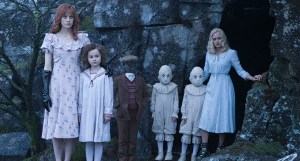 There’s a whimsical nature to the dark elements, and the script is rife with enjoyable payoffs and fun moments that cry out for a full visual immersion. This is Burton’s best film since 2007’s Sweeney Todd (I have a soft spot for that macabre musical), arguably best since 2003’s Big Fish, and maybe his most fun movie since his 90s heyday. If you’re a Burton fan, you’ll be tickled by all the imagination and humor. I grew up on the cinema of Beetlejuice and Edward Scissorhands and The Nightmare Before Christmas (yes, directed by stop-motion maven Henry Selick but still very much a Burton film), so I’ll admit that seeing Burton in high form once again warmed my little mischievous heart.
You get a sense just how involved Burton was in the filmmaking and its details, the degree of passion and involvement, and also his commitment to being a dark movie intended for peculiar children and adults with macabre interests all over the world. I kept thinking that the 12-year-old version of myself would have adored this movie, never mind the 34-year-old version of myself who greatly enjoyed it too. This feels like a natural evolutionary step for children and adolescents who gorged themselves on the works of Edward Gorey and R. L. Stine. It’s not a significant spoiler but it’s something I feel you, dear reader, need to know in order to properly assess just how wonderfully morbid the movie can come across. There is an entire visual feast of a group of villains dining upon the delicacy of… children’s eyeballs. You read that right. It’s a silver platter piled high with severed eyeballs, and they get slurped down like it’s spaghetti. I could only cackle to myself at the audacity of the movie to embrace the fun of the darkness rather than hiding from it, mitigating it, trying to be delicate with tone. The villains want to return to a normal state that can only be achieved by consuming the eyeballs of peculiar children, and so they are hunted not for sport or prejudice but for eyeballs. That’s wonderfully squirmy, and it definitely affected me, an avowed cinema patron who gets extra squirmy with any onscreen eye trauma. There are other creepy and memorable moments, like a dead child being used as a ventriloquist doll and the slenderman-styled hallows creatures. The moments are plenty but they don’t choke the story’s momentum, which hums along with great imagination and lucidity.
There’s a lot going on with Miss Peregrine, and Jane Goldman’s (Kingsmen) screenplay juggles a lot of rules and world building without losing momentum. I was intrigued early and the movie would widen its focus, providing more texture and connection to the world in calculated doses. It was enough that I always felt like I was learning something while still being able to see how the pieces snapped together in retrospect. There’s time travel that has to be done at a very specific point, the rules of who can travel back in time to these bubbles of safety, the history of this specific day stuck in time, the non-linear history of the protectors, the fact that the bubbles are also teleportation hotspots, the history with Jake’s grandfather, the history of the Ymbryne and their powers, the powers of all the peculiars, dream prophecy, mad scientists and their peculiar ailments, the differences between the hallows and the predatory scientists, and also establishing the character dynamics of several lost children and a budding YA romance. It’s amazing that Goldman’s script is as understandable as it is considering all that heavy lifting. It’s not completely free of muddled plot points and some hazy explanations, but those instances are a clear minority to what works so effectively. I wanted to know more about this world, and once they added time travel and teleportation, I was hooked. I enjoyed the movie so much that I’m considering reading the additional books for my next freaky fix.
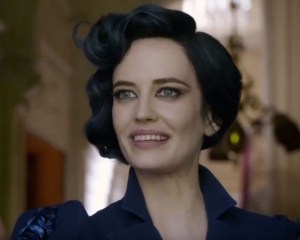 The acting ensemble is full of bright spots and none brighter than the new queen of genre gusto, Eva Green. I raved about Green’s magnetic performance in the considerably lesser 300 sequel. She was easily the best part of that movie and it suffered whenever she wasn’t on the screen. The same can be said for the too-long-in-the-making Sin City sequel. She was the best thing in Burton’s otherwise forgettable Dark Shadows feature. In short, this woman is incredible, and she digs into the vampy and ridiculous with the right degree of malevolence and glee. Green is a wonderful hostess into this magical world, and her foreknowledge gives her a caffeinated energy that makes her even a tad more peculiar. Her children are all fine actors who have uneven parts thanks to the unfair distribution of their powers. Not everyone gets super useful abilities. I felt sorry for the kid who projected his dreams from his eyeball especially during the third act scuffles. A mouth in the back of the head doesn’t seem very useful either. I enjoyed the idea that the invisible kid needs to be fully naked to be fully invisible, and everyone acknowledges this reoccurring fact with shoulder-shrug nonchalance. The standout amongst the peculiars is Ella Purnell as the winsome girl who will float away. She has an innocent and yearning quality that doesn’t sink her character. She’s more than just a love interest to Jake and Purnell helps channel great affection. Jackson (The Hateful Eight) is expectantly highly entertaining as the lead villain and Butterfield (Ender’s Game) is perfectly acceptable as an audience surrogate into this wild world.
I was duly impressed with just about every element, from the structure of the screenplay and its precision with information and intrigue, to the level of acting, to the dark and whimsical tone, to Burton’s own peculiar particulars that fill out the film with adoration. It may sound corny but there is an affection woven throughout the film, for its dispirit outcasts, for their strangeness, for the ardor of telling a spooky story that can appeal to children without pushing away adults. There’s a care that’s been absent Burton’s other recent films, especially Dark Shadows, which left me bewildered whether Burton had any genuine fondness for the source material. Miss Peregrine’s Home for Peculiar Children is a haven for fans of the peculiar, Burton’s oeuvre, and those looking for a quality children’s film that has some bite. I can only hope for more fantastical adventures.
Nate’s Grade: A-
Share this:

Kingsman: The Secret Service (2015)
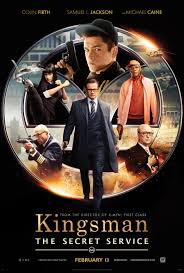 Director Matthew Vaughn’s Kingsman: The Secret Service is my favorite James Bond movie. It’s everything you’d want in a spy thriller while charting its own edgy direction. It’s a combination of Bond and My Fair Lady, and I never knew how brilliant that combination could be until Vaughn got his hands on the graphic novel source material. Newcomer Taron Egerton lays on plenty of star-making charm as a spy-in-training under the guidance of a dapper gentleman brawler Colin Firth. The spy hijinks are fun and stylish but what Vaughn does just about better than any other big-budget filmmaker is pack his movie with payoffs small and large so that the end result is a dizzying rush of audience satisfaction. The action sequences are exhilarating, in particular a frenzied church massacre made to appear as a single take. I never would have thought of the tweedy Firth as an action hero, but he sure plays the part well. There’s also an awesome villainous henchwoman who has blades for legs, and the film makes fine use of this unique killing apparatus. Kingsman explodes with attitude, wit, dark surprises, and knowing nods to its genre forbearers. Vaughn is a filmmaker that has become a trusted brand. He has an innate ability to fully utilize the studio money at his disposal to create daringly entertaining movies that walk to their own stylish beat. This is a cocksure adrenaline shot of entertainment that left me begging for more.
Nate’s Grade: A
Share this:

The Hateful Eight (2015)
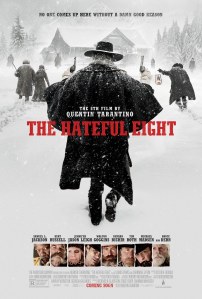 The Hateful Eight almost didn’t happen thanks to our modern-day views on copyright and privacy. Writer/director Quentin Tarantino sent the first draft of his newest script to three trusted actors, and within days it had spread to the outer reaches of the Internet. Tarantino was so incensed that he swore to shelve Hateful Eight and never film it. After a staged reading in L.A. with many of the eventual actors for the film, he changed his mind, to the relief of his sizable fanbase and actors everywhere. The Hateful Eight is a drawing room mystery with plenty of Tarantino’s signature propulsive language and bloody violence, but it’s also the director’s least substantial film to date.
In post-Civil War Wyoming, famous bounty hunter John “The Hangman” Ruth (Kurt Russell) is taking the outlaw Daisy Domergue (Jennifer Jason Leigh) to hang for her crimes. Along the way, he meets up with Major Marquis Warren (Samuel L. Jackson), a bounty hunter who served in the North and carries a letter written to him from none other than Abraham Lincoln. They’re both heading to Red Rock to extract their bounty earnings. Due to an oncoming blizzard, they’re forced to make a stay at Minnie’s haberdashery, except Minnie isn’t anywhere to be found. There’s Bob the Mexican (Demian Bichir) who says Minnie left him in charge, a foppish hangman Oswaldo Moblay (Tim Roth), a quiet cattle driver Joe Gage (Michael Madsen), a Confederate general, Sandy Smithers (Bruce Dern), and Chris Mannix (Walton Goggins), the son of a Confederate rebel who claims to be the newly designated sheriff of Red Rock. Over the course of one long night, everyone’s true identity will be learned, because someone is not who they seem to be and is secretly waiting to free Daisy and kill the rest.
 Even as lesser Tarantino, The Hateful Eight is still an entertaining and talky stage play put to film. The setup is strong and invites the audience to play along, to scrutinize the assorted characters and determine who is telling the truth. There are plenty of twists and turns and some violent surprises to keep things interesting. The conversations of the characters are such a pleasure to listen to; I want to luxuriate in Tarantino’s language. His wordsmith abilities are unparalleled in Hollywood. There’s a reason every star is dying to snag a part in a Tarantino movie, especially now that they’ve caught Oscar fire as of late. That’s somewhat crazy to think about. Cinema’s ultimate indie voice with his encyclopedic knowledge of the medium, high and low art, has become an institution within the system and his violent period films are now looked at as year-end prestige pictures. Tarantino’s M.O. has been to take B-movies and to transform them into A-movie level talent and intelligence. Never has a Tarantino flick felt more B-movie than The Hateful Eight. It was inspired from episodes of TV and it’s easy to see that genesis in its execution. It’s a self-contained mystery that comes to a head. It’s a limited story that’s likely taken as far as it could possible go, pushing three hours. I’m a tad befuddled why this was the movie Tarantino insisted on filming in “glorious Panavision 70 millimeter.” It’s almost entirely set in that one-room interior location. The extra depth that 70 millimeter affords would appear to be wasted, unless you enjoy looking at general store items on shelves in the background. Still, The Hateful Eight is a movie that doesn’t feel like three hours and harbors enough intrigue and payoffs to hook.
I tried to diagnose why this felt like lesser Tarantino, and it’s because over the course of almost three hours we don’t have much at stake because the people inhabiting the movie aren’t really characters but tough-talking facades. Tarantino is often cited for his uniquely florid dialogue, and nobody writes dialogue like Tarantino and his naturally stylized cadences, but another of the man’s skills is how great he can write a coterie of colorful characters that pop from the big screen. You might not be able to remember many lines from Hans Landa or Vincent Vega or Django, but you remember the vivid characters. Tarantino is preternaturally skilled at building characters that feel fully realized with their own viewpoints and flaws and prior experiences. He can make characters stand out but he also has the great ability to make the larger-than-life characters feel real, which is truly genius screenwriting for characters so flamboyant. The older romance in Jackie Brown is perfectly captured and felt. It’s downright mature. This is the first time I would say Tarantino has disappointed when it comes to his characters.
There are broadly drawn folk aplenty onscreen and they still talk in that wonderfully florid language of Tarantino’s that actors must savor like a fine steak, something they can sink themselves in for and enjoy every morsel. However, the characters onscreen have never felt this empty before. They are what they are and the only real change that occurs is that many will be dead before the end credits. They don’t have arcs per se but end points. It’s all about unmasking and identifying the rogues in a room full of rogues. Beyond Warren and Mannix, we’re left with precious little for characterization beyond bravado and nihilism. The effect of how empty they are would be felt less if we weren’t stranded with them for near three hours. Trapped in a room with a group of suspicious characters can only go so far, and ultimately it’s a parlor game that cannot sustain longer staying power. I doubt I’ll ever watch this with the frequency of other Tarantino flicks.
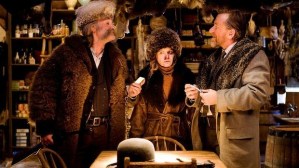 “You keep talkin’. You’re gonna talk yourself to death,” says one of those hateful numbers to another member. I’d pay to listen to Tarantino rewrite the phone book, that’s how excellent the man is with his dialogue. The man likes to hear his words and I like listening to them too. The problem is that The Hateful Eight has no reason for its gargantuan running time. As stated above, the characters we’re getting are nowhere near as complex or interesting as previous Tarantino escapades, so the talking can grow weary. Tarantino has patented a new formula from 2009’s Inglorious Basterds that involves characters playing a game of I-know-you-know-I-know while they suss out the truth, all the while the tension finely simmers until it blows. It’s a long fuse of suspense that can pay off rich rewards, like the near-perfect tavern scene in Basterds. The dinner table scene with Candie and the skull of his favorite house slave is another good example. Once our titular eight have gathered at Minnie’s, the entire movie is this sort of scene. It may be broken up into chapters and flashbacks but it feels like one long scene.
There’s also far less at stake than there was with Basterds or Django Unchained, even Reservoir Dogs, and that’s because the protagonists had goals and we had built up far more allegiance and time with them. When they were in danger, it mattered. The danger doesn’t feel as immediate because so little else is happening. There are plenty of comparisons to Dogs, which also utilized a hidden identity and a confined location. I think the difference was that, besides it being Tarantino’s first foray as a director, the tension was felt more because the danger was immediate from the start and we cared about character relationships. I cared about Mr. Orange and Mr. White and their bond. I can’t say I cared about any of the characters in Hateful Eight. I found them interesting at points, sure, but they were all a bunch of rotten bastards with little variation short of a burgeoning understanding between Mannix and Warren. The wait at Minnie’s feels like the Basterds tavern scene on steroids, pushed to the breaking point, and yet absent the urgency.
The acting is yet another tasty dish served up by Tarantino, and it feels like the actors are having the time of their lives playing their lively scoundrels. Jackson (Kingsmen: the Secret Service) settles in nicely and always seems to elevate his game when he’s reciting Tarantino’s words. He’s icy cool in scenes where the other characters are trying to do whatever they can to fire him up. He’s less bombastic than we’ve come to expect from Jackson. For bombast, there’s Russell (Furious 7) who cranks his performance to the broad heights of his bellicose lawman. Goggins gives a sly and extra caffeinated performance that answered the question of what it would sound like if you dropped his character from TV’s Justified into a Tarantino movie. Roth (Selma) feels like he’s doing his best manic Christoph Waltz impression. Dern (Nebraska) is a racist codger with a soft spot for his kin. Madsen (Kill Bill vol. 2) seems somewhat wasted as a taciturn “cow puncher.” Bichir (The Heat) gets some laughs as a seemingly aloof caretaker. It’s Leigh (Anomalisa) who steals the show, especially in the film’s second half. Daisy is a character that relishes being bad, and Leigh takes every opportunity to enjoy the fun. Her character plays a bit of possum during the first half but it’s the second half where she lets loose and becomes unhinged, and her exasperated and grotesque responses are often played for great sputtering comic effect. It’s a boys movie but it’s the lone woman who will prove most memorable. Tarantino’s last two movies have won acting awards and Leigh just might make it three-in-a-row.
 There are also some uncomfortable elements that can deter your viewing enjoyment, which isn’t exactly a foreign charge against Tarantino’s career. At this point you can probably repeat the oft-cited accusations: flagrant use of the N-word and exploitative violence. At least the historical background provides a context for the other characters unleashing the N-word, and I’d argue it tells us something about the characters as well. The characters that use the N-word when referring to Warren are the ones with allegiances to the Confederacy and those viewpoints don’t vanish even after you lost a war. They’re dismissive and intolerant and view Warren as sub-human. It also doesn’t approach Django Unchained-levels of excess, so I let it slide (I know my perspective as a white male makes my opinion on this effectively meaningless). It was the violence that got to me, specifically the violence directed at Daisy. Tarantino’s penchant for violence goes all the way back to his ear-slicing debut, so it’s nothing unexpected. He often tells stories about violent men and women fighting their way in a world governed by violence. I accept that these characters are bad to their core. That doesn’t excuse behavior. Violence on screen can be tempered with authorial commentary, but it’s the association that bothered me with Hateful Eight. For the entire movie, Daisy is put through the physical wringer. Our very first image of her is with a black eye. She’s a nasty woman and Ruth often expresses his distaste of her by punching her in the face, which is played as dark comedy. This happens repeatedly. We’re meant to recoil from much of the bloody violence on screen but repeatedly we’re meant to laugh at the violent suffering of Daisy. Tarantino has often used over-the-top violence as dark humor, and I’ve laughed along with it. This was one instance though where I stopped laughing and starting shifting uncomfortably in my seat.
Even lesser Tarantino can still be plenty entertaining and superior to most of what Hollywood usually cranks out as product. The Hateful Eight can be exciting, funny, surprising, and plenty of things, but what it can’t be is more than a lark. Tarantino has taken stories that would seem like larks, particularly the Kill Bill series, and infused them with pathos and meditation and soul to go along with all that snazzy genre stuff. It’s disappointing that Hateful Eight isn’t more than what’s on screen, but what’s on screen is still worth watching, though I don’t know whether it’s worth watching a second time.
Nate’s Grade: B
Share this:

Captain America: The Winter Soldier (2014)
 A welcome addition to the Marvel Cinematic Universe, the second Captain America film brings the square superhero to our modern-day and presents a complicated national setting where the enemy is the U.S government. The challenge with a Captain America (played by Chris Evans) movie is just how outdated his whole sensibility seems, an irony-free nationalistic hero. Smartly, the filmmakers have pushed his loyalties to the test, and the movie transforms into something along the lines of a Jason Bourne thriller, where the government is hunting down a rogue fugitive. It’s certainly the most timely superhero film since 2008’s The Dark Knight, and the political commentary on the NSA spying and drones is a welcome big screen subversion. But the action is still what people come for and in that the Winter Soldier is quite an entertaining movie. Directed by the Russo brothers, known mostly for their comedy work in TV like Community, the movie packs quite a punch with a variety of action/thriller sequences, each well staged and well developed. My favorite might be Nick Fury under assault and desperate to escape in his car from overwhelming enemy forces. An opening sequence rescuing hostages on a boat serves as a great reminder why Captain America is indeed so super. The movie does have some issues but nothing so large as to derail the enjoyment. First off the villain is way too obvious, but also the movie lets the U.S. government off the hook, falling back on a select evil group that has been undercover perverting the government. Secondly, the Winter Soldier of the title is one plotline that doesn’t feel needed or well integrated. It’s another super soldier for Cap to combat and this guy has a mysterious link to our hero. It feels like one plotline too many, a story that deserves better attention on its own. Still, Captain America: The Winter Soldier is an engaging, thrilling, intelligent, and altogether entertaining addition into Marvel’s sprawling cinematic canvas.
Nate’s Grade: B+
Share this:

The Avengers (2012)
 For the past four years, Marvel has been seeding its all-star super hero collective in the storylines of its summer blockbusters. And with six super heroes, The Avengers carries some super expectations. The creative mind behind the film is none other than Joss Whedon, best known for creating and shepherding cult TV shows like Buffy the Vampire Slayer, Angel, and Firefly. Not exactly the first name you’d think Marvel would assemble to front a $200 million movie. For geeks, Whedon has become a reliable standard of quality (the patchy TV show Dollhouse notwithstanding). Here is a man who can marry big ideas with sharp characterization and delightfully skewed dialogue. In Whedon, geek nation has a savior, and Marvel knew this. The Avengers is 142 minutes of geek arousal stretched to orgasmic heights.
Nick Fury (Samuel L. Jackson), head of the agency S.H.I.E.L.D., has a dire need for Earth’s mightiest heroes. Loki (Tom Hiddleston) has traveled through a portal and plans on conquering Earth thanks to an approaching alien army. Fury has tasked Tony Stark (Robert Downey Jr.) a.k.a. Iron Man, Steve Rogers (Chris Evans) a.k.a. Captain America, and special agent Natasha “Black Widow” Romanof (Scarlett Johansson) with stopping Loki and rescuing one of S.H.I.E.L.D.’s own agents, the skilled marksman Clint “Hawkeye” Barton (Jeremy Renner), who is under Loki’s devious mind control. Loki’s brother, Thor (Chris Hemsworth), would like to cite jurisdiction and bring his wicked brother back to his home world. The only person who may be able to locate Loki’s path is Dr. Bruce Banner (Mark Ruffalo), a guy with his own anger issues. With this many egos, it’s bound to get dicey. As Banner puts it, “We’re not a team. We’re a time bomb.” Can they put aside their differences to unite to save the Earth? Does a Hulk smash?
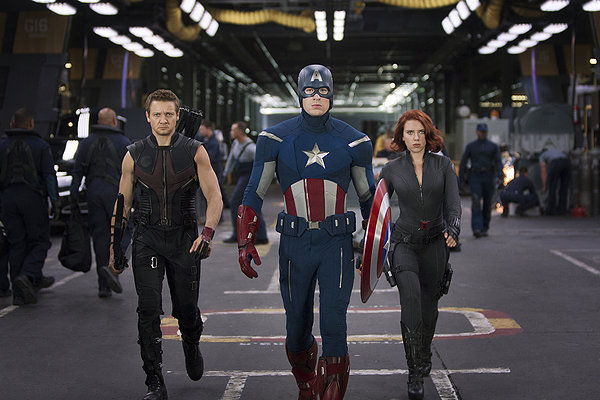 Whedon, the king of clever genre deconstruction last seen in the excellent meta-horror film Cabin in the Woods, plays it relatively straight, giving his big, effects-driven film a straight-laced sense of sincerity. It’s not making fun of these sort of big-budget, effects-driven smash-em-ups, it just wants to deliver the biggest smash-em-up yet. To that end, The Avengers achieves maximum smashitude (trademark pending). By its rousing finish, the movie has become so massively entertaining that you forget the draggy first half. The scope of this thing is just massive. The last thirty minutes is solid action across miles of crumbling, just-asking-to-be-exploded city landscape. But the trick that Whedon pulls off is how to orchestrate action on a monumental scale without losing sight of scale, pacing, and character. You’d think with a full deck of superheroes that somebody would be shortchanged when it came time for the rough and tumble stuff. Not so. Instead of fighting one another, the prospective Avengers work together in all sorts of combinations. The characters are well integrated into the fracas, making particular use of their abilities, and finding new locations of focus every few minutes. This expert hero shuffling keeps things feeling fresh amidst the constant din of chaos.
In fact, the movie finds time to give every hero his or her due, finding a small moment to reveal some characterization. I thought Whedon’s biggest challenge was going to be the juggling act of balancing so many heroes and so much screen time, but the man found a way, like he regularly does, to squeeze in character with ensemble action. The Hulk fares the best. After two movies, it feels like Whedon has finally nailed the character; granted, this success may be credited to the fact that Bruce Banner (all hail Ruffalo) is kept as a supporting character. The struggle of the character being likened to a recovering addict is a smart way to present the character without getting too morose (I enjoyed the revelation that the “Hulk” half prevented Banner from killing himself). When he’s told his mission is to smash, you can feel the exuberant joy of an unleashed Hulk id. The Hulk had two great audience-applause moments that made my theater go berserk. I also really liked the attention given to Black Widow and her lonely back-story. Hawkeye was a complete badass, though he only gets to do fun stuff in the madcap finale. The trouble with the hero team-up franchises is that not everyone’s on the same level of power. Thor is a god for crying out loud, Iron Man has super weapons, Hulk is Hulk, Captain America at least has superhuman strength but what do Hawkeye and Black Widow bring to the team? When you’re competing with all that power, being good with guns or a bow seems pretty puny. And with Hawkeye, there’s going to be a limit to his effectiveness unless he has a magic bag of replenishing arrows. Still, Whedon finds ways to make the heroes badass and humane in equal measure, and surprisingly funny, which is welcomed.
It’s hard to believe that Whedon had only directed one feature film before (2005’s Serenity, based upon Whedon’s canceled Firefly show) being given the keys to the Marvel universe. He’s directed several TV episodes of his signature shows but the man has never produced anything on this scale before. Given a gigantic canvas, Whedon delivers the goods. His action sequences are rollicking and fun and, best of all, shot and edited in a fashion where you can understand what is happening (take some notes, Hunger Games franchise). The action is well choreographed and elevated with organic complications and particular attention paid to location, like the Nicky Fury airship. Whedon is a master of the plot payoff, setting up his elements and then piloting the narrative to satisfying conclusions and integrations (Cabin in the Woods is also a pristine example of this gift). If you’re going to introduce an airship, you better believe that sucker is going to threaten to crash. I’m glad that Loki was brought back as he was the best Marvel big screen baddie yet, though I’m disappointed they essentially put him on ice for an hour.
 The technical elements are ably polished even for this kind of film. The cinematography by Seamus McGarvey (Atonement) is terrific, utilizing bright color in a way that the visuals pop. The special effects are top-notch and you just feel immersed into the action. The destruction is cataclysmic but rarely does the movie feel phony. I was impressed by the Hulk designs and the sequences in inky space with our alien adversaries. For that matter, are these aliens robots? It’s unclear whether the giant flying centipede-like ships are creatures. The 3D conversion is one of the better outings due to the fact that it doesn’t keep throwing stuff in your face. Plus, viewing Johansson’s leather-clad assets in 3D certainly has its own appeal, as does Gwyneth Paltrow in jean shorts. Hey How I Met Your Mother fans, Cobie Smulders looks practically smoldering in her S.H.I.E.L.D. agent outfit too. Okay, I swear I’m done with the female objectification.
I hesitate calling The Avengers the greatest super hero/comic book movie of all time, as the teaming hordes of Internet fanboys foaming at the mouth are wont to do. If your definition of a comic book movie is a giant sandbox with all the coolest toys, then this is your film. This is a comic book turned flesh. The Hulk and Thor fight and prove who is the strongest Marvel man, that’s got to be a geek’s wish come true. Many of the infighting sequences felt like, servicing the tastes of the fanboys, and after a while the constant hero on hero action felt tiresome. I get that we have a clash of egos going on here, but the movie suffers from a lack of narrative cohesion, by which I mean that the first hour of the movie feels like a series of guest appearances by heroes on loan. The movie doesn’t fully come together until the point where the team comes together; I doubt Whedon intended that symbiotic relationship. The movie feels more like a patchwork of standout scenes and memorable moments that a fully formed and cohesive story. If you haven’t seen the previous four Marvel movies (Iron Man, Iron Man 2, Thor, Captain America), you’ll be pretty hard-pressed to follow the story. Loki’s motivation and plan seems rather sketchy other than causing discord amongst the heroic ranks. His powers seem inconsistent and vague. Also I found the musical score by Alan Silvestri to be bland and unworthy.
The Avengers is sure to be geek nirvana for many of the comic book faithful. It’s an audience pleaser of mass scale, and I’m sure that your theater will be cheering in abundance. Whedon has pulled off the near impossible. The movie is a thoroughly entertaining, exciting, and witty popcorn spectacle of the first order. But where the movie hits the ceiling, at least for me, is that it ONLY wants to be the best super hero movie and this seems like limited ambitions. It’s like making the very best possible women in prison movie (great, but is this really all you set your sights on?). I had a great time watching Whedon’s handiwork but I wish it mined the outsized territory for bigger themes, a little more than audience-satisfying pyrotechnics, something I feel that X-Men: First Class did a better job of handling. Don’t get me wrong, I greatly enjoyed The Avengers and it’s a fantastic start to the summer movie season, but by no means is it The Dark Knight or even aspiring to be, and that’s okay. Enjoy the busy escapades of Marvel’s next smash franchise. Who knows when they’ll be able to wrangle everyone together for another adventure, but judging by the sounds of ringing cash registers, the answer is sooner than we think.
Nate’s Grade: B+
Share this:

The Other Guys (2010)
 Surprisingly consistent in its belly laughs, The Other Guys proves that Will Ferrell is at his best when he re-teams with his greatest collaborator, co-writer and director Adam McKay (Anchorman, Step Brothers). The duo takes on the cop genre with a loving parody that manages to send up the genre while celebrating its excesses. Ferrell and his partner (Mark Wahlberg) stumble onto a mostly convoluted financial scam with banks, traders, and the police. The movie takes scene after scene and gives it a little twist for the self-aware characters to comment, usually to great comedic effect. There were some stretches that I was near tears from laughing so hard (the tuna vs. lion argument is an instant classic). I expected to be amused by the movie since nobody does silly smarter than Ferrell with McKay, but I was not prepared for how much I genuinely liked this movie. From scene to scene, I found something different to laugh at. There’s an undercurrent of rage from McKay concerning the economic stickup Wall Street got away with in 2008. The end credits are an animated statistics presentation on how large Wall Street firms screwed over the American public and are still profiting off of pubic misery. It’s a bit odd tonally to cover at the end of the film, like McKay wanted his legions of fans to get some morsel of education by the end of a film with goofy action and juvenile sex gags. The joke is on us all.
Nate’s Grade: B+
Share this:

Iron Man 2 (2010)
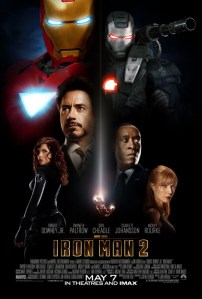 Iron Man was a fresh surprise in the summer of 2008, offering a superhero movie dominated by a middle-aged man’s personality and not the special effects. The story was not overwhelmed by all the demands of what we expect in a glorious summer popcorn experience. Marvel was smart to sign on the same team behind the first film, including director Jon Favreau, but setting a deadline exactly two years after the first film made me worry. There wasn’t much time to get everything together, and it should be no shock that Iron Man 2 feels rushes and absent the finesse of the first film. As much as it pains me to say it, Iron Man 2, while fun in spots, doesn’t come close to the original. You can trace much of it back to the sequel ethos that you take what worked in Part 1, make it much, much bigger and louder, and now you have Part Two. But what worked so exceptionally well in the first Iron Man movie was not the action sequences but the characters, so guess what happens when you pollute the narrative with more characters and disposable action sequences?
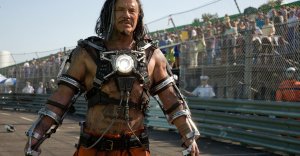
Tony Stark (Robert Downey Jr.) is a self-made superhero and now the world knows that he is indeed the metallic warrior, Iron Man. Stark refuses to hand over his technology to the government, saying he has “successfully privatized world peace.” He appoints his girlfriend/loyal assistant Pepper Potts (Gwyneth Paltrow) to CEO so he can devote his time to ridding the world of evil and lapping up the fame that goes with being Iron Man. Lt. Col. James Rhodes (Don Cheadle replacing Terrence Howard) is concerned for his buddy but also eager to help play around with that super suit. But not everybody loves Tony Stark, notably Justin Hammer (Sam Rockwell), a rival weapons dealer aiming for a Pentagon contract, and Ivan Vanko (Mickey Rourke), a Russian scientist who blames his father’s exile from America and Siberian internment on the Stark family. When Hammer sees Vanko’s attack at a Monaco speedway, he knows he has found an ally against Stark. Hammer whisks his newest Russian friend to New York and enlists his expertise in creating an army of super mechanical fighting suits.
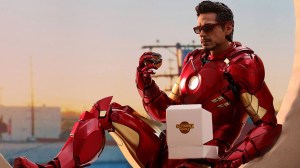 The screenplay by actor-turned-writer Justin Theroux (Tropic Thunder) is overstuffed with people and events all fighting for screen time and narrative dominance that it starts to become unintentionally comical after a while. There are too many storylines jostling for control when any one of them could have comprised a whole movie: military demands to have the suit, Tony deals with blowback from being the most famous man in the universe, and escalation (others trying to top Stark). Don’t even get me started on how Iron Man 2 bends over backwards to advertise that future Marvel Avengers movie lead by Nick Fury (Samuel L. Jackson). I mistakenly believed that the trailers ended before my movie started. There’s a storyline where Tony’s blood is becoming infected with a dangerous chemical every time he uses the Iron Man suit, so being a superhero is literally killing him. You can work with that for some pathos, debating the needs of one man vs. the needs of society and the greater good, personal sacrifice, mortality, legacy, but it all gets way too easily resolved in an absurd way (all I’ll say is, thanks Mad Men‘s Roger Sterling!). It tries to up the ante when less would have been considerably more.
Most of the new characters feel poorly integrated, further causing distraction to any attempts at narrative cohesion. Iron Man 2 also pushes Johansson into the mix so that she can shake up the Tony/Pepper relationship and, plus, she looks good in a skintight cat suit. But her third wheel/love triangle status is barely touched upon and Johansson gets one solid action sequence where she takes out a litany of goons in a hallway with the amazing power of her spinning thighs. Johansson is mostly just another assistant to take notes in the background, although she does it beautifully. The Rourke scenes are few and far between. They establish him as an intimidating force and then he pretty much sits in a room tinkering with stuff, garbling Russian, and feeding his cockatiel for the rest of the movie. He never feels like a real threat or a true match for Tony. Rockwell is the more appealing, slimy villain of the duo, aided by Rockwell’s exasperated bellowing and desperation for the spotlight. Hammer is more interesting to me than a Russian ex-con that rarely speaks, let alone speaks in English. He’s given so little opportunity to develop Vanko as a character. And yet Gary Shandling, as a smug senator trying to make Stark accountable to the U.S. military, might be the film’s best villain of the bunch (curious side note: Shandling and Rourke look oddly similar).
 The personal relationship between Tony Stark and Pepper Potts was the heart of Iron Man. They had that snappy, droll, screwball comedy-esque give-and-take, with hints of something more underneath. This time, the movie doesn’t even speak about their relationship at all, like it never happened in the first film. That scene where she kisses his Iron Man helmet, tosses it out the belly of a plane, and he dives off uttering, “You complete me”? Not in the film. You start to wonder why the movie is being purposely vague and it gets maddening. Their relationship lacks the frustration tinged with flirtation and replaces it with agitation. Both Tony and Pepper are harried and on each other’s last nerve, which doesn’t make for much romantic traction. Their chemistry seems to have dampened. I’m kind of with Pepper on this one because Tony Stark might be even too obnoxious in this movie. Following the sequel-it is code, Tony’s egotistical behavior is expanded and he becomes prone to self-destructive behavior, getting riskier and riskier, pushing others away including, perhaps, decent portions of the audience. He’s stopped being the cocky, likeable arrogant playboy and transformed into a bit of a rich douchebag. Part of this is related to the storyline about the suit literally killing Tony, and his character’s alcoholism featured heavily in the comic books, but it’s just another plot element that feels like it was put in for momentary conflict and then easily resolved or dropped. I understand Tony will be his biggest antagonist but that didn’t stop the first Iron Man film from flying high in entertainment.
The first Iron Man had an unexpected low level of action for a summer movie, but because of the characters you didn’t care. It was that rare comic book movie where you wanted more dialogue and fewer sound effects. To be fair, Favreau and crew saved a pretty nice Iron Mano y Iron Mano fight sequence at the end. Following that narrative lead, Iron Man 2 is structured pretty much like the first when it comes to action. There’s the attack at the Monaco raceway, which features an unrealistic, cartoonish tone that conflicts with the rest of the flick. But the film’s biggest moment of sustained action is the climax involves Tony Stark versus a bunch of silly killer robots. Soulless robot drones don’t get very compelling, plus haven’t we seen a thousand movies where people combat killer robots? What’s more disappointing is that Favreau incoherently stages the action. It’s not due to any sort of hyperactive editing, no, the culprit is that the onscreen action is just moving way too quickly. As a result, much of the action feels like whooshes of color. It’s hard to adjust your eyes to the rapid movement and process what exactly is going on. Because we can’t follow the action the whole thing lacks tension, danger, and drama. I wanted to be blown away by the action, which has several trailer-ready moments of awesome, but mostly I just wanted to be able to understand what I was watching.
 Despite all my complaints, Iron Man 2 still manages to be a fun time out at the movies. Downey is always immensely talented and brings great amounts of energy to the role, centering the movie on his witty charms. While his character is less engaging this go-round, Downey is still on top of his game. Rourke, Rockwell, Paltrow, and Johansson all contribute fine performances when they’re on screen. The low output of Iron Man in suit is compensated by having TWO Iron Men, thanks to Rhodes donning the metal gear and fighting alongside his pal. The opening of this movie captures your interest fairly well, though it loses it again thanks to slack pacing and an influx of new faces. The tone of the movie takes a cue from Downey and the movie as an agreeable, comedic feel without seeming overly glib. And hey, the special effects are pretty nice, too. Iron Man 2 is an adequate popcorn movie but the tragedy of the movie is that the first film was much more than adequate. I think the Iron Man film franchise is in need of a slight upgrade.
Nate’s Grade: C+
Share this:

The Spirit (2008)
 This is the last time someone will let Frank Miller direct. Astoundingly bad, The Spirit is borderline camp for every absurd and bizarre second. It careens all over the place, never settling on a tone. So one minute it will be hard-boiled noir and the next it will break down the fourth wall and amp up the goofy slapstick to Looney Tunes levels. The story is threadbare, the characters are half-developed ideas, and each scene almost exists in its own five-minute world before Miller barrels forward. Sure the flick has some appealing visuals, but even those are derivative of the superior Sin City. As a director, Miller doesn’t cut it. He will shoot scenes with nothing but close-ups, giving no point of establishment for the audience, and he’s too prone to random diversions. Miller displays zero ability, or a complete disregard, for directing actors; they are terrible in different ways. Gabriel Macht, as the back-from-the-dead crime fighter The Spirit, sounds like Paul Rudd doing a Harrison Ford impression. Samuel L. Jackson, as the nefarious criminal/mad scientist/also semi-immortal The Octopus, overacts to a degree not even seen by Samuel L. Jackson. Scarlett Johansson, as an evil assistant, can’t even hide her disdain and boredom. This stuff just becomes unchecked lunacy, but it still manages to be boring through and through. The hero is a stiff, all the women are sex objects, and the conflicts are pointless when the combatants can’t be killed. The only thing worth mentioning is that Eva Mendes is still a gorgeous looking woman. Even Miller couldn’t fumble that one.
Nate?s Grade: D


 nathanzoebl
You must be logged in to post a comment.