Blog Archives
Argylle (2024)
 Knocked around by critics and tagged as the latest excuse for the Death of Filmmaking thanks to its overwhelming budget and general ironic indifference, Argylle is a goofy spy comedy that, while lesser, is an easy watch and would earn regular rotation as a TNT afternoon giant. It’s not trying to be more than a good time, and while its quippy attitude can feel forced and approaching irony overload, it’s also the kind of movie that entertains as breezy escapism. It’s fun. Enough.
Elly Conway (Bryce Dallas Howard) is a best-selling spy novelist with a dashing super spy Lothario lead character by the name of Argylle (Henry Cavill in the worst haircut of his career). She’s journeying with her pet cat, her closest relationship, when she’s stopped on a train by Aidan Wilde (Sam Rockwell). He tells her that he’s a real spy and that everything she’s written in her five novels has come true, and different covert agencies are taking notice. She’s got teams of assassins and spies coming for her, while Aidan tries his best to protect her and get her to remember key details that could save the world from nefarious forces.
 Argylle is too breezy and too predictable by half. It’s a spy thriller that I’m positive many will be able to predict the big twists miles before they occur. Why do all these spies want Elly Conway, and how could she know about the intricate world of international spy craft? The answer is exactly what you’d expect, if you’ve watched more than your share of twist-laden thrillers. Thankfully, director Matthew Vaughn (Kingsman, X-Men: First Class) and company dispatch with this central twist after an hour, providing more time to deal with the aftermath and build off of its story impact. Ah, dear reader, but there’s going to be another twist once you know the first, and again, if you can predict the first, you’re likely to predict the second, because stories about universally good people are often dull, and movies have provided a new medical maxim that characters use maladies to re-evaluate their prior life and choose to be better (oh how nimbly I’m dancing around these spoilers). What makes these predictions forgivable is that the movie seems to know you will anticipate them and has more to offer.
That’s because in this silly universe, very little seems to matter besides getting to the next scene. It’s not a satirical send-up of the genre like Vaughn’s Kingsman movies. Instead, it’s more of a generic distillation of spy thrillers, complete with bad guys walking through mission control banks of computers and barking impotent orders. The only added cleverness that sets the Argylle world apart is Elly’s writing, the fictional version of this far more bland spy universe. In the book parts, Vaughn takes note to raise the style as well as the tongue-in-cheek comedy. It’s supposed to be tone-deaf and dumb and ridiculous, because it’s the big screen version of bad genre writing. You can have fun with that, with characters so serious to the point of parody, with nonsensical technology and near escapes. But when you try to do the same thing in the so-called real world, then the movie starts to eradicate any sense of a baseline for credulity. I did like the practical advice of Aidan on how to crush the skulls of your downed enemy (“Just imagine you’re dancing The Twist.. twist and smash”). By the end of Argylle, Elly and Aidan can do just about anything because they’re practically superheroes. The entertainment of the fish-out-of-water aspect of Elly’s story is short-lived and unfulfilled because the movie becomes more of a tale of automatic self-actualization rather than growth.
 The direction feels rather drab at points, and many locations and scenes have a general sense of missing… something. Just watch any set and it appears so drastically empty that I questioned whether they cut back on the set dressers and props. Empty dance clubs. Empty streets. Empty hallways. Everything is too pristine, too sleek, and too empty and green screened (might be a result of COVID filmmaking). This carries over into the disappointing visual aesthetic, as Vaughn’s signature style feels dampened by the pesky CGI additions of many sequences, adding to the unreality rather than building out this minimalist world. If there had been an extra EXTRA twist that everything was also a story-within-a-spy-story, I would not have been that shocked, and it honestly would have explained the underwritten and underwhelming world of clandestine spy-making.
Vaughn errs in the core creative decision of having his main character mix reality and fantasy, not through the idea itself, which could be ripe, but through its confusing execution and editing. Having Elly hallucinate Agent Argylle in place of a real secret agent is fine, as we can contrast from her idealized version of a super spy, her James Bond, versus the actual grunts struggling to win the day. There are a couple problems with this execution though and firstly that the “reality” isn’t that far removed from the fantasy. This is still a world where Rockwell’s spy is able to commit amazing acts of dexterity and martial arts and balletic violence flying around rooms, but I guess he falls down more. The difference isn’t that fantastic when it’s already a hyper-stylized action world. The bigger issue is just how confusing it all plays out visually because we’re seeing Elly’s perspective and in rapid blinks Cavill will turn into Rockwell and vice versa. It makes for a jarring sequence that doesn’t fully capitalize on the comic potential while keeping the audience distant from fully engaging with the sheer simple pleasures of watching a fun fight. This happens throughout the first half of the movie and severely hampers the action scenes from being accessible. I think we needed a longer duration for this to work. We see Elly’s version for a period of time, and then we cut to the real world where Aidan is bouncing into walls, falling down, and flailing. By continuously jumping back and forth, not just in the scenes but in the same shots, Vaughn has made his movie harder to watch and harder to comprehend, and with a loud soundtrack blaring.
 There is one sequence of great filmmaking for Vaughn, but to explain such will require some spoilers, so beware, dear reader. There are three instances of the whirly-bird dance where a woman is lifted spread-eagle atop a man’s shoulders who then spins her around. The first time, it’s Agent Argylle and Legrange, played by Dua Lipa (Barbie) dripping with sexual energy. The second time is when Elly and Aidan are on a mission and he lifts her up, to her amusement and flirtation. She’s living out her fantasy version, with Rockwell standing in for Cavill and Howard standing in for Dua Lipa. We’ve gone from these stunningly attractive human specimens to people who look more ordinary, including a fuller figured woman engaging in the same sexy shenanigans as the conventional blonde bombshell. She can be her dream version of herself. Finally, the third occurrence happens during a climactic showdown where Elly and Aidan team up against an onslaught of faceless armed henchmen. With the aid of colorful smoke canisters, their offensive surge plays out like a couples’ dance routine, including holding one another for high kicks to incendiary devices. It’s all set to Leona Lewis’ cover of Snow Patrol’s “Run,” and as the music swells, it’s easy to get swept up too. Even the gunshots are set to the beats of the song, culminating in the final whirly-bird dance, except it’s not Elly being lifted, this time it’s Aidan. See, she’s not the Bond girl bombshell, she’s James Bond. It’s a silly moment but with the added setup, thematic underpinnings, and Vaughn’s virtuoso stylistic seizing of the moment, it plays out as empowerment and an expression of love. For real.
I can understand being generally disappointed with Argylle. It looks and feels like it’s been built on the parts of other better spy franchises and desperately lacks the charisma and personality of Vaughn’s Kingsman movies, themselves giddy and perverse satires. I wasn’t the biggest fan of 2017’s The Golden Circle sequel, but it’s got oodles of style to spare compared with Argylle. I wish Vaughn would push himself beyond the orbit of making cheeky, winky spy action comedies, the same genre he’s been playing in since 2015 and now for four movies. While the original Kingsman was a breath of fresh air with fun characters, a snarky attitude, and slick style, Argylle is all snark and minimal style. There’s so much comedy that feels like it should be funnier, from the travails of Elly’s CGI-enchanced cat to the floundering hand-to-hand combat. When recognizable names start showing up playing forgettable genre stock types, and then they start dabbling in accents as other genre stock types, it feels like the whole exercise is a miss. However, the central buddy relationship between Rockwell and Howard is where the movie works, and fortunately that’s the element that has the most foundational effort. This is a movie that, in the future, if it was on TV during a lazy day, you’d sit down and watch the rest and mostly be happy about it. Argylle isn’t anything new or fresh but it’s buoyed by its stars, and not the magazine cover models but its real stars, Rockwell and Howard. In their hands, even lesser spy comedies can still be fairly worthwhile escapist entertainment. Still, I must deduct some points for the movie missing a perfectly setup opportunity to have Henry Cavill and John Cena kiss onscreen at the end. It was right there, folks, and we all deserved it.
Nate’s Grade: C+
Share this:

The Bad Guys (2022)
 Even though it’s based on a popular series of children’s books, if you’ve seen Zootopia, you’ve seen the better version of The Bad Guys. As far as entertainment aimed at the wee ones, you can certainly do worse. It’s brisk, silly, and the animation is quite enjoyable, adding hand-drawn overlays and accents that really make the images pop and provide additional, gratifying textures. The story, on the other hand, is the same old-same old. We have a group of “scary animals” in a world where anthropomorphized creatures walk side-by-side with humans. These spooky creatures get a bad rap because people fear them, so they lean into social prejudices and become a notorious criminal gang. Except now they might want to go good because being good feels better than being bad. Thematically, it’s the same territory that Zootopia trod and with better world-building. We have “bad animals” that are tired of being looked as bad because people wrongly interpret them as scary threats. It’s the predator/prey dynamic but without the depth. Having an all-animal heist crew provides some creative entertainment and Ocean’s 11-style moments of frothy fun; I especially enjoyed that the giant shark is the team’s master of disguise and always very obvious. The character arcs, supposed betrayals, redemption, and plot should be familiar and predictable, which means much of the movie must coast on the appeal of the animation, vocal actors, and general sense of humor. The comedy can be amusing but too often falls upon cheap gags, like the piranha’s defining trait of being a nervous farter. The Bad Guys is suitable for animation aficionados, fans of the book series, and people who have never seen Zootopia, and if that’s you, then just watch Zootopia.
Nate’s Grade: C+
Share this:

Charlie’s Angels (2000) [Review Re-View]
 Originally released November 3, 2000:
These angels aren’t exactly what your father was enjoying when your mother was away fulfilling errands. These angels aren’t delegated as mere sex objects running around providing the jiggle entertainment that is (or was) supplied by today’s Baywatch. The 90s is a different decade after our minority movements and today’s woman is just as apt to do a flying kung-fu face plant into a baddie as any man. The angels of the film are action heroes for an armada of small girls needing some female empowerment when their only other choices consist of a barely clothed Britney or a barely covered Christina. These angels aren’t just the sex objects that the classic assortment of angelic 70s stars were; these angels are also tough-as-nails, resourceful, and not afraid to tussle or tango. Now that this exposition is out I can concentrate on the scattershot film Charlie’s Angels.
The film has been rumored to have at a minimum of 17 writers who tried shaping a story for Cameron Diaz, Drew Barrymore, and Lucy Lui. The story is pretty much shelved toward the back so the forefront is our trio of ladies kicking ass then shaking it with zig-zaggy and wild camera movements from debut filmmaker and video director McG.
Charlie’s Angels is whiz-bang dumb fun. The overall feel of the film is something more difficult to get a grasp on. At times it shows itself as tongue-in-cheek and satirical but then at other times it seems overly serious or overly dumb. The characters are non-existent and basically only discernible by hair color. The characters are very wooden and I actually found more enjoyment watching the villains and seeing more of them; call it the Austin Powers dilemma. Diaz makes the only notable attempt as her goofy and light-hearted angel connects with the audience best. Lui plays a techno-babe dominatrix but is easy to see that she was the last angel chosen and doesn’t exactly gel with the others as much as she could have.
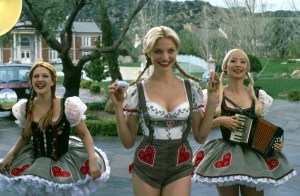 Charlie’s Angels is best when the action is pumping. The scenes are cut together in a jam-packing sequential way adding distinct flavor and style. McG is a true surprise in the effectiveness he can orchestrate his action motifs even if the Matrix effects and moves make absolutely no sense in the real world.
Crispin Glover shows himself as a silent assassin nicknamed “the thin creepy man.” Glover is so suave and slick in his role of the non-verbal Oddjob henchman role that he exhilarated me with every presence he made on screen. Goodness, he was too cool in this film and everyone gets brownie points for allowing him. He has such energy and charisma that I wanted the film to veer off into him and desert our angels. Seeing our ageless McFly perform action scenes and choreographed fights is something I will be pleased with until my grave. seeing Crispin in the excellent Nurse Betty and now huge exposure in this is a true joy. And man… he smokes a cigarette way too cool every time he’s in this film. Some people can smoke cool some of the time but Crispin does it all of the time. His mere presence almost cancels out the annoyance of Barrymore.
The line is drawn with Charlie’s Angels in that it’s sex-kitten jiggle and an acrobatic arrangement of (light) feminism and humor. These gals know they’re sex objects and they’ll use it to their advantage delighting in every second of it. Therefore, you could argue successfully that Angels is exploitation hiding as meaningful but hell… why think about this stuff? The movie rolls along at a fast pace where you don’t keep track of these issues. It’s just an easy sit down.
The gigantic success of Charlie’s Angels makes sequels and a possible franchise all but certain. I’d be happy for McG to hop back in his directorial chair but have a unique idea for Angels 2: Bigger, Longer, and Uncut… it involves Glover kicking a lot of ass really cool like.
Nate’s Grade: B-
——————————————————
WRITER REFLECTIONS 20 YEARS LATER

The 2000 Charlie’s Angels seems to understand that nobody should take this seriously. It even opens with an in-joke of T.J. Hooker: The Movie being inflight entertainment and an undercover character lamenting how bankrupt Hollywood is when it comes to recycling old TV shows. From there, our undercover angel literally exits with her target in the middle of the air and plummets to the water below, safely landing via parachute with a team meeting via helicopter aerial hook-up and a speedboat below. Why any of this? What sense does any of it make? It doesn’t matter in the slightest, and from the opening scene onward the movie lives by this credo, doing its best to be silly and have fun and just not care about the rest, and it shows. Twenty years ago, I think Charlie’s Angels benefited from low expectations as I recall mostly enjoying it. Now, having re-watched the movie for the first time in ages, I will say the fizzy appeal seems to be diluted. It’s still got energy to spare, though it feels a little too antic, a little too episodic and slipshod, and a little too proudly shallow, and that’s before you re-examine its depiction of the angels.
It took 17 writers and considering every under-30 actress in Hollywood to put together Charlie’s Angels. Drew Barrymore had bought the remake rights and wanted to make a big screen splash with a trio of kick-ass heroines that could better relate to the culture of the new century. I understand that Barrymore and her team wanted the angels to be sexy, yes, but also smart and funny and goofy and fearsome and all the things that little girls should believe possible. That’s commendable from a positive representation, but then so much emphasis is placed on their bodies and their off-the-charts sex appeal to bamboozle men that the goal becomes eclipsed. One could argue that Barrymore, Cameron Diaz, and Lucy Lui are embracing their sexuality, and that taking control of this is empowering, and if you feel empowered by Charlie’s Angels, by all right enjoy that and bless you. However, twenty years later, this feels less like the girls are in charge are more like they’re just being exploited in a manner we’re being sold as new feminism.
 There are so many examples where the angels are in skimpy clothing or objectified. There was an entire clip of Diaz dancing in her underwear that I remember Harry Knowles of the early 2000s mainstay Ain’t It Cool News devoted a gross drooling essay to his obsession (“But to sum up, Cameron Diaz’s Swirling Ass is one of the greatest images and objects in the whole of human existence.”). Barrymore’s character is constantly getting undressed and using her body to disarm men. Again, duping men through their hormones can be a key asset as a spy, but it’s happening in every scene and at her disservice as well. She tumbles down a ravine naked in a last-second escape, and the movie treats it as cheeky comedy (no pun intended). Lui adopts a series of disguises that routinely sexualize her, from a masseuse to the most overt, a domineering corporate boss that resembles a dominatrix. They’re straight fetish roles. I’m surprised a Catholic schoolgirl outfit wasn’t adopted as a disguise. The movie’s depiction of its female stars and the emphasis on their bodies feels retrograde for its ideals. I know they wanted to improve upon the portrayals from the 1970s but we still got problems. McG’s stylish direction prioritizes the angels’ sexuality. They can be smart and kick ass but also in a sexy way, the movie is telling you. Thandie Newton was supposed to be an angel but schedule overruns from Mission: Impossible II got in the way, and later she admitted she had strong misgivings because her character was going to be introduced with a closeup of her denim-clad butt. No one is arguing that women should be barred from taking ownership of their sensuality, but the lens Charlie’s Angels utilizes is strictly a male gaze, and these women are repeatedly objectified.
As a result, the movie has a new sheen of discomfort during all the silly, sudsy spy missions and wardrobe changes. Before you might think, “Oh look, they’re dressing up as Japanese geisha girls, what fun,” and now you’re like, “Oh, somebody at the studio was getting off on this.” Before you might think, “Oh look, they’re dressing up as Middle Eastern belly dancers, what fun,” and now you’re like, “Oh, somebody at the studio was getting off on this.” There are a lot of ethnic disguises that would likely get axed today as cultural appropriation. The carefree, frivolous attitude of the movie is meant to be charming and low stakes, but when it’s applied to the exploitative nature of how the women are depicted, it all becomes a bit dodgier to accept.
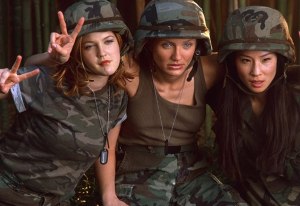 This was the first real blockbuster after The Matrix reshaped action cinema and the stylish choices can run the gamut between exciting and cool to dated and shallow. Twenty years later, it’s just not as impressive that they used wires to swing their actors around for stunt choreography, or that they replicated key Matrix touches like bullet time. The fighting sequences are often choppy in editing and some of the moves meant to demonstrate the power of the angels just feel silly, like a moment where Diaz went full Lui Kang with her flying kicking feet. It’s moments like that where the style gets away from McG. The tonal trick is finding a balance between goofy and cool, exciting and cheesy, and I don’t think the movie achieves this with its action. The set pieces feel built around “cool moments” rather than using geography, organic complications, and escalation. It means that Charlie’s Angels has its share of cool moments but then they are fleeting and ultimately meaningless because they don’t better connect to character, story, or even simply their own satisfying action compositions. It’s like immediately disintegrating cotton candy. The dozens and dozens and dozens of needle-drop music cues feel like another potent example of this charge as well as some anticipated attempt to distract from its shallow and diverting design.
I was dreading revisiting my original review as an 18-year-old because I was convinced my younger self was going to conflate the portrayal of the women as taking ownership. I just knew this would be something I had bought into in 2000, and yet it wasn’t quite so: “The line is drawn with Charlie’s Angels in that it’s sex-kitten jiggle and an acrobatic arrangement of (light) feminism and humor. These gals know they’re sex objects and they’ll use it to their advantage delighting in every second of it. Therefore, you could argue successfully that Angels is exploitation hiding as meaningful but hell… why think about this stuff? The movie rolls along at a fast pace where you don’t keep track of these issues. It’s just an easy sit down.” Hooray for my younger self seeing through this movie’s sheen of empowerment. At the time, it bothered me less because the movie was dumb fun, and now it just seems less fun and also dumber. I was so taken with Crispin Glover (Back to the Future) and his creepy cool style, much of which was Glover’s doing. His character was supposed to have dialogue except he hated the lines and asked to be silent. That’s one way out of memorizing, and it worked because he was a breakout and appeared in the 2003 sequel. Sam Rockwell (Three Billboards) was also a fun discovery though he only gets good once he’s revealed as a baddie. He would reuse those dancing moves for Iron Man 2.
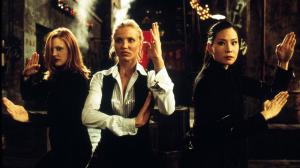 By the time 2003’s sequel Full Throttle rolled out, the appeal was gone. In my own brief review, I summarized, “It all seems so ho-hum and excessive at the same time. Quite an accomplishment. No more please.” I feel like the 2000 film also falls into this summary. It’s clearly not intending to be anything more than a goofy action movie, and I suppose the right person could still likely turn off the necessary parts of their brain to enjoy the rush of sights, sounds, and cleavage. There shouldn’t be a “wrong kind of feminism” so if this works for you, great. Many years later I felt that the male gaze was more ogling the women in the name of celebrating them. And yet Sony still felt there was material to be mined when they tried again with a failed 2019 reboot. The original Charlie’s Angels film is a cocktail of style with a creeping hangover right behind.
Re-Veiw Grade: C
Share this:

The One and Only Ivan (2020)
 Disney’s latest talking animal movie is based on a real story. Not the talking animals part, more a gorilla (voiced by Sam Rockwell) who lived in a strip mall as a circus performer and then became a painter and the notoriety of his art built a movement to free him. The One and Only Ivan is a good-natured family film with affirming lessons and a conservationist advocacy. Kids may laugh at some of the silly animals, or they might cry as the maternal elephant (Angelina Jolie) entrusts onto Ivan the promise to break the newest baby elephant free of bondage. Ivan was raised by Mack (Bryan Cranston) who runs the strip mall circus, though times are tough and he may have lost sight of his priorities with his animals. Enter cute kid, cute baby elephant, cute and scrappy dog, and Ivan’s passion for the arts. The one element that makes this movie different, Ivan’s ability to paint his emotions and reflections, is barely included and that’s a real shame. Ivan becomes like the spider from Charlotte’s Web and uses his position to advocate for another animal, using the subsequent attention to spare this small creature. He paints once and the movie zips to its resolution. The thrust of the story is Ivan addressing his own personal tragedy and letting others in, risking his own safety and ego to protect those vulnerable. The CGI special effects are suitable if unremarkable, landing in that middle zone of meeting expectations of semi-reality but not exceeding them. I would have preferred a documentary going into the actual events of the real Ivan, getting interviews from the people who were there and mattered, their own insights and experiences, and really dwelling more on what the idea of artistic expression means for an ape and what it might mean concerning our connections to these creatures. I think there’s a compelling, enlightening, and heartfelt documentary to be had with the subject matter. The live-action talking-animal movie, however, is just more of the same inoffensive family film treacle and clearly not the one and only.
Nate’s Grade: C+
Share this:

Richard Jewell (2019)
 As I was watching Richard Jewell, a shocking realization began to form in my mind, something I had not anticipated from an awards-friendly venture from the likes of director Clint Eastwood – I was watching a strange secular version of a Kirk Cameron movie. Suddenly it all made sense where I had experienced this exact feeling before while watching a movie I knew wasn’t working. For those who have never watched the low-budget Christian indie dramas starring Cameron, such as Fireproof or the hilariously titled Kirk Cameron Saves Christmas (spoiler: he encourages materialism), they aren’t so much movies as they are filmed sermons, morals that have been given lackluster attention to turn into actual stories with actual characters. They don’t quite exist in a recognizably human reality, so they are often heavy-handed, tone deaf, and very very clunky, and sadly I can ascribe those very same qualities to the movie Richard Jewell.
Jewell (Paul Walter Hauser) is an eager, kind, awkward man who desperately wants to become a police officer and serve the public. His experience with law enforcement hasn’t quite worked out, so he’s currently serving as a security guard during the time of the 1996 Atlanta summer Olympics. He spots a suspicious bag during a concert in Centennial Park, follows protocol alerting others, and in doing so saves lives as it turns out to be a homemade bomb. At first Jewell is a national hero, and the everyman is on talk shows, thanked by strangers, and has a potential book deal in the works. Then the FBI, led by Agent Tom Shaw (Jon Hamm), and the media, represented by Atlanta journalist Kathy Scruggs (Olivia Wilde), turn the scrutiny onto Jewell himself. Suddenly the narrative twists and Jewell is believed to have planted the bomb to become the hero. Jewell is harassed by law enforcement, media speculation, and the pressure of trying to clear his name. He reaches out to an old colleague, rascally lawyer Watson Bryant (Sam Rockwell), to launch a defense and fight back against the Powers That Be.
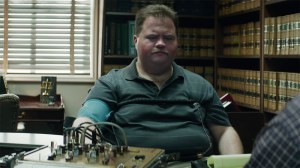 This is the passion play of Richard Jewell but nobody actually feels like a human being, let alone the person at the center of attention. There isn’t a single person onscreen that feels like a person, though the closest is the lawyer, Bryant. Jewell’s mother, Bobi (Kathy Bates), serves no other purpose but to act as her son’s cheerleader through good times and bad. When she has her teary media speech late in the film, I was relatively unmoved, because she was a figurehead. Everyone in the movie represents an idea or an organization, thus serving them up for double duty. Much like a passion play, we’re just here to watch the suffering and scold the abusers. It’s a movie meant to get our blood boiling, but other movies have been made to provoke outrage, especially highlighting past injustices under-reported through history. There’s nothing wrong with a movie that is made with the direct purpose of provoking anger at the mistreatment of others. The key is to make that central story relatable, otherwise the main figure is simply a one-dimensional martyr who only has the emotion of suffering. Without careful plotting and characterization, it can become an empty spectacle. With Richard Jewell, the main character is simply too boring as presented to be the lead. He’s an ordinary guy, but rarely do we see him in moments that provide layers or depth to him. And maybe that’s who he was, a transparent, average man who was too trusting of authority figures and a fair system of justice. Still, it’s the filmmakers’ responsibilities to make Richard Jewell feel like a compelling and multi-dimensional character in a movie literally called Richard Jewell. Even if the character arc is this poor sap starts to stand up for himself, this is severely underplayed. I sympathized with him but he felt more like a Saturday morning children’s mascot. He doesn’t feel like a person, let alone an interesting person, and that’s a big problem when he’s the closest thing the movie offers as a character and not a figurehead.
By far the worst character is Wilde’s media stand-in, a character so abrasively tone deaf and odious that when the bombing happens, she prays that she will be the one to get a scoop. The Evil Media Lady, which is what I’m renaming her because that’s all she serves in the story, is an awful amalgamation of the worst critiques people have with the media: rushing to judgment, callous indifference, and naked self-serving greed. The fact that she’s an invented character means she’s meant to represent the whole of the media, and yes, the media is one of the bad guys in the Richard Jewell story. They deserve ample criticism and condemnation, but when you serve them up in this careless, over-the-top manner, the vilification becomes more apparent than their culpability. Evil Media Lady literally sleeps with an FBI agent to get her scoops, scoops that end up being wrong, because she’s so devious and doesn’t care about The Truth. There is literally a dialogue exchange where she says, “I print the facts,” and another character retorts, “What about the truth, huh?” And wouldn’t you know, by the end, when Jewell’s mother gives her speech, who is listening and having a completely out-of-character turnaround but Evil Media Lady. I texted my friend Joe Marino as this was happening: “The power of her old white lady sad is making EVIL MEDIA LADY sad too, which means old white lady sad is the most powerful sad on Earth.”
 The FBI are also portrayed as a group of conniving snakes who must have thought Jewell was the dumbest human being on the planet the way they interacted with him. When the FBI sets its sights on Jewell as the prime suspect, they bring him in under the guise that they’re filming a training video and he needs help them with some role-playing scenarios. It’s so obvious that it feels fake, and yet my pal Joe Marino replied that this was a real moment, that the FBI had such a low opinion of Jewell that they could get him to sign away his confession through trickery: “We’re going to… pretend… see, that we brought you in as a suspect… and pretend we read you your rights… and you’re going to… pretend… you’re the bomber. Now please actually sign this… pretend form and do not ask for a real lawyer.” I almost need a Big Short-style fourth-wall break where somebody turns to the camera and says, “This really happened.” In fact, a Big Short mixture of documentary, drama, and education would have served this movie well. Here’s the problem with serving up the media and FBI in this manner. They deserve scorn and scrutiny, but when you turn them into exaggerated cartoons of villainy, then it colors the moments onscreen when they’re actually doing the things that they did in real life. This is mitigating the movie’s level of realism as well as the emotional impact. It’s not a person versus a system but rather a martyr versus a series of cartoonish cretins all trying to punish this good Christian man.
The shame of the matter is that Jewell was done great harm for acting courageously, and there is definitely a movie in his tale, but I think the way to go would have been making his lawyer the main focal point. That way there’s more of a dynamic character arc of a man putting it all on the line to defend a media pariah, it could open up to the doubts the lawyer has early on, especially as Jewell is aloof or cagey about certain damaging info (he didn’t pay taxes for years?), eventually coming to realize the quality of man he was defending. Jewell, as a character, is static and stays the same throughout despite his great emotional upheaval. A story benefits from its protagonist changing through the story’s circumstances, and that’s where Rockwell’s character could come into view. He’s also by far the most engaging person and he has enough savvy to be able to fight back in the courts and court of public opinion, becoming an effective ally for a desperate man. That way it’s a story of trust and friendship and righting a wrong rather than a good-if-misunderstood man being martyred.
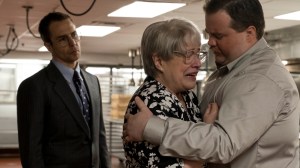 Throughout the two hours, Richard Jewell kept adding more and more examples of being a clunky and heavy-handed exercise. It would have been better for the bombing to be the inciting incident rather than the Act One break, sparing us so many scenes that do little and could be referenced rather than witnessed. Do we need to actually see Jewell getting fired from jobs to feel for him? There’s a reoccurring motif of Jewell bringing Snickers candy bars to Bryant as a friendly gift, and it’s so clumsy and weird. I started wondering if maybe Mars, Incorporated had paid for the bizarre product placement (“When you definitely did not plant a bomb in Centennial Park, break into a Snickers!”). There’s a dramatic beat where Jewell is trying to coax his distraught mother on the other side of a closed door. He just keeps repeatedly saying, “Momma please,” over and over while the music builds, and I guess the magic number was 17, and after that iteration she opens the door and they hug. It’s such an amazingly awkward scene. The dialogue has that same unreality as the rest of the movie, trying too hard to be declarative or leading, giving us lines like, “I’d rather be crazy than wrong,” and, “A little power can make a man into a monster.” It’s the kind of portentous, inauthentic dialogue exchanges I see in those Kirk Cameron movies. I wouldn’t have been that shocked if, by the end, the patriarch of Duck Dynasty showed up, running over the Evil Media Lady, and then they held a benefit concert for the persecution of white Christian males. I’m being a bit facetious here but Richard Jewell shouldn’t remind me of the derelict storytelling and characterization in hammy message-driven religious panoplies.
I was honestly shocked by Richard Jewell. I was expecting far more given the caliber of talent involved in the project as well as the inherent injustice in Jewell’s plight. Eastwood’s modern passion play feels too insufficient in passion. It’s an awkward movie that doesn’t give us a real character at its center, and it plays like every other human being in the universe is a representative of some storytelling function to service that empty center. There were lines of dialogue I just had to scoff over. There were moments that made me roll my eyes. I just couldn’t believe something this clunky could be designed for a late run for awards. The acting is all suitable, and Hauser does fine work as a mild-mannered everyman in a crucible, though I think he showed more adept skill in the enormously compelling I, Tonya. In fact, that 2017 movie could have been a lesson in how to tackle the filmic story of Richard Jewell, mixing in non-fiction elements to retell a story from multiple, fractured, contentious points of view that leapt off the pages. It feels there are many steps that should have been taken instead. Richard Jewell isn’t an awful or irredeemable movie, even though Eastwood’s typically plain shooting style feels even more strained and bland. It’s a movie I could see a contingent of the public genuinely enjoying, especially those already with a healthy mistrust of the FBI and media (you know who you are). But for me, it felt like I was watching the awards-friendly version of Kirk Cameron’s Christians are People Too. And again, Jewell deserves a major expose to chronicle his real injustices. He also deserves better than this.
Nate’s Grade: C
Share this:

Jojo Rabbit (2019)
 Writer/director Taika Waititi has played a vampire, an intergalactic rock monster, and now perhaps the most challenging role of his career, Adolf Hitler. Coming off his meteoric success with the MCU, Waititi is using the time in between mega-budget Thor sequels to write/direct/produce/co-star in a smaller daring indie comedy. Jojo Rabbit follows a young German boy, Jojo (Roman Griffin Dais), during the last year of World War Two. He fantasizes about having an imaginary Hitler (Waititi) as the voice over his shoulder, reinforcing the teachings of adults and authority figures. His worldview is challenged when he discovers a teenager hiding in the family’s walls who just happens to be Jewish. Jojo doesn’t know what to make of Elsa (Thomasin McKenzie), nor does she know what to make of him, and Jojo decides to keep her presence a secret to spare his doting and put-upon mother (Scarlet Johansson). Jojo tries interrogating this wily girl but ends up learning more than he ever imagined.
Given the subject matter, setting, and overall tone, it’s a wonder how well Jojo Rabbit works. I was worried about what kind of tone the movie would be striving for given the delicacy of its subject matter, not that other filmmakers have shied away from incorporating comedy into Holocaust settings. I don’t mean this to be overly flippant but for portions of the movie I felt like I was watching “Wes Anderson’s Nazi Germany.” The entire Act One camp sequence feels like a warped deleted scene from Moonrise Kingdom. I was genuinely surprised how often I was laughing with Jojo Rabbit. Waititi can be hysterical as a bratty, temperamental version of the Fuhrer, but there are moments where he gets caught up in the oratory of his hateful rhetoric that serve as a reminder that even for Jojo, he realizes this man isn’t exactly best friend material. The Hitler imaginary friend goes away for long stretches in the second half as the film emphasizes more drama, which is the right choice as Jojo is coming to doubt what he has been taught from that imaginary friend. The portrayal of Hitler might be offensive to some viewers but I feel like Waititi walks a fine line to root it from the perspective of childhood fantasy. It’s taking the figure on TV and adapting it to suit the needs of a lonely kid wanting to belong. Of course he’d want Hitler to select him as the best little young Aryan that Germany has going. It’s not dismissing the evil of the man but instead serving him up through a specific prism that allows laughter not necessarily even at Hitler himself but at a youthful and immature understanding of something far more complex.
 I was also worried that the comedy might dampen some of the more dramatic turns coming, and this was so not the case. There are dramatic moments hiding under the surface thanks to seeing them from Jojo’s naïve perspective, but then there also big obvious dramatic moments of suffering that hit. As much as the whimsy prevails early, the dramatic moments are delivered in tasteful ways that do not detract from the feelings being felt by the characters as well as the willing viewers. There are a few gut punches that remind you that even with the whimsy of childhood naivete, real people are dying in awful ways because of those complicit in racist genocidal policies. The relationship between Jojo and his mother is the second most significant one, after he and Elsa, but it’s this central focus where we see the starting point of his character arc. His mother tries to shield her child from the larger terrors of their society but that’s increasingly difficult when people are being hanged in the street for helping Jews. She’s hoping to simply play her part in public, get through this terrible time, and finally have the son back that she knows, hoping he will eventually shake free from the propaganda. It’s a role that requires Johansson to play like another cartoonish adult, all bubbling energy and quirky nonchalance, while burying her increasing concern. Part of me almost wishes that she was a co-equal protagonist so we could get an even richer perspective to contrast more fully.
There’s a sprightly whimsy to the proceedings that comes from being locked into the perspective of an imaginative child. It’s not that the world is 100 percent his vision, it’s more that we know that the representation of what we’re seeing might not be a completely objective reflection of the reality Jojo is encountering. This especially includes the portrayal of many adults involved in various levels of the Nazi party. They play out like cartoons and buffoons but are still dangerous cartoons and buffoons. When Jojo’s childhood friend Yorki is talking about fighting on the front and we see him handling a rocket launcher, this is clearly an exaggeration of the desperation of the moment and a young boy’s eagerness to be involved. This creative approach allows Waititi to dabble in the fantastic and keep his audience alert, allowing them to second-guess what we’re seeing on screen and look for the reality in hiding. I laughed pretty consistently at the intended humor and incredulous nature of the adults trying to pass off wrongheaded insights and suggestions as scientific fact or common sense. It’s a movie where you laugh at the ridiculous idiots while hoping that the idiots won’t get the people we care about killed.
 The acting is very strong overall. Newcomer Roman Griffin Davis is exuberant and relatable without coming across as overly cloying or mannered, which can be a rarity for child actors. He has a very difficult role to play from a tone and perspective standpoint, and he succeeds. Another great child actor is Thomasin McKenzie (Leave No Trace) as Elsa, a young girl in an extremely vulnerable position who looks upon this new boy with equal amounts fear, disdain, and pity. She cannot be herself and must choose her words and responses carefully, so it’s a guarded performance of restraint but McKenzie is fabulous in quieter, subtler shifts. The adults are all enjoyable as broadly comical cartoons, with Stephen Merchant (Logan) earning considerable unease as an S.S. officer leading a team sweeping for Jews in hiding. Johansson (Avengers: Endgame) seems a little too eager, a little too antic, but this may pertain to her character’s nerves and desperation, trying to overcompensate her anxiety. Rockwell (Vice) gets the biggest adult role as a disenchanted military vet who sees the writing on the wall. At first his detached nihilism is a source of dark comedy and later he becomes an unexpected father figure for Jojo. I don’t quite know if his hero moments have the desired impact but he’s still an amusing presence.
However, there are also some drawbacks to being a fable, namely a lack of larger specific substance beyond general lessons and general characterization. Jojo Rabbit is being billed as an “anti-hate satire” and I definitely think that summary fits the intent, but “anti-hate” sounds like such a nebulous buzzword that seems more meaningful at first glance and less upon reflection. I would assume every responsible story set during the era of the Holocaust would adopt an “anti-hate” sensibility, because the alternative would be championing the foundations of Nazism. It’s hard for me to imagine any movie desiring a public release being anything other than “anti-hate.” Essentially, we have a character coming to see through the propaganda of the era, judging people as people rather than scary caricatures, and start to reject the teachings of manipulative authority figures. This isn’t a new formula for coming-of-age stories or tales set during times of great strife. It’s a lesson in empathy and rejecting dogma on its face. When it comes to Nazism, that should be the easy part, facilitated by any prolonged exposure to anyone previously deemed an undesirable.
My nagging issue with Jojo Rabbit is that for all its impish whimsy with such a serious historical subject, it ultimately plays things pretty safe. That’s fine, it doesn’t have to a revolutionary film, but it does dull the message a bit when the ultimate lasting takeaway is “hate is bad, Jews are people too.” It’s a bit pat, a bit simple, and a bit too easy. The characterization can also be hampered by this same ethos. The characters are pretty much exactly what you see at first blush. The only character who changes or has room to explore is Jojo. Even Elsie feels more like a stagnant person despite her unique circumstances. This may be because she’s more change agent than character, a figure for Jojo to be horrified by, then entranced with, and finally see as a friend. I still felt moments of genuine emotion for characters onscreen and for Jojo’s journey of self. The movie still works well with its stated goals and direction, it’s just a bit limited because of the simplicity of its message and the lack of greater substance for its many characters.
 The Jojo Rabbit novel was written before the rise of Donald Trump but Waititi has said that when they were filming that America’s current political climate was on his mind, and it’s not hard to make a few adaptations to apply this for the modern era. Perhaps a young boy sees Donald Trump as his imaginary friend and together they’re both all-in on trying to “make America great again” by first and foremost reporting any immigrant they see as illegal. Then later in the story he discovers his family is willfully hiding an undocumented child from being deported after they were stripped from their parents who were then deported. Now our naïve protagonist must reconcile the harsh rhetoric he has been taught with the growing empathy of connecting with another human being who doesn’t seem as dangerous or as sub-human as others claim. If you wanted to even make this parallel, it’s there, though I think that diminishes the setting. We shouldn’t need to tell movies during the Holocaust as metaphors for our modern struggles. I suppose this is another scenario where if you want to Inuit more of a relevant modern message, you can.
Jojo Rabbit (a nickname that seems forgotten after its christening) is a coming-of-age fable with equal parts charm and horror. Waititi takes a serious subject and doesn’t mitigate the evils of Nazism with his portrayal of a daffy imaginary Hitler. The production has an admirable swagger to it as it charts its own course, tackling serious subjects and young whimsy to portray a poignant story about childhood, loss, and growing up. It’s an amusing and heartfelt enterprise that I can’t help but feel could have done more than settling for some pretty safe messages and limited characterization. There wasn’t a moment with Jojo Rabbit where I wasn’t entertained, but I do wish the movie had more on its mind that reminding everyone that hate is bad.
Nate’s Grade: B
Share this:

Vice (2018)
 If Oscar-winning funnyman Adam McKay can take the arcane, convoluted world of finance and spin it into one of the most entertaining, accessible, and enraging films of that year, then just imagine what he could do with the life of Dick Cheney?
We follow Dick Cheney (Christian Bale) from his early days as a college washout, to Washington intern to Donald Rumsfeld (Steve Carell), to youngest chief of staff in a White House administration, to Wyoming Congressman, and eventually Vice President to George W. Bush (Sam Rockwell) where Cheney redefined the VP role as a defacto second president. This is the story of his 60 years shaping the annuls of political power.
 If you have one reason to watch Vice, it’s the staggering performance by Bale (Hostiles). As is custom, the man completely transforms himself into his subject, gaining weight, building muscle in his neck to simulate the Cheney shoulder hunch, and going unrecognizable in startling older age makeup. He doesn’t just look the spitting image of Dick Cheney but he sounds like him too, exhibiting his cadences and mannerisms, and fully inhabiting the man every second he’s onscreen. It’s a compelling, captivating turn that ranks up there with Bale’s best. He’s beyond great but strangely nobody else is. Amy Adams (Arrival) plays Lynne Cheney, Dick’s wife and shrewd political partner, and her worst acting moment is her introductory scene where she lays into the young Cheney. It’s like an audition where the actor is hitting the wrong notes too strongly. Adams regains herself as the film carries on but never has a standout scene. Nobody else other than Bale is given the material to stand out. Rockwell (Three Billboards) and Carell (Beautiful Boy) are enjoyable and aided by impressive makeup, especially old Rumsfeld, but they’re given one note to play. Their roles become more impression than performance and both men drop out of the movie for long periods of time. The next best actor might by Tyler Perry (Gone Girl) as Colin Powell, and maybe that’s because Perry is used to brokering nonsense with his own array of nonsensical characters. He’s already the weary adult.
The meta interludes and fourth wall breaks that helped The Big Short succeed conversely are part of the problem with Vice. Most Americans know a decent amount about the Iraq War and its documented fallout, so there’s less need to have celebrities interject and explain complex scenarios and institutions (the absence of Margot Robbie in a bubble bath will always be felt). The narration by Jesse Plemons (Game Night) doesn’t feel necessary, and his ordinary identity becomes a guessing game for most of the film, trying to link him with Cheney. I was thinking he would be an Iraq War soldier and get killed later on, that way establishing a stand-in for the thousands of men and women who are no longer walking this Earth as a direct result of Cheney’s misguided action. Nope. When his identity is finally revealed you’ll go, “Oh,” and that’s it. Because he wasn’t really a character, he was a narrative device and one that didn’t stand for anything larger. The visual metaphors can also be very, very obvious. There are consistent cuts to Cheney fly-fishing in a river, meant to evoke him luring others into his desired machinations. Even the end credits feature fly-fishing imagery, in case you had forgotten about this enduring metaphor. The conclusion literally involves a heart being removed and the sequence cut along a more figurative betrayal, and you can feel McKay vigorously pointing at the screen and yelling, “See, it’s because he’s heartless, get it? Do you get it?” We get it. The documentary-style and comedic techniques that allowed The Big Short to be as entertaining and accessible, and one of the best films of 2015, are paradoxically the things that seem at odds with Vice.
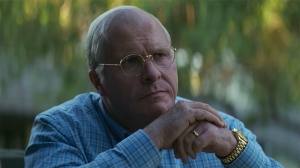 The meta breaks are meant to provide a degree of comedy to the picture, which is generally absent comedy otherwise, unless you count the rise of Cheney’s reign as the darkest of comedies. I suppose Cheney’s nonchalant recognition of his heart attacks (he’s had five) could be a potential comedic lifeline if you’re being generous. One second we’re told people don’t speak in Shakespearean soliloquies in real life, and the next second the Cheneys are talking in Shakespearean verse. When it looks like the Cheneys will drop out of public office to spare their gay daughter Mary (Alison Pill) the inevitable storm of harassment, the movie has a fake-out end credit sequence to sum up their hypothetical lives. To demonstrate Cheney’s knack for making the most ridiculous statement sound statesmen, he recommends that the Oval Office team put miniature beards on a part of their anatomy and perform an adult puppet show, which draws solemn nods of approval from the others. It’s a joke that feels too glib, like the intended point is being lost by the lewd nature of the comedic aside. The only meta aspect that feels earned is the final one, where Cheney turns to the camera and directly addresses the audience, acknowledging he can feel their contempt but refuses to apologize for his actions in order to keep people safe. Because he’s having the final say, because he’s offering a rebuff to his movie, it feels more earned and fitting, and it would have had even more power if it were the only break in the movie rather than the last. It’s hard to call this a comedy; it’s more an incredulous indictment looking for its mob.
I honestly think a straightforward biopic might have been the better route for Cheney. The first half of the film is more interesting and successful because it is the more illuminating half. I never knew that Lynne Cheney’s father likely killed her mother. That’s a pretty bold charge on behalf of the filmmakers. The early Cheney years are the moments the majority of Americans don’t know about, whereas the later years have been well documented by a slew of hard-hitting documentaries, books, and journalistic exposes. There are whole movies about topics like the Valerie Plame leaking (Fair Game), the mounting mistakes after the invasion of Iraq (No End in Sight), the administration’s policy on torture (Taxi to the Dark Side, Standard Operating Procedure), the drumbeat to the war and snuffing out of critical journalism (Shock and Awe, Lions for Lambs), the missing WMDs (Green Zone, Body of Lies), the Bush deferment memos (Truth), the long-term consequences for those servicemen who survive (The Hurt Locker, The Messenger, Stop-Loss, Last Flag Flying, In the Valley of Elah, American Sniper, Thank You For Your Service) and anything that Michael Moore sets his sights on. This list is not exhaustive by any means. Because of that the film seems to become a rudimentary montage once the Iraq War kicks off, sprinting through the rest as an intended tableau of hubris as Cheney’s star and influence falls. I would rather have learned more about Cheney’s early years in the Nixon, Ford, and H.W. Bush administrations and gleaned more personal insights into the man before he becomes this shadowy, mythic figure that seems downright Machiavellian in his control of government. It’s interesting to watch Cheney and his cohorts plot their unchecked executive power behind the back of President Bush, but then what?
 It’s the “then what?” question I keep revisiting with McKay’s film, trying to figure out the larger intended message, themes, and dire warnings. I feel like because of the expanse of time covered, and the meta quirks applied, that the film too often feels like it’s just scratching the surface of Cheney, providing a slight gloss to a political caricature. The biggest takeaway is the slippery slope of the “unitary executive theory,” a term you’ll hear often, that basically follows Nixon’s own words: “If the president does it, it’s not illegal.” This questionable interpretation of Article II of the Constitution gives the president powers that approach a monarch, which seems antithetical the Founders’ intents. McKay warns that any president could take advantage of this theory to do whatever he or she (sad trombone noise… sigh) desires. This is clearly meant to draw a line right to President Trump, but it’s not like the 45th president needs sketchy legal cover to do his misdeeds. The idea that the Justice Department memos would be a lurking danger is quaint. A bad man with power is not going to look for the rules to allow him or her to break them. The idea that a president could be above the law is also a legally specious argument and one I don’t believe our courts would readily back, even with the “unitary executive theory” (at least I hope so). With that in mind, Vice becomes a cautionary tale about the expenditure of power but lacks the adequate follow-through.
Vice is a tricky biopic for a tricky subject and I wonder if it would have worked better being stripped of its prankster, meta interjections and tricks. It’s a condemnation of Dick Cheney but it doesn’t feel like it goes far enough if McKay’s eventual thesis is that the current world problems began, or were grossly exacerbated, by the actions of Cheney. Climate change warnings going unheeded, ISIS formations going ignored, the generational consequences for unsettling the Middle East, and laying the foundation for an authoritarian strongman to be an acceptable political position for millions of Americans. These charges are clearly intended to be a denunciation of Cheney’s legacy, but the end results play out somewhat differently, like a slap on the wrist. I think Dick Cheney could even watch this movie and nod in appreciation. That seems like a mistake. McKay is still a talented writer and filmmaker that knows how to keep his movie flowing and entertaining, buoyed by an outstanding performance from Bale. It’s a movie with great components but seems to clumsily get in its own way with its presentation. If you’re going to expose Dick Cheney as a heinous manipulator of power that has wrecked havoc for billions, then maybe you don’t want to dilute your message.
Nate’s Grade: B-
Share this:

Three Billboards Outside Ebbing, Missouri (2017)
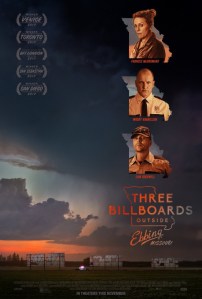 Mildred (Frances McDormand) is a divorced single mother working in the small town gift shop of the small town of Ebbing, Missouri. It’s also been seven months since her teenage daughter was raped, murdered, and set on fire. She rents out three billboards on a rarely used side road to advertise her frustrations with the slow pace of law enforcement. The billboards say, “Raped while dying,” “Seven months and no arrests,” “How come, Chief Willoughby?” The chief (Woody Harrelson) tries to pacify the grieving mother while keeping his loyal officers in check from retaliation. Deputy Dixon (Sam Rockwell) is trying to apply pressure to get the billboards removed by any means. The small town loves their sheriff and turns on Mildred, which suits her just fine. The more people that disagree with her the more it helps fuel her sense of righteous indignation. Mildred engages in an escalating series of battles with the police and town that might just make justice impossible.
Three Billboards Outside Ebbing, Missouri feels like a Coen brothers’ movie played straight, and it’s borderline brilliant in its depiction of homespun characters allowed tremendous emotional latitude. These are people with complex depth who are allowed the power to be contradictory. They can be vicious one moment and kind the next, wise one moment and impulsive and self-destructive the next, capable of great acts of mercy and cruelty. This achieves two things: 1) making the characters feel far more convincingly drawn, and 2) making the characters consistently surprising. This is a messy movie but I don’t mean that as any intended insult. It’s messy in scope, messy in tone, and yet it thrums with the messy feelings and messy complications of human tragedy. What happened to Mildred’s daughter is utterly horrifying and her rage is righteous; however, that doesn’t sanctify her. She makes mistakes, pushes people away, and can be cruel even to her own family. I was expecting Harrelson’s police chief to be a sort of villain, either incompetent or conniving, willfully ignoring the murder investigation. This is not the case at all and he is full of integrity and rightfully beloved in his community. As happens in many criminal cases, the trail of evidence just ran cold, but Mildred would prefer every male in the city, state, and even the country be blood tested to find a culprit. Her demands are fundamentally unreasonable and Willoughby points out the many civil rights protections in possible violation. Just because Mildred has been wronged does not make her the hero, and just because Willoughby is the face of local law enforcement does not make him the enemy. They are people with much more in common than they would ever admit. The awful circumstances of the plot have pit them against one another in an escalating tit-for-tat that serves as projection for Mildred’s blinding fury against a world that would rob her of her daughter.
 The dichotomy of sweetness and terror is best exemplified in the transformation of Mildred and Dixon, one of the most satisfying and engrossing film experiences of the year. Thanks to writer/director Martin McDonagh’s deft handling, these two characters start at opposite ends and grow before our eyes. Mildred tests the limits of her resolve and anger and makes costly mistakes. Dixon begins as the screw-up with a badge (hat he literally misplaces) rumored to have tortured a black prisoner in jail. He seems like the dim-witted poster boy for unchecked masculine privilege. He feels like an enforcer of the corruption we (wrongfully) assume is at work in this small town. As Mildred descends into darker decisions, Dixon ascends and chases a redemptive arc, which is amazing considering the damning behavior he engages in at the halfway mark. These two characters start as adversaries and develop into begrudging allies in a completely organic way that doesn’t blunt either character. That transformation is thrilling to watch and terrifically satisfying on its own terms. By the very end of the movie, I was ready and willing to watch its hypothetical sequel setup, especially if it meant I got to spend more time with these carefully crafted people.
McDonagh’s film juggles many tones, effortlessly switching from laugh-out-loud comedy to crushing drama and back again. I was genuinely surprised how many times I laughed and how hard I was laughing. During my second theatrical viewing, there was an old woman in the back who was quite vocal in her bafflement about how anyone could be laughing. And if you were told the specifics of the plot and its heavy subject matter, I would tend to agree. McDonagh has a preternatural feel for how to find humor in the most unlikely of places. The humor dissipates as the film marches into its second half, a natural byproduct of having to raise the dramatic stakes and make things feel serious. This is the first grounded drama in McDonagh’s filmography (In Bruges, Seven Psychopaths). He doesn’t shortchange the impact of his drama by weaving in more heightened comedic moments. The characters feel realistically developed and portrayed and are allowed to exist in moral grey areas. There’s a minor character played by Peter Dinklage who is positioned as a romantic option and a bit of a fool, but by the end you feel degrees of sympathy even for him. Even this most minor of supporting characters (not a comment on Dinklage’s stature) has earned your emotions. That’s great storytelling but it’s also tremendous execution from the director. Another sure sign of McDonagh’s command for tone is that he undercuts his story’s moment of triumph. I’ll dance around spoilers but Three Billboards looks to end in a way where several characters would claim a hard-won victory, and McDonagh casually strips that away. Even though this is a movie, and even though there are moments of broad, irony-laced comedy, the complexities and disappointments of real life emerge. Even to the very end, Three Billboards doesn’t follow the expected rules of How These Things Go.
 The excellent acting gives further life to these tremendous characters. McDormand (Fargo) is radiating with ferocious resentment and indignation. Her character is a walking missile that just needs to be pointed in the right direction. Her stares alone could cause you to shrivel. McDormand hasn’t been given a character this good in years. She opens up the full reserve of her deep acting reservoir, able to flit from great vulnerability to intense repulsion. She has plenty of big moments where she gets to tell off the disapproving townspeople and media members. It’s ready made for easy laughs, but McDormand is so good that she shades those moments with subtler emotional nuance. You get the laugh and you also get further character insight. It’s a performance of such assured strength that I imagine you’ll be hearing her name often during the awards season. Rockwell (The Way, Way Back) has also never been better. He has to play a similarly deep array of emotions, from idiot comedy to heroic dramatics, and at every point Rockwell is stunning. He makes every joke twice as funny. When Dixon becomes a larger focus of the story is when he undergoes more intensive introspection. He goes from buffoon to three-dimensional character. Harrelson (War for the Planet of the Apes) also delivers a worthy performance as a proud yet wounded man who is trying to do right against a world of pressures and self-doubt.
Three Billboards is an impressive, absorbing, searing film gifted with some of the best-developed characters in 2017. The portrayal of the characters is so complex and given startling life from such amazingly talented actors. You’ll watch three of the best performances of the year right here. You get a really strong sense of just how life has been irrevocably altered from this heinous crime, not just with Mildred but also for the town as a whole. Things cannot go back to being the way they were. The characters you like can make you wince. The characters you don’t like you might find yourself pulling for. Thanks to the complexity and nuance, the film delivers a raft of surprises, both pleasant and painful. These people feel closer to real human beings. McDonagh’s brilliant handling of tone and theme is a remarkable work of vision, cohesion, and execution. This is a darkly comic movie that can make you bust out laughing and an affecting human drama that can make you cry. It takes you on a journey that feels authentic and wildly entertaining. Three Billboards Outside Ebbing, Missouri (which should have simply been called Three Billboards) subverts typical Hollywood clichés by making sure, even during its wilder flights of comic fancy, that everything is grounded with the characters first and foremost.
Nate’s Grade: A
Share this:

The Way, Way Back (2013)
 A throwback to the youthful summer movies of the 80s, The Way, Way Back is a delightful coming-of-age film that manages to excel at both comedy and drama. Oscar-winners Jim Rash and Nat Faxon (co-writers of 2011’s The Descendants) graduate to directors, guiding the famous cast with ease yet squeezing enough satisfying emotional truth into the formula of a screwy, Meatballs-style comedy. We follow 13-year-old Duncan (Liam James) as he spends the summer with his mother (Toni Collette) and her bully of a boyfriend (Steve Carell). My one gripe is that the film spends far more time than it needs to establish just how unequivocally awkward Duncan is. You will likely cringe. When Sam Rockwell enters the picture as a charming goofball water park employee who takes Duncan under his wing is when the movie ascends to a new level of comedy. The Way, Way Back hums along with its own sense of charm, presenting familiar characters/scenes but giving them added texture and relatability. You will be surprised at how much you feel for these characters, you may get a bit misty at points, especially when they behave like people and not zany cartoons. Carell as a bad guy is a real eye-opener; he’s a passive aggressive bully rarely seen in movies. James is an authentically awkward teen but you also buy every step of his journey. It’s just such a sweet, enjoyable, and cute movie, exuding charm and sincerity. Here is a movie that just makes you smile. You’ll leave The Way, Way Back feeling warm and fuzzy, and Rash and Faxon have another winner on their hands.
Nate’s Grade: B+
Share this:

Seven Psychopaths (2012)
 Writer/director Martin McDonagh only has one movie to his name but the man has already accrued legendary status in some circles. The 2008 dark comedy In Bruges didn’t create much of a blip at the box-office, but its blend of absurdist comedy, dark drama, shocking violence, and languid contemplation found a rabid cult following. I have several friends who regard In Bruges as the best film of 2008 (WALL-E still reigns supreme for me but I quite enjoyed In Bruges).McDonuagh’s latest, Seven Psychopaths, reminds me of Barton Fink: both are about struggling writers, both are satires of the film industry, and both have sudden splashes of violence and a serial killer who pushes the protagonist to artistic completion. In other words, Seven Psychopaths is a fun film and a great time at the movies.
Marty (Colin Farrell) is experiencing some killer writer’s block. He’s stuck on his new screenplay titled “Seven Psychopaths.” His buddy Billy (Sam Rockwell) is eager to help out. The guys run afoul of another psychopath, mob boss Charlie (Woody Harrelson), due to Billy’s side business. He kidnaps rich people’s dogs and then his partner, Hans (Christopher Walken), returns them and collects a reward. Billy and Hans have kidnapped the wrong shih tzu, and now Charlie and his muscle is going to make them pay.
 The refreshing thing about the bloody, wickedly entertaining Seven Psychopaths is that it constantly surprises you. This is such a rarity with modern movies, particularly Hollywood movies that attract as notable a cast as this one. McDonagh is wonderfully adept at throwing narrative curveballs. There were a few surprises where I literally jumped in my seat. You constantly think you have the movie figured out, and then it goes down a different alley and becomes more interesting. One of the pleasures of having psychopathic lead characters is that they are impulsive and do not have to follow the normal purview of logical decision making. They might just call the bad guys and divulge where they are hiding. They can do anything at any moment, and part of that unpredictability is what makes the movie feel so electric, so creatively alive. I must stress that McDonagh surprises in ways that feel satisfying and yet believable given the world he’s concocted. Part of the fun in the first half is just figuring out who the seven psychopaths will be. It’s not like it’s some laconic chamber piece mystery but the psychopaths are an eclectic mix from the real to the fictional to real characters doubling as inspiration for fictional ones. I think in the end there may only be six psychopaths, unless McDonagh is counting himself amongst the numbers.
McDonagh also has a blast deconstructing the very kind of movie that he’s providing. Marty bemoans writing another rote psychopathic killer movie where the violence is fetishized and the bad guys are mythologized into idols. You think the film is headed in one direction, in the Guy Ritchie-style standoffs and shootouts, and then it takes a less traveled path, one where it criticizes these sorts of movies and ponders existential questions about the nature of self-expression and death. It began as a care-free movie about thugs and writers and transformed into a movie that manages to have something to say about life, philosophy, and the cyclical nature of vengeance. Two of our three main protagonists are pacifists and remain so to their imperilment. At one point, a character narrates how this story as a proper movie would end, and it covers all the nihilistic clichés of vengeance and epic body counts. But then Marty, and McDonagh as well, wants to turn away from the expected, from violence for the sake of violence, from the exploitation of stylized suffering. McDonagh doesn’t forget to entertain while he’s making you think in between those handfuls of popcorn. The female characters in the movie (Abbie Cornish, Olga Kurylenko) are generally wasted, in different senses, but McDonagh uses this as another charge against this type of film (a boy’s night out of carnage). This is an accessible movie that can be enjoyed on a whole other meta level. I loved the various gear changes. For me it took the pulpy action material and elevated it to another level of genius.
 McDonagh still maintains his darkly sardonic streak of humor that made In Bruges such a riot. I was laughing throughout Seven Psychopaths; chortles, snorts, giggles, big belly laughs. With its heedless violence, obviously this will not be a film that runs on every person’s wavelength of funny. The very opening involves two mafia hitman debating whether shooting somebody in the eye takes actual precision or just dumb luck. It’s the sort of mundane conversation you’d see in a Quentin Tarantino movie, and also the precursor to something nasty and ironic. McDonagh’s sense of humor is similar to Ritchie or the Coen brothers, but the man establishes his own sense of wicked whimsy. The absurdist dialogue is always a hoot and can generate serious malice, especially when delivered by stern psychopaths. Rockwell (Moon) in particular is outstanding and delivers a virtuoso performance of the unhinged. The man just radiates energy. You’ll feel jacked up just watching him. I keep waiting for this underrated actor to break out with each star-making turn, and his comedic zing is played to perfection in Seven Psychopaths. In contrast, Walken (Hairspray) is rather reserved as he underplays his character, one of the saner men he’s played. It feels like the passing of the torch from the older generation of psychopath to the newer generation.
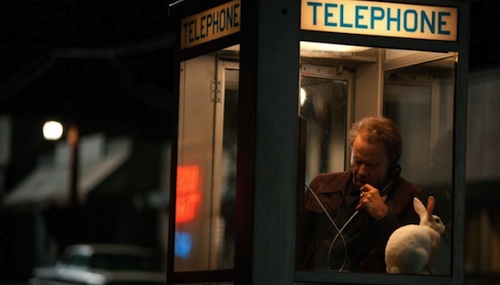
Being a colorful movie about colorful bad guys, and girls, you’d expect there to be some grade-A oddballs, and McDonagh does not disappoint. Some of the psychopaths in question have little bearing on the story plot-wise. There’s Zachariah played by the impeccable Tom Waits (The Imaginarium of Doctor Parnassus). He answers an ad that Billy set up for psychopaths to share their stories to Marty. His tale involves cross-country spree killing of serial killers, rabbit petting, and the love of his life, and partner in crime, leaving him. As far as plot, this little aside has little significance to the plot other than setting up a superb joke to end the movie with. But the character is so interesting, multidimensional, and played with equal parts aloofness and sincerity by Waits, that you can’t imagine the movie without him. Several of these psychopaths could have been the stars of their own movie, from the vigilante killing mob thugs to the tale of one father’s long path to vengeance. Even the fictional psychopath, the Vietnamese man (Long Nguyen) seeking vengeance against G.I.’s, could have enough weight to carry a feature film. The amazing part of the movie is that you don’t feel like any of these characters are shortchanged. McDonagh finds ways to emotionally ground his characters, allowing the audience to empathize amidst the bloodshed and loony characters. We care about Hans and his ailing wife; we care about the friendship between Marty and Billy. It’s real for these characters and so it feels real to us, despite the hyper-real flourishes of the movie.
If you’re a fan of In Bruges, or just dark comedies mixed with sudden violence, then you’ll probably find something to enjoy with Seven Psychopaths. You don’t have to be nuts but it helps. McDonagh has crafted another winner with sharp dialogue, a twisty plot full of surprises, incisive commentary on movies and movie expectations, as well as some sincere soul-searching and poignancy. This baby has it all, folks. Above all else, it’s just a blast of fun. the actors all seem to be having the times of their lives, notably Rockwell, and the morbid laughs and off-kilter thrills should cement another McDonaugh film for cult status. Seven Psychopaths is a palyful movie along the lines of Kiss Kiss Bang Bang and even Adaptation. It’s bursting with ideas and comments and jokes. when you leave the theater you almost want to get back in line and start the ride all over again.
Nate’s Grade: A-


 nathanzoebl
You must be logged in to post a comment.