Blog Archives
Puss in Boots: The Last Wish (2022)
 Puss in Boots: The Last Wish is, surprisingly, genuinely great. No kidding. It’s very very good. It’s been eleven years since the first Puss in Boots spinoff, and that itself was seven years after the character was introduced in 2004’s Shrek 2, and there hasn’t been a Shrek movie since the franchise-killing Forever After in 2010. I would have assumed that Dreamworks had just moved on from this character in the ensuing years, especially as How to Train Your Dragon became their big new commercial franchise, until they too ran that into the ground with 2019’s disappointing third film. I had little expectations of greatness once I heard there was a new Puss in Boots feature, even after I started hearing the growing critical consensus. Early in, only mere minutes, I realized that a Puss in Boots sequel was one of the best movies of 2022 and an exciting and heartfelt sequel that proves that with the right artists and storytellers, any old character can still have vibrant relevance. It’s a children’s movie that can appeal to everyone.
Puss (voiced by Antonio Banderas) is a famous adventurer, sword fighter, and lover of women, but he’s also nearing the end of a long journey. He’s used up his eight lives and is now on his ninth and last, and to escape Death, he sets out on a quest to retrieve a fallen star that will grant one person a wish. It just so happens there are a lot of other characters in this fairy tale kingdom that want to get there too.

It is amazing how hard this movie goes. In its opening sequence, it establishes its bold artistic style that enlivens every second onscreen, it establishes its caliber of exciting action that feels akin to wild comic books and anime, and an emphasis on mortality that provides a sense of danger and emotional foundation for what could have been just another shoddy animated sequel drafting off brand recognition. Let’s just focus on the animation style to begin with. I was expecting the same old CGI that has dominated the world of animation for twenty years, but The Last Wish has been clearly inspired by the greatness of 2018’s Into the Spider-Verse. There is a distinct 2D edge given to the designs, accenting the imagery, and during bouts of action they will lower the frame frate, making the movements much more stark and pronounced. Add to this a lovely, painterly watercolor visual style, more emphasis on the overall impression than finite definition, and the movie is a consistent feast for the eyes. There are stylized sequences that communicate fear and desperation, as well as sequences that exemplify the kinetic movement of superhuman action, smartly altering its visual appearance to better serve whatever emotion it wants you to feel. I hope more and more animation companies continue this magical hybrid of CGI and traditional animation techniques, as also seen in 2021’s The Mitchells vs. the Machines. It’s a great step forward combining the old and the new into a stylized look that allows the creators to make the best of both animation worlds.
The action is also satisfying and surprisingly well developed. The opening sequence involves Puss awakening a giant behemoth and it made me think of the exaggerated and intense action of anime series with giant kaiju monsters like in Attack on Titan. The camera will freely circle and zoom around the theater of action, heightened with exaggerated motion lines and split screens and POV swaps. I also love that the filmmakers understand the inherent qualities of what makes for good action, incorporating the personality of the characters into the situations, providing organic consequences, tailoring to the geography, and providing clear mini-goals. After introducing the secondary antagonist of greedy Jack Horner (John Mulaney), as well as Goldilocks (Florence Pugh) and the three bears (Ray Winstone, Olivia Coleman, Samson Kayo) “crimin’” gang, the movie transforms into a delightful and unexpected fantasy version of Midnight Run. There are multiple groups racing against one another to a destination, all the while jostling for supremacy and bumbling into one another’s way. It makes for a fun series of events as every group has their own reasons for gaining the wishing star. Because of this, their behavior feels in-character and the cross-purpose motivation allows for fun combinations of characters getting in the way of one another and utilizing the specifics of their fantasy character details. There was a midpoint sequence combining all sides in a colorful brawl, including unicorn horns exploding into confetti upon contact, and I just felt a surge of pure incandescent joy.

In yet another of the movie’s pleasant surprises, it has one of the best villains of the year as it deals with the concept of mortality with actual nuance. The main antagonist is literally Death itself, personified as a red-eyed, grinning bounty hunter wolf and voiced by Narcos’ Pablo Escobar, Wagner Moura with a menacing purr. This Wolf is after Puss because he’s now on his last life and the Wolf is personally offended at the idea of having multiple lives. Their first encounter makes Puss feel fear for perhaps the first time in his nine lives. In a morbidly amusing montage, we zip through Puss’ previous eight lives and specifically the moments leading to their comical end. He’s flippant with an unchecked ego, and Death seriously humbles him, being the first to ever land a blade on Puss in Boots, a detail he’d been bragging about even in song. From here, Puss is deathly afraid and the hairs of his body will stick up whenever he suspects the return of the Wolf, who certainly enjoys terrorizing his targets with an ominous whistle to announce his presence. So at a moment’s notice, the crazy and colorful hijinks can stop from hearing that familiar yet eerie whistle. In some ways, it’s a family-friendly depiction of working through trauma. The larger theme is Puss acknowledging his moral shortcomings with his many lives, the time wasted on frivolity and ego, and making the most of the time he has left. The need to re-up his lives is a fine starting motivation based upon fear, personified as trying to literally escape the scary wolf, but it’s also what makes Puss confront his own behavior and want to change as well as hold himself accountable.
The heartfelt portion of the movie is its emphasis on found families, and it was done so well that I actually teared up at points. Yes, dear reader, Puss in Boots 2 had me on the verge of tears more than once. Goldilocks is the leader of her gang of squabbling thieves, but she still views herself as an orphan first, whereas the bears view her as an equal and valued member of the family and crime gang. Even her character arc comes to a poignant conclusion where she realizes that her real family isn’t the one she comes from but the one who makes her feel that she belongs. This theme is also demonstrated with little Perrito (Harvey Guillen, What We Do in the Shadows TV series) as the adorable and undying optimist puppy sidekick. His selfless vantage point contrasts with Puss, and greatly annoys him, but Perrito also has his own goal. He wants to be a comfort dog, and one of the sweetest moments of the movie involves him helping Puss come back from a traumatic response through a shared moment. Even typing these words makes me tear up. The screenplay knows how to develop characters that can grow as friends and family and the drama is directly connected to well-honed characters and thoughtful story without being overly sentimental and maudlin, a slippery slope to doom many child-friendly animated efforts with messages.

Puss in Boots: The Last Wish does everything well. It’s funny and colorful and exciting and meaningful and heartfelt and everything you would want in any movie, let alone one featuring a talking cat swashbuckler in tiny boots. No matter your mixed feelings on Dreamworks animated movies, or their iffy sequels, or even children’s movies as a whole, I whole-heartedly recommend that everyone give this magical movie a fighting chance. The animation is gorgeous and vibrant and colorful, the vocal performances are terrific, the action is fun and well-developed, and the themes and character arcs have substance to provide meaningful layers and emotional heft. This is superior entertainment and all in about 90-some minutes. While I’d slot it below Guillermo del Toro’s masterful stop-motion Pinocchio, this is a wonderful movie and one of the best to ever bear the Dreamworks mantle. It’s the 2022 sequel you never knew that you needed but will be oh so happy that it rightly does.
Nate’s Grade: A-
Share this:

Eternals (2021)

Chloe Zhao is the biggest name Marvel has gotten yet for its cinematic universe (MCU). Sure, they’ve had major directing names before like Kenneth Branagh and Ryan Coogler, and successful populist genre filmmakers like Jon Favreau and Joe Johnston and Joss Whedon and Shane Black, and quirky auteurs like James Gunn and Taika Watiti. However, Zhao is the first Academy Award-winning director to jump into the Marvel sandbox. Zhao seems like an odd fit for something as mainstream and successful as the MCU, but she was excited to tell a big story with the biggest studio operating in Hollywood. Eternals (no “The”) is just as much about the question over what it means to be human as Zhao’s Best Picture-winning Nomadland, and it’s a lot easier to watch with one hundred percent less Frances McDormand pooping in a bucket in her van (granted, she did win an Oscar for that performance). Eternals has received the lowest critical rating of any MCU film in its thirteen-year history and I’m trying to figure out why.
Thousands of years ago, the Eternals were created by the Celestials, powerful beings that are responsible for birthing new galaxies into the universe. The Eternals were sent to protect the inhabitants of Earth from the Deviants, terrifying tendril-heavy monsters that will consume and overrun a world. The Eternals are instructed by their masters not to intervene in human conflicts; only to intervene to save them from Deviants. Now that the last Deviant has been dead for over 500 years, the Eternals have settled into comfortable lives among present-day humans. Then the Deviants return, evolving with added powers and posing a new threat to humanity and the Eternals, but the real threat might be outside the confines of Earth.

Eternals feels like a different kind of Marvel movie in that stretches feel like it’s a Stanley Kubrick movie, or a Terrence Malick movie, or a DC movie. The plot structure and tone even reminded me of Watchmen. Don’t get me wrong, the standard Marvel elements are recognizable, but this is a much slower, more methodical, more cerebral, and more challenging movie that really feels like a distillation of Zhao’s humanist indie naturalism and the crazy cosmos from Jack Kirby’s trippy source material. I can understand why some people would find this movie to be boring and poorly paced. There are extensive flashbacks and setup. It definitely doesn’t need to be a staggering 157 minutes long, second only to the three-plus hours of Endgame. Granted the movie is introducing a dozen characters, their relationships, their powers, their histories, as well as a new history for the universe that doesn’t relate to anything that came before it. There are assorted references to Thanos and the events of Endgame, bringing half the population back, but this is more a standalone movie that can serve as an introduction for those less well-versed in two dozen movies’ previously on’s. I knew going into Eternals it was going to be slow, and I knew several friends that outright hated it, but I think pacing is more to its benefit and detriment. The scenes feel like Denis Villenueve (Dune) is pacing them, where moments are given more time to breathe and where characters are given space to reflect and absorb. Like a Villenueve film, Zhao wants her audience to take in the grandeur of the moment, but she also wants the characters to be able to take in the drama of their circumstances. Some people will find it all too boring, and while there were points that could be trimmed, I was enjoying myself because of the attention to character perspectives that are given precedence over splashy beat-‘em-ups.
I was drawn in by the character reveals, their conflicts, and the time Zhao allows to examine their emotional and philosophical states. Look, it’s still a big, action-packed Marvel movie with plenty of monster fights and a world-saving cataclysm climax, and while those are agreeably executed, I was more taken by letting the characters pontificate on their problems. There’s Sprite (Lia McHugh), an eternally looking child who can never live an adult life she craves. There’s Druid (Barry Keoghan), a man with the power to control the minds of all humans on Earth but is explicitly instructed to remain hands-off with their conflicts. He is severely torn and emotionally wrecked over watching them slaughter one another and knowing he has the power to intervene and resolve genocide, prejudice, and poverty. That’s the eternal question over why a loving God seemingly chooses to be hands-off, all rolled into one character. There’s Thena (Angelina Jolie), a legendary warrior of physical renown but whose mental state is fracturing and who poses a potential lethal threat to her family. There’s her partner, Gilgamesh (Don Lee), who would rather watch over his love as she suffers and potentially declines than have her lose her identity and erase herself. There’s Phastos (Brian Tyree Henry), a man who only wants to help the humans with his technological skills but regrets his contributions and declares humans as unworthy of their keep after Hiroshima. Then there’s a reveal halfway through the Eternals that loads a needs-of-the-many sacrificial debate that positions different characters on different sides of the divide for the final act. I enjoyed that even the villains are presented with their rationale and are tortured over their choices they deem to be necessary for the greater good.

I’ve written a lengthy paragraph all on the meaty character conflicts, and none of them revolve around the goal to gather a magic item or learn a special power. I didn’t mind Zhao’s movie taking its sweet time to allow these conflicts and struggles to be felt because they were evocative, and Zhao’s storytelling shines when she focuses on the noble and often tragic struggles of people being complicated, contradictory, and confusing. Even the big dumb beasts evolve and have a perspective that has an understandable complaint. The final confrontation doesn’t come down to a giant sky beam and an endless army of disposable CGI brutes. It rests upon character conflicts and a romance that spans thousands of years where empathy is the secret weapon. Early on, you think it’s going to be a love triangle, and the movie just teleports out of that trope. I found myself more invested in the ending, even if I could already predict the conclusion. I was more interested in what the conflict was doing to the Eternals as a family fracturing under the weight of their destinies and the consequences of defiance. The film ends on a cliffhanger with significant fallout, and I don’t know how the rest of the MCU is going to square what we learned and accomplished here. This seems in sharp contrast to everything down the road.
Eternals is also an often beautiful-looking movie with Zhao’s penchant for natural landscapes and magic hour lighting. The editing and photography feel nicely matched and allow the viewer to really soak up the natural splendor and the impact of the battles. The action is kept at a human level with the camera tethered to the characters even when in flight. There is the occasionally eye-opening shot of a landscape, or Zhao’s use of visual framing, or the special effects revelations that reminded me of 2001: A Space Odyssey. It’s certainly not the most breezy, action-packed movie in Marvel’s lengthy canon of blockbusters, but it’s not devoid of spectacle.

So then why has Eternals scored so low with film critics and a significant portion of general audiences? Some wonder if the level of diversity and inclusivity of the movie is a factor; we have many non-white characters including a deaf character and a gay male character in a committed relationship, with a genuine and loving onscreen kiss no less (your turn, Star Wars franchise), and that seems like a trigger point for certain fans that grumble about “woke culture.” I’m sure for some that’s a factor. I think the length will be a factor too. I think the elevated emphasis on emotional stakes and philosophical conflicts might be another factor. This doesn’t feel like any Marvel movie that has come before. It’s much more comfortable with silences, with patience, and with cerebral matters (again, not to say the dozens of other MCU entries were absent these). This one is just different, encompassing the directing style and humanist attentions of Zhao and looking at a far larger scope of drama than toppling one super-powered being. I saw this in theaters with my girlfriend’s ten-year-old daughter and her friend and they both said they enjoyed it, so I won’t say it’s too mature or impenetrable for younger viewers. Eternals might be too boring for some, too long, and too different, but I was happy to endure it all.
Nate’s Grade: B
Share this:

Like a Boss (2020)
 There’s little else as energy-zapping as a comedy fumbling for its funny, and that summarizes the disappointing Like a Boss, which is far from being boss-like. Tiffany Haddish and Rose Byrne star as best friends who own a makeup company together and Salma Hayek is the rich CEO who wants to buy their company and drive them apart. That’s about the story because the movie feels like it was one of those imrpov-heavy vehicles designed for the likes of a Melissa McCarthy where the scenes are barely sketched in with the assumption that the performers will discover something funny in the moment on the day of filming. Except this never happened. Like a Boss constantly feels straining, groping, struggling for any comedy from scene to scene. There isn’t one interesting comic dynamic or a set piece that felt really smartly set up and developed. There aren’t even that many set pieces outside a sequence where the ladies eat ghost peppers and cannot handle the heat. There’s one part where they destroy a drone and have to hide it. Nothing comes from this. There’s one part where the ladies are smoking a joint and it falls into a baby’s crib, and you’re waiting for the escalation, but that’s it. Nothing of consequence happens. Mostly the movie is so desperately grasping for whatever it can find to be funny, and every actor feels like they’re in a different movie. I started mentally checking out halfway through. I chuckled a few times but my dispirited sighs outnumbered them. I like Haddish. I like Byrne. I like Hayek. I like director Miguel Arteta (an unexpected Beatriz at Dinner reunion). I like that this is an R-rated comedy aimed at empowering women. The problem is it still needs to be funny. The best friends forever say how much they love one another but they’re also explaining all of their problems and solutions in exposition-heavy vomit sessions to assist the audience (“I know you’ve always have trust issues because of your mothers, and…”). For the scary boss antagonist, Hayek’s character is weirdly impotent and too easily foiled, including being upstaged at her own company’s launch party and deciding to do nothing to stop her usurpation. Like a Boss is a limp and flailing comedy that just made me sad.
Nate’s Grade: C-
Share this:

Beatriz at Dinner (2017)
 Billed as a Trump-era satire, and given the fact that the premise involves a middle-aged, working class Mexican immigrant going head-to-head with a rich, bilious, selfish real estate tycoon who proudly skirts the law, you’d be expecting fireworks. That’s quite a culture clash and writer Mike White (School of Rock) serves up the making of a delicious and squirm-inducing evening as the titular Beatriz (Salma Hayek), a holistic massage therapist, is marooned at the house of a rich client (Connie Britton). They’re hosting a very famous, very influential business tycoon (John Lithgow), and his demeanor and perspective couldn’t be more opposite from Beatriz. As the night wears on, and the wine is consumed, Beatriz confronts these privileged and oblivious people. The most frustrating part about Beatriz at Dinner is that all the pieces are there for a terrific movie but White’s script goes slack in the second half. The film never really escalates the drama and you keep waiting for more confrontations. I think perhaps I wanted the stage play version of this story, a dialogue-driven debate between two combative characters buoyed by a sense of righteous indignation. Hayek is quite good and reminds you what kind of actress she has at her disposal. Her wounded expressions say volumes. The other problem is that this 85-minute movie ends on a note of baffling nihilism that left me cold. It’s like White threw up his hands and declared that as long as there are powerful men in the world like Trump, with an oversized influence the common man cannot compete with, then why bother trying to heal the world and make it a better place? It’s an abrupt ending and one that doesn’t feel in keeping with the character. I wish someone would take this story and adapt it for the stage and give it the treatment it deserved before White sacrificed all for his fatalistic message about the futility of trying in the Trump era.
Nate’s Grade: C+
Share this:

Sausage Party (2016)
 Following the “secret life of” Pixar story model, Seth Rogen and Evan Goldberg’s hard-R animated movie about anthropomorphic food literally uses just about every possible joke it can from its premise. I was expecting plenty of puns and easy sexual innuendo, but what I wasn’t expecting was a religious parable that actually has substance and some crazy left field directions the movie takes that made me spit out my popcorn. Sausage Party seems like a one-note joke as we follow Frank, a sausage (voiced by Rogen), and his girlfriend Brenda, a hotdog bun (Kristen Wiig) and their food friends over the course of the Fourth of July weekend. The supermarket items have been told that loving gods will take them to a wonderful promised land. The reality is far worse as the humans consume and “murder” the supermarket products. The messy food massacre sequences are some of the cleverest moments in the movie, which too often relies on a lot of easy profanity and vulgarity and broad ethnic stereotypes (it earns points for pointing out its lazy ethnic stereotypes too). However, when it veers into its religious commentary and the plight of the atheist, the movie becomes far more than the sum of its sex jokes. It’s consistently funny with some hard-throated laughs toward the end, especially in the jubilantly demented third act that takes an extreme leap first into violence and then into food-based sexuality. The concluding five minutes might be some of the most insane images put to film I’ve ever seen. The only equivalent I can even think of is the concluding act of Perfume. I credit Rogen, Goldberg and their team for taking a potentially one-joke premise and finding something more interesting and substantial, while still finding plenty opportunities for crass humor when called for and then some. Sausage Party is not a film for everybody but it’s also a film that is hard to forget, although you might feel guilty about munching on your popcorn at some point.
Nate’s Grade: B
Share this:

Muppets Most Wanted (2014)
 The Muppets are back, though their new film seems to vaguely be recreating the amusing if somewhat slight Great Muppet Caper. The same blend of Muppet-staple sweet goofiness and anarchy is still a pleasure to watch, causing me to laugh throughout; it’s just that there are more leaden stretches between the laughs. The side stories have more interest and humor than the main storyline where Kermit has been replaced by a nefarious Russian doppelganger. Ricky Gervais is wasted as a criminal sidekick and he doesn’t bring much energy to the film. Fortunately Tina Fey, as a gulag prison guard, and Ty Burrell, as a Pink Panther-like Interpol agent, rise to the occasion. Burrel, teamed up with Sam the Eagle, made the movie for me. Their comic interplay and rivalry is the best and gives way to the best use of sight gags. It’s an amusing and agreeable film but there’s a noticeable spirit missing, possibly from the departure of living Muppet Jason Segel as an actor and a co-writer. I was shocked that Bret McKenzie, who won an Oscar for the 2011 movie, was the same man behind these new tunes. With the exception of maybe two songs, the remaining majority of the songs are downright dreadful. Within minutes of leaving my theater I could not for the life of me remember one of the tunes. The celebrity cameos are also less fun, many poorly integrated into the film, just the actors appearing and then vanishing. James McAvoy just walks onscreen to deliver a package. Is that the best use of everyone’s time? Still, while a noticeable step down from 2011’s The Muppets, the movie still has enough of the Muppet charm and silliness to entertain. It’s just missing some of the magic that made their return so special.
Nate’s Grade: B
Share this:

Grown Ups (2010)
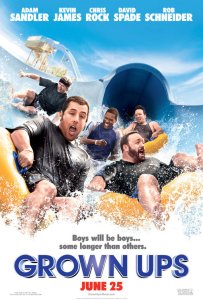 Adam Sandler keeps his friends from the unemployment line with this lowbrow, middle-aged themed, yet still entirely juvenile, comedy, Grown Ups. The movie is really a giant fetid waste of potential. It’s Sandler and his old Saturday Night Live buddies (David Spade, Rob Schneider, Chris Rock, and Kevin James obviously filling the Chris Farley spot) chumming it up and decrying the foibles of being 40. They don’t get the kids today, nostalgically reflect on their summer camp days, and try to recreate some of that old magic with a combined family get-together. Each man falls into a rigid type and will learn some half-hearted, disingenuous form of a life lesson by film’s end. The entire dimwitted plot is as stunted as the male characters. These guys just pal around and it’s termed a movie. The female characters are all one-note: figures of lust, saintly significant others who never get to be in on the joke, shrews, or Schneider’s older wife who is a constant butt of some mean-spirited jokes. The actors do have an amiable chemistry that allows the film to coast for some time before the whole affair just becomes wearisome. These guys have played these types for many many movies, and so everyone just operates on autopilot. The heavy slapstick momentarily distracts from the truth that Grown Ups is an unfunny, crass attempt by Sandler to get audiences to pay for his class reunion. The fact that this junk won the Best Comedy Award from the People’s Choice Awards illustrates the limitations of democracy.
Nate’s Grade: D+
Share this:

Once Upon a Time in Mexico (2003)
 Robert Rodriguez (From Dusk Till Dawn, The Faculty) wrote, directed, produced, photographed, edited, and scored Once Upon a Time in Mexico. I’m sure if you look further this jack-of-all-trades also provided coffee and donuts. Coming off his third Spy Kids feature, Rodriguez seems like the hardest working man in showbiz. Mexico, a sequel to 1995’s Desperado, is one tasty burrito of stylish action, vigorous energy and the immensely appealing Johnny Depp.
Depp stars as Sands, an amoral CIA agent who calls Mexico his beat. Through the help of a one-eyed flunky (Cheech Marin), he recruits a mysterious gunman, El Mariachi (Antonio Banderas), to thwart a coup being lead by Marquez, a military general, and paid for by a drug cartel run by Barillo (Willem Dafoe, a.k.a. the Creepiest Man Alive). Then theres also a retired FBI Agent (Ruben Blades) looking to settle a personal score with Barillo, a Federale (Eva Mendes) looking for some action, a nasty hired gun (Danny Trejo) itching to off a certain Mariachi, Mickey Rourke with a Chihuahua, Enrique Iglesias with a mole, and also the fact that Marquez, who Banderas has been assigned to kill, murdered Banderas wife (Salma Hayek) and daughter. Ill stop so you can catch your breath. Ready? Okay.
 You better think ahead and bring a second pair of pants because Depp will charm them right off as he plays yet another oddball. We are delighted with Sands and his multitude of fake mustaches, tacky T-shirts (one actually says CIA) and method of paying people through cash-filled nostalgic lunch boxes. Despite plotting near a Machiavellian level and shooting innocent chefs, the character settles into a lovable anti-hero that transforms into a blind reaper of vengeance. Depp is one of the best, if not the best, actors on the planet. Once again as he did in Pirates of the Caribbean, Depp gives life to a character and nourishes the film every time hes onscreen. This is Depp’s show. Mexico does have a noticeable lull whenever Depp is absent. I don’t know anyone else that could actually become cooler AFTER what he goes through. Possession is nine-tenths of the law, and Depp totally owns this movie and the 2003 year.
Banderas is smooth and has never looked better than playing the role of the silent-but-deadly musician. Hayeks role amounts to little more than a cameo. Shes witnessed through flashbacks, but she still has a healthy smolder to her. Blades has the most integrity of all the characters. Most of the actors have fun with their roles, especially the ones that are bad (which accounts for most everyone), but you can’t help but get the feeling that theyre being wasted for the most part.
Rodriguez’s overstuffed film is so delightfully over-the top and loopy that it crackles with an infectious kind of energy. Once Upon a Time in Mexico is a wild and lively cartoon of an action movie with a very healthy sense of humor. Its action relies low on CGI and high on inventive, if slightly self-aware, camera angles and furious gun fights. A sequence involving Banderas and Hayek chained to the wrist and swinging one-by-one down the levels of a building is breathtaking.
 What this spaghetti western below the border could have used is a little less of its myriad of twists, double-crosses, triple-crosses, and character subplots. By the time the Day of the Dead rolls on, you might need note cards to keep everything straight. Rodriguez’s earlier Mariachi films were lean on plots which allowed for fun and grandiose action sequences. Perhaps Mexico could have shaved some of these needless characters (cough, Eva Mendes, cough) from its convoluted plot and drawn out its sometimes too quick bursts of stellar action.
Once Upon a Time in Mexico is a bloody good time. Depp amazes yet again in this bombastically silly yet undeniably fun south o the border shoot-em-up. If Rodriguez has any plans for an additional sequel (and he might given his insane work ethic) I’d recommend following Depp’s Sands character wherever the sands take him. To witness this incredibly cool, whip-smart character cut up in any land would certainly be music to my ears.
Nate’s Grade: B
Share this:

Dogma (1999)
 In a time where simply having faith in anything, let alone religion, is scoffed at, Kevin Smith daringly and passionately expresses his personal search for answers and understanding. But while the zealots decree Dogma as blasphemy, what they truly miss is the biggest commercial for faith and God that American audiences have seen in decades of cinema.
The story of the religious epic causing all the hubbub begins with a pair of fallen angels (Ben Affleck and Matt Damon) spurned from the pearly gates of Heaven and banished to Wisconsin. One discovers a re-dedication of a church imploring a little used Catholic practice of plenary indulgence allowing whoever to enter through the church’s arches to have their slate cleaned of all sin. The two seize this opportunity of a dogmatic loophole to sneak back into heaven. The only slight problem is that by doing so they reverse a decree of God and disprove the Almighty’s unfallability, and thus will wipe out all of existence. The voice of God (Alan Rickman) recruits a lapsed Catholic named Bethany (Linda Fiorentino) for a Holy Crusade to halt the scheming angel’s plans for the good of the universe. Along the way she is aided by two unlikely prophets (the dynamic duo of Jay and Silent Bob), an racially discredited 13th Apostle (Chris Rock), and a shapely strip-teasing muse (Salma Hayek) as they engage with demons, seraphims, angles, and all sorts of celestial “who’s who” to stop the end of existence.
 Smith’s direction has taken strides since the point-and-click days of his earlier works; however, there’s still an awkward flatness to his framing and action. Fiorentino plays the role of a grounded character well. Rickman as the bitter Brit shows why he can still take anyone toe-to-toe for acting chops. Affleck and Damon have terrific chemistry together and play off one another for great comedy. Jason Mewes has never been funnier as the terminally stoned and foul mouthed Jay. Rock shows he can restrain his abrasive personality. Salma shows… well she shows she can dance. Jason Lee as an air conditioning-adoring demon and George Carlin as a used car salesman type Catholic Cardinal are so commanding in their presence and excellent in their performances that it’s a sin most of their scenes were cut during editing. Even Alanis Morrisette works as a humanly childish God. She’s given no lines but expresses great feeling and humor anyway.
Dogma is rambunctiously hilarious and a never ending joyride of fun as it jumps from jokes about demons made of excrement to “Buddy Christs” to insightful and sensitive thoughts on religion. Rarely does it bore even with the large plot it must always keep in successive movement. The only drawback Dogma suffers from is the amount of religious points it desires to make. The characters will reach a subject, chat, then directly move on to the next. The sporadic nature can easily keep an audience’s head spinning, but is brought back down to gentle rest from Smith’s Divine wit and sharp writing. Some of the opus’ many characters appear for only brief stretches as Hollywood’s A-list battle for valid screen time among each other.
 Smith is not one to shy away from controversy, or his quota of sexual innuendos and profanity. But the protestors for this film attacking its vulgarity are beyond missing the point; Dogma is reaching people the church hasn’t and can’t. It may be an audacious tweaker of a flick, but ultimately it’s bringing up religion into open debate and discussion amongst the masses where there was none before. And isn’t that in itself glorifying some type of achievement?
It would do well the opponents of Dogma to venture into a darkened theater sometime to see the movie and realize it is a humorous affirmation of faith and beliefs. The story of a crisis of faith is relatable to a society too jaded and cynical. Smith’s wrestle with theology is the public’s gain, and his halo only glows a little brighter for having the courage to do so.
Nate’s Grade: A-
Share this:

Wild Wild West (1999)
 This movie should have been re-titled “Wild Wild Mess.” After much speculation, the truth finally comes out about the overly hyped Will Smith vehicle: It is the loser of the summer season.
Rehashed from a 1960s series that no one under 30 will remember unless they stay up late watching Nick at Nite, it is full of special effects, headlining stars, and a talented director. So what went so terribly wrong?! The main problem is the story, or more accurately, the absence of one. This movie meanders through the entire plot, characters are thrown in, but there is NO story whatsoever.
Will Smith is a real disappointment. Even though he is such a charismatic actor and has a natural likability, he couldn’t save this disaster in the West. There is so little chemistry between Smith and Kline that it probably would’ve been better if ILM just created a Western Jar Jar for Smith to banter with. The jokes are so lame and unfunny that I slapped myself in the face more often than I laughed.
The beautifully delicious Salma Hayek plays peek-a-boo with the audience as she disappears and then reappears periodically throughout the movie. She has no real purpose except for some T&A and a forced romantic love interest. After playing every possible Shakespearean character, Kenneth Branagh now focuses on being an evil Lt. Dan of the South. His villain is more kooky than dangerous and provides more unintentional laughs than thrills.
This is an incredible lumbering mess that shows what can go wrong when children are not supervised while playing with daddy’s toys. May John Peters’ mechanical spider rot in hell! I want two hours of my life back!
Nate’s Grade: D


 nathanzoebl
You must be logged in to post a comment.