Blog Archives
Safe House (2012)
 Safe House is an an action movie that has some nice above-average action sequences strung together by a very sub-average plot. Tobin (Denzel Washington) is a rogue CIA agent being hunted down by shadowy forces. Or is he? A young agent (Ryan Reynolds) was responsible for the safe house in Cape Town that was breached and now takes it upon himself to bring Tobin in for the agency. Or does he? If you’ve seen any spy thriller in the last few years then you’ll recognize the glut of clichés and be able to ably predict the traitorous higher-ups using the economy of characters. Here’s a clue to the villains of the picture: don’t keep all your villainous deeds together on one computer file (and don’t label it “All Our Evil Deeds,” try instead, “Vacation Photos.”). Washington and Reynolds are appealing actors even in ho-hum parts. Washington never seems as devilish or as clever as his character is billed to be. While the plot is bland, director Daniel Espinosa (Easy Money) knows how to shoot some thrilling action sequences. The style is a bit of a Bourne rehash, what with the jangly camera angles, but the movie has a surprising level of verisimilitude; when two guys fight it really feels like a couple guys beating the crap out of each other. The chase sequences are well staged and find smart ways to make use of its South Africa location, like a chase through the levels of a soccer arena or a race atop the rooftops of shanty homes. It’s when the movie stops to catch its breath and the plot reemerges that Safe House becomes a snoozer.
Nate’s Grade: C+
Share this:

The Change-Up (2011)
 For once, I’d love somebody to construct a body-swap movie where the characters realize the tropes and clichés of the body-swap pictures, a parody of the genre. It’d be nice if the characters instantly accepted their situation and knew that they would each have to learn some form of a life-lesson before changing back, and they tried to falsely engineer these saccharine life-lessons. Then it would be fun if they rented all the body-swap movies to write down notes and pointers on how best to deal with their unusual situation. Then, and here’s the best part, both body-swap participants realize that they prefer their new situations. They reject turning back and simply enjoy the whims that come with their new existential home. They reject learning life-lessons and simply make the best of things. For a brief second, I thought The Change-Up might be that very movie but no such luck.
Dave (Jason Bateman) is a business-obsessed lawyer working his way to make partner in his firm. His wife, Jamie (Leslie Mann), and his three children, including twin babies, are neglected at home. Mitch (Ryan Reynolds) is a struggling actor/womanizer who inexplicably is best friends with Dave. After a night at a bar, the fellas relieve themselves in a public fountain. The fountain lady statue obviously has taken offense and thus curses the both of them. The next morning, each awakes to discover they are in different bodies. The business guy has to act like a jerk! The jerk has to act like a business guy! And then there’s the matter of Jamie, who Dave/Mitch has strictly forbidden Mitch/Dave from sleeping with. Complicating matters further, the fountain has been moved by the Atlanta parks department and lost in bureaucratic limbo.
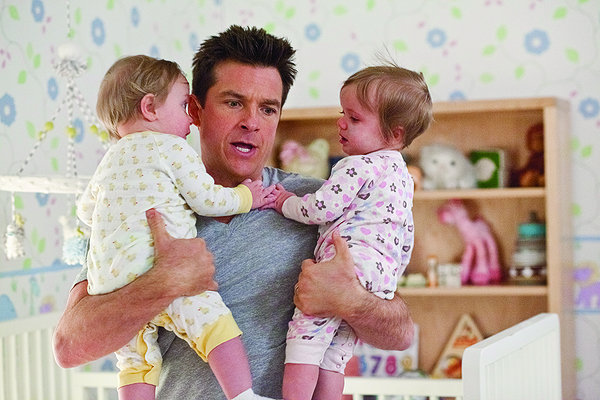 I knew I was in trouble by the first minute of the grossly unfunny Change-Up. Not only do we suffer a poop joke so early, we have to witness a baby firing a stream of fecal matter into Dave’s open mouth. That’s just a taste of the unpleasantness that follows. The movie plays like an exaggerated, sophomoric cartoon written by children. It seems to exist in the same broad universe of 2009’s abominable rom/com The Ugly Truth. What I wrote for that movie could easily apply to The Change-Up: “It’s questionable whether the comedy even reaches juvenile levels. It’s tasteless and piggish, but the weird part is that it comes across as knowledgeable on the subject of sex as a ten-year-old kid who just discovered his dad’s secret stash of Playboys. It talks about the right stuff but does so in a clueless manner. It’s like an exaggerated randy cartoon that chiefly plays to a male fantasy.” I’m not opposed to raunchy sex comedies. However, I am opposed to sex comedies that can’t figure out how to be funny without relying on easy gags. There’s a difference between gross-out humor and simply being gross, though I don’t believe this film knows what that difference is. So we’re treated to an over-the-hill porn star, some anal defilement, a voraciously sexual nine-months pregnant lady, even more poop jokes, and 90 minutes of penis discussion. There’s one actually interesting section where the guys debate the moral ambiguity of body-swap sex. Is it really cheating if Dave/Mitch is in somebody else’s body? What is Mitch/Dave to do if his wife wants to have relations? Sadly, this lone moment of interest is crushed to death by more penis jokes and then forgotten. Reynolds (Green Lantern) and Bateman (Horrible Bosses) try to stay above the fray, fighting the good fight, but even they succumb to the unfunny script and disjointed direction.
After being a distasteful cartoon for so long, the film wants to be dramatic. It wants to be emotional. Tough break, Change-Up, because you cannot have it both ways. The dramatic parts ring resoundingly false, a last-ditch attempt to class up what is a deeply unclassy picture. The tonal shifts are jarring and land with crashing thuds. It’s mostly because these characters are deeply unlikely, particularly the Mitch persona. He’s not just some brash, rude individual who sidesteps social mores, no this guy is downright sociopathtic. He’s egotistical, mean-spirited, and constantly boorish to every person in Dave’s life. He’s cruel to the daughter, he tells Dave’s wife that she’s not attractive, and then there’s the babies whom he treats like a couple of rag dolls to toss around. At one point, Mitch/Dave is on the phone and the kids are left to get in trouble with the kitchen. We’re not talking about getting messy with food, we’re talking sticking their tiny hands in a spinning blender, throwing knives, and licking electrical outlets (it’s like the Roger Rabbit cartoon that opened that flick). Instead of getting off the phone immediately, he continues talking and casually tends to the troubled tots per potential disaster. He teaches Dave’s daughter “violence is always the answer.” Mitch is an unrepentant jerk, and even when Bateman plays Mitch he’s still irredeemable. Am I supposed to feel sorry for this obnoxious guy just because his dad thinks low of him? I think low of him. I detest him. Therefore, when Mitch/Dave is having his Big Emotional Catharsis, it seems facile and hollow. We can generally find a point of likeability for uncouth characters, but not Mitch. As presented, this character has no introspection and few redeeming qualities, so why do I want to spend nearly two hours with this person? You’d think Dave would be the “nice guy” alternative, but he’s smarmy and neglectful too. Besides the “family man/pussy” and “playboy/prick” designations, the characters aren’t different enough to warrant a change of scenery.
 The Change-Up has the single most bizarre moment of any film this calendar year, and it has nothing to do with the metaphysical mechanics of body swapping. Wilde (Cowboys & Aliens, TRON: Legacy) at one point gets rather frisky and takes off her clothes, the last piece her brassier. Mitch’s hands cover her breasts for most of their onscreen freedom except for a handful of side angle shots where Wilde’s breasts are out and ready to greet the audience. Except those are and are not Wilde’s breasts per se. The in-demand actress had pasties to cover her nipples. The pasties were then digitally removed in post-production and replaced with CGI nipples. Let me repeat that for the slower among you – CGI nipples! It was some guy’s job to spend weeks painting nipples onto Olivia Wilde’s breasts. When I see nudity, can I trust that it’s real, or was it doctored by some computer technicians who are laughing at me the whole time? What is happening to this world when it makes me distrust the very sight of breasts?
The Change-Up is a mean-spirited, objectionable, nasty, classless, clueless comedy that’s tonally all over the place. The characters are unlikable, the comic setups are cartoonishly drawn, and the dramatic shifts are flatly false. What’s even worse is that the movie just seems downright hostile toward women. Just because it has a scene where Mann gets to vent the frustrations of the put-upon wife/mom doesn’t mean women are given a fair shake. I’d be more forgiving if the vulgar comedy was ever funny. The Change-Up erroneously believes that having characters say dirty words or inappropriate remarks is the same as comedy. It can be a component of comedy but rarely does it work as a whole substitute. The jokes fall flat, the drama feels forced, and the characters range from nitwits to jerks to deviants and back to jerks once more for good measure. Why would anyone subject themselves to nearly two hours with these people? I just felt bad watching this movie. The Change-Up makes humanity look like a species that deserves an extended time-out.
Nate’s Grade: D+
Share this:

Buried (2010)
 Spending 90 minutes trapped in a cramped space with a sweaty Ryan Reynolds? Doesn’t sound like a bad start for large swaths of the population. Buried is a small indie experiment that places Reynolds in exceedingly tight quarters. Paul is an American contractor driving trucks over in Iraq. Insurgents ambushed his convoy. He awakens to find himself trapped in a coffin and buried under the earth. Packed away inside with him are a lighter, a pen, and most importantly, a cell phone. Can your carrier get you coverage buried under the Iraqi desert? Time to switch, my friends.
For those left curious, yes, it really does take place entirely within a coffin. The entire 95 minutes are spent inside the small space. There is nary a flashback or even a visual insert to be had. You are trapped in that box just like Paul. The film is effectively claustrophobic. Director Rodrigo Cortes (The Contestant) gets terrific mileage out of his ultra confined space. The creative combination of angles, lighting, and nimble camerawork ensure that audiences do not grow tired of seeing the same 6 x 3″ of set. You can practically taste the sweat and dank air on screen. Buried has the most inspired camerawork I’ve seen in a film since 2006’s Children of Men. Cortes has only so much space to room to work and yet he does a magnificent job of manipulating the space to accentuate Paul’s fears and isolation. There are a few shots where the camera seems to keep zooming out, further and further, much further than the ceiling of that box would allow, like Paul is sinking below the sand.
 The script by Chris Sparling is agile and resourceful and keeps finding news ways to keep your eyes glued to the screen. The movie is consumed by that nerve-wracking sense of urgency. The first minute and a half of the film is in darkness, and we awaken to the terror of the situation just as Paul does. Including a cell phone seems like a necessary screenwriting plot device. If Paul awoke by his lonesome, the movie would turn into 90 minutes of watching a guy screaming himself hoarse and clawing away at the wooden walls. A cell phone opens up the narrative. Now Paul has something of a fighting chance to survive. It gives him the motivation to survive and adapt to his surroundings during his limited last moments. The cell phone also allows the bad guys to terrorize Paul over and over. They can make increasingly hostile demands even with their hostage lodged six feet under ground. The demands for money get more and more aggressive, leading to one-sided negotiations, like Paul filming a plea for help that terrorists can exploit and upload to the Internet. The people that Paul does get through to offer little in assistance. To them, it’s just another day going through the same motions, taking down the same messages. Cries for help may not rise above the fray.
The political commentary is, in a word, indelicate. The Iraq War commentary can feel a tad ham-fisted at times in how it wants to boil down and extrapolate Paul as a symbol of the war’s untold hidden human costs. Paul is a contractor paid to ferry supply along the dangerous roads of Iraq. He’s supposed to be seen as “just any guy,” that is, any American Joe. He symbolizes the lost lives that don’t manage to make the news because they don’t have stars and stripes on their uniforms. The Iraq War made use of hundreds of thousands of privet industry contractors, supposedly easing the burden of the U.S. military. Paul is intended to represent the forgotten casualties of war, the people who were merely punching a clock in a foreign land to help their families. The officials that Paul does get through seem more concerned with personal agendas then retrieving an entombed man. The military is concerned, sure, but more interested in locating and killing the terrorists/insurgents that ambushed Paul’s convoy. The State Department is more concerned about containing Paul’s story and ensuring media outlets don’t find out. They’re really worried that any ransom video Paul records will become an Internet sensation, particularly in the dry, dusty part of the world, and become a recruitment tool. Paul’s company is more worried about weaseling out of paying his insurance policy. The movie aims to ask what is the price of one life. Is it just a numbers game? Is losing an American contractor every few weeks worth the price of freedom? What is the definition of an acceptable loss?
 The movie is really a one-man show, so it’s fortunate to have an actor of Reynolds capabilities. He’s used to playing charming, self-effacing, fast-talking rascals; he has an innate ability to command your attention and interest. Reynolds gives a deeply empathetic performance. He goes through different stages of emotions, from shock and horror to anger and frustration, to impotence and self-pity, and all the way back again. You will think step-by-step with him as he tries to assess his situation. It’s a performance rooted in manufactured seclusion, something akin to the one-man show that Tom Hanks shared with a scene-stealing volleyball. Except Reynolds’ commitment seems even greater than what Hanks endured; Reynolds face is in every frame of this film. It would have been very easy for an actor to use the situation as an excuse to bounce off the walls, chewing scenery as an effective means of escape. But Reynolds dials down the histrionics. His character feels awkwardly real under the extreme circumstances.
I really enjoyed the concept, execution (the ending is note perfect), but I also found many of Buried‘s smaller moments to be more than worthwhile. When Paul begins to doubt he’ll ever be found in time, he mentally prepares himself for the inevitable. He films a last will and testament to be found with his corpse, whenever he is eventually unearthed. He leaves messages trying to reach out to love ones one last time. And perhaps most heartbreaking of all, Paul tries to reach his elderly mother, an Alzheimer’s patient in a rest home. He desperately wants to hear one last “I love you” from his mother’s voice, but the woman’s brain is a mental carousel and she is unable to comply. I thought about my own acceptance process if I was in Paul’s exact situation, and I know how much significance I would place on achieving some form of saying goodbye. In order to let go I would need to speak to the people closest to me and tell them how important they were, how much they meant to me. To be denied something so vital to acceptance is cruel. And Paul is denied his one last meaningful goodbye, and I found it to be aching and emotionally terrifying.
If you have any minute fear of tiny spaces or being trapped and helpless, then Buried will get under your skin big time. Add the general race-against-time nature of the script and the flick hums with nervous tension. This film is taut like a drum. It’s ridiculously tense. You may start to feel your feet moving, as if you’re trying to push away the space and dig your way out. It’s hard to believe but a movie that takes place entirely inside a box is one of the most inventive, visually appealing, and enjoyable films of the year.
Nate’s Grade: A
Share this:

The Proposal (2009)
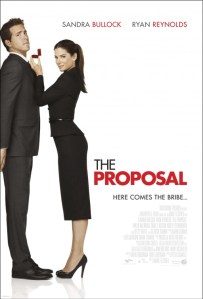 Romantic comedies can be elevated by the chemistry and comic abilities of their leads. I think the most painful modern pairing was Maid in Manhattan, which featured polar opposites Jennifer Lopez and Ralph Fiennes (could you find a more unlikely couple outside of Harold and Maude?). With The Proposal, Sandra Bullock takes a break from her usual pratfalls and finds a worthy sparring partner in the charming, self-effacing Ryan Reynolds. Bullock is a mean book editor who must get married ASAP or be deported back to Canada, and Reynolds plays her beleaguered assistant and surprise sham fiancé. The two actors have a terrific rapport and generous give-and-take, propping the other to higher achievement; they feed off each other. Their spirited, snappy, collaborative, and most significant, fun relationship is what won me over. Otherwise, The Proposal would likely have succumbed to its wealth of genre clichés, like kooky relatives (an irascible Betty White), contrived conflicts (see: premise), last-minute misunderstandings, and the collapsed window of time. These people go from hating each other to loving each other over the course of one weekend in Alaska. Yet through it all, Reynolds and Bullock kept me smiling and alert, saving me from cuteness overdoses. Hopefully Bullock and studio execs will learn from this that bickering couples work best when the actors can play nice together.
Nate’s Grade: B
Share this:

X-Men Origins: Wolverine (2009)
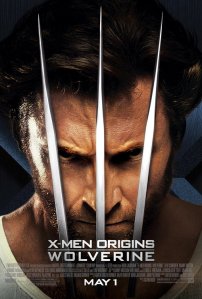 X-Men Origins: Wolverine has been slashed from all sides. First, the movie has not been able to shake bad buzz, from extra reshoots to rumors about conflicts between the studio and the director. There was even one rumor that the head of 20th Century Fox Studios ordered a wall repainted a happier color. Then in early April it got even worse. A DVD-quality print of Wolverine was leaked onto the Internet and spread like crazy, and once something finds itself inside the realm of cyberspace it cannot be put back. The reaction to the leaked copy was mixed, at best. The studio went into damage control mode, stating that the leaked copy was an unfinished work print, that they too were not thrilled with this version and paid millions for reshoots, and the final version that would be released in theaters had 20 minutes of new stuff and 10 minutes additionally edited out. But guess what? The wolverine’s out of the bag, it’s the same exact version minus some completed special effects shots. What amuses me about this whole situation is that the studio is on record trashing the movie, saying they were unhappy with this version, and yet this is the final release. After having seen Wolverine, at least I can say that those Fox execs know mediocrity when they see it.
We get to witness the storied history of Wolverine (Hugh Jackman), which goes all the way back to the pre-Civil War era. Born James Logan, and a mutant, the kid had the unusual ability to produce three jagged bone claws from his knuckles. Logan also had the ability to miraculous heal like his older brother, Victor “Sabertooth” Creed (Liev Schreiber). The two of them make use of their primal, animal instincts and near invulnerability by fighting in every major U.S. war, from Civil to Vietnam. Eventually that kind of thing gets noticed, and General Stryker (Danny Huston) recruits the brothers to be apart of a mutant mercenary group. The group also includes the likes of William “Deadpool” Wade (Ryan Reynolds), “The Blob” (Kevin Durand), and some other unimportant mutants (one of them played by a Black Eyed Pea, will.i.am). Wolverine walks away from the group when he decides that he isn’t cut out for a cutthroat life.
The man finds a quiet place to live along the Canadian Rockies. He’s found a hard-working job, lumberjack, and a good woman, Kayla (Lynn Collins), who loves him. All of this is ruined when Sabretooth comes back around, intent on eliminating the former mercenary members one by one. Stryker appeals to Wolverine to apply for the Weapon X program. He says he can give Logan the tools for his revenge. Wolverine then undergoes the famous procedure that bonds his skeleton with adamantium, an unbreakable metal, and his bone claws become extra sharp metal. Stryker has other plans, naturally, and Wolverine breaks out of the facility. Stryker tells his assassin, “Bring me back his head.” Sorry pal, but you’re the one that just spent half a billion dollars giving Wolverine an unbreakable spinal column.
 Is this origin tale worth telling? Short answer: no. The mysteries behind Wolverine’s back-story aren’t too involving and the answers make the character less interesting. I don’t really care why Wolverine got his metal skeleton or how he came to be an amnesiac, I just accept that the man has some mystique to him. I care even less that one of the answers to those mysteries is a murdered lover. The plot is incredibly thin; Wolverine meets one mutant who tells him to meet another mutant who tells him to meet another mutant, etc. Eventually the film heads for a mutant showdown that plays out like a lame video game, specifically the mid-90s Mortal Kombat (the Final Boss super villain resembles the blade-handed Baracka). What are Gambit (Taylor Kitsch) and Emma Frost doing in this? That?s not the end of the mutant cameos, either. I feel like the only thing we learn about Wolverine is that his super sense of smell cannot detect the difference between real blood and stage blood. The filmmakers think character development involves someone saying no to slaughtering innocents, and then other characters keep telling him, “You’re not an animal.” The movie meanders from one unimaginative special effects set piece to another, stopping at points to shove in various mutants that serve little purpose to the story other than diehard comic fans will be more forgivable.
Oh, but what to do when your main character is indestructible, your main villain is also indestructible, and your other lead villain cannot be killed because he?s due for an appearance in X-Men 2? Why you bring in a third, nigh indestructible being into the stakes, however, this being doesn’t already play into the established X-Men onscreen mythos, so this guy’s okay to kill off, that is, until he too gets a movie built around his character and then that movie has to backtrack to fill in on time before its capped ending. We already had a healing ability mutant with super claws vs. a healing ability mutant with super claws smackdown in X-Men 2, where Lady Deathstrike fought Wolverine. That fight was brutal and well staged. The fights in Wolverine’s big show are uninspired; how much stabbing can you watch between people who instantly heal? Also, apparently another side effect of the Weapon X program is that these metal claws are self-cleaning, because every single damn time Wolverine stabs someone there isn’t a droplet of blood to be found on his claws. It?s hard to get emotionally involved in characters that are fearless and have little at stake. Which, of course, is why Logan had to be given a cruddy romance where he gets to hold his dead lover?s body in his arms and bellow to the heavens for what feels like the 80th time. Seriously, twenty percent of all the dialogue in this movie is some combination of growling, spitting, and bellowing.
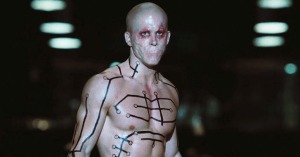 Wolverine isn’t a terrible movie but it’s rather shoddy and thoroughly mediocre. I never thought I’d see this character do the beyond-cliché action movie motif of strutting in slow-mo while an explosion sizzles in the background. This is the kind of film that involves a super team standing shoulder-to-shoulder to walk down like they’re from The Right Stuff. This is the kind of movie that opens with a needless family squabble about Logan finding out the pointless identity of his real father. What was that about? (After killing his father, I remarked to myself, “I guess that he gets that whole healin’ thing from his mother’s side of the family.”) This is the kind of movie that hires Ryan Reynolds and then disarms the man of his greatest asset, his smart mouth. This is the kind of movie that theorizes the only thing to kill an adamantium-skeleton man is with an adamantium bullet, like a sort of werewolf. This is the kind of movie that sends a super assassin, with super bullet-bending powers, out to kill Wolverine but does not arm the super assassin with those special adamantium bullets. Why not shoot this guy in the eye? That is an open body cavity. This is the type of movie where the final super villain is controlled by, get this, key commands like “Engage.” This is the kind of movie where an assortment of characters refrain from killing super bad murderers out of the morally pretentious idea that they, too, would be no different from the super bad murderers. Excuse me, executing super bad murderers would be doing the world a favor here. This is the type of movie that fills the running time with pained dialogue like, “You wanted the animal, you got him,” and, “Nobody gets to kill you but me,” and the best line of them all: “I thought you were the Moon and I was your Wolverine. Turns out you’re the Trickster and I’m just the fool who got played.” Top that, screenwriters.
Whatever the budget was for this movie, well, apparently it wasn’t enough. The adamantium effects looked perfectly reasonable in the first X-Men film and that was nine years ago, so I cannot understand why the claws look astoundingly fake this go-round. They look like direct animation, like Wolverine is holding cartoon claws a la Who Framed Roger Rabbit? When did they become so thick too? These claws are like the size of the steak knives you get at restaurants.
Jackman deserves some of the blame here since he is listed as a producer and he hand selected director Gavin Hood (Tsotsi, Rendition) who does not have the interest or the eye for this kind of material. Hood lacks the finesse and vision to stage exciting action sequences, which explains why he falls back on tired genre tropes like the slow-mo strut in front of fireballs. I am dead certain that this stupid super assassin was pushed into the movie after film producers saw how much money the bullet-curving Wanted made the previous summer. The movie borrows heavily from recent Marvel Origin comics, or so I’m told, which is where the whole “Wolverine through the ages” storyline comes from. Personally, I don’t much care for the idea that Wolverine’s healing ability also deters aging until you hit that agreeable, desirable Hugh Jackman age range, but fine, whatever. The movie takes great effort to showcase Jackman’s flawless physique, and this dude is ripped to the point that you can see bulging veins. I just wished Jackman made more use of his acting muscles in this movie. He snarls and glares, and even has a softer moment or two with Collins, but rarely does Wolverine get to prove why he is such a beloved comics character.
 Thank goodness for Liev Schreiber (who actually also co-starred with Jackman in the forgettable romantic comedy, Kate & Leopold) because this man entertained me from start to finish, which is more than I can say about his movie. Schreiber has fun with his role and totally buys into the character’s animal instincts. He relishes the kill. The bizarre sibling rivalry between he and Wolverine is the best part of the movie, and the interplay between the two actors is when the movie has its few moments of life. Like Watchmen, the film finds its creative peak during the opening credits, as we watch Jackman and Schreiber claw and bite their way through American battlefields.
Here’s an easy solution to the Wolverine amnesia issue that doesn’t involve the use of admantium bullets. Kayla (Silverfox) has the power of hypnosis through touch, so why not in the emotional climax have her touch her dear lover Wolverine and wish, “Forget me. Forget all about me.” There, problem solved, and this way it works emotionally and organically with the story. It took me an hour after seeing X-Men Origins: Wolverine to come up with a better ending, so just imagine what more time will allow. Jackman and company are lost thanks to a mediocre script that sacrifices character for action beats, and even then the action is fairly mundane. There are a handful of cool moments, like Wolverine propelling himself onto a helicopter from an exploding car, but after four movies nothing has come close to producing the adrenaline rush that was the X-Men 2 sequence where Logan unleashes his berserker rage on the commandos in the mansion. By the end of his first solo outing, Wolverine is left without any memory. I won’t say we should all be so lucky but the X-Men filmmakers would be better off paying little attention to this origin tale, unless they want to bring Schreiber back, which they should do at all costs.
Nate’s Grade: C
Share this:

Definitely, Maybe (2008)
 Adam Brooks has spent his whole career in the romantic comedy gutter. His screenwriting credits include French Kiss, Practical Magic, Wimbledon, and the second Bridget Jones flick. Not a whole lot of quality there. Definitely, Maybe is Brooks fourth writing and directing effort but the first to get a major push from the Hollywood studios. Maybe the same purveyors of formula fluff realize that Brooks finally has something good on his hands.
Will Hayes (Ryan Reynolds) picks up his ten-year-old daughter Maya (Abigail Breslin) from school on perhaps the worst day of the school year: sex education day. Kids are crying, parents are stammering to explain, and Maya casually exits her classroom, walks up to dad, and says point blank, “We need to talk.” She wants to know all about the story of how her father and mother, now divorced, met. Finally Will agrees but decides to play a game. He will changes names and identifying characteristics and Maya will have to guess which of his three loves became her mother. Emily (Elizabeth Banks) is Will’s college sweetheart from Wisconsin. Summer (Rachel Weisz) is an ambitious journalist with a taste for older men. April (Isla Fischer) is a Bohemian free spirit that Will meets working on the 1992 Bill Clinton presidential campaign. Maya sits in her bed and pays rapt attention to what she calls a “mystery romance.”
Miraculously, Brooks has written a romantic comedy where the characters are, dare I say it, well developed human beings. These folks are more than stock roles for the genre; in fact, each woman is smart, genuine, charming, fun, and desirable, and yet each woman also has her own set of realistic flaws. Brooks makes sure that we, the audience, admire each woman and recognize that any of the three would make a fine selection. These characters feel real, which is almost unheard of for a genre about ticking biological clocks, cloying and precocious tykes, irrationally sexist and self-absorbed characters, forced misunderstandings that lead to contrived reconciliations that involve some form of chase. Having recently seen 27 Dresses, which plays close to the typical rom-com formula, I appreciate Definitely, Maybe even more.
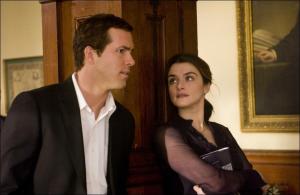
This is a romantic comedy that respects its characters and respects its audience. The people might make bad or impulsive decisions but Brooks doesn’t pass judgment, and, my God, it’s refreshing for the genre. I rolled my eyes when I read blurbs about Definitely, Maybe being “the best romantic comedy since [1976’s] Annie Hall.” While I wouldn’t necessarily go that far, Definitely, Maybe is definitely the best and most enjoyable conventional Hollywood romantic comedies in years (For those wondering what non-conventional romances got me jazzed, here is a small list: Eternal Sunshine of the Spotless Mind, Amelie, Secretary, Once, Sweet Land, A Very Long Engagement, Brokeback Mountain, Aimee and Jaguar, and Before Sunset).
Brooks chronicles Will’s romantic escapades along the timeline of Bill Clinton’s rise in national politics, which is an interesting way to look backwards in time and still be relevant to modern audiences thanks to Mrs. Clinton’s race to reoccupy the White House. I found it interesting that Will’s emotional journey seems to be charted along the same ups and downs as Bill Clinton’s time in office, so when Clinton is mired in the Monica Lewinsky scandal and questioning the definition of the word “is,” Will has lost his idealism and grown into a cynic. He even openly criticizes with great frustration and ire the man he helped put into office. Will’s enthusiasm and disenchantment for Clinton mirrors his budding relationships with women.
Definitely, Maybe has a handful of memorable moments and some amusing dialogue, but Brooks has crafted one hell of a meet-cute scene between Will and April. After an initial first meeting at the campaign headquarters, Will is purchasing a pack of cigarettes when he spots April purchasing a pack of organic cigarettes. He playfully mocks her more expensive purchase. She counter punches and says that her brand is made from better stock and will actually smoke slower, thus being the better purchase. He challenges her to a smoke-off and the two step outside, light up, and for the sake of scientific research they take equally long drags, and sure enough Will’s cigarette cannot last as long. They laugh and eventually Will visits April’s apartment and learns about her poignant search for her lost copy of Jane Eyre out there that has her father’s inscription. It’s a great scene that allows both actors to size each other up.
Thanks to each woman being presented fairly the movie doesn’t make it obvious which woman will eventually become Maya’s mother. The ladies fade in and out through the plot. The guessing game gimmick grabs our intrigue early and Brooks doesn’t tip his hand until the film’s end. What I find interesting is that Will changes with each woman and could feasibly be happy with any of the three, a desirable predicament if ever there was one. The movie even tackles divorce sincerely and without any doom and gloom overly dramatic pronouncements. Definitely, Maybe doesn’t go out on a limb and certainly isn’t remotely edgy, but the flick has a soothing, amiable adult spirit. It may not be revolutionary but simply telling a good story with mildly relatable characters seems like a great step in the right direction for this oft-sneered at genre.
Reynolds knows how to work his suave charisma to a fault. He’s certainly a capable leading man for romantic comedies and he can deadpan with the best of them. He seems like he could use a bit more direction, because there are moments where he seems to be falling back on his standard sly, indignant persona that has characterized his comedy work from 2002’s Van Wilder and on. His interaction with all three women produces varying spikes on the chemistry chart, and for my money he scores the best sparks with the subdued seduction of Weisz.
 The women of Definitely, Maybe are the real winners here even if only one will eventually take home Will. Fisher becomes the heart of the movie and, given the most emotional material, shines the greatest. Banks is wholesome and easy to get cozy with. Weisz is the most enigmatic of the three and offers a beguiling yet very knowing charm. She has a very seasoned sensibility. Her on-again off-again affair with an aging literature professor (a fabulous Kevin Kline playing a fabulous blowhard) adds an intriguing dynamic to her character. The only irritant for me was Breslin’s acting, which was just off enough to annoy me.
Definitely, Maybe is a romantic comedy that proudly treats its characters with respect and develops them into relatable, authentically human characters in a typically inauthentic universe. Brooks mines a gimmick for all its worth, but even after the signs become clear the film is still pleasurable in its predictability thanks to the great characters. It’s rare to see a romantic comedy that bestows a moderate amount of characterization; usually these roles just fall under archetypes. Brooks has shied away from the trappings of the genre (there isn’t a single sing-a-long!) and crafted a genuine romantic comedy that doesn’t rely on sentiment and easy answers even as it heads toward happy ending material. The movie even tackles divorce from a non-judgmental yet honest approach. As far as I’m concerned, Brooks has made amends for his previous screenwriting duds and made a movie that men can truly enjoy as they’re dragged into the theater by their significant other. I would definitely recommend Definitely, Maybe to fans of the genre. This is one worth seeing, folks.
Nate’s Grade: B+
Share this:

Smokin’ Aces (2007)
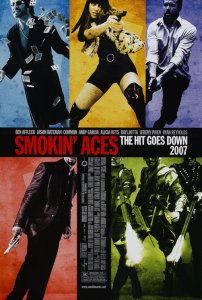 Writer/director Joe Carnahan (Narc) wants to impress an audience so bad with his muscular and macho gangster flick, but his Smokin’ Aces is vapid, nihilistic, and opines not to simply be a Tarantino rip-off, but a rip-off of a Tarantino rip-off. The premise seems ripe enough as we follow a rogue’s gallery of hitmen and killers trying to be the first to knock off a mob snitch/Vegas magician (Jeremy Piven) for a million dollar bounty. The colorful characters are introduced and some are quickly and unexpectedly taken out, but Carnahan never fully knows what to do with his bushel of baddies after he establishes their character quirks. The killers don’t really interact that much with one another and some of them hardly have any screen time at all; perhaps less would have been more in this jumbled stew. Carnahan throws out a few nifty visual tricks but it’s all superfluous and empty. Smokin’ Aces moves quickly, doesn’t make much sense in the beginning and end, and little to any of the characters have satisfying conclusions. So much of the writing feels like lame macho posturing without anything new or interesting to add to an overstuffed shoot-em-up. There are cops, robbers, plenty of gunfire, lesbians, and all sorts of convoluted twists, but it never holds together. Carnahan throws a lot of different elements together but they never extend beyond the elemental stage, so every storyline and character feels like an introduction that?s never capped off. The man has no idea what to do with what he’s started, and a karate kid on Ritalin is all the proof I need. Guy Ritchie did this territory far better service with the marvelously entertaining 2001 film Snatch. Rent that instead and save yourself the headache.
Nate’s Grade: D+
Share this:

Waiting… (2005)
 I have always respected restaurant workers; it’s just how I’ve been brought up. Short of elephant in vitro fertilization, being a waiter has got to be one of the hardest, most thankless jobs on the planet. The waiter (or server, the popularized non-gender specific term) is always the last responsible for food and the first to bear the brunt of a customer’s wrath. They’re easy targets. Their livelihood is also dependent on the idea of common decency in mankind. For these tortured, put upon, overlooked lot comes a new comedy aimed to ease the pain. Waiting… is a balls-out (pun very much intended) gross-out comedy that will make you a better, more sympathetic tipper (I generally start at 20 percent).
Welcome to the wonderful, family-friendly world of Shenaniganz. It’s another day of business for the restaurant staff and another day of enduring the slings and arrows of unruly customers. Monty (Ryan Reynolds), the leader of the pack, escorts a newbie (Freaks and Geeks‘ John Francis Daley) through the rules and customs of the Shenaniganz family. The cooks (Dane Cook, Luis Guzman) like to get randy at work, the bus boys (Max Kasch, MTV’s Andy Milonakis) like to hide in freezers and toke up, and the wait staff (Anna Faris, Justin Long) are all dating each other. Meanwhile, Dean (Long) is mulling over whether to take the manager’s job offered to him by his buffoonish boss (David Koechner). He feels his life is going nowhere and he’s stuck in a dead-end job. And there’s a store-wide game where workers try and get other people to inadvertently look at their genitals. God I hope this doesn’t go on when I order my food.
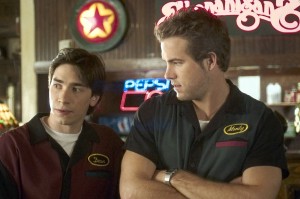 Bishop (Chi McBride) tells two other characters, “You guys are so one-dimensional.” It’s like the movie’s doing my job for me. Waiting… is stocked with underdeveloped characters that don’t even seem used properly. They all have one characteristic of note, from the white wannabe rappers to the bitchy self-loathing server that’s been there longer than anyone else. There’s a lesbian bartender and by the end of the movie that’s still the only thing you know or feel about her. Dean’s girlfriend (Kaitlin Doubleday) has nothing to add to her character, nothing to really say, no personality, she’s just “the girlfriend.” Waiting… has so many lame, poorly developed characters that go nowhere and shed little purpose or personality. It’s a general waste of talent, especially Faris and Guzman.
Reynolds is a charming and gifted comedic actor. He’s got the rat-a-tat-tat delivery down cold and adds a great polish to dialogue that ordinarily wouldn’t seem funny. He can seem at once jerky, knowing, charming, distasteful, and funny. Consider Reynolds a Vince Vaughn Jr. in the making. Long is supposed to play a character dissatisfied with his bearings in life, yet he comes across as disinterested in being in the movie. You almost expect him to shrug his shoulders and just say, “Whatever.” Long too is a very capable comedic actor but he needs far broader roles (Dodgeball) than something where he has to shuffle his feet and mope a lot. As stated earlier, Waiting… really wastes most of its talent by stranding them in thankless roles that don’t give them much to do or add. Koechner is the bright spot as a clueless, leering buffoon of a manager who keeps trying to connect with “the kids” and score with some as well.
 The story feels the same way. For a 90 minute movie so much of this feels unbearably plodding. Waiting… sets up the life of a restaurant well but then can’t find much to do. The story feels formless and the characters can?t provide any direction because of their limitations. The plot seems like a group of anecdotes looking for structure. Even the comedy is rather uninspired and bland. Waiting… attempts gross-out guffaws but just ends up becoming, well, kind of gross. Dropping food and serving it doesn’t exactly register on the Ha-Ha meter no matter how many times the act is repeated. The gross-out apex comes when vengeance is heaped upon a very hostile customer with an assembly line of new “additions” to her order. In this one instance the gross-out is transcended because the audience cares about the situation. Most of the humor is juvenile and not even good at it; the penis-showing-game is inherently homophobic and a running gag with little payoff. The best joke in Waiting… is the film’s production design; Shenaniganz looks nearly identical to those homogenized chain restaurants dotting the landscape. If you stay throughout the entire end credits you’ll discover that all the crap on the walls is actually an elaborate, Rube Goldberg-esque device.
Waiting… is a very knowledgeable film about the food service industry, what with writer/director Rob McKittrick spending years and years in restaurants. I think the only way you could seriously enjoy this comedy, while sober, is if you have experience working in food service. My fiancée has spent years as a server and she identified more with the characters than I ever could. There are scenes in Waiting… that are a server’s fantasy, like when Dean returns his measly one-dollar tip back to his customer. The movie is a safe release for people in the field, much like Office Space. McKittrick even thanks Kevin Smith in the closing credits, but Waiting… doesn’t have an iota of the wit, intelligence, and comedic savvy of Clerks. This is a bargain basement comedy that will largely appeal to fellow restaurant slaves yearning to have their beaten voice heard.
Waiting… is an aimless comedy with no characters to feel for, little personality beyond its knowledge of the restaurant environment, and a cast done in by one-note roles and bland gross-out jokes. Reynolds walks away with his dignity and adds a comedic polish to some otherwise ordinary jokes. Mostly, the film feels like a waste of time, energy, and talent. Waiting… will definitely appeal to people who have felt the wrath of working in food service, but objectively this is one comedy that just doesn’t order up any laughs.
Nate’s Grade: C


 nathanzoebl
You must be logged in to post a comment.