Blog Archives
Vanilla Sky (2001) [Review Re-View]
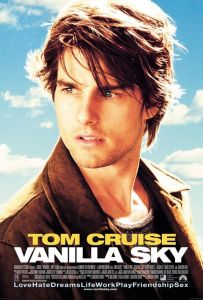 Originally released December 14, 2001:
Talk about a film’s back story. Tom Cruise signed on to do a remake of the 1997 Spanish film Abre Los Ojos (Open Your Eyes) which was directed by Alejandro Amenabar. During the filming the romance between Cruise and Penelope Cruz (no relation) got a little hotter than expected onscreen and broke up his long-standing marriage to Nicole Kidman. At the time she was finishing filming The Others which is the second film by Amenabar. This, by the way, is much more interesting than Vanilla Sky unfortunately.
Cameron Crowe’s remake starts off promising enough with Tom Cruise running around an empty Times Square like a Twilight Zone episode. Afterwards the film begins to create a story that collapses under its own weight. David (Cruise) is a rich boy in control of a publishing empire inherited through his dear old deceased dad. He has the time to throw huge parties where even Spielberg hugs him, and even have crazy sex with crazy Cameron Diaz, whom he tells his best friend (Jason Lee) is his “f*** buddy.” David begins to see a softer side of life with the entrance of bouncy and lively Sophia (Cruz) and contemplates that he might be really falling in love for the first time. But this happiness doesn’t last long as jealous Diaz picks up David in her car then speeds it off a bridge killing her. Then things get sticky including David’s disfiguration, his attempts to regain that one night of budding love and a supposed murder that he committed.
 Crowe is in over his head with this territory. His knack for wonderful exchanges of dialogue and the perfect song to place over a scene are intact, but cannot help him with this mess. Vanilla Sky is an awkward mish-mash of science fiction. The film’s protagonist is standoffish for an audience and many of the story’s so-called resolutions toward the end are more perfunctory than functional. The ending as a whole is dissatisfying and unimaginative. By the time the wonderful Tilda Swinton shows up you’ll likely either be asleep or ready to press the eject button yelling “cop out!”
Seeing Vanilla Sky has made me want to hunt for Amenabar’s Abre Los Ojos and see what all the hype was about, because if it is anything like its glossy American counterpart then I have no idea why world audiences went wild for it.
Nate’s Grade: C
——————————————————
WRITER REFLECTIONS 20 YEARS LATER
Movies have long resorted to being interactive puzzles, inviting audiences to unravel the mystery and hunt for clues as detectives. That’s essentially what Vanilla Sky is at its best, a messy mishmash of a movie that aims a little too high and pins its hopes with a generally unlikeable lead. This psychodrama is meant for dissection, not in a dreamy, obtuse way that David Lynch films invite but more in a canny re-calibration of pop-culture homages and fantasies. The big twist of the movie is that David (Tom Cruise), a rich publishing scion recovering from a savage accident, has elected to live in a simulation, a lucid dream that has been his home for the last hundred-plus years (how kind of the multiple generations of knob-turners to keep things operating). Other stories have followed a similar Twilight Zone-esque twist on the same territory, including the beloved “San Junipero” episode of Black Mirror (that’s right, spoilers, spoilers all around for older sci-fi). Writer/director Cameron Crowe has stated there are over 400 pop-culture connections and references to be had with this movie. The movie is wall-to-wall cultivated jams, as expected from a Crowe picture, but the homages and recreations go beyond simply placing a piece of music to a scene or name dropping an artist. The visual language of the movie is intended to be deconstructed, built upon twentieth-century album covers, music, movies, and plenty more. It’s a dense artistic gamble and, ultimately, I question who is even going to care enough to dive into this movie? Who is going to want to watch Vanilla Sky as a detective?
 This American remake of a 1997 Spanish movie was, in hindsight, the beginning of the end of Crowe’s career as a major director of studio movies for adults. Crowe had just experienced the apex of his career with 2000’s luminescent Almost Famous, a warm hug of a movie, and he had won the Oscar for Best Original Screenplay. It makes sense to try for something big, reunite with his Jerry Maguire star, and go outside his comfort zone with a wide artistic berth of freedom. The 2001 movie just did not work, though not strictly because of Crowe’s game efforts. This is not a miscalculated folly, an artist flying too close to the sun and getting burnt by their arrogance. I think the major flaw comes down to pinning the mystery on the recovery of the romantic and social life of a disagreeable lead character. Early on, David is established as rich, careless, and smug. He keeps his responsibilities as fleeting as his relationships with women. When his on-again-off-again paramour, Julie (Cameron Diaz), drives off a bridge with David inside, part of you might be thinking he deserves what he got for being so callously indifferent with other people. That’s harsh, I realize, but people will not like David, and this is amplified by the general public’s diastase for Cruise himself. Therefore, watching a movie where he tries to overcome him disfigurement and disability and stop being a jerk to everyone in his life is not a journey that invites the viewer to come aboard. He’s just not that interesting as our centerpiece. What’s happening to him can prove interesting, especially as the movie plays with our mind, but at no point will the extended pity party for poor rich David feel compelling as its own drama.
This is the problem with movies that are built around Big Twists: limited replay value. After you know the super twist, very often these movies fail to justify another two-hour investment. Take for instance 1997’s The Game, the forgotten David Fincher movie. It’s a thriller where Michael Douglas is on the run and doesn’t know who is responsible for chasing him. Then the movie says, “Surprise, it’s [blank],” and then it ends. Not every twist unlocks a new and exciting prism of how to view the preceding hours, like a Sixth Sense or Fight Club. Most movies built upon a big reveal as their conclusion tend to deflate immediately. There’s no real reason to watch The Game a second time if you already know what is happening. There’s no real reason to watch 2003’s Identity again once you know all the ridiculous secrets. There’s no real reason to watch Vanilla Sky once you know the explanation for all the strange little hiccups along David’s fraying mental state.
 Look, tons of movies are built around extended mysteries, from Agatha Christie to Knives Out, but the pleasure goes beyond simply solving of the puzzle. It’s the characters, the red herrings, the inspectors or detectives or chief solver of mystery. There is more there for entertainment. With Vanilla Sky, what we’re left with is a lackluster romance of a former pretty boy moping over his slightly adjusted privilege. It’s not like David’s character arc is illuminating or insightful. It’s not like we’re watching the battle over his soul here. He’s just kind of an affable jerk, and then David becomes a scarred jerk, and then he decides to wake up and be a jerk in real life. Progress?
There is a discussion to be had about how much of the movie is a dream, or where real life ends and the dream begins, and apparently even Crowe has determined there are six general interpretations, from the movie’s true and when Tech Support (Noah Taylor) says he switches over is when the dream occurs, to the unfulfilling “it was all a dream” interpretation. I suppose this could be fun for others but again I don’t think there are enough enjoyable components in the movie to incentivize the debate.
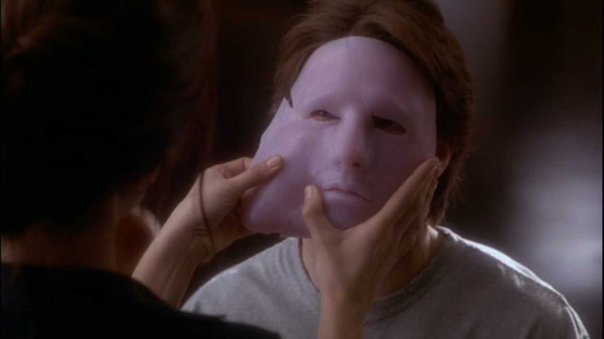
In some ways, this is one of Cruise’s most vain-free performances, yet there is an undercurrent that only seems even more vain. First the obvious; he plays a womanizer who also wears a mask for half of the movie to cover his scarred Phantom of the Opera visage. There’s a lack of vanity playing an annoying, arrogant, unpleasant person, something Cruise has done before and quite well, especially in his extraordinary Oscar-nominated turn in 1999’s Magnolia. He’s even played characters with physical disabilities before, like 1989’s Born on the Fourth of July. However, this “lack of vanity” really plays out as a vain attempt to be even more impressive as a respected thespian. The movie was positioned for a mid-December release, and with Crowe and Cruise on board, it seemed like a legitimate awards contender, until that is it opened wide. While Cruise’s performance is fine, his time under the mask doesn’t proverbially unmask his character for our better consumption.
 Vanilla Sky is mostly known as the big American debut of Penelope Cruz. She was already a muse for Spanish director Pedro Almodóvar and known well in the indie circuit, but from here she became Hollywood’s newest It Girl, only to be stranded in mediocre studio movie after mediocre studio movie (Does anyone remember Captain Corelli’s Mandolin?). It wasn’t until Almodóvar’s 2006 film Volver that studio execs seemed to finally understand how best to utilize her great talent. She won an Oscar for 2008’s Vicky Christina Barcelona and was nominated the following year for the musical Nine. She recently reunited with Almodóvar for 2021’s Parallel Mothers and again is wowing audiences. From early on, she definitely has a spark, an effervescence to her performance in Vanilla Sky. She’s also fighting against being forcibly elbowed into the swampy Manic Pixie Dream Girl category, a term that was originally coined for Crowe’s follow-up film, 2005’s Elizabethtown. Crowe loves writing women under these quirky conditions, however, the movie is told from a flawed male dream perspective, so it also makes sense if its portrayal of David’s idyllic dream woman happens to flatten her down.
It’s true that the story behind the scenes of Vanilla Sky proves more intriguing than the film itself. Cruise and Nicole Kidman were the Hollywood power couple. The ensuing tabloid feeding frenzy over their breakup and Cruise/Cruz relationship outlived the legacy of Vanilla Sky. This was the most ambitious and experimental movie in Crowe’s tenure as a writer/director, and he would never again return to science-fiction as a genre, keeping to the familiar lane of prestige dramas declining in prestige with each new film. My original review in the closing weeks of 2001 was pretty minimal in analysis. I knew this movie didn’t quite work then and it still doesn’t work now. If you’re eager for a dissertation-level analysis on its pop-culture fantasia, then God’s speed to you and your infinite free time.
Re-View Grade: C
Share this:

The Matrix Resurrections (2021)
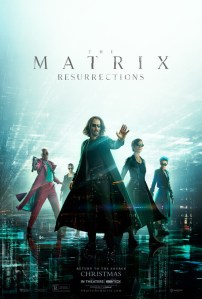 It is hard to overstate how influential The Matrix was upon its release in 1999. It rewrote the science fiction and action genres for Hollywood and introduced American audiences to many of the filmmaking techniques of Eastern cinema. It was exciting, philosophical, challenging, and made an instant brand out of the Wachowskis, the writing/directing siblings who had previously only directed one indie movie. The 2003 sequels were filmed back-to-back and released to great anticipatory fanfare and then, later, derision. The Matrix sequels, Reloaded and Revolutions, became a shorthand joke for bloated artistic miscalculation. They were talky, draggy, and just not what fans were hoping for jacking back into this strange world, and years later I think they’re worth a critical re-evaluation. Flash forward to 2021, and Lana Wachowski has resurrected The Matrix, and with the original actors for Neo and Trinity, both of whom died in Revolutions. Why go back? I think part of this was the declining career of the Wachowskis as directors. I personally loved 2012’s Cloud Atlas but it was an expensive and messy money-loser, the same as 2008’s Speed Racer and 2015’s Jupiter Ascending, a cosmically bad movie. So now it’s back to The Matrix with an older Neo, and older Trinity, and more of the same by design. The Matrix Resurrections just made me sad. It’s a movie that feels resentful for its own inception.
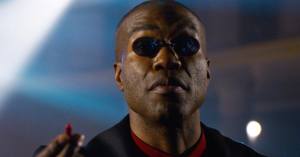
Thomas Anderson/Neo (Reeves) is living out his life as an award-winning game designer. His company and business partner, Smith (Jonathan Groff), are looking for their next big hit, and they’re looking backwards at Anderson’s biggest success… the “Matrix trilogy.” It was a virtual reality program that skewered the difference between reality and fiction. Mr. Anderson might have even based the role of Trinity on Tiffany (Carrie Anne-Moss), a woman he has grown infatuated with over time at a coffee shop. Except Mr. Anderson is having trouble determining what is real and what is only in his head. That’s because a new, younger Morpheus (Yahya Abdul-Mateen II) is telling him that he’s Neo, that he’s destined for greater things, and that he’s been kept in an unorthodox prison to keep him out of the action. Everyone seems interested in reactivating Neo, but for what purpose, and what has happened in the ensuing decades since the end of the war with the machines?
 Part of my struggle with Resurrections is that it too is struggling with its own existence, and not in a meta-textual sort of identity crisis, more like a reason to carry on 18 years later. Fair warning, this movie is far, far more meta than you are anticipating. The entire first hour of the movie features characters justifying rebooting “The Matrix,” the game. It’s a movie where characters glibly talk about parent companies going forward with the IP with or without the involvement of the original creators, so better to be the one trying to staunch the bleeding I suppose. A character literally says Warner Brothers wants a new Matrix and they will not stop until they get one. There are characters that sit around a table and try and break down what made the original Matrix (the game) so cutting-edge, and every person has a different brand slogan. “It was edgy.” “It blew your mind.” “It was a thinking man’s action story.” This prolonged section of Resurrections feels entirely like Wachowski speaking directly to her audience and saying, “Look, I had no reason to be back here. They forced my hand, and I want you to know that I’m not happy about it.” There are literal moments from the 1999 film that are presented as if the characters in the matrix are watching The Matrix to recreate scenes like avid cosplayers. There is one part where a character just starts screaming the word “reboot” with profane intention, promising to get their own spinoff as a threat. The entertainment industry satire about reboots and cash-grab sequels is funny but misplaced and coming from a perspective of defiance. If this was all the movie was then it would have been a fascinating example of an artist burning the bridge to their most successful franchise out of willful spite. However, if we had our own little focus group and asked what made the original Matrix so enjoyable, I doubt anyone would list, “entertainment industry satire and meta humor.”
The Matrix movies are well known for being a smarter, more ambitious viewing experience (“A thinking man’s action story”), blending philosophy and mysticism into anime-style action and kung-fu fights. There’s an intentional repetition here, built upon delivering something familiar and safe to audiences but with a “next gen” feel. We have a new Morpheus and a new Mr. Smith here, but did we require either? When they go through the motions of patterning themselves on characters of old, it feels strained, it feels gassed, and it’s another instance where Wachowski telegraphing to her audience, “Look, the studio demanded I bring back these characters, but I’ll be damned if I know what to do with them.” Morpheus has a little more story leverage as a catalyst for bringing Neo back to his path of enlightenment. Truth be told, I don’t really know half of what was happening in this movie, which lacked the elegant connectivity of the best action movies, linking cause and effect (the Merovingian would be proud of me) and pushing the movie forward to its inevitable conclusion. Even the prior movies felt more like the creators knew what was going on, even if the audience was lagging behind. With Resurrections, it feels like Wachowski and her screenwriters, novelist Dave Mitchell (Cloud Atlas) and Aleksandar Hermon (Sense 8 finale), have just given up trying to make sense of it all.
 Another disappointment is the lack of any signature or memorable action sequences or, in the words of the Matrix round table, moments that “blew your mind.” The use of phones as transport in and out of the matrix has been replaced with mirror portals and doorways, which initially got my hopes up. There are such playful visual possibilities incorporating portals into action (see: Doctor Strange, even Matrix Reloaded), and I felt that Wachowski was up to the imaginative challenge. It too feels like another element that barely registers. The movie takes the anyone-can-become-an-Agent threat of the original trilogy and says, “What if instead of facing deadly Agents, it was just dumb zombies?” The new machines decide to rely upon a hive-mind system of grabbing whatever humans are in the vicinity and taking control of them into mindless foot soldiers. Let’s explore what a downgrade this is. The Agents were dangerous because they had powers that ordinary humans could not hope for, like the bullet dodging. In this movie, ordinary people are easily foiled and often a pathetic excuse for super-powered adversaries. The final act involves an escalation in numbers of the hive mind, but we’ve already been here with the multiple Agents Smiths of the sequels. There is one disturbing change-up where the machines realize how humans can just serve as canon fodder that is dark but a more effective attack. Even the requisite martial arts battles and gravity-defying wire work are humdrum this round.
If there is one thing that Resurrections does well it’s staking its identity out as a romance. Much of the second half prioritizes the relationship between Neo and Trinity, which was always taken for granted in the sequels. It was a romance of more utilitarian purpose, providing Neo with a love interest to motivate him to be saved in times of great peril. With Resurrections, the movie actually takes time to devote to Neo and Trinity as people with desires and what they would find appealing about the other. He’s not the savior of mankind, and she’s not his gateway to knowledge and empowerment. They’re portrayed as people, somewhat unhappy in their lives, and just hoping they might have another chance meeting at their shared coffee shop for one more electrifying conversation. The evolution of the movie places even more importance on this human connection, so I’m glad time has finally been given to exploring what it is that connects Trinity and Neo, especially if their love story is going to play as prominent a resolution to Resurrections. If you have never cared about Trinity and Neo as a couple, then you’ll likely be in for a disappointing second half.
 From a technical standpoint, Resurrections is still a feast for the senses. The photography is moody and atmospheric. The musical score is pumping. The special effects are state-of-the-art. There are a lot of talented people working on this sequel. So why then does the movie feel so perfunctory? In some regard each Matrix sequel has felt this way, adding extraneous pieces onto an already perfect standalone film. Having re-watched both Reloaded and Revolutions again, I can affirmatively declare Resurrections to be the weakest Matrix entry yet. We were all a bit too harsh on the prior two Matrix movies, which fall short of capturing the original’s magic alchemy but bring the goods when it comes to memorable set pieces, eye-popping visuals, and narrative zigs instead of zags (It was undercutting audience expectations before it was cool). They are still a bit too stuffy and talk in circles, but there are definite Major Ideas percolating underneath. In contrast, Resurrections feels more powered by resentment, by Wachowski coming back to this world against her better wishes and judgements. Maybe we should have left things alone.
Nate’s Grade: C
Share this:

West Side Story (2021)
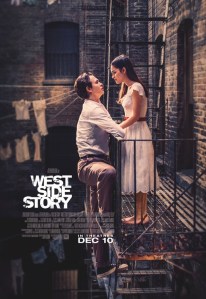 Steven Spielberg, now approaching seventy-five years of age, has experienced such rarefied success as a film director that the man can do whatever he wants. It just so happens he wanted to tackle his first big screen musical, something he’s a little late on considering peers like Martin Scorsese (1977’s New York, New York) and Francis Ford Coppola (1982’s One from the Heart) beat him to the musical punch early. The question isn’t why direct a musical at this stage of his glorious career, it’s why direct a remake of 1961’s Best Picture-winning West Side Story? We already have a perfectly good and revered movie version, and there are other musicals that haven’t even gotten their first big shining moment on the silver screen, so why go back to this particular show a second time?
Once again, we’re following the two New York City street gangs, the Jets, who are made up of Italian and Irish white kids, and the Sharks, made up of Puerto Ricans. Tony (Ansel Elgort) is trying to reform his ways after spending a year in prison for gang violence. The Jets are pleading with him to get back involved, to push back against the Sharks encroaching on their territory. He meets Maria (Rachel Ziegler) at a dance and the two fall instantly in love. The problem is that Maria is Puerto Rican, her brother is the leader of the Sharks, and this relationship would be forbidden and dangerous. Tony and Maria plan to run away together and escape the conflicts of this tragic turf war.
 I’ll risk musical theater heresy and admit outright that Spielberg’s West Side Story actually improves on the much-hallowed 1961 original in several ways. The most immediate and obvious is that we have Hispanic actors playing Hispanic characters. No regrettable brown face including the actual Hispanic actors this time (it’s just humiliating to watch Rita Moreno, in her Oscar-winning role, have to be darkened up to be “more Puerto Rican”). That’s a pretty good improvement already, though it’s not unexpected; 1961 was also the year Breakfast at Tiffany’s was released with its notorious Mickey Rooney performance in jaw-dropping yellow face. Granted, jaw-dropping today, not so back then. 1961 was still only a few years removed from John Wayne taping his eyelids back to portray Genghis Khan. This was the unfortunate norm.
Another immediate improvement is the visual dynamism of 60 years of technical filmmaking advancement. I recently re-watched the 1961 original, a film I haven’t watched since probably the 1990s as a teenager, and it’s a relatively good movie but it’s also a good movie of its time, and by that I mean there are limitations to the presentation. One of the most appealing aspects of movie musicals is how they expand upon our humdrum reality, the splashes of color and synchronicity and bold imagination. I’m not saying the movie musicals of the 1960s were particularly lacking, as there are many classics and favorites, but because of filmmaking practicalities and predilections, movies could only go so far at the time. With 60 years of technological advancements, today’s movie musicals, when under the right guidance, can expand the world of song-and-dance fantasy like few of the past. You need only compare the showstopper “America” in both films, the dancing high-point of either film. The original is on a rooftop for its entire duration. The new version is all over the city block, finally culminating on a crossroads and bringing the denizens of the town out in girl power empowerment. It’s such a high-energy and celebratory sequence and the scale and variance really make it feel so much more joyous and exciting. The choreography is also an improvement. Again, not a slight against the 1961 original, but in the ensuing 60 years we’ve also advanced in the technical precision and creativity of dancers. The 2021 West Side Story is impressive top to bottom with the dancing of all the performers, and with Spielberg as director, he wants you to best appreciate their talents while also making the movie as visually dynamic as he can.
 Spielberg proves an absolute natural at helming a big movie musical. Nothing against Robert Wise, the 1961 director who helmed plenty of influential Hollywood titles like The Sound of Music, The Day the Earth Stood Still, I Want to Live, and Star Trek: The Motion Picture. He was also the editor on Citizen Kane. The man clearly knew how to tell a big screen story across multiple genres. It’s not a shame to say his visual prowess doesn’t quite stack up to a Steven Spielberg, who just happens to be one of the most popular and versatile filmmakers of all time. Spielberg’s camera is much more active than the original movie, and he’s consistently bringing us into the scene, having characters duck in and out of frame, and circling around, always interacting with the world. It makes the movie much more visually immersive and exciting, enlivening an already lively number like the dance hall rivalry between the Jets and the Sharks where each side crowds the edges. The movie operates on a high level of visual pleasure because Spielberg knows exactly how to play to the strengths of the musical genre. Spielberg incorporates the location in each setting and has fun visual flourishes, clearly having given great thought how to visualize every line in each song. The opening of “America” involves women placing clothes on a line, and as the clothes move, it reveals our newest chorus member giving voice to the continuing song. The way the camera moves through the neighborhood to note the encroachment of gentrification. The way he frames the faces of our young lovers. The way he uses shadows as menace. The way he makes every space feel like it’s perfectly utilized for the best shots and edits. Now that Spielberg has proven so adept at handling musicals, somebody please give this man another for our collective benefit.
The top actors are not the leads but two very mesmerizing supporting players. Ariana DeBose, previously seen as one of the ensemble members in 2020’s Hamilton, is pure dynamite as Anita. She explodes with verve and personality and attitude and vibrant life, and the camera loves every second she’s on screen. She gets the bigger emotional arc than Maria. She gets the jubilant song, the aforementioned “America,” and gets her crushing moments of heartache as well. DeBose is phenomenal, and likewise so is Mike Faist (Panic) as the leader of the Jets. Like Anita, this character is brimming with anger and attitude and the movie does a much better job than the 1961 film of presenting him with a point of view that can develop some empathy. Faist is lanky yet so smooth in his movements, and he gets more dancing than just about anyone. He’s balletic in his dancing while still upholding his spiky attitude. Both of these actors are so self-assured in their roles, so vulnerable behind the surface, and so accomplished with their dancing and singing that one wishes the movie would devote more time to both of them.
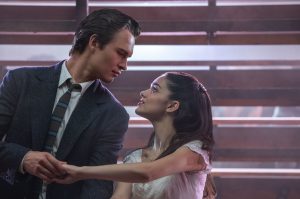 As for our leads, Ziegler and Elgort (Baby Driver) are good but unexceptional as our naifs in love. Ziegler can sing beautifully and definitely has a natural innocence to her appearance. Her eyes are so large and glassy that she reminded me of an animated character at points. Elgort is solid in his singing but I can’t help but feel that he’s been lapped by his co-stars. There is a comic relief musical number, “Gee Officer Krupke,” where the various Jets have fun imitating the nay-saying adults who hastily cast judgement upon these juvenile delinquents. It’s a silly number about guys goofing around and could easily be the first on the chopping block to be cut for time. However, over the course of this fun diversion, I realized that person-to-person in the Jets crew, the same guys that just appeared as background players to fill out a scene previously, how good every person is, and how much more time I wish they had gotten than Elgort. Part of this is that the romance aspect of West Side Story has always been the weakest part of the show. It’s based upon Romeo and Juliet and tied to those tragic plot events, but when both Maria and Tony are ready to run away and marry one another after a single night, and especially after the fateful rumble where Maria is so astonishingly quick to forgiveness (and horniess), the romance plays so incredulously. As a result, the two lovers are essential to the story but also the most boring characters too.
I think the adaptation by Spielberg screenwriting stalwart Tony Kushner (Munich, Lincoln) has smartly updated plenty of political elements, amplifying racial tensions but looking at it over a broader scope. Giving Tony a mentor figure in an older woman who runs her drug store shop, played by Moreno, is a great choice, especially as she represents a medium between the two sides as she is Puerto Rican but her deceased husband was white. It’s smart to have someone from the community and so wise to try and impart lessons to Tony, especially as he wants to change for the better. One update from Kushner didn’t quite jibe for me and felt like token-ism. The youngest member of the Jets, a prepubescent pipsqueak, has been replaced with a trans man fighting for membership. I understand the basic character arc is the same, the outsider trying to be accepted by the group, but the consideration of trans acceptance in the 1960s wasn’t exactly enlightening. The other Jets tease and question the gender identity of the trans man, but this perspective never feels well integrated into the play’s prejudicial world. I suppose more could have been done like having the Sharks harass this character, belittling them over their identity, and then the Jets feeling like one of their own had been attacked and in that they would finally be accepted. Except this inclusion would be around the degradation and potential assault of a trans person, which itself is not the best reason to include a trans character if you’re just setting them up for trauma. I don’t know. This character could have easily been removed if this was all there was.
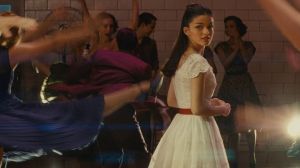 One other aspect I found cumbersome was the creative decision to not include English subtitles during the Spanish-speaking portions of the movie. I cannot understand the artistic rationale for this at all. Sure, Spanish-speaking viewers will be fine, and I could piece enough together with context clues and my rudimentary understanding of like 75 Spanish words, but what are we accomplishing here? It just feels alienating, and it inadvertently likens the viewing experience to what the Jets are going through, feeling like they cannot fully understand their new neighbors. I doubt that Spielberg and company wanted to reinforce the perspective of xenophobia, but purposely removing a key portion of your movie from the majority audience in the U.S. seems so strange to me. If it was just scant conversations or moments, I’d excuse it, but the untitled Spanish accounts for like ten percent of the whole movie. Imagine watching any foreign movie without the subtitles on screen. How much meaning are you able to devise on your own?
West Side Story 2021 is a good time for fans of musical theater and a testament that just because something is old and beloved doesn’t mean it can’t even be improved upon with the right people and goals. Both movies are about the same length, 150 minutes, which seems the de facto standard for movies this holiday season, and you’d have a good time with either. I think the updated version adds more visual creativity, impressive choreography, and remodeled racial and political considerations to make it land better for modern audiences. It might not have been needed but I’m glad all the same we now have two West Side Story movie musicals to cheerfully tap along to.
Nate’s Grade: B+
Share this:

Eternals (2021)

Chloe Zhao is the biggest name Marvel has gotten yet for its cinematic universe (MCU). Sure, they’ve had major directing names before like Kenneth Branagh and Ryan Coogler, and successful populist genre filmmakers like Jon Favreau and Joe Johnston and Joss Whedon and Shane Black, and quirky auteurs like James Gunn and Taika Watiti. However, Zhao is the first Academy Award-winning director to jump into the Marvel sandbox. Zhao seems like an odd fit for something as mainstream and successful as the MCU, but she was excited to tell a big story with the biggest studio operating in Hollywood. Eternals (no “The”) is just as much about the question over what it means to be human as Zhao’s Best Picture-winning Nomadland, and it’s a lot easier to watch with one hundred percent less Frances McDormand pooping in a bucket in her van (granted, she did win an Oscar for that performance). Eternals has received the lowest critical rating of any MCU film in its thirteen-year history and I’m trying to figure out why.
Thousands of years ago, the Eternals were created by the Celestials, powerful beings that are responsible for birthing new galaxies into the universe. The Eternals were sent to protect the inhabitants of Earth from the Deviants, terrifying tendril-heavy monsters that will consume and overrun a world. The Eternals are instructed by their masters not to intervene in human conflicts; only to intervene to save them from Deviants. Now that the last Deviant has been dead for over 500 years, the Eternals have settled into comfortable lives among present-day humans. Then the Deviants return, evolving with added powers and posing a new threat to humanity and the Eternals, but the real threat might be outside the confines of Earth.

Eternals feels like a different kind of Marvel movie in that stretches feel like it’s a Stanley Kubrick movie, or a Terrence Malick movie, or a DC movie. The plot structure and tone even reminded me of Watchmen. Don’t get me wrong, the standard Marvel elements are recognizable, but this is a much slower, more methodical, more cerebral, and more challenging movie that really feels like a distillation of Zhao’s humanist indie naturalism and the crazy cosmos from Jack Kirby’s trippy source material. I can understand why some people would find this movie to be boring and poorly paced. There are extensive flashbacks and setup. It definitely doesn’t need to be a staggering 157 minutes long, second only to the three-plus hours of Endgame. Granted the movie is introducing a dozen characters, their relationships, their powers, their histories, as well as a new history for the universe that doesn’t relate to anything that came before it. There are assorted references to Thanos and the events of Endgame, bringing half the population back, but this is more a standalone movie that can serve as an introduction for those less well-versed in two dozen movies’ previously on’s. I knew going into Eternals it was going to be slow, and I knew several friends that outright hated it, but I think pacing is more to its benefit and detriment. The scenes feel like Denis Villenueve (Dune) is pacing them, where moments are given more time to breathe and where characters are given space to reflect and absorb. Like a Villenueve film, Zhao wants her audience to take in the grandeur of the moment, but she also wants the characters to be able to take in the drama of their circumstances. Some people will find it all too boring, and while there were points that could be trimmed, I was enjoying myself because of the attention to character perspectives that are given precedence over splashy beat-‘em-ups.
I was drawn in by the character reveals, their conflicts, and the time Zhao allows to examine their emotional and philosophical states. Look, it’s still a big, action-packed Marvel movie with plenty of monster fights and a world-saving cataclysm climax, and while those are agreeably executed, I was more taken by letting the characters pontificate on their problems. There’s Sprite (Lia McHugh), an eternally looking child who can never live an adult life she craves. There’s Druid (Barry Keoghan), a man with the power to control the minds of all humans on Earth but is explicitly instructed to remain hands-off with their conflicts. He is severely torn and emotionally wrecked over watching them slaughter one another and knowing he has the power to intervene and resolve genocide, prejudice, and poverty. That’s the eternal question over why a loving God seemingly chooses to be hands-off, all rolled into one character. There’s Thena (Angelina Jolie), a legendary warrior of physical renown but whose mental state is fracturing and who poses a potential lethal threat to her family. There’s her partner, Gilgamesh (Don Lee), who would rather watch over his love as she suffers and potentially declines than have her lose her identity and erase herself. There’s Phastos (Brian Tyree Henry), a man who only wants to help the humans with his technological skills but regrets his contributions and declares humans as unworthy of their keep after Hiroshima. Then there’s a reveal halfway through the Eternals that loads a needs-of-the-many sacrificial debate that positions different characters on different sides of the divide for the final act. I enjoyed that even the villains are presented with their rationale and are tortured over their choices they deem to be necessary for the greater good.

I’ve written a lengthy paragraph all on the meaty character conflicts, and none of them revolve around the goal to gather a magic item or learn a special power. I didn’t mind Zhao’s movie taking its sweet time to allow these conflicts and struggles to be felt because they were evocative, and Zhao’s storytelling shines when she focuses on the noble and often tragic struggles of people being complicated, contradictory, and confusing. Even the big dumb beasts evolve and have a perspective that has an understandable complaint. The final confrontation doesn’t come down to a giant sky beam and an endless army of disposable CGI brutes. It rests upon character conflicts and a romance that spans thousands of years where empathy is the secret weapon. Early on, you think it’s going to be a love triangle, and the movie just teleports out of that trope. I found myself more invested in the ending, even if I could already predict the conclusion. I was more interested in what the conflict was doing to the Eternals as a family fracturing under the weight of their destinies and the consequences of defiance. The film ends on a cliffhanger with significant fallout, and I don’t know how the rest of the MCU is going to square what we learned and accomplished here. This seems in sharp contrast to everything down the road.
Eternals is also an often beautiful-looking movie with Zhao’s penchant for natural landscapes and magic hour lighting. The editing and photography feel nicely matched and allow the viewer to really soak up the natural splendor and the impact of the battles. The action is kept at a human level with the camera tethered to the characters even when in flight. There is the occasionally eye-opening shot of a landscape, or Zhao’s use of visual framing, or the special effects revelations that reminded me of 2001: A Space Odyssey. It’s certainly not the most breezy, action-packed movie in Marvel’s lengthy canon of blockbusters, but it’s not devoid of spectacle.

So then why has Eternals scored so low with film critics and a significant portion of general audiences? Some wonder if the level of diversity and inclusivity of the movie is a factor; we have many non-white characters including a deaf character and a gay male character in a committed relationship, with a genuine and loving onscreen kiss no less (your turn, Star Wars franchise), and that seems like a trigger point for certain fans that grumble about “woke culture.” I’m sure for some that’s a factor. I think the length will be a factor too. I think the elevated emphasis on emotional stakes and philosophical conflicts might be another factor. This doesn’t feel like any Marvel movie that has come before. It’s much more comfortable with silences, with patience, and with cerebral matters (again, not to say the dozens of other MCU entries were absent these). This one is just different, encompassing the directing style and humanist attentions of Zhao and looking at a far larger scope of drama than toppling one super-powered being. I saw this in theaters with my girlfriend’s ten-year-old daughter and her friend and they both said they enjoyed it, so I won’t say it’s too mature or impenetrable for younger viewers. Eternals might be too boring for some, too long, and too different, but I was happy to endure it all.
Nate’s Grade: B
Share this:

Glitter (2001) [Review Re-View]

Originally released September 21, 2001:
It must be seen to be believed. A new college crap-fest drinking game has begun. Begin the Glitter midnight shows! A new age is upon us! Here are a few handful of Glitter‘s bon-mots it serves up to its audience:
-Mariah Carey is shown leaving her real mom at age 8 with her kitten. Somewhere through Glitter she has a fight with her boyfriend and takes her cat (yes the very same immortal cat that must have been pushing 20) and leaves.
-She has a fight with said boyfriend and they both try and write a love song to show their remorse. Except they BOTH come up with the EXACT same song word for word, note for note, and NO ONE thinks this is the creepiest thing ever.
-The movie freakin’ ends with Carey’s boyfriend getting shot and killed. Yes, this is truly how the thing ends. Oh, like any of you cared about plot spoilers anyway.
-Da Brat is in it for “comic relief.”
-The movie is inexplicably set in the 1980s for no reason.
Anyone would have to be crazy thinking Glitter ever remotely resembled art. It’s so bad it’s awesome to watch. Bring some friends over, open up some alcohol, and let the fun times begin.
Nate’s Grade: F, like it matters though
——————————————————
WRITER REFLECTIONS 20 YEARS LATER

Apologies to Mariah Carey, but it’s impossible for me to think about Glitter without thinking about 9/11. I’m not intending to make some snide, crass joke about Carey’s film debut/vanity project bombing so spectacularly considering the tragic terrorist attack that changed everything occurred the week prior to its release. 9/11 was the seminal event of the twenty-first century and a “where were you on that day?” question for Millennials and older generations. As we approach twenty years since that fateful day, it’s hard not to reminisce and pontificate about tragedy, art, and possible catharsis, and yes, eventually Glitter will factor into this prosaic essay too.
Every person has a story. I was a sophomore in college, walking to the campus center to collect a copy of The New York Times, a subscription had been a requirement of my Political Science 101 class. I grabbed my day’s edition and another student said, “Hey, did you hear? Planes hit the World Trade Center.” I remember it not really processing for me and wondering what he was talking about. I went back to my dorm, turned on the news, and was quickly dumbstruck. I eventually wandered into my friend Amanda Hickey’s dorm and we stared glued at the TV as the towers fell and I remember the news people trying to square what was happening. It wasn’t just the south wall coming down, it was the entire building. As the day continued, and more attacks commenced, I remember one girl shaking saying she had just been to the Trade Center (over six months ago, so not exactly like a near miss), and another girl scared that our Jewish-heavy suburb could be the next target. To be fair, it was an alarming time, and nobody quite knew how many more potential planes were to be hijacked next. Nobody quite knew how many potential targets there would be. The federal buildings across the country were shut down. Parents pulled their kids out of school. We all felt vulnerable. Some of us more than others. I had a friend at school, Gavin, who was from New York and whose mother worked in the Trade Center. He was wrecked trying to get a hold of her, and fortunately she did make it out of the second tower and survived. I remember the numbness and feeling like you were watching a movie, like it wasn’t really happening, it was only special effects. It couldn’t possibly be real.

In the weeks and months to come from 9/11, America was looking for an outlet, looking for some kind of unifying force to heal, and that reluctant recipient ended up being Glitter. The movie was clearly intended to be a vehicle for Carey to stretch herself as an actress. It didn’t turn out that way for her though Carey did a more measured (and less glamorous! they always wanted us to know for publicity) supporting turn later in 2009’s Precious. Glitter was a project Carey had been working towards for years. At the start of 2001, Carey signed a $100-million-dollar contract for five albums for Virgin Records. She left her first husband, the controlling music exec Tommy Mottola, in 1998, left Columbia Records, and felt the pressure to deliver. She was one of the best-selling, most successful artists of the 1990s and was declared Billboard’s Artist of the Decade. From July 2001, Carey began behaving erratically. In promotion on MTV’s Total Request Live, she appeared with an ice cream cart, performed an awkward strip tease, and was shortly after hospitalized for a breakdown. On her website she posted: “I’m trying to understand things in life right now and so I really don’t feel that I should be doing music right now… All I really want is [to] just be me and that’s what I should have done in the first place … I don’t say this much but guess what, I don’t take care of myself.” She did not promote Glitter. The soundtrack was released on… September 11 and was also Carey’s lowest-selling album of her career. The movie was released on September 21 and grossed only four million. In 2002, Virgin bought out her $100-million contract for only $28 million.
With the wounds of 9/11 so fresh, it was easy to pile onto Glitter, the first new Hollywood release, as the bad movie that the nation needed right now to hate watch to feel better about itself. The New York Times said it was “an unintentionally hilarious compendium of time-tested cinematic cliches.” Variety said, “as phony a vehicle as one could concoct for a wannabe movie star.” The Village Voice said, “A heart-wrenching debacle from the start of the gun.” The Miami Herald said, “The kind of movie only 11-year-old girls who dot their I’s with hearts would find bearable.” Roger Ebert said the film lacked joy. The New York Daily News said it was “the worst performance by a pop star in a dramatic role since Madonna suited up for Shanghai Surprise.” The Washington Post said the movie was more a showcase for Carey’s breasts. The film appeared on numerous Worst of the Year lists and was nominated for 6 Razzies including Worst Film, with Carey winning the ignoble Worst Actress Award (over fellow nominees, and future Academy nominees, Penelope Cruz, Charlize Theron, and Angelina Jolie).
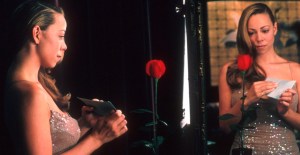
My review was among that throng so eager to find an outlet for our pain, a needed distraction from the harsh reality of wall-to-wall news. I gave the movie a failing grade and declared, “It must be seen to be believed. A new college crap-fest drinking game has begun. Begin the Glitter midnight shows! A new age is upon us!” Suffice to say, Glitter never entered the holy circuit of so-bad-it’s-good movies. I’ve never watched it again in the ensuring twenty years, and upon finally coming back to Glitter in 2021, I have concluded that it’s just thoroughly mediocre and dull. It’s not a good movie. It’s a limp retelling of A Star is Born with a weak romance between Carey’s character Billie Frank and her music producer boyfriend Julian who eventually dies, killed by none other than Terrence Howard (Iron Man), playing a scornful competing music producer who demanded money for “leasing” Billie from his employ as a backup singer. It’s just so thoroughly dull. It’s filled with listless songs from Carey, tracks she had reportedly been working on for years beforehand, and the rise to stardom is absent anything engaging. There are a handful of quirks, like the fact that Billie’s cat seems to be immortal and that she and her boyfriend, separated after a fight, both pen the exact same makeup song. These are fleeting moments but only moments of bizarre fascination. The movie is just an earnest, cloying, and altogether boring retelling of a formula you’ve seen in a thousand other dull movies. It’s not even great at being bad. Everything about Glitter is dull, middling, and not worth your time. Freddy Got Fingered was clearly the worst film of 2001 and still resonates as one of the worst films.
So why did everyone delight in ripping apart this mediocre movie from a troubled pop star? Maybe some were looking for a scapegoat for derision, something to feel superior to at a time where political upheaval made many of us feel like we were plummeting and lost. Maybe it was simply a distraction at a point of feeling overwhelmed by the elevated seriousness of the world, of the news, of our post-9/11 reality and its implications. In some way, Glitter was the first step in the process of art as processing for trauma. I’m not being hyperbolic. We needed Glitter.
In the years to come, a question emerged whether American audiences would want to see movies examining 9/11 and the subsequent War in Iraq. In 2006, Paul Greengrass directed a stirring recreation of the events of Flight 93 on 9/11, the one plane that crashed before its intended target, believed to be the U.S. Capitol. It was my top film of 2006, and Greengrass was nominated for Best Director at the Academy Awards. I remember a conversation where the other person argued it was “too soon” for these kinds of movies. That was the criticism you heard repeated, “too soon,” though that determination will always be different for everyone. Some may find the act of viewership with drama as a therapeutic exercise that can help process complex feelings from trauma. Storytelling can lead people to potential catharsis, a release of heavy emotions, and maybe even a sense of clarity or closure. I remember being an emotional wreck during my 2006 screening and listening to the handful of other people in the theater openly sob. How does one eat a bucket of popcorn to such a movie? The same could be said of a movie about the Holocaust, or slavery, or any of the horrors of history depicted on screen. Storytelling is how we process, learn, and relate to history and its numerous dicey moments. With art, we can possibly achieve catharsis through recognition. Again, not everyone will follow the same therapeutic path. I can completely understand if a person declares they never need to see a movie about the Holocaust, but I would lament that they will miss out on some of cinema’s masterpieces of drama. Art allows us to better know ourselves and to heal and better ourselves under the right context.

If Glitter had come out in 2002, I doubt it would have received the intensity of the critical drubbing it did in the week after 9/11. It’s not a good movie today. It will never be a good movie, but it’s not one of the worst movies of all time, or even of 2001, and the community went overboard because we needed an escape and a collective joke that we could all be amused from amidst the grind of tragedy and tumult. I think even the scathing and sexist critiques of Carey at the time would be pulled back for sensitivity of a woman clearly going through mental health issues. The Razzies nominated Carey’s breasts for Worst Onscreen Pair, a strange and icky joke that I still don’t even know is intended to be defamatory or gross admiration. With twenty years of hindsight, as we approach the anniversary of 9/11, I’ve become less hostile to Glitter. It came out during a time of national psychological need and served a purpose, entertainment even if it was misidentified as so-bad-it’s-good in the zeal to find a powerful escape. The history of Glitter will always be tied to a national tragedy but, oddly enough, its legacy shouldn’t be about Carey’s faulty acting career, or personal troubles, but as the healing nature of art itself. Take that for what it’s worth as you’re doing the math to figure out how old Billie’s cat is.
Re-Review Grade: C-
Share this:

Cinderella (2021)
 Do we need another rendition of good ole’ Cinderella, especially only a few years after the Disney live-action version? The new Cinderella starring pop star Camila Cabello is a surprise jukebox musical, and it’s irreverent where it should be and progressive where social critiques are warranted with the source and historical context. In short, it’s a fleeting but fun experience that’s a winning 100 minutes for families with young children and adults who enjoy a peppy, self-referential musical. Written and directed by Kay Cannon (Pitch Perfect), this movie is packed with singing and dancing to the point that the talking only makes up perhaps twenty percent of the movie. This choice proves to be a durable source of energy and keeps the pacing running smooth. It’s also convenient because we don’t need extra time explaining the setup and character dynamics that we’re all so familiar with at this point thanks to the umpteenth renditions. The mash-up of popular songs kept me amused and guessing what would appear next, and the original songs contributed by Cabello have a nice soaring uplift to them as well as memorable hooks. There’s a “What a Man”/”Seven Nation Army” mashup at a ball that gave me strong Moulin Rouge vibes, especially with all that chaotic sashaying petticoat editing. The movie is also funnier than I expected, with consistent wise-cracking and one-liners that had me laughing and critiques about the patriarchal system from a progressive, feminist perspective. The evil stepmother, played by Idina Menzel (Frozen), is even given her own song detailing her tragic history of being a musical prodigy who had to give it all up in a society that only valued her as marriage material. Even she gets consideration and empathy. The winking feminist criticisms won’t be new to anyone over the age of twelve, but it’s still welcomed even as the film skates over the discordant plot elements to keep things light. The film delivers some bon mots of political thought to go along with its sugary sweetness of a contemporary sing-a-long musical that is easy to digest. Cabello has a natural charisma to her and is surprisingly adept with comedy, able to turn on a dime and deliver a hilarious self-effacing remark. She’s far better at acting than you might believe. If you have no interest in another version of Cinderella, I understand the fatigue with the property. However, this Cinderella understands your fatigue, provides something light and airy, with actors who seem to be legitimately having fun, and it’s got a consistent feminist perspective that chides the prevalent problems with the source material. It works as a family film and even as a diverting jukebox musical for adults whose tastes run a little sweet and a little tart.
Nate’s Grade: B
Share this:

He’s All That (2021)
 I’m sure there aren’t too many who consider 1999’s She’s All That a great film, or even a great high school comedy film, but I know there are fans and I know nobody was clamoring for a Netflix gender-swap remake starring one of Tik Tok’s most famous users. We didn’t need the original but it was a mildly amusing version of My Fair Lady, or its older inspiration Pygmalion, set in the superficial class system of an American education system. It came out during the heyday of 90s teen cinema remaking older literary concepts (Ten Things I Hate About You) and made short-lived careers for stars Freddie Prinze Jr. and Rachel Leigh Cook. My amazement is Netflix rehiring the same writer, R. Lee Fleming Jr., now 50-something, and asking him to remake his twenty-year-old hit for the voice of Generation Z (It’s not even like “all that” has held up in slang parlance). This movie feels every bit the dismal corporate-sponsored, cash-grabbing, star vehicle that it is. Nobody in Generation Z cared about She’s All That, and now very few will really care about He’s All That.
This time we follow Padgett Sawyer played by Tik Tok star Addison Rae (83 million followers in real life!). Padgett is a high school senior who has millions of online followers who hang onto her every word of advice. She uses her position as an influencer to even help pay the bills at home to relieve her overworked mom (Rachel Leigh Cook, not the same character) and maybe pay for her college. She live streams catching her boyfriend cheating, loses her cool, and becomes a meme thanks to an unfortunately timed snot bubble. Now she has to earn back those lost followers and her respect or else she might not still maintain her ascendant social media standing and pay for school. Her catty friend challenges her to makeover a loser guy at school and the hopeless case ends up being Cameron Kweller (Tanner Buchanan), a sarcastic, arty loner who wears a beanie and has long hair (a wig) and rides horses and practices karate. What a loser. She buddies up to Cameron and through that friendship she starts to question her own sense of self and learns what’s really important as she physically changes this guy to be more acceptable to a mainstream opinion of people she’ll never meet in real life. Or something like that.
 The inordinate influence of social media is a very worthwhile avenue to explore for modern satire as a means of separating this He’s All That from its predecessor and making it relevant. The problem with He’s All That is that the movie refuses to go very deep or hard-hitting with this topic because it’s also meant to be a vehicle for fame to launch the feature acting career of Rae. I’ll fully admit, dear reader, that I had no idea who Rae was until watching this movie and I don’t really get the appeal (more on her acting ability later). In this movie, Padgett is obsessed with maintaining her carefully curated online image, a ruse that relies upon a fantasy that no human being could adequately maintain. She wakes up and goes through an entire routine of makeup and hair styling before she records herself “just waking up.” It reminded me of a joke from the fabulous TV series The Marvelous Mrs. Maisel where the title character makes sure her husband never fully sees her in the morning how she actually looks. It was funny then because it commented on the pressure of wives in the 1950s, let alone those from Jewish families, to live up to an impossible beauty standard to appeal to the man’s comforts and desires. With He’s All That, it really becomes the last joke at the expense of our main character. The movie is too afraid to delve any deeper for fear of directing negative attention toward its star and her influencer ilk. It even conveniently sets up the good of her position, what with her able to pay some bills. She can’t be all bad, you’ll say, because she’s helping her mom. I guess we like social media facades now.
Padgett’s plight really doesn’t make much sense in the context of the movie. She’s dropped perhaps a fifth of her many followers after the embarrassment of her public breakup with her louche of a boyfriend, a wannabe recording artist. First off, I don’t know why this personal incident would be so detrimental to her character. Her boyfriend was clearly bad, she stood up for herself, and I would think that would only make people like her more and draw more followers to her brand. The only reason she has to worry is because we’ve awkwardly included Kourtney Kardashian and an even bigger social media influencer. I don’t know why we have a Kardashian here, and I don’t know why she doesn’t merely play herself, unless that too would be another example of striking too close to home with the satirical depictions. Regardless, Padgett is worried she’ll have to, gasp, potentially take out student loans for college. She believes that picking someone to grant a makeover would get back lost followers, which makes some sense, but then her friend also elects to make a personal bet about selecting some campus schlub and turning them into a heartthrob. Why does our main character need two motivating forces for why she agrees to participate in this bet? It’s needlessly extra for a movie with so little else going on.
 Another fault is that there is no chemistry between our leads, which kills the investment in any romantic comedy. The two actors are not a good fit from the beginning, and this comes down to two factors, the underwritten characterization and the limited acting ability of Rae. It was a joke in Not Another Teen Movie, a not-so-great spoof over those popular 90s/early 2000s teen comedies, that the thing separating the obviously beautiful girl from “plain Jane” territory was merely glasses and a ponytail. Cameron is already an appealing guy so when he gets his big physical transformation it’s really just scrubbing off stubble dust and removing the beanie. His character, a self-described outsider, would be unlikely to be seduced by the wiles of popularity. There’s also precious little to be uncovered with the character of Padgett, so the movie can’t even have Cameron fall for Padgett as he realizes she isn’t like his preconceived notions. There’s no heat or sizzle or any point of intrigue between these two that would compel an audience to root for their eventual coupling. Cameron, we’re told, like “Kurosawa, Kubrick, and kung-fu movies,” and he’s basically the gender reverse of a shallow rendition of a manic pixie dream girl who is ultimately just there to get the protagonist to stop and appreciate life and then sublimate their own interests and desires to that of the protagonist. This is a romance where you root for irrevocable heartbreak.
Rae might be an overall pleasant presence but she’s not quite there in the acting department yet. Her limited range really dampers many of the dramatic moments. Her line readings are extremely monotone. There are moments where I thought she was just going to smile her way through a scene. There were several scenes where I was convinced they could only have filmed two takes because this had to be the best one by default. I don’t want to pile on Rae. I don’t know the woman and she’s only twenty years old and this is only one role. Except He’s All That has also clearly been tailored for her and she cannot live up to these standards at this time. There’s an egregiously long dance battle at the prom that goes on forever just to take advantage of Rae’s dance skills from her Tik Tok dances. It’s the same kind of contortion done to make room for Buchanan’s (Cobra Kai) martial arts skills with a silly fight with Padgett’s ex-boyfriend.
 If I was overly cynical, I would estimate that the producers of He’s All That sought an older IP that might still have some pull with an older audience that could be stripped down to its parts and slapped together with a formula that could platform its young stars while also barely hitting that 80-minute feature running time requirement. Except that sounds exactly like what’s happened with He’s All That as well as the preponderance of product placement. This entire movie is a cynical enterprise. It’s not funny at all. It feels completely inauthentic with its portrayal of modern teenagers and social media lifestyles and even the appeal provided by a social media following of fans giving instant validation to every coordinated effort to be your phony best self. The director is Mark Waters, a man who helmed Mean Girls, the 2003 Freaky Friday, and the dark indie comedy The House of Yes. He has talent. He knows how to shoot a comedy. He knows that not every scene needs to be overly lit like night and shadow have no meaning and it all looks so cheap. While watching He’s All That, you’re left with the strong impression that everyone should know better, and you should know better than spending 80 tepid minutes of your time watching this cynical exercise.
Nate’s Grade: D
Share this:

Good on Paper (2021)
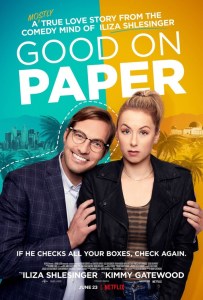 Famed standup comic Iliza Shlesinger had money, a rabid following from several popular Netflix specials, and a boyfriend who went to Yale, was a successful hedge fund manager, and a sweet guy, or so she believed. In real life, Shlesinger was victim to a man who wormed his way into her life and lied about every significant facet of his own life in order to impress. The true-life experience of Schlesinger was her inspiration to write her first screenplay, the “mostly true” Good on Paper. In the Netflix original comedy, Shlesinger plays a fictionalized version of herself, Andrea, a standup comedian who meets Dennis (Ryan Hansen) on an airplane. They form a friendship and he clearly wants more but she’s just not that into him. That doesn’t deter Dennis, who keeps nipping at her heels, and after he tearfully reveals his mother diagnosed with cancer, Andrea decides to give the “nice guy” a chance as a boyfriend. However, his fibs and excuses add up and test the resolve of Andrea, who questions who Dennis really is.
 Where Good on Paper gets good is blowing up the manipulations of the “nice guy” persona that certain men cling to as a shield. There is a contingent of men out there in the dating world that dismissively view the disinterest of select women as a failing not on them but with the women, who just cannot grasp what how much these “nice guys” have to offer. They hold to the adage that “nice guys finish last” as a resentment builder, but it really comes down to this persona being one more version of toxic masculinity. The so-called “nice guys” will never view themselves by those terms, but they’re just as toxic because they proliferate an unhealthy sense of entitlement with their obsessions. Being the nice guy friend to a woman isn’t good enough, and her friendship seemingly isn’t reward enough, no, she must also give of her body if the “nice guy” requests, or so the expectation prevails. The phony “nice guy” accumulates emotional leverage to manipulate and guilt his object of desire and waits. This is gross behavior and I haven’t really seen this blown up before in a romantic comedy setting, so it was a welcomed source of comedy and commentary from Good on Paper. Dennis is a slimeball who uses points of sympathy and charm as pressure points with his targets. For him, it’s about living up to an imaginary standard, a version of himself he thinks others would better respect, and yet had he put in actual effort in self-improvement, chances are somebody out there could have accepted and even been attracted to him on his own terms. But he doesn’t want to put in that level of effort.
The casting of Hansen is also quite helpful because the audience is trying to see the natural charm hidden under the bad greasy haircut, bad fake teeth, and dad bod. Early on, Andrea says she was not physically attracted to Dennis, and this is emphasized by him slipping into a hot tub with his shirtless, untoned body right in her disinterested face. Hansen hasn’t gone full Method and gained weight; his face is cut off for the only shirtless scene, meaning it’s a literal dad bod body double for the actor. Hansen is best known in lunkheaded comic relief roles from TV’s Veronica Mars and Party Down. He has a natural goofy appeal and the casting utilizes this as a weapon. Dennis himself isn’t super charming or super funny, but he’s just funny or charming enough to draft off the actor’s own natural assets that you could understand why a woman like Andrea might find his company interesting. Hansen is great as an oily salesman constantly in flux, and when his elaborate cover stories are jeopardized is when the actor is at his funniest. His pathetic flailing and side-stepping of inconvenient facts pushes the actor to squirm, and since we know he’s the source of such discomfort for our heroine, watching him contort and squirm is gratifying.
 The movie picks up once the lies from Dennis start to converge and multiple, or at least once Andrea begins her personal investigation. The movie’s best scenes are those shared between Shlesinger and her freidn played by Margaret Cho (Drop Dead Diva) as they feed on one another’s nervous energy and wild flights of imagination. The comradery between them has a lively and familial energy and it’s at these moments where the movie really embraces its own chaotic energy. Uncovering the truth about Dennis, and the depths of his deceptions, allows for a steady stream of reveals and payoffs. It’s enough to make me wish the movie spent less time on Dennis’ kooky roommates and a subplot with a rival actress whose seemingly blessed career infuriates and frustrates Andrea and more as a buddy movie between Shlesinger and Cho as bumbling detectives.
I do wish that Shlesinger had pushed further into the realm of farce. The mistaken identity/cover story routine is ready made for extra laughs from going bigger and broader. The movie is at its funniest when it embraces its sitcom setup and rides it for absurdity, like when Dennis is forced to keep adjusting his lies in the presence of Andrea’s friends, some of whom actually went to Yale and know enough to contradict his cover. There are points where it feels like the central premise is being stretched thin because it’s not fully going into the extra machinations and complications of farce. This is evident with a third act that feels misplaced and suddenly too serious, with some gross-out injuries that the proceeding comedy had not prepared us for tonally. There is even a courtroom battle that concludes with a cutaway from the verdict being read to a character explaining what happened. If this was going to be the way of resolving the big climax, why include it? And why include characters literally explaining things offhand in catch-up mode when Shlesinger has already written her stand-up interludes AND her voice over as direct devices? I think perhaps this story was so personal for Shlesinger that she didn’t want to depart too far from the facts of her experiences. As is, it’s definitely an intriguing story and has been featured in her stand-up routines, but as a feature film, Good on Paper could have benefited from some additional jolts of ridiculous comedy.
 Good on Paper is good for 90 minutes of amusement and some decent chuckles. Shlesinger’s character is in her mid-30s and trying to stake out a successful career as a credible actress, and the real-life Shlesinger is trying to do the same so she wrote herself an acting showcase denied to her by other projects. Shlesinger feels like a ready replacement for the kinds of roles I would have associated with Katherine Heigl at the height of her rom-com run, if she wants it. She has a down-to-earth quality that makes her engaging and obvious comic timing. Her dramatic turns also relatively stick, though this might be the fortuitous alignment of her personal experiences directly translating into the role. I do wish Good on Paper had given a little more attention to filling out its story, punching up its comedy, and maybe pushing everything deeper as at times it can feel like an over-extended anecdote. It’s good enough for a light comedy and serves as a cautionary tale about dating in the digital age.
Nate’s Grade: B-
Share this:

In the Heights (2021)
 Weeks ago, I listened to the original Tony Award-winning 2008 Broadway recording for In the Heights, the first major musical by multi-hyphenate artistic virtuoso, Lin-Manuel Miranda. I had never heard the music before and I found that, over the course of a couple hours, little of it stuck with me. There were a handful of tracks where I thought it was nice but nothing grabbed me the way that Hamilton’s soundtrack did from the very start. Because of that musical dip, my expectations lowered slightly for the long-anticipated movie musical of In the Heights. Well, dear reader, let me say what a monumental world of difference seeing the songs in their proper context, with character relationships, and the able performances of the actors can do for making the music come alive. In the Heights is an exuberantly joyous experience, one brimming with energy and good vibes and a warm-hearted welcome that serves as the best argument movie theaters can have to come back and experience the pleasures of the big screen with your friends and family.
Usnavi (Anthony Ramos) is a twenty-something bodega owner in New York City’s Washington Heights neighborhood and dreaming about returning to his home in the Dominican Republic. His young cousin Sonny (Gregory Diaz IV) helps him stock the shelves and keep the family business going. We follow the many faces of the neighborhood, like Abuela (Olga Merediz), who has helped raise everyone as a sweetly matronly figure, Nina (Leslie Grace), returning home from her first year at Stanford as the “girl who made something of herself,” Benny (Corey Hawkins) who was in a relationship with Nina and is looking to work his way up as a cab dispatcher, Daniella (Daphne Rubin-Vega) who is moving her popular salon into another neighborhood, and Vanessa (Melissa Barrera), an aspiring fashion designer who dreams of relocating into Manhattan’s fashion district. Usnavi has been nursing a crush over Vanessa for ages, but will he finally make a move before leaving the country for good to return to the Caribbean?
 This is such a positive and overwhelmingly optimistic story that it becomes infectious, a pleasing balm to sooth all that ails you. It’s very easy to get swept away in the enthusiasm and energy of the movie, enough so that after the exemplary opening number setting up our characters, our setting, and our relationships and goals, people in my theater actually clapped, and I almost felt like joining them. In the Heights succeeds through how relatable and specific it comes across, lovingly showcasing the diverse population of Washington Heights and the community that feels at home here. It’s built upon the celebration of its specific, Latin-American heritage and culture but the movie is also constructed to be so accessible and welcoming to others to learn and join in. The themes and conflicts of these people have specific touchstones to their community, like the threat of deportation and the encroachment of gentrification taking away their neighborhood, but the inner conflicts like feeling the pressure to succeed and questioning whether your dreams are practical are worries that anyone regardless of ethnic background can relate to. In the Heights finds that sweet spot where it’s reverential to its own cultural background and open for anyone.
Naturally, in a musical, much of the appeal will live or die depending upon the quality of the music and the vitality of the performances. With In the Heights, the music and lyrics are quite good and the presentation is phenomenal. If you’re a fan of Hamilton, and if you have ears I assume you would be, it’s fun to listen to the early seeds that would become the signature sound for Lin-Manuel Miranda. There are similar salsa/merengue melodies and hip-hop-infused syncopations that will be familiar to the legions of Hamilton fans, including some rhymes (“Eyes on the horizon” among others). In many ways it’s like watching a junior thesis project of a genius. The opening number does a fantastic job of table setting as well as bringing the audience into this world and getting us excited for more. Usnavi, and Ramos especially, takes full control of our attention and command of the world with fast-paced delivery and extra charisma. There are more bouncy, humorous tunes like “No Me Diga” set in a salon replete with literal bobbing weaves, more traditional Broadway ballads like “Breathe” about a character expressing her doubts and guilt, and the Cole Porter-esque smooth jazz of our young lovers dancing and declaring their affection for one another like “When the Sun Goes Down.”
 But the best moments are the ones that open up the big space and bring the whole community of Washington Heights into the mix. The electricity of the opening number is rekindled in “96,000” where a trip to the local pool turns into a jumping jamboree where everyone dreams about what they would do with a winning lottery ticket sold at Usnavi’s bodega. It allows each character an opportunity to share their dream and what is important to them, providing each person a platform to be more defined. It also taps into that bubbling optimism that permeates the entire movie. The grand finale also has the same effect as characters sing their hearts out about lessons learned and wisdom gained and, thanks to the medium of film, it provides a happy ever after resolution that was unavailable on stage. Miranda is excellent at weaving musical themes to come back into multi-harmonic convergences and crescendos, and it all comes to a rousing and uplifting conclusion.
Another concern about big screen musicals is whether they can translate to the visual landscape of cinema, whether they can escape the trappings of the stage, and In the Heights is exactly how musicals should be filmed. Director John M. Chu (Crazy Rich Asians) got his filmmaking start with the Step Up dance franchise and knows, whatever the film, how to keep things moving swiftly and full of vivacious energy. Even at nearly two-and-a-half hours long, In the Heights doesn’t feel like it has any noticeable down time. The filmmaking choices adapt with the needs and intents of the songs, so when we have a fast-paced multi-part song and dance, the editing adopts this speed, and when we have large ensembles the cinematography widens to take in the expansive group choreography. When things need to slow down and become more intimate, Chu’s camera adopts to this and relies on longer tracking shots and close to medium shots. The pool choreography in “96,000” is splashy fun and lively and very colorful, and the quick visual cues and edits of “In the Heights” incorporates the neighborhood into the music to make New York City feel like a living participant. Chu’s direction takes full advantage of what film can offer but still makes the viewer feel the same intimacy and vibrancy of live theater.
 There are two standout movie moments. The first is the song “Paciencia Y Fe” that does so much symbolic heavy lifting about the immigrant experience, discrimination, and the long struggle for personal dignity, that it made me tear up by the end for a character that, only moments before the empathetic expose, was a nominally nice old lady. The other is “When the Sun Goes Down” between Benny and Nina, which begins with them gazing out a fire escape and takes a magical turn into dancing along the walls of their building like Spider-Man. That transitional moment, from the ordinary to the extraordinary, is the only real magical realism in the show, so Chu has been saving it up for his big moment. The dance is beautiful to behold, and the perspective has an Inception-style spin that alters their balance and perspective of what is up. It’s a beautiful movie moment, captured in long takes, and reminiscent of Fred Astaire’s fanciful fantasias.
Ramos (A Star is Born) played John Laurens in the initial stage show of Hamilton, and its filmed production on Disney Plus, and now he gets his own starring vehicle. He is tremendous as Usnavi, convincingly laid back and charming while also being amusingly anxious around his crush. The awkward romantic fumbles are adorable. Ramos’ singing and skill with the flow of rap lyrics is impressive, but he’s also providing a performance first and worrying about the singing second, not that he should be worried on that front. Hawkins (Straight Outta Compton) surprised me with the range of his singing, and he’s such a pleasant presence to have along. Gregory Diaz IV (Vampires vs. the Bronx) is hilarious at times, like when he’s adopting a macho voice to ask Vanessa adult questions, but he can also break your heart like when he reveals his own legal vulnerability. His poolside solo is also a delightful interjection about what his own rap skills comprise. Merediz (Godmothered) is the only holdover from the original stage show and she is so captivating in her signature number that it’s easy to understand why she was nominated for a Tony Award. There are so many amusing and enjoyable supporting characters populated by familiar faces, like the women of the salon (Rent’s Ruben-Vega, Brooklyn 99’s Stephanie Beatriz, and Orange is the New Black’s Dascha Polanco) providing comic relief and a playful attitude, Jimmy Smits as the noble father giving of himself for his daughter’s future, and Miranda and Hamilton’s Christopher Jackson as dueling sweet treat vendors vying for summer supremacy. You’ll enjoy your time in Washington Heights thanks to these fine folks.
It’s unfair to directly compare In the Heights to Hamilton, like looking at an artist’s portfolio and complaining it isn’t quite up to the standards of Da Vinci, but one area where In the Heights does come up short is the depth of its characterization. The film exudes good vibes as it skips over topical and important political issues with an optimism that might, arguably, borderline on naivete. This feels almost like the opposite-minded compliment to Spike Lee’s Do the Right Thing, another tale of a New York City block one very hot day. The characters are kept at a genial level of interest that makes them enough to feel for and root for, but they’re not exactly deep portrayals with complex conflicts. All the characters have a singularly defined personal conflict that can be resolved by the end, and the lessons about learning to listen to others, appreciate family and self, and find home where you feel it are not exactly revolutionary or complex. Again, this stuff works, and I understand why the story needs characters that have lesser complexity and definition to fulfill the different levels of life. It’s just when compared to the depth of the real people of Hamilton where you realize that maybe the colorful characters of Washington Heights are held to a lesser standard and simply not as multi-dimensional.
 In the Heights is a joyous experience that I think I’ll enjoy more upon re-watching and listening to the soundtrack over the summer months. I can completely understand why people fell in love with this musical upon its initial release and touring, and I can also acknowledge that it’s clearly an earlier artistic steppingstone to greater later achievements for Miranda. That’s not to take anything away from the pleasures of this particular story, these particular characters, and especially these particular songs. In the Heights is a lively and welcoming musical experience that carries a deep affection for its cultural roots and invitation for others to join that celebration. It’s powerfully optimistic that it’s so easy to be swept away and smile with its charms and uplift. In the Heights takes advantage of its cinematic opportunities, the charisma and energy of the talented cast, and the soaring and lovely melodies and catchy rhymes from Miranda. In the Heights is a great way to kick off a return to a summer season at the movies.
Nate’s Grade: A-
Share this:

Pearl Harbor (2001) [Review Re-View]
 Originally released May 25, 2001:
It turns out we went to war in 1941 not because of Japanese aggression, Hitler’s dominance in Europe, or the protection of freedom and democracy. Sorry kids. The real reason we went to war was to complicate and then clear up Kate Beckinsale’s love life. At least that’s what director Michael Bay and screenwriter Randall Wallace would tell you with their indulgent epic Pearl Harbor.
We open in Tennessee in the 20s with two boys who dream of being pilots. Rafe (Ben Affleck) and Danny (Josh Hartnett) grow into strapping young lads who flash their hot dog flyin’ skills at basic training, which brings them chagrin from superiors but admiration from peers. Rafe falls in love with a young nurse named Evelyn (Kate Beckinsale), who goes against ARMY rule and passes Rafe in his eye exam portion when he has a slight case of dyslexia. But he’s just so cuuuute. The romance builds but Rafe feels like he’s grounded when all he wants to do is fly, and volunteers to fight in the RAF over in Europe. He promises he’ll be back to see his lovely Evelyn. Of course he gets into an accident and everyone assumes that poor dyslexic Rafe is fertilizing a lawn somewhere with his remains. Hence Danny slowly but surely develops something for Evelyn in their periods of mourning, and the two consummate their puppy love with a tango in parachute sheets.
All seems well until Rafe returns back from the dead throwing a wrench into Evelyn’s second date parachute plans. Thus the Hollywood favorite of the love triangle endures until the end when the two fly boys enlist in the Doolittle attack against Japan, months after the ferocious attack on Pearl Harbor. The real purpose of the Doolittle attack was not militarily but merely for morale. The real purpose it serves in the movie is to shave off an end on our love triangle.
 Pearl Harbor allows us to follow a group of youthful and innocent starry-eyed kids from training to combat. Each seems pretty much exactly the same to each other. It’s near impossible to distinguish which character is which. It’s like the screenwriter didn’t even have the gall to resort to cliche supporting character roles, and he just made one character and duplicated it. The only one who was noticeable for me was the character of Red (Ewen Bremner, julien donkey boy himself), but that was simply because the man had a speech impediment. We also have our handful of young nurses alongside Beckinsale, and I had an easier time distinguishing between them; everyone had different hair colors.
If you look in the pic, or the credits, you’ll see that two of the nurses would turn out to be Jennifer Garner (Alias) and Sara Rue (Less than Perfect), both stars of ABC shows, and ABC is owned by, yep, Disney. Coincidence? Probably. When they ran this on TV they actually advertised Jennifer Garner above Kate Beckinsale. That reminded me of when Seven ran on TV shortly after Kevin Spacey had won his well-deserved 1999 Best Actor Oscar for American Beauty, and they gave him second-billing in the advertisement over Morgan Freeman, the movie’s true main character.
Affleck has a hayseed Southern twang, but seems to mysteriously disappear for long stretches. Hartnett seems to talk with a deep creak, like a door desperately trying to be pushed open. Beckinsale manages to do okay with her material, but more magnificently manages to never smear a drop of that lipstick of hers during the entire war. We could learn a lot from her smear-defying efforts. Gooding Jr. is pretty much given nothing to work with. I’m just eternally grateful he didn’t go into a usual Cuba frenzy when he shot down a Zero.
Michael Bay has brought us the ADD screenings that are the past, loud hits of The Rock and Armageddon. Teamed up with his overactive man-child producer Jerry Bruckheimer once more, Pearl Harbor is less Bay restrained to work on narrative film as it is Bay free-wheeling. His camera is loose and zig-zagging once more to a thousand edits and explosions. Bay is a child at heart that just loves to see things explode. When he should show patience and restraint he decides to just go for the gusto and make everything as pretty or explosive as possible. This is not a mature filmmaker.
Despite the sledge hammer of bad reviews, Pearl Harbor is not as bad as it has been made out to be. The love story is inept and the acting is sleep-inducing, unless when it’s just funny. It doesn’t start off too badly, but twenty minutes in the movie begins sinking. The centerpiece of the film is the actual Pearl Harbor bombing that clocks in after ninety minutes of the movie. The forty-minute attack sequence is something to behold. The pacing is good and the action is exciting with some fantastic special effects. The movie is bloated with a running time a small bit over three hours total. Maybe, if they left the first twenty minutes in, then gave us the forty minute attack sequence, followed by a subsequent five minute ending to clear up our love triangle’s loose ends… why we’d have an 80 minute blockbuster!
 Pearl Harbor doesn’t demonize the Japanese, but it feels rather false with their open-minded attempts to show both sides as fair minded. It gets to the point where they keep pushing the Japanese further into less of a bad light that it feels incredibly manipulative and just insulting. It seems like the producers really didn’t want to offend any potential Pacific ticket buyers so the picture bends backwards to not be insulting. The only people who could be offended by Pearl Harbor are those who enjoy good stories. Oh yeah, and war veterans too.
The cast of Pearl Harbor almost reads like another Hollywood 40s war movie where all the big stars had small roles throughout, kind of like The Longest Day for the Pepsi generation. Alec Baldwin plays General Doolittle and is given the worst lines in the film to say. Tom Sizemore shows up as a sergeant ready to train the men entering Pearl Harbor. He has five minutes of screen time but does manage to kill people in that short window. Dan Akroyd is in this for some reason or other, likely because Blues Brothers 3000 has yet to be green lighted. John Voight is easily the most entertaining actor to watch in the entire film. He gives a very authentic portrayal of President Roosevelt. I still find trouble believing it was Voight under the makeup.
The blueprint for Pearl Harbor is so transparent. They took the Titanic formula of setting a fictional romance against a disaster, with the first half establishing characters and our love story, and then relegating the second half to dealing with the aftermath of the disaster. It worked in Titanic (yes, I liked the film for the most part), but it doesn’t work here. Pearl Harbor is a passable film, but the mediocre acting, inept romance, square writing, and slack pacing stop it from being anything more. Fans of war epics might find more to enjoy, especially if they don’t regularly have quibbles over things like “characters” and “plot.” To paraphrase that know-it-all Shakespeare: “Pearl Harbor is a tale told by an idiot. It is full of sound and fury, signifying nothing.”
Nate’s Grade: C
——————————————————
WRITER REFLECTIONS 20 YEARS LATER

Believe it or not, there was a point in time where people actually considered the possibility of Michael Bay making an Oscar contender. It seems mostly absurd now but at the time there was a benign sense of hope with the production of Pearl Harbor, the most expensive movie greenlit at the time ($140 million) and whose ultimate costs would exceed $200 million. The blueprint for the movie is easy to spot, borrowed heavily from the success of another risky and very expensive movie about sinking ships, James Cameron’s Oscar-winning blockbuster Titanic. If you’re looking for a movie to follow, you could certainly do worse than the highest grossing movie ever (at the time). There was great speculation and buzz about the movie, for its immense production scope, for the reported ambitions, for the prospect of Bay trying to make a serious movie, albeit a serious movie that still included a healthy helping of his usual explosions. There were similar rumors of disaster courting Titanic, then the first production to go over $200 million, and that turned out fine. Well, as should be obvious especially twenty years after its initial release, Michael Bay is no James Cameron in the realm of filmmaking and action storytelling.
Upon its release Memorial Day weekend in 2001, Pearl Harbor opened to a critical drubbing and general audience indifference. It failed to live up to whatever hype or hope had been attached, though it did snag a Guinness World record for most explosions if you value that honor. Bay has never since attempted a “prestige picture” again, resorting to the comfort of doing what he knows he can do well, showcasing large robots punching each other in between pretty explosions. I don’t know what the real legacy of the Pearl Harbor movie should be but I think, twenty years later, it’s a mediocre attempt to recapture something of a past, whether that was the movies of the 1940s or a very very specific movie from 1997 that rhymes with Smitanic. It’s too bad Pearl Harbor is still a three-hour shrug of a movie.
 A full 90 minutes is devoted to setting up the nascent characters and history before that fateful attack on the Pearl Harbor naval base in Hawaii on December 7, 1941, and that’s the first major misstep for the film. Much of the emotional involvement is built upon a romance that simply does not work in any capacity. Ben Affleck plays Rafe, a dyslexic pilot who charms Evelyn (Kate Beckinsale), a nurse who decides to help him cheat his medical exams. The first 45 minutes demonstrates their abbreviated courtship and romance through a series of cute moments that fail to coalesce into something more meaningful. And if you think that was rushed and abbreviated, after Rafe is believed to be dead, it’s about ten minutes before his best friend and fellow fighter pilot Danny (Josh Hartnett) is starting to fall in love with her and impregnating Evelyn in no time at all. Then Rafe returns, shocker, and everyone is upset with each other and confused, which is exactly what the Japanese military was waiting for, now knowing this is the ultimate time to strike its big assault.
I read that Bay rebuffed some of the more persistent criticism about the fetid romance, saying he and screenwriter Randall Wallace (Braveheart, We Were Soldiers) were aiming to replicate the romances of 1940s movies. To me this sounds like an inartful dodge. The romance in Pearl Harbor is not a throwback to a decade of movies that brought us Casablanca and The Shop Around the Corner and The Lady Eve, classic romances that knew how to pull your heartstrings and still register emotions to this day regardless of being over 70 years old. I think when Bay says he intended the romance to be older, nostalgic, he means simpler, and that’s just an insult to modern audiences as well as film audiences from the 1940s. This romance is just poorly written, not simple. Part of it relates to the chemistry between the three actors, which seems waterlogged, but most of the failure falls upon the shoddy character interactions. This is a movie devoted to having characters exclaim and explain things on screen rather than show you. Instead of watching characters fall in love over time, loosening and relaxing, flirting and deliberating, we just have characters declare feelings over the course of a few months of time. We’re supposed to feel conflicted when Evelyn finds comfort with Danny, but why should anyone care? Was anyone deeply invested in the relationship she had with Rafe? The other problem is that Danny is never even given a chance. His courtship is ridiculously short on time, and in fact his character drops out of the movie for what feels like twenty minutes before coming back to mourn Rafe’s loss. One of the guys says about Evelyn, “She’s got to be with someone, so it might as well be you.” Not exactly a ringing endorsement there, and also that’s pretty misogynistic thinking, my man.
 So much hinges on the romance and yet so little of it seems to carry as soon as the explosions kick in. Once the Japanese aerial assault begins, it’s all chaos until it’s over, and then it becomes about getting some measure of retaliation with the Doolittle raid for Act Three. The romance is, for all intents and purposes, put on hold for over half of the movie. It’s like the movie cannot make up its mind so it leaves it to the Japanese to clarify who Evelyn should end up with. When the entire emotional investment of the movie is predicated on a romantic triangle, and you don’t feel any semblance of human emotions for any combination, you might as well scorch the whole thing and have every participant make the ultimate sacrifice for God and country. This is why Pearl Harbor staggers because its love story does not put in the necessary work. I felt no more tension for Rafe or Evelyn in the bombing than any other nameless extra running for their lives.
As far as spectacle, Pearl Harbor can keep you entertained. Bay still knows intimately well how to stage scenes of multitudinous violence and chaos (his real lifelong romantic partner). The Pearl Harbor bombing is the absolute highlight of the movie and impressive in its scale. The shot of the bombing of the six American warships took six months of coordination to merely rig the 700 sticks of dynamite and cord for a shot that lasts all of 12 seconds. The production built the world’s largest gimble to simulate the top of the U.S.S. Oklahoma capsizing. The scale and scope of the attack is impressively massive and gives a real sense of how overwhelming this surprise attack was on the isolationist American military. The chaos that normally follows a Michael Bay action scene, where geography and mini-goals are lost, can actually be a virtue when communicating the surprise attack. You can get lost in all the noise and smoke. There are some moments that are just strictly movie silly, like a squadron of Zeroes chasing after individual people to shoot, or Tom Sizemore firing a shotgun while fighter planes zoom overhead. It’s little reminders that you’re watching a big screen entertainment of war rather than a realistic and jarring portrayal of the horror of combat. Bay only has one viewpoint when it comes to the military, to sacrifice, and to masculinity, so the tragedy of lives lost is only ever served upon the altar of a jingoistic reverence for military power. I would have preferred an entire half of the movie following the plight of the nurses trying to triage all the wounded and save who they could with dwindling supplies and even less time. That movie doesn’t get made by Bay. There aren’t enough explosions in that kind of movie and too much emphasis on realistic human suffering.
 I’m also confused about the movie’s political apprehension. It bends over backwards to portray the Japanese generals as honorable and morally conflicted, which is better than mustache-twirling stereotypes, but this is still the aggressor country that had already invaded and occupied China. All of the good intentions of being more even-handed with the Japanese, perhaps to fight against anti-Asian demagoguery or even solely from money reasons, get supremely muddled when Bay decides to make the Pearl Harbor bombing even worse than it was in reality. The Japanese took great offense that in the movie their planes are seen attacking hospitals and civilian targets, something that never happened according to history and witnesses on both sides. Bay reportedly included the extra attacks because he wanted the attack to seem more “barbaric.” What is the point of better trying to represent a group of people and make up extra barbarism?
Looking back at my original review from 2001, I believe this was a watershed review for me. I wrote over 1200 words and it’s more in keeping with my current reviews than my early reviews. I find the analysis to be more critical than my early reviews where I was more likely to settle for puns and scant broadsides. This review has a few of those, but I also found myself nodding along with much of it even twenty years later. There are some marvelous turns of phrases, like “A Longest Day for the Pepsi generation” and Harnett’s voice sounding like a stubborn door refusing to stay open. There’s a punchiness to the writing that I recognize and admire, and it’s like I can see myself developing and finding my critical voice at this early juncture, which was almost two years into my beginnings as a fledgling film critic in Ohio. This one feels like a step above. I couldn’t end this analysis better than I did back in 2001, so I’ll quote my then 19-year-old self to close out both reviews: “To paraphrase that know-it-all Shakespeare: ‘Pearl Harbor is a tale told by an idiot. It is full of sound and fury, signifying nothing.’”
Re-View Grade: C


 nathanzoebl
You must be logged in to post a comment.