Blog Archives
My Life in Ruins (2009)
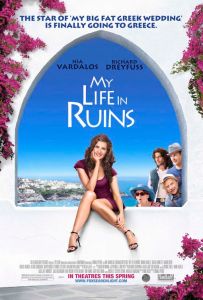 Tacky on nearly all fronts, this Big Fat Greek Wedding wannabe sequel features that hit movie’s star, Nia Vardalos, and plops her in Greece as an unhappy, uptight, undersexed tour guide. The movie follows her exploits to regain her “kefi,” Greek for “mojo.” My Life in Ruins paints in obnoxious broad strokes with its bus of fools, making sure the Australian tourists are never without a can of Fosters in their hand. The stereotypes are plentiful. The lame jokes are easily telegraphed and usually lowbrow (the bus driver’s name is “Poupi Kakas”), the acting is hammy, and the stabs of drama thanks to Richard Dreyfuss as a traveling widower feel alien. Being a romantic comedy replete with stock characters, naturally everything is predictable. Vardalos does a credible job here trying to hold this mess together, though she’s too prone to going for funny faces as a saving grace. Twice characters tell her that she’s not funny, and to this the audience will easily agree. I am dumbfounded that longtime Simpsons writer Mike Reiss wrote this crap. The only real enjoyment you’ll receive from this movie is marveling at all the fabulous Greek sights, from the ancient ruins to the seaside villas. I understand why the cast and crew would sign up to film this movie in Greece, but does that mean I have to subsidize their vacation with my own money? No thank you.
Nate’s Grade: C
Share this:

Away We Go (2009)
 Away We Go sort of came and went in the blink of an eye over the summer. Some critics dinged the indie production as being insufferable, hipster, smug, and unlikable. I agree that the plaintive guitar-strumming score grates, and the costumes have that trying-hard-not-to-be-hip coolness, which can be insufferable, but Away We Go is more than just faulty hipster packaging. There is a moving and entertaining drama inside here. The problem is, you have to sift through some of the junk to reach it.
Burt (John Krasinski) and Verona (Maya Rudolph) are in their early thirties and about to have a baby. They aren’t exactly hipsters but they have been living a somewhat fringe existence; Verona even points out that they have a cardboard window. Their existence has been mostly ramshackle and now its about to change forever. Burt and Verona decide to journey across the country and reunite with family and old friends. They’re studying widely different family units across the country to discover not just what kind of parents they will be but what kind of family they will be.
Just by the fact that nobody dies at the end, this is a big departure for director Sam Mendes (American Beauty, Revolutionary Road). This low-key road trip comedy is quite different from the meticulous prestige pictures associated with the Mendes name. Away We Go is a scruffy, small, and disarming little picture that wants to say something. I was taken aback at how affecting I found moments of Away We Go, though it is only moments. Burt and Verona are not exactly the best equipped to start a family right now, which makes them anxious and nervous, and anxious about not being more nervous. They haven’t exactly matured much since graduated college years ago. But amidst their search for the definition of a “working family” they must accept the uncertainty of life. Burt and Verona have a comfortable interaction, from his upbeat sarcasm to her grounded realism. There’s a great running gag where Burt tries to raise the baby’s heart rate, so his goofy bouts of fake agitation will be immediately followed by a stethoscope and an adorable grin of satisfaction. They are a compatible couple and it is refreshing to see a movie couple that compliments each other in personality. They actually love each other, are good for one another, and are not beset with contrived conflicts. In fact, the movie ends up pretty much exactly where it began, only with a smattering more of wisdom. The lesson learned in Away We Go is that it doesn’t matter what the bumps in life may be, it’s all about who you have as your co-pilot.
 Screenwriters and married partners, Dave Eggers and Vendela Vida, mix in small moments of weight and an overall tone of genial sweetness. The drama and the comedy are given equal share of the script, though the elements don?t mix that often. The funniest moment, by far, is when a little boy tells his mother exactly what he knows about babies (I won’t spoil the guffaw-inducing surprise). There are some quiet yet weighty moments of human observation here. There was a tender exchange between Verona and her sister Grace (Carmen Ejogo) that had me on the verge of tears. The sisters reminisce about their parents, long dead, and then Grace says that having this baby keeps their parents alive; the sisters can see parts of their mother in the baby’s face. Verona is giving back life to her dearly departed mother and keeping her parents’ legacy ongoing. This lovely thought struck me with such sudden force that I felt overcome with emotion. It could be dismissed as a common sense fact of genetic proliferation, but I had never thought of the birth of a child as a means of keeping the past alive and honored. To me, this is a simple yet wonderful and powerful statement. Another great moment is when Burt and Verona make lifelong promises to each other on a trampoline. Verona doesn’t want to marry, so the scene is the equivalent of the two lovebirds exchanging vows. It’s heartfelt and sincere and well within the bounds of the characters.
What?s frustrating to me is that the movie?s poignancy is undercut by its excisions with grotesque cartoon versions of bad parents. Burt and Verona visit different imperfect family units, but it isn’t until the end of the movie where we see anything resembling a semi-authentic brood. Alison Janney plays an obnoxiously loud parent who berates her children for laughs and accepts the brokenness of children; to her, she can’t fight against genetics and thus gives up parenting. On the flip side, Maggie Gyllenhaal plays a narcissistic earth mother who still nurses her children and condemns the very idea of strollers (“I love my babies. Why would I want to push them away?”). In each case, the depicted family is a caricature and readily ridiculed for some easy and snide laughs. Even Burt’s parents (Jeff Daniels, Catherine O’Hara) are figures set to be mocked for their self-absorbed bourgeois values. In some ways, Away We Go started to remind me of that awful movie North, where a young Elijah Wood travels the globe in search of new parents. At each stop, Wood encounters broad caricatures of different family units. In Away We Go, half of the movie is spent palling around with repulsive idiots who overstay their welcome fast. What’s even more frustrating is that the script becomes locked into a pattern, meaning that we spend the same amount of time (10-15 minutes) with each family. This is not helpful when Burt and Verona finally reach the relatable families, in Montreal and Miami, then the movie shortchanges the palpable drama. In Miami, Burt’s brother has had his wife run out on her family, abandoning their daughter. We’ve finally reached interesting and complex character, each with an aching sadness just below the surface about the hardships of parenthood, and the movie has to keep on moving because we spent too much time with the crazies for easy laughs. You’re supposed to spend more time with the good stuff, not the bad.
 The noisy, exaggerated supporting characters are balanced by the believably baffled Krasinki (TV’s The Office) and Rudolph (Idiocracy). He’s effortlessly charming and Rudolph plays her character with subdued texture, uneasily taking everything in for due consideration. Both actors are likable and we grow in empathy with them as they go from stop to stop. The couple is so charismatic that it makes the drama-free reality of functionality forgivable. The rest of the cast play their parts to the hilt, but special consideration should go out to Melanie Lynskey (The Informant!, Heavenly Creatures) who plays the mother of a large adopted clan of kids in Montreal. Her problem is that she cannot conceive and she’s endured five horrible miscarriages. Her slow and melancholy dance around a stripper’s pole is heartbreaking, and that?s something I thought I would never write in my life.
Despite some missteps, Away We Go is a sweet and affectionate little movie that fights against being overly twee and precious. It’s definitely not sentimental but at the same time it rejects cynicism and detached irony, embodied by the compatibility of a couple that truly love each other. At the same time, the movie can be annoying with its loud side characters that act as distractions. The best moments in Away We Go are the small ones centered on Burt and Verona. It’s those handful of small moments that pierce your heart. It’s strange but after writing this review, I realize that I like the good moments even more and the bad moments even less. It’s like Away We Go has become more entrenched in my mind. This is a sometimes promising, sometimes frustrating, drama that knows enough about life to not settle for easy answers. If only it didn’t settle for easy jokes with stupid characters.
Nate’s Grade: B+
Share this:

The Proposal (2009)
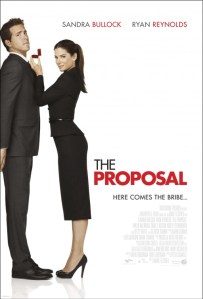 Romantic comedies can be elevated by the chemistry and comic abilities of their leads. I think the most painful modern pairing was Maid in Manhattan, which featured polar opposites Jennifer Lopez and Ralph Fiennes (could you find a more unlikely couple outside of Harold and Maude?). With The Proposal, Sandra Bullock takes a break from her usual pratfalls and finds a worthy sparring partner in the charming, self-effacing Ryan Reynolds. Bullock is a mean book editor who must get married ASAP or be deported back to Canada, and Reynolds plays her beleaguered assistant and surprise sham fiancé. The two actors have a terrific rapport and generous give-and-take, propping the other to higher achievement; they feed off each other. Their spirited, snappy, collaborative, and most significant, fun relationship is what won me over. Otherwise, The Proposal would likely have succumbed to its wealth of genre clichés, like kooky relatives (an irascible Betty White), contrived conflicts (see: premise), last-minute misunderstandings, and the collapsed window of time. These people go from hating each other to loving each other over the course of one weekend in Alaska. Yet through it all, Reynolds and Bullock kept me smiling and alert, saving me from cuteness overdoses. Hopefully Bullock and studio execs will learn from this that bickering couples work best when the actors can play nice together.
Nate’s Grade: B
Share this:

The Invention of Lying (2009)
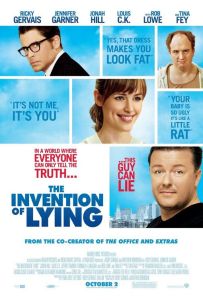 Imagine a world where people could only tell the truth. Sounds scarier than anything in horror movies today.
Mark (Gervais) is trying to romance Anna (Jennifer Garner) but even the waiter tells him she’s out of his league. She tells him upfront that she finds him unattractive and he will never have any hope of having sex with her. She’s more interested in Mark’s snide but handsome co-worker, Brad (Rob Lowe), who she feels is a better genetic match. Mark is about to be fired from his job, writing historical screenplays about the 13th century, and his secretary (Tina Fey) delights in telling him that she loathed every minute they spent together. This is a world without a filter. Until one day Mark goes to take out money from the bank, and something inside his brain switches. His balance is $300 but he asks for $800, and the bank teller apologizes for the computer error and gets Mark his full $800. He explains to his barfly friend Greg (Louis C.K.) that he said something that wasn’t. Nobody understands. “I’m a black Eskimo,” Mark says. Everybody takes him at his word. Mark is the only human on earth who has the ability to tell a lie, which he uses to his great advantage whether it be gambling, getting out of a traffic ticket, or unearthing a “lost” historical chapter about ninjas and aliens that makes for a stirring “non-fiction” film. Mark can’t even explain what he’s done, since the world lacks even a word for “lie.”
Gervais and co-writer Matthew Robinson concoct some interesting and inspired ideas of what a world bereft of lying would be like. Naturally, advertising would be completely different if people had to tell the truth, the whole truth, and nothing but the truth; imagine prescription drug ads that only said, “This is a placebo. Your penis won’t ever grow bigger.” The slogan for Coca-Cola is, “It’s very famous,” and the slogan featured for its rival, Pepsi, is, “When you can’t have Coke.” No one has any concept of fiction, of people pretending to play parts, so movies only consist of an older man sitting comfortably and reading a historical account with some minor dramatic inflection. Movies have become book reports. The sign in front of a retirement center says, “A Sad Place for Hopeless Old People,” and a motel sign reads, “A Cheap Place to Have Intercourse with a Near Stranger.” However, I’m puzzled by how forcefully open every person is. Just because you can only speak the truth doesn’t mean you have to be talking constantly. I understand Gervais’ point about the need for lies to protect people’s feelings, but just because you think someone looks fat doesn’t mean you have to blurt it out. When Mark greets Anna at the door for their date she reveals, “You’re early. I was just masturbating.” It’s funny, sure, but did she feel compelled to link the two statements? It seems in this world, everyone is incapable of keeping their mouths shut.
 The premise of the movie is terrific, and I’m honestly shocked no one has thought of it before. But the premise wears a little thin after the first 30 minutes of people speaking with no filter. You begin to expect outrageous comments that will be hurtful and blunt, and because you expect them it takes away the shock value and lessens the humor. But then The Invention of Lying takes a sharp right turn at about minute forty and becomes a radical and subversive and much funnier movie. Mark is comforting his dying mother (Fionnula Flanagan) who is afraid of leaving existence. She’s afraid of a cold nothingness. So Mark explains to her that there is an afterlife, a world beyond our own, where everybody gets to be around their loved ones in a mansion, and there’s no pain. She closes her eyes and dies in peace with this new knowledge. The doctors and nurses are amazed and beg to know more. Mark has created the idea of religion and God! He’s mobbed by people and camera crews demanding him to explain what he knows. Mark then works up the courage to establish a system of 10 rules to follow, which he tapes onto old pizza boxes. He then addresses his flock and has to explain the complicated minutia of religion, with hilarious questioning from the acolytes. Mark explains that there is a “man in the sky” who watches everything we do and is responsible for everything that happens. “Does that mean the Man in the Sky gave my sister cancer?” someone asks. Mark tries to explain the nature of a loving, all-powerful deity who willingly allows bad things to still happen. “Screw the Man in the Sky,” someone yells, “He’s going to kill us all. We need to fight back!” You try explaining the nature of the unknown to people.
It’s at this point that the movie transforms into a biting satire on belief and belief. I was cackling but I noticed that my theater seemed to get awfully quiet the longer the religious satire went on. I almost spat out my drink when I saw a spinning newspaper headline that said, “Man in the Sky Continues to Give Children AIDS.” It’s offensive but completely within the bounds of religious questioning. Gervais and Robinson aren’t ridiculing religious belief; in fact they seem to prove that it has a definite place of significance within society and can be beneficial psychologically. The satire isn’t savage and still manages to play with the amiable, fable-like nature of the story. Gervais isn’t laying out an argument that believing in an unforeseen deity is stupid. The movie isn’t condescending or hectoring, like Bill Maher’s anti-religion documentary Religulous, but it does take some slyly subversive swipes at the nature of faith and its reliance upon the unproven.
 The Invention of Lying suffers from trying to be a romantic comedy. Too much of its conflict is spent on whether the chubby guy can get the pretty girl. The movie gets a tad sentimental for dealing in bitter-truths, and Gervais and Robinson steer the film to the ultimate romantic comedy setting: objecting at a wedding. I wouldn’t have minded the rom-com asides if they didn’t feel like they kept striking the same chord. Mark wants to be in a relationship with Anna. She points out that he’s fat, has a snub nose, and not a good genetic match. He persists. She points out that he?s fat, has a snub nose, and not a good genetic match. This goes on and on until the inevitable break at the end. Mark, and especially Gervais, is an appealing guy, self-effacing and witty, even downright cute at turns, but when Anna keeps repeating the same looks-first mantra, it makes her seem increasingly shallow and him seem like a glutton for punishment. Garner is a fabulous comedic actress and packs a lot more emotion into her character than I would have expected given the conceit.
Ricky Gervais is catching fire as of late, and it seems that America is finally waking up to the charms and brilliance of this squat comedian. He created The Office, the standard for squirm-based comedy, and appeared in the underrated supernatural comedy Ghost Town last fall. Gervais shows the necessity of lies in our world, from sparing hurt feelings to making mass-market entertainment. The world needs dishonesty. When The Invention of Lying is on-target, it is a hilarious, almost brilliant, comedy, with its best gags saved for taking on “the Man in the Sky.” It’s too bad then that the entire movie doesn’t live up to these flashes of comedic brilliance. Still, the movie is sweet enough and ends on a satisfying level, even if The Invention of Lying begins as one movie and ends as another. Gervais is an appealing lead, though he doesn’t prove much in the way of a director, and he has some real dramatic acting chops too, nicely put to use during his mother’s deathbed scene. I hope more Americans wake up to this man’s charms. Gervais continues to show audiences the sharp wit that has made him one of the world’s foremost funnymen.
Nate’s Grade: B+
Share this:

(500) Days of Summer (2009)
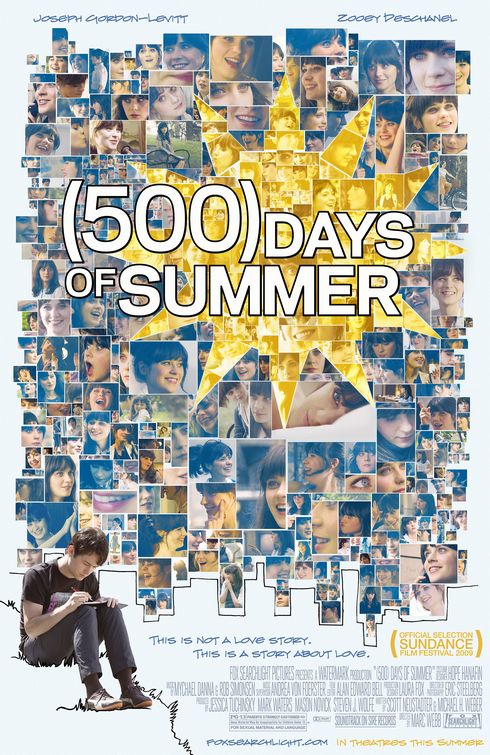
It doesn’t take long before you realize that (500) Days of Summer is a different kind of romantic comedy. In fact, to slap that genre title onto it does a disservice. I’ve watched plenty of romantic comedies (a notable rise in viewership since getting married in 2006), and the traditional Hollywood romantic comedy exists in a world not our own. It is a sitcom world where people blurt out their feelings, interact in bizarre manners, and get into wacky hijinks and contrived misunderstandings. These tales also exist in “movie world”; (500) Days of Summer, on the other hand, is refreshingly recognizable. Granted the characters still have fantastic if slightly off kilter jobs (writer of greeting cards), and the characters live in fabulous and gigantic apartments. Excusing those contextual quirks, the movie is upfront about its intention. “This is a story of boy meets girl,” a narrator intones, “but it is not a love story.”
Tom (Joeseph Gordon-Levitt) recounts the 500 days he has spent with his ex-girlfriend, Summer (Zooey Deschanel), the girl he aches over because he feels her to be his “one.”
This is a movie about love and relationships but it has such a wider scope. It’s perceptive and insightful in the way that human beings engage in coupling. Tom ping-pongs between memories, tying together happy moments and the failed recapturing of those exact happy moments later. I enjoyed how reflexive the film can be with romance. When Tom is infatuated with Summer he lists her attributes: “I love her smile. I love her hair. I love her knees. I love how she licks her lips before she talks. I love her heart-shaped birthmark on her neck.” And then when he is frustrated with Summer, he lists her faults: “I hate her crooked teeth. I hate the way she smacks her lips. I hate her knobby knees. I hate that cockroach shape splotch on her neck.” I appreciate a movie that tries to tackle the complexities of love in a manner that doesn’t seem trite or sensational. A movie doesn’t have to say anything new about romance (is it even possible to scoop the Romantic poets?), but it can still say something true and revealing. It is a story about love, but not a love story.
 It also helps that the characters are meaty and are played by capable actors. Tom is a smart enough guy, though a bit of a foolish romantic. He buys into the love that is talked about in pop songs and greeting cards; he’s not naïve per se but plenty vulnerable enough to get his heart broken in the real world. Summer is an independent woman who says at the start that she is not looking for a boyfriend. She doesn’t wish to be constrained by a relationship and wants to enjoy the carefree days of youth. Yet Tom persists thinking he can wear her down or win her over, waiting for Summer to cave and find solace in Tom’s embrace. He fancies Summer as the “girl of his dreams,” though everyone else isn’t so sure. His little sister argues, “Just because she likes the same bizzaro crap you do doesn’t mean she’s your soul mate.” One of Tom’s friends has a really nice monologue describing his “perfect girl,” and these descriptions noticeably differ from that of his long-term high school sweetheart. But then he stops, reflects, and says that’s what his “perfect girl” would be like, but his current girlfriend, well, she’s better than his imaginary version of a perfect girl. But Summer isn’t a fantasy of romantic perfection, she’s a person. She has her own desires, her own insecurities, her own ambitions, and her own life to lead. These two feel like actual human beings and not stock players, though (500) Days of Summer does carry its own share of stock parts like the square boss (Clark Gregg) and the goofy, horny friend (Geoffrey Arend).
The saying “the camera loves” somebody seems outdated, old fashioned, and liberally applied. But when it comes to actress Zooey Deschanel, well, the camera just loves her. It’s hard not to fall in love with this blue-eyed beauty. She’s adorable, but not in an overly quirky way, and she’s smart, but still approachable, and altogether lovely. She is the face of unrequited love. She can be cold and aloof and jubilant. Deschanel plays the complications and complexities of an enigmatic woman who refuses to abide by labels. Her last conversation with Tom manages to be both crushing and inspirational. Her chemistry with Gordon-Levitt feels entirely naturalistic and pleasant. Gordon-Levitt has been cranking out strong performances in indie films like Brick, Mysterious Skin, and The Lookout. He’s quite possibly becoming one of the premier young actors working today. He has an everyman capability but he also can turn on the charm in a way that doesn’t seem forced, like Shia LaBeouf. Gordon-Levitt is the anchor of this movie and we see the world and Summer through his eyes. He brings great vulnerability to his role and we feel each step of his emotional journey. Both actors deliver terrific performances that don’t stoop to playing by the conventions of the romantic comedy.
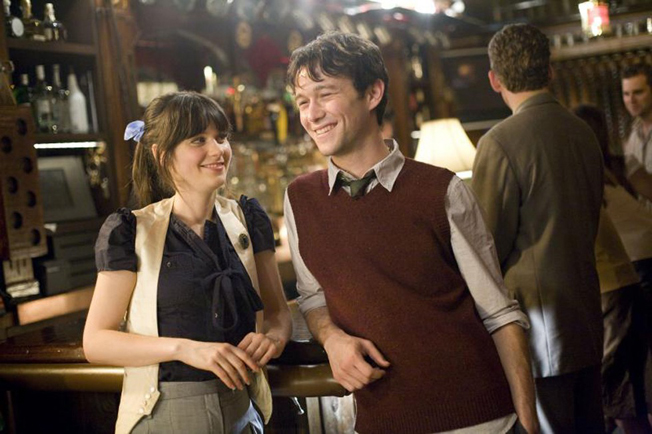 The nonlinear story structure seems like a gimmick until you realize that the writers, Scott Neustadter and Michael H. Weber, have cleverly freed themselves from the contrivances of movie romance time. MRT, for those who prefer their nomenclature in the shorthand, is that unbelievable breadth of time where the characters fall head over in heels in love with each other. It always feels so fast and far too fleeting, so that when complications have to arise late in the second act they too feel rushed. You could apply a healthy dose of montages to signify massive time passages, but those get old unless you’re Sylvester Stallone training to fight another boxing match. (500) Days of Summer tells you right away that this story takes place over a year and a half, and Day One isn’t when boy got girl but when boy met girl. By skipping around to specific dates, Neustadter and Weber are hitting only the highpoints, the memorable moments, and leaving out the unforeseen groundwork. All those mundane yet essential moments of pulling together a successful relationship are there, they are just now implicit. They are implied in the time jumps. The relationship between Tom and Summer, therefore, exists in an expanse of time that feels believable. The nonlinear structure also belies the way our memories work. Human beings don’t remember everything in a straight line, especially in matters of the heart.
There’s a lot of drama to be mined here with the breakup territory, but the movie is also playful and funny. Director Marc Webb, he of the video music world, pokes fun at other filmic expressions of love. At one point, Tom struts down the street and becomes the center of a lively choreographed dance sequence complete with animated blue birds. At another point, during Tom’s heartbreak, the movie descends through Bergman and Fellini visual tropes. It simultaneously communicates Tom’s emotional highs and lows and satirizes the histrionic nature of his feelings. Truly, when one’s in love you couldn’t feel better, or worse, but upon retrospect you can see how silly such in-the-heat-of-the-moment proclamations can be. There’s also a scene later in the film where Tom attends a party that Summer invited him to. The screen cuts in half, and on one side we see Tom’s expectations of what will happen that night and on the other side we see what actually occurs. The visual symmetry is interesting and a great glimpse inside the mind of a hopeful romantic.
 (500) Days of Summer manages to be breezy, moving, delightful, perceptive, charming, and just a great time at the movies. It’s a story about falling in love for the right reasons with the wrong girl. Summer isn’t the villain of the piece but her own woman, and she can be fickle and frustrating but she is not cruel or indifferent. Tom is desperately in search for his “one true love” but he’s playing by a checklist he’s drawn up from movies, TV, and love songs. All of this could have been sticky and formulaic (in fact, the dynamic vaguely resembles the characters from the abysmal Ugly Truth), but the filmmakers and the talented actors make the movie feel honest and relatable. The nonlinear narrative allows the movie to simultaneously be more playful, believable, and actually easier to understand, linking selective memories. No matter your current romantic situation, (500) Days of Summer is a slick antidote to Hollywood’s rom-com factory line.
Nate’s Grade: A
Share this:

New in Town (2009)
 Uninspired, slack, overly sentimental, deeply formulaic, the romantic comedy New in Town is so lazy it could have been written by a committee of trained chimps. This tired fish-out-of-water story takes a big city businesswoman (Renee Zellweger) and drops her in frigid small town Minnesota. Get ready for funny Fargo accents and dated stereotypes, doncha know. First the locals are ridiculed and then our big city gal discovers that these small town folk are to be envied. Just once, I’d like to see a Hollywood movie where a big city professional takes an extended jaunt in some Podunk town and discovers at the end… that small towns are overrated and they’ll take the big city any day. Sorry Sarah Palin, small towns do not have a monopoly on values and are not any more truly American than we city dwellers. Anyway, Zellweger looks like she’s in pain the whole time, then again that could be that natural contortion of her scrunched-up face. There’s a romance between her and the local union rep (Harry Connick Jr.), some lessons to be learned, and a late savior in the form of tapioca pudding. New in Town is moronic at most every step, and given the current wintry economic climate, a romantic comedy about downsizing feels like a bad joke in itself.
Nate’s Grade: C
Share this:

He’s Just Not That Into You (2009)
 Based upon the best-selling nonfiction book, the movie follows the interconnected lives of a cadre of characters trying to get lucky in love. As with any ensemble piece, some storylines are better than others, notably Ginnifer Goodwin (HBO’s Big Love) as a naïve and hapless gal confused by the ever-changing rules and rituals of contemporary courtship. Her scenes with Justin Long, as her dating coach, are the movie’s high-point. The two actors have a light, charming chemistry and their scenes get at the heart of the male/female dating dysfunctionality without feeling trite. But in between, you get a lot of hackneyed yakking about the stereotypical differences between men and women, how dumb men are, how crazy women can be, etc. It’s all been covered to death by other romantic comedies to the point that it feels like common knowledge, which makes it tiring to sit through. Some of the drama feels overly manufactured, like Jennifer Aniston pushing to get married because she her little sister got engaged, there are characters that are just annoying people, like Kevin Connolly continuing to nip at the heels of Scarlett Johansson for some scraps, and Some of the material is weirdly dated, like Drew Barrymore talking about being “Myspace-ed” by a prospective date (Hello, it’s all Facebook all the time now). Naturally, it’s all rather predictable as well, however, this is not the fun date movie it may seem. It hits some rough dramatic patches, like the pains of infidelity, losing trust in a spouse, manipulating people, and occasionally there will be a moment that comes across as genuine and heartfelt, like when Ben Affleck wins over Aniston simply by being thoughtful and doing the dishes. It’s in these sporadic moments that He’s Just Not That Into You feels like it’s tapped something a little deeper and more meaningful than scraping the barrel of romantic comedy clichés.
Nate?s Grade: C+
Share this:

The Ugly Truth (2009)
 Can’t a woman ever catch a break in romantic comedies? The genre occasionally just comes across as contemptible against women. On screen, female figures will fight against misogyny, but then how often do they usually just give in? How often do the female characters change to suit the male characters? Usually, the male romantic lead has some kind of boneheaded secret, but it’s really the women that do all the changing and the man is left off the hook. It’s somewhat appalling and amazing that the unappealing romantic comedy The Ugly Truth was written by three women and produced by Katherine Heigl. I guess they wanted to prove that women could be just as capable of self-sabotage.
Abby (Heigl) is a career-driven TV news producer who’s a bit unlucky when it comes to love. She has a steep checklist of qualifications for a prospective mate. She is aghast when her boss hires Mike (Gerard Butler), a rude public access host of the dating advice show “The Ugly Truth,” to shore up ratings. Mike is an uncivilized shock-jock who dispels pearls of wisdom like, “No man wants to date a fattie.” Abby and Mike bicker from an ideological divide. But when an attractive doctor (Eric Winter) movies in next door to Abby, she agrees to follow Mike’s dating advice. He coaches her on how to win over the doctor, and it generally seems to be working. Of course now Mike thinks he may have fallen in love with Abby as well. Oh what complications await.
 The humor of The Ugly Truth doesn’t even aspire to be sophomoric; it’s questionable whether the comedy even reaches juvenile levels. It’s tasteless and piggish, but the weird part is that it comes across as knowledgeable on the subject of sex as a ten-year-old kid who just discovered his dad’s secret stash of Playboys. It talks about the right stuff but does so in a clueless manner. It’s like an exaggerated randy cartoon that chiefly plays to a male fantasy. The movie feels that the height of comedy is when Abby wears a pair of vibrating panties to a business dinner, and oh no, some little kid is playing with the remote. So Abby is writhing and convulsing while trying to deliver a business speech. It’s the female orgasm turned into a cartoon. I won’t even get into the icky implications that Abby does not even get to control her orgasm, that she is held hostage by the whim of a child (a boy, no less). It just comes across as morally queasy if you think more about it, which may be why Heigl is practically rolling around on the table and chirping like a dolphin. Meg Ryan has nothing to worry about in the world of public displays of an O-face. At least in that movie, the joke was on the audience, and the man, and the woman was in a position of control. I even saw this routine already with a vibrating egg in the 2006 hard-core sex drama, Shortbus.
It doesn’t get much better. There’s a moment at the ballpark where Abby spills her drink onto her date’s lap, so she furiously tries to rub it out, which in crazy movie world means the man instantly attains pleasure. If that wasn’t enough, the movie then takes another step and displays this ordeal on the ballpark’s Jumbotron. And if even that isn’t enough, the movie takes yet another step to obscure what Abby is really doing, so all you see is her bobbing head by the crotch of her date. It’s not really funny because it’s so forceful to the point of being unpleasant. Abby is the butt of most jokes and after awhile it just seems cruel. The jokes recycle the same lousy observations about the differences between men and women. Men want sex. Women want relationships. Men are cretins. Women are crazy. Men like boobies. Blah, blah, blah. This time there’s just more bad language. There’s nothing truly adult here, either in wisdom or comedy. Just because you imply oral sex and throw out a few F-bombs doesn’t mean that your romantic comedy is any more sophisticated and relevant. The Ugly Truth just reeks of desperation.
 The central characters don’t even come across as believable for a romantic comedy. Abby is an intelligent professional woman who will stand up to rampant misogyny in the workplace. She resents Mike’s attitude that the only value women serve is to please men. So then it would only be natural that she follows Mike’s coaching to win the heart of the hunky doctor living next door. She clearly believes that she must become a sexed-up twit to win over a doctor. What? Excuse me, come again? The characters are at the mercy of whatever contrivances the plot requires. Predictably, this is yet another movie where two characters hate each other for two acts only to finally realize in the last act that, surprise, they’re really in love. Because we know the inevitable coupling, an audience likes to pick up on moments that might help explain how we got to our final romantic destination. Will the crude dude really have a mushy heart deep down? Will our icy businesswoman be able to let her hair down and enjoy the messiness of life? Have you ever seen a romantic comedy before and therefore know the answers to these questions? In The Ugly Truth, I could not explain why either of these people would fall in love with the other. I’m sure there are plenty of great backstories where people realized their true love in the basket of a hot air balloon. Seriously, the climax takes place in a hot air balloon and Abby asks, “Why do you love me?” to Mike. “Beats the shit out of me,” he replies. This is intended as a moment of romantic clarity. I view it as the screenwriters giving up, having failed to establish even a remotely credible relationship in a genre replete with easy choices.
I’m actually a fan of Heigl (27 Dresses) and think that she seems like a natural fit within the romantic comedy universe. She’s expressively comedic, has good timing, and she knows how to hit her jokes hard. She can wait until she’s older to do a family drama because right now there’s gold in them thar genre pictures (practice the finer points of singing into a hairbrush and dancing around a coffee table). But The Ugly Truth is a waste of her ability. Abby is a tightly wound control freak and Heigl plays her without an ounce of warmth. Butler (300) can still come across as likeable even if his character is cheerily boorish. He doesn’t hide his natural Scottish brogue too well, though. He’s got more comic firepower and he openly mocks himself, which makes him more appealing as a character. However, there isn’t much in the way of chemistry between Heigl and Butler, only combativeness. Their fighting is the only emotion that seems real.
 So what is the ugly truth of The Ugly Truth? I suppose if you’re a woman, you better not be successful, talented, smart, or slightly overweight. And your dating failures are completely your own fault. And you better be willing to put out or at least dress a little provocatively. And don’t expect your man to change any of his ways, simply lower your standards. That, ladies and gentlemen, is the concluding wisdom from our trio of female screenwriters. Heigl and Butler squander their talents in such a charmless battle of the sexes cartoon. There’s little in the way of wit or insight or even properly executed comedic payoffs. The Ugly Truth needs to be atoned for. It’s rarely funny and it’s insulting and unflattering to both sexes. It exists squarely in the world of exaggerated male fantasy, peculiar for a genre defined by female wish fulfillment. At my screening, there was a family who brought their adolescent kids with them. I could hear pre-teen giggling at the more slapstick-heavy jokes and heard lots of questions whenever something sexual was discussed. At one point, Heigl covers the eyes of a child and says, “This is not for kids,” and I guess that family finally got the message because they left shortly after. Except this movie isn’t intended for anybody. Everyone in the theater should have followed suit.
Nate’s Grade: D+
Share this:

I Love You, Beth Cooper (2009)
 Not the trainwreck it’s been advertised as but still not near the term of “passable,” I Love You, Beth Cooper feels like a forgotten relic from a time capsule of 1980s teen movies. It just feels so powerfully dated and yet unable when to maintain a consistent comedic tone or building interesting characters. During the valedictorian’s (Paul Rust) graduation speech, he loses his filter, lets people know his real thoughts, and Beth Cooper (Hayden Panettiere) gets the titular declaration. Thanks to director Christopher Columbus, the movie wallows in shallow stereotypes; geek goes after head cheerleader. The comedy is ramped-up slapstick that approaches cartoon ridiculousness, including Beth’s ex-boyfriend who assaults and destroys everything in sight without anyone ever calling the police. There are some ham-handed life lessons doled out between the PG-13 randiness. The casting also dooms the flick. Panettiere isn’t a strong actress, and as for Rust, I was irritated by the character’s every movement and word. There are some fun stretches but nothing that ever sticks or resonates. I Love You, Beth Cooper is not worth adulation or scorn, just indifference.
Nate’s Grade: C
Share this:

Last Chance Harvey (2009)
 There aren’t too many movies that feature a middle-aged romance. That’s really the sole draw here. Harvey follows the titular dad (Dustin Hoffman) as he travels overseas to his daughter’s wedding. His life is in shambles and he strikes up a friendship with a downtrodden woman (Emma Thompson) that eventually percolates into romance. The interaction between Hoffman and Thompson is relaxed and charming but the storyline is too slight and predictable. This whirlwind courtship spans one single day, so the movie feels too brief. We’re just getting to know these characters and enjoying their chemistry when the movie just limps to a close. Last Chance Harvey feels less like a movie and more like the first act of a movie. The plot is predictable and hits all the resolution points it needs to, which means get ready for tear-jerking wedding toasts from men who’ve changed and grown wiser over the course of 24 hours. Last Chance Harvey is a mildly pleasant diversion with two talented actors making the most of a shopworn and abbreviated story.
Nate’s Grade: B-


 nathanzoebl
You must be logged in to post a comment.