Blog Archives
Terminator Salvation (2009)
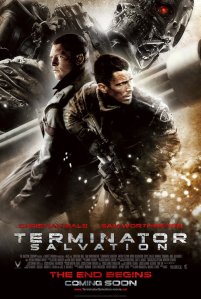 The fourth Terminator movie ultimately comes across as a lifeless enterprise. It’s set during the war between man and machine, which means John Conner (Christian Bale) is leading the human resistance, as was prophesied. He must stop those crafty machines from finding and killing Kyle Reese (Anton Yelchin), who is destined to be sent back in time and become Conner’s father. The storyline focuses a lot more attention on the mysterious man Marcus (Sam Worthington), who isn’t so mysterious because they give away in minutes that he’s a machine. But he’s a thinking machine that reclaims his humanity, or whatever. The point of this movie is to make some cool action sequences and not step on the toes of the previous movies. Director McG (Charlie’s Angels) has a few nifty visual tricks up his sleeve, but this is one soulless machine just going through the Action Blockbuster subroutine. The character development is nil, the story is muddled, the machines are dumb, and Bale forgoes any normal kind of speaking voice in favor of growls and hissing. The throwbacks to the other movies can be fun (a 1984-aged Arnold!) or agonizingly lame (shoehorning in famous quotes like, “I’ll be back”). The movie is competent and has one or two exciting chase sequences, but that is simply not good enough coming from this storied action franchise. Terminator Salvation plays out more like Transformers, where the robots are big and bad and loud and sort of dumb. I guess that sums up the movie pretty well.
Nate’s Grade: C+
Share this:

9 (2009)
 9 began its life with acclaim. Director Shane Acker won a Student Academy Award and a 2004 Oscar nomination for Best Animated Short for his eleven-minute tale of post-apocalyptic ragdoll people. Blown up to feature length and with a screenplay by Pamela Pettler (Corpse Bride), 9 the film is being sold on the name appeal of producers Tim Burton and Timur Bekmambetov (director of Wanted). It’s being sold to gloomy animation aficionados. I can hear the producers saying, “These guys will see anything that?s dark and different.” I advise everyone to surf YouTube and watch the eleven-minute original short by Acker. You’ll save eight bucks and see the more effective and satisfying version of 9. If you wanted to boil 9 down, it’s like The Brave Little Toaster starring the villainous robots from The Matrix. Sound like a winner?
War machines have killed humans. The only life on our planet is a handful of numbered ragdoll creatures. The main hero, #9 (voiced by Elijah Wood), awakes in the home of a dead scientist. The outside world is demolished. He finds other little ragdoll people like him, each numbered 1-8. Together they must try and make sense of this scary new world and survive the roaming robots still on the hunt for… something. #9 accidentally gives life back to the monstrous Machine, who we learn is responsible for the downfall of mankind. Way to go, ragdoll. The Machine is patching together mechanical minions to take over the ashen remains of a post-apocalyptic world absent life. Seriously, I’m at a loss what the big evil Machine hopes to accomplish. Then again, maybe it’s just in need of a hobby.
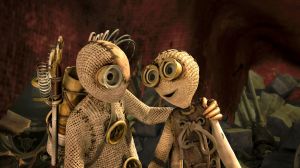 Even at a scant 79 minutes, 9 the movie still feels stretched and draggy, chiefly because the plot is lousy and the character work stopped at the design stage. I was bored throughout, I didn’t care about any character, and the movie failed to even arouse my curiosity to solve the mysteries of the movie. I didn’t even care if I found out why these ragdoll creatures existed or what had happened to leave the world in chaos. I sat in my chair, completely uninvolved with what was happening onscreen. Part of this is because a majority of the plot involves these tiny characters walking from one point (a church) to another (a factory) over and over again; the plot could be substituted by a linear line connecting Point A and Point B. It’s all so crushingly repetitious. And these are not short distances either, compounded by the fact that it’s little eight-inch ragdolls walking these great expanses of land. I invite every reader to position two fingers on their hand, index and middle, and then proceed to pretend to walk across. That, ladies and gentlemen, is the miniature plot of 9 magnified for your edification. Just imagine weird robots chasing after your fingers and you get the drill. There’s not enough story here to make the jump and fill out a feature film.
The characters have an interesting design, to be sure. Each has different sewn parts but Acker makes the mistake of animation where the design is the full personality of the character. #8 is a big dolt, #1 is an old tyrant, #6 is a loon (voiced by Crispin Glover, naturally), #7 is a lady rag doll warrior complete with some purposeful enhanced womanly hips, and so on. The bland characters don?t ever take a moment to ask more important questions. These creatures have just been given life in a hostile world absent of life, so how about a moment where they ponder something a bit existential (Why am I here? What is life?) before they immediately speak English fluently and assimilate perfectly in a world they were born into moments earlier? The characters are a challenge to feel any empathy for.
The mechanical monsters designs also come across as highly derivative; then again, so does the movie as a whole. The main villain, The Machine, looks exactly like the Sentinels from the Matrix movies. It has a central red glowing eye, a head lined with pistons, lots of twisty tentacles, and even creates shockwaves of electricity that seem to bathe over the mighty creature. I think it even makes a similar noise as the Sentinels. Then there’s also one mechanical minion whose key design feature is a mutilated doll head. Too bad I already saw this exact same design in Toy Story 14 years ago. Here’s the thing: I don’t automatically cry foul whenever a design concept looks familiar, but when things just keep hitting you in the face with familiarity then it develops into a pattern. The overall film feels stitched together by the parts of other, better movies.
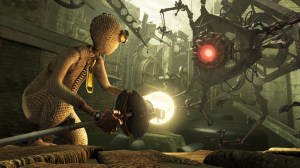 At least there’s a saving grace with bad animated films: you have something moderately interesting to watch considering the painstaking work that goes into every frame. That is not the case with the dreary 9. The entire landscape is post-apocalyptic, which means the sets are little more than ash, ruins, and barren remains. There are only so many scattered mechanical remains you can see before it all just starts resembling one vast junkyard. The setting is not 21st century, but more like mid twentieth in some unidentified Eastern European city (a film reel reveals that we’re in communist territory). I’m not saying that it’s impossible to find beauty in destruction, but this movie misses out. Acker and company has created a competently animated movie with a somewhat different look and feel, but there isn’t a single moment of wonder or awe to be had. It lacks an imaginative spark.
This animated tale lacks a sense of wonder, a sense of intrigue, even a sense of scale. The visuals and story are derivative of other sci-fi/fantasy films. In the original short, the characters were silent, causing the viewer to work harder at interpreting body language and context. If the ragdolls are just going to spout lame exposition gunk, they should have stayed silent. Director Rob Marshall’s upcoming big screen musical, Nine, need not worry about being confused with this film. In about two weeks, everyone except those with Hot Topic punch cards will have forgotten this mediocre movie. People who say, “It’s only an animated movie, give it a break,” are deluding themselves. No matter the genre, an audience should expect to be entertained. 9 just makes me hopeful that in the future Acker proves why he was targeted as a talent on the rise.
Nate’s Grade: C
Share this:

Transformers: Revenge of the Fallen (2009)
 Transformers: Revenge of the Fallen pretty much sells itself. More giant freaking robots. That was enough to make the first movie a worldwide blockbuster. My own teenaged brother-in-law, when he first saw the first Transformers movie, declared it his favorite live action film. Director Michael Bay completely empties his creative cupboard into a bladder-unfriendly two and a half hour endurance test. It’s too bad that that cupboard was bare when it came to story.
Sam (Shia LaBeouf) is headed off to college, and he’s leaving behind his girlfriend Mikaela (Megan Fox) and robot guardian, Bumblebee. Optimus Prime and the other Autobots have been working with the U.S. government to hunt down Decepticons around the globe. There?s a war on the horizon, and weasely U.S. bureaucrats want the Autobots to take a hike. Sam discovers a tiny shard from the super Cube, which was the source of life for the alien robots. His brain is zapped with an alien language that will lead him to a secret location to a secret ancient machine. The Decepticons want this info and chase after Sam and Mikaela. The biggest bad of them all, The Fallen, is sitting at home waiting to return to Earth and exact interstellar vengeance. The Fallen was foiled in 17,000 B.C. by the Prime family line, and only a Prime can kill him. The Decepticons resurrect their leader Megatron and go about trying to snatch Sam, kill Optimus Prime, and destroy man’s planet.
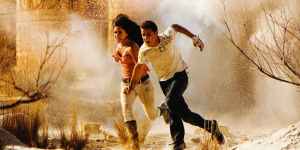
Bay has been condemned for his erratic ADD-shooting style, and this was the first film where I really felt pounded and punished. To contest that this movie is just “a popcorn summer movie” is just making excuses. What the hell was going on? The movie is simply a blur of colors and noise. Transformers 2 is entirely incoherent, both from a story standpoint and simply from a visual standpoint. Bay at least pulls back his camera so that the audience can identify the fighting robots easier this time; this time it’s not like deciphering scrambled porn. It’s the rest of Bay’s characteristically bombastic display of carnage that suffers. Bay is a man that doesn’t know the meaning of the word “small,” and so nonstop explosions and massive destruction litter the movie. Sam is always running or riding in his car to escape. At one point, Sam and his posse hide in a campus library only to have the building turned into cinders (showing Bay’s opinion on what books are really good for). But what exactly is happening? Why does it matter? What are the obstacles? Everything is way too busy and accomplishing so little. Half of the movie consists of the human character running and screaming. It’s excessively excessive and taxingly so.
 A strong example of the film’s incoherence is the 40-minute climax set amidst the pyramids of Egypt. At no point does Bay establish the geography or bother to let the audience follow along. The stakes and parameters have not been made adequately understandable. Ordinarily, in large action sequences there will be different groups of segments and we’ll watch each progress. Here we disjointedly cut back and forth between the groups but I have no idea what?s going on, where the characters are, where they need to be, and what is stopping them. Megatron calls down 13 different evil Decepticon robots to take part in the climactic battle but Bay never introduces these new figures; they get no setup to explain each of their unique weapons systems or general appearance. We see them only at a distance walk through wafting smoke clouds. So when they do pop into battle in quick blurs it’s just another point to be confused about. If you’re like me, you can only endure so much confusion before your brain just gives up. Bay is a fantastic visual stylist, but his action sequences are poorly developed and poorly staged. He needs to check out The Hurt Locker and take notes. Transformers 2 is nothing but non-stop careless mayhem. For what it?s worth, the special effects are incredible at every stop.
The highly ramped-up action would have been acceptable if we knew what the hell was going on and we actually cared about the story. Transformers 2 makes the first film look like poetry in comparison. The story for this movie is simply atrocious and it’s made worse by the merciless attempts at comedy. This movie is stuffed with tin-eared exposition, so our only break to try and assess what the hell we just saw is when the characters take a breather and rapidly spout more plot vomit. It’s like listening to a homeless man shout nonsense for an hour. After a while you just tune out the crazy. If the Decepticons can construct a robot that has the ability to take human form, why the hell aren’t they doing this all the time? Why aren’t they infiltrating government offices instead of prancing around colleges in hot pants? Why in the world would an 18-year-old boy leave the mega hot Megan Fox and his TALKING ROBOT CAR? Why would anyone leave these two to live in a dorm and shower in flip flops? What universe does this college that Sam attends exist in? The place is crawling with leggy, waif-thin bombshells. The movie doesn’t even resort to college stereotypes; there isn’t a single gal that doesn’t look like a magazine cover girl. The Fallen is kind of like the evil leader of the Decepticons and he’s, what, confined to sitting in his robo La-Z-Boy on his home world like Archie Bunker? Get up and do something. The Transformers fought ages ago amidst man?s loin-clothed hunter and gatherer ancestors but leave no record? You’d think some caveman type might consider that worthy of painting on a wall. Why is Megatron even in this movie? What was the point of bringing him back alive if he’s just another lackey to The Fallen guy? Why does no one consider turning over Sam to the Decepticons if it could save the planet? In the big Egyptian battle sequence, where is the Fallen the whole time? He just kind of lazily shows up at the end. Also, ancient robots made a special key to jumpstart an ancient planet-destroying machine, but then we are informed when Sam visits, no joke, Transformers heaven that this key does not work unless the holder has earned the right to use it. It’s like some high tech moral barometer. Why didn’t these alien robots say anything about this? It would have spared a lot of time and energy trying to make sure the Decepticons never got a hold of it. How does a dead human end up going to robot heaven anyway? Does that mean there’s a robot God? Was robot God created by our God? Is there a robot Devil? Does Bay do the work of the robot Devil?
 This time the comedy is puerile and embarrassing. The jokes make this movie tonally feel like a cartoon strictly for snickering adolescents. In the span of 150 minutes we’re given dogs humping twice, a tiny Transformer humping Megan Fox’s leg, Sam’s mother going berserk from ingesting pot brownies, a Transformer testicle joke (why would a robot even need genitals?), and let us not forget John Turturro in a thong. The humor aims low and still finds a way to be even worse. To save you the trouble, I am going to spoil the only two good jokes in this self-indulgent, bloated mess. Here there are, enjoy:
1) Sam is at a frat party, and it’s a frat party unlike anything ever seen unless modern fraternities can afford expensive interior decorators. One unamused frat guy asks Sam what he’s doing. Sam responds, “Going out to get you a tighter shirt.” The frat guy’s flunky clarifies: “There isn’t a tighter shirt. We checked.” I laughed. Sue me.
2) Sam and the gang at one point talk to a Transformer that’s thousands of years old. Apparently the guy is being housed at the Smithsonian Museum, which means that this is the second summer movie that is trying to inform the public that there’s something weird over at the Smithsonian. The old Transformer even has a robot cane, which is too bizarre. He rambles about the old days like Grandpa Simpson, and then finally gave this gem: “My father was a wheel. The first wheel. You know what he could transform into? Nothing! And he did so with honor.” This made me want to think about a period Transformers costume drama, where they exist as textile steam engines and phonographs and Model Ts. Would that not be a vastly more entertaining movie?
Despite all the painfully juvenile attempts at comedy, by far the biggest eyesore would have to be Bay’s Sambot twins, Mudflap and Skids. To say that these two irritating robots are politically incorrect does not go far enough. It’s one thing to reflect a cultural or ethnic stereotype, and it’s another thing entirely to keep digging deeper and deeper. These robots talk in eye-rolling faux gangster street talk, one of them has a big gold tooth, and these robots admit to being illiterate. It’s practically breathtaking to watch how racially insensitive and appalling these characters become. It’s essentially a robotic minstrel show. I’m surprised Bay stopped short of having Mudflap and Skids eat a big bowl of watermelon. This got me thinking about what other highly insensitive Transformers characters that didn’t make the cut over these two. Was there an Asian bot that turned into a car that didn’t drive well? Was there a Jewish bot that chided Optimis Prime to settle down and quit running around with those shiksa sports cars (“You know those aren’t her original parts?”). Bay can dismiss these characters as merely dumb robotic comic relief, except for the fact that these two bumbling, detestable heaps of scrap metal are never, ever funny.
 The actors have little impact in this type of movie. I like LaBeouf (Eagle Eye) but he’s got little to do but stretch his legs. Fox became a star thanks to the previous Transformers flick, and she hasn’t gotten any less attractive. Amazingly enough, she manages to lose more clothes the more she runs in slow-mo, allowing the male audience members to follow the nuance of her bouncing breasts. She’s clearly not the next Meryl Streep but this girl deserves more than being wordless arm candy. Many words have been spilled about the quasi-racist twin robots, but I’m disappointed that people aren’t as equally up in arms over the film’s blatant misogyny. Women don’t seem to exist in the Michael Bay world, only parts and pieces of women. They are all like Alice, the robot programmed to do nothing else but seduce the men. All of the special effects and noise just overwhelm the other actors. The robots themselves have no personality to offer, good or bad.
Transformers: Revenge of the Fallen is an obnoxious block-headed mess that feels like it’s being made up as it goes along. It’s sensory overload without a lick of sense, clarity, wit, and general entertainment. This sequel takes everything that was good about the first Transformers film and undermines it, and it takes everything that was awful and magnifies that awfulness. The first Transformers movie was fun. This is just work to sit through. Apologists will try and rationalize their disappointment, decrying anyone who hoped for something more than a big dumb summer blockbuster about rock’em, sock’em robots. Bay wants to show you everything and as a result you rarely get a chance to process little in this movie. There is absolutely nothing more than meets the eye here. It’s all arbitrary and tedious and it goes on for what feels like an eternity. It’ll make a gazillion dollars at the box office but will anyone remember a single moment from this exhausting junk? Make sure to bring the earplugs and aspirin in abundance.
Nate’s Grade: C-
Share this:

The Day the Earth Stood Still (2008)
 The 1951 original The Day the Earth Stood Still is considered a sci-fi classic for a reason. Versatile director Robert Wise (West Side Story, The Sound of Music) used a robot and an alien invader to help hold a mirror up to the world, asking how humanity was treating its brethren. The technology is easily dated and the tone a bit stately, but the movie is a complex, thoughtful, and relevant tale that begs for caution and kindness. It still holds up much better than most sci-fi chestnuts from yesteryear. And of course anything that film audiences have warm feelings for will be repackaged by Hollywood into a new more mass-appealing product. That means that big-budget Day the Earth Stood Still remake is likely to have no real improvement over the original. Well, it is in color. That’s an improvement for some.
A giant glowing spaceship lands in New York City’s Central Park. A glowing figure exits the craft and enters our world. This figure is Klaatu (Keanu Reeves) who is an alien creature in the guide of a human body. He has been sent by a community of planets to judge the inhabitants of the Earth. You see, the universe is an awfully large expanse of space but it has a limited number of habitable planets. The rest of the universe is taking note of how human beings have treated their home, and they may just decide that the planet is better off without us. Klaatu is helped out by a sympathetic scientist, Helen Benson (Jennifer Connelly). Eventually the alien escapes and the entire U.S. government is on high alert. Helen is trying to convince Klaatu to not rush to judgment. She’s also trying to connect with her angry step-son Jacob (Jaden Smith) after his father died in war. He’s not very trustful of Klaatu and, like plenty of other people, wants the alien dead.
 Whereas the original was a cautionary tale about the Cold War and mutual destruction, and Klaatu was a peaceful Christ-like figure, the new version skips all this. It would rather recycle a message that human beings need to be nicer to Mother Nature. Now, this is an important concern but it’s harder to take seriously when the movie pretends it’s all about doom and gloom and then basically wimps out on an ending. The film is ready to wipe humanity off the globe and even gets a head start with what looks like swarms of microscopic metallic locusts. But then Klaatu looks out at mother and child, embracing as the world they know may come to an end, and concludes that human beings deserve yet another chance because they have the ability to “change.” That’s all it takes? This kind of cop-out ending reminds me of The Happening, another eco-horror movie that wanted to kill off all those pesky humans but then decided they could walk the Earth a tad longer and hopefully wiser. I’m sorry but this is weak. Profess an environmental message but do something with it, don’t thump your chest about taking personal responsibility and then skimp on repercussions. Remember filmmakers that this is fiction. You have the ability, nay the right, to destroy mankind on screen while I safely watch and consume popcorn.
You know what else keeps hurting the weight of the environmental message? The lousy relationship between Helen and her step-son Jason. This entire storyline needs to not exist. I recognize that the original movie had a substantial storyline where a single mom and her precocious son befriend Klaatu, but that doesn’t mean this remake has to reignite old storylines if they just simply won’t work in this retelling. Every time the movie spends significant time with Helen and Jason I felt like the Earth was standing still. This storyline just does not fit. The kid comes across as bratty and dumb and I actually wanted him to be micro-locust food at some points. He’s angry because his father died and that makes him argue that “Kill them all” is a serviceable foreign policy position. Whatever. This storyline is handled so terribly that every moment of drama it is intended to evoke hits with a resounding thud. When the little kid suddenly turns on a dime and helps his alien fugitive, there’s no explanation. He says he’s afraid of being alone. Well what did you think would happen when you called the U.S. government to come and abduct you? I swear that I do not have a heart of stone, and I love children, but every moment of this character felt false and annoyingly so. That’s why The Day the Earth Stood Still grinds to a halt whenever it switches back to this kid. It makes the whole alien threat a lot less menacing when we spend more time with this kid. Don’t we have far more significant things going on in this story than one kid working through his grief and learning to be less bratty?
 Director Scott Derickson (The Exorcism of Emily Rose) doesn’t have a firm handle on how to establish an exciting action set piece, and he also makes his points very bluntly, though that’s also due to the script by David Scarpa. The beginning is the best part of the film, as scientists are whisked away by government authorities who can only say that the threat to the planet is grave. Interest is piqued at this point, as we, like the scientists, try and discover with a mixture of curiosity and anxiety what exactly the Earth is facing. It doesn’t much improve after the 15-minute mark. The movie just looks so drab. There is a discerning lack of action or excitement in a movie that threatens to eliminate the human race. The movie has long boring stretches that almost kill all momentum, and then the movie tries to compensate with an avalanche of special effects.
There are plenty of intriguing concepts and conflicts that fall by the wayside. In the original Klaatu hid among human beings and came to understand people, but in this new version he’s on the run from the start. I don’t necessarily need some tired fish-out-of-water comedy with Keanu, but seeing him learn about humanity before making a judgment is vital to his character. The remake opens in 1928 with aliens taking a DNA sample from a mountain climber (also Keanu Reeves) and then they use his blood to create a human host. What if that guy is still alive and sees his face on the news? What about his family going through and wondering what connection they might all have to the fate of mankind? Wouldn’t it have been easy just to swap Connelly’s character into this role and thus she is the descendant of that mountain climber and has to look in her grandfather’s face as he proclaims humanity’s end? That storyline would be more interesting and playful than anything with the step-kid.
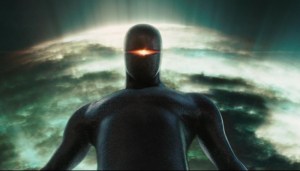
Occasionally sci-fi movies can be partially redeemed by superior special effects. The Day the Earth Stood Still has some pretty shoddy effects that didn’t look much better when I watched the film in IMAX. The aliens have scrapped the older model flying saucers and decide to travel in giant glowing spheres, which may be awe-inspiring to see in person but it’s mostly lame to watch on screen. It’s not even that hard of a CGI effect to perform. The new likeness is completely wrong for Gort, one of the most famous movie robots of all time. In the 1951 original, Gort was a teen foot tall robotic guardian for Klaatu. Derickson has made Gort 40 feet tall and he looks weirdly like an Oscar statuette. The awesome robot is ridiculously captured by the U.S. military so that they can try and drill into it, which makes no sense at all. Then the robot transforms into that swarm of robo-locusts and that’s the last we see Gort in action. That’s just dumb. I would much rather see a giant robot wrecking havoc than a swarm tear apart Giants Stadium. The filmmakers decided that a hazy cloud would be more visually interesting than a giant robot. Give me more Gort!
 I must say that hiring Reeves was the smartest move that the movie made. Reeves’ naturally stiff and aloof line delivery works nicely as an alien trying to some to grips with his new flesh and blood body. Reeves consistently entertains and adds a dash of fun that is mostly missing in this humorless and stubborn remake. Connelly works with what little she’s given, and man can she make her eyes glisten in the most beautiful manner, tearing up at a moment’s notice. Most of the other actors are wasted in stock roles, including Kathy Bates as the Secretary of Defense and Mad Men‘s Jon Hamm as a man who only serves to spout exposition. That’s the dashing Don Drapier, and you give him exposition? I won’t belittle Smith’s performance because in all honesty the kid is a fairly good actor. It’s not his fault he got stuck playing a dumb character that routinely hijacks the movie.
The newest Day the Earth Stood Still does little to justify its existence. This remake would have been better served either cribbing more of the superior original film or just cut off all ties. The remake tries to incorporate plot points that don’t work while also trying to tell its own environmental tale with bigger effects, which also doesn’t fully work. The Day the Earth Stood Still is a plodding and unnecessary remake that fails to stumble into an exciting scenario despite the fact that it involves aliens threatening the planet. But hey, it is in color.
Nate’s Grade: C
Share this:

WALL-E (2008)
 At this point, is there anything Pixar can’t do? They’ve explored the secret life of toys, what’s under the sea, the pains of rearing a family of super heroes, and of course a rat that dreams of becoming a chef. Seriously, anyone that can make that last one not only work but one of the most sparkling, imaginative, enchanting, and poignant films of the year deserves every accolade in the book. Pixar’s newest film, WALL-E, is certainly its most ambitious and potentially its most rewarding yet.
The year is 2700 and the planet Earth has long been left behind by mankind. Humans have exhausted their resources and left behind a planet that looks like one never-ending landfill. Skyscrapers are being built out of garbage cubes. The Waste Allocation Load Lifter – Earth class (WALL-E) robots have been left to toil away and clean up mankind’s mess. There is but one WALL-E robot left and it leads a solitary life of routine. It gets up, it compacts trash into cubes, and it assembles those cubes into eventual giant structures. Then one day a probe lands called EVE. This floating capsule-like robot is easily frustrated and quick on the trigger and WALL-E falls completely in love with his unexpected new companion. The two become close and then EVE is taken away unexpectedly. WALL-E hitches a ride on the ship that collects his beloved and journeys through space to save her.
 I was having reservations citing certain words of praise but this film deserves every ounce of praise; WALL-E is a masterpiece. This is a beautiful story told in a beautiful way in a beautiful looking movie. I imagine kids will be tickled by the funny robots but I really believe that this film will play much better for adults, and when was the last time a mainstream, American family film did that? Most “family” films are an excuse to do something lowbrow and cynical to make a quick buck, like the atrociously cringe-worthy trailer I saw for Beverly Hills Chihuahua (seriously, a civilization of singing/rapping Taco Bell dogs?). Pixar, and God bless them, are proving with each new release that family films need not be brain-killing hours. That reliable Pixar quality touch is never more present than with WALL-E. If you told me that a film that takes place on a trash-filled Earth, with minimal dialogue, and a romance between two robots would be the most thrilling, moving, and wonderful film of 2008, I would have scoffed.
Writer/director Andrew Stanton (Finding Nemo) relies on a universal visual storytelling language to tell the bulk of his tale. WALL-E plays like a gloriously enjoyable silent movie where body language and physicality advance the storyline and provide surprising depth; ignoring brief TV clips of Fred Willard and Hello Dolly, the movie doesn’t have actual dialogue until the 45-minute mark. And it is fantastic. The character of WALL-E is immediately empathetic and the audience will see slivers of themselves inside this independent robot that finds another reason for being. It’s a simple love story told in simple strokes, but it just so happens that Stanton has provided great emotional heft to those strokes. The film has such a huge and vibrant heart. More is said in indecipherable robot bleeps than in much of the tripe Hollywood calls dialogue. Watching WALL-E court EVE, a bit unsuccessfully at first, begins as cute, moves into being adorable, and ends up being greatly touching and flirting with the profound. How many other movies, let alone romances, end with the long-desired climax of two characters merely holding hands? This movie is a delight from beginning to end and a classic example of the power of expert storytelling.
When the film transitions into space is when the potent environmental message, and subversive satire, emerge. Beforehand we have witnessed the awe-inspiring landscape of Earth littered with garbage and empty shopping centers. Humans left the Earth to wait for the robots to do all the work and make the planet hospitable for life once again. For the last 700 years humans have been living in a heavy-duty luxury spaceship. Humans have grown to be fat, lazy, and completely self-involved; people only communicate with others through video screens, even when the other person is inches away. The movie also manages to satirize consumer culture, and in the future one corporate behemoth essentially dictates life’s choices; I found it highly amusing that the former president of the future (a live-action Willard) is also the CEO of the super corporate conglomerate. Business and government have merged completely. The social commentary isn’t as merciless as Mike Judge’s Idiocracy, nor is the environmental message subtle in the slightest, but the satire is sharp enough and blunt that some viewers might be offended, and I think that is genius.
Being a Pixar film, naturally WALL-E is resplendent to look at. The animation is superb and the imagination on display seems limitless. This is one of those films I’m certain I could watch again and again and find something new every time. I don’t really need to say much more about the visuals because they are breathtaking to behold (Roger Deakins, by the far the greatest living cinematographer, was even consulted to help with the look of the film. How awesome is that?).
 And yet even though WALL-E is primarily a love story the film also manages to be greatly exciting and equally funny. Stanton’s screenplay nimbly assembles characters and reintroduces them at key points to push his story onward. I loved that WALL-E is introduced to all sorts of unique robots on the mankind’s space ship and that he even stumbles into, more or less, a group of malfunctioning robots that come to his aid (think the Island of Misfit toys). Stanton manages to reconnect his storytelling threads so that every moment in this movie matters. The last third of the film is a back and forth cat-and-mouse struggle that manages to pump up suspense in smart ways. Stanton lays out his scenario for action and then builds organic complications. I am deeply satisfied when a filmmaker has a firm command of action that they can setup a situation, establish the rules, and then naturally construct obstacles and surprises that feel natural and germane to the story. Pixar has always been able to craft exciting action scenes that felt fully realized and WALL-E is no different.
If there is but one minor quibble I have with this near-perfect film, it is the missed opportunity to explore the mortality of robots. While WALL-E is going through his day-to-day duties he passes by older versions of other WALL-E models. The movie could have pushed just a little harder with the concept that this tiny robot is going to live to collect trash and then die like all the rest, becoming another piece of forgotten garbage. I think if Stanton had only explored this idea a little more it would have made his robo-love story even richer considering that both robots are going against their programming because they have found something that completely changed their world — love. The idea of mortality was explored to excellent effect in 1999’s Toy Story 2, so perhaps the Pixar folk didn’t want to fall into a philosophical repeat.
WALL-E is a wonderful love story, a heartfelt and immensely charming character piece, and a thrilling sci-fi tale that soars to broad heights of imagination. It’s timeless while still being rather timely thanks to its environmental message. Moments after the movie was over I wanted to see it again. I think I’ll feel the same way after the second viewing and the third. This is a phenomenal movie that will stand the test of time as one of the greats.
Nate’s Grade: A
Share this:

Transformers (2007)
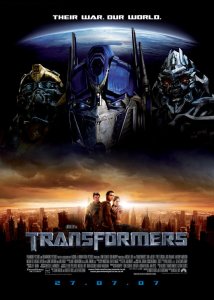 Once again Hollywood is quick to prove that if any television show emits some level of nostalgia, or merchandising potential, it is only a matter of time before it finds itself reconfigured as a big screen blockbuster movie. In all honesty, I was never a huge Transformers fan; I was more into Ghostbusters and then transitioned into Teenage Mutant Ninja Turtles. It may be sacrilegious, but I thought the knockoff cartoon/action figures, The Go Bots, were just as good. Steven Spielberg and critically derided director Michael Bay (Bad Boys II, Armageddon) have teamed up to bring the world a lengthy and noisy Transformers feature film. I can’t wait for the Go Bots to get their own equally pricey close-up.
Sam Witwicky (Shia LaBeouf) is your typical teenager obsessed with getting his own car. He can only afford an old Camaro at a used car lot, and his dreams of impressing the hot girl in school (Megan Fox). But Sam’s car isn’t just any old busted jalopy, no sir, it is really a robot in disguise from another planet. Sam’s car, codenamed Bumblebee, is apart of a robotic race known as the Autobots, led by their leader Optimus Prime (Peter Cullen returning to voice with gravitas). They can transform into vehicles that they scan with their optical sights. The Autobots are trying to save the planet from their evil counterparts, the Decepticons, who have already infiltrated our world in search of their fallen leader, Megatron. It seems Sam holds the key to the survival of Earth. His great grandfather was an Arctic explorer and happened upon the frozen sight of Megatron. He left behind an artifact that reveals the location of the chilled robot as well as a source of unparalleled power known as the Allspark. Needless to say, the military and the Secretary of Defense (John Voight) are a little aghast at how their weapons stack up to big bad robots.
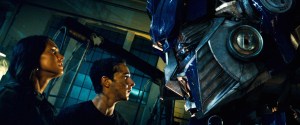 Michael Bay was born to direct a live-action, ultra expensive Transformers movie. The testosterone is through the roof and the film worships everything shiny, fast, and automotive. This is the kind of movie that fits exactly into the artistic parameters of Bay. The film is one gorgeous product placement orgy that is all about the eye candy; the cars are hot and desirable, the car chases are cool, the explosions are a lovely shade of orange, and Megan Fox is quite hot and desirable too (engaged to a 90210 actor? Why oh why, Megan?). The special effects are downright flawless and the action sequences are enormous. The scale of destruction is, like most aspects of Transformers, cranked to such a high degree that summer satisfaction can only ensue. Everything is bigger in Michael Bay world. Transformers is Bay’s best movie so far and it delivers the goods when it comes to hyper-kinetic action and plenty of thrills.
While the movie runs on silliness it also keeps its wits about it and delivers solid and exciting action with a breathless pace. What really surprised me about Transformers is how much humor they squeezed into 143 minutes of loud and hyper bombast. Screenwriters Alex Kurtzman and Roberto Orci (The Island, Mission: Impossible 3) have a great economy to their storytelling. They also have created a wacky teen comedy that just so happens to also be inhabited by giant robots. Much of the first hour is spent with Sam and his attempts to look cool with his new ride and impress the pretty girl. Sam is hocking his family wares on eBay and the Decepticons are on the hunt for… LadiesMan217. There’s a lengthy sequence where five Autobots have to duck and hide outside Sam’s house so he doesn’t get in trouble with his parents. Ma and Pa Witwicky look out the windows, and the robots dodge getting caught, and it’s like a classic bumbling slapstick comedy. A good action movie can become a great one when aided by well-timed humor, and Transformers has so many quips, sight gags, and goofy sidesteps (“Mountain Dew machine must destroy all humans!”) that is could be considered the most expensive comedy of all time (take a seat, Evan Almighty).
 There is, however, a price to be paid for all this comedy and that is that no one acts with any true sense of awe. They are witness to large walking and talking monsters of metal that are out to enslave the planet – there has got to be some wonder there, but the film doesn’t treat anything seriously. Its jokey nature keeps the film from being anything more than disposable, throwaway entertainment. I mean, I find it difficult to take any movie seriously that features a robot “relieve” itself on John Turturro.
Shia LaBeouf (Disturbia) carries the film on his sturdy shoulders. The shape of Transformers has more to do with his horny, smart allecky character than the robots that fight. Normally the only thing required in an effects-heavy action flick are some fast legs and a healthy set of lungs, but LeBeouf has charisma to spare. He has a young Tom Hanks everyman feel to him. The greatest compliment I can give him is that he is the most memorable figure in a movie with big brawling robots. Fox is pretty easy on the eyes. Voight is adept at playing government figures in times of national peril. If you need a guy to stare at something massive, or formative, or formatively massive, and utter, “My God,” then Voight is your man. Kevin Dunn and Julie White provide nice comic additions as Sam’s mother and father.
Transformers may be a perfect slice of summer thrills, but unlike its titular gigantic robots, it’s little more than meets the eye. The movie loses steam whenever it deters from its main story involving Sam. I understand that the filmmakers were trying to widen their story scope, but nothing is gained by the inclusion of such useless characters like the overweight super computer hacker who lives at home with his mom. There’s an elite team of national security analysts and they all happen to be scruffy multi-cultural hippies. We have a blond Aussie (with a nose ring, oh so rebellious) who discovers the Decepticon signal and then, well, she sits in a room for a long while and then mostly sits on her hands during the climax. The opening follows a band of soldiers in the Middle East (which the film reminds us is where Qatar is, because apparently it does not feel that your core Transformers fan has a basic grip on geography) who also must reach the bigwigs in Washington with important info on these killer robots. These dangling storylines could be lost and little momentum would be lost. None of these extra characters are given a lot of attention. Most of them will vanish for long stretches so that when they do reappear you’re reminded how much you did not miss their absence. You’re going to need stock roles, like military men and tech geeks, but Transformers has cast its lot with the simple story of a boy’s first car and his unyielding teenage hormones. Transformers could use a good pruning for balance.
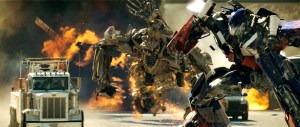 The robust action sequences are somewhat hampered by the typical Michael Bay ADD edits, but what really hurts the action sequences are the robots themselves. The original Transformers were designed smoothly, because in all reality they were animated toys and needed to function for kids. These 21st century Transformers have parts all over the place. There are gears and wheels and who knows what sticking out everywhere. They look far too cluttered, like a little kid’s art project where he keeps slathering on more junk. As a result of this robo design, when it comes to action you may not have a clue what’s actually happening. When the big robots wrestle you’ll be left trying to piece together in your mind which part is the robot mouth, the robot head, the robot fists/claws/drill/whatever. I suppose in a way this kind of demanding user activity is similar to watching scrambled porn; both involve trying to dissect the image into something workable and, thusly, satisfying to the senses. That’s right, I compared Transformers to scrambled porn, which is also quite more than meets the eye.
Obviously, with a film about powerful robots from space, there is going to be a stopgap of logic. If you can accept interstellar robots that arrived from a robotic planet, oh and by the way, they learned English from the Internet (it’s a wonder they speak in full sentences), then you should be able to shrug off any other shortfalls in logic. Transformers was never too deep a subject to being with; every episode of the cartoon revolved around the Autobots and the Decepticons battling over new energon cubes, and that was all the plot needed for a show about robots that fight.
There could be 20 minutes sliced out. Lots of ancillary characters are just dropped. There may be too much humor. The climax is way too long. The dialogue is corny. And yet with all its flaws considered, Transformers is an exhilarating entry into the world of summer smashups and blown eardrums. Michael Bay may never stretch his creative wings with a Victorian costume drama, but the man does what he does well. Transformers is a perfect match for Bay’s noisy and boisterous sense of action and his love of things fast and expensive. There isn’t much below the surface when it comes to Transformers, but it’s such a fun and exciting popcorn movie that it’s hard to argue with the results.
Nate’s Grade: B
Share this:

Star Wars: Revenge of the Sith (2005)
 I was in Dublin, Ireland of all places when I saw Star Wars Episode III: Revenge of the Sith. I was enticed to get off my sick bed and see George Lucas’ final Star Wars installment. As a kid I loved the original trilogy. My expectations were piqued by the promise that Revenge of the Sith would be bigger, badder, and suitably darker than any previous Star Wars installment. It did get the series’ first PG-13 rating and a stern warning to parents from Lucas for nothing. I had equal hopes for the other two prequels, 1999’s The Phantom Menace and 2002’s Attack of the Clones, but said hopes were dashed upon actually watching the movies. This was the last film and I had my fingers crossed ole George would finally get it right.
It’s now several years into the war between the Galactic Republic and the separatists led by General Grievous, leader of the droid army. Anakin (Hayden Christenson) and Obi-Wan (Ewan McGreggor) fight for the Republic and the chancellor of the Senate, Palpatine (Ian McDiarmid). Anakin is having nightmare that his secret wife Amidala (Natalie Portman) will die in childbirth. He seeks out a way to save her and is tempted by certain promises by shadowy figures that the dark side of the force can restore life. From there things are set into motion that turn the Republic into an evil Empire, the Jedi into a near extinct band of warriors, and Anakin into the iconic Darth Vader.
My friend Josh Browning brought up the idea that Star Wars would be so much cooler without George Lucas. I gave this idea some thought and have come to the same conclusion. Can anyone ever say “no” to the Jedi master in plaid? Directing flaws aside, where Lucas really needs assistance is his writing. The biggest qualms I’ve had with the new set of Star Wars, horrible acting aside, is how unforgivably boring they are and the tepid romance. The original Star Wars were about action, adventure, and things that mattered. The prequel set has been mostly about trade, taxation, Senatorial control, and separatists. The majority of the prequels have been sleep-inducing and riddled with pacing issues.
 In an Entertainment Weekly interview, Lucas said 60% of his prequel story was related to the final film. With some quick calculations, that means that there was 20% plot in The Phantom Menace and the remaining 20% in Attack of the Clones. No wonder nothing seemed to be going on! This also creates the problem of Sith having far too much plot to deal with in too short of a reasonable time frame. Things feel left out or not fully explained, like why the hell does General Grievous have a cold? I know I’m missing something but it’s lazy filmmaking to make an audience do extra homework to flesh out your storytelling.
As stated, my other main gripe was the half-baked romance Lucas had between Anakin and Amidala. In Attack of the Clones, the romance is spontaneous. He hasn’t seen her in like 10 years and now they’re instantly smitten? There is no beginning to this romance, no nurturing, no progress. The romantic troubles are worsened by Lucas’ disinterested writing. Lucas cannot write dialogue to save his life. Romantic bon mots like “Hold me like you did at the lake” and “I’ve been dying a little bit day by day, ever since you reentered my life” will not exactly stoke a fire in your loins. Plus Portman and Christenson have as absolutely no chemistry.
Now, the reason I’ve reviewed the romance from Attack of the Clones is because it serves as the linchpin for why Anakin goes bad and becomes Darth Vader. It’s a mighty big question about what turned Anakin from man into one bad mutha, and his quest to save his wife is a satisfyingly plausible answer. But the transition doesn’t have near the punch Lucas intends because of his weak romance he’s penned. Lucas’s shortcomings as a writer finally pull the rug out from Anakin’s big moment.
The acting is another weakness. True, the acting hasn’t always been the top priority with any Star Wars film, but these prequels have shown that Lucas would rather stand behind a computer than in front of an actor. Portman has generally seemed bored and lacks any interest in hiding it. In Attack of the Clones she seemed sedated. In Revenge of the Sith she gets to cry a bunch. In Lucas land, that’s seen as character development.
 I thought Anakin could not get any more annoying than Jake Lloyd’s awful “yippee”-filled run in Menace, but I’m starting to reconsider this. Anakin mopes around and when he gets upset he whines in a falsetto voice. I will say Christenson was rather good in Shattered Glass where his arrested development acting techniques expertly channeled the manipulative Stephen Glass (if you do have a choice, go rent Shattered Glass). But in the more operatic Star Wars world, Christenson routinely comes off like a kid playing dress-up. Even after he’s gone full evil and growls and screams and glares, he comes off like nothing more than a poodle trying to be a guard dog. Of course neither performer is helped any by Lucas’ absentee directing style with actors.
The only members of the Star Wars prequels that will walk away unblemished are Ewan McGreggor and Ian McDiarmid. McGreggor has got the Alec Guinness voice down and proves to be a capable and dignified leading hero. McDiarmid has a juicer role than Anakin and really relishes his villainy.
Sith is the best of the three Star Wars prequels but that isn’t saying a whole lot. Whereas Menace and Clones were boring, Sith is just kind of slow and okay. It’s an improvement but the bar wasn’t exactly set very high. The formula is about the same: the first two acts are again quite plodding and then Lucas unleashes a torrent of action to close out his film. Sith does break apart because, surprise, things actually happen and they actually matter. After about six hours of buildup, actions meet consequences, characters meet their demise, and our boy wonder becomes the dark Jedi. People have been waiting decades for these moments and when they arrive they hit like a thunder bolt. Most of the time at least.
 The special effects are uniformly fantastic, which has never been an issue for Lucas. Yoda moves and emotes fantastically, actually besting some of his flesh and blood thespians. The interaction of live elements and CGI seems improved. Planets are rendered beautifully and the lava world is simply visually stunning and just plain cool.
The action is exciting but a bit overly edited in light saber battles. As we march into Act Three, there’s a terrific sense of climax with Yoda going off to battle Palpatine and Obi-Wan knowing he must put down Anakin. At long last I felt jolts, shivers, and goose bumps at what was to come. The concluding half of Sith is great rollicking entertainment and visually luxurious to watch. See George, light saber duels and character deaths are far more entertaining than trade disputes and embargo talk. The excitement’s back in the Star Wars franchise but it’s a shame it had to only appear this close to the finish line.
The final chapter on the Star Wars universe is closed. Well, for now. The lure of mountains of cash will probably ensure we haven’t seen the last of some of these beloved characters. Revenge of the Sith is a moderately satisfying closing episode to the Star Wars saga. The film still is an exhibition of Lucas’ filmmaking flaws (writing, pacing, his handling of actors) but Sith finally reaches the excitement and grandeur the original Star Wars had. My Dublin theater was roaring, clapping, yelling and screaming throughout. And for the first time during the prequels, so was I for awhile. And you know what the absolute best part was? Not one single word from Jar-Jar Binks!
Nate’s Grade: B-
Share this:

The Hitchhiker’s Guide to the Galaxy (2005)
 I’m a big fan of the late Douglas Adams’ series, so going in I had a slate of expectations but also a working knowledge of this kooky universe. I really don’t think this film will work for anyone but the fans. The movie isn’t even structured like a screenplay, it has more of the novel’s loose loopy feel. Some things work wonderful, like the Vogons, giant marvelous looking puppets made by Jim Henson’s studio. The cast is mostly excellent (Alan Rickman steals the show as the voice of Marvin, a very depressed robot). The animated guide entries in the Hitchhiker’s book are colorful, stylistic, and witty. Somethings, however, don’t work at all. The additions to the story, an increased romantic angle between our lead Arthur Dent (Martin Freeman) and Trillian (Zooey Descehanel) as well as a flat happy ending that rewrites all the opening danger. The Hitchhiker’s Guide to the Galaxy occasionally serves up some juicy bits of wacky humor or visual fantasy (John Malkovich’s bit part is weird) but unless you were a fan of the book series, you’re really not going to be able to follow along or have any interest in keeping up.
Nate’s Grade: C+
Share this:

Sky Captain and the World of Tomorrow (2004)
 Sky Captain and the World of Tomorrow started as a six-minute home movie by Kerry Conran. He used computer software and blue screens to recreate New York City and depict a zeppelin docking at the top of the Empire State building. The six-minute short, which Conran spent several years completing, caught the attention of producer John Avnet (Fried Green Tomatoes). He commissioned Conran to flesh out a feature film, where computers would fill in everything except the actors (he even used the original short in the feature film). The dazzling, imaginative results are Sky Captain and the World of Tomorrow.
Polly (Gwyneth Paltrow) is a reporter in 1930s New York. She?s investigating the mysterious disappearance of World War scientists when the city is invaded by a fleet of robots. The city calls out for the aid of Sky Captain, a.k.a. Joe (Jude Law), a dashing flying ace that happens to also be Polly?s ex. Joe and Polly form an uneasy alliance. He wants to stop Totenkopf (archived footage of Laurence Olivier) from sending robots around the globe and rescue his kidnapped mechanic, Dex (Giovanni Ribisi). She wants to get the story of a lifetime, a madman spanning the world to abduct scientists, parts, and the required elements to start a doomsday device. Along the way, Captain Franky Cook (Angelina Jolie) lends her help with her flying amphibious brigade. Together they might stop Totenkopf on his island of mystery.
 Sky Captain is a visual marvel. It isn’t necessary a landmark, as actors have performed long hours behind green screen before (just look at the Star Wars prequels). Sky Captain is the first film where everything, excluding props the actors handle, is digitally brought to life inside those wonderful computers. The results are breath-taking, like when Polly enters Radio City Music Hall or during an underwater dogfight with Franky’s amphibious squadron. Sky Captain is brimming with visual excitement. The film is such an idiosyncratic vision that there’s no way it could have been made within the studio system.
Sky Captain has definite problems. For one, the characters are little more than stock characters going through the motions. The story also takes a backseat to the visuals. The dialogue is wooden and full of clunkers like, “You won’t need high heels where we’re going.” Generally the dialogue consists of one actor yelling the name of another character (examples include: “Dex!” “Joe!” “Polly!” and “Totenkopf!”). My father remarked that watching Sky Captain was akin to watching What Dreams May Come, because you’re captivated by the painterly visuals enough to stop paying attention to the less-than-there story and characters. The characters running onscreen also appears awkward, like they’re running on treadmills we can’t see, reminiscent of early 1990s video games.
Let’s talk then about those characters then. Paltrow’s character is generally unlikable. She’ll scheme her way toward whatever gains she wishes, but not in a chirpy Lois Lane style, more like a tabloid reporter. She whines, she yells, she complains, she berates, and she doesn’t so much banter as she does argue. Sky Captain is more enigmatic as a character. He seems forever vexed. Jolie’s Captain Franky Cook gives her another opportunity for her to use her faux-British accent. Jolie’s character is the strong-willed, sexy, helpful heroine that should be the center of the film, not Paltrow’s pesky reporter.
It’s also a bit undignified to assemble Laurence Olivier as the villain. It’s very unnecessary, but at least he wasn’t dancing with a vacuum cleaner.
 Now, having acknowledged the flaws of Sky Captain, I must now say this: I do not care at all. This is the first time I’ve totally sidestepped a film’s flaws because of overall enjoyment. I have never felt as giddy as I did while watching Sky Captain and the World of Tomorrow. When the giant robots first showed up I was hopping in my seat. When I saw the mixture of 1930s sci-fi, adventure serials, and Max Fleischer cartoons, I was transported to being a little kid again. No movie has done this so effectively for me since perhaps the first Back to the Future. I loved that we saw map lines when we traveled from country to country. I love the fact that the radio signal hailing Sky Captain is reminiscent of the RKO Pictures opening.This is a whirling, lovelorn homage that will make generations of classic movie geeks will smile from ear to ear. I don’t pretend to brush over the flaws, with which story and characters might be number one, but Sky Captain left me on such a cotton-candy high that my eyes were glazing over.
One could actually make a legitimate argument that the stock characters, stiff dialogue, and anemic story are in themselves a clever homage to the sci-fi serials of old, where the good guys were brave, the women plucky, and the bad guys always bent on world domination. I won?t make this argument, but it could lend credence more toward the general flaws of Sky Captain and the World of Tomorrow.
Sky Captain is an exciting ode to influences of old. It’s periodically breath-taking in its visuals and periodically head scratching with its story, but the film might awaken childhood glee within the viewer. I won’t pretend the film isn’t flawed, and I know the primary audience that will love Sky Captain are Boomers with a love and appreciation for classic cinema. Sky Captain and the World of Tomorrow will be a blast for a select audience, but outside of that group the film’s flaws may be too overwhelming.
Nate’s Grade: B+
Share this:

I, Robot (2004)
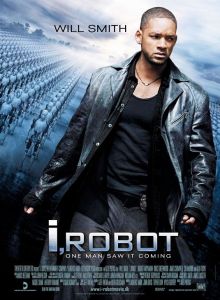 No doubt about it, Will Smith is the best hope our planet has in the face of adversity. He’s taken down aliens three times, foiled one conspiracy, stopped the South from rising again, and the man still finds the time to help Matt Damon with his golf swing. I fear we almost may be taking Smith’s world-saving exploits for granted. Smith’s newest chance to save the world arrives in I, Robot. Can Big Willie save the world yet again, or has he punched his time card one too many times?
In 2035, man has a new class of immigrants to do all the menial tasks no one wants to do – robots that look like crash test dummies. U.S. Robotics (USR) wants to push their new fall line of robots and make sure every happy home has a happy robot. Del Spooner (Will Smith) is a detective wary of our robotic friends. His colleagues laugh at his paranoia, remarking that no robot has ever committed a crime. This is thanks to the three laws hard-wired into every robot: 1) A robot cannot harm a human being, 2) A robot must obey a human beings order as long as it does not conflict with Law #1, and 3) A robot can do whatever to survive as long as this does not conflict with the other laws.
 This sounds great, except the robot creator (James Cromwell, always there if you need an old guy role) has apparently plummeted to his death from his USR office and the circumstances involving his demise are dubious at best. Spooner works alongside a robot technician/shrink (Bridget Moynahan) to find out more about what exactly is going on within USR and its suspicious CEO (the always shady Bruce Greenwood). Spooner discovers that a robot, who wishes to go by the name of Sonny, may have sent his creator to his death and may also be the first step toward uncovering the truth behind a grim conspiracy.
Smith has never really been a great actor but he is likable and charming enough, so that gets him through the day. The problem is that when hes saving the world in summer blockbusters he has a tendency to go into Will Smith Mode, which plays out like hes on auto-pilot. His stares, awkward mannerisms and aw shucks humor seem to be the same in every film. This isn’t to say that Smith cannot be a capable actor, but it seems that when a movies budget goes over a certain amount he resorts to playing Will Smith: World Saver and not so much a character of real value.
The other actors are more so playing vague archetypes than they are anything else. Greenwood is the sneaky, oily executive; Moynahan is the cold scientist learning how to be human once more; the invaluable Chi McBride is the no-nonsense police chief who rolls his eyes at Spooner’s crazy theories; and Shia LeBeof actually shows up for all of three minutes playing some kind of juvenile delinquent that is wholly unnecessary to the film.
The movie’s greatest accomplishment is the character of Sonny, modeled after a physical performance by actor Alan Tudyk. Sonny’s calm line readings, bursts of emotion, and questions on humanity make him a character the audience connects with, especially with the detached nature of Smith and Moynahan’s acting. Bet you never would have guessed this is from the same guy who played Steve the Pirate in Dodgeball.
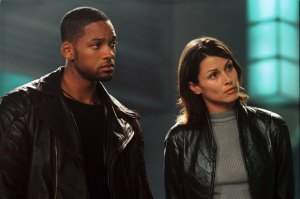 I, Robot isn’t exactly going to establish new ground in the world of science fiction. Its mostly a detective story with some twinges of sci-fi philosophy. As a detective story it adheres to the laws of detective movies, like how NO ONE ever believes the hero on his hypothetical assumptions and paranoia, which will of course always be right, and how the hero can only solve the case after he is thrown off it and gives up his badge. For two thirds of I, Robot we get an amiable, if average, detective story set in the future. Then we get a slightly incoherent final act where robots go all-out crazy.
Director Alex Proyas takes a step back from the grim, noir-ish worlds he worked with so effectively in The Crow and Dark City, and presents a cleaner and more sterilized world. His technical elements, like cinematography and musical score, are still well above par for the summer blockbuster. Proyas is a gifted visual tactician that knows how to wow an audience.
The sleek production design, fancy special effects, and strong visionary directing help lift an average story. Some of the story elements may not all work -like Spooner’s flimsy reason he hates all robots, and Moynahan’s character being very cold because she works around robots (get it? get it?)- but the professionalism of the people behind the scenes help make a rather exciting and occasionally thoughtful movie. Sonny’s questions about life and death as hes near termination are a nice addition to add something more to a summer blockbuster than explosions and car chases. Of course I, Robot also has some exciting car chases and action sequences. Certainly other, better sci-fi movies have dealt with these issues much deeper, and I, Robot seems to only skim the surface of intellectual debate, but at least it’s something (though this sounds really defeatist).
Bearing little resemblance to Asimovs collection of short stories, I, Robot is more a stream-lined sci-fi action flick, but its still a satisfying and stylishly entertaining diversion. Sci-fi fans may grumble at the notion of transforming a complex novel into a watered down action film, but I, Robot is a crowd pleaser that delivers the thrills when it needs to. If Will Smith keeps up this world saving pace he may get a little haggard and start turning into Danny Glover’s Lethal Weapon character: I’m getting too old for this aliens/robots/other aliens/more aliens/giant mechanical spiders shit. Well, at least Smith’s good at it.
Nate’s Grade: B


 nathanzoebl
You must be logged in to post a comment.