Blog Archives
Wonka (2023)
 Was there anyone out there wondering how a young Willy Wonka could have gotten his start as a cutting-edge candy maven? It’s an unnecessary back-story for a kooky character that most will just accept as is. The invented story of Wonka is one of an upstart entrepreneur (Timothee Chalamet) proving a danger to the established corporate oligarchy’s vice-grip on the local confectionery industry. They use the levels of corrupt power to scheme and block Wonka from getting started, but his charms and optimism are just too much, and he wins over the town with his candied delights that provide revelry to the people’s humdrum lives. As a candy-colored musical following an underdog triumphing from the power of friendship and integrity and imagination and good will, it mostly works on a fizzy cloud of its own manufactured whimsy. It’s all highly silly stuff and working very hard to be light-footed and whimsical. There are moments that made me smile and tohers that made me chuckle, like one rich man who gags whenever somebody ever says the word “poor.” The new songs are fairly forgettable except when they’re making you remember the dreamy 1971 numbers. I also think Chalamet (Bones and All) is painfully miscast as our young Wonka. I don’t think his broody-moody acting style works shifting over to manufactured quirk. His performance is just so off from the beginning. Wonka would have been exceedingly better as an original musical without trying to retrofit into the world of Willy Wonka, although that would mean losing Hugh Grant as our first specimen of Oompa Loompa, and he is a droll delight. It’s just weird for a movie to work this hard to tell us how Wonka got his start and to end on uplift when we know in the future he grows up to be a sad middle-aged loner who has to resort to a scam to find a successor, as well as the town becoming an impoverished slum to Wonka’s oppressive factory. My pal Ben Bailey reasoned it would be like a prequel to Death of a Salesman where a younger Willy Loman starts his career as a door-to-door salesman, so chipper and eager to make a name for himself. Wonka is a sugar rush designed as an origin story.
Nate’s Grade: B-
Share this:

The BFG (2016)
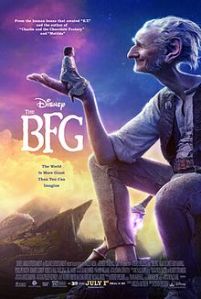 Roald Dahl is the kind of highly imaginative, inventive, and subversive children’s author that makes one wonder why more of his books don’t end up as movies. Charlie and the Chocolate Factory is the best known, and there’s Fantastic Mr. Fox, Matilda, James and the Giant Peach, and the rather spooky for kids 90s film, The Witches (it at least spooked me as a kid). For such a prolific author, it’s a little curious he has so few film credits. Steven Spielberg is one of the most successful directors of the modern era, so if anyone could wrangle Dahl’s wondrous worlds onto the big screen, he should. The BFG should be a transporting experience brought to vivid life with cutting-edge technology. All the special effects in the world, however, can’t solve a raft of nagging script problems that manage to take the fantastic and make it boring and predictable.
In 1980s London, little orphan Sophie (newcomer Ruby Barnhill) is abducted one night when she spots a giant blowing a mysterious trumpet into the windows of sleeping children. Fortunately for Sophie her captor is the BFG (Mark Rylance), which stands for Big Friendly giant, and he’s a vegetarian, having sworn off the bone-eating habits of his nastier giant peers. In Giant Country, the BFG collects and cultivates dream particles, concocting special mixtures that he then shares with sleeping children. The other giants bully and snidely dismiss the puny BFG. Sophie and the kindly BFG must work together to stop the larger giants from going back to London and dining on innocent children.
 The BFG has some pretty big friendly problems when it comes to its misshapen plot structure and its alarming lack of urgency or escalation. We’re all familiar, consciously or unconsciously, to the three-act story structure at this point, which is the principle formula for screenwriting. The BFG gets started pretty quickly, abducting Sophie and taking her to the land of giants by around the 15-minute mark, and from there the movie seems to take a leisurely stroll. I can’t really tell you where the act breaks are because the movie just sort of luxuriates in the meandering interaction between the BFG and his human pupil. There’s the initial threat that the other cannibalistic giants will discover her and this threat pops up in a handful of set pieces where Sophie has to constantly find new hiding places. Unfortunately, this threat never really magnifies or changes. She might get caught, and then she doesn’t. She might get caught, and then she doesn’t. There’s a repetition to this threat with our antagonists at no point getting more threatening. This is and a lack of a narrative motor make the movie feel rudderless, plodding from one moment to the next without a larger sense of direction. And then the third act comes (spoilers), presumably, when Sophie and the BFG travel back to London to try and recruit the Queen of England’s (Penelope Wilton) help. This sequence includes an extended breakfast that it punctuated by the memorable climax of watching the Queen fart and her little corgies fly around the room powered by their flatulence. It has to be the climax because what follows certainly doesn’t follow. Within five minutes, the BFG leads the Brits back to the land of giants and they restrain and airlift all the other giants in shockingly easy fashion. It’s a victory that feels relatively hollow because of its ease. These giants were never much of a threat to begin with, which is why we spent more time deliberating over dream ingredients than a retreat from man-eating colossuses.
Another aspect of Dahl’s novel that falls flat on screen is his verbal gymnastics and witticisms. It just doesn’t work with actors repeating the words without the text in front of your eyes. Listening to the BFG talk for any extended period of time is like being stuck with a crazy person muttering to him or herself. I would estimate that at least 60% of the BFG’s dialogue is folksy malapropisms. It’s not endearing and grows rather tiresome, especially with the unshakable stagnation of the movie’s plot. And so we get scene after scene of a big CGI creature talking verbal nonsense. Are children going to be entertained by any of this? Are they going to be engaged with the giant’s gibberish or will they find it one more impenetrable aspect of a movie and a story that seems to keep the audience at length? I couldn’t engage with the movie because it never gave me a chance to invest in what was happening. The BFG is a gentle soul and shouldn’t be bullied by his giant brethren, but that doesn’t mean I’m going to automatically love him. I didn’t.
 For a Spielberg movie this feels oddly absent his more charming and whimsical touches. There are scant moments where it feels like Spielberg is playing to his abilities in this fantasy motion capture world, like exploring the underwater land where the BFG gathers his dream ingredients, and in the narrow and messy escapes Sophie has not to be caught. It’s a shame that the creative highs of Spielberg in full imagination mode are too often absent the rest of the movie. He too feels like he’s coasting, allowing the technology and the fantasy setting to do the heavy lifting. The land of the giants is a bit too underwhelming as far as fantasy worlds go. It’s simply too recognizable except for slight peculiarities, like “snozcumbers.” It’s not an enchanting location and we’re not given enchanting characters, and with the little narrative momentum or escalating stakes. I experienced a lot more fun and whimsy from Spielberg’s other major mo-cap movie, the nearly forgotten 2011 Adventures of Tintin. The action sequences especially had such a lively sense of comic brio and imagination that was pure Spielberg. I get no such feeling from The BFG. If you told me that Robert Zemeckis had made this movie I wouldn’t have blinked. I don’t know if Spielberg was hoping to recapture that E.T. magic with screenwriter Melissa Mathison (who passed away in 2015) but this isn’t close.
I will credit the special effects department for the amount of work put into Rylance’s BFG visage, which looks eerily like the Oscar-winning actor. The range of the facial expressions is another sign that mo-cap performances are just as legitimate as live action flesh-and-blood performances. I can admire the technical feats of the character while not exactly feeling that much enjoyment from that character. The interaction between the computer elements and the real-life elements could be better, most bothersome with little Sophie interacting with the giant’s giant personal things.
I was left wondering whom The BFG is supposed to appeal to. I think kids and adults will be bored by its slow pace and stagnant, minimal stakes, weird and unengaging characters and their annoyingly impenetrable speech habits, and the overall lack of charm and wonder. It’s saying something significant when the most mesmerizing part of a fantasy movie is watching the Queen of England, her dogs, and a room full of her royal servants violently fart green clouds of noxious gas. That was the one moment in my screening where the kids in the room seemed to be awake. Otherwise the BFG character must have calmly put them to sleep with his prattling gibberish. It’s not an insufferable movie and there are fleeting moments of entertainment, but they drift away like a memory of a dream. There just isn’t enough going on in this movie to justify its near two-hour running time. Not enough conflict, not enough world exploration, not enough character bonding, not enough whimsy, and not enough entertainment. It feels too lightweight to matter and too dull to enchant. The BFG could have used more farts. That would be a sign of life.
Nate’s Grade: C+


 nathanzoebl
You must be logged in to post a comment.