Blog Archives
Lars and the Real Girl (2007)
 In order to be affected by the sweet romantic spell of Lars and the Real Girl, the viewer must accept everything as a fable; to try and apply real world logic would destroy the film’s magic. Lars (Ryan Gosling) is a painfully shy man still haunted by the knowledge that his own birth killed his mother. He lives in his brother’s garage and has difficulties interacting with regular folks. Then one day comes Bianca who just happens to be made of silicone; she’s a Love Doll, though Lars’ relationship with the upgraded Barbie is completely platonic. Lars is using the doll to deal with his own intense loneliness and his family and the town, a.k.a. the most understanding town in the world, play along to help Lars along on his emotional recovery. Gosling, in short, acts the hell out of this movie. His performance is a bit mannered but he channels so much pain and unresolved emotions that it’s a marvel to watch. He makes Lars more than just a weirdo with a weird coping mechanism; he makes Lars deeply, excruciatingly human and filled with unmet desire for affection. Gosling is so immensely talented that I don’t know if there are any limits to what he can bring to a character. The film has just enough psychology to it that the slew of characters deepen as we progress and the audience grows attached. By the end, I was amazed at how much genuine emotion I felt for a giant hunk of silicone. Give credit to the filmmakers who play Lars out with conviction and grace, and give major credit to Gosling.
Nate’s Grade: B+
Share this:

Juno (2007)
 Juno is a hysterical teen comedy with equal parts sweetness and sour. The idea of an underage pregnancy certainly presents a lot of conflicts and seriousness but the film avoids direct messages on the big topics thanks to large doses of levity and some hard-earned wisdom. With this serving as a companion piece to Knocked Up, I suppose Hollywood is convinced there’s something inherently funny about unplanned pregnancy. Remember that, suddenly expectant fathers and mothers.
16-year-old Juno MacGuff (Ellen Page) drinks her “weight in Sunny D” to take pregnancy test after test, but each pee-dipped stick gives the same result: Juno is going to become a mommy. The father is Paulie Bleaker (Michael Cera), a fellow high school student who has a fondness for jogging shorts and orange Tic-Tacs. Juno’s father and step-mother (J.K. Simmons, Allison Janney) lament that they wish their daughter would have told them she was expelled or into hard drugs instead of being pregnant. Still, they are supportive and Juno decides to give away her bun in the oven to a childless couple, Mark and Vanessa (Jason Bateman, Jennifer Garner).
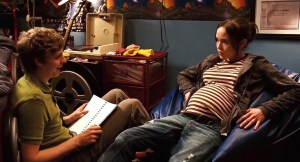 Juno doesn’t patronize or dismiss the gravity of what is indeed happening (a life is being brought into this world); Juno says she is trying to come to grips with issues “way beyond my maturity level.” There are moments that reveal real sadness and regret for some of these characters, and moments of palpable doubt about what it means to officially grow up and assume responsibility for another. Juno also refrains from easy high school stereotypes and coarse humor. Juno is an intelligent comedy that doesn’t make light of its circumstances even if the sarcasm is off the charts. It’s this winning combination of wicked wit and heart that makes [I]Juno[/I] destined to be a crowd-pleaser.
Writer/blogger/former stripper Diablo Cody makes one hell of an impressive screenwriting debut. The dialogue is practically sparkling and revels in the hip, hyper-literate realm that used to dominate the teenage speech patterns of shows like Dawson’s Creek. Sure, it’s not terribly realistic when characters can spout pithy one-liners mixed in with heavy jargon and lots of cool speak, but what do I care when I’m cracking up with laughter so often. But Juno cannot easily be dismissed as glib because Cody throws in some incisive moments that display shades of vulnerability and tenderness with her wacky assortment of characters. Even the aloof oddballs have moments that deepen them from just being quirky for quirky’s sake. These people are more than just receptacles for Cody’s wonderful words; they may begin that way but through the course of 96 minutes they manage to transform into flesh-and-blood where we, the audience, feel their pain and celebrate their happiness. You may be surprised, as I was, to discover yourself holding back tears during the movie’s inevitable and tidy conclusion.
The heavily acoustic score banks on a lot of pleasant, leisurely strumming but it suits the film and the song selections are apt. The very end involves a long acoustic duet rendition of the Moody Peaches’ “Anyone Else But You” and it may be one of the most disarmingly sweet, romantic moments of the year (the repeated lyric “I don’t see what anyone can see in anyone else” is a perfect summary for two outsiders finding their match). In fact, it’s probably the most potentially romantic song ever to include the line “shook a little turd out of the bottom of your pants,” but then again I do profess ignorance when it comes to romantic odes that include defecation references. Somewhere there has to be a Barry White song that has to cover this.
 Director Jason Reitman feels like a natural fit for this smart-allecky material. He lets the story take center-stage and, just as he proved with last year’s Thank You for Smoking, he can coax terrific performances from a strong body of actors. He keeps the pace chugging along and keeps form command of the many storylines and characters needing to be juggled. Juno is a comedy that says more about a character through a handful of smart, wry observations that cut to the bone, which is helpful considering the short running time means the film needs to do the most with its time.
Page should have been crowned a star immediately after her blistering performance as jail bait with claws in Hard Candy, but perhaps her top notch comedic turn in Juno will right this slip-up and give Page the opportunity to star in, at least, the same amount of movies as, oh, I don’t know, Amanda Bynes (Seriously, Hollywood, are you just throwing money at her?). Page is the perfect embodiment of the wiseacre teenager that thinks she knows more than anyone else. She recites the refined dialogue with such precision and ease, always knowing what segments to enunciate or de-emphasize to maintain a seamless comedic tone. Page brings great empathy to a know-it-all character and is the snarky spirit that makes Juno resonate.
The supporting cast around Page doesn’t let her down. Cera gives another fine performance of comic awkwardness befitting a teenager contemplating fatherhood. Simmons and Janney make a great pair of unflappable parents, particularly Janney who gives an ultrasound doc a memorable tongue-lashing for an off the cuff remark about Juno. Bateman works the same laid-back demeanor that he excelled at on TV’s Arrested Development. Rainn Wilson (TV’s The Office) makes a very funny cameo in the beginning.
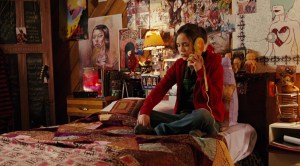 Garner as an actress has been somewhat hamstrung by her roles, either focusing on her multitude of ass-kicking abilities or landing her leads in romantic comedies that don’t require more than dimples and twinkling eyes. In Juno she is driven by her desire to have a baby; she’s affluent, prim, and an easy joke thanks to her stick-in-the-mud seriousness. But then Juno and the audience get a glimpse about how important being a mother is to Vanessa, and Garner nails a rather touching scene where she directly speaks to the growing child inside Juno’s belly upon Juno’s request. She speaks softly to the baby, briefly mentioning how loved they will be, and then she marvels at feeling the baby move. In lesser hands this scene could have induced eye rolls but instead seems genuine and a turning point for how we see Vanessa.
If Juno does have a flaw it is a minor one. The film places its teen romance on the back burner for so long that when it resurfaces and positions itself front and center the storyline lacks credence and believability. The conclusion would have had more emotional weight had the filmmakers spent more time on the teen romance angle, but regardless I was still amused, entertained, and grateful for the ending that came.
Juno is a delightfully tart and hysterical comedy that is easily quote-able thanks to Cody’s quick-fire retorts and snappy dialogue. Page is destined for greatness and Reitman proves once more that he can handle anything thrown at him with deftly comic aplomb. This is an impressive and assured comedy that bristles with comic vitality and confidence. This holiday season, make sure to take a trip to Juno.
Nate’s Grade: A
Share this:

Martian Child (2007)
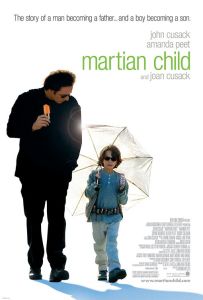 When in doubt for a sentimental story pair up a lonely man with a kid. It worked for Charlie Chaplin, Dustin Hoffman, and even Adam Sandler. There is something fundamentally appealing in an old school Hollywood way about seeing a grown man become kinder, gentler, and loving. Attaching children to slobs and jerks has been historically beneficial in the realm of cinema; they tend to think beyond themselves and become better people. In fact, doctors should take heed and start using children as medicinal services (“Feeling depressed? Raise this adorably precocious child for an indefinite period of time!”). Martian Child is the latest pre-programmed entry in this favorite Hollywood combination.
David (John Cusack) is a science fiction writer still in mourning for his dearly departed wife. He decides to stay true to a plan he and the dead misses had to adopt a child. Enter Dennis (Bobby Coleman), a kid who spends his time in a large box because he believes he’s from Mars. The adoption agency believes that a kid who thinks he’s a Martian would be ideal for a science fiction writer. David reflects that he was an outcast as a kid as well and he sees a side of himself in this spacey kid. David agrees to become a father but is placed on a trial basis because the film needs something to come to a head for Act Three. Dennis says his mission is to learn about “human beingness” but he has other quirks as well; he only eats Lucky Charms cereal, he takes lots of photos as documentation, and he steals items for further study. David learns that parenthood can, shocker, be hard.
 Martian Child champions the tireless idea of the individual in a society of people that follow the herd. You’ll be beaten over the head with the movie’s rampant message of individuality and being true to yourself. David tries teaching his would-be alien tyke that there are benefits in being like everyone else and fitting in, but of course we in the audience know the only reason he would say something against his character’s nature is so that it can be repeated back to him in a time of decision-making. And sure enough, when David’s book editor chastises him for not “being what we want you to be” I felt like Martian Child had given me brain damage with the weight of its browbeating message. The problem, though, is that Dennis is not the center of the film and he’s treated as a gloriously fortuitous writing opportunity. Because of this kiddy K-Pax, David is able to shake off his writer’s block and turn in a story based upon his own experiences being a father to a being from another planet. The point of triumph doesn’t seem to be resolving Dennis’ fragile psyche as it does proving David’s book editor wrong, who we must see gingerly crying as she finishes reading the last page of the manuscript. Take that, heartless barons of mass media!
This would all be fine if Dennis was just different or defiantly eccentric, but Dennis has serious emotional problems and deep psychological issues that David is simply not equipped to handle as a novice parent. Dennis shares a lot of symptoms with Asperger’s Syndrome, a higher functioning level of autism. Watching his developmentally delayed social interaction, his total fascination with a specific topic, and his rigid routine, it seems clear that Dennis does have some form of autism, and autism is a whole lot more than being the fun weird kid that a Hollywood movie can glamorize as an outsider crushed by conformity. The whole setup feels inauthentic and potentially irresponsible.
Much of my displeasure comes back to my feelings about the character of Dennis. Personally I couldn’t stand the kid. Maybe my heart is too cold but I never could find myself getting attached to the pint-sized Martian. In fact, I found him increasingly annoying and his squeaky, horse voice to be like nails on a chalkboard by the end of the film. I was also put off by how the filmmakers seemingly turned little weird Dennis into a miniature version of Michael Jackson – pasty white face, ruby red ring of lips, sunglasses, and a parasol to hide from the oh so hazardous rays of the sun. He does show off some nice Martian dance moves, however, if we recall, Jackson also was adept at walking on the moon.
 Martian Child is also hobbled by a reliance on cloying clichés. Dennis learns to play baseball. Dennis and David have a food fight but not before bonding over smashing a ridiculous number of home items to prove an earth-shattering point that material possessions don’t matter. Inspirational speeches will be recycled later during key points. David is of course a widower because that’s what single men need to be in romantic comedies in order to be acceptable romantic beings. I remember a slew of Disney animated films where most of the main characters had a parent dead or were orphaned, but now it seems that romantic comedies are following suit as well and working under the guideline that it’s better to be dead than divorced. The overt flirtation with his dead wife’s sister (Amanda Peet) seems awkwardly mishandled and needs further elaboration for any of it to sustain credibility. But the most mawkish moment has to be when Dennis is describing his Martian powers and informs us that Martians have the power to grant wishes, and that he will pass one Martian wish over to David to use at his discretion. You better believe that this is going to be referenced during a late third act hug while the music swells. Martian Child may pretend its different but it follows a very well trodden road all the way to the same happy, predictable destination.
I feel bad for Cusack. He deserves better than to headline such a maudlin misfire like Martian Child. This movie wants to aim squarely for the heart but it feels so phony. Watching Cusack interact with a kid is further proof that this man can do damn near anything but he needs some assistance and a sappy story, an annoying child, and a perplexing half-hearted romance aren’t helping. I felt more emotionally involved to the trailer for Cusack’s upcoming Grace is Gone that played before Martian Child than during any of the 108 minutes of this sentimentally cumbersome load. The film is competently made, however, it all comes back to it feeling overwhelmingly phony, being a manufactured tearjerker from the Hollywood factory line. Everything that follows feels like it’s coming from a formula playbook and there’s nothing new or interesting to offer. Perhaps I am jaded and heartless but Martian Child left me envious for the cold reaches of space.
Nate’s Grade: C
Share this:

Stardust (2007)
 Director Matthew Vaughn is about as far away from his previous film as he can get. 2005’s Layer Cake is about as far from princesses and unicorns and pixie dust as can be expected. He turned down X-Men 3 to helm this adaptation of famed comic scribe Neil Gaiman’s graphic novel, Stardust. In style with one of the film’s characters, allow me to say to Vaughn, well played, sir.
In turn of the century England, Tristan (Charlie Cox) is trying to woo Victoria (Sienna Miller), the haughty town hottie in the small village of Wall. The town is called such because there is a winding stonewall that runs alongside that people are forbidden to cross. He’s given seven days to retrieve a fallen star for Victoria to prove his affection for her. In order to do so, he needs to venture beyond the wall, and beyond the wall is another world altogether. The fallen star is a result of an dying king (Peter O’Toole) hurling his enchanted necklace to the heavens. The jewelry collides with a star and causes it to crash to earth. But it’s no smoldering rock taking refuge in that crater; the star has actually taken the form of a slender, long-haired blonde woman named Yvaine (Claire Danes). I can only hope other astral bodies that crash into this planet will result in the same lucky outcome. But Tristan is not the only one after the fallen star. Three very old witches have taken notice and seek to cut out the star’s heart and consume it, which will grant them youth once again. The oldest witch (Michelle Pfeiffer) uses the last bit from the previous star to shed her wrinkles, but every time she uses a speck of magic she loses part of her much-desired youth. Also on the hunt for the star are the king’s ruthless sons, each trying to retrieve their father’s necklace and declare themselves the next king, and each trying to bump off their family competition.
 Stardust is very much in the fractured fairy tale style of The Princess Bride, complete with nudges and winks. The movie works more with the macabre, but this only seems to heighten its magical qualities. I loved the ongoing wisecrack-filled commentary from the increasing number of ghost princes (“Well played”), and I loved that each was stuck in limbo Beetlejuice-style looking as they did when they died. Stardust is stuffed with hocus pocus hokum but it never seems foolish; the movie takes great steps to present the rules and characters of its universe, and as all of the assorted creatures race toward a showdown, Stardust makes total sense. It doesn’t betray the logistic parameters it establishes for such a fantastical parallel world. It means that if you can accept the opening 20 minutes than you should be fine for the duration of Stardust. The film spins a familiar tale of hidden princesses, races against time, battles over a throne, and wicked witches, but it handles the material with aplomb. Stardust‘s biggest asset, beyond the cheeky sense of humor Vaughn instills, is that literally anything could happen next. Suddenly there’s a flying pirate ship out to harness lightning, or a goat-turned-inn keeper, and it’s all so exciting what could be waiting around the corner next.
Vaughn assembles a lot of pieces and then keeps the momentum strong. He makes judicious use of special effects and keeps the audience involved with all the story’s moving pieces. Vaughn has taken the usual fantasy quest framework and channeled the imagination and dry wit of Gaiman. Not every moment runs as smooth as possible, and some are downright awkward, but Stardust stokes a nice balance between high-flying adventure and doodle-on-your-notebook romanticized love. Vaughn’s steady control and vision allow the material to really shine because the audience can open themselves to the magic of the movie.
The acting ensemble brings a lot of enjoyment to this enchanted tale. Pfeiffer is a bewitching villain and relishes her bad girl role; she’s a devious delight but is even better when dealing with the physical comedy of her increasingly aging body. De Niro is immeasurably enjoyable thanks to a role that conflicts with audience expectations for the famous force of movie masculinity. I was howling with laughter watching him cross-dress, swish, and become a giant exaggerated gay stereotype. It might seem trite or offensive to some had it not been for the setup and the film’s tolerant philosophy. Danes delivers a performance that seems to teeter on camp. She ramps up her vocal inflections thanks to her hyper English accent and seems to perform like she’s in front of a mirror and testing out all of her facial muscles. A bit odd. Cox fits snugly into the Hollywood slot of bland male lead.
 The one main drawback for the film is that the screwball bickering between Tristan and Yvaine never really works. The constant arguing rarely comes across as funny and is too poorly veiled to camouflage the film’s romantic intentions. The romantic setup is pretty formulaic. The audience will know right away that Tristan is not meant for his conceited and high-maintenance village girl, and that true love is staring him in the face along the course of his most fantastic voyage. We know from the first second of their meeting that their combative relationship will in time transform into a romantic relationship. But that’s not to say Stardust isn’t a romantic fable. Its heart is simple but it is genuine. While its path is predestined and unshakable, this does not stop the audience from feeling something between Tristan and Yvaine and their eventual coupling. I may be going soft, or perhaps Stardust just won me over completely, but I found myself even slightly moved by the romantic climax.
Stardust is assembled, like most fairy tales, from the working parts of other tales. It’s rather predictable with its big moments (boy meets star girl, boy loses star girl, boy regains star girl), but oh what a fun time the film has from point to point. Stardust is vibrantly alive and cheerfully creative and watching the film almost becomes a dizzying experience. It has a sweet and gentle romance at heart, and its knowing whimsy and charms are hard to resist. You’ll never look at Robert De Niro the same way again.
Nate’s Grade: A-
Share this:

Pirates of the Caribbean: At World’s End (2007)
 Shiver me timbers Jerry Bruckheimer. The Pirates of the Caribbean movies are taking no prisoners when it comes to money and fans. Ten months after 2006’s Dead Man’s Chest comes the concluding chapter to the Pirates saga. At World’s End is longer, bigger, and more expensive, but it is also the first Pirates movie that felt like a ride I wanted to get off.
The British navy, at the command of Lord Beckett (Tom Hollander), is eliminating all piracy once and for all. He now controls the heart of Davey Jones (Bill Nighy) and so controls Jones and the crew of the Flying Dutchman, the most fearsome ship run by cursed barnacle-encrusted crewmen. As the very busy hangmen will attest, it’s not a friendly time to be a pirate. The Black Pearl has set out to Singapore to find support from Soa Feng (Chow Yun-Fat), one of the nine pirate lords. The Pearl is now commanded by Barbosa (Geoffrey Rush) who was brought back from the dead thanks to the witchy Tia Dalma (Naomie Harris). They travel to the ends of the earth to Davy Jones’ locker to rescue Jack Sparrow (Johnny Depp), who was last seen in the belly of a beast. Elisabeth (Keira Knightley) and Will (Orlando Bloom) are both aboard and still bickering about their stalled romance. Once Sparrow returns to the land of the living, the group meets with the other pirate lords from all across the globe in an effort to pull together and stand against Beckett.
 As it turns out, the fear that Pirates of the Caribbean: Dead Man’s Chest was a 150-minute trailer for this movie was unfounded. That’s because the third movie in the Pirates of the Caribbean series completely ignores or messes up the many intriguing setups from the second film. Character motivations from Dead Man’s Chest are mostly unresolved and revert to stock generalizations. Jack Sparrow feels like he’s been grafted onto an unrelated storyline. Most disappointingly is what happens to Davy Jones, the greatest addition to the Pirates landscape. This awesomely-realized villain was scary and fascinating and looked fantastic thanks to Oscar-winning special effects. At World’s End takes such an intriguing villain and turns him into an impotent tool to Beckett. He’s been transformed into a houseboy who might as well fill people’s teacups. Yes Davy Jones thankfully figures into the climax but why in the world’s end must an audience wait that long? Davy Jones reminds me a lot of the ghostly twins from 2003’s The Matrix Reloaded who were completely dropped from the second Matrix film to the third.
But not only does At World’s End fumble the hand-off from the previous sequel, the movie itself establishes many setups with poor or unsatisfying payoffs. So much is made about the pirate lords from all over the world, and we see a colorful collection of international pirating groups that is fitfully amusing, but the whole section has no point at all. Chow Yun-Fat’s character is a non-starter; in fact none of the new characters introduced in At World’s End play any importance on the overall plot. The film is building to a final all-out battle between the united pirate lords and the British navy. We witness the awesome sight of the sea filled with vast armadas of ships, and as an audience we are getting hungry for some epic nautical action. Then At World’s End pretends that none of the other ships matter and sets its entire battle as one ship versus one ship inside a whirlpool. While this is admittedly exciting it isn’t anywhere near as exciting as an entire war amongst hundreds of ships. The filmmakers have all the money in the world and they couldn’t give us a little something bigger in scope? The pirate lords could have just as easily been cut from the movie if they were just going to stand on the sidelines and wave a flag.
The pirate lords make a big deal about their apprehension with releasing the sea goddess Calysto from her earthly prison. The pirates trapped her into the body of a human in order for them to gain control of the seas. They reckon she’ll be one very bitter sea goddess and take out some apocalyptic wrath out on the pirates. So the pirates release her, cowering in fear at her powerful reprisals and,,, nothing. Calysto vanishes, causes some mildly inclement weather, and is never seen again. Talk about a lot of pointless hot air.
 I think perhaps the clearest example of how the movie screws up is with the monstrous Kraken. This slimy beast got a ton of attention in Dead Man’s Chest and was a ferocious terror on the high seas. Now, I would expect that such a creature that played an integral role in Dead Man’s Chest would be back for the next sequel. Ignoring its prominence in the plot, the thing just looked amazing onscreen. But with At World’s End the giant monster is killed off screen and in between the movies. I felt insulted when I saw the mighty carcass washed ashore like a pathetic beached whale. What is satisfying about that? Why would Beckett make Davy Jones kill such a powerful weapon he could use for his own unseemly gain? It makes no sense. The Kraken isn’t the only character done a disservice by a plot stuffed to the gills. Some are killed in terribly pointless incidents and it just becomes irritating.
At World’s End is missing the high-flying fun of the first two Pirates movies, and this venture just feels draggy, tiresome, and far too dreary. You know you’re headed for some morose subject matter when a movie hangs an eight-year-old before the opening credits. This latest film is crushed to death by the weight of excess plot and confusion. There’s a damn near 20-minute section of the movie that’s nothing but characters double-crossing, triple-crossing, quadruple-crossing each other; it literally requires a character to spell out what has just taken place and set the record straight. I don’t think At World’s End ever recovers from this absurdly confusing miscue.
The film seems more interested in talking over an audience than delivering something genuinely thrilling and stirring. There’s a curious lack of action and nothing new matches the imaginative action set pieces of the previous films, like the duel atop the roving water wheel. Excluding a large melee between the Black Pearl and the Flying Dutchman as the climax, the action pops in and out in shortly timed bursts. For a movie within a hair or running three hours, there needed to be more action. Instead of derring-do, At World’s End spends interminable periods of people talking, usually in personal quarters, and explaining the increasingly laborious plot to each other. All of the Pirates movies are filled with false endings and heaping helpings of extra plot, but this is the first time I really felt the real drag of its running time. Director Gore Verbinski still knows how to keep things looking good but he can’t save the film from its anchor of a maddening and convoluted plot.
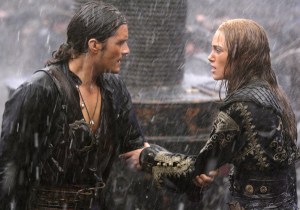 The movie is not without its due pleasures. Depp is always going to enchant with his now iconic character, but the true star of the film is Rush, who makes welcomed return. The special effects are still tops. The sequence rescuing Jack from the world of the dead provides many trippy moments that possess their own strange beauty, like when we watch the Black Pearl sail against the black, star-spotted sky. It’s fun seeing Keith Richards appear in cameo as Jack’s father and the stated inspiration for Depp’s performance. A small man and a large gun makes for one very funny sight gag. A Mexican standoff that actually involves an armed monkey is a comic high point. It’s just that all the fun or memorable moments seem to be the ones that matter the least. At World’s End still manages to do enough right to work, especially its Singapore opening. As far as a movie that upholds the quality of its franchise name, that’s a whole other matter.
Pirates of the Caribbean: At World’s End is a somewhat entertaining but heavily flawed final film to a trilogy. It’s the darkest and trippiest of the three movies, but it also makes the least amount of sense and has the least amount of action. That doesn’t seem like a good exchange in my book. There are not enough important events to justify the bloat. At World’s End has a hardcore case of butterfingers when it comes to handling plot and character setups from earlier films, and as a result almost nothing and no one ends in a satisfying fashion. The effects are still eye-popping and Depp will always be a comic treasure, but this lackluster movie feels like tripping at the end of a marathon. I had so much hope for At World’s End after how gratifying I found the other two movies but I cannot quell my disappointment. This is not a fitting conclusion. This feels more Matrix Revolutions than Return of the King. Of course it’ll make tremendous amounts of booty at the box-office, but will demand for a fourth be as rabid after this muddled and murky capper?
Nate’s Grade: B-
Share this:

Smokin’ Aces (2007)
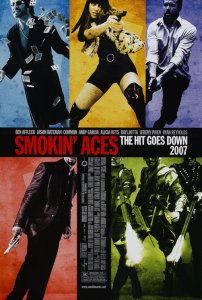 Writer/director Joe Carnahan (Narc) wants to impress an audience so bad with his muscular and macho gangster flick, but his Smokin’ Aces is vapid, nihilistic, and opines not to simply be a Tarantino rip-off, but a rip-off of a Tarantino rip-off. The premise seems ripe enough as we follow a rogue’s gallery of hitmen and killers trying to be the first to knock off a mob snitch/Vegas magician (Jeremy Piven) for a million dollar bounty. The colorful characters are introduced and some are quickly and unexpectedly taken out, but Carnahan never fully knows what to do with his bushel of baddies after he establishes their character quirks. The killers don’t really interact that much with one another and some of them hardly have any screen time at all; perhaps less would have been more in this jumbled stew. Carnahan throws out a few nifty visual tricks but it’s all superfluous and empty. Smokin’ Aces moves quickly, doesn’t make much sense in the beginning and end, and little to any of the characters have satisfying conclusions. So much of the writing feels like lame macho posturing without anything new or interesting to add to an overstuffed shoot-em-up. There are cops, robbers, plenty of gunfire, lesbians, and all sorts of convoluted twists, but it never holds together. Carnahan throws a lot of different elements together but they never extend beyond the elemental stage, so every storyline and character feels like an introduction that?s never capped off. The man has no idea what to do with what he’s started, and a karate kid on Ritalin is all the proof I need. Guy Ritchie did this territory far better service with the marvelously entertaining 2001 film Snatch. Rent that instead and save yourself the headache.
Nate’s Grade: D+
Share this:

Stranger than Fiction (2006)
 Ever think your life would make for a good story? Be careful what you wish for. Harold Crick (Will Ferrell) is hearing voices. They aren’t telling him to kill or do anything subversive. In fact it’s just one voice, an English woman, and she isn’t instructing Crick to do anything. No, she’s more so just… narrating. She comes in and out and expresses the doldrums of Crick?s life. He’s an IRS agent whose life revolves around order, repetition, and numbers. We can even see his inner tabulations thanks to some snazzy onscreen visual effects. Crick is sent to audit Anna (Maggie Gyllenhaal), a baker with a disdain for civil servants and authority. Crick is stricken by this shrewd beauty and finds himself wanting her, something the Narrator affirms for him. Crick’s life takes a dour turn when the Narrator lets on that Harold Crick had set in motion his “imminent death.” Crick is confused and seeks advice from Professor Hilbert (Dustin Hoffman) an expert on literature. Then they figure out the Narrator is Kay Eiffel (Emma Thompson), a famous writer who has the unfortunate habit of bumping off every one of her main characters.
Make no mistake, Stranger than Fiction is funny, but it’s a different kind of funny than most people are accustomed to with Ferrell. In my theater, I kept an eye on a gaggle of teenagers sitting several rows in front of me. I just wanted to observe their body language and what I saw was a lot of fidgeting, getting up for trips to bathrooms and popcorn, and lots of whispery talk. I can only imagine the disappointment of those teenagers expecting Ferrell to rip his clothes off and run around like a buffoon. They were likely busily thumbing away at their ever-present cell phones, text messaging their friends. People that are looking for a wild, sidesplitting, slapstick comedy are going to shaking their head. Stranger than Fiction is funny, but it’s in a very dry, witty way, much like British humor; it’s a humor you can admire for being clever but might not make you roll in any aisle.
 The biggest fans of Stranger than Fiction will be bookworms. This is a very literate movie that works better for those with an appreciation or outright love of literature and storytelling. Professor Hilbert doesn’t initially believe Crick until he learns that Crick’s narrator said, “Little did he know.” That, ladies and gents, is all a professor of literature needs. He has to rule out what kind of story Crick may be apart of, so he subjects Crick to a series of hilarious questions along the lines of treasure-inheriting, nemesis-making, and magical-creature befriending. Crick keeps a notebook to tally examples in his life that may point to whether he is part of a Comedy or a Tragedy. Professor Hilton even explains the difference: in grand Shakespearean tradition, a comedy ends with people getting hitched and a tragedy ends with people getting snuffed. This is all fabulously witty and extremely fun, but I can think you’ll see why hard-core fans of Old School and Talladega Nights might be heading for the exits.
Writer Zach Helm has created a wonderfully whimsical tale that’s trippy but manages to still have warmth and a firm heart. It’s far more embraceable a movie than, say, Adaptation, and less smug. He has a smart sense of humor and loves deconstructing literature, like the Jasper Fforde (The Thursday Next books) of screenwriting. We are really sucked into the movie from the moment we can hear Thompson. The story has an innocence to it and this existential comedy feels out there but still grounded; it’s surprisingly poignant and full of dramatic revelations. Even better, Helm has done something that few have achieved: he wrote a story-within-a-story that works. Kay’s narrative voice is highly droll in her observations on Harold Crick’s life. It sounds like a genuine novel, and on top of that, a novel I would enjoy reading. Stranger than Fiction is all the proof I need that Helm is a talent to keep track of.
 The performers all seem to have the same affection for the material. Ferrell is making that leap from funnyman into leading man, the same dramatic territory Robin Williams first tiptoed in Good Morning Vietnam and, likewise, Jim Carrey approached in The Truman Show. Ferrell won’t turn any heads but he underplays his performance maturely, playing a sad but sweet drone of a human being finally taking charge of his life under very insane circumstances. There’s a quiet moment toward the end where Ferrell is told he must accept his fate and he sits, shell-shocked, tearing up, his voice getting softer with every word. It’s only a moment but it piques my interest in what Ferrell may have in the tank. The comedy he can do in spades, including a desperate moment when he tries narrating his own life to coax his Narrator out of hiding.
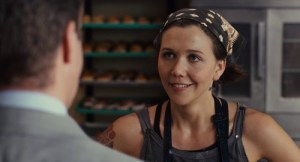
Who will turn heads, however, is Gyllenhaal. I can already see a nation of teen boys falling in love with her tattooed, punky baker. To them I say, get in line pals, Gyllenhaal has made me dot my I’s with hearts ever since her star-making performance in 2002’s kinky romantic comedy, Secretary. She’s easy to fall in love with and expresses a fragile compassion to her role. The romance between Anna and Crick is unexpected but these two people need each other, and you feel that need as you watch their eyes light up as their relationship blossoms. Late moments between them add to the tenderness of the film and you will be on your knees pleading Crick is spared so he can return to loving Anna. I think Wreckless Eric’s “Whole Wide World” will become a potential staple on romantic teenage mix CDs sent to their sweethearts from now on.
Thompson and Hoffman have appealing supporting performances. Thompson has marvelous fun thinking of different grisly outcomes in store for Crick. Her interaction with the hospital staff to see the “not gonna make it people” is a howl. But Thompson is too good of an actress to play it straight. Once she discovers the life-altering implications of her writing she is crushed by guilt, obsessed over killing good people cruelly. Frankly, if I had anyone narrating my life, Thompson’s voice would definitely rank high. Hoffman plays a dedicated literary professor like a straight man, and everything seems on the level for him, even the fantastic. It’s a nice touch for a film that doesn’t require broad strokes.
 The movie doesn’t have the depth of feeling or dark turnarounds that I know Charlie Kaufman would have done. Stranger than Fiction has a lot of fun with a very ripe premise, and is very intellectually stimulating, but you do feel like it could have gone further, exploring the reaches and implications of its metaphysical setup. What if someone who read Kay’s manuscript thought it was such a masterpiece, a shining light of literature that could move mountains, that they knew Crick must die, and that they must kill him to make certain of it. Or what about the relationship between author and character, and the role each has over the other and perhaps a battle over the future, a typewriter, and a happy ending at the end of a tunnel. However, while all of these options would further explore the novel premise, it would betray the movie’s whimsical tone. This isn’t a very dark movie. It has an authentic sweetness to it, and Crick is a gentle and kind man, and to do anything too heavy would work against the film’s tone. The movie explores existential queries and the topics can be grim, but ultimately Stranger than Fiction is life affirming.
Stranger than fiction also has a buoyant, unexpectedly pleasing romance to it. Again, it doesn’t show the depth of love and human feeling that Kaufman’s Eternal Sunshine could, but this is an unfair comparison. This romance is more a subplot that carries increasing weight thanks to heartwarming performances and the winsomely adorable Gyllenhaal. The romance in Eternal Sunshine was the story, and everything else was outside variable coming into contact. It might sound dismissive to call Stranger than Fiction as decaf Charlie Kaufman, but it really is a compliment. Kaufman is the most exciting, brilliant, creative, insightful, and whacked out screenwriter working today. I would give one of my kidneys to write even one story that could be described as decaf Kaufman. Stranger than Fiction may not examine as many themes, conflicts, or relationships as Kaufman might with the material, but this movie is a sweet fable that floats by like a fluffy cloud on a sunny day. It’s just so damn pleasant you sort of soak it in and fall in love, not wanting to leave.
Stranger than Fiction is strange, all right, but gloriously so. Scribe Zach Helm has concocted an existential fairy tale aimed for bookworms and outsiders. The premise is clever but the film doesn’t stop there, and Helm explores the implications of his premise with whimsy, charm, and a sweetness that is hard to rebuke. The wacky story seems reminiscent of Kaufman’s works, but it has a more heartwarming and embraceable appeal. Great performances from a game cast help to push the material even further into excellence. It has a small handful of flaws, perhaps a too limited scope, but that doesn’t stop Stranger than Fiction from being one of the best stories of 2006 and one of the best movies too.
Nate?s Grade: A-
Share this:

Running with Scissors (2006)
 Ever since author James Frey imploded into a million little pieces, the memoir has come under intense scrutiny. At issue is the validity of the written word, whether these people are being honest as they recount their tortured yet inevitably redemptive lives. What is the difference between nonfiction and memoir, and does it implicitly imply personal bias? Running with Scissors is the 2002 best-selling book detailing the bizarre childhood of Augusten Burroughs. It’s a book with lots of out-there claims but they’re all held in check by Burroughs’ tart observation and witty writing. When translated to the silver screen, Running with Scissors loses credibility without the author’s voice. I doubt many people going in cold will even believe what they’re seeing.
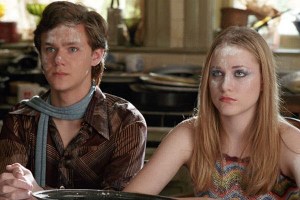
In the 1970s, Augusten (Joseph Cross) is a gay teen growing up in the care of his alcoholic father (Alec Baldwin) and his deeply delusional, bipolar, wannabe poet mother (Annette Benning). When their marriage hits one of its many slags they seek out a therapist, Dr. Finch (Bryan Cox). He has a room he dubs his “masturbatorium,” a resemblance to Santa Claus, and a family just as whacked as he is. His oldest daughter, Hope (Gwyneth Paltrow), helps him in his practice and thinks that pets talk to her, even from beyond the grave. Natalie (Evan Rachel Wood) is the rebellious daughter who likes to play doctor via electric shock therapy. Agnes Finch (Jill Clayburgh) is the matriarch of this cracked family that also enjoys eating some dog kibble here and there. When Augusten’s mother signs over adoption papers he becomes the reluctant newest member of this dysfunctional family.
 The trouble with translating a book is that you lose the author’s voice and commentary. Running with Scissors maintains the horrifying living conditions for Augusten and the stable of oddballs, but lost is the author’s snappy humor that carried him through this tumultuous time. It’s definitely weird but it’s far from engaging. Without the wit and dark humor from Augusten’s voice we’re left with a series of loosely bandaged scenes about crazy characters and crazy anecdotes, little of which contains further importance. This is a fan of the book talking here, and I’m afraid that the film adaptation has heightened some of the weaknesses of the book, namely the loose storyline. When pieced together as a film, Running with Scissors can become slightly tiresome and overly reliant on background details. The film treats its wild, kitschy production design and 70s nostalgia as a character on par with anyone. It makes for great production design, true to the spirit of the book, but also serves as a narrative distraction. Too much attention seems to be put on getting things to look right than getting the screenplay to feel right.
Without the author’s voice the results lose credibility. It’s funny to see a Christmas tree up year round, and it’s funny when Dr. Finch is convinced God is communicating to him through his bowel movements, but it all just comes off as another joke like the art direction and nothing more. When fully added together without any sense of pathos, it all seems like a joke. The subplot involving Augusten’s sexual relationship with a much older schizophrenic patient (Joseph Fiennes) seems mishandled without much insight. Running with Scissors presents all examples of dangerous, sometimes illegal, behavior and doesn’t bat an eye, nor does it pass judgment. While this may irk some and seem irresponsible it’s just another case of little mattering. Running with Scissors, as an adaptation, presents little of consequence.
Director Ryan Murphy also adapted the screenplay and knows a thing or two about dysfunction and trashiness, having created the risky TV show Nip/Tuck. His adaptation has a blunted feel, but it also seems too broad. Then again, maybe only fans of the book would notice. He has a good feel for his actors and can stage some nice shot selections, but man, someone needs to slap his hand away from the AM radio. Running with Scissors is crammed with so many popular 70s tunes that it becomes a crutch, with Murphy hitting the soundtrack button whenever he needs some kind of character catharsis. It doesn’t work and comes across as indulgent and simplistic. There are so many zippy classic pop songs you may think Elton John is owed a writing credit.
 The acting is one of the elements that help give life to this adaptation. Benning has been generating Oscar buzz for her deeply self-involved portrayal of a mom held hostage by her illness. Benning digs deep and displays a comic range of absurd behavior and wild paranoia. She’s all over the place and you can’t help but loathe her, that is, if you ever take her seriously. But then, once overly medicated, she gives an entirely secondary performance as an emotionless zombie, and we feel a sliver of sympathy, a true surprise. It’s a good, meaty role, however, I actually think Clayburgh gives the more Oscar-worthy performance. In a lot of ways she’s resigned to her fate and yet manages to be the gauzy heart of the picture. She tells me more with her wrinkles than Benning does in her gesticulating outbursts.
The rest of the cast work admirably. Cross is our focal point of the story and does a fine job of, essentially, gawking and looking perplexed. He’s like a blank, gangly canvas, and I wonder what else Cross is capable of than a performance built around indignant reactions. Wood is developing into a lovely adult actress and has some of the best foul-mouthed lines. It’s just nice to see Paltrow in a movie again. Baldwin has transformed from leading man into incredibly versatile supporting actor that excels as comedic lunkheads. Cox remains one of my favorite character actors of all time. There’s nothing this man cannot do. The actors all do a good job of filling out their zany characters while leaving their own imprint.
The issue with Running with Scissors is that when you strip away the author’s caustic voice, then the movie strains credibility, even with the knowledge that it?s based on a personal memoir. The movie gets all the wackiness but misses out on some of the finer points and humor that helped save Augusten from his unorthodox housing. The story feels dulled and stretched too broad, and yet it still manages to be intermittently entertaining despite these flaws. The actors range from good to great and the art direction is fantastic, even if Murphy expects it to do more work than his screenplay. Running with Scissors isn’t as nervy, engaging, or provocative as its source material. Then again little else is. Consider the film Running with Safety Scissors.
Nate’s Grade: B-
Share this:

Little Miss Sunshine (2006)
 Slowly but surely, Little Miss Sunshine is gaining momentum as the breakout comedy of the summer. It’s gotten some of the most glowing reviews of the year and is poised to capture the hearts of not just fans of indie cinema but also patrons of the big suburban multiplexes, your red state soccer moms and NASCAR dads. After having seen Little Miss Sunshine, I feel like I must have missed the bandwagon.
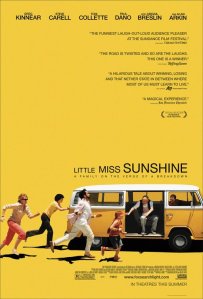
Little Olive (Abigail Breslin) is bursting with shriek-worthy excitement. She just found out she’s a regional contestant in the national Little Miss Sunshine child beauty pageant. Her family crams into a beaten down, canary yellow Volkswagen bus and heads off on a cross-state journey for Olive. Along for the ride are Olive’s fractured family — older brother (Paul Dano), who has taken a vow of silence until he becomes a fighter pilot, stressed-out but supportive mom (Toni Collette), ambitious self-help failure dad (Greg Kinnear), a potty-mouthed, heroin-snorting grandpa (Alan Arkin), and a suicidal gay uncle (Steve Carell). It’s a long road to the pageant, especially with such an eclectic group of people whose only thing in common are their chromosomes.
 I just couldn’t shake the overwhelming feeling that Little Miss Sunshine should be more. It’s not really much of a comedy. There are some funny moments, and pushing the bus is a running gag with better legs than I would have guessed, but the film has a lot of stretches where the laughs are low to nonexistent. It’s not really much of a character piece either. None of the characters are that well defined or allowed to stretch out. The family members are all archetypes of indie film weirdness: the gay intellectual, the verbally inappropriate grandparent, the self-deluded father, the frazzled mother, the loner brother, and the precocious tyke. Little Miss Sunshine does a fine job of setting up its family of cracked characters but then seems to twiddle its thumbs when it comes to development. The only character insights come in a scattered few small moments with Olive. Dad is essentially poisoning his family with his self-help claptrap, casting the world into “winners” and “losers.” There’s a heartfelt moment brilliantly played Breslin where she confesses to grandpa that she doesn’t want to be a loser because her dad would stop loving her. Aside from that, Little Miss Sunshine seems to wind its characters up and then leave them be. I wanted more of just about everything but the movie wouldn’t budge.
The movie spends quite arguably too much time at the Little Miss Sunshine beauty pageant. Child beauty pageants are a well deserved, albeit easy, satirical punching bag, and they creep the hell out of me. Seriously, turning little girls into highly sexualized Barbie dolls seems cruel, unnatural, and very very creepy to me. There was a stupendous documentary that aired on HBO years ago called Living Dolls that traced the life of a six-year-old girl and her stage mother. It was a harrowing film, and the obsessive mother is one of the most disturbing villains I’ve ever seen in a movie, scripted or otherwise. In the film you see how people transform little girls into flirty, overly made-up little adults. It’s sickening.
The reason I bring this up is because Little Miss Sunshine because they lift a direct metaphor. In Living Dolls the main girl is playing one of those tiny slide puzzles where the finished result is an honest to God yellow smiley face. It’s a perfect metaphor of this child attempting to find happiness when no one seems to want her to live as a child. And then I saw the exact same moment in Little Miss Sunshine. Rip-off or accidental homage, you decide. In the same vein, every time Kinnear invokes the name of his literary agent, Stan Grossman, I kept thinking of Fargo.
In Sunshine, the family is aghast at the pageant scene but support Olive anyway. Then things get way too easy. The film concludes with the 5,785th rendition of the weirdos celebrating what makes them who they are, their weirdness, and sticking it to the thumb-nosing naysayers. Then the movie abruptly ends. That’s all, folks. Little Miss Sunshine was already built on the aching backs of two very familiar indie staples, dysfunctional families and road trips, and offers little else to justify its existence.
 It’s hard to really drag this film through the mud. It was proficiently made by the music video directing team of Jonathon Dayton and Valerie Faris (Smashing Pumpkins’ Tonight Tonight). The acting is generally good. The better actors rise to the top despite their limited character depth. Carell is a big name in comedy right now, and he gives a rather subdued, sarcastic performance that will resonate best with audiences. Kinnear is better at playing smug types than pathetic types. His character really is the villain of the piece, so it’s nice to see his transformation even if it is awfully spontaneous. Collette always looks to be on the verge of a nervous breakdown. Breslin (Signs) is pretty cute and will pierce your heart during the aforementioned talk with grandpa.
There are some amusing moments and fun pieces of dialogue, and the film has its heart in the right place. The screenplay needed to go through a few more drafts to strengthen character and story. I can honestly say my favorite part of Little Miss Sunshine was listening to its very Sufjan Stevens-like soundtrack full of meloncholic horns, cellos, violins, squeezebox and electronic whispers. I would recommend the soundtrack ahead of the movie.
I feel some shades of guilt as I gather my opinion, however I cannot deny the overwhelming urge that Little Miss Sunshine should have been more. It needed more comedy, more character depth, more attention to story, and more opportunity for its ensemble of actors to sink their teeth into the material. This appointed indie darling is intermittingly amusing, has some laughs, and may be worth a free afternoon or as a rental. To me, it’s also a big example of wasted potential. Little Miss Sunshine is a beauty that needs more work before it can shine on a greater stage.
Nate’s Grade: C+
Share this:

Brick (2006)
 I appreciate movies that try something different. That isn’t to say I love all movies that try, like Gus van Sant’s latest collection of watch-grass-grow cinema. More often than not I appreciate stabs at originality even if it results in colossal failure. That’s why I can never beat too much on M. Night Shyamalan. When Brick came out last spring it had my attention immediately. Writer/director Rian Johnson placed a hard-boiled detective story in the contemporary setting of a high school. And true to my promise on my podcasts, I bought it the day it came out on DVD. For fans of crime fiction and excitingly bold cinema, rent this movie.
Brendan (Joseph Gordon-Levitt) is a kid that knows the ins and outs of the high school scene. He’s currently looking into what happened to Emily (Emile de Ravin), his ex-girlfriend who was last seen trying to fit in with the popular types. She was in some form of danger and contacted Brendan for help. With the help of The Brain (Matt O’Leary), an old friend, Brendan must negotiate a web of unsavory characters, each with their own game. There’s Dode (Noah Fleiss), a burnout who was last seen crushing on Emily. There’s Laura (Nora Zehetner), a rich girl accustomed to hanging out with bad boys. It all leads to The Pin (Lukas Haas), the man controlling the area’s drug supply and who, we’re told, is “way old, like 26.” The Pin’s been volatile ever since a brick of heroin went missing. If Brendan’s head isn’t spinning piecing together all the clues, surely the audience’s will be.
 Brick is a film that refuses to simply be an afternoon afterthought. This is a movie that demands you sit on edge, poised to decode its complicated detective jargon and twisty storyline. It takes a while to first get into the movie because of its stylized dialogue and how straight everyone plays it. Johnson has recycled the same hard-boiled talk you’d expect coming from the mouths of Humphrey Bogart and Lauren Bacall. I heard that some theaters actually gave a glossary of terms and verbal exchanges for people who went to see Brick. Whether that’s true or not, your brain is working overtime to decipher what is being said, and I love that. I love that Brick doesn’t take time out to explain its terminology but expects you to keep up as best you can. I don?t want to scare readers off, because even if you don’t know any noir vernacular you’ll be able to know what’s going on, but it’s just cooler to be in on the fun. The snappy dialogue is only one part of Johnson’s extremely intelligent, very meaty script.
Brick relies on a gimmick, yes, but what an inventive and clever gimmick. There’s just an extra level of fun for film noir fans, spotting the same archetypes (mysterious damsel in over her head, femme fatales, goons, underworld boss) and locations (gin joints become house parties, detective offices become teen bedrooms). Brendan even gets chewed out by his superior who wants results… his assistant vice principal (Shaft‘s Richard Roundtree). There’s such a common language of film noir and its staples, and part of Brick‘s enjoyment is placing all of them. I’m fully aware that Brick will exist more as an artifact in a film class than as a film casual moviegoers will actively watch. The plot is blissfully twisty with many intriguing players, and once it’s all laid out it actually holds together. Brick is rewarding for those willing to stay attentive.
The movie succeeds because of how committed everyone is. The gimmick seems doomed to fail but the movie has creativity in spades. Of course it’s all highly unrealistic but it all works splendidly within the world it creates. Because the filmmakers play it all straight, you never look at the movie from an outside perspective. You’ll never laugh at it unless you’re giggling about how much fun it is. Unlike other recent brainteasers like Syriana, you do have an emotional connection to the movie and you do care about the characters and are interested to see where the story goes (and it’s not nearly as confounding as Syriana). I love that Brendan outsmarts everyone and sometimes he does it by taking a pounding. I love that he takes so many beatings that he actually gets sick from swallowing so much blood. It’s the attention to details like that where Brick shows its commitment to the world it has created. Brick is reveling instead of deconstructing the detective genre, like the audaciously cheeky Kiss Kiss Bang Bang.
 There are some humorous winks that remind you of Brick‘s gimmick, which is surprisingly easy to forget. The Pin’s mother serves juice to her son’s “friends;” The Pin walks along a beach discussing the details of his operations and then drops a peculiar non-sequitur, asking Brendan if he’s ever read J.R.R. Tolkien (“His descriptions of things is really good. He makes you want to be there.”) That moment has haunted me still months after I viewed Brick in a theater. The Pin is a scary bad guy but it’s that line that makes me go back and say, “Yeah, but they’re just kids.”
Johnson masterfully handles his actors. Gordon-Levitt is fast becoming one of the most versatile young actors. He’s the moral anchor of the movie and Levitt carries the film on his back. He’s great handling the dialogue but even better making Brendan seem human in a highly stylized tale. Zehetner leaves quite an impression as a smoky seductress who may be the biggest player in the film. Haas plays his villain role to eerie perfection.
Brick is an exciting, disarming, demanding, vibrantly different movie that is stone cold cool. This is not the easiest movie to get into, but once you open up to its freshly retro wavelength then Brick is one greatly rewarding movie. Johnson has built a movie around a gimmick but it all holds together so well thanks to his total commitment. The dialogue is heavy in noir slang and the story is crammed with twists and surprises. I loved this movie from the first frame to the last. Johnson has found a refreshingly original movie by going back in time. They don’t make ’em like this anymore.
Nate’s Grade: A


 nathanzoebl
You must be logged in to post a comment.