Blog Archives
Micmacs (2010)
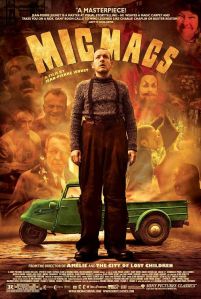 So what exactly does Micmacs even mean? A cursory search online brings me a few definitions: 1) a Native American Algonquian group living in Canada and upper New England, 2) the Algonquian language of the Micmac. That doesn’t exactly clear things up, especially considering that Mimacs is a French movie by the famed filmmaker Jean-Pierre Jeunet. An interview with the director has him explaining that the title is French slang for a mixture. That seems appropriate since the film is a mélange of the director’s other works, high on inventiveness and visual whimsy. Except the one thing Jeunet strangely left out this time was a reason to care amidst the high-powered shenanigans.
Bazil (Danny Boon) is a bit down on his luck. A landmine killed his father when Bazil was a child. He drifted through life, got a job at a video store, and then got a bullet in his brain thanks to a drive-by shootout. The doctors decided to leave the stray bullet inside or else Bazil will become catatonic. Bazil eventually is adopted by a batch of homeless misfits living in a junkyard. They accept Bazil and encourage him to seek vengeance against the warring arms dealers responsible for the land mind and stray bullet. Bazil and his colorful new family plot to antagonize the arms company CEOs. They come up with crazy schemes to then frame on the rival CEOs to escalate tensions. Bazil and crew intend to expose these men and their corporate crimes to the world.
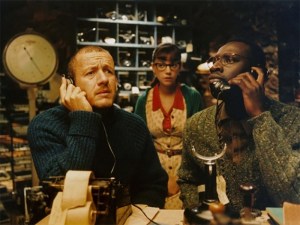 Micmacs succeeds where Rian Johnson’s Brother’s Bloom dangerously came close, and by that I mean that Micmacs overdoses on whimsy and I pronounced it clinically dead about an hour in. It’s too much; it’s just too much. Jeunet has always created movies that existed in rich, idiosyncratic worlds but those worlds always felt lush and lively and bursting with wonder. What saves a movie from whimsy is an emotional connection to the proceedings. 2001’s Amelie is a perfect example of cinematic “magic realism” but it’s also a moving and emotionally rewarding love story that transcends the plucky heroine. 2004’s A Very Long Engagement was a rapturous, old-fashioned love story with flights of fancy. Now, after a long six-year absence, Jeunet seems to have lost touch with the heart. There is no real emotional entry point for Micmacs. The protagonist is pretty much a blank. Yeah, you want him to get justice and you pull for the underdogs, but at no point did I care whatsoever for any character. Most of the junkyard characters are just ideas, walking-talking heist components (the human cannonball, the girl whose brain is good at math, the toy maker). Several characters barely exist except for their specific roles in Bazil’s schemes. There’s a romantic angle with the female contortionist (Julie Ferrier) and Bazil, but that comes off as less a function of the narrative and more of a desperate “Well, who else is gonna get together?” necessity. Jeunet has put together a movie that is all surface and no polish. Sure, the movie is intermittently entertaining and has plenty of imagination, but Micmacs is without a doubt the least involving and least accomplished film from a man responsible for a fantastic output.
The tone of the film seems to hew to something like a silent movie, which might explain why all the older members in my audience were constantly giggling while I just occasionally snickered under my breath. The comedy never rises above the chuckle level. There’s plenty of controlled wackiness, nothing gets too out of hand or edgy despite the fact that the plot revolves around getting vengeance on arms dealers. I was expecting something a little darker than the cutesy oddballs that I got. The best and darkest moment in the film is when we see that one of the arms dealers collects body parts of dead celebrities (Marilyn Monroe’s molar, Mussolini’s eyeball). It’s an interesting quirk that actually reveals something about the dark heart of the antagonist. There should be more moments like this. The bullet in Bazil’s brain is barely referenced. I have no issues with whimsy when it doesn’t overwhelm the narrative, and that’s the problem with Micmacs. The story is merely the vehicle for the inventive hijinks. The story is suffocated by whimsy and visual energy, therefore there’s no room for character development. All that inventiveness takes center stage. If playfulness is all you seek in a movie, then Micmacs will likely satisfy. Jeunet still makes movies that nobody else does, but he’s fallen fall short of his own lofty standards.
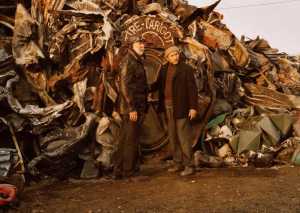 The movie moves along so quickly that it seems like every character just naturally intuits what must be done next, like they all have the screenplay in hand just off camera. Bazil is so quickly adopted by the junkyard gang. He so quickly discovers who is responsible for his life’s troubles. The schemes are so quickly thrown together. They aren’t even that complicated, mostly distracting and framing. The movie just feels like a spinning plate that has to keep moving or else everything will just break. I suppose Jeunet and his longtime co-writing collaborator Guillaume Laurant are trying to keep things busy so people won’t notice that they don’t genuinely care what happens.
This being a Jeunet film, of course it’s spectacular from a technical standpoint. Every frame of a Jeunet film can be used as a mural. His compositions delight the eye and the colorful cinematography by Tetsuo Negata (Splice) makes Paris seem like a dream city. The production design looks like it was taken directly from the Steampunk Architectural Digest magazine. You’ll never have to worry about the visual aesthetics or ingenuity of a Jeunet film. But there are plenty of artists that can master technical craft (you can find them in the world of commercials) but it takes something much more to marry technical precision in the service story and character. Micmacs is a strange film not because of plot, character, tone, or energy, but because Jeunet spent six years in absence and returned with a film that’s got plenty of style but no heart inside all that artifice.
Nate’s Grade: B-
Share this:

The Informant! (2009)
 Stephen Soderbergh’s comic farce is highly amusing from start to finish. I even watched it twice and still found myself shaking my head and chuckling in bafflement. That’s the best way to describe the tone of the film — baffled laughter. Matt Damon stars as Mark Whitaker, a corporate whistleblower whose grasp on the truth is tenuous at best. Damon’s character is a cut-up and his delusions of being a spy plus his scatter-brained narration are as fascinating as they are hilarious. This guy thinks he’s James Bond. And yet the film, while deeply comic, never comes across as snide or condescending even if most of the laughs come from Whitaker’s disconnect from reality. The film has a deliberately ironic tongue-in-cheek vibe, from the silly yet undeniably jaunty kazoo-aided score by Marvin Hamlisch to even the amber-colored cinematography (like the film was shot through the prism of a honey jar), the movie is an entertaining series of blunders and revelations. Damon is charismatic and deeply funny and Whitaker makes for such an interesting main character exactly because he is so unpredictable and unreliable. He doles out the truth in pieces like a kid caught. The Informant! is light and breezy but with some well-honed psychology of rationalization and self-deception. I don’t know how true this supposed true-life tale really is, but it’s a hell of a fun tale.
Nate’s Grade: B+
Share this:

Cloudy with a Chance of Meatballs (2009)
 Thanks to a rambunctious comedic spirit and some delightfully colorful visuals, Cloudy with a Chance of Meatballs is absurdly amusing from start to finish. I was relieved when this animated family film stuck by its own manic comic sensibilities instead of pandering with scatological humor and bizarre and instantly dated pop culture references. The story has the familiar “believe in yourself” elements but it takes it another tasty level. Writer/directors Phil Lord and Chris Miller (MTV’s vastly underrated Clone High) pack the story with jokes of all levels, running gags with surprising payoffs, puns that manage to be funny, satirical one-liners, imaginative visual gags, and inventive action sequences when the film becomes an all-you-can-eat buffet of disaster movies. The pacing is frenetic and the eclectic vocal cast (Bruce Campbell as the villainous mayor! Mr. T as sheriff! Neil Patrick Harris as a talking monkey!) really, as the film says, “carpe some diem.” This isn’t an emotionally engaging movie whatsoever but it’s one of the best comedies of 2009 and certainly one of the most jam-packed, fun 90 minutes you could ask to sit through. Just prepare to be extremely hungry afterward.
Nate’s Grade: A-
Share this:

Zombieland (2009)
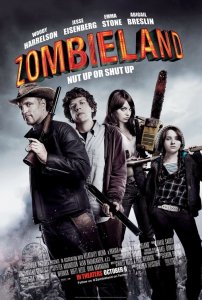 Zombieland is insanely entertaining and one of the most satisfying theatrical experiences of this year. It’s an American Shaun of the Dead, meaning that the zombie genre gets lovingly satirized with some wit, some bite, and a whole lot of blood. This movie isn’t nearly as clever as Shaun but it sure serves up the red meat of what you’d want in a crackling zombie action comedy. Woody Harrelson and Jesse Eisenberg make for an engaging odd couple pairing, director Ruben Fleischer posits a nice amount of visual whimsy with onscreen survival guide rules, and there is a glorious celebrity cameo midway into the movie that might qualify as my favorite 10 minutes of 2009. It’s funny and fiendish but it doesn’t break down the fourth wall. Zombieland does have some flaws to it, like a repetitious second act where the boys get duped by a pair of sisters (Emma Stone, Abigail Breslin) like three or four times, and the climax at an amusement park raises some obvious questions. Why turn on an amusement park and attract every zombie in town? Why dive out of a Hummer when you could drive off? The movie seems to take great aims to set up the damsels in distress, mostly because the inconveniently shut their brains off from survival mode. The silliness and macabre fun is infectious and Zombieland makes you hungry more adventures with these characters killing the undead in gross yet creative ways. I may be biased since Eisenberg’s character is from Columbus, Ohio (the crowd I was with cheered when we were informed our present home town had been decimated by zombies).
Nate’s Grade: A-
Share this:

Away We Go (2009)
 Away We Go sort of came and went in the blink of an eye over the summer. Some critics dinged the indie production as being insufferable, hipster, smug, and unlikable. I agree that the plaintive guitar-strumming score grates, and the costumes have that trying-hard-not-to-be-hip coolness, which can be insufferable, but Away We Go is more than just faulty hipster packaging. There is a moving and entertaining drama inside here. The problem is, you have to sift through some of the junk to reach it.
Burt (John Krasinski) and Verona (Maya Rudolph) are in their early thirties and about to have a baby. They aren’t exactly hipsters but they have been living a somewhat fringe existence; Verona even points out that they have a cardboard window. Their existence has been mostly ramshackle and now its about to change forever. Burt and Verona decide to journey across the country and reunite with family and old friends. They’re studying widely different family units across the country to discover not just what kind of parents they will be but what kind of family they will be.
Just by the fact that nobody dies at the end, this is a big departure for director Sam Mendes (American Beauty, Revolutionary Road). This low-key road trip comedy is quite different from the meticulous prestige pictures associated with the Mendes name. Away We Go is a scruffy, small, and disarming little picture that wants to say something. I was taken aback at how affecting I found moments of Away We Go, though it is only moments. Burt and Verona are not exactly the best equipped to start a family right now, which makes them anxious and nervous, and anxious about not being more nervous. They haven’t exactly matured much since graduated college years ago. But amidst their search for the definition of a “working family” they must accept the uncertainty of life. Burt and Verona have a comfortable interaction, from his upbeat sarcasm to her grounded realism. There’s a great running gag where Burt tries to raise the baby’s heart rate, so his goofy bouts of fake agitation will be immediately followed by a stethoscope and an adorable grin of satisfaction. They are a compatible couple and it is refreshing to see a movie couple that compliments each other in personality. They actually love each other, are good for one another, and are not beset with contrived conflicts. In fact, the movie ends up pretty much exactly where it began, only with a smattering more of wisdom. The lesson learned in Away We Go is that it doesn’t matter what the bumps in life may be, it’s all about who you have as your co-pilot.
 Screenwriters and married partners, Dave Eggers and Vendela Vida, mix in small moments of weight and an overall tone of genial sweetness. The drama and the comedy are given equal share of the script, though the elements don?t mix that often. The funniest moment, by far, is when a little boy tells his mother exactly what he knows about babies (I won’t spoil the guffaw-inducing surprise). There are some quiet yet weighty moments of human observation here. There was a tender exchange between Verona and her sister Grace (Carmen Ejogo) that had me on the verge of tears. The sisters reminisce about their parents, long dead, and then Grace says that having this baby keeps their parents alive; the sisters can see parts of their mother in the baby’s face. Verona is giving back life to her dearly departed mother and keeping her parents’ legacy ongoing. This lovely thought struck me with such sudden force that I felt overcome with emotion. It could be dismissed as a common sense fact of genetic proliferation, but I had never thought of the birth of a child as a means of keeping the past alive and honored. To me, this is a simple yet wonderful and powerful statement. Another great moment is when Burt and Verona make lifelong promises to each other on a trampoline. Verona doesn’t want to marry, so the scene is the equivalent of the two lovebirds exchanging vows. It’s heartfelt and sincere and well within the bounds of the characters.
What?s frustrating to me is that the movie?s poignancy is undercut by its excisions with grotesque cartoon versions of bad parents. Burt and Verona visit different imperfect family units, but it isn’t until the end of the movie where we see anything resembling a semi-authentic brood. Alison Janney plays an obnoxiously loud parent who berates her children for laughs and accepts the brokenness of children; to her, she can’t fight against genetics and thus gives up parenting. On the flip side, Maggie Gyllenhaal plays a narcissistic earth mother who still nurses her children and condemns the very idea of strollers (“I love my babies. Why would I want to push them away?”). In each case, the depicted family is a caricature and readily ridiculed for some easy and snide laughs. Even Burt’s parents (Jeff Daniels, Catherine O’Hara) are figures set to be mocked for their self-absorbed bourgeois values. In some ways, Away We Go started to remind me of that awful movie North, where a young Elijah Wood travels the globe in search of new parents. At each stop, Wood encounters broad caricatures of different family units. In Away We Go, half of the movie is spent palling around with repulsive idiots who overstay their welcome fast. What’s even more frustrating is that the script becomes locked into a pattern, meaning that we spend the same amount of time (10-15 minutes) with each family. This is not helpful when Burt and Verona finally reach the relatable families, in Montreal and Miami, then the movie shortchanges the palpable drama. In Miami, Burt’s brother has had his wife run out on her family, abandoning their daughter. We’ve finally reached interesting and complex character, each with an aching sadness just below the surface about the hardships of parenthood, and the movie has to keep on moving because we spent too much time with the crazies for easy laughs. You’re supposed to spend more time with the good stuff, not the bad.
 The noisy, exaggerated supporting characters are balanced by the believably baffled Krasinki (TV’s The Office) and Rudolph (Idiocracy). He’s effortlessly charming and Rudolph plays her character with subdued texture, uneasily taking everything in for due consideration. Both actors are likable and we grow in empathy with them as they go from stop to stop. The couple is so charismatic that it makes the drama-free reality of functionality forgivable. The rest of the cast play their parts to the hilt, but special consideration should go out to Melanie Lynskey (The Informant!, Heavenly Creatures) who plays the mother of a large adopted clan of kids in Montreal. Her problem is that she cannot conceive and she’s endured five horrible miscarriages. Her slow and melancholy dance around a stripper’s pole is heartbreaking, and that?s something I thought I would never write in my life.
Despite some missteps, Away We Go is a sweet and affectionate little movie that fights against being overly twee and precious. It’s definitely not sentimental but at the same time it rejects cynicism and detached irony, embodied by the compatibility of a couple that truly love each other. At the same time, the movie can be annoying with its loud side characters that act as distractions. The best moments in Away We Go are the small ones centered on Burt and Verona. It’s those handful of small moments that pierce your heart. It’s strange but after writing this review, I realize that I like the good moments even more and the bad moments even less. It’s like Away We Go has become more entrenched in my mind. This is a sometimes promising, sometimes frustrating, drama that knows enough about life to not settle for easy answers. If only it didn’t settle for easy jokes with stupid characters.
Nate’s Grade: B+
Share this:

The Brothers Bloom (2009)
 Con movies work thanks to P.T. Barnum’s belief that the audience wants to be fooled. We all enjoy being conned to some degree. The excitement of con movies is being outsmarted and figuring out how it was accomplished. The Brothers Bloom, by writer/director Rian Johnson, one of the more exciting new filmmakers in Hollywood, is a con artist caper that understands the rules of the game and then aspires to transcend the game. Whether or not it succeeds depends on how much whimsy you can stomach in a two-hour duration.
Stephen (Mark Ruffalo) and Bloom (Adrien Brody) are a pair of con artist brothers. Stephen has been drawing up elaborate schemes ever since childhood, and he always uses his brother as the face of the operations. The brothers have a third member to their team, the mysterious and mute Bang Bang (Rinko Kikuchi), who, we’re told, just appeared out of thin air one day and they expect she’ll leave in the same style. Bloom is tired of playing characters and roles and wants out, but his big bro comes back with one last con in the works. Penelope Stamp (Rachel Weisz) is rich, peculiar, and lonely, ripe for the taking. Bloom snares her with the exciting prospect of being apart of an adventure. There’s a globetrotting plot to profit from selling a book to some shady characters (Robbie Coltrane, Maximilian Schell), and it’s just what Penelope needs to feel alive and leave the confines of her large cage-like home. Naturally, Bloom falls for the “mark” and feels conflicted, but was this part of Stephen’s plan all along? Is he setting up some form of a happy ending for his little brother? Is Penelope in on the con? Who’s conning whom?
 The Brothers Bloom is steeped in whimsy and at times runs dangerously close to falling into the inescapable gravitational pull of “cutsey.” Some have compared the film’s quirky, precocious style to Wes Anderson, but the movie reminds me more of the style of Barry Sonnenfeld, a filmmaker who made outsized whimsy seem like everyday reality; Anderson’s movies seem to exist in their own impeccably handcrafted worlds. I loved the opening 10-minute prologue which explores the childhood history of Stephen and Bloom, examining their first con on local rich kids. It’s quick-witted, snappy, and even has Ricky Jay provide narration, reminiscent of Magnolia or the David Mamet con movies. The Brothers Bloom has a sunny disposition that doesn’t come across as smug. Stylistically, the movie never crosses the line into feeling overly mannered. The Brothers Bloom exists in some unknown time period. The cars are modern, the clothes are from the 1930s (everyone wears a bowler hat with such flourish), and the sets look like they’re from the 1960s. There is no dependence on technology, just good old-fashioned brains and charm.
And yet this is more than an exercise in style. Just as he did with the adroit, neo-noir movie Brick, Johnson takes a genre and subverts its expectations. The Brothers Bloom treats cons more as storytelling, and it positions the film and its characters in an interesting new light. Bloom yearns for an “unwritten life” because all he’s known have been roles in his older brother’s games and cons, and the poor sap doesn’t even know if he has an identity beyond fabrication. Stephen has also begun to blur the lines between reality and his cons, and his life’s ambition is to stage the perfect con where “everybody gets what they want.” Get that? The Brothers Bloom aims for deception that gives everyone, including the deceived, a happy ending. It almost sounds like a charitable goal. Johnson has injected the con artist genre with some pathos and self-reflection. Too many con artist movies are only good for one viewing; once you know the particulars of the con, do you feel invested in watching it play out again? Johnson puts some melancholy into the mix and it gives the film more weight than being the sum of its many quirky parts.
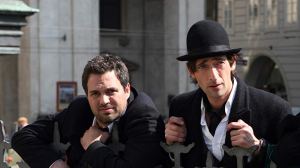 The acting across the board is superb. Ruffalo is his typically low-key yet engaging self, and he seems sincere even when you know he isn’t. His love and concern for his little brother is touching. His schemes are all for his brother to get out of his shell and experience some level of happiness. Brody embraces the weariness of his character. He is confused and tired and feels like he cannot trust human connections; he’s paranoid that all roads lead back to some machination from his brother. His affection for Penelope is like an awakening for his character, and yet he cannot fully give into it because is it genuine? This incredible level of uncertainty with every aspect of life casts a heavy toll, and Brody convinces you of that toll. Kikuchi (Babel) makes great use of physical comedy and has a lot of fun with her mysterious character. She’s mute for practically the entire film yet manages to communicate plenty. But it is Weisz (The Fountain) that steals the movie and steals your heart. Her screwy eccentric is deeply lonely but radiates a ditzy glow. She fully embraces the prospects of adventure and bounces in glee. This woman is powerfully adorable.
There are a handful of missteps in the narrative. The movie likely lasts twenty minutes longer than it needs to, with false endings and even a false third act. Audiences are used to con movies revealing the larger scope by the end after a bevy of last-minute twists. This is not the case with Bloom. The movie gets more muddled and introduces new conflict that isn’t ever really resolved. Audiences expect clarity by the end of the third act, not confusion. I feel like I’m missing something with the duplicitous Diamond Dog character (Schell), and maybe that’s the point; perhaps I’m supposed to be in the dark about his connection to the brothers Bloom. I won’t get into spoilers, but I was expecting more reveals at the end of the movie, perhaps Stephen showing one last final box, and the movie gives you nothing. I suppose the purpose is to play against con movie conventions and the surprise is that there is no real surprise by the end, no “I was in on it” or “It was all part of the plan” a-ha moments of ironic revelation. That’s nice but it doesn’t always make a movie more satisfying. The ending would be more moving if the audience didn’t already feel spent by the time they have to process something more emotional.
Johnson’s follow-up to his immensely entertaining debut is a solid winner, though it leaves you hanging and wanting at the end. The movie is quirky and heavy on the whimsy, and yet it also squeezes in some pathos. Yet the movie falls short of its ambitions and the talent of Johnson. The Brothers Bloom will seem enchanting to some and insufferable to others; it defies expectations and genre conventions, and sometimes would be better off adhering to them. It’s an amusing caper comedy but it could have been something even more special. It just needed a little less narrative sleight-of-hand.
Nate’s Grade: B+
Share this:

Synecdoche, New York (2008)
 Nothing comes easy when dealing with acclaimed screenwriter Charlie Kaufman. The most exciting scribe in Hollywood does not tend to water down his stories. Kaufman’s latest head-trip, Synecdoche, New York, is a polarizing work that follows a nontraditional narrative and works on a secondary existential level. That’s enough for several critics to hurtle words like “incomprehensible” and “confusing” as weapons intended to marginalize Synecdoche, New York as self-indulgent prattle. I guess no one wants to go to the movies and think any more. Thinking causes headaches, after all.
Caden (Phillip Seymour Hoffman) is a struggling 40-year-old theater director trying to find meaning in his beleaguered life. His wife (Catherine Keener) has run off to Germany with his little daughter, Olive. He also manages to botch a potential romance with Hazel (Samantha Morton), a woman who works in the theater box-office who has an unusual crush on Caden. He’s also plagued by numerous mysterious health ailments that only seem to multiply. While his life seems to be in the pits, Caden is offered a theater grant of limitless money. He has big ambitions: he will restage every moment of his whole life to try and discover the hard truths about life and death. Caden must then cast actors to portray the various people in his life. Sammy (Tom Noonan) argues that no other actor could get closer to the truth of Caden; Sammy has been following and studying Caden for over 20 years (don’t bother asking why in a movie like this). Caden also casts his new wife, Claire (Michelle Williams), as herself. The theater production gets more and more complex, eventually requiring the “Caden” character to hire his own Caden actor. Caden hires Hazel to be his assistant and Sammy falls in love with her. Caden admonishes his actor, “That Hazel isn’t for you.” Caden then tries sleeping with “Hazel” (Emily Watson) to get even with the real Hazel. By producing a theatrical mechanism that almost seems self-sustaining, Caden wants to leave his mark on the world and potentially live forever.
 I heard plenty of blather about how mind-numbing Synecdoche, New York was and how Kaufman had really done it this time when he composed a script that involves characters playing characters playing characters. People told me that it was all too much to keep track of and that it made their brains hurt. The movie is complex, yes, and demands a viewer to be actively engaged, but the movie is far from confusing and any person or critic that just throws up their hands and says, “Nope, too much to think about,” is doing their brain a disservice. The movie is relatively easy to follow in a simple linear cause-effect manner; Kaufman only really goes as deep as two iterations from reality, meaning that Caden has his initial doppelganger and then eventually that doppelganger must get his own Caden doppelganger (it’s not nearly as confusing as it sounds if you see it). Now, where the movie might be tricky to understand is how deeply contemplative and metaphorical it can manage to be, especially at its somber close. That doesn’t mean that Synecdoche, New York is impossible to understand only that it requires some extra effort to appreciate. But this movie pays off in huge ways on repeat viewings, adding texture to Kaufman’s intricately plotted big picture, unfolding into a richer statement about the nature of life and death and love.
Theater has often been an easy metaphor for life. William Shakespeare said, “All the world’s a stage, and all the men and women merely players; they have their exits and their entrances; and one man in his time plays many parts.” Kaufman movies always dwell substantially with the nature of identity, and Synecdoche, New York views identity through the artifice of theater. Caden searches for something brutal and true via the stage, but of course eventually his search for truth becomes compromised with personal interests. Characters in Caden’s life are altered and in the end when Caden steps down, as himself, reality starts getting revised. The truth is often blurred through the process of interpretation. Caden ends up swapping identities with a bit player in the story of his life, potentially finding a greater sense of personal comfort as someone else. Don’t we all play characters in our lives? Don’t we all assume different identities for different purposes? Do we act differently at a job than at home, at church than at a bar? Caden remarks that there are no extras in life and that everyone is a lead in his or her own story.
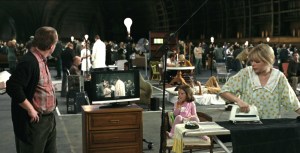 Kaufman’s movie is also funny, like really darkly funny and borderline absurdist to the point of being some strange lost work by Franz Kafka (Hazel even mentions she’s reading Kafka’s The Trial). You may be so caught up trying to render the complexities of the story to catch all of the humor. The movie exists in a surreal landscape, where the characters treat the fantastic practically as mundane. Hazel’s house is constantly on fire and yet none of the characters regard this as dangerous or out of the ordinary. It is just another factor of life. The entire subplot with Hope Davis as a hilariously incompetent therapist is deeply weird. Caden suffers some especially cruel Job-like exploits, particularly what befalls his estranged daughter, Olive. He’s obsessed with her hidden whereabouts and European upbringing, to the point that Caden cannot even remember the name of his other daughter he has with Claire. There is a deathbed scene between the two that is equally sad and twisted given the astounding behavior that Caden is forced to apologize for. There are running gags that eventually transform into metaphors, like Caden’s many different medical ailments and the unhelpful bureaucratic doctors who know nothing and refuse to divulge any info. Kaufman even has Emily Watson, an actress mistaken for Morton, play the character of “Hazel.”
This is Kaufman’s debut as a director and I think the movie ultimately benefits by giving its writer more control over the finished product. The movie is such a singular work of creativity that it helps by not having another director; there is no other artistic vision but Kaufman’s. While the film can feel slightly hermetic at times visually, Kaufman and cinematographer Frederick Elmes (The Ice Storm) pack the film with detail. Stylistically, the film is mannered but this is to make maximum impact for the vast amount of visual metaphors. Synecdoche, New York never feels as mannered as the recent Wes Anderson films, henpecked by a style that serves decoration rather than storytelling. The production design for the world-within-a-world is also alluring and imaginative, like a living, breathing dollhouse.
 The assorted actors do well with their quirky, flawed characters, but clearly Hoffman is the linchpin to the film. He plays a character from middle age to old age, and at every step Hoffman manages to infuse some level of empathy for a man routinely disappointed by his own life. The failed yet lingering and hopeful romance between Caden and Hazel provides an almost sweet undercurrent for a character obsessed with death. Hoffman is convincing at every moment, even as a hobbled 80-year-old man, and gives a performance steeped in sadness but with the occasional glimmer of hope, whether it be the ambition of his theater project or the dream of holding Hazel once more. Morton is also wonderfully kindhearted and endearing as the woman that just seems to keep slipping away from Caden.
There’s no other way to say it but Synecdoche, New York is a movie that you need to see multiple times to appreciate. The plot is so grandiose in scope and ambition that one sitting does not do it justice. Kaufman has forged a strikingly peculiar movie that manages to be surreal and bleakly comic while also being poignant and humane. This is a big movie with big statements that can be easily missed, but for those willing to dig into the wealth of metaphor and reflection, Synecdoche, New York is a rewarding film experience that sticks with you. By the end of this movie, Kaufman has earned the merging of metaphor and narrative. I have already seen the movie twice and still cannot get it out of my thoughts. This isn’t the kind of movie that you feel warm affection for, like Kaufman’s blissfully profound Eternal Sunshine of the Spotless Mind. This movie is less a confounding puzzle than an intellectually stimulating examination on art, the human experience, and, ultimately death. If people would rather kill brain cells watching whatever dreck Hollywood secretes every week (cough, Street Fighter: The Legend of Chun-Li, cough) then that’s their prerogative. Give me a Charlie Kaufman movie and a bottle of aspirin any day.
Nate’s Grade: A
Share this:

Reprise (2008)
 This very New Wave-styled Norwegian film manages to be thoughtful and intelligent, stylish without being vapid, touching, and it brilliantly captures the exuberance of youth on the cusp of adapting into maturity. Reprise follows two best friends and aspiring writers; Phillip finds success immediately but cannot handle it, and Erik must fight through rejections. Director/co-writer Joachim Trier (cousin to Lars) has given the film a hypnotic triptych narrative structure, meaning there are flashbacks, flash forwards, flashbacks within flashbacks, and the viewer is best advised to just succumb to the thrills of the narrative and sort it all out later. The structure made me feel totally immersed in the lives of this small unit of 20-somethings. You get a lifetime of detail thanks to the tangential narrative structure and the help of an occasional narrator. The film has a remarkably deft touch when it comes to crafting realistic characters; the pangs of uncertainty, jealousy, and insecurity all ring true without being trite or obvious. But the movie never gets dour or pretentious as it covers weighty topics. The movie also has an indelible energy that is hard to ignore. Reprise is playfully edited and constantly moving, sometimes forward, sometimes backwards, sometimes telling us a possible scenario that sounds better than reality. I found several small moments to be provocative, like Phillip trying to replicate the happy memories of time and place by trying to re-stage a photo of his girlfriend with his girlfriend (a lovely Viktoria Winge). Reprise is full of small tender moments that speak volumes. This is a terrific film brimming with life and verve and clearly targets Trier as an inspiring filmmaker to watch.
Nate’s Grade: A
Share this:

Speed Racer (2008)
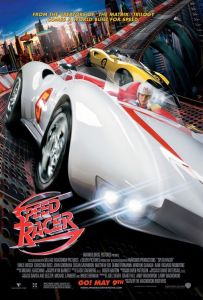 I was wary of this film from the first frame. I think the original Speed Racer cartoon is dopey and insipid. I didn’t really want to pay to have my retinas destroyed by the candy-coated color scheme of the big-budget movie. But I must say, I didn’t hate this movie and that’s a major accomplishment. That’s not to say Speed Racer is a good movie; its script is cheesy, the dialogue is silly, the comedy is dead on arrival, and many of the races end up becoming incoherent flashes of color and noise. But God help me, the Wachowskis have produced a unique movie experience that will likely induce epileptic seizures. Speed Racer has way too much plot going on for a cartoon about a kid who races a fast car. The movie reminds me in a lot of ways of the Wacky Races cartoon where the various teams have theme-driven cars. This provides for plenty of outlandish action sequences that manage to tickle the senses, that is, when the images are somewhat stable. The movie aspires to be a “family film” and with that comes the half-hearted moral message (corporations are evil) and a reminder that family is important. Did I mention there’s also a monkey that gets treated like a member of the family? The movie sometimes feels like the cinematic equivalent of an ice cream headache, but you’re unlikely to see anything like it again in the near future. That may be both a good and a bad thing.
Nate’s Grade: C+
Share this:

Be Kind, Rewind (2008)
 Be Kind, Rewind is a celebration of the love of movies and moviemaking, but it wants to shoot for a deeper message and stumbles. When the movie concentrates on remaking famous movies like Ghostbusters, Robocop, and Rush Hour 2, the movie has a ramshackle charm and great comedic spirit. When the film strays to tell a tale about community pride is when the movie gets dull and leaden. The concept of cheap, quick, homemade versions of Hollywood movies (the YouTube-ification if you will) is fun and Jack Black and Mos Def are definitely having fun in the process. But the movie has too many other elements that just don’t work together. The history of a local jazz legend feels awkward and bogs down the movie’s enjoyment. Director Michel Gondry can only do so much with his quirky visual sensibilities before you start to get bored. Be Kind, Rewind is occasionally entertaining and works best when it’s ripping off other movies than trying to stand on its own merits.
Nate’s Grade: C+


 nathanzoebl
You must be logged in to post a comment.