Blog Archives
Unfrosted (2024)
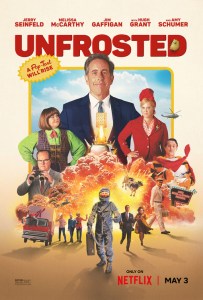 What to make of a movie like Netflix’s Unfrosted. It’s Jerry Seinfeld’s directorial debut, working off a screenplay he co-wrote, his first foray into film writing and acting since 2007’s Bee Movie. His eponymous sitcom “about nothing” was a 1990s mainstay and popularized an ironic meta form of comedy that still continues to dominate comedic tastes. Making a movie about the pseudo history of the invention of Pop Tarts, and the corporate rivalry between the major cereal brands, seems like a further exercise in that realm of humor, potentially satirizing a burgeoning sub-genre of late, the Biopic of Products (Air, Tetris, Flamin’ Hot, Blackberry). Except this supposed “biopic about nothing” is really a head-scratcher. Its humor feels pained and stale, the satire feels missing or glancing at best, and it seems like an expensive lark, wasting the nigh-infinite money of Netflix to purposely make a stupid comedy with all his friends.
Set in the mid 1960s, we follow two households, both alike in dignity, in fair Battle Creek, Michigan where we lay our scene. Kellogg’s has been the dominant cereal-brand for years but its chief rival, Post, is set to launch a new product that will revolutionize breakfast mornings. Bob (Seinfeld) is the head of development for Kellogg’s and reaches out to his old colleague, Donna (Melissa McCarthy), when it becomes evident that Post stole their unused research to develop a pastry treat designed to be cooked in one’s toaster. The warring CEOs, with Jim Gaffigan as Edsel Kellogg III and Amy Schumer as Marjorie Post, are desperate to one-up one another and be seen as more than an inheritor of their family’s wealth. It’s a race to see which company can get their treat to market first and capture the hearts, minds, and sweet teeth of America’s youth.
 I’d be lying if I said I didn’t laugh at points through Unfrosted, which operates like a spoof movie on a slower jokes-per-second pacing guide. There are zany sight gags amidst broadly drawn characters treating the silly straight, though occasionally you’ll have wisecrackers commenting on the inherent absurdity of moments, mostly confined to the stars making asides to the audience. Sometimes it’s lazy jokes that rely upon our foreknowledge, like when Bob coins a NASA beverage by saying it has a “real tang” (get it?). The movie frequently intensifies into goofy escalation when Kellogg’s impanels a team of mascots and inventors as a breakfast brain trust. Every one of these wacky characters is here to provide the exact same joke they will provide throughout the movie, and their inclusion is already suspect. Having the Schwinn bicycle guy (Jack McBrayer) comment on why he should be there is not enough. The hit-to-miss ratio will vary per everyone’s personal sense of humor, but overall I just felt mystified why this project would tempt Seinfeld from his comedy repose. What about this idea excited him? Was it just his lifelong love of cereal and Pop Tarts, a topic from his standup act decades ago? I ate a lot of cereal as a teenager too but I don’t want to make a movie about the Lucky Charms advertising campaign teaching children to beat and pillage the Irish (maybe Ken Loach could direct – to the three people on the Internet who appreciate this joke, I want you to know I appreciate you also).
It can be fun to simply watch dozens of famous people take their turns being silly in what is unquestionably a “dumb comedy.” When you have comedians of this quality in your movie, they’ll find ways to make even so-so jokes hit a little better, and that’s the case here. There’s an entertainment value in just wondering who will show up next, as many characters are only onscreen for a single scene or an abbreviated moment. Unfrosted becomes an example of Seinfeld’s industry power as he empties his Rolodex to fill even the tiniest of roles. Look, it’s James Marsden as Jack LaLanne. Look, it’s Bill Burr as JFK and Dean Norris as Kruschev (double Breaking Bad). Peter Dinklage as the head of the nefarious milkmen cartel? Why not? If you set your expectations low, maybe lower than what you were accounting for, there can be a mild amusement scene-to-scene just seeing who might show up next, almost like a modern-day version of those anarchic big ensemble comedies like It’s a Mad, Mad, Mad, Mad World.
 There is one segment that fell so flat for me that I was in utter amazement, and that was the unexpected January 6th insurrection parody. In a movie that has sustained a surreal and offbeat version of our universe, it evokes one of the most startling days of recent history. I think the humor is meant to derive from simply seeing a bunch of mascots in big colorful costumes as a mob running havoc, but there’s no jokes about like the challenges of a mascot costume in a fight, or say someone tipping over and being unable to get back up like a helpless turtle. There are jokes that can be had with this scenario, but instead Seinfeld is relying on the ironic juxtaposition of the ridiculous with the serious, and I don’t think it ever works as a joke. My sinking feeling began when Hugh Grant’s embittered mascot character wore a headdress resembling the QAnon shaman. It feels tacky and strange and the longer it persists the more I kept wondering what Seinfeld was doing with this. Why include this especially as the only form of relatively topical political humor, beyond, I guess, the depiction of business elites being complete morons? Why this? Again, it would be different if it was funny in execution, like the Saving Private Ryan D-Day parody from Sausage Party. This just isn’t funny, and its inclusion feels so odd compared to the stale nature of its other comedy.
As an admittedly silly enterprise, one that doesn’t even pretend to be accurate even as it flirts with the truth, Unfrosted is a successfully stupid comedy that feels a little too aimless, a little too edge-less and safe, and a little too dated and stale in its approach to comedy (lots of 1960s Boomer nostalgia ahoy). It’s hard to work up that much risible anger over a 90-minute movie that features a living ravioli creature. Clearly this movie wasn’t trying to be anything other than a gleefully stupid comedy, but I wanted more pep from its jokes and whimsy and general idiocy. I think the way to go may have been all the way in the other direction, treating the formation of a toaster pastry like international nuclear secrets and playing the corporate espionage completely straight while also making it patently ridiculous. Unfrosted did, however, make me want a Pop Tart that I ate afterwards, although it was my local grocery store’s generic brand, so I guess that doesn’t directly benefit Kellogg’s. This movie exists as a Seinfeld curiosity that ultimately left me hungry for more.
Nate’s Grade: C
Share this:

Late Night with the Devil (2024)/ Immaculate (2024)
 Late Nigh with the Devil is an intriguing novelty, a found footage item of 1970s late night talk show fame reportedly documenting the last show of Night Owls, a talk show hosted by a man who recently lost his wife to cancer and is also slipping in the ratings and losing his traction in the industry. So Jack Delroy (David Dastmalchian, best known as Polka Dot Man in 2021’s The Suicide Squad) gets the great idea to hold an exorcism live on stage or his big spooky Halloween show. What could go wrong, right? The movie is dedicated to upholding the style and awkward tone of 1970s talk show, and its commitment is by far its most interesting aspect to the found footage sub-genre. I wouldn’t classify the movie as necessarily scary, but it held my attention and I appreciated the corny little nuances of recreating an older form of television and comedy schtick, with a growing sense of foreboding as things start to get progressively worse and Jack pressures his new girlfriend, an occult writer, to bring out her possessed pupil. It takes a little long to get going, and the overall conspiracy of Jack’s connection to an Ilumminati-esque showbiz cult feels so tangential to be important, but I was objectively impressed with the overall recreation of an archaic form of TV. The conclusion, once all chaos is finally unleashed, breaks the rules of the found footage setup but at that point it’s welcomed and things can get a little more weird and visually audacious. Late Night with the Devil works more as a late-night curiosity than a boo-style horror thriller. I appreciated the committed efforts and artistry, as well as the game actors and some wicked gross-out makeup prosthetics, more than the overall movie.
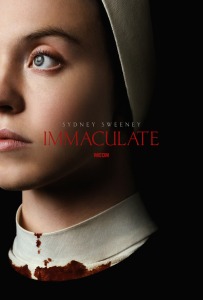 Nuns in Distress has long been a horror genre staple, as the mixture of Catholic imagery and overwrought religious themes proves an unbeatable mix with classic exploitation elements, the depraved and the sanctity. To this we have Immaculate with rising starlet Sydney Sweeney (HBO’s Euphoria) as an American nun traveling to a remote Italian convent and becoming an unwitting victim in a sinister ploy to gestate a new potential messiah. While very serious and broody in presentation, Immaculate is a pretty by-the-numbers mystery that goes to its most obvious route and becomes an overextended hostage thriller for Sweeney. The movie is at its best when it gets crazy, and that includes Sweeney, when she’s allowed to be all-out histrionic. For too long, the movie is too somber and simmering, which works best if the mystery is at least involving and surprising or we build to a great gonzo finish. I wish the movie was more wild. The ending is the best part of Immaculate, where Sweeney is pushed to the point of intense madness, while splattered in blood as per genre rules, and is forced to make extreme and personal choices. In that regard, perhaps Immaculate best operates on a metaphorical level about the horrors of pregnancy, more forced birth from oppressive leaders, and restricting women’s autonomy in a post-Roe v. Wade world. It’s a long wait to that worthwhile finale, and you might get restless from your unholy wait.
Nate’s Grades:
Late Night with the Devil: B-
Immaculate: C
Share this:

Indiana Jones and the Dial of Destiny (2023)

I held off watching Indiana Jones and the Dial of Destiny for almost half a year as I feared that this even longer-in-the-tooth Doctor Henry “Indy” Jones (Harrison Ford) would make me reassess the 2008 Kingdom of the Crystal Skull more favorably. Having re-watched the original trilogy, I can say that Dial of Destiny has made me reassess the much-maligned 2008 sequel. It’s still not good, and has many wide misses, but it’s also a more interesting movie to watch even in its myriad ways of disappointment. Maybe that’s the Steven Spielberg difference, a filmmaker so talented that even his rare cinematic follies have their own dynamic appeal. Dial of Destiny is a nostalgia slog, including the opening action caper with a de-aged Indy set in 1944 battling Nazis, just like we like. The action sequences lack the whimsy and satisfying scope and scale of the past, but everything here just feels on autopilot, including a gruff Ford as an Indy well past his prime in a world that has only gotten more complex. He’s given two lackluster sidekicks, neither of which are well integrated, and an old former Nazi (Mads Milkkelsen) who literally wants to find the ancient time travel device to go back to WWII and give Hitler notes. It all feels so deflated and absent the spirit and fun of the original movies, and it’s disappointing in a manner that is more bland and predictable than crazy and outlandish (nuking the fridge, killer ants, Tarzan swings, etc.). There’s an interesting kernel of a concept here, an archeologist possibly finding a skeleton in an ancient excavation that belongs to himself, and an ending that could have been ballsy and poetically fitting for the adventurer to become literally part of history. Alas, the one really exciting aspect of Dial of Destiny wimps out, settling for an ending that feels like another weak feint to the franchise’s storied past. I was so thoroughly disengaged by this movie throughout its 154 minutes. It is bereft of lasting charm and imagination and fun. At this point, with an 81-year-old Ford, I think it’s time to leave the character in a museum.
Nate’s Grade: C-
Share this:

Oppenheimer (2023)
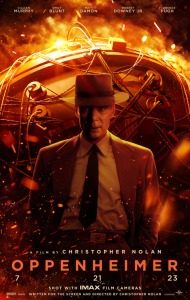 I finally did it. I watched all three hours of Christopher Nolan’s Oppenheimer, one half of the biggest movie-going event of 2023, and arguably the most smarty-pants movie to ever gross a billion dollars. It was a critical darling all year long, sailed through its awards season, and racked up seven Academy Awards including Best Picture and Best Director for Nolan, a coronation for one of Hollywood’s biggest artists whose name alone is each new project’s biggest selling point. I’ve had friends falling over themselves with rapturous praise, and I’m sure you have too, dear reader, so the danger becomes raising your expectations to a level that no movie could ever meet. As I watched all 180 lugubrious minutes of this somber contemplation of man’s hubris, I kept thinking, “All right, this is good, but is it all-time-amazing good?” I can’t fully board the Oppenheimer hype train, and while I respect the movie and its exceptional artistry, I also question some of the key creative decision-making that made this movie exactly what it is, bladder-busting length and all.
As per Nolan’s non-linear preferences, we’re bouncing back and forth between different timelines. The main story follows Robert Oppenheimer (Cillian Murphy) as an upstart theoretical physicist creating his own academic foothold and then being courted to join the Manhattan Project to beat the Nazis in the formation of a nuclear bomb. The other timeline concerns the Senate approval hearing for Lewis Strauss (Robert Downey Jr.), the former head of the Atomic Energy Commission (AEC) with a checkered history with Oppenheimer after the war. A third timeline, serving as a connecting point, involves Oppenheimer undergoing a closed-door questioning over the approval of his security clearance, which brings to light his life of choices and conundrums.
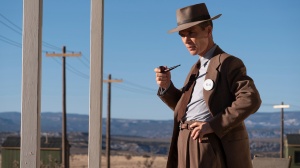 If I was going to be my most glib, I would characterize Oppenheimer in summary as, “Man creates bomb. Man is then sad.” There’s much more to it, obviously, and Nolan is at his most giddy when he’s diving into the heavy minutia of how the project came about, the many brilliant minds working in tandem, and sometimes in conflict, to usher in a new era of science and energy. Of course it also has radical implications for the world outside of academic theory. The world will never be the same because of Oppenheimer dramatically upgrading man’s self-destructive power. The accessible cautionary tale reminds me of a Patton Oswalt stand-up line: “We’re science: all about ‘coulda,’ no about ‘shoulda.’” Oh the folly of man and how it endures.
For the first two hours, the focus is the secretive Manhattan Project out in the New Mexico desert and its myriad logistical challenges, all with the urgency of being in a race with the Nazis who already have a head start (their break is Hitler’s antisemitism pushing out brilliant Jewish minds). That urgency to beat Hitler is a key motivator that allows many of the more hand-wringing members to absolve those pesky worries; Oppenheimer says their mission is to create the bomb and not to determine who or when it is used. That’s true, but it’s also convenient moral relativism, essentially saying America needs to do bad things so that the Germans don’t do worse things, a line of adversarial thinking that hasn’t gone away, only the name of the next competitor adjusts. This portion of the movie works because it adopts a similarly streamlined focus of smart people working together against a tight deadline. Looking at it as a problem needing to surmount allows for an engaging ensemble drama complete with satisfying steps toward solutions and breakthroughs. It makes you root for the all-star team and excitedly follow different elements relating to nuclear fusion and fission that you would have had no real bearing before Nolan’s intellectual epic. For those two galloping hours, the movie plays almost like a brainy heist team trying to pull together the ultimate job.
 It’s the time afterwards where Oppenheimer expands upon the lasting consequences where the movie finds its real meaning as well as loses me as a viewer. The legacy of the bomb is one that modern audiences are going to be readily familiar with 80 years after the events that precipitated their arrival, and they haven’t exactly been shelved or become the world war deterrent hoped for. As one of Oppenheimer’s physicists says, a big bomb only works until someone creates a bigger bomb, and then the arms race starts all over again fighting for incremental supremacy when it comes to whether one’s military might could destroy the world ten times or twelve times over. When Oppenheimer begins having reservations of what he has brought into this world is when his character starts becoming more dynamic, but it’s also too late. He can’t undo what he’s done, the world isn’t going back to a safer existence before nuclear arms, so his tears and fears come as short shrift. There’s a scene where Oppenheimer’s wife, Kitty (Emily Blunt), castigates him and says, “You don’t get to commit the sin and then make all of us to feel sorry for you when there are consequences.” Now this is in reference to a different personal failing of our protagonist, but the message resonates; however, I don’t know if this is Nolan’s grand takeaway. The movie in scope and ambition wants to set up this man as a tragic figure that gave birth to our modern world, but like President Truman says, it’s not about who created the bomb but who uses it. Oppenheimer is treated like a harbinger of regret, but I don’t think the story has enough to merit this examination, which is why Oppenheimer peters out after the bomb’s immediate aftermath.
It reminded me of an Oscar favorite from 2015, Adam McKay’s The Big Short, a true-ish account of real people profiting off the worldwide financial meltdown from 2008. It fools you into taking on the perspective of its main characters who present themselves as underdogs, keepers of a secret knowledge that they are trying to benefit from before an impending deadline. Likewise, the conclusion also makes you question whether you should have been rooting for this scheme all along since it was predicated on the economy crashing; these guys got their money but how many lives were irrevocably ruined to make their big score? With The Big Short, the movie-ness of its telling is part of McKay’s trickery, to ingratiate you in this clandestine financial world and to treat it like a heist or a con, and then to reckon whether you should have ever been rooting for such an adventure. Oppenheimer has a similar effect, lulling you with its admitted entertainment factor and beat-the-deadline structure. Once the mission is over, once the heroes have “won,” now the game doesn’t seem as fun or as justifiable. Except Oppenheimer could have achieved this effect with a judicious resolution rather than an entire third hour of movie shuffled throughout the other two like a mismatched deck of cards.
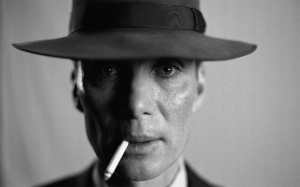 The last hour of the movie features a security clearance interrogation and a Senate confirmation hearing, neither of which have appealing stakes for an audience. After we watch the creation of a bomb, do we really care whether or not this one testy guy gets approved for a cabinet-level position or whether Oppenheimer might get his security clearance back? I understand that these stakes are meaningful for the characters, both essentially on trial for their lives and connections, but Nolan hasn’t made them as necessary for the audience. They’re really systems for exposition and re-examination, to play around with time like it was having a conversation with itself. It’s a neat effect when juggled smoothly, like when Past Oppenheimer is being interviewed by a steely and suspicious military intelligence office (Casey Affleck) while Future Oppenheimer laments to his project superior (Matt Damon) and then Even More Future Oppenheimer regrets his lack of candor to the review board. The shifty wheels-within-wheels nature of it all can be astounding when it’s all firing in alignment, but it can also feel like Nolan having a one-sided conversation with himself too often. It’s another reminder of the layers of narrative trickery and obfuscation that have become staples of a Christopher Nolan movie (I don’t think he could tell a knock-knock joke without making it at least nonlinear). The opposition to Oppenheimer is summarized by Strauss but I would argue the man didn’t need a public witch hunt to rectify what he’s done.
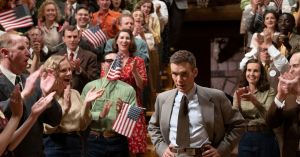
Lest I sound too harsh on Nolan’s latest, there are some virtuoso sequences that are spellbinding with technical artists working to their highest degree of artistry. The speech Oppenheimer gives to his Los Alamos colleagues is a horrifying lurch into a jingoistic pep rally, like he’s the big game coach trying to rally the team. The way the thundering stomps on the bleachers echo the rhythms of a locomotive in motion, driving forward at an alarming rate of acceleration, and then how Nolan drops the background sound so all we hear is Oppenheimer’s disoriented speech while the boisterous applause is muted, it’s all masterful to play with our sense of dread and remorse. This is who this man has become, and his good intentions of scientific discovery will be rendered into easily transmutable us-versus-them fear mongering politics. The ending imagery of Oppenheimer envisioning the world on fire is the exact right ending and hits with the full disquieting force of those three hours. The meeting with Harry Truman (Gary Oldman) is splendid for how undercutting it plays. Kitty’s interview at the hearing is the kind of counter-punching we’ve been waiting for and is an appreciated payoff for an otherwise underwritten character stuck in the Concerned Wife Back at Home role. The best parts are when Oppenheimer and Leslie Groves (Damon) are working in tandem to put together their team and location, as that’s when the movie feels like a well orchestrated buddy movie I didn’t know I wanted. The sterling cinematography, musical score, editing, all of the technical achievements, many of which won Oscars, are sumptuously glorious and immeasurably add to Nolan’s big screen vision.
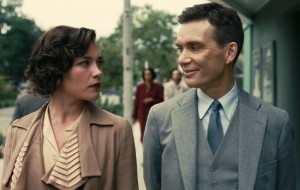 I think I may understand why the subject of sex is something Nolan has conspicuously avoided before. Much has been made about the sex scenes and nudity in Oppenheimer, which seem to be the crux of Florence Pugh’s performance as Jean Tatlock, Oppenheimer’s communist mistress through the years. The moment of Oppenheimer sitting during his hearing about his sexual tryst with an avowed communist leads to him imagining himself in the nude, exposed and vulnerable to these prying eyes and their judgment. Then Kitty imagines seeing Pugh atop her husband in his hearing seat, staring directly at her, and this sequence communicated both of their internal states well and felt justified. It’s the origin of the famous “I am become death” quote where the movie enters an unexpected level of cringe for a movie this serious. I was not prepared for this, so mild spoilers ahead if you care about such things, curious reader. We’re dropped into a sex scene between Oppenheimer and Jean where she takes a break to peruse his library shelves. She’s impressed that he has a Hindu text and pins it against her naked chest and slides atop Oppenheimer once again, requesting he read it to her rather than summarize it. “I am become death,” he utters, as he reads the Hindu Book of the Dead off Pugh’s breasts while they continue to have sex. Yikes. A big ball of yikes. If this is what’s in store, please go back to a sexless universe of men haunted by their lost women.
It’s easy to be swept away by all the ambition of Nolan’s Oppenheimer, a Great Man of History biopic that I think could have been better by being more judiciously critical of its subject. It’s a thoroughly well-acted movie where part of the fun is seeing known and lesser known name actors populate what would have been, like, Crew Member #8 roles for the sake of being part of this movie (Rami Malek as glorified clipboard-holder). Oppenheimer takes some wild swings, many of them paying off tremendously and also a few that made me scratch my head or reel back. It’s a demonstrably good movie with top-level craft, but I can’t quite shake my misgivings that enough of the movie could have been lost to history as well.
Nate’s Grade: B
Share this:

Drive-Away Dolls (2024)
 Drive-Away Dolls is an interesting curiosity, not just for what it is but also for what it is not. It’s the first movie directed solo by Ethan Coen, best known as one half of the prolific filmmaking Coen Brothers, who have ushered in weird and vibrant masterpieces across several genres. After 2018’s The Ballad of Buster Scruggs, their last collaboration, the brothers decided to set out on their own for an unspecified amount of time. This led Joel Coen to direct 2021’s atmospheric adaptation of Macbeth, and now Ethan has decided that the fictional movie he really wants to make, unshackled by his brother, is a crass lesbian exploitation sex comedy. Well all right then.
Set in 1999 for some reason, Jamie (Margaret Qualley) is an out lesbian who unabashedly seeks out her own pleasures, even if it brings about the end of her personal relationships. Her friend, Marian (Geraldine Viswanathan), hasn’t had a lover in over three years and is much more prim and proper. Together, these gal pals decide to drive to Tallahassee, Florida using a drive-away service, where they will be paid to drive one way, transporting a used car. It just so happens that these women have mistakenly been given the wrong car, a vehicle intended for a group of criminals transporting contraband that they don’t want exposed. Jamie is determined to get laid and help Marian get laid all the while goons (Joey Slotnick, C.J. Wilson) are trailing behind to nab the ladies before they discover the valuable contents inside the trunk of their car.
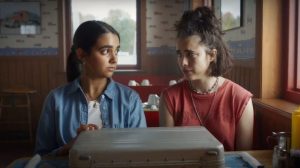 Drive-Away Dolls is clearly an homage to campy 1970s exploitation B-movies but without much more ambition than making a loosey-goosey vulgar comedy consumed by the primal pursuit of sexual pleasure. I was genuinely surprised just how radiantly horny this movie comes across, with every scene built in some way upon women kissing, women having sex, women talking about having sex, women pleasuring themselves, women talking about pleasuring themselves, and women talking about pleasuring other women. When I mean every scene I mean virtually every scene in this movie, as the thinnest wisp of a road trip plot is barely holding together these scenes. From a representational standpoint, why shouldn’t lesbians have a raunchy sex comedy that is so open about these topics and demonstrates them without shame? Except it feels like the crude subject matter is doing all the heavy lifting to make up for the creative shortcomings elsewhere in the movie, which, sadly there are many. The script is co-written by Coen and his wife of many years, Tricia Cooke, an out lesbian, so it feels like the intent is to normalize sex comedy tropes for queer women, but the whole movie still feels overwhelming in the male gaze in its depictions of feminine sexuality. I’m all for a sex-positive lesbian road trip adventure, but much of the script hinges upon the uptight one learning to love sex, which means much of the story is dependent upon the promiscuous one trying to then bed her longtime friend and get her off. Rather than feel like some inevitability, the natural conclusion of a friendship that always had a little something more under the surface, it feels more like a horny and calculated math equation (“If you have two gay female leads, you can get them both kissing women by having them kiss each other”).
I’m sad to report that Drive-Away Dolls is aggressively unfunny and yet it tries so hard. It’s the kind of manic, desperate energy of an improv performer following an impulse that was a mistake but you are now watching the careening descent into awkward cringe and helpless to stop. The movie is so committed to its hyper-sexual goofball cartoon of a world, but rarely does any of it come across as funny or diverting. When Jamie’s ex-girlfriend Suki (Beanie Feldstein) is trying to remove a dildo drilled onto her wall, she screams in tears, “I’m not keeping it if we both aren’t going to use it.” The visual alone, an ex in tears removing all the sexual accoutrements of her previous relationship, some of which can be widely over-the-top, could be funny itself. However, when her reasoning is that we both can’t use this any longer, then the line serves less as a joke and more a visual cue for the audience to think about both of them taking turns. It doesn’t so much work at being funny first and rather as a horny reminder of women being sexual together. The same with a college soccer team’s sleepover that literally involves a basement make-out party with a timer going off and swapping partners. It’s not ever funny but features plenty of women making out with one another to satisfy some audience urges. I will admit it serves a plot purpose of first aligning Jamie and Marian into awkwardly kissing one another, thus sparking carnal stirrings within them.
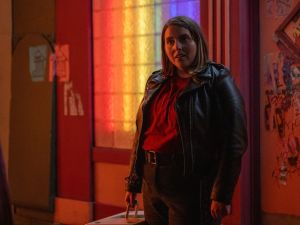 My nagging issue with the movie’s emphasis is not a puritanical response to vulgar comedy but that this movie lacks a necessary cleverness. It doesn’t really even work as dumb comedy, although there are moments that come close, like the absurd multiple-corkscrew murder that opens the movie. It’s just kind of exaggerated nonsense without having the finesse to steer this hyper-sexual world of comedy oddballs. The crime elements clash with the low-stakes comedy noodling of our leads bumbling their way through situation after situation that invariably leads to one of them undressing or inserting something somewhere. The brazen empowerment of women seeking out pleasure is a fine starting point for the movie, but the characters are too weakly written as an Odd Couple match that meets in the middle, the uptight one learning to loosen up and the irresponsible one learning to be less selfish. The goons chasing them are a pale imitation of other famous Coen tough guys; they lack funny personality quirks to broaden them out. There’s a conspiracy exposing political hypocrites condemning the “gay agenda,” and I wish more of this was satirized rather than a briefcase full of reportedly famous phalluses. If you got a briefcase full of famous appendages, I was expecting more jokes than blunt objects.
I feel for the actors, so eager to be part of a Coen movie, even if it’s only one of them and even if it’s something much much lesser. Qualley (Once Upon a Time… in Hollywood) is a typical Coen cartoon of a character, complete with peculiar accent and syntax. She’s going for broke with this performance but the material, time and again, requires so little other than being exaggerated and horny. There is one scene where her physical movements are so broad, so heightened to the point of strain, that I felt an outpouring of pity for her. It feels like a performance of sheer energetic force lacking proper direction. Viswanathan has been so good in other comedies and she’s given so little to do here other than playing the straight women (no pun intended) to Qualley’s twangy cartoon. Her portrayal of sexual coming of age and empowerment was better realized, and funnier, in 2018’s Blockers, a superior sex-positive sex comedy.
 As a solo filmmaker, Ethan Coen seems to confirm that his brother is more the visual stylist of the duo. The movie is awash in neon colors and tight closeups of bug eyes and twangy accents, but the most annoying stylistic feature, by far, is the repeated psychedelic transition shots, these trippy interstitials that don’t really jibe with anything on screen. It felt like padding for an already stretched-thin movie that can barely reach 75 minutes before the end credits kick in. That’s why the extended sequences where the intention seems exploitation elements first and comedy second, or third, or not at all, makes the whole enterprise feel like a pervy curiosity that has its empowering yet obvious message of “girls do it too” as cover. Agreed, but maybe do more with the material beyond showcasing it. Ethan Coen is a prolific writer who has written short story collections (I own his 1998 book Gates of Eden), poetry collections, and he even wrote five one-act plays before the pandemic struck in 2020. I’d love to see those plays. This man has true talent but it’s just not obviously present throughout this film.
Drive-Away Dolls is an irreverent sex comedy with good intentions and bad ideas, or good ideas and bad intentions, an exploitation picture meant to serve as empowerment but still presents its world as exploitation first and last. It’s just not a funny movie, and it’s barely enough to cover a full feature. I suppose one could celebrate its mere existence as an affront to those puritanical forces trying to oppress feminine sexuality, but then you could say the same thing about those 1970s women-in-prison exploitation pictures. It’s a strange movie experience, achingly unfunny, overly mannered, and makes you long for the day that the two Coens will reunite and prove that the two men are better as a united creative force; that’s right, two Coens are better than one.
Nate’s Grade: C-
Share this:

Killers of the Flower Moon (2023)
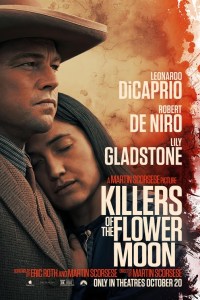
Killers of the Flower Moon has the banner of an Important Movie, telling a story many history books have overlooked for too long, an American tragedy built upon one of America’s original sins with the indigenous peoples, and tying a direct line to not only how we live now as well as how we choose to remember the past. The true story behind the murder of the Osage Nation natives in the 1920s is an urgent story that gets to the heart of greed and the human capacity for evil, and Martin Scorsese’s three-and-a-half-hour movie is somber and mournful and appropriately devastating. But I’m also wondering why I wasn’t as enchanted with it as a movie-going experience. Should I feel movie critic guilt for finding the movie merely good but not transcendentally great?
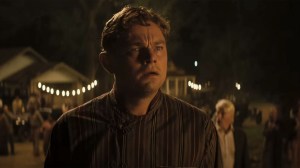
The whole of Killers of the Flower Moon is bleak, which is naturally much of the point. It’s difficult to retell the history of Native Americans in this country, or before there was a “this country,” without making use of lots of synonyms for the word “bleak.” The first hour presents the Native Americans as being legally incapable of greater agency; the murders are consistent, sloppy, and obvious, but the fact that no investigation was triggered for years in an acknowledgement that, simply put, the government just didn’t care about dead Indians. Oh, I hear you saying, but weren’t these Osage different? They had so much money from their oil rights that the local economy exploded with vultures offering common services for egregiously inflated prices to take advantage of people unaccustomed to having money and options. Even with a surge of riches, the Osage didn’t have an elevation in status. They were still looked upon as interlopers in the way of powerful white men getting that money, and there’s nothing these greedy people won’t do to get that money, especially with a system of justice of little accountability for dead minorities. One of the more galling scenes is when the town coroners are questioned over their unusual protocols, like chopping a corpse into tiny pieces so it could not be re-examined by other professionals. The whole town is in on this vile scheme, every doting neighbor can be guilty through complicity or complacency. Death after death, they all know what’s really going on; it’s plain as day, but nobody outside of the Osage feels the burning outrage, and that’s the point of the first half of the movie, to give the audience the same sense of anger and futility.
The majority of the lengthy movie follows our villains plotting their very obvious conspiracy, with Leonardo DiCaprio badly clenching his jaw in every scene as Ernest Burkhart, a WWI-veteran who comes home, becomes a cabbie, and marries Mollie (Lily Gladstone), one of the rich local Osage women. The question for the rest of the movie is whether or not his love for her is genuine or perhaps she is just a means to an end. He’s the lead of the movie and a total dope, a man who unironically proclaims repeatedly, “I love me some money!” Seems hard to read this guy, right? He’s an idiot, and again this might be the point, that this sort of small-thinking man could be the hinge on this entire conspiracy, which results in a lot of Mollie’s family members dying under increasingly mysterious circumstances to consolidate their inheritance. It’s a frustrating and spiritually exhausting experience to watch all these poor characters get murdered, again, so casually and transparently. One of them is staged as a would-be suicide except he’s shot through the back of the head and the gun wasn’t left at the scene. Eventually, the FBI does finally (finally!) arrive in town at the two-hour mark, but by then, I’ve been watching two hours of people dying without a legal stir.

This perspective is best embodied through Mollie, beautifully played by Gladstone (Certain Women, First Cow). When we first meet her, she’s a forward woman who can assert herself and what she wants. Then it all goes downhill after marrying Ernest. She loses damn near every family member she has and is forced to rely upon her husband for support, the same idiot bungling his way through arranging the deaths of her family members. She’s a personal stand-in for the Osage Nation as a whole, as we watch what they have whittled down and bled dry, watching the weight of all this suffering deteriorate their spirits and dignity. This is Mollie, our avatar for tragedy. She’s literally bedridden for a solid hour, and I dearly missed Gladstone’s presence. Since we’ve been aware of the bad deeds of the bad men from the start, much of Killers of the Flower Moon becomes a waiting game of when Mollie is hopefully going to wise up or at least suspect what is happening to her and her family. When will she see Ernest as a more nefarious force in her life, the kind of person you don’t want to solely trust with the responsibility of delivering your life-saving intravenous medicine. It adds to the overall frustrations of watching. Gladstone’s performance rises above whatever limitations her character is stricken with. First off, it’s a powerful performance of immense sorrow; having to watch her pained reaction to overhearing her sister’s skull sawed open for a disrespectful public autopsy is just sickening. The movie lives off this woman’s response to unfathomable trauma on repeat. When she is bedridden and lost in a medical fog, she still manages to communicate her wariness and suspicion through these extra layers of obfuscation.
Robert DeNiro, appearing in his eleventh Scorsese movie, is terrifying as a kindly cattle baron who fashions himself as the best friend of the Osage, preferring to refer to them by their indigenous names and warmly speaking their language. He’s also a monster, a stand-in for American big business and the blood-stained hands of capitalism without morals and oversight. The dramatic core of the movie, besides how far will this go before consequences will at long last germinate, is how can such self-styled men of God commit such heinous acts? How can people justify and equivocate over their own cruel crimes? This question is epitomized in Ernest and his direct connection to Mollie, but it’s also epitomized through DeNiro’s character, William Hale. We have two characters fulfilling the same thematic purpose, which might be the point, but it makes for a redundant narrative experience. DeNiro’s character is so much more interesting than Ernest too, with the full cognitive dissonance of being an avowed man of the people and true ally to the Osage while he’s plotting their demise. DeNiro holds to this homespun, Foghorn Leghorn accent throughout, and I can’t recall him ever raising his voice. It’s a performance where the lasting terror comes through its friendly disconnect. It’s a more impressive performance than watching DiCaprio grimace and mumble through three and a half hours.

Some chastise Killers of the Flower Moon for choosing to tell its story from the perspective of its white perpetrators. I understand from a narrative standpoint and an overall larger thematic point why this was done. Scorsese clearly thinks of his own limits of being the one to tell this story, appearing as a cameo in the coda to provide commentary on how the American morbid desire for true crime and historical atrocities will lead to yesterday’s outrages becoming today’s distilled and de-contextualized “content.” The problem is the movie already feels frustrating as is while we wait for there to finally be some accounting for the ongoing injustices, and centering the entire perspective on only the Osage would magnify this frustration with even less elucidation on the depths of what was happening. Scorsese strips away a lot of the stylistic flourishes and even the electric pacing and editing that we come to expect from his filmography. This is a slow, ponderous movie. It’s meant to provoke outrage. It’s also designed to frustrate, and I suppose I can admire that while also impatiently shifting in my seat and wondering how many of these 206 minutes could have been lost. I feel like a philistine for looking at a $200-million Scorsese movie, while this man is in the late stages of his career and clearly thinking of this reality, and asking, “Hey, can you give me maybe less movie?”
If you haven’t noticed, dear reader, I am a critic in conflict. Killers of the Flower Moon has fantastic production values, strong acting, and the importance of staging history as it was rather than how it may be remembered, especially over events long ignored by history. I even admire the choices that are deliberate that make the movie feel less like easily consumed entertainment. It’s a movie that I feel compelled to see a second time before I settle on my eventual rating (a seven-hour commitment). It’s a sad movie, a bleak movie, a challenging movie, a meaningful movie, and an Important Movie about Important Things. It’s also long, frustrating in structure and execution, and occasionally redundant with its characterization and plotting, giving the impression that things have been stretched beyond breaking. Again, maybe that’s the larger thematic point, but then again I might just be stuck in a rabbit hole of excuses to find some justification for my less-than-ecstatic reaction to Killers of the Flower Moon, a movie of strident artistic vision that can also feel like you’re eating your vegetables for three nonplussed hours.
Nate’s Grade: B
Share this:

Eileen (2023)
 Based upon the novel of the same name, and adapted by the novelist and her husband, Eileen is an affectingly broody unrequited romance awash in noir trappings and feelings. It’s set in a prison facility in 1960s Boston, and one young worker Eileen (Thomasin McKenzie) becomes enraptured with her new co-worker Rebecca, a psychologist with an exceptional sense of confidence and hunger, played by Anne Hathaway. For a solid hour, the movie becomes something akin to 2015’s Carol, a lesbian romance where the social norms of the time force both participants to speak in codes and glances and gestures. Eileen is given to flurries of intense daydreams, often sexual, and sees a fellow creature in Rebecca, who doesn’t so much as walk through rooms as slinks, doesn’t so much as stare but smolders. Hathaway is in full-on femme fatale seduction mode here and enjoying it. It is following along this path of possible mutual connection, of finally acting upon these hidden desires, and then the movie takes a SHARP LEFT TURN and stays there for the rest of the duration. The twist works, and forces the audience to reconsider our notions of obsession and perspective, but it also feels like we’ve abandoned the prior movie into this new even pulpier, slightly more manic movie, and I don’t know if I wanted to leave so suddenly. If this twist were to stand, I think it needed to be introduced sooner, especially if it obliterates the prior dramatic work, and allow more time to deal with its myriad consequences. There is a powerfully gripping and deeply devastating monologue by Marin Ireland that might be the best part of the movie. Eileen the movie is a little like Eileen the character, gliding on appearances and secretly something much darker at its core.
Nate’s Grade: B-
Share this:

The Boy and the Heron (2023)
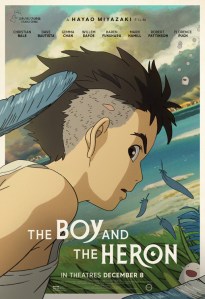 It’s been over ten years since renowned animation legend Hiyao Miyazaki graced the silver screen with what was believed to be his last film yet the retirement didn’t kick, for the benefit of all of us. I’ve resisted watching 2013’s The Wind Rises simply because of the melancholy of it supposedly being his final film. The man is in his 80s and still hand draws much of his storyboards, so if indeed this is the last Miyazaki movie we ever get, it ties thematically with many of the concepts and interests of this man’s storied career that it feels like a fitting capper. It’s his most autobiographical, following 12-year-old Mahito as he relocates to the country after surviving the firebombing of Tokyo during World War II. Unfortunately, he lost his mother in the bombing, and now his father is remarrying his mother’s younger sister, who looks near identical to Mahito’s mother. On the grounds of his new home, the boy discovers a strange overgrown tower with a door that leads to another world, and it’s within this world that a creepy scary bird promises Mohito can find his mother again. The Boy and the Heron is an imaginative and transporting fantasy with some major themes around the edges about grief and acceptance and environmental disaster, but it’s the haphazard structure and poor pacing that hold it back for me. Simply, it’s too long to get going and then too short to conclude. We don’t exit to the hidden fantasy world until almost halfway through, and the time in the regular world is stretched out, especially without going into further detail about our protagonist, who is kept very opaque. The discovery of the new world and learning its strange mostly bird creatures and rules and conflicts is where the movie really gets interesting, especially once the menacing heron becomes a squat man serving as our reluctant guide. It feels like there’s going to be some heavy revelations forthcoming, especially with the supposed duplicate nature of Mohito’s mothers, but it all comes down to an aged Man Behind the Curtain with a reveal straight out of Willy Wonka and the Chocolate Factory. We take too long to get to that intriguing fantasy world, and then once we’re there it feels a little too surface-level in design for a world on the cusp of dying. Then it’s a mad scramble to leave, and while the culminating decision feels earned in its wisdom, it also feels like the movie has simply run out of ideas. The Boy and the Heron is beautifully animated; the world feels like it’s undulating before your eyes, and there are numerous moments that allow it to breathe. However, it feels like maybe we could have gotten started sooner and finished a little later. Even mid-level Miyazaki is better than most, so The Boy and the Heron is still a worthwhile animated fantasy even if it doesn’t reach masterpiece status from a master storyteller. At least now I can finally watch The Wind Rises, so there’s that too.
Nate’s Grade: B
Share this:

Cold Mountain (2003) [Review Re-View]

Originally released December 25, 2003:
Premise: At the end of the Civil War, Inman (Jude Law, scruffy) deserts the Confederate lines to journey back home to Ada (Nicole Kidman), the love of his life he’s spent a combined 10 minutes with.
Results: Terribly uneven, Cold Mountain‘s drama is shackled by a love story that doesn’t register the faintest of heartbeats. Kidman is wildly miscast, as she was in The Human Stain, and her beauty betrays her character. She also can’t really do a Southern accent to save her life (I’m starting to believe the only accent she can do is faux British). Law’s ever-changing beard is even more interesting than her prissy character. Renee Zellweger, as a no-nonsense Ma Clampett get-your-hands-dirty type, is a breath of fresh air in an overly stuffy film; however, her acting is quite transparent in an, “Aw sucks, give me one ‘dem Oscars, ya’ll” way.
Nate’’s Grade: C
——————————————————
WRITER REFLECTIONS 20 YEARS LATER

I kept meaning to come back to Cold Mountain, a prototypical awards bait kind of movie that never really materialized, but one woman ensured that it would be on my re-watch list for 2003. My wife’s good friend, Abby, was eager to hear my initial thoughts on the movie when I wrote my original review at the age of twenty-one. This is because Cold Mountain is a movie that has stayed with her for the very fact that her grandfather took her to see it when she was only nine years old. While watching, it dawned on nine-year-old Abby that this was not a movie for nine-year-olds, and it’s stuck with her ever since. I think many of us can relate to watching a movie with our parents or family members that unexpectedly made us uncomfortable. For me, it was Species, where I was 13 years old and the movie was about a lady alien trying to procreate. I think my father was happy that I had reached an acceptable age to go see more R-rated movies in theaters. Social media has been awash lately with videos of festive families reacting to the shock value of Saltburn with grumbles and comical discomfort (my advice: don’t watch that movie with your parents). So, Abby, this review is for you, but it’s also, in spirit, for all the Abbys out there accidentally exposed to the adult world uncomfortably in the company of one’s parents or extended family.
Cold Mountain succumbs to the adaptation process of trying to squeeze author Charles Frazier’s 1997 book of the same name into a functional movie structure, but the results, even at 150 minutes, are unwieldy and episodic, arguing for the sake of a wider canvas to do better justice to all the themes and people and minor stories that Frazier had in mind. Director Anthony Minghella’s adaptation hops from protagonist to protagonist, from Inman to Ada, like perspectives for chapters, but there are entirely too many chapters to make this movie feel more like a highly diluted miniseries scrambling to fit all its intended story beats and people into an awards-acceptable running time. This is a star-studded movie, the appeal likely being working with an Oscar-winning filmmaker (1996’s The English Patient) of sweep and scope and with such highly regarded source material, a National Book Award winner. The entire description of Cold Mountain, on paper, sounds like a surefire Oscar smash for Harvey Weisntein to crow over. Yet it was nominated for seven Academy Awards but not Best Picture, and it only eventually won a single Oscar, deservedly for Renee Zellweger. I think the rather muted response to this Oscar bait movie, and its blip in a lasting cultural legacy, is chiefly at how almost comically episodic the entire enterprise feels. This isn’t a bad movie by any means, and quite often a stirring one, but it’s also proof that Cold Mountain could have made a really great miniseries.

The leading story follows a disillusioned Confederate defector, Inman (Jude Law), desperately trying to get back home to reunite with his sworn sweetheart, Ada (Nicole Kidman), who is struggling mightily to maintain her family’s farm after the death of her father. That’s our framework, establishing Inman as a Civil War version of Odysseus fighting against the fates to return home. Along the way he surely encounters a lot of famous faces and they include, deep breath here, Phillip Seymour Hoffman, Natalie Portman, Giovanni Ribisi, Cillian Murphy, Eileen Atkins, Taryn Manning, Melora Walters, Lucas Black, and Jena Malone. Then on Ada’s side of things we have Zellweger, Donald Sutherland, a villainous Ray Winstone, Brendan Gleeson, Charlie Hunam, Kathy Baker, Ethan Suplee, musician Jack White, and Emily Descehanel, and this is the storyline that stays put in the community of Cold Mountain, North Carolina.
That is a mountain of stars, and with only 150 minutes, the uneven results can feel like one of those big shambling movies from the 1950s that have dozens of famous actors step on and as quickly step off the ride. Poor Jena Malone (Rebel Moon) appears as a ferry lady and literally within seconds of offering to prostitute herself she is shot dead and falls into the river (well, thanks for stopping by Jena Malone, please enjoy your parting gift of this handsome check from Miramax). Reducing these actors and the characters they are playing down to their essence means we get, at most, maybe 10-15 minutes with them and storylines that could have been explored in richer detail. Take Portman’s character, a widowed mother with a baby trying to eke out a living, one of many such fates when life had to continue after the men ran to war for misbegotten glory. She looks at Inman with desperate hunger, but it’s not exactly lust, it’s more human connection. When she requests that Inman share her bed, it’s just to feel another warm presence beside her, someone that can hold her while she weeps about the doomed fate of her husband and likely herself. There’s a strong character here but she’s only one stop on our expedited tour. The same with Hoffman’s hedonistic priest, a man introduced by throwing the body of a slave woman he impregnated over a ridge, which might be the darkest incidental moment of the whole movie. His character is played as comic relief, a loquacious man of God who cannot resist the pleasures of the flesh, but even he comes and goes like the rest of our litany of very special guest stars. They feel more like ideas than characters.

This is a shame because there are some fantastic scenes and moments that elevate Cold Mountain. The opening Civil War battle is an interesting and largely forgotten (sorry Civil War buffs) battle that begins with a massive surprise attack that produces a colossal explosion and crater and turns into a hellish nightmare. Granted, the movie wants us to sympathize with the Confederates who were bamboozled by the Yankee explosives buried under their lines, and no thank you. The demise of Hoffman’s character comes when he and Inman are captured and join a chain gang, and they try running up a hill to get free from approaching Union troops. The Confederates shoot at the fleeing men, eventually only with Inman left, who struggles to move forward with the weight of all these dead men attached to him. When they start rolling down the hill, it becomes a deeply macabre and symbolic struggle. The stretch with Portman (May December) is tender until it goes into histrionics, with her literal baby being threatened out in the cold by a trio of desperate and starving Union soldiers (one of which played by Cillian Murphy). It’s a harrowing scene that reminds us about the sad degradation of war that entangles many innocents and always spills over from its desired targets. However, this theme that the war and what it wrought is sheer misery is one Minghella goes to again and again, but without better characterization with more time for nuance, it feels like each character and moment is meant to serve as another supporting detail in an already well-proven thesis of “war is hell.”
Even though I had previously watched the movie back in 2003, I was hoping that after two hours of striving to reunite, that Inman and Ada would finally get together and realize, “Oh, we don’t actually like each other that much,” that their romance was more a quick infatuation before the war, that both had overly romanticized this beginning and projected much more onto it from the years apart, and now that they were back together with the actual person, not their idealized imaginative version, they realized what little they had in common or knew about each other. It would have been a well-played subversion, but it also would have been a welcomed shakeup to the Oscar-bait romantic drama of history. Surely this had to be an inconvenient reality for many, especially considering that the men returning from war, the few that did, were often not the same foolhardy young men who leapt for battle.
Zellweger (Judy) was nominated for Best Actress in the preceding two years, for 2001’s Bridget Jones Diary and 2002’s Chicago, which likely greased the runway for her Supporting Actress win from Cold Mountain. There is little subtlety about her “aw shucks” homespun performance but by the time she shows up, almost fifty minutes into the movie, she is such a brash and sassy relief that I doubt anyone would care. She’s the savior of the Cold Mountain farm, and she’s also the savior of the flagging Ada storyline. Pity Ada who was raised to be a nice dutiful wife and eventual mother but never taught practical life skills and agricultural methods. Still, watching this woman fail at farming will only hold your attention for so long. Zellweger is a hoot and the spitfire of the movie, and she even has a nicely rewarding reconciliation with her besotted old man, played by Brendan Gleeson, doing his own fiddlin’ as an accomplished violin player. As good as Zellweger is in this movie is exactly how equally bad Kidman’s performance is. Her Southern accent is woeful and she cannot help but feel adrift, but maybe that’s just her channeling Ada’s beleaguered plight.

I think there’s an extra layer of entertainment if you view Inman’s journey in league with Odysseus; there’s the dinner that ends up being a trap, the line of suitors trying to steal Ada’s home and hand in the form of the duplicitous Home League boys, Hoffman’s character feels like a lotus eater of the first order, and I suppose one reading could have Portman’s character as the lovesick Calypso. Also, apparently Cold Mountain was turned into an opera in 2015 from the Sante Fe Opera company. You can listen here but I’m not going to pretend I know the difference between good and bad opera. It’s all just forceful shouting to my clumsy ears.
Miramax spent $80 million on Cold Mountain, its most expensive movie until the very next year with 2004’s The Aviator. Miramax was sold in 2010 and had years earlier ceased to be the little studio that roared so mighty during many awards seasons. I think Cold Mountain wasn’t the nail in the coffin for the company but a sign of things to come, the chase for more Oscars and increasingly surging budgets lead the independent film distributor astray from its original mission of being an alternative to the major studio system. Around the turn of the twenty-first century, it had simply become another studio operating from the same playbook. Minghella spent three years bringing Cold Mountain to the big screen, including a full year editing, and only directed one other movie afterwards, 2006’s Breaking and Entering, a middling drama that was his third straight collaboration with Law. Minghella died in 2008 at the still too young age of 54. He never lived to fully appreciate the real legacy of Cold Mountain: making Abby and her grandfather uncomfortable in a theater. If it’s any consolation to you, Abby, I almost engineered my own moment trying to re-watch this movie and having to pause more than once during the sex scene because my two children wanted to keep intruding into the room. At least I had the luxury of a pause button.
Re-View Grade: B-
Share this:

Napoleon (2023)
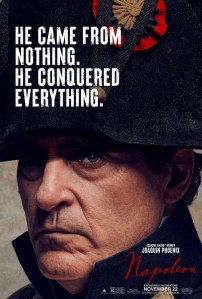
I may be completely in the wrong, but I feel the only way to view Ridley Scott’s latest historical epic, a 158-minute account of the life of Napoleon Bonaparte, is as a comedy with the full intention of not retelling history but of de-mythologizing the grandiosity of its star. Otherwise, these 158 minutes feel like an accelerated Wikipedia summary of the man’s many famous deeds as he rose from general to Emperor and swept his armies across the continent conquering much of Europe. Rather, I choose to think of the movie as a strange comedy that shows how this fearsome military genius might also have been just a strange little guy with a temper.
The Revolution in France is burning out of bodies and the people are growing restless at the lack of meaningful democratic progress. Enter Napoleon Bonaparte (Joaquin Phoenix) as a successful general who will eventually crown himself as Emperor of France. He will wage war across the continent, lead to the deaths of three million by his final defeat 1815, and reshape and revolutionize the military of its days. He will also die alone, exiled, and without the love of his life, his wife, Josephine (Vanessa Kirby).

This all has to be a comedy, right? Ridley Scott (Gladiator, The Last Duel) went to elaborate lengths to make fun of the little general, right? How else to read scenes where Napoleon and Josephine argue at the dinner table where he accuses her of being infertile, she accuses him of being fat, and he agrees that he heartily likes his food and says, “Fate has brought this lamb chop to me.” How else to read a scene where he throws a hilarious hissy fit before the English ambassador, who Napoleon feels has been rude and less than deferential, and he screams, “You think you’re so great because you have boats!” How else do you read a montage of Napoleon seizing power with the military pushing out the old figures of power and one of them, aghast, shouting, “This cannot be. I am enjoying a succulent breakfast!” How else to interpret the scene where Napoleon is going to achieve his coup from the French parliament and he’s run out of the chamber, falling and scampering out like a child caught playing tyrant. It’s moments like these, as well as the acting choices, that push me in the direction of interpreting this movie less as another handsomely mounted biopic of The Great Men of History and more tearing down the lockstep reverence for this figure glorified through centuries of back-patting. I’m reminded of Josh Trank’s relatively unloved Capone movie from 2020, and while imperfect, I appreciated that Trank spent the entire movie tearing down the legend and myth of this bad man and showed him for what he was late in life, a pathetic, decrepit loser riddled with syphilis losing his mind and crapping his pants. I think we need more biopics that have a less reverent approach to their subject because then it provides a public service of inviting viewers to be more critical of history rather than blindly accepting.
I think this is also showcased by the fact that Scott and screenwriter David Scarpa (All the Money in the World) are choosing to tackle the legends rather than the history. Take for instance the acclaimed Battle of Austerlitz, one of the film’s high-points. Napoleon surprises the combined Russian and Austrian troops by firing cannons at the frozen lake, causing it to shatter and entomb thousands of men to their watery graves. It’s a stunning visual sequence that blends the beauty and terror of the events and of course little of it happened in real life. In reality, the lake was really more a series of small ponds and reportedly very few enemy soldiers drowned. In reality, Napoleon never rode into battle as part of his cavalry. The generals stayed behind with orders. Or take for instance Napoleon’s ill-fated march into Russia, and when he arrives he’s so bored and thoroughly depressed as he sits on the empty throne in Moscow, acting like a little kid who is eager to go home already. That’s the difference between history as it happens and history as it is remembered, and that’s the myth-making that Scott is attempting to work through and re-contextualize for the many people who aren’t fanatical acolytes of the historical record. This is Scott saying he’s going to take all the myths and legends and make you critically reconsider.

Then there’s the relationship with Josephine which defines much of the movie, so much so that it provides explanations for why Napoleon left his first exile, because, apparently, he was upset his wife was seeing other people. The relationship plays out like one more of political maneuvering than romance, with some eyebrow-raising bedroom kinks to modernize the tale. Much of their conflict is on Napoleon’s inability to sire a male heir, which is put through the steps of the scientific method by his concerned and opportunistic mother as he attempts to father bastards with other women. This is the storyline that suffers the most from the accelerated pacing and editing, so consumed with moving from place to place and fitting in all the historical checkpoints. The larger nuance of this relationship, and Josephine as a character, is taken out by simplifying it as a tale of two people who realize that gender-specific baby-making is their top priority. In reality, Napoleon absolutely adored his wife and wrote lengthy love letters that you can read today, with lines such as, “I hope before long to crush you in my arms and cover you with a million kisses burning as though beneath the equator,” and, “Without his Josephine, without the assurance of her love, what is left him upon earth? What can he do?” It’s a shame so much of this is reduced to heir-production anxiety.
Phoenix (Beau is Afraid) plays the titular role like he’s sleepwalking, slumped and grumpy and rarely providing much energy except around plates of food. It’s a curious performance and one that helps me to further see the depiction as one through the lens of a critical offbeat comedy. He’s certainly not playing the man like he’s one of the great inspirational figures, and he’s certainly not playing the man like he’s tearing through a multitude of doubts and inner demons. He’s playing Napoleon like a grumpy weird little guy who would rather be dining than conquering. Kirby’s (Mission: Impossible Dead Reckoning) more an accessory in her character’s limited scope but she does have a few moments that reflect Josephine’s moxy.
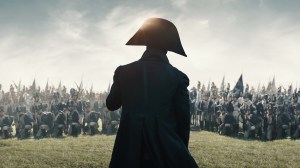
I would be remiss to pass up this chance to sing the praises of my former high school AP history teacher, Mr. Jerry Anglim, who had been teaching history and government for over 26 years before I stepped foot in his classroom. The man brought history alive for me and really crystalized my love for the subject, seeing how it’s all just one big canvas of storytelling. And this man loved teaching the Napoleonic Wars in great detail, and I loved scribbling down those notes every day. I even thought about getting a Napoleon poster to hang in my room, which would have been quite the odd teenage decorating choice. We watched the 1970s Waterloo movie starring Rod Steiger as Napoleon in class on a tiny TV attached to the corner, and yet I was spellbound because of what this teacher had done for me with the subject. So, wherever you are Mr. Anglim, thank you, and I’m sure you have your complaints with this new movie and I would love to hear them.
As a long movie still barely chronicling the major events of its subject, Napoleon feels lacking unless viewed through the lens as a critical comedy tackling his legends and myths. Then the abrupt nature of the plotting becomes more an addition than a subtraction. However, Scott has gone on record that he has a four-hour director’s cut that Apple plans to make available on its streaming platform in the near future, so perhaps my entire interpretation could be blown up. To be fair, the real Napoleon was a military genius and did revolutionize and modernize the French military, and while he didn’t “conquer everything,” especially Great Britain and Russia, the man and his ambitions and good fortune dominated the first fifteen years of the nineteenth century. Human beings will always be drawn to the stories of conquerors, but it’s important to also see them as people, quite often terrible people, but human beings with failings and complexities that are often left behind from decades if not centuries of propaganda and historical whitewashing. As a biopic, Napoleon the movie feels too short and shrift. As a comedy, it’s a lamb chop served up by fate.
Nate’s Grade: C+


 nathanzoebl
You must be logged in to post a comment.