Blog Archives
The Curious Case of Benjamin Button (2008)
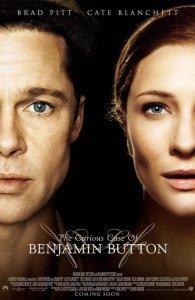 This lavish and long-winded spectacle is curious, all right. Director David Fincher (Se7en, Zodiac) has all the technical wizards at his disposal to produce a near three-hour fantasy about life, love, and death. The Curious Case of Benjamin Button works around the bizarre gimmick of a man going through the process of aging backwards. It’s loosely based on F. Scott Fitzgerald’s short story, adapted by Eric Roth (Forrest Gump), and the results are befuddling. Benjamin is a handsomely mounted and incredibly expensive work engineered for one purpose: to win Oscars. Benjamin Button is a film that strives for making grand statements and wringing a maximum amount of tears, but it’s also a film that lives more in a series of moments than as a cohesive whole. It’s a fine piece of work but feels overburdened by its urgent desire to be profound.
Benjamin Button (Brad Pitt) is born on the day the first World War ended in 1918. He is born as a small infant that better resembles an 80-year-old man (in Fitzgerald’s short story he is born as a full grown old man, which means it must have been fun for his mother). Benjamin is aging backwards but his mind is still as it should be, so while he is all wrinkly, arthritic, and covered in liver spots, Benjamin is like other small kids who want to make friends. Benjamin’s father (Jason Flemyng) is horrified by his son’s condition and abandons him at the steps of a nursing center. Queenie (Taraji P. Henson) raises Benjamin as her own child and he grows up (down?) surrounded by a colorful cast of elderly residents (one woman remarks that a young-old Benjamin looks just like her ex husband). It is here that Benjamin meets the love of his life, Daisy (played by Cate Blanchett in her older years). She’s enchanted by Benjamin’s condition but she has her youth to live and Benjamin is left behind. Daisy becomes a trained ballerina and tours the world. Benjamin goes on a series of escapades, like working on a tugboat, traveling to Russia and having an affair with a diplomat’s wife (Tilda Swinton), and discovering his biological father and the family business of buttons. But he’s always been waiting for Daisy, and eventually they “meet in the middle.”
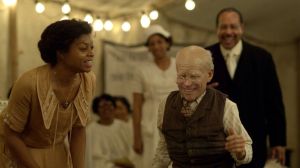 The very nature of the premise means that the movie isn’t going to have many pure, joyful moments. The idea of a romance that needs to take 40 years to connect, and even then has a limited shelf life before they go in their separate aging directions, is beautiful and heartbreaking. Waiting decades for a glimmer of your happiness with your mate, that’s a hard pill to swallow. Benjamin Button explores a similar situation covered by vampire-immortal romances, where you must endure watching your precious loved ones grow old and die. The entire movie radiates with an overwhelming sense of melancholy. The movie manages to find humor and grace amidst its melancholic dirge. The reflections on mortality are ever-present though rarely profound. It may not say anything new or original but it has many things to say about life, death, and the fleeting moments in between. By that notion, the film is structured so that the beginning, where Benjamin is a young old man, it’s more comic and beguiling, then as he and Daisy match up we finally get the pairing we’ve been pining for from the start. The pent-up passion provides great conflict, and then we barely get to enjoy the coupling before reality strikes. The final twenty minutes of the film, where old Daisy cares for old young Benjamin, are incredibly moving and have an indelible symmetry to them, watching an old lady lead a child by the hand.
 So then why do I feel so hesitant about fully accepting this movie? The story follows a similar Gump like pattern of incidents but the movie refrains from being mawkish. The main character is mostly passive with little personality; he’s nice but take away his unusual condition and not many folks would remember their time with Mr. Button. Before he gets with Daisy the film feels a bit episodic with the chapters of Benjamin’s life, and they are entertaining asides but they fail to amount to much more. Benjamin Button feels like something important is absent; it’s not cold as others have claimed but it feels, perhaps, remote, stopping just shy from being a full emotional investment by keeping the audience at a somewhat objective distance. This may be Fincher’s own design because Fincher ensures that a film about living life to the fullest doesn’t degenerate into sentimental claptrap. The end hits hard but not as hard as it could if I was more invested in Benjamin as a character. The Hurricane Katrina framing device seems tacked on, but then again the story mostly takes place in New Orleans and Katrina is rather noteworthy, you could say. The “elderly lady recalls her life story” is reminiscent of Titanic, and might not even be necessary though it offers Daisy the ability to look back over her years with added insight. The layers of realistic makeup piled onto Blanchett are impressive, though I worry what would happen if the actress had to go to the bathroom.
Technically, the movie is nearly flawless. The visual effects are astounding, seamlessly allowing Pitt to play the role even as a young child. The Curious Case of Benjamin Button is a glorious experience to watch but a mildly curious experience to register. The film is so meticulously crafted and it has all the right components of a tragic romance for the ages, but it somehow misses the mark. It’s an entertaining and moving film but it leaves something to be desired. The most resonant moments are also the ones that are the simplest, the ones that lack the window dressing of expensive special effects. I appreciated the film’s expressions of symmetry, but I have the nagging feeling that Benjamin Button both tries too hard and perplexingly doesn’t try hard enough. It keeps audience involvement at a distance, wishing to comment on humanity without embracing humanity. It is difficult for me to articulate what is lacking, because it is an enjoyable if overly long movie, but it falls into the “almost” category of poignant filmmaking. It’s almost a challenging movie, it’s almost an affecting movie, it’s almost a movie worth falling in love with. The film’s story and sensitivity and scope cannot match the technical audaciousness.
Nate’s Grade: B
Share this:

Miss Pettigrew Lives for a Day (2008)
 The movie seems to float on the effervescent air of 1930s screwball comedies, and in truth it does possess some of that snappy allure. Francis McDormand travels into the inner circle of the upper social classes in London and befriends a bubbly lounge singer, played by bubbly actress Amy Adams. The film moves at a ridiculously fast pace, sometimes too fast as it tries to pile on complications and setbacks. This day-in-the-life confection is sweet and well natured but rather too digestible. Once the movie is over I do not see myself ever dwelling upon it once again. It’s a pleasant and entertaining experience even if it dances right out of your memory.
Nate’s Grade: B
Share this:

Australia (2008)
 Baz Luhrmann is a filmmaker that doesn’t know the meaning of the word “small.” He paints in giant strokes with lavish creative flourishes that separate him from the pack of visionary auteurs. I’ve enjoyed every one of his films thus far and I fee that Moulin Rouge is a romantic touchstone that I can go back again and again to be dazzled and moved. I anticipated that Australia would be suitably grandiose in scope and style. While it suitably grandiose it definitely could have used some fine-tuning when it came to scope and style.
Australia follows the adventures of Lady Sarah Ashley (Nicole Kidman) entering the land Down Under in 1939. Her husband owns a cattle ranch in the north called Faraway Downs. She suspects that her husband travels to Australia to get a bit more business down under, if you know what I mean. He’s been killed and the only witness is a half-white, half-aboriginal boy named Nullah (newcomer Brandon Walters). It was customary for the Australian government to abduct mixed race children and ship them off to a church mission, where the tykes got to learn how to be servants for rich white people (this government policy only officially ended in the 1970s). Little Nullah hides on the Faraway downs ranch with his aboriginal mother. Lady Ashley must decide what to do with her strip of land. The local meat baron, King Carney (Bryan Brown), owns all the land surrounding Faraway downs and is close to maintaining a monopoly. Carney’s right hand man, Fletcher (David Wenham), has been keeping watch over Faraway Downs. Lady Ashley decides to hold onto the ranch and to drive the 1,000 head of cattle to sell at the town of Darwin. Carney orders Fletcher to stop the competition in its tracks. With little resources, Lady Ashley needs a rugged man to lead the cattle drive. The Drover (High Jackman) is a man of adventure and promises to deliver the cattle to their destination in Darwin. Through the course of 165 minutes Lady Ashley and the Drover will fall in love, Nullah’s freedom will be in jeopardy, and the Japanese will bomb Darwin in 1941.
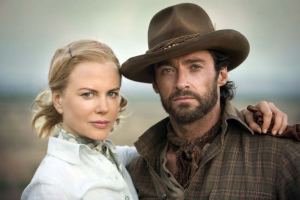 The flick is ambitious, I’ll give it that. Just the title itself sets off an aim to summarize an entire country’s history, culture, and people in a declarative and definitive narrative. Somehow I doubt many will leave the theater and say, “Well, now that’s Australia.” Indeed, I find the film’s narrative to be a limp representation for a country. I suppose most big nationalistic history films start with the birth of nations, but when your country began as a repository for English criminals then I suppose you may want to find a different tale to tell. Australia is really three movies in one colossal package: a Western dust-up, a World War II disaster, and a dark history lesson over the country’s treatment of the aborigines. There is too much movie there, especially at a mammoth running time of 2 hours and 45 minutes. I almost think that Luhrmann believes that if he throws out enough storylines and emotions that somehow it will form a cohesive whole, but the pieces never truly mesh satisfactory. The kitchen sink method rarely works without a grander scheme. The war elements could have been dropped entirely considering that the Japanese bombing sneaks in at the very end of the film and serves little other purpose then decimating the town of Darwin. The movie just all of a sudden transitions into Australia at wartime, and various characters have new positions, like Lady Ashley serving as a phone operator. Where did any of this come from? It just sort of happens without any solid setup or transition despite a near three-hour length. You don’t need to nudge in World War II disasters just to introduce sustainable conflict. Australia is filled with moments where the plot or the characters make big leaps without justifying the transition. Lady Ashley goes from a lily-white upper-class fop to a tanned Outback rootin’-tootin’ adventurer over the course of mere minutes.
Director Luhrmann’s over-the-top visual style is absent and the movie feels strangely square, like Luhrmann is keeping his more manic abilities in check so he can tell an old school epic. But [i]Australia[/i] is not an epic despite a running time that would argue otherwise. It has gorgeous cinematography, gorgeous natural exteriors, and a pair of fairly good-looking leads (Jackman was named People Magazine’s sexiest man alive for 2008), but these are all components and not a finished product. I kept wanting Luhrmann to break free from his creative straitjacket and add some pizzazz and inspired sidesteps. It never happened. Lurhmann has been instrumental in the birth of Australia from beginning to end (he is credited with the screen story), but having such an idiosyncratic and surreal talent make a movie that is so backwards in approach and appeal is lunacy. This is not the best use of Lurhmann’s many talents. Australia has some gauzy and gaudy visuals but it feels altogether devoid of style, though it attempts to make up for that loss in sweep.
 The true history of what happened to mixed race aboriginal children is appalling and certainly worth examination. So why then is Australia another case where the story of a minority’s oppression and tragedy must be told through the eyes of valiant white characters? Nullah’s story is far more interesting then Lady Ashley learning to be a country gal or the Drover learning to settle down. There is much more inherent drama in following a child who feels displaced and forever hunted because of his own genetics. That’s far more powerful than watching the tyke play “Somewhere Over the Rainbow” for the 80th time on his harmonica. Whenever Australia dips into serious statements on the plight of the unfortunate aboriginals, the movie feels very awkward. This is because “serious” is not what the movie does best at all. Australia is a large-scale attempt to revitalize that old-fashioned, sweepingly romantic Hollywood filmmaking of the 1950s. You could just as easily imagine John Wayne and Maureen O’Hara in the starring roles, though the movie’s sensuality and outward comments on racial equality would have been tampered down. My point is that Australia is engineered to be this romantic spectacle that nearly overdoses on sentiment, so whenever it cuts to the aboriginals plight (something serious not in a silly movie sense) then it just seems tonally disjointed.
Let’s also talk about the depiction of the aboriginal people in Australia. Clearly Luhrmann has sympathy for these people and their persecution, and rightfully so. However, the movie turns the aborigines into magical otherworldly spiritual creatures. The depiction is similar to how Native Americans are seen in movies that take place in North America. The Native American is always seen as a being more in tune with nature and spirituality; they’re a “magic Indian” and always seem to possess supernatural powers and great wisdom. These portrayals are intended to be flattering but they really come across as hollow and condescending, transforming disadvantaged people into mystical and mysterious figures. Australia is packed with aborigines walking around, singing their songs to the wind, and having a near-psychic connection to the Earth and its inhabitants. There are several moments where King George, an old aboriginal man, will hum to himself and appear out of nowhere across thousands of miles to pose in a flamingo-like stance. It’s this sort of silly attempt at mystical reverence that stops the movie full-force when it touches upon the terrible realities of how the government treated the aborigines.
 The actors do as best they can with such underwritten characters. Kidman found a perfect collaborator with Luhrmann on Moulin Rouge, a performance that deserved the Best Actress Oscar of that year. She has complete trust in Luhrmann. Her character is the typical role where someone from the outside adapts and finds a new home, which means Kidman is mostly comic and overacts in the beginning. She overdoes the comedy, expressing lines with a bit too much energy that almost seems against her will, like someone is pulling an invisible string to stretch her face into extreme expressions. I’ve always believed that Kidman could be a fine actress but honestly I don’t think I’ve loved a Kidman performance since 2001 with, yep, Moulin Rouge (she was quite fine in Dogville and The Interpreter). I’m starting to dread the thought that I may never see another Kidman performance that sets me afire. Jackman’s background in theater comes in handy when it comes to selling such melodrama and cheesy sentiment. He’s a handsome man and the movie takes great pains to showcase him shirtless. His character is another in a long line of solitary men who have to learn to reach out and love again despite the danger of being hurt. It’ all pretty standard for a Drover, naturally. Walters’ performance can at times be too cloying that it becomes grating. Eventually you do build a tolerance and he becomes more endearing than annoying. I had more fun with the supporting cast who can be relied on to offer glimpses of humor and menace.
I will say that I was rarely bored with the movie, though there are occasions that sag in the overly extended middle. Lurhmann still knows how to make an entertaining movie even if it’s one that generally plays by the book. The first third of the film, the cattle driving section, is the most successful and the most compelling, which is somewhat a backhanded compliment when the movie also deals with racial injustice. The stampede sequence is quite exciting and adds some needed action into the proceedings. From a technical standpoint, everything is staged well and looks refined, and my goodness does Walters have big dark soulful eyes that look pristine on the big screen. Kidman and Jackman’s big screen coupling will likely sate fans of romances between proper ladies and men with musk. Theirs is a romance thinly sketched but told with vigor. Australia is far too accomplished to be dismissed as a bad movie or a grandiose failure, but it never really settles into anything alluring or momentous.
 You know what I’ll take away most from Australia? The term “drover.” Jackman’s character never has a real name, he is simply referred to as “Drover” or occasionally, “Mr. Drover,” as manners require after you sleep with a drover. He is not a “driver” of cattle but a “drover,” which sounds like a present use of a past tense. At one point little Nullah says in voice over, “The Drover drove them cheeky bulls.” Can you “druv”? When you are completed is called “droven”? I wonder if Australian school children ever had to diagram this sentence: “The Drover drove the cows until he had droven them far enough to druv.” This grammatical curiosity lodged in my brain and I amused myself elaborating on the “drover” vocabulary.
Now, Australia itself, as many locals will tell you, isn’t bad. It packs a lot of movie in 165 minutes but I just wish it had been a stronger movie. While the visuals are pleasing and the story is mildly engaging, Australia never justifies itself as the epic it so eagerly wants to become. The story is too disjointed and silly to be taken seriously and too square and stifled to be fun and energetic. Lurhmann is a filmmaker who has such limitless potential; he didn’t just resurrect the movie musical in 2001 but gave it a new language. Watching his talents get henpecked and hampered to tell a nostalgic old-fashioned romance that doesn’t resonate is like watching Gene Kelly paint. Sure it might work but the man just wasn’t meant for it. Which then makes it even more bizarre that Australia has been a passion project that Luhrmann has been working on for years. I don’t feel his passion or even his pride for his native land, though cattle drive tours might increase as a result. This is a movie that could have used more of Luhrmann’s brash and buzzy style. The only thing declarative about Australia is that Luhrmann should have been attached to a different movie.
Nate’s Grade: C+
Share this:

Lust, Caution (2008)
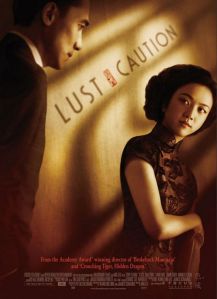 Ang Lee’s period romance is no Brokeback Mountain, though there is a heavy supply of thrusting. Lust, Caution is an NC-17 rated peak into life in China under Japanese occupation in the 1930s. Most of the film follows a school drama club that decides to become freedom fighters. They scheme to murder Chinese officials working with the Japanese government, and one gal (Wei Tang) is tapped to seduce and then kill a high-ranking official. For such a controversial movie, the sex scenes don’t even begin until 90 minutes into the flick (though our undercover heroine is deflowered by her drama club peer for the good of her mission). The movie is exquisitely shot, handsome in its details, and the lead performance by Tang is exceptional, simmering with conflicting emotions and some real sensual heat. The sex scenes doe have an erotic potency to them and they are more explicit than the kinder gentler fare found in typical Hollywood movies that consist of only seeing the slow-motion ecstasy result from a man on top. The offbeat love story gestates too late in the film’s run, leaving little time to delve deeper. Too much of the movie concerns back-story following the drama club’s road to becoming revolutionaries, and while it’s interesting it’s also rather needless on second thought. There’s a nine-minute difference between the R-rated version and the theatrical NC-17 cut; what’s in those nine minutes I do not know since I saw the edited version, but I’ve been told it’s a lot of thrusting. In lusty terms, the movie is heavy on foreplay and too short on a satisfying climax.
Nate’s Grade: B-
Share this:

The Duchess (2008)
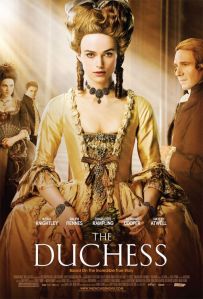 I think I understand the real appeal of costume dramas. No matter what else happens, the costume drama must seem smarter. You have actors, primarily British, waltzing in elaborate costuming in realistic historical settings, each offering demure statements and looking for love and acceptance in a time of chaste expression. You could place Saw 18 in that setting and it would automatically seem smarter. I think the ye olde setting for costume dramas automatically gives these films more plot leeway, but not every film actually proves that it should have earned that leeway. Saul Dibb’s handsomely mounted period drama The Duchess offers little beyond the superficial enjoyment of well-crafted costumes.
In 1770s England, young Georgina (Keira Knightley) has been betrothed to the older Duke of Devonshire (Ralph Fiennes). The newly minted 17-year-old Duchess of Devonshire is whisked away to live in a giant manor. The Duke is rather cold and seems uneasy with human interaction; he shows the most affection for his dogs. He expects Georgina to primarily bear him a son. Several daughters later, the Duke is engaged in affairs and siring illegitimate children. Georgina has become a star of the social sphere, and it is here that she befriends Bess Foster (Hayley Atwell), a woman who is trying to regain her children from her ex-husband. Things get even more complicated when the Duke takes a liking of Bess, and the two become an unofficial union. Georgina has had her only friend taken away and turned into a co-wife. The only solace for the Duchess is in her flirtatious relationship with a politician, Charles Grey (Dominic Cooper). Georgina feels like a prisoner in her own home and yet she cannot desert her children. What’s an oppressed woman to do in 18th century England? That answer should be sadly obvious.
 The Duchess breaks no new ground and, in fact, treads water for the majority of its second half. Georgina was an independent spirit in a time that frowned upon breaking from conformity and tradition. As a woman, she was the victim of a double standard that allowed her husband to sleep with whomever he desired but she could not find physical comfort outside her loveless marriage. Marriage was widely viewed as a means to an end for male progeny, not the culmination of romantic love. Women were pressured into delivering male heirs, despite the fact that men are the ones who determine gender. Typically marriages were family arrangements for class and land ownership, so true passion was procured through marital affairs. I get it because I’ve read Jane Austen novels and seen dozens of period movies that have made the same stilted points. The Duchess presents Georgina as a feminist before her time and then a patriarchal society crushes her spirit. During the second half, when aristocratic life keeps producing heavy obstacles for Georgina, the movie just piles it on. I was left questioning what the point of all this corseted drama actually was.
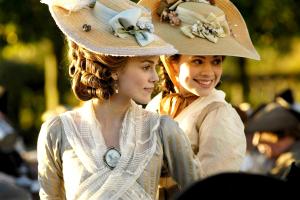
After a while with my downtime I determined whom this movie is really for – hat enthusiasts. This is a Big Hat movie that puts other hat movies to shame. There are gigantic floppy hats, hats that look like fruit displays, hats that look like eighteen-layer cakes, hats that look like they have their own hat, hats with feathers zigging and zagging in every direction, and hats that look like they are consuming their host’s heads. If you work in the haberdashery industry or have an above average interest in hats and hat-related products, then run, don’t walk to The Duchess. You will be enraptured by the orgy of towering hats that jostle for screen time. Rarely are women seen without hats, so you truly will get your hat money’s worth over the course of the film’s two hours. If there were a specific Oscar category for Hat and Hat-like Accoutrement then The Duchess would dominate. I expect it will get nominated for Costumes, and really that seems like half the point in making these powdered wig period dramas.
I think the other point of The Duchess is to channel the modern story of Princess Diana, who is actually a distant relative of Georgina. The two seem to lead somewhat similar lives since they both married young, both had their husbands prefer the mistresses, both were fashion trend setters, both were beloved by the public, and after death both had their husbands remarry the mistresses. The tagline for the film is, “There were three people in her marriage,” a paraphrased quote that Princess Di said in an interview. The Di parallels seem to be all that the filmmakers intended to do with Georgina as a character; she is the least interesting person in her marriage. The Duke and Bess are far more complex and intriguing figures. I’m sure the Georgina biography that serves as the movie’s source is rich in Georgina characterization and personal detail, but all the movie cares about is establishing her as a marital martyr. There is more to this character but she just endures disappointment and punishment; I cannot fully engage with a character when their only personal attribute is suffering. The movie fails to present any notable reason why this woman of history deserves having a feature film.
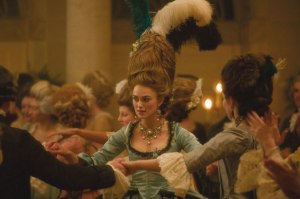 Knightley seems to spend half her film life in corsets. I’m still undecided upon whether she possesses innate acting ability; to me she too often comes across as a pin-up with great cheekbones. That said her eyebrows do a great bit of acting in The Duchess. She has the habit of cocking one ever so slightly and imbuing a scene with a hint of sexual allure or mystique. They’re pretty thick eyebrows too. Knightley does acquit herself well with the material and I doubt this will be the last time I see her in a tremendous silk gown and a humongous hairdo. The most interesting actor is Fiennes because his character is so reserved and awkward in his own skin, so much must be said through the use of gestures, body language, and the perfect execution of line delivery. His character seems just as ill in his setting as Georgina. Atwell is given the most complex character to play. To say that Bess has conflicted loyalties is an understatement. She betrays Georgina but romancing the Duke can ensure that she sees her children once again. Bess should have been the centerpiece of the movie because, as presented, she is far more interesting with more dramatic conflicts and turmoil other than being wronged.
The Duchess is no more and no less than every other costumer period piece you’ve seen before. It starts well but then falls into boring and repetitious plotting (Georgina wants something, she’s denied, she wants something, she’s denied; rather, rinse, repeat, end). The Duchess will delight those in search of yet another unrequited period romance, but I feel that moviegoers should expect more from their entertainment that mechanically fulfilling the period-y checklist. The technical merits like the production art and the costumes, especially the hats, are first rate. There’s little feeling beneath all the fabulous fussing about. It’s too bad the actual drama couldn’t at least be as interesting as the hats.
Nate’s Grade: C+
Share this:

The Wackness (2008)
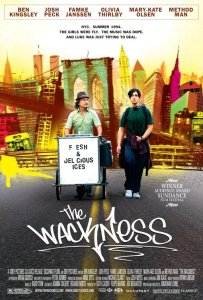 Every Sundance Film Festival seems to coronate new talent and new films that never seem to materialize once they step outside of the happy bubble of festival life. It happened with Happy, Texas, with Tadpole, with Hav Plenty, with Primer and numerous others that never managed to get started with the public. At the 2008 Sundance film festival, the biggest buzz followed the documentary American Teen and The Wackness. Writer/director Jonathan Levine’s coming-of-age tale won the Audience Award for Drama and boasts shimmering visuals, formidable actors, and a hip soundtrack. Too bad the drama gets the least attention in that package. I suspect The Wackness will be yet another Sundance buzz flick that, while well made, fails to leave a mark on mainstream crowds (here’s hoping more for American Teen).
Luke (Josh Peck) has just graduated from a New York City high school and is winding down the summer before he moves on to college. He has a unique summer job: Luke sells marijuana out of an ice cream vendor’s box. One of his clients, Dr. Squires (Ben Kingsley), is a therapist. He trades therapy time to Luke for pot. The two of them form an unanticipated bond and Dr. Squires makes it a point to see that Luke is making the most of his youth. Luke is smitten with the doc’s stepdaughter, Steph (Juno‘s Olivia Thirby, gratifyingly authentic), and determined to lose his virginity and find love before the summer fades away.
 The strength of The Wackness is in the unexpected father/son relationship that forms between Luke and Dr. Squires. Kingsley is sensational in his role and provides all the pathos and unexpected discoveries that the coming-of-age genre is associated with. I think that’s what’s most interesting about Levine’s film, is that Kingsley is going through all the coming-of-age moments reserved for teenage protagonists. Dr. Squires and Luke form a surprising and deep relationship where they learn from each other. Luke learns to talk about his life’s sadness and make it a part of his life, instead of sweeping it under a proverbial rug. Dr. Squires learns to re-embrace life and to kick his heavy supply of pharmaceutical prescriptions. He is coming of age at middle age. He even gets to second base with an Olsen twin (Mary-Kate is only in the film for two scenes and an estimated five minutes). Most of all, Dr. Squires needs a friend and Luke fulfills this desperate void. Kingsley is funny, pathetic, and the real star of The Wackness.
My main problem with The Wackness is how familiar it all comes across. It follows the coming-of-age model down to the end, so a savvy audience is going to realize that Luke will fall in love, get his heart broken, stand up for himself, and gather a bit more wisdom by the time the end credits roll. You’ve seen this movie played in a thousand different ways before, and now The Wackness makes it 1001; you will essentially know every beat of this story before it happens. The film doesn’t break any new ground and doesn’t manage to provide much commentary or lasting insight while it comes of age. The screenwriting fails to hide what disinterests Levine. So we get quick glimpses of Luke’s home life and I swear in every one of them his parents are just yelling. That’s all Levine is interested in, setting up one ten second shot of Luke overhearing his parents shouting again and again. Dr. Squires’ wife (Famke Jannsen) gets the same kind of treatment. She gets a cursory amount of screen time to glower and that’s about it. I can tell Levine is only interested in his three main characters (Luke, Dr. Squires, Steph) but then why does he not concentrate on them further and scuttle what he feels is wasted time?
The Wackness is awash in pointless nostalgia. The movie is set during the summer of 1994 for no real reason. The time setting doesn’t impact the film in any manner except for some digs at Mayor Giuliani’s policies (he was only in office for sixth months or so when the film opens). Levine dishes out pop-culture references like the 8-bit Nintendo game system, old chunky GameBoys, Kurt Cobain’s suicide, mix tapes, and lots of rap music. The Wackness is an ode to mid 90s rap music and Luke is a lover of acts like A Tribe Called Quest, De La Soul, and some up-and-coming guy named The Notorious B.I.G. The soundtrack is also meant to convey good nostalgic vibes of a simpler time only — 14 years ago. Setting the film in 1994 is a lazy attempt to cover the lapses in screenwriting with cozy audience nostalgia. And is there anything really culturally transcendent about the summer of 1994?
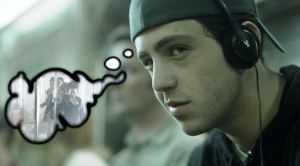
 Peck may have lost like 100 pounds since he was fat comic relief on a Nickelodeon kids show, and he’s marginally handsome, but this kid needs some more practice before he’s a dramatic actor. I understand that his character gets stoned often and, as a typical teenager, is trying to pull off a too-cool-for-the-world-“whatever” attitude, but he seems freaking catatonic. He’s too aloof for his own good. His acting is dry and monotone and he feels like he’s constantly zoning out. Again, I understand that this works with his stoned persona but Peck is hardly ever convincing in the part and his acting shortcomings rob the role of a greater level of sympathy. A great actor can make you like a character that eats babies and kicks puppies, or the other way around, but Peck is not that actor. I believe that part of The Wackness‘ failure to connect and elevate beyond its genre trappings is due to Peck’s poor performance. He’s just kind of boring character and, to borrow a term from our pals on the other side of the pond, a bit of a wanker.
As a director, Levine has a playful and visually appealing look for the film, bathing it in arid tones to echo the hot summer days. The cinematography is a character all its own, giving the film a colorful and lively flair that makes every scene worth watching even if the script fails to do likewise. Levine has a handful of clever visual tricks up his sleeve, like a middle finger that moves through a crowd of New Yorkers at rapid speed before finding and dialing a pay phone. Levine has definite talent as a director and it shouldn’t be long before Hollywood comes knocking and plucks him away to make The Fast and the Furious 8: The Search for Curly’s Gold.
The Wackness feels like a coming-of-age film that goes through the motions. The main character is stoned to the point of comatose and he’s a rather boring protagonist, made even duller by Peck’s lackluster acting ability. Writer/director Levine flexes enough visual artistry to make him a talent to watch, however, his screenplay is too familiar with little personality or flavor to stand out against the pack. The movie looks good, it sounds good, and Kingsley is certainly good, it’s just a shame that it isn’t his movie. Steph tells the mopey Luke that all she sees is the goodness life has to offer and all he sees is “the wackness” (you can go home happy to understand the title). I guess I similarly be accused of focusing on the “wackness” of The Wackness because it’s certainly not a bad movie. It just happens to be ordinary. Though it does have some torrid Kingsley-on-Olsen Twin action. I suppose that isn’t too wack.
Nate’s Grade: C+
Share this:

Mongol (2008)
 Genghis Khan can’t be all bad. The Oscar-nominated foreign film Mongol dares to show the little known softer side to the man that conquered most of the known world in the early 13th century. The film follows the rise of Temudjin (Tadanobu Asano). Mongol has the look and feel of epic adventures of old, the type of stuff Hollywood was churning out at four-hour lengths in the 1960s. The cinematography is excellent and sweeping, the real-life filming locations add great authenticity to the tale, and the acting is universally strong, especially Asano and his stalwart and attractive wife, Börte (Khulan Chuluun). Even though Asano is Japanese he makes a much more convincing Genghis Khan than John Wayne (I advise everyone to skip 1956’s The Conqueror). Most of the film concerns Temudjin’s relationship with his wife and his blood brother, Jamukha (Honglei Sun). Eventually he must defeat his powerful blood brother and consolidate the Mongolian people. The interpersonal relationships between the three principles are surprisingly deft and full of insight. For a two-hour film detailing the life of Genghis Khan, the movie doesn’t resort to many battle sequences. The combat is exhilarating and stylish without ever becoming self-conscious. I read that Mongol is intended to be part one of a trilogy following Genghis Khan, so perhaps there will be more military strategy and battles once he steps off his home turf.
The movie lost me somewhere in its languid middle and never fully regained my attention. The movie starts off well, ends decently enough, but man the time in between gets terribly repetitious. Temudjin is captured. He escapes. He’s captured. He escapes. His wife is captured. He rescues her. I have no idea if all the events the film portrays are necessarily historically accurate as depicted. Even if they are, the filmmakers could have provided a stronger through-line to connect the events and provide a better sense of overall direction. Mongol is certainly a good film but it’s not great. It even feels a tad pre-programmed, like it was constructed for a U.S. audience that has grown accustomed to the likes of Braveheart and other bloody history epics. I’ll keep a passing notice on whether Mongol Part Two (the rise) and Mongol Part Three (the fall) improve upon Part One.
Nate’s Grade: B
Share this:

Indiana Jones and the Kingdom of the Crystal Skull (2008)
 I lived in New Haven, Connecticut for a year while then-partner was earning her Master’s degree at Yale. We hated it. New Haven is a college town that doesn’t know it’s a college town, so everything closes at 10 PM, there are no student prices for anything, and the people there more or less sucked. We were happy to depart from the Nutmeg State. Then the week after we were going to leave was when Steven Spielberg, Harrison Ford, and the production team for Indiana Jones and the Kingdom of the Crystal Skull were coming to town. They were going to film a motorcycle chase along Chapel Street (where I walked to work every day) and all along the Yale campus. Finally, a reason to stay in New Haven presents itself and it has to happen after we escape. It’s not often one of the most anticipated movies comes to your doorstep.
I could have been an extra in the motorcycle chase, which set in 1957, could have used a long-haired Beatnik type (played by yours truly) for an exaggerated reaction shot. I could have been sipping on an espresso and then Indiana Jones could have zoomed by on the bike snatching by hot beverage, leaving a long-haired Beatnik type (me again) to mug shamelessly for the camera. It would have worked. Alas, it was not to be, though it certainly would have made this ages-in-development sequel more enjoyable on my part.
It’s been a long time since part-time archeology professor and full-time treasure hunter Henry “Indiana” Jones (Ford) beat the Nazis. The world has gotten a lot more complicated thanks to the Cold War, the atomic bomb, and the fact that Jones is now well into his 60s. It’s been 19 years since his last adventure but the man with the bullwhip and the dusty fedora still has a knack for intrigue. Soviet KGB agents have captured Indy and his friend Mac (Ray Winstone) and taken them to the Area 51 warehouse. They’re seeking a recovered artifact of alien origins that can wield tremendous power, as they always do. Irina Spalko (Cate Blanchett) is the head KGB agent and likes to threaten her enemies with a riding crop (perhaps she earns some extra money on the side punishing bad, bad comrades). Indiana Jones manages to escape and is pursued by the Soviets and blacklisted by his government due to his perceived involvement with Russia.
 Mutt Williams (Shia LaBeouf) seeks out the help of Dr. Jones. Mutt is a greaser on a motorcycle that might be a chip off the old block. His parents are in trouble. The stepfather that raised him (John Hurt), an old archeology buddy of Indy’s, has traveled to South America and found a legendary crystal skull. The bizarre artifact would lead the way to the mythical golden city and crazy amounts of Mayan supernatural power. Unfortunately, the skull has also made him as batty as a bat and Spalko is going to kill him. Indy and Mutt fly down to South America to save the crazy old man. Oh, and Mutt’s mother is also in danger, and she would be none other than Marion Ravenwood (Karen Allen), who has plenty of romantic history with a certain swash-buckler afraid of snakes.
Seeing Ford back in action just feels right. His character has grown into a bit of a curmudgeon but he’s working the same territory Bruce Willis did last year in the long gestated Die Hard sequel. He’s an old man serving some justice to all these young punks that won’t get off his lawn. The film acknowledges his age and mostly uses it as a means for comedy (he cracks that a life of adventure isn’t “as easy as it used to be”). Ford looks more alert than he has in years.
Blanchett is one of our finest actresses on the planet but she has serious trouble maintaining her Ruskie accent; she alternates between Russian and British the whole movie. Her dominatrix-styled villainess is certainly interesting, and man does she have great posture, but the film doesn’t really know what to do with the Soviet bad guys. They become more or less Nazi stand-ins and seem to repeat the same ambitions that the Nazis carried out in two or the three previous films. Allen has aged magnificently and is a welcome return. She and Ford have terrific screwball comedy chemistry and pick up right where they left off in 1981’s Raiders of the Lost Ark. LaBeouf does a solid job even though he doesn’t have any meat to his character after his Marlon Brando-like introduction in leather jacket and motorcycle. Instead, Spielberg continuously winks at the audience about Mutt’s obvious familial line. It wouldn’t be a Spielberg movie without some family dynamic.
 I’m pleased to reunite with Indiana Jones, I like the new characters, and I even like Mutt, but the story the characters are saddled with is lousy. This is the script that Ford, Spielberg, and co-creator/producer George Lucas all agreed upon? I’m not one of those people that have an issue with aliens being the primary movers and shakers in the plot (in informal talks with friends, many are upset that little green men are the stars). The first three Indy films dealt with a religious supernatural power and now this new installment covers a space alien supernatural power, so that doesn’t concern me. What bothered me is that Crystal Skull is a murky mash-up of [i]Temple of Doom[/i] and Stargate. Once the primary characters reach their hidden temple the movie takes a nosedive. Spielberg almost crafts an anti-intellectual message, where finding out the reality behind the magic ruins the soul. The exact story behind the Crystal Skull is frustrating in how oblique it is, and Spielberg doesn’t want to offer any clarity. I’m at a loss to explain exactly why anything happened in the concluding 20 minutes, least of all how an alien race must have a very different definition of the word “gift.”
Never before has the action in an Indiana Jones film come across as so campy. This is likely the most disappointing part of Crystal Skull: the action is too tongue-in-cheek. There were moments where I thought the film was one step away from Army of Darkness. Spielberg is enough of a brilliant tactician to know how to setup and build satisfying and stylish action, which normally involves organic complications and letting the audience fully grasp what’s happening. This means no rapid-fire edits and plenty of long, high angle shots to get the big picture. And when he’s in his groove, there are few that can top Spielberg when it comes to an action sequence. There are points in Crystal Skull where the action is rollicking and joyously packed with excitement and wonder. The opening sequence inside Area 51 starts the film off with a bang, the motorcycle chase through Yale is well choreographed, and a car chase in the jungle is fantastic in the amount of back-and-forth scuffles and emerging obstacles. It’s by far the film’s high point and then there was one point where Mutt was swinging from vine to vine like freaking Tarzan and he enlisted the help of monkeys. It took me completely out of what had been a rip-roaring action sequence. Then there’s the moment where Marion drives everyone off a cliff and onto a tree that bends to drop them safely before smacking back like a rubber band. I’m not asking for complete believability in an action caper but I’d prefer it not become an embarrassing Looney Tunes cartoon. Crystal Skull is filled with little moments that will completely yank you out of the movie.
The action sequences feel too pat for the material the film wants to cover. Even that great jungle car chase could have been boosted with some extra ingenuity. The scene opens with the Soviets driving a vehicle that is slicing the forest to splinters and clearing a path for the caravan of cars to follow. Now I know the Spielberg of 1981 would never have introduced such an interesting machine in a unique setting without using it later. The Spielberg of 2008 is different because this nifty blade mobile isn’t even seen again after its initial introduction to establish how a car chase in a jungle could be possible. The action relies too heavily on distracting CGI that takes the action sequences on annoying, over-the-top detours. Just because computers can make it happen doesn’t mean it’s always a good avenue to go down. In short, the CGI is undercooked and over used.
 I also need to speak frankly about the CGI — it is terrible. However, when I watched Crystal Skull my party got a tad lost on the way to the theater so the only seats left were the third row from the screen. I spent the entire movie with my neck craned up. Perhaps if I saw the film in a position it was more intended to be seen the special effects would come across as more professionally polished, but from my neck-cramping position they looked pitifully amateurish for a major summer blockbuster with Spielberg and Lucas’s names attached. The effects work is shockingly shoddy, but the practical production design is amazing. Unfortunately, this does not balance out in the film’s favor.
I’m coming across as harsh but I only get this way when my expectations are raised because of a pattern of quality. The three prior Indiana Jones films were lively, imaginative, and deeply charming and satisfying adventures that leaned toward the exaggerated but still managed to thrill without feeling dumb. Raiders of the Lost Ark is one of the few perfect movies in existence, in my opinion, and set the standard for all action/adventure movies to follow. It’s unfair to expect the same sensation watching a sequel 19 years after its predecessor, but Kingdom of the Crystal Skull does manage to hone in on the same spirit that made the other Indy films such high-flying thrill rides. If you set your brain to a low frequency, enter the theater with lowered expectations, and already know that at one point Mutt will swing from vine to vine like freaking Tarzan, then Crystal Skull will provide the necessary popcorn entertainment you’d seek in a summer blockbuster. It is possible to think Crystal Skull ranks up with its predecessors but that requires so much contortion that I wouldn’t know how to arrive at that opinion. I suppose we should all resort to the consolation that even with E.T. taking over the plot, this thing could have been a lot worse. Just remember that if an alien offers you a “gift” to run in the other direction.
Nate’s Grade: C+
Share this:

The Counterfeiters (2007)
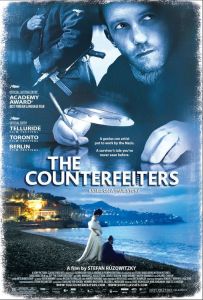 The Oscar-winner for 2007 foreign film is certainly a fine film and a respectable winner, but let’s be honest, the foreign film category was watered down a tad. France nominated Persepolis over The Diving Bell and the Butterfly because a country is only allowed to nominate a single film (sucks to be you, countries with good movies). This rule has resulted in past incidents like Spain nominating Tuesdays in the Sun over Pedro Almodovar’s Talk to Her, which ended up winning the 2002 Best Original Screenplay Oscar despite Spain’s snub. The hard decision by France was moot because Persepolis didn’t make the Academy 2007 shortlist of nine nominees. The biggest snub from that shortlist was Romania’s 4 Months, 3 Weeks, and 2 Days, a harrowing film about two college-aged women seeking an illegal abortion in 1980s communist Romania. It won the Palme d’Or at the Cannes Film Festival and also won the Best Picture award by the European Film Awards (Austria’s The Counterfeiters wasn’t even nominated). Then there was Israel’s amusing and touching film, The Band’s Visit, about an Egyptian band that takes a wrong bus and finds itself in an Israeli town. But the Academy’s foreign films ruled that The Band’s Visit had too much spoken English and therefore could not be ruled as a foreign film. Also left out were Germany’s Edge of Heaven and Spain’s The Orphanage. Nothing against The Counterfeiters but the foreign language field had already snubbed most of the main contenders.
The Counterfeiters is a deeply fascinating true-story about the world’s largest counterfeiting ring. Sal Sorowitsch (Karl Markovics, with a face as hard as flint) is a master forger leading a life of luxury in Berlin until the police capture him and send him to a concentration camp with his fellow Jews. As World War II carries on, the Nazis recruit Sal to lead a team to forge the British pound and the American dollar. The Nazis hope to destabilize their enemies’ economies. Sal is given greater freedoms in the camp and the S.S. officers try to become his chums. But he has to ask himself what his cost his actions will have. He could be prolonging the conflict and actually helping Germany win, but if he doesn’t assist the Nazis then he will surely be murdered as will his team.
Write/director Stefan Ruzowitzky creates great tension from scene to scene but it is the moral dilemmas that stick. What are principles worth? Are they worth dying for? Are they worth endangering others’ lives? The movie takes a docu-drama approach with bobbing handheld camerawork; even the film stock looks like it was soaked in grime for authenticity. And yet I wish The Counterfeiters had chosen to be less enigmatic. The main character is a criminal that keeps his emotions close to the vest, but Ruzowitzky cheats the audience by keeping Sal mostly in his head. The story is filled with factual intrigue and the natural tension given the situation, but after it’s over there isn’t much that’s memorable for a genre that expects more of itself. The Holocaust genre (and let’s not kid ourselves, it is a genre at this point) has some pretty high dramatic expectations and produces films that sear into our brains. The Counterfeiters is a very well told tale with great acting and some interesting character relationships but it can’t fully measure up to other Holocaust parables.
Nate’s Grade: B+
Share this:

10,000 B.C. (2008)
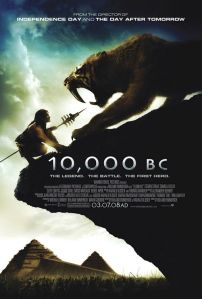 Roland Emmerich is a director used to making big budget, effects laden mainstream blockbusters that baffle film critics. I enjoy some of the man’s output but hold little pretension that Emmerich is not a filmmaker who knows the terms “nuance” and “subtlety.” 10,000 B.C. is another Emmerich flick in the would-be blockbuster mode. It has magazine cover leads, large-scale action set pieces, and a familiar rescue plot route. It also happens to be as dumb as rocks.
Way back in 10,000 B.C., life is more along the lines of nomadic hunting and gathering. The featured tribe has the old staple of the spiritual guide who lays out prophecies. This prophet foresees great calamitous change for the tribe. “Four-legged devils” will bring about destruction. But there is hope. D’leh (Steven Strait, Sky High) will save his tribe from annihilation. He is also destined to love Evolett (Camilla Belle, When A Stranger Calls), who is coveted because she has blue eyes. This, we are told, is a fortuitous sign. One day after a successful mammoth hunt, the tribe falls prey to raiders on horses. These raiders raze the huts and slaughter the people. They cart the rest, including Evolett, off to work as slaves building what appear to be pyramids or ziggurats in Egypt. D’leh must regroup and travel with Tic’tic (Cliff Curtis) all across Africa to save his loin-clothed love.
 This is a colossally stupid movie. Emmerich spins a host of clichés and prays it’s enough to stage some pre-history visual wonders. The movie’s visuals are certainly pleasing to the eye, but the plot and characters are totally vacant. The characters are one-dimensional morons. It’s not even worth mentioning what the numerous historical inaccuracies are (Egypt wasn’t even settled until 7,000 B.C.) because it would be less time consuming to simply state the historical accuracy the film presents. 10,000 B.C. makes Quest for Fire look like a documentary. The plot framework is your usual hero’s journey pastiche, where our lead must accept the responsibility that goes with being a leader. There’s also familiar plot turns like rescuing the damsel in distress, learning important back-story about an absent father, and finally, a slave uprising. 10,000 B.C. is a rip-off of Apocalypto and generally every historical uprising movie where the people band together under the leadership of an individual to tackle an antagonistic authority. This movie feels like it is barely held together by its plot threads, and those threads merely link to tired, groan-inducing clichés that act as placeholders for an actual plot.
What is even worse, 10,000 B.C. is a total bore. The only way something this silly and gleefully historically inaccurate could work is if it offered some adventure thrills. 10,000 B.C. seems to sputter for long stretches, having characters assemble and depart and walk and speak their ridiculous caveman speak. The pacing is rather slack and the action sequences, when they do occur, aren’t very well developed, hoping to leave their mark with plenty of long shots. Several action sequences are doomed from their very conception, like the laughable giant ostriches eating people. The action is just not good at all. Emmerich can generally pull out an exciting, functional action sequence even if it requires you to officially turn your brain off to enjoy. The first half of 10,000 B.C. has a few limited action sequences but they are brief and poorly staged. The second half has one climactic action sequence but it’s hard to tell what the hell is going on. Emmerich does not setup his climax and allow the audience to understand the attack process. When the climactic attack does occur it feels overly chaotic and senseless. How can the audience enjoy the progress of action if it cannot even verify what is happening? If I can’t follow what’s happening then I can’t enjoy it. The equation is that simple. The end of 10,000 B.C. is a big, mammoth-filled mess of a sequence that fails to serve as any payoff.
 The movie is so serious that the silly adventure heroics come across as downright insufferable. I cannot possibly sit through a 1 hour 45-minute film that deals with pet saber tooth tigers, traveling across the entire continent of Africa by foot at record speed, and giant freaking killer ostriches and have the movie try to uphold a serious reality. No movie in the history of mankind will ever be serious as long as it has a killer ostrich. 10,000 B.C. would classify as camp if it weren’t so resoundingly boring. I think Emmerich really stuck to his initial concept and decided somehow the movie would form by itself. He shows a definite interest in recreating sprawling vistas of a time long ago, but he shows barely a whiff of interest in depositing a story to go along with those oh so pretty pictures and ancient landscapes.
The film also feels eerily semi-racist. The good guys are slightly tanned but mostly Anglo-Saxon in their appearance. They even speak English, though really terrible monosyllabic English. Note to all filmmakers: if you are going to make a movie that predominantly features cavemen then do not give them any speeches. They sound absolutely hilarious trying to deliver a rousing speech in their stilted, monotone voices. The villains are outsiders who look very Arabic and Middle Eastern. They speak a different language. They come to terrorize the God-fearing hunters and gatherers, enslave their people, and drag them to a giant temple to be killed in the name of a competing God. I don’t know if the movie is necessarily anti-Arabic but I was given the opportunity to contemplate this subject with all the downtime 10,000 B.C. afforded me.
The special effects are bad. The acting is bad. The story is dreadful. The action is poorly planned and sporadic. And every aspect of this movie radiates stupidity. I suppose some moviegoers can discover some derisive pleasure from watching a really terrible movie about a dreadlocked boy trying to reclaim the only girl in 10,000 B.C. that vigorously tweezes her eyebrows. For me, the movie was far too stagnant and boring to enjoy derisively. 10,000 B.C. takes itself far too seriously for something far too silly. Emmerich has created a movie that manages to be dopey even by caveman movies standards, and this includes a 1981 movie actually called Caveman featuring Ringo Starr. My biggest question after the movie concluded was, “How in the hell did they get Omar Sharif to narrate this stone-age turkey?”
Nate’s Grade: D


 nathanzoebl
You must be logged in to post a comment.