Blog Archives
Hugo (2011)
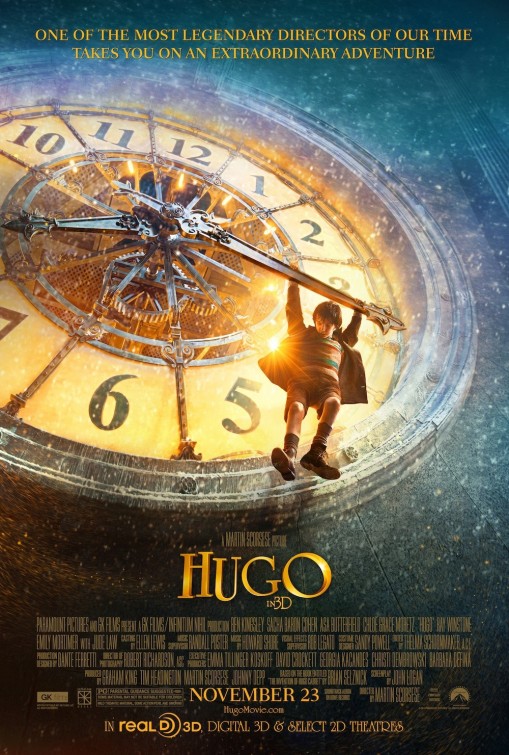 Martin Scorsese tackling a children’s film feels like an odd fit for the man responsible for classic gangster epics and symphonies of violence. But if David Lynch, Kevin Smith, Tim Burton, and Danny Boyle can all make family films that don’t make your brain rot, then why not the greatest living director? Maybe notorious sadist Lars von Trier will be next. Adapted from the award-winning children’s book, Hugo is, as my pal Eric Muller put it, a family film for film historians.
Hugo (Asa Butterfield) is an orphan boy living beneath the walls of the Paris train station. He’s secretly the one responsible for winding up all the clocks and keeping time. He has to stay one step ahead of the Station Inspector (Sacha Baron Cohen), who snatches wayward boys and sends them off to an orphanage. Hugo has been swiping clock pieces from the booth of a mysterious toy collector, George (Ben Kingsley). He needs the tiny pieces to fix a metallic man that Hugo and his late father (Jude Law) had been working on together. Hugo is convinced that if he fixes the metal man the automaton will write out one last message from his father. Hugo befriends George’s niece, Isabelle (Chloe Grace Moretz), and the two of them explore the various shops and shopkeepers of the station. As they uncover more clues, the kids realize that George is actually George Méliès, the filmmaking pioneer best known for the 1902 fantasy, A Trip to the Moon (the one where the moon gets a bullet in its eye).
 Scorsese’s first foray into 3D filmmaking is a rousing sensation for the eyes. The images pop without superfluous objects flying at the camera. The depth of field is nicely and creatively toyed with by Scorsese. Best of all, the 3D enhances the story rather than distracting you. Hugo is a celebration of the advances in moviemaking, and 3D is the latest advancement meant to make the theatergoing experience special. Of course the theatergoing experience has always been special, as the movie indicates. Where else but a theater can we collectively bond with a group of strangers, laughing collectively, feeling the pangs of emotion in unison? There’s a thematic rationale for Scorsese’s use of the third dimension. He masterfully fills the screen with wonderful images, like the massive inner working of clock towers. Scorsese’s signature tracking shots zoom in through the wintry 1930s Paris landscape and train station. A visual highlight is when a trunk of sketches busts open, the papers scattered all over the screen, some moving like flip books, creating the illusion of animation. I can honestly advise people to seek out a 3D showing of Hugo if given the option. For once, it’s worth the extra dough. I only anticipate making this same recommendation for the upcoming Piranha 3DD.
It’s the second half where the movie shows its true intentions, becoming a love letter to the power of cinema and the early pioneers of the art form. Scrosese has long been a historian of the movies, and Hugo is his celebration of the early cinematic dream makers, notably Méliès and his surreal theatrical landscapes. Arthur C. Clark famously said that “any sufficiently advanced technology is indistinguishable from magic.” That’s what early cinema was to a populace that had never seen the likes of moving pictures (we see an early audience fearing for their lives watching a film of a train arriving). It was like a new magic. The turn-of-the century filmmakers like Méliès were charting new terrain as visual storytellers, opening the public to new wonders of the imagination. Simple tricks of editing substitution, dissolves, and visual arrangement could help foster the ongoing illusion. It may be low-rent, like hand painting individual film frames, but it was the special effects of their day. D.W. Griffith once said of Méliès, “I owe him everything.” Scorsese is sharing his passion for the history of the movies and it’s hard not to feel the power of the movies.
But when Hugo gets swallowed whole by Scorsese’s nostalgia, the rest of the plot becomes incidental. The characters, which were not strong to begin with, are given pat resolutions that make you realize how flimsy the characterization is. The movie takes a sub-Amelie route, letting Hugo bring together disparate couples, but you don’t really know anything about these people. Emily Mortimer’s female florist has maybe two lines in the movie, so why should I root for her to get with the Station Inspector? There’s an older couple whose romance is sabotaged by an aggressive pooch. You can imagine the scintillating resolution that awaits. The film history section is honestly the best part of the movie, but it means that everything leading up to that point was just in service to prop up the academic nostalgia. It means that the characters and their mysteries were really unimportant, and they feel that way by film’s end. The movie just grinds to a halt. The mystery of the metal man is that he’s a MacGuffin, a means to discover Méliès’ past. The whole clockwork symbolism can be clumsy, instructing us time and again that people are broken and Hugo feels the need to fix things. Too bad he couldn’t fix the disjointed story.
 The actors manage to make favorable impressions when they can fight free of the movie’s educational pull. Butterfield (The Boy in the Striped Pajamas) is a strong lead actor who rises above the sniveling preface of his character. He makes you root for the kid even when we don’t really know much about him beyond his Dickensian conditions. The kid has some pretty piercing Paul Newman-esque blue eyes too. Moretz (Let Me In, Kick-Ass) is showing the poise and grace to make it long term in this business. Kinglsey (Shutter Island) is effectively curt with his poorly veiled pain and regret. Cohen (Borat) expands his dramatic range noticeably, adding touches of empathy for a character that could mostly have been arch and cartoonish. He’s still the film’s best source for comedy. Michael Stuhlbarg (A Serious Man) makes a welcomed appearance as an expert on early filmmaking, Méliès especially. He serves as the mouthpiece for Scorsese’s passion.
Hugo is a family film that ultimately gets swallowed whole by the filmmakers’ passion. It makes for an entertaining and informative essay on the skill and vision of turn-of-the-century filmmakers, but if people are anticipating a fun story about a scrappy kid and his mischievous adventures, then this is not that movie. Hugo benefits from terrific visuals, strong acting, and Scorsese’s blend of whimsy and innocence without stooping to anything crass or lowbrow. Hugo aspires for the rich, romantic experience of a Jean-Pierre Jeunet film (Amelie, A Very Long Engagement) but comes up short. Hugo is at turns charming and magical but as a narrative it is too often flimsy, a wispy thing meant to lead to Scorsese’s love letter. It’s a fine and fitting tribute but even the best and most powerful love letter can only go so far, never mind the hassle of special 3D glasses.
Nate’s Grade: B
Share this:

J. Edgar (2011)
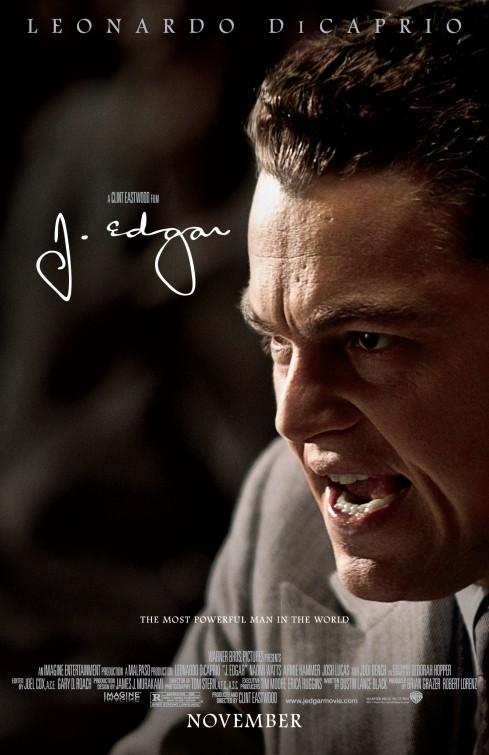 J. Edgar has all the qualities you’d want in a high profile, awards-friendly movie. It charts the life of legendary FBI head J. Edgar Hoover, it stars Leonardo DiCaprio in its title role, and it has Oscar-winner attached as screenwriter (Dustin Lance Black) and director (Clint Eastwood). The only way this movie could be bigger awards bait was if Hoover personally challenged Adolf Hitler to a duel. At a running time of 137 minutes, J. Edgar misses out on explaining why this complex man was who he was, a difficult prospect but I would have at least appreciated some effort.
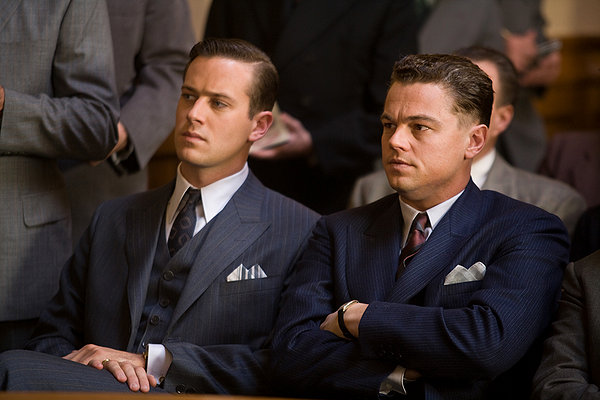
J. Edgar Hoover (DiCaprio) was, at his height, said to be the second most powerful man in the United States. The first director of the Federal Bureau of Investigations served under eight presidents and for over 50 years. The man rose to power fighting against radicals and Bolshevik terrorists in 1919. Hoover successfully arranged for America to deport foreigners with “suspected radical leanings.” He was appointed to head the, then, Bureau of Investigations, where Hoover remade the agency in the image he desired. His agents were going to be clean-cut, college-educated, physically fit, and God help you if you had facial hair. Hoover also fought to bring modern forensic science into investigations and trials, proposing a centralized catalogue of fingerprints, which at the time was dismissed by many as a “speculative science.” Hoover also amassed an extensive system of confidential files on thousands of American citizens he felt were potential threats or if he just didn’t like them. Hoover wasn’t afraid to bully presidents with this secret catalogue. On a personal level, Hoover was admittedly without any friends or interests outside the agency he felt responsible for. His life was defined by three close personal relationships: his mother (Judi Dench), whom Hoover lived with until the day she died; Helen Gandy (Naomi Watts), his loyal secretary and confidant of 40 years; and Clyde Tolson (The Social Network’s Armie Hammer), an FBI agent that Hoover shared a decades-long unrequited romance with. Upon Hoover’s death in 1972, Tolson was given Hoover’s burial flag, and Tolson’s own grave is a mere couple plots away from J. Edgar’s.
 The movie feels trapped in a closet alongside Hoover. The guy was rather enigmatic and hard to nail down, but I would have appreciated Eastwood and Black at least trying to figure the guy out. They treat the subject with such fragility, such sympathetic stateliness about his more salient personality points. It feels like Eastwood doesn’t want to get his hands too dirty, so the provocative material, like the gay stuff, is kept to very period appropriate acts of discretion. A handholding in the backseat of a car is practically scandalous given the treatment on the gay material. The oft rumored cross-dressing aspect is hinted at but explained, in context of the scene, as Hoover’s way of mourning the loss of his mother. With Hoover, there was only his public persona of a moral crusader, a face that he never removed even in his private moments. The guy could never embrace happiness, only duty. It feels like Eastwood couldn’t decide on what stance to take, and thus the film settles on a bloodless examination that won’t upset any of the, presumably, delicate sensibilities of the older audience members. A towering figure of moral certainty, extreme paranoia, righteous conviction, a vindictive streak against his mounting collection of enemies, and a shaky hold on the truth, all in the name of protection against America’s many real and imagined enemies – I feel like the blueprint has been established for the eventual Dick Cheney biopic. It’ll just be slightly less gay.
Let’s talk more about the gay factor. It feels like this area is where Eastwood definitely could have pushed much further, but the old school director seems to be of the opinion that a biopic need not pry nor speculate. Excuse me, but you’re telling me about a man’s life, the least you could do is dig deeper. A domineering mother, who said she’d rather have a dead son than one of those “daffodils,” and the moral restraints of the time, are easy enough to identify why Hoover was a repressed homosexual. That doesn’t separate him from probably a far majority of homosexual men in the first half of the twenty-first century. What makes Hoover, a repressed homosexual, tick? This is no Brokeback Mountain style whirlwind of untamable emotion. Eastwood keeps things chaste, choosing to view Hoover as a celibate man. Hoover and Clyde becomes inseparable “companions,” eating every dinner together, going away on trips, and enjoying the pleasure of one another’s company – the life of the lifelong “bachelor.” But that’s as far as the movie is willing to go (remember the scandalous handholding?). There are hints about how socially awkward Hoover can be, a guy who seems downright asexual at times. He proposed to Helen on a first date where his attempts to charm included showing off his card catalogue system at the Library of Congress (“I bet you show this to all the girls…”). You get the impression he’s not comfortable with this necessary area of human biology. That’s fine room to start, but J. Edgar doesn’t do anything but start its characterization ideas. It gives you ideas to toy with and then moves along. The relationship with Clyde hits a breaking point when Hoover discusses, during one of their weekend getaways, the prospect of finally choosing a “Mrs. Hoover.” Naturally Clyde does not react well to this development, and the two engage in a brawl that ends in a shared bloody kiss. This is about as passionate as Eastwood’s movie ever dares to get.
 I expected more from the Oscar-winning writer of Milk. Black’s lumpy script can often be confusing, lacking a direct narrative through line. Some leaps in time can just be confusing, like when J. Edgar is asking his junior agent typist what figure was most important in the 20th century thus far. The agent answers, “Joe McCarthy,” and then we have a new agent sitting there, and Hoover asks again. Finally we have another agent who responds with Hoover’s desired answer, “Charles Lindbergh.” I suppose we’re left to assume that Hoover fired his typists until he found one who mirrored his own thoughts. There is also far too much time spent over the Lindbergh baby case. I understand it’s the so-called Crime of the Century and, as Black sets up, a situation for Hoover to prove his bureau’s value when it comes to modern criminal science. It just goes on for so long and rarely offers insight into Hoover. Sans Clyde, the majority of the supporting characters offer little insight as well. Hoover’s mother never goes beyond the domineering matrimonial figure. Helen seems like a cipher, rarely giving any explanation for her decades of loyalty despite clear objections to certain choices. She’s too often just a “secretary” there to move the plot along by introducing more characters of minimal impact. With Hoover being such an enigmatic and closeted figure, the supporting characters could have been the areas we found the most insight into the man. Nope.
The entire plot structure feels like a mistake. Hoover is dictating his memoirs so we primarily flash from the 1930s, when Hoover was making a name for himself, to the 1960s, when Hoover is fighting a secret war against, of all things, the Civil Rights movement and Martin Luther King Jr. (he was convinced King was tied to communists). The back-and-forth nature of the story can lead to some confusion over facts and timelines, but the concept of Hoover dictating his memoirs means that the movie becomes a greatest hits compilation, a showcase of Hoover’s finest hours in an attempt to win public support back. He can explain his obsessions and justify his overreaches. That’s why Hoover’s entire catalogue of secret files on thousands of American citizens, including presidents, is given such short shrift. Why would he want to discuss his own subversive tactics hunting subversive elements? The only time the screenplay discusses this secret catalogue is when Hoover and Clyde want to have a good laugh over Eleanor Roosevelt’s lesbian paramour (irony?). Richard Nixon covets these files, so Helen swears that upon the death of her boss that she will shred every page before Tricky Dick can get his hands on them (J. Edgar is rated R for “brief strong language,” and they are all provided by potty-mouthed Nixon). Black attempts something of an Atonement-styled ending with an unreliable narrator, but the effects are slight and only superficial and too late.
 At this point it’s probably going to be rare for DiCaprio (Inception, Revolutionary Road) to give a dud performance. The actor isn’t the first name you’d think of for a Hoover biography. Regardless, the guy does a great job especially with the emotional handicaps given to him by Black’s script and Eastwood’s direction. Given all the emotional reserve, it’s amazing that DiCaprio is able to make his character resonate as much as he can, finding small nuances to work with. Hoover’s clipped speaking style, likely the most readily recognizable feature of the man, is here but DiCaprio does not stoop to impression. He’s coated in what looks like 800 pounds of makeup to portray Hoover in the 1960s. The old age makeup looks good on DiCaprio, though the same cannot be said for his inner circle. Older Clyde looks like he is suffocating behind a gummy Halloween mask; the man looks like he is mummified in his own liver-spotted skin. Older Helen just looks like they powdered her face and added some gray to her hair.
The movie seems to take its emotional cues from its subject; far too much of J. Edgar is reserved, hands-off, and afraid to assert judgment on what was a highly judgmental man of history. What makes Hoover compelling is his array of contradictions. He’s defined by three personal relationships (mother, Clyde, Helen), all of whom he could never have. That’s got to mean something. Instead of exploring these contradictions in any meaningful psychological depth, Eastwood seems to take his hand off the wheel and the film just casually drifts along, steered by the self-aggrandizing of Hoover himself, given so much room to explain detestable behavior in the name of protecting America. J. Edgar is a handsomely mounted biopic with some strong acting, but from Eastwood’s impassive direction (his piano-trinkle score isn’t too good either) and Black’s lumpy script, the finished work feels too closed off and arid for such a controversial subject worthy of closer inspection.
Nate’s Grade: B-
Share this:

Season of the Witch (2011)
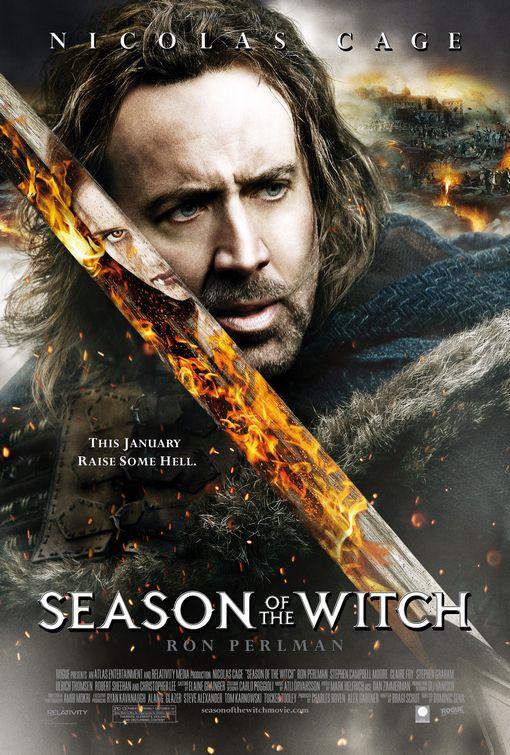 No actor has amassed a higher output of spotty choices than the reigning king of the paycheck film, Nicolas Cage. The man has a habit of appearing in mediocre trash, only notable because a star of Cage’s stature is participating. He’s in late Marlon Brando territory and Cage hasn’t even hit 50 (or blown up to 300 pounds). Every now and then he’ll make a movie that reaffirms how talented an actor he can be, like Adaptation. or Bad Lieutenant: Port of Call New Orleans. But mostly what we associate with Cage nowadays is tic-filled performances, exuberant weirdness, funny hair, and bad movies, two of which are so bad they’re skipping theatrical releases this year (Trespass and Seeking Justice). Season of the Witch will do nothing to change this association.
During the 14th century Crusades, warriors Behmen (Nicolas Cage) and Felson (Ron Perlman) are the best killing machines the Church could hope for. They desert their positions after becoming disillusioned with the Crusades. The duo ventures into a city where a girl (Claire Foy) has been chained in a dungeon. In an airtight piece of impenetrable logic, she’s being blamed for bringing the plague. Behmen and Felson, along with a former knight, a priest, and a young upstart, are tasked with bringing the girl to a monastery where she can be properly dealt with. This secluded monastery is the only place left with a copy of a rare manuscript that contains a spell that will end the pestilence. They put the girl in a cage with wheels and get rolling to that monastery, though not everyone is convinced that the girl is a witch.
 For the first ten minutes, you swear you’re watching a buddy comedy transported to the era of the Crusades. Cage and Perlman are in the front lines of “God’s army” but they’re trading competitive quips like, “You take the 300 on the right. I’ll take the 300 on the left,” and then they preposterously debate who is going to buy post-battle drinks while in the heat of battle. They’re literally slaying enemy soldiers and would rather be arguing over who buys. It’s like they have no attachment to anything happening. This opening Crusade sequence takes us through 12 freaking years of battle locations, but it’s only at the final battle that Cage and Perlman come to the realization that women and children might also be getting slaughtered as they siege city after city. It’s at this point that they get on their moral high horses and stick it to the Catholic leaders: “I serve God, not you. This is not God’s work.” Why did it take them 12 years of fighting to figure out that innocent people may die when you lay waste to cities? Naturally this epiphany only happens after they kill off a European looking innocent. The opening sequence is meant to introduce us to these characters, but it jars the viewer in mere minutes. These guys don’t feel a part of their place or time, and it only gets worse from there. Their nonchalant anachronistic behavior makes the movie seem like a Hope and Crosby vehicle.
This is one thunderously boring movie, putting me to sleep three separate times. I had to rewind what I had missed, and each time I came to the conclusion that I really had missed nothing at all. The problem with the plot is that it makes a mystery pretty obvious. The group is carting around a teen girl in a cage. You’d think this would be something of a conversation starter, perhaps even an opening for a critical analysis of the Inquisition and religious fanaticism at this perilous time. Nope. The whole of the Bubonic Plague is being blamed on a teen girl and nobody seems to bat an eye at this. Sure there’s a few passing references to how killing is wrong (again, remember this took at least 12 years of slaughter to sink in), but the movie’s central storyline seems to shift to a “Is she really a witch?” query. Judging from what kind of film this is, you’d probably be safe betting on “yes” and, well, you’d be partly right. The reason this is no spoiler is because it’s revealed at like halfway through the movie. The girl’s chief defenders suddenly jump on the “burn her” bandwagon. Strange things are following the troupe, so it’s pretty obvious who is at play. However, the girl is no witch but is inhabited by a demon, which seems like splitting hairs. When the super cheesy CGI demon/gargoyle shows its face, the creature actually speaks English but in a really speedy and comical voice that makes it hard to be taken seriously. An earlier cut of the movie did not involve this dumb CGI demon but the girl herself. At least that route would have saved the producers some money and unintentional laughter.
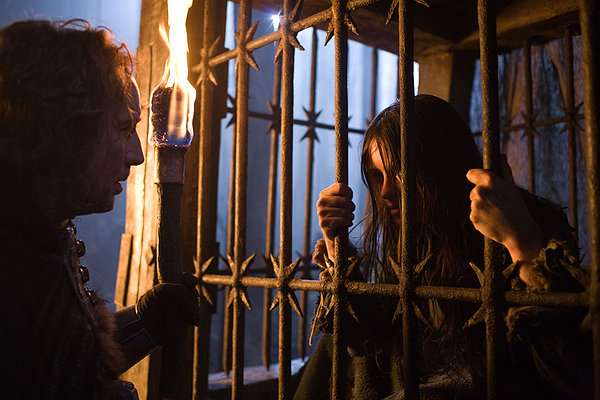 The movie should be far more entertaining, even in a dubious fashion, than it finally is. Season of the Witch flirts with some messages (religion can exploit, women were unfairly persecuted) and silly genre elements amidst a Medieval setting (witches, demons, plague). That sounds like the makings for a campy treat but that treat never materializes. The boring plot lumbers, with the company encountering some setback that picks off their numbers one by one. It’s hard not to feel the drowsy effects of the dull repetition. They encounter killer wolf creatures. Then they encounter a rickety rope bridge, and you better believe that there are rotting boards and fraying ropes. Who keeps building these rope bridges that appear in so many movies, and why do they keep getting hired after continually doing substandard work? Do the regulators get fat payoffs from the rope bridge lobby?
The road to the monastery is a long trek and the movie’s momentum seems to lag with every step. There should be more internal conflict rather than this superficial “killing is wrong” moral that every warrior seems tormented with. The premise should be a ripe opening for a discussion on the perversion of religion for political and personal gain, for the abuses of power, for the archaic view of women as subhuman beings who will seduce men to destruction. There’s even a priest along the way to provide a counterpoint. But alas, Season of the Witch goes hog wild for the cheesy supernatural spooks and even at that it fails miserably.
As of late, the saving grace in a Nicolas Cage paycheck movie is a gonzo performance and some wacky hairdo. We don’t even get that much with Season of the Witch. Cage is oddly subdued throughout the whole movie despite all the swords and witchery. Even his hair is subdued. Without Cage’s typical nutty antics, the movie loses any chance of entertainment it might have ever hoped to have. The shame is that Cage and Perlman both have an easygoing chemistry. You like the two of them together; you just wish they had a better reason to trade insults and one-liners.
Far from bewitching, this movie is ponderously dull. It misses camp by a mile and just lands on mediocrity. There’s nothing about this movie that will stand the test of time, good or bad. This is the definition of a paycheck movie. It flirts with going darker before it settles on a messy monster-heavy ending. The special effects are cheesy, the scares are cheap, the plot is repetitious, the characters feel wrongly transplanted from a modern movie, and Cage sleepwalks through his role. I can’t say I blame him. Season of the Witch put me to sleep and I only had to put up with it for 90 minutes.
Nate’s Grade: D+
Share this:

Red Riding Hood (2011)
 In risk-adverse Hollywood, everything old is new again, so why not remake classic fairy tales for a modern audience? After all, there’s no rights fee. While we’ll have to wait on the competing Snow White films until 2012, Twilight director Catherine Hardwicke unleashes her stylized retelling of the Red Riding Hood tale, titled easily enough, Red Riding Hood. This messy and incompetent movie may cause you to run away screaming into the woods all the way to grandmother’s house.
In a small village on the crest of the big bad words, Valerie (Amanda Seyfried) is betrothed to Henry (Max Irons), a hunky blacksmith that comes from a family of high standing. She’s rather run away with Peter (Shiloh Fernandez), the town’s resident moody guy who’s also her childhood friend. Valerie’s family is ostracized due to past indiscretions, so her grandmother (Julie Christie) lives in a cottage off in the woods. Valerie’s mother died when she was young and she’s been raised by her father (Billy Burke) and her step-mother (Virginia Madsen). This happy hamlet is gripped with fear after a series of violent wolf attacks. Father Solomon (Gary Oldman) ushers into town with a proclamation that he will find the wolf and slay it. But he clarifies that they are hunting for a werewolf among the townsfolk. During one attack, Valerie discovers that she has an odd telepathic link with the wolf, which makes her further question her identity. Naturally, this makes the town fear her and offer her as a red riding sacrifice. But who is the wolf and what is his or her plan with Valerie?
This is a disaster of epic fairy tale proportions. Red Riding Hood attempts to reshape the oft told tale into a palatable mix of sex and violence for today’s pre-teens (teenagers will surely be bored by this), somehow forgetting that the original tale is filled with macabre violence. The filmmakers have tried to make Red Riding Hood (RRH) hip to a younger generation; this ain’t your granny’s fairy tale, yo. But they’ve really turned the simple story into a lumbering, idiotic, grating, and nearly impenetrable movie. This youthful infusion of hollow artifice and misplaced attitude, as well as a fumbling attempt at ill-conceived edge, makes the movie a metaphorical bratty teenager. You get tired of its taxing nature and empty posturing. It’s trying to be cool with last year’s catalogue. Hardwicke is using every tool at her disposal to appeal to an easily bored teenage demographic, so the movie takes several sidesteps that are only justifiable because someone might think they are cool. The musical score includes grating, churning anachronistic electric guitars. It feels like your neighbors are throwing a party and the music occasionally drifts over. These visual and narrative flourishes only remind you how desperate and out-of-tune this whole lousy production is.
 Screenwriter David Johnson (Orphan) takes the familiar woodland frolic and turns it into the world’s worst Agatha Christie-styled guessing game. The wolf is now a werewolf and then the town undergoes a witch-hunt that would make Arthur Miller wince (“I saw Goody Red with the wolf”). It’s here that the movie preposterously attempts to become some sort of important statement on, I kid you not, the war on terror. Solomon brings a metal elephant that he sticks prisoners in to soften them up. He also lights a fire below the belly of the elephant to expedite the process of getting the truth out of a suspect. Solomon’s status as a cleric has to serve as some sort of biting criticism of church authority, especially after he wants to get an inquisition going. I appreciate the wholly misguided attempt at topicality and commentary, but this was not the movie to make statements. Anyway, the plot is convoluted and every scene seems to just further dilute the clarity of the narrative. The movie just descends into a manic game of “Guess the Wolf.” We literally go through just about every speaking part at some point as a potential werewolf suspect. That means every bit part is given due consideration, including the mentally handicapped child. I actively wanted the wolf to be the mentally handicapped kid just for the awkward discussions of what to do next (“We can’t kill the wolf. He’s… special.”). Red Riding Hood works so hard to make like 8 characters look alternatingly guilty. The town seems to be populated by red herrings and not people.
Red Riding Hood is a neutered horror movie and a rather bloodless romance; there’s a lack of blood pumping with either. For a movie about a killer wolf there is precious little blood or wounds even considering some people are mauled to death. It seems the filmmakers had a choice of going with mild gore or mild sensuality to stick the PG-13 landing and erred on the side of hormones. The romantic elements are kept at a pre-teen simmer. For only they will blush at the more suggestive elements, including the table-dance-in-slow-mo shimmy dancing that the town seems to favor during their festivals. At one point Peter unties one of Valerie’s bodice strands. To be fair, in mythical land/mythical time setting, that’s probably like their equivalent of third base. The romantic triangle is desperate to ape the Twilight model, and the male characters are pinup pinheads. They occupy types, one being the brooding “darker” guy who Valerie really wants to be with, and the other is a nice guy from a proud family (sound familiar, Twi-hards?). The movie goes to shoddy lengths to keep these two at odds, when it appears that, like Bella Swan, our Valerie is one flower not worth the trouble of plucking. It’s hard to get involved in a romance when you’d rather watch every participant getting eaten by a wolf.
 “What big eyes you have” is something of an understatement when speaking about the saucer-eyed Seyfried (Letters to Juliet). She gets to make good use of her ocular abilities, though who knows if it’s acting or just expressions of disbelief about what kind of movie she is trapped inside. Seyfried does her whole blasé shtick, which makes the character feel more like an annoying know-it-all even when she admittedly knows nothing. Oldman (The Dark Knight) inhales scenery at a dangerous pace, acting ferociously over-the-top and unrestrained. It’s like he’s trying to channel a wolf in his performance. At least he’s entertaining to watch, which cannot be said for the movie as a whole. Irons (Dorian Gray) is bland but Fernandez (Skateland) is laugh-out-loud awful at a few points. Clearly talking is not this guy’s strong suit. Neither is emoting. The weirdest part of Red Riding Hood is merely seeing Madsen’s face. Clearly this woman has undergone plastic surgery since her Oscar-nominated turn in 2004’s Sideways. She almost resembles a gentler looking Mickey Rourke at certain unkind angles. Another famous face goes to sad lengths to alter her looks to be seen as acceptably good-looking in ageist Hollywood.
Red Riding Hood is a tragic misjudgment on the part of just about everyone involved. The screenwriter thought he must have been making a serious allegory, Hardwicke thought she was making a wild and witchy cousin to Twilight, and the producers thought they were making a film that had genuine appeal. They were all categorically wrong. The reworking of the fairy tale elements is mostly mundane. She gets a red cloak from her granny but otherwise this story might as well just be about a girl and a werewolf. It’s not an imaginative update or a clever reworking, this is just a dumb werewolf story with extra dashes of Twilight for seasoning. The key to unlocking the Red Riding Hood story is not by introducing a sterile love triangle. This hyperactive hodgepodge mistakes setting for atmosphere and a high number of characters for mystery. I was astounded as I sat and watched this movie; turn after turn it veers wildly in tone and execution. I haven’t even talked about the special effects for the wolf, and there’s a reason I am leaving that unsaid. Red Riding Hood is a movie 12-year-old girls might fawn over. If you find yourself outside that marginal demographic, then you’ll likely find this movie to be an irritating, nonsensical, dopey, pitiful bore. You can stuff that in your picnic basket, Red.
Nate’s Grade: D
Share this:

Captain America: The First Avenger (2011)
 In the summer of superheroes, you’ll be excused for feeling some fatigue when it comes to men in tights. Captain America: The First Avenger is a surprisingly enjoyable sepia-tinted action film that flexes enough might to pleasantly hark back to the days of 1940s adventure serials. Taking place almost entirely in the era of World War II, the film, and its hero, and unabashedly square and earnest. Steve Rogers (Chris Evans) begins as a 90-pound weakling determined to fight for his country and gets transformed into a behemoth of beefcake by the Army. Captain America is devoid of the dark brooding that has come to encapsulate modern superhero movies, but it’s also playing its B-movie silliness straight. The flick has more in common with Raiders of the Lost Ark and Sky Captain than most other superhero product. Better yet, the movie finesses the in-your-face patriotism of the title character. I mean the guy is called Captain America. Yet the film finds a way to resonate a sincere nationalistic pride without falling back into Michael Bay-level jingoism. And who’s going to make for better villains than Nazis? Director Joe Johnston (The Rocketeer, Jurassic Park 3) turns out to have been the perfect choice to helm this rah-rah retro enterprise. The pacing is swift, the acting is engaging, the special effects are terrific particularly Evans’ transformation into a weakling, and the film is unexpectedly emotional at points. This is a comic book movie that would appeal to an older generation not normally interested in superheroes, namely people like my dad.
Nate’s Grade: B
Share this:

X-Men: First Class (2011)
 Marvel’s X-Men franchise had some serious damage it needed to undo. The once mighty superhero series had been harmed by that age-old foe – bad sequels. The collective stink from 2006’s X-Men: The Last Stand and the 2009 Wolverine debacle, the franchise had lost some serious luster. While the recovery was not nearly as deep and cataclysmic as what the Batman franchise had to deal with in the wake of 1997’s Batman and Robin, a film that flirted with salting the earth, the X-Men needed some kind of facelift. Enter director Matthew Vaughn (Kick-Ass, Stardust), the man who was going to save the series back in 2006 when original director Bryan Singer flew away to direct a different man in tights. Vaughn was originally tapped to direct Last Stand but he dropped out and was replaced by the hack Brett Ratner (Rush Hour). Thus began the slide toward mediocrity. Now Vaughn is back to tidy up unfinished business, taking the series back to its historical roots in the 1960s. It seems that a trip back in time was just what was needed to make the X-Men fresh.
Back in 1944, Erik Lehnsherr is a prisoner in a Polish concentration camp when Dr. Schmidt (Kevin Bacon) discovers the young boy’s great potential. When enraged, Erik can control anything metallic. In upstate New York at the same time, young Charles Xavier discovers a young shape shifter named Raven. She’s blue from head to toe and afraid. They’re delighted to find one another, fearing they were the only ones “different” in the world, children of the “atomic age.” All three of these people are headed for a collision course. In 1963, Charles (James McAvoy) has become an Oxford professor, Raven (Jennifer Lawrence) has followed him to England, and Erik (Michael Fassbender) has been systematically hunting down the Nazis responsible for his pain and suffering. Dr. Schmidt has now become Sebastian Shaw, a younger-looking playboy with the intent to push the Soviets and Americans to nuclear war. Shaw has his own team of mutant henchmen, including telepath Emma Frost (January Jones, proving once again that she can really only ever be good as Betty Drapier) who walks around in white lingerie the whole movie. Together with CIA agent Moira MacTaggert (Rose Byrne), Charles and Erik assemble their own team of young mutants to thwart Shaw.
Similar to 2009’s Star Trek, this film provides the opportunity to reboot a franchise by going back in time. It transports the series back to the beginning of the friendship between Charles and Erik, and spends the next 130 minutes filling in the rationale for the “why” of their varying personal philosophies. By dialing back, we’re able to play around with 40 years of back-story and histories. While we know the end results, that these two giants will become enemies, that Charles will lose the ability to walk, and that Raven/Mystique will eventually side with Erik, that doesn’t mean there isn’t pleasure to be had in watching the journey. There are all sorts of self-aware in-jokes for fans and a few nifty cameos that left me howling with glee. The script, credited to Vaughn, his writing partner Jane Goldman (Kick-Ass), and four others, smartly moves the film forward; no scene seems at a waste. Even better, the film strikes a tone that manages to take its real-world implications seriously (nuclear brinksmanship, Holocaust, and fighting for equality and acceptance) without diminishing its popcorn thrills.
As a summer movie, X-Men: First Class has enough razzle-dazzle to compliment its intelligent social pontification. Vaughn and his screenwriters have composed action sequences that neatly incorporate the mutant abilities of its subjects while building the tension and smartly utilizing the contours of geography. I hate action sequences that don’t play to the potential of location and subject. An evil teleporter (Jason Flemyng) finds a fiendishly clever way to dispatch 20 CIA agents. Magneto efficiently takes out former Nazis residing in Argentina in one chilling sequence (“I’m Frankenstein’s monster,” he tells one man). Shaw makes for an actual formidable opponent for our fledgling heroes. The personal connection he has with Erik, on top of Bacon’s devilish glimmer of villainy, makes Shaw a strong antagonist that the audience can rally against. Vaughn has a splendid reveal with Shaw. Back when he was a Nazi doctor, he asks young Erik to move a coin with his abilities. The shots consist entirely from one side of his office, showcasing it to be a bookish study. Then when Shaw calls the Nazi guards to bring in Erik’s mother for a little more direct incentive, the camera flips position. We see the opposite side of the room, a medical station on the other side of large glass panels. Inside is a torturous display of medical cutlery. It’s a fantastic reveal that kicks up the tension while adding to the terrifying character of Shaw. The action highpoint, a mutant vs. mutant battle amidst the Soviet and American naval fleets, provides plenty of parallel action to follow that keeps the movie alive and kicking.
The film mixes a frothy, James Bond-esque spy thriller feel in production design and whatever-goes plot savvy, but then recomposes real life events as mutant enhanced. Alert the history textbooks, because the Nazi scientists experimented on mutant children and that mutants averted World War III. Some will chafe at the alternative history approach, but I find it to be more interesting, suspenseful, and a natural fit with the overall Cold War paranoia feel of the setting. Melding the X-Men into history makes for a more intellectually stimulating adventure, tipping its hat at various historical revisions that payoff as small rewards for a well-informed audience. I’m not saying that the movie is like Noam Chomsky’s take on X-Men by any means, but it’s certainly the most heady film in the series since the departure of Bryan Singer (he serves as producer on this flick). Indeed, this is a rather talky X-Men adventure with plenty of philosophical debates and speeches. But then it’s got naked women in blue too. But you see, it’s not just naked women in blue, it’s that a naked woman in blue can become a political statement – man!
And it’s on that note I’d like to say a few words. Mutants have always been a central metaphor for the oppressed, be they Jews, African-Americans, homosexuals, whatever minority group you’d like to slot in. That’s been one of the secrets to the continued success of Marvel’s flagship series – anybody can identify with the fear of being judged, feared, and despised because of who you are. That’s why the character of Raven/Mystique, short of Magneto, is the most fascinating character in the movie. Her true form, scaly and blue, is what keeps her feeling like an outcast. She doesn’t have an invisible power like her surrogate big brother, Charles. She constantly disguises herself in order to fit in, albeit her disguise is the alluring natural figure of Jennifer Lawrence (Winter’s Bone). “Mutant and proud,” she says in disdain when she stares at her bluish reflection in the mirror. It is through Erik hat she begins to believe in this mantra, gaining pride that “blue is beautiful” and she need not even wear clothes to cover who she is up. Raven/Mystique is the figure torn between the two philosophies argued by Charles and Erik. She is the central figure that has to struggle with reality vs. idealism. It’s also a little funny that a movie piggybacking the civil rights movement of the 60s (mutant rights!) also trades in the casual misogyny of the 1960s (women in lingerie as outfits, regularly practiced sexism). I suppose some of this is intentional. I guess the women’s movement will be saved for a sequel.
While the retro setting ties in nicely with the series’ core metaphor about being different/disenfranchised, the dichotomy of ideas presented by Charles and Erik are not given equal measure. That’s because, quite frankly, Erik is a much more powerfully interesting character and more sympathetic than a rich kid who can read people’s minds. Charles Xavier and Magneto have always represented a comic book version of Martin Luther King Jr. and Malcolm X when it came to the ideas of integration, equality, and representation. Charles believes that mutants should assimilate and that humanity will accept in time; peaceful and hidden. Magneto, on the other hand, takes a more militant stance and feels that mutants need not hide who they are out of fear or shame, that they are the dominant species and should not be threatened by the weaker Homo sapiens. But where X-Men: First Class runs into some trouble is that the ideological deck is completely stacked in Magneto’s favor. He’s the one who suffered through concentration camps, Nazi experimentation; he’s seen the worst of what mankind of capable of. He’s a tormented man seeking vengeance, which is character motivation that is easy for an audience to fall behind. Then, even after the mutants save mankind’s bacon during the Cuban Missile Crisis (the first person who tells me this is a spoiler gets a history book thrown at them), they still get treated as the enemy. Almost everything that plays out onscreen aligns with Magneto’s ideology, which makes it hard not to be on Team Magneto as the movie draws to a close. I suppose the film utilizes our knowledge of future events to counterbalance Magneto’s pessimistic world philosophy.
The other issue that lends more credibility to Magneto than perhaps the filmmakers were hoping for is the fact that he’s the most interesting character in the movie, easily. The X-kids are a pretty bland bunch of boys and gals. This is the first class the filmmakers chose? Did they have recruiting violations at the school? Havok (Lucas Till), a goy who can shoot energy beams, Banshee (Caleb Landry Jones), a guy who can scream loudly and fly, somehow, Angel (Zoe Kravitz), a gal with fairy wings and an acid tongue, and then Darwin (Edi Gathegi), a guy who… adapts? Darwin’s power is so obtuse to explain, it’s no wonder he doesn’t last long in service to his country (it’s a bit tacky that when one character says “slavery” the edits have to cut back to the one black mutant for a reaction shot). Each one of these teenagers has a different reaction to their powers. Some are ashamed, some are afraid, others proud or apathetic. But they are all singularly uninteresting. Once they establish their power, they become less a character and just another piece on a game board to be positioned. And Lenny Kravitz’s kid in fairy wings? Plus she spits little fireballs? I’m sorry but that should have been the first thing removed from rewrites. This crew makes it sure that we empathize even more with Magneto as he refines his powers to reach his personal vengeance, which is the film’s pre-designed payoff. We’re not really looking for the team to band together, which they inevitably do, but we’re awaiting that splash of vengeance. And when it does come, it’s satisfying, stylish, and dramatically fitting (“At the count of three, I’m going to move the coin.”). The fact that the movie still has like 15 minutes of material afterward is almost inconsequential.
Vaughn certainly delivers the spectacle, it’s the actors that produce the real fireworks. This is a vehicle for McAvoy (Atonement, Wanted) and Fassbender (Ingloruious Basterds, Jane Eyre), and both men provide admirable gravitas. McAvoy’s role offers a more jocular performance, showing Charles to be a bit of a lady’s man in his younger years, harnessing his telepathic powers to bed him some beauties. Then again, as I’ve been told from my female friends, looking like McAvoy will certainly also help matters. But this is Fassbender’s show. He has a chilly intensity to him, rather than just being cold and indifferent like January Jones. His performance captivates you from the start, and his slow-burning hatred consumes the man. It’s a dramatically rich performance given the material. After being discriminated against for being a Jew, than a mutant, he has to sell that his character, haunted and rage-filled, would ironically follow the same social Darwinism that his Nazi tormentors evoked. And Fassbender sells every bit of an iconic Marvel villain coming into his destiny. However, his Irish accent slips out in the film’s final reel, and I’m really curious why the studio couldn’t have shelled a few bucks to fix that with ADR. Rushed for time, or revealing that Magneto has unheard of Irish lineage?
Going back in time manages to open up all sorts of possibilities for the X-Men franchise. There could be a whole slew of sequels that play around with the rich, complex back stories of the X-Men without having to serve the aging stars of the original trilogy. Vaughn keeps the proceedings amazingly fluid, stylish without being overtaken by visual artifice, and the swinging 60s provides a groovy backdrop. The action delivers when needed, the smart script doesn’t downplay the clash of ideas to go along with the clash of fists, and the special effects are relatively up to snuff as summer escapism goes. The movie is not without its misses, including a cadre of lackluster junior mutants. But Vaughn has re-energized a flagging franchise and given hope for a future (past?). In the pantheon of X movies, I’d place X-Men: First Class as an equal to X2, the best in the series. It may not be at the head of the class, but this superhero flick earns is stripes with a solid effort and strong potential.
Nate’s Grade: A
Share this:

Water for Elephants (2011)
 Would you believe at no point does the film Water for Elephants come close to explaining its title? I have never read the best-selling 2007 novel, where I’m sure it’s given some glancing explanation; so allow me to thus pontificate. Rosie the elephant is given tubs of whiskey at several points in the movie, which she happily laps up thanks to her prominent proboscis. So does that mean that the “water” for elephants is whiskey? If that’s the case, then this is really a tale of dangerous enabling. But then again, how do you tell a four-ton pachyderm that she’s cut off?
Jacob (Robert Pattinson) is one exam away from becoming a licensed vet from Cornell in 1931 when he’s delivered some tragic news. His Polish immigrant parents died in a car accident. Distraught, Jacob runs away and hops onto a passing train, stumbling upon a crew of circus performers. The train belongs to the Benzini Brothers circus, led by the fiery August (Christoph Waltz). He’s about to be thrown off the train when he panics and screams that he’s a vet. August hires the kid as the team’s newest vet and Jacob finds animals that are in bad shape and pushed to their limits. He recommends a mercy killing for the main attraction, a white horse that the boss’s wife, Marlena (Reese Witherspoon), performs upon. He takes some initiative and puts the horse out, despite August’s wishes. Lucky for them all, they find a new star attraction – Rosie the elephant. Robert doesn’t know the first thing about elephants, or “bulls” as they’re referred to by performers, but he’s tasked with getting the creature ready to perform or else everyone will be destitute. The man has a way with pachyderms, and the Benzini Brothers experience a windfall of new business, looking to take on Ringling Brothers. But the whole time, Jacob is making moon eyes at the boss’s wife, despite everyone telling him at every turn not to.
 The biggest issue this movie has is that the trio of main characters all feel like they exist in separate movies. There is zero chemistry between Pattinson and Witherspoon, further dampening their lukewarm romance. Robert is a character defined by being young and having a moral center. He’s not a person so much as an alternative. Marlena is the damsel very distressed, and Witherspoon plays her part all in all slow cock-eyed glances. If I had to pick one of the three, I’d choose to go with August’s version of the story just because he’s a more interesting character than our do-gooding Jacob. August is a huckster who needs to take care of a caravan of drifters and sell them to the public as the stuff of dream and legend. He has some charisma, he’s constantly leveraged against debts, and he is pressured to keep things afloat and to keep people from mutinying. This is beyond the heyday of circuses, so he knows that too many shows with too few people means that his troupe will be picked apart by circus carpetbaggers. You actually start to empathize with him at turns, and then he goes off and beats animals or his wife and that’s that. August is an interesting, vulnerable, flawed character, and he’s given the thankless role of being setup as sneering villain. I would have rather watched August try and keep his deteriorating circus together than watch another tired romantic triangle.
The romance that so much rides on is about as sure-footed as a drunken elephant. Part of this is the failure of Pattinson to deliver a performance that doesn’t feel wooden and artificial, as if he’s posing more than acting. But the romance, which dominates the film’s narrative, is given such scant reasoning that it expects the audience to simply fill in the blanks. He’s a young, good-looking guy who loves animals. She loves animals. Her husband is a jerk, so what’s the problem? Naturally, she’d just run to whatever available catch she could find to escape her hell so anything that delves into more character detail would be a waste of time, right? The movie seems to think so. The love triangle all inhabit very rigidly defined parts. Just because a woman is married to a nasty guy doesn’t mean I instantly want her to get together with just any alternative. Sure this lady deserves to be treated better, but just because a film presents “Option B,” and that option happens to set teenage girls aflutter, doesn’t mean I’m rooting for “Option B” just because it’s not “Option A.” That’s not enough for me to make a satisfying romance, but that’s all Water for Elephants has its aim set on. I need more effort, movie. It’s no surprise that the romantic moments are the weakest parts of the film.
 The real star of the movie is Rosie the elephant. She’s a natural performer and she’s got more presence than Witherspoon. I needed more moments with Rosie. After a somewhat boring first act, I started wishing that Rosie would replace someone in this dull love triangle. Imagine how much more interesting this movie would be if it was the heartbreaking story of one man, on woman, and one elephant. Maybe Jacob likes fat-bottomed girls. For animal lovers, there are some wince-inducing sequences of animal cruelty, mostly at the hands of the temperamental August.
The very opening sets the story up for a colossal disaster in the end, and the fact that we are not delivered disaster is a disaster of storytelling (too much?). I’ll try and keep the spoilers in a general sense without going into specifics. The film is bookended by the framing device of Old Jacob (Hal Holbrook) leaving his nursing home to see a circus and tell his life’s story. During his conversation with a circus leader (Paul Schneider), the young man is taken aback when Old Jacob reveals he was apart of the Benzini Brothers troupe when “it” happened. We’re told that it’s like the third biggest circus disaster in history and it has reverberated through decades. I’m set up for something memorable. I’m set up for a tragic ending, likely involving Marlena so that their love will forever have that tinge of unrequited longing. Then when we do eventually head to our big moment in the big top, well it’s far from memorable. Once you assess the ending, you realize that there is very little to make it number three on history’s lists of circus-related mayhem. If this stuff registered as number three, what the hell was number four? A clown catching his hair on fire? And then the movie carries on to some ludicrously happy ending, which seemed tonally inappropriate given the mood of the film and the poorly written romance between Jacob and Marlena. I was prepared for something operatic and terrible, and skimping out on that after an exasperated setup makes me feel hoodwinked, like listening to August bark about the greatest sights and sounds imaginable when they’re all just a trick. Something tells me that screenwriter Richard LaGravenese (Freedom Writers, P.S. I Love You) was not intending to add some meta commentary on how his story is built for dissatisfaction.
 Water for Elephants is a watered-down romance that flounders thanks to three different actors acting like they’re in three different movies. Also, it doesn’t help your romance when so little work is put into making young people fall in love. There are fascinating circus-related tidbits that make me wish the movie was more Depression era circus drama than Depression era circus romance. It’s a handsome enough movie from a technical standpoint, and it has some points of interest and some interesting characters, but its shackled to such a weightless and naïve love story. This movie was described by many as an “old fashioned” kind of film, and generally that can be construed as a warning signal. When people dub something “old fashioned” it can tend to mean “boring except to older people.” It just so happens that my screening of the film was an open caption screening, which attracted dozens of our nation’s elderly and hearing impaired. I didn’t so much mind having grown up with subtitled foreign films. But one delightful accident of seeing this open captioned screening was that they captioned everything. Every sound, every offhand piece of dialogue that would ordinarily go unnoticed and undetected. So now I got to see, as subtitle form, such discoveries as Guy in Background saying, “Hey pick that up,” and Other Guy in Background responding, “Okay. Put it where?” It was more exciting than what was going on between Jacob and Marlena. Now let’s get that elephant drunk!
Nate’s Grade: C
Share this:

The Eagle (2011)
 In 140 AD, the Roman Empire has spread its reach across the European continent. Commander Marcus Aquila (Channing Tatum) is stationed in northern Britain. 20 years earlier, Marcus’ father led a legion of Romans into the northern British territory. The natives attacked them and Rome’s golden eagle, a significant idol under the guidance of Marcus Senior, was lost to history. Marcus has endured shame and vowed to redeem his family name. After surviving a nightly attack at the fort, Marcus displays great bravery but is injured. He’s honorably discharged from the Roman military. While he regains his strength, Marcus plans on venturing into the northern British highlands and finding that missing eagle. He teams up with Esca (Jamie Bell), a slave whose life he saved, and the duo goes beyond the wall that separates civilization (Rome) for the wilderness (native Britons).
Too often The Eagle feels like its wings were clipped. With such life and death stakes, the movie feels curiously adrift and prosaic. It never feels like it has any rush to go anywhere. In some regard, that makes the film feel like a product of the Hollywood of old, where a plot was allowed to meander and marinate to build to something worthwhile. But The Eagle is hardly worthwhile. It begins with some amount of excitement but that quickly dissipates with an interminable middle that feels like it’s still going on even as I write this. The plot is far too lean to cover a wide canvas, and the characters are far too shallow and incurious. They say so little, and what they do say means so little. It’s general variations on the idea of honor and sacrifice. They’re just focused on retrieving the prize. Meaningful conversation would just get in the way of things. The character dynamics between Marcus and Esca is stilted and kept at a distance. The class struggle and history of foreign occupation is never really addressed beyond a superficial nod. It’s like being stuck with two boring guys on a long, uninteresting road trip. Director Kevin Macdonald (State of Play, Last King of Scotland) gives the proceedings a docudrama touch thanks to his background in nonfiction films; too often this means he goes on half-baked Terrence Malick-like asides to admire a grain of wheat or some old artifact. The docudrama approach seems to conflict with the relatively old fashioned feel for this film, like Macdonald is trying to do his best to lift up material in want. There’s just so little at the core of this movie.
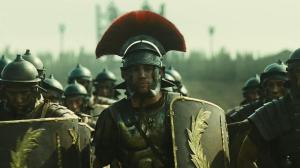 Tatum (G.I. Joe, Step Up) tries some form of an accent, though I’m not exactly sure what region of the Roman Empire the man is hailing from. He still has an imposing presence that manages to fill in the gaps of his acting ability, much in classic Hollywood tradition. And yet the man seemed more masculine in a Nicholas Sparks movie from last year. Bell (King Kong, Jumper) takes his haunted, submissive character to heart and gives a performance that confuses submission with understatement. He main mode of acting is the power of serious staring. The two actors don’t ever develop any onscreen sense of camaraderie or warmth. Even during the climax, you never feel like these guys have anything more than a civil employer/employee relationship. That’s why the laugh-out-loud, tonally jarring ending seems so out of place. Instead, Marcus and Esca strut through the halls of Rome, music triumphantly rocking out, and says, “What do you want to do now?” like they’re lining up weekly wacky adventures to be had. You’ll be surprised to see actors like Donald Sutherland, Mark Strong, Denis O’Hare, and even A Prophet‘s Tahar Rahim littered among the cast. Why are they in this movie when they have such insignificant parts compared to their bland leads?
The colonial perspective also started rubbing me the wrong way. Now colonial tales have long been featured in pop culture. I don’t on the surface have an issue with a storyteller utilizing a massive horde of natives to stand in as an antagonistic force. But sometimes that dynamic creates a skewed rather culturally tactless portrayal. Are the overpowered, conquering empires always blameless? Do the natives, who have been displaced and killed, not have a respectable grievance? Do they not have a right to fight for the lands that have been taken? Too often, the natives are viewed as blunt brutes (just watch the “cowboys and Indian” pictures from the 1950s) and the figures of expansion are viewed as heroic pioneers. The Britons come across as, essentially, the Indians. The filmmakers always want us to side with our hunky hero Marcus and his quest for honor at every turn, but the movie takes great turns to make the natives seem extra villainous. For a while they just come across like another culture. They have community, customs, and the like; it’s just not the dominant culture’s community and customs. And then, in an appalling moment of cheap melodrama, the Briton chief kills a child to send a message to Marcus and his Romans. This material is handled so indelicately that an unsettling undercurrent emerges and gains steady traction.
 So what if the Britons stole one gold eagle 20 years ago? “It’s not just a piece of metal. The eagle is Rome,” we are reminded by Marcus. Symbols are great, but a one-man search in a land as large as Scotland seems impractical so many years hence. And then you have to take into account the time passage. It’s been two decades seen this beloved bauble went M.I.A., and damn near anything could have happened to it. It could have been thrown into the ocean. It could have been buried. It could have been smashed to smithereens. It could have been taken to another land. It could have been melted down into smaller, gift-shop sized eagles on sale to the general public. I’m just saying that in the ensuing 20 years anything could have happened to this bird. The fact that one guy can traipse on foot through Scotland and the first group of natives he runs into happen to possess the artifact that went missing 20 years prior is just insulting. First chance and he lucks in? I was eagerly waiting for an ending where Marcus, brimming with pride at having returned the eagle to Rome, is informed by one of the politicians that it’s the wrong eagle (“Here we go again!”).
The Eagle is dressed up to be an old time adventure story, but it’s just too slovenly paced and generically plotted to work. The lead characters are bland, distant, and noble to the point of annoyance. When a character is defined entirely as forward thinking, exceptionally lucky, ethically straight figure of honor, excuse me when I start to yawn. And when all he’s tasked with is finding an old relic that miraculously happens to be with the first freaking group of people he finds, then excuse me for eyeing my watch. The Eagle has some workmanlike action and suspense to it, brief moments of activity over what is in essence two hours of silent walking (it’s like somebody cut out the middle of a Lord of the Rings movie and sold it). The Eagle, both the film and the titular hunk of metal, are simply not worth the effort.
Nate’s Grade: C
Share this:

Love and Other Drugs (2010)
 Director Edward Zwick has spent the last two decades making mass-friendly action films with designed to teach us all some valuable lesson, like Blood Diamond and Glory. But the idealistic filmmaker began his career with realistic relationship dramas like About Last Night… and the seminal TV show thirtysomething. There wasn’t an explosion to be had, unless you count the emotional ennui of middleclass white people. Love and Other Drugs is adapted from the biography of a Viagra salesman, which seems like a strange jumping off point for a romantic drama. Watch out for those unexpected side effects.
It’s 1996, and Jamie (Jake Gyllenhaal) is a smooth-talking, suave pharmaceutical rep for the medical giant Pfizer. He’s been dispatched to the Ohio River valley area with a mission to push his drug samples on doctors and raise his quotas. While posing as an intern, he meets Maggie Murdock (Anne Hathaway), a coffee shop beauty in stage one of Parkinson’s (don’t attack me, they reveal this spoiler before you even see Hathaway’s face). She spurs his advances but he persists, and the two agree to a strictly sexual relationship. Because of her illness, Maggie is wary of getting attached to people. She sees Jamie as a shallow, well-muscled lunkhead who won’t want anything else but a slew of orgasms from a pretty girl. And Jamie is content, until, of course, he falls in love. Maggie feels she’s sparing her lover the pains that will accompany her Parkinson’s. The two struggle with her illness, the toll it takes on their relationship, and the possible future they will have together… in between lots of sex.
 The true pleasure of Love and Other Drugs is watching Hathaway and Gyllenhaal together onscreen. The Brokeback Mountain buddies have tremendous chemistry that makes their give-and-take exciting and pleasing. Hathaway and Gyllenhaal may be the best onscreen couple I’ve seen since 2005’s Mr. and Mrs. Smith. Chemistry is such an indelible component for romance and yet it is so elusive to capture. So when a cinematic couple really create some serious sparks, it’s a memorable exchange. Hathaway and Gyllenhaal are a terrific team but also the rare screen couple that raises the performance of their partner. You are easily convinced that these two enjoy the company of one another; they’re so confident with each other even as they’re tumbling around naked. Hathaway has grown into an actress of surprising range, making keen use of her animated Disney heroine features. She has a knack for playing defiant, spunky women that have an alluring fragility, and that also describes her Maggie (how does a coffee shop give Hathaway the health insurance she needs for Parkinson’s meds?). Gyllenhaal has always had his boyish charm, but he seems catapulted to new charisma heights with Love and Other Drugs. He’s exploding with energy and comes across bursting with life onscreen. He starts as a suave Lothario drunk on his own charms but, as movie journeys dictate, he morphs into a committed, mature man. The roles are pretty standard (slick selfish salesman, sad girl with illness) but the duo bring extra vitality and heat that makes Love and Other Drugs compulsively watchable in its finer moments.
It’s refreshing to witness a major Hollywood movie that treats human sexuality without the standard artifices of Hollywood. Love and Other Drugs is not coy when it comes to physical lovemaking. This isn’t a blockheaded movie where the woman goes through the entire night of passion while wearing a bra the entire time (the epitome of PG-13 sex). This isn’t a movie where after a healthy bout of sex the couple feels the need to cover up their goods as they lay beside one another. Like after a vigorous sexual experience now the lovers suddenly become bashful at their own state of nakedness (get the fig leaves – stat!). So it’s refreshing to watch a film deal with sexuality without giving undue attention to how “risqué” everything is. The nudity is European-style casual, and while the film manages to be quite sexy, the nudity and sex scenes do not play as shameless titillation. The sex and copious nudity is just another part of the storytelling. Of course it also happens to be a prominent and highly marketable storytelling aspect. It’s not like Hathaway and Gyllenhaal are homely actors. Watching beautiful people writhe together on screen and nonchalantly walk around without a stitch on has always been a sure-fire way to sell tickets. Love and Other Drugs utilizes all that skin to lure boys into a traditional romantic drama. It’s to Zwick’s writing and directing credits, and the natural chemistry of his two high-wattage stars, that the parade of flesh doesn’t feel like naked, prurient exploitation. It’s not exactly an edgy film by any means but it’s assuredly adult in its portrayal of sexuality. Or at least it thinks it is. The sex isn’t really a topic to be explored with nuance and clarity; it’s more something to keep the actors busy.
 Ultimately, the tonal inconsistency is what hampers the momentum of Love and Other Drugs. It’s hard to build narrative momentum when the film just seems to be starting over time and again. Zwick bounces around different tones, sometimes wildly from scene to scene. At heart it’s a weepie romance, the sick girl and her paramour coming to terms with their doomed love. But then the movie also wants to be an energetic, smart-alecky comedy, then there are all sorts of crude gags (hope you like boner jokes), and then the film also wants to be a satire on high-powered pharmaceutical companies and their sleazy influence romancing doctors. And then in between all that is the weepie drama stuff as Maggie has to deal with the (movie) realities of her illness. Here’s an example of the tonal whiplash that did the movie no favors: Jamie stumbles in on his disgusting younger brother (see below) masturbating to a sex tape of Jamie and Maggie, of his own brother and his brother’s girlfriend. The scene is played for broad comic laughs and ends with Jamie beating his brother off screen with that very sex tape. If people needed another reason not to make sex tapes, here it is: Josh Gad might one day view them and pleasure himself. You don’t want that, trust me. But then the very next scene involves Maggie working on her art and unable to control her Parkinson’s symptoms, namely finger tremors. We watch as Maggie diligently and patiently tries to open a bottle of pills, the childproof locked top confounding her stubborn fingers, only to eventually find that the bottle is empty and her symptoms will only increase. The fact that these scenes coexist right next to one another makes their differences all the more jarring. Love and Other Drugs tries to jostle diverse genres but the different tones never coalesce. As a result, you feel violently ripped from one movie to another.
Let me give due attention to just how revolting the character of Jamie’s younger brother is. Josh is a cancer on the movie. He doesn’t make a scene better but rather drags it down to a lower level. He’s slovenly, boorish, coarse, and routinely unfunny. You can practically feel his sweaty fingerprints pawing at the movie for attention. This character is abominable and repulsive. He inserts himself into Jamie’s home and offers no dramatic value. His purpose seems to be solely as a cheap go-to plot device whenever Zwick feels he needs a random profane joke. Gad (The Rocker, 21) is a comic that I have enjoyed in other contexts, but he’s got the wrong energy and feel here, succumbing to the angry desperation of his character. Josh serves no worthwhile purpose and just becomes a pathetic distraction for a movie that already doesn’t seem to have full focus on what matters. He’s supposed to be an annoying presence but this annoying? You probably won’t find a more unnecessary and loathsome fictional character in a movie all year.
 Zwick can’t keep tired clichés from clipping how high the film can fly. The film’s message about family over business feels trite no matter how much nudity tries to obfuscate it. The Parkinson’s angle is too easily transformed into melodrama. The film takes a trip to a Parkinson’s meeting in Chicago with real-life people suffering through different stages of the debilitating disorder. It draws a poor comparison with Maggie’s tremors, which start to seem like a lightweight Hollywood example of illness (like when a character coughs onscreen and it somehow communicates a quickly metastasized cancer). Even after shirking Hollywood conventions the movie manages to end in that tried-and-true fashion where the man has to chase after the woman to give the Big Speech about how he truly feels. The Pfizer storyline that follows the launch of impotence-crushing super drug Viagra feels like the first draft of a different screenplay or the last remnants of a different story that’s been hollowed out. It’s fairly superficial and meant to serve merely as the male lead’s occupation that he has to reconsider when love’s on the line. The side stories and side characters feel like distractions. Oliver Platt is a fine actor to have in your movie, just make sure he has something to do other than drive Gyllenhaal around. Also, the movie follows the lead from the cancelled TV show Cold Case in that every scene from the past has to be accompanied by some generic hit of the day, like a simplistic scrapbook of the times.
Love and Other Drugs feels tragically overextended and if only Zwick had only been more judicious this could have been a really solid film. There are three or four different films at play here. The tone never settles down, bouncing from broad comedy to weepie Lifetime-related drama. Gyllenhaal and Hathaway work wonders together with and without clothes. Their performances make the film stronger, and they make you wish that the movie had more going on for it than spirited rolls in the hay. You even wish there was more to the sex than simply large amounts of it. Zwick will always wear his liberal idealism on his sleeve and slip a message into his films, but this time the message is completely eaten alive. If anybody walks away from Love and Other Drugs with a blinding passion for prescription drug reform, then they must have been watching a different movie. The one I watched was amusing in spurts and had nudity.
Nate’s Grade: B-
Share this:

Jonah Hex (2010)
 Clocking in at barely 73 fraught minutes, Jonah Hex is a bizarre Western sci-fi hybrid that never really stops to fully explain the rules of this universe. Josh Brolin, who does what he can with the disfigured badass, plays the Hex of title. Hex has a facial deformity along his mouth, which means it’s hard to understand whatever the man is saying as he slurs and mumbles the majority of his tough guy talk. It’s not smart to have your main character unintelligible. Watching Jonah Hex gives you the impression that nobody, cast and crew, knew what was happening. One minute Hex rides a horse with a, I kid you not, double gattling gun, and the next he’s fighting against a crazy John Malkovich who wants to build Eli Whitney’s doomsday machine. Did I also mention that Hex can bring people back to life for short periods of time via his magic touch? The look of the film is overly aggressive, with a rock guitar jackhammer score and plenty of souped-up special effects shots that try and ignite some flailing sense of excitement. It’s hard to get excited about a movie that feels so soulless. Jonah Hex feels like some studio shill thought they could buy a comic property and fill it with sure-fire elements that would please a teenage male base. Megan Fox (Transformers) in a bodice can only distract from the gaping void of a cohesive screenplay for so long. Then you stop and remember how much this movie sucks.
Nate’s Grade: D


 nathanzoebl
You must be logged in to post a comment.