Blog Archives
Green Book (2018)
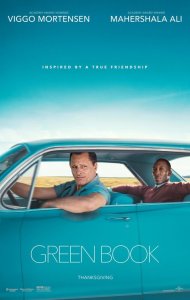 Green Book plays like a twenty-first century rendition of Driving Miss Daisy, a well-meaning and relatively gentle movie about race relations where a prejudiced white person comes about thanks to their firsthand friendship with an African-American male. It’s reportedly inspired by the true story of Tony Lip (Viggo Mortensen), a nightclub bouncer, driving around a famed pianist, Dr. Don Shirley (Mahershala Ali), as he performed throughout the South in 1962. The best part of the movie is the character interaction between this odd couple, and you’ll get plenty of it too. The actors burrow into their very distinctly conflicting characters, so it’s a natural pleasure to watch them eventually bond and learn from one another. This is the kind of racism that doesn’t make people feel too uncomfortable, and you could say that about the film as a whole. It’s a bit safe and has its intentions set on being a big, inclusive crowd-pleaser, and it plays like one. There are moments to make you laugh, moments to make you cheer, and moments to make you tear up. Morstensen and Ali are terrific together and find dignity and humanity in characters that could have easily become one-note stereotypes. The more we learn about Dr. Shirley the more interesting he becomes, a man used to feeling like an outsider no matter the company he keeps. Watching the two men grow and open up to one another can be heartwarming and deeply satisfying. Remarkably, the film is directed and co-written by one half of the Farrelly brothers, the pair responsible for ribald comedies like There’s Something About Mary and Dumb and Dumber. It’s an easy movie to fall for, with its winning formula and enjoyable actors, but there’s a little nagging concern I have that Green Book is too safe, too straight, and too pat in its life lessons. Despite its Best Picture win, it’s not like Driving Miss Daisy has any lasting cultural impression, and I wonder if maybe Green Book is destined for the same. Still, the acting and writing is enough to bring a smile to your face and remind one’s self about the power of kindness.
Nate’s Grade: B
Share this:

Fantastic Beasts: The Crimes of Grindelwald (2018)
 When they adjusted the Hobbit movies so there was going to be three instead of two, it required some very noticeable padding and filler material to meet out that requirement. The second Fantastic Beasts film (of a planned five film series, expanded from a trilogy) feels exactly that way, a mostly table-setting movie with more incidents than plot, a few pertinent revelations, and not much in the manner of resolution. The second Fantastic Beasts does improve on its predecessor in several regards. It introduces a formidable villain that’s well played by Johnny Depp. It introduces a compelling younger version of Albus Dumbledore that’s played by the dashing Jude Law. It also finds more purpose for its hero, the shy magical zookeeper Newt (Eddie Redmayne), as the series inches closer to a wizards-vs-wizards world war. Things take a turn for the darker; within the First Act, a baby is murdered. They didn’t even do that in the new Halloween. The larger world building of Beasts, written by author J.K. Rowling for the screen and directed by longtime stalwart David Yates, has been its biggest draw. The supporting characters are back, though not everyone has much to do. Rowling is improving as a screenwriter but she still has trouble executing exposition-heavy scenes, resorting to sequence after sequence of characters prattling on. Ultimately, it doesn’t feel like there’s much of consequence until the very end, so we endure characters running through underdeveloped and contrived storylines. One of these involves Katherine Waterston mistakenly believing Newt is engaged (his brother is) and somehow, despite having access to magic let alone other forms of media, never findings out the easy truth. It’s stuff like that that show me Rowling was struggling to find material for every character to push them forward on this now extended journey. Crimes of Gindelwald is an overall step in the right direction for the prequel series even if this individual movie has trouble standing on its own magical merits.
Nate’s Grade: B-
Share this:

Suspiria (2018)
 The idea of remaking Dario Argento’s horror classic Suspiria seems like movie heresy. How could any filmmaker attempt to come close to the Italian master’s original? Though that has not stopped Hollywood from remaking other horror classics of yore. Italian director Luca Guadagnino (Call Me By Your Name, A Bigger Splash) tempts the unwise with a new version of Suspiria, this time following the exploits of Susie (Dakota Johnson) in Cold War Germany as she is seduced by a private dance company lead by Madame Blanc (Tilda Swinton) that’s really a front for the occult. The new Suspiria is a worthy, splashy artistic endeavor but it suffers from too much airy meandering in the name of redundant atmosphere, vague and arbitrary plotting, and poor characters.
We’re told up front this is a story in six acts and a resolution but frankly the first two acts could have been completely eliminated. Their bearing on the overall story is minimal, but then I could say the same thing about much of the characters. Chloe Grace Moritz’s role could have been entirely cut. The majority of the story is strange things happening very slowly in the background of a dance school. The characters that do investigate aren’t our protagonists, which then traps us with people who know too much and won’t share, people who don’t know anything, and people who don’t want to know anything. It gets frustrating spending that much time with them, especially when the end destination (coven conspiracy sacrifice) is obvious even if you haven’t watched the 1977 original. I was told that Guadagnino edited an hour out of the final movie. How? What in the world was left out? It feels like everything they could have shot found its way into the finished film, whether it needed to be there or not. There’s an ongoing subplot about the Red Army Faction (a.k.a. Baader-Meinhof Gang) that we keep returning to as if there’s supposed to be larger relevancy. It’s a left-wing conspiracy that translated post-war anger into violence against the government. If I work really hard I can make a larger thematic connection to witches and women, but I won’t. With Suspiria 2018, it’s really just historical atmosphere that adds little but yet is returned to again and again. There is even a post-credit scene of a character doing something unclear while looking toward the camera. Why include any of that? It’s arbitrary and superfluous to the very end.
 The new Suspiria toggles through three tepid lead characters: 1) Johnson’s new dance recruit, 2) Swinton’s artistic director at the school, and 3) Swinton in old-age makeup as a grieving psychiatrist trying to make sense of his life (yes, “his,” as she plays a man). Two of these characters matter in strict plot terms and only one of them are granted some degree of characterization. Susie is essentially an empty vessel who is extremely passive, going along with whatever she’s told (there is a reason for this but it falls under the category of contrived dues ex machina). There are hints of the connection she has to some occult force at play, but we don’t really see any transformation on her part because she’s so opaque to start with. Madame Blanc is the most interesting character, somewhat by default, but she only becomes that in the last third of the film when her personal feelings for Susie make her doubt how far she’s willing to go to achieve the coven’s goal. It’s the only character with a direct internal conflict that seems to matter to the story. The old man has no reason to be in this movie. By the end, it feels like the film has found a significant story reason for his inclusion, one that will actually produce some thematic relevance for Swinton also playing this role, but nope. He serves no purpose other than exposition and to hammer home a tangential historical context of generational guilt. There is a nice character moment between two characters in the resolution but by then it’s too little too late. Even this nice moment doesn’t really need to happen. I think the reason the film toggles between these three characters is even it knows you will get bored with them.
When the horror hits, that’s when Suspiria is at its most rattling. Watching a woman’s body betray her, one excruciating limb convulsion after another, culminating in her own jaw seeming to rotate out of her head, is wince-inducing and terrifying. The sudden jolts of violence made me gasp and squirm every time. This culminates in a third act that is heavy on blood and lunacy, so much so that it feels like the finale to another movie. If the proceeding two hours was understated, atmospheric horror, the last thirty minutes feels like the splatterific Sam Raimi Evil Dead 2. There’s an explicit campiness that feels at odds with the self-serious meanderings of earlier. There are also moments that cannot be described as any other word than “goofy.” There’s an ongoing shot of characters being dispatched in a very exaggerated and theatrical manner, and the fact that we watch thirty of these in a row just invites some degree of laughter. I know I laughed. The final act and confrontation is my favorite part of the film, delivering some long-sought vengeance, but it feels like a different movie. It’s also where Guadagnino’s “put the camera anywhere” stylistic approach betrays him. It’s hard to tell what exactly is happening on a literal level, let alone understanding it, and that’s not even taking into account the muffled sound design of several characters when they hoarsely whisper aloud whatever.
 I would be more forgiving if the new Suspiria had not been as exasperatingly long, a full hour longer than the 1977 original. Long movies only feel long when they haven’t fully engaged you, and there are generally only so many ways to keep an audience’s sustained attention and investment. I understand wanting to allow a movie to breathe or wanting to create an uncertain atmosphere of intoxicating dread, but there has to be more than that. There’s also what I’ll affectionately coin the Nicolas Refn Trap, meaning where all of that breathing space ultimately exposes a lot of empty indulgences and vamping. Suspiria 2018 falls into this trap too often; there simply isn’t enough of anything to spread over those 150 minutes. The odd comparison I would make is to the notorious 1980 Western disaster, Heaven’s Gate, a movie I watched for the first time two years ago and actually appreciated. Let me be more specific: I appreciated the 100-minute very good movie somewhere inside there suffocated by the artistic excesses and peculiar and mercurial artistic demands from its uncompromising director (the man refused to shoot anything for ten hours until he got a cloud positioned exactly where he wanted). I’m convinced there’s a potentially great movie in Suspiria but it’s going to require a lot of excavation to allow it to see the outside.
I was interested in re-watching Argento’s 1977 original for the first time in years, and some things have aged better and some things have aged worse. Argento is a first-class visual stylist and his famous use of color makes the cinematography often beautifully horrific as young women are terrorized. There is even less plot than I remembered, a series of surreal murders finally leading to the obvious reveal of the dance company being a coven of witches. The characterization is even thinner than the thin 2018 film, which means that Guadagnino and company had a lot of room to roam when it came to their grandly grotesque remake. Argento’s film is a remarkable example of the immersive power of the screen, with his gorgeous use of light and color, production design, and a pulsating score that is perhaps a bit too omnipresent and anxious. There is one reoccurring musical sting that sounded precisely like the beginning of “Footloose” and it made me laugh every time, imagining Kevin Bacon dancing through the hallways. It’s a testament to the transcendent power of style when done by a first-rate stylist, and it works so far as to create a nightmarish, oppressive atmosphere. However, that eerie atmosphere and technical craft are about all the original Suspiria has to offer since there is a gnawing scarcity when it comes to characters, structure, and story. That makes the 2018 Suspiria a little more confounding. While it clearly works as an homage to Argento it’s also radically different, and yet it still manages to also have underwritten characters and bad storytelling choices even when it could have ditched the original’s original sins. At least Argento’s version is only 90 minutes and a lot easier to watch in one sitting.
 The Suspiria remake was clearly a labor of love and not a soulless paycheck for all those involved. The technical craft is accomplished, and even though it lacks the vibrant colors of Argento’s original the cinematography is still highly evocative and unsettling. Guadagnino has put a concerted effort into making his movie operatic, lavish, and radically different from the source material. I think it’s different yet reverent enough that fans of the original will find something to enjoy as the film asserts its own identity. And yet the moody atmosphere is undercut by the shortcomings of the characters and the contrived nature of the overly padded and meandering plot. The more I think back on the movie the more it falls apart under further scrutiny. Suspiria is a tonally confused movie that doesn’t have enough substantial material to fill out its gargantuan 150-minute running time. There will be blood but what there needed to be was a more judicious editor.
Nate’s Grade: C
Share this:

Bohemian Rhapsody (2018)
 Biopics are trickier than they appear because how best can you distill the essence, and significance, of a person into two hours? We’ve edged away from the standard cradle-to-grave biopics more in favor of stories that hinge on monumental moments in a person’s life, meant to encapsulate their life both in micro and macro. Bohemian Rhapsody favors the former approach, which causes the movie to feel like it’s rushing through the cornerstones of Queen singer Freddie Mercury’s life. Even at over two hours, the movie feels like it has little time for things, often jumping into polished, well-edited montages of time progression. The creative birth of many of the band’s hits are treated as absurdly easy formations, going from a clap of hands and stomp of feet to “We Will Rock you,” or a bass line to “Another One Bites the Dust.” It’s like the movie is checking boxes for a biopic with an anxious eye toward the clock. Mercury’s homosexuality (he comes out as bisexual to his long-time girlfriend who corrects him and calls him gay) is given its due, not having been underplayed in an effort to court a more mainstream audience. Mercury’s sense of sexuality, and the struggle of his own acceptance, is essential to getting to know this flamboyant front man. Except several of these scenes feel mishandled, which is odd considering director Bryan Singer (X-Men) has often found parallels in big studio films for the gay experience. The movie seems to say if his band mates had only accepted him more then maybe he wouldn’t have fallen into promiscuity by a bad influence and thus contracted HIV. There are also some pat answers as well like a disapproving father. However, the faults of Bohemian Rhapsody are compensated by its virtues, none more so than the electric performance by Rami Malek (TV’s Mr. Robot) as Mercury. The actor struts and preens with infectious charisma, and a mouth full of Mercury’s oversized choppers, and he miraculously captures the powerful stage magic of his character. The concluding 1985 Live Aid performance is astounding to witness and a reflection of just how essential and virtuosic Mercury and company were as live performers. It’s a sustained set of several hits and the movie just sings to a close on the highest of high notes. Bohemian Rhapsody is carried by the music and performance of Mercury the character and Malek the actor. It will make you want to rock out to Queen on the car ride home.
Nate’s Grade: B-
Share this:

Mid90s (2018)
 Jonah Hill’s directing debut is a small slice of 90s cinema that’s heavy on sense of time and place, light on plot, but filled with youthful authenticity. We follow a young kid (10? 12?) as he ingratiates himself with a group of older teen skaters. He wants to emulate these cool kids and dedicates himself to being a skateboarder. There are some intra-group conflicts and jealousies that play out as our protagonist becomes part of the gang. He gets exposed to smoking, drinking, and girls at house parties. There is one sequence at a party where a teen girl (15? 16?) takes our young hero into a bedroom to deflower him, and I instantly became anxious and needed to know the ages of the characters onscreen (it’s never verified). Our main character also happens to be one of the more boring people in the film, almost by design. He’s a blank page for the audience to project onto, and he’s trying so hard at such a formative age to emulate the older teens that it makes sense to leave him less defined. Hill hired professional skateboarders and taught them acting, and they act like professional skateboarders. In fairness, they act like recognizable teenagers, and Hill’s natural ear for dialogue rings true for this time of life. The movie takes a few turns into After School Special territory but doesn’t seem to deal with the consequences or resolutions of those dramatic events, which makes the film feel both more realistic and less fulfilling. Our hero takes a lot of injuries, some of them bleeding-head related, but nothing seems to come from them except the growing admiration of his peers. The home life storyline is worrisome and vague. Our protagonist has a physically abusive older brother (Lucas Hedges) who resents him and a single mother (Katherine Waterston) who seems irresponsible in not doing something about her youngest son being gone well into the morning hours. Even our protagonist seems to have penchant for self-harm, something that will presumably lead to problems down the line. In the meantime, mid90s is a pleasant and mostly entertaining, seemingly autobiographical experience. It gets by on enough for a watch.
Nate’s Grade: B
Share this:

Bad Times at the El Royale (2018)
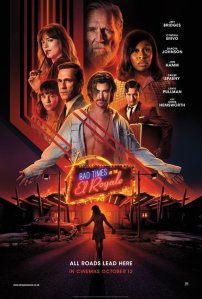 It is no disservice when I say that Bad Times at the El Royale joins the ranks of the finest of Tarantino imitators. It’s packed with twists and turns that keep an audience glued to the screen and continually re-evaluating the characters that we thought we knew. Because of that dynamic the movie invites the audience into becoming more involved, dissecting the information available and waiting for the next clue or plot revelation. It turns watching the film into a game and makes the experience that much more active and thrilling.
In the summer of 1969, the El Royale hotel is in for one hell of a night. The old fashioned hotel sits on the border between Nevada and California, allowing its dwindling customer base the opportunity to choose which state they would like to stay in. A group of strangers cozy up for the night including a priest (Jeff Bridges), a chatty vacuum salesman (Jon Hamm), a hopeful lounge singer (Cynthia Erivo), a skittish bellhop (Lewis Pullman), and a mysterious woman (Dakota Johnson) who happens to have a hostage in her trunk. As the night progresses and the characters uncover one another’s secrets, sometimes with deadly results, menacing cult leader Billy Lee (Chris Hemsworth) comes swaggering to the El Royale to reclaim by force what he feels is rightfully his.
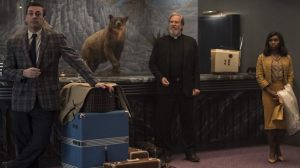 There are Act One twists and reveals in El Royale that would have been the Act Threes of other movies. Writer/director Drew Goddard (Cabin in the Woods, The Martian) has packed his movie full of sinister intrigue as he establishes the hotel, the main characters, and an immediate impression of each in the first 15 minutes. From there, the movie is divided into chapter titles (another Tarantino motif) where we follow different room inhabitants who get 20-minute-vignette spotlights. Once in private, the characters shed their false faces and begin to reveal who they really are, or who we think they might really be, and the movie starts to resemble Tarantino’s own hidden identity parlor game, 2015’s Hateful Eight. The vignettes begin to overlap, ending on cliffhangers and then circling back with a new character as our focal point, re-watching prior scenes but from a different perspective. Goddard’s script is wonderfully clever, layering in questions and answers and a constant desire to upend audience expectations. Even though some segments will repeat, Goddard doesn’t waste time on redundancy. A character will be seen prying loose floorboards searching for something desirable, and we never have to relive the before or after of this moment from that character’s perspective because we’ve been imparted the necessary info and can put the pieces together with the next jump. I appreciated Goddard’s faith in the intelligence of his audience. The pleasure of El Royale is watching it deftly unfold as a fun, funny, startling, appealing mystery.
The characters must also be worthy of our attention, and Goddard does fine work teasing out his colorful cast of criminals and lost souls and deepening most. Everyone has something to hide at the El Royale, and finding out his or her true intentions and motivations is part of the film’s fun. I won’t spoil any of the big surprises or which characters are really putting on a show. Despite all the many plot machinations intertwined, Goddard still finds time for his film to breathe and let the characters talk, opening themselves to one another, sometimes with the assistance of dramatic irony. Jeff Bridges and Cynthia Erivo play the best characters and deliver the best performances. Both of them are haunted by pasts they don’t feel like sharing, both are under some element of disguise to embark on finding their happy ending, and both form a sort of bond throughout the film as kindred spirits, even if they can’t fully trust one another. Bridges has the most complicated back-story but it actually links with a very real and emotional condition: memory loss. His character is (legitimately) going through early dementia and he’s losing full control of his sense of self, occasionally blanking and forgetting who he even is and how he got where he did. For a character pretending to be someone else, there’s a cruel irony to this malady. The seven main characters aren’t all on the same level (some are more plot devices than people) but Goddard knows this, making sure his 142-minute movie spends the most time with the best of them.
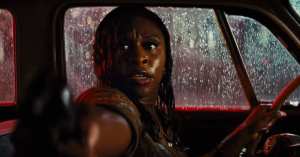 The actors given the best characters are also the ones that deliver the best performances, if you can imagine that. Bridges (Hell or High Water) brings a strong sense of pathos to his memory-addled priest trying to assess his life and his choices. He seems genuine in every moment, which is a feat considering his character has his share of secrets like anyone else. Erivo is a Broadway star making her film debut here, and she steals the show with her bruised sense of optimism. She’s the heart of the movie and a proven survivor, especially from a rigged system that protects predatory men. She brings a quiet power to her character as well as a believable vulnerability that makes you care. Hemsworth (Avengers: Infinity War) is all shaggy, scraggly charm as a cult leader who gets off pitting his followers, and captives, against one another. Really he likes to listen to himself speak, and Hemsworth is having a grand ole time with the part. Another actor exhibiting clear joy is Hamm (Baby Driver) who is, if you’ll pardon the pun, hamming it up with great gusto. He does a far majority of the talking for the first twenty minutes. He’s practically bouncing all over the place as an unchecked extrovert, but when alone, Hamm demonstrates an additional layer to his outlandish character. Another strong impression is from Pullman (Strangers: Prey at Night) as the lone employee eager to find absolution for his part in the El Royale’s history of sin as well as his own personal demons. The weakest of the ensemble ends up being Johnson (Fifty Shades Freed) who gets lost in her femme fatale archetype and can’t seem to find her way out again.
This is only Goddard’s second directing feature and his best directing aspect is that he knows when to linger on the written page. There are several segments that dwell in a certain emotion, elevated by Goddard’s tracking shots to continue the predicated unease. There’s one early moment where the bowels of the El Royale are revealed as hidden viewing areas to secretly record the guests doing their seemingly private illicit good times. The lead character of this vignette walks along the corridor, studying other characters and slowly realizing the implications of what he or she is finding. The scene is given a beautiful and eerie soundtrack thanks to Darlene practicing her singing, belting out “This Old Heart of Mine” like her life depended upon it, the tune taking on a sinister edge as it echoes through the dark hallway along with the tick-tock of the metronome. There’s another terrific singing suspense segment in this very same location, except with a different character spying on Darlene as she and another character work in conjunction to coordinate their movements, timing striking sounds in the room to her claps. Goddard has an adequate eye for visuals but he benefits from the gorgeously conceived and constructed El Royale setting, allowing the quirks of the rundown hotel to serve as another character to his ensemble. I enjoyed little touches, like only the Nevada side having a liquor license and the bright red line that runs down the middle of everything.
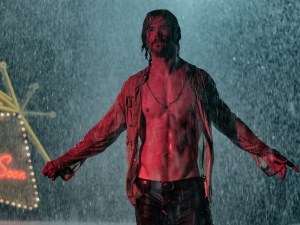 And yet there are some lingering doubts that halt me from a full-throated endorsement of El Royale, and I’ve been trying to articulate them better in the days since I watched the film. It frankly doesn’t fully come together by the end in a way that feels suitably climactic. Once Billy Lee enters the third act, the movie stabilizes and we spend time with the remaining characters assembled together to be terrorized by the cult leader. After seeing everyone else’s story in smaller vignettes with some slippery non-linear perspectives, we’ve finally come to our big confrontation and summit with everyone. Except it doesn’t feel as big as the movies needs it to be. Characters will be dispatched swiftly, and instead of it feeling shocking it feels abrupt and contrived, devaluing the character arcs that had been shuffling forward to that point. The deaths feel too ho-hum, and the final confrontation and melee too chaotic and random. The sacrifices feel wasted and sloppy rather than the payoff from some long established setup. It’s here where Goddard cannot hide his narrative trickery anymore and the machinations are exposed. I couldn’t help but feel that the final act was slowly losing the momentum and excitement that had been built carefully over the course of two hours. Billy Lee isn’t quite the force that his whispered presence has been made out to be, no fault to Hemsworth, who impresses me more and more with every new performance. It’s like by the end of his movie Goddard has realized that certain characters were inevitably just more interesting than others and he saves room for them to get a climax and brushes off the rest. Thematically I don’t quite know if it comes together with any sort of final statement about the 1960s, the dichotomy of good and evil, or anything else. It’s a final act that left me a little disappointed and realizing the end wasn’t nearly as fun as the journey.
Bad Times at the El Royale is a movie jam-packed with twists, plot turns, and colorful characters played by great actors who are clearly enjoying themselves, given the room to roam and stretch their muscles as exaggerated and dangerous criminal cohorts. Goddard’s film is impeccably structured up until its final act where it feels like the answers and confrontations cannot match the mysteries and setup that had been laid before. If you’re a fan of the top level of Tarantino imitators, like Things to Do In Denver When You’re Dead or Lucky Number Slevin, or enjoy unpacking a good mystery, then check into the El Royale, a hotel where maybe the cockroaches have the best chance at survival.
Nate’s Grade: B+
Share this:

First Man (2018)
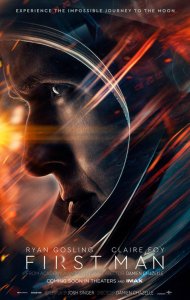 Oscar-winning filmmaker Damien Chazelle got to be the director of a Best Picture winner for approximately three minutes, which, to be fair, is more than most us will ever experience. La La Land won the top prize at the 2017 Oscars only to have it taken away and given to the smaller indie, Moonlight. Where an Academy of old white people that love to celebrate Old Hollywood decide to award a small million-dollar movie about growing up gay and black in the 80s, where does one go next? For Chazelle, it seems the answer is something even more irresistible to the Academy. First Man is partly a biopic on Neil Armstrong and partly a recreation of the 1960s Space Race. The finished movie is so mercurial, so insulated, so dry that I found a far majority of it be kind of boring.
Neil Armstrong (Ryan Gosling) is one of the select pilots training for space. NASA is racing to beat the Russians to the moon, and every new breakthrough is thanks to long hours of hard work. Janet Armstrong (Claire Foy) worries at home, listening to every radio broadcast and wondering if her husband will come back safely.
What First Man does best is make you realize how dangerous every step of the way was to get to the moon. Every leap forward required months of trial-and-error, and sometimes those mistakes cost lives, like the crew of the Apollo 1. The film opens on Armstrong flying above the atmosphere. The emerging curvature of the Earth is beautiful, but the beauty turns to horror quickly as it appears Armstrong’s plane is bouncing off the atmosphere and drifting into orbit. There’s another sequence where he and Buzz Aldrin (Corey Stoll) are above the Earth and planning to dock in space and their capsule spins wildly and if they can’t fix it they’ll black and out and assuredly die. These moments remind the audience about the inherent dangers of the Space Race that we don’t necessarily get in the history books. Looking back, we know the American astronauts succeed in the ultimate mission of landing a man, or an eventual dozen, on the moon, but that foreknowledge produces a false sense of security. Chazelle’s movie reminds us of the enormity of this challenge and the enormity of the dangers. The sound design in this movie is terrific, and Chazelle makes sure you hear every ping, every metal-on-metal scrape, to the point that you fear the whole thing could fall apart at any moment. When Janet furiously dresses down the Mission Control head (Kyle Chandler) that tries to calm her concerns, she accuses them of being boys who think they know what they’re doing. Even after the triumph of the final act, we know what happens two missions later (Apollo 13) to reconfirm just how much we still haven’t perfected when it comes to space travel.
 Besides reminding you of the precarious nature of early space travel, let alone the tests leading up to said travel, First Man doesn’t find much to justify its own existence other than as the latest in Oscar bait. It’s not exactly an in-depth look at the heroism and chutzpah of the Space Race like The Right Stuff, and it’s not exactly an examination on the frailty of man and the meticulous problem solving needed to achieve big goals, like Apollo 13. In fact, while watching this movie I would repeatedly think to myself, “Man, I should go home and watch Apollo 13 again.” When you keep thinking about watching a better movie, you have lost your audience, and that happens throughout First Man. There are thrilling, awestruck sequences to be sure, but that only accounts for perhaps a quarter of the lengthy 140-minute running time. The rest is spent at a distance trying to understand a man who comes across as largely impassive. He’s intensely focused but it’s like the movie adopts his very no-frills attitude, and it goes about its business with little thought for letting an audience into its inner world. We’re still only visitors at best here.
I admittedly don’t know much about Armstrong the man, so I can’t tell if the role was shaped for Gosling’s talents or he just matched perfectly with the man. Armstrong feels like one of the Nicolas Winding Refn roles (Drive) that we’re used to watching Gosling portray. Armstrong feels like somebody ported over a guarded, reserved, mostly silent Refn character into a staid biopic and asked Gosling to communicate a majority of emotion through unblinking stare downs. If there’s one actor you don’t want to challenge to a staring contest, it’s Gosling. Armstrong comes across a very internal man who seems uncomfortable in the spotlight, far less natural than Buzz Aldrin, who the movie unexpectedly positions as kind of a saying-what-we’re-all-thinking jerk. Because Chazelle has decided to keep Armstrong so guarded, it makes the film feel distant, like we’re being told the story second-hand, and that requires Chazelle to fill in the gaps as to the internal motivations and insights for an intensely private man. The answers we’re given seem almost cliché (the death of his young daughter is what drove him into his work, to escape the bounds of his Earthly grief, and to finally say goodbye to her). It’s too convenient as a simple character arc to be fully believed, but that’s all we have to work with because the movie won’t give us much more. It feels more like you are getting the idea of Neil Armstrong the Man rather than a realization. It’s a frustrating experience, watching a biopic and having the filmmakers keep their prized figure behind glass.
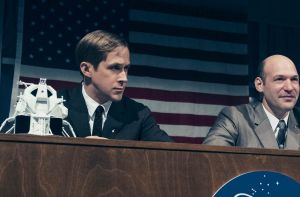 As a director, Chazelle is proving to be a remarkably skilled chameleon. First Man is completely different in style and approach to La La Land as it is to Whiplash (still his finest). His chosen approach for First Man is locking to Armstrong’s perspective, so we’re working with a lot of handheld camerawork that orbits our movie star. Chazelle’s cameras emulate a docu-drama aesthetic and there are several moments where the action happens onscreen and the cameras race to frame it, leaving the image blurry for seconds. I’m not sure that was the best decision. It does create a sense of verisimilitude, which heightens the thrilling aspects of the film like the excursions into space travel. However, it does little to heighten the underwhelming domestic drama on the NASA block. The added realism only benefits a small portion of the movie. At times, a camera racing to catch up with the onscreen action would be considered a hindrance. The claustrophobic feelings are heightened from Chazelle’s cramped camerawork, reminding us again of the tightly precarious spaces these men were willingly sliding into, the fragility of the cockpit walls separating them from an unrelenting empty void. When we switch over to the Apollo 11 mission, Chazelle keeps the attention squarely with the three men making the famous lunar landing. There’s a stirring thrill of destiny and the film transitions into an IMAX footage to make the moment that much more immersive and transformative.
First Man is much like the man of its title, reserved, guarded, and with a laser-like focus on its mission at the expense of outside drama. Chazelle is an excellent filmmaker and the craft on this out of this world, from the production design to the thrilling recreations of the dangers of space, bringing together the alarm through a sumptuous combination of editing, sound design, and cinema verite photography. Of course that verite style is also a double-edged sword, providing another layer to distance the audience. This is a pretty guarded movie with few insights into Armstrong the person. We get more Armstrong the pilot and numbers-cruncher, and I wish Chazelle had steered more into whatever version of Armstrong that opened him up to the audience. The family drama stuff is pretty pat and Foy (The Girl in the Spider’s Web) is generally wasted as the supportive and anxious wife. Most of the actors are generally wasted in this movie, with the potential exception of Gosling, who slips into the shoes of an impassive and emotionally restrained protagonist like it’s second nature. First Man might not be a giant leap artistically, and in fact a majority of the film is dull, but the artistic highs are enough to warrant one viewing. From there, you’ll likely conclude that you don’t need to watch Neil Armstrong stare forlornly into the middle distance again. Frankly, I’d rather watch La La Land again, and that’s saying something.
Nate;s Grade: B-
Share this:

The House with a Clock in Its Wall (2018)
 Who could have guessed that splatterhouse horror director Eli Roth (Hostel, The Green Inferno) was the right candidate to helm a children’s movie that hearkens back to the 90s era of Disney Channel? The House with a Clock in Its Walls is a whimsical and enjoyable family movie that is definitely made primarily for those under the age of twelve. It features a young boy (Owen Vaccaro) going to live with his uncle (Jack Black) who is a warlock and where the neighbor (Cate Blanchett) is a witch. He learns magic, self-confidence, and the legend of the hidden clock that may or may not trigger a doomsday. The 1950s house itself and its magical elements is practically another character in the movie and there’s a cheerful sense of discovery throughout, with a dog-like armchair, a topiary griffin, and a stained glass window that keeps changing. The school scenes could have been trimmed entirely, especially when you consider our main kid had enough motivation to try and bring his departed mom back to life. He didn’t need to impress a bully at school because he wanted a friend. Black (Jumanji 2) is charming as ever and a natural with children. The visuals are colorful and fun. The signature weird and icky details Roth adds made me smile, like pumpkins that vomit pumpkin guts as a weapon. Kyle Maclachlin (TV’s Twin Peaks) plays an evil wizard who wants to end the world after seeing the horrors of the Holocaust. That’s a dark implication for a “children’s movie,” and I appreciate that the film allows for the existence of darkness, which also includes unvarnished appearances of the occult and a red-eyed demon. How about that? The House with a Clock in Its Walls is an entertaining fantasy adventure for families whose kids like to tip-toe into spooky material but aren’t quite ready yet for the harder edged PG-13 scares.
Nate’s Grade: B
Share this:

The Little Stranger (2018)
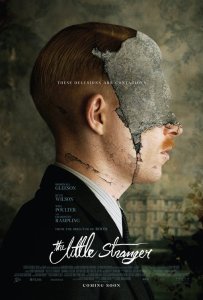
If you’re a fan of slow burning Gothic horror, the kind where characters wander slowly inside ornate and empty houses investigating various noises, then The Little Stranger is the movie for you. It’s about a laconic doctor (Domhnall Gleeson) inserting himself in the lives of a wealthy family who has fallen on hard times, their once glorious estate left to wither in post-WWII Britain. The family is convinced the spirit of a dead little girl haunts their estate and has its ghostly sights set on destroying the last vestiges of their bloodline. It’s a ghost story by design but the supernatural elements get placed on pause for long stretches. The rest of the movie is a restrained romance between the doctor and the introverted and awkward lady of the house, played by Ruth Wilson (TV’s The Affair). In reality, the doctor is more infatuated with the house than the people inside, fondly recalling his early obsession from childhood. It’s easy to see why. The house, and its exquisite production design, is enchanting. At points it feels like the movie has to remember that it’s a ghost story or a mystery as it shifts narrative tracks. The Little Stranger is a movie simmering in eerie atmosphere and is pristinely directed by Lenny Abrahamson (Room), a man proving how readily he can adapt his artistic style. For a good hour, I was on board with the movie and enjoyed its patient, controlled buildup. It’s practically the opposite of the more visceral horror set pieces we’ve become accustomed to. By the end, I was unsure whether the somewhat ambiguous ending justified the time and path taken to get there. If you don’t have a healthy love of Poe-styled Gothic horror, you’ll likely be restless as you watch understated, refined, restrained British family going through understated, refined, restrained drama.
Nate’s Grade: C+
Share this:

Operation Finale (2018)
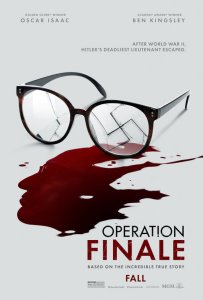 Operation Finale is one of those kinds of movies that is just good enough to make me wish it had been better. It’s based on the true story of an Israeli team of spies that located Adolph Eichmann (Ben Kingsley), one of Hitler’s lieutenants who authored The Final Solution. He’s been hiding in Argentina for years and giving public lectures, which isn’t helpful with keeping a low profile. Oscar Isaac (The Last Jedi) leads the Israeli spies as they plot to kidnap Eichmann, get him to admit his guilt for the Holocaust in writing, and smuggle him out of the country and to Israel to stand trail for the deaths of millions. This story should be exciting, it should be fascinating, it should be compelling, and for stretches it can be, but Operation Finale errs in capturing Eichmann too quickly. The majority of the film is the spy team holding him in a secret location and interrogating him, while the surprisingly Nazi-coddling police force of Argentina hunts for their location. I’m assuming the filmmakers were accurately telling the true story, but you start to question why the spies are taking their sweet time. Why not get on a boat as soon as possible and sail to another country to fly away, one less friendly to former Nazis? There aren’t really any set pieces where their cover might be blown. It’s mostly Isaac talking with Kingsley, and while their conversations are entertaining, it’s yet another preview of a better movie that we’re never going to have delivered. The film lacks enough urgency. The characterization is too limited and the supporting characters are more faces than people; Melanie Laurent essentially plays The Woman Spy. Operation Finale should have either spent more time on the specifics and complications of nabbing Eichamann, presenting a challenge, or it could have accentuated the debate between Isaac and Kingsley over the nature of culpability, rationalization, guilt, and vengeance. There’s probably a really good Nazi-hunting mini-series or Nazi-debating play in here. Either way, the actual finished film is well made, well acted, and well intentioned but also dramatically lacking.
Nate Grade: C+


 nathanzoebl
You must be logged in to post a comment.