Blog Archives
Eddington (2025)

I’ve read more than a few searing indictments about writer/director Ari Aster’s latest film, Eddington, an alienating and self-indulgent movie starring Joaquin Phoenix on the heels of his last alienating and self-indulgent movie starring Phoenix. It’s ostensibly billed as a “COVID-era Western,” and that is true, but it’s much more than that. I can understand anyone’s general hesitation to revisit this acrimonious time, but that’s where the “too early yet too late” criticism of others doesn’t ring true for me. It is about that summer of 2020 and the confusion and anger and anxiety of the time; however, I view Eddington having more to say about our way of life in 2025 than looking back to COVID lockdowns and mask mandates. This is a movie about the way we live now and it’s justifiably upsetting because that’s where the larger culture appears to be at the present: fragmented, contentious, suspicious, and potentially irrevocable.
Eddington is a small-town in the dusty hills of New Mexico, neighboring a Pueblo reservation, and it serves as a tinderbox ready to explode from the tension exacerbated from COVID. Sheriff Joe Cross (Phoenix) has had it up to here with mask mandates and social distancing and the overall attitude of the town’s mayor, Ted Garcia (Pedro Pascal). Joe decides to run for mayor himself on a platform of common-sense change, but nothing in the summer of 2020 was common.

Eddington is a movie with a lot of tones and a lot of ideas, and much like 2023’s Beau is Afraid, it’s all over the place with mixed results that don’t fully come together for a coherent thesis. However, that doesn’t deny the power to these indefatigable moments that stick with you long after. That’s an aspect of Aster movies: he finds a way to get under your skin, and while you may very well not appreciate the experience because it’s intentionally uncomfortable and probing, it sticks with you and forces you to continue thinking over its ideas and creative choices. It’s art that defiantly refuses to be forgotten. With that being said, one of the stronger aspects of Aster’s movies is his pitch-black sense of comedy that borders on sneering cynicism that can attach itself to everything and everyone. There are a lot of targets in this movie, notably conspiracy-minded individuals who want people to “do their own research,” albeit research ignoring verified and trained professionals with decades of experience and knowledge. There’s a lot of people talking at one another or past one another but not with one another; active listening is sorely missing, as routinely evidenced by the silences that accompany the mentally-ill homeless man in town that nobody wants to actively help because they see him as an uncomfortable and loud nuisance. For me, this is indicative of 2025, with people rapidly talking past one another rather than wanting to be heard.
When Aster is poking fun at the earnestness of the high school and college students protesting against police brutality, I don’t think he’s saying these younger adults are stupid for wanting social change. He’s ribbing how transparently these characters want to earn social cache for being outspoken. It’s what defines the character of Brian, just a normal kid who is so eager to be accepted that he lectures his white family on the tenets of destroying their own white-ness at the dinner table, to their decidedly unenthusiastic response. I don’t feel like Aster is saying these kids are phony or their message is misapplied or ridiculous or without merit. It’s just another example of people using fractious social and political issues as a launching point to air grievances rather than solutions. The protestors, mostly white, will work themselves into a furious verbal lather and then say, “This shouldn’t even be my platform to speak. I don’t deserve to tell you what to do,” and rather than undercutting the message, after a few chuckles, it came across to me like the desperation to connect and belong coming out. They all want to say the right combination of words to be admired, and Brian is still finding out what that might be, and his ultimate character arc proves that it wasn’t about ideological fidelity for him but opportunism. The very advancement of Brian by the end is itself its own indictment on white privilege, but you won’t have a character hyperventilating about it to underline the point. It’s just there for you to deliberate.

Along these lines, there’s a very curious inclusion of a trigger-happy group in the second half of the movie that blends conspiracy fantasy into skewed reality, and it begs further unpacking. I don’t honestly know what Aster is attempting to say, as it seems like such a bizarre inclusion that really upends our own understanding of the way the world works, and maybe that’s the real point. Maybe what Aster is going for is attempting to shake us out of our own comfortable understanding of the universe, to question the permeability of fact and fiction. Maybe we’re supposed to feel as dizzy and confused as the residents of Eddington trying to hold onto their bearings during this chaotic and significant summer of 2020.
I think there’s an interesting rejection of reality on display with Eddington, where characters are trying to square news and compartmentalize themselves from the proximity of this world. Joe Cross repeatedly dismisses the pandemic as something happening “out there.” He says there is no COVID in Eddington. For him, it’s someone else’s problem, which is why following prevailing health guidelines and mandates irks him so. It’s the same when he’s trying to explain his department’s response to the Black Lives Matter protests that summer in response to George Floyd’s heinous murder. To him, these kinds of things don’t happen here, the people of Eddington are excluded from the social upheaval. This is an extension of the “it won’t happen to me” denialism that can tempt any person into deluding ourselves into false security. It’s this kind of rationalization that also made a large-scale health response so burdensome because it asked every citizen to take up the charge regardless of their immediate danger for the benefit of others they will never see. For Joe, the tumult that is ensnaring the rest of the country is outside the walls of Eddington. It’s a recap on a screen and not his reality. Except it is his reality, and the movie becomes an indictment about pretending you are disconnected from larger society. It’s easier to throw up your hands and say, “Not me,” but it’s hard work to acknowledge the troubles of our times and our own engagement and responsibilities. In 2025, this seems even more relevant in our doom-scrolling era of Trump 2.0 where the Real World feels a little less real every ensuing day. It’s all too easy to create that same disassociation and say, “That’s not here,” but like an invisible airborne virus not beholden to boundaries and demarcations, it’s only a matter of time that it finds your doorstep too.

You may assume with its star-studded cast that this will be an ensemble with competing storylines, but it’s really Joe Cross as our lead from start to finish, with the other characters reflections of his stress. I won’t say that most of the name actors are wasted, like Emma Stone as Joe’s troubled wife and Austin Butler as a charismatic conman pushing repressed memory child-trafficking conspiracies, because every person is a reflection over what Joe Cross wants to be and is struggling over. Despite his flaws and some startling character turns, Aster has great empathy for his protagonist, a man holding onto his authority to provide a sense of connectivity he’s missing at home. Our first moment with this man is watching him listen to a YouTube self-help video on dealing with the grief of wanting children when your spouse does not. Right away, we already know there’s a hidden wealth of pain and disappointment here, but again Aster chooses empathy rather than easy villainy, as we learn his wife is struggling with PTSD and depression likely as a result of her own father’s potential molestation. This revelation can serve as a guide for the rest of the characters, that no matter their exterior selves that can demonstrate cruelty and absurdism, deep down many are processing a private pain that is playing out through different and often contentious means of survival. I don’t think Aster condones Joe Cross’ perspective nor his actions in the second half, but I do think he wants us to see Joe Cross as more than just some rube angry with lockdown because he’s selfish.
It’s paradoxical but there are scenes that work so splendidly while the movie as a whole can seem overburdened and far too long. The cinematography by the legendary Darius Khnodji (Seven, City of Lost Children) expertly frames and lights each moment, many of them surprising, intriguing, revealing, or shocking. There can be turns that feel sudden and jarring, that catapult the movie into a different genre entirely, into a Hitchcockian thriller where we know exactly what the reference point is that I won’t spoil, to an all-out action showdown popularized by Westerns. Beyond Aster’s general more-is-more preference, I think he’s dabbling with the different genres to not just goose his movie but to question our associations with those genres and our broader understanding of them. It’s not quite as clean as a straight deconstructionist take on familiar archetypes and tropes. It’s more deconstructing our feelings. Are we all of a sudden in a forgiving mood because the movie presents Joe as a one-man army against powerful forces? It’s all-too easy to get caught up in the rush of tension and satisfying violence and root for Joe, but should we? Is he a hero just because he’s out-manned? Likewise, with the conclusion, do we have pity for these people or contempt? I don’t know, though there isn’t much hope for the future of Eddington, and depressingly perhaps for the rest of us, so maybe all we have are those fleeting moments of awe to hold onto and call our own.

Eddington is an intriguing indictment about our modern culture and the rifts that have only grown into insurmountable chasms since the COVID-19 outbreak. It’s a Western in form pitting the figure of the law against the moneyed establishment, and especially its showdown-at-the-corral climax, but it’s also not. It’s a drama about people in pain looking for answers and connections but finding dead-ends, but it’s also not. It’s an absurdist dark comedy about dumb people making dumb and self-destructive decisions, but it’s also not. The paranoia of our age is leading to a silo-ing of information dissemination, where people are becoming incapable of even agreeing on present reality, where our elected leaders are drowning out the reality they don’t want voters to know with their preferred, self-serving fantasy, and if they just say it long enough, then a vulnerable populace will start to conflate fact and fiction. I don’t know what the solution here is, and I don’t think Aster knows either by the end of Eddington. I can completely understand people not wanting to experience a movie with these kinds of uncomfortable and relevant questions, but if you want to have a closer understanding of how exactly we got here, then Eddington is an artifact of our sad, stupid, and supremely contentious times. Don’t be like Joe and ignore what’s coming until it’s too late.
Nate’s Grade: B
Share this:

The Fantastic Four: First Steps (2025)

Apparently there must have been an ancient curse that brings forth a new attempt at a Fantastic Four franchise every ten years, even further if you want to include the 1994 Roger Corman movie that was purposely made and never released just to hold onto the film rights (I’ve seen it, and once you forgive the chintzy special effects and shoestring budget, it’s actually a pretty reverent adaptation). The 2000s Fantastic Four films were too unserious, then the 2015 Fantastic Four gritty reboot (forever saddled with the painful title Fant4stic) was too serious and scattershot. Couldn’t there be a healthy middle? There has been an excellent Fantastic Four film already except it was called The Incredibles. That 2004 Pixar movie followed a family of superheroes that mostly aligned with the powers of the foursome that originally made their debut for Marvel comics in 1961. It makes sense then for Marvel to borrow liberally from the style and approach of The Incredibles because, after all, it worked. There’s even a minor villain that is essentially a mole man living below the surface. Set on an alternate Earth, this new F4 relaunch eschews the thirty-something previous films of the Marvel Cinematic Universe (MCU). You don’t need any prior understanding to follow the action, which is kept to under 105 minutes. The 1960s retro futurist visual aesthetic is a constant delight and adds enjoyment in every moment and every scene. The story is a modern parable: a planet-eating Goliath known as Galactus will consume all of Earth unless Reed Richards (Pedro Pascal) and Sue Storm (Vanessa Kirby), a.k.a. Mr. and Ms. Fantastic, give over their unborn son. The added context is that they have struggled with fertility issues, and now that at last they have a healthy baby on the cusp of being theirs, a cosmic giant wants to call dibs. It makes the struggle and stakes much more personal. It makes the foursome genuinely feel like a family trying to resolve this unthinkable ultimatum. I cared, and I even got teary-eyed at parts relating to the baby and his well-being, reflecting on my own parenting journey.

From a dramatic standpoint, this movie has it. From an action standpoint, it leaves a little to be desired. It incorporates the different powers well enough, but there are really only two large action set pieces with some wonky sci-fi mumbo jumbo. There’s a whimsical throwback that makes the movie feel like an extension of a Saturday morning cartoon show except for the whole give-me-your-baby-or-everybody-dies moral quandary. While I also appreciated its running time being lean, you can feel the absence of connective tissue. Take for instance The Thing (The Bear‘s Ebon Moss-Bachrach) having a possible romance with a teacher played by Natasha Lyonne (Poker Face). The first scene he introduces himself… and then he appears much later at her synagogue seeking her out specifically during mankind’s possible final hours. We’re missing out on the material that would make this personal connection make sense. The same with the world turning on the F4 once they learn they’ve put everyone in danger. It’s resolved pretty quickly by Sue giving one heartfelt speech. The movie already feels like it has plenty of downtime but I wanted a little more room to breathe. I was mostly underwhelmed by Pascal, who seems to be dialing down his natural charm, though his character has some inherently dark obsessions that intrigued me. He recognizes there is something wrong with him and the way his mind operates, and yet he hopes that his child will be a better version of himself, a relatable parental wish. There are glimmers of him being a more in-depth character but it’s only glimmers. The family downtime scenes were my favorite, and the camaraderie between all four actors is, well, fantastic (plus an adorable robot). Kirby (Napoleon) is the standout and the heart of the movie as a figure trying to square the impossible and desperate to hold onto the baby she’s dreamed of for so long.
The Fantastic Four: First Steps is an early step in a better direction. It’s certainly better than the prior attempts to launch Marvel’s first family of heroes, though this might not be saying much. It does more right than wrong, so perhaps the fourth time might actually be the charm.
Nate’s Grade: B-
Share this:

Freaky Tales (2025)
 Watching Freaky Tales, an ode to 1980s Oakland California, punk, rap music, and grindhouse cinema, is like washing in someone else’s nostalgia. It’s a fun throwback experience but it doesn’t amount to much more than transitional diversions that won’t have the same appeal. This is an anthology movie following the events of a few nights in 1987 Oakland with criss-crossing characters told out of order. Given the abbreviated nature of the stories, you either have to make a strong impression with the characters, have memorable and surprising adventures, or have an intricate connection to the different stories that allows the narrative to keep reforming. Otherwise it’s a collection of shorts that don’t really add up to much else. While entertaining in spurts, there isn’t much more to Freaky Tales. The first story involves a punk rock club defending themselves against neo-Nazi bullies. It centers on a budding romance and works well with an exuberant, youthful energy and the theme of a vulnerable community standing together against hate is easy to root for especially when it results in bloody and maimed Nazis. The second story is the weakest and follows a female rap act trying to make the most of a stage show. The third story involves a mob enforcer (Pedro Pascal) trying to make a clean break and coming to terms with his past after a tragedy. It’s a story more memorable for some unexpected cameos and turns rather than supplying an antihero worthy of Pascal. The final story involves a professional basketball player seeking vengeance against the men who killed his family in a burglary-gone-wrong. It’s the most entertaining and ridiculous segment, especially as the pro player reveals the extent of his martial arts and mind powers. While each segment doesn’t quite overstay its welcome, none of the segments feel essential or cleverly integrated with the rest of the tales. As a result, Freaky Tales feels like gonzo campfire stories that don’t exactly go anywhere; pleasantly silly but missing out on greater fun.
Nate’s Grade: B-
Share this:

Gladiator II (2024)
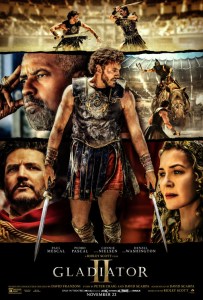 It’s been twenty-four years since Russel Crowe, in his Oscar-winning role, bellowed, “Are you not entertained?” We were, we really were, and Gladiator was a huge hit in 2000 but has also held up as a twenty-first century classic that revived the sword-and-sandals epic. The late sequel hews quite closely to the path of the original Gladiator, a rare example of a movie that was quite literally writing the script as they went and succeeded wildly. The second go-round has a strong same-y feel, which is natural with sequels, but it also has trouble simply standing in the shadow of its superior predecessor.
This time we follow Paul Mescal (Aftersun) as a Roman expat who’s been living abroad as a simple man of the people, except when violence is called upon. His land is conquered by Rome, his beloved is killed, and he’s sold into slavery only to be selected to be trained as a gladiator and only to become a fan favorite who could possibly unseat the Emperor(s). Sounds familiar, right, plus with the revenge motivation? Mescal is playing Lucius, the adult nephew to the late emperor played by Joaquin Phoenix. He’s all grown up and with abs. This Maximum stand-in is actually the blandest character in the film, a scolding figure who says little and doesn’t want to be in any position of leadership. It makes for a lackluster hero especially compared to the presence and magnetism of Crowe in his leading man prime. Fortunately there’s entertaining side characters, notably Denzel Washington (The Equalizer) as a bisexual wheeler-dealer who manipulates his way to the top of the Roman Senate, even garnering the attention of the hedonist twin emperors. The script utilizes a lot of conveniences, from revelations of bloodlines to an adjacent crypt that just so happens to have old Maximus’ armor and sword. Washington’s schemes, more loose-goosey and the benefit of convenient luck than machiavellian plotting, provide the missing entertainment value from Mescal’s underdog-seeking-vengeance arc. Director Ridley Scott returns and stages some fun Colosseum action set pieces, including an aquatic based naval battle with literal sharks. The opening siege against a coastal city by the powerful Roman army is wonderfully visualized. I was never bored but I can’t say that the movie is operating at close to the same level. The second half kind of creaks to a close, with a final one-on-one that feels too lopsided and unfulfilling. The emotional resonance of the prior movie is sufficiently lacking. While Gladiator II can still get your blood moving, it’s also an exercise in rote blood-letting as diminished franchise returns.
Nate’s Grade: B-
Share this:

The Wild Robot (2024)
 There must be something personally appealing when it concerns movies about hopeful robots that serve as change agents to new communities. WALL-E and The Iron Giant are two of my favorite films of all time, and while The Wild Robot won’t quite enter that all-hallowed echelon, it’s still a heartfelt and lovely movie that can appeal to anyone. We follow Roz (voiced by Lupita Nyong’o), a discarded robot looking for tasks to complete on an island. Fortunately, the robot learns how to communicate with the local wildlife, including a baby goose that our robot feels responsible to train how exactly to be a goose, including how to fly before the advent of winter and the larger flock migrates. The characters are kept pretty simple but that doesn’t mean their emotions are. The movie, based upon a popular children’s book series by Peter Brown, is refreshingly mature about nature’s life cycle, not treating death like a taboo subject too dark for children. The themes of parenting, being different, and finding an accepting home through compassion and courage are all resonant no matter your age, and I’m happy to report that I teared up at several points. The parent-child relationship between the damaged robot and orphaned gosling extends beyond them, inspiring other members of the island’s food chain to work together for common goals and sustainability. There’s a late antagonist thrown in to up the stakes and provide a bit more explosive action, including a magnetic magenta-colored forest fire. The movie doesn’t quite close as strongly as it opens, but writer/director Chris Sanders (Lilo & Stitch, How to Train Your Dragon) knows innately how to execute at such a high level where even simple characters and familiar themes have fully developed stories with soaring emotions that arrive fully earned.
Nate’s Grade: B+
Share this:

Drive-Away Dolls (2024)
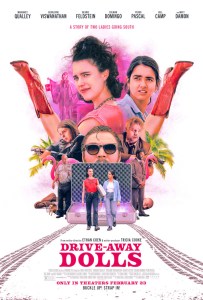 Drive-Away Dolls is an interesting curiosity, not just for what it is but also for what it is not. It’s the first movie directed solo by Ethan Coen, best known as one half of the prolific filmmaking Coen Brothers, who have ushered in weird and vibrant masterpieces across several genres. After 2018’s The Ballad of Buster Scruggs, their last collaboration, the brothers decided to set out on their own for an unspecified amount of time. This led Joel Coen to direct 2021’s atmospheric adaptation of Macbeth, and now Ethan has decided that the fictional movie he really wants to make, unshackled by his brother, is a crass lesbian exploitation sex comedy. Well all right then.
Set in 1999 for some reason, Jamie (Margaret Qualley) is an out lesbian who unabashedly seeks out her own pleasures, even if it brings about the end of her personal relationships. Her friend, Marian (Geraldine Viswanathan), hasn’t had a lover in over three years and is much more prim and proper. Together, these gal pals decide to drive to Tallahassee, Florida using a drive-away service, where they will be paid to drive one way, transporting a used car. It just so happens that these women have mistakenly been given the wrong car, a vehicle intended for a group of criminals transporting contraband that they don’t want exposed. Jamie is determined to get laid and help Marian get laid all the while goons (Joey Slotnick, C.J. Wilson) are trailing behind to nab the ladies before they discover the valuable contents inside the trunk of their car.
 Drive-Away Dolls is clearly an homage to campy 1970s exploitation B-movies but without much more ambition than making a loosey-goosey vulgar comedy consumed by the primal pursuit of sexual pleasure. I was genuinely surprised just how radiantly horny this movie comes across, with every scene built in some way upon women kissing, women having sex, women talking about having sex, women pleasuring themselves, women talking about pleasuring themselves, and women talking about pleasuring other women. When I mean every scene I mean virtually every scene in this movie, as the thinnest wisp of a road trip plot is barely holding together these scenes. From a representational standpoint, why shouldn’t lesbians have a raunchy sex comedy that is so open about these topics and demonstrates them without shame? Except it feels like the crude subject matter is doing all the heavy lifting to make up for the creative shortcomings elsewhere in the movie, which, sadly there are many. The script is co-written by Coen and his wife of many years, Tricia Cooke, an out lesbian, so it feels like the intent is to normalize sex comedy tropes for queer women, but the whole movie still feels overwhelming in the male gaze in its depictions of feminine sexuality. I’m all for a sex-positive lesbian road trip adventure, but much of the script hinges upon the uptight one learning to love sex, which means much of the story is dependent upon the promiscuous one trying to then bed her longtime friend and get her off. Rather than feel like some inevitability, the natural conclusion of a friendship that always had a little something more under the surface, it feels more like a horny and calculated math equation (“If you have two gay female leads, you can get them both kissing women by having them kiss each other”).
I’m sad to report that Drive-Away Dolls is aggressively unfunny and yet it tries so hard. It’s the kind of manic, desperate energy of an improv performer following an impulse that was a mistake but you are now watching the careening descent into awkward cringe and helpless to stop. The movie is so committed to its hyper-sexual goofball cartoon of a world, but rarely does any of it come across as funny or diverting. When Jamie’s ex-girlfriend Suki (Beanie Feldstein) is trying to remove a dildo drilled onto her wall, she screams in tears, “I’m not keeping it if we both aren’t going to use it.” The visual alone, an ex in tears removing all the sexual accoutrements of her previous relationship, some of which can be widely over-the-top, could be funny itself. However, when her reasoning is that we both can’t use this any longer, then the line serves less as a joke and more a visual cue for the audience to think about both of them taking turns. It doesn’t so much work at being funny first and rather as a horny reminder of women being sexual together. The same with a college soccer team’s sleepover that literally involves a basement make-out party with a timer going off and swapping partners. It’s not ever funny but features plenty of women making out with one another to satisfy some audience urges. I will admit it serves a plot purpose of first aligning Jamie and Marian into awkwardly kissing one another, thus sparking carnal stirrings within them.
 My nagging issue with the movie’s emphasis is not a puritanical response to vulgar comedy but that this movie lacks a necessary cleverness. It doesn’t really even work as dumb comedy, although there are moments that come close, like the absurd multiple-corkscrew murder that opens the movie. It’s just kind of exaggerated nonsense without having the finesse to steer this hyper-sexual world of comedy oddballs. The crime elements clash with the low-stakes comedy noodling of our leads bumbling their way through situation after situation that invariably leads to one of them undressing or inserting something somewhere. The brazen empowerment of women seeking out pleasure is a fine starting point for the movie, but the characters are too weakly written as an Odd Couple match that meets in the middle, the uptight one learning to loosen up and the irresponsible one learning to be less selfish. The goons chasing them are a pale imitation of other famous Coen tough guys; they lack funny personality quirks to broaden them out. There’s a conspiracy exposing political hypocrites condemning the “gay agenda,” and I wish more of this was satirized rather than a briefcase full of reportedly famous phalluses. If you got a briefcase full of famous appendages, I was expecting more jokes than blunt objects.
I feel for the actors, so eager to be part of a Coen movie, even if it’s only one of them and even if it’s something much much lesser. Qualley (Once Upon a Time… in Hollywood) is a typical Coen cartoon of a character, complete with peculiar accent and syntax. She’s going for broke with this performance but the material, time and again, requires so little other than being exaggerated and horny. There is one scene where her physical movements are so broad, so heightened to the point of strain, that I felt an outpouring of pity for her. It feels like a performance of sheer energetic force lacking proper direction. Viswanathan has been so good in other comedies and she’s given so little to do here other than playing the straight women (no pun intended) to Qualley’s twangy cartoon. Her portrayal of sexual coming of age and empowerment was better realized, and funnier, in 2018’s Blockers, a superior sex-positive sex comedy.
 As a solo filmmaker, Ethan Coen seems to confirm that his brother is more the visual stylist of the duo. The movie is awash in neon colors and tight closeups of bug eyes and twangy accents, but the most annoying stylistic feature, by far, is the repeated psychedelic transition shots, these trippy interstitials that don’t really jibe with anything on screen. It felt like padding for an already stretched-thin movie that can barely reach 75 minutes before the end credits kick in. That’s why the extended sequences where the intention seems exploitation elements first and comedy second, or third, or not at all, makes the whole enterprise feel like a pervy curiosity that has its empowering yet obvious message of “girls do it too” as cover. Agreed, but maybe do more with the material beyond showcasing it. Ethan Coen is a prolific writer who has written short story collections (I own his 1998 book Gates of Eden), poetry collections, and he even wrote five one-act plays before the pandemic struck in 2020. I’d love to see those plays. This man has true talent but it’s just not obviously present throughout this film.
Drive-Away Dolls is an irreverent sex comedy with good intentions and bad ideas, or good ideas and bad intentions, an exploitation picture meant to serve as empowerment but still presents its world as exploitation first and last. It’s just not a funny movie, and it’s barely enough to cover a full feature. I suppose one could celebrate its mere existence as an affront to those puritanical forces trying to oppress feminine sexuality, but then you could say the same thing about those 1970s women-in-prison exploitation pictures. It’s a strange movie experience, achingly unfunny, overly mannered, and makes you long for the day that the two Coens will reunite and prove that the two men are better as a united creative force; that’s right, two Coens are better than one.
Nate’s Grade: C-
Share this:

Wonder Woman 1984 (2020)
 Big, colorful, and brimming with optimism easy to scoff at, Wonder Woman 1984 (WW84) is finally here to save Christmas and maybe movie theaters and it’s an escapist treat. It won’t register among the best of superhero cinema but will likely keep a smile on your face.
In 1984, Diana (Gald Gadot) is working at the Smithsonian Museum in Washington D.C. and fighting crime as her costumed alter ego. She’s never quite moved on from the death of Steve Trevor (Chris Pine) back in WWI and she dearly needs some friends. Barbara (Kristen Wiig) is a mousy co-worker who comes across a mystical artifact, a rock that magically grants wishes. Barbara wishes to be strong like her boss/idol Diana and she gains new intoxicating power. Max Lord (Pedro Pascal) is a wannabe TV pitchman and an empty suit, fleecing investors and barely keeping ahead of his own Ponzi scheme. He learns of the magic rock and wishes himself to become the rock itself, turning him into a living genie. From there, Max’s wishes are spinning out of control, placing the world in greater crisis. Diana is torn because, before Max absconded with the wish rock, she wished for her heart’s desire, the return of Steve. Stopping Max and reversing the effect of the wishes means having to say goodbye to Steve all over again.
The original Wonder Woman was a break from the pallid doom and gloom motifs that Zack Snyder established, and the sequel goes even further with its candy-colored recreation of the 1980s. I was wondering if there would be a good reason to set the movie specifically during the 80s, and it’s mostly for the Cold War and Yuppies. I was pleasantly surprised that Jenkins and company don’t overdo the 80s nostalgia or the fish-out-of-water comedy for Steve Trevor. I thought this was going to be the entire reason for the throwback setting, and this time instead of Diana marveling at a modern world she did not understand it would be Steve. If you’ve watched the film’s trailer, then you’ve seen all of those jokes at Steve’s expense. That’s it. WW84 can manage to surprise you, mostly in a pleasant manner. Its sincerity is its biggest virtue. It’s a movie about plenty of goofy things but at its core it’s about relatable desires and struggle.
 WW84 is an improvement over the original in the action department. Returning director Patty Jenkins feels freed of emulating Snyder’s house style and brings a welcomed sense of levity and playfulness to the action. The fight choreography makes significant use of Diana’s lasso, opening up the playing field for her to swing around wildly, at times even literally riding the lightning. At points the lasso seems to have a mind of its own and able to divide into fragments. It’s something that helps separate WW84 from the glut of other superhero movies and it offers pleasing visual variance for the fights. There’s a car chase midway through the film where Diana has to leap from speeding truck to speeding truck, dodging goon gunfire. It’s an exciting and sustained action sequence, yet even across the Middle East, chase clichés will reappear, like dumb kids playing in the street ignorant to any emerging noise like a caravan of speeding vehicles. Jenkins seems even more adept behind the camera for the action, delivering big stunts and memorable spectacle ready to make a splash on a big screen. However, some of the CGI can be shockingly dodgy for a big-budget blockbuster and a final confrontation with a CGI-hybrid creature unfortunately reminded me of the lamentable Cats.
The magic wish rock setup shouldn’t be any harder to believe than, say, a secret island of immortal female warriors or just about anything in the absurd and absurdly entertaining 2018 Aquaman feature film. If I can accept a drumming octopus, I can accept a magic wish rock. WW84 hinges on the concept of the drawbacks of creating your own false reality where every wish comes with a cost and an increasing flood of alarming consequences. It it better to just accept the comfort of lies or accept hard truths? The characters even name-check the classic short story The Monkey’s Paw recognizing the ironic trap. That doesn’t stop characters from struggling with the pull of their burning desires, and it makes for an agreeable return for Steve Trevor. Ever since it was revealed that Pine’s character was returning, I was worried what the possible explanations could have been, pessimistic it would be satisfying. Is he going to be a clone? Reincarnation? The grandson who happens to look identical? The screenplay by Jenkins, Geoff Johns, and Dave Callaham finds a way to make it work by bringing him back through magic but with restrictions. In a very Source Code sort of style, Steve is operating in someone else’s body, but only Diana sees Steve. It’s a decision that frames the return in a personal way that also reminds us what is eating at her. It’s been 70 years and she hasn’t moved on from the man she loved, which can be viewed as sad, romantic, and unquestionably unhealthy. It’s a familiar character arc, having to move on from a loved one and accept grief, but it still works, and it humanizes this mighty Amazon warrior woman. It’s a worthwhile development that opens up these living gods into emotional, vulnerable beings.
 With the wish plot comes some gripes and lingering questions. I kept asking, “Is everyone simply not seeing what’s happening?” or, “Is everyone forgetting what has happened?” The scale of the wish consequences is substantial and very public but it never feels like the world is registering just how fantastic these supernatural shenanigans are. In 1984, Wonder Woman is fighting crime as a hobby but still not a named and identified hero. The world does not seem aware of the presence of super beings and amazing powers living among us. So as Max continues his wish-granting ways there are immediate consequences of huge staggering scale, but nobody seems to register how weird and not normal things are, like a giant 50-foot wall suddenly appearing in Egypt. People should be asking what is going on or what others are doing. Therein lies the lingering problem with setting this movie in the past. Much like the 80s-set X-Men: Apocalypse, the events presented generate questions to why future-set movies seem to be ignorant of these same events. If Wonder Woman comes forward and addresses the world, why is she still hiding her identity in 2016’s Batman vs. Superman? And if she learns more about her own super abilities, why does she not make use of these very helpful skills in 2017’s Justice League? These sound like quibbles, and they mostly are, but the movie would have benefited from being a little more judicious with its rules and applications because I started wondering if everyone was oblivious.
I was genuinely surprised how much screen time and consideration was afforded to the primary villain. No, I’m not talking about Barbara/Cheetah, who could have been completely cut from the film. I’m talking about Max Lord. He’s arguably in the film as much as Diana. He’s a con man trying to be a successful TV pitchman and oil tycoon but really he’s trying to be a “somebody” to make his son proud. The problem is that his goal always seems to be just out of reach no matter what is gained. This part confused me. After successful wishes with power and money, Max seems to desperately continue searching for more. I suppose it could just be a general “power-hungry corruption” explanation but I kept asking when enough was enough, and that’s likely the point. I don’t know if Max Lord is a character deserving of this much consideration, but the approach appeals to the film’s empathetic mentality that no one is beyond reach. Rather than the villain having to be physically defeated, WW84 rests on emotionally appealing to a broken man’s sense of self. It makes for a more intriguing conclusion in a superhero realm than merely out-punching the CGI antagonist, like the clunky, lumbering finale from the prior Wonder Woman movie.
The conclusion of WW84 rests upon millions having to make a personal sacrifice for the greater good, which is a lovely sentiment that we could all use at this point after a dispiriting 2020. However, this year has also proven for me that the conclusion of WW84 is pure escapist fantasy. Throughout a deadly pandemic, the United States has been beset by too many people refusing to endure inconveniences in the name of protecting others and saving lives from COVID-19. The cost-benefit doesn’t add up for many if they can’t see the results, never mind the harsh yet sterile reality of over 300,000 dead Americans and counting aided by this selfish obstinance.
 Gadot might not ever escape the long shadow of playing a famous superhero but she’s settled into the role nicely and even gets to flex some untapped acting muscles. I was skeptical of Gadot early when she was hired but became a believer in 2017. She definitely has an unmistakable presence onscreen. Gadot’s best moments aren’t even the punching and kicking, which she does with gusto, but the moments where she has to make grand appeals and hard decisions. There are a few emotional moments where Gadot’s familiarity with the character blends together and she and the filmmakers are not afraid to show strength in other ways other than brawn. Gadot still has a very enjoyable chemistry with Pine (Hell or High Water) that makes them a winning pair. One of the film’s highlights is a personal flight through fireworks that delivers sheer joy for Steve Trevor. His awe about the future and getting one more spin with life itself is heartwarming. Pascal (The Mandalorian) is going big and hammy with his performance that reminded me of the Richard Donner Superman movies. Wiig (Ghostbusters) is the big miss for me. She’s not convincing as a threatening foe and her early scenes as a klutzy, put-upon dweeb feel overdone and yet insufficient. We needed more establishment of Barbara’s life before her wish to better recognize why she would never want to go back. One reoccurring street harasser doesn’t cut it.
Wonder Woman 1984 is fun, splashy, and doesn’t lose sight of its characters and their emotional states even as it elevates the world-annihilation stakes. It’s a movie that seems more confident in its identity than the first film. It accepts that it can be silly, it can be sincere, it can be exciting, it can be smaller and more personal, it can be hokey, it can appeal to your best self. It’s overly long (the opening flashback of young Dianna in the Amazon Games could have been ditched entirely) and not everything works, but the problems are easier to digest and forgive with what does work. It might be the last blockbuster for some time given the uncertain theatrical landscape so I’ll take it. WW84 isn’t the swaggering solo venture the first film proved to be, but I would say it still makes for a mostly satisfying and fun experience that plays to the strength of the creative team.
Nate’s Grade: B-
Share this:

If Beale Street Could Talk (2018)
 Barry Jenkins’ follow-up from his Oscar-winning masterpiece Moonlight is an affecting adaptation of James Baldwin’s novel exploring a larger picture of the African-American experience through the life of one family under pressure. It’s a beautifully tender movie that aches with human feeling, tragic and joyous. We follow a young couple where Tish (Kiki Layne) is pregnant and Alonzo “Fonny” (Stephen James) is in jail for a crime he did not commit. Jenkins jumps around in time, providing mirrored juxtapositions that enliven the emotional outpouring of the scenes on screen, adding a sense of dread at the hardships we know await and a extra compassion for the good times while they last. Regina King is so outstanding as Tish’s mother, who goes out of her way to gather evidence to free Alonzo, that I wished she had more to do than her handful of big Oscar moments. There’s a racist cop that comes into the picture and is easily sidelined again. Many moments follow this lyrical, free-floating structure, zipping from one memory to another, which nicely presents a fuller picture with less. However, it also makes the film feel like it doesn’t fully come together by its very end and whether all of the assorted moments and insights are as helpful. It presents a case study of criminal justice reform and reminder that this family is only but one example. The intimate cinematography is gorgeous and the use of color is spellbinding. The music by Nicholas Britell is also highly involving without being overbearing. If Beale Street Could Talk might not have the awe-inspiring power and artistry of Moonlight, but it’s a moving, compassionate, and beautiful movie that confirms Jenkins as one of the greats.
Nate’s Grade: B+
Share this:

The Equalizer 2 (2018)
 The Equalizer 2 is lucky that the threshold for entertainment is just low enough to cover even middling affairs where Denzel Washington dishes out righteous justice to the cocky criminals and ne’er-do-wells of the world. This is very much a strict formulaic second entry for 2015’s original movie, based on the TV series. It’s lesser in just about every regard although it returns Washington, director Antoine Fuqua, and writer Richard Wenk. It’s hard not to feel like a paycheck venture where everyone went on some autopilot. The plot takes a bit long to get into gear and it’s desperately missing the first movie’s lead mob investigator to create an enticing game of cat and mouse. I miss the gradual escalation, as Washington’s character gets in worse and worse trouble as he moves up the ranks of the Russian mafia. I would actually say Equalizer 2 is a movie that peaks in its first act (my favorite moment was an episodic dishes of violent retribution with a group of arrogant sexual assaulters). There just isn’t anything truly memorable here. The action can often feel murky with how it’s been photographed, and there is the occasional questionable quirk that would take me out rather than fully engage (baking flour is combustible now?). There is a satisfying storyline where Washington reaches out to an at-risk youth to dissuade him from joining a gang. It has some nicely drawn character moments that feel meaningful, but then it’s back to the grind of whatever an Equalizer movie means in the twenty-first century. I enjoyed the first Equalizer as a modern-day Canon action vehicle with some pretty sickly entertaining deaths and taut action/suspense sequences. It was a movie that made its presence felt beyond Washington’s cool charisma. With the sequel, all we’re left with is Washington’s charisma performing the heavy lifting.
Nate’s Grade: C+
Share this:

Kingsman: The Golden Circle (2017)
 I’ve written before that director Matthew Vaughn is the best big screen filmmaker when it comes to making the most of studio money. This is the man who made Daniel Craig Bond, rejuvenated the dormant X-Men franchise, and gifted Fox a twenty-first century James Bond of its own. The first Kingsman movie was one of the best films of 2015 and was bursting with attitude, style, and perverse entertainment. It was my favorite James Bond movie that was never a Bond movie. Success demanded a sequel, and now Kingsman: The Golden Circle is upon us and proof that Vaughn may be mortal after all.
Eggsy (Taron Eagleton) is living a charmed life now that he’s earned his place within the ultra-secret, ultra-powerful Kingsman spy organization. In between battling villains and the riffraff, Eggsy tries to maintain some semblance of a normal life with his girlfriend Tilde (Hanna Alstrom), who, yeah, happens to be the princess of Sweden. Poppy (Julianne Moore) is a drug baron in the vein of Martha Stewart. She’s tired of lurking in seclusion in the jungles of Cambodia and wants the credit she deserves as the most successful businesswoman. She locates the homes of the remaining Kingsman and blows them up, leaving only Eggsy and Merlin (Mark Strong). Poppy takes aim at the war on drugs. She infects her own product with a deadly agent and holds the world hostage. Unless global leaders decriminalize drugs, millions of infected people will die. In the meantime, Eggsy and Merlin travel to Kentucky to seek out help from their American brethren, the Statesmen (Jeff Bridges, Channing Tatum, Halle Berry), a clandestine spy organization that also doubles as a gargantuan bourbon distillery.
 With Vaughn back at the helm I expected the best, and while Kingsman: The Golden Circle has plenty to like there is noticeably less to love. Being a sequel means that what once felt fresh will now lose some measure of its appeal and charm, and Vaughn and company do falter at times under the pressure to live up to what they established with their rip-roaring spy caper of an original. The brilliant structure of the first movie (mentorship, spy camp competition, class conflict themes) cannot be readily duplicated. There are interesting story elements here but Golden Circle doesn’t seem to know what to do with them, including with the titular Golden Circle. The villains never really feel that threatening. Poppy’s scheme is great and the 1950s diner iconography of her home is an eye-catching lair worthy of a demented Bond villain. It’s just that it feels like we never get a villain worthy of their wicked scheme. Where did she get all of this tech? Her henchmen are lackluster and a lackey with a cybernetic arm (Edward Holcroft) is no competition for Sofia Boutella (The Mummy) and her slashing blade legs. When the bad guys don’t feel like much of a challenge, it deflates the stakes and enjoyment factor of the big finale. It’s a series of ideas that need to be pushed further, refined, revised, and better developed. The first film was packed with surprises and payoffs both big and small, and the sequel feels lacking in payoffs of any kind.
The Statesmen are more a pit stop than integral plot element. You would think a majority of the film would be the international clash between Yanks and Brits, supplying some of that class friction that energized the first film. With the exception of Pedro Pascal (Narcos), you could eliminate them from the movie with minimal damage to the story. Channing Tatum (Logan Lucky) has gotten large placement in the advertisement but he is literally put on ice for a majority of the movie. The exaggerated cartoon nature of the Statesmen feels like Vaughn’s goof on American hyper machismo, but they stay at that same cartoon level throughout. They feel like parody figures, and Vaughn sidelines their involvement. The spy missions are a letdown. There’s an enemy compound atop a mountain in Italy, and all they do is walk inside, immediately grab the thing they need, and immediately run away. It all adds up to a two-hour-plus movie that’s still consistently enjoyable but also consistently unmemorable.
 There are things in The Golden Circle that feel like they’re here just because of fan response rather than narrative necessity. The biggest offender is the return of Harry (Colin Firth). He served his purpose bringing Eggsy into the clandestine yet dapper world of the Kingsman, modeling as a father figure, and dying to push our protagonist onward. Bringing him back to life doesn’t serve the story except to bring back a character we genuinely liked. In this sequel, his return and subsequent amnesia doesn’t force Eggsy to retrain his former mentor. Instead he’s mostly a tag-along as another character to shoot the bad guys. Harry simply shouldn’t be here, and resurrecting him takes away from the shock of his death and the weight of his loss. They even recreate the “manners maketh man” bar fight, except the inclusion is so contrived that I thought it was all some kind of Statesman plan to ease Harry back into fighting shape. Nope. Another aspect that feels forced is Eggsy’s relationship with the princess of Sweden. This feels like an apology for the crass joke from the first movie that upset people’s delicate sensibilities (apparently this was worse than a montage of people’s heads exploding). The relationship feels forced and every time the movie cuts back to his troubles with Tilde, they feel small and annoying. It’s like Vaughn is trying to salvage a risqué joke by turning them into a committed couple. Then again the “mucus membrane” moment in Golden Circle (you’ll know it when you see it) seems like a renewed attempt at being transgressive.
The action set pieces have their moments but like everything else there are few that stand out or will stand the test of time. The film starts off strong with a brutal fistfight inside a speeding car. Even with the cramped quarters, it feels easy to follow, creatively inventive, and exciting. As the fight continues, the sequence loses its creative verve and becomes indistinguishable from any other silly Bond car chase. The big finale where the remaining Kingsman storm Poppy’s jungle compound has some cool moments, like Eggsy taking cover behind a giant rolling donut. Regrettably, the action sequences lack the snap and imagination that have defined Vaughn’s films, proving to be yet another underdeveloped aspect. The hand-to-hand fight choreography is still strong and stylish. The final fight between Eggsy and the metallically armed henchman has the fluidity, vision, and fun that were missing from the other scuffles. I’ll credit Vaughn with finding ways to make a lasso and whip look badass and integrating it elegantly with fight choreography (no easy task, right, season five of Game of Thrones?). I kept patiently waiting for any sequence that grabbed my attention like the insane church massacre.
There are two elements in The Golden Circle that rise to the level of entertainment of the first film, and one of those is literally Elton John. It starts off as a cameo with John being kidnapped and forced to perform for Poppy’s private audience. Then he just keeps appearing. He passes over from cameo to downright supporting actor, and just when you think you’ve had enough and that Vaughn has overindulged his Elton John fandom, here comes a climactic solution that is inspired and completely justifies the repeated John appearances. I howled with laughter and wanted to clap in appreciation. It was the best setup-payoff combo in the entire film. The other creative highpoint is a treacherous left turn into the politics of the war on drugs. Poppy argues how legal consumables like alcohol and sugar are far more deadly and addictive. I’ve heard all those arguments before about the hypocritical nature of the war on drugs from every armchair philosopher. Where the film really surprised me was when it gave voice to a nasty perspective I’ve heard in response to the rising opioid crisis in America. Some view drug addicts more as criminals needing to be punished rather than victims needing a helping hand and treatment. When Poppy makes her demands, there are government representatives that openly cheer her ploy, believing they can wipe out the junkie scum. This unsympathetic yet eerily resonant response felt like Vaughn and company finding organic ways to raise the stakes and bring in more sinister forces.
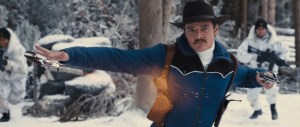 The movie never addresses one holdover from the original Kingsman that I think deserves at least a passing mention, and that’s the fact that every government leader or head of state in Western democracy had their head explode. That kind of public service vacuum would sow plenty of chaos and controversy, especially when people discovered that their elected leaders were complicit with the plan to kill the world’s remaining population. I feel like this was such a huge event that it at least deserves a cursory mention of some sort.
With the glut of disappointing and alternatively maddening action cinema this year, I’ll still gladly take Vaughn’s reheated leftovers. Kingsman: The Golden Circle feels like it’s succumbing to the bombastic spy hijinks it was satirizing before, losing some semblance of its identity and wit to crank out an acceptable though unmemorable sequel. It lacks the sense of danger and genre reinvention that powered the first film. Vaughn’s signature style is still present and there are fun and intriguing story elements available; however, the development is what’s missing. The cool stuff is there but Golden Circle just doesn’t know what to do with it, and so we gallop to the finale feeling a mild dissatisfaction. Apparently the studio execs at Fox want Vaughn to get started on a third Kingsman as soon as possible. I just hope he hasn’t lost his interest in the franchise he birthed. It would be a shame for something like this to become just another underwhelming franchise.
Nate’s Grade: B-


 nathanzoebl
You must be logged in to post a comment.