Blog Archives
Monster (2003) [Review Re-View]
 Originally released December 24, 2003:
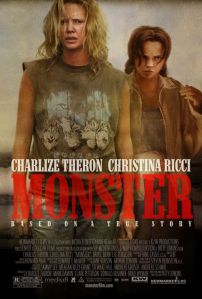
Monster follows the life of Aileen Wuornos (Charlize Theron, now nominated for a Best Actress Oscar), Americas only known female serial killer. In the late 1980s, Wueros was a roadside prostitute flexing her muscles with Florida motorists. She describes hookin’ as the only things shes ever been good at. One day Wuornos has the full intention of taking her own life, but she meets 18-year-old Selby (Christina Ricci) at a lesbian bar and finds a companion. Driven by a growing hatred of men from sexual abuse, Wuorno’s starts killing her johns to try and establish a comfortable life for her and Selby.
Let’s not mince words; Theron gives one of the best performances I have ever seen in my life. Yes, that’s right. One of. The. Best. Performances. Ever. This is no exaggeration. I’m not just throwing out niceties. Theron is completely unrecognizable under a mass of facial prosthetics, 30 extra pounds, fake teeth and a total lack of eyebrows. But this is more than a hollow ploy to attract serious attention to the acting of a pretty face. Theron does more than simple imitation; she fully inhabits the skin of Aileen Wuornos. The closest comparison I can think of is Val Kilmer playing Jim Morrison in The Doors.
Theron is commanding, brave, distressing, ferocious, terrifying, brutal, stirring, mesmerizing and always captivating. It may be a cliché, but you really cannot take your eyes off of her. Her performance is that amazing. To say that Theron in Monster is an acting revelation is perhaps the understatement of the year.
With previous acting roles in Reindeer Games and The Cider House Rules, Theron is usually delegated to pretty girlfriend roles (who occasionally shows her breasts). Who in the world thought she had this kind of acting capability? I certainly did not. If Nicole Kidman can win an Oscar for putting on a fake nose and a so-so performance, surely Theron should win an Oscar for her absolute transformation of character and giving the performance of a lifetime.
With this being said, and most likely over said, Monster is by no means a perfect film. Minus the terrific central performance, Monster is more of an everyday profile of a grotesque personality. The film weakly tries to portray Wuornos more as a victim, but by the end of the film, and six murdered men later, sympathy is eradicated as Wuornos transforms into the titular monster. Some supporting characters, like Ricci’s narrow-minded Christian up bringers, are flat characters bordering on parody. The supporting characters are generally underwritten, especially the male roles that serve as mere cameos in a film dominated by sapphic love.
Monster is proof positive that human beings will never be phased out by advancing machinery when it comes to acting. Monster boasts one of the greatest acting achievements in recent cinematic history, but it also coasts on sharp cinematography and a moody and ambient score by BT (Go). Monster is a haunting film that you won’t want to blink for fear of taking your eyes off of Theron. She gives an unforgettable tour de force performance that will become legendary.
Nate’s Grade: B
——————————————————
WRITER REFLECTIONS 20 YEARS LATER

Monster was a revelation for Charlize Theron, an actress who until then had mostly been known for parts that asked that she be good looking and little else. Twenty years later, Theron is one of the best actresses working in Hollywood and it almost never happened without her breakthrough performance where she brought to startling life the horror of Aileen Wuornos’s tragic life and tragic desperation. When this movie came out originally in 2003, I doubt anyone but Theron’s closest friends suspected she was capable of a performance this raw and spellbinding, but that’s also a condemnation on all of us. How many other actresses out there could maybe rival the best of the best if they just had the right opportunity? How many actresses are stuck playing the same limited roles because that’s all they’re ever asked to do? How many actresses are wrongly assumed to be of limited talent simply because of their comely appearance? That isn’t to say there’s some hidden universal equation that the uglier you are the better at acting you have to be (though it sure has worked out for [insert your example of a conventionally unattractive actor here]), but this movie is a clear indication that too many actors are never given enough opportunities to shine.
Back in early 2004, I credited Theron’s performance as one of the best I’ve ever witnessed in my then-twenty-one years of moviegoing (although that number should be smaller considering I wasn’t keenly watching Scorsese as a baby). She is very good, but I’d like to claw back some of my rapturous words of praise now that we’ve seen twenty years of Theron acting excellence. Looking over her career, I might actually cite 2011’s Young Adult as her finest performance, and that one didn’t even nab an Oscar nomination (she’s since been nominated twice since, for 2005’s North Country and 2019’s Bombshell). The draw of the movie is the head-turning performance from Theron and she just disappears completely inside the skin of her subject. It’s hard to remember at times that this is Theron, thanks to the richness of her startling performance but also the accomplished makeup effects, which were not nominated. At every point, you feel the fire burning behind the stricken complexion of Theron, a fire that will eventually consume her and everything she loves. While highly compelling, this is not a performance of subtlety and restraint. This is a big performance, and the movie is often prone to making loud pronouncements about its subjects and pertinent themes. It’s loud, brash, and maybe for some it will seem a little too loud, a little too unsubtle, but it’s a movie that refuses to be ignored for good reason.
 In my original review I raised some reservations with the rest of the movie, and I’m here to recant one of them. I wrote back in 2004, “The film weakly tries to portray Wuornos more as a victim, but by the end of the film, and six murdered men later, sympathy is eradicated as Wuornos transforms into the titular monster.” I’m positive that many will still cling to this same idea but oh boy have I come around in twenty years. By the time the movie is over, you wonder why more women haven’t just snapped and gone on killing sprees. Wuornos is indeed a victim. She’s responsible for terrible deeds but that doesn’t change the fact that she started as a victim and continued as one until put to death by the state of Florida in 2002. She was a sexual assault survivor, groomed into prostitution, and then trapped by a society that saw her as little other than trash, something to be pitied but ultimately forgotten. She comes of age as an adult thinking her only value is the fleeting moments of pleasure she can provide for men, and in the narration, we hear her dreams that one of these men who repeatedly tell her how pretty she is would take her away to another life, like a princess. Alas. It’s impossible to separate her past as a victim of predatory men from her actions when she turns on predatory men. Being forced into prostitution out of desperation is one of the definitions for sex slavery and trafficking. The movie does try to make her last few johns more ambiguous over whether or not they are “good people” and thus “deserving” of their fates, like a scale is being introduced and we’re doing the calculation whether Wuornos will strike (#NotAllMen, eh felas?). There’s a clear dark path where the murders get considerably worse. She begins by defending herself against a rapist, but by the end, it’s just a kind family man who picked her up without even the intention of having sex. We’re meant to see her transform into the titular monster, but I kept wondering about Aileen Wuornos as the societal stand-in, accounting for thousands of other women who lived and died under similar tragic circumstances.
I also found myself growing increasingly contemptuous of the love interest character played by Christina Ricci (Yellowjackets). When we’re introduced to Selby, she’s a wide-eyed naif testing her boundaries of comfort but clearly tapping into repressed homosexual feelings. Their relationship is meant to serve as the emotional rock for Wuornos, the reason that she’s acting more rash is because she’s trying to earn enough money for the two of them to run away together and build a new life. She is her motivation, but Selby is absolutely the worst. You can excuse some of her hemming and hawing about striking out on her own and leaving her controlling parents, as she’s fighting against repression as well as trepidation for starting out independently, but this lady becomes fully aware of the dangers and dehumanization that Aileen goes through to earn her meager amounts of money, and Selby encourages her to do so. Not just encourages her, Selby pressures her to do so, to get back out there and “provide” for her, knowing fully well what that means, knowing fully well how these men have treated Wournos, repeatedly abusing her. What are you doing to help things out, huh Selby? She’s embarrassed hanging around Wuornos around some other lesbian friends she just met, so she’s already looking to upgrade and move past her lover. By the end, as she’s trying to coax a confession of guilt from her girlfriend to save her own skin, Selby becomes just another user, taking what they want from Wuornos and discarding her when they’ve had their fill.
 This was the directorial debut for Patty Jenkins, who also served as the sole credited screenwriter, and while the indie darling-to-franchise blockbuster pipeline has been alive and well in Hollywood, it was quite a surprising leap that her next movie after Monster was none other than 2017’s Wonder Woman. To go from this small character-driven true crime indie to leading the big screen solo outing for comics’ most famous female hero is quite a bizarre but impressive jump. Her only other feature credit is the much less heralded 2020 Wonder Woman sequel. She was attached to direct a Star Wars movie about fighter pilots but that seems to have gone into turnaround or just canceled. So is the way with Star Wars movies after 2019’s Rise of Skywalker. Just ask the Game of Thrones creators, Josh Trank, and Taika Watiti how that goes.
Monster is a phenomenal performance with a pretty okay movie wrapped around it in support. Twenty years later, Theron is still a monster you can’t take your eyes away from. It changed her career destiny and I think acts as an exemplar for two reasons: leaving the viewer with the question how many other wonderfully talented performers will never get the chance to showcase their true talents because of faulty assumptions, and how many other women are out there living in quiet degradation like Aileen Wuornos.
Re-Veiw Grade: B
Share this:

Wonder Woman 1984 (2020)
 Big, colorful, and brimming with optimism easy to scoff at, Wonder Woman 1984 (WW84) is finally here to save Christmas and maybe movie theaters and it’s an escapist treat. It won’t register among the best of superhero cinema but will likely keep a smile on your face.
In 1984, Diana (Gald Gadot) is working at the Smithsonian Museum in Washington D.C. and fighting crime as her costumed alter ego. She’s never quite moved on from the death of Steve Trevor (Chris Pine) back in WWI and she dearly needs some friends. Barbara (Kristen Wiig) is a mousy co-worker who comes across a mystical artifact, a rock that magically grants wishes. Barbara wishes to be strong like her boss/idol Diana and she gains new intoxicating power. Max Lord (Pedro Pascal) is a wannabe TV pitchman and an empty suit, fleecing investors and barely keeping ahead of his own Ponzi scheme. He learns of the magic rock and wishes himself to become the rock itself, turning him into a living genie. From there, Max’s wishes are spinning out of control, placing the world in greater crisis. Diana is torn because, before Max absconded with the wish rock, she wished for her heart’s desire, the return of Steve. Stopping Max and reversing the effect of the wishes means having to say goodbye to Steve all over again.
The original Wonder Woman was a break from the pallid doom and gloom motifs that Zack Snyder established, and the sequel goes even further with its candy-colored recreation of the 1980s. I was wondering if there would be a good reason to set the movie specifically during the 80s, and it’s mostly for the Cold War and Yuppies. I was pleasantly surprised that Jenkins and company don’t overdo the 80s nostalgia or the fish-out-of-water comedy for Steve Trevor. I thought this was going to be the entire reason for the throwback setting, and this time instead of Diana marveling at a modern world she did not understand it would be Steve. If you’ve watched the film’s trailer, then you’ve seen all of those jokes at Steve’s expense. That’s it. WW84 can manage to surprise you, mostly in a pleasant manner. Its sincerity is its biggest virtue. It’s a movie about plenty of goofy things but at its core it’s about relatable desires and struggle.
 WW84 is an improvement over the original in the action department. Returning director Patty Jenkins feels freed of emulating Snyder’s house style and brings a welcomed sense of levity and playfulness to the action. The fight choreography makes significant use of Diana’s lasso, opening up the playing field for her to swing around wildly, at times even literally riding the lightning. At points the lasso seems to have a mind of its own and able to divide into fragments. It’s something that helps separate WW84 from the glut of other superhero movies and it offers pleasing visual variance for the fights. There’s a car chase midway through the film where Diana has to leap from speeding truck to speeding truck, dodging goon gunfire. It’s an exciting and sustained action sequence, yet even across the Middle East, chase clichés will reappear, like dumb kids playing in the street ignorant to any emerging noise like a caravan of speeding vehicles. Jenkins seems even more adept behind the camera for the action, delivering big stunts and memorable spectacle ready to make a splash on a big screen. However, some of the CGI can be shockingly dodgy for a big-budget blockbuster and a final confrontation with a CGI-hybrid creature unfortunately reminded me of the lamentable Cats.
The magic wish rock setup shouldn’t be any harder to believe than, say, a secret island of immortal female warriors or just about anything in the absurd and absurdly entertaining 2018 Aquaman feature film. If I can accept a drumming octopus, I can accept a magic wish rock. WW84 hinges on the concept of the drawbacks of creating your own false reality where every wish comes with a cost and an increasing flood of alarming consequences. It it better to just accept the comfort of lies or accept hard truths? The characters even name-check the classic short story The Monkey’s Paw recognizing the ironic trap. That doesn’t stop characters from struggling with the pull of their burning desires, and it makes for an agreeable return for Steve Trevor. Ever since it was revealed that Pine’s character was returning, I was worried what the possible explanations could have been, pessimistic it would be satisfying. Is he going to be a clone? Reincarnation? The grandson who happens to look identical? The screenplay by Jenkins, Geoff Johns, and Dave Callaham finds a way to make it work by bringing him back through magic but with restrictions. In a very Source Code sort of style, Steve is operating in someone else’s body, but only Diana sees Steve. It’s a decision that frames the return in a personal way that also reminds us what is eating at her. It’s been 70 years and she hasn’t moved on from the man she loved, which can be viewed as sad, romantic, and unquestionably unhealthy. It’s a familiar character arc, having to move on from a loved one and accept grief, but it still works, and it humanizes this mighty Amazon warrior woman. It’s a worthwhile development that opens up these living gods into emotional, vulnerable beings.
 With the wish plot comes some gripes and lingering questions. I kept asking, “Is everyone simply not seeing what’s happening?” or, “Is everyone forgetting what has happened?” The scale of the wish consequences is substantial and very public but it never feels like the world is registering just how fantastic these supernatural shenanigans are. In 1984, Wonder Woman is fighting crime as a hobby but still not a named and identified hero. The world does not seem aware of the presence of super beings and amazing powers living among us. So as Max continues his wish-granting ways there are immediate consequences of huge staggering scale, but nobody seems to register how weird and not normal things are, like a giant 50-foot wall suddenly appearing in Egypt. People should be asking what is going on or what others are doing. Therein lies the lingering problem with setting this movie in the past. Much like the 80s-set X-Men: Apocalypse, the events presented generate questions to why future-set movies seem to be ignorant of these same events. If Wonder Woman comes forward and addresses the world, why is she still hiding her identity in 2016’s Batman vs. Superman? And if she learns more about her own super abilities, why does she not make use of these very helpful skills in 2017’s Justice League? These sound like quibbles, and they mostly are, but the movie would have benefited from being a little more judicious with its rules and applications because I started wondering if everyone was oblivious.
I was genuinely surprised how much screen time and consideration was afforded to the primary villain. No, I’m not talking about Barbara/Cheetah, who could have been completely cut from the film. I’m talking about Max Lord. He’s arguably in the film as much as Diana. He’s a con man trying to be a successful TV pitchman and oil tycoon but really he’s trying to be a “somebody” to make his son proud. The problem is that his goal always seems to be just out of reach no matter what is gained. This part confused me. After successful wishes with power and money, Max seems to desperately continue searching for more. I suppose it could just be a general “power-hungry corruption” explanation but I kept asking when enough was enough, and that’s likely the point. I don’t know if Max Lord is a character deserving of this much consideration, but the approach appeals to the film’s empathetic mentality that no one is beyond reach. Rather than the villain having to be physically defeated, WW84 rests on emotionally appealing to a broken man’s sense of self. It makes for a more intriguing conclusion in a superhero realm than merely out-punching the CGI antagonist, like the clunky, lumbering finale from the prior Wonder Woman movie.
The conclusion of WW84 rests upon millions having to make a personal sacrifice for the greater good, which is a lovely sentiment that we could all use at this point after a dispiriting 2020. However, this year has also proven for me that the conclusion of WW84 is pure escapist fantasy. Throughout a deadly pandemic, the United States has been beset by too many people refusing to endure inconveniences in the name of protecting others and saving lives from COVID-19. The cost-benefit doesn’t add up for many if they can’t see the results, never mind the harsh yet sterile reality of over 300,000 dead Americans and counting aided by this selfish obstinance.
 Gadot might not ever escape the long shadow of playing a famous superhero but she’s settled into the role nicely and even gets to flex some untapped acting muscles. I was skeptical of Gadot early when she was hired but became a believer in 2017. She definitely has an unmistakable presence onscreen. Gadot’s best moments aren’t even the punching and kicking, which she does with gusto, but the moments where she has to make grand appeals and hard decisions. There are a few emotional moments where Gadot’s familiarity with the character blends together and she and the filmmakers are not afraid to show strength in other ways other than brawn. Gadot still has a very enjoyable chemistry with Pine (Hell or High Water) that makes them a winning pair. One of the film’s highlights is a personal flight through fireworks that delivers sheer joy for Steve Trevor. His awe about the future and getting one more spin with life itself is heartwarming. Pascal (The Mandalorian) is going big and hammy with his performance that reminded me of the Richard Donner Superman movies. Wiig (Ghostbusters) is the big miss for me. She’s not convincing as a threatening foe and her early scenes as a klutzy, put-upon dweeb feel overdone and yet insufficient. We needed more establishment of Barbara’s life before her wish to better recognize why she would never want to go back. One reoccurring street harasser doesn’t cut it.
Wonder Woman 1984 is fun, splashy, and doesn’t lose sight of its characters and their emotional states even as it elevates the world-annihilation stakes. It’s a movie that seems more confident in its identity than the first film. It accepts that it can be silly, it can be sincere, it can be exciting, it can be smaller and more personal, it can be hokey, it can appeal to your best self. It’s overly long (the opening flashback of young Dianna in the Amazon Games could have been ditched entirely) and not everything works, but the problems are easier to digest and forgive with what does work. It might be the last blockbuster for some time given the uncertain theatrical landscape so I’ll take it. WW84 isn’t the swaggering solo venture the first film proved to be, but I would say it still makes for a mostly satisfying and fun experience that plays to the strength of the creative team.
Nate’s Grade: B-
Share this:

Wonder Woman (2017)
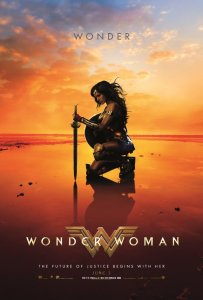 I owe Gal Gadot an overdue apology. When the news first broke that the Israeli model-turned-actor had won the role of Wonder Woman, I was quite dismissive. My heart had been set on Gadot’s Fast and Furious 6 costar, Gina Carano, a former MMA fighter who displayed a natural screen presence. I apologize for not thinking the relatively slim Gadot had what it takes to fill out Diana Prince’s wonder boots. I just couldn’t see it, and that’s an error of imagination on my part. When Gadot made her debut in 2016’s otherwise abominable Batman vs. Superman, she was one of the few high points, granted she was only there for like fifteen minutes. My concerns were abated but could she hold her own film? After 140 minutes of consideration, I can declare that Gadot is a star and a terrific Wonder Woman. The rest of the film is pretty good though not up to her wonder level.
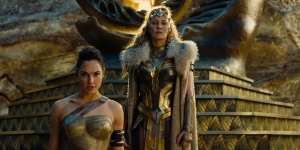
Diana (Gadot) is an Amazonian princess living on a mysterious hidden island ruled by ageless female warriors like Hippolyta (Connie Nielsen) and Antiope (Robin Wright). One fateful day a downed airplane crashes close to their shore. Diana rescues the pilot, Steve Trevor (Chris Pine), and is fascinated to learn he is a man. The Amazonians are distrustful of a man in their land. He warns them about the “war to end all wars” going on that threatens the greater world. The Germans are developing a powerful chemical weapon thanks to the treacherous Dr. Poison (Elena Anaya) and Luddendorff (Danny Huston). Diana decides she cannot stay idle. She leaves her home and travels with Steve to London and eventually the the European Front. Diana is certain the one responsible for the global conflict is none other than the god of war Ares, who will stop at nothing to annihilate mankind.
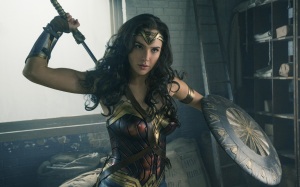 Wonder Woman is an entertaining, empowering, and engaging Golden Age superhero throwback that manages to be the best the DCU has had to offer. This is the movie many fans have been waiting for. Wonder Woman’s structure and tone feels like what would happen if you crammed together Marvel’s Thor and Captain America: The First Avenger. It’s got the ancient mythological society that is separate from mankind. It’s got the fish-out-of-water comedy of a god traveling to the world of man and trying to make sense of our clothing, customs, and backwards gender norms. It’s also set during a world war far in the past and resonates with handsome period-appropriate production values. The comedy aspects are surprisingly restrained; the fish-out-of-water jokes are mostly deployed during Diana’s first encounter with Steve’s secretary, Etta (Lucy Davis). The humor goes a long way to help coalesce the varied tones, tying the campier elements with the more serious war backdrop. It’s a movie that recognizes, at long last, that the DCU can actually be fun. The lighter tone works as well to establish the charming dynamic between Diana and Steve. There’s a screwball comedy feel that gracefully comes in and out, allowing Pine (Star Trek Beyond) to be simultaneously amazed and flat-footed at his ever-increasing crush’s agency. They make a winning pair and there are several moments that are funny, touching, and lovely between them that made me smile.
Gadot (Keeping Up with the Joneses) is a wonderful lead and delivers a star-making turn. She draws you in immediately. Gadot succeeds as a cultural icon come to colorful life. She succeeds as a comic actress bemused and wary at the era’s gender politics. She succeeds as a dramatic actress able to convey the emotions of doubt and torment. But most significantly she succeeds as a person overcome with the sheer thrill of self-discovery. There’s a moment where Diana takes a flying leap to grab a stone tower’s ledge. She grabs it but the ledge breaks and she starts sliding down the face of the tower. She stops her downward plummet by punching her own handhold. She then punches another. Gadot’s face lights up, taking in the sheer scope of her personal possibility. She launches herself up the face of the tower, more determined and blissful than before. Gadot’s greatest strength is her capacity of expressing Diana’s growing sense of self. Her ongoing declaration of agency is given a welcomed and fitting action-movie cool treatment.
 Director Patty Jenkins (Monster) acquits herself impressively in the world of big-budget action. The first action sequence involves ancient Greek femme warriors against German soldiers, and it’s awesome. Watching the galloping horses and gilded warriors confidently mow down the enemy soldiers is a primal joy. Jenkins pleasingly frames her action sequences and uses judicial cuts, keeping an audience oriented through the duration. It’s action you can comprehend and relish. Jenkins has a great command of her visual space and how to sell the bigger moments. We don’t see Diana in her full Wonder Woman regalia until an hour in but when it comes it feels like a big screen moment decades in the making. Diana gets her deserved heroic entrance. Jenkins color palate follows the gun mettle grays of Zach Snyder’s pre-established diluted color scheme, but the less oppressive tone makes it feel less dreary. Something of interest is also how little her camera sexualizes Gadot, who is by all accounts a stunning human being. Given Wonder Woman’s costume, her creator’s kinky origins, and the generally prevalent practice of the male gaze, I would have assumed there would be certain moments to highlight Gadot’s physical assets. The movie does so but it highlights her strength and fortitude rather than her curves. Her femininity isn’t tied into how her body looks to appeal to men. It’s about what her body can do and often to the immediate threat of men. She does get a couple killer evening gowns to wear but her sword is tucked away behind her shoulder blades, a powerful reminder that she’s no man’s sexual object.
With all that said, the praise is a bit over pronounced for Wonder Woman, because while it is clearly head and shoulders above the other DCU films, it’s still only an overall good film and not a great one. I understand that many will celebrate a big-budget action showcase for an idol of female empowerment, but I don’t want to ignore problems either. The biggest issue for Wonder Woman is just how simplistic its characters and themes are. Diana is an interesting character but she’s not that deep. She’s following a common hero’s journey and learning about the possibilities of man, good and bad. She’s trying to understand the inherent contradictions of life, civilization, and war. There isn’t any major test she has to overcome besides a broad accepting of one’s destiny. Steve falls into the love interest/damsel role primarily reserved for women in these sorts of things. His scenes with Diana are some of the best in the movie but he’s still underwritten too. The themes of responsibility and inaction are fairly broad and kept that way. There isn’t much room for nuance. Example: Steve brings Diana into the trenches on the Front and says their destination is on the other side of No Man’s Land, the stalemate between enemy trenches. He then says “no man” two more times, as if the audience doesn’t quite get it and needs it underlined (get it: Diana is “no man”). There’s also the idea that Ares is responsible for men warring with one another to make a point about man’s nature. Minor spoilers here but, shocker, Aries is eventually vanquished and the German soldiers all act like a magic spell has been broken. They’re much more chummy and not as interested in fighting. Doesn’t this then assume that the next war, the one with the Holocaust, was all mankind’s responsibility? Aren’t we proving Ares’ point about our very volatile nature?
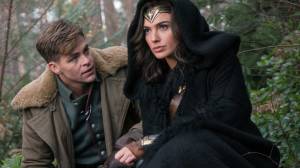 The supporting characters are pretty stock even by stock standards. There’s the charming Arabic soldier (Said Taghnaoui) who dreamed of being an actor, the Scottish sharpshooter (Ewen Bremner) who is unable to shoot any more, and the expat Native American (Eugene Brave Rock) looking to make a profit from war. None of these characters are given a moment to shine nor do they impact the plot in any way. Each one is given a minor characterization note but they don’t come back to them. They are robbed of payoffs. Why give the sharpshooter a PTSD-like trauma if he doesn’t rise to the occasion or explore that trauma? You literally don’t see him shoot anyone from a distance, meaning that his specialty he brings to the group is null and void. The Arab wannabe actor doesn’t get a chance to use his skill set either. Why introduce these characters and provide an angle for them if they’re ultimately just going to be an interchangeable support squad? I know they’re meant to be supporting characters but it goes to the lack of development, and less developed characters that are kept more as background figures offer a less realized world with less payoffs and a somewhat lowered ceiling of potential entertainment.
The third act is also where Wonder Woman becomes another in the tiresome line of CGI overkill. Beforehand Jenkins had done well enough to play into the already established visual stylings of the Snyderverse but the movie is eventually swallowed whole, becoming indistinguishable from the noisy, calamitous, and altogether boring climax of Batman vs. Superman. It’s another CGI monster fight with lots of explosions, flying debris, and the Snyder staple of slow-motion-to-fast speed ramps. The final battle between Diana and Ares doesn’t really alter its dynamics. They take turns punching, throwing things, and taunting one another. There’s no real variation to the fighting. This is supposed to be the ultimate showdown, a battle of the gods, and it feels so detached. Part of this is also because the film keeps the identity of Ares cloaked, which keeps the ultimate bad guy as more a philosophical presence for too long. I think the film also errs by having the actual actor onscreen for the fighting. It would have been best for Ares to have just been a CGI monster rather than what we ultimately get. I’m also unclear exactly what Wonder Woman’s powers are because all of a sudden she just seems to do stuff. This all leads to a final standoff that goes on far too long and feels anticlimactic.
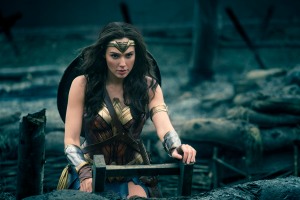 There is also a moment with a mustache that needs highlighting for its sheer hilarity (oblique spoilers). There is a flashback to a thousands-year-old story, and a certain character retains a large, bushy mustache, and it took all my power not to bust out laughing at the absurdity of the image. This could have been preventable. They could have hired any younger actor. The audience would still have known who the onscreen figure was since they were narrating their own tale. They could have also just shaved the stach. Is it possible that the villain’s powers are completely linked to this item of facial hair? Is this a modern-day Samson, a cruel joke practiced by Zeus, who never could have foreseen an age where anachronistic facial hair would be celebrated with undue irony (hipsters will be the death of us all)?
Wonder Woman is going to make a lot of people happy, especially those who have been yearning for a worthy showcase not just for the character but for a strong heroine who doesn’t need romantic entanglements or a man’s approval. Celebrate the big screen outing befitting the biggest female superhero in comics’ canon. Gadot is a genuine star and has a charming and capable sidekick with Pine. The action is enjoyable, the humor keeps things light enough to blend the different tones, and the stylistic choices from Jenkins keep the movie fun for all ages and genders. It’s a celebration of a woman’s might and not necessarily how she looks in her star-spangled mini-skirt. It’s a relative bright spot for the otherwise dreadful, dark, and dreadfully serious DCU, though I still cannot muster any hope for Wonder Woman’s next appearance, Snyder’s Justice League. With all of its virtues and entertainment, Wonder Woman still suffers from some poor development decisions and a lousy final act that hold it back from true greatness. It’s a good movie, but walking away, I couldn’t help feeling that even the best DCU movie (thus far) was about lower middle-of-the-pack compared to the mighty Marvel Cinematic Universe. Wonder Woman is a considerable step forward in the right direction but there’s still many more left to go.
Nate’s Grade: B
Share this:

Monster (2003)
Monster follows the life of Aileen Wuornos (Charlize Theron, now nominated for a Best Actress Oscar), Americas only known female serial killer. In the late 1980s, Wueros was a roadside prostitute flexing her muscles with Florida motorists. She describes hookin’ as the only things shes ever been good at. One day Wuornos has the full intention of taking her own life, but she meets 18-year-old Selby (Christina Ricci) at a lesbian bar and finds a companion. Driven by a growing hatred of men from sexual abuse, Wuorno’s starts killing her johns to try and establish a comfortable life for her and Selby.
Let’s not mince words; Theron gives one of the best performances I have ever seen in my life. Yes, that’s right. One of. The. Best. Performances. Ever. This is no exaggeration. I’m not just throwing out niceties. Theron is completely unrecognizable under a mass of facial prosthetics, 30 extra pounds, fake teeth and a total lack of eyebrows. But this is more than a hollow ploy to attract serious attention to the acting of a pretty face. Theron does more than simple imitation; she fully inhabits the skin of Aileen Wuornos. The closest comparison I can think of is Val Kilmer playing Jim Morrison in The Doors.
Theron is commanding, brave, distressing, ferocious, terrifying, brutal, stirring, mesmerizing and always captivating. It may be a cliché, but you really cannot take your eyes off of her. Her performance is that amazing. To say that Theron in Monster is an acting revelation is perhaps the understatement of the year.
With previous acting roles in Reindeer Games and The Cider House Rules, Theron is usually delegated to pretty girlfriend roles (who occasionally shows her breasts). Who in the world thought she had this kind of acting capability? I certainly did not. If Nicole Kidman can win an Oscar for putting on a fake nose and a so-so performance, surely Theron should win an Oscar for her absolute transformation of character and giving the performance of a lifetime.
With this being said, and most likely over said, Monster is by no means a perfect film. Minus the terrific central performance, Monster is more of an everyday profile of a grotesque personality. The film weakly tries to portray Wuornos more as a victim, but by the end of the film, and six murdered men later, sympathy is eradicated as Wuornos transforms into the titular monster. Some supporting characters, like Ricci’s narrow-minded Christian up bringers, are flat characters bordering on parody. The supporting characters are generally underwritten, especially the male roles that serve as mere cameos in a film dominated by Sapphic love.
Monster is proof positive that human beings will never be phased out by advancing machinery when it comes to acting. Monster boasts one of the greatest acting achievements in recent cinematic history, but it also coasts on sharp cinematography and a moody and ambient score by BT (Go). Monster is a haunting film that you wont want to blink for fear of taking your eyes off of Theron. She gives an unforgettable tour de force performance that will become legendary.
Nate’s Grade: B


 nathanzoebl
You must be logged in to post a comment.