Blog Archives
The Station Agent (2003) [Review Re-View]
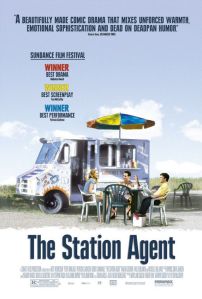 Originally released December 5, 2003:
This is the most charming film of 2003, and Im not just saying this because I had an interview with one of its stars, Michelle Williams (Dawson’s Creek). Fnin McBride (Peter Dinklage) is a man with dwarfism. With every step he takes every look he gives, you witness the years of torture hes been through with glares and comments. Hes shut himself away from people and travels to an isolated train station to live. There he meets two other oddballs, a live-wire hot dog vendor (Bobby Cannavale) and a divorced mother (Patricia Clarkson). Together the three find a wonderful companionship and deep friendship. The moments showing the evolution of the relationship between the three are the films highlights. Its a film driven by characters but well-rounded and remarkable characters. Dinklage gives perhaps one of the coolest performances as the unforgettable Fin. Cannavale is hilarious as the loudmouth best friend that wants a human connection. Clarkson is equally impressive as yet another fragile mother (a similar role in the equally good Pieces of April). The writing and acting of The Station Agent are superb. Its an unforgettable slice of Americana brought together by three oddballs and their real friendship. You;ll leave The Station Agent abuzz in good feelings. This is a film you tell your friends about afterwards. There’s likely no shot for a dwarf to be nominated for an Oscar in our prejudiced times but Dinklage is deserving. The Station Agent is everything you could want in an excellent independent movie. It tells a tale that would normally not get told. And this is one beauty of a tale.
Nate’s Grade: A
——————————————————
WRITER REFLECTIONS 20 YEARS LATER
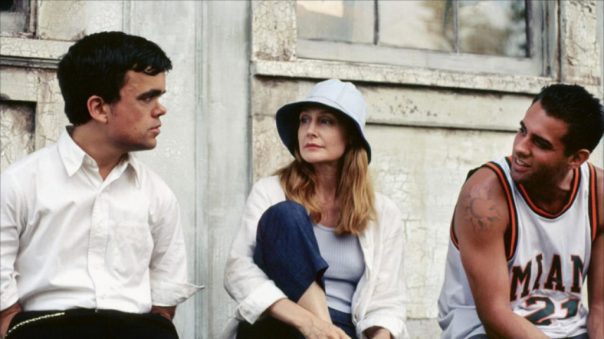
Tom McCarthy didn’t invent the quirky, found family indie but he sure seems to have nearly perfected it, starting with 2003’s The Station Agent. This little gem of a movie is so subdued, so relaxed, and so gentle that it seems to adopt the very personality of its lead character, Fin (Peter Dinklage), a dwarf who just likes trains a lot and wants to live his life in solitude. He’s an unassuming man who keeps to himself as a means of survival, because almost every time he goes into public life Fin is met with stares, snickers, and harassment (the convenience store lady gets his attention to take his unsolicited picture). Very few will get to know this man beyond his superficial physical characteristics, so he retreats within himself, perhaps purposely obsessing over an antiquated hobby as a means of escape to the past. He’s a lonely man and the movie is about him finding his clan, his place in the world, by slowly lowering his defenses. It’s a simple sort of story that is lifted by the strength of its characters and its wonderful ensemble cast.
With such a taciturn main character we need a contrasting character, a much more talkative person with high energy, and this is beautifully embodied by Bobby Cannavale. He plays Joe Oramas, a coffee truck operator who exemplifies joy de vie. He’s charming, garrulous, and relentlessly upbeat, which makes for a magnificent odd couple contrast with Fin, and it allows both characters to gradually change and grow attached to one another’s mutual friendship. Finn allows himself to become more vulnerable and form bonds and Joe starts to see the world from Fin’s point of view, allowing himself to slow down and appreciate the smaller things he might have missed in his excitable and irascible activity. Dinklage’s dry understated performance is a perfect counterpoint to the churning energy emanating from a grinning Cannavale. This is a fine showcase of both actors, who would go on to win six Emmys between them in the years ahead.
The third member of this found family is Olivia, played by Patricia Clarkson, and I actually think the movie might have worked better without her character. She does provide a point of view that our two guys lack; she’s experienced significant grief over a lost child and her life is in shambles as she tries to discover what she wants from her cratering marriage to a young-er John Slattery. Clarkson is also wryly enjoyable and gets some of the best lines in the movie, so she’s not at fault here. I think it’s because I’m confused about how this character is treated, especially compared to the natural opposites-attract dynamic of Fin and Joe’s friendship. Olivia feels like a broken thing that the boys need to try and help get better, but we were already covering this with Finn’s reserve from a lifetime of feeling ostracized. The possible romance between Fin and Olivia is also awkward because there are obvious implications that she sees Fin as a replacement son, even having him sleep in her son’s old bed. At one point, in her anger, she yells at Fin that she’s not his mother, but it feels much more like she’s the one who is looking for a surrogate son, and just because Fin is a dwarf and perhaps of similar heights makes the whole thing feel uncomfortable and ill-advsied. I’m not going to refuse an added Patricia Clarkson in my movie, but upon my re-watch twenty years later, it’s hard not to feel like McCarthy didn’t have as much envisioned for this part.
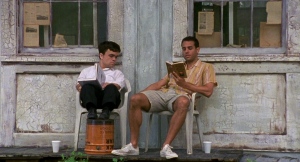 McCarthy’s movie acclimates the viewer to the simple charms of its people and the small town, getting to know the various characters and their foibles and hopes, getting used to the rhythms of this life and adjusting much like Fin. There are small victories that are payoffs, like Fin finally getting a library card, or speaking in front of a school class about his affinity for trains. It works so well. McCarthy continued his found family writing with 2007’s The Visitor and 2011’s Win Win, both anchored by the emotional enormity of sad, lonely men learning to open up to companionship. There were some dips in the road but McCarthy worked his found family magic to the biggest stage with 2015’s Best Picture winner, Spotlight, which McCarthy directed and co-wrote. His only follow-up theatrical movie was 2021’s Stillwater, where an oil rig dad (Matt Damon) tries to save his daughter overseas from a very ripped-from-the-headlines scandal (Amanda Knox was very unhappy). There is also a 2020 Disney Plus movie about a kid detective and his imaginary polar bear best friend (that actually sounds adorable). I guess I figured a Best Picture Oscar on your resume, as well as a history of working within the studio system and world of indies, would have given McCarthy more work than directing a handful of episodes for 13 Reasons Why and creating Alaska Daily. I’ll always be looking for the next McCarthy project when I can.
McCarthy’s failures can be just as intriguing as his successes. The Cobbler is just such an astounding idea that it’s hard to imagine anyone thinking it would work out, with Adam Sandler as a magic shoe-maker. However, this same pessimistic mentality probably prevailed when McCarthy was trying to raise money for The Station Agent. His indie successes proved that he could take any jumble of strange characters and turn it into a functional movie. Maybe that hubris, well-earned along with his contributions to the Oscar-nominated Up script, finally caught up with 2014’s The Cobbler. I would pay good money to one day watch that un-aired footage of the original Thrones pilot, the one the producers themselves acknowledged to be deeply troubled. After retooling the show and cast, bringing in Michelle Fairley and Emilia Clarke, McCarthy departed, though is credited for helping to secure Dinklage’s involvement, and it’s impossible to think of the zeitgeist-defining excellence of the HBO series with anyone else playing the iconic role of Tyrion Lannister.
 Re-evaluating The Station Agent twenty years hence, its many charms are still abundant and I appreciated how gentle and relaxed everything felt. When indie movies deal with heavy amounts of quirk and oddities, it can often be heavy-handed and abrasive, never letting the audience forget for a second just how special and strange and different the movie must be (here comes 2024’s look at Napoleon Dynamite). McCarthy’s movie almost feels like a writing exercise where he plucked three very different characters out of a hat and challenged himself to build a grounded movie built upon their unexpected friendships. It’s a movie confident to just let the characters speak for themselves. It’s more a slice-of-life glimpse at people who feel far more real than most Sundance indies built upon oddballs and quirk. I would slightly lower the grade from an A to an A minus simply because of the Olivia character. Clarkson is great but her role feels undeveloped, somewhat redundant, and a little sloppy. Still, the enjoyable performances, the observational detail, and the simple pleasures of a story well told with characters you genuinely care about are what shines through even twenty years later.
Author’s note: In my original review, I cite having interviewed Michelle Williams (yes, surprise, she plays the small-town librarian). While I was my college newspaper’s film critic from January 2002 to May 2004, I did have the opportunity to interview several actors and directors through phone cattle calls with other collegiate journalists. These names include Angelina Jolie (Tomb Raider 2), Billy Bob Thornton (Bad Santa), Kevin Smith (Jersey Girl), and the late Paul Walker (Timeline). However, my school schedule was not accommodating for the Williams interview, so I had my dormitory neighbor and friend Tim Knopp call in and ask my question. It wasn’t me. I’m coming clean after twenty years, folks. I also recall having him quote a line her character says in The Station Agent, saying Fin had “a nice chin,” and being told that she was baffled and blanking on the reference. I’m sorry, eventual multi-Oscar nominee Michelle Williams, for trying to be clever.
Re-View Grade: A-
Share this:

She Said (2022)
 The fall of Harvey Weinstein was a long, long time coming, and the journalistic procedural drama She Said demonstrates just how hard it is to hold bad men accountable. This is a very similar movie to 2015’s Best Picture-winning Spotlight, following hard-nosed professionals as they go through beat-after-beat of assembling their case, following the leads, and convincing those who have been wronged to come forward and share their personal stories. The star is the details, the main crusading New York Times journalists (Carey Mulligan, Zoe Kazan) being defined by their tenacity and determination. As should be obvious, it’s galling how many people protected this awful man, including the police, because of how influential he was as a movie producer. Peeling back the layers of protection revolves around working on the niggling moral concerns of many who looked the other way, out of financial incentive or fear or disregard for rocking the “way things were.” When the expose picks up actual momentum, you can feel the same excitement of holding the powerful to account, even already knowing the end results that would land Weinstein in jail for the remainder of his life. It’s a simple yet effective approach. She Said is little more than a dramatized in-depth news article on its relevant subject, but the ensemble of actors give it a fire that simply scanning the written word can miss. The direction is very matter-of-fact, the writing is thoughtful though a bit heavy with data dumps, and outside of the victims narrating their experiences, or relatives discovering the extent of those experiences that have been kept hidden from them, there isn’t much sustainable tension. Much has been made of Samantha Morton’s one-scene wonder but I think Jennifer Ehle (Braveheart) does even more with her scenes as a victim choosing to speak during a health scare that reassess her thinking. I wish the movie had extrapolated about the entire film industry protecting abusers, but it keeps its focus squarely narrowed on taking down Weinstein. She Said is a worthy movie with a worthy subject and heavy in the details but maybe light on its own drama.
Nate’s Grade: B
Share this:

The Maze Runner: The Scorch Trials (2015)
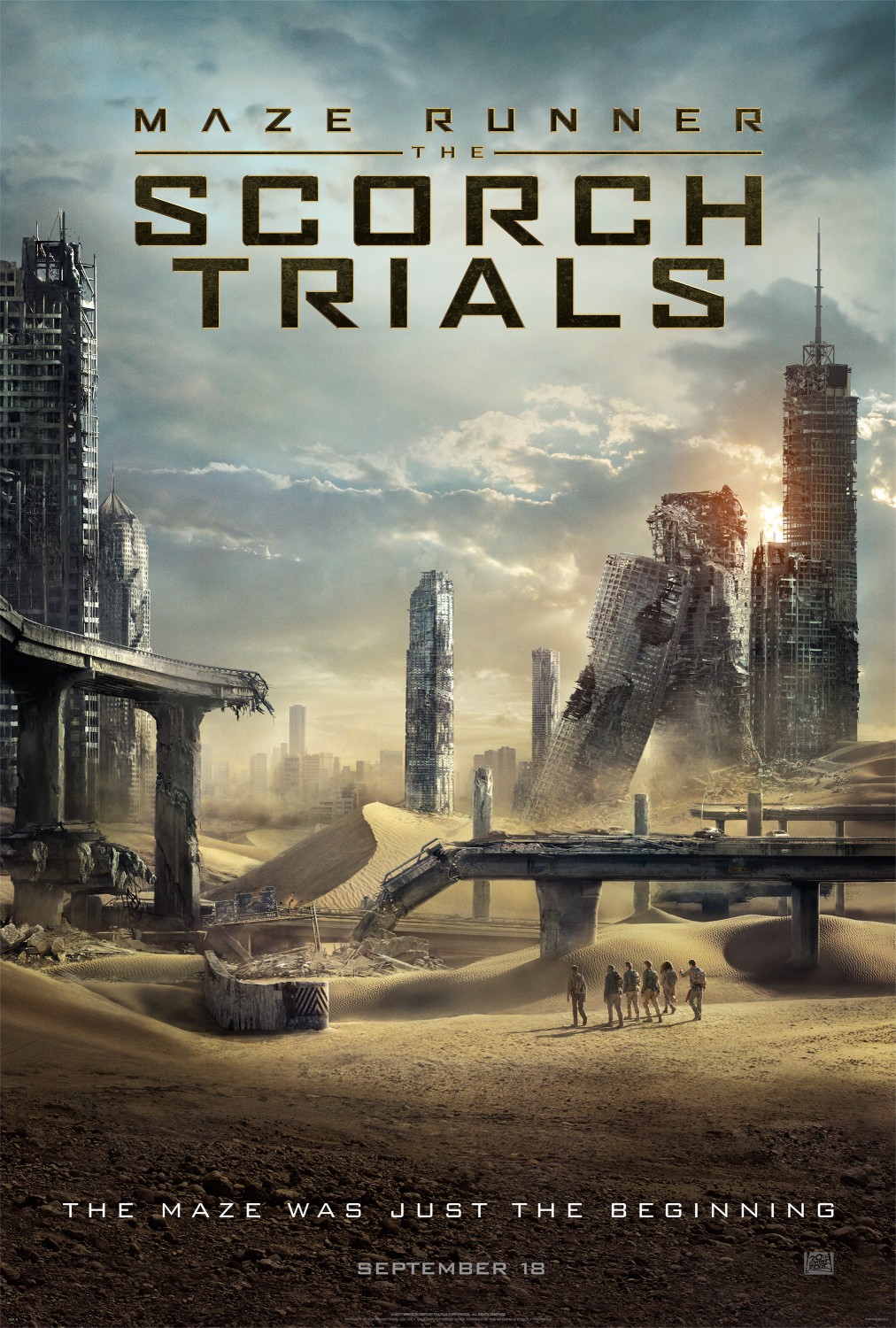 It’s called The Maze Runner: The Scorch Trials, though the trials appear more as “general struggles,” The Scorch appears as but a brief expanse of desert before the mountains, and then there’s the lack of any and all maze running (there is plenty of running, however). This sequel to the YA-inspired hit lives up to my biggest worry: the only thing interesting about this franchise was the maze, and now that’s gone. The mystery of the maze, and its cool factor, gave this story something memorable. Now it’s just generic YA pap. Beyond its boring protagonist, it would be a scorch trial for me to even assign description to these characters. They don’t even get one note to play; they have no notes. That’s because so much of this tedious and bloated sequel is our group of maze survivors running from one outpost to another, seemingly safe and then predictably not. It’s a plot routine that gets redundant quickly, and yet little else seems to occur. They go from stop to stop gaining characters but little else. The momentum feels stalled and there’s no sense of direction to guide the characters. It feels so aimless and dull and far too flimsy to justify even half of the movie’s 132 minutes. I just don’t care about these characters so I rooted for the bad guys. Weirdly enough, the bad guys use tasers and the good guys use bullets. There are some scant highpoints, namely the direction of Wes Ball, who finds ways to make the chase sequences visually stylish and fleetingly exciting, and a self-destruct sequence set to a Patsy Cline tune. There’s enough to get your hopes up before the grim reality of the overwhelming onslaught of YA tropes comes crashing down again. Can we stick these dumb kids back inside a maze already?
Nate’s Grade: C
Share this:

The Maze Runner (2014)
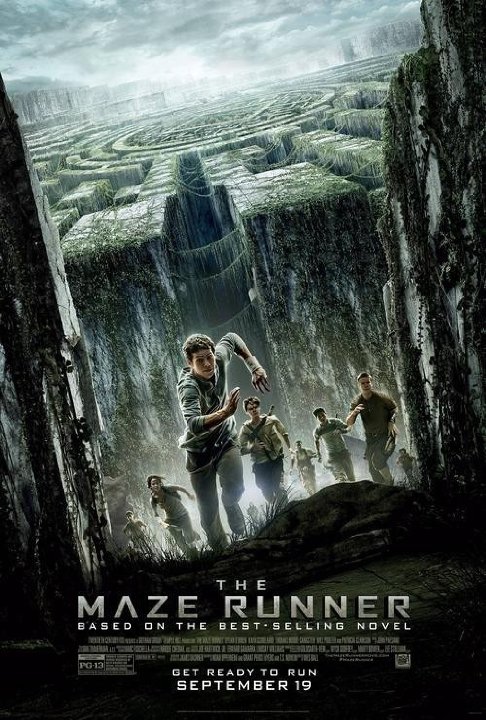 If anyone can reasonably explain to me the end of The Maze Runner in a way that makes some tangible amount of sense, I will give you money. The latest YA-franchise-in-the-making starts off with a storyline that reminded me of Rod Serling. We follow a group of teen boys, memories wiped, as they wake up in the center of a giant mechanical maze. Who put them there? Why? What’s on the other side? As long as the maze and the mystery of it are front and center, the film works, twisting in intrigue. However, when the story veers away to the characters, mostly flat archetypes, and their new society, that’s when I started getting sleepy. You got this awesome huge maze to explore, kids. The film ends up being an exercise in less-is-more restraint when it comes to sustaining a mystery and knowing what points to emphasize and which to skip over. There’s a girl brought into their camp, the first, which they say should be a big idea and change the social dynamics of a group of boys, but it doesn’t. There are silly mechanical spider monsters that scamper through the maze, as if the filmmakers felt a giant maze wasn’t a sufficient enough obstacle and selling point. Scattered flashbacks early on spoil who is responsible for the maze, but when we get to the actual ending, the rationale for who built this large contraption and for what purpose doesn’t add up, like, at all. An explanation wasn’t necessary, but if they needed a quick one I would have accepted, “Aliens did it because.” There’s already a planned sequel in the works. My idea: the kids escape the maze only to discover… they’ve just entered a larger maze. Then they escape that maze only to discover… you get the idea. The Maze Runner is moderately enjoyable. Just don’t expect to enjoy, understand, or even accept the ending and its implications.
Nate’s Grade: B-
Share this:

Shutter Island (2010)
 This was a pulpy B-movie put together with A-movie artistry. In a year that had some artistically polished genre movies, Shutter Island was Martin Scorsese’s return to genre filmmaking and he brought with him an entire team of experts and professionals. The movie is playful and intriguing, engaging the mind enough for a crime thriller that appears to be a straight-forward mystery but then shows flashes of being about something more, something darker. And when you’re dealing with a movie with Holocaust flashbacks, dead kids, Nazi doctors, mental asylums, well you know you’re not going to be reaching subtlety even with a stick. But the way Scorsese orchestrates all these foreboding elements, tying together various plotlines, and working at different levels to satisfy the informed and uninformed, right before delivering a dynamite twist that calls for further investigation and rewatching, well it’s nothing short of masterful. Shutter Island may not be anything more than a souped-up B-movie, but with this level of artistry, it’s also one of the most entertaining films of the year.
Nate’s Grade: A-
Share this:

Easy A (2010)
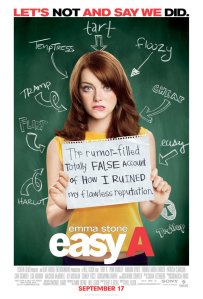 Usually when I think “teen comedy” I think lowest common denominator and a pitch straight down the middle of the plate. Will there be fart jokes? Probably. Will the climax taken place at the prom? Absolutely. Does Easy A do either? Not a chance. This is the sort of teen comedy that would have greatly appealed to me back in my own days of high school institutional education.
Olive (Emma Stone) is a high school senior that gets good grades, behaves well, and spends her weekends hopping around her bedroom and singing a song she can’t get out of her brain. She’s not into parties or idiots or anything remotely dangerous. Then her world turns upside down when she fibs about losing her virginity. Suddenly Olive is branded as the school’s hussy. Inspired by Nathaniel Hawthorne’s famous character, Olive decides to embrace the rumors, accessorizing her wardrobe with plenty of scarlet “A”s along the corseted bust line. Olive’s gay friend asks her for a huge favor: he wants to use her fake notoriety to lose his virginity. The two will attend a party, find a room, and dramatically interpret animated sex. It works like a charm. Her pal is given a free pass, some extra popularity, and it isn’t long before other downtrodden high school rejects seek a similar deal. Outraged at Olive’s lack of shame is Marianne (Amanda Bynes), the school?s busybody and leader of a vocal Christian abstinence program. She doesn’t know whether she wants to save Olive or banish her.
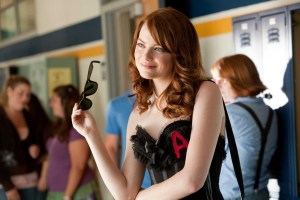 All hail the coming of Emma Stone, comedy goddess and future heartbreaker. Easy A is a fantastic showcase of the many strengths of this irresistible actress. After several supporting roles in films like Superbad and The House Bunny, this is the first opportunity for Stone to have a film where she gets to be the lead, and trust me folks, this won?t be the last one. Stone has a great way of becoming instantly empathetic and, much like the film, being brainy and playfully risqué at the same time. Watching the success of Stone is like watching the road not taken by Lindsay Lohan (be careful whose advice you take, Emma). Stone makes her good times seem effortless, like she really is having a blast playing up her bad girl image. Her facial expressions and sarcastic, know-it-all line readings help push her comedic range even further, and yet she remains completely empathetic the entire time. Stone is the kind of girl that other girls would want to hang out with and guys would crush on. It is impossible to not love this actress, and she makes Easy A easily enjoyable and downright effervescent at times.
The rest of the cast is having just as much fun with the material as Stone. Chief among them are Stanley Tucci and Patricia Clarkson as Olive’s hyper-literate parents. They may seem like they stepped off the train from a Diablo Cody movie at first, but you will quickly get used to their glib rapid-fire repartee. Some might dismiss them as kooks. Thomas Haden Church (Sideways) tries to make the glamorous movie idea of the Hip Teacher into a droll square and succeeds admirably. There’s even Lisa Kudrow (TV’s Friends) as a guidance counselor and Malcolm McDowell (Halloween) as a blasé principal (“This is public school. If I can keep the girls off the pole and the boys off the pipe, I get a bonus”). Then there’s Bynes (Hairspray, She’s the Man) in what was billed as her final film performance before hastily retiring from acting, and then following in the footsteps of other famous retirees like Michael Jordan, Stephen King, Jay-Z, and Brett Farve, and hastily un-retired. She has her cutesy, dimple-faced shtick she cling to, but what happened to her? Her face looks very swollen, like she had an allergic reaction on every day of shooting. It looks like someone inflated her head with the plot to turn her into a Macy’s Day balloon. I started to get concerned for Bynes by the end.
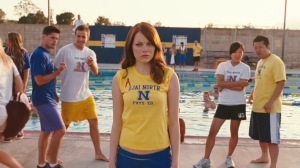 While Stone is the number one, two, and three reasons for seeing this movie, Easy A doesn’t let down her efforts. This is a teen comedy that might just be light years ahead of the pack. There are jokes guaranteed to go over the heads of a majority of audience members, from wisecracks about Sylvia Plath to French wordplay to the Kinsey scale. You’re not going to find any of that stuff in your typically brain-dead Freddie Prinze Jr. vehicle (is it just pathetic to keep holding onto a 10-year-old anti-FPJ grudge? The answer is, “No!”). Though I died a little inside when the movie resorts to explaining the plot of The Scarlet Letter to Joe Public; however, this intellectual Cliff Notes salve was saved by Stone bemoaning the idiotic 1995 Demi Moore film that takes some of the sharpest deviations I’ve ever seen from a classic literary adaptation (“If I have to grade one more paper talking about Hester Prynne taking baths all the time?”). The dialogue is routinely snappy and occasionally barbed, which is a bit of a surprise. It’s witty, a little cheeky, but it doesn’t go over the line or play for the easy gross-out gag. It?s a well-constructed, well-executed teen comedy that has a playful zing, a facetious tone that celebrates literature and makes being smart sexy.
While sex is at the forefront of the plot, the film does not treat the serious subject matter with flippancy. There’s some heavy stuff about what it means to sell out your ideals, prostituting yourself in more ways than the obvious. Olive begins her crusade as a means of taking ownership of her reputation and as an amusing character to play. But then as she dives ahead, accepting gift cards for her imaginary yet cred-boosting favors, the bloom of idealism dims and the meaning of her crusade become murky. What point is she trying to prove, exactly? In the end, is there a sharp difference between being a prostitute and being a “prostitute”? How big of a distance can irony give you? Easy A may have its fun when it comes time to doing the deed (I was howling with laughter about Olive chastising her first “client” about his comment on the aroma of sexual intercourse), but this is a teen movie ready to accept the consequences of its actions with a clear and level head.
 Not everything hums with precision. Easy A can be faulted for being too reverential and referential to 1980s teen comedies. Its ambition to be a modern-day member of this group is a bit too in-your-face. The abstinent Christian opposition feels too broadly drawn and setups for cheap shots and some downright mean punchlines. This movie is better than stooping to tin-eared caricature. The relationship between Olive and her best friend (Alyson Michalka) is vastly underdeveloped. The emergence of a Herpes outbreak also seems a little tacky, especially given its salacious carrier (trying hard not to spoil plot reveals). Then there are simply questions of believability. I?m not expecting a journalistic document of the American educational system, but since when was a high school student losing their virginity scandalous gossip? Why would Olive become the talk of the town by doing something that, according to the CDC, 80% of men and 75% of women have accomplished by age 19? Now, later in the film, the whiff of prostitution would definitely create a stir in the social gossip machine, and with technology, a rumor can spread at the speed of texting.
The film follows a well-worn path and owes a serious debt to the teen films of the 1980s, but Easy A is a winning teen comedy thanks to a snappy script, a playful sense of the taboo, and the courage to shoot for a higher level joke, also Stone’s charismatic comedic performance makes the grade. The entire movie has this bustling, quirky energy to it that feels un-labored. They make it all look so easy. Despite being a thorough genre flick, it is lifted thanks to its zesty writing and acting. In the most simplistically crass terms, Easy A scores.
Nate’s Grade: B
Share this:

Good Night, and Good Luck (2005)
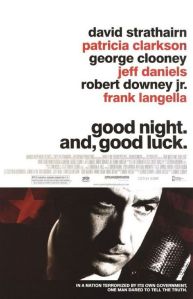 George Clooney’s pet project is articulate and a tad dull. The black and white cinematography is elegant; you can practically taste all the smoke onscreen. The idea of press vs. fear-mongering politician is very relevant today, and the film’s insight into the running of TV news is really interesting, but this is a movie that works best as a study and not as strict entertainment. It?s not stuffy or ideologically overwhelming; in fact it’s easy to follow and easy to get into, even if it leans too heavily on speeches. Clooney, as I predicted, is transforming himself into a terrific director with a great feel for his material. With Good Night, and Good Luck it seems like he got exactly what he wanted, regardless if an audience is going to walk away feeling they got their money’s worth.
Nate’s Grade: B
Share this:

Pieces of April (2003)
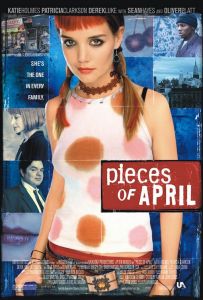 The set-up for Pieces of April, a low-budget film starring Katie Holmes, is a pastiche of familiar independent film elements so much so that it could across as parody. Holmes plays April Burns, a beleaguered teen living on her own in a grungy New York apartment. Today is Thanksgiving and her family will be stopping by for a grand Thanksgiving meal prepared by April. Her cantankerous mother (Patricia Clarkson) is ailing from breast cancer, and when she tries to think of one good memory shes had with April, she can only conjure memories belonging to younger daughter Beth (Alison Pill). She also will be introducing her family to her new boyfriend, Bobby (Derek Luke of Antoine Fisher). April has 24 hours to cook a memorable meal for her family and it could be the last Thanksgiving they spend together.
In the world of independent film, it seems like theres a whole sub-genre of movies that revolve around chaotic Thanksgiving dinners and dysfunctional families. The holiday setting, her mothers cancer, April’s spirited attempts at autonomy in the big city, interracial dating and an apartment complex full of cute oddballs all seem like tried-and-true staples of indie film.
Pieces of April was written and directed by Peter Hedges, writer of What’s Eating Gilbert Grape? and co-writer of About a Boy. His pedigree would certainly state that he knows something about family drama, and Pieces of April is a nice continuation of his observational humor. Hedges has a skilled confidence in his writing. The characters feel real and we gravitate to their vulnerability and hope. We see every sincere detail of Aprils plight to make her family proud. The choice to shoot Pieces of April on digital video adds an extra element of intimacy, like were trapped inside a home video.
Holmes gives her best performance to date. April, with patches of bright orange hair and arms enclosed with bracelets, is a sweetly vibrant character. When a neighbor asks about her relationship with her mother, April describes herself as the first pancake. She’s the one you’re supposed to throw out, another neighbor explains. Holmes’ performance is like a slow simmer of frustration, optimism and determination that wins your heart. Her more dramatic moments of helplessness and disappointment are quite affecting.
The supporting cast for Pieces of April is top-notch. Clarkson gets some weighty moments as the ailing mother, like when she runs out of the car in tears because she cant afford one more bad memory with April. She gets the showy part but enlivens every moment. Oliver Platt further feeds my theory of his quest to be in every movie ever. In Pieces of April he plays the put-upon father who frets his wife could pass any moment. Pill shines as the hyperactively cheerful and overachieving Beth. Her cherubic cheeks and glowing smile leave an indelible impression, and makes me question if her face ever got sore from excessive smiling.
Pieces of April is a pleasurable little comedy thats borderline touching. It’s not much more than a small slice of family drama, but with excellent writing and strong acting, Pieces of April distinguishes itself as more than a collection of familiar staples, and as a warm and quietly charming homespun comedy with an extra helping of heart.
Nate’s Grade: B+
Share this:

The Station Agent (2003)
This is the most charming film of 2003, and Im not just saying this because I had an interview with one of its stars, Michelle Williams (Dawson’s Creek). Fin McBride (Peter Dinklage) is a man with dwarfism. With every step he takes every look he gives, you witness the years of torture hes been through with glares and comments. Hes shut himself away from people and travels to an isolated train station to live. There he meets two other oddballs, a live-wire hot dog vendor (Bobby Cannavale) and a divorced mother (Patricia Clarkson). Together the three find a wonderful companionship and deep friendship. The moments showing the evolution of the relationship between the three are the films highlights. Its a film driven by characters but well-rounded and remarkable characters. Dinklage gives perhaps one of the coolest performances ever as the unforgettable Fin. Cannavale is hilarious as the loudmouth best friend that wants a human connection. Clarkson is equally impressive as yet another fragile mother (a similar role in the equally good Pieces of April). The writing and acting of The Station Agent are superb. Its an unforgettable slice of Americana brought together by three oddballs and their real friendship. Youll leave The Station Agent abuzz in good feelings. This is a film you tell your friends about afterwards. Theres likely no shot for a dwarf to be nominated for an Oscar in our prejudiced times but Dinklage is deserving. The Station Agent is everything you could want in an excellent independent movie. It tells a tale that would normally not get told. And this is one beauty of a tale.
Nate’s Grade: A
Share this:

The Green Mile (1999)
 A prison in the heart of the deep South during the era of the Great Depression is not usually the locale you’d find a somber tale of earnest discovery and passionate awareness to the follies of life. Yet here arrives the long anticipated The Green Mile, the second in tag-team efforts from director Frank Darabont and novelist Stephen King in their own genre creation of nostalgic feel-good prison flicks. All the swelling hype could manage to make the movie seem overbearing, but if you’ve got a free afternoon and a butt made of steel then try The Green Mile.
Darabont seems like the perfect visual interpreter to King’s epic narrative spinning of good, evil, and all that fall between. The movie moves at the pace of molasses and clocks in at over three hours in length. Not exactly audience friendly fodder but one and all will be grateful for the decisions taken to build character development and tension instead of blindly rushing through.
Tom Hanks plays a prison guard on the Death Row block of a Southern penitentiary. Despite the bleak and grim surroundings his humanity still shines through. He escorts and oversees the final moments of many men’s remaining breaths along the final walk of green linoleum tile to the electric chair. Enter one mysterious morn John Coffey (Michael Clark Duncan), a towering giant that seems to break all the rules each of the guards on cell block E has come to realize through their years. Coffey has been convicted of the rape and murder of two little girls, but as Hanks soon learns things aren’t always what they seem. The 7-foot miracle worker displays scenes of empathetic healing like to Christ himself. Hanks views are turned and his eyes open, and that’s just the beginning of the heartstrings being pulled. To release anymore of the plot would be a crime punishable by Ole’ Sparky himself in the Green Mile.
 The pacing is smooth and wrings out every droplet of mystery and drama needed. The Green Mile‘s comprehensive fable quality transcends the period just like The Shawshank Redemption did as well prior. ‘Mile’ should be expected to be a front-runner for Oscars when balloting begins.
The ensemble acting is magnificently eclectic and truly inspiring. Hanks’ name is so synonymous with Oscar that he might as well shave his head and paint his body gold because come nomination time this man’s name is going straight to the ballot. Other stars give thoughtfully deep and refreshing performances guaranteed to turn a few heads. Duncan’s gentle child-like giant is serene and a benevolently touching figure of innocence and warmth. But one can not forget the presence of a very special rodent by the name of Mr. jingles that deserves billing above the credits itself for the quality performance it puts on.
The Green Mile is a sad, touching ,and rather powerful movie that speaks to the viewer’s emotions and gladly earns every one of them. In the end The Green Mile is nothing beyond a long yarn of a fairy tale; but one told so exceptionally, one performed so extraordinarily, and one directed so deftly that you’ll gladly journey down that mile with ease.
Nate’s Grade: B


 nathanzoebl
You must be logged in to post a comment.