Blog Archives
The Father (2020)
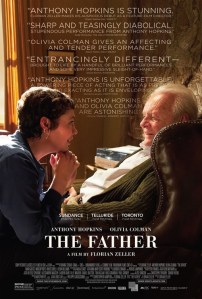 The Father is the kind of movie I’ve been clamoring for years from Hollywood, an Alzheimer’s empathy experiment using the rigors of a visual medium to place a viewer inside the mind of someone haunted by this debilitating mental illness. Film is inherently an immersive experience with a defined point of view, and I always thought it could be helpful in illuminating what it would be like to lose a sense of time, memory, and place as memories blend together and fragment. The Father is based on a play by director Florian Zeller. It’s a deeply empathetic and heartbreaking experience that works as a puzzle to decode but also as a character piece on the end of one ordinary man’s life.
Not much is known about Anthony (Anthony Hopkins) before his gradual mental decline. He had an apartment he lived in for thirty years, there’s definitely hints that a younger daughter had an accident and is no longer alive, and he listens to opera quite frequently. I think there’s a benefit to the audience knowing so little of Anthony before his illness; we do not know what variation of this man is the honest, lucid version from before. We’re only getting impressions and glimmers and some of them are non-linear, where we’ll get the context of a scene after the start of a scene, so it challenges a viewer to be constantly trying to contextualize what we’re seeing with what we know, and it’s an ongoing puzzle to determine a slippery orientation. It makes for an engaging and constantly changing environment and one tailored to engrossing empathy.
 It sounds like the movie might be an overwhelming downer, and most assuredly it will leave an emotional devastation, but it’s also a very fascinating experience. From the beginning, you’re dropped into a scenario that announces to you not to fully trust your eyes and ears. You’re trying to assess character relationships. Who is this woman? Is she Anthony’s adult daughter Anne (Olivia Colman)? Is she a figment of his imagination? Is she the possibly dead daughter? Sometimes characters will be referred to by the same name but be played by different actors, and you must question which version was real, or whether either of them was? Is he projecting his dead daughter onto the face of another woman? Is he projecting an antagonistic man (Mark Gattis) onto the face of a former son-in-law (Rufus Sewell)? Which home is he in at this time? There is much to unpack here and I’m positive that additional viewings would unveil even more clues hiding in plain sight. I’m certain that the paintings on walls in backgrounds are regularly changing with the timeline, and this small detail of set design is never even emphasized. It’s just one aspect of the presentation that has been thoughtfully developed to support its artistic vision.
As one would expect from the premise and its beginnings as a play, this is an actor’s showcase. Hopkins (The Two Popes) delivers one of the best performances of his storied career. We’re so used to seeing Hopkins play men in control, dominating others. I even just re-watched him killing people in the shadows from 2001’s Hannibal sequel. This is the most vulnerable the actor has ever been on screen, and I’ll freely admit that by the end tears were streaming down my face as Anthony has descended into a childish state of need. Hopkins goes through a gamut of emotions and shifts rapidly. In one moment, he can be gregarious and charming, another cold and paranoid, cruel and cutting, but often he’s confused and afraid. He’s trying to maintain his dignity throughout. By being our focal point, we feel the same feelings that this elderly man is experiencing in this moment out of time. Colman (The Favourite) is also terrific as Anthony’s put-upon daughter trying her best but reaching her limits. The accumulation of this man’s experiences, and the weight of the burden on his family, is a devastating conclusion that reminds you what millions of families are going through every day.
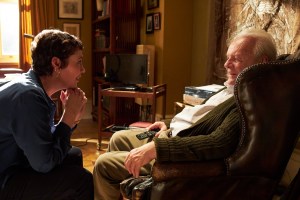 The trappings of plays adapted to film is the struggle to make them feel bigger than potent conversations happening in confined spaces. Zeller’s debut as a director does a fine job of using the techniques of filmmaking to his advantage. With editing and camera placement, he can better orient or disorient an audience, and the impact of character changes has more intensity with our proximity to the actors themselves. The attention toward the visual parallels like hallway shots and people being confined to shadows present an extra layer of symbolism to be decoded. Zeller has clearly thought out how to transcend the stage and to use the immersion of film and freedom of being non-linear with editing to shape the presentation and make it even more effective.
I’ll be honest with you, dear reader, and that is that Alzheimer’s terrifies me. We’re all the accumulation of our memories and experiences, and to think those could be stripped away, muddled and tainted, and change your conception of self, well that is absolutely haunting. It’s the kind of stuff that keeps me up at night, and while my maternal grandfather went through a spell of dementia before passing away at 92 years old, fortunately this illness does not run in my family. I have friends that are dealing with it currently with grandparents and it’s like approaching death before the actual death, watching that version of the person you love shrink to the point where they have been replaced by a stranger, all the while you are helpless to thwart this process. For those people, The Father will hit close to home and might even be too much to handle. It’s such an open-hearted and empathetic portrayal that puts you in the position of having to live with the ravages of Alzheimer’s. It’s so frustrating and confounding and sad, and yet film can open us all to the experiences of others like few other mediums, and The Father might be the closest any of us ever get to understanding what this terrible illness is like for those caught in its snare. It’s a fantastic movie with fantastic performances but even more than that it’s a wonderful experiment in empathy and understanding.
Nate’s Grade: A-
Share this:

Dick Johnson is Dead (2020)
 Dick Johnson is Dead is a documentary but it’s a hard movie to describe because, at its core, it’s the use of art to memorialize a man, to process grief on personal terms, and as a love letter from a daughter to a father. Kirsten Johnston (Cameraperson) records her life caring for her ailing 85-year-old father. Dick is a former therapist, a widower, and starting to go through the early stages of Alzheimer’s and coming to terms with his new limitations. Kirsten is a camera operator who has worked on documentaries for over thirty years, so she turns the lens on her father and the two of them enact a series of wacky fake deaths, starring Dick himself (until the stuntmen take over), as father and daughter work to make a movie celebrating life while they still can together.
 First things first, Dick Johnson is just the sweetest man. Spending time with him is a treat and watching him smile with like his whole face just made me feel happy. I enjoyed learning just what a good person he was and what he’s meant to his friends, family, and colleagues, but he’s just so pleasant and nice and compassionate that you feel the love his daughter intends you to understand. That’s the overwhelming feeling from this quirky documentary. Dick has such love for his daughter and is willing to humor her silly morbid scenarios confronting his death. Kirsten has loved this man for so long and already lost one parent to Alzheimer’s and now must go through it again. She’s using the medium she feels most capable and comfortable with, photography and moviemaking, to celebrate her father and his unheralded life of being a good man coming to an end. My heart ached for him when he breaks into tears articulating what relinquishing his ability to drive means for him and his sense of independence, looking ahead. Kirsten highlights some of the more unusual details about her father for this movie-within-a-movie, creating sequences that shed light on his faith as a Seventh Day Adventist and his insecurity over how his feet appear. It’s insightful aspects that better round out this man, like his ability to start conversations with strangers, or his knack of being able to fall asleep anywhere as long as he can prop his feet up. For Kirsten, recording these moments while her father is still lucid is a matter of documenting him while he can still recognize himself. She laments the minuscule amount of footage she has of her mother before her death. She doesn’t want to make the same mistake with her father, so why not also make him a movie star if she can? Watching Dick Johnson is Dead is to feel overcome with her adoration for this remarkably ordinary and good man.
The movie also serves as a strange way to take control over something inevitable yet unknowable. Dick Johnson is going to die, as we all will, but he will very likely die before his physical body expires. His mind will deteriorate, and he’ll stop being Dick Johnson. I wondered early why the movie kept resorting to slapstick with the many possible deaths of Dick onscreen. It’s more than a bit morbid for a daughter to direct her own father dying again and again in a variety of wild and bloody and violent accidents. I can understand many viewers being put off by this, worrying that Dick is being exploited, and at least finding it all to be in bad taste. I tried to assess why this element was so essential to the production. I suppose it functions as a gimmick that can help it get more attention and a larger audience considering the film lacks a hard-charging topic, unique insider access, or a headline-grabbing name or artistic approach. However, as I continued with the movie, I concluded that Kirsten Johnson is inflicting all manner of over-the-top goofy deaths and violent mayhem upon her beloved father as a means of processing her looming grief. She’s trying to reclaim a sense of control and offering that same ownership to her father. They aren’t running from his death but are embracing it, laughing at it, and doing it their way. The documentary is an artifact of love and a filmmaker using art to comprehend her grief.
 The Seventh Day Adventist adherence presents an interesting dynamic to explore when discussing a spiritual afterlife. This smaller Christian denomination believes that the worthy will return to heaven but only after Jesus returns to Earth to kick-start the whole Armageddon deal. Until that fateful day, the dead will lay in their graves and wait for however long it takes. I had never heard about this before. Many religions are about delayed gratification, the reward coming upon the conclusion of Earthly existence, and these people believe the wait extends even beyond death. A lifetime and then some of waiting would shape very patient people like Dick. The great fear of an Adventist, we’re told, is to be one of the ones left behind, and it’s easy to see the parallels with losing one’s sense of identity through the creeping fog of Alzheimer’s. Apparently, strict Adventists also don’t approve of dancing. In a fantasy sequence engineered by Kirsten, Dick gets to dance in heaven with his wife again and knowing all these details gives the moment, which can be immediately silly on a surface-level, its own sense of poignancy and reverence.
The only thing that holds the movie back is that late into its 90 minutes I feel like it gets too manipulative and meta for its own good. There’s an emotional climax and then the movie reveals some key details that can make you feel a little bamboozled. It’s not enough to sacrifice all the emotional investment and artistic gains that came before but it’s just a few steps too far. Don’t get me wrong, I’m genuinely happy with the overall ending, but I didn’t care for being jerked around.
 Dick Johnson is Dead is a peculiar, funny, heartwarming, and experimental documentary. It reminded me in some ways of 2012’s The Act of Killing where filmmaker Joshua Oppenheimer finds old men who participated in Indonesian genocide in the 1960s to re-enact their crimes but playing their victims and through the surreal prism of a film production. Except this movie is far more personal and far more affirming; it’s very much a love letter to a wonderful man. You feel the intimacy of this family relationship and I felt privileged just to be let in and share these moments, the ordinary ones, the reflective ones, the emotional ones, the silly ones. This is an affecting documentary using its very form and function to use art to make sense of pain. It’s currently available on Netflix streaming and I would highly encourage you to relax, kick your feet up like Dick, and watch one of the best and strangest movies of 2020.
Nate’s Grade: A-
Share this:

Sound of Metal (2020)

I don’t think I’ve better empathized with hearing loss and deafness than with Sound of Metal, a moving and observant drama about a heavy metal drummer quickly losing his sense of hearing. Riz Ahmed (Nightcrawler) plays Ruben, a former junkie who is four years sober and worried about losing his girlfriend/band mate (Olivia Cooke) with his recent diagnosis. He’s attending a treatment center meant to cater to a deaf community and transition others into this community. Ruben is defiant, depressed, angry, all the stages you can imagine with grief. The movie is at its best during its quiet and contemplative moments where we empathize with the terror and alienation of Ruben. When he first joins the center, we don’t get subtitles for the many signed conversations between members. It’s only after Ruben learns ASL, integrates into the community, and opens himself up to the program that we too get to be knowledgeable. The sound design is exceptionally utilized to illustrate Ruben’s changing perspective, and some later choices with it might make you long for the peacefulness of silence. The movie is exquisitely thoughtful and considerate while maintaining a subtle, character-driven approach that keeps things from wallowing in self-pity. For many of the deaf, hearing loss isn’t seen as a disability but a community with its own culture and quality of life. It’s understandable that Ruben is focused on loss but the movie doesn’t dwell in loss, more so transformation and acceptance. Ahmed is fabulous in the lead role which requires him to rely primarily upon non-verbal expression for extended periods. His eyes are his best vessel for communicating Ruben’s emotional state, and Ahmed is sensational. Paul Raci is also great as the leader of the treatment center and the responsibility and generosity he feels to those in his care. Sound of Metal is an immersive, sensitive, authentic and poignant drama with an Oscar-caliber lead performance and a depth of compassion for the many people of the deaf community.
Nate’s Grade: B+
Share this:

Ma Rainey’s Black Bottom (2020)/ One Night in Miami (2020)
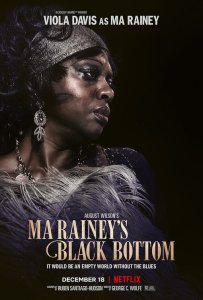 Two new movies are poised for major awards consideration, both based on plays by black authors, and both providing insights into the injustices and experiences of different black Americans from the past. Ma Rainey’s Black Bottom is available on Netflix streaming and One Night in Miami will soon be available through Amazon Prime in January, and both movies are observant, reflective, unsparing, hard-hitting, and provide some of the best acting you’ll see in movies this year.
In 1930s Chicago, Ma Rainey (Viola Davis) is assembling a team of musicians to record her latest blues single “Ma Rainey’s Black Bottom.” Cutler (Colman Domingo) will play trombone, Slow Drag (Michael Potts) will play the bass, old man Toledo (Glynn Turman) will play piano, and Levee (Chadwick Boseman) will play the trumpet. Levee has big ideas about what he can offer, and the rest of the band is happy to simply play their parts. Ma Rainey has her own demands for the record, some of which run counter to Levee and her own manager, and the many personalities will come into direct conflict on one very hot summer day.
 The big reason to see Ma Rainey, beyond the fact that it’s an amazing adaption of a great August Wilson play, is because it’s the final film performance from the late Chadwick Boseman. The world was stunned when the Black Panther actor suddenly died in August in the prime of his career. He had been hiding a years-long battle with colon cancer that only made his work ethic more astonishing. This man knew his life could very likely be cut short, but he wanted to make a difference by using his celebrity status to portray a gallery of historical heroes like Thurgood Marshall and James Brown. Of course, it also raises the question why waste your valuable time on something as mediocre as 21 Bridges. Regardless, with this new knowledge, it’s impossible not to find extra layers of meaning with Boseman’s final remarkable performance. Immediately you notice how thin he is, lanky, and now we know why. The character feels like someone just stringing along on the faintest of threads, a hope for a better tomorrow, and Boseman’s gaunt physical form reinforces that desperate impression. There’s also a moving moment where Levee is monologuing about his disdain for God’s lack of intervention in his life, during his mother’s assault by a team of white men, during the entire experience of every African American. It’s hard not to read the actor’s own personal struggle into this confrontational moment, lashing out at the unfairness of a life denied too early, and it just makes a tragic figure even more wearingly tragic. The final image is so summative of Levee’s tragedy and the music industry profiting off the entrenched exploitation of black musicians, that it feels so dispiriting even without further explanation.
The entire time I was relishing Boseman’s performance like one final meal, and the man makes a feast of it. Another critic compared Boseman’s performance to an athlete “leaving it all on the field,” and I couldn’t agree more. The man gives you everything he has. It’s not a subdued and subtle performance, though Wilson’s plays don’t tend to settle for subdued characters speaking with pronounced subtlety (see: Fences). The playwright’s gift is for crafting big characters with big personalities and big problems, and that’s the way we like it. Levee is a character with more than chip on his shoulder, he has the whole block. He’s bursting with nervous energy, masked as excitement, and eager to finally hit those last few hurdles and get the fame he feels is destined. The other members of the accompaniment are older, settled in their ways and comfortably pessimistic about The Way the World Works. They know the deck is stacked against them and they have accepted this injustice (“Be happy with what you can get,” they argue). Levee is still fighting, still hoping he can break through on the merits of his talents and perseverance, and we can all suspect the hard reality that will come crashing down later. Boseman is captivating from start to finish. It’s his greatest performance of his all-too short career and one I fully expect to sweep come the delayed awards season. It’s the best male acting I’ve seen for all of 2020. As I kept watching, a sadness washed over me, much like watching Heath Ledger during the end of 2008’s The Dark Knight, a melancholy realization that this is it, it’s almost over, and this is all we’ll ever get from an actor who was just beginning to make substantial waves and leave their mark on the industry.
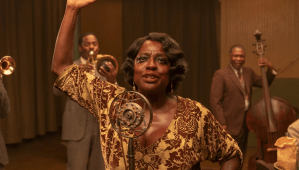 While Boseman’s lead is the biggest draw, Ma Rainey has plenty other aspects deserving of praise. Every character gets time to be fleshed out into feeling like real, complicated people with complicated pasts worth illuminating. Most of the play’s characters are black musicians during a very racist period in American history (you could readily argue that this description applies to all periods). They know they’re being exploited, and they know that these smiling white men with money are only being polite as long as they have something to offer that these men want. Even Ma is aware of her leverage. She’s a successful singer who sells plenty of records, but fame can be fleeting, and her records aren’t selling like they used to, and she knows time is short. She’ll be cast off and replaced by another singer/performer who doesn’t have the wherewithal to push back. Davis (Widows) is a force in this movie, flinty and proud and no-nonsense. She’s great even if she has less screen time than any of the male musicians. It feels like more could be had from exploring her character, her passions, her lesbianism, her sense of self, but Davis still makes quite a presence.
The injustice of the circumstances of the musicians are emblematic of the black experience with America a hundred years hence. Levee has a monologue about his father having to sell his own land to his wife’s attackers. Cutler has a monologue about a preacher who got off on the wrong train stop in Florida and was harassed and threatened by an unruly crowd, his vestments serving him no mercy from a racist mob. Wilson’s wonderful words are brought to sterling life from these seasoned performers and their digressions and reflections better paint a thematic mosaic of shared communal pain. The way the movie holds your attention even when Boseman isn’t on screen is a testament to how engaging and well-realized Wilson’s characters can be no matter how small.
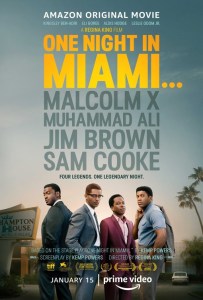 With One Night in Miami, based upon the play by Kemp Powers (co-director of Soul), we follow big names of sports and politics that improbably convened together one night in 1964. Cassius Clay (Eli Goree) has just become heavyweight champion of boxing and is poised to announce his conversion to Islam under the tutelage of Malcolm X (Kingsley Ben-Adir). NFL running back Jim Brown (Aldis Hodge) has crossed over into movies and is starting to think about life after football. Sam Cooke (Leslie Odom Jr.) is riding high off his recording fame but wondering how much more of himself and his artistic voice he should insert. Over the course of this long night, the four men will converse, bond, butt heads, and make changes with their responsibilities.
The movie, adapted by Kemp as well, establishes each participant before bringing them together for that fateful night (inspired by true events, meaning it’s entirely fictionalized). This first act does a fine job of establishing each character but especially a point of insecurity for them that we’ll watch later become raw and, hopefully, reconciled or re-examined. Jim Brown worries that no matter his level of success, he’ll never be legitimate to a section of America. He’s looking at movies as his inroad but even someone of his fame is still the black character killed first. Cassius Clay is hesitant about making his announcement to Mohammad Ali and Islam, second-guessing the commitment he’s signing up for. Sam Cooke is known for his fluffy pop songs and feels like a sellout, needing the credibility of making music that matters. Malcolm X is preparing to break away from the Nation of Islam after his distaste for the hypocrisy of its leadership. He’s positioning Cassius Clay’s announcement as his big pivot point to make a name for his own break-off movement and hopeful that the media attention will translate into new converts.
 The combustibility of this night makes for plenty of compelling drama. Malcolm X is an instigator with the others, spurring them to use their privileged platforms to enact change that can be useful for the Civil Rights movement. He squares his attention on Sam, calling him out for being a tool of white moneymen and even plays him Bob Dylan’s “Blowin’ in the Wind” and asks why this white man is writing more politically active music than Cooke. The singer pushes back, saying he allowed the Rolling Stones to sample his song because it brings more money into his pocket and his songwriters that he can use to profit black businesses. He proclaims he recognizes the system and is playing it to his advantage. They have very different perspectives that clash, making fine drama that spills over. It’s a purity versus pragmatism argument, one that Cooke raises to flout the indulgences he sees in the leadership of the Nation of Islam, a fact we know Malcolm X is aware of and also cannot stomach. It’s also a version of Malcolm X that is more vulnerable than we’re accustomed to seeing. We’re used the strident, righteous Malcolm X, and here he’s much more indecisive and struggling with making some big personal decisions. Leaving his religious organization is verboten, and he’s looking to reform what he views as sinful failings from his peers, and much rests on the publicity of Clay coming forward. This puts Clay in a tough position especially as he feels uncertain about this commitment. The continual push and pull of these four men lead to several interesting discussions, many that become heated, that allow each to open up as a real and complex person, not just a picture in a textbook.
The ensemble is overall quite solid, though the two biggest performers are the ones at the widest ideological divide. Odom Jr. (Hamilton) brings a distinct charisma and has a silky singing voice you wish you got to hear more often, but he’s also hiding a clear disdain. Whether it’s pride or whether it’s shame, it’s there, and Odom harnesses it to make his character feel like a cat ready to strike, wound up from being dismissed by too many others. Ben-Adir (The OA) nails the intonations of Malcolm X but also adds extra layers of doubt and awkwardness. He tries to parry concerns from the other guys that a “party” in this one motel room will be lame by promoting the power of ice cream (only flavor available: vanilla). This is a humbled and scared Malcolm X, one on the precipice of potentially losing his movement and standing to his ethics, and some may argue his ego. Ben-Adir is soulful and presents a fully formed performance more than lazy imitation (he also played President Obama in the recent Comey Rule miniseries for Showtime).
 The biggest question with play adaptations is the challenge of making them feel bigger and more cinematic than contained conversations. Nobody wants to feel trapped in a broom closet. First time film director Regina King (If Beale Street Could Talk) gets the most from her performers and handling of the subject matter, though the various rooms inside and outside the Miami motel provide little in the way of variance. The men go to the roof to watch the fireworks. A couple leave to go get some liquor. The focus is on the men, so the background of the setting isn’t a huge deal to the entertainment. King’s direction is more felt in the performances, as most actors-turned-directors tend to be, and with that she’s aces. With Ma Rainey, director George C. Wolfe (The Immortal Life of Henrietta Lacks) does an excellent job of opening the spaces visually but also making the spaces reflective of mood. The ashy rundown basement where the band practices, the sweat-glistening off the performers with the hot, daub lighting, the peeling paint and broken doors leading to symbolic dead-ends. Wolfe has a stronger command of visuals, not just making his pictures pretty, but also making his play-turned-film feel less confined by its original stage bound limitations.
Ma Rainey’s Black Bottom and One Night in Miami are both deserving of your attention. I found Ma Rainey to be the more engaging movie with the higher artistic peaks, anchored by an amazing and career-defining performance from Chadwick Boseman. One Night in Miami is consistently probing and generous and thoughtful and superbly acted as well. Both movies are great tools for empathy and interesting to take together considering they churn with experiences of black characters fighting for equality from a broken system several decades apart. There have been gains made from the time period of Ma Rainey but Malcolm X’s complaints are extremely valid, and many resonate today in the face of systematic racism and police brutality. Watch both movies when available and welcome more black-penned plays making the big screen leap.
Nate’s Grades:
Ma Rainey’s Black Bottom: A-
One Night in Miami: B+
Share this:

Soul (2020)
 I needed to watch Soul twice before I fully processed how I felt about it. Pixar’s latest animated wonder follows a New York City music teacher named Joe (voiced by Jamie Foxx) who goes into a coma right before his big break playing for a jazz legend. He’s transformed into a cuddly little blue tuft of cloud creature and informed his soul is ready for The Great Beyond. In a nod to Heaven Can Wait, Joe indignantly fights his way back to Earth to reclaim a life he felt was just now getting on track. His ticket back to Earth is through mentoring a surly, pessimistic young soul 22 (Tina Fey) that nobody seems able to reach, even Mother Theresa. Early on, there are two very clear realizations. First, Soul is beautiful to look at and very weird and art deco with its character designs in its spiritual realms. Second, the world building and rules of this special world are quite convoluted. Unlike Inside Out where you were dropped into a new world and all the parts added up with a sense of logic, the spirit world and especially the process of how baby souls become what they are seems hazy and arbitrary and not fully articulated. This confusing world building also includes the idea of people “being in the zone,” lost souls wandering the land as lumbering monsters, and a traveling group of mystics that can meditate their way into this higher plane of existence. That’s even before a second act trip back to Earth that reminded me of Brave and leaned into slapstick and comical misunderstandings. There is a soul guardian on the hunt for Joe to keep things back in order, though the consequences of a soul count being out of whack are never explained. I thought this antagonist character was going to amount to much more but is mostly forgotten. Where Soul succeeds is with its heart about people trying to find their spark, that special something that lifts their spirits and makes them who they are, and I think it’s an important lesson that it’s not the same as a purpose. The comedy banter between Foxx and Fey is solid and there are some funny sequences and a few gags that impressed for going the extra mile. I was interested from the opening moments but I cannot say I was terribly emotionally invested. Part of this is because the movie swiftly runs through so much world building and rule-setting in 90 minutes, partly because the character of Joe is a bit close-minded in how he designates success, and partly because the young character of 22 feels more like a sidekick than a developed supporting role. The musical score by Atticus Ross and Trent Reznor is highly original and evocative. It was providing an emotional resonance and wonder I found missing at other points in the film. It feels very ethereal and propulsive and just new and exciting. The climactic track “Earthbound” feels so stirring and emotional and light. It’s my favorite film score of the year. Soul is a fun and imaginative movie that has some wrinkles with its world building, characterization, and delayed emotional investment, but even a second-tier Pixar movie means it’s still one of the better movies you’ll see for 2020.
Nate’s Grade: B
Share this:

Traffic (2000) [Review Re-View]
 Originally released December 27, 2000:
The war on drugs may be one worth fighting but it’s a battle that every day seems more and more impossible. Traffic is a mirror that communicates the fruition of our current procedures to stop the illegal flow of drugs.
Traffic is told through three distinct and different narratives. One involves an Ohio Supreme Court justice (Michael Douglas) newly appointed as the nation’s next Drug Czar. While he accepts his position and promises to fight for our nation’s children, back at home, unbeknownst to him, his daughter is free-basing with her bad influence boyfriend. Another story involves a wealthy bourgeois wife (Catherine Zeta-Jones) awakened to her husband’s arrest. Her shock continues when family lawyer Dennis Quaid informs her of her husband’s true source of income. He’s to be prosecuted by two DEA agents (Don Cheadle and Luis Guzman) unless she can do something. The final and most compelling narrative involves Benicio Del Toro as an honest cop in Tijuana battling frustration with the mass corruption surrounding the city. Each story weaves in and out at various points in the film.
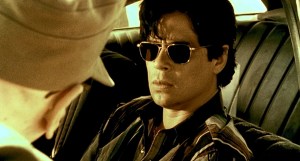 Traffic was photographed and directed by the man with the hottest hand in Hollywood, Steven Soderbergh. He uses a documentary feel to his filming that adds to the realism. Different color tones are assigned toward the three narratives as reflections of the emotional background. Soderbergh expertly handles the many facets of the drug industry and pulls out his typical “career best” performances from his onslaught of actors.
Benicio Del Toro is the emotional center of Traffic. His solemn demeanor and hound dog exterior reflect a good man trying to fight the good fight in a corrupt environment. He effortlessly encompasses determination, courage, and compassion that you’ll easily forget the majority of his lines are in Espanol. Benicio is an incredibly talented actor and one with such vibrant energy whenever he flashes on screen. It’ll be wonderful watching him collect all his awards.
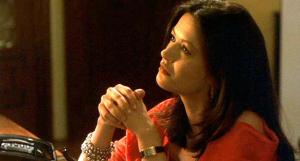
Catherine Zeta-Jones also shows strong signs there may well indeed be an actress under her features. Her role is one of almost terror as you watch her so easily slip into her imprisoned hubby’s shoes. The ease of transformation is startling, but in an “evil begets evil” kind of fashion. The fact that she’s pregnant through the entire movie only makes the shift from loving house wife to drug smuggler more chilling.
 The entire cast does credible acting performances with particular attention paid toward the younger actors deservingly. Don Cheadle throws in another terrific performance showing he’s sublimely one of the best actors around today.
Traffic oversteps its ambitions and aims for a scope far too large. It is based on a 6 hour BBC mini-series, so trying to cram that material into a two hour plus format is taxing. As a result we get an assembly of characters, but too many with too little time in between to do any justice. Screenwriter Stephen Gaghan (Rules of Engagement) condenses the towering impact and influence drugs have well enough, but he intercuts the stories too sporadically that attachment never builds for either of the three narratives. He does balance the Douglas Drug Czar one carefully as not to fall into the cliched vigilante metamorphosis. But the mini-series had more characterization and depth to its tale.
Traffic is a good film but it has edges of greatness never fully visioned. Soderbergh shines bright yet again and all accolades will be deserved. Traffic is undeniably a good film, but it’s one you may not want to watch a second time.
Nate’s Grade: B
——————————————————
WRITER REFLECTIONS 20 YEARS LATER

So twenty years later, how is that war on drugs going? Considering the billions of dollars and countless lives that have gone into trying to stop the intricate infrastructure of supply and demand for the drug trade, the United States has little to show for its efforts. If anything, there has been a dawning realization of the futility of playing cartel whack-a-mole, removing one leader just for another to take their place in the supply chain. There have also been movements toward treating addicts rather than incarcerating them. The country has stubbornly become more accommodating and understanding of the ravages of addiction; it only seemed to take the spread of the opioid crisis where affluent families in the suburbs were affected personally. Tragically, it seems too many Americans have to have an “it could happen to me!” moment before their empathy for another person’s struggles kicks in. These relaxing attitudes have translated into recreational marijuana being legal in 15 states as of this review. Many other states have decriminalized marijuana, and Oregon has recently voted to decriminalize all drugs. It seems that in 2020, our concept of the war on drugs has dramatically changed. Some may find these developments an admission of giving up, of retreating from some moral duty, but others have concluded that maybe we’ve been fighting all wrong for 50 years and the only thing we have to show for our blood-soaked efforts is that multiple criminal elements got much richer.
 It’s an interesting social and cultural landscape for going back and re-watching 2000’s Traffic, the last film on my re-watch of 2000 cinema. Times have changed and this is felt in Steven Soderbergh’s Oscar-winning ensemble covering the globe-trotting scope of the war on drugs. Traffic won four Oscars, including for Soderbergh for Director, Benicio Del Toro for Best Supporting Actor, and for editing and adapted screenplay. The only Oscar it was nominated for that it didn’t win was Best Picture, losing to Ridley Scott’s sword-and-sandals epic, Gladiator. It was an ambitious movie and had over 100 speaking roles. Soderbergh served as his own cinematographer and cameraman, bringing a docu-drama versatility to the movie that added its own sense of realism. 2000 was the year Soderbergh hit his critical peak. He was an indie darling from 1989’s influential sex, lies, and videotape and puttered throughout the 90s with small, personal, weird movies (I loved Schizopolis as a teenager), and then in 1998 he gained a new level of credibility providing sheen and heat to Out of Sight, the movie that cemented George Clooney as a major movie star. The one-two punch of Traffic and Erin Brockovich in 2000 earned Soderbergh two Oscar nominations for director, a feat not accomplished since 1938, and after 2001’s highly successful Ocean’s 11 remake, Soderbergh had jumped to the top of the industry while maintaining his indie artistic credentials. He’s been dabbling and experimenting since (A movie shot on an iPhone!) with mixed results, but the man’s track record is hard to digest into simple categorization. He can jump from an action showcase for an MMA fighter, to a gleeful male stripper romp, to a four-hour epic covering the life of Che Guevera. With Traffic, Soderbergh was working with his biggest budget and cast yet. The decision to use different color tones is smart to easily distinguish the various storyline locations so that an audience can be immediately oriented when jumping around from place to place. It’s also extremely hard on the eyes at times. The Mexican storyline is so washed out in bleached colors that it looks like an atomic bomb just went off in the distance and is filtering the world with an excess of bright light to make you squint. Soderbergh also has a penchant for natural light coming through windows to be seen as giant blocks of white. Again, it achieves its artistic purpose but it also makes you want to avert your gaze.
The 150-minute movie is based on a sprawling 1989 BBC miniseries that totaled six hours. Stephen Gaghan (Syriana) adapted the screenplay and he does a fine job of condensing the major plot points of the mini-series into a manageable feature length. He also does a fine job of articulating the many intertwined players and motivations and contradictions of the drug trade. However, I can’t help but feel like some of the nuance and character development is lost by condensing everything into the body of a manageable American feature production. Take for example the character Catherine Zeta-Jones (Chicago) plays, Helena Ayala. She’s a rich southern California housewife who has her life upturned when she discovers her husband, recently arrested by the DEA, is one of the chief distributors for a Mexican cartel. Her character is in disbelief and shock at first, then she tries to make due with legal bills and mortgage payments. Things get considerably worse when the cartel threatens her children if Helena can’t pay her husband’s outstanding debts that have now fallen onto her. Her character arc goes from an ignorant, privileged housewife into a ruthless co-conspirator willing to do whatever it takes to protect her family and maintain the cushy lifestyle they have become accustomed to. Over the course of the BBC miniseries, you watch that version of the character undergo significant changes in six hours. In the 2000 film, the character undergoes significant changes in a matter of scenes. Helena goes from desperate to duplicitous in literally minutes, and the jump feels too unearned. The rushed storytelling caps some naturalism. A character can go from not trusting the DEA to providing damning evidence to the DEA in three scenes. A character can go from bored, privileged teenager to junkie prostitute in three scenes. For a movie about gritty realism, these character leaps can feel overly forced and inauthentic. There are so many characters and storylines and political points to make that the overall narrative can feel crowded, so while it’s always interesting, it can inadvertently fashion its own ceiling for emotional engagement because the many characters feel like impressions hitting their marks rather than as fully developed portrayals of people.
 The storyline that has aged the worst is Michael Douglas (Ant-Man) playing Robert Wakefield, a newly installed Drug Czar learning the ropes. For the majority, he’s akin to a 60 Minutes journalist just sitting in rooms and asking various professionals about their experiences and advice from their unique positions. From there, the storyline takes up the “it could happen to me!” trapping with Robert’s private school daughter (Erika Christensen) becoming an addict. It may have been surprising for a high-profile politician to have a child as an addict, but now this kind of irony feels passe. We’re used to politicians having ironic skeletons in their closet. The ongoing plot of her descent doesn’t really humanize her even as she makes some drastic decisions to chase that next high. She’s more an ironic counterpoint to shake her father, and the audience, of their preconceived mental imagery of what an addict might look like. It feels slightly retrograde and pearl-clutching, not simply that she goes through hell but that it’s set up to register that, oh my, WHITE PEOPLE, even RICH WHITE PEOPLE, can also be junkies. In 2000, this story might have been jolting and scared some older adults into wondering if this drug menace could find its way into their hallowed gated homes too. Nowadays, it seems obvious. If the storyline of a father dealing with his addict daughter had reveled more about one another as characters it would be worth the attention, but the daughter is kept as an example, a symbol, and Robert just has to take his lumps before the inevitable conclusion that his job is a lot harder than he would have imagined. His speech at his introduction at the White House has the hallmarks of drama ready and waiting, as he chokes over the political boilerplate he no longer believes in, but he simply walks out rather than sharing what he’s learned.
The best storyline in Traffic is, no surprise, the one closest to the action with Benicio Del Toro (Sicario) playing what feels like the only honest cop left in Mexico. Obviously that’s an over simplification, but the police force and political class are heavily corrupted by the cartels and their money. The character Javier Rodriguez has to navigate this tricky world without making himself as a target for those corrupt officials who think he’s an impediment. He’s trying to do good in a deeply flawed system and maybe even he knows he’s fighting a losing battle but he’s decided to keep his integrity while trying to fight what he considers is a worthy cause. A high-ranking general seeking his services reminds him of his lowly pay as a police officer, yet Javier Rodriguez is unmoved. Del Toro made a career of playing oddballs and sleazes, so it’s interesting to watch him play a fairly noble, straight forward role and in a language he didn’t speak before production (while born in Puerto Rico, he moved early and grew up in the U.S. and knew little Spanish). I don’t know if I would have awarded him the Oscar (my favorite for 2000 was Willem Dafoe as a vampire) but it’s certainly an understated performance with real gravitas. Del Toro is the quiet, churning contemplation of this movie and I would have been happy if the whole enterprise had been devoted to his south of the border exploits. I appreciated that the moves in this storyline would have larger effects on others, like a crackdown on a cartel being a reason why they need more money and the reason they now step up the pressure on Helena to pay up or else. It best encapsulates the knotty, interconnected framework that Gaghan and Soderbergh are going for.
 Traffic is one of those movies you know are good. It’s well written, well acted, and has a definite vision it’s going for that it mostly achieves. It’s also a movie that engages more intellectually than emotionally. There are some deaths and downturns but I doubt you’ll feel much regret or catharsis. The movie unfolds like an in-depth journalistic article, and the leaps in rushed characterization feel like a result of a looming deadline and a hard cap with its word count. It’s unfair for me to continue comparing the movie to its miniseries when that project had almost three times the length to fill out its tale (about poppy trafficking and heroin manufacturing in tribal Afghanistan) but it’s a clear-cut case of crammed plotting. My initial review back in 2000 keeps mostly to the plot and the many actors, though I think I overstated Zeta-Jones being “chilling” and I think my love of Del Toro in Way of the Gun that year transferred some extra praise for his performance here. It’s hard to remember but I was really anticipating this film my freshmen year of college. Traffic is a good movie but it’s not exactly one people get excited over. Every aspect is professional, proficient, but there isn’t exactly a lingering takeaway that changes your perception of the war on drugs. I’ll hold to the same grade and say it’s an admirable accomplishment but one better suited for a mini-series (it was adapted back into a TV miniseries in 2004).
Re-View Grade: B
Share this:

Nomadland (2020)
 Part poetic elegy for an America of old, part sunset-tinted road trip, part condemnation of economic fragility, part character study of a lost soul who prefers wide open spaces, Nomadland is a small indie trying to say a lot but in as few words as possible. Consider writer/director Chloe Zhao’s film a mixture of the compassionate, languid colorful character-driven slice-of-life Linklater movies and the romantic, spiritual hymns to nature and the universe from Terrence Malick. It’s ultimately about Fern (Frances McDormand) as a woman who travels the American southwest from season to season in her van, going from one temporary job to another. The temptation would be to make it about her running away from her past, her pain, and need to finally process her grief in a transformative way before she can settle down and make herself a home. Zhao’s movie rejects that easy formula; there are several moments where characters implore Fern to plant roots, to have a comfortable life with a man who adores her, but she can’t. She has to keep moving, from job to job and state to state. It’s not like a rejection of privilege and standing like 2007’s Into the Wild. If Fern could be rich, she’d happily not have to crap into a bucket in her van or sleep in parking lots or scrounge for food. She’s one of millions on the fringes of society because of how disposable so many corporations view their laborers. The opening text tells us that within one year of the factory in Fern’s hometown closing, the chief employer of the town, that its zip code was dissolved. Nomadland doesn’t ever feel like a preachy movie but it definitely has points it wants to raise about how we treat people in need, how business exploits them and their lack of options, and how others view these itinerant Americans and their plight. Really, though, it’s a movie of moments and there are some that are beautiful and powerfully poignant, like a woman stricken with cancer talking about her final desire to return to a lake frequented by birds, or another character discussing the death of his son and how that has informed his view of God and an afterlife. It’s these moments where a character just seems to take center stage and become fully developed, adding to Zhao’s humanist thesis about how every person, no matter their circumstances, is worthy of compassion and consideration. I enjoyed McDormand (Three Billboards) and thought she was a fine entry point into this under-seen world. I also think she was better served as a sort of living journalist letting us discover non-professional actors that open up their hearts and lives and feel like genuine human beings with a wealth of life inside them just waiting to be learned. That gracious, affirmative spirit hangs over every lovely frame and moment in a movie that could be described as Frances McDormand Tries All the Jobs. Still, it’s a movie of moments, and some of them truly sing and others just sort of go by without leaving as much of an impression. Nomadland is a pretty, thoughtful, meditative movie about persistent, stubborn creatures, namely us.
Nate’s Grade: B
Share this:

Mank (2020)

In 2003, director Peyton Reed (Ant-Man, Bring it On) recreated the “no-sex sex comedies” of the 1960s starring Doris Day and Rock Hudson, with Down with Love. It recreated not just that era in time but also the hokey filmmaking techniques of its time, including green screen for rear projection as the characters drive. It was a big homage to older Hollywood and a celebration of its outdated filmmaking and storytelling. But was the movie ever more than one elaborate homage? Did the film have any other reason for being than imitation? What about Gus van Sant’s shot-for-shot remake of Hitchcock’s Psycho? This is what I thought of as I watched David Fincher’s highly anticipated new movie, Mank, a surefire awards contender about Herman Mankiewicz as he writes early drafts of his career masterpiece, Citizen Kane. Fincher goes to a lot of trouble to recreate the look, feel, and sound of Mank’s creative era, but by the end I had one clear summation in mind: Mank is David Fincher’s Down with Love.
Herman “Mank” Mankiewicz (Gary Oldman) is washed up and he knows it. It’s 1940 and he’s worn out his welcome at the movie studios he used to be a screenwriting titan, heading story departments and adding witty, sardonic patter to dozens of studio pictures. He was a favored guest of newspaper tycoon William Randolph Hearst (Charles Dance) and a friend to his wife Marion Davies (Amanda Seyfried), an actress who got a boost from her high-profile marriage. Now he’s on the outs of the industry that has grown tired of his antics. Enter 24-year-old radio wunderkind Orson Welles (Tom Burke) who personally wants to work with Mank. Welles has been given full creative control for his feature film debut and wants to make something big. He tasks Mank with writing the first draft and Mank turns to the people he knows best to skewer.

I was not expecting my blasé reaction to a Fincher film. It’s his first movie in 6 years (Gone Girl) and I think maybe his least compelling movie of his career. I’m not going to say that The Game or Panic Room are more artistic movies than Mank, steeped in the Hollywood studio system and lovingly recreating a faded era of bigwigs and big mouths. However, I will resolutely claim that either The Game or Panic Room are more entertaining. I doubt I’ll ever watch Mank again in my life. Thanks to the convenience of Netflix streaming, I watched the 130-minute movie over the course of two days but I was starting and stopping throughout. At one point I found myself zoning out and realized I had missed the importance of the scene and had to rewind to watch again. Dear reader, this was not my expected response at all. Why did I find the movie so lackluster? I think it comes down to the fact that it doesn’t really give you any more insight into Mank, the old studio bosses, the life and allure of filmmaking, the ascending industry of motion pictures and their prevailing cultural dominance, or even on Hearst or intriguing behind the scenes struggles with Kane. You’re just witness to history and not actively digesting and assessing it. In all honesty, you would be better off watching the Oscar-winning documentary The Battle Over Citizen Kane or the underseen 1999 HBO TV movie RKO 281 (starring Liev Schireber as Welles and John Malkovich as Mank). Either of those two other movies would give you better intrigue and insight into the men and their legacies.
The character of Mank comes across so superficially like he’s just a catty, booze-soaked genius who is only good for a cutting retort and vomiting on your floor. I cannot state enough how uninteresting the character of Herman Mankiewicz comes across during this movie. He’s exactly the same from beginning to end and it gets rather tiresome. Even his first moments, where every dialogue response has to be pithy or setting up a later pithy remarks, can grow tiresome. It’s as if Fincher has made Mank one of his own characters in one of his own movies. He’s certainly not an unblemished protagonist. He has all manner of self-control problems, from his drinking to his mouth to his gambling to his general impulsivity. There should be drama here especially as he composes what every character tells him is “the best thing you’ve ever written.” I think part of the reason that I never really warmed to this character is that it never feels like anything really matters to him. Sure, he has his liberal values and trumpets causes and spats but I didn’t feel like I ever really knew Mank as an actual person. He’s too flippant, too passing, and too pleased to remain that way that spending an entire movie with this portrayal becomes exasperating.
The screenplay by Jack Fincher (the late father of the director) jumps back and forth between the framing device of Mank being cooped up in 1940 and writing Kane and his earlier experiences in Tinseltown through the 1930s. The framing device is unnecessary and boring. Mank’s relationship with the personal secretary (Lily Collins) tasked to write his dictation is just a dull storytelling device, another person in the room to give Mank a foil to launch his wit, and also, naturally, to remind him just how great a writer he can be. The 1940 Mank doesn’t feel like he’s gained any more wisdom or remorse. The flashbacks, accompanied by typewriter screenplay headlines, never fully coalesce into a clearer picture of the times. There is a lengthy subplot involving muckraking writer Upton Sinclair (literally played by Bill Nye “The Science Guy”) running for California governor, but all it does is establish that the studio heads are on one side of the ideological spectrum and Mank is on the other. There’s some conflict, yes, for him to continue working with these fat cats, the antithesis of his socialist politics, but it’s such a lengthy segment that I kept waiting for more relevance or life lessons. Then there’s a guy who might or might not kill himself and I’m supposed to care. The screenplay feels more like a series of anecdotes that jumps around a bit too much to really offer an insightful portrait of its star.

It also doesn’t help matters that Fincher’s film is part revisionist fantasy about the creation of Kane. This discredited theory stems from film critic Pauline Kael’s 1971 book, Raising Kane, where she proposed that it was solely Markiewicz and not Welles who wrote Citizen Kane. That is true… for the first two drafts. There were five drafts afterwards leading to production. It’s very true that much of the sturdy foundations were laid in place from Mank and his connections to Hearst and Davies (though Mank swore his portrayal of Davies was not intended to be her but the media version of her). It’s also true that Welles would shape and revise what Mank had begun and improve upon an already great start. There are plenty of articles to be read to better educate on the subject, or you can watch The Battle Over Citizen Kane, but the idea that Welles wanted to steal unearned credit and that Mank is some artistic martyr has not held up to decades of re-evaluation after Kael’s initial publication. There really is an interesting story how many ground-breaking rules Welles and Mank and cinematographer Gregg Tolland broke to tell their great American movie, and how revolutionary the movie was and continues to be so modern. You don’t have to resort to revisionist fantasy to tell the story of Mank and Kane, especially when the portrayal of Mankiewicz isn’t exactly notable to engender my passionate outrage.
Another bizarre choice is that Mank sidesteps the real blowback from Citizen Kane. Hearst was a powerful man and using his considerable influence to sabotage the movie. RKO Pictures was offered a sum to sell the film and bury it so it would never be seen. Hearst used his newspaper empire to discredit and defame Welles and his collaborators, but the genius of their work was too much to ignore and was nominated for nine Academy Awards in 1941 including Best Picture, Best Director, and Best Actor. It lost to How Green Was My Valley (the Crash of its day) and only won a single category, Best Original Screenplay. To turn the opposition against Hearst and the powerful mechanisms of capitalism into a squabble with Welles over sole ownership of a collaborative work just seems petty and insulting. Again, there is real drama and real backlash to Kane’s domestic release. Welles was never given complete control again and Mankiewicz faded back into alcoholic obscurity and eventually died in 1953 at age 55. There was much more that Mank could have gone into as a film and yet it just dragged through scene after scene of characters entering rooms, saying pithy remarks, and exiting rooms. More was required.

Oldman (Darkest Hour) is a reliable actor and can be enjoyable as Mank but he’s also victim to the overall tone and limited characterization. His performance is too smirky and self-satisfied, like the character knows he’s going to serve up the perfect one-liner waiting in his mouth at every turn. It’s also a little weird that Oldman is even older than Mank was after he died but Mank’s wife (Tuppence Middleton), who was the exact same age of Mank, is played by a woman almost 30 years younger than Oldman. I see some things from the old system still remain. I thought the two best actors in the movie were Dance (HBO’s Game of Thrones) as Hearst and Seyfried (First Reformed) as his wife, Marion Davies. Dance very much is modeling Hearst like a living king holding court, and Mank is his favorite jester, and the malevolent authority just under the surface is always noticeable, always on the cusp, a powerful man ready to act upon his power. Seyfried gets to reclaim Davies as a character and showcase her not just as a smart actress, who would act “dumb and silly” when she got ahead of herself with Hearst, but as a loving and supportive spouse. She’s goofy, humble, loyal, but also multi-dimensional, far more than the low-class, lonely wannabe opera singer Charles Foster Kane destroys his marriage over that she represented. If anyone deserves to be nominated for an Oscar for Mank, it’s Seyfried and the way she can breathe depth and life so brightly into her role.
Give the tremendous filmmaking pedigree of Fincher, there are obvious technical pleasures to admire. Mank is a stunning recreation of the old studio system, and there is an enjoyment simply watching this world come back to vivid life. The costumes and lavish production design are impressive. Knowing how mercurial Fincher can be as an artist, whenever you’re watching a crowd scene, I think about how long it took to stage every specific element. Fincher is rarely rivaled as a big screen visual stylist with his compositions and camera movements. There’s a gorgeous montage where Mank awaits the gubernatorial election returns and the imagery comes together like a Renaissance painting, reminding the viewer why Fincher made such a name for himself as a music video director in the 80s and 90s. Fincher also adopts much of the technical style of Mank’s era including a sound design that sounds like it’s crackling and humming constantly and “cigarette burns” in the top corner to denote reel changes. Atticus Ross and Trent Reznor produce a score that is jaunty, jazzy, and period appropriate, a big detour from their ominous, fuzzy, electronic-heavy scores we associate with them. It’s a whole lot of effort to make a painstaking homage of an older era but what does the movie offer outside of this homage? I don’t think much. If you’re a fan of Old Hollywood and Citizen Kane, you may get more out of Mank, but if you’re looking for insight and entertainment into the men and the movies beyond stylistic imitation, retreat to the real deal.
Nate’s Grade: B-
Share this:

Cast Away (2000) [Review Re-View]
 Released December 22, 2000:
Strand Tom Hanks on a desert island for years? Sounds too good to be true to many a disgruntled movie goer. Such is the state in Cast Away, Robert Zemeckis’ existential meditation on man, nature, FedEx and their product placement checks, and of course… volleyballs.
Hanks is yet another everyman, except he’s a real stickler for time and order as a FedEx supervisor. His girlfriend (Helen Hunt) is pushing for marriage but hey – they’ve got all the time in the world, right? So Tom boards a FedEx flight headed for the South Pacific that hits a nasty collision with a powerful storm. The plane goes down abruptly in what is likely the most terrifying plane crash ever performed on film. Hanks washes ashore onto a mysterious deserted island after drifting alone in the vast ocean. Without civilization and without human contact he must start all over just to survive the day. So becomes the odyssey of Island Tom.
Cast Away hits one out of the park with its near dialogue free middle act with Tom’s first days upon his new island home. Hanks struggles to do everyday things from finding food to creating a makeshift shelter. As Hanks goes through these daily troubles the audience is with him every moment and learns as he does. Cast Away‘s middle is fascinating to watch. After a few days some packages from the crash wash ashore including a volleyball that Tom turns into his best friend. “Wilson” is Hanks’ companion and is totally understandable how one would branch out for contact under the circumstances. Plus, Wilson’s a dynamite celebrity of his own right now.
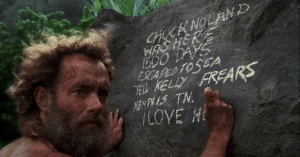 Hanks’ acting is his usually above average output, but his whole role seems more like a showcase for his method acting than the acting itself. The first half of Cast Away was shot then they took a year off so Hanks could become scruffy, thin Caveman/Unibomber Hanks. The transition is fun to watch and remarkable for an actor to devote himself completely to their role. But the part itself, and Hanks’ show, seem more spectacle than substance. Helen Hunt pops up in the beginning and end proving that she can somehow manage to be in every film in December. Pretty much the next actor in the film would be… well, a volleyball. Cast Away is basically a one-man show.
Despite a wonderful middle Cast Away is suffering from the opposite syndrome of Saving Private Ryan: strong middle, weaker beginning and end sandwiching it. Our opening plays like an extended commercial for FedEx, complete with the dazzling FedEx package POV cam (coming soon!). The end plays like a thank you card to FedEx. The ending also suffers from extreme let-down from multiple climaxes that don’t end the film but just give way to another climax. By the time the movie does end you’re exhausted.
Zemeckis lends a skilled hand toward the direction, the script plays to the strengths of the tale good enough, and Cast Away has its moments but becomes too heavy-handed at certain periods. Still, the volleyball is good. Go for the volleyball.
Nate’s Grade: B
(For fun, count the amount of times FedEx is mentioned or seen in the film. Hell, do it with this review too. I’ll even help you out – FedEx, FedEX, FedEx, FedEx, FedEx, FedEx, FedEx, FedEx, FedEx, FedEx, FedEx, FedEx, FedEx, FedEx, FedEx. Oh fun.)
——————————————————
WRITER REFLECTIONS 20 YEARS LATER

Twenty years later, Cast Away feels almost like finding a message in a bottle of another time, a time when director Robert Zemeckis was routinely making great movies, and when Tom Hanks ruled the box office and awards circuit (he has only been nominated for one Oscar since Cast Away, in 2019 for playing Fred Rogers). It’s also a movie that reminds you that despite all else that concept is king. It’s an especially easy movie to watch, and its middle portion is so beautifully clear and accessible that any group of people could keep up and find the island plot thrilling and fascinating. There are long, long portions where the only dialogue spoken in the movie is between one very harried man and a volleyball he has adopted as his only friend. Cast Away is in many ways a textbook example of elegant visual storytelling and also an example of the limitations of emotional engagement when there’s not much else going on but survival.
Please don’t get me wrong, I was mesmerized during the island portion of this movie, which makes about 80 minutes of an otherwise overly long 140-minute movie. When it’s Chuck Noland (Hanks) stranded on a deserted island and having to think step-by-step for shelter, food, and basic care, I was hooked. I was thinking each step of the way, learning and applying that new knowledge base with the main character, and it’s just an imminently enjoyable formula to witness a character work through problems and triumph under extreme circumstances. I felt the same thing with 2015’s The Martian, which was dubbed “Cast Away on Mars.” It even goes back to arguably the first novel, Robinson Crusoe, following one man and his wits and will alone on a perilous island. Very often the protagonist in these man-versus-nature stories is a stand-in for all of us, representing humanity’s quest to conquer the elements and prove our collective mettle to the universe. There is an immensely satisfying pleasure watching storytelling that is precise, efficient, and clean, imparting the necessary information to build onto the next scene and for each setup to expand your understanding and trace to the next payoff. Screenwriter William Broyles Jr. (Apollo 13, Planet of the Apes) deserves more plaudits than he has been given. The island portion of Cast Away is beautiful and near brilliant. Each moment builds so naturally. You learn the geography of the island, the mini goals of cracking open a coconut, building a fire, turning the FedEx trinkets into valuable tools of adaptation, it all builds and at your own pace.
 When we make that four-year time jump, Zemeckis definitely wants it to be a showstopper moment and it is earned. The camera slowly pans to linger on the image of Chuck, much more tan, gaunt, and with a beard that I wrote in 2000 could rival the Unibomber. It’s such a striking image coming right after an unexpected time jump. That’s Tom Hanks, one of the members of Hollywood royalty, and he looks so different from his earlier, schlubby everyman self. The sight is also a stark reminder of Hanks’ physical dedication to the role. He spent a year losing 50 pounds and growing out his scraggly beard. The entire film production went on hiatus and Zemeckis shot an entire other movie released in 2000 (the unremarkable What Lies Beneath). His performance is genuinely great and perhaps more deserving of the Oscar that year than eventual winner Russell Crowe for Gladiator. It’s a performance that is more than a Method physical transformation. His terror, elation, and worry are readily apparent onscreen. It’s a one-man show so you better not get complacent because the audience has nothing else to hold its attention than watching your face, your expressions, your tumult. Not everyone can share the screen with a volleyball and make you feel something when that ball drifts away.
It’s all the rest of Cast Away that can’t quite add up. The first act is mostly establishing Chuck as a figure fated for grand ironic punishment, a workaholic taskmaster who has all the time in the world and nothing more to do but sit with his thoughts. The first act establishes his Before life for our contrast, so we know what he will be leaving behind, and this only really works when the final act rolls around to offer the After period. Now we check in on these minor characters and what four years have done for their lives, how they mourned and moved on from Chuck, and how they’re handling his miraculous re-appearance. You could make an entire movie about a woman whose former love comes back years later after being presumed dead and how this shakes up her current relationship and her own mental sense of self and yearning. That’s a tremendous amount of internal struggle to sift through. Except, with Cast Away, Chuck has lost something but it doesn’t really feel like he’s lost much. Our only time spent with Kelly (Helen Hunt) is during the first act, and while he holds onto her memory and she ostensibly serves as a motivational force for him to get off the island, it’s not felt by the viewer. So when we learn she’s married and a mother, it doesn’t feel so tragic as it does mundane. Life carries on.
 By then it’s too late to make Chuck a more substantially interesting character. The point of interest was watching his survival on the island. Back at home, he’s just another guy, and there isn’t enough from an emotional standpoint to make him compelling. It’s not about him trying to readjust to a society he was ripped away from, catching up on lost time, feeling like a man who was in a coma and now has to pick up everything he’s been asleep for. These characterization shortcomings don’t become more notable until after Chuck gets rescued. Beforehand, I was caught in the immediate physical danger and conflicts of survival, but once we’re off the island, we’re just left with some guy. He hasn’t gone through a radical internal synthesis through his time on the island. He’ll probably be fine and live a normal life. The movie literally leaves him at a crossroads and sets up a handy romantic consolation for him. Does the audience really care which road Chuck takes from here? I doubt it. Chuck stops being interesting when he is saved.
Cast Away really was the last even semi-great movie by Zemeckis. He spent the bulk of the 2000s making animated movies using state-of-the-art motion capture technology. He’s since retreated back to live-action after his mo-cap experiments became too costly for studios. Strangely, Zemeckis has taken to remaking documentaries into entirely unnecessary dramatic features (2015’s The Walk, 2018’s Welcome to Marwen). The passion and pure filmmaking chops that placed Zemeckis as one of the most exciting filmmakers in Hollywood seems to have dimmed. Watch 2016’s Allied and tell me you feel passion. It’s like his interests in the technical side of filmmaking have swallowed his drive and creative expression as a storyteller. With Cast Away, it’s a return to basics of pure visual storytelling and Zemeckis excels so strongly. It makes me mourn what could have been considering Zemeckis abandoned live-action filmmaking, his own lost decade chasing after animated movies that felt like 3-D theme park rides. This is a man responsible for two of my favorite movies of all time (Back to the Future, Who Framed Roger Rabbit?) so I’ll always have hope that I can see glimmers of the same artist that delighted me.
Looking back at my original review from 2000, I’m becoming more and more proud of my younger self and his ability to analyze and articulate his film criticism. It’s a little fun to read words I wrote twenty years ago about a movie and nod along and go, “Right on,” with the same agreement to this day. I don’t want to get ahead of myself and say this was a shift in the complexity of my film reviews, but my major points still stand in 2020 as they did in 2000. Apparently, FedEx did not pay a dime for product placement, though the company reaped financial rewards for years after the exposure. They even made a Super Bowl ad in 2003 that provides a further epilogue where Chuck (Hanks again) finds out the one package he refused to open just had all these handy tools that could have saved him. Cast Away is still an invigorating movie today, even if that only amounts to 80 of its 140 minutes.
Re-View Grade: B+
Share this:

You Can Count on Me (2000) [Review Re-View]
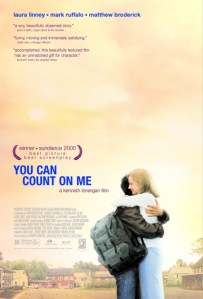 Released November 17, 2000:
Kenneth Lonergan has had quite an up and down year. He started the year co-writing the atrocious What Planet Are You From? and writing The Adventures of Rocky and Bullwinkle to ending it with the character ensemble piece that ran away with an armful of awards at Sundance. Lonergan uses subtle moves to create a vivid mosaic of small town America and family relationships with You Can Count on Me. In film, quite often do we see the relationships of sisters or brothers (maybe too often). Rarely, though, do we see a thorough drama hinged upon the relationship of a brother and sister. Both torn by their genders yet always drawn together. You may kid, and get angry, but when danger arises you will always come to the defense of your sibling. It’s this seperational friction yet togetherness that creates the brother-sister bond.
Laura Linney and Mark Ruffalo are brother and sister who years ago lost their parents to a horrible automobile accident when they were young. Forced with the battle of growing up with grief, each goes their separate way. Ruffalo is branded the “difficult” rebellious one, yet deep down he knows that his publicly deified sister is just as much the rebel. Linney is a single mother dealing with the pressures of raising her son (a Culkin kid) and working in her town’s bank branch headed by her new boss (Matthew Broderick). Her brother reappears in her life suddenly and the two learn a little form each other. With her brother she can rely on someone else to watch her child and experiences another flash of the mischief that she had to forfeit from her childhood in order to raise her younger brother. Ruffalo provides the male figure her son is lacking and begins to shed the boy’s over protection and opens him up to the world. One experiences responsibility, one experiences release. but do either learn? That is a good question.
 Lonergan crafts a subtle texture that allows his characters to breathe and grow but not necessarily learn. His modest character-driven picture may make you think of Made for TV but its a slice of life that’s immersible. It’s hard to find a film that is subtle, at its own pace, and restrained when it needs to be.
Linney is fantastic as the sister that breaks loose and winds up sleeping with her boss with reckless childish rebellion. Her performance is an Oscar nomination lock as her character runs the emotional gamut. Ruffalo is amazing and establishes himself as one to surely look out for. his mannerisms and expressions are wonderful and his demeanor is reminiscent of Marlon Brando.
You Can Count On Me is a wonderfully affecting story about people who are more complicated then simple plot synopsis will allow. Lonergan has crafted something of an anomaly in modern cinema: a film that takes its time, doesn’t answer any questions, but makes us feel all the better after seeing it.
Nate’s Grade: B+
——————————————————
WRITER REFLECTIONS 20 YEARS LATER
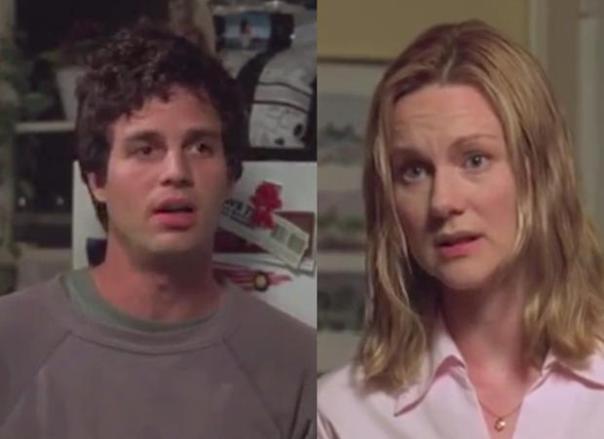
You Can Count on Me was a breath of fresh air in 2000. It was an impressive star-making performance for Mark Ruffalo, who would go onto three Oscar nominations and be the Hulk people actually wanted to see. It was a showcase for Laura Linney, her biggest big screen role to date and earned her an Oscar nomination, her first of three. It was the first personal movie by writer/director Kenneth Lonergan, a playwright who had become one of Hollywood’s popular writers for rewriting studio projects trapped in hell. Lonergan was nominated for Best Original Screenplay, losing to Cameron Crowe’s Almost Famous, and then finally winning the same award for 2016’s emotionally devastating Manchester by the Sea. It’s strange to recall that the biggest name involved with this small, character-driven indie wasn’t any of these three but Matthew Broderick, drafting off his mordant turn in Alexander Payne’s Election. This is one of those slice-of-life movies where the characters are the driving force of the plot, where the small connections and mistakes are the ones that resonate most. And yet, I didn’t see it back in 2000 but I did upon my re-watch, there’s a degree of broad sentimental contrivance as well, an element missing in Lonergan’s latter efforts, including possible masterpiece, 2011’s Margaret.
 We follow the lives of two very different and not so different siblings coming back together. They’ve been orphans since they were children and had to rely upon one another. Sammy (Linney) is the responsible one with the good job and a young son she’s raising on her own. Terry (Ruffalo) is the irresponsible one who gets into fights, can’t keep a job, and served a little time in jail he was embarrassed to tell his sister about. He comes back initially for some quick money, to the disappointment of Sammy, and then sticks around longer and longer, bonding with his nephew and going through old and new arguments with his sister over his life decisions and direction.
It doesn’t take long to realize Lonergan’s striking ability to compose naturalistic dialogue that has pinpoint precision when it comes to characterization. Watching any pairing of characters has the wonderful effect of the best plays, where that intriguing combination of character interactions is like an exciting chemical reaction, creating something new and welcomed. Every conversation then takes on meaning to see how the character interactions change or influence the participants. It means that Lonergan is generous and judicious with his details. A dinner meant to be celebratory can become a re-airing of grievances and disappointments. A night out hustling pool can go from being a bad idea to becoming a male bonding experience that has to stay a secret. The characters are so richly observed and developed that You Can Count on Me is implicitly saying to its audience, “Hey, no matter the scene, you can count on me.”
The relationship between Sammy and Terry is the most emotionally resonant and complex, with each of them defying the easy characterization they’ve been assigned as Good Kid and Bad Kid. He’s resentful of his sister and her judgement when he thinks she can be just as irresponsible. She’s resentful of her brother and his immaturity and inability to put down roots, bumming around and getting into the same old scrapes. Coming back together, each reconnects on a personal and family level where they may be combustible but they realize how much they need and love one another. A final heartfelt goodbye between them, while waiting for a bus to take Terry away, becomes an awkward but affecting moment because they really don’t know when their paths will cross once again. Sammy sure hopes it’s sooner, as her young son has grown attached to Terry. I think deep down Terry hopes it is as well and likes the comfort and support offered from this family that has an open spot in waiting for him on call. He’s ostensibly leaving to make things right with his girlfriend (or ex-girlfriend? It’s unclear since he’s been away) and has grown as a person from the experience of being an uncle. He’s not at the end of his arc, wherever that may eventually lead, but he’s moved closer on that journey. That’s a good summation for all the characters. There aren’t clearly designated arcs but nudges along a very human path to growing and learning.
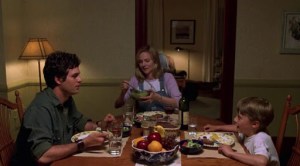 Ruffalo (Spotlight) instantly grabs your attention. His performance almost has a shy obstinance, like he doesn’t want to be seen by the viewer, tired of the judgement he knows is coming, and he’s constantly retreating inward in defense and score-settling. He’s so immersed in the character that the actor dissolves entirely. His commitment to character is immediate. There was a reason he was drawing comparisons to Marlon Brando upon release. Linney (Love Actually) is terrific as well as the flabbergasted older sibling tired of having to play parent to her rebellious brother. She has many moments of exasperation with her brother, the men of this small town, her ineffectual boss she has a short-lived affair with. She’s drifting just like Terry but doesn’t realize it; Sammy vacillates between wanting to settle down with a nice boring guy who says he loves her. She’s been stuck fulfilling responsibilities for so long that her brother’s return allows her to cut loose a little bit, to be bad again, to make careless and selfish choices. Linney serves as a strong anchor for us as well as an example that being an adult doesn’t mean being in control.
Where You Can Count on Me slightly falters, and not by much, is the inclusion of storylines that feel a bit too maudlin and TV-movie-of-the-week. There are two tracks of emotions in the movie, subtle and overt, and it’s become clearer which is which upon re-watch twenty years later. I almost feel like Lonergan included some of these parts because they made selling his indie easier to studio executives. The affair Sammy has with her boring yet sleazy boss (Broderick) offers no real insights beyond Sammy’s capacity for self-destructive whims. She keeps coming back to this weak man, maybe because there’s no future with him since he’s married and his wife is pregnant, and maybe because she knows she can drop him. I started groaning whenever her boss called again, so desperate for one more last time, and that is likely the point. It’s watching someone continue down a path we all know should be avoided. It also explains how she might have ended up with her son’s father, played by Josh Lucas (villain in 2003’s first Hulk movie). Terry decides the little kid deserves to see his father and the unannounced visit doesn’t end well. The bad dad denies he is even the father, they get into a fistfight, and the little kid gets to feel abandoned all again. These broad dramatic moments stick out amidst the more subtle and naturalistic movements throughout. It’s not enough to drag down the whole of Lonergan’s enterprise but they feel like discordant notes in an otherwise sumptuous symphony where all the players are working in impressive synchronicity.
 Looking back at my original review in 2000, it hits a lot of the same observations that came to me in 2020 re-watching the movie. The complexity of the characters, the unobtrusive direction, and the naturalism of top performers is as evident back then as it is now. It’s easy to see what drew such celebrated actors to bring life to these people. Lonergan gained confidence as a writer/director and held true to his visions, including a five-year struggle with producers over his ambitious artistic intentions for Margaret that brought in none other than Martin Scorsese to play as elder statesman deal-breaker. His works have become more intimate and insular. Looking back on his first film, which Lonergan even has a small acting role as the town pastor, is like watching the first steps of an artist who would later sprint. You Can Count on Me is a funny, poignant, and engrossing character piece on sibling rivalry and small-town conformity, but it’s also got a few issues that Lonergan would shed later in his career. Come to see a young Ruffalo tear through scenes and Linney match him moment-for-moment.
Re-View Grade: B+


 nathanzoebl
You must be logged in to post a comment.