Blog Archives
The Banshees of Inisherin (2022)
 The Banshees of Inisherin is a melancholy movie that aspires for tragi-comedy but comes up short. I’m a big fan of writer/director Martin McDonagh’s past films, especially 2017’s Three Billboards and 2008’s In Bruges, and his command of character writing and finely hewn tonal shifts. With Banshees, it’s the tale of a falling out between two friends, Colm (Brendan Gleeson) and Padraic (Colin Farrell), and the repercussions of this disunion. Colm (pronounced Call-em) looks at his long-time daily drinking partner as unrepentantly dull and as a drain on his emotional energy. As he’s getting older, he’s more mindful of his time and wants to try and create a violin piece to outlive him. Padraic (pronounced Patrick) cannot accept that his friend can just abruptly end things, so he persists, wanting to know why, wanting to know what he can do to mend this friendship, and not listening to Colm’s threats if he doesn’t leave well enough alone. The film is set in 1923 on the island of Inisherin during the short-term Irish civil war, and the backdrop gives way to gorgeous landscapes and an overwhelming sense of isolation. Every character in this movie is feeling some gnawing sense of loneliness and discontent, from Colm and Padraic looking at their friend and wondering why, to Padraic’s sister Siobhan (Kerry Condon) who pines to leave and start a life on the mainland on her own, to Dominic (Barry Koeghan) who is looking for any human connection beyond his alcoholic and abusive father. McDonagh is terrific at writing his characters and interspersing droll humor and establishing the staid rhythms of this small world. The actors are all uniformly fantastic with special attention to the sad-eyed Farrell and super-charged Koeghan. I was enjoying my time but then I started to worry what this would all amount to, and the answer remains a big question mark. The movie’s story feels like an over-extended parable, and in doing so that holds many of the characters to be less developed and nuanced, serving their role as perspectives or victims of the folly of fate. By the end, I don’t really know what the larger theme or message of McDonagh’s movie. Maybe it’s about the facile nature of so many friendships, maybe it’s about what we choose to signify the fullness of a life lived, or maybe it’s just that a man’s donkey is nothing to trifle with. The Banshees of Inisherin is more funny than profound, but even kept too strictly in parable terms, it’s still an entertaining and occasionally heartbreaking watch.
Nate’s Grade: B
Share this:

The Fabelmans (2022)
 Steven Spielberg has been the most popular film director of the last fifty years but he’s never turned the focus squarely on himself, and that’s the draw of The Fabelmans, a coming-of-age drama that’s really a coming-of-Spielberg expose. The biographical movie follows the Fabelman family from the 1950s through the late 60s as Sammy (our Steven Spielberg avatar) becomes inspired to be a moviemaker while his parents’ marriage deteriorates. As a lifelong lover of movies and a childhood amateur filmmaker, there’s plenty here for me to connect with. The fascination with recreating images, of chasing after an eager dream, of working together with other creatives for something bigger, it’s all there and it works. I’m a sucker for movies about the assemblage of movie crews, those found families working in tandem. However, the family drama stuff I found less engaging. Apparently Sammy’s mother (Michelle Williams) is more impulsive, spontaneous, and attention-seeking, and may have some un-diagnosed mental illness at that, whereas his father (Paul Dano) is a dry and boring computer engineering genius. I found the family drama stuff to be a distraction from the storylines of Sammy as a budding filmmaker experimenting with his art and Sammy the unpopular new kid at high school harassed for being Jewish. There are some memorable scenes, like a girlfriend’s carnal obsession with Jesus, and a culmination with a bully that is surprising on multiple counts, but ultimately I found the movie to be strangely remote and lacking great personal insight. This is why Spielberg became the greatest filmmaker in the world? I guess. I’ll credit co-writer Tony Kushner (West Side Story, Lincoln) for not making this what too many modern author biopics have become, a barrage of inspirations and connections to their most famous works (“Hey Steven, I want you to meet our neighbor, Ernest Thalberg, or E.T. as we used to call him back at Raiders U.”). The Fabelmans is a perfectly nice movie, with solid acting, and the occasional moment that really grabs hold of you, like a electrifying meeting with a top Hollywood director in the film’s finale. For me, those moments were only too fleeting. It’s a family drama I wanted less family time with and more analysis on its creator.
Nate’s Grade: B
Share this:

Women Talking (2022)
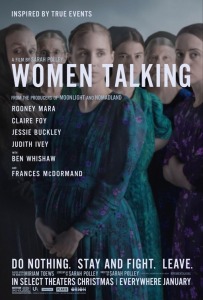 The hard-hitting Oscar-worthy drama Women Talking could have been titled Twelve Angry Women, but with the necessary subtitle: But They’re Very Justified in Their Rage. It is, as the title suggests, a movie almost entirely about women talking in one central location, enough so to feel like a stage play captured for the screen. However, the reason these women are assembled is heartbreaking, infuriating, and eminently engrossing. Women Talking demands to be heard.
The dozen women have gathered to debate the future of their participation in their community, a closed-off Mennonite coalition. They are victims of heinous sex crimes and general repression, debating between staying and fighting and abandoning their way of life. These women are talking about their own agency and what their collective response will be to the great wrongs that have prevailed upon them. It’s not just that the women of this community have been preyed upon by predators in their midst, their trauma has been dismissed as ghosts and devils until literal men were literally caught and apprehended. The next part is even more galling, as the guilty men will be returning back to the community and the women are expected to forgive the predators and go back to life as it has been. Except how exactly has life been for the women of this small community? The assaults have been going on for decades, enough that many of the children are the byproducts of their abusers. One grandmother is brought to tears that she should have done more to protect her adult daughter, herself married to an abusive man. The systematic nature of this abuse is the core of their deliberation. Can they stay and reform a broken society from inside, or is the best hope radically breaking away and starting anew without the men?
 The movie also serves as a debate over the capacity for grace and forgiveness, reminding me in subject as well as the approach of last year’s equally hard-hitting and equally spellbinding indie, Mass. I found it especially insulting that these women are expected, by the male leaders, to simply forgive and forget, to shuffle back to subservience. It’s a larger philosophical discussion over the nature of grace and accountability. It would be showing grace to these men to forgive them when they do not deserve it, and surely the male leaders would underline this point in a comparison with their religious text, akin to Jesus forgiving those who crucified him. However, if forgiveness is not the catalyst for reform and reclamation, then it’s just another empty gesture that maintains the status quo of abuse going unpunished and the abusers being protected. It’s easy to make larger connections to larger societies protecting predators through conditioned silence. The entertainment industry has been rife with bad men, and yes it’s typically men, behaving criminally and being protected by their position, and it might be easy to make connections with Women Talking and She Said, the fact-based take-down of Harvey Weinstein. Are these people worthy of forgiveness or is the patriarchal system of power (women aren’t even allowed to learn to read and write in this community) beyond salvaging? Within minutes of watching, I was already shaking my head and saying they should burn it all to the ground.
Women Talking is powerful and somber without being overly grave to the detriment of the material. It’s never taken anything less than serious, but the subject matter is handled very sensitively and even rated PG-13. Under the careful guidance of writer/director Sarah Polley (Away From Her, Stories We Tell), the film doesn’t soft-pedal the abuse these women have suffered but it doesn’t wallow in it either, getting overloaded with sordid details. The screenplay unfolds key pieces of information over time, allowing the audience to piece together a fuller picture (I didn’t even realize the family connection of the dozen women until an hour in). It would be easy if the only response explored was one of unfathomable rage, best exemplified by a stirring monologue where Claire Foy (The Crown, First Man) rattles off what she will do to protect her young daughter including murder, including vying with the Almighty, and even including spending eternity in hell. It’s easy to be all teeth-gnashing vengeance and fury, and entirely deserved considering these women are already looked upon as second-class citizens. However, Polley aligns her movie as a debate between anguish and hope and the difference between false and real hope. Is it real to hope that these men will change? Is it real to hope that August (Ben Whishaw), a college-educated child of a former outcast, can break the cycle? By the end, the main feeling I had was catharsis, that these women can chart a new, better path.
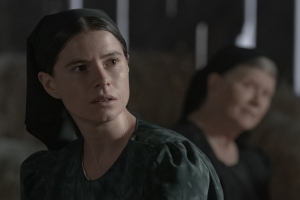 Given the heavy subject matter and the ensemble nature of the production, you would be right to assume that this is an actors’ showcase. The three biggest roles belong to Foy’s Salome, Rooney Mara’s Ona, and Jessie Buckley’s Mariche, each presenting a different perspective. Salome wants to stay but mostly as a means of collecting vengeance for her and her daughter. Mariche wants to forgive the men because, if they do exile themselves, they are told their immortal souls will be denied the kingdom of heaven. It also happens that Mariche’s alcoholic husband is one of the accused men returning. Ona is pregnant with her attacker’s child and questioning which setting would be best for her, staying with what she knows or risking a new life, for better or worse. Foy and Buckely (The Lost Daughter, Men) each have a signature monologue opening up their character perspective and each of them cinches it (call it their “Oscar clip moments”). Mara (Nightmare Alley) has the more contemplative and subdued role, which makes it less showy. Her character is the one who questions the most the value of forgiveness, and of course whether it counts when forgiveness is forced with the threat of eternal damnation. If Salome is the movie’s fury, then Ona is a reflection of begrudging hope, and Mara succeeds with a noble sense of grace.
There are two minor quibbles I have with Women Talking that hold it slightly back for me, and it’s not the locked-in setting making the proceedings feel like a staged play. Polley uses visual inserts and cutaways to devastating effect to highlight the women’s trauma, from awakening to the aftermath of assault to miscarriages, notions to heighten the visual storytelling potential of the medium without digging into exploitation and losing the tasteful tone. The directing even takes a few cues from Sydeny Lumet’s work from 12 Angry Men. One critical aspect that holds back the movie, again only slightly, is that the characters tend to feel a little more like various points of view rather than finely developed characters. Given the nature of the debate, there’s a lot of ground to cover, and it’s a smart storytelling move to coalesce. It just slightly limits some emotional engagement; it’s still there because of the skill of the actors and every drop of empathy they rightly earn, but the characters aren’t as well realized as they could have been. This can also be simply because we’re dealing with a dozen characters to try and supply enough material for. Even in 12 Angry Men, not every juror is going to be given equal importance (nobody cares about you, juror #7, so sit down). I reflect back to Mass, an excellent 2021 movie that you should seek out, and how personable and in-depth those characters came across over their feature-length sit-down. It also helps that it only had four characters to balance. The other minor criticism I have is the overemphasis the movie places on a long-in-the-works romance between Ona and August, who maybe has more screen time than maybe any woman. For a movie dealing with the sexual and emotional trauma of women and them taking account, I’m left uncertain about the amount of time we spend on an unrequited romance. It’s not like Polley is elbowing in wacky rom-com material, as it all likewise carries the same subdued tone. I just don’t know if this movie needs a romance elevated during its otherwise 100 plaintive minutes.
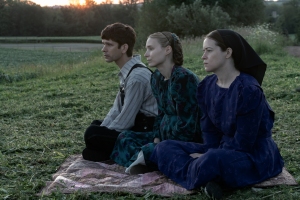 Women Talking is an urgent movie that every person should watch. The central dynamic is radiating with dramatic potential, and the actors are uniformly excellent, even the youngest actors handling some very touchy material. Polley’s direction is stately and subdued without removing any of the surging emotional power inherent in her drama. I’m overjoyed that Polley has returned back to filmmaking as she hasn’t made a movie in ten years. It’s a triumphant return for Polley, one that will likely have her vying on the biggest stages come awards season. Women Talking is timely and, unfortunately, also timeless. By the end, you’ll feel slightly exhausted but better for it, like the euphoria that comes after a good cry and you feel like, having pushed through, you’ll be better for it.
Nate’s Grade: B+
Share this:

Guillermo del Toro’s Pinocchio (2022)/ Pinocchio (2022)
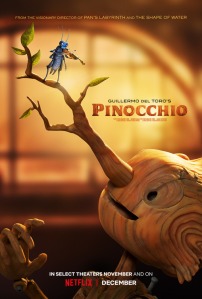 It seems 2022 has unexpectedly become the year of Pinocchio. The 1883 fantasy novel by Carlo Collodui (1826-1890) is best known via the classic Walt Disney animated movie, the second ever for the company, and it was Disney that released a live-action remake earlier in the year on their streaming service. Now widely available on Netflix is Guillermo del Toro’s stop-motion Pinocchio, so I wanted to review both films together but I was also presented with a unique circumstance. Both of these movies were adaptations of the same story, so the comparison is more direct, and I’ve decided to take a few cues from sports writing and break down the movies in a head-to-head competitive battle to see which has the edge in a series of five categories. Which fantastical story about a little puppet yearning to be a real boy will prove superior?
1. VISUAL PRESENTATION
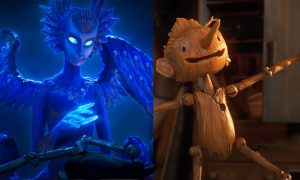
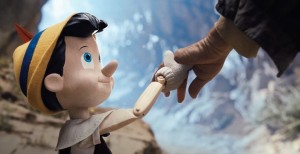
The Netflix Pinocchio is a lovingly realized stop-motion marvel. It’s del Toro’s first animated movie and his style translates easily to this hand-crafted realm. There is something special about stop-motion animation for me; I love the tactile nature of it all, the knowledge that everything I’m watching is pain-stakingly crafted by artisans, and it just increases my appreciation. I fully acknowledge that any animated movie is the work of thousands of hours of labor and love, but there’s something about stop-motion animation that I just experience more viscerally. The level of detail in the Netflix Pinocchio is astounding. There is dirt under Geppetto’s fingernails, red around the eyes after crying, the folds and rolls of fabric, and the textures feel like you can walk up to the screen and run your fingers over their surfaces. I loved the character designs, their clean simplicity but able readability, especially the sister creatures of life and death with peacock feather wings, and the animation underwater made me question how they did what they did. del Toro’s imagination is not limited from animation but expanded, and there are adept camera movements that require even more arduous work to achieve and they do. I loved the life each character has, the fluidity of their movements, that they even animated characters making mistakes or losing their balance or acting so recognizably human and sprightly. There’s a depth of life here plus an added meta-textual layer about puppets telling the story about a puppet who was given life.
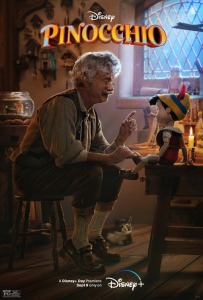 In contrast, the Disney live-action Pinocchio is harsh on the eyes. It’s another CGI smorgasbord from writer/director Robert Zemeckis akin to his mo-cap semi-animated movies from the 2000s. The brightness levels of the outside world are blastingly white, and it eliminates so much of the detail of the landscapes. When watching actors interact, it never overcomes the reality of it being a big empty set. The CGI can also be alarming with the recreation of the many animal sidekicks of the 1940 original. Why did Zemeckis make the pet goldfish look sultry? Why did they make Jiminy Cricket (Joseph Gordon-Levitt) look like a Brussel sprout come to life? It might not be the dead-eyed nightmare fuel of 2004’s The Polar Express, but the visual landscape of the movie is bleached and overdone, making everything feel overly fake or overly muddy and glum. The fact that this movie looks like this with a $150 million budget is disheartening but maybe inevitable. I suppose Zemeckis had no choice but to replicate the Pinocchio character design from 1940, but it looks remarkably out of step and just worse. When we have the 1940 original to compare to, everything in the 2022 remake looks garish or ugly or just wrong. The expressiveness of the hand-drawn animation is replaced with creepy-looking CGI animal-human hybrids.
Edge: Netflix Pinocchio
2. FATHER/SON CHARACTERIZATION
The relationship between Pinocchio (voiced by Gregory Mann) and Geppetto (David Bradley) is the heart of the Netflix Pinocchio, and I don’t mind sharing that it brought me to tears a couple of times. As much as the movie is about a young boy learning about the world, it’s also about the love of a father for a child. The opening ten minutes establish Geppetto’s tragedy with such surefooted efficiency that it reminded me of the early gut punch that was 2009’s Up. This Geppetto is constantly reminded of his loss and, during a drunken fit, he carved a replacement child that happens to come to life. This boy is very different from his last, and there is a great learning curve for both father and son about relating to one another. This is the heart of the movie, one I’ll discuss more in another section. With del Toro’s version, Geppetto is a wounded and hurting man, one where every decision is connected to character. This Pinocchio is a far more entertaining creature, a child of explosive energy, curiosity, and spitefulness. He feels like an excitable newborn exploring the way of the world. He’s so enthusiastic so quickly (“Work? I love work, papa!” “I love it, I love it!… What is it?”) that his wonder can become infectious. This Pinocchio also cannot die, and each time he comes back to life he must wait longer in a netherworld plane. It provides even more for Pinocchio to understand about loss and being human. This is a funny, whimsical, but also deftly emotive Pinocchio. He points to a crucifix and asks why everyone likes that wooden man but not him. He is an outsider learning about human emotions and morals and it’s more meaningful because of the character investment.
 In contrast, the Disney live-action Pinocchio treats its title character as a simpleton. The problem with a story about a child who breaks rules and learns lessons by dealing with the consequences of his actions is if you have a character that makes no mistakes then their suffering feels cruel. This Pinocchio is simply a sweet-natured wannabe performer. He means well but he doesn’t even lie until a sequence requires him to lie to successfully escape his imprisonment. The relationship with Geppetto (Tom Hanks) is strange. This kindly woodcarver is a widower who also has buried a son, but he comes across like a doddering old man who is quick to make dad jokes to nobody (I guess to his CGI cat and goldfish and multitude of Disney-tie-in cuckoo clocks). I don’t know what Hanks is doing with this daffy performance. It feels like Geppetto lost his mind and became stir crazy and this performance is the man pleading for help from the town, from the audience, from Zemeckis. It’s perplexing and it kept me from seeing this man as an actual character. He bounces from catalyst to late damsel in distress needing saving. The relationship between father and son lacks the warmth of the Netflix version. Yet again, the live-action Pinocchio is a pale imitation of its cartoon origins with either main character failing to be fleshed out or made new.
Edge: Netflix Pinocchio
3. THEMES
There are a few key themes that emerge over the near two-hours of the Netflix Pinocchio, which is the longest stop-motion animated film ever. Sebastian J. Cricket (Ewan McGregor) repeats that he “tried his best and that’s the best anyone can do,” and the parallelism makes it sound smarter than it actually is. The actual theme revolves around acceptance and the burdens of love. Geppetto cannot fully accept Pinocchio because he’s constantly comparing him to Carlo. When he can fully accept Pinocchio for who he is, the weird little kid with the big heart and unique perspective, is when he can finally begin to heal over the wound of his grief over Carlo, allowing himself to be vulnerable again and to accept his unexpected new family on their own terms. There’s plenty of available extra applications here to historically marginalized groups, and del Toro is an avowed fan of freaks and outcasts getting their due and thumbing their nose at the hypocritical moral authorities. By setting his story in 1930s Italy under the fascist rule of Benito Mussolini, del Toro underlines his themes of monsters and scapegoats and moral hypocrites even better, and the change of scenery really enlivens the familiar story with extra depth and resonance. All these different people want something out of Pinocchio that he is not. Geppetto wants him to strip away his individuality and be his old son. Count Volpe (Christoph Waltz) wants Pinocchio to be his dancing minion and secure him fame and fortune. Podesta (Ron Perlman) wants Pinocchio as the state’s ultimate soldier, a boy who cannot die and always comes back fighting. When Pinocchio is recruited to train for war with the other young boys to better serve the fatherland’s nationalistic aims, it’s a far more affecting and unsettling experience than Pleasure Island, which is removed from this version. In the end, the movie also becomes a funny and touching exploration of mortality from a magic little child. The Wood Sprite (Tilda Swinton), this version of the Blue Fairy, says she only wanted to grant Geppetto joy. “But you did,” he says. “Terrible, terrible joy.” The fleeting nature of life, as well as its mixture of pain and elation, is an ongoing theme that isn’t revelatory but still feels impressively restated.
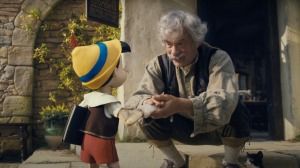 I don’t know what theme the Disney live-action movie has beyond its identity as a product launch. I suppose several years into the Disney live-action assembly line I shouldn’t be surprised that these movies are generally listless, inferior repetitions made to reignite old company IP. For a story about the gift of life, the Disney Pinocchio feels so utterly lifeless. I thought the little wooden boy was meant to learn rights and wrongs but the movie doesn’t allow Pinocchio to err. He’s an innocent simpleton who gets taken advantage of and dragged from encounter to encounter like a lost child. The Pleasure Island sequence has been tamed from the 1940s; children are no longer drinking beer or smoking cigars. They’re gathered to a carnival and then given root beer and told to break items and then punished for this entrapment. The grief Geppetto feels for his deceased loved ones is played out like a barely conceived backstory. He’s just yukking it up like nothing really matters. By the end, when he’s begging for Pinocchio to come back to life, you wonder why he cares. If you were being quite generous, you might be able to uncover themes of acceptance and understanding, but they’re so poorly developed and utilized. That stuff gets in the way of Pinocchio staring at a big pile of horse excrement on the street, which if you needed a summative visual metaphor for the adaptation, there it is.
Edge: Netflix Pinocchio
4. EMOTIONAL STAKES
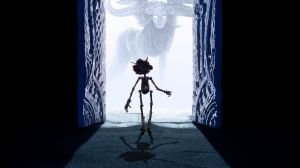 One of these movies made me cry. The other one made me sigh in exasperation. The Netflix Pinocchio nails the characterization in a way that is universal and accessible while staying true to its roots, whereas the Disney live-action film feels like a crudely packaged remake on the assembly line of soulless live-action Disney remakes. By securing my investment early with Geppetto’s loss, I found more to relish in the layers of his relationship with Pinocchio. In trying to teach him about the world, Geppetto is relying upon what he started with his past son, and there are intriguing echoes that lead to a spiritual examination. Pinocchio is made from the tree from the pinecone that Carlo chased that lead to his death. Pinocchio hums the tune that Geppetto sang to Carlo. Is there something more here? When he visits Death for the first time, the winged creature remarks, “I feel as though you’ve been here before.” These little questions and ambiguity make the movie much more rewarding, as does del Toro’s ability to supply character arcs for every supporting player. Even the monkey sidekick of the villain gets their own character arc. Another boy desperately desires his stern father’s approval, and he’s presented as a parallel for Pinocchio, another son trying to measure up to his father’s demands. Even this kid gets meaningful character moments and an arc. With this story, nobody gets left behind when it comes to thoughtful and meaningful characterization. It makes the movie much more heartwarming and engaging, and by the end, as we get our poignant coda jumping forward in time and serving as multiple curtain calls for our many characters, I was definitely shedding a flurry of tears. Hearing Geppetto bawl, “I need you… my boy,” to the lifeless body of Pinocchio still breaks me. Under del Toro’s compassionate lens, everyone is deserving of kindness.
As should be expected by now, the Disney live-action movie is lackluster at best when it comes to any kind of emotional investment. The characters stay as archetypes but they haven’t been personalized, so they merely remain as grubby facsimiles to what we recall from the 1940 version. Jiminy Cricket is meant as Pinocchio’s conscience but he vacillates from being a nag to being a smart aleck who even breaks the fourth wall to argue with his own narration. I hated every time he called the main character “Pee-noke” and he did it quite often. He’s far more annoying than endearing. There’s also a wise-cracking seagull that is just awful. The Honest John (Keegan Michael-Key) character is obnoxious, and in a world with a talking fox who dresses in human clothing, why would a “living puppet” be such a draw? He even has a joke about Pinocchio being an “influencer.” The only addition I liked was a coworker in Stromboli’s traveling circus, a former ballerina who injured herself and now gets to live out her dancing dreams by operating a marionette puppet. However, the movie treats the puppet like it’s a living peer to Pinocchio and talks directly to the puppet rather than the human operating the puppet, and the camera treats her like she’s the brains too. Safe to say, by the end when Pinocchio magically revives for whatever reason, just as he magically reverted from being a donkey boy, I was left coldly indifferent and more so just relieved that the movie was finally over.
Edge: Netflix Pinocchio
5. MUSIC
 This was one area where I would have assumed the Disney live-action film had an advantage. Its signature banger, “When You Wish Upon a Star,” became the de facto Disney theme song and plays over the opening title card for the company. It’s still a sweet song, and Cynthia Erivo (Harriet) is the best part of the movie as the Blue Fairy. It’s a shame she only appears once, which is kind of negligent considering she sets everything in motion. The Netflix Pinocchio is also a musical and the songs by Alexandre Desplat (The Shape of Water) are slight and low-key, easy to dismiss upon first listen. However, the second time I watched the movie, the simplicity as a leitmotif really stood out, and I noticed the melody was the foundation for most other songs, which created an intriguing interconnected comparison. While nothing in the Netflix Pinocchio comes close to being the instantly humable classic of “When You Wish Upon a Star,” the songs are more thoughtful and emotionally felt and not just repeating the hits of yore, so in the closest of categories, I’m going to say that Netflix’s Pinocchio wins by a nose (pun intended).
Edge: Netflix Pinocchio
CONCLUSIONS
One of these Pinocchio movies is a visual marvel, heartfelt and moving, wondrous, and one of the best films of 2022. The other is a hollow vessel for corporate profit that copies the imprint of the 1940 animated film but only more frantic, scatalogical, and confused. In the year of our lord Pinocchio Two Thousand and Twenty-Two, there is only one movie you should see, and at this point ever see as it concerns this old tale. Guillermo del Toro has harnessed magic, and we are all the better for his bayonet imagination and enormous heart for his fellow outsiders.
Nate’s Grades:
Guillermo del Toro’s Pinocchio: A
2022 Pinocchio: C-
Share this:

Tar (2022)
 It’s been 16 years since writer/director Todd Field has helmed a movie, and if you’re a fan of his two previous efforts (2001’s In the Bedroom, 2006’s Little Children), and if you watch both it’s hard not to be, then a new Field movie is cause enough to celebrate. Tar is set up like a biopic for a brilliant yet problematic German conductor, Lydia Tar (Cate Blanchett), a renowned talent in her field who also happens to have a long history of grooming her female Julliard music students into transactional sexual relationships. The movie is presented like one of those Oscar bait-ready biopics, enough so that I looked up more about Lydia Tar’s life (surprise: she’s completely fictional). It’s a character study of a flawed creative superstar in the wake of a Me Too reckoning, and in one revealing and excellently written sequence, Lydia argues for the noble separation of the art and artist and harangues an undergrad for his refusal to play the old classical masters for their centuries-old outdated perspectives. She accuses him of playing into performative identity politics, of course glossing over her own narcissistic problems. The dialogue is impressively curated, with lengthy conversations feeling authentic and packed with details of the world of classical music and composition and different ways we appreciate and interpret art. The movie unfolds at a very relaxed pace, revealing key details and connections about Lydia without underlying their significance. You have to really keep up with the movie, and the first hour is quite slow to get over. It opens with a fifteen-minute New Yorker on-stage interview with Lydia, and names will be dropped that won’t be relevant for whole acts. It’s self-indulgent but the details feel so authentic that I was still impressed even as I was beginning to lose my patience or attention. Even the opening credits last over five minutes, and that’s just white text on a black screen. The movie picks up more of a momentum as Lydia’s career starts to unravel and her past inappropriate relationships are given new attention in a post-Me Too media environment. Blanchett, as you would expect, is brilliant. She’s a complex mess of contradictions, and whether she fully acknowledges them is up to the viewer’s interpretation. Once you start recognizing her “performance” of self, every scene becomes a careful study in how many facades a person can leverage and what degree of self-awareness she may be privy to. Field’s direction is very calculated and downright Kubrickian, emphasizing long takes and cool color palates (Field had a small role in Eyes Wide Shut) to go along with its intellectual, understated, methodical approach (also in running time, and at 150 minutes in length, it’s overlong). I wasn’t as captivated with Tar as I was Field’s other movies, but there’s still much to admire, a commanding performance from Blanchett, and I hope I don’t have to wait another 16 years for Todd Field’s next able effort.
Nate’s Grade: B
Share this:

Bowling for Columbine (2002) [Review Re-View]

Originally released October 11, 2002:
Documentary filmmaker, political activist and corporate pot-stirrer Michael Moore prefaces his latest film Bowling for Columbine by admitting his lifetime membership in the National Rifle Association (NRA). He even received a marksmanship award as a teenager in his hometown of Flint, Michigan. Bowling for Columbine is Moore’s sprawling and hilarious search for answers among America’s zealous gun culture and alarmingly high number of homicides. It’s the tangents Moore just can’t help but take along the ride that add some of the more fun moments.
He opens a checking account at a Michigan bank that’s offering a gun for new customer accounts. Moore astutely asks an employee, “Do you think it’s a good idea handing out guns in a bank?” Moore travels to Canada to find out what reasons exist that make our cultures so different when it comes to crime. After hearing from citizens about how they don’t lock their doors, Moore decides to go door-to-door and see for himself. Sure enough, he walks into half-a-dozen homes.
Moore is better at pointing the finger than fathoming real answers. He touches media sensationalism, our nation’s bloody history, corporate greed, past military involvement, and an environment of fear being developed by those who profit from such actions. The sobering truth is that there are no easy answers to be debunked. The film’s climax involves an impromptu sit-down with NRA president Charlton Heston. Moore questions the sensitivity of the NRA after it held support rallies days after the school shootings in Littleton and Flint. Heston becomes weary and walks out of the interview after five minutes.
The film demands to be seen. It’s complex, challenging, and thought-provoking. Not only is Bowling for Columbine the most important film of 2002, it’s also one of the best.
Nate’s Grade: A
——————————————————
WRITER REFLECTIONS 20 YEARS LATER
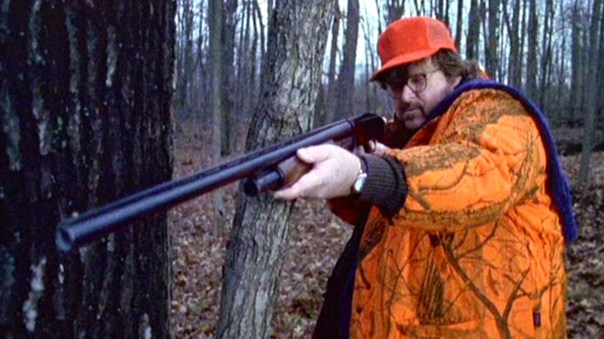
I was a junior in high school when the horrific massacre at Columbine happened in April of 1999. I remember the shock that washed over the country. I remember the daze and sorrow. I remember students not coming back to school for days, some because they feared that our Ohio school could be the next site of the next tragedy because of how upending the Columbine school shooting had been for the general sense of security. “How could this happen?’ we solemnly asked. I remember exasperated politicians wringing their hands, grasping for solutions and scapegoats alike, and I most remember just the overall gravity of the whole situation, the sense of loss, and the sense that this meant something significant. Flash forward twenty years, and the Columbine school shootings, which snuffed out 15 lives that fateful morning, is now ranked fifth on the list of deadliest school shootings in the United States, having been gut-wrenchingly eclipsed by the 18 at Parkland in 2018, the 22 in Uvalde in 2022, the 28 in Sandy Hook in 2012, and the 33 in Virginia Tech in 2007. Since then, mass shootings and spree killers have become so common that the satirical news website The Onion keeps recycling the same condemning headline with the latest mass shooting: “‘No Way To Prevent This,’ Says Only Nation Where This Regularly Happens” (this damning headline has been repeated 22 times in eight years time, and it’s only a matter of months at most before it gets repeated yet again if history is anything).
After each new tragedy, we’ve been inured to the reality of anything of merit being done in the way of reform; we move from “thoughts and prayers” to, “let’s not politicize this now,” to, “you’ll never solve every problem,” and then finally to a litany of social issues that conveniently are the real culprits, and never the guns mind you, of course. It’s easy to be cynical that, in our current day and age, no gun tragedy will ever move politicians to make real changes. After Sandy Hook, the most watered down of reforms, increasing background checks, was met with stonewalling from Republicans and those funded by the formidable National Rifle Association (NRA) lobby. After 60 people were slaughtered during a music festival in Las Vegas in 2017, the next hopeful reform was eliminating bump stocks. That didn’t happen. The patterns emerge and become their own tragic parody of performative action masquerading as meaningful action.

When people argue, “Well criminals will just ignore the new laws we pass anyway,” I’m dumbfounded by this logic, as if that is reason enough to cancel all attempts at law and governance. The oft-quoted axiom of a “good guy with a gun” being the only real solution to a “bad guy with a gun” is equally nonsensical to me. If that’s the case, then the rising presence of guns would better police these matters, mitigating their deadliness, and that is definitely not the case. The good guys with the guns aren’t working. The challenge is determining who is a good guy with a gun or a bad guy with a gun. This reflexive thinking never applies to other tragedies: “The only way to battle a bad drunk driver is with a good drunk driver.” It’s maddening for any citizen genuinely seeking common sense gun reform that’s supported by a far majority of voters.
America’s fixation with our gun culture was already a potent issue in 2002 when political muckraker Michael Moore elevated himself to new commercial and critical heights, and it’s only become even more essential to unpacking twenty years later. Moore had restyled documentary filmmaking with his searing and tragic-comic 1989 Roger and Me, his documentation of the fall of the American auto industry in his hometown of Flint, Michigan, where my mother grew up, and his search for answers with General Motors’ CEO, Roger B. Smith. Moore put himself front and center in his films, the schlubby everyman trying to hold truth to power, though he himself would have a slippery hold on it as well. Moore directed two more features in the 1990s, The Big One and Canadian Bacon, his only non-documentary film. But Moore catapulted into a new stratosphere of media attention and derision in the George W. Bush era, first with 2002’s Bowling for Columbine, which won him his first Oscar and set doc box-office records, and then in 2004 for Fahrenheit 9/11, which obliterated the box-office records Moore had just set and would have likely won him another Oscar but he refused to submit in Documentary and only wanted to submit for Best Picture (Born into Brothels won that year instead, so thanks I guess).
Bowling for Columbine is an aggravating movie by design and through Moore’s tactics. The issue of guns and violence in America has only become more central to American lives. Moore’s thesis is messy because it’s hard to find a single cause for the root of America’s gun violence, ignoring, of course, the sheer number of guns, though he even says Canada has a high guns-per-resident ratio from their culture of hunting but lacks our murder rate. The section on the media sensationalism driving gun sales is potent, as a nation constantly in fear will reach for protection that is abundant supply and access. As the murder rate has gone down over the 1990s and 2000s, the network news’ reporting over violent crime has increased, as well as gun ownership. It’s a brew of paranoia that benefits politicians, media, and especially gun manufacturers. Gun sales soared once Barack Obama swept into office, not because he said he would take people’s guns, but a section sure trumpeted those fears for monetary gain. The extended anecdote on the mother of the youngest school shooter, a six-year-old, is a powerful indictment on welfare-to-work and a system that forces people into unlivable choices. I wish Moore had touched more upon the mental health aspect of the gun violence equation, as the far majority of gun violence are suicides and not homicides. Many were quick to deduce that the Columbine killers, Eric Harris and Dylan Klebold, were victims of bullying, but millions are victims of bullying and do not shoot up their schools. In a 2017 TED Talk, Dylan Klebold’s mother, Sue, discussed her personal process of coming to terms with her son’s actions and realizing how essential his desire to die was to his infamous actions. When people make irrational, impassioned, split-second decisions, and guns are readily available, then bad things can be made even worse. Moore doesn’t explore this angle, unfortunately. Some of his larger connections can seem very reaching, like when he tries to say that kids knowing their parents work for Lockheed Martin, a military weapons manufacturer, would be less likely to value human life.

But it’s the needless sleight-of-hand tactics with the truth that confound me with Moore, and these inevitably blunt the power of his message and ability to convert thinkers. This habit infuriates and flabbergasts me. Moore has so many good points already at his disposal, so many meaningful data points and heart-tugging anecdotes that he doesn’t need to stretch the truth to convey his message. I’ve since used Bowling for Columbine as an example in teaching credibility gaps and the concept of ethos with public speaking. This is epitomized in the handling of NRA president Charlton Heston. Shortly after the events of Columbine are replayed for us, including frantic 911 calls and security camera footage, Moore cuts to Heston defiantly declaring, “With my cold dead hands,” and informs the viewer that within ten days that the NRA held their annual conference in Denver, despite pleas from local leaders for distance and sensitivity. “Don’t come here? We’re already here,” Heston replies to applause. The problem is that Moore has stitched together two separate Heston speeches to seem as one, including the “From my cold dead hands” intro, which was given an entire year after the Columbine shooting. He also excludes pertinent details like the fact that the meeting in Denver was scheduled a year in advance, the NRA was required by law to notify all four million of its members ten days before a location change, and all other NRA events were canceled except for the meeting required by corporate law. When you look at the parts of Heston’s speech Moore picked from, anyone could follow the same approach and edit the speech to say whatever message they desired. The climax of the movie is Moore sitting down with Heston, but when he peppers him with questions about his speech days after Columbine, and Heston has no idea what he’s talking about, it’s because Moore isn’t playing fair. Then also take into account the aged actor likely going through the Althzeimer’s that caused him to step down from acting and the NRA in 2002. Look, I’m no fan of the NRA, and I personally believe their self-serving actions perform a genuine harm to the country, but this is just self-righteously badgering an ailing old man.
Moore is not the only documentary filmmaker to make use of selective editing, anecdotal evidence extrapolated, and narrative cheats for manipulative emotional purposes, but when you’re being provocative, you’re going to get push back, and when you use deceitful storytelling methods with your facts, you are a disservice to your cause and your message. There’s so much on this topic that Moore can effectively criticize, like the handy media scapegoats, the failings of zero tolerance and school resource officers, the obvious hypocrisy of do-nothing elected officials, the fear-mongering news seeking out consistent sensationalism, a deference to the military industrial complex, and the fact that the rest of the world watches the same movies, listens to the same music, plays the same violent video games, and yet, to paraphrase The Onion, we’re the only country where this happens all the time. Sadly, no place is safe in the U.S. from a possible mass shooting, and yet a good portion of this country will shrug and say that’s just the price we have to pay for living our freedoms. There are so many fallible arguments to poke apart, and that’s why I’m so frustrated with Moore’s misuse of his platform, giving his opponents the ammunition to dismiss his points.

Moore’s career has fallen quite a bit from his meteoric height in 2002 and 2004, last releasing Fahrenheit 11/9 in 2018 to warn about the lasting dangers of an inactive voting public and Donald Trump as president (it grossed $6.3 million, approximately five percent of the gargantuan $119 million gross of Fahrenheit 9/11). It feels like Moore’s style, once so revolutionary, prankish, and urgent, has now become stale. As I wrote in 2018: “If our country ever needed Moore, it would be now, but his time might have already passed as an influencer. The last time Moore was breaking through into the cultural conversation was with Sicko in 2007, years before the formation of the ACA. Since then we’ve seen the rise of social media, YouTube, and the instant commentaries of media old and new, all trying to one-up one another in expediency and exclusivity. Is Moore just another member of the old guard he laments has become obsolete?” It’s not uncommon for a filmmaker to lose their edge or passion after 30 years. It’s also not uncommon for the envelope-pushers to become part of an establishment that a younger public starts tuning out for lack of relevance. I don’t know if Moore has a real audience any more.
Re-reading my old 2002 review, I’m sure glad I kept a paper copy of each of my published film reviews for my college newspaper because it was the only surviving copy I could find. I could not find my review for Bowling for Columbine on any of the websites and blogs I’ve used over the years, so in 2022, I literally sat with my twenty-year-old newspaper and retyped my relatively brief review from 2002. Thank you, me, for stubbornly holding onto these yellowing papers. I remember being more taken with the film in 2002, so much so that I would brush aside criticisms from my other friends who made valid points about Moore’s larger thesis (they just “didn’t get it,” I’m sure I incredulously scoffed). My apologies, my put-upon and sensible friends.
In the scheme of Moore’s catalog of films, I still think Roger and Me is his finest work and much of this is because it’s the most personal of his movies, chronicling the decline of his hometown with his special access. It’s the one that feels most essential for him to be the face of the movie. Bowling for Columbine is a messy movie but all Moore’s films are scattershot entertainments in retrospect, each deserving of reflection but also outside verification. As a result, the movies never become more than the sum of their parts and floating ideas and interviews and stunts and his loose thesis statements rarely coalesce into anything definitive, like an Alex Gibney documentary. Moore can be hectoring and disingenuous, especially during his interviews, and most of all aggravatingly short-sighted in his techniques, but he is a documentary industry unto himself and with good reason. Bowling for Columbine is the start of a conversation, with many asides both illuminating and diversionary, and it’s still worth watching twenty years later, as gun violence has only gotten worse. I think it’s likely Moore’s third best film, after 2007’s Sicko, but maybe I’ll change my mind in 2027. Until then, I’m lowering the film grade from an A to a B.
Re-Review Grade: B
Share this:

Blonde (2022)
 After receiving such blistering and excoriating responses, I went into writer/director Andrew Dominik’s Blonde with great trepidation. The near-three-hour biopic on the iconic Marilyn Monroe, played by Ana de Armas, is the first movie to earn an NC-17 rating since 2011’s Killer Joe, and as such, there’s a natural curiosity factor to any movie receiving such hostile reactions. Fans and critics have called the movie exploitative, navel-gazing, misogynistic, and redundant misery porn. One critic even said Blonde was “the worst movie Netflix has ever made.” I was a major fan of Dominik’s verbosely titled 2007 film, The Assassination of Jesse James by the Coward Robert Ford, and less so 2012’s Killing Them Softly, though I recognized sparing artistic merit. It’s been ten years since Dominik has directed a movie, so surely Blonde, based upon the novel by Joyce Carol Oates, had to have some merit beyond all its hype and criticism, right? Well, no. I processed my general disgust for Dominik’s three-hour slow-mo car crash. This movie is so stupendously misguided and cruel and filled with bizarre, outlandish, and maddening artistic decisions. For my movie review, I felt I needed to break my standard formula, so I decided to give voice to my analysis and criticisms by writing a pretend conversation between Dominik and a stand-in for the Netflix production. Enjoy, dear reader, and beware.
Andrew Dominick sits in front of the desk of a very concerned Netflix Producer, who fidgets uncomfortably in his seat and shuffles papers in his hands.
Netflix Producer: So, thanks, Andrew for making time for this meeting. We’ve seen your full movie and we have some… well, concerns.
Andrew Dominik: That’s life, man. You can’t tell stories without risk. Break a few eggs.
Netflix Producer: Yes, sure, but, well, I guess one of our biggest questions is why did you need almost three hours to devote entirely to the lengthy suffering of Marilyn Monroe? This is supposed to be a biopic, but all we get, scene after scene, to a fault, is a moment of Marilyn being abused, or crying, or being generally exploited. It’s… a lot to take in, Andrew.
 Andrew Dominik: Hey man, that was her life. She was this glamorous star, but behind the glamor is a lot more dirt and grime. Everyone wanted to be her, and I wanted to show the world how wrong that would be. This is a woman who was desired by the world and she was still a victim in the Old Hollywood system, which was a rape factory. I was just being honest, man.
Netflix Producer: I get that principle, but it really feels like the only version of Marilyn we get in this movie is the role of a long-suffering victim. It’s practically a passion play: The Passion of Marilyn Monroe. You’re cheapening her real-life suffering by making it so redundant to the point of self-parody, and also, if you were so concerned about creating an honest portrayal of what this woman went through, then why are you also making things up to add to her legitimate suffering?
Andrew Dominik: What d’ya mean? I adapted the book.
Netflix Producer: Yes, but you do know that Oates’ book is explicitly fictitious, right? It’s made up. Marilyn never had a throuple relationship with Charlie Chaplain Jr. and Edward G Robinson Jr. Marilyn had a positive relationship with her mother. Even worse, you’re adding fictitious suffering, like her relationship with her mother, or Marilyn being raped during an audition.
Andrew Dominik: Yeah, that might never have happened, but the rape represents the-
Netflix Producer: I’m gonna stop you there. You should refrain from sentences that include the phrase, “The rape represents [blank].” We don’t need literal sexual violence, of which we return to time and again, to stand in for a larger thematic message. Also, it’s quite disingenuous to add extra traumatic experiences when you’re purporting to tell this woman’s real trauma and conflict.
Andrew Dominik: Agree to disagree, then.
Netflix Producer: No, not really, but, okay, Andrew, can you tell me any personable impression you get of Marilyn from this movie? And-and you cannot say “victim.”
 Andrew Dominik: She was…….
Netflix Producer: …Yes?
Andrew Dominik: Sexy?
Netflix Producer: Okay, sex symbol for nearly 60 years after her death, sure. What else?
Andrew Dominik: She was…. Um…. Uh… Can I look this up on my phone?
Netflix Producer: See, Andrew, this is our problem-
Andrew Dominik: Oh, she has daddy issues! There. That.
Netflix Producer: And for an hour you have her referring to all the men in her life as “daddy,” which is very uncomfortable especially when those men are literally abusing her.
Andrew Dominik: But, y’see, she calls ‘em all “daddy” because she has-
Netflix Producer: Oh, we get it. Thank you. You have 160 minutes and you keep hitting the same point over and over, bludgeoning the viewer into submission. It’s more than a bit gratuitous, especially when you factor that you’re adding even more trauma.
Andrew Dominik: What d’ya mean by “gratuitous?”
Netflix Producer: I have prepared several examples. For starters, it might be a bit much within the first twenty minutes of your movie to subject your audience to a mother trying to drown her child in the bathtub and Marilyn being sexually assaulted at one of her first auditions.
Andrew Dominik: Okay. Okay. I get that.
Netflix Producer: Then there’s the ghastly POV shot from inside Marilyn’s vagina, which by God happens twice, and both times it’s during forced abortions. Did we really need that queasy angle that is literally invading her body against her will to accomplish what exactly?
Andrew Dominik: The purpose of any true artist is to go deeper-
 Netflix Producer: I’m gonna stop you there again. It’s just bad taste, Andrew. Also, speaking of bad taste, maybe we don’t need the entire sequence where JFK rapes her and then hires government goons to abduct her and force Marilyn into an abortion. And then, on top of all that, she hears the pleas of her first aborted fetus calling back to her. Yikes. Can you at any point step outside of your position, Andrew, and realize how shockingly gratuitous all of that can be?
Andrew Dominik: It’s all designed to separate the person from the icon. Marilyn Monroe never really existed beyond the fantasies of the public, man. It’s about bringing back her humanity.
Netflix Producer: Separating the legend from the person would be a natural artistic angle, but that means spending time establishing the person, building her up through multiple dimensions, multiple opportunities to flesh her out. You only spend time seeing her as a victim, that is when we’re not meant to partake in the same sexualization of her that you seem to be criticizing. I mean the 1996 HBO TV movie managed by having two different actresses portray her, with Naomi Judd as Norma Jean and Mira Sorvino as Marilyn. That literalized the differences and even had Marilyn converse with her former persona as a plot device. You have none of that.
Andrew Dominik: I might not have that, but my movie has a cross dissolve that goes from Marilyn getting banged to the literal crest line of Niagara Falls.
Netflix Producer: I don’t think that really makes up for a lack of character substance.
Andrew Dominik: Agree to disagree, man.
Netflix Producer: You really can’t keep using that as a defense.
Andrew Dominik: Agree to disagree, man.
Netflix Producer: Your horror show of relentless trauma and bad taste might undercut your stated goal of humanizing this woman. She’s not a character but a symbol of abject suffering, a martyr, and you increase her suffering, and sometimes in grating, absurdly grotesque ways. Do you even care about this woman? You’ve devoted three hours to reanimating her as a powerless punching bag.
Andrew Dominik: Well, I did say Gentlemen Prefer Blondes is about “well-dressed whores” and that Blonde is “just another movie about Marilyn Monroe. And there will be others.” I also said that the most important part of her life was that she killed herself.
 Netflix Producer: Exactly. That makes us question whether you have the passion and sensitivity for this project. Why does this movie even have to be NC-17? Will your three hour torture chamber be bereft of meaning if the audience doesn’t see two inner vaginal camera angles?
Andrew Dominik: How dare you even question my artistic integrity. If you remove those shots, you might as well be removing the soul of this movie. Why even tell this story?
Netflix Producer: Yes, why indeed?
Andrew Dominik: It’s meant to be disorienting.
Netflix Producer: Congrats.
The Netflix producer leans back in his chair and releases an extended, wearying sigh.
Andrew Dominik: So… after everything…. Are you going to make me cut anything?
Netflix Producer: Please. We’re so hungry for Oscar recognition, we don’t care. Go for it.
I want to cite de Armas’ (The Gray Man) performance as one of the few attributes to the movie. It’s hard to watch this woman suffer and cry in literally every scene, but I also just felt so sad for not just her character but for de Armas as an actress herself. She shouldn’t have to endure everything that she does to play this character. She is undercut by Dominik’s artistic antics and avarice at every turn, like the story jumping around incoherently so every scene fails to build upon one another. There is no genuine character exploration to be found here. It’s a cycle of suffering, and the movie wants to rub your nose in the exploitation of Monroe while simultaneously exploiting her. De Armas deserves better. Marilyn Monroe deserves better. Every viewer deserves better. Spare yourself three awful hours of pointless suffering in the name of misapplied art.
Nate’s Grade: F
Share this:

Licorice Pizza (2021)
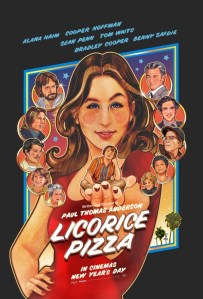
It took me many months but I’ve finally watched the last of the 2021 Best Picture nominees, and now I can safely say, I just don’t understand all the love for Licorice Pizza. It’s writer/director Paul Thomas Anderson’s (Phantom Thread, Boogie Nights) nostalgic L.A. hangout movie, but the axiom of hangout movies is that they only really work if you actually want to hang out with the participants. I’m not certain I needed or wanted to watch either of our lead characters navigate the curious bounds of their possible romantic entanglement. Alana Haim plays Alana, an under-achieving 25-year-old looking to better define herself, and Cooper Hoffman, son of the late Phillip Seymour Hoffman, who appeared in five prior PTA movies, plays an over-achieving 15-year-old that is in a hurry to grow up and conquer the adult world. He’s crushing on her, she’s flattered but says it’s not appropriate, and over two hours we watch a series of meandering episodic adventures that test their will-they-won’t-they determination. I found Haim’s character to be generally unlikable and, worse, uninteresting. She’s petulant, needling, prone to jealousy but also clearly likes the attention but doesn’t know how far to test it. Hoffman’s character, based in part on Tom Hanks’ childhood friend and producing partner Gary Goetzman, is like a human puppy dog, so overwhelming and sunny and anxious to be liked, but I can’t see any more depth to him or her. They’re just kind of annoying and maybe that’s the point about looking back. I don’t see the larger thesis or theme in many of Anderson’s small and unfunny asides. He’s trying so delicately to recreate a feeling of time and place of early 1970s Los Angeles, but the movie doesn’t succeed in answering why anyone else should really care about this personal PTA slice of nostalgia. The best part of the movie, by far, is the segment where Bradley Cooper plays the lascivious and self-absorbed hairdresser-turned-producer John Peters. Too many of the other misadventures feel like table anecdotes brought to overextended life with technical pizazz and minimal emotional accessibility. Licorice Pizza left me cold and unfulfilled.
Nate’s Grade: C+
Share this:

Elvis (2022)
 Elvis the movie is exactly what I would have hoped for from a Baz Luhrmann film, which is an experience that no one else can provide, a messy, chaotic, crazy, sometimes tin-eared yet audacious and immersive kaleidoscope of sight and sound that feels like a theme park ride. As with all Luhrmann films, the first 20 minutes is a rush of tones, characters, and near constant frenetic movement; it’s so much to process before the movie eventually settles down, at least marginally, or the viewer becomes better acclimated to the madcap storytelling style of this mad Aussie. I feel completely certain that people will call Elvis brilliant, and people will deem Elvis to be ridiculous and campy, and I would say it defiantly manages to be all of these identities at once. It is ridiculous, it is campy, it is emotional and sincere, it is, at points, even brilliant, and in a way, this shambolic style perfectly symbolizes Elvis himself, a performer that seems to be anything that the viewer projects onto him, a trailblazer who suffered for his art before becoming an irreplaceable industry and edifice of pop-culture obsession unto himself.
We chart the rise of Elvis Presley (Austin Butler) from a young crooner in the 1950s to the best-selling solo artist in recording history. Colonel Tom Parker (Tom Hanks) discovers Presley, granted after he’s been a chart-topping local hit in the South, and sees a grand opportunity. With Elvis, there is no limit to where they both can go, and so Parker becomes Elvis’ manager for over twenty years for better and worse, engineering Elvis’ tour of duty in the military to take him away from negative headlines, only for him to meet and marry Priscilla (Olivia DeJonge), to locking him into a Vegas headlining gig to erase the mystery man’s heavy debts to the mob. Under Luhrmann’s guidance, you’ll experience it all and then some in the frenzied 160 minutes.
 Elvis was many things for many people. He was a smooth crooner, he was an electric live performer, he was the benefactor of being a white vessel for music that was built upon the less heralded work of black performers, he was a victim, he was selfish, he was devoted to his fans and the stage, he was… America. In 2022, I would have asked if contemporary culture even cared about Elvis anymore, a man who died over 40 years ago, and whether we even have a lens to appreciate the man. Was he simply coasting off the hard work of other black performers? Did he groom his eventual bride considering her age upon their meeting? Was Elvis too old fashioned to even be anything other than a musical touchstone that other artists have surpassed? Is he just a joke? Luhrmann does a fine job of re-contextualizing Elvis, what made him unique for his era, and what made him still captivating to watch to this day. Even the archival footage the closes the movie is a reminder of the unmitigated power the man put into his singing.
It wouldn’t be a Luhrmann movie without a narrator, and this time we get the story’s main antagonist as our prism to view Elvis, marking him chiefly as victim. Tom Parker is a cartoon of a character especially as portrayed by Hanks. I love me some Tom Hanks, the man is an American treasure, and I appreciate that the man is definitely going for broke, but I don’t know at all what he was going for with this performance (the makeup does him no favors also). Hanks is fascinating because he is playing a villainous character that is constantly trying to re-frame their villainy, telling his side of the story but being careful, though not that careful, to always have an answer for an accusation. It feels like Hanks has stepped off the wacky Moulin Rouge! stage and everyone else in the movie is playing things completely straight. The entire acting troupe is all playing under one direction, and then there’s Hanks in his fat suit, who is breaking through the fourth wall, compulsively narrating our story, and acting like a loquacious Loony Tunes figure any second away from his own song and dance. His repeated use of the term “snow job” and “snowman,” which he dubbed himself as a showman, is overused to the point of being a verbal crutch, reminiscent of how often Jay Gatsby had to say some variation of “ole sport” in the 2013 movie or else he might irrevocably burst into glitter (or so I assume). It’s such a bizarre performance of wild choices that I can subjectively say it might be Hanks’ worst and yet it also feels like Hanks is giving Luhrmann exactly what he wants. It’s such a bold move to essentially cede your famous biopic to the most ridiculous character to tell from their ridiculous perspective. Imagine I, Tonya being told from Paul Walter Hauser’s character or House of Gucci being told from Jared Leto’s character, and that’s what we have here. I almost kind of love it, and in doing so, we see from the manipulator how he worked his magic to keep financial control over Elvis. Even Elvis’ later years are provided with a perspective that re-frames the man as a victim of a moneymaking machine that wouldn’t stop until it had drained every last drop of blood from this hard-working man.
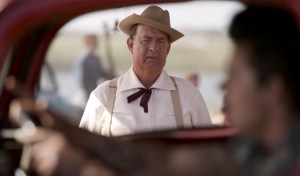 I think this is smart because, on the surface, Elvis might not be the most complicated person to devote two hours to unpacking his character dimensions. He liked to sing, as it touched something deep inside him, and he wanted to be true to himself, but this framework isn’t any different from any number of famous musician biopics we’ve become more than accustomed to. He dealt with drug addiction and erratic behavior but, again, even this is musical biopic basics. Even his doomed relationship with Priscilla is familiar stuff, as she could rarely compete with the demands and the allure of the stage. I think Luhrmann and his co-writers wisely saw that the best storytelling avenue with Elvis is through the lesser-known Colonel, a bizarre and calculating figure cackling in the shadows. There are significant questions over who this proud huckster really is and what he did to bully and cajole Elvis into his favor. There’s inherent conflict there as well as an angle that I would argue most are unfamiliar with. I didn’t know much about the history of Elvis the man but I knew even less about this would-be Colonel.
The most Luhrmann of sequences is Elvis’ breakthrough live performance where it feels like every woman in attendance is catching a fever of combustible hormonal fury. The way the man shook his hips, moved his body, his gyrations that so many adults felt were dangerously subversive, were part and parcel of the younger Elvis. He really was a born performer, and even says he can’t sing if he isn’t allowed to move how he feels he must with the music. During this crazy sequence, Luhrmann’s camera is trained on the emotional response of the audience experiencing a sensation that cannot be contained, bubbling to the surface into tears, shrieks, and convulsions, and it moves through the crowd like waves. It’s such an enthusiastic experience that plays right into the stylistic and tonal wheelhouse of Luhrmann. It’s also an unsubtle reminder, not that much is subtle in a Luhrmann movie, that part of the man’s appeal was his raw sexual magnetism.
In a modern era, the condemnation of Elvis as a corrupting influence on the youth feels comically quaint, until you remember that all of this was also filtered through a very racist paranoia. Elvis was deemed a danger because he was an accessible introduction to music and culture that was associated with black people. The accusations of Elvis corrupting the youth are all tinged with racial implications about his source of inspiration, never mind that Elvis was also influenced by a religious revivalism. The movie doesn’t say that Elvis was a sham, only succeeding off the work of other esteemed yet unfairly unheralded black artists. With the many onscreen performances, he is clearly talented, and offers his own versions of others’ songs, but he’s also deferential to the people he grew up with and the music he clearly loves and wants to be a part of to the detriment of whatever Tom Parker and his handlers believe is commercially viable. B. B. King (Kelvin Harrison Jr.) even remarks about Elvis’ own privilege when he thinks about bucking politicians demanding that he perform safe songs without his signature dancing (“They’ll arrest me for just crossing the street. You are a famous white boy who makes them too much money.”).
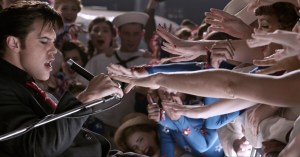 I’ve purposely delayed from discussing the best reason to go see all 160 ungainly minutes, and that is Butler’s glorious performance. The young man simply dissolves into the role and makes you forget you’re watching an actor. The way he captures the cadence, the drawl, the presence of Elvis, and not just his jerky movements, is phenomenal, and then you remember that it’s Butler doing all his own singing as well, and the spell is near complete. He is Elvis. It’s a performance guaranteed to win as many plaudits as awards season has to offer. Through Butler’s performance, a younger generation can understand what all the hubbub was about. The man brings the character to life but he especially brings Elvis the performer to startling life. Even if you hate Luhrmann’s other movies, and he is definitely divisive, and even if you couldn’t care less about Elvis in the year 2022, this movie is well worth watching for the sheer brilliance of Butler alone.
In some ways, Elvis the movie feels like a perfect assignment for director Baz Luhrmann. His unconventional stylistic approach livens up an otherwise conventional rise-and-fall tale, broadening the appeal of Elvis for an audience that might have otherwise shrugged at a movie chronicling the man’s exploits. The subject matter is also the squarest for Luhrmann, which makes it also the safest movie of his career, which is truly saying something considering some of the imaginative highs of this movie. There will be just as many people put off by the excessive, in-your-face style of the movie as drawn in by that Luhrmann razzle dazzle. Watching Elvis feels like you’re watching two movies simultaneously atop one another. Luhrmann can be exhausting even at his best but he’s also one of the few filmmakers that makes watching a movie such a textual experience, where sight and sound are layered in such meaningful and granular details to better immerse the viewer. The way even the sound designs ebbs and flows, braids musical notes and themes and older selections of influential resources as it all composes a wonderful soundscape. Few put this kind of thought into every nanosecond that Luhrmann does, himself a natural showman who cannot help himself. While plenty will wish for restraint, I say, much as others asked for restraint from Elvis’ gyrations, to let Baz be Baz, and he lets Elvis be Elvis to the giddy entertainment of the audience.
Nate’s Grade: B
Share this:

Drive My Car (2021)
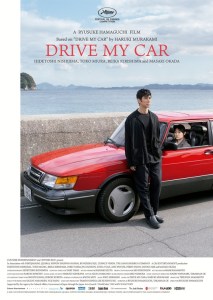 Here comes my shocking cinematic admission that lowers my standing with my critical brethren: I don’t see what the big fuss is with Drive My Car. The three-hour Japanese movie has bewitched most critics, won several Best Film of the Year designations, and was nominated for four Oscars including Best Picture, something only ten or so films have achieved in the Academy’s history. It’s a guaranteed winner for Best International Film, something only one other Japanese film has earned, and no, not anything from legendary Akira Kurosawa. All this is a protracted way of saying this is a very well regarded movie across the globe… and I just couldn’t get into it. Part of this is that the length is overly indulgent and meandering. The three hours feel far too leisurely, and structurally, the entire opening 45 minutes could have been cut and begun with our grieving actor/theater professional restarting his life two years after the sudden death of his wife. Everything you would need to know in that pre-credit beginning is covered later in the movie, which made me wonder why not leave some of the elements as mysteries to be filled in later such as the character’s complicated relationship to his unfaithful wife, what he knew or didn’t know, who is the voice on the tape he’s listening to running lines for the Chekov play Uncle Vanya in his car, and his personal connection to the leading man in the play he’s directing. A whole hour of this movie might be listening to actors say lines from Uncle Vanya, or just hear lines from Uncle Vanya, and then applying the 1898 Russian play to these modern characters and their lives. It’s clever but this kind of stuff works better as subtext. With Drive My Car, it’s the text, the literal text of the story for long portions, and that comes across as frustrating because it’s setting up characters, having them read a famous play, and then telling the audience, “Well, you find the connections.” Again, this works as layered subtext and metaphor in addition to a compelling story, but so much of Drive My Car is at this level of artistic interpretation. Did we need a dozen subdued scenes of them practicing the play in order for the ending to have its impact? That’s the power of art, a tool we can use to relate our fears, hopes, and identities with, sympathizing with the struggles and triumphs of people from other times and places. The core of this movie, for me, was the relationship between the main character and his younger driver assigned to him by the university. This character unfortunately doesn’t get her due until much later. Drive My Car has some beautiful moments, like a graceful family dinner, like the trip to the garbage site in Hiroshima, like a backseat monologue about, what else, decoding a story for meaning as it applies to character insight. This isn’t a bad movie. I can certainly appreciate the big swings at big ideas about grief, the human condition, and the reflective power of art. It’s just structured in a way that doesn’t allow those core elements to shine. Eliminate many scenes of play rehearsals, eliminate many scenes of driving, and even eliminate the opening 45 minutes, and you have a better paced, better emphasized human drama, at least to my mind. There are plenty of people who have fallen in love with all three hours, but I found myself more listless than lovelorn. I really wanted to like Drive My Car better but I found too much of it to be meandering, redundant, and frustratingly cold and opaque. In the end, after three dragging hours, I could at least say, yes, that woman certainly did drive that man’s car.
Nate’s Grade: B-


 nathanzoebl
You must be logged in to post a comment.