Blog Archives


The Green Mile (1999)
 A prison in the heart of the deep South during the era of the Great Depression is not usually the locale you’d find a somber tale of earnest discovery and passionate awareness to the follies of life. Yet here arrives the long anticipated The Green Mile, the second in tag-team efforts from director Frank Darabont and novelist Stephen King in their own genre creation of nostalgic feel-good prison flicks. All the swelling hype could manage to make the movie seem overbearing, but if you’ve got a free afternoon and a butt made of steel then try The Green Mile.
Darabont seems like the perfect visual interpreter to King’s epic narrative spinning of good, evil, and all that fall between. The movie moves at the pace of molasses and clocks in at over three hours in length. Not exactly audience friendly fodder but one and all will be grateful for the decisions taken to build character development and tension instead of blindly rushing through.
Tom Hanks plays a prison guard on the Death Row block of a Southern penitentiary. Despite the bleak and grim surroundings his humanity still shines through. He escorts and oversees the final moments of many men’s remaining breaths along the final walk of green linoleum tile to the electric chair. Enter one mysterious morn John Coffey (Michael Clark Duncan), a towering giant that seems to break all the rules each of the guards on cell block E has come to realize through their years. Coffey has been convicted of the rape and murder of two little girls, but as Hanks soon learns things aren’t always what they seem. The 7-foot miracle worker displays scenes of empathetic healing like to Christ himself. Hanks views are turned and his eyes open, and that’s just the beginning of the heartstrings being pulled. To release anymore of the plot would be a crime punishable by Ole’ Sparky himself in the Green Mile.
 The pacing is smooth and wrings out every droplet of mystery and drama needed. The Green Mile‘s comprehensive fable quality transcends the period just like The Shawshank Redemption did as well prior. ‘Mile’ should be expected to be a front-runner for Oscars when balloting begins.
The ensemble acting is magnificently eclectic and truly inspiring. Hanks’ name is so synonymous with Oscar that he might as well shave his head and paint his body gold because come nomination time this man’s name is going straight to the ballot. Other stars give thoughtfully deep and refreshing performances guaranteed to turn a few heads. Duncan’s gentle child-like giant is serene and a benevolently touching figure of innocence and warmth. But one can not forget the presence of a very special rodent by the name of Mr. jingles that deserves billing above the credits itself for the quality performance it puts on.
The Green Mile is a sad, touching ,and rather powerful movie that speaks to the viewer’s emotions and gladly earns every one of them. In the end The Green Mile is nothing beyond a long yarn of a fairy tale; but one told so exceptionally, one performed so extraordinarily, and one directed so deftly that you’ll gladly journey down that mile with ease.
Nate’s Grade: B
Share this:

Being John Malkovich (1999)
 I think I’ll simply surmise the emphasis of this review in one opening sentence: The most refreshingly and exhilarating original movie in years. MTV music video chief royale Spike Jonze directs a modern day fable that is a hallucinatory trip through the looking glass and into man’s thirst for celebrity. While Malkovich is stuffed with enough brilliant gags to kill the Austin Powers franchise, it is also a deeply articulate and insightful piece about the longing for love and fame. The movie is often thought-provoking while side-splitingly hilarious.
I will not spill one lick of Charlie Kaufman’s plot to ensure the viewing audience the pleasure of astute surprise, and there is plenty. Malkovich is the first film in a long time to have just as many unexpected twists and turns in the final 30 minutes as it does in the first 30 minutes. The acting is wonderful consisting of John Cusack’s greasy puppeteer loser, to Cameron Diaz’s frumpy animal loving wife, to Catherine Keener’s man-eating ice queen, to even a wonderful inspired parody of John Malkovich as himself playing himself.
Being John Malkovich isn’t afraid to tackle weighty subjects such as gender identity or the hunger to be somebody, but it never looks down upon the characters or the audience but instead treats each with nurturing respect. The movie is a breeze of fresh air in a field cluttered with too many formulaic fluff appealing to mass audiences and consumer goods. Malkovich is destined to become a cult classic and deservedly so. The flick is a spurt of creative madness bordering on genius that one wonders how it ever made it into release with today’s society and studio heads. God bless you Spike Jonze and you too Charlie Kaufman. Fare thee well.
Nate’s Grade: A
Share this:

American Beauty (1999)
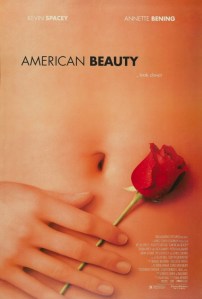 American Beauty balances between dark comedy and moving drama not only well but tremendously on target. It’s a slice of life showing the dark side of a faceless and cold suburban life. The deterioration of a family and the escape of one man as he realizes the trivial nature of the things that get in the way of seizing life. American Beauty is not a rose for everyone but it’s one standing out from the pack screaming to be picked.
Kevin Spacey plays Lester Burnham, the husband and father of our story’s family. Life has been sucked dry from his system and he’s lost interest in everything he holds around him.
Annette Benning plays Carolyn Burnham, mother and wife. She breaths the mantra, “To be successful one must present an image of success at all times.” like she was beating a Bible until it bled. She’s a woman whom image is everything, and looking good is all that matters. She has become so detached from her family and life that she has actually lost her humanity in the hunt for success while waving her cheerful smile as a mask that eludes to the superficial inside. Carolyn is a woman who refuses to let herself fail or have weakness, and those around her to make her seem weak.
 Thora Birch, of Alaska and Now and Then fame, is the estranged daughter to Spacey and Bening. She feels alienated from her parents, and despises them from easily seeing through each. Thora discovers new ways to feel contempt for her parents with each day. She is a repressed child who is looking for an outlet of understanding and help. Enter pot dealing creepy new neighbor Wes Bentley. He sees true beauty where no one could, and is the escape and shoulder that young Thora has needed all her life from her monstrously neglectful parents. Wes videotapes everything in an effort to keep the memories of beauty alive to venture back and relive the moments. He shares his prized image with Thora one day, that of a plastic bag inflating and deflating with the autumn breeze as it swirls around almost balletic dancing. The image is mesmerizingly hypnotic and you understand that Wes is a character who looks beneath the surface and most likely the most noble in the entire movie.
Mena Suvari switches from sweet choirgirl from American Pie to ditzy teen vamp. She is a person who feels such insecurity for herself that the only happiness she can arrive is from being wanted by other people. She must have acceptance in some form or another, and “ordinary” to her is a worse word than “ugly.” She acts like a teen nympho but in the end reveals that she is really an innocent young girl desperately wanting to be liked and wanted.
There are other characters that round out the cast; a brief appearance with Scott Bakula who makes a quantum leap into a gay neighbor, Allison Janney as the mother to Wes and the silent hollow image of a wife she has become to socially hide her husband’s secret, Chris Cooper again as an abusive father who’s maliciously homophobic but hiding a devastating secret deep within, even Peter Gallagher with the biggest eyebrows you’ve ever seen as a suave real estate mogul that knows how to cater to Carolyn’s thematic problems.
 The basis of the story hinges on Lester’s reawakening. He is a man going through the motions of life like a walking dead man. A man who tells people that even he wouldn’t remember himself. Lester is an unhappy cog until viewing his daughter’s friend Angela (Suvari) at a high school basketball game. At first glimpse she becomes the intense object of his desire and obsession, and his focus on life centers around this young gal. But with that moment Lester’s life is broken, and his eyes are opened for the first time in a very long time. He sees the trite redundancy with the day-to-day grind of ordinary suburbanite life. Lester breaks free and does what he wishes, he is a free man. Free of his job, his nagging ice queen of a wife, free of all worries and fears.
As far as Oscar races go, all others don’t even bother filling out an application for an invitation – Spacey has Best Actor locked. He might as well start clearing a space on his shelf next to the one he got for The Usual Suspects. Spacey is so wonderfully wry and self degrading that he transforms into an actually likeable almost laid back hero for the audience. They know his tragic fate and feel good when he gets the most he can with each day, and not letting himself be pushed around anymore. Benning is also delightful and wickedly hilarious in her materially overzealous soccer mom. Birch is excellent showing the pains of alienation and showing that despite what her character thinks she is really the last person on earth who needs a boob job. Director Sam Mendes’ first feature after touring the theater circuit shows his devotion to characters and actors with subdued symbolism layered between every frame of film. I say Oscars should go all around and this movie deserves a good swapping of gold statuettes.
I could go on talking about the depth and characters for hours but I’ll just stop here and say that you won’t see a more engaging, compelling, and brutally honest and sadly funny film in the entire year of 1999. One of the best films not only of this year but of the entire decade.
Nate’s Grade: A
Share this:

Tarzan (1999)
 The next installment in Disney’s stranglehold on children is strikingly beautiful in its fluid animation, color, picture, and at times true excitement. But again it’s just more of the same.
Despite its rich animation, the story is again the lacking problem ringing in Disney’s big ears. Every word and action falls under the strict Disney formula code, which is restraining imaginative thought more than helping it. But that’s what you gotta’ do I guess if you wanna’ sell a billion of Tickle me Tarzan merchandise.
The plot is like a ghost of what Burroughs’ novel was originally, but with the typical Disney formula points; there’s the hero suffering from an identity crisis wanting something more, the fawn-like love interest who will eventually fall in love with the only available white man in central Africa, the treacherous one-note villain, and of course the bumbling sidekicks with comic relief and one-liners of slapstick and amusement for the kids. None of this was in The Iron Giant and it still managed to be a great film. Can we at least drop some of the items on the list?
The movie can get overly pretentious at times with the hammering of the ideals that nature… good, animals… good, man… bad. I’ve heard it all before, do I need it set to Phil Collins’ monotonous radio-friendly pop songs as well now?
Despite some flaws and the worse villain in a Disney movie of recent memory (a poor man’s Gaston) it is still enjoyable and worthwhile even with the creative constraint of the Mickey Mouse. Sure it’s already made millions but for my money Mulan was better.
Nate’s Grade: C+
Share this:

The Sixth Sense (1999)
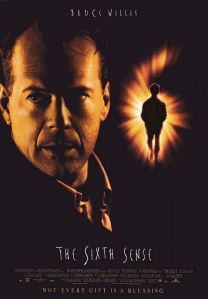 August is mostly thought of as a time of dead water for summer movies. But now I think it should be regarded as the best month for film this whole mediocre summer, and The Sixth Sense is one of the main reasons. Though the title kinda’ sucks.
In a summer low on genuine chills here’s one movie that offers honest-to-God-grip-the-armrest-chills. It’s very moody when it needs to be and creepy when it never has to be but is anyway, and constantly moving. The Sixth Sense also offers audiences something they haven’t seen this summer: real characters with depth. The characters leap from the screen and are slowly established as complicated, rounded, and very thoughtful people. Now that’s something that took me for surprise.
Bruce Willis achieves his quiet mode and teams up yet again with another child (a la Mercury Rising). Willis’ acting is solemn and just enough to drive his character through his quest. You haven’t seen Bruce Willis show this much emotion since he walked over glass in Die Hard! But the story of The Sixth Sense is a little tyke that comes from out of nowhere and redefines child acting. To say Haley Joel Osment carries the film is an understatement – he throws it on his back and runs a 4.3 with it. If Ana Paquan can win an Oscar for babysitting a piano then this kid deserves one too. This is the greatest child actor I’ve seen in years and I begin to wonder why Lucas chose his miscast young Anakin.
The best thing The Sixth Sense has is intelligence. It rewards those who stood up and paid attention with a knock-out terrific ending that wraps everything up you questioned before. And you will rerun things in your mind over and over when you leave the theater. My only complaint, and it is small, is that the direction could be tighter at times. But for everything The Sixth Sense has to offer I will gladly wait in line for seconds. The best summer chiller, and one of the best movies of the year. The title still sucks though.
Nate’s Grade: A
Share this:

South Park: Bigger, Longer, and Uncut (1999)
I ‘ll start off and say I had fallen out of favor with the show at the time and really wasn’t interested in seeing the movie. But after being dragged along by a group of friends against my will I’m very glad I did.
I don’t fall into hysterics by hearing eight-year-old cartoons use the F-word profusely like many in my theater, but luckily for me there was plenty of wit to go around. The movie is riotously funny and I often found myself at times having to grip the armrest so I wouldn’t tumble out of my seat.
The movie could have been easily re-titled South Park: The Musical with the batch of 14 original songs they have that parody the Disney formula tunes and classic Broadway renditions. The songs are dead-on perfect at parodying their designed targets. The music is so brilliant and catchy that it deserves to be nominated for an Oscar for Best Original Comedy or Musical score if there is any justice in the film community. Never thought you’d see the words South Park and Oscar in the same sentence did you? Well neither did I.
The movie even plays witness to issues circling our country today like knee-jerk reaction to assess blame, responsible parenting, and blaming Hollywood media. This is a true piece of comic brilliance as they satirize anything and everything and so damn well. There are those that might take offense to some of the racial jokes but take it with a grain of salt because pretty much every person of race, creed, culture, and what not will be a source of humor. After all, that’s what Brian Boitono would do.
Nate’s Grade: A


 nathanzoebl
You must be logged in to post a comment.