Blog Archives
The Hurt Locker (2009)
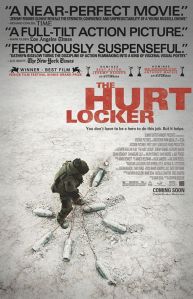 The Hurt Locker is an action movie on a very human scale. Sure there is a time and place for your Michael Bay-esque action vehicles, the type that scorch square miles and leave recognizable world cities in ruins. However, those kinds of action movies are never the kind where storytelling ever enters the fray beyond a meager question of how to get from Point/Explosion A to Point/Explosion B. In fact, Bay openly admits to planning the story of Transformers 2 by working on various action sequences during the 2007 writer’s strike and then tasking screenwriters to connect the dots. The Hurt Locker exists in a frighteningly believable world. This isn’t a movie about explosions but about the extinguishing of explosions. It follows the Explosives Ordinance Disposal (EOD) unit, tasked with detecting and detonating bombs and other improvised incendiary explosives (IED) in the field of combat. You will not be restless for loud “booms” while watching The Hurt Locker. In fact, you will be on pins and needles hoping that you never hear another loud “boom.”
Delta Company are the men responsible for protecting the other soldiers by disposing of bombs. The new team leader, Staff Sgt. William James (Jeremy Renner) has defused over 800 bombs during his tour of duty. He knows he’s the best and he’s addicted to the thrill of being so close to death. He will make occasionally reckless decisions putting himself, but not his fellow company men, at higher risk. This does not sit well with Sergeant JT Sanborn (Anthony Mackie), a by-the-book type that doesn’t appreciate his officer chasing a thrill. The other EOD unit member, Specialist Owen Eldridge (Brian Geraghty), is a man more accustomed to taking orders than giving them, and his indecision may have actually cost the life of the former head of the EOD. Both Sanborn and Eldridge worry that their new team member is going to get them all killed.
 Director Kathryn Bigelow (Near Dark, Point Break) has been directing male-centered action flicks for over two decades; it’s been seven years since her last feature, the regrettable Harrison Ford submarine flick, K-19: The Widowmaker. The Hurt Locker is her finest work to date by far. Her action sequences are visceral and downright agonizing to sit through. She is masterful at setting up the geography of the set piece, ratcheting up the suspense, adding organic obstacles and complications, and then makes sure with her camera and editing that an audience knows exactly what’s happening to whom for every minute that ticks off the clock. Bigelow takes her time to establish the particulars of her locations and sequences, allowing the audience to, surprise, understand what is happening and better engage in the movie. Bigelow chose to shoot the movie in Jordan, the neighboring country to Iraq, and the locations and actual refugee extras add an unvarnished sense of realism. The movie goes without music during much of the action, which makes it all the more uneasy. There isn’t any over eager composer telling you how you should feel, no direction that now things will get even more hairy. You will feel every second of danger, and Bigelow crams in a whole lot of danger. Things can go wrong very, very quickly.
There’s nothing to action cinema quite like the bomb that’s only a few tick-tocks away from doing its dirty work. Do you cut the yellow wire or the green wire? Never cut the red wire. The bombs found in Iraq are a stark range of death. There’s the crude incendiary device just wrapped up in garbage, but then there’s also the fiendishly clever devices with multiple charges and there are grotesque devices as well. At perhaps the film’s most guttural and shocking moment, Staff Sgt. William James finds the corpse of an innocent stuffed with explosives. The easiest thing would be to simply detonate the bomb, but that would also desecrate the body of someone we have come to know. Watching James snip open the crude stitching and dig inside the chest cavity, if we didn’t know then we know now, Bigelow has made sure that The Hurt Locker is the most emotionally resonating contemporary war film in memory.
 Bigelow and screenwriter Mark Boal, an Iraq War journalist, create a vivid sense of dread, antipathy, and most of all, paranoia. Is that a kite flying in the air or is that a signal? Is that a nondescript observer with a cell phone or is that a terrorist with a remote detonator? Is that child being friendly or collecting intelligence? Your mind will race through all these possibilities because Bigelow teases out her action sequences to an unbearably taut level. The audience cares about these soldiers and wants to see them make it back home (we’re informed how many days Delta Company has left on their tour throughout the film), which Bigelow uses to her advantage at every turn. What happens matters. My nerves were frayed during several sequences, including one where the soldiers are pinned down by distant enemy gunfire. The moment turns into a duel and a chess game, as each side tries to adjust their gaze in the searing heat and measure their long-range shot before the other side beats them to it. Then the sequence turns into a waiting game. This is the kind of movie that keeps you poised on the edge of your seat fearful that at any moment something disastrous will suddenly happen. Every time Staff Sgt. William James went back out to defuse another bomb, my sense of dread intensified. I began to doubt everything that I would ordinarily take for granted in other movies.
While being a top-notch action movie, Boal (In the Valley of Elah) has also crafted a great character study. In between the bomb episodes we learn more about these men, which makes it all the more hard to see them then head out to defuse another explosive. The film opens on a quote equating war as a drug, and we explore this notion through the character of Staff Sgt. William James and the weight his unique duty bears. It takes a special person to volunteer for defusing roadside bombs. The defuser must be extremely intelligent, be extremely cool under pressure, and be able to work in a giant suit that makes them look like a chubby astronaut, while enduring debilitating desert temperatures of 110 degrees. It sounds like a suicide mission. James is an adrenaline junkie and war is his drug. He exudes a Zen-like calm in the heat of the moment and this is now the only life for him. Shopping for cereal back home has lost its meaning. Being a husband has lost its meaning. His life now has one purpose. Renner (28 Weeks Later, North Country) gives a stirring performance laced with cavalier confidence and resignation. Mackie (Eagle Eye, We Are Marshall) is also another standout in the pared down cast. When he laments about the dishonor of having no one to remember you in death, you feel the man’s existential sorrow.
 Ignore the political cranks that decry The Hurt Locker as another partisan anti-war film from Hollywood. The American public has been mostly indifferent to any contemporary movie that aims to tackle our current military conflicts in Iraq and Afghanistan, but The Hurt Locker eschews the politics of war to focus on the realities and dangers of its characters. These guys are more concerned with surviving the next bomb than the politics of why they’re in the Middle East. The public has voted with their wallets and does not want to see the reality of war onscreen, or at least the Hollywood version of war reality, but I pray that those same people give The Hurt Locker a fighting chance. There is no preaching to be found here. The Hurt Locker could just have easily taken place during other wars, though the current Iraq War allows for added cultural dissonance (Is the central goal of bomb-defusing a metaphor for our conflict in the region?). This is a film that transcends politics and genre.
The Hurt Locker is more than an action movie, more than a war movie, more than a psychological study; this is an outstanding movie. This movie is a drug to the adrenaline senses and I need another hit. This is one of the finest films of the year and as it expands across the nation, I highly encourage everyone to seek out The Hurt Locker.
Nate’s Grade: A
Share this:

Reservation Road (2008)
 This movie beguiles me. I watched it over a month ago and I am still turning it over in my brain, and not just for the fact that I get it confused with the similar sounding yet also disappointing Reservation Road. It’s another movie that presents the suburbs as a prison of bourgeoisie social moirés about how men and women are expected to live to be happy. The movie looks magnificent thanks to skilled cinematography by Roger Deakens, even if it falls back on redundant visual metaphors (look, the windows are shaped like prison bars!). The acting by Leonardo DiCaprio and Kate Winslet, the unhappily 1950s married couple Frank and April Wheeler, is mostly impressive. Michael Shannon deservedly was nominated for an Oscar as an unhinged realtor’s son who cuts through all the troublesome and fake niceties. It is a terrific performance and jolts the movie with much-needed energy, somewhat like Renee Zellweger’s role in Cold Mountain. I think that’s where my biggest area of concern is: the movie is just kind of placidly dull. Watching people be miserable for most of a two-hour running time isn’t a deal-breaker, but the movie needs to have some life to it. Revolutionary Road feels just as morose and restrained as its assortment of doomed married couples eeking out an existence. Perhaps that is an achievement to be heralded for director Sam Mendes. Then again, perhaps it just means I felt purposely remote and directionless and just waited for the movie to expire.
Nate’s Grade: B-
Share this:

Up (2009)
 With every new movie Pixar re-establishes itself as the most creatively reliable studio in the business. And every year some critics beat the drum that THIS is the movie that will break free from the animation ghetto and earn a Best Picture Oscar nomination. If anyone out there would like to tell me how The Reader could be a superior film to WALL-E, by all means enlighten me. Pixar has been producing engrossing and complex entertainment, not merely cute cartoons. But if WALL-E failed to score a nomination in a so-so film year, then I doubt that Pixar’s latest, Up, will fly into the winner’s circle.
Carl Frederickson (voiced by Edward Asner) is a cantankerous 78-year-old man who wants nothing more in life than to be left alone. He lives in a house he built with his late wife, Ellie. They met when they were kids and bonded over a shared love of thrill-seeking adventure, like their hero, explorer Charles Muntz (Christopher Plummer). Ellie’s dream is to eventually travel to Paradise Falls in South America, but she never lives to see it. Carl is about to be thrown into a retirement center and have his home demolished, so the geezer hatches an escape plan. The former balloon salesman attaches thousands of balloons to his house and floats away headed for Paradise Falls. Carl is ready to enjoy the quiet when he gets a knock at his front door. He has a stowaway. Russell (Jordan Nagai) is an overweight eight-year-old determined to get his last Wilderness Scout badge, which involves helping the elderly. Together, they journey through the jungles of Venezuela and find remarkable discoveries and constant danger, including the presence of a sinister and still very-much-alive Charles Muntz.
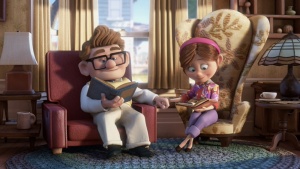
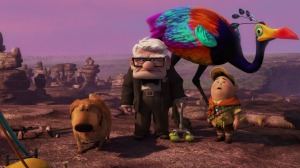 Up is the colorful tale of a dreamer who longs for escape, and you feel the same rush of excitement to be unbound and take off. Naturally, there will be bonding between the grouchy old man and the earnest kid. Up really becomes an altogether different movie once it lands in Venezuela. It transforms into an unconventional adventure story replete with talking dogs and giant birds. I loved the Dug character and was bemused at hearing the scattered thought patterns of man’s best friend (“I have just met you and I love you”). The side characters somewhat steal the show and, at the same time, feel overextended. With that said, I’ll probably end up buying my wife a talking stuffed Dug. The last act soars with about 20 minutes of thoughtful, exciting, well-constructed action weighted by an emotional connection to character. At the same time, Up tackles some major issues and does so without getting mired in sappy sentimentality. Carl is dealing with loss and has hardened against a world he feels indifferent to. Up almost had me in tears within the first 10 minutes during its elegant wordless montage charting the courtship and marital life of Carl and Ellie. It’s a fabulous moment and greatly economical, packing an emotional punch unequaled by the rest of the film.
The visual storytelling is still top of the line entertainment. The animation is superb as usual. The flying house is an explosion of colors and instantly brought a smile to my face. Carl’s character design looks like he was a Lego character that was brought to life. He’s all square and boxy whereas Russell is round to the point of being an Easter egg with legs (is Russell Asian-American or biracial, or is it just a character design that I’m reading too much into?). The South American jungles are lush and filled with inventive creatures. I saw the movie in a conventional theater but the option is out there to catch the movie in Disney 3-D, but I don’t think it will add much to the whole experience.
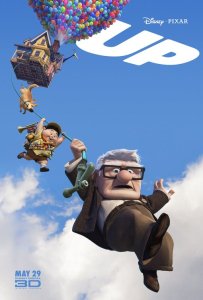
The central image is lovely and instantly iconic: the house floating through the clouds thanks to thousands of colorful balloons. It’s a beautiful image and a perfect metaphor for the memory of Carl’s deceased wife. They built that house together and lived a full life inside, he refers to the house as “Ellie,” and at one point Carl even ties the floating house to his back, tethering her memory to Earth while simultaneously carrying his grief with him at every step. The idea of a flying house tickles the imagination and yet never once demands more critical examination. We accept that Carl has rigged the house to take flight and never once stop and question the extreme engineering improbabilities. The flying house is just the mode of transportation for the characters to complete their story, but it is not the whole story. Think of it as a more comfortable mode of family flying than a queen-sized mattress that included Angela Lansbury (1971’s curious Nazi-fighting family flick, Bedknobs and Broomsticks). The rest of the movie never quite matches the directness and depth of that visual metaphor.
 Up ducks out on making its tale more of a feeling, living movie, something more than striking visuals and some fun set pieces and odd characters with a dash of sentiment. Up establishes its strange story elements but then doesn’t plausibly make much more out of them. The story becomes a somewhat constricted rescue caper to return a Mama bird to her babies and keep her out of the hands of a Bad Man. Charles Muntz is a fairly weak villain. I’ve also got a burning question: if Carl is 78 years old, how old exactly is his childhood hero, Muntz? It’s a bit simplistic and that’s fine, and it’s still an enjoyable conclusion, but the movie doesn’t ascend from the sum of its parts like the finest works of Pixar, like WALL-E and The Incredibles. This one’s just missing some of that Pixar magic. Yeah, there’s the overall arc of Carl overcoming the loss of his wife and softening his hard exterior, but tell me what exactly else happens that matters? The kid makes a friend? It’s about human connection but how exactly is that best served by giant birds and talking dogs flying biplanes? Up also isn’t as visually arresting or creative as previous Pixar flicks, aside from that floating house. As far as Pixar films go, this is about square down the middle (between Monster’s Inc. and Finding Nemo, better than Cars and A Bug’s Life). But even that statement is prefaced by the fact that Pixar’s output is generally head and shoulders above every other studio in technical precision, creative ingenuity, and emotional heft.
Up takes some fancy flights of imagination and has plenty of humor and charm to make it a family-friendly winner. I have some reservations with the movie and its plot, but there’s no question that Pixar knows how to construct a movie that manages to appeal to everyone, even if it involves cranky old men as unlikely action heroes. I feel like perhaps Up is suffering because it has the rotten luck of following the release of WALL-E, a timeless masterpiece that I have since watched probably over 30 times. Up is a warm-hearted and engaging film even if it never reaches the creative and emotional heights of other Pixar masterworks. Still, a “pretty good” Pixar movie has a legitimate shot at being the best movie I see this summer.
Nate’s Grade: B+
Share this:

Rachel Getting Married (2008)
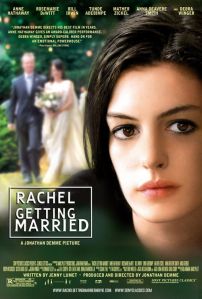 Jonathan Demme’s dark comedy is a movie at battle with its context. At heart, there is a fantastic and engrossing family dysfunction that rears its ugly head and re-opens old wounds. Watching Rachel (Rosemarrie DeWitt, who didn’t get nominated for an Oscar why?) unleash years of repressed pain upon the likes of her toxic, needy, narcissistic little sister Kym (Anne Hathaway), just fresh from drug rehab, is enthralling because of how raw and hurtful the emotions are. You can feel the sting of the words. Through the arguments, a picture emerges of this family’s tragic history and he emotional tug-of-war between the siblings. This is the great stuff, but then the setting of the movie overpowers the drama and sidelines it. Rachel Getting Married will make you feel like you are apart of this martial extravaganza, so we see about fifteen minutes of toasting from EVERY PERSON, because, really, much of this is all exposition from characters who won’t be heard from again. We also see about 15-20 minutes of eclectic musical performances, dancing, and all the rest that comes at the close of a reception. While the wedding/reception is an interesting multicultural blend, it feels like an unyielding intermission from the terrific family drama. Hathaway is as good as advertised and soaks up the troubled life of a notorious problem child defined by little else than her problems. DeWitt is outstanding as the big sister tired of being pushed aside. Demme’s handheld camerawork, and the extensive ensemble of slightly eccentric characters, made me feel like this was an Oscar-serious version of one of the Christopher Guest mockumentaries like Waiting for Guffman. There is succulent family misfortune here, with great acting, but I wanted less wedding and more Rachel and friends.
Nate’s Grade: B
Share this:

The Reader (2008)
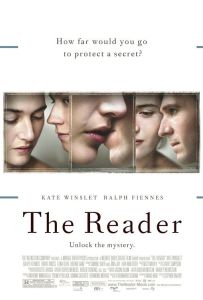 Every now and then, the assorted members that make up the Motion Picture Academy make, shall we say, quizzical selections. There are snubs and undeserving winners, but then there’s the crazy nomination where you see the movie and say to yourself, “What the hell were they thinking?” In recent years I’ve usually found at least one Best Picture nominee that left me scratching my head. In 2007 it was Atonement, in 2004 it was Finding Neverland. But I could at least fathom a guess as to why each of those movies appealed to the Academy and garnered a Best Picture nominee. I’m stumped when it comes to 2008 Best Picture nominee, The Reader. Based upon an award-winning novel, I can only surmise that Academy voters saw the words “Kate Winslet” and “Holocaust” and thought the movie had to be far worthier than the likes of WALL-E or The Dark Knight.
In post-World War II Germany, teenager Michael Berg (David Kross) begins a torrid affair with an older woman, Hanna Schmitz (Winslet). He’s 15 years old; she’s easily twice his age. She instructs her young lover to read to her before they engage in sexual activity, which turns reading into an act of foreplay. The summer affair ends abruptly when Hanna runs off after her employer has given her a promotion. Michael is heartbroken that his lover has flown the coop. Flash forward several years and Michael is attending law school in Berlin. He and his fellow students visit an ongoing trial that features a group of former female concentration camp guards. To Michael’s shock, Hanna is on trial as one of the murderous Nazi guards. The young boy is beset by his feelings of love for a person who has committed despicable deeds. Hanna is keeping a deeper secret and will go to her grave to keep it. Eventually an adult Michael (Ralph Fiennes, wasted) finds his life returning to an imprisoned, older Hanna, possibly his life’s greatest love.
 The Reader contains interesting story elements: sex, guilt, romantic affairs with former Nazi prison guards. But rarely do any of these interesting elements actually transform into an interesting story. The movie just kind of lies there, basking in some phony reflective pause when the movie manages to be so distant and uninvolved. At times the movies seems to have little interest in its own self. This movie feels like it was made to be Oscar-bait because it deals with Big Themes and Important Topics, or at least the film wants to appear like it deals with said items. The Reader is mostly shallow. It pretends to present a moral quandary but director Stephen Daldry (The Hours) doesn’t bother to analyze the contradictions of his characters. The film alternates between characters shouting obvious declarations and just stumbling around in contemplation, bumping into the furniture. It’s simultaneously annoying and boring. The movie wants to put a human face on monstrous deeds, which can be a noble pursuit. The Reader fails to be a “challenging” movie when it can’t be bothered to challenge its characters to do something.
The message of quasi redemption at the center of this specific film is either laughably naïve or downright insulting. Hanna keeps a personal secret shame at all costs, and she would rather go to prison for life as a Nazi murderer than let people know she cannot read. I’m sorry, but that’s dumb. The fact that it seems like The Reader presents the theory that Hanna’s illiteracy mitigates her guilt is offensive. I’m sure the 300 people that were locked in a burning church to die would be sympathetic that their killer couldn’t read See Spot Run. In what world is illiteracy more shameful than genocide? If you’re going to float ridiculous notions at least commit to exploring their very ridiculousness, and therefore acknowledge that there is something amiss. The Reader instead seems to flutter from idea to idea without ever truly delving deeper. If you’re going to craft a character that’s more afraid of a library than a book burning, at least try and explore this enigma. There’s drama in the disconnect. But the movie never feels like this should be an issue. Can’t you see, silly movie goers, that Hanna is but a symbol for the German people who couldn’t read the signs to come and were ignorant to the extent of Hitler’s horrors. She would rather stick to her duty than claim moral responsibility. That’s fine, but there are a great number of movies, and countless more books, that have examined the psychological culpability that can turn a populace into silently willing participants in mass murder. The Reader would rather spend its closing moments exploring the magical healing power of literature. The fact that the film eliminates the novels’ section where Hanna reads news articles and novels about the Holocaust (thus gaining moral clarity) is dumb. Instead of gaining insight into her actions she reads Chekhov. The movie ends up transforming into a weird and wrongheaded episode of Reading Rainbow.
 Winslet’s acting is fine. She’s such a gifted actress that I doubt you’ll see her give a bad performance even if the movie doesn’t live up to her talent. She isn’t doing anything showy to make Hanna a sympathetic character, which works out well, but the film’s distant perspective means that Hanna seems more like an aloof cipher. She’s this formless blob of a character that expresses a mixture of human emotions but doesn’t resemble a recognizable human. This is the fault of the director and screenwriter who chose to replace subtext with ponderous silent stares (note to all “deep” filmmakers: THEY ARE NOT THE SAME). Winslet slips into the character with the same ease she has slipping out of her clothes. The Reader is another nudity-filled performance for Winslet, her eighth movie featuring her nude (also her fourth Oscar nomination for a nude performance, there must be some connection). As readers can attest, I am no prude when it comes to the female form, but even I thought things were getting a little gratuitous. In the first 45 minutes, Winslet is naked in almost every scene she shares with Kross. It’s almost as if the nudity is supposed to disarm the audience and make Hanna a more intimate. Winslet is one of her generation’s finest actresses, which is reason enough that she shouldn’t be handed a Best Actress Oscar for substandard material.
The Reader may not be a traditional Holocaust film and in fact it’s really not so much about the Holocaust. Sure, that colossal event casts a shadow over Germany, but the movie is mostly about a cold and daft woman and the callow boy who loves her. It’s about two characters, but it the movie is too reserved and then some. Everybody just seems numb, which makes for a boring movie after a while. I repeat: a boring movie about underage sexual affairs with freaking’ Nazis! Winslet’s fine performance is not enough to redeem the whole movie. I think much was lost in translation from page to screen. The Reader actually was more effective when it was just a cradle-robbing unorthodox love story. But then, those flicks don’t typically get nominated for Best Picture Oscars.
Nate’s Grade: C
Share this:

Milk (2008)
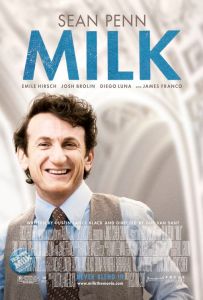 The biopic of America’s first openly gay elected official is stirring, thoughtful, and occasionally limited. Sean Penn gives a wonderful performance as the captivating and tragic Harvey Milk, assassinated in 1978 by fellow San Francisco councilman Dan White (Josh Brolin). He changes his look, his voice, how he carries his shoulders and moves his arms; it’s a terrific and transformative performance that only sometimes hits a few fey stereotypes. The movie mostly follows Milk’s path as a community organizer who successfully mobilized the gay rights movement. You’ll witness local politics in depth, and that’s my one reservation with this fine film – it focuses too heavily on the political formation of a movement and less on the man that kick-started it. You get little glimpses of Milk the man, and most of those glimpses happen to be his romantic relationships with annoying men. That said, director Gus Van Sant orchestrates real archival footage from the time including protestors and homophobic spokespeople, and it gives the movie an authentic relevancy. The deadly confrontation between Milk and White is played in a painful, very un-Hollywood approach that made me wince hard. It’s amazing to watch Milk and realize how far the American public has come since the 1970s and how much further we, as a nation, have to go.
Nate’s Grade: A-
Share this:

Doubt (2008)
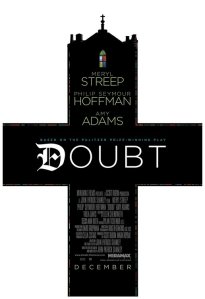 You know you’re in for some intellectual and moral ambiguity when the opening sermon covers the nature of doubt. Doubt follows a New York head nun (Meryl Streep) in 1964 that suspects one of the new parish priests (Philip Seymour Hoffman) of having an inappropriate relationship with a young male student. The acting by the four principal actors is phenomenal. This is a showcase of stellar acting. Streep is ferocious and unwavering, a one-woman wrecking ball, and yet she still manages to make an antagonistic character empathetic: she’s doing what she feels is right to protect her students. Are unethical deeds acceptable in a righteous pursuit? Does she truly believe her convictions, or is Streep striking back against an entrenched hierarchy that diminishes her value? There is a clear resentment between some of the nuns and the array of priests with all the power and all the say. Naturally, in a he-said she-said molestation case, the audience is more likely to side with the funny, caring, progressive priest than the scary nun who detests ballpoint pens and Frosty the Snowman. In the end, the accusations aren’t cleared up and the film lets the audience debate the results. Director/writer John Patrick Shanley adapts from his acclaimed stage play and does a mostly fine job bringing it alive on screen, though he has a penchant for relying on really simplistic visual metaphors. The supporting cast rises up to Streep’s level, notably Viola Davis as the mother of the boy accused of being mishandled. Note to future students of acting: study Davis’ 10 minutes of screen time to see how a truly talented thespian displays a range of conflicted emotions, none of them feeling inauthentic or cheap. Doubt isn’t just one of the best-acted films of the year but also one of the best, period, and I have little doubt to that.
Nate’s Grade: A
Share this:

Changeling (2008)
 This is one crackerjack of a story. The true-life tale of a mother, Christine Collins (Angelina Jolie), who loses her son, only to have the LAPD give her a different boy is easily gripping. The pace is a bit elegiac but the movie never gets boring, partly because Christine is beset by a multitude of adversity by the corrupt members of the 1920s LAPD who want the case to go away. Changeling can seem to fall prey to outrage cinema, and the audience is clearly going to demand some justice after watching Christine undergo a torture chamber of abuse. And justice is what we get. The last 45 minutes of this movie is protracted courtroom sequences where the antagonists get stomped upon with righteous fury. It just keeps going on and on, as if to compensate for the massive grievances Christine endures. Writer J. Michael Stracynzski (Babylon 5) makes the drama stick close to the facts of the case, which is admirable but it also makes Changeling anchored to reality when there is nothing, repeat nothing, subtle in this movie. It’s hardcore melodrama all the way through, but I didn’t mind one bit. Jolie’s frantic performance suits the melodramatic material. She leaves it all on the floor, as they say in sports. Clint Eastwood doesn’t seem to be too enraptured by the material, routinely slipping into his understated direction that seems at odds with such a juicy story. Changeling feels like a tremendously fascinating story that isn’t necessarily presented in the best fashion. Still, this is fine stuff.
Nate’s Grade: B+
Share this:

Frost/Nixon (2008)
 The adaptation of the hit stage play, with its original leads, is an intellectually stimulating experience and a fluid adaptation from stage to screen, thanks to director Ron Howard. The acting is top-notch; Frank Langella may not readily resemble President Richard Nixon but he inhabits the man completely. In a surprising twist, Frost/Nixon is not a heavy-handed story that merely beats up on an antagonist that can no longer defend himself. Nixon’s faults are not excused but the man is presented in a deeply humanistic portrayal. This isn’t a mustache-twirling rogue but a man who came from abject poverty, who rose above his critics who dismissed his humble beginnings, and who has regret and shame for what transpired while he was in office. And he’s funny. Nixon is a funny man. Characters are not just political punching bags here. Peter Morgan’s screenplay, based upon his stage play, brings tremendous excitement to the art of debate, framing it like a boxing match. The sparring side notes present some of the more fascinating details between the series of four interviews between Nixon and British personality David Frost (Michael Sheen). But here’s the thing. Frost/Nixon is an entertaining movie but once it’s over it completely vanishes from your brain. It leaves little impact. The movie tries to make Frost’s coup a bigger deal than it was. The film is constantly trying to convince you of its importance. It’s a swell time for two hours but after that, what? Obviously the grilling of the president for getting away with crimes in office is supposed to be a statement on the outgoing President Bush, but what? Should we hope that an unassuming figure much like Frost will be able to get Bush to open up his soul? Get Regis Philbin on the phone.
Nate’s Grade: A-
Share this:

The Curious Case of Benjamin Button (2008)
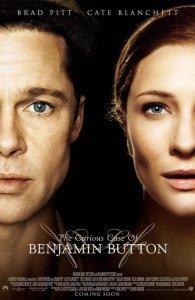 This lavish and long-winded spectacle is curious, all right. Director David Fincher (Se7en, Zodiac) has all the technical wizards at his disposal to produce a near three-hour fantasy about life, love, and death. The Curious Case of Benjamin Button works around the bizarre gimmick of a man going through the process of aging backwards. It’s loosely based on F. Scott Fitzgerald’s short story, adapted by Eric Roth (Forrest Gump), and the results are befuddling. Benjamin is a handsomely mounted and incredibly expensive work engineered for one purpose: to win Oscars. Benjamin Button is a film that strives for making grand statements and wringing a maximum amount of tears, but it’s also a film that lives more in a series of moments than as a cohesive whole. It’s a fine piece of work but feels overburdened by its urgent desire to be profound.
Benjamin Button (Brad Pitt) is born on the day the first World War ended in 1918. He is born as a small infant that better resembles an 80-year-old man (in Fitzgerald’s short story he is born as a full grown old man, which means it must have been fun for his mother). Benjamin is aging backwards but his mind is still as it should be, so while he is all wrinkly, arthritic, and covered in liver spots, Benjamin is like other small kids who want to make friends. Benjamin’s father (Jason Flemyng) is horrified by his son’s condition and abandons him at the steps of a nursing center. Queenie (Taraji P. Henson) raises Benjamin as her own child and he grows up (down?) surrounded by a colorful cast of elderly residents (one woman remarks that a young-old Benjamin looks just like her ex husband). It is here that Benjamin meets the love of his life, Daisy (played by Cate Blanchett in her older years). She’s enchanted by Benjamin’s condition but she has her youth to live and Benjamin is left behind. Daisy becomes a trained ballerina and tours the world. Benjamin goes on a series of escapades, like working on a tugboat, traveling to Russia and having an affair with a diplomat’s wife (Tilda Swinton), and discovering his biological father and the family business of buttons. But he’s always been waiting for Daisy, and eventually they “meet in the middle.”
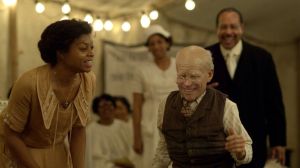 The very nature of the premise means that the movie isn’t going to have many pure, joyful moments. The idea of a romance that needs to take 40 years to connect, and even then has a limited shelf life before they go in their separate aging directions, is beautiful and heartbreaking. Waiting decades for a glimmer of your happiness with your mate, that’s a hard pill to swallow. Benjamin Button explores a similar situation covered by vampire-immortal romances, where you must endure watching your precious loved ones grow old and die. The entire movie radiates with an overwhelming sense of melancholy. The movie manages to find humor and grace amidst its melancholic dirge. The reflections on mortality are ever-present though rarely profound. It may not say anything new or original but it has many things to say about life, death, and the fleeting moments in between. By that notion, the film is structured so that the beginning, where Benjamin is a young old man, it’s more comic and beguiling, then as he and Daisy match up we finally get the pairing we’ve been pining for from the start. The pent-up passion provides great conflict, and then we barely get to enjoy the coupling before reality strikes. The final twenty minutes of the film, where old Daisy cares for old young Benjamin, are incredibly moving and have an indelible symmetry to them, watching an old lady lead a child by the hand.
 So then why do I feel so hesitant about fully accepting this movie? The story follows a similar Gump like pattern of incidents but the movie refrains from being mawkish. The main character is mostly passive with little personality; he’s nice but take away his unusual condition and not many folks would remember their time with Mr. Button. Before he gets with Daisy the film feels a bit episodic with the chapters of Benjamin’s life, and they are entertaining asides but they fail to amount to much more. Benjamin Button feels like something important is absent; it’s not cold as others have claimed but it feels, perhaps, remote, stopping just shy from being a full emotional investment by keeping the audience at a somewhat objective distance. This may be Fincher’s own design because Fincher ensures that a film about living life to the fullest doesn’t degenerate into sentimental claptrap. The end hits hard but not as hard as it could if I was more invested in Benjamin as a character. The Hurricane Katrina framing device seems tacked on, but then again the story mostly takes place in New Orleans and Katrina is rather noteworthy, you could say. The “elderly lady recalls her life story” is reminiscent of Titanic, and might not even be necessary though it offers Daisy the ability to look back over her years with added insight. The layers of realistic makeup piled onto Blanchett are impressive, though I worry what would happen if the actress had to go to the bathroom.
Technically, the movie is nearly flawless. The visual effects are astounding, seamlessly allowing Pitt to play the role even as a young child. The Curious Case of Benjamin Button is a glorious experience to watch but a mildly curious experience to register. The film is so meticulously crafted and it has all the right components of a tragic romance for the ages, but it somehow misses the mark. It’s an entertaining and moving film but it leaves something to be desired. The most resonant moments are also the ones that are the simplest, the ones that lack the window dressing of expensive special effects. I appreciated the film’s expressions of symmetry, but I have the nagging feeling that Benjamin Button both tries too hard and perplexingly doesn’t try hard enough. It keeps audience involvement at a distance, wishing to comment on humanity without embracing humanity. It is difficult for me to articulate what is lacking, because it is an enjoyable if overly long movie, but it falls into the “almost” category of poignant filmmaking. It’s almost a challenging movie, it’s almost an affecting movie, it’s almost a movie worth falling in love with. The film’s story and sensitivity and scope cannot match the technical audaciousness.
Nate’s Grade: B


 nathanzoebl
You must be logged in to post a comment.