Blog Archives
Mary Queen of Scots (2018)
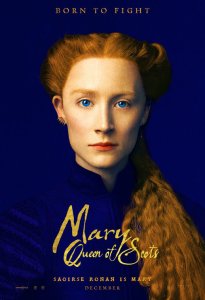 Serving as a feminist reclamation project, Mary Queen of Scots attempts to re-contextualize “Bloody Mary” in the royal dispute for the English throne. As played by Saoirse Ronan, Mary is portrayed as an empathetic, open-minded but strong-willed ruler looking to make peace between the two nations, and Elizabeth is portrayed as a flinty, scared, aloof woman that literally tells her younger cousin that she is her better in every manner. It’s a flip of how the two women are often portrayed throughout history, which raises the question of whether history has been twisted from centuries of revisionist and political obfuscation. There are definitely elements in this movie that I know are historically questionable, like Mary accepting a gay man into her royal court of ladies with open arms and a dismissive view of his sexual leanings. I find it hard to fathom that a devout Catholic woman who ordered heathens burned at the stake would be so anachronistically tolerant of homosexuality. If there’s a new theme for this costume drama it’s that women, even those in power, even those who were deemed wicked or corrupt by historians (universally men for centuries), were hemmed in by scheming men who were trying to usurp their power, undermine them, and manipulate them. Mary is thrown into one faulty suitor after another, positioning her as the victim of a patriarchal society. Again, I suspect there is validity to this context but it treats Mary with kid gloves, denying her righteous impulses. Ronan (Lady Bird) delivers a fine performance of grit and grace, but it’s Margot Robbie (I, Tonya) as Elizabeth that really misses the mark. She is sadly miscast and seems to shrink in the role. The depiction of Queen Elizabeth is also a disservice for drama and the concluding makeup reminded me of the Queen of Hearts from Tim Burton’s Alice in Wonderand. Mary Queen of Scots is an acceptable costume drama told with a little more heat (it’s R-rated for some reason) and a little more consideration to its subjects, but Mary Queen of Scots made me question the voracity of its portraits and made me really wish I was watching the Cate Blanchett Elizabeth movie instead.
Edit: There are two Marys at this time, Stuart and Tudor, and I have conflated them. In my defense, it seems like there shouldn’t be more than one Mary by name when you’re talking about a Catholic rival who is related to Elizabeth. I’ve left my review uncorrected to further own my ignorance.
Nate’s Grade: B-
Share this:

Roma (2018)
 Alfonso Cuaron won a bushel of Oscars for his last groundbreaking project, 2013’s lost in space epic, Gravity, and one of the most daring and innovative filmmakers working in cinema had what every artist craves — cache. He could do whatever he wanted with his earned credits. And so Cuaron told a personal story about growing up in Mexico City, a love letter to his own nanny. Roma follows the life of Cleo (Yalitza Aparicio) for most of the year 1971, through her ups and downs and the loping rhythms of domestic life. This review is going to come across sounding far more critical than I intend. It’s mostly because I’m trying to deduce why my own experience with Roma was not the rapturous, transformative experience that my fellow film critics have sang. It’s a good movie but I’m trying to pinpoint why it kept me from fully engaging, or what within me stopped from engaging further. I think it stems from the central intent of the film and its overall perspective that proves too limiting for my tastes.
But first the good and the exquisite. Roma is a lusciously photographed and composed movie that brilliantly recreates the time and place of Cuaron’s childhood with stunning black and white photography (Cuaron serves as his own cinematographer for the first time). There are moments that are stupendously put together, pulled directly from Cuaron’s impeccable memory. Sometimes these even stem into the surreal, like a forest fire that features a man in holiday costume singing to himself while life and the flames rage on behind him, the chaos of the moment centered on a beautiful focal point. There’s an extended sequence of a car trying to park down a narrow driveway that becomes a symbol of unchecked manhood. There’s a riot that feels like it is being captured live, even though your brain tells you it’s the work of hundreds of people all coordinated to bring about Cuaron’s vision. There’s even a subtle (maybe not so subtle) nod to Gravity at the local movie theater. There is one family relative who garishly hangs the heads of dearly beloved dogs from the past as if they were hunting trophies. It’s a peculiar and striking detail and something that carefully tells you more about a side character. Then Cuaron cleverly cuts to the current canine being pet, establishing the connection of present and future as well as past and present, an achingly affecting theme throughout the film, trying to better understand our beginnings and the people who impact us.
 You can tell he has great affection for the women often responsible for the upbringing of children in rich homes. Cleo is the main character of Roma and given humble life by first-time actress Yalitza Aparicio. She’s very passive and selfless to a fault, but her actions demonstrate the care she has for the family she works for, especially the younger children. The emotional thrust of the film is Cleo’s unexpected pregnancy. She’s single, young, and worried it might cost her employment. It’s a difficult decision and the would-be father, a friend of a cousin, seems to want nothing to do with this new responsibility. There’s a moment late in the film, filmed in Cauron’s signature long takes, that breaks your heart, forcing the audience into Cleo’s position where she is struggling for meaning as an agonizing reality sinks in. Aparicio shows that she is more than capable of communicating larger emotions when given the opportunity.
And yet, I kept waiting to be truly transfixed, and waited, and ultimately I found myself enjoying Roma but more as a lyrical long form memory piece from someone else’s life than as a functioning drama. This is a love letter to Cuaron’s childhood nanny (it’s dedicated to her by name) and it’s a recreation of his childhood memories, which makes it deeply personal and lovingly realized from the basis of plucking fully formed moments and bringing them to startling life. The visual arrangements, movements, and bustling activity of life feel beautifully reconstructed. The problem starts to be that the movie feels like a series of moments rather than a larger story, and the argument for many will be that this is by grand design, that Cuaron is intending to comment upon the nature of life and memory through the smaller details, the kind that find their sticking places in our senses, and I do not dispute this intention. However, the end result can approach feeling like watching someone else’s dream of their past, a collection of home movies. The entry point for an audience member is going to be narrower because we didn’t live these memories.
Roger Ebert said that cinema was an empathy machine and with the right storyteller an audience should have no problem being able to experience a plethora of emotions and experiences from a wealth of characters in an array of circumstances and settings. The added problem with Roma is that Cuaron purposely chooses an outsider perspective but also choosees to film it as an outsider. Cleo is an outsider presence, which is a good starting point for drama and contrasts. She’s an indigenous Mexican, working poor, and the family member who isn’t really family. She floats through different communities feeling like she doesn’t fully belong, reminded of what sets her apart and unable to fully immerse herself in her surroundings. She’s left her family, her old way of life to move into the city and be a surrogate parent, and when she becomes pregnant she has to question her commitment to having her own child. The character of Cleo has great potential for human drama, though Cuaron seems to idealize her and hold her as a romantic symbol of his childhood, like he’s trying to do right by her legacy and memory. She’s a little too simplified, a little too selfless, and a little too opaque for the lead of a movie.
 Being an outsider is a good starting point for a story, allowing insight and criticism. This perspective is nullified by Cuaron’s storytelling and filmmaking choices to make the audience feel like a passive observer. Cuaron favors long wide shots that keep the viewer at a relative distance, both literally and figuratively. We’re soaking in all the details of the scene but those details are set dressing and visual compositions (Cuaron even imported his family’s old furniture). We don’t delve deeper into this realm because we are observing it from afar, from the added distance of time. It’s like a museum piece of a middle-class Mexican family’s life, safe for consumption and minor consideration before an audience is free to move onto the next exhibit. There’s a compassion that almost feels clinical, like the artist too afraid to spoil their art. I have no doubt how meaningful the movie is personally for Cuaron but he curiously forgoes the tools to make it more accessible, more open to others to empathize, and more meaningful for people who unfortunately didn’t have a Cleo.
Roma is a gorgeous movie that is handsomely made and lovingly dedicated to the people who often go unseen and undervalued in a lifetime. It’s elegantly photographed and often has the feel of a living dream built from Cuaron’s childhood memories. It’s well intentioned and with obvious artistic flair. However, when it was all done, all 135 minutes, I felt surprisingly unaffected. It’s a movie of moments, some of them vivid and others lyrical, but the outsider perspective and filmmaking choices made it hard to find an entry point and to fully engage in Cleo’s plight and the characters as a whole. So much more attention seems to be placed upon recreations of time, place, and people that were meaningful to Cuaron, but that doesn’t make them meaningful to me without added efforts. Roma is a quality movie with quality production and an okay story that holds back the intended reach.
Nate’s Grade: B
Share this:

Green Book (2018)
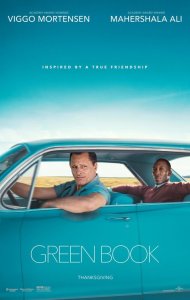 Green Book plays like a twenty-first century rendition of Driving Miss Daisy, a well-meaning and relatively gentle movie about race relations where a prejudiced white person comes about thanks to their firsthand friendship with an African-American male. It’s reportedly inspired by the true story of Tony Lip (Viggo Mortensen), a nightclub bouncer, driving around a famed pianist, Dr. Don Shirley (Mahershala Ali), as he performed throughout the South in 1962. The best part of the movie is the character interaction between this odd couple, and you’ll get plenty of it too. The actors burrow into their very distinctly conflicting characters, so it’s a natural pleasure to watch them eventually bond and learn from one another. This is the kind of racism that doesn’t make people feel too uncomfortable, and you could say that about the film as a whole. It’s a bit safe and has its intentions set on being a big, inclusive crowd-pleaser, and it plays like one. There are moments to make you laugh, moments to make you cheer, and moments to make you tear up. Morstensen and Ali are terrific together and find dignity and humanity in characters that could have easily become one-note stereotypes. The more we learn about Dr. Shirley the more interesting he becomes, a man used to feeling like an outsider no matter the company he keeps. Watching the two men grow and open up to one another can be heartwarming and deeply satisfying. Remarkably, the film is directed and co-written by one half of the Farrelly brothers, the pair responsible for ribald comedies like There’s Something About Mary and Dumb and Dumber. It’s an easy movie to fall for, with its winning formula and enjoyable actors, but there’s a little nagging concern I have that Green Book is too safe, too straight, and too pat in its life lessons. Despite its Best Picture win, it’s not like Driving Miss Daisy has any lasting cultural impression, and I wonder if maybe Green Book is destined for the same. Still, the acting and writing is enough to bring a smile to your face and remind one’s self about the power of kindness.
Nate’s Grade: B
Share this:

Bohemian Rhapsody (2018)
 Biopics are trickier than they appear because how best can you distill the essence, and significance, of a person into two hours? We’ve edged away from the standard cradle-to-grave biopics more in favor of stories that hinge on monumental moments in a person’s life, meant to encapsulate their life both in micro and macro. Bohemian Rhapsody favors the former approach, which causes the movie to feel like it’s rushing through the cornerstones of Queen singer Freddie Mercury’s life. Even at over two hours, the movie feels like it has little time for things, often jumping into polished, well-edited montages of time progression. The creative birth of many of the band’s hits are treated as absurdly easy formations, going from a clap of hands and stomp of feet to “We Will Rock you,” or a bass line to “Another One Bites the Dust.” It’s like the movie is checking boxes for a biopic with an anxious eye toward the clock. Mercury’s homosexuality (he comes out as bisexual to his long-time girlfriend who corrects him and calls him gay) is given its due, not having been underplayed in an effort to court a more mainstream audience. Mercury’s sense of sexuality, and the struggle of his own acceptance, is essential to getting to know this flamboyant front man. Except several of these scenes feel mishandled, which is odd considering director Bryan Singer (X-Men) has often found parallels in big studio films for the gay experience. The movie seems to say if his band mates had only accepted him more then maybe he wouldn’t have fallen into promiscuity by a bad influence and thus contracted HIV. There are also some pat answers as well like a disapproving father. However, the faults of Bohemian Rhapsody are compensated by its virtues, none more so than the electric performance by Rami Malek (TV’s Mr. Robot) as Mercury. The actor struts and preens with infectious charisma, and a mouth full of Mercury’s oversized choppers, and he miraculously captures the powerful stage magic of his character. The concluding 1985 Live Aid performance is astounding to witness and a reflection of just how essential and virtuosic Mercury and company were as live performers. It’s a sustained set of several hits and the movie just sings to a close on the highest of high notes. Bohemian Rhapsody is carried by the music and performance of Mercury the character and Malek the actor. It will make you want to rock out to Queen on the car ride home.
Nate’s Grade: B-
Share this:

Can You Ever Forgive Me? (2018)
 Melissa McCarthy adopts the Oscar bait route of pre-approved credibility, which usually means playing a tragic, self-destructive real-life figure, stripping away any sense of vanity, and working with an up-and-coming indie film director (Diary of a Teenage Girl‘s Marielle Heller). The recipe is alive and well in the consistently entertaining, but only for so far, Can You Ever Forgive Me? which traces the life of literary author Lee Israel, a biographer who nobody wants to read, that is, until she starts “discovering” lost letters from the likes of Noel Coward, Dorothy Parker, and other famous authors. In total, Israel forged 400 letters and sold them to private collectors and archivists until the FBI charged her with fraud. Because of the relatively low-stakes nature of her accidental jaunt into criminality, the “how” is less interesting than the budding friendship formed between Israel and a malcontent bawdy barfly/partner in crime (Richard E. Grant). Their rapport is wonderful and they truly seem to be having a ball with their ill-gotten gains, yet they still maintain a vulnerability even to the very end. In many ways this film does for McCarthy and her standard barrage of caustic, anti-social characters what Punch-Drunk Love did for the Adam Sandler introverted goofball sad-sack barely concealing his explosive rage. It’s a grounded deconstruction on that familiar movie archetype we’ve seen from a popular comic actor. There are some interesting aspects about Israel’s lonely life, like a timid female bookshop owner who circles around a potential romance with Israel, but it’s really a two-hander of a movie between Grant and McCarthy. Can You Ever Forgive Me? is a slight character-driven drama with comedic elements, but McCarthy shows that she has the acting chops to play multi-faceted characters in any genre if given the right opportunity.
Nate’s Grade: B
Share this:

First Man (2018)
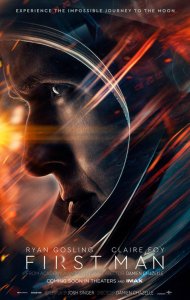 Oscar-winning filmmaker Damien Chazelle got to be the director of a Best Picture winner for approximately three minutes, which, to be fair, is more than most us will ever experience. La La Land won the top prize at the 2017 Oscars only to have it taken away and given to the smaller indie, Moonlight. Where an Academy of old white people that love to celebrate Old Hollywood decide to award a small million-dollar movie about growing up gay and black in the 80s, where does one go next? For Chazelle, it seems the answer is something even more irresistible to the Academy. First Man is partly a biopic on Neil Armstrong and partly a recreation of the 1960s Space Race. The finished movie is so mercurial, so insulated, so dry that I found a far majority of it be kind of boring.
Neil Armstrong (Ryan Gosling) is one of the select pilots training for space. NASA is racing to beat the Russians to the moon, and every new breakthrough is thanks to long hours of hard work. Janet Armstrong (Claire Foy) worries at home, listening to every radio broadcast and wondering if her husband will come back safely.
What First Man does best is make you realize how dangerous every step of the way was to get to the moon. Every leap forward required months of trial-and-error, and sometimes those mistakes cost lives, like the crew of the Apollo 1. The film opens on Armstrong flying above the atmosphere. The emerging curvature of the Earth is beautiful, but the beauty turns to horror quickly as it appears Armstrong’s plane is bouncing off the atmosphere and drifting into orbit. There’s another sequence where he and Buzz Aldrin (Corey Stoll) are above the Earth and planning to dock in space and their capsule spins wildly and if they can’t fix it they’ll black and out and assuredly die. These moments remind the audience about the inherent dangers of the Space Race that we don’t necessarily get in the history books. Looking back, we know the American astronauts succeed in the ultimate mission of landing a man, or an eventual dozen, on the moon, but that foreknowledge produces a false sense of security. Chazelle’s movie reminds us of the enormity of this challenge and the enormity of the dangers. The sound design in this movie is terrific, and Chazelle makes sure you hear every ping, every metal-on-metal scrape, to the point that you fear the whole thing could fall apart at any moment. When Janet furiously dresses down the Mission Control head (Kyle Chandler) that tries to calm her concerns, she accuses them of being boys who think they know what they’re doing. Even after the triumph of the final act, we know what happens two missions later (Apollo 13) to reconfirm just how much we still haven’t perfected when it comes to space travel.
 Besides reminding you of the precarious nature of early space travel, let alone the tests leading up to said travel, First Man doesn’t find much to justify its own existence other than as the latest in Oscar bait. It’s not exactly an in-depth look at the heroism and chutzpah of the Space Race like The Right Stuff, and it’s not exactly an examination on the frailty of man and the meticulous problem solving needed to achieve big goals, like Apollo 13. In fact, while watching this movie I would repeatedly think to myself, “Man, I should go home and watch Apollo 13 again.” When you keep thinking about watching a better movie, you have lost your audience, and that happens throughout First Man. There are thrilling, awestruck sequences to be sure, but that only accounts for perhaps a quarter of the lengthy 140-minute running time. The rest is spent at a distance trying to understand a man who comes across as largely impassive. He’s intensely focused but it’s like the movie adopts his very no-frills attitude, and it goes about its business with little thought for letting an audience into its inner world. We’re still only visitors at best here.
I admittedly don’t know much about Armstrong the man, so I can’t tell if the role was shaped for Gosling’s talents or he just matched perfectly with the man. Armstrong feels like one of the Nicolas Winding Refn roles (Drive) that we’re used to watching Gosling portray. Armstrong feels like somebody ported over a guarded, reserved, mostly silent Refn character into a staid biopic and asked Gosling to communicate a majority of emotion through unblinking stare downs. If there’s one actor you don’t want to challenge to a staring contest, it’s Gosling. Armstrong comes across a very internal man who seems uncomfortable in the spotlight, far less natural than Buzz Aldrin, who the movie unexpectedly positions as kind of a saying-what-we’re-all-thinking jerk. Because Chazelle has decided to keep Armstrong so guarded, it makes the film feel distant, like we’re being told the story second-hand, and that requires Chazelle to fill in the gaps as to the internal motivations and insights for an intensely private man. The answers we’re given seem almost cliché (the death of his young daughter is what drove him into his work, to escape the bounds of his Earthly grief, and to finally say goodbye to her). It’s too convenient as a simple character arc to be fully believed, but that’s all we have to work with because the movie won’t give us much more. It feels more like you are getting the idea of Neil Armstrong the Man rather than a realization. It’s a frustrating experience, watching a biopic and having the filmmakers keep their prized figure behind glass.
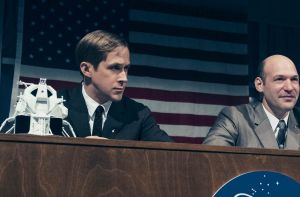 As a director, Chazelle is proving to be a remarkably skilled chameleon. First Man is completely different in style and approach to La La Land as it is to Whiplash (still his finest). His chosen approach for First Man is locking to Armstrong’s perspective, so we’re working with a lot of handheld camerawork that orbits our movie star. Chazelle’s cameras emulate a docu-drama aesthetic and there are several moments where the action happens onscreen and the cameras race to frame it, leaving the image blurry for seconds. I’m not sure that was the best decision. It does create a sense of verisimilitude, which heightens the thrilling aspects of the film like the excursions into space travel. However, it does little to heighten the underwhelming domestic drama on the NASA block. The added realism only benefits a small portion of the movie. At times, a camera racing to catch up with the onscreen action would be considered a hindrance. The claustrophobic feelings are heightened from Chazelle’s cramped camerawork, reminding us again of the tightly precarious spaces these men were willingly sliding into, the fragility of the cockpit walls separating them from an unrelenting empty void. When we switch over to the Apollo 11 mission, Chazelle keeps the attention squarely with the three men making the famous lunar landing. There’s a stirring thrill of destiny and the film transitions into an IMAX footage to make the moment that much more immersive and transformative.
First Man is much like the man of its title, reserved, guarded, and with a laser-like focus on its mission at the expense of outside drama. Chazelle is an excellent filmmaker and the craft on this out of this world, from the production design to the thrilling recreations of the dangers of space, bringing together the alarm through a sumptuous combination of editing, sound design, and cinema verite photography. Of course that verite style is also a double-edged sword, providing another layer to distance the audience. This is a pretty guarded movie with few insights into Armstrong the person. We get more Armstrong the pilot and numbers-cruncher, and I wish Chazelle had steered more into whatever version of Armstrong that opened him up to the audience. The family drama stuff is pretty pat and Foy (The Girl in the Spider’s Web) is generally wasted as the supportive and anxious wife. Most of the actors are generally wasted in this movie, with the potential exception of Gosling, who slips into the shoes of an impassive and emotionally restrained protagonist like it’s second nature. First Man might not be a giant leap artistically, and in fact a majority of the film is dull, but the artistic highs are enough to warrant one viewing. From there, you’ll likely conclude that you don’t need to watch Neil Armstrong stare forlornly into the middle distance again. Frankly, I’d rather watch La La Land again, and that’s saying something.
Nate;s Grade: B-
Share this:

A Star is Born (2018)
 There have been four official renditions of A Star is Born. I say “official” because other storytellers have imitated the famous formula countless times (2011’s Best Picture-winner The Artist is essentially the same tale). The original 1937 version starred Janet Gaymor and Frederick March and was about a Hollywood acting starlet. The 1954 version starred Judy Garland and James Mason and was nearly three hours. The 1976 version swapped Hollywood for the music industry, starring Barbara Streisand and Kris Kristofferson (a generation asks, that guy from Blade?). Now Bradley Cooper has taken to reviving this old favorite, much like a singer re-imagining a classic song. As a character says in the film, there are only 12 notes within each octave, and it’s up to the individual artists to take those same 12 notes and spin them in meaningful ways; it’s the singer, not the song. Cooper and his company have refashioned A Star is Born for 2018 audiences, and it’s an emotionally satisfying showcase for its booming stars.
Jack (Cooper) is a popular singer-songwriter with a long career of hits stretching back decades. Ally (Lady Gaga a.k.a. Stefani Germanotta) is a waitress with big dreams of stardom. She writes her own songs but is afraid to perform them because of her looks. One night Jack stumbles onto her performance in a drag club, and from there he’s smitten. He invites her onstage at one of his concerts and the duo sing Ally’s song she wrote. From there they’re inseparable and Ally’s career explodes. She transitions to a solo pop act thanks to a thinly veiled villainous British manager (Rafi Gavron). Jack’s addictions and maladies seem to be getting worse as the relationship continues and Ally must choose between her blossoming career and being the caretaker for the self-destructive man she loves.
 This is Bradley Cooper’s debut as a director, as well as a screenwriter, and he knows that the formula of A Star is Born is universal and requires little tinkering. The real draw will be in the characters and the performances, and that’s where A Star is Born 2018 shines. Cooper’s character is a talented mess and we’re introduced to both aspects early. The film opens with him playing onstage and it’s full of vigor, swagger, and all shot in a long take to keep the electric feeling alive, also highlighting Cooper doing his own strumming. This is a rock star that knows what he’s doing, we immediately sense. Then in the car ride as he desperately looks for a source of alcohol, we see how cavalier he is about his own addictions and self-destruction. He’s also suffering from tinnitus and refuses to wear hearing aids because he feels it will make it harder for him to be in the moment, thus taking away something from the authenticity of his performance. That’s a key word when it comes to Jack. He is obsessed with authenticity and using the spotlight to say something meaningful. This ethos will cause friction in his relationship with Ally as she gets molded into a pre-fabricated pop star with lyrics about butts in jeans. Jack knows deep down that his time in waning, both commercially and physically, and he is driven to make the most of it before the spotlight dissipates. In some ways, Ally is a reclamation project for his career and his person. It’s not manipulative. He genuinely wants to do right by her and give her the opportunities that he thinks she deserves. I never doubted Jack’s fidelity to Ally, especially as we learn piece-by-piece his troubled back-story with a troubled father. Jack has two significant relationships in his life, Ally and his older brother and tour manager, Bobby (Sam Elliot). He pushes them away while needing to draw them closer and that conflict drives the character more so than his musical legacy.
Cooper the actor does a suitably good job losing himself in the character, alternating charm and warmth and rage and stubbornness. His singing vocals are pretty solid and add to the overall impression of Jack as a character rather than an acting vehicle for a director who wanted to show off. As a director, Cooper follows the instincts of his character and has a very practical, no-frills sense of style, sticking to longer takes and pinning the camera to his performers to get every nuance of emotion across their tear-stricken faces. His camera instincts are on verisimilitude and trust in his actors, and they deliver for him. I liked the little moments that Cooper finds to let his characters stretch and for his film to breathe. The initial courtship between Ally and Jack over the course of one long night sets the tone for the rest of the movie. We can tell early on there’s something special between these two. There’s also some fine moments between Cooper and Elliot (The Hero) expressing the hardships of two hard-headed brothers tired of dealing with the scars of their alcoholic father. It’s a delicate balance so the soapier elements don’t overwhelm the pivotal sense of realism that Cooper is after. The fact that he finds that right balance throughout a 135-minute movie is an accomplishment in and of itself, let alone for a novice director, although the pacing is a bit sluggish at points.
 This is rightfully Gaga’s show and she dazzles on stage and on screen. It’s tailor-made to be a showcase for Gaga and her sensational singing, so she’s got many supports from Cooper and company to succeed. Cooper is good but she is unquestionably great. It’s her movie and just as Ally becomes a star so too does Gaga. It’s not just the musical performances too, which are uniformly outstanding while still being able to be done through the lens of her character. Her performance of “La vie en Rose” is slinky, brimming with assurance, and magnetic to watch, giving the audience a sense to what Ally is capable of. You can easily see why Jack would become enchanted with her immediately. Her big moment singing her original song to a stadium of thousands is the highlight of the film. Cooper’s camera stays trained on Ally on the sidelines as she goes through a myriad of emotions, working up the courage to saunter onstage at the right time to belt out her original tune. It’s a thrilling and emotionally rousing moment that feels literally star making. You see her nerves melt away as she lets go and immerses herself in the music. The dramatic moments are just as nicely delivered, though there are the occasional bump or two. Gaga has a feisty sense of self that pushes her to push back, but she can also be achingly vulnerable and lovesick as her character falls head over heels for a troubled man. She’s present in every scene and has a strong rapport with Cooper. I fully expect her to earn an Oscar nomination for her performance and likely one for an original song.
With all that being said, A Star is Born 2018 also strangely relegates Ally’s character. Walking away, I began thinking over the movie and its characterization and I realized that Cooper and his team of screenwriters have given the rising star the least amount of material. She’s got the most screen time and her character arc is evidently clear, the rags-to-riches ascent, the naiveté giving way to hard-won wisdom and heartache. She has big dreams and gets more confident as the film continues and her career comes alive. All of that is clear, but dig deeper and you’ll discover less than you remember. Ally doesn’t even follow the track where as her notoriety increases so does her ego. She’s pretty much the same caring, humble, ambitious human being as a waitress and as a Grammy award-winning musician. I suppose her static status says something about how solidified her own sense of self is even after her dreams come true. She’s not one for the temptations of the recording industry and grater fame and fortune. I don’t think she even has a flaw; perhaps a mild lack of confidence in her performance abilities thanks to shallow male executives that equate physical looks with commercial mass appeal (Gaga herself has spoken about the negative feedback she received for years because of her looks). But a lack of confidence is a pretty weak and easily resolved flaw in a narrative. I think her big character flaw is actually her devotion to her self-destructive relationship with Jack. In order to go into more detail, I’ll be spoiling portions of the movie (if you haven’t seen any of the other versions) so please skip the next paragraph to remain absolutely pure.
 Inherent with every rendition of A Star is Born is one performer on the rise and one performer on the decline. This goes with the territory, as does the falling star having some kind of crippling addiction that only gets worse. Cooper is too devoted to bringing a sense of realism to his film to merely add a happy ending. The romantic relationship between Ally and Jack is the heart of this movie but I began questioning whether it was actually a good relationship, not good in a sense of the quality of writing but good in a sense of whether it was ultimately healthy for Ally. He’s an alcoholic, a pill-popper, and he’s pushing himself too hard in a race against his irreversible hearing loss. He’s spiraling and figuratively drowning (literally in the 1954 version) and looking for a lifeline, and that’s Ally. She becomes a primary caregiver for his benders. She’s willing to sacrifice her career for him, and that level of devotion alarms even Jack, pushing him into making a fatal decision in the guise of helping her. That’s right, it’s a movie that portrays suicide not just as a tragedy but also as a misplaced gift (2016’s Lights Out did something similar to resolve its supernatural dilemma). It’s hard to tell what Cooper’s view of this decision is, whether it’s romantic or wrong-headed and cruel. Their relationship is self-destructive and Ally’s insistence on sticking it out, with a man who doesn’t trust his own will power to stay sober, comes across as a questionable asset. Should I not be hoping that she leaves and finds happiness with someone who is healthier for her?
A fun thing I noticed was the ongoing appearance of alums from the TV series Alias. The show aired from 2001-2006 and was some of the best network TV, especially its first two rollicking seasons of spy hijinks. Cooper was a supporting character on that show and he does right to his co-stars by using his own increasing leverage in Hollywood (three Oscar nominations, repeated bankabaility) to give them high-profile work. Greg Grunberg, J.J. Abrams’ lucky charm, plays Jack’s understanding and put upon personal driver. Ron Rifkin plays an addiction counselor that offers hard wisdom to Jack. I was hoping that Victor Garber and Jennifer Garner might be around the corner but alas it was not to be.
A Star is Born 2018 is a worthy and emotionally involving addition to the oft-repeated formula. It’s more emotionally grounded, eschewing sensational melodrama for something authentic and resonating after it’s long over. This is a familiar story but it’s been made relevant to a modern audience and given an emotional clarity that is richly affecting. It’s a big Old School sort of movie with big feelings but Cooper maintains a sense of integrity throughout, treating his characters as flesh-and-blood human beings. Gaga is the sensational standout but every actor does good to great work here. I wish the script gave her character more dimension and opportunity to flash even more complex impulses, but I’ll be happy with what I got. A Star is Born 2018 may be the best version yet, and that’s saying something for a story that’s been kicked around since FDR. It’s the singer, not the song, and this movie is sweet music to your ears.
Nate’s Grade: B+
Share this:

BlackkKlansman (2018)/ Sorry to Bother You (2018)
 Two African-American filmmakers, one making his debut and another in his fourth decade of popular storytelling, have produced two of the most uncompromising, entertaining, provocative, and exacting and relevant movies of this year. Boots Riley’s absurdly comic indie Sorry to Bother You was a festival smash, and Spike Lee’s BlackkKlansman is being positioned as a summer breakout. Audiences have often looked to the movies as an escape from the woes of our world, and when the news is non-stop catastrophic woe, that’s even more apparent. However, both of these movies, while enormously entertaining and charged with fresh relevancy, are a reminder of the very social ills many may actively try to avoid. Both films, and their respective filmmakers, make cases why ignorance is a privilege we cannot afford. Also, did I mention that the movies are outstanding, daring, and hilarious?
It’s the early 1970s, and Ron Stallworth (John David Washington) is the first black officer on the Colorado Springs police force. He wants to be a detective and taken seriously, and one day he calls the leader of the local chapter of the Ku Klux Klan pretending to be a white nationalist. He builds a relationship over the phone with the Klan but he can’t meet them in person. Enter fellow officer Flip Zimmerman (Adam Driver) who stands in as the public Ron Stallworth, avowed white supremacist. Problem is Flip is Jewish, a group the Klan isn’t much more favorable with. The two officers must work together to gather enough actionable evidence to stop the Klan before they kill.
 This is Lee’s best film since 2000’s Bamboozled and he feels jolted awake by the material. He doesn’t shy away from the film’s relevance and potent power but also knows how to faithfully execute the suspense sequences and police procedural aspects of the story by Charlie Wachtel, David Rabinowitz, Kevin Willmott, and Lee himself, based upon Stallworth’s book. The story alone is the film’s greatest selling point. It feels like a bizarre recreation of that Dave Chapelle sketch about the blind, and black, Klansman. It’s a story inviting irony and bafflement, and it’s ribald and funny for long stretches, buoyed by Washington’s charismatic and forceful performance (close your eyes and he sounds just like his dad, Denzel). The story is so fascinating that you just want to see where it goes. Stallworth is fighting for respect in a still-racist police force, and he’s pushing Zimmerman to feel more invested in their operation from his own maligned status. “I never thought much about being Jewish,” he shares with Ron, “But I’ve been thinking a lot about it recently.” Theirs is a partnership we root for, and each new accomplishment bonds them together and increases their credibility with a wary police chief. It’s a movie that has a steady supply of payoffs and complications, leaving you satisfied by the end but also more than a bit rattled at the uneasy connections to contemporary news.
This is a character-driven suspense film that does so much so well, drawing in thrills and laughs without making either feel cheaper by their inclusion. This is an undercover operation so every scene with the Klan has the electric uncertainty of whether or not Flip will be caught and our heroes doomed. Because you have two Ron Stallworths, we already have a complicated ruse to keep up (though why Flip couldn’t simply also be the voice on the phone is likely just how it happened in real life). Each new piece of information, each new meeting, takes our characters deeper into the Klan infrastructure, including a guided visit from none other than Grand Wizard (a.k.a. head honcho) David Duke (Topher Grace in an outstanding performance). The risk escalates from being caught to thwarting a planned bombing that could kill innocent minority protestors. The movie does a great job of finding new ways to remind you what is at stake, and while the Klansman are set up to be laughed at and ridiculed, they are still seen as dangerous. They still have the direct intent to physically harm others, not just harass and intimidate.
 Because of the undercover operation, you’d be right to assume that Stallworth’s personal life and blossoming romance with a collegiate activist, Patrice (Laura Harrier), would be the least interesting part of the movie. It’s not poorly written or acted by any means. She serves as a reminder of Stallworth’s split loyalties, working for the police, which many in his community see as a tool of oppression from racists with a badge (and we too see this in action). He is always hiding some part of himself, be it his racial identity, his personal affiliation, or even what he really feels about his corrupt colleagues. Even with her, he cannot relax completely. It shows the more personal side of the Stallworth character and provides something real for him to lose, especially once the local Klan targets Patrice. I understand the role she serves in the larger story but I’d lying if I wasn’t eager to get out of every one of her scenes and back into the action. That’s the problem when you have one superior storyline; the others begin to feel like filler you’d rather leave behind to get back to the good stuff.
BlackkKlansman also can’t help itself with the political parallels to our troublesome 45th president, but I loved every one of them. A superior officer warns Stallworth about his dealings with Duke, specifically that he might make good on the promise to retire as Grand Wizard and go for political office. “Come on, America would never elect a man like David Duke as president,” he says with thinly veiled incredulity. The characters might as well turn and wink to the camera and say, “We’re talking about Trump,” but I laughed all the same. At one Klan dinner, the participants chant, “America first,” which is a Trumpian campaign slogan, if you didn’t know dear reader, derived from the Klan (Trump’s own father was arrested attending a 1927 Klan rally). These parallels are destined to turn off some viewers, though I think the subject matter and Lee’s name should be enough to know exactly what kind of movie you’re electing to watch. Nobody goes to a Lars von Trier film expecting to be uplifted about the state of humanity.
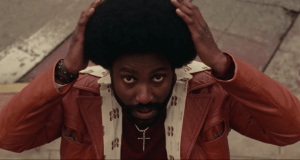 It’s at its very end where the film reminds you just how sadly relevant it still is today (minor spoilers but I don’t think they will ruin anything for you). While Stallworth has bested the local chapter of the KKK, there’s another late night with a sudden alarming noise, Stallworth on his guard, and a cross is burning out in the distance. Just because our characters have foiled a band of racists doesn’t mean racism has been eradicated. Instead, as the film suggests, it evolves, and Lee concludes with an impactful montage of news footage of the Charlottesville white supremacist rally and President Trump contorting to find fault on “both sides” when clearly one side was murderous and racist. You even see real-life David Duke on the premises spewing his re-branded style of hate. The evolution of white supremacy demagoguery has become political, and it has found cover under the guise of a president eager to stoke racial resentments and divisions to his advantage. He’s normalized the abhorrent behavior and given it mainstream cover. It’s a powerful and lasting conclusion (much in the same way as the montage of Hollywood’s harmful depiction of black people in Bamboozled — including the Klan hero worship in Birth of a Nation, also featured here prominently) that should remind people that the threats of racism and Nazis and the KKK are not a thing of the past. It is very much a staple of the present, and how much it is allowed to remain a staple is up to the moral outrage of voters.
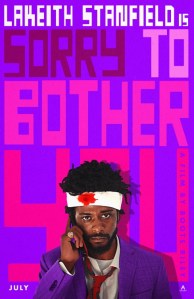 Sorry to Bother You is also sharply cutting and topical about being black in America. In present-day Oakland, Cassius “Cash” Green (Lakeith Stanfield) is struggling to make ends meet, move out of his uncle’s garage, and do right by his girlfriend and performance artist, Detroit (Tessa Thompson). He gets a job at a telemarketer and discovers a new talent when he turns on his “white voice” (voiced by David Cross) and becomes a power caller, crushing his competition. He moves his way up the chain, losing touch with his base of working-class friends looking to strike to unionize. Once at the top, Cash draws the attention of the CEO, Steve Lift (Armie Hammer), who has big plans for a man with Cash’s gifts and seeming flexibility when it comes to corporate moral relativism.
Sorry to Bother You is a wild, hilarious movie bursting with things to say with its shotgun approach to satire, or as my pal Ben Bailey termed, a blunderbuss approach, messy and all over the place and, sometimes, maybe missing its intended mark. I thought the movie was simply going to be about the modern-day struggles of being black and poor in America, and the movie covers those aspects with aplomb. It’s also sized up ample room to satirize consumer culture, labor exploitation and worker rights, male and female relationships, art and media, cultural appropriation, and even memes. Because of all the topics, the movie could run the danger of feeling unfocused, but thanks to the remarkably assured vision and handling of writer/director Boots Riley, it all feels connected by its unique voice operating at a risky but exhilarating level.
 There are a lot of bizarre dips into the absurd that had me howling and on the edge of my seat wondering where we would go next. The most popular TV show is just watching a person get the stuffing beaten out of them, and it adopts a pretty simplistic name to go along with this transparency. A very Google or Amazon-esque company is offering “lifetime jobs” for employees to live in their factories and have all their cares taken for by a corporate slaver, I mean kindly overlord. There’s an art show that consists of hurling cell phones at a woman’s body. There’s a corporate video with a female caveman narrator where she is, 1) stop-motion animated, and, 2) topless the entire time, complete with animated swinging breasts. There’s an ongoing thread that seems to trace the life cycle of a meme. A woman throws a Coke can at Cash in protest. She gets plucked form obscurity, gains a talk show, gets an endorsement from Coke and her own video complete with dramatic re-enactment and chirpy jingle, and Cash getting hit becomes its own Halloween costume for white people. There are throwaway lines in this movie that any other major comedy would die for. This is a movie that is impossible to fall asleep to because every moment could be different and you won’t want to miss one of them.
There are moments that strike beyond the immediacy of the onscreen absurdity. One of those moments was when Cash was invited to join the big corporate after party. He’s out of his element, surrounded by rich, relatively young privileged white people. They assume, being black, that Cash will instinctively know how to rap, and they insist that he perform a free-style rap for the assorted group. This ignorant assumption is just the start for Riley, because Cash gets up there and struggles to perform, barely able to scrap together the most elementary of rhyme, and the illusion has become dashed with the crowd. He notices they’re losing their interest with him, so in a desperate ploy, he just shouts two words over and over into the microphone with enthusiasm: the N-word and a profanity. He does this for like a minute, and the crowd of privileged white people shouts it back at him, seemingly lying in wait for some tacit permission by “popular music” for them to likewise use the N-word. It was an indictment that went beyond that scene. Another is ultimately what happens to the big bad corporation by the film’s end. It literally made me guffaw because it felt completely in place with the tone of the movie.
 All of this zany and funny stuff would feel passing if there weren’t at least some characters worth our time. Cash is an engaging young man trying to get his life on track. He discovers he has a gift when it comes to coding, to blending into a white-majority community in a comfortable and acceptable manner. It’s a survival technique many African-Americans have had to perfect on a daily basis, and soon to be featured in the upcoming adaptation of the best-selling YA novel, The Hate U Give. Even amidst its more bizarre moments and asides, the movie is about a black man trying to get by with limited opportunities in a society that too often devalues him.
Stanfield (Get Out) has been a strong acting presence for some time, first in the remarkably powerful Short Term 12 and most recently on Donald Glover’s Atlanta. He grabs your attention and Stanfield has a gift for comedy, particularly a nervous energy that draws you closer rather than pushing you away. His character goes on the rise-and-fall path, so we still need to be pulling for him to turn away from his newfound egotism, and Stanfield keeps us rooted. Thompson (Thor: Ragnarok) is Cash’s conscience and her wardrobe and accessories are amazing, from her declarative “The Future is Female Ejaculation” T-shirt to her large earring messages. Hammer (Call Me By Your Name) is confidently smooth and sleazy as a coked-out, venal CEO that is so blasé about his wrongdoing that it doesn’t even register for him as wrong. I appreciated that even with all the wackiness of this cracked-mirror version of our universe, Riley puts in the time and effort to make the characters count rather than be expendable to the satirical aims.
Now, there is a significant turn in the third act that veers the movie into territory that will test how far audiences are willing to go along with Riley’s raucous ride. I won’t spoil what happens but for several of my friends it was simply a bridge too far. For a select few, they even said this turn ruined the movie for them. It worked for me because it felt like an escalation in the dastardly labor practices of the corporation and was finally a visceral reminder of their cruelty. Beforehand, Cash has been making moral compromises to keep his ascending career, excusing the after effects of his success even when it’s selling weapons to foreign countries. That stuff is over the phone, part of his coded performance, and easier to keep out of mind. This escalation finally is too much to pretend to ignore. It’s too much to excuse his own culpability working for the enemy. It’s what pushes Cash back to his circle of friends he had left behind for the corporate ladder, it’s the thing that politically activates him, and it’s what pushes him to make a difference. I can understand, given the somewhat goofy nature of the plot turn, that several viewers will feel like Riley gave up his artistic high ground to self-indulgence. However, I would counter that the line between self-indulgence and an assured vision can be tenuous. The movie is so alive, so vibrant, and so weird, so having another weird detour felt agreeable.
 BlackkKlansman and Sorry to Bother You are each unique and fun but with larger messages to say about the black experience and other fissures within our volatile society. You’ll be thoroughly entertained by either film and you’ll walk away with something to ponder and discuss with friends and family and maybe that one racist uncle at Thanksgiving, the one who uses the term “false flag operation” a little too liberally. BlackkKlansman tells a fascinating, comic, and thrilling story about racism of the past, drawing parallels to the trials of today, in particular under the era of Trump. Sorry to Bother You has many targets, many points, and much to say, exploding with thoughts and cracked comedy. Riley is holding up a mirror to the shortcomings and inanities of our own society and the ease we can all feel to turn a blind eye to the difficult realities of systemic racism, capitalism, and worker rights. Lee is a known firebrand and his polemic doesn’t shy from its political relevancy, but it tells a highly engaging story first and foremost, with top acting performances from its cast. In a summer of studios afraid to take chances, here are two excellent movies that take crazy chances and provide bountiful rewards.
Nate’s Grades:
BlackkKlansman: A-
Sorry to Bother You: A-
Share this:

Black Panther (2018)
 Black Panther is unlike any other Marvel Cinematic Universe (MCU) film prior. It’s unlike any other super hero film prior. Yes, there have been African-American leading men in comic-based movies, notably Wesley Snipes’ half-vampire-all-badass Blade. However, this is the first movie I can think of with this kind of budget, this kind of backing, and with this kind of ownership over its cultural heritage and the heavy burdens it carries.
We last saw T’Challa (Chadwick Boseman) in Captain America: Civil War mourning the loss of his father, the king of the African nation of Wakanda. The outside world does not know that Wakanda sits on a vast supply of virbanium, the strongest and more durable metal in the world and the key to Wakanda’s impressive technology. Under a holographic cover, Wakanda is a thriving metropolis with flying cars, skyscrapers, and next gen weapons. T’Challa goes home and must earn the right to the throne. However, Erik Killmonger (Michael B. Jordan), a former top-level black ops solider, is looking for his own path into Wakanda and onto the throne. Killmonger teams up with arms dealer, Ulysses Klaue (Andy Serkis), to force Wakanda to deal with being cut off from the world.
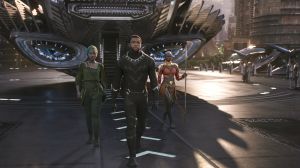 This is a movie populated almost entirely by black faces, notably black women (more on that later), and they are given a mainstream platform that celebrates its multitudinous African roots and traditions thanks to co-writer/director Ryan Coogler (Creed). This movie is proudly black, which will rankle some on the fringes of society, as if celebrating one’s own identity is somehow denigrating those who do not apply to that status. Black Panther is not an exclusionary movie because of its content and execution; this is a very accessible movie to a mass audience, even those who haven’t been paying attention to every nitty-gritty detail in the previous seventeen MCU entries. There are only two characters from other MCU films that appear, one as a post-credits cameo and the other an officious representative (Martin Freeman) of the outside’s clandestine organizations. This is a unique world isolated from the long shadow of colonialism. Wakanda has never known, to our knowledge, the depravity of the European and American slave trade. They have continued to develop uninterrupted by conquerors, slave traders, and the crippling aftereffects of racism. The Wakanda people could very easily be the conquerors themselves. They’re the most technologically advanced nation on the planet and hide as a “third-world nation,” utilizing the ignorance of the Western world to its security. The world of Wakanda is a fascinating, awe-inspiring, and defiantly independent nation.
The larger theme is over the responsibilities inherent to those with privilege. The nation of Wakanda is vastly successful by all conventional metrics. T’Challa must wrestle with whether to continue their exclusionary stance, ignore the plight of the larger world and say it’s none of their business or engage with the world, potentially putting his own kingdom’s peace and prosperity at risk. It’s a simple enough theme and yet it has tremendous weight to it especially when you account for those on the other end of the Wakanda borders. The character of Killmonger is a direct reflection of this. His experiences in Oakland are not the ideal pairing with the luxury of Wakanda. Killmonger sees Wakanda’s great influence as a way to protect beleaguered black citizens of the world and especially in the United States. It’s a way to prevent more senseless deaths from black citizens who were slain as a result of the fear of just being black (a powerful example was Coogler’s debut film, Fruitvale Station). It’s a pointed political statement that doesn’t get too heavy-handed (even though I would have preferred that). It questions the value of isolationism especially when suffering can be prevented. Killmonger works as a villain because you can understand his point of view. He goes beyond the need for vengeance. The wrongs he wants to right are larger and historical. Even Killmonger’s last line really attaches itself to this theme. T’Challa offers him a way out but with imprisonment. “No,” Killmonger declines, “My people were the ones who leaped over the sides of the slave ships. They knew death was better than bondage.” The emphasis is “his people,” not T’Challa’s, not Wakanda. His people were the ones who suffered from slavery. Could Wakanda have possibly prevented it?
 Another wonderful surprise of Black Panther is its incredible all-female ensemble that provides expert support to their king. T’Challa has the good fortune of four strong women, each of them having a different and vital relationship to him. The standout will be Danai Gurira (TV’s Walking Dead) as the fierce chief of security, Okoye. She has a swagger that vacillates between being intimidating and being brashly enjoyable. Okoye has many of the best lines and she throws herself into every fight. There’s also a sense of duty that transcends a single man that challenges her loyalty. Letitia Wright (TV’s Humans) plays Shuri, the Q of this world, the top scientist and creator of many a gadget. She’s T’Challa’s little sister and their interplay is very competitive and teasing. She’s looking to be more involved in the action and a highlight is when she teams up with her big bro. Lupita Nyong’o (The Jungle Book) is Nakia, a former flame of T’Challa’s who comes in and out of his life as an undercover spy. All three of these women have a powerful sense of agency and are integrated in important and essential ways. Even though Nakia may slide into that romantic interest role, she still has a vibrant life outside whatever feelings she may or may not have for the hero. Then there’s T’Challa’s mother, Ramonda (Angela Bassett), who radiates strength and fortitude. These women gave me some of the biggest moments of entertainment in the entire 135 minutes of movie.
Now some careful readers might note that I haven’t done much to emphasize the actual action of the super hero action movie, and that’s for a good reason. Black Panther stands stronger on theme and character than it does its actual action sequences. Coogler had a wonderful sense of scale and verisimilitude with 2015’s Creed, relying on long takes to put the audience in the heightened drama of the boxing ring. With Black Panther, the action sequences can lose a sense of immediacy. Many happen at night or are filmed and edited in ways that diminish some of their impact, like hand-to-hand combat in splashing water where the splashes obscure the activity. Other scenes felt like a video game CGI cut-scene. Speaking of video games, Black Panther’s suit has a crazy ability to absorb the kinetic energy of weapons, which means the stakes take a dip when our hero can merely just stand and allow himself to get shot repeatedly. The payoff for this absorption is a giant energy shockwave but it plays out like a fighting game’s special feature. It’s an aspect that’s not really utilized in a satisfying or unique way. The final showdown between Black Panther and Killmonger feels too weightless in execution. It’s meant to even the playing field by nullifying their extra abilities, but if they both have the same “Panther powers” isn’t the field already even? The third act, the usual punching bag for MCU critics, is the best part of the movie from an action standpoint. It utilizes the characters in significant ways and allows for organic complications while still maintaining its wider sense of spectacle. Plus it’s one of the few action sequences that allow all the pyrotechnics to be enjoyed during the visibility of day.

Boseman (Marshall) was an excellent choice for a stoic and too-cool-for-school character that can glide right on by. The ageless Boseman is at his best when he’s working off the other actors, especially his female posse. He has a couple of very effective emotional confrontations as he learns of his family’s secrets. As steady and soothing a presence as Boseman can be, this is Jordan’s movie. Michael B. Jordan (Creed) has been Coogler’s cinematic good luck charm and we’re still benefiting from that divine kinship. His character is at the heart of the central thematic question. While T’Challa is ultimately the one who has to decide, it is Killmonger who embodies that need for change and the desire to rectify the past. There’s a flashback with Jordan that got me to tear up, and this guy was the villain! It’s one of the film’s biggest mistakes sidelining Jordan for far too long. After his introduction, Killmonger is strangely absent for the next hour or so of the movie, ceding the spotlight to Serkis (War for the Planet of the Apes), a more antic and goofy scenery-chewing baddie who has a few regrettably “faux hip” lines of dialogue that land awkwardly. Serkis is having a blast but can feel like a holdover from a different film.
Much like last summer’s Wonder Woman, this is a movie that is going to mean a lot to a lot of people. It has a personal significance that I will not be able to fully tap into, no matter the expansive powers of empathy. Black Panther, as a long-awaited cultural moment, will have many ripples of inspiration. After my early screening, I sat back and watched an African-American boy, no older than seven or eight, walk out of the theater in a daze. His eyes were wide, his mouth agape, and he said in astonishment, “That was the best movie ever.” That kid has a hero he can call his own. That matters. Black Panther, as a work of art, is rich in topical themes and has a wide supporting net of exciting, robust, and capable women. I enjoyed how personal and relevant and political the movie could become, folding new and challenging ideas onto the MCU formula. Coogler is a marvelous director and storyteller showing rare acumen for being able to handle the rigors of a Hollywood blockbuster and deliver something hearty. The action has some issues and there are some structural hiccups that hold it from the MCU’s upper echelon (I enjoyed all of the 2017 MCU movies better). Black Panther is a winning movie when it features its sterling cast celebrating their virtues and solidarity and a still respectable enough action spectacle when called upon for big screen duty.
Nate’s Grade: B
Share this:

Phantom Thread (2017)

When the 2017 Oscar nominees were announced, one of the bigger surprises was the amount of love the Academy dished out for writer/director Paul Thomas Anderson’s Phantom Thread. In hindsight, maybe this should have been more obvious considering the Oscar-friendly pedigree (Anderson a.k.a. PTA), the acting phenom (Daniel Day-Lewis), the setting (1950s), and the subject matter (obsessive artists). I had no real desire to see Phantom Thread after enduring PTA’s last two movies. I strongly disliked Inherent Vice and The Master, to the point that when I read about the love for either I can only stare at my feet, shake my head, and hope one day these defenders of rambling, plotless, pointless navel-gazing will come to their better senses. While not nearly ascending to the heights of his early, propulsive, deeply felt works, Phantom Thread is for me a marked improvement as a PTA film experience and an intriguing study in toxic desire.
In 1950s post-war London, fashion designer Reynolds Woodcock (Day-Lewis) is famous for dressing movie stars, princesses, and the rich elite of the world. His sister, Cyril (Leslie Manville), acts as his business manager and personal manager, including kicking out the old muses who have overstayed their welcome. After a day out in the country, Reynolds becomes instantly smitten with Alma (Vicky Krieps), a foreign waitress. He pulls Alma into his highly secluded world. She lives in the Woodcock offices and he summons her at all hours, caught up in the madness of inspiration. Alma is overjoyed by the attention and adoration from such a famous and brilliant artist. It’s the kind of feeling she doesn’t want to end, and when Reynolds begins to lose interest with her, Alma will fight however she can to stay longer in this new and exciting world.

While this doesn’t have nearly the same amount of plot in comparison to early PTA, Phantom Thread at least held my interest and felt like what I was watching mattered. The character dynamics were compelling. Reynolds is a puzzle and we’re side-by-side with Alma trying to figure him out, suss his moods, and analyze why he is the way he is and how best to compensate. It becomes something like a portrait of a Great Artist who doesn’t operate on the same social and interpersonal levels as the rest of us, leaving Alma fumbling for stability. A breakfast in silence can become a battle of wills on the sound design team (you’ll never notice the sound of bread scraping like ever before). It’s not quite the thorough character study that There Will Be Blood purported to be, but Day-Lewis is as reliable an anchor for a movie as you’ll get in cinema. I was especially fascinated by the role of his sister, Cyril. She’s the gatekeeper to a very private world and knows the precise routines and preferences of her very fussy brother. She doesn’t necessarily approve of his actions but she sees them out, though occasionally she has to be more of the responsible one of the pair. Cyril is his lifeline, enabler, and enforcer. She treats Alma as a visitor into their home, further magnifying her worry about eventually being replaced by another muse for Reynolds. This insecurity is what drives much of the film’s second half as Alma tries everything she knows to assert power and influence so that she will not be unceremoniously carved out of this new special life for herself.
At its core Phantom Thread is an exploration of the stubborn artistic process and the toxic relationship of chasing those mercurial, waning affections. It’s very easy to feel for Alma, a relative nobody plucked form obscurity and whisked away to a glamorous world of the London’s fashion scene where she is the chief muse of a brilliant man. When he lays the full force of his attentions on her, it’s like feeling the warmth of the sun, and her world revolves around feeling that intensity. When his attention is elsewhere, Alma can feel lost and discarded, desperate to seek that warmth and fulfillment once more, though running into barriers because of Reynolds’ peculiar personal habits and demands. She plans a surprise romantic dinner that Reynolds resents, and he congratulates himself on the “gallantry” of eating his asparagus with butter instead of the salt he normally likes. Reynolds is a powerful figure who casts a powerful shadow. You feel for Alma as she tries again and again to find the exact formula for pleasing and comforting this obsessive man given to routines. She’s tying to crack the code back into Reynolds good graces. He’s an inscrutable force and one Alma is willing to genuflect to for his affections. Because of this dynamic, much of Phantom Thread is watching Alma try and fail to impress or win back the attentions of Reynolds, which is part fascinating and part humiliating. The film explores Reynolds’ history of burning through his shiny new muses, relying upon the iron-hearted determination of his sister to finally push out the discarded lovers/muses. For Reynolds, his muses follow the cyclical pattern of a love affair, the excitement and discovery of something new, the possibilities giving way to artistic breakthroughs, and then what once seemed en vogue is now yesterday’s old fashion.

Because of this tight narrative focus, the film does become repetitious in its second half, finding more ways to expound upon the same ideas already presented. Reynolds is a jerk. His process is of utmost importance and must not be altered. Alma is struggling to make herself more essential and less expendable in his orbit. She doesn’t want to end up like all the other prim women who have been elbowed out of the spotlight. She’s feisty and pushy and will challenge Reynolds, and this doesn’t usually work out well. While the strength of the acting never wavers, the plot does feel like it reaches a ceiling, which makes the film feel like it’s coasting for far too long (and it’s also far too long). It feels like Alma is fighting an unwinnable battle and after all her efforts she’ll just be another muse in a history of muses. That’s probably why Anderson gooses his third act with a thriller turn and with a specific plot device I’ve weirdly seen a lot in 2017. It feels like this plot turn is going to disrupt the cycle of Reynolds affections, and then as things begin reverting back to the old Reynolds, it all feels so hopelessly Sisyphean. And then, dear reader, the literal last few minutes almost save this entire movie’s lethargic second half. It’s a new turn that made me go, “Ohhhhh,” in interest, and it redefined the relationship and power dynamic between Alma and Reynolds in an intriguing way. It says a little something about the relationship between self-sacrifice and self-sabotage and how the power of giving can approach perverse levels of distorted self-fulfillment.
The biggest selling point of any movie with Daniel Day-Lewis is the man himself. He’s literally only been in four movies over the last decade, and in two of them he’s won Best Actor Oscars and was just nominated for another with Phantom Thread (Gary Oldman has that thing in the bag this year, though). The excellence of Day-Lewis is beyond dispute, and yet I would argue that Day-Lewis is pushed aside by the acting power of Krieg (A Most Wanted Man). This woman commands your attention enough that she can go toe-to-toe with Day-Lewis and win. She’s the worst at holding back her emotions and playing games, which makes her the most affecting to watch. When her romantic dinner goes badly, you can feel her reaching for reason, thinking out loud, her eyes glassy with uncertainty. When she’s speaking in an interview about her relationship with Reynolds, the warmth in Krieg radiates out from her. The other standout is Manville (Harlots) who does an incredible amount with mere looks. She can be withering. It’s a performance as controlled as Alma is uncontrolled, relying on the facade of calm to operate through a manufactured space of rules and expectations. And yes Day-Lewis is terrific. It’s also the first time he’s used his natural speaking voice in decades on screen.

Paul Thomas Anderson’s newest movie is about the world of fashion but it’s really about three characters jostling for understanding, attention, and control. We follow the tumultuous power dynamics of an artist-muse-lover relationship and the toxic implications it has on Alma as she struggles to maintain her position. The second half can get a bit repetitious and feel rudderless, but the eventual ending and wealth of great acting makes it an arguably justified journey. I lamented that Anderson was no longer making movies for me with the lurch he had taken with The Master and Inherent Vice in particular. He doesn’t have to make movies for me at all, but it was this sad realization that made me feel like I was undergoing a breakup with an eclectic artist I had loved tremendously in my younger days (Boogie Nights remains one of my favorites). Phantom Thread doesn’t exactly return things back to the way they used to be but it at least rights the ship, offering a mild course correction with a movie that is accessible and substantive. If this is indeed Day-Lewis’ last movie, at least it was better than Nine.
Nate’s Grade: B


 nathanzoebl
You must be logged in to post a comment.