Blog Archives
If I Had Legs I’d Kick You (2025)
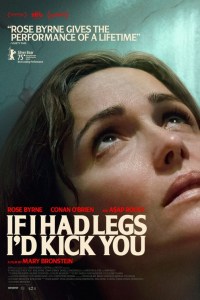
I have been told by numerous friends and other critics that If I Had Legs I’d Kick You falls in that dreaded entertainment zone of the “difficult watch.” These are usually made up of admired movies tackling challenging subjects in unflinching ways, movies that are easier to admire than love. I was girding myself to finally watch If I Had Legs (this will be the reference for the title from here out because, frankly, I’m too lazy to type out an extra three words every reference), I found it pretty despairing, especially for women, especially for parents of young children, and especially for those suffering or who have suffered through some degree of post-partum depression. This movie is a sensory immersion into the frazzled, anxious, and punishing existence of our heroine, just trying to catch her breath or get a break in a universe that seems cruelly engineered to only provide stressors. It’s a truly phenomenal movie giving bristling life to the perspective of writer/director Mary Bronstein (Yeast), with stylistic and surreal touches that reminded me of Charlie Kaufman or even Franz Kafka. The tragi-comic absurdity, as well as the unrelenting existential anxiety, is meant to provoke a primal, wince-inducing response, eliciting sympathy for the countless mothers coasting hour-to-hour looking for a little oasis of relief. If I Had Legs is one of those rare feel-bad experiences that I not only admire but I think I actually love.
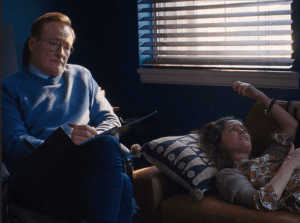
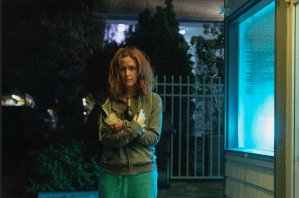
Rose Byrne plays Linda, a forty-something woman being pulled in every direction. Her young daughter is suffering from a physical malady that requires her to have a feeding tube, and she needs to gain weight in order to have the tube removed, but the child can’t gain weight because she doesn’t want to eat, and this obstacle is compounded by the hospital telling Linda if the child doesn’t meet her goal weight, then it’s a reflection of neglect, and Linda herself will have to attend parenting classes. The child is also, let’s put this nicely, very high-maintenance and attention-demanding. There’s also Linda’s husband who is away at sea and generally unhelpful and curt whenever caught on the phone. Linda also has a therapist (Conan O’Brien) who is likewise generally unhelpful and seems disdainful even talking to her. Then the roof of her apartment explodes with a torrent of water, and now Linda and her daughter have to live out of a local motel, further exacerbating all of their personal problems. It’s forty minutes in when the movie reveals Linda’s profession and I genuinely gasped: she’s a psychiatrist with her own very demanding clients to counsel. It’s not easy being Linda, but then again, there are plenty of Lindas in the world just waiting to catch a break.
This movie is a lot. It’s a lot to process, and it’s very deliberately using disorienting creative decisions to test your limits. The sound design is an especially effective dynamic that raises anxiety. Bronstein never shows you the face of Linda’s daughter, at least not until the very end of the movie, and there’s a stark reason for this. Our identity is Linda, and this voice that keeps coming in, frequently interrupting, occasionally screaming, and often compounding the stress of her mom, is designed to be viewed as a primary source of agitation. We don’t see the daughter because in this vision she doesn’t exist as a character but more as a burden. We view the child as Linda perceives her. There’s a trying sequence where Linda’s client leaves her baby behind and vanishes, forcing Linda to cart around a crying baby while frantically looking for the mother. The soundtrack of a crying baby is like a direct line to your nervous system that something is wrong and all you want is for the child to be soothed, but it keeps going for nearly five minutes straight, with that screechy wailing eating away at you one cry at a time. I can readily imagine my wife watching this movie and just turning it off after ten minutes.
The movie is packed with these creative decisions, all designed to make Linda’s perspective that much more empathetic and exhausting. For those tut-tuting Linda viewing her daughter as a burden, I’d ask for some grace, but also the movie doesn’t withhold criticism from its protagonist. She can be selfish as she’s spiraling, even seeking comfort in bad places. It would be harder to endure if the perspective was purely Job-like, wherein Linda relentlessly suffers because the universe is indifferent, or God is unhappy and spitefully targeting this poor woman. It does feel like everything is going wrong, but that’s also because we’re anchored in Linda’s perspective. Seeing things from her daughter’s perspective would make for a fairly different movie, but that’s not what this movie aspires to be. It’s not meant to be balanced, it’s meant to convey a very specific viewpoint, and that perspective feels like everything is stacked against you. In one key moment, what my pal Eric Muller dubbed Byrne’s “Oscar clip moment,” she unloads on her therapist and desperately pleads for someone to just tell her exactly what to do, to have responsibility and uncertainty stripped from her life. She wants a clear direction and the relief of knowing what to do, something that is rarely so clear in the adult world. It’s hard not to feel for Linda in the movie unless you’re actively trying to reject the vision of the director. If I Had Legs is a movie deliberately designed to be overstimulating and upsetting, so it’s going to be a select audience willing to wallow in the discomfort for the insight offered. I can see plenty saying, “Yeah, I live this, so no thanks.” I get it. After becoming a parent myself, my tolerance for emotionally-draining media certainly lowered. However, I think there’s ample artistic accomplishment to be savored with If I Had Legs that is worth treading the discomfort.
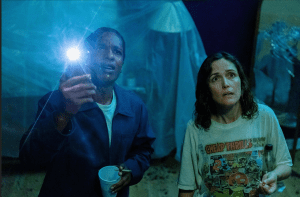
Byrne has been playing around the world of comedies since 2010’s Get Him to the Greek (a peak candidate for “most canceled cast” of the modern era, Byrne excluded) that I forgot how great she can also be in dramas. This is my favorite female performance of 2025. She is astounding. It’s smart to hire an actress of Byrne’s caliber, someone capable of finding the dark humor and exasperated guffaws of a life that feels like an assembly line of slaps to the face. The camera also rarely leaves her orbit, tacitly tying our sympathies, and it takes a lot to command the screen knowing your face is often going to be the measured focal point of every reaction to every slight and surprise and shock. She is the face of beleaguered motherhood, and it’s hard not to relate to at least a dozen moments of this nuanced and transcendent performance.
I don’t believe that If I Had Legs is unforgivably bleak; it’s certainly intense and agitating, but in order to make my finer point I need to spoil the end of the movie. However, dear reader, I truly don’t believe this is a movie that can be ruined through spoilers. So much of its appeal is the execution of such a specific vision, and to give one’s self over to that voice and its effect cannot be diminished through prior knowledge. It’s about the experience. Consider yourself warned, folks. Throughout the movie, the hole in Linda’s apartment ceiling becomes a sort of metaphor for her experience, an empty void. She dreams about losing herself inside the void, giving herself to the emptiness, and it’s easy to make a connection to darker impulses of self-destruction. This comes to a head at the very end, when Linda literally tries to run into the ocean to escape the troubles of her life, and the sea won’t have it, repeatedly throwing her back onto the shore. Even her attempt to escape ends up in tragic-comic slapstick. But it’s here where the movie switches gears, and we now see Linda’s daughter for the first time just as Linda is promising to be better for her. This changing of perspective effectively communicates Linda seeing her daughter, actually seeing her as a person rather than a nuisance, a peripheral voice of need and stress. The movie ends not on the harried breathing of Linda trying to calm down but on the hopeful smile of her daughter, and it might be misplaced optimism after a movie that feels plenty pessimistic, but I viewed this as a meaningful change. Even after all her struggles, even after her mistakes, there’s still the desire to do right for your loved ones, to improve.
I originally wanted to do a double review, pairing If I Had Legs with Die My Love, the newest Lynn Ramsey movie that explores the inexplicable loneliness of post-partum depression with Jennifer Lawrence trying to reconnect with her body, her sense of self, and the world as it was and is. I felt beforehand that the movies would have the connecting themes of the difficulties of motherhood, and they do, but I feel both movies are so tonally different in approach and execution that they deserve to be judged separately. If I Had Legs I’d Kick You might just be that hard-to-stomach film-experience so many have warned about (don’t expect the hamster to last long), but it’s such a transporting, exhilarating, and deeply humane vision executed to a remarkable degree of vibrant life. It’s personal and yet easily empathetic. It’s an unflinching and unsentimental portrayal not just of motherhood but of the difficulties of maintaining sanity in a world that often feels indifferent to your needs. It’s a difficult movie to watch, yes, but that doesn’t mean it lacks value and impact. If you’re brave and willing to wade through the deliberate discomfort, If I Had Legs is a remarkably good bad time at the movies.
Nate’s Grade: A
Share this:

It Was Just an Accident (2025)
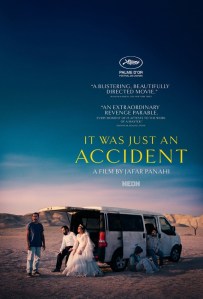
Iranian writer/director Jafar Panahi (The White Balloon, The Circle) is an example of an artist literally willing to put it all on the line for his art. He’s been banned by the authorities of Iran from making movies, and then Panahi secretly made a documentary of himself serving as a taxi driver in 2015. Scanning his filmography, all of his movies after 2000 were either made “illegally” or banned in his home country before their release. He was sentenced to a six-year prison sentence in 2022 and was released shortly after undergoing a hunger strike. Panahi filmed his latest movie, It Was Just an Accident, in secret without knowledge by the Iranian Authority, which makes sense considering how openly critical it is about the regime. It won the Palm D’or, the top prize, at the 2025 Cannes film festival and has been one of the most acclaimed movies of the year. It’s also likely going to make life much harder for Panahi, who was also sentenced in absentia by Iran to another prison sentence for “propaganda activities.” Yet his art persists, and It Was Just an Accident is easily one of the finest movies of 2025 and it’s no accident.
It begins simple enough. A middle-aged man and his family have car trouble after accidentally hitting a stray dog (sorry fellow animal lovers, but at least you don’t see it). They are taken into a nearby garage and that’s where the owner overhears the family man’s voice and then freezes in terror. He sounds EXACTLY like the man who interrogated and tortured him for the Iranian government years ago. Could it be the same man? How can he verify? And if so, what does he plan to do with his possible former captor?
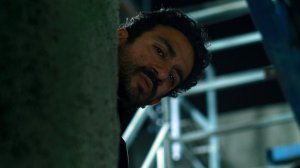
What a brilliantly developed and executed movie this is, taking a concept that’s easy to plug right into no matter the language and cultural barriers, and then to unfold in such contemplative, bold, and unexpected ways. It captures mordant laughter, poignant human drama, and a nerve-wracking thrills. Most of all it’s terribly unexpected. As more and more people get brought in on the kidnapping, and more reveal their personal trauma from their shared captor, I really didn’t know what the fate would be for anyone. Would they kill this man? If so, what would that say and how would they view themselves after? If not, what lessons might they have learned from this ordeal and what lessons might their former captor have learned? It really kept me guessing and because it’s so exceptionally well developed and written, the script could have gone in any direction and I would have likely found satisfaction. There’s even the question over whether or not all these people are mistaken and projecting their fury onto an innocent man. However, I will say, the movie flirts with Coen-essque dark comedy, almost at a farcical level for its first half as these amateurs stumble their way through a kidnapping plot they are not equipped to control (a woman is stuck in her wedding dress for the entirety of these vigilante deliberations). Then in its second half it transitions into a really affecting moral drama about the lengths of trauma and the desire for forgiveness as a key point toward processing grief and preparing oneself to move forward. Even though the circumstances are specific to Iran, the movie is emblematic of accountability and reconciliation, and those elements can be easily empathized with no matter one’s cultural borders.
As you might expect, this is a movie brimming with anger, but it’s not suffused with bitterness, which is a remarkable feat given its subject matter. This is a movie that unfolds like a crime thriller, with each scene unlocking a better understanding of a hidden shared history. Each new character provides a larger sense of a bigger picture of oppressive state control and abuses, with each new person adding to the chorus of complaints. Naturally, many of these victims want to seek the harshest retribution possible for a man who tortured them with impunity. It’s easy to summon intense feelings of outrage and to demand vengeance. The filmmakers have other ideas in mind that aren’t quite as tidy. It’s easy to be consumed by anger, by outrage, that surging sense of righteous indignation filling you with vibrant purpose. It’s another matter to work through one’s anger rather than simply serve it. I’m reminded of the masterful 2021 movie Mass, a small indie about two groups of parents having a lengthy conversation; it just so happens one couple’s son was killed in a school shooting and the other couple’s son was the gunman responsible. It was a remarkably written movie (seriously, go watch it) and a remarkably empathetic movie for every character. It’s easy to pick sides of right and wrong, but it’s so much more engaging, intriguing, but also humane to find the foundations of connections, that every person lives with their own regrets and guilt and doubts. It Was Just an Accident follows a similar moral edict. Every character is a person, and every person is deserving of having their perspective better known, and we are better having given them this grace.

I think the movie is also especially prescient about this time and place in American history. It very well may prove a sign of the future, detailing a populace of the abused and traumatized and the former aggressors who worked for an authoritarian agent and administered cruel violence to cruel ends. It’s not difficult to see a version of this movie set in, say, 2035 America, with a ragtag group of characters discovering a retired ICE agent who they all have an antagonistic relationship with. In many ways the movie is about Iran and its history of an oppressive government turning on its own people, but in many ways it can also be about any system of power abusing that power to inflict fear and repudiation. It’s about a reckoning, and that’s why I think while the movie is clearly of its culture and time it’s very easy to apply the movie’s lessons and themes and larger ideas to any country, It’s all about characters coming to terms with harm and accountability, and sometimes it takes a long time after the fact for the perpetrators to accept that harm has been done, especially if they can fall on the morally indefensible “just following orders” defense. In the near future, will ICE agents, especially the ones who joined up after Trump took office for the second time, argue the same as the Nazis at Nuremberg? Will they rationalize their actions as just fulfilling a job to pay a mortgage? It might even be overly optimistic to believe a reckoning would even occur in the not-so-distant future, not to the profile of the Nuremberg trials but even just an individual accounting of individual wrongdoing. That assumes an acceptance of wrong and ostensibly a sincere request for forgiveness. As I write this, with an ICE officer whisked away to the protective bosom of federal government after executing a woman shortly after dropping her child off at school, it’s difficult for me to even accept that those in power and so eager to impose their bottomless grievances upon the vulnerable and innocent would ever allow themselves to accept the possibility of blame or regret. But then again this is perhaps what the citizens of Iran felt and they’re presently marching in the thousands to protest their authoritarian government in 2026, so maybe there’s hope yet for we Americans in 2026 too.
There is a deliberate sense to every minute of It Was Just an Accident, from its long takes to its interlocking sense of discovery, to the questions it raises, answers, and leaves for you to ponder. It’s a movie that drops you into a fully-realized world with rich characters that reveal themselves over time. If there’s one pressing moral for Panahi, I think it’s that every person matters, even the ones we’re told have less value. This is an insightful, searing, and ultimately compassionate cry for justice and empathy. It will be just as effective no matter the date you watch it, but with a movie this good, why wait?
Nate’s Grade: A
Share this:

The Secret Agent (2025)
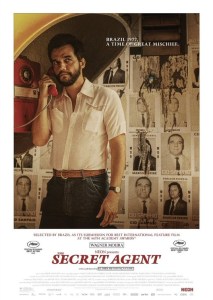 The Secret Agent is a hard movie to fully categorize. It’s set in 1977 Brazil and with its title you might think it’s about some clandestine espionage operation or fighting against a corrupt government, and it does fit those descriptions but not in a traditional Hollywood way. We follow Wagner Moura (Narcos, Civil War) as a former grant-supported energy scientist who comes to clash with a powerful businessman who then hires an assassination team to kill this know-it-all. It’s also about entrenched police corruption and coverups, a found family of people seeking protection and new lives, the search for memory and proof of life, a father wanting to connect with his son in the wake of his mother’s death, and then there’s a running story about a severed leg that goes into the wildest, most unexpected places. It is a leisurely paced movie at almost two hours and forty minutes in length, but each scene is its own luxurious moment to dwell in. Take for instance the opening scene where Moura drives his car to a dusty, rural gas station and finds a dead body covered in newspaper. Nobody wants to come claim the corpse, and then the police do arrive but they take particular interest in Moura, wanting to search his car and ask him questions. Do they know something? Who is this man? A similar early scene involves the police investigating a dead shark where a severed human leg was found inside its mouth, and the way it unfolds and escalates is so naturally fascinating. The Secret Agent juggles many different tones, from nostalgic drama to crime thriller, but every scene is so expertly written and paced by writer/director Kleber Mendoca Filho (Aquarius, Pictures of Ghosts). You may grow weary by its length, but when I was in every scene, I didn’t want it to end because it feels so well-realized in its moment. There’s a subversive switch-out with its climax that reminded me of No Country for Old Men, and the ending coda ties together the flash-forwards and hits hard with the theme of uncovering and honoring the past. This is a lot of movie, much of it I admired more than I outright loved, but it’s such a fascinating balancing act that I would recommend The Secret Agent as a sprawling dive into Brazilian history, culture, and its own political reckoning.
Nate’s Grade: B+
Share this:

Hamnet (2025)
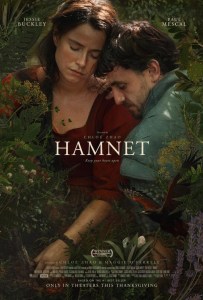 It’s the sad Shakespeare movie, and with Paul Mescal (Gladiator II) as Will, it could just as easily be dubbed the Sad Sexy Shakespeare movie. Hamnet is a fictionalized account of Will and his wife Agnes (Jessie Buckley) processing the death of their young son, Hamnet, which we’re told in opening text is a common name transference for Hamlet. Right away, even before co-writer/director Chloe Zhao (Nomadland, Eternals) brings her usual stately somberness, you know what kind of movie you’re in for. It’s pretty (and famous) people in pain. The entire time I was watching this kid Hamnet and just waiting for the worst. It doesn’t arrive until 75 minutes into the movie, and it’s thoroughly devastating, especially the circumstances surrounding the loss. This is less a Shakespeare movie and more a Mrs. Shakespeare movie, which is more illuminating since she’s typically overshadowed by her verbose husband. She’s an intriguing figure who shares some witchy aspects, communing with nature and even foretelling her future husband’s greatness and dying with only two living children, which presents a pall when she has three eventual children. Once Will finds success as a London playwright, he feels like an absentee father and husband, briefly coming in and out of his family’s life in Stratford. However, the final act is what really doesn’t seal the movie for me. I don’t think it’s really a spoiler to admit the final 15 minutes of the movie is basically watching Hamlet performed on stage, with Agnes as the worst audience member, frequently talking through the show and loudly harassing the actors before finally succumbing to the artistry of the play and finding it a fitting outlet for her grief. In short, the movie is meant to provide more personal insight and tragedy into this famous play, asking the viewer to intuit more meaning (“Oh, Hamlet is his dead son, Hamnet! I get it”), but ultimately the ending is just watching Hamlet. I don’t feel like we get any meaningful insight into William Shakespeare as a person besides his irritation at being a Latin teacher, and frustratingly, Agnes is constrained as well, held in a narrow definition of the grieving mother. This is a shame since she showed such fire and individuality in the first half. Buckley (The Lost Daughter) is terrific, ethereal, earthy, and heartbreaking and a shoo-in for an Oscar. I found her final moments, especially reaching out to her son, so to speak, especially poignant. Hamnet is a good-looking, well-acted movie about sad famous people who then rely upon the arts to help heal their gulf of sadness. There’s not much more to Hamnet than that, but with such exceptional professionals and artists at the ready, it might be more than enough for most.
Nate’s Grade: B-
Share this:

Sentimental Value (2025)
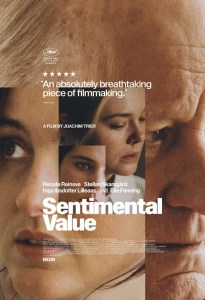
It’s an old cliche to say “they don’t make movies like this anymore,” but with our current media environment, there’s a reluctant truth to the fact that many genres, particularly adult dramas, romantic comedies, and non-action comedies, have declined steadily from their studio heyday. And yet Sentimental Value is also proof against this adage, as this wonderful movie is the kind of engrossing, mature, and thoroughly artistic original adult drama that Hollywood would have positioned decades ago to prominent award glory, like your Terms of Endearment or Rain Mans. I guess the caveat is that Sentimental Value comes from Norway, so outside the Hollywood system, and it’s reminding every movie lover not just of what we’ve lost in recent times with studio output of rich adult dramas, but it reminds us why we love the movies. Sentimental Value is easily one of the best movies of the year and a triumph all around of acting, writing, directing, and editing. It’s so thoroughly well-realized that it feels like we’ve been dropped into the realm of a classic novel brought to stunning life with a level of care, insight, and artistry that is rare to experience in any medium. I knew right away I was in for something truly special.
We begin by tracing the history of a house in Oslo, particularly the Borg family that has lived there for generations going back to pre-World War II. The father, Gustav (Stellan Skarsgard), is a famous film director who divorces his wife when their two daughters are young. The oldest daughter, Nora (Renate Reinsve), grows into a talented but neurotic theater actress, one beholden to stage fright even after all her accolades. Her younger sister, Agnes (Inga Ibsdotter Lilleaas), has married, has a young son, Erik, and she works as a historian researching specifically her grandmother who was tortured by the Nazis. After the death of their mother, Gustav resurfaces in their lives after a long absence working in Hollywood. He has plans. He has written a semi-autobiographical screenplay about the life of his mother, and he wants to film it in their family house, and he wants Nora to play the starring role. The sisters are resentful and wary of their father, but could this entire artistic enterprise be a push for reconciliation and better understanding for everyone?
I’m talking mere seconds into the movie, director/co-writer Joachim Trier (The Worst Person in the World) had already grabbed me with his deft storytelling. A narrator provides the complicated history of this house, treating it like a living vessel that itself has been an observer to the many generations residing within. The details are so precise and telling, like a novel giving you a larger sense of the world that exists beyond the margins of what we can see and hear. To say the movie is a complex family drama is only scratching the surface. Let’s just unpack some of the layers inherent from its premise. Gustav’s world is cinema and he wants to make what might be his last movie his greatest and most personal. He’s telling his story, asking his own daughter to play his own mother. When Gustav was a child, he was the last person to speak to his mother before she decided to take her own life by hanging herself. Think about the psychology at work here, a father trying to reconnect with his estranged daughter through the means of her playing his own mother and possibly better understanding his loss that has haunted him since childhood. Then Gustav also wants Erik, his grandson, to play the younger version of himself in the movie, though Agnes is against the idea. There are so many intriguing layers at play with all of this, the use of art to process grief and trauma, the mirrors of family members portraying other members as engines of empathy, and the act of filmmaking as recovery. I’ll slightly spoil the movie to say that Nora turns down the role. The rest of the movie is about how she gets to “yes.”
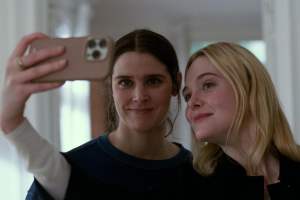
In the wake of Nora’s rejection, Gustav offers the role to an American actress, Rachel Kemp (Elle Fanning), a hot commodity that convinces Netflix to get involved. However, with the streaming giant attached, there are several compromises that Gustav must endure. He intended the project to be in his native tongue but now it’s in English. He isn’t allowed to bring back older members of his crew he’s worked with for decades, like a retired cinematographer who is infirm to the point where he needs to walk around with a cane. With each compromise, you can see Gustav making a mental cost-benefit equation. He envisions this movie as his most important, and possibly his last, and it becomes a gauntlet of what shape it might eventually take to get made and if that shape is too malformed and unrecognizable from his original artistic vision. When you consider this movie could also be his vehicle to better understand his own mother, as well as an amends to his daughters, then every new compromise bears even more significance. Rachel is eager to please a director as well-regarded and as famous as Gustav, but she also recognizes her vulnerabilities and shortcomings. She can’t shake the feeling that she’s not right for the part, that Nora is the rightful pick, and she’s struggling to get a better grip, plus there’s the whole Norwegian accent that she has to master as well. Fanning (Predator Badlands, A Complete Unknown) has a few standout scenes but even she recognizes she’s the interloper to this family.
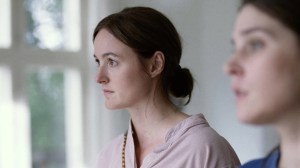
Reinsve has been a collaborator of Trier’s all the way back to 2011’s Oslo, August 31st, but it was her starring role in 2022’s The Worst Person in the World that cemented her international stardom. She’s a wonderfully intuitive and expressive actress, inviting us in with every scene to study her character’s guarded emotional responses and occasional outbursts, like her stage fright hysteria. As the older sister, Nora has built more resentment against their father, whom she blames for everything that her family lacked back in Norway while her father was off in Hollywood making movies with celebrities. Nora is wary about filmmaking, viewing the theater as more of a pure artistic and worthy medium for acting, though you could even view this designation as a division she has drawn: “this is my territory, and that is my father’s territory.” Now he wants to bring her into his world, and she can’t help but be skeptical after all their time apart. Why now? Why this? While this is a splendid ensemble drama with great attention paid to many characters, for all intents and purposes, Nora is our protagonist, and Reinsve keeps us compelled to examine every internal development of this character.
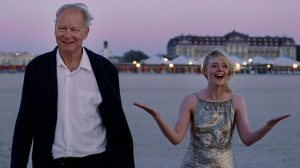
Every actor is at the top of their game, contributing to a marvelous ensemble that makes this family so richly felt. Skarsgard (Dune) is used to playing heavies, stooges, and bad dads, and the role of Gustav allows him to tap into all of those mercurial skills to bring to life a man who is trying to take stock of his life late in its run and make some changes, notably who is allowed inside his cherished circle. Skargsard is mournful but still egotistical, reaching for reconciliation but not begging for it, using the enterprise of the movie and particularly the leading role offer as the unspoken apology. However, Gustav is more than just an absent father, as in the screenplay, by Trier and longtime collaborator Eskil Vogt, he’s also still suffering from his own trauma with the loss of his mother. This movie is an attempt to better understand her and perhaps her psychology that would lead her to make such a heartbreaking decision to end her life. It’s an honest attempt to bring back to life a woman he dearly misses while also discovering a path of forgiveness, while he seeks his own act of forgiveness with his own adult daughters. I told you, there are layers all over this movie.
As the younger sister, Agnes has a more charitable view of her father, and she even acted for him in one of his earlier movies and fondly recalls how warm his attention and affection felt. She’s wary about his desire to have her son, who has professed an affinity for filmmaking but not acting, play the role of young Gustav. She’s worried about her child going through the same level of attachment and disenchantment that she experienced when she was younger and wanting to grow closer to a man who had kept his distance from his family. Agnes’ story is one of uncovering the history of her grandmother, a member of the Norwegian resistance who was taken into custody during Nazi occupation and endured all kinds of torture. Her grandmother is indicative of an entire generation of resistance, and by re-examining one person it provides a larger statement about the sacrifices of those who deserve not to be forgotten, whose memories persist even after the horrors they survived. The movie makes an implicit line between her suffering and eventual suicide but making it a direct line of cause and delayed effect is not so simple. People are complicated by nature, and Agnes fits this bill as well, as demonstrated by Lilleaas’s commanding supporting performance. I think she has what may be the most affecting scene in the movie, a sisterly heart-to-heart that strikes you right in your own heart.
Reminiscent of Ingmar Bergman and Francois Truffaut, Sentimental Value is a richly realized drama with such engrossing and complex characters told in a richly entertaining fashion. There are stylistic touches, like the recurring omniscient narrator, but the movie is more grounded in the simple pleasures of transporting us into the lives of other people and to embrace their flaws and hopes and desires. The actors are incredible and bring such startling life to these characters and their nuances. I could have endured an entire series in this world but at a little over two hours, Sentimental Value feels complete and satisfying. It’s the kind of movie “they don’t make anymore,” to our detriment, so when you discover a film as beautifully executed as this one about the relatable issues that drive many families apart and can bring them back together, then you thank your lucky stars that we still have filmmakers dedicated to making complex adult dramas without any high-concept gimmick to couch their real intentions. This is a marvelous movie about life. Full stop. See it, reader.
Nate’s Grade: A
Share this:

Marty Supreme (2025)
 Marty Supreme is like the Oscar bait version of 2019’s Uncut Gems. Director/co-writer Josh Safdie, one half of the Safdie brothers that literally gave us Uncut Gems, has applied that same panic attack-inducing formula to a more broadly friendly combination of elements (example: this movie doesn’t open on a colonoscopy). Timothee Chalamet plays the titular Marty, a young man in 1952 New York City with a dream of being the best ping pong player on the world stage. He’s so supremely confident of his abilities that he never seems to plan beyond the immediacy. He’s a born hustler, and the majority of this 150-minute exercise is watching him work multiple schemes to gather the funds to secure a plane ticket to Japan. Reminiscent of Uncut Gems, it’s a movie of antic episodic events, with a charismatic but self-destructive lead spinning collapsing scheme upon collapsing scheme, one ending while another begins, and struggling to keep them all spinning and paying out. It makes for a frantic, propulsive experience, and even though there are some shady characters eventually and threats of violence, the stakes feel less dramatic and therefore more accessible to endure for so long. This is the kind of movie where, upon finally getting an item that will pay for that ticket, Marty’s own uncompromising hedonism has to be satiated in that moment of supposed triumph, all for it to get taken away again. In many ways, Marty is his own worst enemy when it comes to actually achieving his goals.
The whole thing is built upon the performance of Chalamet, who dominates the movie. There’s maybe five total minutes where Marty isn’t on screen. It’s a movie that needs a charismatic anchor. Chalamet digs in as the smooth-talking, impulsive, manipulative con man literally looking for his big ticket to stardom. It’s a brash performance of bravado, and it’s easy to get carried away by the actor, or at least intrigued to see how Marty is going to get out of all these crazy jams of his. The whole movie kind of takes a note from its lead to be bold. There’s digressions upon digressions. There’s key supporting roles for Tyler the Creator and Kevin O’Leary, yes, the bald guy from Shark Tank. There’s an opening credits sequence following sperm fertilizing an egg. The last 20 minutes is almost all ping pong action. There’s anachronistic music throughout. It’s remarkable how much of it works, but the frantic, anxious nature of the plotting covers up the hollowness of Marty. Perhaps he’s always yammering because a second of silence could force introspection. I don’t know if this man is capable of reflection, despite what the final image might infer. It’s a wild, whirling, consistently surprising movie that blends in so many characters and incidents to keep you entertained, but I don’t know if, much like Marty, there’s anything deeper under the surface of that desperation
Nate’s Grade: B
Share this:

Bugonia (2025)

A remake of a 2003 South Korean movie, Bugonia is an engaging conflict that needed further restructuring and smoothing out to maximize its entertainment potential. Jessie Plemons stars as a disturbed man beholden to conspiracy theories, namely that the Earth is populated with aliens among us that are plotting humanity’s doom. He kidnaps his corporate boss, a cold and cutthroat CEO (Emma Stone), who he is convinced is really an Andromedan and can connect him with the other aliens. The problem here is that the story can only go two routes. Either Plemons’ character is just a dangerous nutball and has convinced himself of his speculation and this will lead to tragic results, or his character will secretly be right despite the outlandish nature and specificity of his conspiracy claims. Once you accept that, it should become more clear which path offers a more memorable and interesting story. The appeal of this movie is the tense hostage negotiation where this woman has to wonder how to play different angles to seek her freedom from a deranged kidnapper. Both actors are at their best when they’re sparring with one another, but I think it was a mistake to establish so much of Plemons and his life before and during the kidnapping. I think the perspective would have been improved following Stone from the beginning and learning as she does, rather than balancing the two sides in preparation. The bleak tone is par for a Yorgos Lanthimos (Poor Things) movie but the attempts at humor, including some over-the-top gore as slapstick, feel more forced and teetering. I never found myself guffawing at any of the absurdity because it’s played more for menace. The offbeat reality that populates a Lanthimos universe is too constrained to the central characters, making the world feel less heightened and weird and therefore the characters are the outliers. I enjoyed portions of this movie, and Stone’s performance has so many layers in every scene, but Bugonia feels like an engaging premise that needed more development and focus to really get buggy.
Nate’s Grade: B-
Share this:

Wicked: For Good (2025)

To paraphrase a famous debate line, I knew Wicked, Wicked was one of my top films of 2024, and you, Wicked: For Good, are no Wicked. Obviously that’s not completely true as For Good is the second half of the adaptation of the popular Broadway musical, of which only the first act compromised the prior movie released a year ago. The problem was that the first Wicked movie felt complete, and had there never been another second after, it would have served as a fitting and even moving portrait of the unknown back-story to the Wicked Witch of the West and the implied propaganda that would taint the perception of the citizens of Oz. The movie was two hours and forty minutes but it felt extremely well-paced and developed. It felt, more or less, complete, even though I know it was only adapting half the musical. In short, it did too good of a job, and now Wicked: For Good suffers as a sequel because what’s left to tell just isn’t as compelling or as emotionally or thematically coherent as its charming predecessor. Plus, all the banger songs were clearly in the first movie.
After the events of the first movie, Elphaba (Cynthia Erivio) has assumed the mantle of the Wicked Witch of the West and is sabotaging the Wizard of Oz’s (Jeff Goldblum) plans at expansion and animal abuse. Glinda (Ariana Grande) is the Wizard’s public ambassador and the “good witch” to inspire the masses, even though she doesn’t possess actual magical abilities. Glinda wishes dearly that Elphaba will change her mind and decide to work with her and the Wizard. However, Elphaba wants to expose corruption, and the Wizard is at the top of her list of the corrupt and powerful needing to be toppled for good.

For Good suffers from the adaptation struggles the 2024 Wicked film was able to avoid. The first movie was an effervescent treat built upon a poignant friendship and some killer songs given the full showstopper visual treatment. It was a vibrant adaptation, and while it expanded upon the stage show significantly, the extra time with the characters felt like breathing space, and it all contributed to what felt to me like an extremely well paced and well developed and arguably complete movie experience. Now the second act of a musical is almost always the shorter of the two, and For Good is about 30 minutes shorter than its predecessor. The filmmakers even added two new songs for Oscar eligibility and further padding, neither of which are winners (more on the songs later in the review). That sense of care is not present in For Good, as characters are frustratingly repeating beats they already worked through. Take for instance Glinda, who begins the first movie as an entitled popular girl used to getting her own way, and by the end of the movie, she’s grown to see the world differently and through her sisterly friendship with Elphaba, she has a more empathetic and grounded perspective. She has already changed for the better, and yet in For Good it feels like the movie kicks her character growth backwards. She has to again learn that maybe the Wizard and others are not the best people in charge just because they are. Wicked is a victim of its own success. The character development and arc was so well realized in the first movie that Glinda feels like she’s repeating lessons she’s already learned. I also don’t buy Elphaba being seriously tempted by the Wizard’s offer of collaboration after all she experienced and learned earlier. It’s irksome to have the characters seem curiously different from where we left them in 2024’s Wicked. There is also a character relationship revelation that I and many others had figured out FROM THE OPENING SCENE of the first movie. Behold, dear reader, For Good doesn’t even address this until the last twenty minutes of the movie and it does absolutely nothing with this revelation. I was flabbergasted.
The biggest time-waster and padding is when Wicked drags The Wizard of Oz characters and plot incidents awkwardly into its own universe. Granted, the entire enterprise is supposed to be the unknown back-story for the villain of The Wizard of Oz which gives it its identity. Except Dorothy and her lot are not essential at all to telling this story, as evident with the sense that the 2024 Wicked could feel complete. Dorothy and her motley crew of locals, some of whom are made up of previously established characters, are given the Rosencrantz and Gildenstern treatment, meaning they’re primarily kept off-screen and incidental. You don’t even see Dorothy’s face once. These characters feel annoyingly tacked-on and inconsequential to the story we’ve already spent three hours with. They’re knowing nods for the audience and they’re also making efforts to better pad out the running time. I don’t fully comprehend their importance in this new retelling. The treacherous Madame Morrible (Michelle Yeoh) sees the presence of Dorothy as an advantageous development, like she can use her as a Chosen One to thwart Elphaba. It’s never remotely explained why this makes sense. Why this person versus any other Oz citizen? Dorothy possesses special shoes but we’ve seen what can be accomplished with them. They’re not really some superpower or a weapon, more an item of personal attachment for Elphaba she would like returned. In this retelling, the entire inclusion of Dorothy and her friends is a means to an end for a public ruse. It might seem odd to say this Wizard of Oz back-story would have been better minus Dorothy but there it is.

Now it’s time to discuss the actual songs for this movie musical. The best known and most popular tunes were all in the first act and thus the first movie. The songs for For Good are a combination of middling ballads and continuation of the leitmotifs and themes of the previous one. There’s perhaps a bigger emotional current when characters bring back melodies and lyrics from the first movie to expand or contrast, like “I’m Not That Girl.” Did you want another song with Goldblum singing? The biggest number is “For Good” where Elphaba and Glinda face off and admit their shared sisterly love for one another, but again this was already established by the end of 2024’s Wicked. It’s more explicitly stated through song but the sentiment was evident to me already. Adding further disappointment, returning director John M. Chu (Into the Heights, Crazy Rich Asians) lacks the same thoughtful staging of the musical numbers in this edition. He is a filmmaker who innately knows how to adapt stage musicals into the medium of film, and he did so splendidly with 2024’s Wicked. With For Good, the staging lacks a real immersion and visual dynamism, often murky or overly saturated, like “No Good Deed” being performed almost entirely with intrusive sunsetting silhouettes dominating the screen. The less engaging songs, added with less engaging visual staging, make the movie feel longer and less jubilant. I don’t know if “For Good” has the intended emotional crescendo simply because this movie isn’t nearly as good.
As a personal note, the 2024 Wicked was the last movie I saw in theaters with my father while he was alive. We were supposed to see Gladiator II together as a family after Thanksgiving but he wasn’t feeling up to it, and then a little more than two weeks later he was unresponsive. I’m happy Wicked was such a pleasant and enjoyable experience for him, but as we left the theater, he asked me, “Wasn’t there supposed to be more?” We had seen the stage show when it toured through our city many years ago, and I remarked that there was going to be a whole second movie adapting the second act of the musical and it was going to be released in a year. He nodded and I felt the silent acknowledgement shared between us: he would not be around to see the conclusion, that it was a future unavailable to him. So it’s hard for me to not have some melancholy feelings with For Good, and I’ll admit maybe that’s influencing my critique.

Wicked: For Good is a frustrating, disappointing extension of what had been a sterling and magical original movie. It doesn’t outright ruin what came before it but confirms for me that 2024’s Wicked could stand on its own. The songs aren’t as good. The staging and visuals aren’t as good. The character development feels repeated and occasionally confounding. The plotting is stretched and unsatisfying. The inclusion of the more direct Wizard of Oz characters feels arbitrary and unnecessary. The actors are still charming and affecting and sing wonderfully, but they’re also unable to defy the gravity of the material they’re stuck with. If you’re a super fan of the source material, albeit the original story by L. Frank Baum, the 1939 Wizard of Oz movie, the Gregory Maguire book, the 2000s stage musical, or even the first movie, you will probably find enough to sing along to and walk away fairly happy. I loved the 2024 Wicked and was left mostly cold at the concluding half but I realize I very well may be a curmudgeonly minority here. My advice would be to consider the 2024 Wicked a complete movie and skip For Good.
Nate’s Grade: C+
Share this:

One Battle After Another (2025)
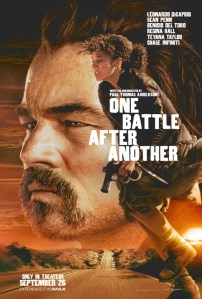
Over his thirty-year career, writer/ director Paul Thomas Anderson (PTA) has developed a mystique and reputation like few other auteurs working in cinema. He’s a visionary filmmaker whose first few movies count among my favorites of all time (Boogie Nights, Magnolia) and whose latter output can leave me shrugging and sighing (Licorice Pizza, Inherent Vice, The Master). My decade-plus-long observational bon mot has been that Anderson decided to make amends for his plot-heavy early movies with more airy, far less plotted vibes-movies. One Battle After Another is something far different from Anderson. He’s making his own version of a $150-million studio action movie, with big ideas and Leonardo DiCaprio as lead (DiCaprio has long regretted passing on Dirk Diggler, still Mark Wahlberg’s acting high-point, so thanks Leo). PTA is using the big-budget storytelling of action cinema to tell something new and personal and politically relevant behind all the gunfire and daring car chases. It’s been dubbed the movie of the moment and perhaps the one to beat for the 2025 Academy Awards. Now that I’ve finally watched all 150 minutes of Anderson’s opus, I’m not as high on it as others but do acknowledge it is a thrilling, engrossing, and occasionally frustrating work from a visionary artist.
Bob (DiCaprio) used to run with a leftist military group known as the French 75. He fell in love with Perfidia (Teyana Taylor), one of the leaders of the group, and together they had a baby, little Willa. Perfidia runs off, unable to settle down, leaving Bob to raise their daughter under a different identity. Sixteen years later, that old life comes back to Bob. It so happens Colonel Steven J. Lockjaw (Sean Penn) had an ongoing sexual tryst with Perfidia during one of their stings. There’s a chance that Willa (Chase Infiniti), now a teenager wanting to live a normal life, is actually his biological daughter. He needs to capture her under any circumstance and possibly dispose of her in order to be admitted to an exclusive white supremacist cabal within the U.S. government. Bob is forced back to action to find and protect Willa but he’s not exactly in the best shape. He’s been a burnout for so long. Can he now be a hero?
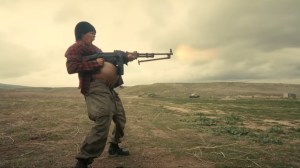
While the movie was filmed throughout 2024, and supposedly has been in the works for over twenty years by Anderson, One Battle After Another feels extremely timely and relatable in these troubled political days of ours (even the title expresses what it’s like to get up and try and process the daily barrage of horrifying news in this Trump Administration 2.0 Era). Anderson’s screenplay, loosely adapted from Thomas Pynchon’s 1990 novel Vineland, proposes a right-wing U.S. government swept up in fascist impulses that is highly militarized and declares war on immigration, rounding up primarily Hispanic men, women, and children and locking them away in camps. It’s also a law enforcement unit that pose as protestors to create a rationale for enacting physical violence and intimidation against peaceful protestors. At the core is a secret society of white supremacists running the show. Short of a concurrent documentary, it will be harder to find a movie more politically topical to the status of life in 2025, especially for the many shaking their heads and wondering how exactly we got here. Pynchon’s original novel was about the transformation of 1960s America to the 1980s, and it feels highly relevant to our 2025 times where there yet again seems to be great upheaval and conflict over those in power operating said power against the governed. It’s impossible to watch One Battle After Another and not think about the headlines. It’s not exactly the escapism many might be seeking. There’s never been a leftist paramilitary group as organized and as successful as the French 75 (they have their own affiliated convent – nuns with guns). The movie isn’t leftist wish-fulfillment to take down the current administration. It’s more a father-daughter battle to reunite in the face of state terror. It certainly has its fiery political commentary, but it’s more a family striving to stay together.
I did quite enjoy that the movie undercuts Bob as our hero, using him more as an entry point into other characters in this story, others who have a much larger impact and prove more capable. The character of Bob serves as a gateway for the other characters to really take over and shine, and it’s smart to use the familiar archetype of the old gunslinger being called back into action past his prime to atone for the sins of the past. We’ve seen this kind of character before, but Bob is kind of hapless and far out of his depth, and it makes the movie so much more entertaining. The rest of the movie exists in a more familiar action-thriller setting, albeit with some fun house mirror edges for pointed satire, but Bob is this bumbling, stumbling dope from a stoner comedy whose been copy-pasted into a different genre. He provided explosives for the French 75 but that doesn’t mean he’s got a wealth of clandestine knowledge and cunning at his disposal, especially since he’s normally inebriated. Now sixteen years later, the archetype would typically have to pull out their old skills that have calcified over a long hibernation, but Bob doesn’t have those skills. When he has an opportunity to take the big heroic shot, he misses. When he has the opportunity to make a daring escape, he falls off the side of a building. When he has to remember the coded exchanges of old, he can’t remember all of the parts. The climax doesn’t really even involve him as he’s playing catch-up for most of the extended conclusion. He’s more like the Big Lebowski waking up in, say, No Country for Old Men and desperately seeking shelter.
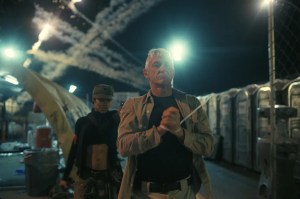
However, Anderson’s empathy for his characters of all stripes shines through, and while Bob is presented as diminished or bumbling, he’s not a complete moron without any redeeming qualities. His most resounding positive quality is his complete dedication and love for his daughter. We’ve seen this kind of story before, the overbearing parental figure trying to drill their child to be prepared for when danger inevitably arises, and the child growing resentful and distant to the parent because of that demanding and limiting home life. Then trouble strikes and the child has to rely upon those seasoned skills they practiced while that paranoid and obsessive adult was ultimately proven right for their unorthodox parenting. Bob’s love for Willa is what has shaped his life for these past sixteen years. He’s the parent who stayed, the one who settled from his old life to take on the responsibility of raising a child as a new life. He’s the one who changed her diapers, the one who shows up for parent-teacher conferences even if it’s to lecture the teachers about the curriculum while lighting up a joint. His love for his daughter is the thing that drives him forward and keeps him going. You feel that love between them, and in the climax of the movie, it becomes something poignant about the connection between these two over such extreme circumstances. There’s an ongoing question over the paternity of Willa but this never for a second changes Bob’s view of his daughter or his willingness to do anything to save her. If he was a Liam Neeson-styled master spy with a particular set of skills, the journey wouldn’t feel as rewarding. With Bob being punched down by the universe again and again but still going, it makes us root for him more.
Penn is completely enthralling as Lockjaw. His danger is never downplayed, and he’s frequently shown as a man who will use his considerable means of power to get what he wants, but Anderson also finds interesting ways to lampoon him and complicate him. I loved that the secret white supremacist society Lockjaw is so eager to join is called the Christmas Adventurers Club. It’s so stupidly anodyne that it sounds like a rejected title for a Boxcar Children novel. The members even pledge, “Merry Christmas. Hail Saint Nick.” It’s so stupid but so are many of the associative slogans of these right-wing groups (I learned the Proud Boys are named after a cut song from Disney’s animated Aladdin, “Proud of Your Boy,” and no I am not kidding). These men are indeed dangerous but they’re also not insurmountable, and I think that’s an important distinction. They’re small, angry, racist men trying to forcibly reshape the world but they are a minority of a minority clinging to power to reject progressive reforms. Lockjaw’s big problem is that he has a tremendous attraction to African-American women, the type of people he should see as inferior. The movie’s momentum is kicked into gear all because Lockjaw wants to be accepted in this special club. Penn is incredible in how he brings to life the snarling contradictions of this man, someone so aggressively challenging but who is also given to gnawing insecurities. Even the way Penn holds his body and walks is an indication of who this man is, with stick firmly planted in rear. He’s scary but he is also stupid, a fine encapsulation of our present political quandary. I’d expect him to be the current front-runner for Best Supporting Actor at the Oscars but it is still plenty early for predictions.

I do wish those engaging supporting characters had more to do besides Lockjaw. Even at 150 minutes, there isn’t much development for Willa to really grow as a character. She’s the target for the chase, and she’s the one trying to understand what is happening as it happens. It would make sense for her to have been the protagonist as she has the most to learn. For far too much of the movie she’s just a passive passenger, being shipped from one location to another. I wish we had more moments to really grapple with her perspective and her shifting opinion about her father and his past. I do enjoy that she’s the real star of the climax but at that point I wished we had seen far more of her resilience and determination and making use of what her father had been teaching her, not simply trading coded conversations. If she is the future, the possibility of turning this world around as someone declares by film’s end, then maybe let’s spend a little more time with her being active and reflective and taking more ownership of her survival. It’s as much her movie as it is Bob’s but he gets far more generous screen time over those 150 minutes.
The same can be said for Willa’s mother, Perfidia. I never found her that interesting as a character. She’s a true-born revolutionary from a family of revolutionaries, but some part of her is drawn back to Lockjaw, whether it’s simply the transactional exchange of sex for protection and assurances, or maybe something more, perhaps the power play of dominance over the very kind of bad men in power she wanted to control. She runs away from a domestic life with baby Willa because she knows she’s ill-suited for it. From there, she gets captured and turns on her former comrades to enter Witness Protection, which she runs away from. I kept waiting for her to resurface in a meaningful way in the story since we’re shown that she escapes into Mexico (Lockjaw lies that he killed her rather than admit she ran off). However, Anderson only utilizes the character as a catalyst, a means of entangling the two men into a paternal showdown. It’s disappointing that Perfidia is reduced to such a nothing of a character when there was much to explore.
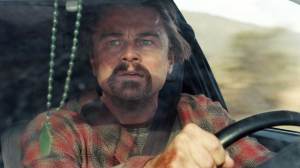
And now comes the part of the review where we talk about Anderson’s bold leap into action filmmaking. He’s not the first prestige indie darling to make a grand genre jump into action-thriller bravado. One thinks of Sam Mendes tackling Skyfall with aplomb, Paul Greengrass with the Bourne series, Patty Jenkins going from Monster to Wonder Woman, Lee Issac Chung going from Minari to Twisters, and of course the big man himself, Christopher Nolan. It can be done with the right filmmaker understanding the key tenets of action, in particular how to connect the various set pieces and conflicts with the characters and their emotional state and chain of needs and priorities. I was impressed with Anderson’s sense of scope and his ability to wring tension. There aren’t really many strict action scenes. Much ink has been spilled on the climactic chase that utilizes a series of rolling hills as the focal point of this battle, and it’s immersive and exciting and different. I’d also be lying if I said I wasn’t a little disappointed by it. This is because this sequence, up until the very very end, is all about one car tailing another. It’s taut and extremely well photographed, but ultimately it amounts to two cars following one another until one clever conclusion. It’s not really a sequence that changes and finds organic complications. It has the makings of a great action sequence but stalls. I thought back to 2014’s Snowpiercer and the sniper shooting match at two different points in the train, where each participant was waiting for the train to curve just so to better facilitate their shot. That was geography as advantage. Overall, Anderson is definitely making his version of an action movie but I don’t feel like he’s fully committed to the planning and development of those sequences. It feels more like ironic subversion when the genuine article would have been more appealing and impactful and just novel.
While One Battle After Another doesn’t rise to the capital-M masterpiece that so many of my critical brethren are falling over themselves to proclaim, it is a good movie with bold artistic swings. It thrums with energy and empathy. It’s probably PTA’s most accessible movie since There Will Be Blood or arguably Boogie Nights. I enjoyed the different characters and the brimming conflict and how much of the movie is grounded on the character relationships and their perspectives. There is a clear command of craft here like every PTA movie. He’s definitely passionate about bringing this world to life, which is eerily relevant to our own politically tumultuous times, but he still finds room for satirical mockery that doesn’t diminish the tension of the villains. It’s a universe I wanted more explanation and exploration, and the most interesting character by far is Benicio del Toro as a humble town sensei who is at the forefront of an immigrant underground railroad. I was never bored and often quite entertained but I stepped away wanting more, and maybe that’s greedy of me or an entitlement of the viewer. One Battle After Another flashes such terrific intrigue and personality that I wanted more refinement and development to better accentuate its mighty potential.
Nate’s Grade: B
Share this:

A Complete Unknown (2024)

I’m not really a Bob Dylan fan. While I can appreciate several of his songs, it’s his voice that has always put me off. An entire movie about the mystique of Dylan and his rise through the 1960s folk scene was never going to be too appealing for me. So keep all of that in mind as I tell you that A Complete Unknown is a thoroughly fine movie with the not-so grand insight that this famous troubadour might just be a talented prick. The end. Director/co-writer James Mangold returns to the musical biopic sub-genre almost twenty years after his Walk the Line (a non-Joaquin Phoenix Johnny Cash has a cameo in this movie too, securing the Boomer Music Cinematic Universe). It all feels very stately and staid and reverent and, especially during its climax, hopelessly quaint. The conclusion is over whether or not Dylan will play music at the Newport Folk Festival that the fuddy-duddy programmers demand. Will he go electric? Will he play traditional folk? Will you care? I suppose it’s about people trying to control and define this idiosyncratic artist who wants to be himself, whatever that may be, whatever feathers may be ruffled by the traditionalist gatekeepers of the folk music scene. This celebration of artistic integrity and creative revolution would mean a little more if I got a better understanding of Dylan as a person. Blessed with audience foreknowledge, we already know he’s going to be successful and that his creative impulses will be rewarded. Timothee Chalamet does a fine Dylan impression and recreates the famous songs with an impeccable nasally impersonation. For my money, I’d rather this have been a Pete Seger (Edward Norton) movie about his passing of the torch from one generation of folk artists to another and recognizing that the culture and peace movement were moving beyond him. Regardless, if you’re a Bob Dylan fan, there’s plenty to like, especially many extended jam sessions. If you’re looking for more than a handsomely recreated Best Of album, you might need to read a book instead.
Nate’s Grade: C+


 nathanzoebl
You must be logged in to post a comment.