Blog Archives
Moondance (2020)

I didn’t even plan on writing this review. I knew of the indie musical Moondance because I was familiar with several crew members who worked on the $500,000 project and watching their pictures on social media, but when I discovered it had been filmed entirely outside the state of Ohio, primarily in Kalamazoo, Michigan, I decided to exclude it from my mission to professionally review Ohio-made indies. As of this writing, it was available on the website Tubi for free with ads, so I started it on a whim to show my girlfriend what I had intended to watch, and then I kept watching, and then I didn’t want to continue but I felt compelled to, and now I feel compelled to dissect this movie as best as I can, even with its tangential connection to the Ohio indie film scene. Moondance is a confounding experience for a lover of big screen musicals because it’s a musical that doesn’t really want to be a musical, a comedy that doesn’t know how to do comedy, and a drifting drama bereft of characters to root for and reasons to cheer.
The story is familiar. We have our boy, in this instance Oscar (Jonah Robinson), a composer suffering writer’s block, and he meets our girl, Abby (Carolyn Rabbers), a dancer. Oscar is instantly smitten and tries tracking Abby down, while his “best friend” Pat (Sam Jones) schemes with his very David Rose-esque assistant Sean (Brandon Stewart) to have her for his own. In between these shenanigans, Cooper Flannigan (credited as “Self”) appears to be a hipster friend of Oscar but also the god of this universe as he routinely breaks the fourth wall and is played by the actual writer/director.
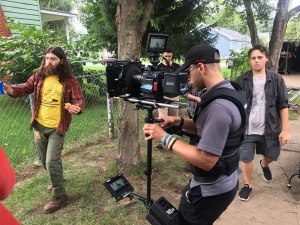
I have to give credit for anyone having the gumption to try and create a low-budget musical. That’s a tall creative order and unfortunately Moondance can’t quite match its toe-tapping ambitions. There are only four songs in the entire musical before the end credits (I’ll get to those later). By the 45-minute mark, I had only experienced one legitimate song-and-dance number and I was wondering if the reality of this movie had simply abandoned being a musical. There are a couple additional dance numbers as one would expect with Abby being a dancer, some set to performances from musicians, but for the first hour there are only two honest-to-goodness moments where characters break out into song. Why is there no opening musical number that introduces the different characters and their different perspectives, stations, plights, goals? That would be an economical way to establish the world and its players. There seems to be real hesitancy onscreen with embracing its musical identity. The musical numbers are meant to give us insight into the characters who can’t help but blurt out their feelings, and yet during the requisite boy-and-girl-on-the-outs part, there is no musical number. There isn’t even a musical number for their growing affection for one another. We’re missing a love theme, and for a romance-heavy musical that’s meant to evoke the feeling of Old Hollywood, that seems like a massive oversight.
The staging and performance of the musical numbers, when they do appear, can also be underwhelming and counter-productive. From a choreography standpoint, much more emphasis is placed on the background players including a superfluous “intermission” dance. There is one number where the key characters do little more than literally ride a bicycle in a circle, and I would argue this is the best number in the film. There is more dancing than singing and that seems the primary reason why Rabbers was chosen as the lead female role. She certainly has talent as a dancer. As a singer is another matter. I feel unkind even articulating this but for a musical it needs to be said: Moondance would have been better off dubbing Rabbers. Her singing voice is just not there. I don’t see any harm to the production if the filmmakers had dubbed her singing. Another issue is that Abby’s dancing feels a bit too chaotic and chaotically edited. There’s a moment of sorrow where she dances out her feelings, but the choreography isn’t conveying the emotions of the scene any differently than a previous dance for us to compare with, and the editing isn’t helping, until it concludes with her pounding a wall in frustration and falling into a crumple on the floor. The camera could have locked onto her face, so as she moved and performed the emphasis was on her emotional state and what the dancing signifies. Whether it’s the lackluster songs, singing, and the nascent choreography that needs to communicate more personality for the big players, Moondance stumbles as a musical.

From a comedy standpoint, let me focus on one small scene that I think exemplifies the pitfalls of comedy construction that Moondance suffers from throughout. We start a scene with Oscar and Cooper at an ice-skating rink watching a curling team practice. Oscar opens the scene by declaring, “22 dance studios!” to tell us he has struck out trying to find Abby, and then for good measure he repeats the line to better establish his bafflement. “What am I supposed to do now?” he asks Cooper, who asks whether Oscar has considered the possibility his dream girl doesn’t exist. “No, I haven’t considered the possibility she doesn’t exist,” Oscar replies, weirdly echoing the exact wording just to hammer this home for the audience. He sees Cooper distracted, sighs, and says, “I’m going to go to the bathroom, or the parking lot or… something.” He then leaves and then Cooper addresses the camera and informs us on the mechanics of the sport of curling. This will never come up again in the entire movie. So, dear reader, let’s deconstruct this scene. It begins with Oscar stating his futility. He repeats his line twice. His friend offers no help, makes a reference to Oscar’s mental state, not a joke but a reference, to which Oscar simply repeats the assertion rather than supply a joke response or anything that can be constituted a response. Because of this, Cooper has nothing funny to build off from, so he asks a simple “what next” and rather than supply a joke that showcases Oscar’s pitiful state, he offers two suggestions, neither of them funny, then doesn’t even provide a third suggestion, instead giving up and not even following the age-old comedy rule of three. From there, Cooper informs us about something that will not matter and is not funny. Why does this scene even need to exist if even the characters can’t be bothered to come up with jokes?
I was dumbstruck by the ineffectual comedy throughout Moondance. This is the kind of movie that has characters devise a stakeout and disguise themselves in bear costumes for no reason. Do they do anything in these costumes? No. The joke, I assume, is that they’re in funny costumes. This is akin to a character walking into a room with a silly hat, and the director saying, “Hey you, look at this comical hat being worn. Isn’t it so unlike normal hats? A normal person would never wear a hat like this. What a cut-up to wear this hat. Are they going to do anything differently because of this hat? Well, no, but what a silly hat, right? Please laugh.” Just stopping at this conception and doing nothing else is not comedy. There need to be setups, payoffs, subversion, running jokes, subversion of running jokes, something, anything. There is a stark sense of desperation throughout Moondance when it comes to its sense of humor. Take for instance a dinner where the group is hob-knobbing but then the girls meet below the table to share their real thoughts under the excuse of retrieving a fallen fork. Why not repeat this setup, making it more outlandish and obvious as you go? Why not present one perception, above table, of the girls, and one below where they are their true selves and confessing distaste? There are moments where it feels like the writer/director just had little grasp on humor and lost track of opportunities. The jokes are rarely accessible; it feels like you’ve entered into a private conversation and are left to put the pieces together. Sean is definitely slotted as “comic relief” but he feels overexposed. I was confused what his relationship was supposed to be with Pat. Is he the assistant, lover, or friend? Eventually I learned that he was Pat’s brother, but why did I have to fight so hard to understand this fact? The writing doesn’t make it easy for the audience to follow along, and this extends to its comedy writing. The fourth wall breaks are tone-breaking but, again, not funny. They feel included just as a fun way to include the crew in the movie, which, again, feels like a private party indulgence. The comedy of Moondance is primarily dormant. It’s over-compensating a lack of funny on the page by asking its actors to dial up their performances, so all the unfunny dialogue and antics now just seem like they’re being performed by crazy people on illicit substances.

If this movie was going for satire, I think it missed it by a wide margin. I don’t know why we have a character with godlike powers and this is treated like a lame party trick. Why not refocus the entire movie from this perspective and have Cooper be the god of a rom-com musical universe, and he’s the only one who knows he’s in a movie, and he’s pulling out every stop to get his chosen guy and chosen girl to get their big happy ending. That way it would play upon our knowledge of genre tropes and bring something fresh, while utilizing the fourth wall breaks as essentially strategy planning and introducing a team of helpers that would see through his efforts. Instead, we get the jovial character of Cooper who strolls around and offers few insights into the nature of romance or the nature of romance movies and our association of them. He feels like a magic hobo. I sense the homage to the Old Hollywood musicals and the big band accompaniment for all those jazz hands and hoofing, but it’s more intention than actuality. It’s going through the motions, and without enjoyable characters and an engaging story, it’s an homage that ends up empty.
My final criticism might be the one that made it the hardest for me to embrace Moondance, and this is how aggressively unlikable nearly all of the characters come across. In a romantic musical, you can have less than stellar singing, dancing, and even songs but your audience needs to care about the people onscreen. You need to feel the desire for them to get together, find their happiness, and at a basic level, you have to enjoy spending time with your core group of characters. Otherwise you’re stuck, and dear reader, stuck is what I felt with these people. I never cared about Abby and Oscar getting together because I never found them to be remotely interesting. Oscar is a bland protagonist. The only thing we know about him is that he writes symphonies. He immediately becomes obsessed with Abby to the point that, even before he ever speaks his first word to her, he declares Abby “his girl” in a creepy act of possession. He’s in love with her but cannot explain why. Would have been perfect for a song there to articulate his new feelings, right? We know even less about Abby. She’s a dancer and wants to save an old dance studio, but anything else? Well during a scene where she lunches with a friend, she has a giant burger as her meal. Does she eat it? No, but just being seen with this pound-plus of beef is meant to do the work the screenplay hasn’t and imbue useful characterization. She’s not some prim “just east a salad” kind of girl, oh no, give her a honking burger. To my best estimation, Abby and Oscar go on two dates (one of which she apparently has harassed a waiter, and this is supposed to be endearing?) so when they part ways before Act Three, this short-lived breakup doesn’t exactly feel as earth-shattering as the characters try to convince us. We’re simply not invested. Rabbers and Robinson (Jack Jonah) don’t have strong chemistry together but it’s not their fault. The script gave them nothing to work with and no points of characterization to better define them as people or make either of them interesting to watch.

The character of Pat is pompous and entitled and I don’t know how anyone would remotely take his involvement in what is angled as a love triangle with any seriousness. He is a terrible character and a terrible person and he just seems to exist in a daydream of privilege. What does he do all day? He buys expensive paintings for his… Rubens parties (again, another point of accessibility made challenging for the audience when this is referenced without context and it took my third stab at understanding what it meant to gain clarity). Later in the film, he monologues to his paintings before setting them ablaze, and it’s played like the mental break of a serial killer, and it’s so tonally off to induce whiplash. Pat’s the cartoonish fop character that would be presented as the rich buffoonish bad boyfriend in any other movie, and yet here he’s supposed to be the best friend to Oscar, yet we see no behavior that communicates their close personal relationship. This is a trenchant problem throughout Moondance, the screenplay constantly having to tell you of something rather than show you. It’s like watching characters thrown into an improv game and grasp for any fragile means of escape from scene to scene.
With all of these words spent in constructive critique, it might seem like Moondance is without notable artistic merit and that is not the case. The photography by Greg Kraus (The Curse of Lilith Ratchet) is well lit and at its best when it has plenty of movement to give a sense of energy that is usually flagging from the page and performances. The smoky jazz number makes fun interplay with shadow to better establish an evocative mood. The musical productions are heavy with big band sounds and brass instruments, enough so that I started wondering if anyone has done a ska indie original musical. The opening segment involves a band performing in a studio space and it was a pleasant experience to set a tone. The musical performances are solid. The musical compositions are competent if unmemorable. I don’t know why the production didn’t just fully go the jukebox musical route with local artists if we were only getting four original songs (though the titular “Moondance” song lyrics were a bit childish, reminding me of the Hokey Pokey). Hey, they got TV’s Adam Conover (Adam Ruins Everything) to be a brief narrator, a role that seems even less necessary when Cooper is breaking the fourth wall repeatedly as a would-be guide for the audience since he’s already our stand-in god.

Moondance ends on a two musical numbers, the first a kind of curtain call on a theater stage that allows every character, including the dry cleaner guy, to get a sendoff and also break the fourth wall. Afterwards, Cooper addresses the audience and acts as emcee through the various departments and crew members who worked on the movie, with the camera moving in and out of rooms with an impressively agile tracking shot, and ending on several spirited dances, one of which serves as the still image on the Tubi page. The problem is that this is, easily, the most involved musical number and it’s reserved for the end credits. I can imagine Cooper and the filmmakers thought they were ending on a high note to say a fun goodbye to their audience, but by reserving it for the end credits that roll over the scene, it makes it harder to read the credits that are spaced so far apart and it makes it harder to pay attention to the song and dance because of the rolling credits. Why not go split-screen? For me, this sums up the misapplied application of Moondance and its throwback ambitions. It’s not whimsical. It’s not charming. It’s not funny at all. There aren’t characters to care about. The musical numbers are too few and far between. The potential hook to separate this, its satirical behind-the-scenes god at play in a musical world, is not incorporated in a vital and clever manner. Moondance is a strange passion project because it’s hard to feel any passion for this story and characters. It pains me to be as blunt as I am but there are too many issues to go ignored. I wish everyone with the production good luck in the future. This will stand as an artifact of bewilderment for me. See it for yourself on Tubi and whether it casts a bewitching spell on you, dear reader, or leaves you just as confused and disappointed.
Nate’s Grade: D+
Share this:

Evil Takes Root (2020)
 A new horror movie was filmed around Columbus, Ohio by a fledgling studio, Genre Labs, and a group of filmmakers who have made other successful Ohio thrillers and is now available for digital viewing on multiple platforms. Evil Takes Root is the most impressive looking and sounding Ohio indie I have seen yet. I mean this in all sincerity when I say it “looks like a real movie.” Even the poster art looks snazzy.
Dr. Thane Noles (Sean Carrigan) is still mourning the loss of his wife Mandy (Constance Brenneman) from mysterious circumstances (vague voice mail, hanging from a tree, black eyes, etc.). His daughter Sarah (Stevie Lynn Jones) is struggling with her grief and befriends a girl, Christina (Reagan Belhorn), going through a similar loss. Christina is desperate to bring her mother back and is doing the bidding of a supernatural presence to make this wish come true. The result is that Sarah becomes the vessel for this evil spirit, a Baitbat, a mythological figure from Philippines’ culture. Felix Fojas (Nicholas Gonzalez) is back in town to investigate the death of Mandy, the woman he still loves after an affair many years ago. Felix is a professor and a big believer in the supernatural, and he strongly believes evil is present and busy in Ohio.
 The production is glowing with professionalism that we associate with larger-budget studio ventures. Sure, you still slightly sense its lower budget in how much bang for your buck we get onscreen, but there are more than enough moments that impressed me from the technical aspects of moviemaking. The sound design is sensational. This has often been the biggest hindrance with local indies, and wow what a difference a professional sound design team can have on a horror movie. The creeping and scratchy noises of the Baitbat and its demonic intonations are unsettling and worthy of a few jumps. A great sound design team can goose any moment into being scarier. The spooky set pieces on their own weren’t imaginative or innovative but the sound design and photography elevated them. On the other side, this is a great looking movie, even with the drained color wash I usually dislike. Director and co-writer Chris W. Freeman (Sorority Party Massacre) knows how to make a horror movie with plenty of pleasing visual compositions by cinematographer Roy Rossovich (Union Furnace). Freeman is ready for a bigger stage, folks. There are a few instances of sweeping camera movements that made me go, “Whoa.” One involves a chase scene in the woods where naked witches run from their bonfire into the dark of the woods to kill an interloper, and the camera moves over the terrain with smooth velocity, and the way the fire illuminated the bodies as they went from one light source to another is simply stunning to watch. If it wasn’t for the topless women, I would expect a shot like that to be in the trailer. The focus levels, the way the camera movements enhance the frame and tension, even the use of a rain machine for mood, it’s all superbly impressive. The editing by Jason Heinrich and Jamie Marsh is great as well and makes the movie feel even more indistinguishable from Hollywood genre fare.
That impressive level of professionalism doesn’t extend to the story, sadly. Evil Takes Root is a very generic story told with very generic characters. I kept waiting for little moments to round them out, little moments to make me think differently about a character, to bring their conflicts into a new focus or coalesce their themes into the obstacles they’re confronting. I was simply looking for more personality than the five stages of grief at work. I can tell you what the characters do, as well as their larger plot designations, but I can’t tell you about who they are as people. There really isn’t one thing terribly interesting that any character does onscreen. They go about the discovery of the supernatural haunting, and then it’s concluded in a way that is anticlimactic in how easy it seems to be resolved. I read on another review that, according to the director’s commentary, that the movie underwent a troubled production and worked to fit footage that was shot many years apart. In that regard, it feels like a consistent product. I can’t see any obvious seams that show I’m watching a movie with significant scheduling gaps. Congratulations. But it also feels like any other small-scale Hollywood genre horror thriller, something like 2009’s The Unborn. Do you remember The Unborn? Do you remember it actually co-starred Gary Oldman? All that technical acumen put toward a mediocre story overstuffed with redundant characters (more on that below) and it’s a shame. The spooky set pieces are too short-lived and lack anything particularly memorable as well. Too much about this movie makes it burdensome to attempt to remember because it’s skating on generic and familiar tropes without leaving its stamp.
 This is disappointing considering I haven’t really seen too many American horror movies tackle the mythology of the Philippines. There must be plenty of fun choices to select for a big screen fright fest and for a majority of Western viewers, it would be a new kind of monster. I desperately wanted to learn more about the Baitbat and what made this creature unique. However, we don’t even know what this malevolent creature is until literally the last ten minutes, and I have no idea why the filmmakers held that from the audience for so long. The Baitbat is the lone thing to better help separate this movie from the glut of other possession/demon movies, so I don’t know why you wouldn’t make it more of a feature and try and tap into that potential and history. The viewer needs to know specific rules related to this spirit and it’s only a hasty exposition drop at the very end where we learn what the spirit is and what it wants. Imagine The Exorcist if you never knew what was going on with Regan until the last ten minutes. The Baitbat is our chief antagonist. We need to know more and earlier in order to make the movie more interesting. The tree root-tenatcle design of the creature is creepy and lends itself well to low-light silhouettes, which makes sense why it was chosen for a cost-conscious production. Other wicked cool Philippines monsters deserving of horror spotlights include a manananggal, a creature that separates its torso to fly, and a tikbalang, a creature with the head of a horse, the body of a man, and the feet of a horse.
There is a shocking amount of redundancy in this story best exemplified by the glut of characters. We have two grieving fathers raising teenage girls, we have two men who loved the same woman who was killed in the opening scene, we have two spiritual figures trying to combat evil possession, we have two teenage girls struggling with their loss of their mothers, we even have three authority figures (doctor, cop, pastor) all inserting themselves into this strange case. There’s so much crossover with these characters and their comparative stories that I’m quite surprised the filmmakers didn’t do some serious collapsing to better prune their narrative. If you’re going to have such character redundancy, you would think you’d highlight their parallel journeys as well as whatever can separate them. This is done to some extent but the differences are usually superficially one-note and never really affect the plot. Take for instance the commonality between Felix and Dr. Thane Noles. Felix was the “other man” in an affair and never lost his feelings for Mandy, though she lost hers for him. Felix blames himself for Mandy’s death but he’s still hung up on her after nine years since their tryst. A smart screenplay would really dive into this character dynamic, two men who shared the love of the same woman, but each should be able to provide insight into creating a bigger picture of this woman. The kind of woman she was with Felix should be different than who she was with her husband, not necessarily better but different. This would then provide a bridge for both men to find a level of understanding through these trying circumstances, not bonding per se but each discovering a little more about the woman they loved, getting to learn something new in her absence. Unfortunately, the film leaves all this drama unfulfilled, using the shared love as merely an excuse why Felix sticks around and why Dr. Noles doesn’t quite like him. Why do we need two spiritual warriors too except for maybe some sort of Exorcist homage? Make these character points matter more.
 The same scrutiny could be applied to both daughters as well. Why do we need both girls vying for screen time and going through the paces of the same story? Because of the juggling, they drop out for long stretches of the movie’s 95 minutes, like right after Sarah gets possessed. You would think that lost time experience, as well as her involvement in a murder, would be an enticing thing to further explore. You would think a spirit taking over her body and getting more oppressive would be a natural escalation with urgency to watch. We’d witness Sarah freak out as she wakes up from more and more shocking behavior. It’s an easy story because it makes sense, watching our possessed schoolgirl lose her mind and body. However, Evil Takes Root only tags in Sarah when it wants to, and this means her ongoing development as a demon vessel is curiously left underdeveloped. In contrast, Christina is immediately the more interesting character because she has a hearing disability and a lingering resentment over her father. Christina is even willing to explore with dark arts to bring her mother back from the dead. Dear reader, I ask you why can these two characters not simply be combined? If one girl is stepping into the supernatural, why not have her as the own affected? Why do her actions need to be carried out on a different character who has a similar back-story but who happens to not personally involve the supernatural to try and bring her dead mom back? Why have Sarah volunteer at a hearing-impaired school when we could just follow Christina at that same school from the point of view of someone who is already hearing impaired? These are the central relationships and characters and yet they could have been streamlined or retooled for more concise and developed drama.
Evil Takes Root is a horror movie that makes me feel stuck in the middle of praise and shrugging. It looks and sounds like a professional movie with real technical acumen, but it’s also a lot of effort to tell a deeply generic story with deeply generic characters and no standout set pieces. The sound design, editing, cinematography, and spindly special effects are impressive and seamlessly blended together. The monster needed more screen time. Nobody should be ashamed to have this movie on their resume, though the screenwriters (the director and the producer) might not feel that same degree of pride. Perhaps the mediocre story is a result of the production problems trying to make dispirit pieces come together into a meaningful and cogent whole. I cannot say. Whatever the reasons, Evil Takes Root is a very good-looking yet methodically generic horror movie.
Nate’s Grade: C+
Share this:

Darkest Edge (2020)
 My pal Ben Bailey hates me reviewing Ohio-produced indie films. To be fair, he doesn’t have anything against the idea of providing critical and professional analysis to local filmmakers on their cinematic offerings. What he laments is how mediocre many of the finished projects end up being and how, in his view, it’s establishing a negative impression that Ohio movies suck. Truth be told, I haven’t found that one Ohio-made indie that has completely floored me. I’ve found several that I enjoyed and others that had elements to be proud about. The thriller Darkest Edge was filmed throughout Ohio and Kentucky and features Ohio talent in front and behind the camera. It’s the feature debut for director Naim David and screenwriter Joe Gribble. It’s a movie that aims beyond its own restricted reach but proves one of the less successful thrillers I’ve seen.
Mark (Christopher Rowley) is a Chicago journalist who is still reeling from his sister’s suicide. He’s on the verge of divorce and never seeing his daughter again, never mind his obsessive drinking. He’s given one final assignment, the closing of a notorious mental asylum in Dayton, Ohio, the very place that his departed sister spent time within. Ellen (Jocelyn Jae Tanis) is his assistant who insists upon being his camera operator. The two travel to Dayton and investigate the asylum, interview wary doctors, and Mark unlocks memories and secrets of his past.

Why is this thing in the middle of the screen?
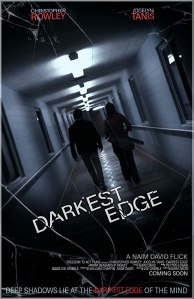
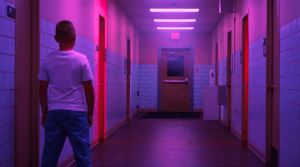
Where this movie runs most adrift is with mood and execution. Look at that poster at the top of the review, check out the description of the plot setup, even judging by the spooky yet unmemorable title (I kept thinking “Dark Edge,” “Dark Corners,” “Darkest Corner” in my head). Even the tagline says, “Deep shadows lie at the darkest edge of the mind.” All of this is setting you, the viewer, to expect a creepy psychological thriller in a creepy asylum and for creepy things to happen. There have been horror movies that have been little more than watching wayward characters haplessly explore a haunted old locale, uncovering its secrets and perhaps its residents, living or dead. This simple plot setup can work as long as the filmmakers can execute their intended mood with aplomb. Unfortunately, Darkest Edge makes a critically fatal error in choosing its creepy locations. To put it simply, this soon-to-be-closing sanitarium is not scary looking in the slightest. The outside looks like a high school building from the 1960s. The inside looks very non-intimidating. There are doors labeled with pieces of paper and an accessible exit door literally within feet of “patient rooms.” While watching, my girlfriend pointed out this very problematic design flaw for a mental institution and I was aghast with that slip-up. The inside of this asylum is also practically abandoned. It’s supposed to be closing soon but there’s still supposed to be patients, evidenced by our characters randomly walking around the facility and finding doors obviously locked. This sense of emptiness will be a prolific problem with the movie (more on that later), but the asylum could have always been closed down and emptied already upon investigation. Another killer error is that almost the entire movie takes place during the day, which only further hampers the scare factor of this already ordinary looking building. It’s like watching people explore an office park and finding nothing. If Darkest Edge was going to hinge so much over a singular creepy location, oh is this place a big miss.
 With the location not exactly hitting the intended mood, I held hope that the central mystery tying to the protagonist’s memory, his occasional alcohol-induced blackouts, and hazy memories of this particular asylum could generate the intrigue that the setting was not. Mark is torn over the suicide of his sister, he’s been drinking so heavily he reeks at work, and this asylum might be the very same one that his sister was held at during both of their youths. Surely there has to be a dark secret afoot, or we’re being set up for some last-minute twist. I started guessing what the twist would be within ten minutes, because Darkest Edge seemed overwhelmingly like the kind of thriller that would roll out a last-minute twist. I thought maybe Mark’s daughter was really dead. My most outlandish, hacky guess was that Mark was really still in the asylum and that everything outside was a figment of his fevered imagination. Admittedly, that would have been an awful ending but it would have tapped into the psychological thriller context of its genre. There isn’t really any sort of mind-bending twist here. There is a revelation but, shockingly, the movie goes down a sentimental route that feels unearned and tonally ill-suited for the prior 75 minutes. It’s such a curious ending and goes against the very setup of this kind of movie. You’re expecting the story to end in a dark, desolate, traumatic place. If you want catharsis, you got to put in the work as a storyteller.
Unfortunately, a word I seem to find myself using often here, Darkest Edge doesn’t provide a compelling personal mystery for the audience. Mark is a boring character. He’s troubled and haunted in a general sense but the screenplay doesn’t give us anything too specific. Yes, his sister kills herself and he feels some guilt over this, but the entire movie doesn’t provide insight into the sister character or their relationship. If he’s so hard up over her death, you don’t feel why. He’s a sloppy drunk, and if you made a drinking game where you took a drink every time you saw Mark drinking, or holding a bottle, then you would black out just like Mark. It’s his lone defining characteristic and it is given again and again and again. Strangely, Mark will black out and find himself transported to distant locations, like thirty miles away from where he was (the movie, weirdly, makes sure we know the mile distances between specific Ohio cities). You would expect this would be a clue about some larger context, a deeper meaning for the torment plaguing our protagonist. Well your guess is as good as mine because ultimately those blackout long-distance travels don’t get clarified at all. For Mark to function as a character, he needs more specifics, especially when it comes to a trauma. He needs a specific fear or tragedy that haunts him and resurfaces with his trip to the asylum. We get what appear to be flashback snippets of a little boy exploring the interior of the asylum (apparently it was also just as easy to wander back then too). It’s all too vague and poorly explained, forcing the viewer to extrapolate connections and meaning. By providing a specific trigger and goal at the start, a viewer could watch Mark journey through his trauma rather than having to guess at it and its implications. I assume this was designed to make Mark’s personal history more enigmatic, but mystery only really works when you’re invested; otherwise it’s just obtuse, and that’s what we have here with Mark and Darkest Edge.
 The reality of Darkest Edge is hard to take seriously, and part of this is affected by the limitations of the low budget and certain filmmaking choices that accentuate those. Just because a movie has a low budget doesn’t mean it can’t succeed or utilize a clever creative ingenuity to tell its story and entertain. If you want to tell a creepy story about exploring a creepy location, choose a genuinely creepy location, and shoot it during night time to build an effective atmosphere. Use shadows to your advantage and play up the worry of what may be around the corner next. Build that sense of compounding dread. Walking ordinary hallways during daylight hours is not making your movie scary unless people are encountering weird events or threatening folk, neither of which happens here. There are some doctors hiding extreme methods but these methods are questionably vindicated by the end. There needs to be a clear threat and for the far, far majority of Darkest Edge there isn’t and this results in the movie feeling meandering.
The technical elements can be distracting and disappointing. The fuzzy sound design is a noticeable shortcoming, often dampening from shot-to-shot. The extreme lack of background noise is unmistakable and makes the movie feel like it was filmed in a space capsule. This, coupled with the lack of background activity and extras, makes the movie feel borderline like a Twilight Zone episode where there are only five or six people left on Earth. The limits of the reported $7500 budget are also felt with the shot selections; frequently a scene will just bounce between two set shots, locked into a plodding shot-reverse shot rhythm. There are dramatic moments that are kept at a distance when a closer shot was begging to showcase the actor’s emotive powers. It leaves an impression that the production was pressed for time to get editorial coverage, and it feels like actors were often filmed at different times and cut together for conversations. There is very limited lighting overall and the photography quality is also a step removed, so why not make this entirely a found footage film? That would have allowed the limitations of the production to be an acceptable part of the presentation. The music is also far too loud at points, drowning out the dialogue, and far too generic without establishing a sense of foreboding. I kept scratching my head at the artistic choices, which routinely magnified the budget shortfalls rather than making decisions that would better compensate instead.
 The acting is mostly fine especially since the actors haven’t been given much to work with. The characters are boring and have one trait they get to rub down to its nub. Rowley (Primordial) has a beaten down, hangdog expression that works well. Most of the times he’s either playing hungover or short-tempered, and without a stronger personality, it’s easy to start mentally checking out with his character. Tanis (Lilith, Cinestudy) delivers a performance that manages to mingle ambition, naivete, and a barely concealed contempt for her colleague. She had so much more potential to explore and I wish we spent more time with Ellen rather than watching Mark get drunk for the twentieth time. Anthony Panzeca (Dodging the Bullet) plays an orderly at the asylum and makes a warm impression. His performance is the closest to unveiling charm in a cast regularly acting confounded or irritable. There’s a Dayton journalist that is such a confusing character for me. She buddies up with Mark by opening up her archives of news collections on the asylum. She then asks Mark what he’s found… in her own news archives? Shouldn’t she already be familiar with what she has?
Darkest Edge is not the movie the poster, tagline, or even setup proclaim it to be. It’s not really a thriller, let alone an accessible psychological thriller, and it’s not really a horror movie. It should be creepy given the setting and its supposedly sordid history, but too much of this movie is kept vague and obtuse, failing to give the audience a reason for watching. The characters aren’t that interesting or complex or compelling and their traumas are kept too unspecified to engage. If it was going to focus on the mental torment and troubled history of a troubled man, the script needed to make him more dimensional and his issues more central to the events unfurling. Tone-wise the movie doesn’t work or build a sense of momentum. It’s hard to make a scary thriller/horror movie when nobody looks like they’re scared, and that’s for good reason considering the settings are more mundane and plainer than skin-crawling and disturbing. I feel bad saying so but Darkest Edge is really a boring jaunt along empty hallways. Even if you’re an overly generous fan of this sub-genre, there is little to engage with during the padded 80 minutes. The most frightening aspect isn’t the haunted asylum but botching a go-to scary setting.
Nate’s Grade: D+
Share this:

The Curse of Lilith Ratchet (2018)
 At its core, The Curse of Lilith Ratchet is a low-budget horror movie stuck between two paths of entertainment and sadly reaching neither. It could have been a genuinely good horror movie, one where its concept begets creative ingenuity, like a Lights Out or Final Destination, where the set pieces are well developed, the characters are interesting and meaningful, and there are pertinent themes linked to character to make the horror more immediate and impactful. Or it could have gone a completely different route and declared itself a schlocky horror movie, owning a trashy flair of fun while doling out exploitation elements of sex and violence to provide the prurient thrills of genre satisfaction. Unfortunately, Lilith Ratchet isn’t good enough to be legitimately good and it’s not knowingly bad enough to be particularly entertaining. It’s just another disappointing low-budget horror movie with too little thought given to its story and characters and horror sequences.
A group of friends steal a shrunken head belonging to the notorious Lilith Ratchet, a Civil War-era woman who murdered her cheating husband with an axe and was then killed herself. She would curse anyone who would say her name and attached nursery rhyme. Alice (KateLynn Newberry) and her pals offer the famous head to popular paranormal radio host, Hunter Perry (Rob Jaeger). He broadcasts from a dance club for a special Halloween show and brings in volunteers for a game of hot potato with the shrunken head (again, this is designed for an auditory medium, which doesn’t seem wise). The evil spirit roams the Earth, striking down in order those who held her shrunken head, and Alice scrambles for a potential way out.
 Here’s an example that hits both areas I cited above as it concerns that middle ground between well-developed horror and schlocky camp (mild spoilers I guess). Our first Lilith Ratchet victim, after the prologue, is abruptly run over by a car. This news does not reach his girlfriend, Lauren (Brianna Burke), until Alice delivers it in person, which seems beyond bizarre to me. Side note: cell phones do not seem to really exist in this universe. They do appear every so often, but when it comes to reaching others during times of crisis, or distributing key information, nobody picks up their phone to dial or text. They instead wait to hear face-to-face, and that consistent delay of communication breaks the tenuous reality of the movie. Writer/director Eddie Lengyel (Scarred, Mother Krampus 2) might as well have set the film during the 1980s or beforehand if modern technology matters so minimally. These characters are still talking about a popular radio show; not a viral podcast but, an alternative radio show. It doesn’t quite feel of today.
Back to my example, Lauren is informed her boyfriend has died. She retreats indoors to take a long bubble bath. She doesn’t exactly seem too broken up after her immediate response but hey we all grieve in different ways. Now, considering we’re dealing with a supernatural presence, why not take the form of the dead boyfriend? This would make the encounter more personal; the spirit could dig into Lauren’s suffering and perhaps any feelings of guilt, it would be an opportunity to open her more up as a character before her inevitable death, and it would simply be more interesting. Sadly, the film doesn’t go this route. Instead, she lounges in her bathwater and oblivious to the Big Scary Lady walking around the room. Then she’s violently pulled into the water and released, and this happens maybe four times. I don’t know about you but if I’m being yanked by a malevolent spirit in my bathtub, I’m getting out of that tub quick. Lauren leisurely tries to catch her breath. So, if we weren’t going with the more character-focused and developed death, then we should go for something memorable or truly horrifying. Instead, we get a woman being pulled under her bathwater and it happens three to four times. It’s not interesting and it becomes repetitious to the point of unintentional comedy. It’s also a bathing kill that veers away from T&A or anything too tawdry, which means it fails to register either as effective, engaging traditional horror and as schlocky, fun, campy horror. It just made me think of the obvious homage to Nightmare on Elm Street and then it didn’t offer anything more.
 Even with its low budget, that didn’t consign The Curse of Lilith Ratchet to certain doom. The problems begin early when it comes to establishing its universe and its rules in a way that feels consistent and credible. The script requires plenty of sloppy exposition and a questionable structure of this information. We should know the rules of Lilith Ratchet early to play along. It isn’t until over an hour into the movie where the characters even piece things together. There are also scenes that have no need to exist or their placement is questionable. Do we need a scene where the characters chat with a local shop owner who warns them about his open “not for sale” display? If we cut that scene, then it presents the characters as more devious when they explain how they obtained the shrunken head. When we do get the Lilith Ratchet back-story, we get it twice, first when Hunter is presented with the shrunken head and then second on his paranormal radio broadcast. Why not condense this into one experience? Why not even open with the back-story, then pull back and reveal him on his radio broadcast, and then from there have the characters on his doorstep with the shrunken head, knowing from the broadcast he was a fan? That’s a cleaner structure. There is a weird plurality of scenes of people consoling Dylan (Roger Conners), but it’s always someone informing you after-the-fact about relationships. I didn’t know he was best friends with a murder victim, and now everyone on the street wants to console him like he’s an unofficial mayor of the city. It’s storytelling that’s trying to fill you in on significance after it matters. If you’re going to be late giving us information to understand the characters’ emotional states, don’t bother.
As a horror movie, there are too many moments that are expected. It feels like we’re running through the motions to include certain moments because they’re expected. The opening prologue introduces a threat and some mild gore, but the massacre of this sorority doesn’t have any larger ramifications for the entire story. We see some of the dead girls, which means that Lilith Ratchet can indeed take the form of the dead, but they don’t act too suspiciously. It’s simply a quick visual cue for the audience not to trust these onscreen women. If she can take this form, I wish she had done it more often, especially as people started getting dispatched. The opening also has what might be the funniest moment in the entire film. One of our sorority girls sees the evil spirit, runs upstairs, hides in her bathroom without locking the door, climbs into the shower as a meager form of protection, and this is even funnier because the shower is a clear glass door. I don’t know what she was expecting hiding behind a completely transparent cover in an accessible room. Are we supposed to ridicule this person? I don’t get the sense anything is done for laughs. Likewise, there’s a preponderance of jump scares in place of cleverly designed set pieces of terror. There’s nothing tailored toward Lilith Racthet’s personal history to make it her feel more than a generic haunt.
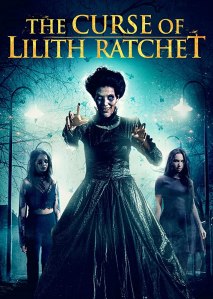
 The real star of the movie is Lilith Ratchet and the actress behind the spirit, Crissy Kolarik (Mother Krampus 2). It’s rare for a horror movie to not just create a spooky creature but to even create an affecting silhouette, something easily identified and quickly felt. Lilith Ratchet is a great looking creation. She’s in a flowing Gothic gown, her clawed fingernails stretched at her sides, her Victorian era hairstyle and pale face. It’s a creepy image and Kolarik has a really strong sense of poise and presence as she patiently stalks the sets, enough that I was reminded of The Nun, another immediately creepy specter with a clearly identifiable silhouette. The backlit moments that highlight Lilith’s shape also have an unsettling impact. I wish that this evil spirit had a more interesting story to utilize this actress and setup. While the movie never calls for her to do anything terrible different, Kolarik excels at being the big bad boo and glaring menacingly.
Under its DVD release title, American Poltergeist: The Curse of Lilith Ratchet is a bit misleading considering she’s not a poltergeist. Or a demon. Or much of a ghost really. She’s kind of a walking idea, a version of the Bloody Mary urban legend. This lack of clarity and personal alignment is symptomatic of the movie as a whole. It’s certainly not a bad looking movie for its reported $15,000 budget. It has professional lighting that establishes a mood and solid makeup and gore effects, and even the score can have its draw. The acting is acceptable even with characters absent goals, dimension, or general points of interest. I have seen far worse movies with far bigger budgets. What I’m getting at is that The Curse of Lilith Ratchet had effective and appealing technical merits and a capable cast that could convey dismay and confusion. It had a starting foundation that could have delivered had they been given a good and interesting story. Alas, the screenplay feels too unfocused, sloppy, overcrowded, and lacking in direction and escalation and personal stakes beyond the obvious. We’re talking about stuff like an extended sequence of hot potato with a shrunken head for a radio show. If you’re not going to make smartly designed scary sequences, then perhaps try your hand at making a campy, gory, silly, knowing movie. The tongue-in-cheek version of this movie could have been a blast. The Curse of Lilith Ratchet is a middling horror movie that just comes and goes, leaving little impression other than a lingering sense that somehow it should have been better.
Nate’s Grade: C-
Share this:

Killer Raccoons 2: Dark Christmas in the Dark (2020)
 Dear reader, I already know what your first question is regarding the title of this low-budget, schlocky comedy, and yes, there actually was a first Killer Raccoons movie. Back in 2005, writer/director Travis Irvine and his pals made Coons! Night of the Bandits of the Night for only $5,000 and their slasher killer was a team of trash-eating, nocturnal mammals with a bad rap. It got a small DVD release from Troma Studios and would be considered a success by any modest standards of genre filmmaking. For whatever reason, Irvine decided he had more raccoon-related mayhem to indulge and got his friends back together to make a sequel 15 years later. Filmed throughout Ohio in 2018, the end result is Killer Raccoons 2: Dark Christmas in the Dark (it seems in the ensuring decade, somebody wised up about not having “coons” as a title). As with other Ohio-based indies, I do happen to know several people involved in this local production but I will be doing my best to write an objective, bias-free review of… a killer raccoons movie. That might be one of the most absurd sentences I’ve ever written in my years as a film critic.
Ty Smallwood (Yang Miller) has just gotten out of prison after the events of the first film. He’s looking to start a new life, prefers to go by Casey, and has plenty of people unable to recognize him (it’s a different actor from the first film). Casey is meeting Darlene (Evelyn Troutman), the little sister of one of the women killed at that fateful campsite 15 years ago. They’ll better get to know one another over one long train ride home for the holidays. Ranger Rick Danger (Mitch Rose, also a different actor) has other plans. He and the other surviving members of the summer camp have hijacked the train with help from raccoons wielding automatic weapons. Ranger Danger plans on holding the nation’s government hostage (the mayor of their small town is now the Secretary of Defense) with a super phallic death laser satellite operated in space by trained raccoons (why? Who cares?). Casey teams up with a steward, Double A (Ervin Ross), and they go car-to-car trying to rescue passengers, evade armed raccoons, and thwart Danger’s evil catastrophic plans.
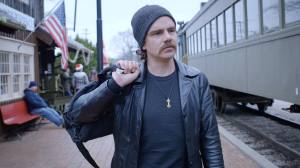 Somebody actually went and made a schlocky beat-for-beat parody of 1995’s Under Siege 2: Dark Territory, and I have yet to process whether this is a commendable act of unusual comedy obsession or simply a folly with no real appeal but to the smallest of fringe audiences. The Under Siege sequel was another Die–Hard-in-a-place setup happening miraculously again (this time on a train!) with Steven Seagal as its leaden lead, so devoting the plot structure to reminding people about the existence of this movie and its many low-points seems, in some sense, like the kind of hyper-specific meta ironic comedy you’d find in an Adult Swim special. In my own comedy writing, I rekindled an old TV series from the 90s that was unceremoniously cancelled after eight episodes (The 100 Lives of Captain Black Jack Savage), leaving its 100-countdown mission unfinished and dangling in my mind until I wrote my own conclusion. Re-examining some forgotten relic of personal pop-culture, especially something built around silly and stupid, is a fine starting point for a comedy riff. However, the expectation is that more will be done than serving as a reminder of that inspiration. If you’re simply re-creating the beats of the source to completion then what exactly is the point? Nobody needs a crummier version of an already crummy movie. That’s where Killer Raccoons 2 goes awry. It’s so committed to recreating Under Siege 2, including exact character roles, names, and many dialogue repetitions, that you could have removed the killer raccoons completely. I even started watching Under Siege 2 again for this review simply to determine if the pixelated spy camera nudity used in the opening to demonstrate the satellite’s telephoto prowess was exactly the same stock footage used in the actual movie (they are separate people; you’re welcome, world). Killer Raccoons 2 is more an inexplicably fixated parody than a goofy killer animal comedy, and that is a major letdown of imagination.
Let me give you an example of the disappointing complacency of too much of the comedy. The hijackers (all sporting an eye-patch, a stylish motif I did enjoy) are trying to find Darlene among the passengers since they now know she has value with her relationship to Casey. Darlene says she’ll adopt a disguise and she literally arranges a strand of hair to lay across her face like a fake mustache. Now this is a silly, obviously transparent disguise but it shouldn’t be the end of the joke. A better extension would be since we expect it to be so flimsy that it somehow works and the hijackers cannot tell the difference. Then the hair strand could drop and the hijacker would express immediate confusion and alarm, only for Darlene to place it back in place, and the hijacker’s worry replaced yet again (“There was another woman just here.”). It’s one idea but it’s an idea, building off subverting expectations and then developing the setup to build into something more. The problem with Killer Raccoons 2 is that there aren’t any real comic set pieces, no really well-structured scenarios that can make you smile from their very inception about what will transpire. The closest is an improvised fight with whatever household kitchen items are available, at one point pitting waffle maker against waffle maker. Much of the humor is so obvious that the obvious nature is itself the joke, like the chintzy special effects, bad wigs, and copious amount of penis jokes (the deadly satellite is named the “PEN-15”). However, there’s a fine line between an obvious joke being funny and the filmmakers pointing it out. There are too many times where characters literally explain jokes or point out the absurdities.
 This is a 96-minute comedy when, in all honesty, it could have even been pared down to 80 minutes. The pacing can feel slack and many confrontations can stretch on, circling the same obvious joke. Even moments that work, like the improvised fight, go on too long and without sustained energy. There are way too many plot beats from Under Siege 2 distilled here (the Seagal movie is only a couple minutes longer). There are too many characters involved in the action too. I’m shocked how much effort Irvine has gone to in order to bring characters and story points from the original into this unexpected sequel. It’s been 15 years so I can’t imagine there was much demand for fidelity to not just Killer Raccoons 1 but also Under Siege 2. The most useless character is a painfully protracted cameo by the likes of aging porn star Ron Jeremy. I understand the appeal from a marketing standpoint of having a celebrity “name,” but the movie would have been better served with Jeremy making his contractual appearance and then hastily departing. The movie’s humor dies a tragic death every strained second he is regrettably onscreen.
As a hit-or-miss comedy, there are moments that had me genuinely laughing, mostly because of the exuberance of its go-for-broke cast. There were repetitions that would occasionally make me giggle, like referring to Darlene’s “dead sister he lost his virginity to,” or the emphasis on “for real dead for real” with characters always surviving insane mishaps through two movies. There are the occasional moments were a sudden escalation in violence against the raccoons got me to laugh. When the film is being silly, it has a charm where the goofiness and cheap budget enhance the entertainment value (“While this spoon appears to be harmless, it’s actually really super-hot”). Take for instance Ranger Danger furiously typing in the air but with no keyboard present. The sight itself is good enough to earn a quick goofy smile, but if the movie were to comment upon it, then the joke would just seem ruined. It’s that character that, by far, brought me the most laughter. The character of Ranger Danger is a twangy hoot chiefly because of the comic timing and impressive gusto of debut actor Mitch Rose. He takes okay jokes and adds such professional polish that got me to laugh out loud (“A gazillion dollars?” “I just… look, I made up a number”). Several of his line deliveries are pure wonders (everything about the golden VHS tape he so reveres), and he’s the kind of capable comic actor that could be the anchor of a bigger vehicle. Somebody get this man more work in the funny industry, pronto. Yang Miller (Huckleberry) is also deserving of praise by playing his self-serious loner hero so serious that he’s oblivious to his own ineptitude.
 I don’t have to over-complicate this. By its overly verbose title alone, you’ll know if you have any interest in Killer Raccoons 2: Dark Christmas in the Dark. It’s a goofy comedy that’s proudly low-budget, lowbrow, and low on ambition. It’s a sequel to a movie nobody likely saw, religiously parodying an action movie that hardly anyone remembers, and it’s filled with little raccoon puppets that could have easily been ditched for what they add to the overall comedy. I’m a little shocked there aren’t more tasteless exploitation elements present, like gratuitous nudity, over-the-top gore, and more envelope-pushing crude humor. Killers Raccoons 2 feels decidedly juvenile but not quite transgressive. It’s not going to be a great experience but the hits might outnumber the misses, especially if your sense of humor is attuned to the likes of schlocky Troma movies, Conan O’Brien, and late-night Adult Swim. It’s that combination of trash and irony that can prove blithely appealing, though I wish Irvine had put more effort into his comedy compositions. It feels weird to lament what could have been with a title like Killer Raccoons 2, but this just could have been funnier. A strange side note is that Irvine ran as the libertarian candidate for governor in Ohio in 2018. There’s a lazy joke to be had about him running the government the way he makes his movies, but I’m not going to stoop to that level. That’s for Killer Raccoons 3.
Nate’s Grade: C
Share this:

Union Furnace (2015)
 As an Ohio-based film critic seeking out Ohio-based indies to provide professional reviews for, I had to be asked whether I knew Nicholas Bushman, and the name was completely foreign to me. Bushman was born in Columbus, dropped out of school at 16 to make movies, and has four features and counting to his name. His IMDB bio even declares, “Bushman has announced himself as one of the most promising voices outside of the Hollywood establishment.” Take that, anybody making movies in New York City. I kid but I was excited to discover a new Ohio filmmaker who has found a level of success on his own terms. I watched his 2015 thriller Union Furnace because it was filmed in southern Ohio, and parts of Columbus, and also because my girlfriend’s mother knew some people linked to the movie and had a DVD copy available. It’s a low-budget, scuzzy little thriller that forces the viewer to ask how far they would go for a buck.
Cody (Mike Dwyer, co-writer with Bushman) is a car thief whose life is spiraling out of control. He comes across a mysterious stranger (Seth Hammond as “Lion Mask”) with a tempting proposition that could solve his money woes. Cody agrees to enter into an underground series of betting games. He’s blindfolded, taken to a woodsy location, and finds himself competing with seven other strangers (this includes Keith Freaking David). They’re trapped, staring down a crowd of creepy mask-wearing gamblers, and the implied threat only one will survive.
 There are three clear paths to do a movie like Union Furnace: 1) deliver characters worth rooting for through these trials and tribulations or at least characters with secrets who might not be as they seem, 2) deliver really fiendish and degrading games and tests that a viewer can think alongside and imagine what they would do if given a terrible choice of terrible options, and 3) slowly unravel a mystery of who is responsible for the games and what their motivations are. It’s even further disappointing that Union Furnace doesn’t really do any of these. Let’s go path-by-path and analyze where the film’s storytelling shortcomings hamper its development.
It’s really hard to find any interesting character to emotionally engage with here. Perhaps they’re meant to be kept at a surface-level to adopt the perspective of our lead, Cody, as he too is trying to figure out who these people/competitors are over the course of one hellish night. If that’s the case, which I think is cop-out reasoning, then we need more careful attention given to Cody as our protagonist. He’s the main character of the film and the only person we follow before the fateful games, and it feels like he has material that could be utilized to make him a better formed character. He’s in debt, he’s stealing cars from church parking lots, he’s been in trouble before, and he might have a drug addiction. That’s a fine beginning for a desperate character, but what does it add to the overall narrative once the games actually begin? Sadly, too little. I was waiting for the games to have an ironic personal connection to the struggles of Cody, like maybe something relating to renewing an addiction that would make him question his limits. I suppose you could be overly generous and say Cody wanting the money for himself and then thinking of others is a character arc, but that’s too broad and unearned because of the lackluster supporting characters. Too many of these characters get whisked away too quickly to make much of an overall impression. Not having any character to really root for, or emotionally connect with, is a miscalculation considering the other miscalculations in narrative construction.
 We’ve seen low-budget thrillers and horror films with similar premises, like Would You Rather and Cheap Thrills and even Saw, that present the audience with a garish game to play along. It’s part of the appeal of these kinds of movies, envisioning yourself onscreen and what you’d do. Take the simple games of Would You Rather that involve harming yourself or harming another person, taking an awful punishment as-is or the potential mystery option that could be worse. Those kinds of scenarios allow for characters to open up for an audience, show us who is selfish, who is squeamish, what their personal morals and ethics can be when tested. The games need to be conversation-starters above all else, and that’s where Union Furnace misses. I looked at the running time and an entire HOUR passes before any of the seven games crosses into being something truly intriguing or stomach-churning. For the majority of the running time, the games are obtuse versions of what feel like childhood schoolyard games. The first game is literally playing a board game. There’s also a game of who cannot speak and even musical chairs. It’s not like these simple games have been given a sharper edge, like the chairs in musical chairs each have a knife propping out from the seat, so lunging and fighting for that coveted seat could turn very precarious (actually, maybe I will write that musical chairs horror film after all). There’s a level of obfuscation that also harms the sinister impact of the games. Some of them are unclear exactly what the contestants should even be aiming for. A late one seems to involve forced sexual contact, and it’s played in a restrained manner out of taste, but by leaving it so unclear it actually minimalizes the impact of its degradation. These games are fairly lame.
And lastly we have the revelations pertaining to our mask-wearing organizers and their betters, and I hope you’re also ready to be disappointed. The ringleader in the lion mask lacks a strong personality or menace to be truly memorable or to keep our attention as a nefarious emcee. Besides Cody, we spend the most time with Lion Mask but do we gain anything? The dialogue is obtuse and later conversations between Cody and Lion Mask feel like they’re holding two separate conversations, talking past one another than learning from the other. Take lines like, “You wandered wide the primrose path and found friends in Night Alley and Circus Surprise City” and, “You know, people are critical because they want to get something off their chest, because they want to put something in their heart.” Huh? There’s not exactly anything that forms into a specific point of view for this character that helps to drive his actions. He’s more or less just a performer revving up his crowd of gamblers. I was hoping we might get more of a history behind the organization and its rumors of traveling from economically distressed small-town to the next small-town, like a deranged carnival sideshow. There isn’t enough here to justify being this vague. The sense of discovering as it pertains to identity and mission are unimportant. I suppose there can be power in the idea of your neighbors possibly being behind dime store Halloween masks, ready and waiting to bet on your life if given the opportunity, but the dramatic potential is much higher if you actually do something with that rather than keep the organization vague.
 Being a low-budget thriller, Union Furnace does have technical merits worth bragging about. It’s a professional-looking movie and has some of the best sound I’ve heard from an indie production, which is usually a cumbersome handicap to many smaller movies. The filmmakers use their limitations to their advantage in artistic ways. I was expecting a limited location thriller but the grimy basement-esque dwelling adds a really effective discomfort for everything. The cinematography by Roy Rossovich (Evil Takes Root) makes smart use of lighting to make everything feel even more seemly, so exposed lights, high contrasts, and neon colors bathe the actors, making them feel like they’re in a 1990s music video (Fiona Apple’s “Criminal” came to mind) or a snuff film of the same wallpapered era. This is smart artistic collaboration and taking a potential negative, a lower budget, and finding creative ways to make it more a strength. As a director, Bushman is pretty solid all around. He has a fine command of visual compositions and building mood through select bizarre imagery. There’s a moment where a woman in a flesh-colored mask sings a rendition of the national anthem, and it’s so weird and off-putting that I wished Bushman gave us even more bizarre moments like this. Even just watching the trailers for his other films, I can tell Bushman is a natural director. I’d be curious to watch his other movies like his follow-up Stranger in the Dunes, filmed in North Carolina as a gift for his crew who braved the sub-freezing temps for Union Furnace.
The performances are decent but David (Cloud Atlas) is clearly the titan here. Even getting an actor of David’s caliber for something this low-budget in Ohio is an amazing accomplishment. Watching David command the screen is exciting in such a smaller role; I figured either he was going to die very quickly or go a long way, but I didn’t initially know which. He has a few strong angry outbursts where he feels he’s reached his limit and how much nonsense he’s willing to tolerate. He has an instant magnetism that the other actors simply don’t have (to be fair, he is Keith David). Dwyer (Future Lies), in only his second onscreen acting credit, does a serviceable job as the lead actor, especially at conveying the resignation of his character’s doomed thoughts suffocating him. Katie Keene (Clowntown) was another standout as a single-mother who gets some of the worst of the games. Her shell-shocked horror is some of the most quietly affecting moments.
 On the DVD extras, Bushman reveals that he and Dwyer only spent two weeks writing the screenplay for Union Furnace, and I honestly can say they needed more time. I kept waiting for something more, a turn, a twist, taking it to their oppressors, revealing some hidden personal depth that had been lying in plain sight, just something more than what felt so remorselessly rote. If the movie was going for straight nihilism, then the games needed to be fiercer and from the start. If we were meant to engage with the characters, then we needed more time seeing how these games are affecting them other than paranoia and bluster. If the movie was going for a mystery, then the wrong things were kept in secret, like understanding the expectations for the games. If you’re a fan of seedy, low-budget thrillers you may find enough enjoyment from Union Furnace and its technical merits, plus the presence of the great Keith David. I’ll be curious to investigate the other movies of Nicholas Bushman. As a director, I think he’s showcasing skill and potential. As a writer, I’m less sure of that. Still, the man is making his own movies on his own terms and he’s cranking them out every couple of years. He’s making this a career, and I hope that he can continue doing so, as well as hopefully re-evaluating what’s best for a story.
Nate’s Grade: C
Share this:

The Right to Remain (2020)
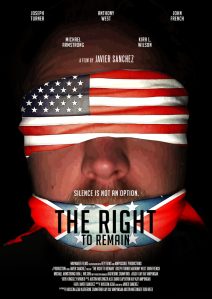 The Right to Remain is definitely a message movie with a very pertinent message for our trying times of racial injustice and civil unrest. This Ohio-made indie, filmed in my hometown of Columbus, was made before 2020 but its release seems even more timely with the outrage over police abuses dominating the news (it’s currently available for free on the film’s website as a five-part series). Even the title itself I find very fitting, taking its phrasing from the Miranda Rights that police officers are required to recite upon making an arrest and transforming it into a more exclamatory statement of defiance, one that could apply to the protests in the wake of George Floyd’s execution and the injustices roiling the country. The right to remain; the right to remain alive, the right to remain a citizen, the right to remain a human being deserving of equality. It’s all right there in the title as a starting point, so kudos to screenwriter/producer Javier Sanchez. The Right to Remain is a message movie that mostly succeeds on a patented formula even if it could have been a bit more ambitious or specific with its examination on race relations.
In 1987, Forsyth County Georgia is awash in racial acrimony. The overwhelming white citizens want to drive out black citizens from calling this county home. Master (Anthony West) is detained in the county jail after a botched bank robbery. The presiding officers harass, antagonize, and even torture Master during his extended lockup (where is the man’s lawyer?). Danny (Joe Turner) is an officer who doesn’t want to join in the harassment. He’s fighting against his own environmental upbringing, but he starts to see Master differently, even forming an unexpected friendship. Danny’s change of heart is tested when he learns that several townsfolk, aided by complicit officers, want to lynch Master to send a message.
Given the focus of the movie, it’s going to make liberal use of the N-word, which always carries a burden of justification for the storyteller. The movie is set in 1980s Georgia, and we’re following multiple racist characters, so it seems logical that when it comes to African-Americans, these people have one go-to word. It’s appropriate in that context but the filmmakers need to be careful about how often the word appears, not to dull its hateful power or, worse, to feel enabled by their setting to unleash the word without abandon. I feel like the filmmakers here have their hearts in the right place and trust them more with the N-word than Quentin Tarantino.

Behind-the-scenes picture from film website.
The message of this movie is pretty identifiable but still affecting. Watching two characters from different walks of life find common ground and build an uneasy friendship is a tried-and-true formula for mass appeal uplift. It recently even earned Oscar gold with 2018’s Best Picture-winner Green Book. The core of the movie is using a personal relationship and gradual reawakening from hate to discuss a larger issue, namely the mistreatment of black citizens and rampant police harassment. Through Master, the audience is able to personalize the experiences of a larger community. It’s all there and it still works from a general storytelling standard. However, do we need even more movies where black experiences are being told through the prism of a noble white person’s emerging epiphany? While he didn’t create this trope, I call this the Edward Zwick Model of nudging an audience with social commentary, like showing slavery and racism through a white P.O.V. (Glory), showing the Japanese modernization through a white P.O.V. (The Last Samurai), and showing the horrors of the diamond industry exploiting Africans through a white P.O.V. (Blood Diamond). Do we really need these gatekeepers to better tell the stories of minorities? I would say no, Hollywood execs would argue otherwise, but in 2020, I think using the suffering of a minority character to better educate a concerned white character is even more unnecessary. By no means am I condemning The Right to Remain and its filmmakers, good people with a story they wanted to tell and following a recognizable model to do so. I believe entirely in their good faith. Still, I kept debating whether this should be Danny’s story or Master’s.
Much of the movie is going to hinge on the writing and performances of the two men at the core of this relationship, so it’s a relief that this is where the movie shines. The two men begin to see past their prejudices, though, to be fair, this is far more pronounced with Danny realizing that his captive is not the animal his fellow officers decry. Master explains his reasoning for robbing the bank of the exact amount owed his family from Forsyth’s ancestors stealing his great-grandfather’s holdings in 1912. I enjoyed that he learns a sense of calm through his interactions with a kindly black pastor (Michael Armstrong), but it’s not a larger integration of spirituality, it’s actual pragmatic breathing exercises and meditation. Master even tries yoga. The larger emphasis is on Danny and his personal growth through his interactions with Master. It’s through small actions like a conversation, a shared game, a walk in the fresh air, but it feels earned and appropriately paced. By the end of the film, Danny is willing to put his life on the line to save Master and he has shaken free from the racist group-think that permeates the town. I like that even though the relationship between these two men improves, it’s not like everything can be readily resolved. You can tell Danny still has some lingering prejudices, and Master still has some doubts, but both men want to believe in the goodness of the other. I appreciated that degree of subtlety for a movie that doesn’t exactly trade in subtlety in service of its larger message. Not a complaint, mind you.
 Several supporting characters would probably have been better left out of the overall story. I don’t think we needed as many scenes with racists just glowering and being racist. As a movie, The Right to Remain runs around two hours total and could be trimmed down. As a series, if it were to remain so, I can understand the desire to refresh a viewer on the prejudices of the town and the stewing threat these bad men pose on the periphery of the story. The racist rogue’s gallery needed less check-ins. They bring in a white boy who was reportedly the victim of violence from a black man, and I thought we were going to get more examples of how racist brainwashing works through the role of this young boy with some very unfortunate burn make-up. Really, it looks like he has a pizza on his face minus the cheese. Except that’s not what happens, which seems peculiar that the good ole’ boys didn’t want to involve him in their fledgling murder message. Danny has a sickly pregnant wife (Vera Angelina Ignatov) whose narrative purpose seems to be to symbolize what he has lost in service of his job in a racist police force. That description makes it sound like she pushes him to take a stand against the pressures in his force but it’s really simpler than that. She’s the standard Wife to a Cop that reminds him he should be home more often. This also extends into the wife’s sister character (Kira L. Wilson) who also reminds Danny that he should be home more often. It’s redundant, and ending the film’s resolution with the wife’s sister’s personal recollection of when she knew racism was bad is strange.
The acting overall is both pleasant and earnest. West has a righteous defiance but also has a battle-weary resignation about his time as a black man in Georgia. He has an easy charisma that draws the viewer into his orbit. Seeing his responses to the tiny kindnesses offered is heartbreaking. Turner (Broken Mirror) begins as an uncomfortable but compliant officer and much of the movie rests upon his dawning realization of his own wrongs. Turner finds a well of decency to tap into with the character that makes him compelling even with the familiar formula. Turner and West have an amiable chemistry together and the best moments are their conversations. Another actor of note is John French (Confined) who plays what might be the most boisterously racist character I’ve seen in a movie since Alan Tudyk took my breath away in the Jackie Robinson biopic, 42. French is our primary villain and face of racism, and the actor seems to come alive with the pettiness and viciousness of his grotesque character. His chief seems to relish his position of authority and how we can abuse his powers. Also, given the Georgia setting, you’ll hear a range of Southern accents, some more understated and some more cartoonish.
I was slightly disappointed that the specific message of Forsyth County gets lost. The larger messages of racial tolerance swallow up the specifics of what happened in Forsyth, to the point that this story could have been told anywhere in the South. I was expecting the movie to come with facts and livid details about the history of Forsyth County and its bloody past of driving out all black residents in 1912 and how that legacy has shaped its descendants. There are brief news clips of Klansman and white supremacists rallying in 1987 to remind you of how prevalent this hateful organization still was in the community. There are even clips from Oprah Winfrey’s talk show, which worries me about copyright use and licensing for this production. The larger picture on racism still comes together with clarity, but I was hoping for something a little more specific about the county that inspired this movie. Imagine watching a movie about the Tulsa riots in 1921 and the decimation of Black Wall Street at the hands of envious white supremacists and that movie doesn’t go into specific details unique to its setting. It would be slightly disappointing because of the dramatic potential to a community opening up about its own past.
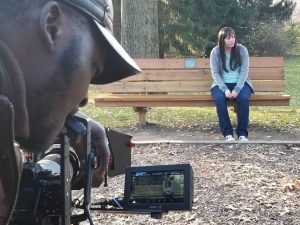
Behind-the-scenes picture from film website.
The Right to Remain is a low-budget indie ($10,000) so some technical issues and limitations are expected as long as they don’t fully rip the viewer out of the reality of the movie. The photography can be limited depending upon locations. Since much of the film is set in the whereabouts of Master’s jail cell, I was hoping for a larger variety of camera angles to spice up and differentiate the many sit-downs between bars. The sound design and recording, a notorious calamity of many an indie production, is also noticeably askew at points, with room tone levels clashing between shots. Other shots seem to use sound recorded from on-person mics where actors are rustling those microphones on their persons. An acoustic song seems to come in abruptly and leave just as abruptly, scoring moments awkwardly and then vanishing. It would be less bizarre if it didn’t show up repeatedly as if the sole musical selection for this universe. Any movie on a minuscule budget is going to have to cut some corners. Maybe the lighting isn’t dynamic here, maybe there isn’t as much coverage for certain scenes for the edit here, and maybe a location is lost and a more mundane setting is forced as a solution. There are numerous problems and solutions. I feel like director Hussein Azab (The Thin Blue Line) does a fine job of keeping things rolling without giving into artistic sacrifices. Sure, the sound could be improved, and maybe that pizza-face kid should just have been sidelined, but the big stuff is there on screen and it’s generally successful, which means the director had his priorities straight.
With message firmly pinned to its proverbial sleeve, The Right to Remain is a poignant drama that feels familiar and effective and well-acted and emotionally involving. It’s a low-budget success story of an Ohio indie who has found a timely relevance with its subject matter. Something tells me, sadly, that this movie will not stop being timely in the near future. The film is currently available for online streaming and even has a discussion guide with resources. It may be familiar, it could have been a little more polished, but the movie simply just works, and that’s a credit to the many cast and crew who had a worthy story to show the world.
Nate’s Grade: B-
Share this:

The Incredible Jake Parker (2020)
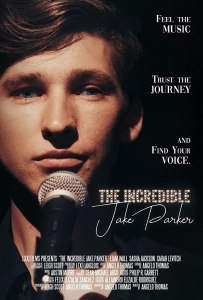 The Incredible Jake Parker is an Ohio indie written/directed/produced by Angelo Thomas, who just graduated from his arts college this spring. The 22-year-old adapted his own book into his first feature, all while finishing college and taking on activist responsibilities. The fact he has a finished feature film before he even graduated college, a film that was scheduled to open in multiple cities, is a damn impressive feat. Thomas is already well ahead of the game. Unfortunately, Jake Parker became another victim of COVID-19’s theater closings, and the limited release has been postponed. I was graciously given a digital link of the film to review and, even though I know people involved with the production, I vow to be as objective and constructive as possible with this film review. I honestly think the delay might help the movie, allowing for further critical examination and technical tinkering. As is, The Incredible Jake Parker is a well-made, albeit criminally short, indie that feels like it’s missing necessary development and potential drama to convey the steps in the journey of its titular star.
Jake Parker (Liam Wall) is a teenage musical sensation but he’s got a secret. He’s rapidly losing weight, enough to alarm doctors and his manager. Jake is anorexic. His tour is put on hold while he checks into a treatment center that will help him reflect and grow. He’s angry and eager to leave, but the more time he spends with the doctors and fellow patients, the more that Jake is able to tackle his personal demons with his body issues and figure out the man he wants to be.
The filmmakers behind The Incredible Jake Parker have an important and very personal message they take very seriously. Thomas has been open about his own troubles with an eating disorder and has spoken across the country about his experiences and insights. The character of Jake Parker is obviously informed from his own struggles and triumphs. Eating disorders are also a malady not typically associated with men, so smashing that taboo and educating viewers is admirable. We even see this flippant attitude in the movie where catty media figures wave away the implications of an eating disorder, especially for men, and prescribe just “eating a hamburger.” Body dysmorphic disorder is particularly affected by our omnipresent media culture that applies value to being thin, desirable, and staying within the codified boundaries of what is deemed appealing. That level of scrutiny and pressure can affect anyone’s mental health, let alone a performer whose press coverage and album sales can be affected by his good looks. It’s understandable to fall sway to negative thoughts that one’s body just simply isn’t good enough. The movie is filled with useful information about eating disorders as well as steps one can take to regain control over their body and mind and make healthy choices. By that regard, the movie can provide a great outreach to connect with people, especially young people, and inspire them to improve their own mental health and physical well-being. That’s what good art can do.
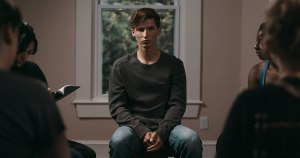 Now, with all that being said, it doesn’t feel like those good intentions have latched onto a suitable and engaging narrative to carry the burden of its worthy message. The movie is only 64 minutes long before its end credits and has the unmistakable feeling of missing development. We spend the first act establishing the problems for Jake and then in the last five minutes he finds effective solutions to those problems, but the connective tissue, the work, is missing in between. I’m going to go into some mild spoilers here though I don’t consider these to be significant because, realistically, did you expect Jake to not get better? I went back and re-watched what was Jake’s breakthrough therapy session and it amounts to being told that resilience is key and to find his inner strength. The very next scene involves Jake requesting ice cream to dine with a friend, seeming to now be able to manage his eating disorder, but why? Why was this a big breakthrough for Jake and why does it come with so much movie left? There’s another personal revelation that Jake is hiding that takes precedent in the last 15 minutes, which is odd to include so late after he seemed to overcome the movie’s big conflict, and even stranger to consider the fear it could pose to his musical career given modern-day sensibilities. It’s included to provide another scandal but it’s also there to get the plot even further across the hour-mark. Even his other late conflicts resolve so easily, some over text messages, that it begs the question of why introduce obstacles if they are so quickly overcome? When you wrap up your main internal struggle so early and with little elaboration, it leaves us questioning why we still have a movie.
So absent more in-depth examination on those problems, maybe we can use the extra time allotted to get to know Jake more as a character or the other residents of his treatment center, building a friendly network of lovable people leaning on one another to get better. The supporting characters are typically defined by their problem and stay that way. Mom (Rachel Coolidge) is an alcoholic, though we don’t see her drunk or even drink in hand if I recall, and Dad (John French) is a workaholic, though we don’t see him in a hurry to leave (the closest family Jake has is his British manager). Jordan (Sarah Levitch) has an eating disorder and was abandoned by her parents. I’m assuming the supporting characters at this treatment center all suffer from eating disorders but that could be my mistake. I have to go with this assumption because there is a raft of supporting characters that don’t open up about their specific problems, only occasionally their feelings of being helpless or being ashamed. A support group is a fantastic setting to derive some character-driven drama, forcing people to confront their pasts, mistakes, sense of self, vulnerabilities, relationships, and even butt heads before growing closer. It’s a conflict crucible ready for meaty scenes and yet it too is MIA. If Jake’s ultimate triumph over his personal demons is derived from the support he feels with the friends he’s made, then it would naturally need to feature meaningful interactions with supporting characters where we get to understand them and watch that progression of friendship and trust. It’s not that the material with these characters is bad, it’s just that they could all benefit from more of it.
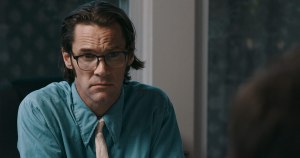 I do want to congratulate Thomas and his team for putting together a very professional looking movie. Even though its budget is a fraction of the Hollywood indie, The Incredible Jake Parker looks polished and proficient. The lighting and cinematography are a highlight of the movie, often finding compelling ways to frame the angular jawline of our titular star in anguish. It was filmed over nine days in Louisiana (boo) with some second unit work filmed in Columbus, Ohio (yeah). The songs we do get from Thomas and co-writers Austin Moore and Liam Wall are peppy and well composed with impressive production value. Just watching Wall sing is enjoyable and he seems at his most comfortable when he’s belting a tune and guitar in hand. The acting overall is generally good. Wall (Gold Dust) is a little stilted at times though it works for the awkwardness or clenched-jaw resentment he holds onto like a lifeline. Sasha Jackson (Blue Crush 2) has a few nicely delivered moments expressing her maternal worry and hope for Jake, who is more than just a client. The assorted supporting players make pleasant impressions, enough so that I desperately wanted them to have even more interactions to better allow the actors to shine.
Given Jake’s musical profession, I was expecting the film to include moments of his singing and guitar-playing for performances and songwriting, a reflection of his inner struggle for control and creative expression. What I wasn’t expecting was the movie to become a traditional movie musical where the characters just break into song and look into the camera. It first happens around the half-hour mark and took me aback, but I liked the two-minute introspective song and thought, “Okay, well if this is going to become a major element of the storytelling, I’m ready now.” I kept waiting for another moment of song-breaking and it didn’t occur until nearly the very end of the movie. It lasted, and I counted, 34 total seconds. Why break reality if it’s only going to last as long as a television commercial? If these two moments are the only ones that break reality to become a movie musical, then why include them if they only amount to two-and-a-half minutes? Could the sentiment not have been expressed with Jake merely playing his guitar and singing to himself rather than the music kicking in from on high? I was actually expecting more musical numbers simply because Wall can sing and play the guitar, as evidenced in the grabber of an opening scene where Jake records his amateur song that goes viral. He has talent so it would make sense that he writes a new song to discuss his journey, something he could perform at the very end to express his maturation and lessons learned, a new Jake Parker. That inspirational song, “Incredible,” plays over the end credits but why not actually see Wall perform the song to the camera, with the emotion pouring out of him, to mark the climax? It’s not like the film was running too long. Imagine the end of 2018’s A Star is Born and instead of Lady Gaga delivering that last powerful song to sum up her experiences, it just played over the credits.
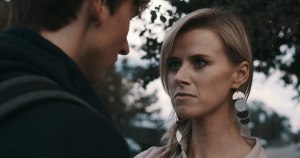 There are some other technical areas where The Incredible Jake Parker could benefit from some further attention before its big release rollout. The sound mix is often noticeably amiss with different shots having fuzzy interference that’s all the more noticeable when it’s edited with shots without. Some shots don’t seem to be using sound from other takes, so an off-screen character will sound distant because their dialogue was recorded away from the boom microphone. Why not pull sound from that character when they were on mic and layer it over? The color grading isn’t consistent at points, most notably when the film transitions from purchased stock footage that is vibrant in color to the more muted colors of the actual movie. I’m also hopeful that a new musical score can be applied (not the songs, the actual score) because it’s often too plain. The bigger technical element that could use another overview is the editing. Jake Parker is edited with a formula that a spoken line equals a shot cut. A character speaks. Next shot. A character speaks. Next shot. Repeat. It’s a stolid rhythm that can gum up the visual flow of scenes. The movie is crying out for another careful pass in the editing suite. It’s little things in the edit and pacing that can help mitigate whatever filming limitations there may have been.
The Incredible Jake Parker is a musical with a message and some spiffy technical acumen, especially considering that Angelo Thomas is only 22 years old and pulled this all off. Even though it’s only 68 minutes with credits, there is much to be impressed with this first film. There’s a late montage of real people (I’m assuming) who speak about their own struggles with eating disorders and mental health, their advice, and what a figure like Jake can mean to them, and while it may be manipulative my heart felt full-to-bursting while watching this genuine outpouring. It made me even more certain that had the film given more space to Jake’s journey, I would have been even more dazzled. Rare is the film I say could use an additional half hour minimum. The Incredible Jake Parker has all the hallmarks of great drama, with the insights of a man who lived it, so I wish we could have really dived into the development of its title character and his incredible story.
Nate’s Grade: C+
Share this:

Constraint (2019) [PART THREE]
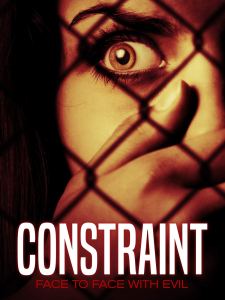 Please read PART ONE and PART TWO if you have yet to as I try and better articulate my questions over this Columbus, Ohio indie and its confounding creative decision-making. Dear reader, I am going to take you live through this very intellectual and artistic assessment as I continue to watch Constraint.
The main plot revolves around Oracabessa (Brooklyn Sabino Smith), a young cellist, who becomes entangled in a web of human traffickers, led by Tuco (Ralph Scott).
I’m now heading into Act Three with a half-hour left of movie to go with Constraint. Oracabessa mumbles the address from Tuco’s I.D. and wanders into the woods rather than call for help or use her moped or one of the cars at the scene of the accident. Magically, she finds the location. Her sense of direction must be superb while suffering from a concussion. Why would she think Tucco was holding the trafficking victims at his registered home address? I feel like the first step of human trafficking, after giving away one’s moral whole, is not to keep your victims at your home.
Dear reader, I am all about climaxes where our protagonist wreaks havoc among some very bad people who deserve some very bad justice dealt to them in hopefully poetic and painful ways. It’s a natural storytelling formula rife with catharsis and payoffs. But like other formulas, you need to still put in the work to reap the rewards. Just because our heroine is stumbling to a compound to free the victims and bring down their tormentors does not mean it works. It’s skipping to a climax the movie doesn’t really deserve because we spent so much precious time on side characters that didn’t matter and dawdled. Just in case if you mistook the good faith of the production, there’s also a gratuitous rape scene used as a setting device for one of the heretofore unknown bad men (at least she was clothed). One of the women from the beginning is found in the basement, she mistakes Oracabessa’s intentions, and runs to her to be saved, and she then gets gunned down in the back by the traffickers. She was let down twice by our heroine.
 Our leading lady wanders the compound and comes across two children, one white and one non-white, both of them trafficking victims, but she only addresses the white kid and says, “I’ve come to take you home.” They ask if she is the police, again a reminder that perhaps alerting the police to the whereabouts of this site might have been a higher priority than going alone. She is only here, it would seem, for these two children. Sorry the women she found in the confusingly oriented basement. I was already having a hard time liking this protagonist as is but this sealed it.
A lot of shots of running through the woods happen without much to connect a sense of spacing and geography, and then Oracabessa is saved when Derick drives up and they get inside his car and drive away to safety. The following then happens in our bulrush of a resolution:
1) Oracabessa is in a hospital bed. A nurse is asking her about medications.
2) Nicolas quickly rides a motorcycle to the hospital entrance outside.
3) The nurse says she “just got your blood tests back” (a certain The Room line echoed in my head) and then imparts, “Have you ever been pregnant before?” Why is this even being asked except to imply that she is currently pregnant or never had a son like she confessed before. We get no clear indication on either of these being true, so, again, why include it?
4) Cut to Nicolas running down the hospital corridor while SUDDEN electronica music begins blaring like we just dropped into an action set piece from Blade.
5) Nicolas comes into Oracabessa’s room and pulls up a blanket on her in a manner that seems less “tucking in” and more “pulling sheet over a corpse on a slab.”
6) We reveal in the same hospital is Oracabessa’s brother who was indeed the drug carrier that Tuco stabbed far earlier and has not been referenced since. The doctor says he lost a lung.
7) Nicolas thanks Derick for saving Oracabessa and they seem to part on good terms. In the same camera setup, with Derick in the same outfit, thus implying that same day, Oracabessa leaves on crutches, meaning she was discharged in hours. The ADR-ed line “Think you cracked the skull” occurs without Derick moving his mouth.
8) We jump to a new scene where Oracabessa has her hands around Derick’s face and she says, “I’m going to kiss you now, and it’s going to be the last time. I’ll never kiss you again.” It’s a repetitious line that screamed Neil Breen to me.
 9) We jump to a new scene where Oracabessa is hobbling to the ballet class teacher who shows no sympathy and literally tells her that her last performance “was an abortion.” Yikes! This is then immediately followed by Derick saying, “A woman has a right to choose” to Nicolas.
10) While talking to the creeper from before with the French accent who heads a music school, Oracabessa SUDDENLY remembers a time she saw him sitting in the passenger seat of Tuco’s car while it passed her on the street. Who else will she arbitrarily remember next? And how often did she see this one car drive around her entire town that she committed to memory? She, at long long LONG last, finally calls the police and has the human trafficker creeper arrested.
11) She then flies to Jamaica and visits her father, asking him about the little boy he ran over. Did this man serve jail time? Oracabessa blames herself for the kid’s death and now I feel like this should have been dealt with more if we’re going this route. It doesn’t feel like catharsis because it doesn’t feel like it was on her mind too often. Did I confuse the earlier scene of her talking about a son as this kid?
12) Nicolas surprises her in Jamaica. “Whatever happened to that Derick fellow?” asks dad at a dinner with the three of them. We’ve been told Nicolas was engaged to Oracabessa, so it seems peculiar that of the two men in his daughter’s life, this is the one he is unfamiliar with. Dad threatens Nicolas with great harm if he does anything to hurt his daughter. Is this comedy?
13) The voiceover overlaps and we jump to a wedding party dinner with the use of split screens. Why split screens? With how quickly we are rushing through plot content, I feel like this is the series finale of HBO’s Six Feet Under and I’ll see the next hundred years of these people’s lives.
14) The various characters mingle and dance in, what else, a wide angle that lasts an astounding FOUR MINUTES without cuts, as if the movie didn’t know it was over. It’s just lingering with no real purpose of why the audience needs to see any of this for four minutes. There is no dramatic change. Just people hugging. If the movie already wasn’t nearly two hours long, I would have accused the filmmakers of dragging this thing to a feature-length running time. Then the end credits just appear, which they could have done four minutes ago too.
 Finally, now I can derive my critical conclusions on this truly bizarre Ohio indie movie. Constraint feels overwhelmingly like Ohio’s own Neil Breen movie, plotted so loosely, so archaically, with characters behaving so randomly and nonsensically, and with a story that never seems to have traction, bouncing from one character to another and going on strange tangents and flashbacks, like it’s trying to pack in some half-formed Armistead Maupin ensemble piece. Constraint is just as much about a girl walking around town with her cello on her back (possibly one quarter of all shots) as it is about sex trafficking and finding the victims (when it’s not squeezing in some nudity from them). The pacing seems overstuffed and insufficient, with so many things happening but little connection to make those actions feel important even with life and death stakes. Perhaps having our main trafficker just wandering around town at all hours takes away from his mystery and danger. This is a movie where anything might happen at a moment’s notice because it doesn’t feel like much of what you’re watching builds off what came before. Being redundant at 110 minutes is just inexcusable. The scenes in a movie should matter, as should their placement, and the characters should learn, grow, progress, or at least present an interesting viewpoint for an audience to follow.
From a production standpoint, Constraint has some positive qualities but they are routinely hobbled by the exasperating creative choices of the man in charge, writer and director and editor and cinematographer Richard A. Nelson (The Endangered). The man likely should have only had one job on this project as director. He needed other creative supports that could better concentrate on seeing a vision through, a better writer to make a better story with fleshed-out characters, a better cinematographer to ensure more seamless camera arrangements for the edit, a better editor that wouldn’t sabotage the movie’s flow and literal comprehension with so many erratic edits. It’s not a bad looking movie despite some unfortunate edits and a heavy reliance on day-for-night filming. The acting is generally acceptable but I don’t hold the performances against the actors. The characters they are playing are very difficult to find a sustainable reality to inhabit. Smith (Indie Film School) has something about her that keeps you watching, which is good considering her cellist character doesn’t fulfill that same outcome. Scott (After) is dependably great. There are even moments, slivers, that give an idea of how good all these actors could be with better material, like the small scene between Alice and Tuco together. Constraint feels like a dozen movies that have been sloppily distilled together, with inorganic sections intruding upon one another. I don’t know if this approaches a so-bad-it’s-good quality but it’s flabbergasting to witness.
I cannot advise you to watch Constraint but I cannot not advise you to watch this. It’s Ohio’s own Neil Breen indie and I never thought I would discover something quite like that.
Nate’s Grade: D-
Share this:

Constraint (2019) [PART TWO]
Please read PART ONE if you have yet to as I try and better articulate my questions over this Columbus, Ohio indie and its confounding creative decision-making. Dear reader, I am going to take you live through this very intellectual and artistic assessment as I continue to watch Constraint.
The main plot revolves around Oracabessa (Brooklyn Sabino Smith), a young cellist, who becomes entangled in a web of human traffickers, led by Tuco (Ralph Scott).
I am now 45 minutes into the movie and screamed, “What?” to my screen. Oracabessa (Brooklyn Sabino Smith) is once again playing cello for a ballet class and the instructor doesn’t like the musical selection. She requests Wagner, and Oracabessa says she won’t. The instructor is animated and agitated and demands to know why she can’t play the composer. “I didn’t say I couldn’t play it. I won’t,” she replies. Why? Is this going to be like some character moment like in La La Land where Ryan Gosling gets fired for refusing to play the holiday music his boss asks for as dining accompaniment? I would think refusing to play what a client was requesting could cease in you getting more work from that client. And considering this one ballet class is the only thing we’ve watched her do for money, I wouldn’t be too pushy.
Oracabessa sees Tuco walking along the street again which begs the question of how protected does this guy think he is? She follows him but the ensuing tailing sequence goes through a blender of edits so it more implies the chase than allows it to establish. She then joins the college professor, and Derick, and others at a hookah bar to translate a French speaker. “What about having your own racial identity?” Why does this scene exist in a story about sex trafficking? Is the professor Oracabessa’s sister? Why was this never established earlier? There’s now a discussion over whether or not Jewish people should be defined by the Holocaust and its impact and it’s like a family dinner squabble, still with the omnipresent ADR dialogue, and I’m starting to lean into the arbitrary madness of Constraint as it further infects me.
 We transition back to the life of Tuco, our beleaguered sex trafficker. He kills a guy for being late to a drug deal and I cannot say but this might have been Oracabessa’s brother from the previous family dinner scene. Tuco has his kidnapped women line up in their underwear so they can be “inspected” by his superior. He warns them not to “embarrass him,” though I have no idea how that would be achieved. And then the women start stripping off their clothes and the camera angles are PURPOSELY AIMED to highlight their full-frontal nudity, even one side view that captures all three women’s breasts in a row while cutting off their heads. That’s when I stood out of my chair, cursed this movie out loud, and paced around the room in building anger.
Nudity in film by itself doesn’t have to be sexual or gratuitous, but this nudity is meant for titillation, framed for this purpose, and to squeeze this into the context of sex trafficking, a very depressing and all-too-real reality for many, I felt extremely grossed out. The scene doesn’t need visible nudity to feel the distress and vulnerability of the captured women. I love exploitation movies as entertainment, and have even supported a few financially, but story context and tone are key. The women of this moment are there to be objectified and the camera objectifies them too. You know how I know how these actresses felt about this scene? None of their last names can be found in the film’s credits, so I don’t think they were too happy to have their full names associated.
We now transition to another new perspective, this time Nicolas’ parents (Dino Tripodis and Kristina Kopf, The Street Where We Live). “He experimented with something exotic,” the father says, and I don’t know if this implies that dad is racist for thinking “black” equals “exotic.” This entire scene feels even more student film-esque than the rest, with the editing choices and the characters dancing around critiques of domesticity and parenting. The wide angles that suddenly cut to extreme close-ups of faces, the jump cuts, and ADR sound design, it’s all starting to make this feel like a foreign film that’s trying to be New Wave arty. “You didn’t even leave your son with the hopeful illusion that maybe his parents were in love at one time,” mom says. The dialogue in this movie feels like it was written by an A.I. at many points. Nicolas later confronts dad who is apparently out on a date with another woman, and he does so with his mom in tow. “My whole life, the one thing you’ve been good at, is making people cry,” Nicolas bemoans. The wide shots showcase a bar/restaurant with nobody else in attendance, again another mistake with revealing the limitations of filmmaking. Now the scene is suddenly in black and white, so is this an established flashback? If the whole thing was a flashback for Nicolas then why wasn’t it all coded in black and white? Wait, then Nicolas’ own voice over narration is coming in while dad is talking in the present. We then pull into a flashback of Nicolas telling the story of meeting his divorced father in the park to Oracabessa, so we witnessed a flashback-within-a-flashback for a side character. “What would you say is the most devastating thing to happen in your life?” he asks Oracabessa. Sheesh, if this is your pillow talk no wonder she dumped you, dude. There’s now a flashback 23 years to Jamaica with Oracabessa’s biological father. There’s an ongoing streak of whispered poetic voice over from Terrence Malick films. What movie am I watching now? I can’t keep up with the shifting perspectives and visual vocabulary that keeps being broken so flagrantly and randomly.
 Folks, the erratic edits have not gotten any better and a conversation will randomly jump from four different camera positions from line to line to completely obliterate flow.
Derick and Nicolas are fighting over Oracabessa, who doesn’t want either of them, and then Oracabessa is playing at a big recital, and again I have to remind myself this is supposed to be a movie about sex trafficking but it’s playing like some small-town ensemble piece (why else do the same people keep running into each other in a city of over a million?) but like a Christopher Guest mockumentary (Waiting for Guffman) played straight. Why does Tuco even attend this recital?! Oracabessa follows him and the chase has several nice camera angles for a low-budget indie, and it’s also edited in a way that maintains the suspense and is readable for the audience, going from better selected angles to convey the progression of the chase and Oracabessa following closely. The music, however, is way too overwrought and we watch Tuco go into a restaurant, eat, and then leave with Oracabessa following again. Why did we need a pitstop? She didn’t even go inside.
Tuco finally ambushes Oracabessa and runs her over, which triggers a flashback of her son (?) she confessed she lost (in the flashback with Nicolas) being run over in the past. The way the scene plays doesn’t make it seem like she was witness to this event for recollection. Nope, it’s just a kid that Oracabessa’s father ran over while she was a child, which explains why she could recall this moment but also makes it too confusing for an audience to adjust to what is being thrown at us without context as it plays. It wasn’t even in black and white, which is the established code for flashback. A drunk driver then plows into Tuco’s car, which smashes into Tuco, finally killing him and setting Ralph Scott (Minus One) free from the earthly bonds of this movie. Oracabessa takes his I.D., gun, and sets off, presumably, on a path of righteous vengeance as she… wanders into the woods, but what do I know?
So this one woman had her father run over a child, abandon her, then she lost a child of her own, and has been stalked by human traffickers. This is getting into telenovela territory of melodrama. And so ends PART TWO of my real-time review of Constraint.


 nathanzoebl
You must be logged in to post a comment.