Blog Archives
Aquaman and the Lost Kingdom (2023)
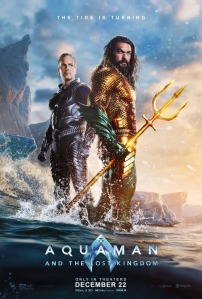 Aquaman and the Lost Kingdom is he last of the Zack Snyder-then-not-Snyder-verse DCU movies, and with that the ten years of mostly middling super hero heroics comes to an end not with a bang but with a whimper. I was a fan of 2018’s original Aquaman thanks to the self-aware craziness and visual decadence from its wily director, James Wan (Malignant). This is still the major appeal of the franchise, a universe that feels pulled from a child’s imagination and recreated in loving splendor on the big screen. The problem with this tone is that it’s a delicate balance between silly fun and silly nonsense. The goofy charm of these movies is still alive and well as they open up an even bigger undersea world of lore (Martin Short as a fish lord!), but this time it feels like a movie that is making it up as it goes, and all that “and this happens next” storytelling begins to feel like a monstrous CGI mess needing to be tamed. This might have something to do with the fact that Wan finished filming the movie over two years ago and it’s endured several re-shoots, including featuring two different Batman actor cameos at different points, to now bring to a close a decade of interconnected movies that are going to be blinked out of larger continuity in 2025 (excluding Margot Robbie’s Harley Quinn, I guess). Lost Kingdom has plenty of enjoyably weird undersea nightmare creatures, a specialty of Wan given his horror roots, but the ultimate villain spends most of his time sitting on a throne in wait and is laughably dismissed so easily in the climax. The whole evil magic trident that corrupts from its evil influence has a very Lord Sauron ring to it. I give the movie points for transforming into a buddy movie between Arthur Curry (Jason Momoa) and his brother Orm (Patrick Wilson) halfway through. The jail break sequence is fun and different, and their bickering dynamic makes for winning comedy. However, the drama feels too overworked, with holdovers from the first film (Black Manta, Amber Heard’s unremarkable love interest) repeating their same beats with robotic dedication. The opening reveal of Arthur being a new dad and it cramping his macho-cool style made he fear we were headed for Shrek 4 territory, where the new dad needs one more adventure to realize the importance of family, etc. Because even when you’re riding a mechanical shark, fighting alongside the crab people, and tunneling through worm prisons, it’s all about recognizing the importance of family, kids (the real undersea treasure after all). I defy anyone not to laugh at the literal concluding speech and its enigmatic “sure, fine, whatever”-energy. As a mere movie, Lost Kingdom is silly escapist entertainment that could enchant a few with lowered expectations, and as the final entry point in a universe of super heroes, it’s a fitting nonsensical end.
Nate’s Grade: C
Share this:

Cold Mountain (2003) [Review Re-View]

Originally released December 25, 2003:
Premise: At the end of the Civil War, Inman (Jude Law, scruffy) deserts the Confederate lines to journey back home to Ada (Nicole Kidman), the love of his life he’s spent a combined 10 minutes with.
Results: Terribly uneven, Cold Mountain‘s drama is shackled by a love story that doesn’t register the faintest of heartbeats. Kidman is wildly miscast, as she was in The Human Stain, and her beauty betrays her character. She also can’t really do a Southern accent to save her life (I’m starting to believe the only accent she can do is faux British). Law’s ever-changing beard is even more interesting than her prissy character. Renee Zellweger, as a no-nonsense Ma Clampett get-your-hands-dirty type, is a breath of fresh air in an overly stuffy film; however, her acting is quite transparent in an, “Aw sucks, give me one ‘dem Oscars, ya’ll” way.
Nate’’s Grade: C
——————————————————
WRITER REFLECTIONS 20 YEARS LATER

I kept meaning to come back to Cold Mountain, a prototypical awards bait kind of movie that never really materialized, but one woman ensured that it would be on my re-watch list for 2003. My wife’s good friend, Abby, was eager to hear my initial thoughts on the movie when I wrote my original review at the age of twenty-one. This is because Cold Mountain is a movie that has stayed with her for the very fact that her grandfather took her to see it when she was only nine years old. While watching, it dawned on nine-year-old Abby that this was not a movie for nine-year-olds, and it’s stuck with her ever since. I think many of us can relate to watching a movie with our parents or family members that unexpectedly made us uncomfortable. For me, it was Species, where I was 13 years old and the movie was about a lady alien trying to procreate. I think my father was happy that I had reached an acceptable age to go see more R-rated movies in theaters. Social media has been awash lately with videos of festive families reacting to the shock value of Saltburn with grumbles and comical discomfort (my advice: don’t watch that movie with your parents). So, Abby, this review is for you, but it’s also, in spirit, for all the Abbys out there accidentally exposed to the adult world uncomfortably in the company of one’s parents or extended family.
Cold Mountain succumbs to the adaptation process of trying to squeeze author Charles Frazier’s 1997 book of the same name into a functional movie structure, but the results, even at 150 minutes, are unwieldy and episodic, arguing for the sake of a wider canvas to do better justice to all the themes and people and minor stories that Frazier had in mind. Director Anthony Minghella’s adaptation hops from protagonist to protagonist, from Inman to Ada, like perspectives for chapters, but there are entirely too many chapters to make this movie feel more like a highly diluted miniseries scrambling to fit all its intended story beats and people into an awards-acceptable running time. This is a star-studded movie, the appeal likely being working with an Oscar-winning filmmaker (1996’s The English Patient) of sweep and scope and with such highly regarded source material, a National Book Award winner. The entire description of Cold Mountain, on paper, sounds like a surefire Oscar smash for Harvey Weisntein to crow over. Yet it was nominated for seven Academy Awards but not Best Picture, and it only eventually won a single Oscar, deservedly for Renee Zellweger. I think the rather muted response to this Oscar bait movie, and its blip in a lasting cultural legacy, is chiefly at how almost comically episodic the entire enterprise feels. This isn’t a bad movie by any means, and quite often a stirring one, but it’s also proof that Cold Mountain could have made a really great miniseries.

The leading story follows a disillusioned Confederate defector, Inman (Jude Law), desperately trying to get back home to reunite with his sworn sweetheart, Ada (Nicole Kidman), who is struggling mightily to maintain her family’s farm after the death of her father. That’s our framework, establishing Inman as a Civil War version of Odysseus fighting against the fates to return home. Along the way he surely encounters a lot of famous faces and they include, deep breath here, Phillip Seymour Hoffman, Natalie Portman, Giovanni Ribisi, Cillian Murphy, Eileen Atkins, Taryn Manning, Melora Walters, Lucas Black, and Jena Malone. Then on Ada’s side of things we have Zellweger, Donald Sutherland, a villainous Ray Winstone, Brendan Gleeson, Charlie Hunam, Kathy Baker, Ethan Suplee, musician Jack White, and Emily Descehanel, and this is the storyline that stays put in the community of Cold Mountain, North Carolina.
That is a mountain of stars, and with only 150 minutes, the uneven results can feel like one of those big shambling movies from the 1950s that have dozens of famous actors step on and as quickly step off the ride. Poor Jena Malone (Rebel Moon) appears as a ferry lady and literally within seconds of offering to prostitute herself she is shot dead and falls into the river (well, thanks for stopping by Jena Malone, please enjoy your parting gift of this handsome check from Miramax). Reducing these actors and the characters they are playing down to their essence means we get, at most, maybe 10-15 minutes with them and storylines that could have been explored in richer detail. Take Portman’s character, a widowed mother with a baby trying to eke out a living, one of many such fates when life had to continue after the men ran to war for misbegotten glory. She looks at Inman with desperate hunger, but it’s not exactly lust, it’s more human connection. When she requests that Inman share her bed, it’s just to feel another warm presence beside her, someone that can hold her while she weeps about the doomed fate of her husband and likely herself. There’s a strong character here but she’s only one stop on our expedited tour. The same with Hoffman’s hedonistic priest, a man introduced by throwing the body of a slave woman he impregnated over a ridge, which might be the darkest incidental moment of the whole movie. His character is played as comic relief, a loquacious man of God who cannot resist the pleasures of the flesh, but even he comes and goes like the rest of our litany of very special guest stars. They feel more like ideas than characters.

This is a shame because there are some fantastic scenes and moments that elevate Cold Mountain. The opening Civil War battle is an interesting and largely forgotten (sorry Civil War buffs) battle that begins with a massive surprise attack that produces a colossal explosion and crater and turns into a hellish nightmare. Granted, the movie wants us to sympathize with the Confederates who were bamboozled by the Yankee explosives buried under their lines, and no thank you. The demise of Hoffman’s character comes when he and Inman are captured and join a chain gang, and they try running up a hill to get free from approaching Union troops. The Confederates shoot at the fleeing men, eventually only with Inman left, who struggles to move forward with the weight of all these dead men attached to him. When they start rolling down the hill, it becomes a deeply macabre and symbolic struggle. The stretch with Portman (May December) is tender until it goes into histrionics, with her literal baby being threatened out in the cold by a trio of desperate and starving Union soldiers (one of which played by Cillian Murphy). It’s a harrowing scene that reminds us about the sad degradation of war that entangles many innocents and always spills over from its desired targets. However, this theme that the war and what it wrought is sheer misery is one Minghella goes to again and again, but without better characterization with more time for nuance, it feels like each character and moment is meant to serve as another supporting detail in an already well-proven thesis of “war is hell.”
Even though I had previously watched the movie back in 2003, I was hoping that after two hours of striving to reunite, that Inman and Ada would finally get together and realize, “Oh, we don’t actually like each other that much,” that their romance was more a quick infatuation before the war, that both had overly romanticized this beginning and projected much more onto it from the years apart, and now that they were back together with the actual person, not their idealized imaginative version, they realized what little they had in common or knew about each other. It would have been a well-played subversion, but it also would have been a welcomed shakeup to the Oscar-bait romantic drama of history. Surely this had to be an inconvenient reality for many, especially considering that the men returning from war, the few that did, were often not the same foolhardy young men who leapt for battle.
Zellweger (Judy) was nominated for Best Actress in the preceding two years, for 2001’s Bridget Jones Diary and 2002’s Chicago, which likely greased the runway for her Supporting Actress win from Cold Mountain. There is little subtlety about her “aw shucks” homespun performance but by the time she shows up, almost fifty minutes into the movie, she is such a brash and sassy relief that I doubt anyone would care. She’s the savior of the Cold Mountain farm, and she’s also the savior of the flagging Ada storyline. Pity Ada who was raised to be a nice dutiful wife and eventual mother but never taught practical life skills and agricultural methods. Still, watching this woman fail at farming will only hold your attention for so long. Zellweger is a hoot and the spitfire of the movie, and she even has a nicely rewarding reconciliation with her besotted old man, played by Brendan Gleeson, doing his own fiddlin’ as an accomplished violin player. As good as Zellweger is in this movie is exactly how equally bad Kidman’s performance is. Her Southern accent is woeful and she cannot help but feel adrift, but maybe that’s just her channeling Ada’s beleaguered plight.

I think there’s an extra layer of entertainment if you view Inman’s journey in league with Odysseus; there’s the dinner that ends up being a trap, the line of suitors trying to steal Ada’s home and hand in the form of the duplicitous Home League boys, Hoffman’s character feels like a lotus eater of the first order, and I suppose one reading could have Portman’s character as the lovesick Calypso. Also, apparently Cold Mountain was turned into an opera in 2015 from the Sante Fe Opera company. You can listen here but I’m not going to pretend I know the difference between good and bad opera. It’s all just forceful shouting to my clumsy ears.
Miramax spent $80 million on Cold Mountain, its most expensive movie until the very next year with 2004’s The Aviator. Miramax was sold in 2010 and had years earlier ceased to be the little studio that roared so mighty during many awards seasons. I think Cold Mountain wasn’t the nail in the coffin for the company but a sign of things to come, the chase for more Oscars and increasingly surging budgets lead the independent film distributor astray from its original mission of being an alternative to the major studio system. Around the turn of the twenty-first century, it had simply become another studio operating from the same playbook. Minghella spent three years bringing Cold Mountain to the big screen, including a full year editing, and only directed one other movie afterwards, 2006’s Breaking and Entering, a middling drama that was his third straight collaboration with Law. Minghella died in 2008 at the still too young age of 54. He never lived to fully appreciate the real legacy of Cold Mountain: making Abby and her grandfather uncomfortable in a theater. If it’s any consolation to you, Abby, I almost engineered my own moment trying to re-watch this movie and having to pause more than once during the sex scene because my two children wanted to keep intruding into the room. At least I had the luxury of a pause button.
Re-View Grade: B-
Share this:

The Hours (2002) [Review Re-View]
 Originally released December 25, 2002:
Okay, after watching the Golden Globes award show and seeing The Hours crowned with the highest prize, and hearing incessantly about Nicole Kidman’’s fake prosthetic nose in the movie, it was time to venture into that darkened theater and see how good the awards-friendly The Hours was. Little did I fully realize what I was getting myself into.
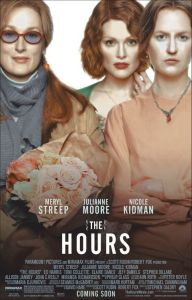
Nicole Kidman plays Virginia Woolf, who is in the midst of writing her novel Mrs. Dalloway, where she proposes to display a woman’s entire life through the events of a single day. Julianne Moore plays Laura Brown, a housewife in 1951 having difficulty adjusting to a domestic life that she feels ill equipped for. Meryl Streep plays Clarissa Vaughan, a gay copy-editor in 2001 planning a party for a poet and former lover (an emaciated Ed Harris), who is suffering from the late stages of AIDS. These three storylines will be juggled as the film progresses, with each woman’s life deeply changing before the end of the day.
The Hours is a meandering mess where the jigsaw pieces can be easily identified. The attempt at a resolution for an ending, tying the three storylines together, is handled very clumsily. The film spins on and on that you start to believe the title may be more appropriate than intended. What this movie needed was a rappin’ kangaroo, post haste! The film is wrought with victimization and screams “Give me an award already!” Before you know it you’’re being bludgeoned to death with what is profoundly the most over serious Lifetime network movie ever assembled. And there’s nothing fundamentally wrong with Lifetime movies but The Hours does not share the sensibilities of its TV brethren.
 Kidman, nose and all, gives a strong performance displaying the torture and frailty of a writer trapped within her own mind but too often relies on wistful staring or icy glares. Moore is effectively demoralized but cannot resonate with such a shallow character. Streep is the least effective of the three and fizzles among an over-stuffed assembly of characters.
The supporting cast is unjustly left for dead. The characters are seen as parody (Toni Collette as Moore’s un-liberated homemaker neighbor), extraneous (Claire Danes as Streep’s daughter, Allison Janney as Streep’s lover, Jeff Daniels as Harris’ ex-lover, you know what, almost anyone in the Streep storyline), one-note (the workmanlike John C. Reilly who plays yet another doting and demystified husband) or merely obnoxious (Moore’s brat child that refuses to separate from her). It appears The Hours is the three lead actress’ game and everyone else is not invited to play along.
Stephen Daldry’s direction shows surprising stability and instinct after his art-house pandering Billy Elliot showed little. The technical aspects of ‘lThe Hours are quite competent, especially the sharp editing and musical score, which just points out further how slickly hollow and manufactured the film is.
The Hours is an over-glossed, morose film that is too self-important for its own good. It sucks the life out of everything. And for all its doom and gloom and tsunami of tears, the only insightful thing The Hours is trying to pass off onto the public is that women are more depressed than you think.
Nate’s Grade: C
——————————————————
WRITER REFLECTIONS 20 YEARS LATER
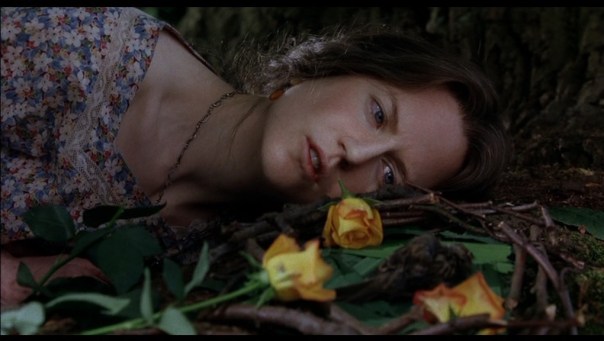
I thought 2002’s The Hours would be a good movie to come back to not necessarily because I thought it would be revelatory but because I thought it may have been emblematic of my more dismissive, glib attitude when I was a twenty-year-old smart alack getting published in his college newspaper and considering myself a hotshot wordsmith. I was worried that my initial review would come across as snide and condescending considering the subject matter. I dubbed it the “most over serious Lifetime network movie ever assembled” and yet, twenty years later, after having devoted two more hours watching The Hours, I must say that this comment still holds merit.
I was fully ready to disavow my younger self as being unkind to this movie, or being too quick to dismiss a movie about women’s suffering through three generations, especially as a young man trying to be clever and, by early 2000s standards, snarky and cynical. Well, even in 2022, I still dislike The Hours, and it’s because of how overwrought everything comes across in this movie. This movie is overstuffed with the trapping of importance, and the 1950s section featuring Julianne Moore as an unhappy housewife stifling her desires (not to be confused with her 1950s unhappy housewife also stifling her desires in 2002’s Far From Heaven) is played to the point that it could be self-parody. That’s not the kind of artistic approach you’d think you would want in something so transparently desirous of special award consideration. For me, it was unmistakable even early on, and the heightened melodramatic atmosphere made me, at several points, almost want to giggle at how obvious and cloying and annoyingly reaching each moment came across. There is no subtlety to be had with The Hours, and that’s fine, but there is also no real striking substance beyond a few transitory moments of grace that stand out. The Moore segment has her drifting through the day like a zombie and almost on the verge of tears at every single turn. I felt sorry for Moore, who is coasting on emotional instinct as the character she’s been given is, at best, meant to be a symbolic placeholder of millions of women of her era. Her interaction with her son makes her sound like a deranged android grasping for human behavior. The moment where they sift flour together and claim it’s beautiful was just so stupifying. It’s amazing to me that Moore was nominated for Best Supporting Actress for this role. She’s also the example of the kind of woman that Woolf was writing about with her titular Mrs. Dalloway heroine, but without Woolf explicitly commenting, the entire 1950s segment is one big airless melodrama, meant as a misdirect of the movie’s miserablist obsession with suicide. By the time old lady Julianne Moore shows up to unload a hasty monologue explaining decades of unknown drama, you may have decided that the three stories could have been two (or one).

Each of the three plot segments is intended to better inform the other, to coalesce into a thesis statement on the plight of women, except each storyline is so thinly written. Without the others to provide direct companionship, each one of these storylines would be pitifully minimal and fail to evolve the notions of feminine hardship. Virginia Woolf (Nicole Kidman) is sad because she feels stifled by the country and doctors who are trying to improve her mental health. Laura Brown (Moore) feels stifled because she is a cloested lesbian pretending to be a happy and doting housewife to her oblivious husband (John C. Reilly, not to be confused with his other oblivious husband in 2002’s Chicago). And Clarissa Vaughan (Meryl Streep) is sad because one of her closest friends (Ed Harris) is dying from AIDS. That’s it. Each of the three timelines is threaded together for the intention of greater relevance, but what it really does is put the onus on the viewer to find more relevancy in context. Sometimes the three women will be doing the same actions, sometimes one will make a comment that seems to be answered by another, and sometimes they’ll inadvertently quote one another or Woolf’s novel. Except the connections and layers are superficial and clinging to an obvious thesis and biding its overlong time for absent depth.
Much of the early publicity around The Hours circulated around Kidman’s fake nose, which producer Harvey Weinstein hated (he also hated the score by Phillip Glass that would later be nominated for an Academy Award) but Kidman absolutely loved. During the time of production, she was divorcing Tom Cruise and was a tabloid magnet but the prosthetic nose allowed her a degree of refreshing anonymity with the paparazzi. She kept the nose on for the entire movie. I’ve been more critical of Kidman’s since her early 2000s career summit (Moulin Rouge, The Others, The Hours), but she legitimately is good in this and has more spark and reserved melancholy than she’s shown in numerous latter roles. Whether she deserved the Best Actress Oscar over the likes of Diane Lane (Unfaithful), Salma Hayek (Frida), Renee Zellweger (Chicago), and Moore (Far From Heaven), is another question I think I already know the answer to, but it allowed every single critic and would-be Oscar historian to use the same hacky joke: “she won by a nose.”

This cast is stacked to the point that even small parts are played by great actors. On top of the big three you’ve got Harris and Reilly, Toni Collette, Claire Danes, Margo Martindale, Eileen Atkins, Allison Janney, Miranda Richardson, and Jeff Daniels. It’s an embarrassment of acting riches, which makes it all the more disappointing when they are kept strictly as archetypes and stereotypes.
Director Stephen Daldry is a complete mystery to me. His first three directing features earned him three Oscar nominations for Best Director (2000’s Billy Elliot, The Hours, 2008’s The Reader). I thought The Reader was horribly misguided but it led to Kate Winslet winning her first Oscar, and I thought his follow-up, 2011’s Extremely Loud and Incredibly Close, was also horribly misguided and was still nominated for Best Picture. I don’t understand the adulation.
In my original review, I concluded by saying, “The Hours is an over-glossed, morose film that is too self-important for its own good. It sucks the life out of everything. And for all its doom and gloom and tsunami of tears, the only insightful thing The Hours is trying to pass off onto the public is that women are more depressed than you think.” I thought re-evaluating the movie twenty years later would prove more insightful and perhaps prove my younger self wrong, but the me of the year 2022 was the one in the wrong. I agree that its central thesis is relevant, but having three underwritten stories of sorrow stacked atop each other and expecting poetry is asking a lot. I wish this movie was indeed better but it’s prime early 2000s overwrought Oscar bait.
Re-View Grade: C
Share this:

The Northman (2022)
 Consider writer/director Robert Eggers’ bloody Viking revenge movie as a companion piece to 2021’s The Green Knight. Both movies take mythical, supernatural-aided tales of heroics and medieval masculinity and feed into the spectacle while also cleaving the legend to make way for a sense of humanity. We follow Amleth (Alexander Skatsgard) who is a displaced prince who has sworn to kill his treacherous uncle and rescue his mother (Nicole Kidman). It’s a tale so old that it inspired Shakespeare’s Hamlet, though that play could have benefited from a climax involving two hulking naked men dueling to the death atop an exploding volcano. The Northman reminds me a lot of Mel Gibson’s Apocalypto, a movie I described back in the day as “an art film for jocks.” It’s immersive and impressive down to the exact detail, and it doesn’t shirk on the blood and combat. It’s also unmistakably the work of Eggers, a very precise and idiosyncratic indie director whose prior movies felt like stylistic dares. The camerawork is often long with single takes, making all the visual arrangements and coordination that much more impressive. It’s staggering that a studio provided Eggers with $90 million to go make his version of Conan the Barbarian. At a lugubrious 140 minutes, there’s enough sticky carnage to satiate fans of brutish medieval action movies, but I appreciated how Eggers keeps his story purposely streamlined and simplistic until a few keen reveals force the audience and protagonist to re-examine the assumptions and fleeting honor of vengeance in this harsh, unfair environment of men out-killing one another. It’s a movie that provides the red meat and then makes you question whether you might want to go vegan. There’s more that can be unpacked but I wish Eggers had cut back at points. This is a slow movie, which does contribute to its mood and atmosphere, but I also wish Eggers had gotten to some of his plot points with a bit more haste and vigor. The Northman is transporting and bold and also more than a bit bloated. You could laugh at some of its over-the-top machismo but I feel like Eggers is inviting criticism of that very machismo, so enjoy the movie on one level where it indulges all the Old World violence, and then enjoy it on another level where it subverts and castigates the same Old World violence. Or you could just watch for the glistening muscles, famous faces, bad accents, bad wigs, guttural score, and weird imagery.
Nate’s Grade: B
Share this:

Being the Ricardos (2021)
 Have you ever wondered what a week in the production of the I Love Lucy show would be like? Have you ever wondered about Lucille Ball and Desi Arnaz’s marriage? Have you ever wondered if Ball was secretly a communist? Well worry no longer, because Being the Ricardos is writer/director Aaron Sorkin’s ode to early television, the creative process, and recapturing something he was trying to articulate in his failed TV series, Studio 60 on the Sunset Strip. Yes, this feels like an especially long edition of that old show, with too many plotlines vying for attention like B-stories and C-stories for an episode of television, and several of them have curious conclusions. The storyline given such outward significance, whether or not Ball will be shunned as a possible communist in her youth, is wrapped up so anticlimactically and easily, and the storyline given such minimal coverage, Desi’s possible infidelity, is then given an ending that doesn’t feel nearly as setup to have its proper impact. The acting is another issue. Everyone is mostly good, but Kidman is no Lucille Ball, and while she doesn’t attempt a direct impression it’s still not a favorable comparison. Bardem is better as Arnaz but you can’t help but feel both actors are miscast. The supporting players, like J.K. Simmons as William Frawley, Nina Arianda as Vivian Vance, and Tony Hale as show creator Jess Oppenheimer, offer the more entertaining and insightful positions from the wings. Being the Ricardos feels like Sorkin trying to work his signature rat-a-tat snappy dialogue but missing a few rhythms, and part of that might be Sorkin serving as his own director for the third time. Director Sorkin plays everything too stately and serious, so even when the script is telling us these comedy writers are making a comedy show, the flow is off and everything is a little too self-important and reaching for culture war symbolic terms, reminiscent of, you guessed it, Studio 60 on the Sunset Strip. I guess my disappointment was not really getting to know more about Ball besides her perfectionism and underrated comedy savvy. This movie is just too busy with narrative devices; there are documentary-esque interviews with aged crew members in the future, a present-day storyline about workshopping one episode through a week’s schedule, and intermittent flashbacks to Lucy and Desi that can be confusing when past and present swap. Then there’s the black and white interludes of the show which are Lucy’s imagination of what may be? It’s a cluttered mess with pacing issues. You also get to watch Lucy and Desi have sex, which is like walking in on your parents. Being the Ricardos feels like an overly serious TV movie that’s too busy and scattered to remind itself that funny people can also be fun people.
Nate’s Grade: B-
Share this:

The Others (2001) [Review Re-View]
 Originally released August 10, 2001:
Nicole Kidman has saved the summer of 2001 – it is now official. In what would have been deemed a pit of mediocrity and nightmares consisting of Angelina Jolie as some raider of tombs or Marky Mark making dough-eyes at attractive apes, has now been bookended by two terrific Kidman films. First Moulin Rouge ushered us in and now The Others is leading us the way out.
The Others is the tale of Grace (Kidman) trying to take care of her two ailing young children shortly after the end of World War II. Kidman is waiting for the return of her husband from the war and is all alone in a giant Gothic mansion. Her two children suffer from a rare allergy to sunlight that is so severe that if exposed long enough their bodies will develop markings and they will asphyxiate to death. To accommodate this illness the entire Kidman household is in the dark and grounded in stern rules. No door is to be unlocked without locking the last, like trapping water in compartments of a sinking ship.
 Grace discovers that she does need help and accepts three mysterious strangers that have said they were caretakers to this house once before. Before long the children start reporting odd events occurring that resemble ghosts; a door is opened when it shouldn’t be, someone is making noise where there is no one, and the children report having interaction with otherworldly spirits. Grace scoffs at any notion of the paranormal and goes back to instructing her children with the Bible and its accounts of penance and hell. The incidences begin to build further and further until The Others becomes a full-fledged ghost spectacle.
Spanish writer/director Alejandro Amenábar’s first English feature film is one of carefully textured craft and effective mood. The Others follows the points of ghost stories closely from dark hallways to the creepy and slightly dilapidated house closely. Every move, though, is so well in tune that they are highly effective in creating actual suspense and spookiness. One may have seen the same items numerous times before, however The Others utilizes them so gracefully that it achieves the full desired impact each can bring. Amenábar has created a ghost story that is genuinely creepy and at times scary.
Kidman shines as the dutiful and determined mother. Her performance is one of great dedication and she just consumes whole-heartedly the distress, confusion, and fear of this lonely mother. She is a true anchor for a film. Watching every moment of her on screen is amazing as well as invigorating. This role may lead to possible Oscar buzz come the end of the year but that is just speculation for now.
 The rest of the acting is very thorough and well handled by the few other cast members. James Bentley and Alakina Mann portray Kidman’s afflicted children and have much of the movie hinging on their performances. Not to worry, these two excel and give credence to being two of the more gifted child actors in a while. Their efforts greatly induce sympathy as well as great scares at key moments.
The story of The Others by Amenábar may seem simplistic, or even predictable, but the more I thought of the structure and the order of events the more well oiled and calculated it became. This is a delicate story told with great precision with a fantastic knockout ending that had me reworking everything. The Others is an example of why screenwriting is not yet dead in Hollywood.
The Others is a wonderfully brooding film with real scares and great performances, as well as terrific turns in writing and directing by Amenábar. Nicole Kidman has thankfully done it again, and if anyone dares doubt the power and newfound importance of her then see the rest of the summer of 2001’s offerings.
Nate’s Grade: A
——————————————————
WRITER REFLECTIONS 20 YEARS LATER

They don’t really make movies like The Others any more. It’s a patient movie with lots of old-fashioned craft and has more in common with horror movies from a different era. While I would claim that the popular Conjuring franchise, at least the James Wan entries, is a successful Old School horror throwback, its execution can also become quite extreme and ridiculous. Something like The Others dutifully takes its time and nips at your nerves, knowing precisely what key piece of information to tantalize and when to provide more, just enough to grab you deeper into its central mystery and worry over the looming danger for the characters. Twenty years later, the movie plays just as splendidly as it did initially in 2001 but now I have more reverence and appreciation for how it goes about telling its ghost story in a very methodical manner. Not every horror movie ages well. I’m sure that modern audiences could watch The Exorcist and laugh at what, in 1973, scared people to the point of vomiting in theater aisles. If you’re not executing at a high level, it could make for a tragically boring movie. It’s a good thing then that The Others is a PG-13 horror movie that plays all of its limitations to its many artistic advantages.
 Coming at the end of a mediocre summer slate of movies in 2001, The Others was a surprise hit, earning over $200 million dollars on a modest budget of $17 million. It helps when your entire movie takes place in one Gothic house and one of the biggest fears is being caught in the light. The premise involves a World War II-era estate where Grace (Nicole Kidman) is seeking help for her two children, Anne and Nicholas, who have a rare photo sensitivity allergy. Direct sunlight will cause them to break out in lesions and potentially asphyxiate (this is a real and rare condition afflicting around 1000 people on the planet). This is a brilliant turn because it means that most of the movie must take place in darkness and even the hint of light could be enough to start causing trembles. A late scare in the movie is simply the realization by Grace that all of the curtains have been removed from the house. Taken without context, that can seem laughable or ludicrous for a horror movie. With the proper context, it becomes a devastating turn. Much like A Quiet Place so brilliantly made sound the enemy, The Others makes the prospect of light the enemy. We start to associate darkness with safety, and then writer/director Alejandro Amenabar uses that environment to drive minimalist horror to great effect. The sound design of whispers, of footsteps, of something that shouldn’t be there is elevated, and the intrusion into the safe space of the vulnerable children makes us all feel a little more vulnerable. It takes the familiar setting of old Gothic horror tales about dark corridors and creaky attics and elevates it anew.
The story is simple but so excellently structured and performed. A mother and her two children are terrorized by ghosts in an old house. Three caretakers arrive to help who know more than what they let on. These characters allow Grace to have someone to question and share her emotional state of mind but they also provide dramatic irony and dread for the audience. They know what’s going on with the house and they’re hiding something, initially tombstones they will later reveal but who do they belong to? They know the house intimately but what is their actual connection to its history? Early on we already have our concerns, as the notice Grace sent out seeking help was never mailed. Halfway through, the caretakers discuss among themselves a secret they are hiding relating to the history of the house. By this point, we have already had a few ghostly encounters so our assumption is that it will relate with the otherworldly intruders. These characters are conflict stirring and keepers of secrets to be revealed in time. Amenabar has a divine instinct of when to drop a new clue, when to pick up the escalation, and when to finally lay out his plot particulars. The big twist has been hiding in plain sight from the start, from the very opening image of Grace gasping awake in her bed and coming down from her frantic distress.
 The ultimate revelation that Grace and her children are not being haunted by malevolent spirits but are in fact the real malevolent spirits is a terrific rug-puller. Much like the best twist endings, many of which occurred in contemporaries like The Sixth Sense and Fight Club, you can re-watch the movie and see all the clues you missed or how the added perspective reinterprets sequences for added depth. It’s not just a great twist but a culmination of an emotional catharsis; much like The Sixth Sense, it’s a ghost coming to terms with accepting their ghostly identity. Unlike The Sixth Sense, our ghostly protagonist refuses to go gently into the light. Grace has her children repeat to her, “This is our house,” and they refuse to budge. One of the final images, of Anne dancing in the sunlight, is both a victory and condemnation. She can at long last not worry about the rays of sunlight harming her and can live life like an average child. However, she has no life to live and can never leave the house, never grow old, and refuses to part under the rigid determination of her mother, the same woman who killed her and doomed her to purgatory. In some regard it’s a happy ending because hooray the kids can relax, and in many other more disturbing implications, it’s a guilt-ridden murderous mother refusing to let go of her children even after killing them. The movie serves as an empathy experiment to provide back-story for the kind of specters that would haunt an old Hammer horror movie. It might make you rethink other ghost stories or at least try and see things from the ghostly perspective.
I will say that this movie was also maddeningly hard to hear at times. I had to crank up my TV to unheard of volume levels to clearly make out what people were saying. Kidman is quite good but she has a habit of falling back on very breathy acting, relying on whispered intonation. I’m glad I already saw the movie but the sound levels forced me to actively pay attention. Maybe your TV will be different.
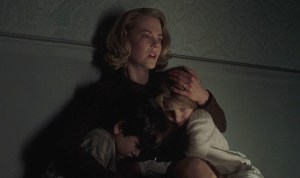 Amenabar is a Spanish filmmaker that rose to international acclaim with 1997’s Open Your Eyes, starring Penelope Cruz and later remade into Vanilla Sky, also starring Penelope Cruz (coming to a Re-Veiw in December!). The Others was a significant breakthrough, and in 2004 Amenabar won the Academy Award for Best Foreign Film for The Sea Inside, a true-life drama where Javier Bardem portrays a man fighting for the right to end his own life. He seemed like an international director on an accelerated ascent, and it all came to a crash with 2009’s costly historical intolerance drama, Agora, starring Rachel Weisz and Oscar Isaac that examined the contentious relationship between Christians and Pagans in fourth century Egypt. It cost $70 million dollars, was over two hours, and made a pittance at the U.S. box-office. From there, Amenabar has primarily worked within the Spanish cinema (2019’s While at War), Spanish TV (2021’s La Fortuna), and one schlocky horror movie about a Satanic cult (2015’s Regression, a title that is too on-the-nose perfect). Admittedly, I haven’t watched any of these follow-ups and the Spanish productions could genuinely be great. I think Amenabar’s early success helped pave the way for another Spanish filmmaker, J.A. Bayona, whose 2007’s haunted manor movie The Orphanage was an excellent Old School horror that could be sincerely scary while still patiently building its unsettling atmosphere.
Looking back at my review from 2001, I think my love of Moulin Rouge carried over into my overly enthusiastic evaluation of Kidman’s increasingly unraveled performance. She’s good but she’s not quite at Oscar levels of accomplishment here, and yet Kidman was nominated for a BAFTA for this role instead of the singing courtesan. The child actors are both good, though neither acted again in credited roles after the mid-2000s, but for me to cite them as “two of the most gifted child actors in a while” reads like hyperbole. My original analysis didn’t get too deep into the mechanics of why everything worked so well, for fear of spoiling its big surprises, and instead kept to admiring its craft, care, and execution, aspects that are still easily apparent and admirable in 2021 as well. The Others is a splendid ghost story no matter the year and will likely still prove to be many years from now.
Re-View Grade: A
Share this:

Moulin Rouge! (2001) [Review Re-View]

Released May 17, 2001:
Director Baz Luhrmann’s last project was the MTV-friendly William Shakespeare’s Romeo + Juliet (like someone else has a Romeo and Juliet) which was adored by the under 15 set that now buy N*SYNC merchandise. Luhrmann waited a long time for his follow up with Moulin Rogue, a manic musical that seems like candy for the eyes. It may have been a long time but it was well worth the wait.
The sparkling world of Moulin Rogue is around turn of the century France. Christian (Ewan McGregor), an aspiring writer, has traveled to this place against his father’s wishes. Christian believes in the beauty of love and the pull of the heart. Within minutes of setting foot in France he gets wrapped up into a production by a dwarf (John Leguizamo) and his cadre of assistants. Christian is sent to the most provocative club in town, the Moulin Rogue. Here he attempts to persuade the most famous showgirl Satine (Nicole Kidman) to help push for their musical to get financial backing. Satine inadvertently confuses Christian for the man she is supposed to seduce for a large some of money, the Duke (Richard Roxburgh). And thus the merry band of misfits get their play the backing while Christian blossoms a love for Satine. But their love must remain hidden for the Duke is led to believe that Satine is his and his alone.

Kidman owns this movie, plain and simple. From her first shattering entrance being lowered from the ceiling to the last scene, she is absolutely magnificent. McGregor gives a nice performance as the dough-eyed lover. Jim Broadbent plays the Moulin Rogue’s owner, Zidler with howling delight in all his manic expressions. Even Roxburgh gives an underwritten antagonist the right amount of weasely twitch.
One of the more surprising features is how well the two leads can actually sing. Kidman gives a soft and sexy take on “Diamonds are a Girl’s Best Friend” and McGregor can belt out a tune with some admirably throaty pipes. As these two veer in and out of songs it’s a pleasure to watch and hear.
Luhrmann has crafted a musical with ADD, but I say this as a compliment. Moulin Rogue‘s pace is fast and pounding. People twirl above the sky, the camera zooms wildly through town streets, and dump trucks worth of confetti fly through the air. Moulin Rouge is exploding with glitz and never lets up. The editing and visual artistry is stirring. By about ten minutes into the proceedings when a green fairy starts singing a seductive version of “The Hills Are Alive” you know you are in for something else. And what a something else the film delivers. There was not a moment I didn’t have a smile glued to my stupid face.

Moulin Rogue could be described as a musical for people who dislike traditional musicals. In traditional musicals people go along stuffy formula, then break out into great choreography song-and-dance. With Lurhmann’s musical is a breakneck of pomp where the characters zip around to exaggerated Hanna-Barbara sound effects and start chiming away with 70s and 80s pop songs that we all know. After the initial shock/humor of hearing characters belt out renditions of “Roxanne” and “Like A Virgin,” a familiarity sets in and it blends in to produce a surprising artistic addition.
The story of the movie is nothing new or extraordinary; it’s well worn territory. But where Moulin Rouge breaks apart and shines are with its style and exposure. The visuals are astoundingly lush and lively, the music is game and pumping, and the movie is just screaming to be seen. This was a true work of love.
The movie is bursting to the seams with life. I loved every single second, every single frame, every single moment of Moulin Rouge. I can’t wait to go see it again.
Nate’s Grade: A
——————————————————
WRITER REFLECTIONS 20 YEARS LATER

This was a movie I was looking forward to revisiting and was partly dreading. With the movies that I loved in my past, there is more at stake revisiting them and finding that some of the luster, some of that original magic that enchanted me twenty years hence might be missing. Nothing is lost by re-learning that something like Freddy Got Fingered is still as awful today as it was in 2001. I had this same nagging concern with several of my favorites of 1999 and 2000, and not all of them held up (these re-reviews cannot help being partly biographical). Moulin Rouge wasn’t even a movie I had much interest in seeing back in 2001. I went at the behest of my friend Kevin Lowe and I remember my expectations being low, or maybe I wasn’t in the greatest mood, but within ten minutes that all changed. Moulin Rouge is a movie I unabashedly loved at 19 years old and watched repeatedly through my early 20s and consider a personal favorite. I was caught up in the razzle, the dazzle (especially the dazzle), but the sumptuous and crazed artistry of it all, where it could simultaneously be nostalgic and modern, irreverent and deeply serious, hopelessly romantic in the squarest of terms while being so quizzically weird. It could have been a spectacular disaster but it ended up being a spectacular spectacular. I’m happy to report that Moulin Rouge retains its charm and soaring passion even twenty toe-tapping years later.

This has and will always be a love-it-or-hate-it film. I don’t think there are many people who can watch this movie and remark, “Eh, it was okay I guess.” The opening act is relentlessly paced, anarchic and antic, bouncing all over the place, exploding with information, humor, colors, and bawdy and bizarre imagery, intending to shake you from your doldrums of what a modern big screen musical experience can entail. Under the mad genius of co-writer/director Baz Luhrmann, the movie is bracingly transporting and takes you for an immediate rush, and just as it slows down, you’re hooked. Or, if you’re in the hate-it camp, you’ve found the movie to be a scattershot, self-indulgent, ADD-addled, exhausting ride you’re eager to depart. An amusement park ride is a fine analogy for Moulin Rouge, a movie reverberating with energy and movement; it really does feel like it can’t possibly stand still. There’s a seductive green fairy line dancing, and a singing moon performing opera, and a narcoleptic Argentinian, and John Leguizamo as a dwarf, and plenty of ribald sexual humor and goofy slapstick comedy. It is, to put it lightly, a lot to handle.
With apologies to modern poets, for most of us, the poetry of our modern culture is the songs that have shaped us and our biographical experiences, the soaring ballads, the friendly singalongs, the bangers to shout at the top of your lungs, the love songs to swoon along to and melt away. Moulin Rouge is a major musical that only has one original song, the modern wedding staple “Come What May,” which was actually written for Luhrmann’s prior movie, 1995’s Romeo and Juliet, and thus declared ineligible for the Academy Award for Original Song (sorry Randy Newman, but your Monster’s Inc. song cannot compete). It is a musical composed of renditions and snippets of hit music, cementing its amalgamation as a pop-culture chimera. In many ways it previews the viral Glee music mashups and remixes, the effortless blending of one song into another, the melodies gliding like dancers and then becoming something excitingly new. It’s a different kind of creativity because it’s one thing just to hit “play” on some Greatest Hits CD and it’s another to make sure the songs track the emotional journeys and perspectives of its primary players. Early on, as Christian (Ewen McGregor) belts tunes from The Sound of Music, captivating his peers with his apparent genius, we immediately understand the instant appeal this man would have, seeming like a musical prophet to those lucky enough to listen in 1899 Paris. It’s a clever shorthand and another reflection that modern music has enough vitality and depth to serve as the romantic poetry of our age. Moulin Rouge also predates the sharp rise in jukebox musicals, using the songs of the past, usually limited to one artist, as part of the infectious fun.

The singing and song renditions are luscious and odd and beautifully re-calibrated. The introduction of Satine (Nicole Kidman) is a bold move, lowered on trapeze, her pale skin practically glowing, as she breathily sings “Diamonds Are a Girl’s Best Friend.” It’s like the movie perceives Satine as an angel being lowered to the mores of man. A male duet of “Like a Virgin” between club owner Harold Zidler (Jim Broadbent) and the villainous, twitchy, possessive and foppish Duke (Richard Roxburgh) is hilarious and at points unfathomably creepy. Watching “Roxanne” performed as a sultry tango is so good that you’ll never want to hear it any other way. The singing by the famous stars is remarkably polished and without the advent of Autotune, especially from McGregor who belts his tunes with impressive range. The blending of this sonic soundscape, especially McGregor inter-cutting with that “Roxanne” number, can be overwhelming to fully process, like the movie is trying to reach you on a pure emotional, elemental level where you feel it before you can fully process it intellectually. I think that sums up the movie and its lasting appeal well, because I can logically pick apart certain artistic choices, like the exaggerated cartoon sound effects that could have been pared back, but the movie is a messy, joyously messy, exuberant love letter to big messy emotions and cheesy romanticism even to the point of mockery. This is a big screen musical for our modern age, and it’s meant to tap the right combination of buttons to make you fall in love, and I do every time.
It’s amazing to me how Moulin Rouge feels like a crossroads of the old and new, reaching back to the big movie musicals of old but with the hyper-kinetic style of modern music videos. It’s immediately fresh but also familiar, and that clever construction most notably extends to its very specific use of music. It’s not trying to erase the old school musical but drag it into a new century, drafting off of modern music hits to reach a new audience waiting to feel that same heightened reality that those old musicals might not capture for a younger generation. The movie also begat a resurgence of big screen musicals like 2002’s Chicago, 2004’s Phantom of the Opera, 2005’s Rent and The Producers (also co-starring Kidman), 2006’s Dreamgirls, 2007’s Sweeney Todd and Hairspray, and on and on to recent musicals like 2019’s Rocketman (jukebox musical) and 2020’s The Prom (also co-starring Kidman). Everything Chicago did, I felt like Moulin Rouge did better the year before, and I’m convinced Kidman’s Best Actress Oscar for The Hours was a makeup award for being overlooked for her superior performance in Moulin Rouge a year prior. I don’t know if Kidman was ever better than she was here at this moment in her career, fresh off her divorce from Tom Cruise. I feel strongly that Broadbent should have won his 2001 Best Supporting Actor Oscar for this and not Iris. The movie was nominated for eight Oscars and justly won two for Best Art Direction and Costumes, both going to Luhrmann’s wife, Catherine Martin, who would also win two Oscars for her husband’s equally lush and anachronistic 2013 adaptation of The Great Gatsby. The electric editing, glittering cinematography, and all the bravura technical elements blend into a rare artistic vision so complete and so extravagantly bold at this budget level.

It should also be noted that Moulin Rouge was adapted into a Broadway stage musical in 2019, updating with more twenty-first century hits like “Crazy in Love” and “Firework” and “Toxic” and “Bad Romance” among others. Its stage run was postponed because of COVID although a national tour is planned for 2022.
From my original review back in 2001, many of my same points still hold up and it was difficult to perfectly capture the spell this movie can have, the same difficulty I’m running into today in 2021 to try and convey its unique hold on me. Regrettably, it’s another review that I felt I needed to take a potshot on “teenyboppers” from my oh so dismissive position as critic. It’s nice when I find myself agreeing with my twenty years younger self. I especially agree with this one summative statement: “There was not a moment I didn’t have a smile glued to my stupid face.” Moulin Rouge is one of my happy movies and twenty years later my stupid face is still smiling.
Re-Review Grade: A
Share this:

The Prom (2020)
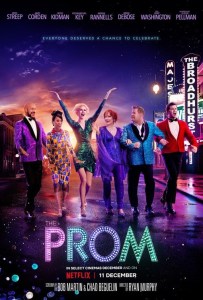 It’s full of big feelings, declarations of self-identity, an unabashed love of the transformative power of theater, and its power of positivity can be a balm to many during this holiday season. The Prom is based on a short-lived Broadway musical about a girl in Indiana who wants to bring her girlfriend to the school prom and the ensuing media controversy that erupts. A team of out-of-work theater actors (Meryl Streep, Anthony Rannels, Nicole Kidman, James Corden) see publicity value in rallying to her cause, so they decamp to Indiana and challenge the homophobic PTA leader (Kerry Washington) who refuses to hold an inclusive prom. Director Ryan Murphy’s style and sensibilities work well within the realm of musical theater; a decade of television curation for FX and now Netflix has made him an expert on camp and flash. The man loves applying slick gloss to trash. His camera is constantly, uncontrollably moving during the numerous musical numbers, attempting to compensate for the generic quality of the majority of them. There are two standouts. The first is when Corden’s character takes our lesbian teen to the mall for a makeover. It’s got a catchy hook and one that becomes a reoccurring theme for the show. The second is when Rannels’ character is pointing out the hypocrisy of local Christians decrying homosexuality but falling short of other Biblical teachings. The story is sweet but un-challenging. The plot exhausts so quickly that I was amazed at one point to discover there was still an hour left in the over two-hour production. Each member of the squad gets a signature number to varying degree of success. The happy ending is affirming and heartfelt but also quite easy and kind of unearned. The amount of catharsis and reconciliation doesn’t gel with the emotional investment and development of these characters. They’re nice but relatively dull, and the industry satire only goes so far to chide the out-of-touch Broadway elites for their own prejudices of Midwest life. The Prom is disposable fluff that will pacify an afternoon.
Nate’s Grade: C+
Share this:

Bombshell (2019)
 More an expose on toxic work environments than anything overtly political, Bombshell is an effective true-life drama about the many pitfalls, humiliations, traps, harassment, and compromises that women face in the workforce. We follow the downfall of news magnate Roger Ailes (John Lithgow), the imposing man who built the Fox News empire and who also bullied his employees and solicited sexual favors from the many women who were on his payroll. Margot Robbie plays an invented character meant to provide that entry point into Ailes the creep in creepy action. She’ll be harassed and pressured for sex by a man described as “Jabba the Hut,” and Robbie is terrific in her big dramatic moments portraying what the pressure and shame does for her ambitious anchor. The other two main characters wrestle with how far to go in a corporate culture of keeping secrets from very powerful, very dirty old men. Gretchen Carlson (Nicole Kidman) is consulting lawyers for a personal harassment lawsuit against Ailes the person, not Fox News, but she needs other women to come forward. Megyn Kelly (Charlize Theron) is struggling with the scrutiny she has endured after then-presidential candidate Donald Trump turns his small Twitter thumbs against her. The Fox bigwigs won’t go on record to defend her, and their journalists, because they need Trump to drive ratings. The movie uses several Big Short-style narrative tricks to help tell its sordid tale, including swapping narration and fourth-wall breaks; a run through of hearing from Ailes’ past victims in their own words is striking, especially a woman who says she was only 16 at the time. Part of the fun are the many many cameos and just watching actors portray different Fox News personalities (Richard Kind as Rudy Guiliani!). The makeup is also phenomenal and Theron looks unrecognizable as Kelly. The film itself doesn’t feel like it’s telling you anything you already don’t know about the subject; people will compromise their morals for personal gain, power leads to exploitation, women are unfairly treated, and it’s easier to fall in line than stand up to power. There’s still a thrill of watching the downfall of a serial abuser, and the acting is strong throughout, but Bombshell can’t shake the feeling of being a slicker, more star-studded TV movie version of recent history. Even with the urgency of the topic, it feels light, and not because of its use of incredulous humor. I could have used more behind-the-scenes details, and maybe that’s where Showtime’s miniseries The Loudest Voice comes in, retelling the same story with Russell Crowe as Ailes. It’s a solid movie on a very pertinent subject and worth seeing but it also makes me wish for a harder-hitting, more widely sourced expose on this very bad man who felt forever protected by the status quo of power.
Nate’s Grade: B
Share this:

Aquaman (2018)

It’s hard not to talk about the fledgling DCU without grading on a curve. Wonder Woman was a great success and a definite step in the right direction but it still had clear Act Three problems. However, when your previous movies are the abysmal Suicide Squad and Batman vs. Superman, anything in the right direction is seen as enlightenment. There are currently no planned Superman films, no planned Batman films, and it looks like the teetering DCU is banking its future on the success of Wonder Woman and Aquaman. If you had told me that the future of an interconnected series of franchises would rest upon the shoulders of a man who talks to fish, I would have laughed. Enter director James Wan, best known for the Conjuring franchise and plugging into Furious 7 without missing a beat. Warner Bros. desperately wanted Wan’s stewardship to get a notoriously difficult comics property to float in the modern market. The early marketing was not encouraging but I held out a slim degree of hope that Wan would make it work. While Aquaman as a whole has its share of problems, Wan has done it. He’s made a big screen Aquaman movie that is fun, visually immersive, weird, and packed with great action. I was just as surprised as you, dear reader, but the smile on my face was evident.
Arthur Curry (Jason Momoa) is heir to the undersea throne of Atlantis. His mother (Nicole Kidman) fled her arranged marriage and had a son with a human lighthouse keeper. She retreated back into the ocean to prevent further harm to her shore side family. Arthur is approached by princess Meera (Amber Heard) to return to Atlantis and claim his birthright to the throne, currently occupied by Arthur’s half-brother, King Orm (Patrick Wilson). The reigning king is planning to unite the seven sea kingdoms to launch an attack against the surface-dwellers. Arthur must go back to the people who reportedly killed his mother and challenge his half-brother for supremacy. Along the way he’ll have to venture across the globe with Meera for a series of adventures to reclaim lost artifacts, while also dodging Black Manta (Yahya Abdul-Mateen II), a pirate gifted with underwater technology who swears vengeance against Arthur for letting his father die.

Make no mistake, there is definitely a ceiling capped for Aquaman. The characterization is pretty standard stuff with little added nuance. It’s a dash of Chosen One destined to bridge communities, a dash of Prodigal Son outcast trying to make amends and duty, and there’s the general pledged vengeance that reappears again and again for motivation. The plot is reminiscent of a video game, structured so that Arthur and Meera have to travel from one stage to another, finding an important artifact and then going to the next stage. Sometimes there are mini-bosses at these various video game stages. The antagonists are acceptable but without much in the way of depth or charisma. You might even find yourself agreeing with King Orm as far as his pre-emptive strike over mankind (the latent racism of “half-breeds” maybe not as much). The leads are also given little. Momoa (Justice League) is a naturally charismatic actor but his range is limited; he basically has two modes, off and on. This might have been one reason why the screenplay resolves to merely push him toward his “call to action,” which I thought was his Justice League arc. Still he’s an affable and handsome presence even with lesser material. Heard (London Fields) is struggling to find her character’s place in the story. She’s a romantic interest, quest cohort, and there are attempts to push through more feminist agency but it’s too murky. It feels like she’s trapped by her character and her giant Halloween store red wig. If you cannot get over these deficits, it’s going to feel like a relentless 143-minute video game.
And yet the movie works thanks to the talents of Wan and the overall abundant sense of exuberant fun. Wan has become a first-class chameleon, able to adapt his skill set to whatever genre he attaches himself to, be it high-octane car chase thriller, slow burn horror to grisly torture porn, or now splashy superhero blockbuster. Early on, I knew we were in good hands when Wan showcases a destructive fight scene between Kidman and a group of aqua storm troopers in long takes and wide angles, letting the choreography speak for itself and allowing the audience to fully take in every smash and crash. The action is consistently interesting and filmed in ways to highlight its best points. An underwater brotherly battle takes the movement within water into account, adapting fight choreography to add this new dimension. That’s what good action movies should be doing, applying their unique settings into the action development. There isn’t a boring action moment in the film. Even when we get to the big CGI armies duking it out, Wan instinctively knows to pull back to avoid overkill. Even the otherwise normal hand-to-hand combat is clever and consistently entertaining. The highlight of the movie is actually on land, an extended chase through the villas of Tuscany. Arthur and Meera are battling Black Manta but they’re also divided, and Wan’s camera will zoom back and forth between the two, connecting each on their parallel tracks. They jump from tiled roof to tiled roof, escaping danger. There’s one super aqua storm trooper who takes a more direct approach and just runs through room after room, and the camera follows him on this direct line of destruction. There’s even a payoff where Meera uses her powers in a wine shop to her great advantage. It’s moments like this where Wan is clearly having fun and demonstrating that he and his team have put good thought into their action.

The visuals are wildly immersive and amplify the sense of fun the film has to offer. There are plenty of cinematic reference points of influence here, from George Lucas to James Cameron, but Wan and his team do an excellent job of making this universe feel full. We visit many different undersea realms and people, including seahorse people, crab people, and just taking ownership of the weirdness without irony is refreshing. With the exception of Momoa’s need to undercut moments with quips, the film feels genuine and proud of its old-fashioned mentality, taking the ridiculousness and treating it with sincerity. That doesn’t mean there aren’t campy and absurd moments that are enjoyable precisely because of their camp and absurdity. There are people riding great white sharks and battling crab people to the death. How can that not be silly? There’s one group of creatures that feel plucked from Pitch Black, a band of feral monsters vulnerable to fire. There’s a fun and effective sequence where Arthur and Meera must dive to escape with their lit flare and we see the full totality of their situation, a literal sea of these monsters breaking apart just so as they dive. It’s a creepy moment made even better by Wan’s visual choices, which always seem to correspond to what’s best for the experience. The special effects are uniformly great and the attention to the undersea worlds is pristine.
Ultimately your view of Aquaman will come down to what you’re willing to forgive in the name of fun spectacle. Its best Marvel Cinematic Universe (MCU) equivalent are the pre-Ragnarok Thor films. There are definite deficits with the minimal characterization and the familiar hero’s journey plot arc, but the execution level and the sheer energetic entertainment are enough to rise above. The action sequences are routinely thrilling, eye-catching, and wonderfully alive and clever thanks to Wan. They’ve found a way to make Aquaman cool and fun, which is what rules the day when it comes to the film version. Aquaman is another step in the right direction for the notoriously gloomy DCU. If Wan was attached for a sequel, I’d genuinely be interested. This is nothing you haven’t seen before in any number of movies (just now underwater), it’s not exactly intellectually stimulating or emotionally involving, and yet the sheer success of the visuals, action orchestration, and the sense of fun override the rest of the detractions for me. It reminds me of the Fast and Furious franchise. I don’t care a lick for any non-Rock/Statham characters; I’m just there for the physics-defying stunts and set pieces. It provides the goods when it comes to action spectacle, and so does this movie. If you’re looking for a 90s throwback to big, fun action movies, then take the dive with Aquaman.
Nate’s Grade: B


 nathanzoebl
You must be logged in to post a comment.