Blog Archives
X (2022)/ Choose or Die (2022)
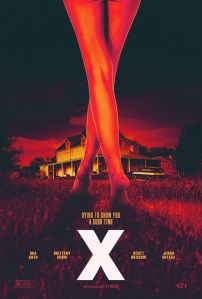 Horror is likely the most forgiving genre out there for being derivative. Just about every modern horror movie wears its many influences, even the recent trend of elevated horror movies that are trying to say Big Things with equal amounts of arty style and bloodshed. There’s only so many monsters that can chase so many teenagers. Ti West (House of the Devil) is a director I haven’t fully enjoyed, though I would say X is his most accomplished film to date for me. It’s clearly going for a Texas Chainsaw Massacre vibe and docu-drama aesthetic. It’s set in 1979 and we follow a ragtag film crew trying to make “a good dirty movie.” They’ve rented a guest house in the middle of nowhere Texas as their film site because who knows. The octogenarian couple who owns the farm property doesn’t seem to approve of these young folk, and the old lady ends up becoming the slasher killer that mows down the randy young adults. Turns out the old lady has her own urges that the old husband is no longer physically able to satisfy, so she seeks out solace one way or another with the newcomers, whether that be through her sexual satisfaction or through violence. To West’s credit, he has given more attention to his characters. These people are not going to be confused with three-dimensional figures but there’s enough character shading that made me more interested in spending time with them and a little more rueful that most of them will probably die horribly soon enough (Chekhov’s alligator). The slow burn is not wasted time or dawdling, and there are some very well-executed squirm-worthy moments of discomfort. I don’t think X quite works on that elevated horror level of late; it’s mostly a slasher movie with a dollop more complexity and style. The real reason to appreciate X is from the dual performances from actress Mia Goth (Suspiria), the first as a stripper-turned-ingenue that sees pornography as a path of possible self-actualization, but she’s also secretly the killer old lady under piles and piles of makeup. Her wild performances, including scenes where she is facing off against herself, makes the movie far more interesting. Goth goes for broke. I don’t think the X is as fun as it thinks it is, nor is it as thoughtful as it thinks it is, and I don’t know if I care about a prequel that was shot back-to-back that illuminates the killer old lady’s younger life. Is this character really that interesting to warrant her own movie? As a horror movie, it’s disturbing and bloody and surprising in equal measure even as it doesn’t do much with re-configuring the many conventions of its genre.
 Netflix’s Choose or Die is one of those spooky horror movies that wants the audience to play its deadly games alongside the unfortunate characters, much like Saw and Would You Rather?, and I typically enjoy these kinds of movies and thinking what options or strategies I would undergo if I was in their place. The structure is pretty straight forward, with a young woman (Iola Evans) and her programmer friend (Asa Butterfield) coming across a cursed old school text-based computer video game that forces its users to make awful choices. The game turns itself on every 24 hours, so there’s a natural delivery of set pieces, each increasing in its personal stakes. There’s the amateur investigation of the history of this 80s video game and uncovering the possible owner who might be benefiting from all this cruelty and sadism. This is a movie built around its set pieces and they start strong. When the protagonist sees the game in action, with a poor diner worker force-feeding herself broken pieces of glass, it’s truly horrifying and the sound design makes it so much worse. The movie isn’t s gory as it could have been and implies a lot more than it shows. The problem with Choose or Die is that there are too many leaps in logic and characters doing silly things just for the sake of the plot. There needs to be an established system of rules or else everything will feel arbitrary, and eventually that is what dooms Choose or Die. Even while we get more of an explanation behind the makers of the game and their occult connections it never feels like we’re better positioned to beat the game. I will say the final act, the Boss Battle, is where the movie cranks things up and gets really intense and darkly humorous. There’s a showdown that involves a key concept of self-harm that plays out in moderately clever, bizarre, and surprising ways, and this splashy, silly finish made me wish the rest of the movie could have lived in this tonal space. I found the overall sound design to be very annoying as it cranked up the volume on lots of glitchy electronic noises that just made me want to turn it off. There are some good ideas here, like the criticisms of being too nostalgic to the past, and of misogynist men believing nobody else is deserving of being the hero of their story, but this is a movie that lives or dies on its killer set pieces, and those just fall flat after its unsettling first level. Watching someone vomit VHS tape is not scary. Watching people move their bodies like they have no control over them will inherently look goofy. Choose or Die wouldn’t be the worst choice of a movie to kill 85 minutes but it’s certainly not much more than the sum of its parts, and even those are overly derivative and been done better by its predecessors.
Nate’s Grades:
X: C+
Choose or Die: C
Share this:

Windfall (2022)
 When is a 90-minute movie egregiously too long? When it’s like Windfall and lacking plot and direction and tone to justify all those minutes. The scaled-down production follows three characters confined to the grounds of one location. Nobody (Jason Segel) is trespassing and living on a fancy estate, complete with orange grove, but when the rich owners, CEO (Jessie Plemons) and Wife (Lily Collins), come home and find the mysterious man, he holds them hostage. From there, you would think the movie might be a comedy of errors, a social satire, and it’s not really. Or maybe you would think it’s a taught thriller with each side trying to manipulate the other, and it’s not really. It’s not really a comedy and not really a thriller, so its laughs are minimal, its thrills are trifling, and it comes down to spending too much time with characters that lack the depth to justify the investment. This movie is strictly kept at parable level, so the characters are meant as ciphers, hence the generic title names. These people are not that interesting to spend this much time with. The movie feels like an anecdote stretched beyond the breaking point and by writers I respect (Seven‘s Andrew Kevin Walker and Charlie McDowell, the writer/director of 2014’s The One I Love). That beguiling little indie movie also revolved around one luxury vacation home and a feuding couple but it had an intelligent sci-fi twist that kept things focused on characters and creative ingenuity. There is no such turn with Windfall. It’s all kept so frustratingly obvious, so the movie just feels plodding and meandering, like we’re simply waiting with the characters for things to end too. The insights are too few. The burst of violence at the end as climax feels unearned and too little too late to raise the stakes. Mostly, Windfall is a hostage drama that doesn’t want to be a hostage drama, a social satire that doesn’t want to be a social satire, a thriller that doesn’t want to be a thriller, and a movie that doesn’t have a consistent tone or direction or entertainment value.
Nate’s Grade: C
Share this:

The Adam Project (2022)
 Watching the trailer for Netflix’s The Adam Project, I wasn’t too impressed. It felt like a combination of familiar and popular movies like Back to the Future, E.T., and Looper. It seemed like another assembly of popular sci-fi movie tropes and I wasn’t expecting much else. Then as I watched the movie, I realized how enjoyable and engaging this original story by writer T.S. Nowlin was and what must have attracted Tom Cruise to want to star and produce this project in 2012. It met a long developmental hell, as is common in the industry, before being given a second life at Netflix with Ryan Reynolds as star and director Shawn Levy (Free Guy). It kind of muffs the action and sci-fi spectacle, but The Adam Project is a movie that’s big where it counts.
Adam (Reynolds) is a pilot in 2050 who is fighting against a corporate evil that uses time travel to enshrine its power. Adam’s own wife (Zoe Saldana) crash landed in 2018. In desperation, he travels back in time to find her and team up against their future foes, except he lands not in 2018 but in 2022, and he meets his younger, twelve-year-old self (Walker Scobell). It so happens that Adam’s ship is marked to respond only to his DNA, so he needs his younger self to help while he recovers from his injuries. Unfortunately, the future is antsy to eliminate Adam and sends killer super soldiers and missile-launching spaceships. Both Adams come to the conclusion the only way to prevail is to stop the initial first steps of the invention of time travel, meaning going back further to see their departed father, Louis Reed (Mark Ruffalo), the inadvertent creator of time travel.
 Where The Adam Project really shines is with its core ideas and relationships, which is the emotional heart of a movie. It’s peculiar because we’re so used to seeing the other half, the sci-fi action spectacle, prioritized at the expense of story and characterization. Usually a studio puts much more emphasis on a movie looking good, or at least passably entertaining, and less on the substance that would make it meaningfully so. Credit to the filmmakers that they understood what the core appeal of this movie was and that is the idea of characters out of time getting a chance to interact, learn, and reconcile. Who among us wouldn’t want another opportunity to talk with a loved one before they are gone? Who among us would not be hesitant to eliminate the special confluence of events that lead a special someone into our life? The idea of two different aged versions of one character butting heads is inherently fun but also meaningful, because every one of their squabbles or disagreements is telling from a character standpoint. We’re learning about the differences between these two versions and two different timelines. The older Adam is resentful of his younger self, of his naivety, and looking to toughen him up or settle some scores he thinks will be cathartic. The younger version resents his older self for being so domineering, for being so cynical, and for pushing him into uncomfortable situations to relieve long-standing grudges that he hasn’t dwelled over yet. It also allows older Adam to remember things that he has forgotten from the perspective of his younger self. The buddy banter is capable and spry but it’s also revelatory about the characters, which makes every interaction more important.
Adam’s father doesn’t come back until the second half of the film, and then the movie transforms into a real family affair and takes on extra pathos. Dear old dad is the square pushing back against the ethical implications of knowingly participating with time travel. Here we have three different characters, all related, but each has a different perspective and competing goals: Younger Adam wants to beat the bad guys but also is freshest in his grief over his dad and wants to save him; Older Adam wants to rescue his wife but also has a score to settle with his departed father; and Dad gets a chance to see his grown son, something he will never otherwise witness, but is adamant about refusing to help and prosper from time travel foreknowledge shenanigans. That’s a good combination of conflicts and personality differences, and through the relatable lens of broken relationships repairing between two sons and their father, it elevates each routine action moment later.
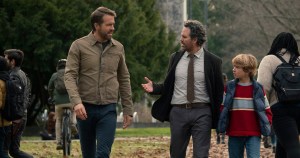 My other surprise was how mundane the action plays in The Adam Project. I started to notice how the action was usually pretty small-scale with only a handful of future soldiers fighting in relatively open and empty spaces. The big future addition is an electrified baton that older Adam utilizes, as younger Adam gushes, much like a lightsaber. It has the power to propel enemies in a force blast that launches out in a circumference, but I kept questioning why Adam wasn’t knocked over by this force as well? It’s a cool device but little else is utilized to separate the past and future. When the characters murder people, they vanish in fiery clouds, free of blood, and we’re told this is what happens when a person is killed outside their timeline. I think it was meant to make the audience forget the mechanics or downplay that all these vanishing soldiers are actually being murdered from existence. The younger versions of these characters are still present but it’s not like there’s another version that will take their place. Their lives ended in this moment as they traveled back in time to this final fate. No do-overs for them. The finale of The Adam Project is a mess of bad CGI and a world-destroying machine; both it and the plot are on apocalyptic autopilot at this point. The preceding movie was much better to simply fall victim to such a dumb climax. It’s not enough to dent the positives that came before it, but the movie succumbs to the pressures of big blockbuster silliness it had avoided.
Here is a vehicle that makes perfect use of the charms of its leading man. Reynolds (Free Guy) has always been a charismatic performer, a fast-talking rogue you can’t help but fall for, but not every movie role allows him to play to his strengths, Sometimes he’s just on quip overload and can come across like the overly ironic, insincere, vacuous version of his motormouth persona. His glib demeanor has a way of eating him whole. Here, the actor gets to essentially be playing off himself, and it works so much better. Reynolds is also a natural with kids (see 2008’s Definitely, Maybe) and there’s an inherent big brother/little brother vibe to the Adam interactions that makes them heartwarming while also amusing. Newcomer Scobell is able to hold his own with Reynolds, no small feat. He has a vibrant, excitable energy that feels youthful without getting into annoying Anakin “yippee” Skywalker territory. Reynolds may be the star but you’ll enjoy spending time with young Adam too, and this is also a credit to Scobell and his performance. Ruffalo and Jennifer Garner (a welcomed 13 Going on 30 reunion) are enjoyable if extremely under utilized; each could have had a whole movie from their vantage point.
 The Adam Project is an action movie that looks like typical pandering studio junk at first glance but gets the hard stuff right, namely the reasons why you should care about any of the flying bodies, explosions, and world-ending CGI. It’s about the characters, and here we have a dynamic that keeps things interesting and fun while also making the dilemma personable and emotional. The same stakes given to saving the world are also given to having one more conversation with a departed father or with trying to get things right in your past while time is still ahead of you. The Adam Project might be overlooked or discounted because of how its parts appear to be generic and stale, but it’s the care with which they are assembled that won me over. I’m just amazed that, for once, a Hollywood big-budget tentpole release emphasized the right stuff.
Nate’s Grade: B
Share this:

The Texas Chainsaw Massacre (2022)
 What are we doing here? This new Netflix Texas Chainsaw Massacre is part reboot and part distant sequel to the 1974 original, even bringing back sole survivor Sally Hardesty to get her very grizzled Jamie Lee Curtis-in-Halloween 2018 vengeance. There are a lot of bad sequels and remakes in this franchise’s history, blinked out of existence here with this ret-con, so keep your expectations pretty low. This is a 75-minute movie with a wisp of a plot, so much so that it doesn’t even wait until the twenty-minute mark for the conveyor belt of carnage to begin. I suppose that can be a virtue for genre audiences. This is a decidedly gory and crunchy horror movie, gleefully splashing in entrails and jump scares rather than taking the time to develop something more. If we’re upholding the original’s timeline, then this Leatherface is in his mid-seventies. We need fun slasher movies too (I enjoyed the fifth Scream), but this one just feels spiteful and creatively hollow. I don’t really even understand the premise, that a group of political activists are literally buying or auctioning a ghost town to turn it into a gentrified, liberal mecca in the Texas desert. Young liberals are removing racist Texans from their homes and Fyre Fest-chasing Zoomers are invading? What? Then there’s our Final Girl who herself is the survivor of a school shooting and working through her trauma, and flashbacks, to regain her control by literally learning to arm herself. Oh no. Elise Fisher (Eighth Grade), you deserve so much better. It’s fast-paced. It’s exceedingly bloody. It’s over quickly. I guess there are ways this new Texas Chainsaw Massacre could have been worse but there’s even more ways it could have been better.
Nate’s Grade: C
Share this:

The Hand of God (2021)
 For writer/director Paolo Sorrentino’s Oscar-winning 2013 film The Great Beauty, of which I was a great fan, I wrote: “It’s a bawdy, beautiful, and entertaining film but one that also takes its time, luxuriates in atmosphere… The film is far more free-floating and meditative … I felt like I could celebrate the absurdities and joys of life along with the people onscreen. It’s existential without being laboriously pretentious, and the comedy and stylish flourishes help anchor the entertainment.” Most of those words still apply to 2021’s autobiographical coming-of-age drama, The Hand of God, so why does it feel less appealing this time? We follow a young man in 1980s Naples and his large, boisterous, very Italian family. It’s a movie of moments, several extended vignettes, and it sadly doesn’t add up to much for me. I think that’s because the young protagonist is too blank to care about. He’s a surrogate for the filmmaker, but you never get a sense of his passions or interests or even personality. It’s a movie of people talking to and at him, so it’s hard to work up much emotion for his triumphs and perseverence. There are some memorable parts, like his awkward deflowering to an older woman, and a tragic turn halfway through that sneaks up on you. The life lessons are familiar for the well-trod territory, and the personal details of the era, the community, the 1982 World Cup (where we get the title from) feel richly realized as Sorrentino’s gauzy nostalgia. It’s just that Sorrentino’s ratio of interesting to ponderous moments has tilted into the negative this time. The Hand of God is overlong, free-floating, occasionally beautiful and frustratingly inaccessible.
Nate’s Grade: B-
Share this:

Passing (2021)
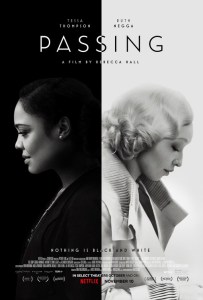 Actress Rebecca Hall’s debut as a screenwriter and a director was snatched up by Netflix and now poised as an Oscar contender. It’s set in the 1920s and follows two women, Irene (Tessa Thompson) and Clare (Ruth Negga). Both women come from the same neighborhood but have lived different though fruitful lives, though Clare’s fortunes hinge on a secret she hides even from her rich husband. She’s a light-skinned Black woman but she has been posing as being white, and she’s reaped the rewards. As the two former friends reconnect, Clare visits the clubs and parties of Harlem as if a tourist, and she seems to have charmed Irene’s husband to spark unrest in her home. The movie is very tasteful and stately, filmed in black and white and in a 4:3 aspect ratio, communicating the boxes these women felt trapped in by society’s racial aptitudes. The problem is that Passing has so much explosive drama at its core but it’s too demure to a fault, which leads to a lot of wheel spinning and pensive glances. The movie almost follows the “uninvited guest” plot device, where Clare makes herself more at home in Irene’s world to her chagrin. There’s a general danger of whether Clare’s secret will come out, especially since her husband is overtly racist, but she seems so blase about her situation. The movie seems to feel like it’s lacking a potent sense of dread for these women, leaving it more implied than felt. It’s a character study but the primary characters seem more like archetypes, symbols intended for a larger social debate after the film’s conclusion. Both actresses are terrific, however, and would be worthy nominees for awards. Negga (Loving) has the more locked-in performance as the woman living her facade, only offering glimpses of what the real Clare thinks about herself. Thompson (Dear White People) is the one trying to hold it all together while she tries to assess whether her former friend has figured out a social cheat code, is deluding herself, or is herself a corrupting influence. The ending is so abrupt that I had to rewind to better understand what had happened. It’s left for interpretation about culpability and intent, but it’s further confirmation that the characters are meant as symbols more than people, and their fates feel a little too tailored for study. Passing is a good movie, don’t get me wrong, but one that left me checking the time a little too often to see how slowly it was passing.
Nate’s Grade: B
Share this:

The Power of the Dog (2021)
 Every year, it seems that Netflix’s crown jewel for their big Oscar hopes ends up getting marvelous critical acclaim, and then when I finally watch it I am left disappointed. It happened in 2018 with Roma. It happened in 2019 with The Irishman. And it happened in 2020 with Mank. I haven’t disliked any of those movies, but I was unable to see the highly laudable merits as other critics. Now here comes their big Oscar play for 2021, Jane Campion’s The Power of the Dog, a Western that has been gracing the top of more critics lists than any other American film this year (I’ll be getting to you soon enough, Drive My Car). As I burned through awards movie after awards movie to assess, I held back from The Power of the Dog for a time. I just didn’t want to find that once again I was disappointed with the latest Netflix Oscar contender. I’m still chewing over my feelings with The Power of the Dog, which has a lot going on under the surface and a palpable tension that you’re unsure of how and when it will erupt. It’s also a movie that touches upon repression, toxic masculinity, manifest destiny, grooming, emotional and physical manipulation, and the danger of unstable men who are unable to process who they really are.
Set in 1925 Montana, Phil (Benedict Cumberbatch) and his brother George (Jessie Plemons) own and operate a cattle ranch. George marries a widow, Rose (Kirsten Dunst), and brings his new wife and her teenage son, Peter (Kodi Smit-McPhee) to live at the ranch. Phil resents his new sister-in-law, looks down on her son, and torments both repeatedly. Rose sees Phil as an enemy, someone who will not stop until he forces her out, and his target becomes her son, Peter.
 This is less a traditional Western in several respects and more a tight character study that happens to be set at the conclusion of a Western fantasy for America, transitioning to modernity. It goes against our preconceived notions of a Western, not in a deliberately deconstructive way like 1992’s brilliant Best Picture, Unforgiven, but more in providing contrary thematic details that often get squeezed out. I was expecting the movie to take place maybe during the 1870s or 1880s, but the fact that it’s taking place five years removed from the Great Depression offers different story opportunities and larger reflection. There’s a reason this story is told well after the halcyon days of the Old Wild West. The movie is about certain characters holding onto an exclusive past that has eclipsed them and others ready to move forward by shuttling over their past and the obstacles standing in the way of personal progress.
There are thematic layers expertly braided together that touch upon the larger question over what it means to be a man in society. Each of the primary male characters (Phil, George, Peter) is an outsider to some degree, someone who doesn’t neatly fit into what constitutes a conventional man of the times. George is soft, empathetic, meek yet in a position of power from his family’s status; Peter is rail-thin, academic, odd, effeminate at turns, a dandy presented for ridicule; Phil is the one who presents as a “man’s man,” a hard-driving, hard-drinking man of the land who imposes his will on others. However, deep down, Phil is hiding a key part of himself that would conflict with his society’s view of masculinity. Each man bounces around points of conflict and connection with one another, familial bonds fraying, and a slow-burning battle for supremacy escalating.
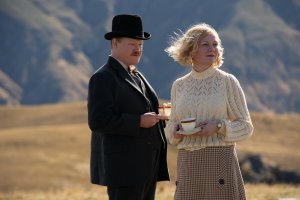 The movie could have also been charitably nick-named “Benedict Cumberbatch is a jerk to everyone,” as this is much of what Campion’s script, based upon the 1957 novel by Thomas Savage consists of. The movie is absent a primary perspective. We drift from person to person in the small-scale ensemble, elevating this next character and their views and worries and priorities. Phil could be deemed the primary protagonist and antagonist, especially the latter. He’s a mean man. Phil is a man who likes to make others uncomfortable, who needles them, and he takes great interest in targeting Rose, partly because he doesn’t like the influence she has on his only brother, and partly because he can get away with it. When he sets his sights on Peter, you don’t quite know what this hostile man will do to get his way. Will he manipulate Peter to turn him from his mother? Will he endanger Peter as a threat to Rose? Will he go further and possibly kill Peter? Or, as becomes more evident, does he see Peter in a very different light, a special kinship that had defined Phil’s own secretive past.
I suppose it’s a spoiler to go further so if you want to, dear reader, then go ahead and skip to the next paragraph. Phil reveres “Bronco Henry,” a deceased rancher that taught him many things when he was younger. The movie heavily, heavily implies that this long-departed older man had a romantic relationship with Phil when he was much younger, something the grown Phil cherishes, caressing himself in private with a scrap of fabric belonging to Henry. The lazy characterization would be, “Oh, Phil is homophobic because he’s really gay, and he’s angry because he cannot accept himself.” With Campion, Phil could be viewed as a victim too. He was likely groomed by an older man, and maybe that relationship was viewed by Phil as more romantic and consensual than it was, but it’s the lingering nostalgic memory of the intimate happiness that he holds onto, afraid to move on because of the danger of letting go and the danger of possibly reaching out, being vulnerable again. Yes, dear reader, this is more a gay cowboy movie than Brokeback Mountain (which, to be fair, were sheep herders). Savage himself was also gay. As Phil takes Peter under his wing, you don’t know whether this man is going to kill or kiss him, and the tension is ripe enough that either way it can ties you up into anxious knots.
The acting is extremely polished all around, with each performer having layers of subtext to shield their true intentions. Cumberbatch (Spider-Man: No Way Home) is a thorn in so many sides and it isn’t until much later that the veil begins to drop, ever so slightly, allowing you to finally see extra dimension with what appears to be a bully character for so long. He might just be too impenetrable for too long for some viewers to develop any empathy. Plemons (Jungle Cruise) and Dunst (Melancholia) are sweet together, and I enjoyed how each one leans upon the other for support. Rose is the butt of much of Phil’s torment and teasing, so we watch Dunst break down under the constant abuse of her berating brother-in-law. When her character sees a way to gain an upper hand, it becomes like a light in the darkness for her momentary relief. I felt heartbroken for Rose as she studied a piano tune for weeks to impress esteemed guests of her husband’s, only to succumb to her nerves and insist she couldn’t play because she didn’t think she could be good enough. Then to watch Phil cruelly needle her further about her disappointment by whistling that same tune is even worse. This is the best acting of Smit-McPhee (Let Me In) since he was vying with Asa Butterfield (Hugo, Ender’s Game) for every preteen lead in big studio features. There’s a deliberate standoffish quality to the character, to Peter’s way of viewing others. It’s like he’s part alien, studying the things that make people tick. Like Cumberbatch, there are multiple layers to this performance because his intentions are equally if not more guarded. You almost need to watch the movie a second time to better identify what Smith-McPhee is doing in scene after scene.
 The Power of the Dog is a terrific looking and sounding movie. The photography is beautiful, the New Zealand landscapes are awe-inspiring, the production design is handsome, the musical score by Johnny Greenwood (There Will Be Blood) is discordant strings that enhances the tension permeating through the movie. Campion hasn’t directed a movie in over ten years, and this is only her second movie since 2003’s misbegotten erotic thriller, In the Cut, starring an against-type Meg Ryan. It feels like she’s had no time away with how controlled and resonant her directing plays. I wish her script was less ambiguous to a fault; it errs somewhat I believe by holding out key revelations about Phil for too long, leaving us with the man being an unrepentant bully for too long. There are significant turns in the concluding minutes that will reorient your interpretation of the entire film, and I have every reason to believe that when I watch The Power of the Dog another time it will be even more impressive.
Congratulations, Netflix, on breaking your streak of disappointing me with your prized awards contenders. I’ve included many Netflix movies in my best lists, and worst lists, over the years, as that is the lot when you have such an enormous library in the prestige streaming arms race. The Power of the Dog is an intimate and occasionally even sensual Western that pushes its put-upon characters to their breaking point, and perhaps the audience, while rewarding the patient and observant viewer. There’s gnawing, uneasy tension that gets to be overwhelming, but the movie benefits from the unexpected destination for where that tension will lead. Will it be violence? Will it be passion? Will it be a crime of passion? The acting is great, the artistic quality of the movie is high, and each scene has much to unpack, allowing for further rewarding examination. I wish there was more of the last half hour when things better come into sharper focus, and I wish the movie was a little less ambiguous for so long, but this is one of the better films of 2021 and Campion’s best movie since 1993’s The Piano (I fully expect her to become the first female director nominated twice for the Best Director Oscar). The Power of the Dog is a lyrical, surprising drama, a sneaky character study, and proof that my Netflix overrated front-runner curse has been lifted (for now).
Nate’s Grade: A-
Share this:

Don’t Look Up (2021)
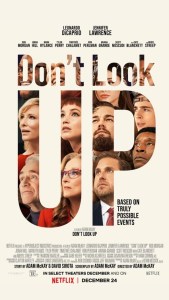 A scorched Earth satire that flirts with a literal scorched Earth, Don’t Look Up is writer/director Adam McKay’s star-studded condemnation of everything stupid and myopic in media, politics, and pop culture. Jennifer Lawrence plays a doctoral student who discovers a comet heading for direct cataclysmic impact with Earth, and she and her astronomy mentor (Leonardo DiCaprio) are trying to sound the alarm but nobody seems to be listening. Not the president (Meryl Streep) and her inept chief of staff/son (Jonah Hill). Not the greedy CEO (Mark Rylance) of a tech company. Not the media where morning TV co-hosts (Cate Blanchett, Tyler Perry) are more compelled by music star breakups than pressing science. It makes a person want to stand up and scream about priorities, and that’s McKay’s point, one that will be bludgeoned again and again. This movie is animated with seething rage about the state of the world and the cowardice about facing obvious problems head-on. It’s fit as a climate change allegory but COVID-19 or any scientific crisis could be applied as well. It’s about choosing ignorance and greed, about deferring to our worst instincts, and those in power who profit from inaction. I laughed at several points, some of it good cackling, and the movie is dark to its bitter end. This is the bleakest movie of McKay’s foray into his more sober, activist movie-making (The Big Short, Vice). It’s less Seeking a Friend for the End of the World, exploring the foibles of humans reconciling their last moments of existence, and more Idiocracy, where there is a lone voice of reason and the rest of the population are aggravating morons that refuse to accept reality even if it literally means just looking up with their own eyes. In some ways, the dark laughter the movie inspires is cathartic after years of COVID denials and mask tirades and horse medicine. The satire is bracingly blunt but also one joke on repeat. If you’re the right audience, that one joke will be sufficient. I don’t think the movie quite achieves the poignancy it’s aiming for by the end of its 138 minutes, but the anger is veritably felt. Don’t Look Up wants us to save the world before it’s too late, though the people that need to see the movie the most will be the ones fastest to dismiss it. Still, congrats to McKay for making a movie this depressing and relevant for the holidays.
Nate’s Grade: B+
Share this:

The Lost Daughter (2021)
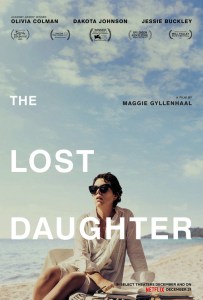 As a film critic part of a credited organization, I’m used to getting goodies in what I call “screener season,” the months of October to December when studios want to court critical favor for year-end consideration of their assorted movies for awards and titles. Netflix has sent me enough heavy coffee table books that I could, in Cosmo Kramer-style, fashion a literal coffee table made from them. For The Lost Daughter, Netflix sent me quite a bundle, including the film’s source material, a 110-page novella written by Italian author Elena Ferrante (My Brilliant Friend), which I read, and an actual bottle of sauvignon blanc wine. This was the first time a movie studio had sent me alcohol (my girlfriend drank a glass and did not like it, so thanks anyway, Netflix, but we dumped the bottle). I found the novella to be well written with plenty of poetic insights and turns of phrase, but I didn’t see the movie there. After sitting down and watching the two-hour feature film, I still don’t quite see the movie in this story.
Leda (Olivia Colman) is 48 years old, a literary professor, and vacationing on a small villa in Greece. Her time away is disrupted by a large, boisterous family sharing her resort. Leda is intrigued by a mother, Nina (Dakota Johnson), and her young daughter, Elena. It makes her reflective of her own time as a mother (played in flashback by Betty Buckley) to her two daughters, now both in their early twenties and having little to do with their mother. One day, Leda picks up Elena’s forgotten doll from the beach with the intention of returning her to the child, and then she simply does not do this. Leda grows closer to Nina, disapproving of her arrogant husband, her boorish relatives, and some of her risky personal choices, and we’re left to question whether she’s relating to this young, besieged mother or judging her from afar.
 This is one of those character study films that will ebb and flow on the level of the performers, and the actors elevate the material beyond what is present on the page. There are several intriguing conversations that shed light on characters and their view of parenthood, like Leda explaining how she feels that she gave the best of herself to her daughters when they were born, and now what she’s left with are the scraps. It’s not breaking new ground to view motherhood in non-glamorous terms. I thought 2018’s Tully did this with great observational detail, unsparing honesty, and great empathy. The Lost Daughter is not exactly Tully, which explored the hardships of motherhood with a put-upon woman who was valiantly struggling to keep her head above water, but it was a woman who wanted to be in the fight. With this movie, you never quite get a clear sense of Leda’s relationship with her two children, who are mostly kept to flashbacks when they are very young. Writer/director Maggie Gyllenhaal (yes, that Maggie Gyllenhaal) employs a non-linear plot to better inform the interior thinking of Leda, so we’ll have past and present juxtaposed for our ongoing evaluation. This is a smart way to follow the imprecise nature of hazy memory. There will be moments that will cause you discomfort, like when one of Leda’s young children is pleading through tears for her mother to kiss her wounded finger, and Leda withholds doing this as a power play, as an act of spite, as a knowing punishment for her wailing child. It’s also potentially relatable for others out there who too have, at the apex of their frustrations and exhaustion, lashed out at children and regretted it later, acknowledging that every parent will fail at some point over the long journey of time and to only attempt to minimize the inherent damage that will be left.
The Lost Daughter becomes an exercise in how long you want to spend with a pleasantly unpleasant woman. Leda is complicated, yes, but she’s also admittedly cruel and selfish, and the movie is trying to make her a case study, to shed our moral judgements and acknowledge that parenthood can be a draining experience. I understand the intention for embarking on empathy for unsympathetic characters; hundreds of movies have invited us into the minds of unlikable and downright psychopathic characters. I’ve always said that I need not like a character, I only need to find them interesting to keep me watching. Leda is an interesting woman because of where she veers from common practice. Most of us would return a missing doll to her rightful owner, especially as that child is grief-stricken and her wave of terror is affecting everyone in her family. Most of us would recognize others suffering and our ability to ease this, to absolve that suffering in an instant, and we would do so. Then the question becomes why isn’t Leda returning this doll to this child? The movie is an elusive attempt to answer, and each person’s interpretation will undoubtedly be different. I don’t know if this doll, perhaps the “lost daughter” of the film’s title, is Leda attempting to hold onto her own daughters, reclaim a version of motherhood that suits her, that doesn’t require of her. Or maybe she views the doll with derision. Whatever the case may be, have at it, dear reader, and enjoy not getting this question resolved.
 I completely understand viewers growing frustrated with watching two hours of a middle-aged woman holding onto a child’s doll and refusing to return it. It’s spiteful, and maybe that’s the point. Maybe Leda wants to impart the same lessons of hardship she endured as a struggling mother at her wits end. Maybe it’s her way of trying to shake Nina to re-examine whether being a mother is a role she is cut out for. Maybe it’s simply the continuation of a sadistic rationalization, “I had to suffer through this, so then you should have to suffer too” that props up whenever sociopolitical reforms and progress are met with generational push-back. By the end of the movie, I don’t know if Leda has seriously changed her outlook or sense of self. I don’t know if anything has really changed, and I don’t know if we’ve gotten to understanding her any better. Again, maybe that’s the point; people are complicated and possibly unknowable. But as a filmmaker showing us a character’s interior life and flashbacks, maybe you should try.
There is a late revelation in the movie that is going to be a deal-breaker for many. I won’t spoil it, though I will say that this reveal is covered in the first chapter of the novella, providing you this key piece of info as a prism for your early assessment. It explains why Leda has a strained relationship with her adult daughters and why thinking back about her perceived parenting failures causes her shivers of grief and guilt. At the same time, there are plenty of feminist stories about women shirking societal demands, so others could perceivablly view this revelation as an act of empowerment or self-determination, and others may just find it as the final straw in giving up in trying to sympathize with an already difficult person.
Fortunately, if you’re going to build a movie around a challenging character, Colman (The Father) and Buckley (I’m Thinking of Ending Things) are two of the most compelling actors for the cause. Much of their performances is naturally guarded, requiring each actress to hold back and utilize more subtle acting muscles. Colman’s middle-aged Leda is more set in her perception of self, more settled though not quite self-assured, so her performance seems more like cracking through a veneer and pushing back, trying to find the real Leda’s feelings about her life and the people she is socializing with. Colman is mesmerizing as always. Buckley’s young Leda is the version that is fraught with being an attentive mother as well as a burgeoning literary academic. Hers is the role of frustration, of shutting down, of desiring an escape hatch from the perils of motherhood. When young Leda is away on an academic retreat, she’s like a completely different person, and Buckley makes it clear that she covets this version of herself. Both women are gifted actresses and provide lifelines for the viewer to better analyze and unpack Leda as a puzzle.
 Gyllenhaal makes an impressively natural debut as a director. Her camera is usually very closely tied to her actors, bobbing to catch up and keep them in frame, afraid of leaving their sights. Her attention to detail is solid and her command of the actors is strong across the board. Her adaptation makes smart choices to better visualize the drama. After I read the novella, I genuinely wondered how the movie could even convey the material. It was so insular, so personal, and again, much of the onscreen drama was a woman hiding a doll from a child. I was worried the movie might become a ridiculous thriller of waiting for Leda to be caught, how she had to go to greater lengths to keep her secret, and thankfully that is not the case.
I can easily foresee The Last Daughter becoming a polarizing movie upon its Netflix streaming release at the end of the month. Some will hail it for being challenging and thorny, an indictment on the expectations of motherhood from a society that sets ambitious women up to fail. Some, and I predict the majority of viewers, will find the movie to be an insufferable character study of a misanthropic protagonist. I know the movie wasn’t trying to make an audience like its lead character, but I don’t know if by the end we are better at understanding her and her choices. It leads to a sort of, “That’s all there is?” ending that will frustrate many. The acting is strong to excellent overall and Gyllenhaal has a bright future ahead as a director, but The Lost Daughter might be too lost for too many to care. Just give the kid back her doll already, lady!
Nate’s Grade: B-
Share this:

tick… tick… BOOM! (2021)
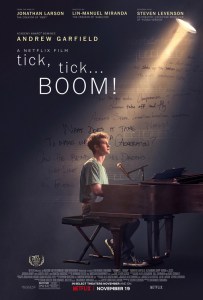 Netflix’s tick, tick… BOOM! is a cause celebre that has attracted none other than the likes of Lin Manuel-Miranda. This is Miranda’s directorial debut, which Netflix won in a bidding war, and it’s filled to the brim with Broadway legends and theater titans who all want to rally to the cause of bringing alive the other show of Jonathan Larson’s tragically short career. Larson would go on to create the hit musical Rent but died before it opened to the public, succumbing to a sudden aortic aneurysm at the age of 35. He never lived to see the tremendous success of Rent and that legacy is the emotional substance of tick, tick… BOOM!, if you happen to know about it. The story, and consequently the movie, feel like a lob to the insulated world of theater aficionados. The movie is semi-autobiographical about Larson (Andrew Garfield) on the verge of turning 30 in New York City in 1990 without achieving his big artistic dreams. He’s been toiling with a satirical sci-fi musical opus for years and is close to finishing it for a make-or-break presentation. The movie is based on Larson’s one-man show detailing his creative process and being young and hungry in New York in the early 90s. It was moderately successful and paved the way for Rent, but it was further adapted in 2001 into a three-person show, which has expanded even further with the film. The songs, written and composed by Larson, are enjoyable but none of them really stand out. I may have liked the least substantial one the best where Larson sings about his distaste at serving brunch patrons in a parody of Stephen Sondheim’s Sundays in the Park with George. The sequence is also wall-to-wall with Broadway cameos. I could not better emotionally connect with the movie. It hangs with looming tragedy of Larson’s surprise death, only five years away, as he wants to do something great with his life and make artistic waves. I think if you removed that added dramatic irony of tragedy, it’s watching a young artist struggle in the theater scene and hold onto his vision, integrity, and friendships, something we’ve seen but benefits with the verve of perosnality. As a story, it’s fallen into a trap where the struggles can be quite relatable to aspiring creatives and also not specific enough to greatly care about Larson as a character onscreen. Garfield sings well and is perfectly charming. Miranda proves apt with the language of film to translate from the confines of the stage. The entire project feels suffused with admiration and good intentions. tick, tick… BOOM! is a labor of love from many theater professionals. It’s an amusing but emotionally limited musical experience. Still, with this much talent, heart, and good will, it’s worth watching for no other reason to see what Miranda and his theater brethren can do together when trying to celebrate one of their own.
Nate’s Grade: B


 nathanzoebl
You must be logged in to post a comment.