Blog Archives
Scoop (2024)
 It’s like a British Bombshell, a behind-the-scenes account of the media attempting to hold key political and public figures to account for gross sexual imposition. With the Netflix drama Scoop, it just so happens to be Prince Andrew (Rufus Sewell), interviewed by BBC TV journalist Emily Maitlis (Gillian Anderson) in 2019 and scrutinized heavily for his close ties to former friend Jeffrey Epstein. The first half of the movie is about the wheeling and dealing behind the scenes to garner the high-profile interview, to convince Andrew he can clear his name after his connections to Epstein resurfaced. The second half of the movie is pretty much just the interview, which is indeed interesting to watch for the inherent drama, but after a while, I wondered what this movie was adding that I otherwise couldn’t gain from simply watching the actual 2019 BBC interview? There aren’t really scintillating details or clever scheming to guarantee the interview or outfox its news rivals, and the newsroom personalities, lead by Billie Piper (Doctor Who), are hard-working and tireless stock types that don’t leave much of a distinct impression even after the time together. It’s really a plainly presented dramatized version of the infamous interview, the one where Andrew was professing his innocence against his Epstein accuser with his bizarre argument that he has a condition where his body doesn’t sweat. Anderson is great, and Sewell is terrific as he melds into this figure of complacent arrogance and self-delusion (the makeup is also quite impressive). Still, if you’re really interested in gaining further insight, you might be better off looking elsewhere, or just watching the original interview. Consider this a bonus epilogue to Netflix’s The Crown for any die-hard royal aficionados.
Nate’s Grade: B-
Share this:

Damsel (2024)
 After a decade of having a creative partner who literally has compiled over 4,000 pitches for possible movie and TV concepts, it was inevitable that Hollywood would eventually get close to some of them. This has happened before a few times, again given the significant library of my friend’s imagination, but never has it gotten as close as Damsel, Netflix’s new action fantasy film flipping the script of the shrinking violet being sacrificed to the clutches of a monster. In my friend’s pitch, the young girl is presented to a dragon with the implication that this regular offering will spare her small town from angry dragon fire. Just as she’s waiting to be eaten, the dragon undoes her bindings and they talk, because the dragon can talk, and he’s very curious why these people keep leaving him young girls every so many years. The revelation is that the dragon is not savage but intelligent, and the two bond, forming a partnership where she brings the dragon back to her community and shows them the error of their long-standing prejudices. Of course it all gets bigger from there, with warring kingdoms wanting to harness the last dragon to capture this unparalleled weapon of mass destruction. There was even a budding romance between the dragon and the young woman, with the possibility of the dragon turning into a human Beauty and the Beast-style. The title: Damsel. While my friend’s Damsel and Netflix’s Damsel have some core similarities, they do tell different stories built upon the same premise of the virgin sacrifice and the killer creature being more than what they seem.
Unfortunately, Netflix’s version is too narrow to be fully satisfying with its fairy tale script flip. We have Millie Bobby Brown as our titular damsel, Elodie, a woman trying to do well for her family, notably her father (Ray Winstone), stepmother (Angela Bassett), and younger sister. The young prince needs a bride, and the Queen (Robin Wright) isn’t too shy to still turn up her nose at her new in-laws that she sees as merely a means to an end, nothing more. Of course it’s revealed that this end is as “human sacrifice” to a dragon that has reportedly stalked the kingdom for centuries. Elodie is thrown down a vast canyon into the lair of an angry dragon (voiced by the unmistakable Shohreh Aghdashloo). From there, Elodie must use her wits to survive the dragon, escape above ground, and save her younger sister from being doomed to a similar fate.
 The premise is so strong, upending ages-old tropes of the female sacrifice and the monstrous creature, as even with Netflix’s Damsel the dragon is a victim of historical slander. There’s so many places you can go with this, especially building upon the dynamic of the two of these discarded outcasts banding together to push back against the cruelty of society. However, that’s not the movie Netflix’s Damsel becomes. It sort of is, at the very end in resolution, with a latent promise of possible further adventures, but it’s mostly a locked-in survival thriller.
I was not expecting the majority of Damsel to be Elodie’s basic survival once she’s been hurled into the pit by her recently dearly beloved (just following orders from mom, he says). It works, but it feels very constrained creatively. Now, I am generally a fan of these kinds of stories, the step-by-step survival tales where we are thinking alongside the plucky protagonist. I find them fun and follow a satisfying structure of amassing payoffs. It’s naturally enjoyable to watch a character tackle problems and succeed. However, it’s also vital that the audience understands the problem to know the challenge. In a fantasy setting, this requires more time to establish new rules and circumstances. Here we have a few sequences like when Elodie discovers bio-luminescent slugs and uses them as a light source for exploring her captivity (bonus: their sticky slime is healing). The timeline is relatively short, maybe a day at most, so it’s not like Elodie has to think about long-term survival; it’s much more immediate about escaping from the wrath of the predator. Just finding a safe hiding spot is enough. It’s engaging but by limiting the focus to an almost real-time survival cat-and-mouse game, it caps the movie’s creative possibility. I was far more interested in the prospect of eventually moving beyond the initial amity between Elodie and the dragon, where they could share their royal rage together. I kept waiting for this initial battle to give way into a different level of understanding, something to deepen and alter this relationship, but this doesn’t arrive until the very resolution of an hour after Elodie first hides from the fearsome dragon.
While I was never bored by watching Elodie think how to get over a crevasse, or how to navigate a treacherous pass, I was reminded of 2022’s The Princess, a spirited and gleefully violent feminist romp with a similar starting point of a damsel taking matters into her own hands and fighting for her freedom. With that film, the upturned premise was simple, but each new floor down the tower revealed something about our heroine, each new challenge was different and relied upon a different skill or tactic. Unfortunately, that movie was “deleted” from the Disney/Fox/Hulu library for tax purposes, though you can still rent or purchase it on Amazon but, as of now, no physical media exists. This is an excellent example of a movie with a limited scope that knows how to play to the limitations of story while still revealing character through action. While that movie lost some momentum and clarity when the princess was kicked out of her tower imprisonment, I found much to celebrate with the movie’s ingenuity and spirit. With Netflix’s Damsel, I was getting antsy to leave the cave and move things along. The twist about the true nature of the dragon, and her past with the legendary royal hero, should be obvious to most.
 Let it be said that this is where Brown (Enola Holmes) graduated to being a steely and capable adult actress. She’s the star of the movie and has to command our attention and hold it for long stretches on her own. Brown throws herself into the physicality of the role with a relish that only makes her eventual triumph feel that much more worthy. The side characters don’t amount to much but have reliably winning actors to draw our attention. Aghdashloo (The Expanse) is a wonderful scene companion even with only a smoky voice. Wright (Wonder Woman) is haughty to the point of thin-lipped camp. Although this is a criminal under-utilization of the talents of Bassett (Black Panther: Wakanda Forever), who plays the concerned stepmother. That’s what happens when most of your movie is about one girl in a cave. The other characters are confined to the opening and closing of your survival thriller.
I suppose I’m being cheeky by referring to the movie as “Netflix’s Damsel” considering there isn’t any other version out there. I’m not accusing Netflix or screenwriter Dan Mazeau (Wrath of the Titans, Fast X) of ripping off my friend; it’s more an example of parallel thinking playing around with old fantasy tropes and giving them a new spin for modern times. I mostly enjoyed Netflix’s Damsel but couldn’t help but wonder what might have been, not just with my friend’s competing take on the material but with the story possibilities not taken here thanks to its limited scope. As a survival thriller in a fantasy setting, it works. There was just more that could have been, and while I should judge the movie that exists rather than the movie that could have been, Netflix’s Damsel is a fantasy action vehicle that swings its sword ably but had so much more potential to slay.
Nate’s Grade: B-
Share this:

Leave the World Behind (2023)
 Apocalyptic thrillers can oddly enough serve as a therapeutic means for dealing with our fears of being helpless against forces well beyond our control, but they’re also reflections of our current state of anxiety as well. There’s more than just giant hurricanes or earthquakes breaking records on the Richter scale, it’s about how we respond to the momentous and alarming changes and what that says about The Way We Live Now. The new Netflix apocalyptic thriller Leave the World Behind, based on the 2020 book of the same name, has some big mysteries that I feel safe to say won’t fully be explained by the end. There is a possible explanation but it’s a movie more consumed with how people respond to tumult than the tumult. I found the majority of the movie to be gripping and engaging, and while it doesn’t exactly nail the landing, writer/director Sam Esmail (Mr. Robot, Homecoming) crafts a paranoid thriller with flair. It’s an apocalyptic thriller at crossroads with a paranoia thriller and a disaster movie, and the biggest challenge of them all is ultimately being able to trust another person during a time of remarkable uncertainty.
Amanda (Julia Roberts) and her husband Clay (Ethan Hawke) have elected to take a spur-of-the-moment family vacation out of New York City and onto a lavish home in Long Island. Everything seems so placid until the phones no longer get a signal, the TV broadcasts are strictly limited to a blank emergency screen, and two strangers show up (Mahershala Ali, Myhal’la) saying this is their house and they would like to stay inside. They claim that the U.S. is under a cyber assault and there’s more to come.
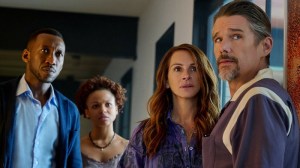 Leave the World Behind has two intriguing questions to keep the audience hooked: what is actually happening and who are these new people? Most disaster movies put you in the thick of the action, from presidential boardrooms to scientific outposts keeping up with the changing data and going over the options to prevent further loss of life. This movie purposely leaves you in the dark in a well-kept Long Island home and the first thing that goes is the expediency of knowing things from our phones. When two new people come knocking at the door to say the world is falling apart and this is our home, trust us, it’s hard not to hold some level of suspicion. Can we take these people at their word? What kind of agenda could they secretly have? And if so, what does that say about what has happened or what is happening in the outside world? They seem like they know more than what they’re letting on, so how much do they know themselves? It’s the slow drip of information that makes the movie simmer in such an anxious predicament of looking at every new piece as another new question. This places the viewer uncomfortably in similar territory as Amanda, who despite her prejudices might be right not to trust the newcomers. We’re stuck on the outside wondering what has happened and what may be left. The movie is carefully crafted to only give us so much to work with while our minds start reading and rereading everything for more connection and meaning, running rampant and going stir crazy just like the characters. While the second big question naturally gave way and could only produce so much tension, the main thrust of the movie kept me hooked and excited and worried and actively questioning just what exactly was going on.
I appreciate how Esmail is a restlessly ambitious filmmaker. He took on directing duties for the entire second season of Mr. Robot and from there continued coming up with new challenges. There was an episode meant to be told as an episode-length elaborate tracking shot. There was an episode that was told almost without any spoken words, entirely through visual action. There was an episode that was presented like a five-act stage play and it was enthralling. While these are the easy to recall gimmick episodes, Esmail’s directing vision for his series never eclipsed the series itself. It elevated the episodes but the emphasis was still on the significance of the characters and their emotional states (highly recommend Mr. Robot, one of my favorite 2010s TV shows, to anyone who has yet to watch). With Leave the World Behind, only his second feature after 2014’s parallel universe rom-com Comet, Esmail refuses to let any sequence pass without some kind of visual flourish. His camera is constantly swooping through the visual landscape, flipping and spinning and craning above the characters from on high. It reminded me of Brian DePalma, who also loves the high angle pans across rooms and also abides by the dogma that there should be no uninteresting shots in a movie. It’s easy to appreciate but without an engaging story can quickly become a distracting exercise in empty artifice, which is also how I view most DePalma. Here, much like Esmail’s accomplished prestige TV work, the style makes me better appreciate how much effort and thought Esmail has put into his presentation and his ideas. The man wants you to see his work, and there’s no fault in that as long as you’re enjoying the experience, which I was for the most part.
 There are some supremely well-crafted moments played to a breaking point of intensity. Early on, as the family relaxes on the beach, they see a ship in the distance, an ordinary sight on a seemingly ordinary day. Then hours pass and it’s getting closer, and closer, and finally the realization begins to settle in that this thing is now a danger and they need to very much run very much now. Esmail’s camerawork keeps the scene feeling kinetic, with a long take that establishes the colossal danger as the tanker runs aground and the family has narrowly fled in time. In many ways this moment also serves as an ecological metaphor, with problems looming in the distance but ignored until they are at their most dangerous and right on top of us. Another sequence involves Clay venturing outside and discovering what appears to be a dust storm the color of blood. It’s getting closer and closer and the movie is testing how much we can take before you start hitting an imaginary gas pedal to strongly suggest Clay out of there. There’s another sequence that’s a literal pile-up of driver-less cars coming to the same nexus point like they’re all migrating. It makes for an immediately eerie sequence that becomes extra horrifying once the Teslas become unmanned missiles.
The themes of disconnection aren’t exactly subtle but that doesn’t mean they are misguided. This movie is about as subtle as an oil tanker heading straight for you, but I didn’t mind because of the skill of the storytellers and the ongoing mysteries that kept me begging for every new morsel. The messaging isn’t exactly complex. At one point Amanda has a speech that might as well be titled “This is Why Humans Are Terrible and We Deserve This.” Following this, another character tells her that they may not agree on much but she agrees with every word she just uttered with her speech, so you know this is the kind of pessimistic monologue that can reach across the doom-scrolling aisle. The movie almost frustratingly ends without a larger sense of clarity over what has been happening, a fate that would have greatly angered my wife. Esmail gives you something that can work as an explanation without making it definitive; it’s merely a theory but it’s enough to hold onto if you desperately need an explanation. However, the way the movie ends feels less conclusive and more like the conclusion of a season of television where the characters, now grouped together, are in for something fierce next year so stay tuned. The nature of this story is designed to leave you hanging, and that’s why I circle back on it mattering more on how these characters respond to this apocalyptic event versus what is clearly happening.
 Chilling and effectively plotted to keep you guessing until the end, Leave the World Behind is an apocalyptic thriller that really simmers in the anxiety of the unknown. It’s not perfect but it’s pretty good, as long as you can accept not having all the answers. The acting is strong but it’s the control and finesse that Esmail exhibits as director and screenwriter that really makes the material engaging and impactful. It’s an apocalyptic thriller where the scariest proponent might be having to live with one another.
Nate’s Grade: B
Share this:

Rebel Moon – Part One: A Child of Fire (2023)
 Creating an original sci-fi/fantasy universe is hard work. It involves bringing to life an entire new universe of characters, worlds, back-stories, rules, conflicts, cultures, and classes. There’s a reason major studios look to scoop already established creative universes rather than build their own from scratch. This is what director Zack Snyder had in mind when he pitched a darker, grittier, more mature Star Wars to Disney, who passed. Over the ensuing decade, Snyder and his collaborators, Shay Hatten and Kurt Johnstad, continued working on their concept, transforming it into an original movie series, resulting in Netflix’s big-budget holiday release, Rebel Moon – Part One: A Child of Fire, a clunky title I will not be retyping in full again. Snyder’s original results of the “darker, grittier Star Wars” are rather underwhelming and don’t make me excited for the concluding second movie being released in April. Why go to the trouble of building your own universe if you don’t want to fill in the details about what makes it important or at least even unique? I can see why Snyder would have preferred Rebel Moon as a Star Wars pitch, because they could attach all the established world-building from George Lucas and his creative collaborators as a quick cheat code.
In another galaxy, the imperial Motherworld is the power in the universe. The king and his family have been assassinated, and in the power struggle that follows, several planets have taken up arms to fight for independence. On a distant moon, Kora (Sofia Boutella) is doing her best to live a nondescript life as a farmer, helping to provide for her community and stay out of trouble. Well trouble comes knockin’ anyway with Admiral Atticus Noble (Ed Skrein) and his fleet looking for resources and powerless villagers to abuse. Kora’s history of violence comes back to her as she fights back against the Motherworld soldiers with cool precision. Her only hope is to gather a team of the most formidable warriors to protect her village from reprisals. Kora and company band together while her mysterious past will come back to haunt her reluctant return to prominence.
 For the first thirty to forty minutes of Rebel Moon, I was nodding along and enjoying it well enough, at least enough to start to wonder if the tsunami of negative reviews had been unfairly harsh, and then the rest of the movie went downhill. One of the major problems of this Part One of a story is that it feels like a movie entirely made up of Act Two plotting. Once our hero sets off on her mission, the movie becomes a broken carousel of meeting the next member of the team, seeing them do something impressive as a fighter, getting some info dump about their mediocre tragic backstory, and then we’re off to the next planet to repeat the process. After the fifth time, when a character says, “Anyone else you know?” I thought that the rest of the movie, and the ensuring Part Two, would be nothing but recruiting members until every character in the galaxy had joined these ragtag revolutionaries, like it was all one elaborate practical joke by Snyder. Some part of me may still be watching Rebel Moon, my eyes glazing over while we add the eight hundred and sixty-sixth person who is strong but also shoots guns real good. Then the movie manufactures an ending that isn’t really an ending, merely a pause point, but without any larger revelations or escalations to further our anticipation for Part Two in four months’ time. What good are these handful of warriors going to be defending a village in a sci-fi universe where the bad guys could just nuke the planet from orbit? Find out in April 2024, folks!
The entire 124-minute enterprise feels not just like an incomplete movie but an incomplete idea. This is because the influences are obvious and copious for Snyder. Rebel Moon starts feeling entirely like Star Wars, but then it very much becomes a space opera version of The Magnificent Seven, itself a remake of Akira Kurosawa’s Seven Samurai. With our humble farmer, our high plains drifter trying to turn their back on an old life of violence, and the recruitment of our noble fighters to ward off the evil bandits coming to harass this small outpost, it’s clearly The Magnificent Seven, except Snyder doesn’t provide us the necessary material to invest in this scrappy team. The characters are all different variations of the same stoic badass archetype, like you took one character mold and simply sliced it into ten little shear pieces. The characters don’t even have the most basic difference you could offer in an action movie, variation in skill and weapons. One lady has laser swords (a.k.a. lens flair makers) but pretty much everyone else is just the same heavy gun fighter. One guy doesn’t even bother to put on a shirt. Some of them are slightly bigger or more slender than others but the whole get-the-gang-together plot only really works if we have interesting characters. If we don’t like the prospective team members, it’s like we’re stuck in an endless job interview with only lousy candidates.
 The fact that Rebel Moon is derivative is not in itself damaging. Science fiction is often the sum of its many earlier influences, including Star Wars. Rebel Moon cannot transcend its many film influences because it fails to reform them into something coherent of its own. There is no internal logic or connection within this new universe. The original world building amounts to a slain royal family, an evil fascist regime, and maybe a magic princess connected to a prophecy of balance, and that’s it. All the flashbacks and expository data dumps fail to create a clearer, larger picture of how this sci-fi universe operates. The inner workings are kept so broad and abstract. We have an imperial evil and assorted good-hearted little guys. The movie begins by introducing a robot clan of knights that are dying out, and even a young Motherworld soldier who seems likely to defect, both opportunities to go into greater character detail and open up this world and its complications. So what does Snyder do? He leaves both behind shortly. Even though we visit a half dozen planets, these alien worlds don’t feel connected, as if Snyder just told concept artists to follow whatever whim they had. They don’t even feel that interesting as places. One of them is desert. One of them has a saloon. One of them is a mining planet. It’s like the worlds have been procedurally generated from a computer for all we learn about them. They’re just glorified painted backdrops that don’t compliment the already shaky world building. They’re too interchangeable for all the impact on the plot and characters and any declining sense of wonder.
Given the open parameters of imagination with inventing your own sci-fi/fantasy universe, I am deeply confused by some of the choices that Snyder makes that visually weigh down this movie in anachronistic acts of self-sabotage. Firstly, the villains are clearly meant to be a one-to-one obvious analog for the Empire in Star Wars, itself an analog for the fascists of World War II, but Lucas decided having them as stand-ins was good enough without literally having them dress in the same style of uniforms as the literal fascists from World War II. You have an interconnected galaxy of future alien cultures and the bad guys dress like they stepped out of The Man in the High Castle. It’s too familiar while being too specific, and the fact that it’s also completely transparent with its iconic source references is yet another failure of imagination and subtext. I just accepted that the Space Nazis were going to look like literal Nazis, but what broke my brain was the costuming of Skrein’s big baddie in the second half of the movie. At some point he changes into a white dress shirt with a long thin black tie and all I could think about was that our space opera villain looks like one of those door-to-door Mormon missionaries (“Hello, have you heard the Good Word of [whatever Snyder is calling The Force in this universe]?”). Every scene with this outfit ripped me out of the movie; it was like someone had photo-shopped a character from a different movie. It certainly didn’t make the devious character of Atticus Noble more threatening or even interesting. I view this entire creative decision as a microcosm for Rebel Moon: a confused fusion of the literal, the derivative, and the dissonant.
 Snyder is still a premiere visual stylist so even at its worst Rebel Moon can still be an arresting watch. He’s one of the best at realizing the awe of selecting the right combination of images, a man who creates living comic book splash pages. I realized midway through Rebel Moon why the action just wasn’t as exciting for me. There’s a decided lack of weight. It’s not just that scenes don’t feel well choreographed or developed to make use of geography, mini-goals, and organic complications, the hallmarks of great action, it’s that too little feels concrete. It feels too phony. I’m not condemning the special effects, which are mostly fine. The action amounts to Character A shoots at Bad Guy and Character B shoots at Other Bad Guy, maybe behind some cover. There’s only one sequence that brings in specifics to its action, with the challenge of defeating a rotating turret gun pinning the team down from escape. That sequence established a specific obstacle and stakes. It worked, and it presented one of the only challenges that wasn’t immediately overcome by our heroes.
The Snyder action signature of slow-mo ramps has long ago entered into self-parody territory (I’m convinced a full hour of his four-hour Justice League cut was slow motion), so its use has to be even more self-aware here, especially in quizzical contexts. There are moments where it accentuates the visceral appeal of the vivid imagery, like a man leaping atop the back of a flying griffin, akin to an 80s metal album cover come to life. Then there are other times that just leave you questioning why Snyder decided to slow things down… for this? One such example is where a spaceship enters the atmosphere in the first twenty minutes, and a character drops their seeds in alarm, and those seeds falling are detailed in loving slow motion. Why show a character’s face to impart an emotion when you can instead see things falling onto the ground so dramatically?
 The actors are given little to do other than strike poses and attitudes, and for that they all do a fine job of making themselves available for stills and posters and trailers. Boutella (The Mummy) is good at being a stoic badass. I just wish there was something memorable for her to do or make use of her athleticism. The best actor in the movie is Skrein (Deadpool) who really relishes being a smarmy villain. He’s not an interesting bad guy but Skrein at least makes him worth watching even when he’s in the most ridiculous outfit and awful Hitler youth haircut. There’s also Jena Malone (Sucker Punch) as a widowed spider-woman creature. So there’s that. Cleopatra Coleman (Dopesick), who plays one half of a revolutionary set of siblings along with Ray Fisher, sounds remarkably like Jennifer Garner. Close your eyes when she’s speaking, dear reader, and test for yourself. I was most interested in Anthony Hopkins as the voice of our malfunctioning android (literally named “Jimmy the Robot”) operating on mysterious programming that hints at something larger in place relating to perhaps the princess being alive. Fun fact: Rebel Moon features both actors who played the role of Daario on Game of Thrones (Skrien and Michiel Husiman).
Even with all the money at Netflix’s mighty disposal, Rebel Moon can’t make up for its paltry imagination and thus feels like an empty enterprise. I’m reminded of 2011’s Sucker Punch, the last time Snyder was left completely to his own devices. I wrote back then, “Expect nothing more than top-of-the-line eye candy. Expect nothing to make sense. Expect nothing to really matter. In fact, go in expecting nothing but a two-hour ogling session, because that’s the aim of the film. Look at all those shiny things and pretty ladies, gentlemen.” That assessment seems fitting for Rebel Moon as well, a movie that can’t be bothered to provide compelling characters, drama, or world-building to invest in over two to four hours, once you consider the approaching Part Two. I wish this movie had a more distinct vision and sense of humor, something akin to Luc Besson’s lively Fifth Element, but fun is not allowed in the Zack Snyder universe, so everything must be grim, because grim means mature, and mature means automatically better, right? Rebel Moon is a space opera where you’ll prefer the void.
Nate’s Grade: C-
Share this:

May December (2023)

The critical darling May December reminded me of another 2023 Netflix prestige awards contender, David Fincher’s The Killer. That genre movie was about trying to tell a realistic version of the cool super spy assassin and I found that enterprise to be fitfully interesting but mostly dull and unfulfilled. This movie seems to be going for a similar artistic approach under director Todd Haynes (Carol, Far From Heaven), tackling a sensationalized ripped-from-the-tabloids tale of perversity but telling a more realistic version, which also leaves the movie fitfully interesting but mostly dull and unfulfilled. May December is a frustrating viewing experience because you easily recognize so much good, so many exciting or intriguing elements, but I came away wishing I had seen a different combination and execution.
Elizabeth (Natalie Portman) is a famous actress with an exciting new movie role. She’s going to play Gracie (Julianne Moore), a woman who gained national scandal for her sexual relationship with a then-13-year-old Joe. The two of them have been together for several decades and have several children and now are inviting Elizabeth into their home to better understand her character. Each person is on their guard. Elizabeth wants to keep prying to uncover emotional truths that she can gobble up to improve her future performance and career. Gracie is wary of making sure the version of her story that she wants for public media consumption is what Elizabeth receives. And Joe (Charles Melton), now in his mid-thirties and looking more like an older brother than father to his graduating children, is reflecting about the history of his relationship and who was culpable.

There’s so much here in the premise of an actress studying her subject and wreaking domestic havoc in her attempt to discover secret truths that would rather stay hidden. May December uses this premise as an investigative device, allowing the inquisitive actress to serve as the role of the audience, trying to form a cohesive vision of events from each new interview. It allows the first half of the movie to feel like a true-crime mystery, uncovering the different sides of a sordid story and the lasting consequences and legacy for so many. There’s a very lurid Single White Female approach you could go, where the avatar of the person starts to replace the real person, where Elizabeth crosses all sorts of lines and even thinks about crossing some of the same lines that Gracie had; what better way to get in the mind of a predator, right? I was waiting for this interloper to destabilize this carefully put-together illusion of a “normal family,” but by the end you feel like little has been learned and most everything reverts to its prior stasis. I suppose that’s, again, the more realistic version of this kind of story, that even when confronted with uncomfortable revelations most people will fall back on what they know. May December’s underwhelming conclusion is that, by the end, maybe people are actually who we think they are.
Haynes’ cinematic specialty is exploring the artificiality of movies, from having multiple actors portray Bob Dylan in 2007’s I’m Not There, to destabilizing the nostalgia of the 1950s Douglas Sirk-styled romantic drama with 2002’s Far From Heaven. He’s also inherently drawn to stories of emotional and sexual repression. This movie is all about performance as identity; it’s about an actress trying to refine her tools, but it’s also about a middle-aged woman who has adopted performance as her defense system (this also might explain why Gracie’s lisp seems to come and go). Some part of her has to know that she crossed some very serious lines, no matter how many times she explains away their relationship as merely “unconventional.” Even though they’ve kept this union for 25 or so years, it still began when Joe was 13 years old and she was an adult. There are very intriguing dimensions to this dramatic dynamic, with the excuse of a Hollywood version of their “love story” to motivate each participant to reflect with renewed perspective. The problem is that Gracie has worn her mask for so long that I doubt there is another version of her any longer (“I am naive. In a way, it’s a gift”). As a means of survival, she projects herself as a well-intentioned victim of scrutiny rather than as a child predator who has manipulated her husband into codependency for decades. This means that, frustratingly, there isn’t much there to glean once the facts of the case have been collected, which makes watching a bad TV actress try and better emulate a bad person incapable of introspection seem like an empty exercise in artistic masturbation, and maybe that’s the point?

The conversation around May December being some kind of “camp comedy” (it was recently nominated for Best Comedy/Musical by the Golden Globes) has left me genuinely stupefied. I think the term “camp” is used a little too loosely, as some seem to conflate any heightened emotion as equivalent to camp. May December is really more an example of melodrama. It’s near impossible to retell the Mary Kay Letourneau story without the use of melodrama, so its inclusion doesn’t merely qualify the movie as camp. But at the same time Haynes is making deliberate use of certain elements that make the movie even more jarring, like the oppressive and operatic musical stings that hearken to earlier 1950s melodramas. These musical intrusions are so broadly portentous that it’s practically like Haynes is elbowing you and saying, “Eh, eh?” I suppose you can laugh at how arch and over-the-top the musical stings are, but is this a comedic intention? Are we supposed to laugh at how out of place this musical arrangement is in modern filmmaking, or is Haynes trying to draw allusions to old Hollywood melodramas and make a case for this being similar? Whatever the case may be, I guess one could laugh at the stilted performances but then I think that’s approaching the movie from an ironic distance that makes it harder to emotionally engage, which seems like the whole point of the exercise, to go deeper than lazy tabloid summation.
The performances from the female leads circling and studying one another are rather heavy on mannered affectations and arch irony, but it’s Melton (TV’s Riverdale) who emerges as the soul of the movie. He’s so easy going and dutiful, quick to defend his wife and assure everyone that even at 13 years old he knew what he was doing and consented to their affair. Of course this is nonsense, and the real draw of the movie is watching this family man begin to crack, and when he does it’s like every repressed emotion comes spilling out. It makes you wish that he had been the main character of the story and Elizabeth more the supporting character trailing after.

Allow me a tangent, dear reader, because I’m reminded of the 2023 re-release of 1979’s notorious Caligula where a producer tried to re-edit the famously trashy movie, hewing closer to author Gore Vidal’s original screenplay and less the explicit excess of producer and Penthouse publisher Bob Guccione’s editorial influence. It seems like so much effort to reclaim one of cinema’s most over-the-top movies, but can you really make a classy version of a movie about the cruel Roman emperor that has a wall of spinning blades as an execution device and copious floating brothels? The movie is forever known for its trashy and outrageous elements because it is emulating an outrageous tyrant of history given to hedonistic and lascivious excess. Nobody wants the “classy” version of this sensational story because that’s the tamped-down and boring version of this story (granted, there are plenty of prurient Guccione additions that we could also do without). Taking sensational melodrama and trying to subvert the sensationalism under the guise of genre deconstruction can work; however, the key is that the “classy” approach has to be a more compelling alternative to the soapier, melodramatic version. I think I would have enjoyed the more sundry and soapy version of May December because with this version I felt too removed, and the movie itself felt too removed and uninterested in so many of its more potent elements for the sake of drifting ambiguity. It’s a drama that seems to stew in downy contemplation but without enough compelling examination to make the effort fulfilling. I kept waiting for the movie to open up, and then the movie just ran out of time. It’s got some admirable goals, and a strong performance from Melton that makes your heart ache, but May December would have been better served either being far more trashy or far more serious rather than straddling a middle ground that left me distant and impatient and ultimately disappointed.
Nate’s Grade: C+
Share this:

The Killer (2023)
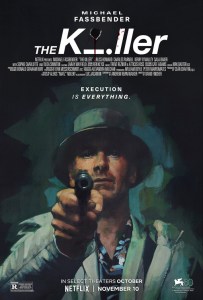 Were you even aware that David Fincher had a new movie? The celebrated director has been very mercurial since 2014’s Gone Girl, only helming one other movie. His partnership with Netflix has afforded the notoriously perfectionist director a lot of creative latitude, though sadly not a third season of Mindhunter. But even the artistic cache of a new Fincher movie isn’t enough for Netflix to change its business model. The Killer only played in theaters for two weeks before beaming into millions of homes. You would think this streaming giant would want to leverage its big names and their new projects, but I’m reminded of how much money Netflix likely left aside forgoing Glass Onion’s theatrical run. Alas, The Killer is an intriguing if cold and unsatisfying thriller that epitomizes the limits of surface-level living.
Our titular killer (Michael Fassbender) is hired to kill a Parisian businessman and botches the job. He’s on the run and fears for his well-being from his employers wanting to eliminate any loose ends. His girlfriend in the Dominican Republic is beaten and threatened, and the lead killer realizes he’s going to have to out-kill all the other killers after him if his loved ones don’t get killed. Through five chapters, each ending in a death, the killer works his way up the food chain.
 Fincher is attempting to strip out the movie-cool mythos of the world of hired assassins, to subvert the entertainment value that can come with expert murderers leading to blood and death. The Killer is Fincher’s stubborn subversion of what a trained assassin movie should be, and his main takeaway, beyond stripping the misplaced glamor from the profession, is how tedious it would all be in real life. In the movie world, being a trained killer involves all sorts of exciting derring-do and acrobatics and the like. In the possible real world, being a trained killer is more like a paid security guard; it’s a lot of protracted sitting and waiting and watching, and it’s easy to understand just how overwhelmingly boring all this would be. The opening twenty minutes quite convincingly strips the cool factor away from this profession. It doesn’t make you feel the weight of the culpability, like 2018’s You Were Never Really Here (more on that later), but what it makes you feel is just how maddening and boring this whole job must be and what kind of dedicated people would succeed. It’s like Fincher is making a bet with a mainstream audience that he can find a way to make a boring assassin movie, and while doing so can be seen as subversive to some degree, bleeding much of the thrills out of the picture, it also feels like a bet gone wrong. You made the main character boring on purpose to prove a point, but regardless of intent, your protagonist is still boring. Victory?
As physically inactive as Act One proves, watching our title killer sit and wait and watch, it is conversely hyperactive in narration. This is wall-to-wall narration as our lead character expounds upon his regiment to keep his mind and body ready when his eventual window materializes. It reminded me of the narration of Patrick Bateman from American Psycho, about his methodical lifestyle routines. Except that character was being satirized from their first moments, whereas the emptiness of our killer here is the larger point, that he’s fashioned himself into an unfeeling weapon. Here is a character that feels he is only effective if he strips everything human away, if he only focuses on the job regardless of politics or consequences, and lives his spartan existence. I’m sure he envisions himself as some noble modern-day samurai, living a code others cannot keep. Except the movie reveals throughout that he might not be the best killer in the phone book. First off, he misses shooting his target, which sets everything into motion. All his narration about focus and yoga and dedication and even I know you shouldn’t fire while someone else is in front of your target. There’s a jarring scene where he fires nails into the lungs of a character and theorizes the man has six or seven minutes left to live before his lungs fill up. Nope. The man dies within one minute max. For all his resourcefulness, which is benefited by the long reach of capitalism, the man also doesn’t live up to his self-image. His paranoia keeps him from returning to his home on time and allows the attack on his girlfriend to happen in his absence. There might be an even deeper commentary on how even the lead is confusing his life for a movie.
 My favorite scene is a sit down with a competing hired hitman played by Tilda Swinton (Three Thousand Years of Longing). She’s one of the two competing assassins responsible for targeting his girlfriend, so she presents a threat. He meets her at a fancy restaurant and she already accepts that she will not be making it to dessert. She is the exact opposite of our main character, a woman who has found a way to live a normal life in the suburbs, marry a man, and enjoy the luxuries of a life afforded by her wealth. She’s not living out of storage units or purposely dressing like a German tourist to stay under the radar. In some ways, this has allowed our more single-minded assassin to get the jump on her, to take advantage of her complacency. However, it’s also an indictment on the stripped-down, isolationist life our lead killer has prioritized. Here is a woman who has embraced allowing herself to enjoy things. She’s not eating McDonald’s breakfast sandwiches minus the slimy egg patty. She’s not slumming it for her “art.” She sees no value in abstinence. This stark contrast, as well as a sustained conversation between two foes, is the highlight of the film. It’s also interesting to watch Swinton’s character go through her own mini-grieving process accepting the likelihood that this will be her final meal, and so she savors it without fear.
Being a David Fincher movie, you can rightly assume that the technical elements are nearly flawless. The visual arrangements are beautiful, the cinematography is chilly and atmospheric, and the editing is precise and smooth. The first attempted kill has a nice degree of tension simply from shifting audio levels, going from diegetic to narration, never allowing the viewer to properly adjust during such a heightened point of paying attention. It’s naturally unsettling and effectively raises the tension of a moment we’ve been waiting over twenty minutes to arrive. There is an extended hand-to-hand fight sequence that’s exceptionally well choreographed and carries on from room to room, transforming with each new location and utilizing the geography of each space nicely (the John Wick folks would approve). The overall movie feels more in keeping with the likes of Fincher’s Panic Room or The Game, a more straightforward thriller that lacks simply extra levels and commentary, like Zodiac or Gone Girl. There’s nothing wrong with a well-executed and developed thriller purely designed to be a good time. It’s just at this stage of Fincher’s career, the expectations are raised, fairly or unfairly, with every new release. The Killer is a polished thriller meant to be pared down to its essential parts and can be enjoyed as such.
There is little to hold onto here emotionally though, so we’re left with the intellectual curiosity of watching a so-called professional go about their business and see how he gets around obstacles. Very often it’s dressing up in a delivery outfit and simply waiting on other polite strangers to open doors for his unassuming facade. One could argue that the character arc is about a man who rejects empathy, argues that it is weakness, comes around to accept empathy, and embraces it on his way out. I can see some of this, as the motivation for his trail of vengeance is to protect his loved one from being harmed again. There’s even a moment where he demonstrates a sliver of sympathy to a victim, albeit still utilizing gruesome violence. Except I don’t believe that easy assessment of this being a journey of embracing empathy. This doesn’t come across as a character changing who they are but instead as a character cleaning up their own mess. The main character keeps reiterating to “stick to the plan, don’t improvise,” but I don’t think he’s reflecting at any point on his actions beyond a clinical cause-effect relationship. He’s stripped all the complexities of humanity out from himself but recognizing fault isn’t the same as building and maintaining a sense of empathy. I also think the reading that many critics are making of Fincher standing in for the main character, a dedicated tactician who tries to do it all, is a little too cute and desperate for meta-narratives to derive a better lens to analyze the overall vacancy of the lead character.
 This is very different from Lynn Ramsay’s You Were Never Really Here, a film that also subverted the same hitman sub-genre and made the audience re-examine its own bloodlust. As I wrote in 2018: “The focus of the movie is on the man committing the acts of violence rather than how stylish and cool and cinematic those acts of violence can be. …Ramsay offers discorded images and brief flashes and asks the audience to put together the pieces to better understand Joe as a man propelled and haunted by his bloody past…. It’s not all tragedy and inescapable dread. Amidst Joe’s tortured past and troubled future, there’s a necessary sense of hope. You don’t know what will happen next but you’re not resigned to retrograde nihilism.” This is not the feeling I took from The Killer, and I recommend everyone watch Ramsay’s movie too.
The problem with making a boring assassination thriller on purpose is that, at the end of the day, you still have a boring assassination thriller. Fassbender (who hasn’t been on screen since 2019’s Dark Phoenix killed the X-Men franchise) can be compelling for two hours doing just about anything, and a performance that is minimal in spoken dialogue does not mean a minimal performance. He’s great to sit and watch, the running commentary of his narration serving as a starting point to assess all the concentrated, nuanced acting under the surface. The Killer has sheen and skill, much like its title character, but it too also misses the mark where it counts.
Nate’s Grade: B-
Share this:

Pain Hustlers (2023)
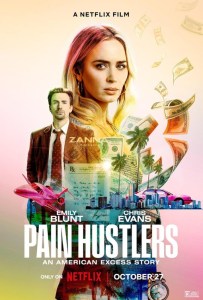
Pain Hustlers is the next attempt to dramatize the numerous stories behind the opioid crisis, a storytelling edict that is becoming its own tragic true-crime sub-genre (Dopesick, Pain Killer, Four Good Days, Recovery Boys, All the Beauty and the Bloodshed). The Netflix original has a starry cast and a topical and serious subject but it’s an un-serious movie caught up in the superficial quirks and appeal of being and making a goofy crime story of greedy sleazeballs.
Liza (Emily Blunt) is a struggling single mother trying to claw her way out of debt and, with her unfinished education and criminal record, few options are widely available. Then enters Pete Brenner (Chris Evans), a loud, gouache pharmaceutical rep for a powerful pain killer. He promises a lifestyle of luxury and power, as long as Liza is willing to ignore or bend a few ethics along the way. Together, they build a sales force of attractive women who wine and dine smaller doctors in order to get them to prescribe their special drug to anyone in need. It’s just that a drug intended for end-of-life pain wasn’t meant for common headaches. As sales boom, Liza begins to worry that her glitzy lifestyle is built upon a mountain of American corpses.
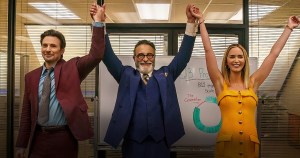
The biggest drawback of Pain Hustlers is that it fully focuses on the glitz and gives lip service to the cost of chasing that avarice. Plenty of movies illuminating bad people doing bad things are accused of glamorizing the misdeeds, from gangster movies to dark romances, though this narrow viewing often seems to conflate depiction with condoning the behavior (see: The Wolf of Wall Street). Watching stories about people stumbling their way into glamorous positions should provide some allure so as to better understand the seductive draw for the characters. The world of vice and power will be a compelling conflict, but for Pain Hustlers, it falters by just focusing on the high-powered lifestyle yet it still lacks specificity to make this story feel interesting on its own. You’ve seen variations of this kind of story before (we’ll call it Scorsese-esque) about the people struggling with less who get a ticket into a new world of access and freedom and then begin to worry At What Cost. Pain Hustlers goes through its plot beats with the most mechanical of movements. The personal details from this supposedly true story feel so generic, reminiscent of similar tales like, Love & Other Drugs and Hustlers. It feels less like an insider account of how these shady people exploited so many and more like the screenplay was cobbled together by what the filmmakers assumed this story must have pertained without reading much of the source novel by Evan Hughes. It’s absent the useful details that allow more of these accounts to prosper as we investigate moral relativism.
The other nagging shortcoming of Pain Hustlers is the consequences for all these bad people. I’m not saying that we need to see comeuppance and justice levied in order for the movie to work thematically; very often these white collar criminal types receive the faintest glance of judicial punishment. What this movie lacks is the emphasis on the consequences, and considering our main characters are pushing sleazy doctors to push highly addictive opioids, that’s a big miss. The movie is all about the climb for its heroine, the comparison of having the fancy life versus a life without. It shortchanges the extremely human cost of its bad actors in a way that does a disservice to the movie and its message. Because of its lack of specificity, this story could have been propelled by any prescription drug, from Viagra to Lipitor. The fact that we’re talking fentanyl, a drug responsible for 200 deaths every day last year according to the CDC, seems immaterial, and that is bizarre.

The effects of the opioid crisis begun by Purdue Pharma and the Sackler family, and then trickled down through the complicated tributaries of the American medical infrastructure, will be felt for generations. This is a major story. It would be like, say, telling the story of a struggling single mom who decides to take a career advancement in the Nazi Party in 1940s Germany. You’re not just doing a disservice to the people who really suffered, you’re doing a disservice to the audience to ignore the gravity of their moral culpability and excuse-making, of the drama of the character having to confront their part. For a movie about people profiting from opioid over-prescriptions, there is a grand total of one scene where Liza has to deal with the harsh real-world consequences of her actions (minor spoilers ahead, but I’d advise you to continue, dear reader). Early in the movie, when Liza was forced out of her home, she spent a few days living in a motel. The neighbor lady at the motel has a husband who dies from the opioid crisis, and this one man is meant to symbolize what she has wrought as a whole. It doesn’t work, and the fact that the movie presents Liza in tears trying to make amends to this widow, a character we haven’t had any thought over since Liza leaving her Act One beginnings, is a pitiful excuse for a reckoning.
Evans (The Grey Man) and Blunt (Oppenheimer) feel on autopilot here, namely because of the broad and bland characterization. Blunt resumes her Southern accent I recall from the Quiet Place movies, but her energy level feels too low, too disengaged, like she’s already at her quiet rectitude character phase when she should be at the gee-whiz giddiness of her moral slide. Evans is meant to be playing a cad prone to vulgar boasts and condescension for those he willfully steps over to reach his goals, but his “sleazeball” acting tics feel too forced, too played up, in all the ways that Blunt feels dialed down. There’s no baseline for the two of them, so the scenes they share together feel over and under-cooked, and with a generically developed rise-and-fall screenplay to boot. Andy Garcia (Father of the Bride) is the most interesting character as the head of the company, a doctor who began trying to ensure those in desperate need could have the dignity of mitigating their pain, and transforms into a megalomaniacal huckster who only wants to keep meeting the next sales projections. His rise-and-fall seems much more steep and intriguing than trying to give us Liza, a gutsy single mom (with a wacky mother of her own played by Catherine O’Hara) who we’re supposed to identify with and forgive for playing her part in a deadly chain that has wrecked untold lives across the country and world. She did it for her own kid’s medical treatment. So it’s all okay, right?

This is director David Yates’ first movie away from the familiar confines of the Harry Potter universe since the ill-fated 2016 Tarzan reboot, and only his second non-Potter movie since 2005. Given that history, I’m curious whenever this man jumps onto a non-Potter project because you would assume it has to be special in some manner. I’ll credit Yates with changing his visual preferences from the very drabby and gray palette of his Potter filmography.Pain Hustlers adopts a lot of the stylistic tics we expect in glitzy crime thrillers, from handheld camerawork to sun-bleached colors. There are other techniques to bring a documentary-like authenticity, but the constant cutting back to black-and-white interviews with the characters after the fact only serves as a narration crutch to keep things moving. The character narration lacks further insight from the distance or remorse of the onscreen events. The whole movie feels like a copy of a Scorsese imitator, something akin to 2009’s forgettable The Middle Men, a crime movie about a plunge into the underworld from a naif that doesn’t try too hard beyond empty reconfiguration of the superior style of its influences that I doubt anyone really remembers (you might as well add directorial narration, “Ever since I was young I always wanted to make a gangster movie…”). As immediate evidence to the case, there is a slow-motion house party in Pain Hustlers set to “Turn Down For What.”
Should you spend two hours watching Pain Hustlers? Not really, though if you have a fascination with the many schemers who contributed to making the opioid crisis as trenchant and terrible as it currently is, and likely will be for the near future, then maybe there’s some mild value to be had here. But even those people would be better served watching another Netflix series tackling the same subject matter, the 2023 limited series Pain Killer. For me, the Pain Hustlers story was too broad, and where it could have broken out with specificity is where it decided to wimp out and defer to genre cliches. It’s hard for me to argue that you should spend two hours watching this movie on the subject when you would be far better served, from an informative and entertainment standpoint, watching the two-part, four-hour 2021 documentary Crime of the Century by masterful filmmaker Alex Gibney. That film is damning and compelling and authentic in ways Pain Hustlers can only hope to imitate.
Nate’s Grade: C
Share this:

Heart of Stone (2023)
 Heart of Stone is pre-molded for the Netflix formula of star-driven action vehicles and spy thrillers that are meant to pass the time and do little else to stimulate your thinking or entertainment. These expensive and generally disappointing genre movies feel remote and mechanical, as if the almighty Netflix algorithm thought, after housing and documenting thousands of action movies, that it too could make a competent spy thriller.
Rachel Stone (Gal Gadot) belongs to MI-6 but also another organization, The Charter. They’re a clandestine peace keeping force powered by a super A.I. known as The Heart. Super hacker Keya (Alia Bhatt, RRR) is after the Heart, and she’ll wreck havoc until she gets it.
There are plenty of recognizable genre elements and inspirations here, but the problem with Heart of Stone is that it never gets beyond feeling like another bland summation of its formula-laden parts. You’ve seen bits and pieces of this movie before, so the viewing experience becomes a personal guessing game of how long it will take for Heart of Stone to utilize this genre cliche or that cliche. There’s no surprise or verve or quirk to be had here. Everything is pulled from a big bucket of cliches and then reassembled to best simulate a genre movie that you mostly remember seeing before. This lack of effort and finesse can make the movie quite a slog to sit through. The lack of imagination translates even to its generic title. See, her last name is Stone, and she works for a secret organization where people have code names after playing cards. Do you get it? This clunky name generator title feels like something that some feeble social media post would ask as it really intends to steal your identity from security questions.
 I keep going back to the very core construction of the plot and scratching my head in confusion. Stone is part of MI-6, a spy agency, but she’s also part of ANOTHER even more secret spy agency, which she must keep secret from her fellow secret keepers already doing their spy thing. Why do we need the extra layer of subterfuge? What does this add? The situation where the very deadly and skilled person is hiding in plain sight, the Superman pretending to be the bumbling Clark Kent, is already there with her being a hidden spy, so why do we need a second layer? It’s a complication that doesn’t add anything of value. She’s already on a mission and getting tech help from her own spy team and agency, and she’s also given even more secret tech help from the other more secret spy agency. It’s redundant. It’s not like TV’s Alias or Hydra in the Marvel movies where there was an opposition force within the spy agency, actively working against its aims. It also has the detriment of prolonging the eventual revelation and inevitable betrayal from within the team (don’t act like you didn’t see this coming from the opening mission). We all know it’s coming, so then I think that perhaps the filmmakers will use this extra time with these co-workers to better develop them, give them intriguing dimensions, or at least complicate the relationships with our protagonist who is actively lying to them about who she is. Nope. She does take care of one guy’s cat.
Another element that made little sense to me was the chosen villain. Spy and action movies lend themselves to larger-than-life characters that aim at world destruction and big swings. This movie introduces us to a super hacker who excelled in her field. Okay, and? The character feels more like a hostage than the antagonist that is masterminding the world-trotting schemes. There’s nothing of interest to this Keya character; she’s practically amorphous, so poorly defined that any other character can project onto her. I kept waiting for the motivation for why she’s resorted to her schemes, what she would want to do with the secret supercomputer, something to better add dimension or at least context for this character. Her motivation is just as frustratingly vague as the rest of her, as it’s revealed quite late that she wants the supercomputer to right the wrongs of the world, though what exactly those are, and whether she has a personal connection, who knows? She’s so bland as a villain that (mild spoilers) when she’s eventually deposed by another villain, I felt a little surge of relief that maybe someone else could do better villainy.
Even familiar genre movies can be saved with well constructed and exciting action, like those Chris Hemsworth Extraction movies that coast off the fumes of the most tortured military action cliches. Alas, there is no relief for Heart of Stone. The action is supremely bland and lacking better connections to the characters and their plights. It’s usually just chases and shootouts. There’s one sequence that takes place inside a floating satellite station, and I thought that for once things might get interesting. The subsequent action is just another fist fight and beating the other person to grab a thing before everything explodes from a gas leak. This could have just as easily taken place in a warehouse or a boat or a house or a basement or anywhere. Why introduce a fantastical setting and then ignore utilizing those unique aspects? I guess it does lead to a debris chase that reminded me of Black Widow’s finale. There is a mid-movie chase through the streets of Libson that has some life to it as we watch cars careen at high speeds, but it’s also nothing we haven’t seen before and better in a dozen other movies with more conviction than this one.
 Gadot has rocketed to fame from her Wonder Woman status and she can be a charming screen presence, but let’s acknowledge there are definite acting limitations as well. I challenge you, dear reader, to think of a beloved Gadot performance outside of her Amazonian warrior woman. Were you floored from Triple 9? Or Keeping Up with the Joneses? Or Death on the Nile? There’s a reason the producers decided to just make everyone on Wonder Woman’s ancient island mirror Gadot’s Israeli accent. With that said, Gadot seems so thoroughly bored here. It might be the groan-inducing dialogue that confuses what constitutes banter and quips; take for instance a moment when a member of the spy team remarks about her haphazard driving, “Are you trying to kill us?” and Gadot woodenly replies, “Actually quite the opposite.” The movie is filled with these lackluster quotes and genre buzzwords but without any real meaning behind the words. It’s a movie going through the motions, and Gadot is following suit. It’s not that she’s bad here. She’s never asked to really try.
The conclusion of this review is as good a place as any to talk about the implications of the story, something that Heart of Stone doesn’t seem slightly interested in. The “heroes” of the super secret spy agency have a supercomputer that makes scarily accurate predictions, enough so that the spy agency takes them on blind faith as operating orders. Nobody really asks whether this is a good thing, except for a scant reference by our antagonist before they decide to jump ship and join Team Follow the A.I. Nobody explores the more existential question of whether these things are accurate because the machine was right or because the people were just doing what the machine said, thus making these things become accurate because of the engineering direction. There’s a Minority Report aspect about free will and abdicating this to machines that is begging to be better explored. Unfortunately, this all-knowing supercomputer is just any other disposable spy thriller element jumbled together to best resemble another disposable product. I read that Netflix intended for this to be the start of a franchise, and without an intriguing world, lead character, spy agency, or set of ongoing conflicts, it’s hard for me to envision anything Heart of Stone could offer that people would request a return visit. If you need something loud and derivative to take a drowsy nap to, then Heart of Stone is the next The Grey Man.
Nate’s Grade: C-
Share this:

Nimona (2023)
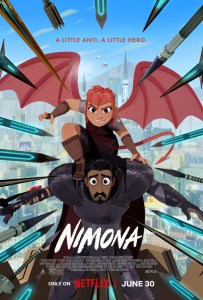
Based on the graphic novel by ND Stevenson (She-Ra), itself a web comic from 2012-2014, Nimona was developed by Blue Sky Animation Studios and originally scheduled to be released in 2020, and then Disney bought Fox, shut down Blue Sky, and pushed back against the gay content of Nimona before just canceling it altogether in 2021, and then Netflix came in and saved the project and released it, gay and all, during the last day of Pride Month. It’s been a long, protracted journey for Nimona to get to your screen and, reader, it was worth it. The movie is a rambunctious and revisionist fairy tale that is both subversive and deeply sincere, enough so that an emotional confrontation of accepting someone on their own terms elicited genuine tears on my part (for those keeping record, that’s three straight animated movies in the month of June that caused me to cry). Nimona (voiced superbly by Chloe Grace Moretz) is a high-energy prankster in a fantasy world melding Medieval culture with future technology. She befriends a fellow outsider, Ballister (voiced by Riz Ahmed), after the kingdom views him as a wanted villain. Together, they try and clear Ballister’s name by finding the real killer, and maybe they can wreck some stuff too just for fun. The cell-shaded style, a familiar aesthetic in the realm of video games, adds a bright and slickly appealing quality to the animation, and the frenetic pace and anarchic humor keep the movie bristling with entertainment, while the emotional core (vulnerable outcasts finding community) sneaks up on you and delivers a more resonating climactic finish than simply vanquishing a baddie. The ending even has rich thematic notes of The Iron Giant, which is never a bad influence. The queer content is also treated without sensationalism and treated as any other aspect of human compassion. The heart and message are just as impressive as the visuals and the humor. Nimona is a funny all-ages adventure that deserves its big screen moment after its long gestation.
Nate’s Grade: B
Share this:

All Quiet on the Western Front (2022)
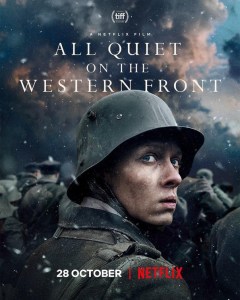 The surprise surge of the Oscar season is a German-language remake of the 1929 Best Picture winner, and after watching all 140 minutes, it’s easy to see how it would have made such an impact with modern Academy voters. All Quiet on the Western Front is still a relevant story even more than 100 years after its events. It’s a shattering anti-war movie that continuously and furiously reminds you what a terrible waste of life that four-year battle over meters of territory turned out to be, claiming over 17 million casualties. I’ve read the 1928 German novel by Erich Remarque and the new movie is faithful in spirit and still breathes new life into an old story. We follow idealistic young men eager to experience the glory of war and quickly learn that the horror of modern combat isn’t so glorious. There are sequences in this movie that are stunning, like following the history of a coat from being lifted off a dead soldier in the muck, to being reworked at a seamstress station, to being commissioned to a new recruit who questions why someone else’s name is in his jacket. It’s a simple yet evocative moment that sells the despairing reality. The movie doesn’t skimp on carnage as well, as long stretches will often play out like a horror movie where you’ll fear the monsters awaiting in the smoke and that nowhere is safe for long. And yet, where the movie hits the hardest isn’t depicting the trenchant terror but with the little pieces of humanity that shine through the darkness. There’s a small moment in a crater shared by two enemies where one of them is dying, and these final moments of recognizing the same beleaguered helpless and frightened humanity of “their enemy” are poignant. Make no mistake, All Quiet is a condemnation on the systems of war where old pompous generals send young men to needlessly die for outdated and absurd reasons like the concept of “maintaining national honor.” A significant new subplot involves Daniel Bruhl (Captain America: Civil War) as a representative of the German government trying to negotiate an armistice when the French representatives are looking for punishment. It allows us to take a larger view of the politics that doomed so many and laying the foundation for so many more doomed lives. The ending of this movie is a nihilist gut punch. The production values are impressive and elevate the artistry of every moment. The sound design is terrific, the cinematography is alternatingly beautiful and horrifying, and the production design is startlingly detailed and authentic; it’s easy to see how this movie could have earned nine Oscar nominations. All Quiet on the Western Front is a warning, a eulogy, and a powerful reminder that even older stories can still be relevant and resonant.
Nate’s Grade: B+


 nathanzoebl
You must be logged in to post a comment.